25 đề thi thử Tiếng Anh chuẩn cấu trúc bộ giáo dục có lời giải chi tiết(p25)
50 câu hỏi
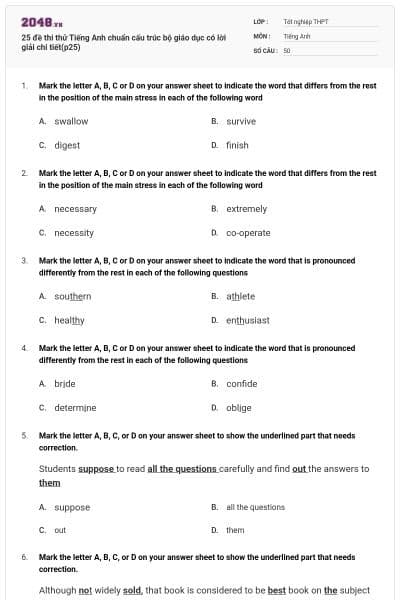
Mark the letter A, B, C or D on your answer sheet to indicate the word that differs from the rest in the position of the main stress in each of the following word
swallow
survive
digest
finish
Đáp án B
swallow /ˈswɑloʊ/
survive /sərˈvaɪv/
digest /ˈdaɪʤɛst/
finish /ˈfɪnɪʃ/
Mark the letter A, B, C or D on your answer sheet to indicate the word that differs from the rest in the position of the main stress in each of the following word
necessary
extremely
necessity
co-operate
Đáp án A
necessary /ˈnɛsəˌsɛri/
extremely /ɛkˈstrimli/
necessity /nəˈsɛsəti/
co-operate /koʊ-ˈɑpəˌreɪt/
Mark the letter A, B, C or D on your answer sheet to indicate the word that is pronounced differently from the rest in each of the following questions
southern
athlete
healthy
enthusiast
Đáp án A
southern /ˈsʌðərn/
athlete /ˈæˌθlit/
healthy /ˈhɛlθi/
enthusiast /ɛnˈθuziˌæst/
Mark the letter A, B, C or D on your answer sheet to indicate the word that is pronounced differently from the rest in each of the following questions
bride
confide
determine
oblige
Đáp án C
bride /braɪd/
confide /kənˈfaɪd/
determine /diˈtɛrmin/
oblige /əˈblaɪʤ/
Mark the letter A, B, C, or D on your answer sheet to show the underlined part that needs correction.
Students suppose to read all the questions carefully and find out the answers to them
suppose
all the questions
out
them
Đáp án A
Suppose => are supposed
Mark the letter A, B, C, or D on your answer sheet to show the underlined part that needs correction.
Although not widely sold, that book is considered to be best book on the subject
not
sold
best
the
Đáp án C
Best => the best
Mark the letter A, B, C, or D on your answer sheet to show the underlined part that needs correction.
I found my new contact lenses strangely at first, but I got used to them in the end
my new
strangely
got used
in the end
Đáp án B
Strangely => strange
Mark the letter A, B, C or D on your answer sheet to indicate the correct answer to each of the following questions
By the time human beings become fully aware of the importance of the ozone layer, it ______ seriously damaged
will be
will have been
is
has been
Đáp án B
Dấu hiệu nhận biết thì hoàn thành “By the time…”
Mark the letter A, B, C or D on your answer sheet to indicate the correct answer to each of the following questions
I should very much like to have gone to that party of theirs, but _______
I'm not invited
I will not be invited
I have not been invited
I was not invited
Đáp án D
Mark the letter A, B, C or D on your answer sheet to indicate the correct answer to each of the following questions
The last person __________ will have to turn off the lights
have left
left
leaving
to leave
Đáp án D
Mark the letter A, B, C or D on your answer sheet to indicate the correct answer to each of the following questions
You will spend at least one year working abroad ________ you can find out how things operate overseas
because
so as to
so that
so long as
Đáp án C
Mark the letter A, B, C or D on your answer sheet to indicate the correct answer to each of the following questions
When wet, ________
these old papers give off a bad smell
we get a bad smell from these old papers
a bad smell comes from these old papers
there is a bad smell coming from these old papers
Đáp án A
Give off: tỏa ra khói, ánh sáng,…
Mark the letter A, B, C or D on your answer sheet to indicate the correct answer to each of the following questions
He couldn't give a ________ explanation for his actions
satisfied
satisfying
satisfactory
satisfaction
Đáp án C
Mark the letter A, B, C or D on your answer sheet to indicate the correct answer to each of the following questions
Thanks to his parents’ ______ , he tried his best to win a place at a university
approve
approval
disagreement
rejection
Đáp án B, phù hợp về mặt nghĩa
A. chứng minh
B. sự tán thành
C. bất đồng
D. từ chối
Dịch: Nhờ có sự tán thành của bố mẹ, anh ấy đã nỗ lực hết mình để đậu đại học.
Mark the letter A, B, C or D on your answer sheet to indicate the correct answer to each of the following questions
To attract the waiter’s attention, wait until you _______ and raise you hand slightly
catch his eye
can attract him
pay attention to him
take advantage of him
Đáp án: A
Giải thích:
Kiến thức: Cụm từ cố định (Collocations)
A. catch somebody’s eye: thu hút sự chú ý của ai đó
B. can attract him: có thể hấp dẫn anh ta
C. pay attention to somebody/something: chú ý tới ai/cái gì
D. take advantage of somebody/something: lợi dụng ai/cái gì
Dựa vào nghĩa, chọn A.
Dịch: Để thu hút sự chú ý của người phục vụ, hãy đợi đến khi bạn bắt gặp ánh mắt anh ấy và hơi giơ tay lên.
Mark the letter A, B, C or D on your answer sheet to indicate the correct answer to each of the following questions
Don’t ________ to conclusions, we don’t yet know all the relevant facts
hurry
jump
rush
run
Đáp án: B
Giải thích:
to jump to conclusion: đi tới kết luận
Dịch: Đừng vội kết luận, chúng tôi chưa biết tất cả các sự kiện liên quan.
Mark the letter A, B, C or D on your answer sheet to indicate the correct answer to each of the following questions
A good stereo system doesn’t have to cost ____ and ___. You can find one for a reasonable price
an arm – a leg
a hand – a leg
a finger – a toe
a hand – a foot
Đáp án A
Cost an arm and leg: đắt
Mark the letter A, B, C or D on your answer sheet to indicate the correct answer to each of the following questions
The boy was always ________ trouble as a youth. Then, to everyone’s surprise, he became a policeman
getting into
looking after
going on
keeping with
Đáp án A
Get into: dính líu
Look after: chăm sóc
Go on: tiếp tục
Mark the letter A, B, C or D on your answer sheet to indicate the correct answer to each of the following questions
All the children have gone ________ mumps
along with
down with
out with
through with
Đáp án B
Go out with: đi chơi
Go through with: thực hiện lời hứa
Go along with: tán thành
Go down with: mắc bệnh
Mark the letter A, B, C or D on your answer sheet to indicate the correct answer to each of the following questions
Jeff: “May I borrow your dictionary for a while?”
Bloom: “__________”
You’re welcome.
I’m sorry. I’m using it.
Never mind.
Take care
Đáp án B
A. Mời bạn.
B. Tôi xin lỗi. Tôi đang sử dụng nó.
C. Đừng bận tâm.
D. Hãy cẩn thận
Mark the letter A, B, C or D on your answer sheet to indicate the correct answer to each of the following questions
Anne: “I can’t really stand the noise from the next-door house, especially after 10 p.m.”
Mary: “__________. You should talk to your neighbor.”
Calm down, Anne.
I’m sorry. I didn’t mean that
I know what you mean
What a girl
Đáp án A
A. Bình tĩnh nào, Anne.
B. Tôi xin lỗi. Tôi không có ý đó
C. Tôi hiểu bạn mà
D. Quả là một cô gái
Mark the letter A, B, C, or D on your answer sheet to indicate the word or phrase that is CLOSEST in meaning to the underlined part in each of the following questions
Any students who neglects his or her homework is unlikely to do well at school
puts off
takes out
attends to
puts over
Đáp án A
Put off: trì hoãn
Take out: vứt bỏ
Attend to: giair quyết vấn đề
Put over: truyền đạt, giảng giải
Mark the letter A, B, C, or D on your answer sheet to indicate the word or phrase that is CLOSEST in meaning to the underlined part in each of the following questions
Although we argued with him for a long time, he stood his ground
changed his decision
refused to change his decision
felt sorry for us
wanted to continue
Đáp án B
A. thay đổi quyết định của mình
B. từ chối thay đổi quyết định của mình
C. cảm thấy tiếc cho chúng tôi
D. muốn tiếp tục
Mark the letter A, B, C, or D on your answer sheet to indicate the word or phrase that is OPPOSITE in meaning to the underlined part in each of the following questions
Charles W.Eliot, the president of Harvard in 1869, initiated a system under which most required courses were dropped in favor of elective courses
initiated
compulsory
optional
necessary
Đáp án C
A. bắt đầu
B. bắt buộc
C. tùy chọn
D. cần thiết
Mark the letter A, B, C, or D on your answer sheet to indicate the word or phrase that is OPPOSITE in meaning to the underlined part in each of the following questions
He drives me to the edge because he never stops talking
cheers me up
irritates me
moves me
frightens me
Đáp án A
A. làm tôi vui lên
B. làm tôi khó chịu
C. khiến tôi xúc động
D. làm tôi sợ
Mark the letter A, B, C, or D on your answer sheet to indicate the sentence that is closest in meaning to each of the following questions
There was no need for you to have left the house in such weather.
You shouldn’t leave the house in such weather.
You didn’t have to leave the house in such weather.
You didn’t need to leave the house in such weather.
You needn’t have left the house in such weather
Đáp án D
Mark the letter A, B, C, or D on your answer sheet to indicate the sentence that is closest in meaning to each of the following questions
If it hadn’t been for his carelessness, we would have finished the work.
He was careless because we hadn’t finished the work
If he were careful, we would finish the work.
If he had been more careful, we would have completed the work.
Because he wasn’t careless, we didn’t finish the work
Đáp án C
Mark the letter A, B, C, or D on your answer sheet to indicate the sentence that is closest in meaning to each of the following questions
It's thought that the accident was caused by human error
The accident took place because of thoughtlessness
Humans' thoughtlessness caused the accident.
The accident is thought to have been caused by human error.
The accident is thought to cause human error
Đáp án C
Mark the letter A, B, C, or D on your answer sheet to indicate the sentence that best combines of each pair of sentences in the following questions
I thought they might be hungry. I offered them something to eat.
Thinking they might be hungry, I offered them something to eat.
Thought they might be hungry, I offered them something to eat.
I thought they might be hungry, offering them something to eat.
Having thought they might be hungry, I offered them something to eat.
Đáp án A
Mark the letter A, B, C, or D on your answer sheet to indicate the sentence that best combines of each pair of sentences in the following questions
He wore glasses and a false beard. He wanted nobody to recognize him
He wore glasses and a false beard in order to avoid being recognizing.
He wore glasses and a false beard in order to avoid recognizing.
He wore glasses and a false beard in order that avoid being recognized.
He wore glasses and a false beard in order to avoid being recognized
Đáp án A
Read the following passage and mark the letter A, B, C or D on your answer sheet to indicate the correct word for each of the blanks from 31 to 35
How men first learnt to creat words is unknown; in other words, the origin of language is a (31) _____ . All we really know is that men, unlike animals, somehow invented certain sounds to express thoughts and feelings, actions and things so that they could communicate with each other; and that later they agreed (32) _____ certain signs, called letters, which could be combined to represent those sounds, and which could be written down. These sounds, whether spoken or written in letters, are called words. Great writers are those who not only have great thoughts but also express these thoughts in words that appeal powerfully to our minds and emotions. This charming and telling use of words is what we call literary style. Above all, the real poet is a master of words. He can (33) _____ his meaning in words which sing like music, and which by their position and association can (34) _____ men to tears. We should, therefore, learn to choose our words carefully, (35) _____ they will make our speech silly and vulgar.
Điền câu 31
story
secret
mystery
legend
Đáp án C
Story: câu chuyện
Secret: bí mật
Mystery: bí ẩn
Legend: huyền thoại
Read the following passage and mark the letter A, B, C or D on your answer sheet to indicate the correct word for each of the blanks from 31 to 35
How men first learnt to creat words is unknown; in other words, the origin of language is a (31) _____ . All we really know is that men, unlike animals, somehow invented certain sounds to express thoughts and feelings, actions and things so that they could communicate with each other; and that later they agreed (32) _____ certain signs, called letters, which could be combined to represent those sounds, and which could be written down. These sounds, whether spoken or written in letters, are called words. Great writers are those who not only have great thoughts but also express these thoughts in words that appeal powerfully to our minds and emotions. This charming and telling use of words is what we call literary style. Above all, the real poet is a master of words. He can (33) _____ his meaning in words which sing like music, and which by their position and association can (34) _____ men to tears. We should, therefore, learn to choose our words carefully, (35) _____ they will make our speech silly and vulgar.
Điền câu 32
at
upon
with
to
Đáp án B
Read the following passage and mark the letter A, B, C or D on your answer sheet to indicate the correct word for each of the blanks from 31 to 35
How men first learnt to creat words is unknown; in other words, the origin of language is a (31) _____ . All we really know is that men, unlike animals, somehow invented certain sounds to express thoughts and feelings, actions and things so that they could communicate with each other; and that later they agreed (32) _____ certain signs, called letters, which could be combined to represent those sounds, and which could be written down. These sounds, whether spoken or written in letters, are called words. Great writers are those who not only have great thoughts but also express these thoughts in words that appeal powerfully to our minds and emotions. This charming and telling use of words is what we call literary style. Above all, the real poet is a master of words. He can (33) _____ his meaning in words which sing like music, and which by their position and association can (34) _____ men to tears. We should, therefore, learn to choose our words carefully, (35) _____ they will make our speech silly and vulgar.
Điền câu 33
carry
convey
transfer
transmit
Đáp án B
Read the following passage and mark the letter A, B, C or D on your answer sheet to indicate the correct word for each of the blanks from 31 to 35
How men first learnt to creat words is unknown; in other words, the origin of language is a (31) _____ . All we really know is that men, unlike animals, somehow invented certain sounds to express thoughts and feelings, actions and things so that they could communicate with each other; and that later they agreed (32) _____ certain signs, called letters, which could be combined to represent those sounds, and which could be written down. These sounds, whether spoken or written in letters, are called words. Great writers are those who not only have great thoughts but also express these thoughts in words that appeal powerfully to our minds and emotions. This charming and telling use of words is what we call literary style. Above all, the real poet is a master of words. He can (33) _____ his meaning in words which sing like music, and which by their position and association can (34) _____ men to tears. We should, therefore, learn to choose our words carefully, (35) _____ they will make our speech silly and vulgar.
Điền câu 34
take
send
break
move
Đáp án D
Read the following passage and mark the letter A, B, C or D on your answer sheet to indicate the correct word for each of the blanks from 31 to 35
How men first learnt to creat words is unknown; in other words, the origin of language is a (31) _____ . All we really know is that men, unlike animals, somehow invented certain sounds to express thoughts and feelings, actions and things so that they could communicate with each other; and that later they agreed (32) _____ certain signs, called letters, which could be combined to represent those sounds, and which could be written down. These sounds, whether spoken or written in letters, are called words. Great writers are those who not only have great thoughts but also express these thoughts in words that appeal powerfully to our minds and emotions. This charming and telling use of words is what we call literary style. Above all, the real poet is a master of words. He can (33) _____ his meaning in words which sing like music, and which by their position and association can (34) _____ men to tears. We should, therefore, learn to choose our words carefully, (35) _____ they will make our speech silly and vulgar.
Điền câu 35
or
so
although
because
Đáp án A
Read the following passage and mark the letter A, B, C or D on your answer sheet to indicate the correct answer to each of the questions from 36 to 42
Bees, classified into over 10,000 species, are insects found in almost every part of the world except the northernmost and southernmost regions. One commonly known species is the honeybee, the only bee that produces honey and wax. Humans use the wax in making candles, lipsticks, and other products, and they use the honey as a substance that people eat to maintain life and growth. While gathering the nectar and pollen with which they make honey, bees are simultaneously helping to fertilize the flowers on which they land. Many fruits and vegetables would not survive if bees did not carry the pollen from blossom to blossom.
Bees live in a structured environment and social structure within a hive, which is a nest with storage space for the honey. The different types of bees each perform a unique function. The worker bee carries nectar to hive in a special stomach called a honey stomach. Other workers make beeswax and shape it into a honeycomb, which is a waterproof mass of six-sided compartments, or cells. The queen lays eggs in completed cells. As the workers build more cells, the queen lays more eggs.
All workers, like the queen, are female, but the workers are smaller than the queen. The male honeybees are called drones; they do no work and cannot sting. They are developed from unfertilized eggs, and their only job is to impregnate a queen. The queen must be fertilized in order to lay more worker eggs. During the season when less honey is available and the drone is of no further use, the workers block the drones from eating the honey so that they will starve to death
The word “which” in the fourth sentence refers to________
fertilizer
honey
flowers
bees
Đáp án C
Từ "cái" trong câu thứ tư đề cập đến _________.
A. phân bón
B. mật ong
C. hoa
D. ong
Read the following passage and mark the letter A, B, C or D on your answer sheet to indicate the correct answer to each of the questions from 36 to 42
Bees, classified into over 10,000 species, are insects found in almost every part of the world except the northernmost and southernmost regions. One commonly known species is the honeybee, the only bee that produces honey and wax. Humans use the wax in making candles, lipsticks, and other products, and they use the honey as a substance that people eat to maintain life and growth. While gathering the nectar and pollen with which they make honey, bees are simultaneously helping to fertilize the flowers on which they land. Many fruits and vegetables would not survive if bees did not carry the pollen from blossom to blossom.
Bees live in a structured environment and social structure within a hive, which is a nest with storage space for the honey. The different types of bees each perform a unique function. The worker bee carries nectar to hive in a special stomach called a honey stomach. Other workers make beeswax and shape it into a honeycomb, which is a waterproof mass of six-sided compartments, or cells. The queen lays eggs in completed cells. As the workers build more cells, the queen lays more eggs.
All workers, like the queen, are female, but the workers are smaller than the queen. The male honeybees are called drones; they do no work and cannot sting. They are developed from unfertilized eggs, and their only job is to impregnate a queen. The queen must be fertilized in order to lay more worker eggs. During the season when less honey is available and the drone is of no further use, the workers block the drones from eating the honey so that they will starve to death
The word “simultaneously” in the fourth sentence is closest meaning to ________
stubbornly
concurrently
skillfully
diligently
Đáp án B
Từ “simultaneously” trong câu thứ tư gần nghĩa với ________.
A. ngoan cố
B. đồng thời
C. khéo léo
D. siêng năng
Read the following passage and mark the letter A, B, C or D on your answer sheet to indicate the correct answer to each of the questions from 36 to 42
Bees, classified into over 10,000 species, are insects found in almost every part of the world except the northernmost and southernmost regions. One commonly known species is the honeybee, the only bee that produces honey and wax. Humans use the wax in making candles, lipsticks, and other products, and they use the honey as a substance that people eat to maintain life and growth. While gathering the nectar and pollen with which they make honey, bees are simultaneously helping to fertilize the flowers on which they land. Many fruits and vegetables would not survive if bees did not carry the pollen from blossom to blossom.
Bees live in a structured environment and social structure within a hive, which is a nest with storage space for the honey. The different types of bees each perform a unique function. The worker bee carries nectar to hive in a special stomach called a honey stomach. Other workers make beeswax and shape it into a honeycomb, which is a waterproof mass of six-sided compartments, or cells. The queen lays eggs in completed cells. As the workers build more cells, the queen lays more eggs.
All workers, like the queen, are female, but the workers are smaller than the queen. The male honeybees are called drones; they do no work and cannot sting. They are developed from unfertilized eggs, and their only job is to impregnate a queen. The queen must be fertilized in order to lay more worker eggs. During the season when less honey is available and the drone is of no further use, the workers block the drones from eating the honey so that they will starve to death
According to the passage, the drone__________.
collects less honey than workers
mates with the queen and has no other purpose
comes from eggs fertilized by other drones
can be male or female
Đáp án B
Theo đoạn văn, ong mật đực
A. thu thập ít mật ong hơn ong thợ
B. làm bạn đời với nữ hoàng và không có mục đích nào khác
C. đến từ trứng được thụ tinh
D. có thể là đực hoặc cái
Read the following passage and mark the letter A, B, C or D on your answer sheet to indicate the correct answer to each of the questions from 36 to 42
Bees, classified into over 10,000 species, are insects found in almost every part of the world except the northernmost and southernmost regions. One commonly known species is the honeybee, the only bee that produces honey and wax. Humans use the wax in making candles, lipsticks, and other products, and they use the honey as a substance that people eat to maintain life and growth. While gathering the nectar and pollen with which they make honey, bees are simultaneously helping to fertilize the flowers on which they land. Many fruits and vegetables would not survive if bees did not carry the pollen from blossom to blossom.
Bees live in a structured environment and social structure within a hive, which is a nest with storage space for the honey. The different types of bees each perform a unique function. The worker bee carries nectar to hive in a special stomach called a honey stomach. Other workers make beeswax and shape it into a honeycomb, which is a waterproof mass of six-sided compartments, or cells. The queen lays eggs in completed cells. As the workers build more cells, the queen lays more eggs.
All workers, like the queen, are female, but the workers are smaller than the queen. The male honeybees are called drones; they do no work and cannot sting. They are developed from unfertilized eggs, and their only job is to impregnate a queen. The queen must be fertilized in order to lay more worker eggs. During the season when less honey is available and the drone is of no further use, the workers block the drones from eating the honey so that they will starve to death
According to the passage, honey is carried to the hive in a honey stomach by the ______________
workers
drones
males
queens
Đáp án A
Theo đoạn văn, mật ong được mang đến tổ ong trong dạ dày mật ong bởi ______________
A. ong thợ
B. ong mật đực
C. ong đực
D. nữ hoàng
Read the following passage and mark the letter A, B, C or D on your answer sheet to indicate the correct answer to each of the questions from 36 to 42
Bees, classified into over 10,000 species, are insects found in almost every part of the world except the northernmost and southernmost regions. One commonly known species is the honeybee, the only bee that produces honey and wax. Humans use the wax in making candles, lipsticks, and other products, and they use the honey as a substance that people eat to maintain life and growth. While gathering the nectar and pollen with which they make honey, bees are simultaneously helping to fertilize the flowers on which they land. Many fruits and vegetables would not survive if bees did not carry the pollen from blossom to blossom.
Bees live in a structured environment and social structure within a hive, which is a nest with storage space for the honey. The different types of bees each perform a unique function. The worker bee carries nectar to hive in a special stomach called a honey stomach. Other workers make beeswax and shape it into a honeycomb, which is a waterproof mass of six-sided compartments, or cells. The queen lays eggs in completed cells. As the workers build more cells, the queen lays more eggs.
All workers, like the queen, are female, but the workers are smaller than the queen. The male honeybees are called drones; they do no work and cannot sting. They are developed from unfertilized eggs, and their only job is to impregnate a queen. The queen must be fertilized in order to lay more worker eggs. During the season when less honey is available and the drone is of no further use, the workers block the drones from eating the honey so that they will starve to death
In what way does the reading imply that bees are useful in nature?
They pollinate fruit and vegetable plants.
They make marvelous creation from max.
They kill the dangerous drones.
They create storage spaces
Đáp án A
Ong có ích trong tự nhiên theo cách nào?
A. Chúng thụ phấn cho cây ăn quả và rau.
B. Chúng tạo ra những điều tuyệt vời từ sáp.
C. Chúng giết chết các các con ong mật đực nguy hiểm.
D. Chúng tạo ra không gian lưu trữ
Read the following passage and mark the letter A, B, C or D on your answer sheet to indicate the correct answer to each of the questions from 36 to 42
Bees, classified into over 10,000 species, are insects found in almost every part of the world except the northernmost and southernmost regions. One commonly known species is the honeybee, the only bee that produces honey and wax. Humans use the wax in making candles, lipsticks, and other products, and they use the honey as a substance that people eat to maintain life and growth. While gathering the nectar and pollen with which they make honey, bees are simultaneously helping to fertilize the flowers on which they land. Many fruits and vegetables would not survive if bees did not carry the pollen from blossom to blossom.
Bees live in a structured environment and social structure within a hive, which is a nest with storage space for the honey. The different types of bees each perform a unique function. The worker bee carries nectar to hive in a special stomach called a honey stomach. Other workers make beeswax and shape it into a honeycomb, which is a waterproof mass of six-sided compartments, or cells. The queen lays eggs in completed cells. As the workers build more cells, the queen lays more eggs.
All workers, like the queen, are female, but the workers are smaller than the queen. The male honeybees are called drones; they do no work and cannot sting. They are developed from unfertilized eggs, and their only job is to impregnate a queen. The queen must be fertilized in order to lay more worker eggs. During the season when less honey is available and the drone is of no further use, the workers block the drones from eating the honey so that they will starve to death
All of the following are characteristics of a honeycomb except__________.
it contains hexagonal sections
it is made of wax
it is made of honey
it is impermeable
Đáp án C
Tất cả những điều sau đây là các đặc tính của tổ ong ngoại trừ ___________.
A. nó chứa các phần lục giác
B. nó được làm bằng sáp
C. nó được làm bằng mật ong
D. nó là không thấm nước
Read the following passage and mark the letter A, B, C or D on your answer sheet to indicate the correct answer to each of the questions from 36 to 42
Bees, classified into over 10,000 species, are insects found in almost every part of the world except the northernmost and southernmost regions. One commonly known species is the honeybee, the only bee that produces honey and wax. Humans use the wax in making candles, lipsticks, and other products, and they use the honey as a substance that people eat to maintain life and growth. While gathering the nectar and pollen with which they make honey, bees are simultaneously helping to fertilize the flowers on which they land. Many fruits and vegetables would not survive if bees did not carry the pollen from blossom to blossom.
Bees live in a structured environment and social structure within a hive, which is a nest with storage space for the honey. The different types of bees each perform a unique function. The worker bee carries nectar to hive in a special stomach called a honey stomach. Other workers make beeswax and shape it into a honeycomb, which is a waterproof mass of six-sided compartments, or cells. The queen lays eggs in completed cells. As the workers build more cells, the queen lays more eggs.
All workers, like the queen, are female, but the workers are smaller than the queen. The male honeybees are called drones; they do no work and cannot sting. They are developed from unfertilized eggs, and their only job is to impregnate a queen. The queen must be fertilized in order to lay more worker eggs. During the season when less honey is available and the drone is of no further use, the workers block the drones from eating the honey so that they will starve to death
The passage implies that bees can be found in each of the following parts of the world except _________.
Africa
China
Europe
Antarctica
Đáp án D
Những con ong có thể được tìm thấy ở nhiều nơi trên thế giới ngoại trừ _________.
A. Châu Phi
B. Trung Quốc
C. Châu Âu
D. Nam Cực
Read the following passage and mark the letter A, B, C or D on your answer sheet to indicate the correct answer to each of the questions from 43-50.
Before the 1500’s, the Western plains of North America were dominated by farmers. One group, the Mandans, lived in the upper Missouri River country, primarily in present-day North Dakota. They had large villages of houses built close together. The tight arrangement enabled the Mandans to protect themselves more easily from the attacks of others who might seek to obtain some of the food these highly capable farmers stored from one year to the next.
The women had primary responsibility for the fields. They had to exercise considerable skill to produce the desired results, for their northern location meant fleeting growing seasons. Winter often lingered; autumn could be ushered in by severe frost. During the spring and summer, drought, heat, hail, grasshoppers, and other frustrations might await the wary grower.
Under such conditions, Mandan women had to grow maize capable of weathering adversity. They began as early as it appeared feasible to do so in the spring, clearing the land, using fire to clear stubble from the fields and then planting. From this point until the first green corn could be harvested, the crop required labor and vigilance. Harvesting proceeded in two stages. In August the Mandans picked a smaller amount of the crop before it had matured fully. This green corn was boiled, dried, and shelled, with some of the maize slated for immediate consumption and the rest stored in animal-skin bags. Later in the fall, the people picked the rest of the corn. They saved the best of the harvest for seeds or for trade, with the remainder eaten right away or stored for later use in underground reserves. With appropriate banking of the extra food, the Mandans protected themselves against the disaster of crop failure and accompanying hunger.
The women planted another staple, squash, about the first of June, and harvested it near the time of the green corn harvest. After they picked it, they sliced it, dried it, and strung the slices before they stored them. Once again, they saved the seed from the best of the year`s crop. The Mandans also grew sunflowers and tobacco; the latter was the particular task of the older men
What is the main topic of the passage?
Various ways corn can be used
Weather conditions on the western plains
The agricultural activities of a North American Societ
The problems encountered by farmers who specialize in growing one crop
Đáp án C
Chủ đề chính của đoạn văn là gì?
A. Có thể sử dụng ngô theo nhiều cách khác nhau
B. Điều kiện thời tiết ở vùng đồng bằng phía tây
C. Các hoạt động nông nghiệp của Bắc Mỹ
D. Những vấn đề mà nông dân chuyên trồng một vụ gặp phải
Read the following passage and mark the letter A, B, C or D on your answer sheet to indicate the correct answer to each of the questions from 43-50.
Before the 1500’s, the Western plains of North America were dominated by farmers. One group, the Mandans, lived in the upper Missouri River country, primarily in present-day North Dakota. They had large villages of houses built close together. The tight arrangement enabled the Mandans to protect themselves more easily from the attacks of others who might seek to obtain some of the food these highly capable farmers stored from one year to the next.
The women had primary responsibility for the fields. They had to exercise considerable skill to produce the desired results, for their northern location meant fleeting growing seasons. Winter often lingered; autumn could be ushered in by severe frost. During the spring and summer, drought, heat, hail, grasshoppers, and other frustrations might await the wary grower.
Under such conditions, Mandan women had to grow maize capable of weathering adversity. They began as early as it appeared feasible to do so in the spring, clearing the land, using fire to clear stubble from the fields and then planting. From this point until the first green corn could be harvested, the crop required labor and vigilance. Harvesting proceeded in two stages. In August the Mandans picked a smaller amount of the crop before it had matured fully. This green corn was boiled, dried, and shelled, with some of the maize slated for immediate consumption and the rest stored in animal-skin bags. Later in the fall, the people picked the rest of the corn. They saved the best of the harvest for seeds or for trade, with the remainder eaten right away or stored for later use in underground reserves. With appropriate banking of the extra food, the Mandans protected themselves against the disaster of crop failure and accompanying hunger.
The women planted another staple, squash, about the first of June, and harvested it near the time of the green corn harvest. After they picked it, they sliced it, dried it, and strung the slices before they stored them. Once again, they saved the seed from the best of the year`s crop. The Mandans also grew sunflowers and tobacco; the latter was the particular task of the older men
The Mandans built their houses close together in order to ________
allow more room for growing corn
share farming implements
protect themselves against the weather
guard their supplies of food
Đáp án D
Người Mandans xây dựng nhà của họ gần nhau để ________.
A. cho phép nhiều chỗ trồng bắp
B. dùng chung dụng cụ nông nghiệp
C. bảo vệ mình chống lại thời tiết
D. bảo vệ nguồn cung cấp thực phẩm của họ
Read the following passage and mark the letter A, B, C or D on your answer sheet to indicate the correct answer to each of the questions from 43-50.
Before the 1500’s, the Western plains of North America were dominated by farmers. One group, the Mandans, lived in the upper Missouri River country, primarily in present-day North Dakota. They had large villages of houses built close together. The tight arrangement enabled the Mandans to protect themselves more easily from the attacks of others who might seek to obtain some of the food these highly capable farmers stored from one year to the next.
The women had primary responsibility for the fields. They had to exercise considerable skill to produce the desired results, for their northern location meant fleeting growing seasons. Winter often lingered; autumn could be ushered in by severe frost. During the spring and summer, drought, heat, hail, grasshoppers, and other frustrations might await the wary grower.
Under such conditions, Mandan women had to grow maize capable of weathering adversity. They began as early as it appeared feasible to do so in the spring, clearing the land, using fire to clear stubble from the fields and then planting. From this point until the first green corn could be harvested, the crop required labor and vigilance. Harvesting proceeded in two stages. In August the Mandans picked a smaller amount of the crop before it had matured fully. This green corn was boiled, dried, and shelled, with some of the maize slated for immediate consumption and the rest stored in animal-skin bags. Later in the fall, the people picked the rest of the corn. They saved the best of the harvest for seeds or for trade, with the remainder eaten right away or stored for later use in underground reserves. With appropriate banking of the extra food, the Mandans protected themselves against the disaster of crop failure and accompanying hunger.
The women planted another staple, squash, about the first of June, and harvested it near the time of the green corn harvest. After they picked it, they sliced it, dried it, and strung the slices before they stored them. Once again, they saved the seed from the best of the year`s crop. The Mandans also grew sunflowers and tobacco; the latter was the particular task of the older men
According to the passage, the Mandans preserved their food by ________
drying
freezing
smoking
salting
Đáp án A
Theo đoạn văn, người Mandans bảo quản thức ăn của họ bằng cách ________.
A. làm khô
B. đông lạnh
C. hút
D. ướp muối
Read the following passage and mark the letter A, B, C or D on your answer sheet to indicate the correct answer to each of the questions from 43-50.
Before the 1500’s, the Western plains of North America were dominated by farmers. One group, the Mandans, lived in the upper Missouri River country, primarily in present-day North Dakota. They had large villages of houses built close together. The tight arrangement enabled the Mandans to protect themselves more easily from the attacks of others who might seek to obtain some of the food these highly capable farmers stored from one year to the next.
The women had primary responsibility for the fields. They had to exercise considerable skill to produce the desired results, for their northern location meant fleeting growing seasons. Winter often lingered; autumn could be ushered in by severe frost. During the spring and summer, drought, heat, hail, grasshoppers, and other frustrations might await the wary grower.
Under such conditions, Mandan women had to grow maize capable of weathering adversity. They began as early as it appeared feasible to do so in the spring, clearing the land, using fire to clear stubble from the fields and then planting. From this point until the first green corn could be harvested, the crop required labor and vigilance. Harvesting proceeded in two stages. In August the Mandans picked a smaller amount of the crop before it had matured fully. This green corn was boiled, dried, and shelled, with some of the maize slated for immediate consumption and the rest stored in animal-skin bags. Later in the fall, the people picked the rest of the corn. They saved the best of the harvest for seeds or for trade, with the remainder eaten right away or stored for later use in underground reserves. With appropriate banking of the extra food, the Mandans protected themselves against the disaster of crop failure and accompanying hunger.
The women planted another staple, squash, about the first of June, and harvested it near the time of the green corn harvest. After they picked it, they sliced it, dried it, and strung the slices before they stored them. Once again, they saved the seed from the best of the year`s crop. The Mandans also grew sunflowers and tobacco; the latter was the particular task of the older men
Why does the author believe that the Mandans were skilled farmers?
They could grow crops despite adverse weather.
They could grow crops in most types of soil.
They developed new varieties of corn.
They developed effective fertilizers.
Đáp án A
Tại sao tác giả tin rằng các Mandans là nông dân có tay nghề?
A. Họ có thể trồng trọt mặc dù thời tiết bất lợi.
B. Họ có thể trồng vụ mùa ở hầu hết các loại đất.
C. Họ đã phát triển các giống ngô mới.
D. Họ phát triển phân bón hiệu quả
Read the following passage and mark the letter A, B, C or D on your answer sheet to indicate the correct answer to each of the questions from 43-50.
Before the 1500’s, the Western plains of North America were dominated by farmers. One group, the Mandans, lived in the upper Missouri River country, primarily in present-day North Dakota. They had large villages of houses built close together. The tight arrangement enabled the Mandans to protect themselves more easily from the attacks of others who might seek to obtain some of the food these highly capable farmers stored from one year to the next.
The women had primary responsibility for the fields. They had to exercise considerable skill to produce the desired results, for their northern location meant fleeting growing seasons. Winter often lingered; autumn could be ushered in by severe frost. During the spring and summer, drought, heat, hail, grasshoppers, and other frustrations might await the wary grower.
Under such conditions, Mandan women had to grow maize capable of weathering adversity. They began as early as it appeared feasible to do so in the spring, clearing the land, using fire to clear stubble from the fields and then planting. From this point until the first green corn could be harvested, the crop required labor and vigilance. Harvesting proceeded in two stages. In August the Mandans picked a smaller amount of the crop before it had matured fully. This green corn was boiled, dried, and shelled, with some of the maize slated for immediate consumption and the rest stored in animal-skin bags. Later in the fall, the people picked the rest of the corn. They saved the best of the harvest for seeds or for trade, with the remainder eaten right away or stored for later use in underground reserves. With appropriate banking of the extra food, the Mandans protected themselves against the disaster of crop failure and accompanying hunger.
The women planted another staple, squash, about the first of June, and harvested it near the time of the green corn harvest. After they picked it, they sliced it, dried it, and strung the slices before they stored them. Once again, they saved the seed from the best of the year`s crop. The Mandans also grew sunflowers and tobacco; the latter was the particular task of the older men
The word “ they” in paragraph 3 refers to_____
conditions
maize
Mandan women
Mandan people
Đáp án C
Từ “họ” trong đoạn 3 đề cập đến _____
A. điều kiện
B. ngô
C. phụ nữ Mandan
D. người Mandan
Read the following passage and mark the letter A, B, C or D on your answer sheet to indicate the correct answer to each of the questions from 43-50.
Before the 1500’s, the Western plains of North America were dominated by farmers. One group, the Mandans, lived in the upper Missouri River country, primarily in present-day North Dakota. They had large villages of houses built close together. The tight arrangement enabled the Mandans to protect themselves more easily from the attacks of others who might seek to obtain some of the food these highly capable farmers stored from one year to the next.
The women had primary responsibility for the fields. They had to exercise considerable skill to produce the desired results, for their northern location meant fleeting growing seasons. Winter often lingered; autumn could be ushered in by severe frost. During the spring and summer, drought, heat, hail, grasshoppers, and other frustrations might await the wary grower.
Under such conditions, Mandan women had to grow maize capable of weathering adversity. They began as early as it appeared feasible to do so in the spring, clearing the land, using fire to clear stubble from the fields and then planting. From this point until the first green corn could be harvested, the crop required labor and vigilance. Harvesting proceeded in two stages. In August the Mandans picked a smaller amount of the crop before it had matured fully. This green corn was boiled, dried, and shelled, with some of the maize slated for immediate consumption and the rest stored in animal-skin bags. Later in the fall, the people picked the rest of the corn. They saved the best of the harvest for seeds or for trade, with the remainder eaten right away or stored for later use in underground reserves. With appropriate banking of the extra food, the Mandans protected themselves against the disaster of crop failure and accompanying hunger.
The women planted another staple, squash, about the first of June, and harvested it near the time of the green corn harvest. After they picked it, they sliced it, dried it, and strung the slices before they stored them. Once again, they saved the seed from the best of the year`s crop. The Mandans also grew sunflowers and tobacco; the latter was the particular task of the older men
The word "disaster" is closest in meaning to ________
control
catastrophe
avoidance
history
Đáp án B
Từ " disaster" gần nghĩa với ________.
A. kiểm soát
B. thảm họa
C. tránh
D. lịch sử
Read the following passage and mark the letter A, B, C or D on your answer sheet to indicate the correct answer to each of the questions from 43-50.
Before the 1500’s, the Western plains of North America were dominated by farmers. One group, the Mandans, lived in the upper Missouri River country, primarily in present-day North Dakota. They had large villages of houses built close together. The tight arrangement enabled the Mandans to protect themselves more easily from the attacks of others who might seek to obtain some of the food these highly capable farmers stored from one year to the next.
The women had primary responsibility for the fields. They had to exercise considerable skill to produce the desired results, for their northern location meant fleeting growing seasons. Winter often lingered; autumn could be ushered in by severe frost. During the spring and summer, drought, heat, hail, grasshoppers, and other frustrations might await the wary grower.
Under such conditions, Mandan women had to grow maize capable of weathering adversity. They began as early as it appeared feasible to do so in the spring, clearing the land, using fire to clear stubble from the fields and then planting. From this point until the first green corn could be harvested, the crop required labor and vigilance. Harvesting proceeded in two stages. In August the Mandans picked a smaller amount of the crop before it had matured fully. This green corn was boiled, dried, and shelled, with some of the maize slated for immediate consumption and the rest stored in animal-skin bags. Later in the fall, the people picked the rest of the corn. They saved the best of the harvest for seeds or for trade, with the remainder eaten right away or stored for later use in underground reserves. With appropriate banking of the extra food, the Mandans protected themselves against the disaster of crop failure and accompanying hunger.
The women planted another staple, squash, about the first of June, and harvested it near the time of the green corn harvest. After they picked it, they sliced it, dried it, and strung the slices before they stored them. Once again, they saved the seed from the best of the year`s crop. The Mandans also grew sunflowers and tobacco; the latter was the particular task of the older men
Throughout the passage, the author implies that the Mandans ________.
planned for the future
were open to strangers
valued individuality
were very adventurous
Đáp án A
Trong suốt đoạn văn, tác giả cho rằng người Mandan________
A. đã lên kế hoạch cho tương lai
B. đã mở lòng với người lạ
C. đánh giá cao những cá thể
D. rất mạo hiểm
Read the following passage and mark the letter A, B, C or D on your answer sheet to indicate the correct answer to each of the questions from 43-50.
Before the 1500’s, the Western plains of North America were dominated by farmers. One group, the Mandans, lived in the upper Missouri River country, primarily in present-day North Dakota. They had large villages of houses built close together. The tight arrangement enabled the Mandans to protect themselves more easily from the attacks of others who might seek to obtain some of the food these highly capable farmers stored from one year to the next.
The women had primary responsibility for the fields. They had to exercise considerable skill to produce the desired results, for their northern location meant fleeting growing seasons. Winter often lingered; autumn could be ushered in by severe frost. During the spring and summer, drought, heat, hail, grasshoppers, and other frustrations might await the wary grower.
Under such conditions, Mandan women had to grow maize capable of weathering adversity. They began as early as it appeared feasible to do so in the spring, clearing the land, using fire to clear stubble from the fields and then planting. From this point until the first green corn could be harvested, the crop required labor and vigilance. Harvesting proceeded in two stages. In August the Mandans picked a smaller amount of the crop before it had matured fully. This green corn was boiled, dried, and shelled, with some of the maize slated for immediate consumption and the rest stored in animal-skin bags. Later in the fall, the people picked the rest of the corn. They saved the best of the harvest for seeds or for trade, with the remainder eaten right away or stored for later use in underground reserves. With appropriate banking of the extra food, the Mandans protected themselves against the disaster of crop failure and accompanying hunger.
The women planted another staple, squash, about the first of June, and harvested it near the time of the green corn harvest. After they picked it, they sliced it, dried it, and strung the slices before they stored them. Once again, they saved the seed from the best of the year`s crop. The Mandans also grew sunflowers and tobacco; the latter was the particular task of the older men
Which of the following processes does the author imply was done by both men and women?
Harvesting corn
Clearing field
Harvesting squash
Planting corn
Đáp án A
Tác giả cho rằng cả phụ nữ và đàn ông đều tham gia vào quá trình nào?
A. Thu hoạch ngô
B. Khai hoang đồng ruộng
C. Thu hoạch bí
D. Trồng ngô