25 đề thi thử Tiếng Anh chuẩn cấu trúc bộ giáo dục có lời giải chi tiết(p21)
50 câu hỏi
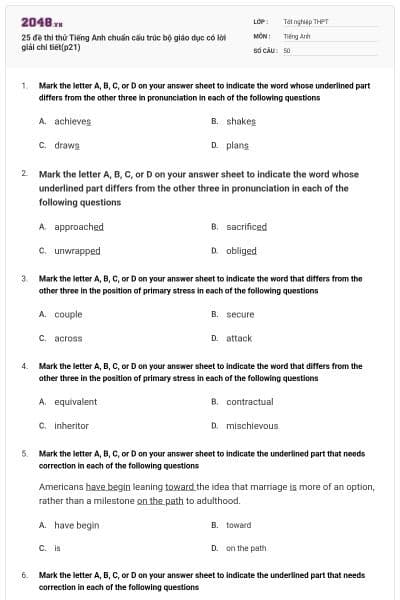
Mark the letter A, B, C, or D on your answer sheet to indicate the word whose underlined part differs from the other three in pronunciation in each of the following questions
achieves
shakes
draws
plans
Đáp án B
achieves /əˈʧivz /
shakes /ʃeɪks/
draws /drɔz/
plans /plænz/
Mark the letter A, B, C, or D on your answer sheet to indicate the word whose underlined part differs from the other three in pronunciation in each of the following questions
approached
sacrificed
unwrapped
obliged
Đáp án D
approached /əˈproʊʧt/
sacrificed /ˈsækrəˌfaɪst/
unwrapped /ənˈræpt/
obliged /ˈblaɪʤd/
Mark the letter A, B, C, or D on your answer sheet to indicate the word that differs from the other three in the position of primary stress in each of the following questions
couple
secure
across
attack
Đáp án A
couple /ˈkʌpəl/
secure /sɪˈkjʊr/
across /əˈkrɔs/
attack /əˈtæk
Mark the letter A, B, C, or D on your answer sheet to indicate the word that differs from the other three in the position of primary stress in each of the following questions
equivalent
contractual
inheritor
mischievous
Đáp án D
equivalent /ɪˈkwɪvələnt/
contractual /kənˈtrækʧuəl/
inheritor /ɪnˈhɛrətər/
mischievous /ˈmɪsʧəvəs/
Mark the letter A, B, C, or D on your answer sheet to indicate the underlined part that needs correction in each of the following questions
Americans have begin leaning toward the idea that marriage is more of an option, rather than a milestone on the path to adulthood.
have begin
toward
is
on the path
Đáp án A
Have begin => have begun
Mark the letter A, B, C, or D on your answer sheet to indicate the underlined part that needs correction in each of the following questions
Rainforests are being cut and burning at such a speed that they will disappear from the earth in the near future
are being cut
burning
such a speed
from
Đáp án B
Burning => burnt/burned
Mark the letter A, B, C, or D on your answer sheet to indicate the underlined part that needs correction in each of the following questions
Our brains are incredibly agile machines, and it’s hard to think of anything they do more efficient than recognize face
are
anything
efficient
recognize
Đáp án C
Efficient => efficiently
Mark the letter A, B, C, or D on your answer sheet to indicate the correct answer to each of the following questions.
learning
having learnt
to learn
learn
Đáp án C
Mark the letter A, B, C, or D on your answer sheet to indicate the correct answer to each of the following questions.
During our stay in Venice, we bought a ________ bottle.
glass lovely perfume
lovely glass perfume
lovely perfume glass
glass perfume lovely
Đáp án B
OSACOMP: opinion size/shape age color origin material purpose
Mark the letter A, B, C, or D on your answer sheet to indicate the correct answer to each of the following questions.
Jack insisted that he didn’t need any help, ________ I helped him anyway
therefore
nevertheless
moreover
but
Đáp án D
Mark the letter A, B, C, or D on your answer sheet to indicate the correct answer to each of the following questions.
Frankly, I'd rather you ______ anything about it for the time being
do
didn't do
don't do
doing
Đáp án: B
Giải thích:
Would rather somebody did / did not do something: muốn ai làm gì
Chọn B.
Dịch: Thành thật mà nói, tôi muốn bạn không làm gì cả vào lúc này.
Mark the letter A, B, C, or D on your answer sheet to indicate the correct answer to each of the following questions.
Dien Bien Phu is the place ________ our army won a resounding victory in 1954.
which
that
what
\D. where
Đáp án D
Mark the letter A, B, C, or D on your answer sheet to indicate the correct answer to each of the following questions.
_____ had the restaurant opened ________ people were flocking to eat there
Hardly …than
No sooner…when
No sooner ...than
Hardly …. than
Đáp án: C
Giải thích:
Kiến thức: Đảo ngữ
Cấu trúc đảo ngữ:
Hardly + had + S + VpII + when + S + V-ed: vừa mới… thì…
No sooner + had + S + VpII + than + S + V-ed: ngay khi/vừa mới… thì…
Chỉ có đáp án C đúng cấu trúc.
Dịch: Nhà hàng vừa mở cửa thì mọi người ùn ùn tới ăn ở đó.
Mark the letter A, B, C, or D on your answer sheet to indicate the correct answer to each of the following questions.
He had no ________ of selling the clock – it had belonged to his grandfather
interest
intend
intention
meaning
Đáp án C
Have no intention of doing sth: không có ý định làm gì
Mark the letter A, B, C, or D on your answer sheet to indicate the correct answer to each of the following questions.
Body language is a potent form of _______ communication
verbal
non-verbal
tongue
oral
Đáp án B
Mark the letter A, B, C, or D on your answer sheet to indicate the correct answer to each of the following questions.
We try to help our mother _______ household chores
make
take
build
do
Đáp án D
Mark the letter A, B, C, or D on your answer sheet to indicate the correct answer to each of the following questions.
Each of us must take ______ for our own actions
responsibility
ability
possibility
probability
Đáp án A
Take responsesibility for doing sth: chịu trách nhiệm về việc gì
Mark the letter A, B, C, or D on your answer sheet to indicate the correct answer to each of the following questions.
Please _____ and see us when you have time. You are always welcome
come away
come to
come in
come round
Đáp án D
Mark the letter A, B, C, or D on your answer sheet to indicate the correct answer to each of the following questions.
After her illness, Lam had to work hard to _______ his classmates
catch sight of
keep pace with
get in touch with
make allowance for
Đáp án B
Catch sight of: thoáng thấy
Keep pace with: theo kịp
Get in touch with: giữ liên lạc
Make allowance for: được sự cho phép
Mark the letter A, B, C or D on your answer sheet to indicate the most suitable response to complete each of the following exchanges
- Hung: “Thank you very much for a lovely party.”
- Hoa: “________”.
Thanks
Have a good day
You are welcome
Cheers
Đáp án C
Mark the letter A, B, C or D on your answer sheet to indicate the most suitable response to complete each of the following exchanges
Mary has a special meal tonight. She has just made friend with Steven, so she wants to invite him to have dinner with her. Choose the most suitable response to fill in the blank in the following exchange.
- Mary: “ Would you like to have dinner with me?”
- Steven: “ _______”
Yes, it is. Isn’t it?
Yes, I’d love to
Yes, so do I
I’ve had enough
Đáp án B
Choose A, B, C or D to indicate the word or phrase that is CLOSEST meaning to the underlined part in each of the following questions
You can safely cross out your old reminders once you have achieved your tasks
remember
forget
erase
collect
Đáp án C
Choose A, B, C or D to indicate the word or phrase that is CLOSEST meaning to the underlined part in each of the following questions
Tourists today flock to see the two falls that actually constitutes Niagara falls
come without knowing what they’ll see
come in large numbers
come out of boredom
come by plane
Đáp án B
A. đi mà không biết những gì họ sẽ thấy
B. đi đến ồ ạt
C. thoát ra khỏi sự nhàm chán
D. đi bằng máy bay
Choose A, B, C or D to indicate the word or phrase that is OPPOSITE in meaning to the underlined part in each of the following questions.
A deficiency of vitamin D can lead to permanent bone deformities
irreparable
infinite
serious
temporary
Đáp án D
A. không thể khắc phục
B. vô hạn
C. nghiêm trọng
D. tạm thời
Choose A, B, C or D to indicate the word or phrase that is OPPOSITE in meaning to the underlined part in each of the following questions.
Certain courses are compulsory; others are optional.
required
free
pressure
voluntary
Đáp án A
A. bắt buộc
B. miễn phí
C. áp lực
D. tự nguyện
Mark the letter A, B, C, or D on your answer sheet to indicate the sentence that is closest in meaning to each of the following questions
“If you touch my bike again, I’ll tell mother”, said my elder brother.
My elder brother threatened to tell mother if I touched his bike again.
My elder brother said that he would not tell mother if I touched his bike again.
My elder brother advised me to tell mother if I touched his bike again.
My elder brother tried to convince me that touching his bike again is unallowed
Đáp án A
“Nếu mày chạm vào xe đạp của tao một lần nữa, tao sẽ nói với mẹ”, anh trai tôi nói.
A. Anh trai của tôi đe dọa sẽ nói với mẹ nếu tôi chạm vào chiếc xe đạp của anh ta một lần nữa.
B. Anh trai tôi nói rằng anh sẽ không nói với mẹ nếu tôi chạm vào chiếc xe đạp của anh lần nữa.
C. Anh trai tôi khuyên tôi nên nói với mẹ nếu tôi chạm vào chiếc xe đạp của anh ta một lần nữa.
D. Anh trai tôi cố gắng thuyết phục tôi rằng việc chạm vào chiếc xe đạp của anh ta một lần nữa là không được phép
Mark the letter A, B, C, or D on your answer sheet to indicate the sentence that is closest in meaning to each of the following questions
Lucy always reminds me of my youngest sister
My youngest sister’s name is Lucy.
I always think of Lucy, my youngest sister.
Whenever I see Lucy, I think of my youngest sister.
It is Lucy who is my youngest sister.
Đáp án C
Lucy luôn nhắc tôi nhớ về em gái út của tôi.
A. Tên em gái út của tôi là Lucy.
B. Tôi luôn nghĩ về Lucy, em gái út của tôi.
C. Bất cứ khi nào tôi nhìn thấy Lucy, tôi đều nhớ tới em gái út của mình.
D. Đó là Lucy, em gái út của tôi
Mark the letter A, B, C, or D on your answer sheet to indicate the sentence that is closest in meaning to each of the following questions
They had such a fierce dog that nobody would visit them
So fierce was their dog that nobody would visit them.
Their dog was fierce enough for anybody to visit them.
If their dog weren’t fierce, somebody would visit them.
So fierce a dog did they had that nobody would visit them
Đáp án C
Mark the letter A, B, C, or D on your answer sheet to indicate the sentence that best combines each pair of sentences in the following questions
I think my hair looks fine. My mother believes it needs a little more brushing
Not only do I think my hair looks fine, but my mother also believes it needs a little more brushing.
Either my mother believes it needs a little more brushing or I think my hair looks fine.
I think my hair looks so fine that my mother believes it needs a little more brushing.
I think my hair looks fine, but my mother believes it needs a little more brushing
Đáp án D
Mark the letter A, B, C, or D on your answer sheet to indicate the sentence that best combines each pair of sentences in the following questions
We can protect the world in which we live. We, for example, can grow more trees and recycle rubbish
We can protect the world in which we live by growing more trees and recycling rubbish.
We can protect the world in which we live as well as we can grow more trees and recycle rubbish.
We can protect the world in which we live, growing more trees and recycle rubbish.
We can protect the world in which we live such as growing more trees and recycling rubbish
Đáp án D
Read the following passage and mark the letter A, B, C or D on your answer sheet to indicate the correct word for each of the blanks from 31 to 35
The latest addiction to trap thousands of people is Internet, which has been (31) ______ for broken relationships, job losses, financial ruin and even one suicide. Psychologists now recognize Internet Addiction Syndrome (IAS) as a new illness that could cause serious problems and ruin many lives. Special help groups have been set up to of sufferers help and support.
IAS is similar to (32) ______ problems like gambling, smoking and drinking : addicts have dreams about Internet; they need to use it first thing in the morning; they lie to their partners about how much time they spend online; they wish they could cut down, but are unable to do so . A recent study found that many users spend up to 40 hours a week on the Internet; (33) ______ they felt guilty, they became depressed if they were (34) ______ to stop using it.
Almost anyone can be at risk. Some of the addicts are teenagers who are already hooked on computer games and who find it very difficult to resist the games on the Internet. Surprisingly, however, psychologists (35) ______ that most victims are middle-aged housewives who have never used a computer before
Điền câu 31
blamed
faulted
mistaken
accused
Đáp án A
Blame for sth: trách nhiệm về cái gì
Read the following passage and mark the letter A, B, C or D on your answer sheet to indicate the correct word for each of the blanks from 31 to 35
The latest addiction to trap thousands of people is Internet, which has been (31) ______ for broken relationships, job losses, financial ruin and even one suicide. Psychologists now recognize Internet Addiction Syndrome (IAS) as a new illness that could cause serious problems and ruin many lives. Special help groups have been set up to of sufferers help and support.
IAS is similar to (32) ______ problems like gambling, smoking and drinking : addicts have dreams about Internet; they need to use it first thing in the morning; they lie to their partners about how much time they spend online; they wish they could cut down, but are unable to do so . A recent study found that many users spend up to 40 hours a week on the Internet; (33) ______ they felt guilty, they became depressed if they were (34) ______ to stop using it.
Almost anyone can be at risk. Some of the addicts are teenagers who are already hooked on computer games and who find it very difficult to resist the games on the Internet. Surprisingly, however, psychologists (35) ______ that most victims are middle-aged housewives who have never used a computer before
Điền câu 32
another
other
the other
others
Đáp án B
Read the following passage and mark the letter A, B, C or D on your answer sheet to indicate the correct word for each of the blanks from 31 to 35
The latest addiction to trap thousands of people is Internet, which has been (31) ______ for broken relationships, job losses, financial ruin and even one suicide. Psychologists now recognize Internet Addiction Syndrome (IAS) as a new illness that could cause serious problems and ruin many lives. Special help groups have been set up to of sufferers help and support.
IAS is similar to (32) ______ problems like gambling, smoking and drinking : addicts have dreams about Internet; they need to use it first thing in the morning; they lie to their partners about how much time they spend online; they wish they could cut down, but are unable to do so . A recent study found that many users spend up to 40 hours a week on the Internet; (33) ______ they felt guilty, they became depressed if they were (34) ______ to stop using it.
Almost anyone can be at risk. Some of the addicts are teenagers who are already hooked on computer games and who find it very difficult to resist the games on the Internet. Surprisingly, however, psychologists (35) ______ that most victims are middle-aged housewives who have never used a computer before
Điền câu 33
although
despite
unless
without
Đáp án A
Read the following passage and mark the letter A, B, C or D on your answer sheet to indicate the correct word for each of the blanks from 31 to 35
The latest addiction to trap thousands of people is Internet, which has been (31) ______ for broken relationships, job losses, financial ruin and even one suicide. Psychologists now recognize Internet Addiction Syndrome (IAS) as a new illness that could cause serious problems and ruin many lives. Special help groups have been set up to of sufferers help and support.
IAS is similar to (32) ______ problems like gambling, smoking and drinking : addicts have dreams about Internet; they need to use it first thing in the morning; they lie to their partners about how much time they spend online; they wish they could cut down, but are unable to do so . A recent study found that many users spend up to 40 hours a week on the Internet; (33) ______ they felt guilty, they became depressed if they were (34) ______ to stop using it.
Almost anyone can be at risk. Some of the addicts are teenagers who are already hooked on computer games and who find it very difficult to resist the games on the Internet. Surprisingly, however, psychologists (35) ______ that most victims are middle-aged housewives who have never used a computer before
Điền câu 34
let
allowed
had
made
Đáp án D
Read the following passage and mark the letter A, B, C or D on your answer sheet to indicate the correct word for each of the blanks from 31 to 35
The latest addiction to trap thousands of people is Internet, which has been (31) ______ for broken relationships, job losses, financial ruin and even one suicide. Psychologists now recognize Internet Addiction Syndrome (IAS) as a new illness that could cause serious problems and ruin many lives. Special help groups have been set up to of sufferers help and support.
IAS is similar to (32) ______ problems like gambling, smoking and drinking : addicts have dreams about Internet; they need to use it first thing in the morning; they lie to their partners about how much time they spend online; they wish they could cut down, but are unable to do so . A recent study found that many users spend up to 40 hours a week on the Internet; (33) ______ they felt guilty, they became depressed if they were (34) ______ to stop using it.
Almost anyone can be at risk. Some of the addicts are teenagers who are already hooked on computer games and who find it very difficult to resist the games on the Internet. Surprisingly, however, psychologists (35) ______ that most victims are middle-aged housewives who have never used a computer before
Điền câu 35
find
feel
say
tell
Đáp án A
Read the following passage and mark the letter A, B, C, or D on your answer sheet to indicate the answer to each of the following questions.
All mammals feed their young. Beluga whale mothers, for example, nurse their calves for some twenty months, until they are about to give birth again and their young are able to find their own food. The behavior of feeding of the young is built into the reproductive system. It is a nonselective part of parental care and the defining feature of a mammal, the most important thing that mammals-- whether marsupials, platypuses, spiny anteaters, or placental mammals -- have in common.
But not all animal parents, even those that tend their offspring to the point of hatching or birth, feed their young. Most egg-guarding fish do not, for the simple reason that their young are so much smaller than the parents and eat food that is also much smaller than the food eaten by adults. In reptiles, the crocodile mother protects her young after they have hatched and takes them down to the water, where they will find food, but she does not actually feed them. Few insects feed their young after hatching, but some make other arrangement, provisioning their cells and nests with caterpillars and spiders that they have paralyzed with their venom and stored in a state of suspended animation so that their larvae might have a supply of fresh food when they hatch.
For animals other than mammals, then, feeding is not intrinsic to parental care. Animals add it to their reproductive strategies to give them an edge in their lifelong quest for descendants. The most vulnerable moment in any animal's life is when it first finds itself completely on its own, when it must forage and fend for itself. Feeding postpones that moment until a young animal has grown to such a size that it is better able to cope. Young that are fed by their parents become nutritionally independent at a much greater fraction of their full adult size. And in the meantime those young are shielded against the vagaries of fluctuating of difficult-to-find supplies. Once a species does take the step of feeding its young, the young become totally dependent on the extra effort. If both parents are removed, the young generally do not survive.
What does the passage mainly discuss?
The care that various animals give to their offspring.
The difficulties young animals face in obtaining food.
The methods that mammals use to nurse their young.
The importance among young mammals of becoming independent
Đáp án A
Đoạn văn chủ yếu thảo luận là gì?
A. Sự chăm sóc mà các loài động vật khác nhau cung cấp cho con cái của chúng.
B. Những khó khăn mà động vật trẻ phải đối mặt trong việc có được thức ăn.
C. Các phương pháp mà động vật có vú sử dụng để nuôi dưỡng trẻ.
D. Tầm quan trọng của động vật có vú trẻ trở nên độc lập
Read the following passage and mark the letter A, B, C, or D on your answer sheet to indicate the answer to each of the following questions.
All mammals feed their young. Beluga whale mothers, for example, nurse their calves for some twenty months, until they are about to give birth again and their young are able to find their own food. The behavior of feeding of the young is built into the reproductive system. It is a nonselective part of parental care and the defining feature of a mammal, the most important thing that mammals-- whether marsupials, platypuses, spiny anteaters, or placental mammals -- have in common.
But not all animal parents, even those that tend their offspring to the point of hatching or birth, feed their young. Most egg-guarding fish do not, for the simple reason that their young are so much smaller than the parents and eat food that is also much smaller than the food eaten by adults. In reptiles, the crocodile mother protects her young after they have hatched and takes them down to the water, where they will find food, but she does not actually feed them. Few insects feed their young after hatching, but some make other arrangement, provisioning their cells and nests with caterpillars and spiders that they have paralyzed with their venom and stored in a state of suspended animation so that their larvae might have a supply of fresh food when they hatch.
For animals other than mammals, then, feeding is not intrinsic to parental care. Animals add it to their reproductive strategies to give them an edge in their lifelong quest for descendants. The most vulnerable moment in any animal's life is when it first finds itself completely on its own, when it must forage and fend for itself. Feeding postpones that moment until a young animal has grown to such a size that it is better able to cope. Young that are fed by their parents become nutritionally independent at a much greater fraction of their full adult size. And in the meantime those young are shielded against the vagaries of fluctuating of difficult-to-find supplies. Once a species does take the step of feeding its young, the young become totally dependent on the extra effort. If both parents are removed, the young generally do not survive.
What can be inferred from the passage about the practice of animal parents feeding their young?
It is unknown among fish.
It is unrelated to the size of the young.
It is dangerous for the parents.
It is most common among mammals.
Đáp án B
Điều gì có thể được suy ra từ đoạn văn về việc nuôi trẻ của cha mẹ động vật?
A. Nó không được biết đến trong cá.
B. Nó không liên quan đến kích thước của trẻ.
C. Nó nguy hiểm cho cha mẹ.
D. Nó phổ biến nhất ở động vật có vú.
Read the following passage and mark the letter A, B, C, or D on your answer sheet to indicate the answer to each of the following questions.
All mammals feed their young. Beluga whale mothers, for example, nurse their calves for some twenty months, until they are about to give birth again and their young are able to find their own food. The behavior of feeding of the young is built into the reproductive system. It is a nonselective part of parental care and the defining feature of a mammal, the most important thing that mammals-- whether marsupials, platypuses, spiny anteaters, or placental mammals -- have in common.
But not all animal parents, even those that tend their offspring to the point of hatching or birth, feed their young. Most egg-guarding fish do not, for the simple reason that their young are so much smaller than the parents and eat food that is also much smaller than the food eaten by adults. In reptiles, the crocodile mother protects her young after they have hatched and takes them down to the water, where they will find food, but she does not actually feed them. Few insects feed their young after hatching, but some make other arrangement, provisioning their cells and nests with caterpillars and spiders that they have paralyzed with their venom and stored in a state of suspended animation so that their larvae might have a supply of fresh food when they hatch.
For animals other than mammals, then, feeding is not intrinsic to parental care. Animals add it to their reproductive strategies to give them an edge in their lifelong quest for descendants. The most vulnerable moment in any animal's life is when it first finds itself completely on its own, when it must forage and fend for itself. Feeding postpones that moment until a young animal has grown to such a size that it is better able to cope. Young that are fed by their parents become nutritionally independent at a much greater fraction of their full adult size. And in the meantime those young are shielded against the vagaries of fluctuating of difficult-to-find supplies. Once a species does take the step of feeding its young, the young become totally dependent on the extra effort. If both parents are removed, the young generally do not survive.
The author lists various animals in line 5 to ________
contrast the feeding habits of different types of mammals
describe the process by which mammals came to be defined
emphasize the point that every type of mammal feeds its own young
explain why a particular feature of mammals is nonselective
Đáp án C
Tác giả liệt kê các loài động vật khác nhau trong dòng 5 để ________
A. đối chiếu thói quen ăn uống của các loại động vật có vú khác nhau
B. mô tả quá trình mà các động vật có vú đã được xác định
C. nhấn mạnh rằng mọi loại động vật có vú đều nuôi dưỡng con của chúng
D. giải thích lý do tại sao một đặc điểm đặc biệt của động vật có vú là không chọn lọc
Read the following passage and mark the letter A, B, C, or D on your answer sheet to indicate the answer to each of the following questions.
All mammals feed their young. Beluga whale mothers, for example, nurse their calves for some twenty months, until they are about to give birth again and their young are able to find their own food. The behavior of feeding of the young is built into the reproductive system. It is a nonselective part of parental care and the defining feature of a mammal, the most important thing that mammals-- whether marsupials, platypuses, spiny anteaters, or placental mammals -- have in common.
But not all animal parents, even those that tend their offspring to the point of hatching or birth, feed their young. Most egg-guarding fish do not, for the simple reason that their young are so much smaller than the parents and eat food that is also much smaller than the food eaten by adults. In reptiles, the crocodile mother protects her young after they have hatched and takes them down to the water, where they will find food, but she does not actually feed them. Few insects feed their young after hatching, but some make other arrangement, provisioning their cells and nests with caterpillars and spiders that they have paralyzed with their venom and stored in a state of suspended animation so that their larvae might have a supply of fresh food when they hatch.
For animals other than mammals, then, feeding is not intrinsic to parental care. Animals add it to their reproductive strategies to give them an edge in their lifelong quest for descendants. The most vulnerable moment in any animal's life is when it first finds itself completely on its own, when it must forage and fend for itself. Feeding postpones that moment until a young animal has grown to such a size that it is better able to cope. Young that are fed by their parents become nutritionally independent at a much greater fraction of their full adult size. And in the meantime those young are shielded against the vagaries of fluctuating of difficult-to-find supplies. Once a species does take the step of feeding its young, the young become totally dependent on the extra effort. If both parents are removed, the young generally do not survive.
According to the passage, how do some insects make sure their young have food?
By storing food near their young.
By locating their nests or cells near spiders and caterpillars.
By searching for food some distance from their nest.
By gathering food from a nearby water source.
Đáp án B
Theo đoạn văn, làm thế nào để một số loài côn trùng đảm bảo trẻ có thức ăn?
Few insects feed their young after hatching, but some make other arrangement, provisioning their cells and nests with caterpillars and spiders that they have paralyzed with their venom and stored in a state of suspended animation so that their larvae might have a supply of fresh food when they hatch.
A. bằng cách lưu trữ thực phẩm gần trẻ của họ.
B. Bằng cách định vị tổ hoặc tế bào của chúng gần nhện và sâu bướm.
C. Bằng cách tìm kiếm thức ăn cách xa tổ của chúng.
D. Bằng cách thu thập thức ăn từ một nguồn nước gần đó
Read the following passage and mark the letter A, B, C, or D on your answer sheet to indicate the answer to each of the following questions.
All mammals feed their young. Beluga whale mothers, for example, nurse their calves for some twenty months, until they are about to give birth again and their young are able to find their own food. The behavior of feeding of the young is built into the reproductive system. It is a nonselective part of parental care and the defining feature of a mammal, the most important thing that mammals-- whether marsupials, platypuses, spiny anteaters, or placental mammals -- have in common.
But not all animal parents, even those that tend their offspring to the point of hatching or birth, feed their young. Most egg-guarding fish do not, for the simple reason that their young are so much smaller than the parents and eat food that is also much smaller than the food eaten by adults. In reptiles, the crocodile mother protects her young after they have hatched and takes them down to the water, where they will find food, but she does not actually feed them. Few insects feed their young after hatching, but some make other arrangement, provisioning their cells and nests with caterpillars and spiders that they have paralyzed with their venom and stored in a state of suspended animation so that their larvae might have a supply of fresh food when they hatch.
For animals other than mammals, then, feeding is not intrinsic to parental care. Animals add it to their reproductive strategies to give them an edge in their lifelong quest for descendants. The most vulnerable moment in any animal's life is when it first finds itself completely on its own, when it must forage and fend for itself. Feeding postpones that moment until a young animal has grown to such a size that it is better able to cope. Young that are fed by their parents become nutritionally independent at a much greater fraction of their full adult size. And in the meantime those young are shielded against the vagaries of fluctuating of difficult-to-find supplies. Once a species does take the step of feeding its young, the young become totally dependent on the extra effort. If both parents are removed, the young generally do not survive.
The word "it" in line 20 refers to________
feeding
moment
young animal
size
Đáp án C
Từ "nó" trong dòng 20 đề cập đến _________
A. việc cho ăn
B. thời điểm
C. động vật nhỏ
D. kích thước
Read the following passage and mark the letter A, B, C, or D on your answer sheet to indicate the answer to each of the following questions.
All mammals feed their young. Beluga whale mothers, for example, nurse their calves for some twenty months, until they are about to give birth again and their young are able to find their own food. The behavior of feeding of the young is built into the reproductive system. It is a nonselective part of parental care and the defining feature of a mammal, the most important thing that mammals-- whether marsupials, platypuses, spiny anteaters, or placental mammals -- have in common.
But not all animal parents, even those that tend their offspring to the point of hatching or birth, feed their young. Most egg-guarding fish do not, for the simple reason that their young are so much smaller than the parents and eat food that is also much smaller than the food eaten by adults. In reptiles, the crocodile mother protects her young after they have hatched and takes them down to the water, where they will find food, but she does not actually feed them. Few insects feed their young after hatching, but some make other arrangement, provisioning their cells and nests with caterpillars and spiders that they have paralyzed with their venom and stored in a state of suspended animation so that their larvae might have a supply of fresh food when they hatch.
For animals other than mammals, then, feeding is not intrinsic to parental care. Animals add it to their reproductive strategies to give them an edge in their lifelong quest for descendants. The most vulnerable moment in any animal's life is when it first finds itself completely on its own, when it must forage and fend for itself. Feeding postpones that moment until a young animal has grown to such a size that it is better able to cope. Young that are fed by their parents become nutritionally independent at a much greater fraction of their full adult size. And in the meantime those young are shielded against the vagaries of fluctuating of difficult-to-find supplies. Once a species does take the step of feeding its young, the young become totally dependent on the extra effort. If both parents are removed, the young generally do not survive.
According to the passage, animal young are most defenseless when
their parents are away searching for food
their parents have many young to feed
they are only a few days old
they first become independent
Đáp án D
Theo đoạn văn, động vật nhỏ không có khả năng tự vệ nhất khi
The most vulnerable moment in any animal's life is when it first finds itself completely on its own, when it must forage and fend for itself.
A. cha mẹ của chúng đang đi tìm thức ăn
B. cha mẹ của chúng có nhiều đứa để nuôi
C. chúng chỉ là một vài ngày tuổi
D. chúng lần đầu tiên trở nên độc lập
Read the following passage and mark the letter A, B, C, or D on your answer sheet to indicate the answer to each of the following questions.
All mammals feed their young. Beluga whale mothers, for example, nurse their calves for some twenty months, until they are about to give birth again and their young are able to find their own food. The behavior of feeding of the young is built into the reproductive system. It is a nonselective part of parental care and the defining feature of a mammal, the most important thing that mammals-- whether marsupials, platypuses, spiny anteaters, or placental mammals -- have in common.
But not all animal parents, even those that tend their offspring to the point of hatching or birth, feed their young. Most egg-guarding fish do not, for the simple reason that their young are so much smaller than the parents and eat food that is also much smaller than the food eaten by adults. In reptiles, the crocodile mother protects her young after they have hatched and takes them down to the water, where they will find food, but she does not actually feed them. Few insects feed their young after hatching, but some make other arrangement, provisioning their cells and nests with caterpillars and spiders that they have paralyzed with their venom and stored in a state of suspended animation so that their larvae might have a supply of fresh food when they hatch.
For animals other than mammals, then, feeding is not intrinsic to parental care. Animals add it to their reproductive strategies to give them an edge in their lifelong quest for descendants. The most vulnerable moment in any animal's life is when it first finds itself completely on its own, when it must forage and fend for itself. Feeding postpones that moment until a young animal has grown to such a size that it is better able to cope. Young that are fed by their parents become nutritionally independent at a much greater fraction of their full adult size. And in the meantime those young are shielded against the vagaries of fluctuating of difficult-to-find supplies. Once a species does take the step of feeding its young, the young become totally dependent on the extra effort. If both parents are removed, the young generally do not survive.
The word "shielded" in line 22 is closest in meaning to
raised
protected
hatched
valued
Đáp án B
Từ "shielded" trong dòng 22 gần nhất có nghĩa là
A. nuôi
B. bảo vệ
C. nở
D. giá trị
Read the following passage and mark the letter A, B, C or D on your answer sheet to indicate the correct answer to each of the questions from 43 to 50
Being aware of one's own emotions - recognizing and acknowledging feelings as they happen - is at the very heart of Emotional Intelligence. And this awareness encompasses not only moods but also thoughts about those moods. People who are able to monitor their feelings as they arise are less likely to be ruled by them and are thus better able to manage their emotions.
Managing emotions does not mean suppressing them; nor does it mean giving free rein to every feeling. Psychologist Daniel Goleman, one of several authors who have popularized the notion of Emotional Intelligence, insisted that the goal is balance and that every feeling has value and significance. As Goleman said, "A life without passion would be a dull wasteland of neutrality, cut off and isolated from the richness of life itself." Thus, we manage our emotions by expressing them in an appropriate manner. Emotions can also be managed by engaging in activities that cheer us up, soothe our hurts, or reassure us when we feel anxious.
Clearly, awareness and management of emotions are not independent. For instance, you might think that individuals who seem to experience their feelings more intensely than others would be less able to manage them. However, a critical component of awareness of emotions is the ability to assign meaning to them - to know why we are experiencing a particular feeling or mood. Psychologists have found that, among individuals who experience intense emotions, individual differences in the ability to assign meaning to those feelings predict differences in the ability to manage them. In other words, if two individuals are intensely angry, the one who is better able to understand why he or she is angry will also be better able to manage the anger.
Self-motivation refers to strong emotional self-control, which enables a person to get moving and pursue worthy goals, persist at tasks even when frustrated, and resist the temptation to act on impulse. Resisting impulsive behavior is, according to Goleman, "the root of all emotional self-control."
Of all the attributes of Emotional Intelligence, the ability to postpone immediate gratification and to persist in working toward some greater future gain is most closely related to success - whether one is trying to build a business, get a college degree, or even stay on a diet. One researcher examined whether this trait can predict a child's success in school. The study showed that 4-year-old children who can delay instant gratification in order to advance toward some future goal will be "far superior as students" when they graduate from high school than will 4-year-olds who are not able to resist the impulse to satisfy their immediate wishes
Which of the following can we infer from paragraph 1?
Some people can understand their feelings better than others.
People who can manage their emotions will be controlled by them.
If people pay attention to their feelings, they will not be able to manage them.
If people pay attention to their feelings, they can control their emotions better
Đáp án C
Điều nào sau đây chúng ta có thể phỏng đoán từ đoạn 1?
People who are able to monitor their feelings as they arise are less likely to be ruled by them and are thus better able to manage their emotions.
A. Một số người có thể hiểu cảm xúc của họ tốt hơn những người khác.
B. Những người có thể quản lý cảm xúc của họ sẽ được kiểm soát bởi họ.
C. Nếu mọi người chú ý đến cảm xúc của họ, họ sẽ không thể quản lý chúng.
D. Nếu mọi người chú ý đến cảm xúc của họ, họ có thể kiểm soát cảm xúc của họ tốt hơn
Read the following passage and mark the letter A, B, C or D on your answer sheet to indicate the correct answer to each of the questions from 43 to 50
Being aware of one's own emotions - recognizing and acknowledging feelings as they happen - is at the very heart of Emotional Intelligence. And this awareness encompasses not only moods but also thoughts about those moods. People who are able to monitor their feelings as they arise are less likely to be ruled by them and are thus better able to manage their emotions.
Managing emotions does not mean suppressing them; nor does it mean giving free rein to every feeling. Psychologist Daniel Goleman, one of several authors who have popularized the notion of Emotional Intelligence, insisted that the goal is balance and that every feeling has value and significance. As Goleman said, "A life without passion would be a dull wasteland of neutrality, cut off and isolated from the richness of life itself." Thus, we manage our emotions by expressing them in an appropriate manner. Emotions can also be managed by engaging in activities that cheer us up, soothe our hurts, or reassure us when we feel anxious.
Clearly, awareness and management of emotions are not independent. For instance, you might think that individuals who seem to experience their feelings more intensely than others would be less able to manage them. However, a critical component of awareness of emotions is the ability to assign meaning to them - to know why we are experiencing a particular feeling or mood. Psychologists have found that, among individuals who experience intense emotions, individual differences in the ability to assign meaning to those feelings predict differences in the ability to manage them. In other words, if two individuals are intensely angry, the one who is better able to understand why he or she is angry will also be better able to manage the anger.
Self-motivation refers to strong emotional self-control, which enables a person to get moving and pursue worthy goals, persist at tasks even when frustrated, and resist the temptation to act on impulse. Resisting impulsive behavior is, according to Goleman, "the root of all emotional self-control."
Of all the attributes of Emotional Intelligence, the ability to postpone immediate gratification and to persist in working toward some greater future gain is most closely related to success - whether one is trying to build a business, get a college degree, or even stay on a diet. One researcher examined whether this trait can predict a child's success in school. The study showed that 4-year-old children who can delay instant gratification in order to advance toward some future goal will be "far superior as students" when they graduate from high school than will 4-year-olds who are not able to resist the impulse to satisfy their immediate wishes
The word "soothe" in paragraph 2 could be best replaced by ______________.
reduce
weaken
worsen
relieve
Đáp án D
Từ "soothe” trong đoạn 2 có thể được thay thế bằng ______________.
A. giảm
B. làm suy yếu
C. xấu đi
D. giảm bớt
Read the following passage and mark the letter A, B, C or D on your answer sheet to indicate the correct answer to each of the questions from 43 to 50
Being aware of one's own emotions - recognizing and acknowledging feelings as they happen - is at the very heart of Emotional Intelligence. And this awareness encompasses not only moods but also thoughts about those moods. People who are able to monitor their feelings as they arise are less likely to be ruled by them and are thus better able to manage their emotions.
Managing emotions does not mean suppressing them; nor does it mean giving free rein to every feeling. Psychologist Daniel Goleman, one of several authors who have popularized the notion of Emotional Intelligence, insisted that the goal is balance and that every feeling has value and significance. As Goleman said, "A life without passion would be a dull wasteland of neutrality, cut off and isolated from the richness of life itself." Thus, we manage our emotions by expressing them in an appropriate manner. Emotions can also be managed by engaging in activities that cheer us up, soothe our hurts, or reassure us when we feel anxious.
Clearly, awareness and management of emotions are not independent. For instance, you might think that individuals who seem to experience their feelings more intensely than others would be less able to manage them. However, a critical component of awareness of emotions is the ability to assign meaning to them - to know why we are experiencing a particular feeling or mood. Psychologists have found that, among individuals who experience intense emotions, individual differences in the ability to assign meaning to those feelings predict differences in the ability to manage them. In other words, if two individuals are intensely angry, the one who is better able to understand why he or she is angry will also be better able to manage the anger.
Self-motivation refers to strong emotional self-control, which enables a person to get moving and pursue worthy goals, persist at tasks even when frustrated, and resist the temptation to act on impulse. Resisting impulsive behavior is, according to Goleman, "the root of all emotional self-control."
Of all the attributes of Emotional Intelligence, the ability to postpone immediate gratification and to persist in working toward some greater future gain is most closely related to success - whether one is trying to build a business, get a college degree, or even stay on a diet. One researcher examined whether this trait can predict a child's success in school. The study showed that 4-year-old children who can delay instant gratification in order to advance toward some future goal will be "far superior as students" when they graduate from high school than will 4-year-olds who are not able to resist the impulse to satisfy their immediate wishes
According to paragraphs 1 to 3, people should be aware of their emotions so that they can ____________
manage their emotions appropriately
stop feeling angry
experience feelings more intensively
explain their emotions to others
Đáp án A
Theo các đoạn từ 1 đến 3, mọi người nên nhận thức được cảm xúc của họ để họ có thể
Clearly, awareness and management of emotions are not independent.
A. quản lý cảm xúc của họ một cách thích hợp
B. ngừng cảm thấy tức giận
C. trải nghiệm cảm xúc mạnh mẽ hơn
D. giải thích cảm xúc của họ cho người khác
Read the following passage and mark the letter A, B, C or D on your answer sheet to indicate the correct answer to each of the questions from 43 to 50
Being aware of one's own emotions - recognizing and acknowledging feelings as they happen - is at the very heart of Emotional Intelligence. And this awareness encompasses not only moods but also thoughts about those moods. People who are able to monitor their feelings as they arise are less likely to be ruled by them and are thus better able to manage their emotions.
Managing emotions does not mean suppressing them; nor does it mean giving free rein to every feeling. Psychologist Daniel Goleman, one of several authors who have popularized the notion of Emotional Intelligence, insisted that the goal is balance and that every feeling has value and significance. As Goleman said, "A life without passion would be a dull wasteland of neutrality, cut off and isolated from the richness of life itself." Thus, we manage our emotions by expressing them in an appropriate manner. Emotions can also be managed by engaging in activities that cheer us up, soothe our hurts, or reassure us when we feel anxious.
Clearly, awareness and management of emotions are not independent. For instance, you might think that individuals who seem to experience their feelings more intensely than others would be less able to manage them. However, a critical component of awareness of emotions is the ability to assign meaning to them - to know why we are experiencing a particular feeling or mood. Psychologists have found that, among individuals who experience intense emotions, individual differences in the ability to assign meaning to those feelings predict differences in the ability to manage them. In other words, if two individuals are intensely angry, the one who is better able to understand why he or she is angry will also be better able to manage the anger.
Self-motivation refers to strong emotional self-control, which enables a person to get moving and pursue worthy goals, persist at tasks even when frustrated, and resist the temptation to act on impulse. Resisting impulsive behavior is, according to Goleman, "the root of all emotional self-control."
Of all the attributes of Emotional Intelligence, the ability to postpone immediate gratification and to persist in working toward some greater future gain is most closely related to success - whether one is trying to build a business, get a college degree, or even stay on a diet. One researcher examined whether this trait can predict a child's success in school. The study showed that 4-year-old children who can delay instant gratification in order to advance toward some future goal will be "far superior as students" when they graduate from high school than will 4-year-olds who are not able to resist the impulse to satisfy their immediate wishes
From paragraph 2, we can see that Daniel Goleman______________.
trained people to increase their Emotional Intelligence
treated patients who had emotional problems
wrote about Emotional Intelligence
studied how people manage their emotions
Đáp án C
Từ đoạn 2, chúng ta có thể thấy rằng Daniel Goleman______________.
Psychologist Daniel Goleman, one of several authors who have popularized the notion of Emotional Intelligence,…
A. đào tạo mọi người để tăng trí thông minh cảm xúc của họ
B.điều trị bệnh nhân có vấn đề về cảm xúc
C. viết về trí thông minh cảm xúc
D. nghiên cứu cách mọi người quản lý cảm xúc của họ
Read the following passage and mark the letter A, B, C or D on your answer sheet to indicate the correct answer to each of the questions from 43 to 50
Being aware of one's own emotions - recognizing and acknowledging feelings as they happen - is at the very heart of Emotional Intelligence. And this awareness encompasses not only moods but also thoughts about those moods. People who are able to monitor their feelings as they arise are less likely to be ruled by them and are thus better able to manage their emotions.
Managing emotions does not mean suppressing them; nor does it mean giving free rein to every feeling. Psychologist Daniel Goleman, one of several authors who have popularized the notion of Emotional Intelligence, insisted that the goal is balance and that every feeling has value and significance. As Goleman said, "A life without passion would be a dull wasteland of neutrality, cut off and isolated from the richness of life itself." Thus, we manage our emotions by expressing them in an appropriate manner. Emotions can also be managed by engaging in activities that cheer us up, soothe our hurts, or reassure us when we feel anxious.
Clearly, awareness and management of emotions are not independent. For instance, you might think that individuals who seem to experience their feelings more intensely than others would be less able to manage them. However, a critical component of awareness of emotions is the ability to assign meaning to them - to know why we are experiencing a particular feeling or mood. Psychologists have found that, among individuals who experience intense emotions, individual differences in the ability to assign meaning to those feelings predict differences in the ability to manage them. In other words, if two individuals are intensely angry, the one who is better able to understand why he or she is angry will also be better able to manage the anger.
Self-motivation refers to strong emotional self-control, which enables a person to get moving and pursue worthy goals, persist at tasks even when frustrated, and resist the temptation to act on impulse. Resisting impulsive behavior is, according to Goleman, "the root of all emotional self-control."
Of all the attributes of Emotional Intelligence, the ability to postpone immediate gratification and to persist in working toward some greater future gain is most closely related to success - whether one is trying to build a business, get a college degree, or even stay on a diet. One researcher examined whether this trait can predict a child's success in school. The study showed that 4-year-old children who can delay instant gratification in order to advance toward some future goal will be "far superior as students" when they graduate from high school than will 4-year-olds who are not able to resist the impulse to satisfy their immediate wishes
All of the following are mentioned in paragraph 2 about our emotions EXCEPT
__________
every feeling is important
we can manage our emotions
emotions are part of a satisfying life
we should ignore some feelings
Đáp án D
Tất cả những điều sau đây được đề cập trong đoạn 2 về cảm xúc của chúng tôi trừ
A. mọi cảm giác đều quan trọng
B. chúng ta có thể quản lý cảm xúc của mình
C. cảm xúc là một phần của cuộc sống hạnh phúc
D. chúng ta nên bỏ qua một số cảm xúc
Read the following passage and mark the letter A, B, C or D on your answer sheet to indicate the correct answer to each of the questions from 43 to 50
Being aware of one's own emotions - recognizing and acknowledging feelings as they happen - is at the very heart of Emotional Intelligence. And this awareness encompasses not only moods but also thoughts about those moods. People who are able to monitor their feelings as they arise are less likely to be ruled by them and are thus better able to manage their emotions.
Managing emotions does not mean suppressing them; nor does it mean giving free rein to every feeling. Psychologist Daniel Goleman, one of several authors who have popularized the notion of Emotional Intelligence, insisted that the goal is balance and that every feeling has value and significance. As Goleman said, "A life without passion would be a dull wasteland of neutrality, cut off and isolated from the richness of life itself." Thus, we manage our emotions by expressing them in an appropriate manner. Emotions can also be managed by engaging in activities that cheer us up, soothe our hurts, or reassure us when we feel anxious.
Clearly, awareness and management of emotions are not independent. For instance, you might think that individuals who seem to experience their feelings more intensely than others would be less able to manage them. However, a critical component of awareness of emotions is the ability to assign meaning to them - to know why we are experiencing a particular feeling or mood. Psychologists have found that, among individuals who experience intense emotions, individual differences in the ability to assign meaning to those feelings predict differences in the ability to manage them. In other words, if two individuals are intensely angry, the one who is better able to understand why he or she is angry will also be better able to manage the anger.
Self-motivation refers to strong emotional self-control, which enables a person to get moving and pursue worthy goals, persist at tasks even when frustrated, and resist the temptation to act on impulse. Resisting impulsive behavior is, according to Goleman, "the root of all emotional self-control."
Of all the attributes of Emotional Intelligence, the ability to postpone immediate gratification and to persist in working toward some greater future gain is most closely related to success - whether one is trying to build a business, get a college degree, or even stay on a diet. One researcher examined whether this trait can predict a child's success in school. The study showed that 4-year-old children who can delay instant gratification in order to advance toward some future goal will be "far superior as students" when they graduate from high school than will 4-year-olds who are not able to resist the impulse to satisfy their immediate wishes
The word "them" in paragraph 3 refers to ______________.
psychologists
individuals
individual differences
intense emotions
Đáp án D
Từ "chúng" trong đoạn 3 đề cập đến ______________.
A. nhà tâm lý học
B. cá nhân
C. sự khác biệt cá nhân
D. cảm xúc mãnh liệt
Read the following passage and mark the letter A, B, C or D on your answer sheet to indicate the correct answer to each of the questions from 43 to 50
Being aware of one's own emotions - recognizing and acknowledging feelings as they happen - is at the very heart of Emotional Intelligence. And this awareness encompasses not only moods but also thoughts about those moods. People who are able to monitor their feelings as they arise are less likely to be ruled by them and are thus better able to manage their emotions.
Managing emotions does not mean suppressing them; nor does it mean giving free rein to every feeling. Psychologist Daniel Goleman, one of several authors who have popularized the notion of Emotional Intelligence, insisted that the goal is balance and that every feeling has value and significance. As Goleman said, "A life without passion would be a dull wasteland of neutrality, cut off and isolated from the richness of life itself." Thus, we manage our emotions by expressing them in an appropriate manner. Emotions can also be managed by engaging in activities that cheer us up, soothe our hurts, or reassure us when we feel anxious.
Clearly, awareness and management of emotions are not independent. For instance, you might think that individuals who seem to experience their feelings more intensely than others would be less able to manage them. However, a critical component of awareness of emotions is the ability to assign meaning to them - to know why we are experiencing a particular feeling or mood. Psychologists have found that, among individuals who experience intense emotions, individual differences in the ability to assign meaning to those feelings predict differences in the ability to manage them. In other words, if two individuals are intensely angry, the one who is better able to understand why he or she is angry will also be better able to manage the anger.
Self-motivation refers to strong emotional self-control, which enables a person to get moving and pursue worthy goals, persist at tasks even when frustrated, and resist the temptation to act on impulse. Resisting impulsive behavior is, according to Goleman, "the root of all emotional self-control."
Of all the attributes of Emotional Intelligence, the ability to postpone immediate gratification and to persist in working toward some greater future gain is most closely related to success - whether one is trying to build a business, get a college degree, or even stay on a diet. One researcher examined whether this trait can predict a child's success in school. The study showed that 4-year-old children who can delay instant gratification in order to advance toward some future goal will be "far superior as students" when they graduate from high school than will 4-year-olds who are not able to resist the impulse to satisfy their immediate wishes
In paragraph 3, the author explains the concept of awareness and management of
emotions by______________.
describing how people learn to control their emotions
giving an example of why people get angry
comparing how two people might respond to an intense emotion
explaining why some people are not aware of their emotions
Đáp án C
Trong đoạn 3, tác giả giải thích khái niệm về nhận thức và quản lý cảm xúc bằng cách:
A. mô tả cách mọi người học cách kiểm soát cảm xúc của họ
B. đưa ra một ví dụ về lý do tại sao mọi người tức giận
C. so sánh hai người có thể phản ứng như thế nào với một cảm xúc mãnh liệt
D. giải thích tại sao một số người không nhận thức được cảm xúc của họ
Read the following passage and mark the letter A, B, C or D on your answer sheet to indicate the correct answer to each of the questions from 43 to 50
Being aware of one's own emotions - recognizing and acknowledging feelings as they happen - is at the very heart of Emotional Intelligence. And this awareness encompasses not only moods but also thoughts about those moods. People who are able to monitor their feelings as they arise are less likely to be ruled by them and are thus better able to manage their emotions.
Managing emotions does not mean suppressing them; nor does it mean giving free rein to every feeling. Psychologist Daniel Goleman, one of several authors who have popularized the notion of Emotional Intelligence, insisted that the goal is balance and that every feeling has value and significance. As Goleman said, "A life without passion would be a dull wasteland of neutrality, cut off and isolated from the richness of life itself." Thus, we manage our emotions by expressing them in an appropriate manner. Emotions can also be managed by engaging in activities that cheer us up, soothe our hurts, or reassure us when we feel anxious.
Clearly, awareness and management of emotions are not independent. For instance, you might think that individuals who seem to experience their feelings more intensely than others would be less able to manage them. However, a critical component of awareness of emotions is the ability to assign meaning to them - to know why we are experiencing a particular feeling or mood. Psychologists have found that, among individuals who experience intense emotions, individual differences in the ability to assign meaning to those feelings predict differences in the ability to manage them. In other words, if two individuals are intensely angry, the one who is better able to understand why he or she is angry will also be better able to manage the anger.
Self-motivation refers to strong emotional self-control, which enables a person to get moving and pursue worthy goals, persist at tasks even when frustrated, and resist the temptation to act on impulse. Resisting impulsive behavior is, according to Goleman, "the root of all emotional self-control."
Of all the attributes of Emotional Intelligence, the ability to postpone immediate gratification and to persist in working toward some greater future gain is most closely related to success - whether one is trying to build a business, get a college degree, or even stay on a diet. One researcher examined whether this trait can predict a child's success in school. The study showed that 4-year-old children who can delay instant gratification in order to advance toward some future goal will be "far superior as students" when they graduate from high school than will 4-year-olds who are not able to resist the impulse to satisfy their immediate wishes
According to paragraph 5, children might be more successful in school if they can resist impulses because they can ____________.
easily understand new information
be more popular with their teachers
have more friends at school
focus on their work and not get distracted
Đáp án D
Theo đoạn 5, trẻ em có thể thành công hơn ở trường nếu chúng có thể chống lại các mong muốn vì chúng có thể ____________.
A. dễ hiểu thông tin mới
B. phổ biến hơn với giáo viên của họ
C. có nhiều bạn bè ở trường
D. tập trung vào công việc của họ và không bị phân tâm