25 đề thi thử Tiếng Anh chuẩn cấu trúc bộ giáo dục có lời giải chi tiết(p17)
50 câu hỏi
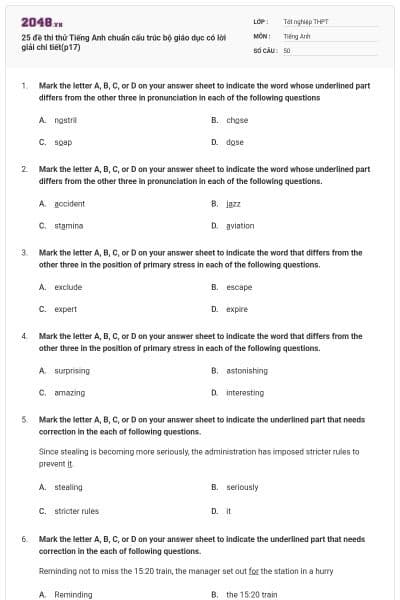
Mark the letter A, B, C, or D on your answer sheet to indicate the word whose underlined part differs from the other three in pronunciation in each of the following questions
nostril
chose
soap
dose
Đáp án A
Nostril /'nɒstrəl/ (n): lỗ mũi
Chose / t∫əʊz / (V-ed): đã chọn
Soap /səʊp/ (n): xà phòng
Dose /dəʊs/ (n): liều (thuốc)
Mark the letter A, B, C, or D on your answer sheet to indicate the word whose underlined part differs from the other three in pronunciation in each of the following questions.
accident
jazz
stamina
aviation
Đáp án D
Accident /'æksɪdənt/ (n): tai nạn
Jazz /dʒæz/ (n): nhạc jazz
Stamina /‘stæmɪnə/ (n): sức lực
Aviation /eɪvi’eɪ∫ən/ (n): ngành hàng không
Mark the letter A, B, C, or D on your answer sheet to indicate the word that differs from the other three in the position of primary stress in each of the following questions.
exclude
escape
expert
expire
Đáp án C
Exclude /ɪk'sklu:d/ (v): loại trừ, khai trừ
Escape /i'skeɪp/ (v): thoát hiểm, tẩu thoát; (n): sự trốn thoát
Expert /'ek.spɜ:t /(n): chuyên gia
Expire /ik’spaɪər/ (v): hết hiệu lực, hết hạn
Mark the letter A, B, C, or D on your answer sheet to indicate the word that differs from the other three in the position of primary stress in each of the following questions.
surprising
astonishing
amazing
interesting
Đáp án D
Surprising /sa'praɪzɪη/ (adj): đáng ngạc nhiên
Astonishing /ə’stɒnɪ∫ɪη/ (adj): đáng ngạc nhiên
Amazing /ə’meɪzɪη/ (adj): kinh ngạc, tuyệt vời
Interesting/’ɪntrəstɪη/ (adj): lý thú, thú vị
Mark the letter A, B, C, or D on your answer sheet to indicate the underlined part that needs correction in the each of following questions.
Since stealing is becoming more seriously, the administration has imposed stricter rules to prevent it.
stealing
seriously
stricter rules
it
Đáp án B
Become + adj: trở lên, trở thành như thế nào
Chữa lỗi: seriously ® serious
Dịch: Bởi vì nạn trộm cắp đang trở lên ngày càng nghiêm trọng, chính phủ áp đặt luật nghiêm khắc hơn để bảo vệ điều này.
Mark the letter A, B, C, or D on your answer sheet to indicate the underlined part that needs correction in the each of following questions.
Reminding not to miss the 15:20 train, the manager set out for the station in a hurry
Reminding
the 15:20 train
for
in a hurry
Đáp án A
Có thể dùng V-ing hoặc PII để rút gọn mệnh đề khi chúng có chung chủ ngữ. Vì Câu mang nghĩa bị động nên không dùng V-ing
Chữa lỗi: Reminding ® Reminded
Dịch: Được nhẳc nhở không được nhỡ chuyến tàu lúc 15:20, người quản lí lao đến sân ga một cách vội vàng
Mark the letter A, B, C, or D on your answer sheet to indicate the underlined part that needs correction in the each of following questions.
Small town newspapers often urge readers to make business with local merchants
newspapers
urge
make
local
Đáp án B
“Newspapers” là danh từ không đếm dược ® động từ chia số ít
Chữa lỗi: urge ® urges
Dịch: Báo chí của những thị trấn nhỏ thường kêu gọi những người đọc tham gia kinh doanh với những thương nhân địa phương
Mark the letter A, B, C, or D on your answer sheet to indicate the correct answer to each of the following questions
Aerodynamics is the study of the forces ________ on an object as it moves through the atmosphere.
acting
act
are acting
acted
Đáp án A
Mệnh đề quan hệ rút gọn, sử dụng V-ing để rút gọn cho mệnh đề mang nghĩa chủ động Acting ~ that/which act
Dịch: Khí động học là sự nghiên cứu của các lực lượng tác động lên một vật khi nó di chuyển qua bầu khí quyển
Mark the letter A, B, C, or D on your answer sheet to indicate the correct answer to each of the following questions
I’m sure Mary will have no ________ the driving test
difficulties of passing
difficulty passing
difficulties to pass
difficulty to pass
Đáp án B
Have (no) difficulty (in) doing something: (không) gặp khó khăn trong việc gì
Dịch: Tôi chắc là Mary sẽ không gặp khó khăn gì để đỗ kì thi lái xe
Mark the letter A, B, C, or D on your answer sheet to indicate the correct answer to each of the following questions
We’d better insure the jewelry ________ robbery.
in case of
but for
as a result of
in addition to
Đáp án A
In case of + N: phòng khi, trong trường hợp
But for + N: ngoại trừ, nếu không có
As a result of: kết quả là
in addition to + N: thêm vào
Dịch: Chúng ta nên dự phòng đồ trang sức quí trong trường hợp bị trộm
Mark the letter A, B, C, or D on your answer sheet to indicate the correct answer to each of the following questions
The Z-War ________ in 1979.
brought about
turned up
broke out
took out
Đáp án C
Bring about: đem lại kết quả
Turn up: xuất hiện
Break out: khởi phát bất thình lình, bùng nổ
Take out: lấy đi
Dịch: Chiến tranh Z bùng nổ năm 1979
Mark the letter A, B, C, or D on your answer sheet to indicate the correct answer to each of the following questions
He’d rather ________ a hot beverage during a meal.
me not to have
me did not have
I did not have
I do not have
Đáp án C
S1 + would rather + S2 + V(past) : S1 muốn S2 làm gi
Dịch: Anh ấy muốn tôi uống đồ uống nóng trong suốt bữa ăn
Mark the letter A, B, C, or D on your answer sheet to indicate the correct answer to each of the following questions
At first it was all silence. Then ________ that I was familiar with.
came a voice
a voice came
a voice is coming
a voice comes
Đáp án A
Dạng đảo ngữ đặc biệt: V + S (động từ được chia theo S)
Dịch: Đầu tiên là sự im lặng. Rồi một giọng nói mà tôi quen biết vang lên.
Mark the letter A, B, C, or D on your answer sheet to indicate the correct answer to each of the following questions
The man ________ car is brown is my boyfriend
which
whose
whom
who
Đáp án B
Sau chỗ trống là một danh từ ® dùng đại từ quan hệ “whose” để thay thế cho dạng sở hữu cách.
Dịch: Người đàn ông có xe màu nâu là bạn trai của tôi.
Mark the letter A, B, C, or D on your answer sheet to indicate the correct answer to each of the following questions
Hurry up. Rose! They’ve only got ________ tickets left.
a lot of
a little
a few
plenty of
Đáp án C
“Tickets” là danh từ đếm được số nhiều ® loại B, D Dựa vào nghĩa của câu ® chọn “a few”
Dịch: Nhanh lên nào Rose! Họ chỉ còn vài chiếc thuyền trống thôi.
Mark the letter A, B, C, or D on your answer sheet to indicate the correct answer to each of the following questions
Being well-dress and punctual can help you make a good ________ on your audience
effectiveness
pressure
employment
impression
Đáp án D
Make/ create an impression on somebody: gây ấn tượng cho ai
Dịch: Ăn mặc gọn gàng và đúng giờ có thể giúp bạn tạo ấn tượng tốt cho khán giả của bạn.
Mark the letter A, B, C, or D on your answer sheet to indicate the correct answer to each of the following questions
The program “Rush Hours” is a project that uses short films to teach lessons in
traffic safety and ________
protecting
protector
protective
protection
Đáp án D
Protecting (V-ing): bảo vệ
Protector (n): người bảo vệ
Protective (adj): bảo vệ
Protection (n): sự bảo vệ
Từ nối “and” nối 2 từ có cùng từ loại ® chỗ trống cần một danh từ Dựa vào ngữ nghĩa chọn “protection”.
Dịch: Chương trình “giờ cao điểm” là một dự án mà sử dụng những đoạn phim ngắn để truyền dạy những bài học về an toàn và bảo vệ giao thông
Mark the letter A, B, C, or D on your answer sheet to indicate the correct answer to each of the following questions
Her manager fired her, ________ made her so upset.
that
this
what
which
Đáp án D
Dùng đại từ quan hệ “which” để thay thế cho cả một mệnh đề đứng trước dấu phẩy
Dịch: Ông chủ đã xa thải cô ấy, điều này làm cô ấy tức giận.
Mark the letter A, B, C, or D on your answer sheet to indicate the correct answer to each of the following questions
One thing seems rather certain. The battle ________ in a proper way.
hasn’t run
wasn’t run
hadn’t run
wouldn’t run
Đáp án B
Chủ ngữ “the advertising campaign” là danh từ chỉ vật, và dựa vào nghĩa của câu ® dùng dạng bị động
Dịch: Một thứ có vẻ khá chắc chắn. Chiến dịch quảng cảo đã không được điều hành một cách đúng đắn.
Mark the letter A, B, C, or D on your answer sheet to indicate the most suitable response to complete each of the following exchanges.
-“You look lovely today. I like your new dress.” – “________”
It’s nice of you to say so
Shall I? Thanks.
Oh, well done.
I feel interesting to hear that.
Đáp án: A
Giải thích:
Dịch:
- “Hôm nay bạn trông thật xinh đẹp. Tớ thích chiếc váy mới của bạn.”
- "_______________"
A. Thật tốt khi bạn nói vậy.
B. Tôi có nên không? Cảm ơn.
C. Ồ, làm tốt lắm!
D. Tôi thấy thú vị khi nghe điều đó. (khi diễn tả cảm xúc của người, dùng tính từ đuôi –ed)
Đáp án A dùng để đáp lại lời khen. Các đáp án còn lại không phù hợp.
Mark the letter A, B, C, or D on your answer sheet to indicate the most suitable response to complete each of the following exchanges.
Where are we going to see him? – “ ________ the lecture room?”
How about
How is about
What is about
What about is
Đáp án A
Dùng “how about + N/ V-ing” để đưa ra một gợi ý
Dịch: "Chúng ta sẽ gặp anh ấy ở đâu?” - “Ở hội trường thế nào?”
Mark the letter A, B, C, or D on your answer sheet to indicate the word(s) CLOSEST in meaning to the underlined word(s) in each of the following questions
The critic believed that the instructor had been negligent in allowing the kids to swim in dangerous water.
benevolent
morbid
careless
dark
Đáp án C
Benevolent (adj): nhân từ, rộng lượng
Morbid (adj): có bệnh, bệnh hoạn
Careless (adj): cẩu thả, sơ ý ~ negligent (adj): thờ ơ, không lo, cẩu thả
Dark (adj): tối, tối tăm, mờ ám
Dịch: Các nhà phê phán tin rằng giáo viên đã sơ ý trong việc cho phép bọn trẻ bơi ở vùng nước nguy hiểm.
Mark the letter A, B, C, or D on your answer sheet to indicate the word(s) CLOSEST in meaning to the underlined word(s) in each of the following questions
The alteration between the two versions is minor.
insignificant
arguable
careless
astonishing
Đáp án A
Insignificant (adj): không đáng kể, có thể bỏ qua ~ minor (adj): nhỏ, không đáng kể
Arguable (adj): gây tranh cãi
Careless (adj): cẩu thả
Astonishing (adj): kinh ngạc, đáng ngạc nhiên
Dịch: Sự sửa đổi giữa hai bản thảo là không đáng kể.
Mark the letter A, B, C, or D on your answer sheet to indicate the word(s) OPPOSITE in meaning to the underlined word(s) in each of the following questions.
The director’s mad idea lead the company follow the wrong way.
crafty
simple
sensible
insane
Đáp án C
Crafty (adj): xảo trá
Simple (adj): đơn giản
Sensible (adj): hợp lý, đúng đắn >< mad (adj): điên rồ
Insane (adj): điên
Dịch: Ý tưởng dại dột của giám đốc đã đưa cả công ty đi sai hướng.
Mark the letter A, B, C, or D on your answer sheet to indicate the word(s) OPPOSITE in meaning to the underlined word(s) in each of the following questions.
He's a great reputation, but he doesn't show off it.
regard
let down
hide
propose
Đáp án C
Regard (v): coi như, xem là
Let down (v): để xuống
Hide (v): giấu >< show off (v); khoe khoang, phô trương
Propose (v): đề xuất
Dịch: Anh ấy rất có tiếng nhưng anh ấy không hề khoe khoang.
Mark the letter A, B, c, or D on your answer sheet to indicate the sentence that is closest in meaning to each of the following questions.
“We lost the last battle because of the player 11.” Said the team captain.
The team captain refused to tell the player 11 about their loss in the last battle.
The team captain admitted to the player 11 that they had lost the last battle.
The team captain blamed the player 11 for their loss in the last battle.
The team captain said that without the player 11, they might have lost the battle.
Đáp án C
Dịch đề: “Chúng tôi thua trận đấu bởi vì cầu thủ 11” đội trưởng nói.
Cấu trúc: blame sb for sth: đổ lỗi cho ai về điều gì
Dịch: Đội trưởng đổ lỗi cho cầu thủ 11 về sự thất bại cùa họ trong trận đấu
Mark the letter A, B, C, or D on your answer sheet to indicate the correct answer to each of the following questions
The gentleman wore gloves in order not to leave any fingerprints
In order to leave some fingerprints the man took off his gloves
His fingerprints would not be left unless the gentleman wore gloves.
The gentleman wore gloves so that he would not leave any fingerprints.
The gentleman wore gloves in order that his fingerprints would be taken.
Đáp án C
Dịch đề: Người đàn ông đeo gang tay để không để lại bất kỳ dấu vân tay nào.
Cấu trúc: in order to + V = so that + clause: để (chỉ mục đích của hành động)
Dịch: Người đàn ông đeo găng tay để ông ấy sẽ không để lại dấu vân tay nào.
Mark the letter A, B, c, or D on your answer sheet to indicate the sentence that is closest in meaning to each of the following questions.
I was surprised that he knew a lot about Vietnamese culture
I was surprised at his poor knowledge of Vietnamese culture.
That he knew a lot about Vietnamese culture amazed me
I knew very little about Vietnamese culture, which surprised him
It astonished me that Vietnamese culture was what he liked most.
Đáp án B
Dịch đề: Tôi ngạc nhiên rằng anh ấy biết nhiều về văn hóa Việt Nam.
Để biến đổi một mệnh đề lên làm chủ ngữ của câu, ta thêm “that” vào trước mệnh đề đó Dịch: Việc anh ấy biết nhiều về văn hóaViệt Nam đã làm tôi ngạc nhiên.
Mark the letter A, B, c, or D on your answer sheet to indicate the sentence that best combines each pair of sentences in the following questions.
Jack graduated with good marks. However, he joined the ranks of the unemployed
Although Jack graduated with good marks, he joined the ranks of the unemployed.
Jack joined the ranks of the unemployed because he graduated with good marks
Jack graduated with good marks, he would join the ranks of the unemployed.
That Jack graduated with a good marks he helped him join the ranks of the unemployed.
Đáp án A
Dịch đề: Jack tốt nghiệp với một tấm bằng giỏi. Tuy nhiên, anh ấy vẫn ở trong hàng ngũ thất nghiệp.
Although + SVO, SVO: mặc dù... nhưng...
Dịch: Mặc dù Jack tốt nghiệp với tấm bằng giỏi, nhưng anh ấy vẫn ở trong hàng ngũ thất nghiệp.
Mark the letter A, B, c, or D on your answer sheet to indicate the sentence that best combines each pair of sentences in the following questions.
Put your glove on. You will get cold.
Put your glove on, otherwise you will get cold.
You will not get cold unless you put your glove on.
You not only put your glove on but also get cold.
It is not until you put your glove t on that you will get cold.
Đáp án A
Dịch đề: Hãy đeo găng vào. Bạn sẽ bị cảm lạnh đấy.
Otherwise: nếu không thì (được sử dụng trong câu điều kiện)
Dịch: Hãy đeo găng vào, nếu không thì bạn sẽ bị cảm lạnh đấy.
Read the following passage and mark the letter A, B, c, or D on your answer sheet to indicate the correct word or phrase that best fits each of the numbered blanks from 31 to 35.
One of the most important (31) ________ of a standardized test is time. You’ll only be allowed a certain number of minutes for each section, so it is very essential that you use your time wisely. The most significant time strategy is pacing yourself. Before you initiate, take just a few seconds to review the test, noting the number of questions and the sections that looks easier than the rest. Then, make a rough time plan based (32) ________ the amount of time available to you. Mark the halfway point on your test and make a memo beside that mark of the time when the testing period is half over.
Once you start the test, continue moving. If you work slowly in an attempt to make fewer mistakes, your mind will become bored and begin to wander. You’ll end up with far (33) ________ mistakes if you’re not concentrating. If you take too long to answer questions that stump you, you may end up running out of time before you finish. So don’t stop for difficult questions. Skip them and move on. You can come back to them later if you have time. A question that takes you five seconds to answer counts as much as one that takes you several minutes, so pick up the easy points first. (34) ________, answering the easier questions first helps build your confidence and gets you in the testing groove. If you’re a little ahead, you know you’re on track and may even have a little time left to check your work. If you’re a little behind, you have several choices. You can pick up the pace a little, but do this only if you can do it (35) ________.
Điền câu 31
issues
information
concern
factors
Đáp án D
Issue (n): vấn đề
Information (n): thông tin
Concern (n): mối quan tâm
Factor (n): nhân tố, yếu tố
Dịch: “Một trong số những nhân tố quan trọng nhất của một bài kiểm tra đạt chuẩn là thời gian...”
Read the following passage and mark the letter A, B, c, or D on your answer sheet to indicate the correct word or phrase that best fits each of the numbered blanks from 31 to 35.
One of the most important (31) ________ of a standardized test is time. You’ll only be allowed a certain number of minutes for each section, so it is very essential that you use your time wisely. The most significant time strategy is pacing yourself. Before you initiate, take just a few seconds to review the test, noting the number of questions and the sections that looks easier than the rest. Then, make a rough time plan based (32) ________ the amount of time available to you. Mark the halfway point on your test and make a memo beside that mark of the time when the testing period is half over.
Once you start the test, continue moving. If you work slowly in an attempt to make fewer mistakes, your mind will become bored and begin to wander. You’ll end up with far (33) ________ mistakes if you’re not concentrating. If you take too long to answer questions that stump you, you may end up running out of time before you finish. So don’t stop for difficult questions. Skip them and move on. You can come back to them later if you have time. A question that takes you five seconds to answer counts as much as one that takes you several minutes, so pick up the easy points first. (34) ________, answering the easier questions first helps build your confidence and gets you in the testing groove. If you’re a little ahead, you know you’re on track and may even have a little time left to check your work. If you’re a little behind, you have several choices. You can pick up the pace a little, but do this only if you can do it (35) ________.
Điền câu 32
from
on
in
out
Đáp án B
Base on something: dựa vào cái gì
Dịch: Và rồi, tạo một bản kế hoạch thời gian phác thảo được dựa trên khoảng thời gian dành cho bạn...”
Read the following passage and mark the letter A, B, c, or D on your answer sheet to indicate the correct word or phrase that best fits each of the numbered blanks from 31 to 35.
One of the most important (31) ________ of a standardized test is time. You’ll only be allowed a certain number of minutes for each section, so it is very essential that you use your time wisely. The most significant time strategy is pacing yourself. Before you initiate, take just a few seconds to review the test, noting the number of questions and the sections that looks easier than the rest. Then, make a rough time plan based (32) ________ the amount of time available to you. Mark the halfway point on your test and make a memo beside that mark of the time when the testing period is half over.
Once you start the test, continue moving. If you work slowly in an attempt to make fewer mistakes, your mind will become bored and begin to wander. You’ll end up with far (33) ________ mistakes if you’re not concentrating. If you take too long to answer questions that stump you, you may end up running out of time before you finish. So don’t stop for difficult questions. Skip them and move on. You can come back to them later if you have time. A question that takes you five seconds to answer counts as much as one that takes you several minutes, so pick up the easy points first. (34) ________, answering the easier questions first helps build your confidence and gets you in the testing groove. If you’re a little ahead, you know you’re on track and may even have a little time left to check your work. If you’re a little behind, you have several choices. You can pick up the pace a little, but do this only if you can do it (35) ________.
Điền câu 33
more
away
under
from
Đáp án A
Far more (mistakes): nhiều (lỗi sai) hơn
Dịch: “….Bạn sẽ kết thúc với nhiều lỗi sai hơn nếu bạn không tập trung...”
Read the following passage and mark the letter A, B, c, or D on your answer sheet to indicate the correct word or phrase that best fits each of the numbered blanks from 31 to 35.
One of the most important (31) ________ of a standardized test is time. You’ll only be allowed a certain number of minutes for each section, so it is very essential that you use your time wisely. The most significant time strategy is pacing yourself. Before you initiate, take just a few seconds to review the test, noting the number of questions and the sections that looks easier than the rest. Then, make a rough time plan based (32) ________ the amount of time available to you. Mark the halfway point on your test and make a memo beside that mark of the time when the testing period is half over.
Once you start the test, continue moving. If you work slowly in an attempt to make fewer mistakes, your mind will become bored and begin to wander. You’ll end up with far (33) ________ mistakes if you’re not concentrating. If you take too long to answer questions that stump you, you may end up running out of time before you finish. So don’t stop for difficult questions. Skip them and move on. You can come back to them later if you have time. A question that takes you five seconds to answer counts as much as one that takes you several minutes, so pick up the easy points first. (34) ________, answering the easier questions first helps build your confidence and gets you in the testing groove. If you’re a little ahead, you know you’re on track and may even have a little time left to check your work. If you’re a little behind, you have several choices. You can pick up the pace a little, but do this only if you can do it (35) ________.
Điền câu 34
Beside
However
Besides
Therefore
Đáp án C
Dựa vào nghĩa của câu ® chọn “besides”
Dịch: Ngoài ra, việc trả lời những câu hỏi dễ hơn trước giúp xây dựng sự tự tin và giúp bạn có thói quen làm bài kiểm tra...”
Read the following passage and mark the letter A, B, c, or D on your answer sheet to indicate the correct word or phrase that best fits each of the numbered blanks from 31 to 35.
One of the most important (31) ________ of a standardized test is time. You’ll only be allowed a certain number of minutes for each section, so it is very essential that you use your time wisely. The most significant time strategy is pacing yourself. Before you initiate, take just a few seconds to review the test, noting the number of questions and the sections that looks easier than the rest. Then, make a rough time plan based (32) ________ the amount of time available to you. Mark the halfway point on your test and make a memo beside that mark of the time when the testing period is half over.
Once you start the test, continue moving. If you work slowly in an attempt to make fewer mistakes, your mind will become bored and begin to wander. You’ll end up with far (33) ________ mistakes if you’re not concentrating. If you take too long to answer questions that stump you, you may end up running out of time before you finish. So don’t stop for difficult questions. Skip them and move on. You can come back to them later if you have time. A question that takes you five seconds to answer counts as much as one that takes you several minutes, so pick up the easy points first. (34) ________, answering the easier questions first helps build your confidence and gets you in the testing groove. If you’re a little ahead, you know you’re on track and may even have a little time left to check your work. If you’re a little behind, you have several choices. You can pick up the pace a little, but do this only if you can do it (35) ________.
Điền câu 35
comfortable
uncomfortable
comfortably
uncomfortably
Đáp án C
Chỗ trống cần một trạng từ ® loại A, B Dựa vào ngữ nghĩa ® chọn C
Dịch: “…Bạn có thể tăng tốc một chút, nhưng làm điều này chỉ khi bạn có thể làm nó một cách thoải mái.”
Read the following passage and mark the letter A, B, c, or D on your answer sheet to indicate the correct answer to each of the questions from 36 to 42.
The first navigational lights in the New World were probably lanterns hung at harbor
entrances. The first lighthouse was put up by the Massachusetts Bay Colony In 1766 on Little Brewster Island at the entrance to Boston Harbor. Paid for and maintained by light dues levied on ships, the original beacon was blown up in 1776. By then there were only a dozen or so true lighthouses in the colonies. Little over a century later, there were 700 lighthouses.
The first eight erected on the West Coast in the 1850’s featured the same basic New
England design: a Cape Cod dwelling with the tower rising from the center or standing close by. In New England and elsewhere, though, lighthouses reflected a variety of architectural styles. Since most stations in the Northeast were built on rocky eminences, enormous towers were not the rule. Some were made of stone and brick, others of wood or metal. Some stood on pilings or stilts: some were fastened to rock with iron rods. Farther south, from Maryland through the Florida Keys, the coast was low and sandy. It was often necessary to build tall towers there – massive structures like the majestic Cape Hatteras, North Carolina lighthouse, which was lit in 1870. At 190 feet, it is the tallest brick lighthouse in the country.
Not withstanding differences in appearance and construction, most American lighthouses shared several features: a light, living quarters, and sometimes a bell (or, later, a foghorn). They also had something else in common: a keeper and, usually, the keeper's family. The keeper's essential task was trimming the lantern Nick in order to maintain a steady bright flame. The earliest keepers came from every walk of life-they were seamen. Farmers, mechanics, rough mill hands-and appointments were often handed out by local customs commissioners as political plums. After the administration of lighthouses was taken over in 1852 by the United States Lighthouse 803rd, an agency of the Treasury Department, the keeper corps gradually became highly professional.
What is the best title for the passage?
The Lighthouse on Little Brewster Island
The Life of a Lighthouse Keeper
Early Lighthouses in the United States
The Modern Profession of Lighthouse Keeping
Đáp án C
Dựa vào câu đầu và nội dung xuyên suốt toàn đoạn văn ® nội dung chính của bài nói về những ngọn hải đăng đầu tiên ở Mỹ
Read the following passage and mark the letter A, B, c, or D on your answer sheet to indicate the correct answer to each of the questions from 36 to 42.
The first navigational lights in the New World were probably lanterns hung at harbor
entrances. The first lighthouse was put up by the Massachusetts Bay Colony In 1766 on Little Brewster Island at the entrance to Boston Harbor. Paid for and maintained by light dues levied on ships, the original beacon was blown up in 1776. By then there were only a dozen or so true lighthouses in the colonies. Little over a century later, there were 700 lighthouses.
The first eight erected on the West Coast in the 1850’s featured the same basic New
England design: a Cape Cod dwelling with the tower rising from the center or standing close by. In New England and elsewhere, though, lighthouses reflected a variety of architectural styles. Since most stations in the Northeast were built on rocky eminences, enormous towers were not the rule. Some were made of stone and brick, others of wood or metal. Some stood on pilings or stilts: some were fastened to rock with iron rods. Farther south, from Maryland through the Florida Keys, the coast was low and sandy. It was often necessary to build tall towers there – massive structures like the majestic Cape Hatteras, North Carolina lighthouse, which was lit in 1870. At 190 feet, it is the tallest brick lighthouse in the country.
Not withstanding differences in appearance and construction, most American lighthouses shared several features: a light, living quarters, and sometimes a bell (or, later, a foghorn). They also had something else in common: a keeper and, usually, the keeper's family. The keeper's essential task was trimming the lantern Nick in order to maintain a steady bright flame. The earliest keepers came from every walk of life-they were seamen. Farmers, mechanics, rough mill hands-and appointments were often handed out by local customs commissioners as political plums. After the administration of lighthouses was taken over in 1852 by the United States Lighthouse 803rd, an agency of the Treasury Department, the keeper corps gradually became highly professional.
Why does the author mention the Massachusetts Bay Colony?
It was the headquarters of the United States Lighthouse Board.
Many of the tallest lighthouses were built there
The first lantern wicks were developed there.
The first lighthouse in North America was built there.
Đáp án D
Thông tin “The first lighthouse was put up by the Massachusetts Bay Colony In 1766” ® tác giả đề cập đến Massachusetts Bay Colony vì nó là ngọn hải đăng đầu tiên ở Mỹ được xây dựng.
Read the following passage and mark the letter A, B, c, or D on your answer sheet to indicate the correct answer to each of the questions from 36 to 42.
The first navigational lights in the New World were probably lanterns hung at harbor
entrances. The first lighthouse was put up by the Massachusetts Bay Colony In 1766 on Little Brewster Island at the entrance to Boston Harbor. Paid for and maintained by light dues levied on ships, the original beacon was blown up in 1776. By then there were only a dozen or so true lighthouses in the colonies. Little over a century later, there were 700 lighthouses.
The first eight erected on the West Coast in the 1850’s featured the same basic New
England design: a Cape Cod dwelling with the tower rising from the center or standing close by. In New England and elsewhere, though, lighthouses reflected a variety of architectural styles. Since most stations in the Northeast were built on rocky eminences, enormous towers were not the rule. Some were made of stone and brick, others of wood or metal. Some stood on pilings or stilts: some were fastened to rock with iron rods. Farther south, from Maryland through the Florida Keys, the coast was low and sandy. It was often necessary to build tall towers there – massive structures like the majestic Cape Hatteras, North Carolina lighthouse, which was lit in 1870. At 190 feet, it is the tallest brick lighthouse in the country.
Not withstanding differences in appearance and construction, most American lighthouses shared several features: a light, living quarters, and sometimes a bell (or, later, a foghorn). They also had something else in common: a keeper and, usually, the keeper's family. The keeper's essential task was trimming the lantern Nick in order to maintain a steady bright flame. The earliest keepers came from every walk of life-they were seamen. Farmers, mechanics, rough mill hands-and appointments were often handed out by local customs commissioners as political plums. After the administration of lighthouses was taken over in 1852 by the United States Lighthouse 803rd, an agency of the Treasury Department, the keeper corps gradually became highly professional.
It can be inferred from the passage that lighthouses in the Northeast did not need high towers because ________ .
ships there had high masts
coastal waters were safe
the coast was straight and unobstructed
the lighthouse were built on high places
Đáp án D
Dựa vào thông tin: “Since most stations in the Northeast were built on rocky eminences, enormous towers were not the rule...” ® các ngọn hải đăng ở vùng Đông bắc không cần những cái tháp cao bởi vì chúng được xây dựng trên những địa điểm cao.
Read the following passage and mark the letter A, B, c, or D on your answer sheet to indicate the correct answer to each of the questions from 36 to 42.
The first navigational lights in the New World were probably lanterns hung at harbor
entrances. The first lighthouse was put up by the Massachusetts Bay Colony In 1766 on Little Brewster Island at the entrance to Boston Harbor. Paid for and maintained by light dues levied on ships, the original beacon was blown up in 1776. By then there were only a dozen or so true lighthouses in the colonies. Little over a century later, there were 700 lighthouses.
The first eight erected on the West Coast in the 1850’s featured the same basic New
England design: a Cape Cod dwelling with the tower rising from the center or standing close by. In New England and elsewhere, though, lighthouses reflected a variety of architectural styles. Since most stations in the Northeast were built on rocky eminences, enormous towers were not the rule. Some were made of stone and brick, others of wood or metal. Some stood on pilings or stilts: some were fastened to rock with iron rods. Farther south, from Maryland through the Florida Keys, the coast was low and sandy. It was often necessary to build tall towers there – massive structures like the majestic Cape Hatteras, North Carolina lighthouse, which was lit in 1870. At 190 feet, it is the tallest brick lighthouse in the country.
Not withstanding differences in appearance and construction, most American lighthouses shared several features: a light, living quarters, and sometimes a bell (or, later, a foghorn). They also had something else in common: a keeper and, usually, the keeper's family. The keeper's essential task was trimming the lantern Nick in order to maintain a steady bright flame. The earliest keepers came from every walk of life-they were seamen. Farmers, mechanics, rough mill hands-and appointments were often handed out by local customs commissioners as political plums. After the administration of lighthouses was taken over in 1852 by the United States Lighthouse 803rd, an agency of the Treasury Department, the keeper corps gradually became highly professional.
According to the passage, where can the tallest brick lighthouse in the United States be found?
Little Brewster Island
The Florida Keys
Cape Hatteras
Cape Cod
Đáp án C
Dựa vào đoạn “It was often necessary to build tall towers there - massive structures like the majestic Cape Hatteras, North Carolina lighthouse, which was lit in 1870. At 190 feet, it is the tallest brick lighthouse in the country” ® ngọn hải đăng bằng gạch cao nhất ở nước Mỹ có thể được tìm thấy ở Cape Hatteras
Read the following passage and mark the letter A, B, c, or D on your answer sheet to indicate the correct answer to each of the questions from 36 to 42.
The first navigational lights in the New World were probably lanterns hung at harbor
entrances. The first lighthouse was put up by the Massachusetts Bay Colony In 1766 on Little Brewster Island at the entrance to Boston Harbor. Paid for and maintained by light dues levied on ships, the original beacon was blown up in 1776. By then there were only a dozen or so true lighthouses in the colonies. Little over a century later, there were 700 lighthouses.
The first eight erected on the West Coast in the 1850’s featured the same basic New
England design: a Cape Cod dwelling with the tower rising from the center or standing close by. In New England and elsewhere, though, lighthouses reflected a variety of architectural styles. Since most stations in the Northeast were built on rocky eminences, enormous towers were not the rule. Some were made of stone and brick, others of wood or metal. Some stood on pilings or stilts: some were fastened to rock with iron rods. Farther south, from Maryland through the Florida Keys, the coast was low and sandy. It was often necessary to build tall towers there – massive structures like the majestic Cape Hatteras, North Carolina lighthouse, which was lit in 1870. At 190 feet, it is the tallest brick lighthouse in the country.
Not withstanding differences in appearance and construction, most American lighthouses shared several features: a light, living quarters, and sometimes a bell (or, later, a foghorn). They also had something else in common: a keeper and, usually, the keeper's family. The keeper's essential task was trimming the lantern Nick in order to maintain a steady bright flame. The earliest keepers came from every walk of life-they were seamen. Farmers, mechanics, rough mill hands-and appointments were often handed out by local customs commissioners as political plums. After the administration of lighthouses was taken over in 1852 by the United States Lighthouse 803rd, an agency of the Treasury Department, the keeper corps gradually became highly professional.
In line 15, to which of the following does the word "They" refer?
Lighthouses
Differences
Quarters
Features
Đáp án A
Dựa vào câu phía trước và câu chứa đại từ “they” “Not withstanding differences in appearance and construction, most American lighthouses shared several features: a light, living quarters, and sometimes a bell (or, later, a foghorn). They also had something else in common...” ® đại từ này đề cập đến đối tượng “lighthouses”
Read the following passage and mark the letter A, B, c, or D on your answer sheet to indicate the correct answer to each of the questions from 36 to 42.
The first navigational lights in the New World were probably lanterns hung at harbor
entrances. The first lighthouse was put up by the Massachusetts Bay Colony In 1766 on Little Brewster Island at the entrance to Boston Harbor. Paid for and maintained by light dues levied on ships, the original beacon was blown up in 1776. By then there were only a dozen or so true lighthouses in the colonies. Little over a century later, there were 700 lighthouses.
The first eight erected on the West Coast in the 1850’s featured the same basic New
England design: a Cape Cod dwelling with the tower rising from the center or standing close by. In New England and elsewhere, though, lighthouses reflected a variety of architectural styles. Since most stations in the Northeast were built on rocky eminences, enormous towers were not the rule. Some were made of stone and brick, others of wood or metal. Some stood on pilings or stilts: some were fastened to rock with iron rods. Farther south, from Maryland through the Florida Keys, the coast was low and sandy. It was often necessary to build tall towers there – massive structures like the majestic Cape Hatteras, North Carolina lighthouse, which was lit in 1870. At 190 feet, it is the tallest brick lighthouse in the country.
Not withstanding differences in appearance and construction, most American lighthouses shared several features: a light, living quarters, and sometimes a bell (or, later, a foghorn). They also had something else in common: a keeper and, usually, the keeper's family. The keeper's essential task was trimming the lantern Nick in order to maintain a steady bright flame. The earliest keepers came from every walk of life-they were seamen. Farmers, mechanics, rough mill hands-and appointments were often handed out by local customs commissioners as political plums. After the administration of lighthouses was taken over in 1852 by the United States Lighthouse 803rd, an agency of the Treasury Department, the keeper corps gradually became highly professional.
It can be inferred from the passage that the Treasury Department, after assuming control of the lighthouses, improved which of the following?
The training of the lighthouse keepers
The sturdiness ofthe lighthouses
The visibility of the lights
The locations of the lighthouses
Đáp án A
Dựa vào câu cuối “After the administration of lighthouses was taken over in 1852 by the United States Lighthouse 803rd, an agency of the Treasury Department, the keeper corps gradually became highly professional” ® sau khi đảm đương việc kiểm soát hải đăng, Bộ tài chính đã cải thiện lại việc đào tạo những người trông coi hải đăng.
Read the following passage and mark the letter A, B, c, or D on your answer sheet to indicate the correct answer to each of the questions from 36 to 42.
The first navigational lights in the New World were probably lanterns hung at harbor
entrances. The first lighthouse was put up by the Massachusetts Bay Colony In 1766 on Little Brewster Island at the entrance to Boston Harbor. Paid for and maintained by light dues levied on ships, the original beacon was blown up in 1776. By then there were only a dozen or so true lighthouses in the colonies. Little over a century later, there were 700 lighthouses.
The first eight erected on the West Coast in the 1850’s featured the same basic New
England design: a Cape Cod dwelling with the tower rising from the center or standing close by. In New England and elsewhere, though, lighthouses reflected a variety of architectural styles. Since most stations in the Northeast were built on rocky eminences, enormous towers were not the rule. Some were made of stone and brick, others of wood or metal. Some stood on pilings or stilts: some were fastened to rock with iron rods. Farther south, from Maryland through the Florida Keys, the coast was low and sandy. It was often necessary to build tall towers there – massive structures like the majestic Cape Hatteras, North Carolina lighthouse, which was lit in 1870. At 190 feet, it is the tallest brick lighthouse in the country.
Not withstanding differences in appearance and construction, most American lighthouses shared several features: a light, living quarters, and sometimes a bell (or, later, a foghorn). They also had something else in common: a keeper and, usually, the keeper's family. The keeper's essential task was trimming the lantern Nick in order to maintain a steady bright flame. The earliest keepers came from every walk of life-they were seamen. Farmers, mechanics, rough mill hands-and appointments were often handed out by local customs commissioners as political plums. After the administration of lighthouses was taken over in 1852 by the United States Lighthouse 803rd, an agency of the Treasury Department, the keeper corps gradually became highly professional.
Where in the passage does the author tell how lighthouses in the Northeast were fastened to the surrounding rock?
Lines 3-4
Line 10
Lines 14-15
Line 19
Đáp án B
Thông tin nằm ở dòng 10 “Some stood on pilings or stilts: some were fastened to rock with iron rods…” ® chọn B
Read the following passage and mark the letter A, B, C, or D on your answer sheet to indicate the correct answer to each of the questions from 43 to 50.
In the past oysters were raised in much the same way as dirt farmers raised tomatoes - by transplanting them. First, farmers selected the oyster bed, cleared the bottom of old shells and other debris, then scattered clean shells about. Next, they "planted" fertilized oyster eggs, which within two or three weeks hatched into larvae. The larvae drifted until they attached themselves to the clean shells on the bottom. There they remained and in time grew into baby oysters called seed or spat. The spat grew larger by drawing in seawater from which they derived microscopic particles of food. Before long farmers gathered the baby oysters transplanted them in other waters to speed up their growth, then transplanted them once more into another body of water to fatten them up.
Until recently; the supply of wild oysters and those crudely farmed were more than enough to satisfy people's needs. But today the delectable seafood is no longer available in abundance. The problem has become so serious that some oyster beds have vanished entirely.
Fortunately, as far back as the early 1900's marine biologists realized that if new measures were not taken, oysters would become extinct or at best a luxury food. So they set up well equipped hatcheries and went to work. But they did not have the proper equipment or the skill to handle the eggs. They did not know when, what, and how to feed the larvae. And they knew little about the predators that attack and eat baby oysters by the millions. They failed, but they doggedly kept at it. Finally, in the 1940's a significant breakthrough was made.
The marine biologists discovered that by raising the temperature of the water, they could induce oysters to spawn not only in the summer but also in the fall, winter, and spring. Later they developed a technique for feeding the larvae and rearing them to spat. Going still further, they succeeded in breeding new strains that were resistant to diseases, grew faster and larger, and flourished in water of different salinities and temperatures. In addition, the cultivated oysters tasted better.
Which of the following would be the best title for the passage?
The Threatened Extinction of Marine Life
The Cultivation of Oysters
The Discoveries Made by Marine Biologists
The Varieties of Wild Oysters
Đáp án B
Dựa vào những thông tin trong các đoạn, có thể thấy tất cả đều liên quan đến việc nuôi trồng hàu ® suy ra tiêu đề phù hợp nhất cho đoạn văn sẽ là “ Sự nuôi trồng loài hàu” (The Cultivation of Oysters)
Read the following passage and mark the letter A, B, C, or D on your answer sheet to indicate the correct answer to each of the questions from 43 to 50.
In the past oysters were raised in much the same way as dirt farmers raised tomatoes - by transplanting them. First, farmers selected the oyster bed, cleared the bottom of old shells and other debris, then scattered clean shells about. Next, they "planted" fertilized oyster eggs, which within two or three weeks hatched into larvae. The larvae drifted until they attached themselves to the clean shells on the bottom. There they remained and in time grew into baby oysters called seed or spat. The spat grew larger by drawing in seawater from which they derived microscopic particles of food. Before long farmers gathered the baby oysters transplanted them in other waters to speed up their growth, then transplanted them once more into another body of water to fatten them up.
Until recently; the supply of wild oysters and those crudely farmed were more than enough to satisfy people's needs. But today the delectable seafood is no longer available in abundance. The problem has become so serious that some oyster beds have vanished entirely.
Fortunately, as far back as the early 1900's marine biologists realized that if new measures were not taken, oysters would become extinct or at best a luxury food. So they set up well equipped hatcheries and went to work. But they did not have the proper equipment or the skill to handle the eggs. They did not know when, what, and how to feed the larvae. And they knew little about the predators that attack and eat baby oysters by the millions. They failed, but they doggedly kept at it. Finally, in the 1940's a significant breakthrough was made.
The marine biologists discovered that by raising the temperature of the water, they could induce oysters to spawn not only in the summer but also in the fall, winter, and spring. Later they developed a technique for feeding the larvae and rearing them to spat. Going still further, they succeeded in breeding new strains that were resistant to diseases, grew faster and larger, and flourished in water of different salinities and temperatures. In addition, the cultivated oysters tasted better.
In the first paragraph, the production of oysters is compared to what other industry?
Mining
Fishing
Banking
Farming
Đáp án D
Dựa vào câu “In the past oysters were raised in much the same way as dirt farmers raised tomatoes” trong đoạn văn đầu, sản phẩm hàu được so sánh với ngành nông nghiệp.
Read the following passage and mark the letter A, B, C, or D on your answer sheet to indicate the correct answer to each of the questions from 43 to 50.
In the past oysters were raised in much the same way as dirt farmers raised tomatoes - by transplanting them. First, farmers selected the oyster bed, cleared the bottom of old shells and other debris, then scattered clean shells about. Next, they "planted" fertilized oyster eggs, which within two or three weeks hatched into larvae. The larvae drifted until they attached themselves to the clean shells on the bottom. There they remained and in time grew into baby oysters called seed or spat. The spat grew larger by drawing in seawater from which they derived microscopic particles of food. Before long farmers gathered the baby oysters transplanted them in other waters to speed up their growth, then transplanted them once more into another body of water to fatten them up.
Until recently; the supply of wild oysters and those crudely farmed were more than enough to satisfy people's needs. But today the delectable seafood is no longer available in abundance. The problem has become so serious that some oyster beds have vanished entirely.
Fortunately, as far back as the early 1900's marine biologists realized that if new measures were not taken, oysters would become extinct or at best a luxury food. So they set up well equipped hatcheries and went to work. But they did not have the proper equipment or the skill to handle the eggs. They did not know when, what, and how to feed the larvae. And they knew little about the predators that attack and eat baby oysters by the millions. They failed, but they doggedly kept at it. Finally, in the 1940's a significant breakthrough was made.
The marine biologists discovered that by raising the temperature of the water, they could induce oysters to spawn not only in the summer but also in the fall, winter, and spring. Later they developed a technique for feeding the larvae and rearing them to spat. Going still further, they succeeded in breeding new strains that were resistant to diseases, grew faster and larger, and flourished in water of different salinities and temperatures. In addition, the cultivated oysters tasted better.
In the passage, which of the following is NOT mentioned as a stage of an oyster's life?
Debris
Egg
Larvae
Spat
Đáp án A
Dựa vào đoạn “Next, they" planted" fertilized oyster eggs, which within two or three weeks hatched into larvae. The larvae drifted until they attached themselves to the clean shells on the bottom. There they remained and in time grew into baby oysters called seed or spat. The spat grew larger by drawing in seawater from which they derived microscopic particles of food” ® các đáp án B, C, D đã được đề cập đến trong đoạn văn như là một giai đoạn của vòng đời loài hàu.
Read the following passage and mark the letter A, B, C, or D on your answer sheet to indicate the correct answer to each of the questions from 43 to 50.
In the past oysters were raised in much the same way as dirt farmers raised tomatoes - by transplanting them. First, farmers selected the oyster bed, cleared the bottom of old shells and other debris, then scattered clean shells about. Next, they "planted" fertilized oyster eggs, which within two or three weeks hatched into larvae. The larvae drifted until they attached themselves to the clean shells on the bottom. There they remained and in time grew into baby oysters called seed or spat. The spat grew larger by drawing in seawater from which they derived microscopic particles of food. Before long farmers gathered the baby oysters transplanted them in other waters to speed up their growth, then transplanted them once more into another body of water to fatten them up.
Until recently; the supply of wild oysters and those crudely farmed were more than enough to satisfy people's needs. But today the delectable seafood is no longer available in abundance. The problem has become so serious that some oyster beds have vanished entirely.
Fortunately, as far back as the early 1900's marine biologists realized that if new measures were not taken, oysters would become extinct or at best a luxury food. So they set up well equipped hatcheries and went to work. But they did not have the proper equipment or the skill to handle the eggs. They did not know when, what, and how to feed the larvae. And they knew little about the predators that attack and eat baby oysters by the millions. They failed, but they doggedly kept at it. Finally, in the 1940's a significant breakthrough was made.
The marine biologists discovered that by raising the temperature of the water, they could induce oysters to spawn not only in the summer but also in the fall, winter, and spring. Later they developed a technique for feeding the larvae and rearing them to spat. Going still further, they succeeded in breeding new strains that were resistant to diseases, grew faster and larger, and flourished in water of different salinities and temperatures. In addition, the cultivated oysters tasted better.
In the passage, which of the following is NOT mentioned as a stage of an oyster's life?
In the early part of the 19th century
At the beginning of this century
In the 1940's
Just recently
Đáp án B
Theo thông tin trong bài “Until recently; the supply of wild oysters and those crudely farmed were more than enough to satisfy people's needs. But today the delectable seafood is no longer available in abundance. The problem has become so serious that some oyster beds have vanished entirely”® các nhà khoa học phát hiện rằng loài hàu đang gặp nguy hiểm ở trong đầu thế kỷ này
Read the following passage and mark the letter A, B, C, or D on your answer sheet to indicate the correct answer to each of the questions from 43 to 50.
In the past oysters were raised in much the same way as dirt farmers raised tomatoes - by transplanting them. First, farmers selected the oyster bed, cleared the bottom of old shells and other debris, then scattered clean shells about. Next, they "planted" fertilized oyster eggs, which within two or three weeks hatched into larvae. The larvae drifted until they attached themselves to the clean shells on the bottom. There they remained and in time grew into baby oysters called seed or spat. The spat grew larger by drawing in seawater from which they derived microscopic particles of food. Before long farmers gathered the baby oysters transplanted them in other waters to speed up their growth, then transplanted them once more into another body of water to fatten them up.
Until recently; the supply of wild oysters and those crudely farmed were more than enough to satisfy people's needs. But today the delectable seafood is no longer available in abundance. The problem has become so serious that some oyster beds have vanished entirely.
Fortunately, as far back as the early 1900's marine biologists realized that if new measures were not taken, oysters would become extinct or at best a luxury food. So they set up well equipped hatcheries and went to work. But they did not have the proper equipment or the skill to handle the eggs. They did not know when, what, and how to feed the larvae. And they knew little about the predators that attack and eat baby oysters by the millions. They failed, but they doggedly kept at it. Finally, in the 1940's a significant breakthrough was made.
The marine biologists discovered that by raising the temperature of the water, they could induce oysters to spawn not only in the summer but also in the fall, winter, and spring. Later they developed a technique for feeding the larvae and rearing them to spat. Going still further, they succeeded in breeding new strains that were resistant to diseases, grew faster and larger, and flourished in water of different salinities and temperatures. In addition, the cultivated oysters tasted better.
According to the passage, which of the following words best describes the efforts of the marine biologists working with oysters?
Persistent
Intermittent
Traditional
Fruitless
Đáp án A
Dựa vào đoạn “So they set up well equipped hatcheries and went to work. But they did not have the proper equipment or the skill to handle the eggs. They did not know when, what, and how to feed the larvae. And they knew little about the predators that attack and eat baby oysters by the millions. They failed, but they doggedly kept at it. Finally, in the 1940’s a significant breakthrough was made” ® những nhà sinh vật học đã nỗ lực một cách kiên trì ® chọn A
Read the following passage and mark the letter A, B, C, or D on your answer sheet to indicate the correct answer to each of the questions from 43 to 50.
In the past oysters were raised in much the same way as dirt farmers raised tomatoes - by transplanting them. First, farmers selected the oyster bed, cleared the bottom of old shells and other debris, then scattered clean shells about. Next, they "planted" fertilized oyster eggs, which within two or three weeks hatched into larvae. The larvae drifted until they attached themselves to the clean shells on the bottom. There they remained and in time grew into baby oysters called seed or spat. The spat grew larger by drawing in seawater from which they derived microscopic particles of food. Before long farmers gathered the baby oysters transplanted them in other waters to speed up their growth, then transplanted them once more into another body of water to fatten them up.
Until recently; the supply of wild oysters and those crudely farmed were more than enough to satisfy people's needs. But today the delectable seafood is no longer available in abundance. The problem has become so serious that some oyster beds have vanished entirely.
Fortunately, as far back as the early 1900's marine biologists realized that if new measures were not taken, oysters would become extinct or at best a luxury food. So they set up well equipped hatcheries and went to work. But they did not have the proper equipment or the skill to handle the eggs. They did not know when, what, and how to feed the larvae. And they knew little about the predators that attack and eat baby oysters by the millions. They failed, but they doggedly kept at it. Finally, in the 1940's a significant breakthrough was made.
The marine biologists discovered that by raising the temperature of the water, they could induce oysters to spawn not only in the summer but also in the fall, winter, and spring. Later they developed a technique for feeding the larvae and rearing them to spat. Going still further, they succeeded in breeding new strains that were resistant to diseases, grew faster and larger, and flourished in water of different salinities and temperatures. In addition, the cultivated oysters tasted better.
In the passage, the author mentions that the new strains of oyster are ________
cheaper
shaped differently
better textured
healthier
Đáp án D
Thông tin trong bài “…they succeeded in breeding new strains that were resistant to diseases, grew faster and larger, and flourished in water of different salinities and temperatures...” giống hàu mới khỏe mạnh hơn ® chọn D
Read the following passage and mark the letter A, B, C, or D on your answer sheet to indicate the correct answer to each of the questions from 43 to 50.
In the past oysters were raised in much the same way as dirt farmers raised tomatoes - by transplanting them. First, farmers selected the oyster bed, cleared the bottom of old shells and other debris, then scattered clean shells about. Next, they "planted" fertilized oyster eggs, which within two or three weeks hatched into larvae. The larvae drifted until they attached themselves to the clean shells on the bottom. There they remained and in time grew into baby oysters called seed or spat. The spat grew larger by drawing in seawater from which they derived microscopic particles of food. Before long farmers gathered the baby oysters transplanted them in other waters to speed up their growth, then transplanted them once more into another body of water to fatten them up.
Until recently; the supply of wild oysters and those crudely farmed were more than enough to satisfy people's needs. But today the delectable seafood is no longer available in abundance. The problem has become so serious that some oyster beds have vanished entirely.
Fortunately, as far back as the early 1900's marine biologists realized that if new measures were not taken, oysters would become extinct or at best a luxury food. So they set up well equipped hatcheries and went to work. But they did not have the proper equipment or the skill to handle the eggs. They did not know when, what, and how to feed the larvae. And they knew little about the predators that attack and eat baby oysters by the millions. They failed, but they doggedly kept at it. Finally, in the 1940's a significant breakthrough was made.
The marine biologists discovered that by raising the temperature of the water, they could induce oysters to spawn not only in the summer but also in the fall, winter, and spring. Later they developed a technique for feeding the larvae and rearing them to spat. Going still further, they succeeded in breeding new strains that were resistant to diseases, grew faster and larger, and flourished in water of different salinities and temperatures. In addition, the cultivated oysters tasted better.
In what paragraph does the author describe successful methods for increasing
the oyster population?
First
Second
Third
Fourth
Đáp án D
Những phương pháp thành công cho việc làm tăng số lượng hàu được miêu tả trong đoạn thứ tư “The marine biologists discovered that by raising the temperature of the water, they ... oysters tasted better” ® chọn đáp án D
Read the following passage and mark the letter A, B, C, or D on your answer sheet to indicate the correct answer to each of the questions from 43 to 50.
In the past oysters were raised in much the same way as dirt farmers raised tomatoes - by transplanting them. First, farmers selected the oyster bed, cleared the bottom of old shells and other debris, then scattered clean shells about. Next, they "planted" fertilized oyster eggs, which within two or three weeks hatched into larvae. The larvae drifted until they attached themselves to the clean shells on the bottom. There they remained and in time grew into baby oysters called seed or spat. The spat grew larger by drawing in seawater from which they derived microscopic particles of food. Before long farmers gathered the baby oysters transplanted them in other waters to speed up their growth, then transplanted them once more into another body of water to fatten them up.
Until recently; the supply of wild oysters and those crudely farmed were more than enough to satisfy people's needs. But today the delectable seafood is no longer available in abundance. The problem has become so serious that some oyster beds have vanished entirely.
Fortunately, as far back as the early 1900's marine biologists realized that if new measures were not taken, oysters would become extinct or at best a luxury food. So they set up well equipped hatcheries and went to work. But they did not have the proper equipment or the skill to handle the eggs. They did not know when, what, and how to feed the larvae. And they knew little about the predators that attack and eat baby oysters by the millions. They failed, but they doggedly kept at it. Finally, in the 1940's a significant breakthrough was made.
The marine biologists discovered that by raising the temperature of the water, they could induce oysters to spawn not only in the summer but also in the fall, winter, and spring. Later they developed a technique for feeding the larvae and rearing them to spat. Going still further, they succeeded in breeding new strains that were resistant to diseases, grew faster and larger, and flourished in water of different salinities and temperatures. In addition, the cultivated oysters tasted better.
Which of the following best describes the organization of the passage?
Step by step description of the evolution of marine biology
Discussion of chronological events concerning oysterproduction
Random presentation of facts about oysters
Description of oyster production al different geographic locations
Đáp án B
Dựa vào nội dung của đoạn văn, ta thấy đầu tiên tác giả nói đến việc nuôi hàu, tiếp đến là đến vấn đề loài hàu có nguy cơ bị tuyệt chủng, tiếp đến là những nỗ lực của các nhà sinh vật học để làm tăng số lượng hàu, và cuối cùng sau đó họ nhân giống được những giống hàu mới ® có thể thấy cách viết của đoạn văn là thảo luôn về những sự việc thời gian liên quan đến việc sản xuất hàu