25 đề thi thử Tiếng Anh chuẩn cấu trúc bộ giáo dục có lời giải chi tiết(p14)
50 câu hỏi
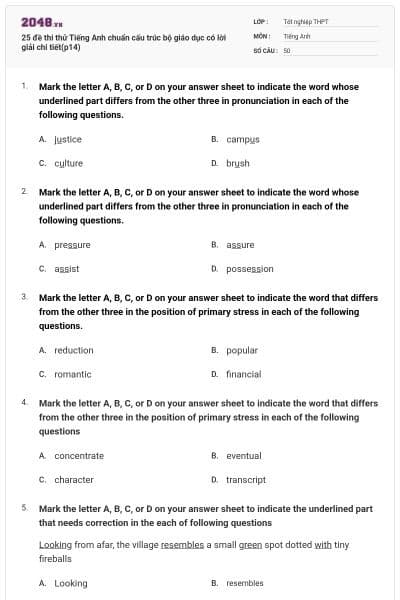
Mark the letter A, B, C, or D on your answer sheet to indicate the word whose underlined part differs from the other three in pronunciation in each of the following questions.
justice
campus
culture
brush
Đáp án B
Từ “campus” có phần gạch chân phát âm là /ə/
Các từ còn lại có phần gạch chân phát âm là /ʌ/
Mark the letter A, B, C, or D on your answer sheet to indicate the word whose underlined part differs from the other three in pronunciation in each of the following questions.
pressure
assure
assist
possession
Đáp án C
Từ “assist” có phần gạch chân phát âm là /s/
Các từ còn lại có phần gạch chân phát âm là /ʃ/
Mark the letter A, B, C, or D on your answer sheet to indicate the word that differs from the other three in the position of primary stress in each of the following questions.
reduction
popular
romantic
financial
Đáp án B
Từ “popular” có trọng âm rơi vào âm tiết thứ nhất
Các từ còn lại có trọng âm rơi vào âm tiết thứ hai
Mark the letter A, B, C, or D on your answer sheet to indicate the word that differs from the other three in the position of primary stress in each of the following questions
concentrate
eventual
character
transcript
Đáp án B
Từ “eventual” có trọng âm rơi vào âm tiết thứ hai
Các từ còn lại có trọng âm rơi vào âm tiết thứ nhất
Mark the letter A, B, C, or D on your answer sheet to indicate the underlined part that needs correction in the each of following questions
Looking from afar, the village resembles a small green spot dotted with tiny fireballs
Looking
resembles
green
with
Đáp án A
Khi 2 mệnh đề cùng chủ ngữ, ta có thể rút gọn mệnh đề trước bằng V-ing (HTPT) nếu mang nghĩa chủ động hoặc PII (QKPT) nếu mang nghĩa bị động.
Câu mang nghĩa bị động →A là đáp án sai
Chữa lỗi: Looking →Looked
Dịch: Khi được nhìn từ xa, ngôi làng giống như một quả cầu lửa với những đốm nhỏ màu xanh lá cây
nằm rải rác
Mark the letter A, B, C, or D on your answer sheet to indicate the underlined part that needs correction in the each of following questions
When the chemicals inside a cell no longer produce ions, the cell stops to function
When
inside
no longer
to function
Đáp án D
Stop + V-ing: dừng làm việc gì
Stop + to V: dừng (làm gì) để làm gì
Chữa lỗi: to function → functioning
Dịch: Khi các thành phần hóa học bên trong của một tế bào không sản xuất ra các ion, tế bào đó sẽ ngừng hoạt động.
Mark the letter A, B, C, or D on your answer sheet to indicate the underlined part that needs correction in the each of following questions
I can’t stand make noise in class. Would you please do something more useful?
make
Would
something
useful
Đáp án A
Can’t stand + V-ing: không thể chịu được việc gì
Chữa lỗi: make → making
Dịch: Tôi không thể chịu nổi việc gây ồn ào trong lớp. Làm ơn làm thứ gì đó có ích hơn được không?
Mark the letter A, B, C, or D on your answer sheet to indicate the correct answer to each of the following questions
The Lake District, _______ was made a national park in 1951, attracts a large number of tourists every year.
that
where
what
which
Đáp án D
Thay thế cho N chỉ vật làm chủ ngữ → dùng “which”
Dịch: Lake District, được lập thành một vườn quốc gia vào năm 1951, thu hút một số lượng lớn khách du lịch mỗi năm
Mark the letter A, B, C, or D on your answer sheet to indicate the correct answer to each of the following questions
The _______ north we go, the less likely we are to meet high temperatures.
far
further
farther
farthest
Đáp án C
Dạng so sánh kép → loại A, D
Farther: dùng với một đặc tính tự nhiên, dùng để miêu tả cự ly địa lý (có thể quan sát, cảm nhận và tự đánh giá)
Further: dùng với nghĩa trừu tượng, dùng để chỉ mức độ hoặc không gian, thời gian,…
Dịch: Chúng ta càng đi xa hơn về phía Nam, chúng ta càng ít có khả năng gặp phải nhiệt độ cao
Mark the letter A, B, C, or D on your answer sheet to indicate the correct answer to each of the following questions
_______ the weather forecast, it will rain heavily later this morning.
On account of
According to
Due to
Because of
Đáp án B
On account of: trong trường hợp
According to sth: theo như cái gì
Due to + N: bởi vì (thường dùng với nghĩa tiêu cực)
Because of + N: bởi vì
Dịch: Theo như dự báo thời tiết, trời sẽ mưa lớn sau sáng nay
Mark the letter A, B, C, or D on your answer sheet to indicate the correct answer to each of the following questions
I _______ the bell three times when he answered the door.
had rung
rang
would ring
was ringing
Đáp án A
Diễn tả hành động xảy ra trước một hành động khác trong quá khứ → dùng thì QKHT
Dịch: Tôi đã nhấn chuông 3 lần khi anh ấy ra mở cửa
Mark the letter A, B, C, or D on your answer sheet to indicate the correct answer to each of the following questions
The ______ vegetation in the jungle made it difficult to spot snakes and lizards
heavy
elaborate
thick
lush
Đáp án C
Heavy (adj): nặng
Elaborate (adj): kỹ lưỡng
Thick (adj): dày, rậm rạp
Lush (adj): tươi tốt
Dịch: Thảm thực vật rậm rạp trong rừng làm cho khó phát hiện được những con rắn và những con thằn lằn.
Mark the letter A, B, C, or D on your answer sheet to indicate the correct answer to each of the following questions
“Do you like the weather here?” - “I wish it _______.”
doesn’t rain
didn’t rain
won’t rain
hadn’t rained
Đáp án B
Diễn tả mong muốn không đúng ở HT với “wish” → dùng thì QKĐ (“tobe” chia là “were” với mọi chủ ngữ)
Dịch: “Bạn có thích thời tiết ở đây không?” – “Tôi ước gì trời không mưa.”
Mark the letter A, B, C, or D on your answer sheet to indicate the correct answer to each of the following questions
She should have been here but she’s _______ flu
gone thought with
come in for
gone down with
come against
Đáp án: B
Giải thích:
A. go through sth: kiếm tra kĩ; trải qua việc gì đó.
Ex:
She went through the company’s account, looking for evidence of fraud: Cô ta kiểm tra kỹ tài khoản của công ty, tìm kiếm chứng cứ lừa đảo.
She’s been going through a bad patch recently: Cô ta vừa trải qua một vận đen lớn gần đây.
B. go down with sth: become sick/ ill (tiếng Anh-Anh)
Ex:
Your daughter has gone down with smallpox: Con gái của tôi đã mắc phải bệnh đậu mùa.
C. come in for with sth: chịu đựng cái gì.
Ex:
The publishing house has come in for a lot of criticism due to its new book: Nhà xuất bản đã hứng chịu rất nhiều chỉ trích vì cuốn sách mới của mình.
D. come up against sth (v): giải quyết, vượt qua khó khăn.
Ex:
We may find we come up against quite a lot of opposition from local people: Chúng tôi có thể thấy rằng chúng tôi phải đối mặt với khả nhiều sự phản đối từ người dân địa phương.
Đáp án chính xác là B. gone down with.
Dịch: Cô ấy đáng lẽ đã ở đây nhưng cô ấy lại bị cúm gà.
Mark the letter A, B, C, or D on your answer sheet to indicate the correct answer to each of the following questions
No sooner _______ my car than the alarm went off.
the thief had touched
had the thief touched
touched the thief
the thief touched
Đáp án B
Cấu trúc: No sooner + had + S + PII … than + S + V (past) …: vừa mới… thì…
Dịch: Tên trộm vừa mới chạm vào chiếc xe thì chuông cảnh báo reo lên
Mark the letter A, B, C, or D on your answer sheet to indicate the correct answer to each of the following questions
The doctor told him to keep _______ sweets and chocolate to lose weight
off
up
at
back
Đáp án A
Keep off: tránh xa
Keep up: giữ gìn
Keep at: kiên trì (làm việc)
Dịch: Bác sĩ bảo anh ấy tránh xa đồ ngọt và sô-cô-la để giảm cân
Mark the letter A, B, C, or D on your answer sheet to indicate the correct answer to each of the following questions
You _______ that book last year - it only came out two weeks ago
can’t have read
mustn’t have read
shouldn’t have red
needn’t have read
Đáp án A
Diễn tả dự đoán về một hành động, sự việc không thể xảy ra trong quá khứ → dùng “can’t have + PII”
Dịch: Bạn không thể nào đọc cuốn sách đó năm ngoái được – nó mới chỉ xuất bản 2 tuần trước thôi
Mark the letter A, B, C, or D on your answer sheet to indicate the correct answer to each of the following questions
Are you having a _______ exam before you sit the actual exam in July?
fake
false
mock
counterfeit
Đáp án C
Mock test/ exam: kỳ thi thử
Fake (n): vật làm giả, đồ giả mạo
False (adj): sai, nhầm/ không thật, giả
Counterfeit (adj): giả, giả mạo (counterfeit money: tiền giả)
Dịch: Bạn sẽ có một kỳ thi thử trước khi bạn thi kỳ thi chính thức vào tháng Bảy đúng không?
Mark the letter A, B, C, or D on your answer sheet to indicate the correct answer to each of the following questions
There should be an international law against _______.
reforestation
forestry
deforestation
afforestation
Đáp án C
Reforestation (n): tái trồng rừng
Forestry (n): lâm nghiệp
Deforestation (n): nạn phá rừng
Afforestation (n): rừng
Dịch: Nên có một bộ luật quốc tế chống nạn phá rừng
Mark the letter A, B, C, or D on your answer sheet to indicate the most suitable response to complete each of the following exchanges.
Bob: “Our team has just won the last football match.”
Michael: “_______!”
Good idea. Thanks for the news
Yes. I guess it’s very good
Well, that’s very surprising
Yes, it’s our pleasure
Đáp án C
Bob: “Đội của chúng ta đã thắng trận đá bóng chung kết rồi.”
Michael: “Ồ, thật là đáng ngạc nhiên!”
Mark the letter A, B, C, or D on your answer sheet to indicate the most suitable response to complete each of the following exchanges.
“_______” - “Oh, it’s great!”
How is the English competition like?
Would you like the English competition?
What do you like about the English competition?
What do you think of the English competition?
Đáp án D
“Bạn nghĩ gì về kỳ thi tiếng Anh?” – “Oh, nó thật tuyệt!”
Mark the letter A, B, C, or D on your answer sheet to indicate the word(s) CLOSEST in meaning to the underlined word(s) in each of the following questions
The introduction of credit cards radically modified North Americans’ spending habits
reduced
altered
resolved
devoted
Đáp án B
Modify (v) ~ alter (v): thay đổi
Reduce (v): giảm
Resolve (v): quyết định
Devote (v): cống hiến
Dịch: Sự ra đời của thẻ tín dụng đã làm thay đổi hoàn toàn thói quen chi tiêu của những người Bắc Mỹ
Mark the letter A, B, C, or D on your answer sheet to indicate the word(s) CLOSEST in meaning to the underlined word(s) in each of the following questions.
The bread has become stale and I cannot swallow it
gone away
gone down
gone up
gone off
Đáp án: D
Giải thích:
Kiến thức: Từ vựng – Từ đồng nghĩa
stale (adj): ôi, không tươi (thường dùng cho đồ ăn, bánh mì, bánh ngọt)
Xét các đáp án:
A. go away: rời đi
B. go down: giảm xuống
C. go up: tăng lên
D. go off: hỏng, không còn tươi (thức ăn)
→ stale = go off
Dịch: Bánh mì đã trở nên ôi thiu và tôi không thể nuốt được nó.
Mark the letter A, B, C, or D on your answer sheet to indicate the word(s) OPPOSITE in meaning to the underlined word(s) in each of the following questions
She came for Christmas laden with gifts for everyone.
later
provided
unloaded
lifted
Đáp án C
Lade (v): mang theo, chất đầy >< unload (v): dỡ bỏ
Later (adv): sau đó
Provide (v): cung cấp
Lift (v): nhấc
Dịch: Cô ấy đến vào Giáng Sinh mang theo những món quà cho mọi người
Mark the letter A, B, C, or D on your answer sheet to indicate the word(s) OPPOSITE in meaning to the underlined word(s) in each of the following questions.
Population growth rates vary among regions and even among countries within the same region
restrain
stay unchanged
remain unstable
fluctuate
Đáp án B
Vary (v): khác nhau, thay đổi >< Stay unchanged: giữ nguyên, không thay đổi
Restrain (v): giữ lại, ngăn lại
Remain unstable: luôn không ổn định
Fluctuate (v): biến động, thay đổi
Dịch: Tỷ lệ gia tăng dân số khác nhau giữa các vùng miền và thậm chí giữa các đất nước ở trong cùng một vùng.
Mark the letter A, B, C, or D on your answer sheet to indicate the sentence that is closest in meaning to each of the following questions
While I strongly disapproved of your behavior, I will help you this time.
Despite of my strong disapproval of your behavior, I will help you this time.
Although I strongly disapproved of your behavior, but I will help you this time.
Because of your behavior, I will help you this time.
Despite my strong disapproval of your behavior, I will help you this time
Đáp án D
Đề: Trong khi tôi hoàn toàn không tán thành về thái độ của bạn, tôi vẫn sẽ giúp bạn thời gian này.
Đáp án C không hợp nghĩa → loại C
Although + SVO, SVO…: mặc dù …, nhưng… → loại B (thừa “but”)
Despite + N/ V-ing, SVO…: Mặc dù…, nhưng… → chọn D
Dịch: Mặc phù sự hoàn toàn không tán thành của tôi về thái độ của bạn, tôi vẫn sẽ giúp bạn thời gian này
Mark the letter A, B, C, or D on your answer sheet to indicate the correct answer to each of the following questions
Nothing but the whole story would satisfy Jane
Jane wouldn’t be satisfied with anything.
Jane insisted on being told the complete story.
On the whole, Jane was satisfied with the story.
Jane wanted to know just the end of the story.
Đáp án: B
Giải thích:
Dịch: Không có gì ngoài toàn bộ câu chuyện có thể làm Jane hài lòng.
A. Jane sẽ không hài lòng với bất cứ điều gì.
B. Jane khăng khăng muốn được kể toàn bộ câu chuyện.
C. Nhìn chung, Jane hài lòng với câu chuyện.
D. Jane chỉ muốn biết kết thúc của câu chuyện.
Dựa vào nghĩa, chọn B.
Mark the letter A, B, C, or D on your answer sheet to indicate the correct answer to each of the following questions
Mary might have phoned while we were out
Possibly Mary phoned while we were out.
Unfortunately we were out while Mary phoned.
We were sure Mary had phoned while we were out.
Mary ought to have phoned while we were out
Đáp án A
Đề: Mary có thể đã gọi điện đến khi chúng ta đi ra ngoài.
Cấu trúc: might + have + PII: có thể đã làm gì (diễn tả dự đoán có thể xảy ra trong QK)
→ các đáp án B, C, D đều không hợp nghĩa
Dịch: Có thể Mary đã gọi điện đến khi chúng ta đi ra ngoài
Mark the letter A, B, C, or D on your answer sheet to indicate the sentence that best combines each pair of sentences in the following questions.
The student next to me kept chewing gum. That bothered me a lot.
The student next to me kept chewing gum, that bothered me a lot.
The student next to me kept chewing gum, which bothered me a lot.
The student next to me kept chewing gum bothering me a lot.
The student next to me kept chewing gum bothered me a lot
Đáp án B
Đề: Cậu học sinh bên cạnh tôi cứ nhai kẹo cao su. Điều đó đã làm phiền tôi rất nhiều.
Nối 2 câu bằng mệnh đề quan hệ, ta dùng “which” để thay thế cho mệnh đề trước dấu phẩy
Dịch: Cậu học sinh bên cạnh tôi cứ nhai kẹo cao su, mà điều đó đã làm phiền tôi rất nhiều.
Mark the letter A, B, C, or D on your answer sheet to indicate the sentence that best combines each pair of sentences in the following questions
The police issued a warning on the radio. A dangerous man had escaped from hospital.
A dangerous man had escaped from hospital, so the police issued a warning on the radio.
The police issued a warning on the radio about a dangerous man had escaped from hospital.
The police issued a warning on the radio, namely, a dangerous man had escaped from hospital
A dangerous man had escaped from hospital where the police issued a warning on the radio
Đáp án A
Đề: Cảnh sát đã đưa ra một cảnh báo trên đài phát thanh. Một người đàn ông nguy hiểm đã trốn thoát khỏi bệnh viện.
Các đáp án B, C, D không đúng nghĩa → chọn A
Dịch: Một người đàn ông nguy hiểm đã trốn thoát khỏi bệnh viện, vì vậy cảnh sát đã đưa ra một lời cảnh báo trên đài phát thanh.
Read the following passage and mark the letter A, B, C, or D on your answer sheet to indicate the correct word or phrase that best fits each of the numbered blanks from 31 to 35.
Early writing and Alphabets
When people first began to write, they did not use an alphabet. Instead, they drew small pictures to (31) _______ the objects they were writing about. This was very slow because there was a different picture for any word.
The Ancient Egyptians had a system of picture writing that was described hieroglyphics. The meaning of this writing was forgotten for a very long time but in 1799 some scientists (32) _______ a stone near Alexandria, in Egypt. The stone had been there for (33) _______ a thousand years. It had both Greek and hieroglyphics on it and researchers were finally able to understand what the hieroglyphics meant.
An alphabet is quite different from picture writing. It (34) _______ of letters or symbols that represent a sound and each sound is just part of one word. The Phoenicians, who lived about 3,000 years ago, developed the modern alphabets. It was later improved by the Roman’s and this alphabet is now used (35) _______ throughout the world.
Điền câu 31
notice
show
appear
mark
Đáp án B
Notice (v): chú ý
Show (v): cho biết, chỉ ra
Appear (v): có vẻ, giống như
Mark (v): đánh dấu
Dịch: “… Thay vào đó, họ vẽ những bức vẽ nhỏ để chỉ ra những vật thể mà họ đang viết…”
Read the following passage and mark the letter A, B, C, or D on your answer sheet to indicate the correct word or phrase that best fits each of the numbered blanks from 31 to 35.
Early writing and Alphabets
When people first began to write, they did not use an alphabet. Instead, they drew small pictures to (31) _______ the objects they were writing about. This was very slow because there was a different picture for any word.
The Ancient Egyptians had a system of picture writing that was described hieroglyphics. The meaning of this writing was forgotten for a very long time but in 1799 some scientists (32) _______ a stone near Alexandria, in Egypt. The stone had been there for (33) _______ a thousand years. It had both Greek and hieroglyphics on it and researchers were finally able to understand what the hieroglyphics meant.
An alphabet is quite different from picture writing. It (34) _______ of letters or symbols that represent a sound and each sound is just part of one word. The Phoenicians, who lived about 3,000 years ago, developed the modern alphabets. It was later improved by the Roman’s and this alphabet is now used (35) _______ throughout the world.
Điền câu 32
discovered
realized
delivered
invented
Đáp án A
Discover (v): khám phá, phát hiện
Realize (v): nhận ra
Deliver (v): phân phát
Invent (v): phát minh, sáng chế
Dịch: “… Ý nghĩa của bài viết này đã bị lãng quên suốt một thời gian dài nhưng vào năm 1799 một số nhà khoa học đã phát hiện ra một tảng đá gần Alexandria, ở Ai Cập…”
Read the following passage and mark the letter A, B, C, or D on your answer sheet to indicate the correct word or phrase that best fits each of the numbered blanks from 31 to 35.
Early writing and Alphabets
When people first began to write, they did not use an alphabet. Instead, they drew small pictures to (31) _______ the objects they were writing about. This was very slow because there was a different picture for any word.
The Ancient Egyptians had a system of picture writing that was described hieroglyphics. The meaning of this writing was forgotten for a very long time but in 1799 some scientists (32) _______ a stone near Alexandria, in Egypt. The stone had been there for (33) _______ a thousand years. It had both Greek and hieroglyphics on it and researchers were finally able to understand what the hieroglyphics meant.
An alphabet is quite different from picture writing. It (34) _______ of letters or symbols that represent a sound and each sound is just part of one word. The Phoenicians, who lived about 3,000 years ago, developed the modern alphabets. It was later improved by the Roman’s and this alphabet is now used (35) _______ throughout the world.
Điền câu 33
quite
more
over
already
Đáp án C
Over + a period of time: hơn …
Dịch: “… Tảng đá đã ở đó khoảng hơn 6 nghìn năm…”
Read the following passage and mark the letter A, B, C, or D on your answer sheet to indicate the correct word or phrase that best fits each of the numbered blanks from 31 to 35.
Early writing and Alphabets
When people first began to write, they did not use an alphabet. Instead, they drew small pictures to (31) _______ the objects they were writing about. This was very slow because there was a different picture for any word.
The Ancient Egyptians had a system of picture writing that was described hieroglyphics. The meaning of this writing was forgotten for a very long time but in 1799 some scientists (32) _______ a stone near Alexandria, in Egypt. The stone had been there for (33) _______ a thousand years. It had both Greek and hieroglyphics on it and researchers were finally able to understand what the hieroglyphics meant.
An alphabet is quite different from picture writing. It (34) _______ of letters or symbols that represent a sound and each sound is just part of one word. The Phoenicians, who lived about 3,000 years ago, developed the modern alphabets. It was later improved by the Roman’s and this alphabet is now used (35) _______ throughout the world.
Điền câu 34
consistsof
includes
contains
involves
Đáp án A
Consist of: bao gồm
Dịch: “… Nó bao gồm nhiều ký tự hoặc biểu tượng mà thể hiện một âm thanh và mỗi âm thanh chỉ là một phần của một từ…”
Read the following passage and mark the letter A, B, C, or D on your answer sheet to indicate the correct word or phrase that best fits each of the numbered blanks from 31 to 35.
Early writing and Alphabets
When people first began to write, they did not use an alphabet. Instead, they drew small pictures to (31) _______ the objects they were writing about. This was very slow because there was a different picture for any word.
The Ancient Egyptians had a system of picture writing that was described hieroglyphics. The meaning of this writing was forgotten for a very long time but in 1799 some scientists (32) _______ a stone near Alexandria, in Egypt. The stone had been there for (33) _______ a thousand years. It had both Greek and hieroglyphics on it and researchers were finally able to understand what the hieroglyphics meant.
An alphabet is quite different from picture writing. It (34) _______ of letters or symbols that represent a sound and each sound is just part of one word. The Phoenicians, who lived about 3,000 years ago, developed the modern alphabets. It was later improved by the Roman’s and this alphabet is now used (35) _______ throughout the world.
Điền câu 35
broadly
widely
deeply
hugely
Đáp án B
Broadly (adv): chung, đại khái, đại thể
Widely (adv): một cách rộng rãi
Deeply (adv): một cách sâu sắc
Hugely (adv): rất đỗi, hết sức
Dịch: “… bảng chữ cái này hiện đang được sử dụng một cách rộng rãi khắp thế giới.”
Read the following passage and mark the letter A, B, C, or D on your answer sheet to indicate the correct answer to each of the questions from 36 to 42.
Homing pigeons are placed in a training program from about the time they are twenty-eight days of age. They are taught to enter the loft through a trap and to exercise above and around the loft, and gradually they are taken away for short distances in wicker baskets and released. They are then expected to find their way home in the shortest possible time.
In their training flights or in actual races, the birds are taken to prearranged distant points and released to find their way back to their own lofts. Once the birds are liberated, their owners, who are standing by at the home lofts, anxiously watch the sky for the return of their entries. Since time is of the essence, the speed with which the birds can be induced to enter the loft trap may make the difference between gaining a win or a second place.
The head of a homing pigeon is comparatively small, but its brain is one quarter larger than that of the ordinary pigeon. The homing pigeon is very intelligent and will persevere to the point of stubbornness some have been known to fly a hundred miles off course to avoid a storm.
Some homing pigeon experts claim that this bird is gifted with a form of built-in radar that helps it find its own loft after hours of flight, for hidden under the head feathers are two very sensitive ears, while the sharp, prominent eyes can see great distances in daytime.
Why do homing pigeons fly home? They are not unique in this inherent skill: it is found in most migratory birds, in bees, ants, toads, and even turtles, which have been known to travel hundreds of miles to return to their homes. But in the animal world, the homing pigeon alone can be trusted with its freedom and trained to carry out the missions that people demand
What is the purpose of the passage?
To convince the reader to buy a homing pigeon
To inform the reader about homing pigeons and their training
To protect homing pigeons against the threat of extinction
To encourage the owners of homing pigeons to set the birds free
Đáp án B
Nội dung bài xoay quanh những đặc điểm của chim bồ câu dẫn đường và quá trình huấn luyện chúng
→ chọn B. Mục tiêu của bài viết là để thông tin cho người đọc về chim bồ câu dẫn đường và sự huấn luyện của chúng.
Read the following passage and mark the letter A, B, C, or D on your answer sheet to indicate the correct answer to each of the questions from 36 to 42.
Homing pigeons are placed in a training program from about the time they are twenty-eight days of age. They are taught to enter the loft through a trap and to exercise above and around the loft, and gradually they are taken away for short distances in wicker baskets and released. They are then expected to find their way home in the shortest possible time.
In their training flights or in actual races, the birds are taken to prearranged distant points and released to find their way back to their own lofts. Once the birds are liberated, their owners, who are standing by at the home lofts, anxiously watch the sky for the return of their entries. Since time is of the essence, the speed with which the birds can be induced to enter the loft trap may make the difference between gaining a win or a second place.
The head of a homing pigeon is comparatively small, but its brain is one quarter larger than that of the ordinary pigeon. The homing pigeon is very intelligent and will persevere to the point of stubbornness some have been known to fly a hundred miles off course to avoid a storm.
Some homing pigeon experts claim that this bird is gifted with a form of built-in radar that helps it find its own loft after hours of flight, for hidden under the head feathers are two very sensitive ears, while the sharp, prominent eyes can see great distances in daytime.
Why do homing pigeons fly home? They are not unique in this inherent skill: it is found in most migratory birds, in bees, ants, toads, and even turtles, which have been known to travel hundreds of miles to return to their homes. But in the animal world, the homing pigeon alone can be trusted with its freedom and trained to carry out the missions that people demand
According to the passage, what happens to homing pigeons when they are about a month old?
They are kept in a trap.
They enter their first race.
They begin a training program
They get their wings clipped and marked
Đáp án C
Thông tin trong bài “Homing pigeons are placed in a training program from about the time they are twenty-eight days of age”
→ Khi chim bồ câu dẫn đường được khoảng một tháng tuổi, chúng sẽ bắt đầu một quá trình huấn luyện.
In line 7, when the author states that the owners "anxiously watch the sky" there is
want their pigeon to win the race
are sending radar signals to their pigeons
do not know whether the race began on time
do not trust the rules set down by the judges
Đáp án A
Thông tin trong bài “In their training flights or in actual races, the birds are taken to prearranged distant points and released to find their way back to their own lofts. Once the birds are liberated, their owners, who are standing by at the home lofts, anxiously watch the sky for the return of their entries”
→ tác giả chỉ ra rằng chủ nhân những con chim muốn chúng thắng cuộc đua khi nhìn một cách lo lắng lên bầu trời
Read the following passage and mark the letter A, B, C, or D on your answer sheet to indicate the correct answer to each of the questions from 36 to 42.
Homing pigeons are placed in a training program from about the time they are twenty-eight days of age. They are taught to enter the loft through a trap and to exercise above and around the loft, and gradually they are taken away for short distances in wicker baskets and released. They are then expected to find their way home in the shortest possible time.
In their training flights or in actual races, the birds are taken to prearranged distant points and released to find their way back to their own lofts. Once the birds are liberated, their owners, who are standing by at the home lofts, anxiously watch the sky for the return of their entries. Since time is of the essence, the speed with which the birds can be induced to enter the loft trap may make the difference between gaining a win or a second place.
The head of a homing pigeon is comparatively small, but its brain is one quarter larger than that of the ordinary pigeon. The homing pigeon is very intelligent and will persevere to the point of stubbornness some have been known to fly a hundred miles off course to avoid a storm.
Some homing pigeon experts claim that this bird is gifted with a form of built-in radar that helps it find its own loft after hours of flight, for hidden under the head feathers are two very sensitive ears, while the sharp, prominent eyes can see great distances in daytime.
Why do homing pigeons fly home? They are not unique in this inherent skill: it is found in most migratory birds, in bees, ants, toads, and even turtles, which have been known to travel hundreds of miles to return to their homes. But in the animal world, the homing pigeon alone can be trusted with its freedom and trained to carry out the missions that people demand
According to the passage, what is the difference between a homing pigeon and an ordinary one?
The span of the wings
The shape of the eyes
The texture of the feathers
The size of the brain
Đáp án D
Thông tin trong bài “The head of a homing pigeon is comparatively small, but its brain is one quarter larger than that of the ordinary pigeon”
→ sự khác nhau giữa chim bồ câu dẫn đường và chim bồ câu thông thường chính là kích thước của bộ não
Read the following passage and mark the letter A, B, C, or D on your answer sheet to indicate the correct answer to each of the questions from 36 to 42.
Homing pigeons are placed in a training program from about the time they are twenty-eight days of age. They are taught to enter the loft through a trap and to exercise above and around the loft, and gradually they are taken away for short distances in wicker baskets and released. They are then expected to find their way home in the shortest possible time.
In their training flights or in actual races, the birds are taken to prearranged distant points and released to find their way back to their own lofts. Once the birds are liberated, their owners, who are standing by at the home lofts, anxiously watch the sky for the return of their entries. Since time is of the essence, the speed with which the birds can be induced to enter the loft trap may make the difference between gaining a win or a second place.
The head of a homing pigeon is comparatively small, but its brain is one quarter larger than that of the ordinary pigeon. The homing pigeon is very intelligent and will persevere to the point of stubbornness some have been known to fly a hundred miles off course to avoid a storm.
Some homing pigeon experts claim that this bird is gifted with a form of built-in radar that helps it find its own loft after hours of flight, for hidden under the head feathers are two very sensitive ears, while the sharp, prominent eyes can see great distances in daytime.
Why do homing pigeons fly home? They are not unique in this inherent skill: it is found in most migratory birds, in bees, ants, toads, and even turtles, which have been known to travel hundreds of miles to return to their homes. But in the animal world, the homing pigeon alone can be trusted with its freedom and trained to carry out the missions that people demand
The author mentions all of the following at tributes that enable a homing pigeon to return home EXCEPT
instinct
air sacs
sensitive ears
good eyes
Đáp án B
Thông tin trong bài “…for hidden under the head feathers are two very sensitive ears, while the sharp, prominent eyes can see great distances in daytime” và “They are not unique in this inherent skill”
→ Một đôi tai nhạy cảm, một đôi mắt tốt và bản tính vốn có đã giúp chim bồ câu dẫn đường trở về nhà.
→ Đáp án B không được đề cập → chọn B
Read the following passage and mark the letter A, B, C, or D on your answer sheet to indicate the correct answer to each of the questions from 36 to 42.
Homing pigeons are placed in a training program from about the time they are twenty-eight days of age. They are taught to enter the loft through a trap and to exercise above and around the loft, and gradually they are taken away for short distances in wicker baskets and released. They are then expected to find their way home in the shortest possible time.
In their training flights or in actual races, the birds are taken to prearranged distant points and released to find their way back to their own lofts. Once the birds are liberated, their owners, who are standing by at the home lofts, anxiously watch the sky for the return of their entries. Since time is of the essence, the speed with which the birds can be induced to enter the loft trap may make the difference between gaining a win or a second place.
The head of a homing pigeon is comparatively small, but its brain is one quarter larger than that of the ordinary pigeon. The homing pigeon is very intelligent and will persevere to the point of stubbornness some have been known to fly a hundred miles off course to avoid a storm.
Some homing pigeon experts claim that this bird is gifted with a form of built-in radar that helps it find its own loft after hours of flight, for hidden under the head feathers are two very sensitive ears, while the sharp, prominent eyes can see great distances in daytime.
Why do homing pigeons fly home? They are not unique in this inherent skill: it is found in most migratory birds, in bees, ants, toads, and even turtles, which have been known to travel hundreds of miles to return to their homes. But in the animal world, the homing pigeon alone can be trusted with its freedom and trained to carry out the missions that people demand
In line 12, the pronoun "it" refers to which of the following?
Radar
Bird
Loft
Form
Đáp án B
Câu trong bài “Some homing pigeon experts claim that this bird is gifted with a form of built-in radar that helps it find its own loft after hours of flight”
→ Đại từ “it” trong câu chính là đề cập đến danh từ “bird”
Read the following passage and mark the letter A, B, C, or D on your answer sheet to indicate the correct answer to each of the questions from 36 to 42.
Homing pigeons are placed in a training program from about the time they are twenty-eight days of age. They are taught to enter the loft through a trap and to exercise above and around the loft, and gradually they are taken away for short distances in wicker baskets and released. They are then expected to find their way home in the shortest possible time.
In their training flights or in actual races, the birds are taken to prearranged distant points and released to find their way back to their own lofts. Once the birds are liberated, their owners, who are standing by at the home lofts, anxiously watch the sky for the return of their entries. Since time is of the essence, the speed with which the birds can be induced to enter the loft trap may make the difference between gaining a win or a second place.
The head of a homing pigeon is comparatively small, but its brain is one quarter larger than that of the ordinary pigeon. The homing pigeon is very intelligent and will persevere to the point of stubbornness some have been known to fly a hundred miles off course to avoid a storm.
Some homing pigeon experts claim that this bird is gifted with a form of built-in radar that helps it find its own loft after hours of flight, for hidden under the head feathers are two very sensitive ears, while the sharp, prominent eyes can see great distances in daytime.
Why do homing pigeons fly home? They are not unique in this inherent skill: it is found in most migratory birds, in bees, ants, toads, and even turtles, which have been known to travel hundreds of miles to return to their homes. But in the animal world, the homing pigeon alone can be trusted with its freedom and trained to carry out the missions that people demand
Why does the author mention bees, ants, toads, and turtles in the last paragraph?
To describe some unusual kinds of pets
To measure distances traveled by various animals
To compare their home-finding abilities with those of homing pigeons
To interest the reader in learning about other animals
Đáp án C
Thông tin trong bài “Why do homing pigeons fly home? They are not unique … the missions that people demand.”
→ tác giả đề cập đến những loài động vật khác nhằm so sánh khả năng tìm đường về nhà của chúng với khả năng tìm đường về nhà của chim bồ câu dẫn đường
Read the following passage and mark the letter A, B, C, or D on your answer sheet to indicate the correct answer to each of the questions from 43 to 50.
If the salinity of ocean waters is analyzed, it is found to vary only slightly from place to place. Nevertheless, some of these small changes are important. There are three basic processes that cause a change in oceanic salinity. One of these is the subtraction of water from the ocean by means of evaporation-conversion of liquid water to water vapor. In this manner, the salinity is increased, since the salts stay behind. If this is carried to the extreme, of course, white crystals of salt would be left behind: this, by the way, is how much of the table salt we use is actually obtained.
The opposite of evaporation is precipitation. such as rain, by which water is added to the ocean. Here the ocean is being diluted so that the salinity is decreased. This may occur in areas of high rainfall or in coastal regions where rivers flow into the ocean. Thus salinity may be increased by the subtraction of water by evaporation, or decreased by the addition of fresh water by precipitation or runoff.
Normally in tropical regions where the Sun is very strong, the ocean salinity is somewhat higher than it is in other parts of the world where there is not as much evaporation. Similarly, in coastal regions where rivers dilute the sea salinity is somewhat lower than in other oceanic areas.
A third process by which salinity may be altered is associated with the formation and melting of sea ice. When seawater is frozen, the dissolved materials are left behind. In this manner, seawater directly beneath freshly formed sea ice has a higher salinity than it did before the ice appeared. Of course, when this ice melts, it will tend to decrease the salinity of the surrounding water.
In the Weddell Sea, off Antarctica, the densest water in the oceans is formed as a result of this freezing process, which increases the salinity of cold water. This heavy water sinks and is found in the deeper portions of the oceans of the world
What does the passage mainly discuss?
The bodies of water of the world
The elements of salt
The many forms of ocean life
The salinity of ocean water
Đáp án D
Dựa vào câu mở đầu “If the salinity of ocean waters is analyzed, it is found to vary only slightly from place to place” và các thông tin được đề cập đến trong toàn đoạn văn → đoạn văn chủ yếu thảo luận về độ mặn của nước biển.
Read the following passage and mark the letter A, B, C, or D on your answer sheet to indicate the correct answer to each of the questions from 43 to 50.
If the salinity of ocean waters is analyzed, it is found to vary only slightly from place to place. Nevertheless, some of these small changes are important. There are three basic processes that cause a change in oceanic salinity. One of these is the subtraction of water from the ocean by means of evaporation-conversion of liquid water to water vapor. In this manner, the salinity is increased, since the salts stay behind. If this is carried to the extreme, of course, white crystals of salt would be left behind: this, by the way, is how much of the table salt we use is actually obtained.
The opposite of evaporation is precipitation. such as rain, by which water is added to the ocean. Here the ocean is being diluted so that the salinity is decreased. This may occur in areas of high rainfall or in coastal regions where rivers flow into the ocean. Thus salinity may be increased by the subtraction of water by evaporation, or decreased by the addition of fresh water by precipitation or runoff.
Normally in tropical regions where the Sun is very strong, the ocean salinity is somewhat higher than it is in other parts of the world where there is not as much evaporation. Similarly, in coastal regions where rivers dilute the sea salinity is somewhat lower than in other oceanic areas.
A third process by which salinity may be altered is associated with the formation and melting of sea ice. When seawater is frozen, the dissolved materials are left behind. In this manner, seawater directly beneath freshly formed sea ice has a higher salinity than it did before the ice appeared. Of course, when this ice melts, it will tend to decrease the salinity of the surrounding water.
In the Weddell Sea, off Antarctica, the densest water in the oceans is formed as a result of this freezing process, which increases the salinity of cold water. This heavy water sinks and is found in the deeper portions of the oceans of the world
According to the passage, the ocean generally has more salt in
coastal areas
tropical areas
rainy areas
turbulent areas
Đáp án B
Thông tin trong bài “Normally in tropical regions where the Sun is very strong, the ocean salinity is somewhat higher than it is in other parts of the world where there is not as much evaporation”
→ biển thông thường sẽ có nhiều muối hơn ở những khu vực nhiệt đới.
Read the following passage and mark the letter A, B, C, or D on your answer sheet to indicate the correct answer to each of the questions from 43 to 50.
If the salinity of ocean waters is analyzed, it is found to vary only slightly from place to place. Nevertheless, some of these small changes are important. There are three basic processes that cause a change in oceanic salinity. One of these is the subtraction of water from the ocean by means of evaporation-conversion of liquid water to water vapor. In this manner, the salinity is increased, since the salts stay behind. If this is carried to the extreme, of course, white crystals of salt would be left behind: this, by the way, is how much of the table salt we use is actually obtained.
The opposite of evaporation is precipitation. such as rain, by which water is added to the ocean. Here the ocean is being diluted so that the salinity is decreased. This may occur in areas of high rainfall or in coastal regions where rivers flow into the ocean. Thus salinity may be increased by the subtraction of water by evaporation, or decreased by the addition of fresh water by precipitation or runoff.
Normally in tropical regions where the Sun is very strong, the ocean salinity is somewhat higher than it is in other parts of the world where there is not as much evaporation. Similarly, in coastal regions where rivers dilute the sea salinity is somewhat lower than in other oceanic areas.
A third process by which salinity may be altered is associated with the formation and melting of sea ice. When seawater is frozen, the dissolved materials are left behind. In this manner, seawater directly beneath freshly formed sea ice has a higher salinity than it did before the ice appeared. Of course, when this ice melts, it will tend to decrease the salinity of the surrounding water.
In the Weddell Sea, off Antarctica, the densest water in the oceans is formed as a result of this freezing process, which increases the salinity of cold water. This heavy water sinks and is found in the deeper portions of the oceans of the world
All of the following are processes that decrease salinity EXCEPT
evaporation
precipitation
runoff
melting
Đáp án A
Thông tin trong bài “… salinity may be increased by the subtraction of water by evaporation, or decreased by the addition of fresh water by precipitation or runoff…” và “when this ice melts, it will tend to decrease the salinity of the surrounding water”
→ Các đáp án B, C, D đều được đề cập đến là quá trình làm giảm độ mặn
Read the following passage and mark the letter A, B, C, or D on your answer sheet to indicate the correct answer to each of the questions from 43 to 50.
If the salinity of ocean waters is analyzed, it is found to vary only slightly from place to place. Nevertheless, some of these small changes are important. There are three basic processes that cause a change in oceanic salinity. One of these is the subtraction of water from the ocean by means of evaporation-conversion of liquid water to water vapor. In this manner, the salinity is increased, since the salts stay behind. If this is carried to the extreme, of course, white crystals of salt would be left behind: this, by the way, is how much of the table salt we use is actually obtained.
The opposite of evaporation is precipitation. such as rain, by which water is added to the ocean. Here the ocean is being diluted so that the salinity is decreased. This may occur in areas of high rainfall or in coastal regions where rivers flow into the ocean. Thus salinity may be increased by the subtraction of water by evaporation, or decreased by the addition of fresh water by precipitation or runoff.
Normally in tropical regions where the Sun is very strong, the ocean salinity is somewhat higher than it is in other parts of the world where there is not as much evaporation. Similarly, in coastal regions where rivers dilute the sea salinity is somewhat lower than in other oceanic areas.
A third process by which salinity may be altered is associated with the formation and melting of sea ice. When seawater is frozen, the dissolved materials are left behind. In this manner, seawater directly beneath freshly formed sea ice has a higher salinity than it did before the ice appeared. Of course, when this ice melts, it will tend to decrease the salinity of the surrounding water.
In the Weddell Sea, off Antarctica, the densest water in the oceans is formed as a result of this freezing process, which increases the salinity of cold water. This heavy water sinks and is found in the deeper portions of the oceans of the world
Which of the following statements about the salinity of a body of water can best be inferred from the passage?
The temperature of the water is the most important factor.
How quickly the water moves is directly related to the amount of alt.
Ocean salinity has little effect on sea life.
Various factors combine to cause variations in the salt content of water.
Đáp án D
Dựa vào các thông tin được đề cập trong đoạn văn → có thể suy ra rằng có nhiều nhân tố kết hợp lại để gây ra sự thay đổi lượng muối trong nước biển.
Read the following passage and mark the letter A, B, C, or D on your answer sheet to indicate the correct answer to each of the questions from 43 to 50.
If the salinity of ocean waters is analyzed, it is found to vary only slightly from place to place. Nevertheless, some of these small changes are important. There are three basic processes that cause a change in oceanic salinity. One of these is the subtraction of water from the ocean by means of evaporation-conversion of liquid water to water vapor. In this manner, the salinity is increased, since the salts stay behind. If this is carried to the extreme, of course, white crystals of salt would be left behind: this, by the way, is how much of the table salt we use is actually obtained.
The opposite of evaporation is precipitation. such as rain, by which water is added to the ocean. Here the ocean is being diluted so that the salinity is decreased. This may occur in areas of high rainfall or in coastal regions where rivers flow into the ocean. Thus salinity may be increased by the subtraction of water by evaporation, or decreased by the addition of fresh water by precipitation or runoff.
Normally in tropical regions where the Sun is very strong, the ocean salinity is somewhat higher than it is in other parts of the world where there is not as much evaporation. Similarly, in coastal regions where rivers dilute the sea salinity is somewhat lower than in other oceanic areas.
A third process by which salinity may be altered is associated with the formation and melting of sea ice. When seawater is frozen, the dissolved materials are left behind. In this manner, seawater directly beneath freshly formed sea ice has a higher salinity than it did before the ice appeared. Of course, when this ice melts, it will tend to decrease the salinity of the surrounding water.
In the Weddell Sea, off Antarctica, the densest water in the oceans is formed as a result of this freezing process, which increases the salinity of cold water. This heavy water sinks and is found in the deeper portions of the oceans of the world.
The word "it" in line 16 refers to which of the following?
Sea ice
Salinity
Seawater
Manner
Đáp án C
Thông tin trong bài “… seawater directly beneath freshly formed sea ice has a higher salinity than it did before the ice appeared”
→ từ “it” chính là dạng thay thế của danh từ “seawater”
Read the following passage and mark the letter A, B, C, or D on your answer sheet to indicate the correct answer to each of the questions from 43 to 50.
If the salinity of ocean waters is analyzed, it is found to vary only slightly from place to place. Nevertheless, some of these small changes are important. There are three basic processes that cause a change in oceanic salinity. One of these is the subtraction of water from the ocean by means of evaporation-conversion of liquid water to water vapor. In this manner, the salinity is increased, since the salts stay behind. If this is carried to the extreme, of course, white crystals of salt would be left behind: this, by the way, is how much of the table salt we use is actually obtained.
The opposite of evaporation is precipitation. such as rain, by which water is added to the ocean. Here the ocean is being diluted so that the salinity is decreased. This may occur in areas of high rainfall or in coastal regions where rivers flow into the ocean. Thus salinity may be increased by the subtraction of water by evaporation, or decreased by the addition of fresh water by precipitation or runoff.
Normally in tropical regions where the Sun is very strong, the ocean salinity is somewhat higher than it is in other parts of the world where there is not as much evaporation. Similarly, in coastal regions where rivers dilute the sea salinity is somewhat lower than in other oceanic areas.
A third process by which salinity may be altered is associated with the formation and melting of sea ice. When seawater is frozen, the dissolved materials are left behind. In this manner, seawater directly beneath freshly formed sea ice has a higher salinity than it did before the ice appeared. Of course, when this ice melts, it will tend to decrease the salinity of the surrounding water.
In the Weddell Sea, off Antarctica, the densest water in the oceans is formed as a result of this freezing process, which increases the salinity of cold water. This heavy water sinks and is found in the deeper portions of the oceans of the world.
Why does the author mention the Weddell Sea?
To show that this body of water has salinity variations
To compare Antarctic waters with Arctic waters
To give an example of cold-water salinity
To point out the location of deep waters
Đáp án C
Dựa vào thông tin đề cập trong đoạn cuối → tác giả đề cập đến biển Weddell để cho ví dụ về độ mặn của nước lạnh
Read the following passage and mark the letter A, B, C, or D on your answer sheet to indicate the correct answer to each of the questions from 43 to 50.
If the salinity of ocean waters is analyzed, it is found to vary only slightly from place to place. Nevertheless, some of these small changes are important. There are three basic processes that cause a change in oceanic salinity. One of these is the subtraction of water from the ocean by means of evaporation-conversion of liquid water to water vapor. In this manner, the salinity is increased, since the salts stay behind. If this is carried to the extreme, of course, white crystals of salt would be left behind: this, by the way, is how much of the table salt we use is actually obtained.
The opposite of evaporation is precipitation. such as rain, by which water is added to the ocean. Here the ocean is being diluted so that the salinity is decreased. This may occur in areas of high rainfall or in coastal regions where rivers flow into the ocean. Thus salinity may be increased by the subtraction of water by evaporation, or decreased by the addition of fresh water by precipitation or runoff.
Normally in tropical regions where the Sun is very strong, the ocean salinity is somewhat higher than it is in other parts of the world where there is not as much evaporation. Similarly, in coastal regions where rivers dilute the sea salinity is somewhat lower than in other oceanic areas.
A third process by which salinity may be altered is associated with the formation and melting of sea ice. When seawater is frozen, the dissolved materials are left behind. In this manner, seawater directly beneath freshly formed sea ice has a higher salinity than it did before the ice appeared. Of course, when this ice melts, it will tend to decrease the salinity of the surrounding water.
In the Weddell Sea, off Antarctica, the densest water in the oceans is formed as a result of this freezing process, which increases the salinity of cold water. This heavy water sinks and is found in the deeper portions of the oceans of the world.
Which of the following is NOT a result of the formation of ocean ice?
The salt remains in the water
The surrounding water sinks
Water salinity decreases
The water becomes denser
Đáp án C
Thông tin trong đoạn cuối “…the densest water in the oceans is formed as a result of this freezing process, which increases the salinity of cold water. This heavy water sinks…”
→ sự hình thành băng ở biển KHÔNG làm giảm độ mặn của nước biển
Read the following passage and mark the letter A, B, C, or D on your answer sheet to indicate the correct answer to each of the questions from 43 to 50.
If the salinity of ocean waters is analyzed, it is found to vary only slightly from place to place. Nevertheless, some of these small changes are important. There are three basic processes that cause a change in oceanic salinity. One of these is the subtraction of water from the ocean by means of evaporation-conversion of liquid water to water vapor. In this manner, the salinity is increased, since the salts stay behind. If this is carried to the extreme, of course, white crystals of salt would be left behind: this, by the way, is how much of the table salt we use is actually obtained.
The opposite of evaporation is precipitation. such as rain, by which water is added to the ocean. Here the ocean is being diluted so that the salinity is decreased. This may occur in areas of high rainfall or in coastal regions where rivers flow into the ocean. Thus salinity may be increased by the subtraction of water by evaporation, or decreased by the addition of fresh water by precipitation or runoff.
Normally in tropical regions where the Sun is very strong, the ocean salinity is somewhat higher than it is in other parts of the world where there is not as much evaporation. Similarly, in coastal regions where rivers dilute the sea salinity is somewhat lower than in other oceanic areas.
A third process by which salinity may be altered is associated with the formation and melting of sea ice. When seawater is frozen, the dissolved materials are left behind. In this manner, seawater directly beneath freshly formed sea ice has a higher salinity than it did before the ice appeared. Of course, when this ice melts, it will tend to decrease the salinity of the surrounding water.
In the Weddell Sea, off Antarctica, the densest water in the oceans is formed as a result of this freezing process, which increases the salinity of cold water. This heavy water sinks and is found in the deeper portions of the oceans of the world.
What can be inferred about the water near the bottom of oceans?
It is relatively warm.
Its salinity is relatively high.
It does not move.
It is formed by melting sea ice
Đáp án B
Đoạn cuối của bài “In the Weddell Sea, off Antarctica, the densest water in the oceans is formed as a result of this freezing process, which increases the salinity of cold water. This heavy water sinks and is found in the deeper portions of the oceans of the world”
→ có thể suy ra rằng độ mặn của nước gần dưới đáy biển tương đối cao