25 đề thi thử Tiếng Anh chuẩn cấu trúc bộ giáo dục có lời giải chi tiết(p13)
50 câu hỏi
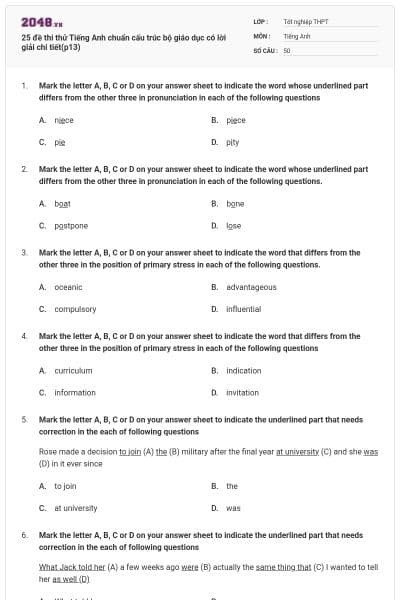
Mark the letter A, B, C or D on your answer sheet to indicate the word whose underlined part differs from the other three in pronunciation in each of the following questions
niece
piece
pie
pity
Đáp án C
Từ “pie” có phần gạch chân phát âm là /ai/
Các từ còn lại có phần gạch chân phát âm là /i:/
Mark the letter A, B, C or D on your answer sheet to indicate the word whose underlined part differs from the other three in pronunciation in each of the following questions.
boat
bone
postpone
lose
Đáp án D
Từ “lose” có phần gạch chân phát âm là /u:/
Các từ còn lại có phần gạch chân phát âm là /ou/
Mark the letter A, B, C or D on your answer sheet to indicate the word that differs from the other three in the position of primary stress in each of the following questions.
oceanic
advantageous
compulsory
influential
Đáp án C
A. oceanic /ouʃi’ænik/ thuộc đại dương (adj)
B. advantageous /,ædvən’teidʤəs/ có lợi (adj)
C. compulsory /kəm’pʌlsəri/ bắt buộc (adj)
D. influential /,influ’enʃəl/ có ảnh hưởng (adj)
Từ “compulsory” có trọng âm rơi vào âm tiết thứ hai
Các từ còn lại có trọng âm rơi vào âm tiết thứ ba
Mark the letter A, B, C or D on your answer sheet to indicate the word that differs from the other three in the position of primary stress in each of the following questions
curriculum
indication
information
invitation
Đáp án A
Từ “curriculum” có trọng âm rơi vào âm tiết thứ hai
Các từ còn lại có trọng âm rơi vào âm tiết thứ ba
Mark the letter A, B, C or D on your answer sheet to indicate the underlined part that needs correction in the each of following questions
Rose made a decision to join (A) the (B) military after the final year at university (C) and she was (D) in it ever since
to join
the
at university
was
Đáp án D
Có trạng từ “since” → thì HTHT
Chữa lỗi: was → has been
Dịch: Rose quyết định tham gia quân sự sau năm cuối tại đại học và ở đó kể từ đấy
Mark the letter A, B, C or D on your answer sheet to indicate the underlined part that needs correction in the each of following questions
What Jack told her (A) a few weeks ago were (B) actually the same thing that (C) I wanted to tell her as well (D)
What told her
were
same thing that
as well
Đáp án B
Chủ ngữ của câu là “what Jack told her” → chủ ngữ là N không đếm được
Chữa lỗi: were → was
Dịch: Những gì Jack đã nói với cô ấy một vài tuần trước cũng là những gì tôi muốn nói với cô ấy
Mark the letter A, B, C or D on your answer sheet to indicate the underlined part that needs correction in the each of following questions
In 1934, a group of experts (A) in Italy accidentally found that dogs could not precisely (B) see color with its (C) own eyes when they were born (D)
experts
precisely
its
were born
Đáp án C
Mệnh đề sau “that” đang đề cập đến đối tượng “dogs” là N số nhiều → dùng “its” không phù hợp
Chữa lỗi: its → their
Dịch: Năm 1934, một nhóm nhà chuyên gia ở Ý đã phát hiện ra rằng những con chó không thể nhìn thấy màu sắc khi chúng mới sinh
Mark the letter A, B, C or D on your answer sheet to indicate the correct answer to each of the following questions
As the child ________, Jack decided to go out silently
sleeps
has slept
sleep
was sleeping
Đáp án D
Dựa vào mệnh đề sau → câu ở thì QK đơn → chỉ đáp án D đúng.
Dịch: Vì đứa trẻ đang ngủ nên Jack quyết định đi ra ngoài, một cách nhẹ nhàng
Mark the letter A, B, C or D on your answer sheet to indicate the correct answer to each of the following questions
I’m scared ________ snakes, they terrify me
in
to
of
for
Đáp án C
Be scared of sth: sợ cái gì
Dịch: Tôi sợ rắn, chúng làm tôi kinh hãi
Mark the letter A, B, C or D on your answer sheet to indicate the correct answer to each of the following questions
We’ve already bought the house but won’t ________ it until May, when the present occupants have moved out
take possession of
catch sight of
keep tract of
gain recognition of
Đáp án A
Take possession of sth: chiếm hữu cái gì
Catch sight of sth: nhìn thấy, bắt gặp cái gì
Keep track of sth: theo dõi
Gain recognition of sth: được công nhận về cái gì
Dịch: Chúng tôi đã mua ngôi nhà đó nhưng sẽ không chiếm hữu nó cho đến tháng 5, khi người ở hiện tại đã chuyển đi
Mark the letter A, B, C or D on your answer sheet to indicate the correct answer to each of the following questions
Whenever he had an important decision to make, he ________ a cigar to calm his nerves
would light
would be lighting
would have lit
had lit
Đáp án: A
Giải thích:
Kiến thức: Thì của động từ
Khi muốn diễn tả một thói quen hay một việc sẽ làm trong quá khứ, ta sử dụng cấu trúc “would + V”.
Dịch: Mỗi khi anh ấy cần ra một quyết định quan trọng, anh ấy sẽ châm một điếu thuốc để trấn tĩnh tinh thần.
Mark the letter A, B, C or D on your answer sheet to indicate the correct answer to each of the following questions
You can stay here until your visa runs ________.
up
out
off
away
Đáp án B
Run out: hết (thời hạn)
Dịch: Bạn có thể ở lại đây cho đến khi visa của bạn hết hạn
Mark the letter A, B, C or D on your answer sheet to indicate the correct answer to each of the following questions
Is he looking for anything in ________?
special
detail
peculiar
particular
Đáp án D
In particular: đặc biệt
Dịch: Anh ấy đang tìm kiếm thứ gì đặc biệt à?
Mark the letter A, B, C or D on your answer sheet to indicate the correct answer to each of the following questions
________ more about her, you would never ask her to marry you
If you know
If you did know
If you knew
If did you know
Đáp án C
Dựa vào mệnh đề sau → câu ĐK loại II
Dịch: Nếu bạn biết nhiều hơn về cô ấy, bạn sẽ không bao giờ hỏi cưới cô ấy cả
Mark the letter A, B, C or D on your answer sheet to indicate the correct answer to each of the following questions
I got everyone in the company ________ my boss’s birthday card before I sent it to her
sign
to sign
signing
signed
Đáp án B
Get sb to V: nhờ, bảo ai làm gì
Dịch: Tôi bảo mọi người trong công ty ký tên vào thiệp mừng sinh nhật của sếp trước khi tôi gửi nó cho cô ấy
Mark the letter A, B, C or D on your answer sheet to indicate the correct answer to each of the following questions
A number of deaths in the last 3 months ________ caused by car accidents
were
have been
have
are
Đáp án B
A number of + N + V (chia ở dạng số nhiều)
The number of + N + V (chia ở dạng số ít)
Có trạng từ “in the last 3 months” → dùng thì HTHT
Dịch: Nhiều người bị chết trong 3 tháng qua được gây ra bởi tai nạn xe hơi
Mark the letter A, B, C or D on your answer sheet to indicate the correct answer to each of the following questions
Rose shouted as if she ________ a ghost.
has seen
had seen
would see
see
Đáp án B
Diễn tả sự việc không có thật ở QK với “as if” → dùng thì QKHT
Dịch: Rose hét lên như thể cô ấy vừa nhìn thấy ma vậy
Mark the letter A, B, C or D on your answer sheet to indicate the correct answer to each of the following questions
Be sure not to rely too ________ on your mother tongue when you are learning a foreign language
abundantly
severely
numerously
heavily
Đáp án D
Abundantly (adv): Phong phú
Severely (adv): Nghiêm trọng
Numerously (adv): nhiều
Heavily (adv): Nặng nề
Dịch: Đừng nên dựa vào tiếng mẹ đẻ nhiều quá khi học một ngoại ngữ
Mark the letter A, B, C or D on your answer sheet to indicate the correct answer to each of the following questions
He never lets anything ________ him and his weekend fishing trip
come among
come between
come up
come on
Đáp án B
Come between: gây sự tranh chấp, mâu thuẫn/ can thiệp vào
Come up: xảy ra
Come on: nhanh lên
Dịch: Anh ấy không bao giờ để bất cứ điều gì can thiệp vào giữa anh ấy và chuyến đi câu cá cuối tuần
Mark the letter A, B, C or D on your answer sheet to indicate the correct answer to each of the following questions
It is important that he ________ a gallon of water with him if he wants to hike to the bottom of the Grand Canyon
taking
takes
took
take
Đáp án D
Thể giả định: It’s important/ necessary/ essential… that + S +V(nguyên thể)
Dịch: Điều quan trọng là anh ta phải mang theo một ga-lông nước nếu anh ta muốn đi xuống đáy của hẻm núi Grand Canyon
Mark the letter A, B, C or D on your answer sheet to indicate the most suitable response to complete each of the following exchanges
“I wouldn’t do that if I were you.” – “________”
Wouldn’t you? Why?
It’s out of the question.
I’d rather you didn’t.
Would you, really?
Đáp án A
Dịch: “Tôi sẽ không làm điều đó nếu tôi là bạn.”
“Bạn sẽ không làm thế ư? Tại sao thế?”
Mark the letter A, B, C or D on your answer sheet to indicate the most suitable response to complete each of the following exchanges
- Assistant: “Is there anything I can do for you, sir?”
- Customer: “________”
Yes, you are welcome.
Not now. Thanks away.
Sure. Go ahead, please.
Ok! Your time.
Đáp án B
Dịch: - Người bán hàng: “Tôi có thể giúp gì cho ngài được không ạ?”
- Khách hàng: “Không phải lúc này. Dù gì cũng cảm ơn anh.”
Mark the letter A, B, C or D on your answer sheet to indicate the word(s) CLOSET in meaning to the underlined word(s) in each of the following questions
Unselfishness is the very essence of friendship
important part
difficult part
romantic part
interesting part
Đáp án A
- essence (n) ~ important part: bản chất, phần quan trọng
Dịch: Sự không ích kỷ là một phần rất quan trọng của tình bạn
Mark the letter A, B, C or D on your answer sheet to indicate the word(s) CLOSET in meaning to the underlined word(s) in each of the following questions
Why don’t you vote – how can you be so indifferent!
neutral
unkind
precious
mean
Đáp án A
- indifferent (adj) ~ neutral (adj): thờ ơ, lạnh lùng, trung lập
- unkind (adj): không tốt
- precious (adj): quý giá
- mean (adj): kiệt sỉ
Dịch: Tại sao bạn không bầu cử - tại sao bạn có thể trung lập như thế chứ!
Mark the letter A, B, C or D on your answer sheet to indicate the word(s) OPPOSITE in meaning to the underlined word(s) in each of the following questions
Rose clearly remembers talking to Jack in a chance conference last year
unplanned
deliberate
accidental
unintentional
Đáp án B
- a chance: tình cờ >< deliberate (adj): cố ý, có chủ tâm
- unplanned (adj): tình cờ, chưa được lên kế hoạch
- accidental (adj): tình cờ
- unintentional (adj): không có chủ ý
Dịch: Rose nhớ rõ rằng đã nói chuyện với Jack trong một buổi hội nghị tình cờ năm trước
Mark the letter A, B, C or D on your answer sheet to indicate the word(s) OPPOSITE in meaning to the underlined word(s) in each of the following questions.
In remote societies, it’s essential to replenish stocks before the winter sets in
remake
empty
refill
repeat
Đáp án B
- replenish (v): cung cấp thêm, làm cho đầy lại >< empty (v): làm cho trống rỗng
- remake (v): làm lại
- refill (v): đổ đầy lại
- repeat (v): nhắc lại
Dịch: Ở những vùng miền hẻo lánh, rất quan trọng để cung cấp thêm hàng hóa trước khi mùa đông bắt đầu.
Mark the letter A, B, C or D on your answer sheet to indicate the sentence that is closest in meaning to each of the following questions
It doesn’t matter to them which movie they go to
Whatever movies are shown, they never see.
They don’t mind which movie they go to.
They don’t care about the cost of the movies they see.
Which movie they go to matters more than the cost
Đáp án B
Đề: Không quan trọng đối với họ việc xem phim gì.
A. Bất cứ phim nào được chiếu, họ không bao giờ xem.
B. Họ không để tâm đến bộ phim nào họ sẽ xem.
C. Họ không quan tâm về giá cả của những bộ phim mà họ xem.
D. Việc bộ phim nào họ xem quan trọng hơn là giá cả.
Mark the letter A, B, C or D on your answer sheet to indicate the sentence that is closest in meaning to each of the following questions.
The judge was being escorted from the court by strong police guards
Strong police guards were escorting the judge at the court.
Strong police guards were escorting the judge into the court.
Strong police guards were escorting the judge from the court.
Strong police guards were escorting the judge towards the court.
Đáp án C
Đề: Quan tòa đang được hộ tống ra khỏi tòa án bởi những viên cảnh sát khỏe mạnh.
A. Những viên cảnh sát khỏe mạnh đang hộ tống quan tòa tại tòa án.
B. Những viên cảnh sát khỏe mạnh đang hộ tống quan tòa vào tòa án
C. Những viên cảnh sát khỏe mạnh đang hộ tống quan tòa ra khỏi tòa án
D. Những viên cảnh sát khỏe mạnh đang hộ tống quan tòa đi tòa án
Mark the letter A, B, C or D on your answer sheet to indicate the sentence that is closest in meaning to each of the following questions
The trainer’s strategies were directly responsible for the team’s defeat
The team lost because the trainer had no direct strategies.
The team’s responsibility is to defeat the trainer’s strategies.
The trainer directly guided the team, but had no responsibility.
The team lost as a direct consequence of the trainer’s strategies.
Đáp án D
Đề: Chiến thuật của huấn luyện viên chịu trách nhiệm trực tiếp cho sự thất bại của đội.
A. Đội đó thua vì huấn luyện viên đã không có chiến thuật trực tiếp.
B. Trách nhiệm của nhóm là để đánh bại chiến thuật của huấn luyện viên.
C. Huấn luyện viên trực tiếp hướng dẫn đội bóng, nhưng không có trách nhiệm.
D. Đội đó thua là một hậu quả trực tiếp của chiến thuật của huấn luyện viên.
Mark the letter A, B, C or D on your answer sheet to indicate the sentence that best combines each pair of sentences in the following questions
The agreement ended six-month negotiation. It was signed yesterday.
The agreement which ends six-month negotiation was signed yesterday.
The agreement which was signed yesterday lasted six months.
The negotiation which lasted six months was signed yesterday
The agreement which was signed yesterday ended six-month negotiation.
Đáp án D
Đề: Các thỏa thuận đã chấm dứt cuộc đàm phán kéo dài suốt 6 tháng. Nó được ký kết ngày hôm qua.
A. Các thỏa thuận mà chấm dứt cuộc đàm phán kéo dài sáu tháng đã được ký kết ngày hôm qua. (sai thì của động từ “end”)
B. Các thỏa thuận được ký kết ngày hôm qua kéo dài sáu tháng.
C. Cuộc đàm phán kéo dài sáu tháng đã được ký kết ngày hôm qua.
D. Các thỏa thuận được ký kết ngày hôm qua đã chấm dứt cuộc đàm phán kéo dài suốt sáu tháng
Mark the letter A, B, C or D on your answer sheet to indicate the sentence that best combines each pair of sentences in the following questions.
Jack wanted to get some fresh air in the apartment. He opened the window
Jack wanted to get some fresh air in the apartment because he opened the window.
Having opened the window, the apartment could get some fresh air by Jack
Jack got some fresh air in the apartment, even though he opened the window.
Jack opened the window in order to get some fresh air in the apartment
Đáp án D
Đề: Jack muốn có một chút không khí trong lành ở trong phòng. Ông ấy mở cửa sổ.
In order to V: để làm gì (chỉ mục đích của hành động)
A. Jack muốn có một ít không khí trong lành ở trong phòng bởi vì ông ấy mở cửa sổ.
B. Sau khi mở cửa sổ, căn phòng có thể có một ít không khí trong lành bởi Jack.
C. Jack đã có một ít không khí trong lành trong phòng, mặc dù ông ta mở cửa sổ.
D. Jack đã mở cửa sổ để có được một ít không khí trong lành trong phòng.
Read the following passage and mark the letter A, B, C or D on your answer sheet to indicate the correct word or phrase that best fits each of the numbered blanks from 32 to 36.
Human beings have a strong need to put their experiences and difficulties into confrontations. That is why everyone (32)________ a ‘friendly ear’ – somebody who eager to listen to their dilemmas and joys. Nevertheless few individuals (33)________ how complicated listening skill is. To be a good listener needs great powers of concentration, which can only be grown through practice.
There are two reasons why listening is often such hard (34)________ . The first is merely that people much prefer to speak. How often have you missed what someone has said because you were thinking about what you were going to say in response? The second reason is that people speak too slowly. The typical speed is about 125 words per minute, (35)________ is not fast enough for the human brain. It allows too much time for the concentration to fail, as the brain tries to keep itself busy with others, unrelated thoughts.
Next time you are in a listening situation, try to guess what the utterer is going to say. Ask yourself questions about what is being said, and (36)________ if the speaker answers them. Finally, make quick sum-ups in your mind of the main points that have been made. All of these stuffs will help you focus on and make you a better listener.
Điền câu 32
favors
appeals
appreciates
claps
Đáp án C
- favor (v): đồng ý
- appeal (v): thu hút
- appreciate (v): đánh giá cao, cảm kích
- clap (v): khen ngợi, vỗ tay khen ngợi
Dịch: “Đó là lí do tại sao mọi người CẢM KÍCH một người biết lắng nghe…”
Read the following passage and mark the letter A, B, C or D on your answer sheet to indicate the correct word or phrase that best fits each of the numbered blanks from 32 to 36.
Human beings have a strong need to put their experiences and difficulties into confrontations. That is why everyone (32)________ a ‘friendly ear’ – somebody who eager to listen to their dilemmas and joys. Nevertheless few individuals (33)________ how complicated listening skill is. To be a good listener needs great powers of concentration, which can only be grown through practice.
There are two reasons why listening is often such hard (34)________ . The first is merely that people much prefer to speak. How often have you missed what someone has said because you were thinking about what you were going to say in response? The second reason is that people speak too slowly. The typical speed is about 125 words per minute, (35)________ is not fast enough for the human brain. It allows too much time for the concentration to fail, as the brain tries to keep itself busy with others, unrelated thoughts.
Next time you are in a listening situation, try to guess what the utterer is going to say. Ask yourself questions about what is being said, and (36)________ if the speaker answers them. Finally, make quick sum-ups in your mind of the main points that have been made. All of these stuffs will help you focus on and make you a better listener.
Điền câu 33
realize
narrate
trust
notice
Đáp án A
- realize (v): nhận ra
- narrate (v): liên quan
- trust (v): tin
- notice (v): ngăn chặn
Dịch: “Nhưng rất ít người NHẬN RA rằng kỹ năng lắng nghe là gì”
Read the following passage and mark the letter A, B, C or D on your answer sheet to indicate the correct word or phrase that best fits each of the numbered blanks from 32 to 36.
Human beings have a strong need to put their experiences and difficulties into confrontations. That is why everyone (32)________ a ‘friendly ear’ – somebody who eager to listen to their dilemmas and joys. Nevertheless few individuals (33)________ how complicated listening skill is. To be a good listener needs great powers of concentration, which can only be grown through practice.
There are two reasons why listening is often such hard (34)________ . The first is merely that people much prefer to speak. How often have you missed what someone has said because you were thinking about what you were going to say in response? The second reason is that people speak too slowly. The typical speed is about 125 words per minute, (35)________ is not fast enough for the human brain. It allows too much time for the concentration to fail, as the brain tries to keep itself busy with others, unrelated thoughts.
Next time you are in a listening situation, try to guess what the utterer is going to say. Ask yourself questions about what is being said, and (36)________ if the speaker answers them. Finally, make quick sum-ups in your mind of the main points that have been made. All of these stuffs will help you focus on and make you a better listener.
Điền câu 34
job
work
performance
business
Đáp án B
- (n): nhiệm vụ, công việc
- work (n): công việc, việc (nói chung)
- performance (v): trình bày
- business (n): công việc (nghề nghiệp)
Dịch: “Có 2 lí do tại sao việc lắng nghe thường là một VIỆC rất khó…”
Read the following passage and mark the letter A, B, C or D on your answer sheet to indicate the correct word or phrase that best fits each of the numbered blanks from 32 to 36.
Human beings have a strong need to put their experiences and difficulties into confrontations. That is why everyone (32)________ a ‘friendly ear’ – somebody who eager to listen to their dilemmas and joys. Nevertheless few individuals (33)________ how complicated listening skill is. To be a good listener needs great powers of concentration, which can only be grown through practice.
There are two reasons why listening is often such hard (34)________ . The first is merely that people much prefer to speak. How often have you missed what someone has said because you were thinking about what you were going to say in response? The second reason is that people speak too slowly. The typical speed is about 125 words per minute, (35)________ is not fast enough for the human brain. It allows too much time for the concentration to fail, as the brain tries to keep itself busy with others, unrelated thoughts.
Next time you are in a listening situation, try to guess what the utterer is going to say. Ask yourself questions about what is being said, and (36)________ if the speaker answers them. Finally, make quick sum-ups in your mind of the main points that have been made. All of these stuffs will help you focus on and make you a better listener.
Điền câu 35
this
that
which
what
Đáp án C
Thay thế cho một mệnh đề, dùng “which”
Read the following passage and mark the letter A, B, C or D on your answer sheet to indicate the correct word or phrase that best fits each of the numbered blanks from 32 to 36.
Human beings have a strong need to put their experiences and difficulties into confrontations. That is why everyone (32)________ a ‘friendly ear’ – somebody who eager to listen to their dilemmas and joys. Nevertheless few individuals (33)________ how complicated listening skill is. To be a good listener needs great powers of concentration, which can only be grown through practice.
There are two reasons why listening is often such hard (34)________ . The first is merely that people much prefer to speak. How often have you missed what someone has said because you were thinking about what you were going to say in response? The second reason is that people speak too slowly. The typical speed is about 125 words per minute, (35)________ is not fast enough for the human brain. It allows too much time for the concentration to fail, as the brain tries to keep itself busy with others, unrelated thoughts.
Next time you are in a listening situation, try to guess what the utterer is going to say. Ask yourself questions about what is being said, and (36)________ if the speaker answers them. Finally, make quick sum-ups in your mind of the main points that have been made. All of these stuffs will help you focus on and make you a better listener.
Điền câu 36
see
watch
look
tell
Đáp án A
- see (v): nhìn, xem xét
- watch (v): xem
- look (v): nhìn
- tell (v): bảo, kể
Dịch: “…Hỏi mình những câu hỏi về điều gì đang được nói, và XEM XÉT liệu người nói có trả lời những câu hỏi đó…”
Read the following passage and mark the letter A, B, C or D on your answer sheet to indicate the correct answer to each of the questions from 37 to 43.
Anthropologists have pieced together the little they know about the history of left - handedness and right - handedness from indirect evidence. Though early men and women did not leave written records, they did leave tools, bones, and pictures. Stone Age hand axes and hatchets were made from stones that were carefully chipped away to form sharp cutting edges. In some, the pattern of chipping shows that these tools and weapons were made by right handed people, designed to fit comfortably into a right hand. Other Stone Age implements were made by or for left-handers Prehistoric pictures, painted on the walls of caves, provide further clues to the handedness of ancient people. A right - hander finds it easier to draw faces of people and animals facing toward the left, whereas a left - hander finds it easier to draw faces facing toward the right. Both kinds of faces have been found in ancient painting. On the whole, the evidence seems to indicate that prehistoric people were either ambidextrous or about equally likely to be left - or right - handed.
But, in the Bronze Age, the picture changed. The tools and weapons found from that period are mostly made for right - handed use. The predominance of right - handedness among humans today had apparently already been established.
What is the main topic of the passage?
The purpose of ancient implements
The significance of prehistoric cave paintings
The development of right – handedness and left – handedness
The similarities between the Stone Age and Bronze Age.
Đáp án C
Đề: Chủ đề chính của đoạn văn là gì?
A. Mục đích của các dụng cụ cổ xưa
B. Tầm quan trọng của bức tranh khắc trong hang động thời tiền sử
C. Sự phát triển của việc tay phải và thuận tay thay trái
D. Các điểm tương đồng ở giữa thời kỳ đồ đá và thời kỳ đồ đồng
Thông tin lấy ở “Anthropologists have pieced together the little they know about the history of left – handedness and right – handedness from indirect evidence”
Dịch: các nhà khảo cổ cho thấy họ có biết rất ít về lịch sử của thuận tay trái và tay phải qua những bằng chứng trực quan
Read the following passage and mark the letter A, B, C or D on your answer sheet to indicate the correct answer to each of the questions from 37 to 43.
Anthropologists have pieced together the little they know about the history of left - handedness and right - handedness from indirect evidence. Though early men and women did not leave written records, they did leave tools, bones, and pictures. Stone Age hand axes and hatchets were made from stones that were carefully chipped away to form sharp cutting edges. In some, the pattern of chipping shows that these tools and weapons were made by right handed people, designed to fit comfortably into a right hand. Other Stone Age implements were made by or for left-handers Prehistoric pictures, painted on the walls of caves, provide further clues to the handedness of ancient people. A right - hander finds it easier to draw faces of people and animals facing toward the left, whereas a left - hander finds it easier to draw faces facing toward the right. Both kinds of faces have been found in ancient painting. On the whole, the evidence seems to indicate that prehistoric people were either ambidextrous or about equally likely to be left - or right - handed.
But, in the Bronze Age, the picture changed. The tools and weapons found from that period are mostly made for right - handed use. The predominance of right - handedness among humans today had apparently already been established.
Which of the following helped lead to conclusions about whether Stone Age people preferred one hand to the other?
Petrified forms of vegetation
Patterns of stone chipping
Fossilized waste material
Fossilized footprints
Đáp án B
Đề: Điều nào sau đây giúp dẫn đến kết luận về việc liệu người thời kỳ đồ đá thuận tay này hơn tay kia?
A. Hóa thạch của thực vật
B. Các mẫu đá được đập vỡ
C. Vật liệu phế thải
D. Những dấu chân hóa thạch
Thông tin “Stone Age hand axes and hatches … comfortably into a right hand”
Read the following passage and mark the letter A, B, C or D on your answer sheet to indicate the correct answer to each of the questions from 37 to 43.
Anthropologists have pieced together the little they know about the history of left - handedness and right - handedness from indirect evidence. Though early men and women did not leave written records, they did leave tools, bones, and pictures. Stone Age hand axes and hatchets were made from stones that were carefully chipped away to form sharp cutting edges. In some, the pattern of chipping shows that these tools and weapons were made by right handed people, designed to fit comfortably into a right hand. Other Stone Age implements were made by or for left-handers Prehistoric pictures, painted on the walls of caves, provide further clues to the handedness of ancient people. A right - hander finds it easier to draw faces of people and animals facing toward the left, whereas a left - hander finds it easier to draw faces facing toward the right. Both kinds of faces have been found in ancient painting. On the whole, the evidence seems to indicate that prehistoric people were either ambidextrous or about equally likely to be left - or right - handed.
But, in the Bronze Age, the picture changed. The tools and weapons found from that period are mostly made for right - handed use. The predominance of right - handedness among humans today had apparently already been established.
In line 6, the word “further” is closest in meaning to which of the following?
advanced
additional
artistic
factual
Đáp án B
Further (adj) ~ additional (adj): thêm nữa, hơn nữa
Read the following passage and mark the letter A, B, C or D on your answer sheet to indicate the correct answer to each of the questions from 37 to 43.
Anthropologists have pieced together the little they know about the history of left - handedness and right - handedness from indirect evidence. Though early men and women did not leave written records, they did leave tools, bones, and pictures. Stone Age hand axes and hatchets were made from stones that were carefully chipped away to form sharp cutting edges. In some, the pattern of chipping shows that these tools and weapons were made by right handed people, designed to fit comfortably into a right hand. Other Stone Age implements were made by or for left-handers Prehistoric pictures, painted on the walls of caves, provide further clues to the handedness of ancient people. A right - hander finds it easier to draw faces of people and animals facing toward the left, whereas a left - hander finds it easier to draw faces facing toward the right. Both kinds of faces have been found in ancient painting. On the whole, the evidence seems to indicate that prehistoric people were either ambidextrous or about equally likely to be left - or right - handed.
But, in the Bronze Age, the picture changed. The tools and weapons found from that period are mostly made for right - handed use. The predominance of right - handedness among humans today had apparently already been established.
According to the passage, a person who is right-handed is more likely to draw people and animals that are facing
upward
downward
toward the right
toward the left
Đáp án D
Theo đoạn văn, một người thuận tay phải có nhiều khả năng vẽ người và động vật mà đang đối diện
A. ở phía trên
B. ở phía dưới
C. về phía bên phải
D. về phía bên trái
Thông tin trong bài “A right – hander finds … facing toward the right”
Read the following passage and mark the letter A, B, C or D on your answer sheet to indicate the correct answer to each of the questions from 37 to 43.
Anthropologists have pieced together the little they know about the history of left - handedness and right - handedness from indirect evidence. Though early men and women did not leave written records, they did leave tools, bones, and pictures. Stone Age hand axes and hatchets were made from stones that were carefully chipped away to form sharp cutting edges. In some, the pattern of chipping shows that these tools and weapons were made by right handed people, designed to fit comfortably into a right hand. Other Stone Age implements were made by or for left-handers Prehistoric pictures, painted on the walls of caves, provide further clues to the handedness of ancient people. A right - hander finds it easier to draw faces of people and animals facing toward the left, whereas a left - hander finds it easier to draw faces facing toward the right. Both kinds of faces have been found in ancient painting. On the whole, the evidence seems to indicate that prehistoric people were either ambidextrous or about equally likely to be left - or right - handed.
But, in the Bronze Age, the picture changed. The tools and weapons found from that period are mostly made for right - handed use. The predominance of right - handedness among humans today had apparently already been established.
In line 11, the words “the picture” refer to which of the following?
Faces of animals and people
People’s view from inside a cave
People’s tendency to work with either hand
The kinds of paint used on cave walls
Đáp án C
Đề: Ở dòng 11, từ “the picture” đề cập đến điều gì?
A. Khuôn mặt của động vật và con người
B. Cái nhìn của con người từ trong một cái hang
C. Xu hướng làm việc với một trong hai tay của con người
D. Những loại tranh được sử dụng trên các vách hang động
Dựa vào thông tin ở trước “On the whole, the evidence … equally likely to be left – or right – handed” → đáp án C đúng
Read the following passage and mark the letter A, B, C or D on your answer sheet to indicate the correct answer to each of the questions from 37 to 43.
Anthropologists have pieced together the little they know about the history of left - handedness and right - handedness from indirect evidence. Though early men and women did not leave written records, they did leave tools, bones, and pictures. Stone Age hand axes and hatchets were made from stones that were carefully chipped away to form sharp cutting edges. In some, the pattern of chipping shows that these tools and weapons were made by right handed people, designed to fit comfortably into a right hand. Other Stone Age implements were made by or for left-handers Prehistoric pictures, painted on the walls of caves, provide further clues to the handedness of ancient people. A right - hander finds it easier to draw faces of people and animals facing toward the left, whereas a left - hander finds it easier to draw faces facing toward the right. Both kinds of faces have been found in ancient painting. On the whole, the evidence seems to indicate that prehistoric people were either ambidextrous or about equally likely to be left - or right - handed.
But, in the Bronze Age, the picture changed. The tools and weapons found from that period are mostly made for right - handed use. The predominance of right - handedness among humans today had apparently already been established.
Where is the passage does the author mention a type of evidence that was NOT studied by anthropologists researching the handedness of ancient people?
Lines 1-3
Lines 7-8
Lines 9-10
Lines 11-13
Đáp án A
Đề: Chỗ nào trong đoạn văn tác đề cập đến một loai bằng chứng mà KHÔNG được nghiên cứu bởi các nhà chủng tộc học về việc thuận sử dụng tay của người cổ đại?
Thông tin được đề cập “Anthropologists have pieced… leave tools, bones, and pictures”
Read the following passage and mark the letter A, B, C or D on your answer sheet to indicate the correct answer to each of the questions from 37 to 43.
Anthropologists have pieced together the little they know about the history of left - handedness and right - handedness from indirect evidence. Though early men and women did not leave written records, they did leave tools, bones, and pictures. Stone Age hand axes and hatchets were made from stones that were carefully chipped away to form sharp cutting edges. In some, the pattern of chipping shows that these tools and weapons were made by right handed people, designed to fit comfortably into a right hand. Other Stone Age implements were made by or for left-handers Prehistoric pictures, painted on the walls of caves, provide further clues to the handedness of ancient people. A right - hander finds it easier to draw faces of people and animals facing toward the left, whereas a left - hander finds it easier to draw faces facing toward the right. Both kinds of faces have been found in ancient painting. On the whole, the evidence seems to indicate that prehistoric people were either ambidextrous or about equally likely to be left - or right - handed.
But, in the Bronze Age, the picture changed. The tools and weapons found from that period are mostly made for right - handed use. The predominance of right - handedness among humans today had apparently already been established.
The author implies that which of the following developments occurred around the time of the Bronze Age
The establishment of written records
A change in the styles of cave painting
An increase in human skill in the handling of tools
The prevalence of right handedness
Đáp án B
Đề: Tác giả ngụ ý rằng đó trong sự phát triển nào sau đây đã xảy ra trong thời kỳ đồ đồng
A. Việc thành lập các bản ghi chép
B. Một sự thay đổi trong phong cách của tranh được khắc trong hang động
C. Sự gia tăng kỹ năng của con người trong việc xử lý các công cụ
D. Tỉ lệ thuận tay phải
Thông tin được đề cập “Other Stone Age implements were made by or for left-handers Prehistoric pictures, painted on the walls of caves, provide further clues to the handedness of ancient people.”
Read the following passage and mark the letter A, B, C or D on your answer sheet to indicate the correct answer to each of the questions from 44 to 50.
Insects’ lives are very short and they have many enemies, but they must survive long enough to breed and perpetuate their kind. The less insect-like they look, the better their chance of survival. To look "inedible" by resembling or imitating plants is a deception widely practiced by insects. Mammals rarely use this type of camouflage, but many fish and invertebrates do.
The stick caterpillar is well named. It is hardly distinguishable from a brown or green twig. This caterpillar is quite common and can be found almost anywhere in North America. It is also called "measuring worm" or "inchworm." It walks by arching its body, then stretching out and grasping the branch with its front feet then looping its body again to bring the hind feet forward. When danger threatens, the stick caterpillar stretches its body away from the branch at an angle and remains rigid and still, like a twig, until the danger has passed.
Walking sticks, or stick insects, do not have to assume a rigid, twig-like pose to find protection; they look like inedible twigs in any position. There are many kinds of walking sticks, ranging in size from the few inches of the North American variety to some tropical species that may be over a foot long. When at rest their front legs are stretched out, heightening their camouflage. Some of the tropical species are adorned with spines or ridges, imitating the thorny bushes or trees in which they live.
Leaves also seem to be a favorite object for insects to imitate. Many butterflies can suddenly disappear from view by folding their wings and sitting quietly among the foliage that they resemble.
What is the main subject of the passage?
Caterpillars that live in trees
The feeding habits of insects
How some insects camouflage themselves
Insects that are threatened with extinction
Đáp án C
Đề: Nội dung chính của đoạn là gì?
A. Những con sâu bướm sống trên cây
B. Thói quen ăn uống của côn trùng
C. Côn trùng ngụy trang như thế nào
D. Côn trùng bị đe dọa tuyệt chủng
Thông tin được đề cập “To look “inedible” by resembling or imitating plants is a deception widely practiced by insects”
Read the following passage and mark the letter A, B, C or D on your answer sheet to indicate the correct answer to each of the questions from 44 to 50.
Insects’ lives are very short and they have many enemies, but they must survive long enough to breed and perpetuate their kind. The less insect-like they look, the better their chance of survival. To look "inedible" by resembling or imitating plants is a deception widely practiced by insects. Mammals rarely use this type of camouflage, but many fish and invertebrates do.
The stick caterpillar is well named. It is hardly distinguishable from a brown or green twig. This caterpillar is quite common and can be found almost anywhere in North America. It is also called "measuring worm" or "inchworm." It walks by arching its body, then stretching out and grasping the branch with its front feet then looping its body again to bring the hind feet forward. When danger threatens, the stick caterpillar stretches its body away from the branch at an angle and remains rigid and still, like a twig, until the danger has passed.
Walking sticks, or stick insects, do not have to assume a rigid, twig-like pose to find protection; they look like inedible twigs in any position. There are many kinds of walking sticks, ranging in size from the few inches of the North American variety to some tropical species that may be over a foot long. When at rest their front legs are stretched out, heightening their camouflage. Some of the tropical species are adorned with spines or ridges, imitating the thorny bushes or trees in which they live.
Leaves also seem to be a favorite object for insects to imitate. Many butterflies can suddenly disappear from view by folding their wings and sitting quietly among the foliage that they resemble.
In lines 1, the word “enemies” refers to
other creatures competing for space
extreme weather conditions
creatures that eat insects
inedible insects
Đáp án C
Đề: Ở dòng 1, từ “enemies” (kẻ thù) đề cập đến
A. những loài sinh vật tranh giành nơi ở
B. điều kiện thời tiết cực kì khắc nghiệt
C. những sinh vật mà ăn côn trùng
D. những con côn trùng không ăn được
Thông tin được đề cập “Insects’ lives are very short and they have many enemies…”
Dịch: Cuộc sống của những con côn trùng thì rất ngắn và chúng có kẻ thù. Vậy kẻ thù ở đây là những loài ăn những con côn trùng này
Read the following passage and mark the letter A, B, C or D on your answer sheet to indicate the correct answer to each of the questions from 44 to 50.
Insects’ lives are very short and they have many enemies, but they must survive long enough to breed and perpetuate their kind. The less insect-like they look, the better their chance of survival. To look "inedible" by resembling or imitating plants is a deception widely practiced by insects. Mammals rarely use this type of camouflage, but many fish and invertebrates do.
The stick caterpillar is well named. It is hardly distinguishable from a brown or green twig. This caterpillar is quite common and can be found almost anywhere in North America. It is also called "measuring worm" or "inchworm." It walks by arching its body, then stretching out and grasping the branch with its front feet then looping its body again to bring the hind feet forward. When danger threatens, the stick caterpillar stretches its body away from the branch at an angle and remains rigid and still, like a twig, until the danger has passed.
Walking sticks, or stick insects, do not have to assume a rigid, twig-like pose to find protection; they look like inedible twigs in any position. There are many kinds of walking sticks, ranging in size from the few inches of the North American variety to some tropical species that may be over a foot long. When at rest their front legs are stretched out, heightening their camouflage. Some of the tropical species are adorned with spines or ridges, imitating the thorny bushes or trees in which they live.
Leaves also seem to be a favorite object for insects to imitate. Many butterflies can suddenly disappear from view by folding their wings and sitting quietly among the foliage that they resemble.
According to the passage, how does the stick caterpillar make itself look like a twig?
By holding its body stiff and motionless
By looping itself around a stick
By changing the color of its skin
By laying its body flat against a branch
Đáp án A
Đề: Theo đoạn văn, con sâu bướm làm thế nào để ngụy trang giống như một cành cây nhỏ?
A. Bằng cách giữ cho cơ thể cứng và bất động
B. Bằng cách quấn vào một cành cây nhỏ
C. Bằng cách thay đổi màu da
D. Bằng cách nằm bẹt trên một cành cây
Thông tin “When danger threatens, …the danger has passed” Ý câu này là chúng trở nên cứng khô và yên ắng như 1 cái cây.
Read the following passage and mark the letter A, B, C or D on your answer sheet to indicate the correct answer to each of the questions from 44 to 50.
Insects’ lives are very short and they have many enemies, but they must survive long enough to breed and perpetuate their kind. The less insect-like they look, the better their chance of survival. To look "inedible" by resembling or imitating plants is a deception widely practiced by insects. Mammals rarely use this type of camouflage, but many fish and invertebrates do.
The stick caterpillar is well named. It is hardly distinguishable from a brown or green twig. This caterpillar is quite common and can be found almost anywhere in North America. It is also called "measuring worm" or "inchworm." It walks by arching its body, then stretching out and grasping the branch with its front feet then looping its body again to bring the hind feet forward. When danger threatens, the stick caterpillar stretches its body away from the branch at an angle and remains rigid and still, like a twig, until the danger has passed.
Walking sticks, or stick insects, do not have to assume a rigid, twig-like pose to find protection; they look like inedible twigs in any position. There are many kinds of walking sticks, ranging in size from the few inches of the North American variety to some tropical species that may be over a foot long. When at rest their front legs are stretched out, heightening their camouflage. Some of the tropical species are adorned with spines or ridges, imitating the thorny bushes or trees in which they live.
Leaves also seem to be a favorite object for insects to imitate. Many butterflies can suddenly disappear from view by folding their wings and sitting quietly among the foliage that they resemble.
Which of the following is true of stick insects?
They resemble their surroundings all the time.
They make themselves look like other insects.
They are camouflage only when walking.
They change color to make themselves invisible.
Đáp án A
Đề: Câu nào sau đây đúng về những loài côn trùng trên cây?
A. Chúng luôn giống môi trường xung quanh
B. Chúng ngụy trang thành những loài côn trùng khác
C. Chúng chỉ được cải trang khi đang di chuyển
D. Màu sắc thay đổi khiến chúng không bị nhìn thấy
Read the following passage and mark the letter A, B, C or D on your answer sheet to indicate the correct answer to each of the questions from 44 to 50.
Insects’ lives are very short and they have many enemies, but they must survive long enough to breed and perpetuate their kind. The less insect-like they look, the better their chance of survival. To look "inedible" by resembling or imitating plants is a deception widely practiced by insects. Mammals rarely use this type of camouflage, but many fish and invertebrates do.
The stick caterpillar is well named. It is hardly distinguishable from a brown or green twig. This caterpillar is quite common and can be found almost anywhere in North America. It is also called "measuring worm" or "inchworm." It walks by arching its body, then stretching out and grasping the branch with its front feet then looping its body again to bring the hind feet forward. When danger threatens, the stick caterpillar stretches its body away from the branch at an angle and remains rigid and still, like a twig, until the danger has passed.
Walking sticks, or stick insects, do not have to assume a rigid, twig-like pose to find protection; they look like inedible twigs in any position. There are many kinds of walking sticks, ranging in size from the few inches of the North American variety to some tropical species that may be over a foot long. When at rest their front legs are stretched out, heightening their camouflage. Some of the tropical species are adorned with spines or ridges, imitating the thorny bushes or trees in which they live.
Leaves also seem to be a favorite object for insects to imitate. Many butterflies can suddenly disappear from view by folding their wings and sitting quietly among the foliage that they resemble.
Which of the following are NOT mentioned in the passage as objects that are imitated as a means of protection?
Thorns
Flowers
Leaves
Sticks
Đáp án B
Đề: Thứ nào KHÔNG được đề cập trong đoạn văn như những vật thể mà được ngụy trang như một cách tự vệ?
A. Những cái gai
B. Những bông hoa
C. Những chiếc lá
D. Những cành cây nhỏ
Read the following passage and mark the letter A, B, C or D on your answer sheet to indicate the correct answer to each of the questions from 44 to 50.
Insects’ lives are very short and they have many enemies, but they must survive long enough to breed and perpetuate their kind. The less insect-like they look, the better their chance of survival. To look "inedible" by resembling or imitating plants is a deception widely practiced by insects. Mammals rarely use this type of camouflage, but many fish and invertebrates do.
The stick caterpillar is well named. It is hardly distinguishable from a brown or green twig. This caterpillar is quite common and can be found almost anywhere in North America. It is also called "measuring worm" or "inchworm." It walks by arching its body, then stretching out and grasping the branch with its front feet then looping its body again to bring the hind feet forward. When danger threatens, the stick caterpillar stretches its body away from the branch at an angle and remains rigid and still, like a twig, until the danger has passed.
Walking sticks, or stick insects, do not have to assume a rigid, twig-like pose to find protection; they look like inedible twigs in any position. There are many kinds of walking sticks, ranging in size from the few inches of the North American variety to some tropical species that may be over a foot long. When at rest their front legs are stretched out, heightening their camouflage. Some of the tropical species are adorned with spines or ridges, imitating the thorny bushes or trees in which they live.
Leaves also seem to be a favorite object for insects to imitate. Many butterflies can suddenly disappear from view by folding their wings and sitting quietly among the foliage that they resemble.
In which paragraph does the author describe the way in which stick caterpillars move?
Paragraph one
Paragraph two
Paragraph three
Paragraph four
Đáp án B
Đề: Ở đoạn văn nào tác giả miêu tả cách sâu bướm di chuyển?
Thông tin này được đề cập trong đoạn 2 “It walks by arching … bring the hind feet forward”
Read the following passage and mark the letter A, B, C or D on your answer sheet to indicate the correct answer to each of the questions from 44 to 50.
Insects’ lives are very short and they have many enemies, but they must survive long enough to breed and perpetuate their kind. The less insect-like they look, the better their chance of survival. To look "inedible" by resembling or imitating plants is a deception widely practiced by insects. Mammals rarely use this type of camouflage, but many fish and invertebrates do.
The stick caterpillar is well named. It is hardly distinguishable from a brown or green twig. This caterpillar is quite common and can be found almost anywhere in North America. It is also called "measuring worm" or "inchworm." It walks by arching its body, then stretching out and grasping the branch with its front feet then looping its body again to bring the hind feet forward. When danger threatens, the stick caterpillar stretches its body away from the branch at an angle and remains rigid and still, like a twig, until the danger has passed.
Walking sticks, or stick insects, do not have to assume a rigid, twig-like pose to find protection; they look like inedible twigs in any position. There are many kinds of walking sticks, ranging in size from the few inches of the North American variety to some tropical species that may be over a foot long. When at rest their front legs are stretched out, heightening their camouflage. Some of the tropical species are adorned with spines or ridges, imitating the thorny bushes or trees in which they live.
Leaves also seem to be a favorite object for insects to imitate. Many butterflies can suddenly disappear from view by folding their wings and sitting quietly among the foliage that they resemble.
When in the passage does the author describe the habitat of tropical stick insects?
Line 7
Lines 10-11
Lines 13-14
Lines 16-17
Đáp án C
Đề: Chỗ nào trong đoạn văn tác giả mô tả thói quen của những loài côn trùng sống trên cây nhiệt đới?
Thông tin nằm ở dòng 13, 14 “Some of the tropical species … bushes or trees in which they live”