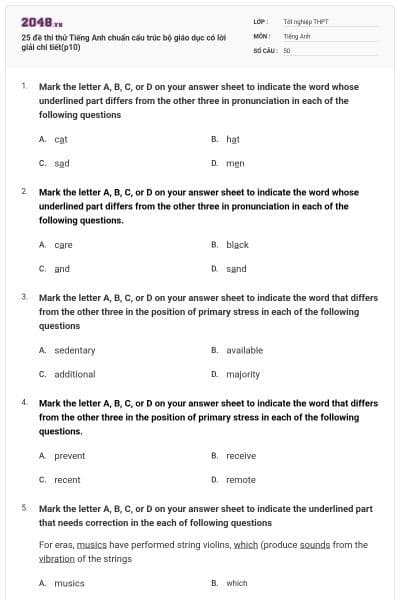
25 đề thi thử Tiếng Anh chuẩn cấu trúc bộ giáo dục có lời giải chi tiết(p10)
50 câu hỏi
Mark the letter A, B, C, or D on your answer sheet to indicate the word whose underlined part differs from the other three in pronunciation in each of the following questions
cat
hat
sad
men
Đáp án D
phát âm là /e/
Các đáp án khác phát âm là /æ/
Mark the letter A, B, C, or D on your answer sheet to indicate the word whose underlined part differs from the other three in pronunciation in each of the following questions.
care
black
and
sand
Đáp án A
phát âm là /eǝ/
Các đáp án khác phát âm là /æ/
Mark the letter A, B, C, or D on your answer sheet to indicate the word that differs from the other three in the position of primary stress in each of the following questions
sedentary
available
additional
majority
Đáp án A
A. sedentary /'sedntri/ (a): ngồi nhiều, tĩnh lại
B. available /ǝveɪlǝbl/ (a): sẵn có
C. additional /ǝ'dɪʃǝnl/ (a): thêm vào, cộng vào
D. majority /mǝ'dʒɒrǝti/ (n): phần lớn, đa số
Mark the letter A, B, C, or D on your answer sheet to indicate the word that differs from the other three in the position of primary stress in each of the following questions.
prevent
receive
recent
remote
Đáp án C
A. prevent /prɪ'vent/ (v): ngăn cản, ngăn ngừa
B. receive /rɪ'si:v/ (v): tiếp nhận
C. recent /'ri:snt/ (adj): gần đây, cách đây không lâu
D. remote /rɪ'mout/ (adj): hẻo lánh, xa xôi
Mark the letter A, B, C, or D on your answer sheet to indicate the underlined part that needs correction in the each of following questions
For eras, musics have performed string violins, which (produce sounds from the vibration of the strings
musics
which
sounds
vibration
Đáp án A
Động từ "have played" à chủ từ chỉ người số nhiều
Chữa lỗi: music à musicians
Dịch: Từ nhiều thời kỳ, các nhạc sĩ đã chơi ghi ta thùng, thứ nhạc cụ tạo ra âm thanh từ sự rung của dây đàn
Mark the letter A, B, C, or D on your answer sheet to indicate the underlined part that needs correction in the each of following questions.
The head teacher emphasized the need for fairness and equality between the teachers of the school.
the need
for fairness
between
teachers
Đáp án C
Chữa lỗi: between à among
between: giữa (2 đối tượng)
among: giữa (từ 3 đối tượng trở lên)
Dịch: Tổ trường đã nhấn mạnh sự cần thiết về công lý và sự bình đẳng giữa tất cả mọi giáo viên trong trường.
Mark the letter A, B, C, or D on your answer sheet to indicate the underlined part that needs correction in the each of following questions.
Rose is not confident enough to enter a beautiful contest.
is
confident
to enter
beautiful
Đáp án D
Chữa lỗi: beautiful à beauty
Dịch: Rose không đủ tự tin để tham gia vào cuộc thi sắc đẹp
Mark the letter A, B, C, or D on your answer sheet to indicate the correct answer to each of the following questions
In an ________ to diffuse the tension, I suggest that we go to see a movie
attempt
improvement
determination
capability
Đáp án A
in an attempt to + V: trong một nỗ lực làm gì
Dịch: Để giảm bớt sự căng thẳng, tôi đề nghị chúng ta hãy đi xem phim
Mark the letter A, B, C, or D on your answer sheet to indicate the correct answer to each of the following questions.
One man ________ outside his own nation is tipped to become the new President
little knowing
to know little
little known
to be little known
Đáp án D
Mệnh đề quan hệ dạng giản lược, đối với bị động thì giữ lại động từ ở dạng phân từ 2
Dịch: Một người đàn ông chẳng mấy ai biết ngoài đất nước của anh ấy đã dự đoán là sẽ trở thành tổng thống mới
Mark the letter A, B, C, or D on your answer sheet to indicate the correct answer to each of the following questions.
We are surprised to hear that Rose and Jack have ________. They seemed very happy together when I saw them last in Hanoi
ended up
been separating
split up
finished up
Đáp án C
split up: chấm dứt mối quan hệ
end up: kết luận, kết thúc
separate: tách rời, riêng rẽ
finish up: hoàn thành
Dịch: Chúng tôi ngạc nhiên khi nghe rằng Rose và Jack đã cắt đứt mối quan hệ, Họ dường như rất hạnh phúc bên nhau khi tôi thấy họ ở Hanoi
Mark the letter A, B, C, or D on your answer sheet to indicate the correct answer to each of the following questions.
The serious issue ________ question made everyone in the meeting overstressed
from
at
on
in
Đáp án D
in question: đang được thảo luận
Dịch: vấn đề nghiêm trọng đang được thảo luận làm tất cả mọi người trong cuộc họp căng thẳng quá mức
Mark the letter A, B, C, or D on your answer sheet to indicate the correct answer to each of the following questions.
We really respect our teacher ________ her good teaching method
by
about
with
for
Đáp án D
to respect sb for sth: tôn trọng ai vì điều gì
Dịch: Chúng tôi thật sự tôn trọng giáo viên vì phương pháp giảng dạy tốt của cô
Mark the letter A, B, C, or D on your answer sheet to indicate the correct answer to each of the following questions.
It's too loud here. I would really like to go somewhere ________ so that we can talk
the quietest
quieter
more quieter
quite
Đáp án B
Cấu trúc so sánh hơn short adj+er chính là quieter
Dịch: Chỗ này quá ồn ào. Tôi thật sự muốn chúng ta đến nơi nào đó yên tĩnh hơn để có thể nói chuyện
Mark the letter A, B, C, or D on your answer sheet to indicate the correct answer to each of the following questions.
The profit has now ________ towards the point where it nearly doubled.
arrived
approached
advanced
reached
Đáp án C
advance to/towards sth: đạt đến mức độ nào, giai đoạn nào = reach/approach sth
Dịch: lợi nhuận đã đạt đến độ gần gấp đôi
Mark the letter A, B, C, or D on your answer sheet to indicate the correct answer to each of the following questions.
No matter how angry my mother was, she would never ________ to violence
utilize
resolve
resor
resource
Đáp án C
resort TO sth: sử dụng đến cái gì (tiêu cực)
utilize sth: sử dụng sth
resolve ON sth/V-ing: kiên quyết làm gì
have a recourse TO sb/sth: nhờ cậy ai, cái gì
Dịch: Dù giận dữ đến đâu, mẹ tôi cũng không bao giờ sử dụng bạo lực
Mark the letter A, B, C, or D on your answer sheet to indicate the correct answer to each of the following questions.
Whenever the boss does something, he should ________ for the sake of the company
go down well with
turn over a new leaf
weigh up the pros and cons
get through
Đáp án C
weigh up the pros and cons: cân nhắc ưu, nhược điểm
turn over a new leaf: bước sang trang mới
Dịch: Khi làm việc gì, sếp cũng phải cân nhắc ưu, nhược điểm vì lợi ích của công ty.
Mark the letter A, B, C, or D on your answer sheet to indicate the correct answer to each of the following questions.
________ Rose likes to do something that she has never done before
Very so often
Every so often
Very often so
Every often so
Đáp án B
every so often: thỉnh thoảng
Dịch: Thỉnh thoảng Rose thích làm việc gì đó mà cô ấy chưa bao giờ từng làm
Mark the letter A, B, C, or D on your answer sheet to indicate the correct answer to each of the following questions.
Look, will you stop ________ in and let me finish my sentence?
butting
moving
pushing
plugging
Đáp án: A
Giải thích:
Ta có các cấu trúc sau:
butt in (phr.v): nói chen, ngắt lời ai một cách thô lỗ
move in (phr.v): bắt đầu chuyển vào sống ở nhà mới
push in (phr.v): chen hàng
plug something in (phr.v): cắm điện
Dựa vào nghĩa, ta chọn đáp án A.
Dịch: Này, bạn có thể dừng ngắt lời tôi và để tôi nói xong câu được không?
Mark the letter A, B, C, or D on your answer sheet to indicate the correct answer to each of the following questions.
Hey, have you watched the extensive ________ of sporting events on Star Channel this afternoon?
broadcast
network
coverage
vision
Đáp án C
coverage: việc đưa tin
coverage of sporting events: sự kiện thể thao
Dịch: Này, cậu đã xem 1 lượng lớn các chương trình sự kiện thể thao trên kênh Star chiều nay chưa?
Mark the letter A, B, C, or D on your answer sheet to indicate the most suitable response to complete each of the following exchanges.
"How beautiful you are!" - "________"
Say it again. I like to hear your words
Many thanks! That's a nice to hear
I think so. I am proud of myself
Yes, don't you think?
Đáp án B
Dùng "Many thanks!" để đáp lại lời khen
Mark the letter A, B, C, or D on your answer sheet to indicate the most suitable response to complete each of the following exchanges.
"________." - "Never mind, better luck next time."
I've broken your precious vase
I have a lot on my mind
I couldn't keep my mind off work
I didn't get the vacant position
Đáp án D
Dịch: "Tôi đã không dành được vị trí trống đó (việc làm)." - "Không sao, lần tới sẽ may mắn hơn."
Mark the letter A, B, C, or D on your answer sheet to indicate the word(s) CLOSEST in meaning to the underlined word(s) in each of the following questions
At school, please concentrate on what the teacher is saying or asking you
pay all attention to
be interested in
be related to
express interest to
Đáp án A
- pay attention to = concentrate on: tập trung vào vấn đề
- be interested in: hứng thú với việc gì
- be related to: liên quan đến việc gì
- express interest to: thể hiện sự hứng thú
Dịch: Khi ở trường, bạn nên tập trung vào điều mà giáo viên sẽ nói hay hỏi bạn
Mark the letter A, B, C, or D on your answer sheet to indicate the word(s) CLOSEST in meaning to the underlined word(s) in each of the following questions
We really appreciate your assistance, without which we couldn't have got our job done in time.
devalue
are proud of
feel thankful for
have need of
Đáp án C
- appreciate = feel thankful for (v): đánh giá cao, biết ơn
- devalue (v): đánh giá thấp; khấu hao
- be proud of: tự hào về điều gì
- have need of (v): cần
Dịch: Chúng tôi thật sự biết ơn về sự giúp đỡ của bạn, không có điều đó thì chúng tôi sẽ không thể hoàn thành công việc đúng giờ được.
Mark the letter A, B, C, or D on your answer sheet to indicate the word(s) OPPOSITE in meaning to the underlined word(s) in each of the following questions
"Don't be such a pessimist. There's always a rainbow after the storm. Cheer up!"
activist
feminist
optimist
fighter
Đáp án C
- activist (n): nhà hoạt động xã hội
- feminist (n): người bênh vực phụ nữ
- optimist (n): người lạc quan >< pessimist (n): người bi quan
- fighter (n): chiến binh
Dịch: Đừng trở nên là một người quá bi quan như thế. Luôn có cầu vồng sau cơn mưa. Vui lên nào!"
Mark the letter A, B, C, or D on your answer sheet to indicate the word(s) OPPOSITE in meaning to the underlined word(s) in each of the following questions
Rare flowers grew in abundance on the island. The aborigines even exported the surplus
spare
small quantity
plenty
large quantity
Đáp án B
- spare (n): thừa
- small quantity (n): (số) lượng nhỏ
- plenty (n): nhiều
- large quantity (n): (số) lượng lớn
Dịch: Những loài hoa hiếm thấy mọc rất nhiều trên đảo. Những người thổ dân đảo còn xuất khẩu sản lượng thừa
Mark the letter A, B, C, or D on your answer sheet to indicate the sentence that is closest in meaning to each of the following questions
The request was so great that they had to reprint the manuscript instantly
So great was the request that they had to reprint the manuscript instantly.
So great the request was that they had to reprint the manuscript instantly.
So great was the request so they had to reprint the manuscript instantly
So great the request was, they had to reprint the manuscript instantly
Đáp án A
Cấu trúc: N + be + so adj + that SVO à Dạng đảo ngữ: So + adj + be + N + that SVO
Dịch: Lượng yêu cầu nhiều đến nỗi họ đã phải tái bản bản thảo ngay lập tức
Mark the letter A, B, C, or D on your answer sheet to indicate the sentence that is closest in meaning to each of the following questions.
My workmate said to me, "If I were you, I would tell them the reality
My workmate said me to tell the reality.
My workmate advised me to tell the reality.
My workmate felt sorry for me and asked me to tell the reality.
My workmate advised me not to tell the reality.
Đáp án B
Với câu trực tiếp sử dụng "If I were you" khi chuyển về câu tường thuật thì sử dụng động từ advise.
Đề: Đồng nghiệp tôi nói rằng: "Nếu tôi là bạn, tôi sẽ nói cho họ biết về tình trạng thực tế".
A. Đồng nghiệp tôi nói với tôi tình trạng thực tế.
B. Đồng nghiệp tôi khuyên tôi nói tình trạng thực tế.
C. Đồng nghiệp tôi cảm thấy tiếc cho tôi và nói cho tôi tình trạng thực tế.
D. Đồng nghiệp tôi khuyên tôi không nên nói tình trạng thực tế.
Mark the letter A, B, C, or D on your answer sheet to indicate the sentence that is closest in meaning to each of the following questions.
People believe that 13 is an unlucky digit
People are believed that 13 is an unlucky digit.
13 has been believed to be an unlucky digit
It's believed that 13 is an unlucky digit.
It's believed 13 to be an unlucky digit
Đáp án C
Câu bị động đặc biệt: People + say/believe/notice/… + that SVO.
à It's said/believed/noticed/… that SVO; hoặc: S is said/believed/noticed/… to V
Mark the letter A, B, C, or D on your answer sheet to indicate the sentence that best combines each pair of sentences in the following questions.
The gentleman wanted to get some fresh air in the chamber. He opened the window
The gentleman wanted to get some fresh air in the chamber because he opened the window.
The gentleman opened the window in order to get some fresh air in the chamber.
The gentleman got some fresh air in the chamber, even though he opened the window
Having opened the window, the chamber could get some fresh air
Đáp án B
Đề: Người đàn ông muốn có một ít không khí trong phòng. Ông ấy mở cửa sổ. vế sau chỉ mục đích, hai câu cùng chủ từ dùng in order to/so as to V
Mark the letter A, B, C, or D on your answer sheet to indicate the sentence that best combines each pair of sentences in the following questions.
She turned the TV at 7:30. She was still listening to it when her mama came home at 9:00
She has been listening to the TV at 7:70
She has been listening to the TV since 7:30.
She has been listening to the TV after 7:30.
She has been listening to the TV by 7:30
Đáp án B
Đề: Cô ấy bật TV lên lúc 7:30. Cô ấy vẫn đang nghe nó khi mẹ cô ấy về nhà lúc 9:00.
Sử dụng thì quá khứ hoàn thành diễn tả một hành động bắt đầu từ trước và kéo dài liên tục đến một thời điểm trong quá khứ.
Dịch: Cô ấy đã xem TV từ 7:30
Read the following passage and mark the letter A, B, C, or D on your answer sheet to indicate the correct word or phrase that best fits each of the numbered blanks from 31 to 35.
Stories about how people somehow know when they are being watched have been going around for centuries. However, few (31) ________ have been made to study the phenomenon scientifically. Now, with the accomplishment of the largest ever research of the so-called staring effect, there is striking indication that this is a recognizable and (32) ________ sixth sense. The research elaborates thousands of kids. For the research, they stood with their eyes covered and with their backs to other youngsters, who were told to either stare at them or look away. The outcomes constantly revealed that the kids who could not see were able to (33) ________ when they were being stared at. In total of 14.000 experiments (34) ________ globally, the teenagers (35) ________ sensed when they were being watched almost 81% of the time
Điền câu 31
efforts
attempts
exams
goals
Đáp án B
Chú ý "…made to investigate" à make an attempt to do st.
Dịch: Tuy nhiên, rất ít nỗ lực được thực hiện để nghiên cứu hiện tượng này một cách khoa học
Read the following passage and mark the letter A, B, C, or D on your answer sheet to indicate the correct word or phrase that best fits each of the numbered blanks from 31 to 35.
Stories about how people somehow know when they are being watched have been going around for centuries. However, few (31) ________ have been made to study the phenomenon scientifically. Now, with the accomplishment of the largest ever research of the so-called staring effect, there is striking indication that this is a recognizable and (32) ________ sixth sense. The research elaborates thousands of kids. For the research, they stood with their eyes covered and with their backs to other youngsters, who were told to either stare at them or look away. The outcomes constantly revealed that the kids who could not see were able to (33) ________ when they were being stared at. In total of 14.000 experiments (34) ________ globally, the teenagers (35) ________ sensed when they were being watched almost 81% of the time.
Điền câu 32
genuine
recognized
established
assured
Đáp án A
genuine (a): tự nhiên, có thật.
Dịch: …có bằng chứng rất ấn tượng về việc đây là giác quan thứ sáu thật sự và có thể nhận biết được
Read the following passage and mark the letter A, B, C, or D on your answer sheet to indicate the correct word or phrase that best fits each of the numbered blanks from 31 to 35.
Stories about how people somehow know when they are being watched have been going around for centuries. However, few (31) ________ have been made to study the phenomenon scientifically. Now, with the accomplishment of the largest ever research of the so-called staring effect, there is striking indication that this is a recognizable and (32) ________ sixth sense. The research elaborates thousands of kids. For the research, they stood with their eyes covered and with their backs to other youngsters, who were told to either stare at them or look away. The outcomes constantly revealed that the kids who could not see were able to (33) ________ when they were being stared at. In total of 14.000 experiments (34) ________ globally, the teenagers (35) ________ sensed when they were being watched almost 81% of the time.
Điền câu 33
sign
discovery
expose
tell
Đáp án D
to tell (sb) where/what/how/…: nói cho ai về điều gì, đưa ra thông tin.
Dịch: Kết quả thường xuyên cho thấy những đứa trẻ không nhìn thấy gì vẫn có thể biết người đang nhìn chằm chằm vào
Read the following passage and mark the letter A, B, C, or D on your answer sheet to indicate the correct word or phrase that best fits each of the numbered blanks from 31 to 35.
Stories about how people somehow know when they are being watched have been going around for centuries. However, few (31) ________ have been made to study the phenomenon scientifically. Now, with the accomplishment of the largest ever research of the so-called staring effect, there is striking indication that this is a recognizable and (32) ________ sixth sense. The research elaborates thousands of kids. For the research, they stood with their eyes covered and with their backs to other youngsters, who were told to either stare at them or look away. The outcomes constantly revealed that the kids who could not see were able to (33) ________ when they were being stared at. In total of 14.000 experiments (34) ________ globally, the teenagers (35) ________ sensed when they were being watched almost 81% of the time.
Điền câu 34
controlled through
worked over
carried on
carried out
Đáp án D
to carry out: thực hiện
to carry on: tiếp tục
Dịch: Tổng cộng đã có 14,000 thử nghiệm được thực hiện trên toàn thế giới,…
Read the following passage and mark the letter A, B, C, or D on your answer sheet to indicate the correct word or phrase that best fits each of the numbered blanks from 31 to 35.
Stories about how people somehow know when they are being watched have been going around for centuries. However, few (31) ________ have been made to study the phenomenon scientifically. Now, with the accomplishment of the largest ever research of the so-called staring effect, there is striking indication that this is a recognizable and (32) ________ sixth sense. The research elaborates thousands of kids. For the research, they stood with their eyes covered and with their backs to other youngsters, who were told to either stare at them or look away. The outcomes constantly revealed that the kids who could not see were able to (33) ________ when they were being stared at. In total of 14.000 experiments (34) ________ globally, the teenagers (35) ________ sensed when they were being watched almost 81% of the time.
Điền câu 35
carefully
correctly
accurately
effortlessly
Đáp án B
correctly (adv): đúng cách thức, phù hợp
exactly (av): chính xác, đúng đắn
thoroughly (adv): hoàn toàn, kỹ lưỡng, thấu đáo
perfectly (adv): một cách hoàn hảo
Dịch: Những đứa trẻ cảm nhận một cách chính xác mình đang bị nhìn gần 81%
Read the following passage and mark the letter A, B, C, or D on your answer sheet to indicate the correct answer to each of the questions from 36 to 42.
The history of clinic nutrition, or the study of the relationship between health and how the body takes in and utilizers food substances, can be divided into four distinct eras: the first began in the nineteenth century and extended into the early twentieth century when it was recognized for the first time that food contained constituents that were essential agents. Near the end of this era, research studies demonstrated that rapid weight loss was associated with nitrogen imbalance and could only be rectified by providing adequate protein associate with certain foods.
The second era was initiated in the early decades of the twentieth century and might be called "the vitamin period". Vitamins came to be recognized in foods, en deficiency syndromes were described. As vitamins became recognized as essential food constituents necessary for health, it became tempting to suggest that every disease and condition for which there had been no previous effective treatment might be responsive to vitamin therapy. At the point in time, medical schools started to become more interested in having their curricula integrate nutritional therapies in medicine. Reckless claims were made for effects of vitamins that went far beyond what could actually be achieved from the use of them.
In the third era of nutritional history in the early 1950's to mid-1960's, vitamin therapy began to fall into disrepute. Concomitant with this, nutrition education in medical schools also became less popular. It was just a decade before this that many drug companies had found their vitamins sales skyrocketing and were quick to supply practicing physicians with generous samples of vitamins and literature extolling the virtue of supplementation for a variety health-related conditions. Expectations as to the success of vitamins in disease control were exaggerated. As is known in retrospect, vitamin and mineral therapies are much less effective when applied to health-crisis conditions that when applied to long-term problems of nutrition that lead chronic health problem.
What does the passage mainly discuss?
The effects of vitamins in the human body
The history f food preferences from the 19th century to the present.
The stages of development of clinical nutrition as a field of study.
Nutritional practices of the 19th century.
Đáp án C
Đoạn 1 có đề cập "The history of clinical nutrition… can be divided into four distinct eras", và tiếp sau đó, tác giả trình bày về 3 thời kỳ (eras) đầu tiên.
Dịch: Lịch sử về các chất dinh dưỡng, hay sự nghiên cứu về mối quan hệ giữa sức khỏe và làm thế nào cơ thể có thể hấp thụ và sử dụng các chất trong thức ăn, có thể được chia làm 4 giai đoạn…"
Read the following passage and mark the letter A, B, C, or D on your answer sheet to indicate the correct answer to each of the questions from 36 to 42.
The history of clinic nutrition, or the study of the relationship between health and how the body takes in and utilizers food substances, can be divided into four distinct eras: the first began in the nineteenth century and extended into the early twentieth century when it was recognized for the first time that food contained constituents that were essential agents. Near the end of this era, research studies demonstrated that rapid weight loss was associated with nitrogen imbalance and could only be rectified by providing adequate protein associate with certain foods.
The second era was initiated in the early decades of the twentieth century and might be called "the vitamin period". Vitamins came to be recognized in foods, en deficiency syndromes were described. As vitamins became recognized as essential food constituents necessary for health, it became tempting to suggest that every disease and condition for which there had been no previous effective treatment might be responsive to vitamin therapy. At the point in time, medical schools started to become more interested in having their curricula integrate nutritional therapies in medicine. Reckless claims were made for effects of vitamins that went far beyond what could actually be achieved from the use of them.
In the third era of nutritional history in the early 1950's to mid-1960's, vitamin therapy began to fall into disrepute. Concomitant with this, nutrition education in medical schools also became less popular. It was just a decade before this that many drug companies had found their vitamins sales skyrocketing and were quick to supply practicing physicians with generous samples of vitamins and literature extolling the virtue of supplementation for a variety health-related conditions. Expectations as to the success of vitamins in disease control were exaggerated. As is known in retrospect, vitamin and mineral therapies are much less effective when applied to health-crisis conditions that when applied to long-term problems of nutrition that lead chronic health problem.
It can be inferred from the passages that which of the following discoveries was made during the first era in the history of nutrition?
Protein was recognized as an essential component of diet.
Vitamins were synthesized from foods
Effective technique of weight loss were determined.
Certain food were found to be harmful to good health.
Đáp án A
"Near the end of this era…associated with certain food"
Dịch: Gần cuối của giai đoạn này, các nghiên cứu chứng minh rằng sự giảm cân nhanh chóng có liên quan đến sự thiếu cân bằng nitrogen và có thể điều chỉnh bằng việc cung cấp protein có trong thức ăn hằng ngày
Read the following passage and mark the letter A, B, C, or D on your answer sheet to indicate the correct answer to each of the questions from 36 to 42.
The history of clinic nutrition, or the study of the relationship between health and how the body takes in and utilizers food substances, can be divided into four distinct eras: the first began in the nineteenth century and extended into the early twentieth century when it was recognized for the first time that food contained constituents that were essential agents. Near the end of this era, research studies demonstrated that rapid weight loss was associated with nitrogen imbalance and could only be rectified by providing adequate protein associate with certain foods.
The second era was initiated in the early decades of the twentieth century and might be called "the vitamin period". Vitamins came to be recognized in foods, en deficiency syndromes were described. As vitamins became recognized as essential food constituents necessary for health, it became tempting to suggest that every disease and condition for which there had been no previous effective treatment might be responsive to vitamin therapy. At the point in time, medical schools started to become more interested in having their curricula integrate nutritional therapies in medicine. Reckless claims were made for effects of vitamins that went far beyond what could actually be achieved from the use of them.
In the third era of nutritional history in the early 1950's to mid-1960's, vitamin therapy began to fall into disrepute. Concomitant with this, nutrition education in medical schools also became less popular. It was just a decade before this that many drug companies had found their vitamins sales skyrocketing and were quick to supply practicing physicians with generous samples of vitamins and literature extolling the virtue of supplementation for a variety health-related conditions. Expectations as to the success of vitamins in disease control were exaggerated. As is known in retrospect, vitamin and mineral therapies are much less effective when applied to health-crisis conditions that when applied to long-term problems of nutrition that lead chronic health problem.
The word "tempting" is closest meaning to ________
necessary
attractive
realistic
correct
Đáp án B
tempting (adj) = attractive (adj): hấp dẫn, thu hút.
Read the following passage and mark the letter A, B, C, or D on your answer sheet to indicate the correct answer to each of the questions from 36 to 42.
The history of clinic nutrition, or the study of the relationship between health and how the body takes in and utilizers food substances, can be divided into four distinct eras: the first began in the nineteenth century and extended into the early twentieth century when it was recognized for the first time that food contained constituents that were essential agents. Near the end of this era, research studies demonstrated that rapid weight loss was associated with nitrogen imbalance and could only be rectified by providing adequate protein associate with certain foods.
The second era was initiated in the early decades of the twentieth century and might be called "the vitamin period". Vitamins came to be recognized in foods, en deficiency syndromes were described. As vitamins became recognized as essential food constituents necessary for health, it became tempting to suggest that every disease and condition for which there had been no previous effective treatment might be responsive to vitamin therapy. At the point in time, medical schools started to become more interested in having their curricula integrate nutritional therapies in medicine. Reckless claims were made for effects of vitamins that went far beyond what could actually be achieved from the use of them.
In the third era of nutritional history in the early 1950's to mid-1960's, vitamin therapy began to fall into disrepute. Concomitant with this, nutrition education in medical schools also became less popular. It was just a decade before this that many drug companies had found their vitamins sales skyrocketing and were quick to supply practicing physicians with generous samples of vitamins and literature extolling the virtue of supplementation for a variety health-related conditions. Expectations as to the success of vitamins in disease control were exaggerated. As is known in retrospect, vitamin and mineral therapies are much less effective when applied to health-crisis conditions that when applied to long-term problems of nutrition that lead chronic health problem.
The word "reckless" can be best replaced by ________.
recorded
irresponsible
informative
urgent
Đáp án B
reckless (adj) = irresponsible (adj): thiếu thận trọng, liều lĩnh
Read the following passage and mark the letter A, B, C, or D on your answer sheet to indicate the correct answer to each of the questions from 36 to 42.
The history of clinic nutrition, or the study of the relationship between health and how the body takes in and utilizers food substances, can be divided into four distinct eras: the first began in the nineteenth century and extended into the early twentieth century when it was recognized for the first time that food contained constituents that were essential agents. Near the end of this era, research studies demonstrated that rapid weight loss was associated with nitrogen imbalance and could only be rectified by providing adequate protein associate with certain foods.
The second era was initiated in the early decades of the twentieth century and might be called "the vitamin period". Vitamins came to be recognized in foods, en deficiency syndromes were described. As vitamins became recognized as essential food constituents necessary for health, it became tempting to suggest that every disease and condition for which there had been no previous effective treatment might be responsive to vitamin therapy. At the point in time, medical schools started to become more interested in having their curricula integrate nutritional therapies in medicine. Reckless claims were made for effects of vitamins that went far beyond what could actually be achieved from the use of them.
In the third era of nutritional history in the early 1950's to mid-1960's, vitamin therapy began to fall into disrepute. Concomitant with this, nutrition education in medical schools also became less popular. It was just a decade before this that many drug companies had found their vitamins sales skyrocketing and were quick to supply practicing physicians with generous samples of vitamins and literature extolling the virtue of supplementation for a variety health-related conditions. Expectations as to the success of vitamins in disease control were exaggerated. As is known in retrospect, vitamin and mineral therapies are much less effective when applied to health-crisis conditions that when applied to long-term problems of nutrition that lead chronic health problem.
The word "them" refers to ________.
therapies
claims
effects
vitamins
Đáp án D
"Reckless claims were made for effects of vitamins that went far beyond what could actually be achieved from the use of them."
Dịch: Những tuyên bố thiếu thận trọng về hiệu quả của vitamin đã đi khá xa so với những cái có thể đạt được từ việc sử dụng chúng.
Read the following passage and mark the letter A, B, C, or D on your answer sheet to indicate the correct answer to each of the questions from 36 to 42.
The history of clinic nutrition, or the study of the relationship between health and how the body takes in and utilizers food substances, can be divided into four distinct eras: the first began in the nineteenth century and extended into the early twentieth century when it was recognized for the first time that food contained constituents that were essential agents. Near the end of this era, research studies demonstrated that rapid weight loss was associated with nitrogen imbalance and could only be rectified by providing adequate protein associate with certain foods.
The second era was initiated in the early decades of the twentieth century and might be called "the vitamin period". Vitamins came to be recognized in foods, en deficiency syndromes were described. As vitamins became recognized as essential food constituents necessary for health, it became tempting to suggest that every disease and condition for which there had been no previous effective treatment might be responsive to vitamin therapy. At the point in time, medical schools started to become more interested in having their curricula integrate nutritional therapies in medicine. Reckless claims were made for effects of vitamins that went far beyond what could actually be achieved from the use of them.
In the third era of nutritional history in the early 1950's to mid-1960's, vitamin therapy began to fall into disrepute. Concomitant with this, nutrition education in medical schools also became less popular. It was just a decade before this that many drug companies had found their vitamins sales skyrocketing and were quick to supply practicing physicians with generous samples of vitamins and literature extolling the virtue of supplementation for a variety health-related conditions. Expectations as to the success of vitamins in disease control were exaggerated. As is known in retrospect, vitamin and mineral therapies are much less effective when applied to health-crisis conditions that when applied to long-term problems of nutrition that lead chronic health problem.
Why did vitamins therapy begin losing favour in the 1950's?
The public lost interest in vitamins.
Medical schools stopped teaching nutritional concepts
Nutritional research was of poor quality.
Claims for the effectiveness of vitamin therapy were seen to be exaggerated
Đáp án D
"Expectations as to the success of vitamins in disease control… that lead to chronic health problems"
Dịch: Những sự mong đợi thành công về việc vitamin có thể kiểm soát bệnh tật đã đi quá đà. Như đã biết trong quá khứ, liệu pháp trị bệnh bằng vitamin và chất khoáng thì ít có hiệu quả hơn khi áp dụng với tình trạng khủng hoảng sức khỏe so với khi áp dụng cho vấn đề về dinh dưỡng lâu dài mà điều này dẫn đến các vấn đề sức khỏe kinh niên
Read the following passage and mark the letter A, B, C, or D on your answer sheet to indicate the correct answer to each of the questions from 36 to 42.
The history of clinic nutrition, or the study of the relationship between health and how the body takes in and utilizers food substances, can be divided into four distinct eras: the first began in the nineteenth century and extended into the early twentieth century when it was recognized for the first time that food contained constituents that were essential agents. Near the end of this era, research studies demonstrated that rapid weight loss was associated with nitrogen imbalance and could only be rectified by providing adequate protein associate with certain foods.
The second era was initiated in the early decades of the twentieth century and might be called "the vitamin period". Vitamins came to be recognized in foods, en deficiency syndromes were described. As vitamins became recognized as essential food constituents necessary for health, it became tempting to suggest that every disease and condition for which there had been no previous effective treatment might be responsive to vitamin therapy. At the point in time, medical schools started to become more interested in having their curricula integrate nutritional therapies in medicine. Reckless claims were made for effects of vitamins that went far beyond what could actually be achieved from the use of them.
In the third era of nutritional history in the early 1950's to mid-1960's, vitamin therapy began to fall into disrepute. Concomitant with this, nutrition education in medical schools also became less popular. It was just a decade before this that many drug companies had found their vitamins sales skyrocketing and were quick to supply practicing physicians with generous samples of vitamins and literature extolling the virtue of supplementation for a variety health-related conditions. Expectations as to the success of vitamins in disease control were exaggerated. As is known in retrospect, vitamin and mineral therapies are much less effective when applied to health-crisis conditions that when applied to long-term problems of nutrition that lead chronic health problem.
The word "skyrocketing" is closest meaning to ________.
internationally popular
acceptable
increasing rapidly
surprising
Đáp án C
skyrocket = increase rapidly: tăng vọt
Read the following passage and mark the letter A, B, C, or D on your answer sheet to indicate the correct answer to each of the questions from 43 to 50.
Plants and animals will find it difficult to escape from or adjust to the effect of global warming. Scientists have already observed shifts in the lifecycles of many plants and animals, such as flowers blooming earlier and birds hatching earlier in the spring. Many species have begun shifting where they live or their annual migration patterns due to warmer temperatures.
With further warming, animals will tend to migrate toward the poles and up mountainsides toward higher elevations. Plants will also attempt to shift their rangers, seeking new areas as old habitats grow too warm. In many places, however, human development will prevent these shifts. Species that find cities of farmland blocking their way north or south may become extinct. Species living in unique ecosystems, such as those found in polar and mountaintop regions, are especially at risk because migration to new habitats is not possible. For instance, polar bears and marine mammals in the Arctic are already threatened by dwindling sea ice but have nowhere father to go.
Projecting species extinction due to global warming is extremely difficult. Some scientists have estimated that 20 to 50 percent of species could be committed to extinction with 2 to 3 Celsius degrees of further warming. The rate of warming, not just the magnitude, is extremely important for plants and animals. Some species and even entire ecosystems, such as certain types of forest, many not be able to adjust quickly enough and may disappear.
Ocean ecosystems, especially fragile ones like coral reefs, will also be affected by global warming. Warmer ocean temperatures can cause coral to "bleach", a state which if prolonged will lead to the death of the coral. Scientists estimate that even 1 Celsius degree of additional warming could lead to widespread bleaching and death of coral reefs around the world. Also, increasing carbon dioxide in the atmosphere enters the ocean and increases the acidity of ocean waters. This acidification further stresses ocean ecosystems.
Scientists have observed that warmer temperatures in the spring cause flower to ________.
die instantly
bloom earlier
become lighter
lose colour
Đáp án B
"Plants and animals will find it difficult…many plants and animals, such as flowers blooming earlier and birds hatching earlier in the spring."
Dịch: Động thực vật sẽ cảm thấy khó khăn trong việc thoát khỏi hay thích ứng với sự ảnh hưởng của biến đổi khí hậu. Cách nhà khoa học đã quan sát sự thay đổi về vòng đời của một số loại động thực vật, chẳng hạn như việc hoa nở sớm và chim ấp sớm vào mùa xuân.
Read the following passage and mark the letter A, B, C, or D on your answer sheet to indicate the correct answer to each of the questions from 43 to 50.
Plants and animals will find it difficult to escape from or adjust to the effect of global warming. Scientists have already observed shifts in the lifecycles of many plants and animals, such as flowers blooming earlier and birds hatching earlier in the spring. Many species have begun shifting where they live or their annual migration patterns due to warmer temperatures.
With further warming, animals will tend to migrate toward the poles and up mountainsides toward higher elevations. Plants will also attempt to shift their rangers, seeking new areas as old habitats grow too warm. In many places, however, human development will prevent these shifts. Species that find cities of farmland blocking their way north or south may become extinct. Species living in unique ecosystems, such as those found in polar and mountaintop regions, are especially at risk because migration to new habitats is not possible. For instance, polar bears and marine mammals in the Arctic are already threatened by dwindling sea ice but have nowhere father to go.
Projecting species extinction due to global warming is extremely difficult. Some scientists have estimated that 20 to 50 percent of species could be committed to extinction with 2 to 3 Celsius degrees of further warming. The rate of warming, not just the magnitude, is extremely important for plants and animals. Some species and even entire ecosystems, such as certain types of forest, many not be able to adjust quickly enough and may disappear.
Ocean ecosystems, especially fragile ones like coral reefs, will also be affected by global warming. Warmer ocean temperatures can cause coral to "bleach", a state which if prolonged will lead to the death of the coral. Scientists estimate that even 1 Celsius degree of additional warming could lead to widespread bleaching and death of coral reefs around the world. Also, increasing carbon dioxide in the atmosphere enters the ocean and increases the acidity of ocean waters. This acidification further stresses ocean ecosystems.
According to paragraph 2, when their habitats grow warmer, animals tend to move ________.
south - eastwards and down mountainsides toward lower elevations.
north - westward and up mountainsides toward higher elevations
toward the North Pole and down mountainsides toward lower elevations
toward the poles and up mountainsides toward higher elevations.
Đáp án D
"With further warming, animals will tend to migrate toward the poles and up mountainsides toward higher elevations."
Dịch: Với việc ngày càng ấm dần lên, động vật sẽ có khuynh hướng di cư về các cực và từ các vùng núi về các vùng có độ cao hơn."
Read the following passage and mark the letter A, B, C, or D on your answer sheet to indicate the correct answer to each of the questions from 43 to 50.
Plants and animals will find it difficult to escape from or adjust to the effect of global warming. Scientists have already observed shifts in the lifecycles of many plants and animals, such as flowers blooming earlier and birds hatching earlier in the spring. Many species have begun shifting where they live or their annual migration patterns due to warmer temperatures.
With further warming, animals will tend to migrate toward the poles and up mountainsides toward higher elevations. Plants will also attempt to shift their rangers, seeking new areas as old habitats grow too warm. In many places, however, human development will prevent these shifts. Species that find cities of farmland blocking their way north or south may become extinct. Species living in unique ecosystems, such as those found in polar and mountaintop regions, are especially at risk because migration to new habitats is not possible. For instance, polar bears and marine mammals in the Arctic are already threatened by dwindling sea ice but have nowhere father to go.
Projecting species extinction due to global warming is extremely difficult. Some scientists have estimated that 20 to 50 percent of species could be committed to extinction with 2 to 3 Celsius degrees of further warming. The rate of warming, not just the magnitude, is extremely important for plants and animals. Some species and even entire ecosystems, such as certain types of forest, many not be able to adjust quickly enough and may disappear.
Ocean ecosystems, especially fragile ones like coral reefs, will also be affected by global warming. Warmer ocean temperatures can cause coral to "bleach", a state which if prolonged will lead to the death of the coral. Scientists estimate that even 1 Celsius degree of additional warming could lead to widespread bleaching and death of coral reefs around the world. Also, increasing carbon dioxide in the atmosphere enters the ocean and increases the acidity of ocean waters. This acidification further stresses ocean ecosystems.
The pronoun "those" in paragraph 2 refers to ________.
species
ecosystems
habitats
areas
Đáp án A
"Species living in unique…to new habitats is not possible."
Dịch: Những loại động vật sống trong các hệ sinh thái đặc biệt, chẳng hạn như các loài được phát hiện ở các cực và vùng núi, thì đặc biệt rủi ro cao bởi vì sự di cư đến một môi trường sống mới là điều không thể
Read the following passage and mark the letter A, B, C, or D on your answer sheet to indicate the correct answer to each of the questions from 43 to 50.
Plants and animals will find it difficult to escape from or adjust to the effect of global warming. Scientists have already observed shifts in the lifecycles of many plants and animals, such as flowers blooming earlier and birds hatching earlier in the spring. Many species have begun shifting where they live or their annual migration patterns due to warmer temperatures.
With further warming, animals will tend to migrate toward the poles and up mountainsides toward higher elevations. Plants will also attempt to shift their rangers, seeking new areas as old habitats grow too warm. In many places, however, human development will prevent these shifts. Species that find cities of farmland blocking their way north or south may become extinct. Species living in unique ecosystems, such as those found in polar and mountaintop regions, are especially at risk because migration to new habitats is not possible. For instance, polar bears and marine mammals in the Arctic are already threatened by dwindling sea ice but have nowhere father to go.
Projecting species extinction due to global warming is extremely difficult. Some scientists have estimated that 20 to 50 percent of species could be committed to extinction with 2 to 3 Celsius degrees of further warming. The rate of warming, not just the magnitude, is extremely important for plants and animals. Some species and even entire ecosystems, such as certain types of forest, many not be able to adjust quickly enough and may disappear.
Ocean ecosystems, especially fragile ones like coral reefs, will also be affected by global warming. Warmer ocean temperatures can cause coral to "bleach", a state which if prolonged will lead to the death of the coral. Scientists estimate that even 1 Celsius degree of additional warming could lead to widespread bleaching and death of coral reefs around the world. Also, increasing carbon dioxide in the atmosphere enters the ocean and increases the acidity of ocean waters. This acidification further stresses ocean ecosystems.
The phrase "dwindling sea ice" in paragraph 2 refers to ________.
the frozen water in the Arctic
the violent Arctic Ocean
the melting ice in the Arctic
the cold ice in the Arctic
Đáp án C
"For example, polar bears and marine mammals in the Arctic are already threatened by dwindling sea ice but…"
Dịch: Lấy ví dụ như, gấu bắ cực và động vật biển có vú ở Đại Tây Dương thì hoàn toàn bị đe dọa bởi sự tan băng…"
Read the following passage and mark the letter A, B, C, or D on your answer sheet to indicate the correct answer to each of the questions from 43 to 50.
Plants and animals will find it difficult to escape from or adjust to the effect of global warming. Scientists have already observed shifts in the lifecycles of many plants and animals, such as flowers blooming earlier and birds hatching earlier in the spring. Many species have begun shifting where they live or their annual migration patterns due to warmer temperatures.
With further warming, animals will tend to migrate toward the poles and up mountainsides toward higher elevations. Plants will also attempt to shift their rangers, seeking new areas as old habitats grow too warm. In many places, however, human development will prevent these shifts. Species that find cities of farmland blocking their way north or south may become extinct. Species living in unique ecosystems, such as those found in polar and mountaintop regions, are especially at risk because migration to new habitats is not possible. For instance, polar bears and marine mammals in the Arctic are already threatened by dwindling sea ice but have nowhere father to go.
Projecting species extinction due to global warming is extremely difficult. Some scientists have estimated that 20 to 50 percent of species could be committed to extinction with 2 to 3 Celsius degrees of further warming. The rate of warming, not just the magnitude, is extremely important for plants and animals. Some species and even entire ecosystems, such as certain types of forest, many not be able to adjust quickly enough and may disappear.
Ocean ecosystems, especially fragile ones like coral reefs, will also be affected by global warming. Warmer ocean temperatures can cause coral to "bleach", a state which if prolonged will lead to the death of the coral. Scientists estimate that even 1 Celsius degree of additional warming could lead to widespread bleaching and death of coral reefs around the world. Also, increasing carbon dioxide in the atmosphere enters the ocean and increases the acidity of ocean waters. This acidification further stresses ocean ecosystems.
It is mentioned in the passage that if the global temperature rose by 2 or 3 Celsius degrees, ________.
half of the earth's surface would be flooded
the sea level would rise by 2o centimetres
water supply would decrease by 50 percent
20 to 50 percent of species could become extinct
Đáp án D
"Some scientist have estimated that 20 to 50 percent of species could be committed to extinction with 2 to 3 Celsius degrees of further warming."
Dịch: Một vài nhà khoa học đã dự đoán rằng từ 20 đến 50 phần trăm loài có thể bị đẩy đến sự tuyệt chủng với sự nóng lên từ 2 đến 3 độ C
Read the following passage and mark the letter A, B, C, or D on your answer sheet to indicate the correct answer to each of the questions from 43 to 50.
Plants and animals will find it difficult to escape from or adjust to the effect of global warming. Scientists have already observed shifts in the lifecycles of many plants and animals, such as flowers blooming earlier and birds hatching earlier in the spring. Many species have begun shifting where they live or their annual migration patterns due to warmer temperatures.
With further warming, animals will tend to migrate toward the poles and up mountainsides toward higher elevations. Plants will also attempt to shift their rangers, seeking new areas as old habitats grow too warm. In many places, however, human development will prevent these shifts. Species that find cities of farmland blocking their way north or south may become extinct. Species living in unique ecosystems, such as those found in polar and mountaintop regions, are especially at risk because migration to new habitats is not possible. For instance, polar bears and marine mammals in the Arctic are already threatened by dwindling sea ice but have nowhere father to go.
Projecting species extinction due to global warming is extremely difficult. Some scientists have estimated that 20 to 50 percent of species could be committed to extinction with 2 to 3 Celsius degrees of further warming. The rate of warming, not just the magnitude, is extremely important for plants and animals. Some species and even entire ecosystems, such as certain types of forest, many not be able to adjust quickly enough and may disappear.
Ocean ecosystems, especially fragile ones like coral reefs, will also be affected by global warming. Warmer ocean temperatures can cause coral to "bleach", a state which if prolonged will lead to the death of the coral. Scientists estimate that even 1 Celsius degree of additional warming could lead to widespread bleaching and death of coral reefs around the world. Also, increasing carbon dioxide in the atmosphere enters the ocean and increases the acidity of ocean waters. This acidification further stresses ocean ecosystems.
According to the passage, if some species are not able to adjust quickly to warmer temperatures, ________.
they may be endangered
they can begin to develop
they will certainly need water
they move to tropical forests
Đáp án A
"Some species and even entire ecosystem, such as certain types of forest, many not be able to adjust quickly enough and may disappear."
Dịch: Một vài loài và thậm chí toàn bộ hệ sinh thái, chẳng hạn như các loại đặc trưng ở rừng, nhiều loài sẽ không có khả năng thích ứng đủ nhanh và có thể biến mất
Read the following passage and mark the letter A, B, C, or D on your answer sheet to indicate the correct answer to each of the questions from 43 to 50.
Plants and animals will find it difficult to escape from or adjust to the effect of global warming. Scientists have already observed shifts in the lifecycles of many plants and animals, such as flowers blooming earlier and birds hatching earlier in the spring. Many species have begun shifting where they live or their annual migration patterns due to warmer temperatures.
With further warming, animals will tend to migrate toward the poles and up mountainsides toward higher elevations. Plants will also attempt to shift their rangers, seeking new areas as old habitats grow too warm. In many places, however, human development will prevent these shifts. Species that find cities of farmland blocking their way north or south may become extinct. Species living in unique ecosystems, such as those found in polar and mountaintop regions, are especially at risk because migration to new habitats is not possible. For instance, polar bears and marine mammals in the Arctic are already threatened by dwindling sea ice but have nowhere father to go.
Projecting species extinction due to global warming is extremely difficult. Some scientists have estimated that 20 to 50 percent of species could be committed to extinction with 2 to 3 Celsius degrees of further warming. The rate of warming, not just the magnitude, is extremely important for plants and animals. Some species and even entire ecosystems, such as certain types of forest, many not be able to adjust quickly enough and may disappear.
Ocean ecosystems, especially fragile ones like coral reefs, will also be affected by global warming. Warmer ocean temperatures can cause coral to "bleach", a state which if prolonged will lead to the death of the coral. Scientists estimate that even 1 Celsius degree of additional warming could lead to widespread bleaching and death of coral reefs around the world. Also, increasing carbon dioxide in the atmosphere enters the ocean and increases the acidity of ocean waters. This acidification further stresses ocean ecosystems.
The word "fragile" in paragraph 4 most probably means ________.
very large
easily damaged
rather strong
pretty hard
Đáp án B
fragile: easily broken or damaged à fragile = easily broken: mỏng manh, dễ vỡ
Read the following passage and mark the letter A, B, C, or D on your answer sheet to indicate the correct answer to each of the questions from 43 to 50.
Plants and animals will find it difficult to escape from or adjust to the effect of global warming. Scientists have already observed shifts in the lifecycles of many plants and animals, such as flowers blooming earlier and birds hatching earlier in the spring. Many species have begun shifting where they live or their annual migration patterns due to warmer temperatures.
With further warming, animals will tend to migrate toward the poles and up mountainsides toward higher elevations. Plants will also attempt to shift their rangers, seeking new areas as old habitats grow too warm. In many places, however, human development will prevent these shifts. Species that find cities of farmland blocking their way north or south may become extinct. Species living in unique ecosystems, such as those found in polar and mountaintop regions, are especially at risk because migration to new habitats is not possible. For instance, polar bears and marine mammals in the Arctic are already threatened by dwindling sea ice but have nowhere father to go.
Projecting species extinction due to global warming is extremely difficult. Some scientists have estimated that 20 to 50 percent of species could be committed to extinction with 2 to 3 Celsius degrees of further warming. The rate of warming, not just the magnitude, is extremely important for plants and animals. Some species and even entire ecosystems, such as certain types of forest, many not be able to adjust quickly enough and may disappear.
Ocean ecosystems, especially fragile ones like coral reefs, will also be affected by global warming. Warmer ocean temperatures can cause coral to "bleach", a state which if prolonged will lead to the death of the coral. Scientists estimate that even 1 Celsius degree of additional warming could lead to widespread bleaching and death of coral reefs around the world. Also, increasing carbon dioxide in the atmosphere enters the ocean and increases the acidity of ocean waters. This acidification further stresses ocean ecosystems.
The bleaching of coral reefs as mentioned in paragraph 4 indicates ________.
the water absorption of coral reefs
the quick growth of marine mammals
the blooming phase of sea weeds
the slow death of coral reefs
Đáp án D
"Warmer ocean temperatures can cause coral to "bleach", a state which if prolonged will lead to the death of the coral."
Dịch: Nhiệt độ đại dương nóng lên có thể làm cho san hô bị tẩy trắng, một tình trạng mà nếu bị kéo dài sẽ dẫn tới cái chết của san hô