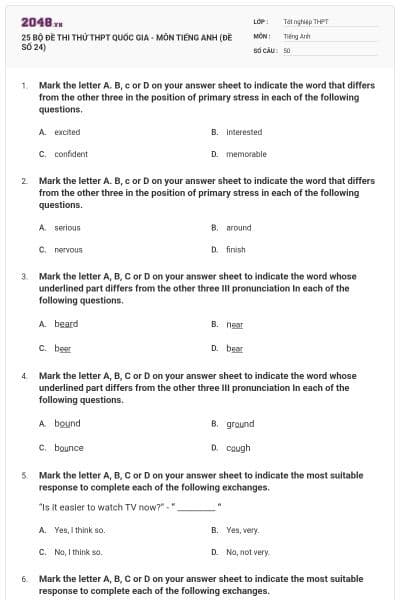
25 BỘ ĐỀ THI THỬ THPT QUỐC GIA - MÔN TIẾNG ANH (ĐỀ SỐ 24)
50 câu hỏi
Mark the letter A. B, c or D on your answer sheet to indicate the word that differs from the other three in the position of primary stress in each of the following questions.
excited
interested
confident
memorable
Chọn A
(Trọng âm rơi vào âm tiết thứ hai, các từ còn lại rơi vào âm thứ nhất).
A. excited /ɪkˈsaɪtɪd/ (adj): háo hức.
B. Interested /ˈɪntrəstɪd/ (adj): thích thú.
C. Confident /ˈkɑːnfɪdənt/ (adj): tự tin.
D. memorable /ˈmemərəbl/ (adj): đáng nhớ.
Mark the letter A. B, c or D on your answer sheet to indicate the word that differs from the other three in the position of primary stress in each of the following questions.
serious
around
nervous
finish
Chọn B
(Trọng âm rơi vào âm tiết thứ hai, các từ còn lại rơi vào âm thứ nhất.
A. serious /ˈsɪriəs/ (adj): nghiêm trọng/ nói thật.
(Đuôi “ious” trọng âm rơi vào âm tiết đứng trước nó).
B. around /əˈraʊnd/ (adv): đây đó, quanh, gần.
C. nervous /ˈnɜːrvəs/ (adj): bồn chồn, lo lắng.
(Tính từ hai âm tiết thường nhấn trọng âm thứ nhất.)
D. finish /ˈfɪnɪʃ/ (v): kết thúc.
Mark the letter A, B, C or D on your answer sheet to indicate the word whose underlined part differs from the other three III pronunciation In each of the following questions.
beard
near
beer
bear
Chọn D
(“ea” được phát âm là /e/, còn lại là /ɪ/)
A. beard /bɪrd/ (n): râu.
B. near /nɪr/ (adj): gần.
C. beer /bɪr/ (n): bia.
D. bear /ber/ (n): con gấu.
Mark the letter A, B, C or D on your answer sheet to indicate the word whose underlined part differs from the other three III pronunciation In each of the following questions.
bound
ground
bounce
cough
Chọn D
(“ou” được phát âm là /ɔː/, còn lại là /aʊ/)
A. bound /baʊnd/ (v): nhảy lên.
B. ground /ɡraʊnd/ (n): mặt đất.
C. bounce /baʊns/ (v): nảy lên, bật lên.
D. cough /kɔːf/ (v): ho.
Mark the letter A, B, C or D on your answer sheet to indicate the most suitable response to complete each of the following exchanges.
“Is it easier to watch TV now?” - “ _________ ”
Yes, I think so.
Yes, very.
No, I think so.
No, not very.
Chọn A
“Bây giờ xem TV có dễ hơn không?” – “Có, tôi nghĩ vậy.”
A. Có, tôi nghĩ vậy.
B. Có, rất dễ.
C. Không, tôi nghĩ vậy.
D. Không, không dễ lắm.
Mark the letter A, B, C or D on your answer sheet to indicate the most suitable response to complete each of the following exchanges.
“How do you like the film?” - “ _________”
It began at four.
Yes, I’ll see it again.
There is a clever boy in it.
It’s very interesting.
Chọn D
“Bạn thích phim này không?” – “Nó rất thú vị.”
A. Nó bắt đầu lúc 4 giờ.
B. Có, tôi sẽ xem lại nó.
C. Có một cậu bé thông minh trong đó.
D. Nó rất thú vị.
Mark the letter A, B, C or D on your answer sheet to indicate the word(s) OPPOSITE in meaning to the underlined word(s) in each of the following questions.
Roget's Thesaurus, a collection of English words and phrases, was originally arranged by the ideas they express rather than by alphabetical order.
unless
as well as
restricted
instead of
Chọn D
A. Unless (conj): nếu không, trừ phi.
B. As well as (conj): cũng như.
C. Restricted: bị hạn chế.
D. Instead of: thay vì = Rather than: hơn là.
Dịch câu: Roget's Thesaurus, bộ sưu tập các từ và cụm từ tiếng anh, ban đầu được sắp xếp theo ý tưởng mà chúng thể hiện chứ không phải theo thứ tự bảng chữ cái.
Mark the letter A, B, C or D on your answer sheet to indicate the word(s) OPPOSITE in meaning to the underlined word(s) in each of the following questions.
As a government official, Benjamin Franklin often traveled abroad.
alone
secretly
widely
overseas
Chọn D
A. Alone (adv): cô đơn, đơn độc.
B. Secretly (adv): bí mật.
C. Widely (adv): mở rộng.
D. Overseas (adv): ở nước ngoài = Abroad (adv): nước ngoài.
Dịch câu: Là một tổ chức chính phủ, Benjamin Franklin thường đi ra nước ngoài.
Mark the letter A, B, C or D on your answer sheet to indicate the word(s) CLOSET in meaning to the underlined word(s) in each of the following questions.
Solar energy is not only plentiful but also infinite.
limited
boundless
without limit
indefinite
Chọn A
A. limited: giới hạn, hạn chế >< infinite: vô tận, không bờ bến.
B. boundless: bao la, bát ngát.
C. without limit: không giới hạn.
D. indefinite: không giới hạn, vô số.
Dịch câu: Năng lượng mặt trời không chỉ phong phú mà còn vô hạn.
Mark the letter A, B, C or D on your answer sheet to indicate the word(s) CLOSET in meaning to the underlined word(s) in each of the following questions.
Rearrange the following sentences to make a letter of acceptance responding to an invitation to spend a weekend in the country.
Rebuke
disparagement
dislike
refusal
Chọn D
A. Rebuke: khiển trách, quở trách
B. disparagement: sự xem thường, khinh rẻ.
C. dislike: không thích
D. refusal: từ chối >< acceptance: chấp nhận
Dịch câu: Sắp xếp lại các câu sau đây để viết một lá thư chấp nhận lời mời đến nghỉ dưỡng tại một vùng quê.
Mark the letter A, B, C or B on your answer sheet to indicate the correct answer to each of the following questions.
Johnny used to be one of the most _________ athletes in my country.
succeed
success
successful
successfully
Chọn C
Đằng sau chỗ trống là “athletes”, đây là một danh từ, vì vậy đứng trước nó phải là 1 tính từ để bổ nghĩa cho danh từ.
Trong 4 đáp án chỉ có đáp án C là tính từ.
Dịch câu: Johnny đã từng là một trong những vận động viên thành công nhất ở nước tôi
Mark the letter A, B, C or B on your answer sheet to indicate the correct answer to each of the following questions.
The 22nd SEA Games consisted of athletes from eleven _________countries.
participate
participant
participation
participating
Chọn D
Đằng sau chỗ trống là “countries”, đây là một danh từ, vì vậy đứng trước nó phải là 1 tính từ để bổ nghĩa cho danh từ.
A. participate (v): tham gia
B. participant (n): người tham gia
C. participation (n): sự tham gia
D. participating (adj): tham gia
Dịch câu: SEA Games lần thứ 22 gồm có các vận động viên từ 11 quốc gia tham gia.
Mark the letter A, B, C or B on your answer sheet to indicate the correct answer to each of the following questions.
_________ that she burst into tears.
So angry was she
So was so anger
Such her anger was
So angry she was
Chọn A
Đảo ngữ với So
So + adj + pronoun + S + V + that + S + V
Dịch câu: Cô ấy giận đến nỗi bật khóc.
Mark the letter A, B, C or B on your answer sheet to indicate the correct answer to each of the following questions.
The teacher said Columbus _________ America in 1942.
discovered
had discovered
was discovering
would discover
Chọn B
Câu tường thuật gián tiếp lùi 1 thì từ quá khứ “ discovered” à quá khứ hoàn thành “had discovered”
Dịch câu: Giáo viên nói rằng Colombus đã khám phá ra Châu Mỹ vào năm 1942.
Mark the letter A, B, C or B on your answer sheet to indicate the correct answer to each of the following questions.
“Have you seen Kate?” “No, but she _________ be at her desk.”
may
ought
would
can
Chọn D
“can be”: có thể. Diễn tả sự suy đoán tại thời điểm hiện tại một sự việc có hoặc không xảy ra.
“ought” cần phải đi kèm “to V”, có thể thay cho “should” hoặc diễn tả cho sự suy đoán nào đó gần đúng với sự thật; “may be” và “ would be” không phù hợp với ngữ cảnh -> không phù hợp làm đáp án.
Dịch câu: “Cậu có thấy Kate không?” “Không. Nhưng cô ấy có thể đang ở chỗ bàn học của mình”
Mark the letter A, B, C or B on your answer sheet to indicate the correct answer to each of the following questions.
The boy accused his friend of _________ stolen his bicycle.
have
to have
not to have
having
Chọn D
Cấu trúc “accuse somebody of + V-ing”, nghĩa là buộc tội ai đó.
Dịch câu: Cậu bé buộc tội bạn của nó đã ăn cắp chiếc xe đạp của mình.
Mark the letter A, B, C or B on your answer sheet to indicate the correct answer to each of the following questions.
You have to study harder in order to _________ your classmates.
keep pace into
keep pace on
keep pace at
keep pace with
Chọn D
Ta có cụm từ cố định “keep pace with somebody/something”, mang nghĩa là “theo kịp, bắt kịp ai”.
Dịch câu: Cậu phải học chăm hơn để theo kịp các bạn trong lớp.
Mark the letter A, B, C or B on your answer sheet to indicate the correct answer to each of the following questions.
Economic reforms are often carried _________ to promote the developing of a country.
out
on
for
in
Chọn A
A. carry out (v): thực hiện
B. carry on (v): tiếp tục
C. carry in (v): mang vào
D. carry for (v): mang cho
Mark the letter A, B, C or B on your answer sheet to indicate the correct answer to each of the following questions.
Some species of rare animals are in _________ of extinction.
danger
dangerous
danger
endanger
Chọn A
A. danger (n): sự nguy hiểm
B. dangerous (adj): nguy hiểm
C. dangerously (adv): một cách nguy hiểm
D. endanger (v): gây nguy hiểm
Dịch nghĩa: Một số loài động vật quý hiếm đang nằm trong nguy cơ tuyệt chủng.
Mark the letter A, B, C or B on your answer sheet to indicate the correct answer to each of the following questions.
While they were ________tables, he was _________ the radio.
arranging - listening to
arranging - hearing
laying -listening to
making- hearing
Chọn A
Arraging the table: sắp xếp bàn ăn
Động từ “hear” không được dùng ở thể tiếp diễn nên ta chọn động từ “listen to”
Dịch câu: Trong khi họ sắp xếp bàn ăn thì anh ấy nghe đài.
Mark the letter A, B, C or B on your answer sheet to indicate the correct answer to each of the following questions.
We depend on species diversity to provide food, clean air and water.
popularity
existence
development
variety
Đáp án: D
Giải thích:
Kiến thức: Từ vựng – Từ đồng nghĩa
diversity (n): sự đa dạng
Xét các đáp án:
A. popularity (n): sự nổi tiếng
B. existence (n): sự tồn tại
C. development (n): sự phát triển
D. variety (n): sự đa dạng
=> diversity = variety
Dịch: Chúng ta phụ thuộc vào sự đa dạng loài để cung cấp thực phẩm, không khí sạch và nước.
Mark the letter A, B, C or B on your answer sheet to indicate the correct answer to each of the following questions.
Most novels are divided into several _________.
chapters
units
sections
passages
Chọn A
A. Chapter (n): chương
B. Unit (n): đơn vị
C. Section (n): phần
D. Passages (n): đoạn văn
Dịch câu: Hầu hết các cuốn tiểu thuyết đều được chia thành vài chương.
Mark the letter A, B, C or B on your answer sheet to indicate the correct answer to each of the following questions.
One of the four period of time in which a game of American football is divided is known as a _________.
part
half
quarter
stage
Chọn C
A. part(n): phần
B. half(n): nửa
C. quarter(n): phần tư
D. stage(n): sân khấu, màn
Dịch câu: Một trong 4 phần thời gian được chia của một trận bóng Mỹ được gọi là một phần tư trận.
Mark the letter A, B, C or B on your answer sheet to indicate the correct answer to each of the following questions.
If you _________ the goalie, there are seven players in a team.
gather
conclude
collect
include
Chọn D
A. gather(v): gom lại
B. conclude(v): kết luận
C. collect(v): thu thập
D. include(v): bao gồm
Dịch câu: Nếu bao gồm cả thủ môn thì có tất cả 7 cầu thủ trong một đội.
Read the following passage and mark the letter A, B, C or D on your answer sheet to indicate the correct word or phrase that best fits each of the numbered blanks from 25 to 29. Fill in the appropriate word in question 25
University researchers have taken samples from a preserved dodo specimen in an (25) _____ to uncover the extinct bird’s family tree. They worked with the British Natural History Museum to collect and study genetic material from large number of specimens: a preserved dodo, the extinct solitaire bird, and 35 kind of living pigeons and doves. Their analysis (26) _____ the doo and the solitaire to be close relatives with the Nicobar pigeon, their nearest living relative. The dodo lived on Mauritius in the Indian Ocean. It was a flightless bird, bigger than a turkey. By 1681, all dodos had been (27) _____ by hungry sailors. The solitaire, which looked a bit like a dodo, had gone the same way by 1800. By extracting short pieces of the dodo’s DNA and (28) _____ these with the DNA of living birds, the scientists were able to deduce when the dodo evolved away from its relatives into a separate entity. The scientists can now (29) _____ assume that the dodo developed its distinctive appearance and features as a result of its geographical isolation. They are now convinced that it separated from the solitaire about 25 million years ago, long before Mauritius became an island.
order
intention
assistance
attempt
Chọn C
C. attempt (n): nỗ lực
A. order (n): mệnh lệnh, yêu cầu
B. intention (n): dự định
D. assistance (n): hỗ trợ, giúp đỡ
“in an attempt to do something”: trong nỗ lực làm gì
Dịch bài:
Các nhà nghiên cứu ở trường đại học đã lấy mẫu từ một mẫu chim dodo được bảo tồn trong một nỗ lực để phát hiện ra cây gia phả của loài chim tuyệt chủng. Họ đã làm việc với Bảo tàng Lịch sử Tự nhiên Anh để thu thập và nghiên cứu vật liệu di truyền từ một số lượng lớn mẫu vật: một con chim dodo được bảo tồn, chim solitaire tuyệt chủng và 35 loại chim bồ câu và chim bồ câu trắng sống. Phân tích của họ cho thấy doo và solitaire là họ hàng gần với chim bồ câu Nicobar, họ hàng gần nhất còn sống của chúng. Chim dodo sống trên Mauritius ở Ấn Độ Dương. Đó là một con chim không biết bay, lớn hơn một con gà tây. Đến năm 1681, tất cả các con dodo đã bị giết bởi các thủy thủ đói. Chim solitaire, mà trông giống như một dodo, cũng chết như thế năm 1800. Bằng cách trích xuất đoạn ngắn DNA của dodo và so sánh chúng với DNA của chim sống, các nhà khoa học đã có thể suy ra khi dodo tiến hóa từ họ hàng của nó thành một thực thể riêng biệt. Các nhà khoa học bây giờ có thể chắc chắn cho rằng dodo phát triển bề ngoài và các đặc điểm riêng biệt của nó là do sự cô lập địa lý của nó. Bây giờ họ bị thuyết phục rằng nó tách ra khỏi loài chim solitaire khoảng 25 triệu năm trước, lâu trước khi Mauritius trở thành một hòn đảo.
Read the following passage and mark the letter A, B, C or D on your answer sheet to indicate the correct word or phrase that best fits each of the numbered blanks from 25 to 29. Fill in the appropriate word in question 26
University researchers have taken samples from a preserved dodo specimen in an (25) _____ to uncover the extinct bird’s family tree. They worked with the British Natural History Museum to collect and study genetic material from large number of specimens: a preserved dodo, the extinct solitaire bird, and 35 kind of living pigeons and doves. Their analysis (26) _____ the doo and the solitaire to be close relatives with the Nicobar pigeon, their nearest living relative. The dodo lived on Mauritius in the Indian Ocean. It was a flightless bird, bigger than a turkey. By 1681, all dodos had been (27) _____ by hungry sailors. The solitaire, which looked a bit like a dodo, had gone the same way by 1800. By extracting short pieces of the dodo’s DNA and (28) _____ these with the DNA of living birds, the scientists were able to deduce when the dodo evolved away from its relatives into a separate entity. The scientists can now (29) _____ assume that the dodo developed its distinctive appearance and features as a result of its geographical isolation. They are now convinced that it separated from the solitaire about 25 million years ago, long before Mauritius became an island.
involves
recommends
advises
shows
Chọn A
A. show (v): chỉ ra
B. involve (v): liên quan
C. advise (v): khuyên bảo
D. recommend (v): gợi ý
Read the following passage and mark the letter A, B, C or D on your answer sheet to indicate the correct word or phrase that best fits each of the numbered blanks from 25 to 29. Fill in the appropriate word in question 27
University researchers have taken samples from a preserved dodo specimen in an (25) _____ to uncover the extinct bird’s family tree. They worked with the British Natural History Museum to collect and study genetic material from large number of specimens: a preserved dodo, the extinct solitaire bird, and 35 kind of living pigeons and doves. Their analysis (26) _____ the doo and the solitaire to be close relatives with the Nicobar pigeon, their nearest living relative. The dodo lived on Mauritius in the Indian Ocean. It was a flightless bird, bigger than a turkey. By 1681, all dodos had been (27) _____ by hungry sailors. The solitaire, which looked a bit like a dodo, had gone the same way by 1800. By extracting short pieces of the dodo’s DNA and (28) _____ these with the DNA of living birds, the scientists were able to deduce when the dodo evolved away from its relatives into a separate entity. The scientists can now (29) _____ assume that the dodo developed its distinctive appearance and features as a result of its geographical isolation. They are now convinced that it separated from the solitaire about 25 million years ago, long before Mauritius became an island.
killed
extinct
disappeared
vanished
Chọn A
A. kill (v): giết
B. vanish (v): biến mất
C. disappear (v): biến mất
D. extinct (adj): tuyệt chủng
Read the following passage and mark the letter A, B, C or D on your answer sheet to indicate the correct word or phrase that best fits each of the numbered blanks from 25 to 29. Fill in the appropriate word in question 28
University researchers have taken samples from a preserved dodo specimen in an (25) _____ to uncover the extinct bird’s family tree. They worked with the British Natural History Museum to collect and study genetic material from large number of specimens: a preserved dodo, the extinct solitaire bird, and 35 kind of living pigeons and doves. Their analysis (26) _____ the doo and the solitaire to be close relatives with the Nicobar pigeon, their nearest living relative. The dodo lived on Mauritius in the Indian Ocean. It was a flightless bird, bigger than a turkey. By 1681, all dodos had been (27) _____ by hungry sailors. The solitaire, which looked a bit like a dodo, had gone the same way by 1800. By extracting short pieces of the dodo’s DNA and (28) _____ these with the DNA of living birds, the scientists were able to deduce when the dodo evolved away from its relatives into a separate entity. The scientists can now (29) _____ assume that the dodo developed its distinctive appearance and features as a result of its geographical isolation. They are now convinced that it separated from the solitaire about 25 million years ago, long before Mauritius became an island.
researching
comparing
combining
studying
Chọn B
A. research (v): nghiên cứu
B. compare (v): so sánh
C. study (v): học tập
D. combine (v): kết hợp
Read the following passage and mark the letter A, B, C or D on your answer sheet to indicate the correct word or phrase that best fits each of the numbered blanks from 25 to 29. Fill in the appropriate word in question 29
University researchers have taken samples from a preserved dodo specimen in an (25) _____ to uncover the extinct bird’s family tree. They worked with the British Natural History Museum to collect and study genetic material from large number of specimens: a preserved dodo, the extinct solitaire bird, and 35 kind of living pigeons and doves. Their analysis (26) _____ the doo and the solitaire to be close relatives with the Nicobar pigeon, their nearest living relative. The dodo lived on Mauritius in the Indian Ocean. It was a flightless bird, bigger than a turkey. By 1681, all dodos had been (27) _____ by hungry sailors. The solitaire, which looked a bit like a dodo, had gone the same way by 1800. By extracting short pieces of the dodo’s DNA and (28) _____ these with the DNA of living birds, the scientists were able to deduce when the dodo evolved away from its relatives into a separate entity. The scientists can now (29) _____ assume that the dodo developed its distinctive appearance and features as a result of its geographical isolation. They are now convinced that it separated from the solitaire about 25 million years ago, long before Mauritius became an island.
hardly
surely
highly
safely
Chọn C
A. highly (adv): rất nhiều
B. hardly (adv): hầu như không có
C. surely (adv): chắc chắn
D. safely (adv): an toàn
Read the following passage and mark the letter A, B, C or B on your answer sheet to indicate the correct answer to each of the questions from 30 to 34.
Four West Indian geckos, with human assistance, have recently entered the United States. The yellowheaded gecko, the ashy gecko, the reef gecko, and the ocellated gecko are presently inhabiting the tropical areas of the Keys and the tip of southern Florida. The Mediterranean gecko also arrived along the Gulf coast some time ago, via the West Indies. The only other geckos in the United States live in the Southwest. In extreme southern California, the leaf-gingered gecko lives in dry, rocky country and scampers over boulders at night, hiding by day in crevices. It has a slender, tapered tail and stalks insects by raising itself high on its legs, cocking its head, and twitching its tail nervously before leaping on its prey. In courtship, the tail is also waved by the male as he approaches the female.
Although most lizards are excellent climbers, the geckos are able to walk on smooth surfaces with the help of unique clinging devices under the toes. Also, the undersides of most geckos have pads of large scales, each of which bear microscopic hairs with hundreds of branches having minute, blunt ends that press against the surface that the gecko is on, enabling the gecko to cling to almost any surface. Like other lizards, geckos have the ability to shed their tails if attacked by an enemy. They stump heels and a new tail is grown in approximately the same shape as the original. Unlike most lizards, most geckos have no moveable eyelids. The nocturnal geckos have vertical pupils, which contract in bright light. All geckos, except several New Zealand species, lay eggs. The eggs have a tough, white shell and are laid under stones, behind window shutters or under bark.
In line 1, the author uses the words "human assistance” to mean:
West Indian geckos W7ere raised by human
people brought West Indian geckos to these areas
humans saved West Indian geckos from extinction
West Indian geckos reached these places while escaping from humans.
Chọn D
Theo như đoạn văn, loài tắc kè _________
A. sống ở những vùng khô, núi đá
B. có đuôi ngắn và gầy
C. vừa mới vào Mĩ
D. là sinh vật sống về đêm
Dẫn chứng: “The banded gecko inhabits the desert areas from southern California to southern Texas. This three-to-four-inch nocturnal gecko”
(Loài tắc kè sống ở những vùng xa mạc trải dài từ Nam California đến Nam Texas. Đó là loài tắc kè dài từ 3-4 inch và sống về đêm)
Read the following passage and mark the letter A, B, C or B on your answer sheet to indicate the correct answer to each of the questions from 30 to 34.
Four West Indian geckos, with human assistance, have recently entered the United States. The yellowheaded gecko, the ashy gecko, the reef gecko, and the ocellated gecko are presently inhabiting the tropical areas of the Keys and the tip of southern Florida. The Mediterranean gecko also arrived along the Gulf coast some time ago, via the West Indies. The only other geckos in the United States live in the Southwest. In extreme southern California, the leaf-gingered gecko lives in dry, rocky country and scampers over boulders at night, hiding by day in crevices. It has a slender, tapered tail and stalks insects by raising itself high on its legs, cocking its head, and twitching its tail nervously before leaping on its prey. In courtship, the tail is also waved by the male as he approaches the female.
Although most lizards are excellent climbers, the geckos are able to walk on smooth surfaces with the help of unique clinging devices under the toes. Also, the undersides of most geckos have pads of large scales, each of which bear microscopic hairs with hundreds of branches having minute, blunt ends that press against the surface that the gecko is on, enabling the gecko to cling to almost any surface. Like other lizards, geckos have the ability to shed their tails if attacked by an enemy. They stump heels and a new tail is grown in approximately the same shape as the original. Unlike most lizards, most geckos have no moveable eyelids. The nocturnal geckos have vertical pupils, which contract in bright light. All geckos, except several New Zealand species, lay eggs. The eggs have a tough, white shell and are laid under stones, behind window shutters or under bark.
According to the passage, the banded gecko.
lives in dry, rocky country
has a short, stout tail
recently entered the United States
is nocturnal
Chọn D
D. noctual = active at night (hoạt động về đêm)
Quick moving: di chuyển nhanh
Very poisonous: rất độc
Cold-blooded: khát máu, máu lạnh, hung tợn
Read the following passage and mark the letter A, B, C or B on your answer sheet to indicate the correct answer to each of the questions from 30 to 34.
Four West Indian geckos, with human assistance, have recently entered the United States. The yellowheaded gecko, the ashy gecko, the reef gecko, and the ocellated gecko are presently inhabiting the tropical areas of the Keys and the tip of southern Florida. The Mediterranean gecko also arrived along the Gulf coast some time ago, via the West Indies. The only other geckos in the United States live in the Southwest. In extreme southern California, the leaf-gingered gecko lives in dry, rocky country and scampers over boulders at night, hiding by day in crevices. It has a slender, tapered tail and stalks insects by raising itself high on its legs, cocking its head, and twitching its tail nervously before leaping on its prey. In courtship, the tail is also waved by the male as he approaches the female.
Although most lizards are excellent climbers, the geckos are able to walk on smooth surfaces with the help of unique clinging devices under the toes. Also, the undersides of most geckos have pads of large scales, each of which bear microscopic hairs with hundreds of branches having minute, blunt ends that press against the surface that the gecko is on, enabling the gecko to cling to almost any surface. Like other lizards, geckos have the ability to shed their tails if attacked by an enemy. They stump heels and a new tail is grown in approximately the same shape as the original. Unlike most lizards, most geckos have no moveable eyelids. The nocturnal geckos have vertical pupils, which contract in bright light. All geckos, except several New Zealand species, lay eggs. The eggs have a tough, white shell and are laid under stones, behind window shutters or under bark.
Which of the following is closest in meaning to the word "nocturnal”?
quick-moving
very poisonous
cold-blooded
active at night
Chọn D
D. noctual = active at night (hoạt động về đêm)
Quick moving: di chuyển nhanh
Very poisonous: rất độc
Cold-blooded: khát máu, máu lạnh, hung tợn
Read the following passage and mark the letter A, B, C or B on your answer sheet to indicate the correct answer to each of the questions from 30 to 34.
Four West Indian geckos, with human assistance, have recently entered the United States. The yellowheaded gecko, the ashy gecko, the reef gecko, and the ocellated gecko are presently inhabiting the tropical areas of the Keys and the tip of southern Florida. The Mediterranean gecko also arrived along the Gulf coast some time ago, via the West Indies. The only other geckos in the United States live in the Southwest. In extreme southern California, the leaf-gingered gecko lives in dry, rocky country and scampers over boulders at night, hiding by day in crevices. It has a slender, tapered tail and stalks insects by raising itself high on its legs, cocking its head, and twitching its tail nervously before leaping on its prey. In courtship, the tail is also waved by the male as he approaches the female.
Although most lizards are excellent climbers, the geckos are able to walk on smooth surfaces with the help of unique clinging devices under the toes. Also, the undersides of most geckos have pads of large scales, each of which bear microscopic hairs with hundreds of branches having minute, blunt ends that press against the surface that the gecko is on, enabling the gecko to cling to almost any surface. Like other lizards, geckos have the ability to shed their tails if attacked by an enemy. They stump heels and a new tail is grown in approximately the same shape as the original. Unlike most lizards, most geckos have no moveable eyelids. The nocturnal geckos have vertical pupils, which contract in bright light. All geckos, except several New Zealand species, lay eggs. The eggs have a tough, white shell and are laid under stones, behind window shutters or under bark.
The word "minute” is closest in meaning to _________
very quick
very small
extremely hard
extremely fast
Chọn D
D. noctual = active at night (hoạt động về đêm)
Quick moving: di chuyển nhanh
Very poisonous: rất độc
Cold-blooded: khát máu, máu lạnh, hung tợn
Read the following passage and mark the letter A, B, C or B on your answer sheet to indicate the correct answer to each of the questions from 30 to 34.
Four West Indian geckos, with human assistance, have recently entered the United States. The yellowheaded gecko, the ashy gecko, the reef gecko, and the ocellated gecko are presently inhabiting the tropical areas of the Keys and the tip of southern Florida. The Mediterranean gecko also arrived along the Gulf coast some time ago, via the West Indies. The only other geckos in the United States live in the Southwest. In extreme southern California, the leaf-gingered gecko lives in dry, rocky country and scampers over boulders at night, hiding by day in crevices. It has a slender, tapered tail and stalks insects by raising itself high on its legs, cocking its head, and twitching its tail nervously before leaping on its prey. In courtship, the tail is also waved by the male as he approaches the female.
Although most lizards are excellent climbers, the geckos are able to walk on smooth surfaces with the help of unique clinging devices under the toes. Also, the undersides of most geckos have pads of large scales, each of which bear microscopic hairs with hundreds of branches having minute, blunt ends that press against the surface that the gecko is on, enabling the gecko to cling to almost any surface. Like other lizards, geckos have the ability to shed their tails if attacked by an enemy. They stump heels and a new tail is grown in approximately the same shape as the original. Unlike most lizards, most geckos have no moveable eyelids. The nocturnal geckos have vertical pupils, which contract in bright light. All geckos, except several New Zealand species, lay eggs. The eggs have a tough, white shell and are laid under stones, behind window shutters or under bark.
The author’s main purpose is to _________
compare lizards and geckos
describe the behavior and environment of geckos
analyze the life of gecko
illustrate the habits of geckos
Chọn C
Mục đích chính của tác giả trong bài viết là
A. So sánh thằn lằn với tắc kè => ý chính đoạn 2
B. Miêu tả hành vi và môi trường sống của tắc kè => ý chính đoạn 1
C. Phân tích cuộc đời của tắc kè
D. Minh họa thói quen của tắc kè => không bao quát toàn bài
Read the following passage and mark the letter A, B, C or D on your answer sheet to indicate the correct answer to each of the questions from 35 to 42
In the United States, it is important to be on time, or punctual, for an appointment, a class, a meeting, etc... This may not be true in some other countries, however. An American professor discovered this difference while teaching a class in a Brazilian university. The two-hour class was scheduled to begin at 10 a.m, and end at 12 a.m. On the first day, when the professor arrived on time, no one was in the classroom. Many students came after 11 a.m. Although all of the students greeted the professor as they arrived, few apologised for their lateness. Were these students being rude? He decided to study the students’ behavior.
In American university, students are expected to arrive at the appointed hour. On the other hand, in Brazil, neither the teacher nor the students always arrive at the appointed hour. Classes not only begin at the scheduled time in the United States, but they also end at the scheduled time. In the Brazilian class, only a few students left the class at noon, many remained past 12:30 to discuss the class and ask more questions. While arriving late may not be important in Brazil, neither is staying late.
The explanation for these differences is complicated. People from Brazilian and North American cultures have different feelings about lateness. In Brazil, the students believe that a person who usually arrives late is probably more successful than a person who is always on time. In fact, Brazilians expect a person with status or prestige to arrive late, while in the United States, lateness is usually considered to be disrespectful and unacceptable. Consequently, if a Brazilian is late for an appointment with a North America, the American may misinterpret the reason for the lateness and become angry.
As a result for his study, the professor learned that the Brazilian students were not being disrespectful to him. Instead, they were simply behaving the appropriate way for a Brazilian student in Brazil. Eventually, the professor was able to adapt his own behavior to feel comfortable in the new culture.
What is the main idea of this passage?
It is not important to be on time in Brazil.
People learn the importance of time when they are children.
It is important to be on time for class in the United States.
The importance of being on time differs among different countries.
Chọn A
Dịch câu: Không cần thiết phải đúng giờ khi ở Brazil
Các câu khác sai về nghĩa.
Dịch bài
Ở Hoa Kỳ, điều quan trọng là phải đúng giờ, trong một cuộc hẹn, một lớp học, một cuộc họp, v.v ... Tuy nhiên, điều này có thể không đúng ở một số quốc gia khác. Một giáo sư người Mỹ đã phát hiện ra sự khác biệt này khi dạy một lớp học tại một trường đại học ở Brazil. Lớp học kéo dài hai giờ dự kiến bắt đầu lúc 10 giờ sáng và kết thúc lúc 12 giờ sáng. Vào ngày đầu tiên, khi giáo sư đến đúng giờ, không có ai ở trong lớp. Nhiều sinh viên đã đến sau 11 giờ sáng. Mặc dù tất cả các sinh viên chào đón giáo sư khi họ đến, nhưng rất ít người xin lỗi vì sự muộn màng của họ. Những học sinh này có thô lỗ không? Ông ta đã quyết định nghiên cứu hành vi của học sinh ở nước này.
Tại các trường đại học Mỹ, sinh viên luôn đến vào giờ đã hẹn. Mặt khác, ở Brazil, cả giáo viên và học sinh đều không đến đúng giờ hẹn. Các lớp học không chỉ bắt đầu vào thời gian dự kiến ở Hoa Kỳ, mà còn kết thúc vào thời gian dự kiến. Trong lớp học Brazil, chỉ có một vài học sinh rời lớp vào buổi trưa, nhiều người vẫn ở lại sau 12:30 để thảo luận về lớp học và đặt thêm câu hỏi. Mặc dù đến muộn có thể không quan trọng ở Brazil, nhưng họ cũng không ở lại muộn.
Thật khó để giải thích cho những sự khác biệt này. Những người từ các nền văn hóa Brazil và Bắc Mỹ có cảm giác khác nhau về sự trễ giờ. Ở Brazil, các sinh viên tin rằng một người thường đến muộn có lẽ thành công hơn một người luôn luôn đúng giờ. Trên thực tế, người Brazil mong muốn một người có địa vị hoặc uy tín đến muộn, trong khi ở Hoa Kỳ, sự trễ thường được coi là thiếu tôn trọng và không thể chấp nhận được. Do đó, nếu một người Brazil trễ hẹn với Bắc Mỹ, người Mỹ có thể hiểu sai lý do cho sự muộn màng và trở nên tức giận.
Từ kết quả nghiên cứu của mình, giáo sư đã hiểu được rằng các sinh viên Brazil không phải không tôn trọng ông. Thay vào đó, họ chỉ đơn giản là cư xử theo cách thích hợp của một sinh viên Brazi. Cuối cùng, giáo sư đã có thể điều chỉnh hành vi của chính mình để cảm thấy thoải mái trong nền văn hóa mới.
Read the following passage and mark the letter A, B, C or D on your answer sheet to indicate the correct answer to each of the questions from 35 to 42
In the United States, it is important to be on time, or punctual, for an appointment, a class, a meeting, etc... This may not be true in some other countries, however. An American professor discovered this difference while teaching a class in a Brazilian university. The two-hour class was scheduled to begin at 10 a.m, and end at 12 a.m. On the first day, when the professor arrived on time, no one was in the classroom. Many students came after 11 a.m. Although all of the students greeted the professor as they arrived, few apologised for their lateness. Were these students being rude? He decided to study the students’ behavior.
In American university, students are expected to arrive at the appointed hour. On the other hand, in Brazil, neither the teacher nor the students always arrive at the appointed hour. Classes not only begin at the scheduled time in the United States, but they also end at the scheduled time. In the Brazilian class, only a few students left the class at noon, many remained past 12:30 to discuss the class and ask more questions. While arriving late may not be important in Brazil, neither is staying late.
The explanation for these differences is complicated. People from Brazilian and North American cultures have different feelings about lateness. In Brazil, the students believe that a person who usually arrives late is probably more successful than a person who is always on time. In fact, Brazilians expect a person with status or prestige to arrive late, while in the United States, lateness is usually considered to be disrespectful and unacceptable. Consequently, if a Brazilian is late for an appointment with a North America, the American may misinterpret the reason for the lateness and become angry.
As a result for his study, the professor learned that the Brazilian students were not being disrespectful to him. Instead, they were simply behaving the appropriate way for a Brazilian student in Brazil. Eventually, the professor was able to adapt his own behavior to feel comfortable in the new culture.
All of these following sentences are true for the first day of the professor in Brazil EXCEPT _________.
Many students came after 11 a.m.
He was late for the class.
The class was scheduled to begin at 10 a.m and end at 12 a.m.
All of the students greeted him when they arrived.
Chọn B
Tất cả các ý sau là đúng khi nói về ngày đầu làm việc của vị giáo sư ở Brazil, ngoại trừ______
A. Rất nhiều học sinh đến sau 11 giờ.
B. Ông ấy đến lớp muộn.
C. Giờ học theo lịch bắt đầu từ 10 giờ sáng và kết thúc vào 12 giờ trưa.
D. Tất cả học sinh chào ông ấy khi họ đến lớp.
Read the following passage and mark the letter A, B, C or D on your answer sheet to indicate the correct answer to each of the questions from 35 to 42
In the United States, it is important to be on time, or punctual, for an appointment, a class, a meeting, etc... This may not be true in some other countries, however. An American professor discovered this difference while teaching a class in a Brazilian university. The two-hour class was scheduled to begin at 10 a.m, and end at 12 a.m. On the first day, when the professor arrived on time, no one was in the classroom. Many students came after 11 a.m. Although all of the students greeted the professor as they arrived, few apologised for their lateness. Were these students being rude? He decided to study the students’ behavior.
In American university, students are expected to arrive at the appointed hour. On the other hand, in Brazil, neither the teacher nor the students always arrive at the appointed hour. Classes not only begin at the scheduled time in the United States, but they also end at the scheduled time. In the Brazilian class, only a few students left the class at noon, many remained past 12:30 to discuss the class and ask more questions. While arriving late may not be important in Brazil, neither is staying late.
The explanation for these differences is complicated. People from Brazilian and North American cultures have different feelings about lateness. In Brazil, the students believe that a person who usually arrives late is probably more successful than a person who is always on time. In fact, Brazilians expect a person with status or prestige to arrive late, while in the United States, lateness is usually considered to be disrespectful and unacceptable. Consequently, if a Brazilian is late for an appointment with a North America, the American may misinterpret the reason for the lateness and become angry.
As a result for his study, the professor learned that the Brazilian students were not being disrespectful to him. Instead, they were simply behaving the appropriate way for a Brazilian student in Brazil. Eventually, the professor was able to adapt his own behavior to feel comfortable in the new culture.
Why did the professor study the Brazilian students’ behaviour?
None of the students apologized for their lateness.
He wanted to understand why the students came late.
He wanted to make the students come to class on time.
The students seemed very rude to him.
Chọn B
Tại sao vị giáo sư nghiên cứu hành vi của sinh viên Brazil?
A. Không một sinh viên nào xin lỗi vì đến muộn.
B. Ông ấy muốn hiểu lí do sinh viên đến muộn.
C. Ông ấy muốn sinh viên đến lớp đúng giờ.
D. Sinh viên có vẻ vô lễ với ông ấy.
Ý chính của đoạn văn là tầm quan trọng của việc đúng giờ tuỳ thuộc vào mỗi quốc gia. Và một vị giáo sư qua thời gian dạy học tại Brazil đã nghiệm ra điều này. Khi ông đến lớp đúng giờ, sinh viên chưa đến. Họ đến muộn và chào thầy, nhưng lại có vẻ như không thấy có lỗi và ít ai xin lỗi. Ông băn khoăn liệu điều này có phải bất nhã và ông quyết định nghiên cứu hành vi của sinh viên. Và đoạn cuối kết lại bằng việc vị giáo sư nghiệm ra rằng không phải sinh viên thiếu tôn trọng mình, mà họ chỉ cư xử theo lẽ thường ở Brazil.
Từ đó, ta thấy, việc nghiên cứu hành vi của sinh viên Brazil là do vị giáo sư muốn hiểu lí do họ đến muộn, từ đó rút ra sự khác biệt về quan điểm của các quốc gia, không phải do ông thấy sinh viên có vẻ bất nhã, vô lễ. Như vậy, ta chọn B. Với các đáp án khác:
A sai vì “few apologised for their lateness”, không phải “none of the students apologised”
Đáp án C không được đề cập.
Read the following passage and mark the letter A, B, C or D on your answer sheet to indicate the correct answer to each of the questions from 35 to 42
In the United States, it is important to be on time, or punctual, for an appointment, a class, a meeting, etc... This may not be true in some other countries, however. An American professor discovered this difference while teaching a class in a Brazilian university. The two-hour class was scheduled to begin at 10 a.m, and end at 12 a.m. On the first day, when the professor arrived on time, no one was in the classroom. Many students came after 11 a.m. Although all of the students greeted the professor as they arrived, few apologised for their lateness. Were these students being rude? He decided to study the students’ behavior.
In American university, students are expected to arrive at the appointed hour. On the other hand, in Brazil, neither the teacher nor the students always arrive at the appointed hour. Classes not only begin at the scheduled time in the United States, but they also end at the scheduled time. In the Brazilian class, only a few students left the class at noon, many remained past 12:30 to discuss the class and ask more questions. While arriving late may not be important in Brazil, neither is staying late.
The explanation for these differences is complicated. People from Brazilian and North American cultures have different feelings about lateness. In Brazil, the students believe that a person who usually arrives late is probably more successful than a person who is always on time. In fact, Brazilians expect a person with status or prestige to arrive late, while in the United States, lateness is usually considered to be disrespectful and unacceptable. Consequently, if a Brazilian is late for an appointment with a North America, the American may misinterpret the reason for the lateness and become angry.
As a result for his study, the professor learned that the Brazilian students were not being disrespectful to him. Instead, they were simply behaving the appropriate way for a Brazilian student in Brazil. Eventually, the professor was able to adapt his own behavior to feel comfortable in the new culture.
The word "rude" is closest in meaning to _________.
respectful
polite
noisy
impolite
Chọn D
(to) be rude = (to) be impolite: thiếu lịch sự, bất nhã
Read the following passage and mark the letter A, B, C or D on your answer sheet to indicate the correct answer to each of the questions from 35 to 42
In the United States, it is important to be on time, or punctual, for an appointment, a class, a meeting, etc... This may not be true in some other countries, however. An American professor discovered this difference while teaching a class in a Brazilian university. The two-hour class was scheduled to begin at 10 a.m, and end at 12 a.m. On the first day, when the professor arrived on time, no one was in the classroom. Many students came after 11 a.m. Although all of the students greeted the professor as they arrived, few apologised for their lateness. Were these students being rude? He decided to study the students’ behavior.
In American university, students are expected to arrive at the appointed hour. On the other hand, in Brazil, neither the teacher nor the students always arrive at the appointed hour. Classes not only begin at the scheduled time in the United States, but they also end at the scheduled time. In the Brazilian class, only a few students left the class at noon, many remained past 12:30 to discuss the class and ask more questions. While arriving late may not be important in Brazil, neither is staying late.
The explanation for these differences is complicated. People from Brazilian and North American cultures have different feelings about lateness. In Brazil, the students believe that a person who usually arrives late is probably more successful than a person who is always on time. In fact, Brazilians expect a person with status or prestige to arrive late, while in the United States, lateness is usually considered to be disrespectful and unacceptable. Consequently, if a Brazilian is late for an appointment with a North America, the American may misinterpret the reason for the lateness and become angry.
As a result for his study, the professor learned that the Brazilian students were not being disrespectful to him. Instead, they were simply behaving the appropriate way for a Brazilian student in Brazil. Eventually, the professor was able to adapt his own behavior to feel comfortable in the new culture.
In general, what did the Brazilian students think about people who are late?
They are disrespectful people.
They are rude people.
They are successful people.
They are important people.
Chọn C
Nhìn chung, sinh viên Brazil nghĩ gì về những người hay trễ giờ?
A. Họ thiếu tôn trọng người khác.
B. Họ là người thiếu văn hoá.
C. Họ là người thành công.
D. Họ là người quan trọng.
Dẫn chứng: “In Brazil, the students believe that a person who usually arrives late is probably more successful than a person who is always on time.”
“Ở Brazil, sinh viên tin rằng những người hay trễ giờ thường thành công hơn những người đúng giờ.”
Read the following passage and mark the letter A, B, C or D on your answer sheet to indicate the correct answer to each of the questions from 35 to 42
In the United States, it is important to be on time, or punctual, for an appointment, a class, a meeting, etc... This may not be true in some other countries, however. An American professor discovered this difference while teaching a class in a Brazilian university. The two-hour class was scheduled to begin at 10 a.m, and end at 12 a.m. On the first day, when the professor arrived on time, no one was in the classroom. Many students came after 11 a.m. Although all of the students greeted the professor as they arrived, few apologised for their lateness. Were these students being rude? He decided to study the students’ behavior.
In American university, students are expected to arrive at the appointed hour. On the other hand, in Brazil, neither the teacher nor the students always arrive at the appointed hour. Classes not only begin at the scheduled time in the United States, but they also end at the scheduled time. In the Brazilian class, only a few students left the class at noon, many remained past 12:30 to discuss the class and ask more questions. While arriving late may not be important in Brazil, neither is staying late.
The explanation for these differences is complicated. People from Brazilian and North American cultures have different feelings about lateness. In Brazil, the students believe that a person who usually arrives late is probably more successful than a person who is always on time. In fact, Brazilians expect a person with status or prestige to arrive late, while in the United States, lateness is usually considered to be disrespectful and unacceptable. Consequently, if a Brazilian is late for an appointment with a North America, the American may misinterpret the reason for the lateness and become angry.
As a result for his study, the professor learned that the Brazilian students were not being disrespectful to him. Instead, they were simply behaving the appropriate way for a Brazilian student in Brazil. Eventually, the professor was able to adapt his own behavior to feel comfortable in the new culture.
It can be inferred from the passage that _________.
Most American students arrive after the class has begun.
Most Brazilian students leave immediately when the class is finished.
Brazilian students often come late and leave early.
For most Americans, being late is unacceptable.
Chọn D
Ta có thể suy ra từ đoạn văn rằng_______
A. Phần lớn sinh viên Mỹ đến lớp sau khi giờ học đã bắt đầu.
B. Phần lớn sinh viên Brazil rời lớp ngay khi hết tiết.
C. Sinh viên Brazil thường đến trễ về sớm.
D. Đối với đa số người Mỹ, trễ giờ là việc không thể chấp nhận.
Dẫn chứng: “in the United States, lateness is usually considered to be disrespectful and unacceptable.”
“tại Mỹ, việc trễ giờ được đánh giá là thiếu tôn trọng và không thể chấp nhận được.”
Các đáp án còn lại:
A sai vì sinh viên Mỹ coi trọng sự đúng giờ.
B, C sai vì sinh viên Brazil thường đến muộn và ở lại muộn sau khi hết tiết.
Read the following passage and mark the letter A, B, C or D on your answer sheet to indicate the correct answer to each of the questions from 35 to 42
In the United States, it is important to be on time, or punctual, for an appointment, a class, a meeting, etc... This may not be true in some other countries, however. An American professor discovered this difference while teaching a class in a Brazilian university. The two-hour class was scheduled to begin at 10 a.m, and end at 12 a.m. On the first day, when the professor arrived on time, no one was in the classroom. Many students came after 11 a.m. Although all of the students greeted the professor as they arrived, few apologised for their lateness. Were these students being rude? He decided to study the students’ behavior.
In American university, students are expected to arrive at the appointed hour. On the other hand, in Brazil, neither the teacher nor the students always arrive at the appointed hour. Classes not only begin at the scheduled time in the United States, but they also end at the scheduled time. In the Brazilian class, only a few students left the class at noon, many remained past 12:30 to discuss the class and ask more questions. While arriving late may not be important in Brazil, neither is staying late.
The explanation for these differences is complicated. People from Brazilian and North American cultures have different feelings about lateness. In Brazil, the students believe that a person who usually arrives late is probably more successful than a person who is always on time. In fact, Brazilians expect a person with status or prestige to arrive late, while in the United States, lateness is usually considered to be disrespectful and unacceptable. Consequently, if a Brazilian is late for an appointment with a North America, the American may misinterpret the reason for the lateness and become angry.
As a result for his study, the professor learned that the Brazilian students were not being disrespectful to him. Instead, they were simply behaving the appropriate way for a Brazilian student in Brazil. Eventually, the professor was able to adapt his own behavior to feel comfortable in the new culture.
What did the professor learn from the study?
It’s normal to arrive late for class in Brazil.
Brazilian students are disrespectful to him.
Brazilian students never apologize for their behavior.
Brazilian students are very rude.
Chọn A
Đoạn cuối: “As a result for his study, the professor learned that the Brazilian students were not being disrespectful to him. Instead, they were simply behaving the appropriate way for a Brazilian student in Brazil.”
“Theo như kết quả nghiên cứu, giáo sư nghiệm ra rằng sinh viên Brazil không phải thiếu tôn trọng mình. Thay vào đó, họ chỉ cư xử theo lẽ thường tại Brazil.”
Do đó, việc đến muộn là rất bình thường, không hẳn do thiếu tôn trọng hay vô lễ.
Read the following passage and mark the letter A, B, C or D on your answer sheet to indicate the correct answer to each of the questions from 35 to 42
In the United States, it is important to be on time, or punctual, for an appointment, a class, a meeting, etc... This may not be true in some other countries, however. An American professor discovered this difference while teaching a class in a Brazilian university. The two-hour class was scheduled to begin at 10 a.m, and end at 12 a.m. On the first day, when the professor arrived on time, no one was in the classroom. Many students came after 11 a.m. Although all of the students greeted the professor as they arrived, few apologised for their lateness. Were these students being rude? He decided to study the students’ behavior.
In American university, students are expected to arrive at the appointed hour. On the other hand, in Brazil, neither the teacher nor the students always arrive at the appointed hour. Classes not only begin at the scheduled time in the United States, but they also end at the scheduled time. In the Brazilian class, only a few students left the class at noon, many remained past 12:30 to discuss the class and ask more questions. While arriving late may not be important in Brazil, neither is staying late.
The explanation for these differences is complicated. People from Brazilian and North American cultures have different feelings about lateness. In Brazil, the students believe that a person who usually arrives late is probably more successful than a person who is always on time. In fact, Brazilians expect a person with status or prestige to arrive late, while in the United States, lateness is usually considered to be disrespectful and unacceptable. Consequently, if a Brazilian is late for an appointment with a North America, the American may misinterpret the reason for the lateness and become angry.
As a result for his study, the professor learned that the Brazilian students were not being disrespectful to him. Instead, they were simply behaving the appropriate way for a Brazilian student in Brazil. Eventually, the professor was able to adapt his own behavior to feel comfortable in the new culture.
The word "misinterpret" is closest in meaning to _________.
mismanage
misread
misunderstand
misreport
Chọn C
Misinterpret (v): hiểu sai, hiểu nhầm
A. mismanage (v): quản lý tồi
B. misread (v): đọc nhầm
D. misreport (n): bản báo cáo sai
Mark the letter A, B, C or D on your answer sheet to indicate the sentence that is closest in meaning to each of the following questions.
It doesn’t matter to them which movie they go to.
They don’t care about the cost of the movies they see.
They don’t mind which movie they go to.
Whatever movies are shown, they never see.
Which movie they go to matters more than the cost.
Chọn B
Nghĩa câu gốc: Đối với họ thì xem phim gì đều không quan trọng.
B. Họ không bận tâm đến bộ phim nào mà họ sẽ xem.
Các đáp án còn lại sai nghĩa gốc:
A. They don’t care about the cost of the movies they see. Họ không quan tâm đến chi phí của những bộ phim họ xem.
C. Whatever movies are shown, they never see. Bất cứ bộ phim nào đang chiếu, họ không bao giờ xem.
D. Which movie they go to matters more than the cost. Vấn đề họ sẽ xem bộ phim nào quan trọng hơn vấn đề giá cả.
Mark the letter A, B, C or D on your answer sheet to indicate the sentence that is closest in meaning to each of the following questions.
Tim broke his arm and couldn’t battle in the final.
If Tim didn’t break his arm, he could battle in the final.
If Tim hadn’t broken his arm, he could battle in the final now
Tim couldn’t battle in the final due to his broken arm.
But for his broken arm, Tim couldn’t have played in the final.
Chọn C
Nghĩa câu gốc: Tim bị gãy tay và đã không thể chơi trận chung kết. (Bối cảnh quá khứ).
C. Tim đã không thể chơi trận chung kết bởi cái tay gãy.
Các câu còn lại:
A. If Tim didn’t break his arm, he could battle in the final. Nếu Tim không bị gãy tay, anh ấy có thể chơi trận chung kết. (Sai cấu trúc câu điều kiện loại 2)
B. If Tim hadn’t broken his arm, he could battle in the final now. Nếu Tim đã không bị gãy tay, anh ấy có thể chơi trận chung kết bây giờ. (Sai cấu trúc câu điều kiện loại 3)
D. But for his broken arm, Tim couldn’t have played in the final. Nếu không vì cái tay gãy, Tim đã không thể đã chơi trận chung kết.
Mark the letter A, B, C or D on your answer sheet to indicate the sentence that is closest in meaning to each of the following questions.
I was surprised that he knew a lot about Vietnamese culture.
I knew very little about Vietnamese culture, which surprised him.
That he knew a lot about Vietnamese culture amazed me.
I was surprised at his poor knowledge of Vietnamese culture
It astonished me that Vietnamese culture was what he liked most.
Chọn B
Nghĩa câu gốc: Tôi ngạc nhiên với việc anh ấy biết nhiều về văn hóa Việt Nam.
B. Việc anh ấy biết rất nhiều về văn hóa Việt Nam làm tôi kinh ngạc.
Các đáp án còn lại sai nghĩa gốc:
A. I knew very little about Vietnamese culture, which surprised him. Tôi biết rất ít về văn hóa Việt Nam, điều này làm anh ấy rất ngạc nhiên.
C. I was surprised at his poor knowledge of Vietnamese culture. Tôi ngạc nhiên trước kiến thức nghèo nàn của anh ấy về văn hóa Việt Nam.
D. It astonished me that Vietnamese culture was what he liked most. Điều làm tôi ngạc nhiên chính là việc văn hóa Việt Nam là thứ anh ấy thích nhất.
Mark the letter A, B, C or B on your answer sheet to indicate the underlined part that needs correction in each of the following questions.
I (A) wish my mother (B) gives (C) me presents (D) more often.
wish
gives
me
more often
Chọn B
Gives => gave. (Cấu trúc câu điều ước trong hiện tại: (to) wish + S + V quá khứ đơn).
Dịch câu: Tôi ước mẹ tôi tặng quà cho tôi thường xuyên hơn.
Mark the letter A, B, C or B on your answer sheet to indicate the underlined part that needs correction in each of the following questions.
He had to (A) admit that there (B) were something in (C) what mother kept (B) saying.
admit
were
what
saying
Chọn B
Were => was. (Từ ‘something’ chia số ít).
Dịch câu: Cậu ấy phải thừa nhận rằng có 1 điều gì đó trong lời mẹ nói.
Question 48.
Very => too. (Cấu trúc ‘too + adj/adv + for somebody to do something’).
Dịch câu: Cậu ấy quá yếu để có thể nâng được chiếc vali này.
Mark the letter A, B, C or B on your answer sheet to indicate the underlined part that needs correction in each of the following questions.
He is (A) very (B) weak (C) to lift (D) this suitcase.
very
weak
to
this
Chọn A
Very => too. (Cấu trúc ‘too + adj/adv + for somebody to do something’).
Dịch câu: Cậu ấy quá yếu để có thể nâng được chiếc vali này.
Mark the letter A, B, C or D on your answer sheet to indicate the sentence that best combines each pair of sentences in the following questions.
"Why don’t you participate in the volunteer work in summer?" said Sophie.
Sophie suggested my participating in the volunteer work in summer.
Sophie made me participate in the volunteer work in summer.
Sophie asked me why not participate in the volunteer work in summer.
Sophie suggested me to participate in the volunteer work in summer.
Chọn A
Giải thích:
A. Sophie gợi ý tôi tham gia vào tham gia vào công việc tình nguyện mùa hè.
B. Sophie bắt tôi tham gia vào công việc tình nguyện mùa hè.
C. Sophie hỏi tôi tại sao không tham gia vào công việc tình nguyện mùa hè.
D. Sophie gợi ý tôi tham gia vào công việc tình nguyện mùa hè => Sai cấu trúc”suggest”.
Dịch câu: “Tại sao bạn không tham gia vào công việc tình nguyện mùa hè nhỉ?” - Sophie nói
Mark the letter A, B, C or D on your answer sheet to indicate the sentence that best combines each pair of sentences in the following questions.
Jack was suspected to have stolen credit cards. The police have investigated him for days.
Suspected to have stolen credit cards, Jack has been investigated for days.
Suspected to have stolen credit cards, Jack has been investigated for days.
Having suspected to have stolen credit cards, Jack has been investigated for days.
Jack has investigated for days, suspected to have stolen credit cards.
Chọn A
Nghĩa câu gốc: Jack bị nghi là đã ăn trộm thẻ tín dụng. Cảnh sát đã điều tra anh ta nhiều ngày rồi.
A. Bị nghi là đã ăn trộm thẻ tín dụng, Jack đã bị điều tra trong nhiều ngày rồi.
B. (Anh ta) nghi là đã ăn trộm thẻ tín dụng ta đã bị điều tra trong nhiều ngày rồi.
C. (Anh ta) đã nghi là đã ăn trộm thẻ tín dung, Jack đã bị điều tra trong nhiều ngày rồi.
D. Jack đã điều tra trong nhiều ngày rồi, bị nghi là đã ăn trộm thẻ tín dụng