25 BỘ ĐỀ THI THỬ THPT QUỐC GIA - MÔN TIẾNG ANH (ĐỀ SỐ 14)
51 câu hỏi
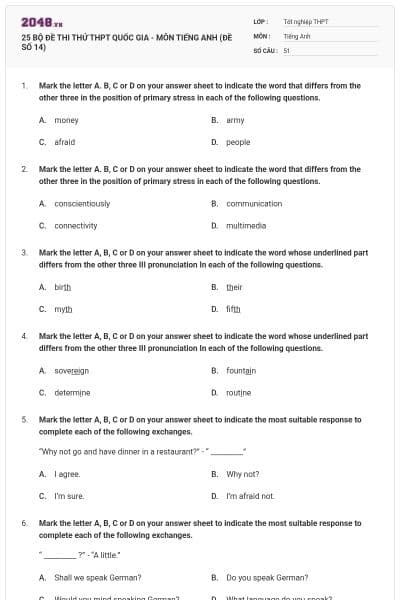
Mark the letter A. B, C or D on your answer sheet to indicate the word that differs from the other three in the position of primary stress in each of the following questions.
money
army
afraid
people
Đáp án C. (Trọng âm rơi vào âm tiết thứ 2, còn lại rơi vào âm tiết thứ 1)
A. money /ˈmʌni/ (n): tiền bạc
B. army /ˈɑːrmi/ (n): quân đội
C. afraid /əˈfreɪd/ (adj): sợ hãi, đáng sợ
D. people /ˈpiːpəl/ (n): con người, mọi người
Mark the letter A. B, C or D on your answer sheet to indicate the word that differs from the other three in the position of primary stress in each of the following questions.
conscientiously
communication
connectivity
multimedia
Đáp án B. (Trọng âm rơi vào âm tiết thứ 4, còn lại rơi vào âm tiết thứ 3)
A. conscientiously /ˌkɑːnʃiˈen.ʃəs/ (adv): chu toàn, tận tình
B. communication /kəˌmjuː.nəˈkeɪʃən/ (n): sự giao tiếp
(Đuôi “ion” trọng âm rơi vào âm tiết trước nó)
C. connectivity /ˌkɒnekˈtɪvəti/ (adj): kết nối, liên kết
(Đuôi “ity” trọng âm rơi vào âm tiết trước nó)
D. multimedia /ˌmʌltiˈmiːdiə/ (n): đa phương tiện
Mark the letter A, B, C or D on your answer sheet to indicate the word whose underlined part differs from the other three III pronunciation In each of the following questions.
birth
their
myth
fifth
Đáp án B (“th” được phát âm là /ð/, còn lại là /θ/).
A. birth /bȝ:θ/ (n): sự sinh ra.
B. their /ðeə/: của họ.
C. myth /mɪθ/ (n): thần thoại.
D. fifth /fɪfθ/: thứ năm.
Mark the letter A, B, C or D on your answer sheet to indicate the word whose underlined part differs from the other three III pronunciation In each of the following questions.
sovereign
fountain
determine
routine
Đáp án B (“ai” được phát âm là /ə/, còn lại là /ɪ/).
A. sovereign /’sɔvərɪn/ (adj): tối cao.
B. fountain /’faʊntən/ (n): đài phun nước.
C. determine /dɪ’tȝ:mɪn/ (v): quyết tâm.
D. routine /rʊ’tɪ:n/ (n): lịch trình.
Mark the letter A, B, C or D on your answer sheet to indicate the most suitable response to complete each of the following exchanges.
“Why not go and have dinner in a restaurant?” - “ _________”
I agree.
Why not?
I’m sure.
I’m afraid not.
Đáp án D.
“Sao chúng ta không đi ăn tối ở nhà hàng?” – “Tôi e là không.”
A. Tôi đồng ý.
B. Sao lại không?
C. Tôi chắc chắn.
D. Tôi e là không.
Mark the letter A, B, C or D on your answer sheet to indicate the most suitable response to complete each of the following exchanges.
“ _________ ?” - “A little.”
Shall we speak German?
Do you speak German?
Would you mind speaking German?
What language do you speak?
Đáp án B.
“Bạn có nói tiếng Đức không?” – “Một chút.”
A. Chúng ta có nên nói tiếng Đức không?
B. Bạn có nói tiếng Đức không?
C. Bạn có phiền nói tiếng Đức không?
D. Bạn nói tiếng gì?
Mark the letter A, B, C or D on your answer sheet to indicate the word(s) CLOSET in meaning to the underlined word(s) in each of the following questions.
Though he’s rich, he prefers to live in a modest little house.
current
clever
attractive
humble
Đáp án D.
A. Current (adj): hiện tại.
B. Clever (adj): thông minh, khéo léo.
C. Attracive (adj): hấp dẫn.
D. Humble (adj): khiêm tốn, nhún nhường = Modest (adj): khiêm tốn.
Dịch câu : Kể cả khi anh ấy giàu có, anh ấy cũng thích sống ở một căn nhà nhỏ khiêm tốn.
Mark the letter A, B, C or D on your answer sheet to indicate the word(s) CLOSET in meaning to the underlined word(s) in each of the following questions.
He had never experienced such discourtesy towards the president as it occurred at the annual meeting in May.
encouragement
rudeness
politeness
measurement
Đáp án B.
A. Encouragement (n) : sự khuyến khích.
B. Rudeness (n) : sự thô lỗ = Discourtesy (n) : sự bất lịch sự.
C. Politeness (n) : sự lịch sự.
D. Measurement (n): phép đo, sự đo lường.
Dịch câu : Anh ấy chưa bao giờ trải qua sự bất lịch sự như vậy đối với tổng thống khi nó diễn ra vào cuộc họp thường niên vào tháng 5.
Mark the letter A, B, C or D on your answer sheet to indicate the word(s) OPPOSITE in meaning to the underlined word(s) in each of the following questions.
After many months of grueling work and painful injuries to her shoulder and back, Susan realized that her dream of swimming the English Channel was unattainable.
realistic
unachievable
impossible
confuse.
Đáp án A.
A. Realistic (adj) : thực tế >< Unattainable (adj) : không thể tới được, không thể đạt được.
B. Unachievable (adj) : không thể đạt được.
C. Impossible (adj): không thể làm được.
D. Confuse (v) : bối rối, lúng túng.
Dịch câu : Sau nhiều tháng làm việc mệt mỏi và chấn thương đau đớn ở vai và lưng, Susan nhận ra ước mơ bơi lội qua kênh đào nước Anh là điều không thể.
Mark the letter A, B, C or D on your answer sheet to indicate the word(s) OPPOSITE in meaning to the underlined word(s) in each of the following questions.
He wants to find a temporary job or a seasonal one.
permanent
genuine
eternal
satisfactory
Đáp án A.
A. Permanent (adj) : cố định, lâu dài >< Temporary (adj) : tạm thời.
B. Genuine (adj) : thật, xác thực.
C. Eternal (adj): vĩnh viễn, bất diệt.
D. Satisfactory (adj): vừa ý, thỏa đáng.
Dịch câu : Anh ấy muốn tìm một công việc tạm thời hoặc công việc theo thời vụ.
Mark the letter A, B, C or D on your answer sheet to indicate the correct answer to each of the following questions.
The schoolboys are in a hurry _________ they will not be late for school.
so as to
to
for
in order that
Đáp án D.
So as to/to + V = For + V-ing = In order that + mệnh đề: để làm gì
Dịch nghĩa: Mấy cậu học sinh đang vội đi để không bị muộn vào lớp.
Mark the letter A, B, C or D on your answer sheet to indicate the correct answer to each of the following questions.
We are concerned with the problem of energy resources _________ we must also think of our environment.
despite
though
as though
but
Đáp án D.
In spite of/Despite + N/V-ing: mặc dù
Though/ As though + mệnh đề: mặc dù
But: nhưng, thường đứng giữa câu
Dịch nghĩa: Chúng ta lo ngại về vấn đề nguồn năng lượng nhưng chúng ta cũng phải nghĩ về môi trường của chúng ta.
Mark the letter A, B, C or D on your answer sheet to indicate the correct answer to each of the following questions.
I knew they were talking about me _________ they stopped when I entered the room.
because
because of
owing to
due to
Đáp án A.
Mệnh đề chỉ lý do:
Because / As / Since / Due to the fact that + S + V
Dịch câu: Tôi biết họ đang nói về tôi vì họ đã im bặt khi tôi bước vào phòng.
Mark the letter A, B, C or D on your answer sheet to indicate the correct answer to each of the following questions.
She asked me _________ my holidays _________.
where I spent / the previous year
where I had spent / the previous year
where I spent / last year
where did I spend / last year
Đáp án B.
Đây là câu tường thuật, không phải câu hỏi nên không thể đảo động từ lên trước.
Trong câu tường thuật gián tiếp lùi 1 thì: “where I spent” là thì quá khứ, lùi 1 thì thành “where I had spent” là thì quá khứ hoàn thành. Đồng thời “last year” -> “the previous year”
Dịch nghĩa: Cô ta hỏi tôi nơi tôi đã đi vào kì nghỉ năm ngoái.
Mark the letter A, B, C or D on your answer sheet to indicate the correct answer to each of the following questions.
It could not tell the difference between Indian music and jazz. It _________ tell the difference between Indian music and jazz.
might not
may not
mustn’t
wasn’t able to
Đáp án D.
wasn’t able to = couldn’t: không thể / không có khả năng
Dịch nghĩa: Không thể phân biệt được sự khác biệt giữa nhạc Ấn Độ và nhạc Jazz.
Mark the letter A, B, C or D on your answer sheet to indicate the correct answer to each of the following questions.
She refused _________ back again
not to come
is coming
Coming
to come
Đáp án D.
Cấu trúc “S + refuse + to V-inf”, nghĩa là “Ai đó từ chối làm gì”
Cần phân biệt “refuse + to V-inf” và “deny + V-ing”. Cấu trúc “refuse to V-inf” mang nghĩa là “từ chối làm việc gì đó (việc mình chưa làm)”; còn “deny + V-ing” là “từ chối, chối bỏ một việc mình đã làm rồi”.
Dịch câu: Cô ta từ chối quay trở lại.
Mark the letter A, B, C or D on your answer sheet to indicate the correct answer to each of the following questions.
Thanks _________ the inventions _________ labor-saving devices, women have more free time to take part _________ social work.
through / over / for
on /from/ with
forward / for / from
to / of / in
Đáp án D.
Ta có các cụm từ cố định:
- Thanks to + n: Nhờ vào ai, cái gì
- The invention of something: Sự phát minh, sáng chế của cái gì
- Take part in: tham gia vào
Dịch câu: Nhờ phát minh ra các thiết bị tiết kiệm sức lao động, phụ nữ có nhiều thời gian rảnh hơn để tham gia vào các công việc xã hội.
Mark the letter A, B, C or D on your answer sheet to indicate the correct answer to each of the following questions.
I come from a city _________ is located in the southern part of the country.
who
whom
that
whose
Đáp án C.
Đáp án A “Who” thay thế cho danh từ chỉ người làm chủ từ trong mệnh đề quan hệ. Cấu trúc: N (person) + WHO + V + O
Đáp án B “Whom” thay thế cho danh từ chỉ người làm tân ngữ cho động từ trong mệnh đề quan hệ. Cấu trúc: N (person) + WHOM + S + V
Đáp án D Whose dùng để chỉ sở hữu cho danh từ chỉ người hoặc vật, thường thay cho các từ: her, his, their, hoặc hình thức ‘s. Cấu trúc: N (person, thing) + WHOSE + N + V
“That” có thể thay thế cho vị trí của who, whom, which trong mệnh đề quan hệ quan hệ xác định
* Các trường hợp thường dùng “that”:
- Khi đi sau các hình thức so sánh nhất
- Khi đi sau các từ: only, the first, the last
- Khi danh từ đi trước bao gôm cả người và vật
- Khi đi sau các đại từ bất định, đại từ phủ định, đại từ chỉ số lượng: no one, nobody, nothing, anyone, anything, anybody, someone, something, somebody, all, some, any, little, none.
* Các trường hợp không dùng that:
- trong mệnh đề quan hệ không xác định
- sau giới từ
Dịch câu: Tôi đến từ thành phố mà nằm ở phía nam của đất nước này.
Mark the letter A, B, C or D on your answer sheet to indicate the correct answer to each of the following questions.
Communist is the highest form of _________
social
socialist
society
socialism
Đáp án B.
A. social(adj) : thuộc xã hội
B. socialist(n): người theo chủ nghĩa xâ hội
C. society(n): xã hội
D. socialism(n): chủ nghĩa xã hội
Dịch nghĩa: Người cộng sản là hình thức cao nhất của người theo chủ nghĩa xã hội.
Mark the letter A, B, C or D on your answer sheet to indicate the correct answer to each of the following questions.
I _________ much of you lately. We _________ three months ago
haven’t seen- last meet
didn’t see- met
haven’t seen- have meet
didn’t see- have met
Đáp án A.
Trong câu đầu tiên xuất hiện từ “lately” nên động từ nên được chia ở thì hiện tại hoàn thành để chỉ hành động vừa mới diễn ra. Trong câu thứ hai xuất hiện cụm “three months ago” nên động từ nên được chia ở thì quá khứ để chỉ hành động diễn ra trong quá khứ
Dịch nghĩa: Gần đây tớ không được gặp cậu nhiều. Lần cuối cùng chúng mình gặp nhau là 3 tháng trước đấy.
Mark the letter A, B, C or D on your answer sheet to indicate the correct answer to each of the following questions.
The control of _________ has been carried out through measures rooted in monetarism.
inflate
inflationist
inflation
inflator
Đáp án C.
inflate(v): thổi phồng, lạm phát
inflationist (n): người theo chủ trương lạm phát
inflation (n): sự lạm phát
inflator(n): cái bơm
Dịch nghĩa: Sự điều chỉnh lạm phát đã được thực hiện thông qua các giải pháp trong chính sách tiền tệ.
Mark the letter A, B, C or D on your answer sheet to indicate the correct answer to each of the following questions.
Considering peasants make up nearly 80% of Vietnam's population.
specialists
Economists
professors
fanners
Đáp án D.
specialists(n): chuyên gia
economists(n): nhà kinh tế
professors(n): giáo sư
farmers(n): nông dân
Dịch nghĩa: Số lượng nông dân chiếm 80 phần trăm dân số Việt Nam.
Mark the letter A, B, C or D on your answer sheet to indicate the correct answer to each of the following questions.
A _________ is a large animal that lives in deserts and is used for carrying goods and people.
slope
dune
spinifex
camel
Đáp án D.
slope(n): dốc
dune(n): cồn cát
spinifex(n): một loại cỏ sa mạc
camel(n): lạc đà
Dịch nghĩa : Lạc đà là một loài động vật lớn sống ở sa mạc và được dùng để chuyên chở hàng hóa và con người.
Mark the letter A, B, C or D on your answer sheet to indicate the correct answer to each of the following questions.
The idea of building a _________ with human intelligence is not only ambitious butalso highly unconventional.
robot
corporation
Line
road
Đáp án A.
robot(n): người máy
corporation(n): tập đoàn
line(n): đường kẻ, hàng, đường dây
road(n): con đường
Dịch nghĩa: Ý tưởng xây dựng một người máy với trí tuệ nhân tạo không chỉ đầy tham vọng mà còn có tính độc đáo cao.
Read the following passage and mark the letter A, B, C or D on your answer sheet to indicate the correct word or phrase that best fits each of the numbered blanks from 25 to 29. Fill in the appropriate word in question 25
We can (25) _______ other people in many different ways. We can talk and write, and we can send messages with our hands and faces. There is also the phone (including the mobile!), the fax, and e-mail. Television, film, painting, and photography can also communicate ideas.
Animals have ways of exchanging information, too. Bees dance and tell other bees where (26) _______ food. Elephants make sounds that humans can’t hear. Whales sing songs. Monkeys use their faces to show anger and love. But this is nothing (27) _______ to what people can do. We have language - about 6,000 languages, in fact. We can write poetry, tell jokes, make promises, explain, persuade, tell the truth, or tell lies. And we have a sense of past and future, not just present.
Radio, film, and television (28) _______ a huge influence on society in the last hundred years. And now we have the Internet, which is infinite. But what is this doing to this? We can give and get a lot of information very quickly. But there is (29) _______ information that it is difficult to know what is important and what isn’t. Modem media is changing our world every minute of every day.
communicate to
talk with
talk to
communicate with
Đáp án D
A. talk to = B. talk with: nói chuyện với
C. communicate (something) to (someone) : nói với ai về cái gì
D. communicate with: giao tiếp với
Dịch nghĩa: Chúng ta có thể giao tiếp với người khác bằng nhiều cách khác nhau.
Read the following passage and mark the letter A, B, C or D on your answer sheet to indicate the correct word or phrase that best fits each of the numbered blanks from 25 to 29. Fill in the appropriate word in question 26
We can (25) _______ other people in many different ways. We can talk and write, and we can send messages with our hands and faces. There is also the phone (including the mobile!), the fax, and e-mail. Television, film, painting, and photography can also communicate ideas.
Animals have ways of exchanging information, too. Bees dance and tell other bees where (26) _______ food. Elephants make sounds that humans can’t hear. Whales sing songs. Monkeys use their faces to show anger and love. But this is nothing (27) _______ to what people can do. We have language - about 6,000 languages, in fact. We can write poetry, tell jokes, make promises, explain, persuade, tell the truth, or tell lies. And we have a sense of past and future, not just present.
Radio, film, and television (28) _______ a huge influence on society in the last hundred years. And now we have the Internet, which is infinite. But what is this doing to this? We can give and get a lot of information very quickly. But there is (29) _______ information that it is difficult to know what is important and what isn’t. Modem media is changing our world every minute of every day.
to find
found
finding
they find
Đáp án A
Cấu trúc S+V+Wh-questions+to V
Dịch nghĩa: Ong khiêu vũ để nói với các con ong khác nơi tìm ra thức ăn.
Read the following passage and mark the letter A, B, C or D on your answer sheet to indicate the correct word or phrase that best fits each of the numbered blanks from 25 to 29. Fill in the appropriate word in question 27
We can (25) _______ other people in many different ways. We can talk and write, and we can send messages with our hands and faces. There is also the phone (including the mobile!), the fax, and e-mail. Television, film, painting, and photography can also communicate ideas.
Animals have ways of exchanging information, too. Bees dance and tell other bees where (26) _______ food. Elephants make sounds that humans can’t hear. Whales sing songs. Monkeys use their faces to show anger and love. But this is nothing (27) _______ to what people can do. We have language - about 6,000 languages, in fact. We can write poetry, tell jokes, make promises, explain, persuade, tell the truth, or tell lies. And we have a sense of past and future, not just present.
Radio, film, and television (28) _______ a huge influence on society in the last hundred years. And now we have the Internet, which is infinite. But what is this doing to this? We can give and get a lot of information very quickly. But there is (29) _______ information that it is difficult to know what is important and what isn’t. Modem media is changing our world every minute of every day.
is compared
comparing
compare
compared
Đáp án D
Mệnh đề rút gọn
But this is nothing compared to what people can do = But this is nothing which is compared to what people can do.
Dịch nghĩa: Nhưng không có gì có thể so sánh được với những gì con người có thể làm.
Read the following passage and mark the letter A, B, C or D on your answer sheet to indicate the correct word or phrase that best fits each of the numbered blanks from 25 to 29. Fill in the appropriate word in question 27
We can (25) _______ other people in many different ways. We can talk and write, and we can send messages with our hands and faces. There is also the phone (including the mobile!), the fax, and e-mail. Television, film, painting, and photography can also communicate ideas.
Animals have ways of exchanging information, too. Bees dance and tell other bees where (26) _______ food. Elephants make sounds that humans can’t hear. Whales sing songs. Monkeys use their faces to show anger and love. But this is nothing (27) _______ to what people can do. We have language - about 6,000 languages, in fact. We can write poetry, tell jokes, make promises, explain, persuade, tell the truth, or tell lies. And we have a sense of past and future, not just present.
Radio, film, and television (28) _______ a huge influence on society in the last hundred years. And now we have the Internet, which is infinite. But what is this doing to this? We can give and get a lot of information very quickly. But there is (29) _______ information that it is difficult to know what is important and what isn’t. Modem media is changing our world every minute of every day.
is compared
comparing
compare
compared
Đáp án D
Mệnh đề rút gọn
But this is nothing compared to what people can do = But this is nothing which is compared to what people can do.
Dịch nghĩa: Nhưng không có gì có thể so sánh được với những gì con người có thể làm.
Read the following passage and mark the letter A, B, C or D on your answer sheet to indicate the correct word or phrase that best fits each of the numbered blanks from 25 to 29. Fill in the appropriate word in question 28
We can (25) _______ other people in many different ways. We can talk and write, and we can send messages with our hands and faces. There is also the phone (including the mobile!), the fax, and e-mail. Television, film, painting, and photography can also communicate ideas.
Animals have ways of exchanging information, too. Bees dance and tell other bees where (26) _______ food. Elephants make sounds that humans can’t hear. Whales sing songs. Monkeys use their faces to show anger and love. But this is nothing (27) _______ to what people can do. We have language - about 6,000 languages, in fact. We can write poetry, tell jokes, make promises, explain, persuade, tell the truth, or tell lies. And we have a sense of past and future, not just present.
Radio, film, and television (28) _______ a huge influence on society in the last hundred years. And now we have the Internet, which is infinite. But what is this doing to this? We can give and get a lot of information very quickly. But there is (29) _______ information that it is difficult to know what is important and what isn’t. Modem media is changing our world every minute of every day.
are having
have had
have
had
Đáp án B
Thì hiện tại hoàn thành dùng để diễn tả hành động bắt đầu ở quá khứ và đang tiếp tục ở hiện tại.
Dịch nghĩa: Radio, phim, TV có sức ảnh hưởng to lớn đến xã hội trong hàng trăm năm qua.
Read the following passage and mark the letter A, B, C or D on your answer sheet to indicate the correct word or phrase that best fits each of the numbered blanks from 25 to 29. Fill in the appropriate word in question 29
We can (25) _______ other people in many different ways. We can talk and write, and we can send messages with our hands and faces. There is also the phone (including the mobile!), the fax, and e-mail. Television, film, painting, and photography can also communicate ideas.
Animals have ways of exchanging information, too. Bees dance and tell other bees where (26) _______ food. Elephants make sounds that humans can’t hear. Whales sing songs. Monkeys use their faces to show anger and love. But this is nothing (27) _______ to what people can do. We have language - about 6,000 languages, in fact. We can write poetry, tell jokes, make promises, explain, persuade, tell the truth, or tell lies. And we have a sense of past and future, not just present.
Radio, film, and television (28) _______ a huge influence on society in the last hundred years. And now we have the Internet, which is infinite. But what is this doing to this? We can give and get a lot of information very quickly. But there is (29) _______ information that it is difficult to know what is important and what isn’t. Modem media is changing our world every minute of every day.
so many
such much
so much
too much
Đáp án C
Cấu trúc so adj that...: quá... đến nỗi mà
Nhưng có quá nhiều thông tin đến nỗi mà rất khó để biết thông tin nào quan trọng, thông tin nào không.
Read the following passage and mark the letter A, B, C or B on your answer sheet to indicate the correct answer to each of the questions from 30 to 37.
There are a number of natural disasters that can strike across the globe. Two that are frequently linked to one another are earthquakes and tsunamis. Both of them can cause a great amount of devastation when they hit. However, tsunamis are the direct result of earthquakes and cannot happen without them.
The Earth has three main parts. They are the crust, the mantle, and the core. The crust is the outer layer of the Earth. It is not a single piece of land. Instead, it is comprised of a number of plates. There are a few enormous plates and many smaller ones. These plates essentially rest upon the mantle, which is fluid. As a result, the plates are in constant - yet slow - motion. The plates may move away from or towards other plates. In some cases, they collide violently with the plates adjoining them. The movement of the plates causes tension in the rock. Over a long time, this tension may build up. When it is released, an earthquake happens.
Tens of thousands of earthquakes happen every year. The vast majority are so small that only scientific instruments can perceive them. Others are powerful enough that people can feel them, yet they cause little harm or damage. More powerful earthquakes, however, can cause buildings, bridges, and other structures to collapse. They may additionally injure and skill thousands of people and might even cause the land to change it appearance.
Since most of the Earth's surface is water, numerous earthquakes happen beneath the planet's oceans. Underwater earthquakes cause the seafloor to move. This results in the displacement of water in the ocean. When this occurs, a tsunami may form. This is a wave that forms on the surface and moves in all directions from the place where the earthquake happened. A tsunami moves extremely quickly and can travel thousands of kilometres. As it approaches land, the water near the coast gets sucked out to sea. This causes the tsunamis to increase in height. Minutes later, the tsunami arrives. A large tsunami - one more than ten meters in height - can travel far inland. As it does that, it can flood the land, destroy human settlements, and kill large numbers of people.
Which of the following statements does paragraph 1 support?
Earthquakes cause more destruction than tsunamis.
A tsunami happens in tandem with an earthquake.
The most severe type of natural disaster is an earthquake.
Earthquakes frequently take place after tsunamis do.
Đáp án B
Đoạn văn 1 ủng hộ ý nào sau đây?
A. Động đất gây ra nhiều thiệt hại hơn sóng thần.
B. Sóng thần xảy ra song song với động đất.
C. Loại hình thiên tai tàn khốc nhất là động đất.
D. Động đất thường xảy ra sau sóng thần.
Dẫn chứng: However, tsunamis are the direct result of earthquakes and cannot happen without them.
Dịch bài đọc:
Có rất nhiều thiên tai có thể xảy ra trên toàn cầu. Hai loại thường xuyên liên kết với nhau là động đất và sóng thần. Cả hai chúng có thể gây ra một sức tàn phá lớn khi chúng xảy ra. Tuy nhiên, sóng thần là kết quả trực tiếp của động đất và không thể xảy ra mà không có nó.
Trái đất có ba phần chính. Chúng là lớp vỏ, lớp phủ và lõi. Lớp vỏ là lớp bên ngoài của trái đất. Nó không phải là một mảng duy nhất. Thay vào đó, nó bao gồm một số mảng. Có một vài mảng lớn và nhiều mảng nhỏ hơn. Những mảng này chủ yếu nằm trên lớp phủ, đó là chất lỏng. Kết quả là, các mảng được trong chuyển động liên tục nhưng chậm. Các mảng có thể di chuyển ra khỏi hoặc lên trên các mảng khác. Trong một số trường hợp, chúng va chạm dữ dội với các mảng nối liền chúng. Sự di chuyển của các mảng gây ra sự áp lực trong đá. Trong một thời gian dài, áp lực này có thể tăng lên. Khi nó được giải phóng, một trận động đất sẽ xảy ra.
Hàng chục nghìn trận động đất xảy ra mỗi năm. Phần lớn là quá nhỏ mà chỉ có các công cụ khoa học mới có thể cảm nhận được chúng. Những trận khác thì đủ mạnh để mọi người có thể cảm nhận được chúng, tuy nhiên chúng ít gây thiệt hại hoặc thiệt hại. Các trận động đất mạnh hơn, tuy nhiên, có thể làm cho các tòa nhà, cầu cống, và các cấu trúc khác sụp đổ. Chúng có thể làm tổn thương và giết chết thêm hàng ngàn người và thậm chí có thể khiến đất đai thay đổi hình dáng của nó.
Vì hầu hết bề mặt trái đất là nước, rất nhiều trận động đất xảy ra dưới đại dương của hành tinh. Động đất dưới nước làm cho đáy biển di chuyển. Điều này dẫn đến sự dịch chuyển của nước trong đại dương. Khi điều này xảy ra, một cơn sóng thần có thể hình thành. Đây là một làn sóng hình thành trên bề mặt và di chuyển theo mọi hướng từ nơi diễn ra trận động đất. Sóng thần di chuyển rất nhanh và có thể di chuyển hàng ngàn cây số. Khi tiếp cận đất, nước gần bờ biển bị hút ra biển. Điều này làm cho sóng thần tăng chiều cao. Vài phút sau, cơn sóng thần đến. Một cơn sóng thần lớn - cao hơn 10 mét - có thể đi sâu vào nội địa. Khi đó, nó có thể làm ngập đất, phá hủy các khu định cư của con người, và giết chết một lượng người lớn.
Read the following passage and mark the letter A, B, C or B on your answer sheet to indicate the correct answer to each of the questions from 30 to 37.
There are a number of natural disasters that can strike across the globe. Two that are frequently linked to one another are earthquakes and tsunamis. Both of them can cause a great amount of devastation when they hit. However, tsunamis are the direct result of earthquakes and cannot happen without them.
The Earth has three main parts. They are the crust, the mantle, and the core. The crust is the outer layer of the Earth. It is not a single piece of land. Instead, it is comprised of a number of plates. There are a few enormous plates and many smaller ones. These plates essentially rest upon the mantle, which is fluid. As a result, the plates are in constant - yet slow - motion. The plates may move away from or towards other plates. In some cases, they collide violently with the plates adjoining them. The movement of the plates causes tension in the rock. Over a long time, this tension may build up. When it is released, an earthquake happens.
Tens of thousands of earthquakes happen every year. The vast majority are so small that only scientific instruments can perceive them. Others are powerful enough that people can feel them, yet they cause little harm or damage. More powerful earthquakes, however, can cause buildings, bridges, and other structures to collapse. They may additionally injure and skill thousands of people and might even cause the land to change it appearance.
Since most of the Earth's surface is water, numerous earthquakes happen beneath the planet's oceans. Underwater earthquakes cause the seafloor to move. This results in the displacement of water in the ocean. When this occurs, a tsunami may form. This is a wave that forms on the surface and moves in all directions from the place where the earthquake happened. A tsunami moves extremely quickly and can travel thousands of kilometres. As it approaches land, the water near the coast gets sucked out to sea. This causes the tsunamis to increase in height. Minutes later, the tsunami arrives. A large tsunami - one more than ten meters in height - can travel far inland. As it does that, it can flood the land, destroy human settlements, and kill large numbers of people.
The word "it" in bold in paragraph 2 refers to _________.
the Earth
the core
the crust
the mantle
Đáp án C
Từ “it” ở đoạn 2 ám chỉ đến......
A. Trái Đất
B. hạt nhân
C. vỏ Trái Đất
D. vỏ ngoài
Dẫn chứng: The crust is the outer layer of the Earth. It is not a single piece of land. Instead, it is comprised of a number of plates.
“it” là “the crust”
Read the following passage and mark the letter A, B, C or B on your answer sheet to indicate the correct answer to each of the questions from 30 to 37.
There are a number of natural disasters that can strike across the globe. Two that are frequently linked to one another are earthquakes and tsunamis. Both of them can cause a great amount of devastation when they hit. However, tsunamis are the direct result of earthquakes and cannot happen without them.
The Earth has three main parts. They are the crust, the mantle, and the core. The crust is the outer layer of the Earth. It is not a single piece of land. Instead, it is comprised of a number of plates. There are a few enormous plates and many smaller ones. These plates essentially rest upon the mantle, which is fluid. As a result, the plates are in constant - yet slow - motion. The plates may move away from or towards other plates. In some cases, they collide violently with the plates adjoining them. The movement of the plates causes tension in the rock. Over a long time, this tension may build up. When it is released, an earthquake happens.
Tens of thousands of earthquakes happen every year. The vast majority are so small that only scientific instruments can perceive them. Others are powerful enough that people can feel them, yet they cause little harm or damage. More powerful earthquakes, however, can cause buildings, bridges, and other structures to collapse. They may additionally injure and skill thousands of people and might even cause the land to change it appearance.
Since most of the Earth's surface is water, numerous earthquakes happen beneath the planet's oceans. Underwater earthquakes cause the seafloor to move. This results in the displacement of water in the ocean. When this occurs, a tsunami may form. This is a wave that forms on the surface and moves in all directions from the place where the earthquake happened. A tsunami moves extremely quickly and can travel thousands of kilometres. As it approaches land, the water near the coast gets sucked out to sea. This causes the tsunamis to increase in height. Minutes later, the tsunami arrives. A large tsunami - one more than ten meters in height - can travel far inland. As it does that, it can flood the land, destroy human settlements, and kill large numbers of people.
What is the passage mainly about?
How earthquakes and tsunamis occur.
What kind of damage natural disasters can cause.
Why tsunamis are deadlier than earthquakes.
When earthquakes are the most likely to happen.
Đáp án A
Bài đọc chủ yếu nói về?
A. Động đất và sóng thần xảy ra như thế nào?
B. Các thiên tai có thể gây ra những thiệt hại nào?
C. Tại sao sóng thần gây nguy hiểm chết người hơn động đất?
D. Khi nào động đất có kahr năng xảy ra nhất?
Dẫn chứng: Two that are frequently linked to one another are earthquakes and tsunamis. Both of them can cause a great amount of devastation when they hit.
Read the following passage and mark the letter A, B, C or B on your answer sheet to indicate the correct answer to each of the questions from 30 to 37.
There are a number of natural disasters that can strike across the globe. Two that are frequently linked to one another are earthquakes and tsunamis. Both of them can cause a great amount of devastation when they hit. However, tsunamis are the direct result of earthquakes and cannot happen without them.
The Earth has three main parts. They are the crust, the mantle, and the core. The crust is the outer layer of the Earth. It is not a single piece of land. Instead, it is comprised of a number of plates. There are a few enormous plates and many smaller ones. These plates essentially rest upon the mantle, which is fluid. As a result, the plates are in constant - yet slow - motion. The plates may move away from or towards other plates. In some cases, they collide violently with the plates adjoining them. The movement of the plates causes tension in the rock. Over a long time, this tension may build up. When it is released, an earthquake happens.
Tens of thousands of earthquakes happen every year. The vast majority are so small that only scientific instruments can perceive them. Others are powerful enough that people can feel them, yet they cause little harm or damage. More powerful earthquakes, however, can cause buildings, bridges, and other structures to collapse. They may additionally injure and skill thousands of people and might even cause the land to change it appearance.
Since most of the Earth's surface is water, numerous earthquakes happen beneath the planet's oceans. Underwater earthquakes cause the seafloor to move. This results in the displacement of water in the ocean. When this occurs, a tsunami may form. This is a wave that forms on the surface and moves in all directions from the place where the earthquake happened. A tsunami moves extremely quickly and can travel thousands of kilometres. As it approaches land, the water near the coast gets sucked out to sea. This causes the tsunamis to increase in height. Minutes later, the tsunami arrives. A large tsunami - one more than ten meters in height - can travel far inland. As it does that, it can flood the land, destroy human settlements, and kill large numbers of people.
The word "adjoining" in bold in paragraph 2 is closest in meaning to _________.
bordering
residing
approaching
appearing.
Đáp án A
Từ “adjoining” ( tiếp giáp) được in đậm ở đoạn 2 gần nghĩa nhất với....
A. giáp biên giới
B. cư trú
C. tiếp cận
D. xuất hiện
Read the following passage and mark the letter A, B, C or B on your answer sheet to indicate the correct answer to each of the questions from 30 to 37.
There are a number of natural disasters that can strike across the globe. Two that are frequently linked to one another are earthquakes and tsunamis. Both of them can cause a great amount of devastation when they hit. However, tsunamis are the direct result of earthquakes and cannot happen without them.
The Earth has three main parts. They are the crust, the mantle, and the core. The crust is the outer layer of the Earth. It is not a single piece of land. Instead, it is comprised of a number of plates. There are a few enormous plates and many smaller ones. These plates essentially rest upon the mantle, which is fluid. As a result, the plates are in constant - yet slow - motion. The plates may move away from or towards other plates. In some cases, they collide violently with the plates adjoining them. The movement of the plates causes tension in the rock. Over a long time, this tension may build up. When it is released, an earthquake happens.
Tens of thousands of earthquakes happen every year. The vast majority are so small that only scientific instruments can perceive them. Others are powerful enough that people can feel them, yet they cause little harm or damage. More powerful earthquakes, however, can cause buildings, bridges, and other structures to collapse. They may additionally injure and skill thousands of people and might even cause the land to change it appearance.
Since most of the Earth's surface is water, numerous earthquakes happen beneath the planet's oceans. Underwater earthquakes cause the seafloor to move. This results in the displacement of water in the ocean. When this occurs, a tsunami may form. This is a wave that forms on the surface and moves in all directions from the place where the earthquake happened. A tsunami moves extremely quickly and can travel thousands of kilometres. As it approaches land, the water near the coast gets sucked out to sea. This causes the tsunamis to increase in height. Minutes later, the tsunami arrives. A large tsunami - one more than ten meters in height - can travel far inland. As it does that, it can flood the land, destroy human settlements, and kill large numbers of people.
The word "perceive" in bold in paragraph 3 is closest in meaning to _________
comprehend
detect
prevent
locate
Đáp án B
Từ “perceive” ( nhận thức) được in đậm ở đoạn 3 gần nghĩa nhất với.....
A. thấu hiểu
B. tìm ra/ phát hiện ra
C. ngăn cản
D. đặt / để/ có vị trí
Read the following passage and mark the letter A, B, C or B on your answer sheet to indicate the correct answer to each of the questions from 30 to 37.
There are a number of natural disasters that can strike across the globe. Two that are frequently linked to one another are earthquakes and tsunamis. Both of them can cause a great amount of devastation when they hit. However, tsunamis are the direct result of earthquakes and cannot happen without them.
The Earth has three main parts. They are the crust, the mantle, and the core. The crust is the outer layer of the Earth. It is not a single piece of land. Instead, it is comprised of a number of plates. There are a few enormous plates and many smaller ones. These plates essentially rest upon the mantle, which is fluid. As a result, the plates are in constant - yet slow - motion. The plates may move away from or towards other plates. In some cases, they collide violently with the plates adjoining them. The movement of the plates causes tension in the rock. Over a long time, this tension may build up. When it is released, an earthquake happens.
Tens of thousands of earthquakes happen every year. The vast majority are so small that only scientific instruments can perceive them. Others are powerful enough that people can feel them, yet they cause little harm or damage. More powerful earthquakes, however, can cause buildings, bridges, and other structures to collapse. They may additionally injure and skill thousands of people and might even cause the land to change it appearance.
Since most of the Earth's surface is water, numerous earthquakes happen beneath the planet's oceans. Underwater earthquakes cause the seafloor to move. This results in the displacement of water in the ocean. When this occurs, a tsunami may form. This is a wave that forms on the surface and moves in all directions from the place where the earthquake happened. A tsunami moves extremely quickly and can travel thousands of kilometres. As it approaches land, the water near the coast gets sucked out to sea. This causes the tsunamis to increase in height. Minutes later, the tsunami arrives. A large tsunami - one more than ten meters in height - can travel far inland. As it does that, it can flood the land, destroy human settlements, and kill large numbers of people.
D. The mantle beneath it keeps it from moving too much.D. The mantle beneath it keeps it from moving too much.
There many separate pieces that make it up.
It is the smallest of the Earth's three layers.
It is thicker on land than it is under the water.
The mantle beneath it keeps it from moving too much.
Đáp án A
Câu nào sau đây là đúng theo như bài đọc?
A. Có nhiều mảng riêng biệt tạo nên nó.
B. Nó là tầng nhỏ nhất trong 3 tầng của Trái Đất.
C. Vỏ Trái Đất trên đất dày hơn khi ở dưới nước.
D. Lớp vỏ bên dưới nó giữ cho nó không di chuyển quá nhiều.
Dẫn chứng: Instead, it is comprised of a number of plates. There are a few enormous plates and many smaller ones
Read the following passage and mark the letter A, B, C or B on your answer sheet to
indicate the correct answer to each of the questions from 30 to 37.
There are a number of natural disasters that can strike across the globe. Two that are frequently linked to one another are earthquakes and tsunamis. Both of them can cause a great amount of devastation when they hit. However, tsunamis are the direct result of earthquakes and cannot happen without them.
The Earth has three main parts. They are the crust, the mantle, and the core. The crust is the outer layer of the Earth. It is not a single piece of land. Instead, it is comprised of a number of plates. There are a few enormous plates and many smaller ones. These plates essentially rest upon the mantle, which is fluid. As a result, the plates are in constant - yet slow - motion. The plates may move away from or towards other plates. In some cases, they collide violently with the plates adjoining them. The movement of the plates causes tension in the rock. Over a long time, this tension may build up. When it is released, an earthquake happens.
Tens of thousands of earthquakes happen every year. The vast majority are so small that only scientific instruments can perceive them. Others are powerful enough that people can feel them, yet they cause little harm or damage. More powerful earthquakes, however, can cause buildings, bridges, and other structures to collapse. They may additionally injure and skill thousands of people and might even cause the land to change it appearance.
Since most of the Earth's surface is water, numerous earthquakes happen beneath the planet's oceans. Underwater earthquakes cause the seafloor to move. This results in the displacement of water in the ocean. When this occurs, a tsunami may form. This is a wave that forms on the surface and moves in all directions from the place where the earthquake happened. A tsunami moves extremely quickly and can travel thousands of kilometres. As it approaches land, the water near the coast gets sucked out to sea. This causes the tsunamis to increase in height. Minutes later, the tsunami arrives. A large tsunami - one more than ten meters in height - can travel far inland. As it does that, it can flood the land, destroy human settlements, and kill large numbers of people.
Based on the passage, what is probably true about tsunamis?
They kill more people each year than earthquakes.
They are able to move as fast as the speed of sound.
They cannot damage ships sailing on the ocean.
They can be deadly to people standing near shore.
Đáp án D
Theo bài đọc câu nào đúng khi nói về sóng thần?
A. Mỗi năm nó giết chết nhiều người hơn động đất.
B. Nó có thể di chuyển với tốc độ nhanh như âm thanh.
C. Nó có thể phá những con tàu đang lênh đênh trên đại dương.
D. Nó có thể gây chết người khi họ đứng gần bờ biển.
Dẫn chứng: As it does that, it can flood the land, destroy human settlements, and kill large numbers of people.
Read the following passage and mark the letter A, B, C or B on your answer sheet to indicate the correct answer to each of the questions from 30 to 37.
There are a number of natural disasters that can strike across the globe. Two that are frequently linked to one another are earthquakes and tsunamis. Both of them can cause a great amount of devastation when they hit. However, tsunamis are the direct result of earthquakes and cannot happen without them.
The Earth has three main parts. They are the crust, the mantle, and the core. The crust is the outer layer of the Earth. It is not a single piece of land. Instead, it is comprised of a number of plates. There are a few enormous plates and many smaller ones. These plates essentially rest upon the mantle, which is fluid. As a result, the plates are in constant - yet slow - motion. The plates may move away from or towards other plates. In some cases, they collide violently with the plates adjoining them. The movement of the plates causes tension in the rock. Over a long time, this tension may build up. When it is released, an earthquake happens.
Tens of thousands of earthquakes happen every year. The vast majority are so small that only scientific instruments can perceive them. Others are powerful enough that people can feel them, yet they cause little harm or damage. More powerful earthquakes, however, can cause buildings, bridges, and other structures to collapse. They may additionally injure and skill thousands of people and might even cause the land to change it appearance.
Since most of the Earth's surface is water, numerous earthquakes happen beneath the planet's oceans. Underwater earthquakes cause the seafloor to move. This results in the displacement of water in the ocean. When this occurs, a tsunami may form. This is a wave that forms on the surface and moves in all directions from the place where the earthquake happened. A tsunami moves extremely quickly and can travel thousands of kilometres. As it approaches land, the water near the coast gets sucked out to sea. This causes the tsunamis to increase in height. Minutes later, the tsunami arrives. A large tsunami - one more than ten meters in height - can travel far inland. As it does that, it can flood the land, destroy human settlements, and kill large numbers of people.
Which of the following is NOT mentioned in paragraph 3 about earthquakes?
How severe the majority of them are
What kind of damage they can cause
How often powerful ones take place
How many people they typically kill
Đáp án C
Ý nào sau đây không được đề cập ở đoạn 3 khi nói về động đất?
A. Chúng nghiêm trọng tới mức nào
B. Chúng có thể gây ra loại thiệt hại nào.
C. Chúng thường diễn ra mạnh như thế nào.
D. Chúng thường khiến cho bao nhiêu người chết
Dẫn chứng: More powerful earthquakes, however, can cause buildings, bridges, and other structures to collapse. They may additionally injure and skill thousands of people and might even cause the land to change it appearance.
=> Không đề cập đến cách một trận động đất diễn ra.
Read the following passage and mark the letter A, B, C, or D on your answer sheet to indicate the correct answer to each of the questions from 38 to 42.
"Did you see that?" Joe said to his friend Bill. "You're a great shooter!"
Bill caught the basketball and bounced it before throwing it again. The ball flew into the net.
"Bill, you never miss!" Joe said admiringly.
"Unless I'm in a real game," Bill complained. "Then I miss all the time."
Joe knew that Bill was right. Bill performed much better when he was having fun with Joe in the school yard than he did when he was playing for the school team in front of a large crowd.
"Maybe you just need to practice more," Joe suggested.
"But I practice all the time with you!" Bill objected. He shook his head. "I just can't play well when people are watching me."
"You play well when I'm watching," Joe pointed out.
"That's because I've known you since we were five years old," Bill said with a smile. "I'm just not comfortable playing when other people are around."
Joe nodded and understood, but he also had an idea.
The next day Joe and Bill met in the school yard again to practice. After a few minutes, Joe excused himself.
"Practice without me," Joe said to his friend. "I'll be back in a minute."
Joe hurried through the school building, gathering together whomever he could find - two students, a math teacher, two secretaries, and a janitor. When Joe explained why he needed them, everyone was happy to help.
Joe reminded the group to stay quiet as they all went toward the school's basketball court. As Joe had hoped, Bill was still practicing basketball. He made five baskets in a row without noticing the silent people standing behind him.
"Hey, Bill!" Joe called out finally.
Bill turned. A look of surprise came over his face.
I just wanted to show you that you could play well with people watching you," Joe said. "Now you'll have nothing to worry about for the next game!"
At the end of the story, all of the following people watch Bill practice EXCEPT ________
the basketball coach
a janitor
a janitor
Joe
Đáp án A. the basketball coach
Joe hurried through the school building, gathering together whomever he could find—two students, a math teacher, two secretaries, and a janitor. When Joe explained why he needed them, everyone was happy to help.
Dịch bài đọc:
“Cậu thấy chưa?” Joe nói với bạn anh ta Bill. “Cậu là một cầu thủ giỏi!”
Bill bắt lấy quả bóng rổ và nẩy bóng trước khi tiếp tục ném nó. Quả bóng bay thẳng vào lưới.
“Bill, cậu không bao giờ ném trượt!” Joe nói một cách ngưỡng mộ.
“Trừ khi tớ ở trong một trận đấu thật.” Bill phàn nàn. “Lúc đấy tớ sẽ ném trượt suốt”.
Joe biết rằng Bill nói đúng. Bill thể hiện tốt hơn nhiều khi anh ta chơi đùa với Joe trong sân trường hơn là chơi trong đội của trường trước một đám đông lớn.
“Có thể cậu cần luyện nhiều hơn”. Joe gợi ý.
“Nhưng tớ đã tập luyện suốt với cậu!” Bill cãi. Cậu ta lắc đầu. “Tớ chỉ không chơi tốt khi có người theo dõi tớ thôi”.
“Cậu chơi rất tốt khi tớ theo dõi mà” Joe chỉ rõ.
“Đó là vì tớ đã quen cậu từ khi chúng ta 5 tuổi,” Bill vừa nói vừa cười. “Tớ chỉ không cảm thấy thoải mái khi chơi mà có nhiều người xung quanh thôi”.
Joe gật đầu và hiểu ra, đồng thời cậu ấy cũng nảy ra một ý tưởng.
Ngày tiếp theo Joe và Bill gặp lại ở sân trường để tập luyện. Sau vài phút, Joe thoái thác.
“Cứ tập luyện mà không có tớ đi,” Joe bảo với bạn của mình. “ Tớ sẽ quay lại trong vài phút nữa”/
Joe băng nhanh qua tòa nhà trường học, tập trung tất cả những người mà cậu ta có thể tìm được – 2 học sinh, một giáo viên toán, một người gác cổng. Khi Joe giải thích vì sao anh ta cần bọn họ, mọi người đều vui vẻ giúp đỡ.
Joe nhắc nhở nhóm người trật tự khi họ đi vào sân bóng rổ. Như Joe kì vọng, Bill vẫn đang luyện bóng. Cậu ta ném trúng 5 quả liền một lúc mà không hề để ý tới đám người yên lặng đằng sau.
“Này Bill,” Cuối cùng thì Joe cũng gọi.
Bill quay lại. Một cái nhìn đầy ngạc nhiên xuất hiện trên khuôn mặt cậu ta.
“Tớ chỉ muốn cho cậu thấy rằng cậu có thể chơi tốt kể cả khi có người đang theo dõi,” Joe nói. “ Bây giờ cậu sẽ không có gì để lo cho trận đấu tiếp theo cả!”
Read the following passage and mark the letter A, B, C, or D on your answer sheet to indicate the correct answer to each of the questions from 38 to 42.
"Did you see that?" Joe said to his friend Bill. "You're a great shooter!"
Bill caught the basketball and bounced it before throwing it again. The ball flew into the net.
"Bill, you never miss!" Joe said admiringly.
"Unless I'm in a real game," Bill complained. "Then I miss all the time."
Joe knew that Bill was right. Bill performed much better when he was having fun with Joe in the school yard than he did when he was playing for the school team in front of a large crowd.
"Maybe you just need to practice more," Joe suggested.
"But I practice all the time with you!" Bill objected. He shook his head. "I just can't play well when people are watching me."
"You play well when I'm watching," Joe pointed out.
"That's because I've known you since we were five years old," Bill said with a smile. "I'm just not comfortable playing when other people are around."
Joe nodded and understood, but he also had an idea.
The next day Joe and Bill met in the school yard again to practice. After a few minutes, Joe excused himself.
"Practice without me," Joe said to his friend. "I'll be back in a minute."
Joe hurried through the school building, gathering together whomever he could find - two students, a math teacher, two secretaries, and a janitor. When Joe explained why he needed them, everyone was happy to help.
Joe reminded the group to stay quiet as they all went toward the school's basketball court. As Joe had hoped, Bill was still practicing basketball. He made five baskets in a row without noticing the silent people standing behind him.
"Hey, Bill!" Joe called out finally.
Bill turned. A look of surprise came over his face.
I just wanted to show you that you could play well with people watching you," Joe said. "Now you'll have nothing to worry about for the next game!"
Bill is upset because
his team loses too many games.
he plays better in practice than he does during games.
the school yard is not a good place to practice.
Joe watches him too closely when he plays.
Đáp án B. he plays better in practice than he does during games.
Dẫn chứng: Bill performed much better when he was having fun with Joe in the school yard than he did when he was playing for the school team in front of a large crowd.
Read the following passage and mark the letter A, B, C, or D on your answer sheet to indicate the correct answer to each of the questions from 38 to 42.
"Did you see that?" Joe said to his friend Bill. "You're a great shooter!"
Bill caught the basketball and bounced it before throwing it again. The ball flew into the net.
"Bill, you never miss!" Joe said admiringly.
"Unless I'm in a real game," Bill complained. "Then I miss all the time."
Joe knew that Bill was right. Bill performed much better when he was having fun with Joe in the school yard than he did when he was playing for the school team in front of a large crowd.
"Maybe you just need to practice more," Joe suggested.
"But I practice all the time with you!" Bill objected. He shook his head. "I just can't play well when people are watching me."
"You play well when I'm watching," Joe pointed out.
"That's because I've known you since we were five years old," Bill said with a smile. "I'm just not comfortable playing when other people are around."
Joe nodded and understood, but he also had an idea.
The next day Joe and Bill met in the school yard again to practice. After a few minutes, Joe excused himself.
"Practice without me," Joe said to his friend. "I'll be back in a minute."
Joe hurried through the school building, gathering together whomever he could find - two students, a math teacher, two secretaries, and a janitor. When Joe explained why he needed them, everyone was happy to help.
Joe reminded the group to stay quiet as they all went toward the school's basketball court. As Joe had hoped, Bill was still practicing basketball. He made five baskets in a row without noticing the silent people standing behind him.
"Hey, Bill!" Joe called out finally.
Bill turned. A look of surprise came over his face.
I just wanted to show you that you could play well with people watching you," Joe said. "Now you'll have nothing to worry about for the next game!"
What does Joe decide to gather a group of people for?
To have more people see the next game
To show them Bill’s talent
To get more players for his team
To help Bill feel less nervous
What does Joe decide to gather a group of people for?
Đáp án D. To help Bill feel less nervous
Dẫn chứng: "I just wanted to show you that you could play well with people watching you," Joe said. "Now you'll have nothing to worry about for the next game!"
Read the following passage and mark the letter A, B, C, or D on your answer sheet to indicate the correct answer to each of the questions from 38 to 42.
"Did you see that?" Joe said to his friend Bill. "You're a great shooter!"
Bill caught the basketball and bounced it before throwing it again. The ball flew into the net.
"Bill, you never miss!" Joe said admiringly.
"Unless I'm in a real game," Bill complained. "Then I miss all the time."
Joe knew that Bill was right. Bill performed much better when he was having fun with Joe in the school yard than he did when he was playing for the school team in front of a large crowd.
"Maybe you just need to practice more," Joe suggested.
"But I practice all the time with you!" Bill objected. He shook his head. "I just can't play well when people are watching me."
"You play well when I'm watching," Joe pointed out.
"That's because I've known you since we were five years old," Bill said with a smile. "I'm just not comfortable playing when other people are around."
Joe nodded and understood, but he also had an idea.
The next day Joe and Bill met in the school yard again to practice. After a few minutes, Joe excused himself.
"Practice without me," Joe said to his friend. "I'll be back in a minute."
Joe hurried through the school building, gathering together whomever he could find - two students, a math teacher, two secretaries, and a janitor. When Joe explained why he needed them, everyone was happy to help.
Joe reminded the group to stay quiet as they all went toward the school's basketball court. As Joe had hoped, Bill was still practicing basketball. He made five baskets in a row without noticing the silent people standing behind him.
"Hey, Bill!" Joe called out finally.
Bill turned. A look of surprise came over his face.
I just wanted to show you that you could play well with people watching you," Joe said. "Now you'll have nothing to worry about for the next game!"
What would be the best title for the story?
Practice Makes Perfect
Joe Joins the Team
Bill Wins the Big Game
Bill's Basketball Problem
What would be the best title for the story?
Đáp án D. Bill's Basketball Problem
Dẫn chứng: "Unless I'm in a real game," Bill complained. "Then I miss all the time."
Bill said with a smile. "I'm just not comfortable playing when other people are around."
Read the following passage and mark the letter A, B, C, or D on your answer sheet to indicate the correct answer to each of the questions from 38 to 42.
"Did you see that?" Joe said to his friend Bill. "You're a great shooter!"
Bill caught the basketball and bounced it before throwing it again. The ball flew into the net.
"Bill, you never miss!" Joe said admiringly.
"Unless I'm in a real game," Bill complained. "Then I miss all the time."
Joe knew that Bill was right. Bill performed much better when he was having fun with Joe in the school yard than he did when he was playing for the school team in front of a large crowd.
"Maybe you just need to practice more," Joe suggested.
"But I practice all the time with you!" Bill objected. He shook his head. "I just can't play well when people are watching me."
"You play well when I'm watching," Joe pointed out.
"That's because I've known you since we were five years old," Bill said with a smile. "I'm just not comfortable playing when other people are around."
Joe nodded and understood, but he also had an idea.
The next day Joe and Bill met in the school yard again to practice. After a few minutes, Joe excused himself.
"Practice without me," Joe said to his friend. "I'll be back in a minute."
Joe hurried through the school building, gathering together whomever he could find - two students, a math teacher, two secretaries, and a janitor. When Joe explained why he needed them, everyone was happy to help.
Joe reminded the group to stay quiet as they all went toward the school's basketball court. As Joe had hoped, Bill was still practicing basketball. He made five baskets in a row without noticing the silent people standing behind him.
"Hey, Bill!" Joe called out finally.
Bill turned. A look of surprise came over his face.
I just wanted to show you that you could play well with people watching you," Joe said. "Now you'll have nothing to worry about for the next game!"
In line 6, the word performed is closest in meaning to _________
played
changed
moved
acted
Đáp án A. played
Dẫn chứng: Bill performed much better when he was having fun with Joe in the school yard than he did when he was playing for the school team in front of a large crowd.
Mark the letter A, B, C or D on your answer sheet to indicate the sentence that is closest in meaning to each of the following questions.
“Don’t forget to hand in the report, Pete !” said Kate.
Kate forgot to hand in the report to Pete.
Kate said that Pete Had forgotten to hand in the report.
Kate reminded Pete of handing in the report.
Kate reminded Pete to hand in the report.
Đáp án D.
Nghĩa câu gốc: Kate bảo: “Đừng quên nộp báo cáo đấy, Pete!”
Sử dụng cấu trúc "remind somebody to do something".
Các đáp án còn lại sai nghĩa gốc:
C. Kate reminded Pete of handing in the report. (cấu trúc “remind somebody of somebody/something” chứ không bao giờ theo sau là V-ing)
B. Kate said that Pete had forgotten to hand in the report: Kate nói rằng Pete đã quên nộp báo cáo.
A. Kate forgot to hand in the report to Pete: Kate quên nộp báo cáo cho Pete.
Mark the letter A, B, C or D on your answer sheet to indicate the sentence that is closest in meaning to each of the following questions.
Had the announcement been made earlier, more people would have attended the lecture.
The late announcement helped make the lecture well – attended
More people came late to the lecture because of the late announcement.
The lecure was held so late that a few people attended it.
Few people came to the lecture because the announcement was not made earlier
Đáp án: D
Giải thích:
Nếu thông báo được đưa ra sớm hơn, nhiều người sẽ tham dự bài giảng hơn.
A. Việc thông báo muộn đã giúp bài giảng được nhiều người tham dự.
→ Sai nghĩa. Cấu trúc: make sb/sth adj: khiến ai/cái gì như thế nào
B. Nhiều người hơn đến muộn bài giảng vì thông báo trễ.
→ Sai nghĩa. Cấu trúc: because of + N/V-ing: bởi vì
C. Bài giảng được tổ chức quá muộn đến mức có một số người tham dự.
→ Sai nghĩa. Cấu trúc “quá…đến nỗi mà”: S + be/V + so + adj/adv + that + clause.
D. Không ai đến dự buổi giảng vì thông báo không được đưa ra sớm hơn.
→ Đúng. Cấu trúc: because + clause: bởi vì
Few + N đếm được số nhiều: 1 vài, 1 ít (gần như không có) → mang nghĩa phủ định
Dịch: Nếu thông báo được đưa ra sớm hơn, nhiều người sẽ tham dự bài giảng hơn.
= Không ai đến dự buổi giảng vì thông báo không được đưa ra sớm hơn.
Mark the letter A, B, C or D on your answer sheet to indicate the sentence that is closest in meaning to each of the following questions.
When the birth rate is high, the expectation of life is low
The birth rat is as high sa the expectation of life.
The higher the birth rate, the lower the expectation of life
The birth rate and the expectation of life are high and low respectively.
The high rate of giving birth dends on the low rate of expectation of life.
Đáp án B.
Dịch câu đề: Khi tỉ lệ sinh cao, kỳ vọng về cuộc sống thấp
Đáp án C sai về nghĩa.
Đáp án A sai vì trong đề không có dẫn chúng về tỉ lệ 2 cái là như nhau.
Đáp án D sai vì không có tỷ lệ nào phụ thuộc tỷ lệ nào.
C. The birth rate and the expectation of life are high and low respectively. Tỷ lệ sinh và kỳ vọng sống cao và thấp tương ứng.
B. The higher the birth rate, the lower the expectation of life. Tỷ lệ sinh con càng cao, kỳ vọng sống càng thấp
A. The birth rat is as high sa the expectation of life. Tỷ lệ sinh con cao như kỳ vọng của cuộc sống.
D. The high rate of giving birth dends on the low rate of expectation of life. Tỷ lệ sinh con cao phụ thuộc vào tỷ lệ kỳ vọng thấp của cuộc sống.
Mark the letter A, B, C or B on your answer sheet to indicate the underlined part that needs correction in each of the following questions.
(A) The place (B) which (C) he was bom is (D) now a big city.
The place
which
he was bom
now
Đáp án A
Sửa ‘which’ => ‘in which/ where’: đại từ quan hệ chỉ địa điểm
Dịch nghĩa: Nơi mà anh ấy được sinh ra giờ đã là 1 thành phố lớn.
Mark the letter A, B, C or B on your answer sheet to indicate the underlined part that needs correction in each of the following questions.
(A) A new bridge (B) will be (C) build (D) over this river
build
will
over this river
A
Đáp án: A
Giải thích:
Chủ ngữ “A new bridge” là danh từ chỉ vật nên ta dùng câu bị động.
Sửa: build → built (thể bị động: be V3/-ed trong này ‘built’ là quá khứ bất quy tắc của ‘build’)
Dịch: Cây cầu mới sẽ được xây dựng bắc qua con sông này.
Mark the letter A, B, C or B on your answer sheet to indicate the underlined part that needs correction in each of the following questions.
(A) It was a nice day, (B) so we decided (C) going (D) for a walk.
It
so
going
for a walk.
Đáp án: C
Giải thích:
decide to V: quyết định làm gì
Sửa: going → to go
Dịch: Hôm đó trời đẹp, vì vậy chúng tôi quyết định đi dạo.
Mark the letter A, B, C or D on your answer sheet to indicate the sentence that best combines each pair of sentences in the following questions.
Mr. Smith first met his partner in 2011.
Mr. Smith has known his partner since 2011.
Mr. Smith hasn’t known his partner before.
Mr. Smith hasn’t met his partner for 6 years.
Mr. Smith has met his partner for 6 years.
Đáp án A
A. Smith đã biết đối tác của mình từ năm 2011.
B. Smith đã không biết đối tác của mình trước đây.
C. Smith đã không gặp đối tác của mình trong 6 năm.
D. Smith đã gặp đối tác của mình suốt 6 năm.
Dịch nghĩa: Ông Smith lần đầu tiên gặp đối tác của mình trong năm 2011.
Mark the letter A, B, C or D on your answer sheet to indicate the sentence that best combines each pair of sentences in the following questions.
The man wanted to get some fresh air in the room. He opened the window
The man wanted to get some fresh air in the room because he opened the window
The man opened the window in order to get some fresh air in the room
The man got some fresh air in the room, even though he opened the window
Having opened the window, the room could get some fresh air
Đáp án B
Người đàn ông muốn có chút không khí trong lành vào trong phòng. Ông đã mở cửa sổ.
Dịch nghĩa: Người đàn ông đã mở cửa sổ để đưa không khí trong lành vào trong phòng