25 BỘ ĐỀ THI THỬ THPT QUỐC GIA - MÔN TIẾNG ANH (ĐỀ SỐ 11)
50 câu hỏi
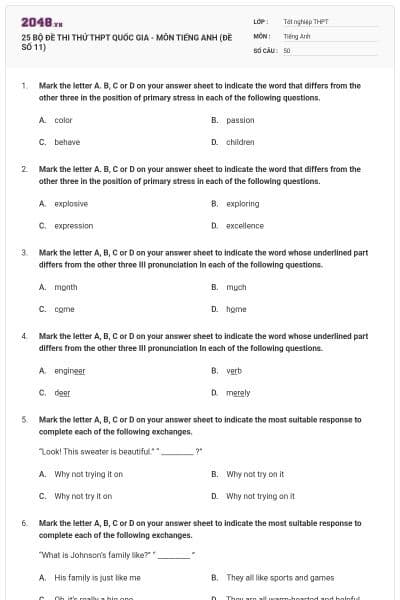
Mark the letter A. B, C or D on your answer sheet to indicate the word that differs from the other three in the position of primary stress in each of the following questions.
color
passion
behave
children
Đáp án C (Trọng âm rơi vào âm tiết thứ hai, các từ còn lại rơi vào âm thứ nhất).
A. color /’kʌlə/ (n): màu.
B. passion /’pæʃən/ (n): nhiệt huyết.
(Đuôi “ion” trọng âm rơi vào âm tiết đứng trước nó).
C. behave /bɪ’heɪv/ (v): cư xử.
(Động từ 2 âm tiết thì trọng âm thường rơi vào âm tiết thứ 2).
D. children /’tʃɪldrən/ (n): trẻ con.
Mark the letter A. B, C or D on your answer sheet to indicate the word that differs from the other three in the position of primary stress in each of the following questions.
explosive
exploring
expression
excellence
Đáp án D (Trọng âm rơi vào âm tiết thứ nhất, các từ còn lại rơi vào âm thứ hai).
A. explosive /ɪks’pləʊsɪv/ (adj): có tính nổ.
(Đuôi “ive” trọng âm rơi vào âm tiết đứng trước nó).
B. exploring /ɪks’plɔ:rɪŋ/ (v): khám phá.
C. expression /ɪks’preʃən/ (n): biểu cảm.
(Đuôi “ion” trọng âm rơi vào âm tiết đứng trước nó).
D. excellence /’eksələns/ (n): sự xuất sắc.
Mark the letter A, B, C or D on your answer sheet to indicate the word whose underlined part differs from the other three III pronunciation In each of the following questions.
month
much
come
home
Đáp án D (“o” đọc là /əu/, còn lại là /a/)
A. month /mʌnθ/ (n): tháng
B. much /mʌtʃ/ (adj): nhiều
C. come /kʌm/ (v): đến
D. home /həum/ (n): nhà
Mark the letter A, B, C or D on your answer sheet to indicate the word whose underlined part differs from the other three III pronunciation In each of the following questions.
engineer
verb
deer
merely
Đáp án B (“er” đọc là /ɜː/, còn lại đọc là /ɪə/)
A. engineer /ˌen.dʒɪˈnɪər/ (n): kỹ sư
B. verb /vɜːb/(n): động từ
C. deer /dɪər/(n): con hươu
D. merely /ˈmɪəli/(adv): chỉ, đơn thuần.
Mark the letter A, B, C or D on your answer sheet to indicate the most suitable response to complete each of the following exchanges.
“Look! This sweater is beautiful.” “ _________ ?”
Why not trying it on
Why not try on it
Why not try it on
Why not trying on it
Đáp án C.
A: “Nhìn kìa! Cái áo kia đẹp quá.”
B: “Sao cậu không thử mặc nó xem như thế nào?”
A. Why not trying it on
B. Why not try on it
C. Why not try it on - Sao cậu không thử mặc nó xem như thế nào
D. Why not trying on it
Mark the letter A, B, C or D on your answer sheet to indicate the most suitable response to complete each of the following exchanges.
“What is Johnson’s family like?” “ _________ ”
His family is just like me
They all like sports and games
Oh, it’s really a big one
They are all warm-hearted and helpful
Đáp án D.
A: “Gia đình của Johnson là những người như thế nào vậy?”
B: “Họ đều rất tốt bụng và sẵn sang giúp đỡ người khác”
A. Gia đình của cậu ấy đều giống anh vậy
B. Họ đều thích chơi thể thao và chơi trò chơi
C. Ồ, đấy là một gia đình rất lớn
D. Họ đều rất tốt bụng và sẵn sang giúp đỡ người khác
Mark the letter A, B, C or D on your answer sheet to indicate the word(s) CLOSET in meaning to the underlined word(s) in each of the following questions.
Those with incomes ranging from $2000 to $4000 enjoy a luxurious and extravagant life.
grazing
raving
varying
Turning
Đáp án C.
A. grazing: gặm cỏ.
B. raving: nói say sưa (rave about something).
C. varying = ranging: thay đổi.
D. Turning: xoay, biến đổi.
Dịch câu: Những người có thu nhập từ $ 2000 đến $ 4000 tận hưởng một cuộc sống sang trọng và lộng lẫy.
Mark the letter A, B, C or D on your answer sheet to indicate the word(s) CLOSET in meaning to the underlined word(s) in each of the following questions.
Today, she is fortunate to be one of the last few surviving U-boats in the world, preserved in time and on display in the Museum of Science in Chicago.
under supervision
on exhibit
located
Stored
Đáp án B.
A. under supervision: được giám sát.
B. on exhibit = on display: được trưng bày.
C. located: được đặt ở đâu.
D. Stored: được lưu trữ.
Dịch câu: Hôm nay, con thuyền này may mắn là một trong số ít những chiếc thuyền chữ U còn sống sót trên thế giới, được bảo tồn đúng lúc và được trưng bày tại Bảo tàng Khoa học ở Chicago.
Mark the letter A, B, C or D on your answer sheet to indicate the word(s) OPPOSITE in meaning to the underlined word(s) in each of the following questions.
Thousands are going starving because of the failure of this year’s harvest.
poor
rich
hungry
full
Đáp án D
A. poor: nghèo
B. rich: giàu
C. hungry: đói
D. full: no đủ >< starving: chết đói
Dịch câu: Hàng ngàn người sẽ chết đói bởi sự thất bại của mùa vụ năm nay.
Mark the letter A, B, C or D on your answer sheet to indicate the word(s) OPPOSITE in meaning to the underlined word(s) in each of the following questions.
The situation in the country has remained relatively stable for a few months now.
objective
changeable
constant
ignorant
Đáp án B
A. objective: khách quan
B. changeable: linh hoạt >< stable: ổn định
C. constant: liên tục
D. ignorant: thờ ơ
Dịch câu : Tình trạng ở vùng nông thôn vẫn khá ổn định trong vài tháng gần đây.
Mark the letter A, B, C or D on your answer sheet to indicate the correct answer to each of the following questions.
If you hadn’t watched that late movie last night, you _________ sleepy now.
wouldn’t have been
wouldn’t be
might have not been
wouldn’t have been being
Đáp án B.
Cấu trúc câu điều kiện trộn lẫn: “If S + had + V(P2), S + would/ could/ might + V”
Câu điều kiện trộn lẫn được sử dụng cho trường hợp: hành động được diễn ra trong quá khứ nhưng có kết quả có ảnh hưởng tới hiện tại.
Dịch nghĩa: Nếu bạn không xem phim muộn tối qua, bạn đã không buồn ngủ bây giờ.
Mark the letter A, B, C or D on your answer sheet to indicate the correct answer to each of the following questions.
_______, he walked to the station.
Despite being tired
Although to be tired
In spite being tired
Despite tired
Đáp án A.
In spite of/Despite + N/V-ing: mặc dù
Although + mệnh đề: mặc dù
Dịch nghĩa: Dù mệt nhưng anh ấy vẫn đi bộ đến sân ga.
Mark the letter A, B, C or D on your answer sheet to indicate the correct answer to each of the following questions.
Josh couldn’t open the door _________ the lock was broken.
Because
because of
due to
owing to
Đáp án A.
Mệnh đề chỉ lý do:
Because / As / Since / Due to the fact that + S + V
Dịch câu : John không thể mở cửa vì khoa cửa bị vỡ.
Mark the letter A, B, C or D on your answer sheet to indicate the correct answer to each of the following questions.
The teacher said Columbus _________America in 1942.
discovered
had discovered
was discovering
would discover
Đáp án B.
Câu tường thuật gián tiếp lùi 1 thì từ quá khứ “ discovered” -> quá khứ hoàn thành “had discovered”
Dịch nghĩa: Giáo viên nói rằng Colombus đã khám phá ra Châu Mỹ vào năm 1942.
Mark the letter A, B, C or D on your answer sheet to indicate the correct answer to each of the following questions.
‘Do you like to play tennis?” “I _________, but now I prefer golf”
used to
used to do
used to played
used to playing
Đáp án A.
Used to do something: đã từng thường xuyên làm gì.
Trong trường hợp này vì là câu trả lời cho câu hỏi nên không lặp lại động từ “play”
Dịch nghĩa: “Bạn có thích chơi tennis không?” “Tôi có, nhưng bây giờ tôi thích chơi golf hơn
Mark the letter A, B, C or D on your answer sheet to indicate the correct answer to each of the following questions.
Ann offered _________ after our children while we were out.
look
to look
looking
look to
Đáp Án B.
Cấu trúc “S + offer + to V-inf”, nghĩa là “đề nghị được làm gì”
Dịch câu: Ann đề nghị trông nom lũ trẻ khi chúng tôi đi vắng.
Mark the letter A, B, C or D on your answer sheet to indicate the correct answer to each of the following questions.
She often reads newspapers and look through the Situations _________ columns every day, but up to now she has not found any job yet.
Article
Space
Vacant
Spot
Đáp án C.
A. Article(n): bài báo.
B. Space(n): chỗ trống.
C. Vacant(n): chỗ trống.
D. Spot (n): điểm.
Dịch nghĩa: Cô ấy thường đọc báo vào xem cột Việc cần người hằng ngày, nhưng cho tới giờ cô ấy vẫn chưa tìm được việc nào
Mark the letter A, B, C or D on your answer sheet to indicate the correct answer to each of the following questions.
Alaska, _________ my brother lives, is the largest state in the United States.
which
where
who
All are correct
Đáp án B.
Đáp án A “ Which” thay thế cho danh từ chỉ vật, làm chủ ngữ hoặc tân ngữ trong mệnh đề quan hệ. Cấu trúc: N (thing) + WHICH + V + O; N (thing) + WHICH + S + V
Đáp án C “Who” thay thế cho danh từ chỉ người làm chủ từ trong mệnh đề quan hệ. Cấu trúc: N (person) + WHO + V + O
Đáp án D không phù hợp
“Where” thay thế từ chỉ nơi chốn, thường thay cho “there”: N (place) + WHERE + S + V (WHERE = ON / IN / AT + WHICH)
Dịch câu : Alaska, nơi anh trai tôi sống, là bang lớn nhất nước Mỹ.
Mark the letter A, B, C or D on your answer sheet to indicate the correct answer to each of the following questions.
Can you tell me about the _________ process to tertiary study in Vietnam?
apply
applicable
application
applicant
Đáp án C.
A. apply (v): ứng tuyển
B. applicable(adj) : có thể ứng tuyển
C. application(n) : sự ứng tuyển
D. applicant(n) : ứng viên
Ta có: application process (n): quá trình ứng tuyển
Dịch nghĩa: bạn có thể nói cho tôi quá trình ứng tuyển vào đại học ở Việt Nam được không?
Mark the letter A, B, C or D on your answer sheet to indicate the correct answer to each of the following questions.
While my mother _________ a film on TV, my father was cooking dinner. It was March 8th yesterday.
watched
was watching
had watched
watches
Đáp án B.
Trong câu xuất hiện giới từ “While”, và động từ “watch” diễn ra song song với động từ “cook”, cả hai động từ này đều diễn ra trong quá khứ nên động từ phải chia ở thì quá khứ tiếp diễn.
Dịch nghĩa: Trong khi mẹ tôi xem phim trên Tv thì bố tôi đang nấu bữa tối. Hôm qua là ngày 8/3
Mark the letter A, B, C or D on your answer sheet to indicate the correct answer to each of the following questions.
It is _________ to cross the sea in a small boat.
danger
endanger
dangerous
endangered
Đáp án C.
danger(n): mối nguy hiểm
dangerous(adj): nguy hiểm
endanger(v): gây nguy hiểm
endangered(v): nguy cơ tuyệt chủng
Sử dụng cấu trúc “It is + adj + to + mệnh đề” để nhấn mạnh mức độ, tình trạng của sự việc.
Dịch nghĩa: Việc vượt biển trên một chiếc thuyền nhỏ rất nguy hiểm.
Mark the letter A, B, C or D on your answer sheet to indicate the correct answer to each of the following questions.
Most novels are divided into several _________.
chapters
units
sections
passages
Đáp án A.
chapter(n): chương
unit(n): đơn vị
section(n): phần
passages(n): đoạn văn
Dịch nghĩa: Hầu hết các cuốn tiểu thuyết đều được chia thành vài chương.
Mark the letter A, B, C or D on your answer sheet to indicate the correct answer to each of the following questions.
Unlike football, a water polo game is _________ into quarters.
divided
separated
cut
played
Đáp án A.
divided(v): được chia ra
separated(v): được tách ra
cut(v): cắt
played(v): được chơi
Dịch nghĩa: Không như bóng đá, một trận bóng nước được chia thành 4 hiệp.
Mark the letter A, B, C or D on your answer sheet to indicate the correct answer to each of the following questions.
A kick taken as a penalty in the game of football is called a penalty kick or _________ kick.
punishment
foul
opposition
spot
Đáp án A.
punishment: phạt. trừng phạt
foul: phạm lỗi
opposition: đối lập, vị trí đối lập
spot: điểm
Dịch nghĩa: Một cú đá để trừng phạt trong các trận bóng đá được gọi là đá penalty hoặc đá phạt.
Read the following passage and mark the letter A, B, C or D on your answer sheet to indicate the correct word or phrase that best fits each of the numbered blanks from 25 to 29. Fill in the appropriate word in question 25
The 15th Asian Games took place from December 1 through December 15, 2006, in Doha, Capital of Qatar. More than 10,000 athletes, who (25) _________45 countries and regions, took part in 39 sports and 424 events of the Games, the most important event in Asia. Some new events such as chess and triathlon were also included in the Games.
The 15th Asian Games was organized at 34 sporting (26) _________ , including Khalifa Stadium, which hosted the opening and closing ceremonies. The Opening Ceremony of the 15th Asian Games, Doha 2006, at Khalifa Stadium, was the most (27) _________ opening of any Games with 50,000 people to get into Khalifa Stadium and more than one billion television viewers. The Doha Asian Games Organizing Committee (DAGOC) wanted to ensure that everybody who saw the ceremony would have a memory for life as suggested in the (28) _________ "The Games of Your Life." The 15th Asian Games was a successful sporting event that all (29) _________ would never forget
expressed
represented
symbolized
typified
Đáp án B
Symbolized: biểu tượng
Represented: đại diện
Expressed: thể hiện/ trình bày
Typified: đặc trưng
The 15th Asian Games took place from December 1 through December 15, 2006, in Doha, capital of Qatar. More than 10,000 athletes, who (25)___________ 45 countries and regions, took part in 39 sports and 424 events of the Games, the most important event in Asia. Some new events such as chess and triathlon were also included in the Games.
[Thế Vận hội châu Á lần thứ 15 diễn ra từ ngày 1 tháng 12 đến ngày 15 tháng 12 năm 2006, ở Doha, thủ đô của Qatar. Hơn 10.000 vận động viên, người mà đại diện cho 45 quốc gia và vùng lãnh thổ, tham gia vào 39 môn thể thao và 424 sự kiện của Thế vận hội, sự kiện quan trọng nhất của châu Á. Một số sự kiện mới chẳng hạn như cờ vua và 3 môn phối hợp (bơi lội, đua xe đạp và chạy điền kinh) được bao gồm trong Thế vận hội.]
Read the following passage and mark the letter A, B, C or D on your answer sheet to indicate the correct word or phrase that best fits each of the numbered blanks from 25 to 29. Fill in the appropriate word in question 26
The 15th Asian Games took place from December 1 through December 15, 2006, in Doha, Capital of Qatar. More than 10,000 athletes, who (25) _________45 countries and regions, took part in 39 sports and 424 events of the Games, the most important event in Asia. Some new events such as chess and triathlon were also included in the Games.
The 15th Asian Games was organized at 34 sporting (26) _________ , including Khalifa Stadium, which hosted the opening and closing ceremonies. The Opening Ceremony of the 15th Asian Games, Doha 2006, at Khalifa Stadium, was the most (27) _________ opening of any Games with 50,000 people to get into Khalifa Stadium and more than one billion television viewers. The Doha Asian Games Organizing Committee (DAGOC) wanted to ensure that everybody who saw the ceremony would have a memory for life as suggested in the (28) _________ "The Games of Your Life." The 15th Asian Games was a successful sporting event that all (29) _________ would never forget
venues
facilities
events
teams
Đáp án A
events: sự kiện
facilities: cơ sở vật chất
venues: địa điểm
teams: đội/ nhóm
The 15th Asian Games was organized at 34 sporting (26)___________, including Khalifa Stadium, which hosted the opening and closing ceremonies.
[Thế Vận hội lần thứ 15 được tổ chức ở 34 địa điểm thể thao khác nhau, bao gồm sân vận động Khalifa, cái mà đăng cai tổ chức lễ khai mạc và bế mạc.]
Read the following passage and mark the letter A, B, C or D on your answer sheet to indicate the correct word or phrase that best fits each of the numbered blanks from 25 to 29. Fill in the appropriate word in question 27
The 15th Asian Games took place from December 1 through December 15, 2006, in Doha, Capital of Qatar. More than 10,000 athletes, who (25) _________45 countries and regions, took part in 39 sports and 424 events of the Games, the most important event in Asia. Some new events such as chess and triathlon were also included in the Games.
The 15th Asian Games was organized at 34 sporting (26) _________ , including Khalifa Stadium, which hosted the opening and closing ceremonies. The Opening Ceremony of the 15th Asian Games, Doha 2006, at Khalifa Stadium, was the most (27) _________ opening of any Games with 50,000 people to get into Khalifa Stadium and more than one billion television viewers. The Doha Asian Games Organizing Committee (DAGOC) wanted to ensure that everybody who saw the ceremony would have a memory for life as suggested in the (28) _________ "The Games of Your Life." The 15th Asian Games was a successful sporting event that all (29) _________ would never forget
colorful
formal
spectacular
elaborate
Đáp án C
Spectacular: ngoạn mục/ ấn tượng
Formal: trang trọng
Colorful: nhiều màu sắc
Elaborate: tỉ mỉ, chi tiết
The Opening Ceremony of the 15th Asian Games, Doha 2006, at Khalifa Stadium, was the most (27)___________ opening of any Games with 50,000 people to get into Khalifa Stadium and more than one billion television viewers.
Lễ khai mai của Thế Vận hội lần thứ 15, Doha 2006, tại sân vận động Khaliffa, là lễ khai mạc ngoạn mục nhất của bất cứ thế vận hội nào với 50.000 người đô xô đến sân vận động Khaliffa và hơn 1 tỉ người xem trên tivi.
Read the following passage and mark the letter A, B, C or D on your answer sheet to indicate the correct word or phrase that best fits each of the numbered blanks from 25 to 29. Fill in the appropriate word in question 28
The 15th Asian Games took place from December 1 through December 15, 2006, in Doha, Capital of Qatar. More than 10,000 athletes, who (25) _________45 countries and regions, took part in 39 sports and 424 events of the Games, the most important event in Asia. Some new events such as chess and triathlon were also included in the Games.
The 15th Asian Games was organized at 34 sporting (26) _________ , including Khalifa Stadium, which hosted the opening and closing ceremonies. The Opening Ceremony of the 15th Asian Games, Doha 2006, at Khalifa Stadium, was the most (27) _________ opening of any Games with 50,000 people to get into Khalifa Stadium and more than one billion television viewers. The Doha Asian Games Organizing Committee (DAGOC) wanted to ensure that everybody who saw the ceremony would have a memory for life as suggested in the (28) _________ "The Games of Your Life." The 15th Asian Games was a successful sporting event that all (29) _________ would never forget
streamer
banner
portrait
slogan
Đáp án D
Portrait: chân dung
Banner: biểu ngữ
streamer: cờ đuôi nheo
slogan: khẩu ngữ
The Doha Asian Games Organizing Committee (DAGOC) wanted to ensure that everybody who saw the ceremony would have a memory for life as suggested in the (28)___________"The Games of Your Life."
Ban tổ chức của thế vận hội châu Á Doha muốn đảm bảo rằng mọi người ngờời mà nhìn thấy lễ này sẽ nhớ mãi cả đời như đã đề xuất trong khẩu hiệu “ Thế Vận hội để đời”.
Read the following passage and mark the letter A, B, C or D on your answer sheet to indicate the correct word or phrase that best fits each of the numbered blanks from 25 to 29. Fill in the appropriate word in question 29
The 15th Asian Games took place from December 1 through December 15, 2006, in Doha, Capital of Qatar. More than 10,000 athletes, who (25) _________45 countries and regions, took part in 39 sports and 424 events of the Games, the most important event in Asia. Some new events such as chess and triathlon were also included in the Games.
The 15th Asian Games was organized at 34 sporting (26) _________ , including Khalifa Stadium, which hosted the opening and closing ceremonies. The Opening Ceremony of the 15th Asian Games, Doha 2006, at Khalifa Stadium, was the most (27) _________ opening of any Games with 50,000 people to get into Khalifa Stadium and more than one billion television viewers. The Doha Asian Games Organizing Committee (DAGOC) wanted to ensure that everybody who saw the ceremony would have a memory for life as suggested in the (28) _________ "The Games of Your Life." The 15th Asian Games was a successful sporting event that all (29) _________ would never forget
attendants
attendees
attendances
attenders
Đáp án B
attendances: sự có mặt / sự tham dự
attendees: người tham dự vào một sự kiện
attendants: người giúp việc/ người hỗ trợ người khác
attenders : người tham dự thường xuyên
The 15th Asian Games was a successful sporting event that all (29)___________ would never forget.
Thế Vận hội lần thứ 15 là một sự kiện thể thao thành công cái mà tất cả người tham gia sẽ không bao giờ quên.
Read the following passage and mark the letter A, B, C or B on your answer sheet to indicate the correct answer to each of the questions from 30 to 34.
Learning means acquiring knowledge or developing the ability to perform new behaviors. It is common to think of learning as something that takes place in school, but much of human learning occurs outside the classroom, and people continue to learn throughout their lives.
Even before they enter school, young children learn to walk, to talk, and to use their hands to manipulate toys, food, and other objects. They use all of their senses to learn about the sights, sounds, tastes, and smells in their environments. They learn how to interact with their parents, siblings, friends, and other people important to their world. When they enter school, children learn basic academic subjects such as reading, writing, and mathematics. They also continue to learn a great deal outside the classroom. They learn which behaviors are likely to be rewarded and which are likely to be punished. They learn social skills for interacting with other children. After they finish school, people must learn to adapt to the many major changes that affect their lives, such as getting married, raising children, and finding and keeping a job.
Because learning continues throughout our lives and affects almost everything we do, the study of learning is important in many different fields. Teachers need to understand the best ways to educate children. Psychologists, social workers, criminologists, and other human-service workers need to understand how certain experiences change people’s behaviors. Employers, politicians, and advertisers make use of the principles of learning to influence the behavior of workers, voters, and consumers.
Learning is closely related to memory, which is the storage of information in the brain. Psychologists who study memory are interested in how the brain stores knowledge, where this storage takes place, and how the brain later retrieves knowledge when we need it. In contrast, psychologists who study learning are more interested in behavior and how behavior changes as a result of a person’s experiences.
There are many forms of learning, ranging from simple to complex. Simple forms of learning involve a single stimulus. A stimulus is anything perceptible to the senses, such as a sight, sound, smell, touch, or taste. In a form of learning known as classical conditioning, people learn to associate two stimuli that occur in sequence, such as lightning followed by thunder. In operant conditioning, people learn by forming an association between a behavior and its consequences (reward or punishment). People and animals can also learn by observation - that is, by watching others perform behaviors. More complex forms of learning include learning languages, concepts, and motor skills.
Getting married, raising children, and finding and keeping a job are mentioned in paragraph 2 as examples of ______.
the situations in which people cannot teach themselves
the ways people’s lives are influenced by education
the changes to which people have to orient themselves
the areas of learning which affect people’s lives
Đáp án C
Kết hôn, nuôi dạy con, tìm và giữ việc làm được đề cập đến trong đoạn 2 như là ví dụ của ______.
A. những tình huống trong đó con người không thể tự dạy mình
B. cách sống của con người bị ảnh hưởng bởi giáo dục
C. những thay đổi mà con người phải tự định hướng
D. các lĩnh vực học tập ảnh hưởng đến cuộc sống của con người
Thông tin: After they finish school, people must learn to adapt to the many major changes that affect their lives, such as getting married, raising children, and finding and keeping a job.
Dịch bài đọc:
Học tập có nghĩa là thu thập kiến thức hoặc phát triển khả năng thực hiện hành vi mới. Thường nghĩ đến việc học như là một điều xảy ra ở trường học, nhưng phần lớn sự học hỏi của con người xảy ra bên ngoài lớp học, và mọi người tiếp tục học hỏi suốt cuộc đời của họ.
Ngay cả trước khi đi học, trẻ nhỏ học đi bộ, nói chuyện, và sử dụng bàn tay để thao tác đồ chơi, thức ăn và các đồ vật khác. Chúng sử dụng tất cả các giác quan để tìm hiểu về thị giác, thính giác, vị giác, và khứu giác trong môi trường của chúng. Chúng học cách giao tiếp với cha mẹ, anh chị em, bạn bè, và những người khác quan trọng với thế giới của chúng. Khi đi học, trẻ học các môn học cơ bản như đọc, viết và toán học. Chúng cũng tiếp tục học hỏi rất nhiều ở ngoài lớp học. Chúng học những hành vi nào có thể sẽ được thưởng và có thể sẽ bị trừng phạt. Chúng học các kỹ năng xã hội để giao tiếp với những đứa trẻ khác. Sau khi học xong, phải học cách thích ứng với những thay đổi lớn ảnh hưởng đến cuộc sống của họ, như kết hôn, nuôi dạy trẻ, tìm kiếm và giữ việc làm.
Bởi vì việc học tiếp tục trong suốt cuộc đời của chúng ta và ảnh hưởng đến hầu hết mọi thứ chúng ta làm, nghiên cứu về học tập là rất quan trọng trong nhiều lĩnh vực khác nhau. Giáo viên cần phải hiểu cách tốt nhất để giáo dục trẻ em. Các nhà tâm lý học, nhân viên xã hội, các nhà tội phạm học và các nhân viên dịch vụ nhân sự khác cần phải hiểu những trải nghiệm nào làm thay đổi hành vi của con người. Nhà tuyển dụng, chính trị gia và nhà quảng cáo sử dụng các nguyên tắc học tập để ảnh hưởng đến hành vi của người lao động, cử tri và người tiêu dùng.
Học tập có quan hệ mật thiết với trí nhớ, đó là việc lưu giữ thông tin trong não. Các nhà tâm lý học nghiên cứu bộ nhớ quan tâm đến cách bộ não lưu giữ kiến thức, nơi lưu giữ này diễn ra, và làm thế nào bộ não sau đó lấy lại kiến thức khi chúng ta cần nó. Ngược lại, các nhà tâm lý học nghiên cứu việc học tập quan tâm đến hành vi và hành vi thay đổi như là kết quả của kinh nghiệm của một người.
Có nhiều hình thức học tập, từ đơn giản đến phức tạp. Các hình thức học đơn giản liên quan đến một tác nhân kích thích. Một tác nhân kích thích là bất cứ điều gì cảm nhận được với các giác quan, chẳng hạn như thị giác, thính giác, khứu giác, xúc giác, hay vị giác. Trong một hình thức học được gọi là điều kiện cổ điển, người ta học cách liên kết hai kích thích xảy ra theo trình tự, như sét đánh theo sau sấm sét. Trong điều kiện hoạt động, con người học bằng cách tạo ra mối liên hệ giữa hành vi và hậu quả (phần thưởng hay hình phạt). Con người và động vật cũng có thể học bằng cách quan sát - nghĩa là, khi xem những người khác thực hiện hành vi. Các hình thức học tập phức tạp hơn bao gồm học ngôn ngữ, khái niệm, và kỹ năng vận động.
Read the following passage and mark the letter A, B, C or B on your answer sheet to indicate the correct answer to each of the questions from 30 to 34.
Learning means acquiring knowledge or developing the ability to perform new behaviors. It is common to think of learning as something that takes place in school, but much of human learning occurs outside the classroom, and people continue to learn throughout their lives.
Even before they enter school, young children learn to walk, to talk, and to use their hands to manipulate toys, food, and other objects. They use all of their senses to learn about the sights, sounds, tastes, and smells in their environments. They learn how to interact with their parents, siblings, friends, and other people important to their world. When they enter school, children learn basic academic subjects such as reading, writing, and mathematics. They also continue to learn a great deal outside the classroom. They learn which behaviors are likely to be rewarded and which are likely to be punished. They learn social skills for interacting with other children. After they finish school, people must learn to adapt to the many major changes that affect their lives, such as getting married, raising children, and finding and keeping a job.
Because learning continues throughout our lives and affects almost everything we do, the study of learning is important in many different fields. Teachers need to understand the best ways to educate children. Psychologists, social workers, criminologists, and other human-service workers need to understand how certain experiences change people’s behaviors. Employers, politicians, and advertisers make use of the principles of learning to influence the behavior of workers, voters, and consumers.
Learning is closely related to memory, which is the storage of information in the brain. Psychologists who study memory are interested in how the brain stores knowledge, where this storage takes place, and how the brain later retrieves knowledge when we need it. In contrast, psychologists who study learning are more interested in behavior and how behavior changes as a result of a person’s experiences.
There are many forms of learning, ranging from simple to complex. Simple forms of learning involve a single stimulus. A stimulus is anything perceptible to the senses, such as a sight, sound, smell, touch, or taste. In a form of learning known as classical conditioning, people learn to associate two stimuli that occur in sequence, such as lightning followed by thunder. In operant conditioning, people learn by forming an association between a behavior and its consequences (reward or punishment). People and animals can also learn by observation - that is, by watching others perform behaviors. More complex forms of learning include learning languages, concepts, and motor skills.
According to the passage, what are children NOT usually taught outside the classroom?
literacy and calculation
right from wrong
life skills
interpersonal communication
Đáp án A
Theo đoạn văn, trẻ em thường không được giảng dạy gì ở ngoài lớp học?
A. biết chữ và tính toán
B. từ đúng đến sai
C. kỹ năng sống
D. giao tiếp giữa các cá nhân
Thông tin: When they enter school, children learn basic academic subjects such as reading, writing, and mathematics.
Read the following passage and mark the letter A, B, C or B on your answer sheet to indicate the correct answer to each of the questions from 30 to 34.
Learning means acquiring knowledge or developing the ability to perform new behaviors. It is common to think of learning as something that takes place in school, but much of human learning occurs outside the classroom, and people continue to learn throughout their lives.
Even before they enter school, young children learn to walk, to talk, and to use their hands to manipulate toys, food, and other objects. They use all of their senses to learn about the sights, sounds, tastes, and smells in their environments. They learn how to interact with their parents, siblings, friends, and other people important to their world. When they enter school, children learn basic academic subjects such as reading, writing, and mathematics. They also continue to learn a great deal outside the classroom. They learn which behaviors are likely to be rewarded and which are likely to be punished. They learn social skills for interacting with other children. After they finish school, people must learn to adapt to the many major changes that affect their lives, such as getting married, raising children, and finding and keeping a job.
Because learning continues throughout our lives and affects almost everything we do, the study of learning is important in many different fields. Teachers need to understand the best ways to educate children. Psychologists, social workers, criminologists, and other human-service workers need to understand how certain experiences change people’s behaviors. Employers, politicians, and advertisers make use of the principles of learning to influence the behavior of workers, voters, and consumers.
Learning is closely related to memory, which is the storage of information in the brain. Psychologists who study memory are interested in how the brain stores knowledge, where this storage takes place, and how the brain later retrieves knowledge when we need it. In contrast, psychologists who study learning are more interested in behavior and how behavior changes as a result of a person’s experiences.
There are many forms of learning, ranging from simple to complex. Simple forms of learning involve a single stimulus. A stimulus is anything perceptible to the senses, such as a sight, sound, smell, touch, or taste. In a form of learning known as classical conditioning, people learn to associate two stimuli that occur in sequence, such as lightning followed by thunder. In operant conditioning, people learn by forming an association between a behavior and its consequences (reward or punishment). People and animals can also learn by observation - that is, by watching others perform behaviors. More complex forms of learning include learning languages, concepts, and motor skills.
It can be inferred from the passage that social workers, employers, and politicians concern themselves with the study of learning because they need to _________.
make the objects of their interest more aware of the importance of learning
understand how a stimulus relates to the senses of the objects of their interest
thoroughly understand the behaviours of the objects of their interest
change the behaviours of the objects of their interest towards learning
Đáp án C
Có thể suy luận từ đoạn văn rằng các nhân viên xã hội, nhà tuyển dụng, và các chính trị gia quan tâm đến việc nghiên cứu về học tập vì họ cần ______.
A. làm cho các đối tượng quan tâm nhiều hơn về tầm quan trọng của việc học
B. hiểu cách thức một kích thích liên quan đến các giác quan của các đối tượng quan tâm của họ
C. hiểu sâu sắc các hành vi của các đối tượng mà họ quan tâm
D. thay đổi hành vi của các đối tượng mà họ quan tâm đối với việc học
Thông tin: Psychologists, social workers, criminologists, and other human-service workers need to understand how certain experiences change people’s behaviors.
Read the following passage and mark the letter A, B, C or B on your answer sheet to indicate the correct answer to each of the questions from 30 to 34.
Learning means acquiring knowledge or developing the ability to perform new behaviors. It is common to think of learning as something that takes place in school, but much of human learning occurs outside the classroom, and people continue to learn throughout their lives.
Even before they enter school, young children learn to walk, to talk, and to use their hands to manipulate toys, food, and other objects. They use all of their senses to learn about the sights, sounds, tastes, and smells in their environments. They learn how to interact with their parents, siblings, friends, and other people important to their world. When they enter school, children learn basic academic subjects such as reading, writing, and mathematics. They also continue to learn a great deal outside the classroom. They learn which behaviors are likely to be rewarded and which are likely to be punished. They learn social skills for interacting with other children. After they finish school, people must learn to adapt to the many major changes that affect their lives, such as getting married, raising children, and finding and keeping a job.
Because learning continues throughout our lives and affects almost everything we do, the study of learning is important in many different fields. Teachers need to understand the best ways to educate children. Psychologists, social workers, criminologists, and other human-service workers need to understand how certain experiences change people’s behaviors. Employers, politicians, and advertisers make use of the principles of learning to influence the behavior of workers, voters, and consumers.
Learning is closely related to memory, which is the storage of information in the brain. Psychologists who study memory are interested in how the brain stores knowledge, where this storage takes place, and how the brain later retrieves knowledge when we need it. In contrast, psychologists who study learning are more interested in behavior and how behavior changes as a result of a person’s experiences.
There are many forms of learning, ranging from simple to complex. Simple forms of learning involve a single stimulus. A stimulus is anything perceptible to the senses, such as a sight, sound, smell, touch, or taste. In a form of learning known as classical conditioning, people learn to associate two stimuli that occur in sequence, such as lightning followed by thunder. In operant conditioning, people learn by forming an association between a behavior and its consequences (reward or punishment). People and animals can also learn by observation - that is, by watching others perform behaviors. More complex forms of learning include learning languages, concepts, and motor skills.
The word "retrieves” in paragraph 4 is closest in meaning to _________.
recovers
creates
generates
gains
Đáp án A
Từ "retrieves" ở đoạn 4 gần nhất có nghĩa là _______.
A. phục hồi
B. tạo ra
C. sinh ra
D. tăng
"retrieve" = recover: lấy lại, phục hồi
Read the following passage and mark the letter A, B, C or B on your answer sheet to indicate the correct answer to each of the questions from 30 to 34.
Learning means acquiring knowledge or developing the ability to perform new behaviors. It is common to think of learning as something that takes place in school, but much of human learning occurs outside the classroom, and people continue to learn throughout their lives.
Even before they enter school, young children learn to walk, to talk, and to use their hands to manipulate toys, food, and other objects. They use all of their senses to learn about the sights, sounds, tastes, and smells in their environments. They learn how to interact with their parents, siblings, friends, and other people important to their world. When they enter school, children learn basic academic subjects such as reading, writing, and mathematics. They also continue to learn a great deal outside the classroom. They learn which behaviors are likely to be rewarded and which are likely to be punished. They learn social skills for interacting with other children. After they finish school, people must learn to adapt to the many major changes that affect their lives, such as getting married, raising children, and finding and keeping a job.
Because learning continues throughout our lives and affects almost everything we do, the study of learning is important in many different fields. Teachers need to understand the best ways to educate children. Psychologists, social workers, criminologists, and other human-service workers need to understand how certain experiences change people’s behaviors. Employers, politicians, and advertisers make use of the principles of learning to influence the behavior of workers, voters, and consumers.
Learning is closely related to memory, which is the storage of information in the brain. Psychologists who study memory are interested in how the brain stores knowledge, where this storage takes place, and how the brain later retrieves knowledge when we need it. In contrast, psychologists who study learning are more interested in behavior and how behavior changes as a result of a person’s experiences.
There are many forms of learning, ranging from simple to complex. Simple forms of learning involve a single stimulus. A stimulus is anything perceptible to the senses, such as a sight, sound, smell, touch, or taste. In a form of learning known as classical conditioning, people learn to associate two stimuli that occur in sequence, such as lightning followed by thunder. In operant conditioning, people learn by forming an association between a behavior and its consequences (reward or punishment). People and animals can also learn by observation - that is, by watching others perform behaviors. More complex forms of learning include learning languages, concepts, and motor skills.
According to the passage, which of the following is learning in broad view comprised of?
Acquisition of social and behavioural skills
Knowledge acquisition outside the classroom
Acquisition of academic knowledge
Knowledge acquisition and ability development
Đáp án D
Theo đoạn văn, học trong khái niệm bao quát bao gồm?
A. Tiếp thu các kỹ năng xã hội và hành vi
B. Kiến thức thu được bên ngoài lớp học
C. Tiếp thu kiến thức lý thuyết
D. Phát triển kiến thức và phát triển khả năng
Thông tin: Learning means acquiring knowledge or developing the ability to perform new behaviors.
Read the following passage and mark the letter A, B, C, or D on your answer sheet to indicate the correct answer to each of the questions from 35 to 42.
Pollution emitted in industrial areas represents a threat to human health and the surrounding natural resources. We have a tendency to believe that the production processes are the only source of environmental damage, and often forget about the possible long-term effects of harmful production practices. We may think that the closure of these huge industrial areas would improve the quality of the environment. Unfortunately, this ignores the threat of the remaining waste, which is abandoned and poorly stored. It represents an even bigger danger because it stands neglected as it degrades and leaks into the earth without any control at all.
Changes in the water chemistry due to surface water contamination can affect all levels of an ecosystem. It can affect the health of lower food chain organisms and, consequently, the availability of food up through the food chain. It can damage the health of wetlands and damage their ability to support healthy ecosystems, control flooding, and filter pollutants from storm water runoff. The health of animals and humans are affected when they drink or bathe in contaminated water. In addition water-based organisms, like fish and shellfish, can pile up and concentrate contaminants in their bodies. When other animals or humans eat these organisms, they receive a much higher dose of contaminant than they would have if they had been directly exposed to the original contamination.
Contaminated groundwater can badly affect animals, plants and humans if it is removed from the ground by manmade or natural processes. Depending on the study of rocks of the area, groundwater may rise to the surface through springs or seeps, flow sideways into nearby rivers, streams, or ponds, or sink deeper into the earth. In many parts of fhe world, groundwater is pumped out of the ground to be used for drinking, bathing, other household uses, agriculture, and industry.
Contaminants in the soil can harm plants when they take up the contamination through their roots. Eating, breathing in, or touching contaminated soil, as well as eating plants or animals that have piled up soil contaminants can badly affect the health of humans and animals.
Air pollution can cause breathing-related problems and other bad health effects as contaminants are absorbed from the lungs into other parts of the body. Certain air contaminants can also harm animals and humans when they contact the skin. Plants rely on breathing for their growth and can also be affected by exposure to contaminants moved in the air.
According to the passage, the industry is likely to be thought as _________.
a danger to the environment
the only source of pollution
the utmost harmful activity
a threat to human health
Đáp án B.
Theo đoạn văn, ngành công nghiệp có thể sẽ được nghĩ là ______.
A. một mối nguy hiểm cho môi trường
B. nguồn ô nhiễm duy nhất
C. hoạt động gây hại tối đa
D. một mối đe dọa đối với sức khoẻ con người
=> đáp án B
Thông tin: We have a tendency to believe that the production processes are the only source of environmental damage
Dịch bài đọc:
Ô nhiễm trong lĩnh vực công nghiệp là mối đe dọa đối với sức khoẻ con người và các nguồn tài nguyên thiên nhiên xung quanh. Chúng ta có khuynh hướng tin tưởng rằng quá trình sản xuất là nguồn gây ra thiệt hại về môi trường duy nhất và thường quên đi những ảnh hưởng lâu dài có thể xảy ra đối với các hoạt động sản xuất có hại. Chúng ta có thể nghĩ rằng việc đóng cửa các khu công nghiệp lớn này sẽ cải thiện chất lượng môi trường. Thật không may, điều này đã bỏ qua mối đe dọa của chất thải hiện có, chúng bị đào thải và kém trong việc lưu trữ. Nó đại diện cho một nguy hiểm lớn hơn bởi vì nó bị lãng quên khi nó giảm và rò rỉ vào đất mà không có bất kỳ kiểm soát nào cả.
Những thay đổi trong hóa học nước do ô nhiễm nước bề mặt có thể ảnh hưởng đến tất cả các cấp của một hệ sinh thái. Nó có thể ảnh hưởng đến sức khoẻ của các sinh vật chuỗi thức ăn thấp, và theo đó là sự sẵn có của thức ăn thông qua chuỗi thức ăn. Nó có thể làm hại vùng đất ngập nước và làm hư hại khả năng hỗ trợ các hệ sinh thái lành mạnh, kiểm soát lũ lụt, và lọc các chất gây ô nhiễm khi bão lũ. Sức khoẻ của động vật và con người bị ảnh hưởng khi họ uống hoặc tắm trong nước bị ô nhiễm. Ngoài ra, các sinh vật sống dưới nước, như cá và động vật có vỏ, có thể chất đống lên và tập trung các chất gây ô nhiễm trong cơ thể của chúng. Khi các động vật hoặc con người ăn các sinh vật này, họ sẽ tiếp nhận một lượng chất gây ô nhiễm cao hơn nhiều so với khi họ bị nhiễm trực tiếp.
Nước ngầm bị nhiễm bẩn có thể ảnh hưởng xấu đến động vật, thực vật và con người nếu nó bị di chuyển khỏi mặt đất bằng các quá trình nhân tạo hoặc tự nhiên. Tùy thuộc vào các loại đá của vùng, nước ngầm có thể trào lên bề mặt thông qua suối hoặc bể nước, chảy theo dòng vào sông, suối, hoặc ao nuôi, hoặc chìm sâu vào lòng đất. Ở nhiều nơi trên thế giới, nước ngầm được bơm ra khỏi mặt đất để sử dụng cho việc uống, tắm rửa, sử dụng trong gia đình, nông nghiệp và công nghiệp.
Chất ô nhiễm trong đất có thể gây hại cho cây trồng khi rễ của chúng hút chất ô nhiễm. Ăn, hít vào hoặc chạm vào đất bị ô nhiễm, cũng như ăn thực vật hoặc động vật có chứa chất gây ô nhiễm có thể ảnh hưởng xấu tới sức khoẻ của người và động vật.
Ô nhiễm không khí có thể gây ra các vấn đề liên quan đến hô hấp và các ảnh hưởng xấu đến sức khoẻ khi chất ô nhiễm bị hấp thụ từ phổi vào các bộ phận khác của cơ thể. Một số chất gây ô nhiễm không khí cũng có thể gây hại cho động vật và người khi chúng tiếp xúc với da. Cây cối sống dựa vào quang hợp để tăng trưởng và cũng có thể bị ảnh hưởng bởi việc tiếp xúc với các chất gây ô nhiễm di chuyển trong không khí.
Read the following passage and mark the letter A, B, C, or D on your answer sheet to indicate the correct answer to each of the questions from 35 to 42.
Pollution emitted in industrial areas represents a threat to human health and the surrounding natural resources. We have a tendency to believe that the production processes are the only source of environmental damage, and often forget about the possible long-term effects of harmful production practices. We may think that the closure of these huge industrial areas would improve the quality of the environment. Unfortunately, this ignores the threat of the remaining waste, which is abandoned and poorly stored. It represents an even bigger danger because it stands neglected as it degrades and leaks into the earth without any control at all.
Changes in the water chemistry due to surface water contamination can affect all levels of an ecosystem. It can affect the health of lower food chain organisms and, consequently, the availability of food up through the food chain. It can damage the health of wetlands and damage their ability to support healthy ecosystems, control flooding, and filter pollutants from storm water runoff. The health of animals and humans are affected when they drink or bathe in contaminated water. In addition water-based organisms, like fish and shellfish, can pile up and concentrate contaminants in their bodies. When other animals or humans eat these organisms, they receive a much higher dose of contaminant than they would have if they had been directly exposed to the original contamination.
Contaminated groundwater can badly affect animals, plants and humans if it is removed from the ground by manmade or natural processes. Depending on the study of rocks of the area, groundwater may rise to the surface through springs or seeps, flow sideways into nearby rivers, streams, or ponds, or sink deeper into the earth. In many parts of fhe world, groundwater is pumped out of the ground to be used for drinking, bathing, other household uses, agriculture, and industry.
Contaminants in the soil can harm plants when they take up the contamination through their roots. Eating, breathing in, or touching contaminated soil, as well as eating plants or animals that have piled up soil contaminants can badly affect the health of humans and animals.
Air pollution can cause breathing-related problems and other bad health effects as contaminants are absorbed from the lungs into other parts of the body. Certain air contaminants can also harm animals and humans when they contact the skin. Plants rely on breathing for their growth and can also be affected by exposure to contaminants moved in the air.
Which of the followings affect an ecosystem as the whole?
Surface water contamination
Soil contamination
Groundwater contamination
Air contamination
Đáp án A.
Vấn đề nào sau đây ảnh hưởng đến toàn bộ hệ sinh thái?
A. Ô nhiễm nước bề mặt
B. Sự ô nhiễm đất
C. Ô nhiễm nước ngầm
D. Ô nhiễm không khí
Dẫn chứng: Changes in the water chemistry due to surface water contamination can affect all levels of an ecosystem.
Read the following passage and mark the letter A, B, C, or D on your answer sheet to indicate the correct answer to each of the questions from 35 to 42.
Pollution emitted in industrial areas represents a threat to human health and the surrounding natural resources. We have a tendency to believe that the production processes are the only source of environmental damage, and often forget about the possible long-term effects of harmful production practices. We may think that the closure of these huge industrial areas would improve the quality of the environment. Unfortunately, this ignores the threat of the remaining waste, which is abandoned and poorly stored. It represents an even bigger danger because it stands neglected as it degrades and leaks into the earth without any control at all.
Changes in the water chemistry due to surface water contamination can affect all levels of an ecosystem. It can affect the health of lower food chain organisms and, consequently, the availability of food up through the food chain. It can damage the health of wetlands and damage their ability to support healthy ecosystems, control flooding, and filter pollutants from storm water runoff. The health of animals and humans are affected when they drink or bathe in contaminated water. In addition water-based organisms, like fish and shellfish, can pile up and concentrate contaminants in their bodies. When other animals or humans eat these organisms, they receive a much higher dose of contaminant than they would have if they had been directly exposed to the original contamination.
Contaminated groundwater can badly affect animals, plants and humans if it is removed from the ground by manmade or natural processes. Depending on the study of rocks of the area, groundwater may rise to the surface through springs or seeps, flow sideways into nearby rivers, streams, or ponds, or sink deeper into the earth. In many parts of fhe world, groundwater is pumped out of the ground to be used for drinking, bathing, other household uses, agriculture, and industry.
Contaminants in the soil can harm plants when they take up the contamination through their roots. Eating, breathing in, or touching contaminated soil, as well as eating plants or animals that have piled up soil contaminants can badly affect the health of humans and animals.
Air pollution can cause breathing-related problems and other bad health effects as contaminants are absorbed from the lungs into other parts of the body. Certain air contaminants can also harm animals and humans when they contact the skin. Plants rely on breathing for their growth and can also be affected by exposure to contaminants moved in the air.
Which of the followings is NOT badly affected by contaminated groundwater?
Human
Plants
Rocks
Animals
Đáp án C.
Cái gì không bị ảnh hưởng xấu bởi nước ngầm bị ô nhiễm?
A. con người
B. cây cối
C. hòn đá
D. động vật
Read the following passage and mark the letter A, B, C, or D on your answer sheet to indicate the correct answer to each of the questions from 35 to 42.
Pollution emitted in industrial areas represents a threat to human health and the surrounding natural resources. We have a tendency to believe that the production processes are the only source of environmental damage, and often forget about the possible long-term effects of harmful production practices. We may think that the closure of these huge industrial areas would improve the quality of the environment. Unfortunately, this ignores the threat of the remaining waste, which is abandoned and poorly stored. It represents an even bigger danger because it stands neglected as it degrades and leaks into the earth without any control at all.
Changes in the water chemistry due to surface water contamination can affect all levels of an ecosystem. It can affect the health of lower food chain organisms and, consequently, the availability of food up through the food chain. It can damage the health of wetlands and damage their ability to support healthy ecosystems, control flooding, and filter pollutants from storm water runoff. The health of animals and humans are affected when they drink or bathe in contaminated water. In addition water-based organisms, like fish and shellfish, can pile up and concentrate contaminants in their bodies. When other animals or humans eat these organisms, they receive a much higher dose of contaminant than they would have if they had been directly exposed to the original contamination.
Contaminated groundwater can badly affect animals, plants and humans if it is removed from the ground by manmade or natural processes. Depending on the study of rocks of the area, groundwater may rise to the surface through springs or seeps, flow sideways into nearby rivers, streams, or ponds, or sink deeper into the earth. In many parts of fhe world, groundwater is pumped out of the ground to be used for drinking, bathing, other household uses, agriculture, and industry.
Contaminants in the soil can harm plants when they take up the contamination through their roots. Eating, breathing in, or touching contaminated soil, as well as eating plants or animals that have piled up soil contaminants can badly affect the health of humans and animals.
Air pollution can cause breathing-related problems and other bad health effects as contaminants are absorbed from the lungs into other parts of the body. Certain air contaminants can also harm animals and humans when they contact the skin. Plants rely on breathing for their growth and can also be affected by exposure to contaminants moved in the air.
Which of the followings has the closest meaning to the word “absorbed” in the last paragraph?
Consumed
Taken in
Swallowed
Piled up
Đáp án B.
Câu nào sau đây có ý nghĩa gần nhất với từ "hấp thụ" ở đoạn cuối?
A. tiêu thụ
B. hấp thu vào
C. nuốt
D. chất đống
Read the following passage and mark the letter A, B, C, or D on your answer sheet to indicate the correct answer to each of the questions from 35 to 42.
Pollution emitted in industrial areas represents a threat to human health and the surrounding natural resources. We have a tendency to believe that the production processes are the only source of environmental damage, and often forget about the possible long-term effects of harmful production practices. We may think that the closure of these huge industrial areas would improve the quality of the environment. Unfortunately, this ignores the threat of the remaining waste, which is abandoned and poorly stored. It represents an even bigger danger because it stands neglected as it degrades and leaks into the earth without any control at all.
Changes in the water chemistry due to surface water contamination can affect all levels of an ecosystem. It can affect the health of lower food chain organisms and, consequently, the availability of food up through the food chain. It can damage the health of wetlands and damage their ability to support healthy ecosystems, control flooding, and filter pollutants from storm water runoff. The health of animals and humans are affected when they drink or bathe in contaminated water. In addition water-based organisms, like fish and shellfish, can pile up and concentrate contaminants in their bodies. When other animals or humans eat these organisms, they receive a much higher dose of contaminant than they would have if they had been directly exposed to the original contamination.
Contaminated groundwater can badly affect animals, plants and humans if it is removed from the ground by manmade or natural processes. Depending on the study of rocks of the area, groundwater may rise to the surface through springs or seeps, flow sideways into nearby rivers, streams, or ponds, or sink deeper into the earth. In many parts of fhe world, groundwater is pumped out of the ground to be used for drinking, bathing, other household uses, agriculture, and industry.
Contaminants in the soil can harm plants when they take up the contamination through their roots. Eating, breathing in, or touching contaminated soil, as well as eating plants or animals that have piled up soil contaminants can badly affect the health of humans and animals.
Air pollution can cause breathing-related problems and other bad health effects as contaminants are absorbed from the lungs into other parts of the body. Certain air contaminants can also harm animals and humans when they contact the skin. Plants rely on breathing for their growth and can also be affected by exposure to contaminants moved in the air.
What is the topic of the passage?
Sources of environmental damage
The pollution from the city
Bad effects of industrial waste
The quality of the environment
Đáp án C.
Chủ đề của đoạn văn là gì?
A. Các nguồn gây tổn hại môi trường
B. Sự ô nhiễm từ thành phố
C. Ảnh hưởng xấu của chất thải công nghiệp
D. Chất lượng môi trường
Read the following passage and mark the letter A, B, C, or D on your answer sheet to indicate the correct answer to each of the questions from 35 to 42.
Pollution emitted in industrial areas represents a threat to human health and the surrounding natural resources. We have a tendency to believe that the production processes are the only source of environmental damage, and often forget about the possible long-term effects of harmful production practices. We may think that the closure of these huge industrial areas would improve the quality of the environment. Unfortunately, this ignores the threat of the remaining waste, which is abandoned and poorly stored. It represents an even bigger danger because it stands neglected as it degrades and leaks into the earth without any control at all.
Changes in the water chemistry due to surface water contamination can affect all levels of an ecosystem. It can affect the health of lower food chain organisms and, consequently, the availability of food up through the food chain. It can damage the health of wetlands and damage their ability to support healthy ecosystems, control flooding, and filter pollutants from storm water runoff. The health of animals and humans are affected when they drink or bathe in contaminated water. In addition water-based organisms, like fish and shellfish, can pile up and concentrate contaminants in their bodies. When other animals or humans eat these organisms, they receive a much higher dose of contaminant than they would have if they had been directly exposed to the original contamination.
Contaminated groundwater can badly affect animals, plants and humans if it is removed from the ground by manmade or natural processes. Depending on the study of rocks of the area, groundwater may rise to the surface through springs or seeps, flow sideways into nearby rivers, streams, or ponds, or sink deeper into the earth. In many parts of fhe world, groundwater is pumped out of the ground to be used for drinking, bathing, other household uses, agriculture, and industry.
Contaminants in the soil can harm plants when they take up the contamination through their roots. Eating, breathing in, or touching contaminated soil, as well as eating plants or animals that have piled up soil contaminants can badly affect the health of humans and animals.
Air pollution can cause breathing-related problems and other bad health effects as contaminants are absorbed from the lungs into other parts of the body. Certain air contaminants can also harm animals and humans when they contact the skin. Plants rely on breathing for their growth and can also be affected by exposure to contaminants moved in the air.
The word “if5 in the first paragraph refers to _________.
the remaining waste
a danger
the environment
the threat of the remaining waste
Đáp án A.
Từ "nó" trong đoạn đầu đề cập đến ____.
A. chất thải hiện có
B. nguy hiểm
C. môi trường
D. sự đe dọa của chất thải hiện có
Read the following passage and mark the letter A, B, C, or D on your answer sheet to indicate the correct answer to each of the questions from 35 to 42.
Pollution emitted in industrial areas represents a threat to human health and the surrounding natural resources. We have a tendency to believe that the production processes are the only source of environmental damage, and often forget about the possible long-term effects of harmful production practices. We may think that the closure of these huge industrial areas would improve the quality of the environment. Unfortunately, this ignores the threat of the remaining waste, which is abandoned and poorly stored. It represents an even bigger danger because it stands neglected as it degrades and leaks into the earth without any control at all.
Changes in the water chemistry due to surface water contamination can affect all levels of an ecosystem. It can affect the health of lower food chain organisms and, consequently, the availability of food up through the food chain. It can damage the health of wetlands and damage their ability to support healthy ecosystems, control flooding, and filter pollutants from storm water runoff. The health of animals and humans are affected when they drink or bathe in contaminated water. In addition water-based organisms, like fish and shellfish, can pile up and concentrate contaminants in their bodies. When other animals or humans eat these organisms, they receive a much higher dose of contaminant than they would have if they had been directly exposed to the original contamination.
Contaminated groundwater can badly affect animals, plants and humans if it is removed from the ground by manmade or natural processes. Depending on the study of rocks of the area, groundwater may rise to the surface through springs or seeps, flow sideways into nearby rivers, streams, or ponds, or sink deeper into the earth. In many parts of fhe world, groundwater is pumped out of the ground to be used for drinking, bathing, other household uses, agriculture, and industry.
Contaminants in the soil can harm plants when they take up the contamination through their roots. Eating, breathing in, or touching contaminated soil, as well as eating plants or animals that have piled up soil contaminants can badly affect the health of humans and animals.
Air pollution can cause breathing-related problems and other bad health effects as contaminants are absorbed from the lungs into other parts of the body. Certain air contaminants can also harm animals and humans when they contact the skin. Plants rely on breathing for their growth and can also be affected by exposure to contaminants moved in the air.
According to the passage, which of the followings supports healthy ecosystem?
Lower food chain organisms
Water - based organisms
Animals
Wetlands
Đáp án D.
Theo đoạn văn, cái gì hỗ trợ hệ sinh thái lành mạnh?
A. Các sinh vật chuỗi dưới thức ăn
B. Sinh vật sống dưới nước
C. Động vật
D. Đất ngập nước
Thông tin: It can damage the health of wetlands and damage their ability to support healthy ecosystems, control flooding, and filter pollutants from storm water run off.
Read the following passage and mark the letter A, B, C, or D on your answer sheet to indicate the correct answer to each of the questions from 35 to 42.
Pollution emitted in industrial areas represents a threat to human health and the surrounding natural resources. We have a tendency to believe that the production processes are the only source of environmental damage, and often forget about the possible long-term effects of harmful production practices. We may think that the closure of these huge industrial areas would improve the quality of the environment. Unfortunately, this ignores the threat of the remaining waste, which is abandoned and poorly stored. It represents an even bigger danger because it stands neglected as it degrades and leaks into the earth without any control at all.
Changes in the water chemistry due to surface water contamination can affect all levels of an ecosystem. It can affect the health of lower food chain organisms and, consequently, the availability of food up through the food chain. It can damage the health of wetlands and damage their ability to support healthy ecosystems, control flooding, and filter pollutants from storm water runoff. The health of animals and humans are affected when they drink or bathe in contaminated water. In addition water-based organisms, like fish and shellfish, can pile up and concentrate contaminants in their bodies. When other animals or humans eat these organisms, they receive a much higher dose of contaminant than they would have if they had been directly exposed to the original contamination.
Contaminated groundwater can badly affect animals, plants and humans if it is removed from the ground by manmade or natural processes. Depending on the study of rocks of the area, groundwater may rise to the surface through springs or seeps, flow sideways into nearby rivers, streams, or ponds, or sink deeper into the earth. In many parts of fhe world, groundwater is pumped out of the ground to be used for drinking, bathing, other household uses, agriculture, and industry.
Contaminants in the soil can harm plants when they take up the contamination through their roots. Eating, breathing in, or touching contaminated soil, as well as eating plants or animals that have piled up soil contaminants can badly affect the health of humans and animals.
Air pollution can cause breathing-related problems and other bad health effects as contaminants are absorbed from the lungs into other parts of the body. Certain air contaminants can also harm animals and humans when they contact the skin. Plants rely on breathing for their growth and can also be affected by exposure to contaminants moved in the air.
Which of the followings is the flow of water from the ground to the surface?
Streams
Ponds
Rivers
Springs
Đáp án D.
Cái nào là dòng chảy của nước từ mặt đất đến bề mặt?
A. dòng
B. ao
C. sông
D. suối
Thông tin: Depending on the study of rocks of the area, groundwater may rise to the surface through springs or seeps, flow sideways into nearby rivers, streams, or ponds, or sink deeper into the earth.
Mark the letter A, B, C or D on your answer sheet to indicate the sentence that is closest in meaning to each of the following questions.
It is expected that tax increases will be announced in tomorrow’s budget statement.
In tomorrow’s budget statement tax increases are expected to announce.
It is expected that people will announce in tomorrow budget tax increases.
Tax increases are expected to be announced in tomorrow’s budget statement.
Hope that they will announce tax increases in tomorrow’s budget statement.
Đáp án C.
Câu gốc dùng cấu trúc It is expected that
Câu gốc: Dự kiến việc tăng thuế sẽ được công bố trong báo cáo ngân sách của ngày mai.
A. Trong ngày mai, báo cáo tăng thuế ngân sách dự kiến sẽ công bố.
B. Dự kiến mọi người sẽ thông báo tăng thuế ngân sách vào ngày mai. (Câu này sai danh từ chính, danh từ chính trong câu gốc là “Tax increases”, còn câu này là “tomorrow budget tax increases”)
C. Việc tăng thuế được dự kiến sẽ được công bố trong báo cáo ngân sách ngày mai.
D. Hy vọng rằng họ sẽ thông báo tăng thuế trong báo cáo ngân sách ngày mai. (Dùng sai động từ truyền đạt)
Mark the letter A, B, C or D on your answer sheet to indicate the sentence that is closest in meaning to each of the following questions.
“You had better see a doctor if the sore throat does not clear up.” she said to me.
She insisted that I see a doctor unless the sore throat did not clear up.
She ordered me to see a doctor if the sore throat did not clear up.
She reminded me of seeing a doctor if the sore throat did not clear up.
She suggested that I see a doctor if the sore throat did not clear up.
Đáp án D.
Nghĩa câu gốc: Tốt nhất là con nên đi gặp bác sĩ nếu cơn đau họng không thuyên giảm. Mẹ nói với tôi. Đó là một lời gợi ý trong khi các đáp án còn lại mang sắc thái khác.
D. Mẹ đề nghị tôi đi khám bác sĩ nếu đau họng không khỏi.
A. She insisted that I see a doctor unless the sore throat did not clear up. Mẹ khăng khăng bắt tôi đi khám bác sĩ nếu đau họng không khỏi.
B. She ordered me to see a doctor if the sore throat did not clear up. Mẹ ra lệnh cho tôi đi khám bác sĩ nếu đau họng không khỏi.
C. She reminded me of seeing a doctor if the sore throat did not clear up. Mẹ làm tôi nhớ lại việc đi khám bác sĩ nếu đau họng không khỏi.
Mark the letter A, B, C or D on your answer sheet to indicate the sentence that is closest in meaning to each of the following questions.
“Never borrow money from friends”, my father said.
My father suggested me that I should borrow money from friends.
My father told me not to borrow money from friends.
My father advised me to borrow money from friends.
My father advised me not to lend my friends money.
Đáp án B.
Dịch câu gốc: Cha tôi nói, "Không bao giờ vay tiền từ bạn bè” .
Đáp án B. Bố tôi bảo tôi không được vay tiền từ bạn bè..
A. My father suggested me that I should borrow money from friends. Bố tôi đề nghị tôi nên vay tiền từ bạn bè.
C. My father advised me to borrow money from friends. Bố tôi khuyên tôi nên vay tiền từ bạn bè.
D. My father advised me not to lend my friends money. Bố tôi khuyên tôi không nên cho bạn bè mượn tiền.
Mark the letter A, B, C or B on your answer sheet to indicate the underlined part that needs correction in each of the following questions.
The effects of cigarette (A) smoke has (B) been proven to be (C) extremely (D) harmful.
cigarette
has
to be
extremely
Đáp án B.
has => have
Chủ ngữ của câu là “the effects” số nhiều nên đáp án B phải sửa thành “have”.
Tạm dịch: Những ảnh hưởng của việc hút thuốc lá đã được chứng minh là rất có hại.
Mark the letter A, B, C or B on your answer sheet to indicate the underlined part that needs correction in each of the following questions.
Only (A) after food has been dried (B) or canned it should (C) be stored for future use.(D)
Only
dried
it should
use
Đáp án: C
Giải thích:
Kiến thức: Đảo ngữ
Cấu trúc: Only after + S + V (hoàn thành) + trợ động từ + S + V
Sửa: it should → should it
Dịch: Chỉ sau khi thực phẩm đã được sấy khô hoặc đóng hộp, nó mới nên được bảo quản để sử dụng sau.
Mark the letter A, B, C or B on your answer sheet to indicate the underlined part that needs correction in each of the following questions.
Hoa’s (A) parents didn't (B) allow her going (C) to the cinema with (D) her friends yesterday.
Hoa’s
didn't
going
with
Đáp án C .
going => to go
Cấu trúc: allow somebody to do something: cho phép ai đó làm gì
Tạm dịch: Cha mẹ Hoa không cho phép cô đi xem phim với bạn bè ngày hôm qua.
Mark the letter A, B, C or D on your answer sheet to indicate the sentence that best combines each pair of sentences in the following questions.
I had just come home. Then I heard the phone ringing.
No sooner had I come home then I heard the phone ringing.
Scarcely had I come home when I heard the phone ringing.
I had barely come home than I heard the phone ringing.
Hardly barely come home did I hear the phone ringing.
Đáp án B
Đáp án B: Tôi vừa vào nhà thì tôi nghe thấy tiếng chuông điện thoại reo.
Đáp án A sai ở chữ “then”
Đáp án C sai ở chữ “than”
Đáp án D sai cấu trúc.
*Cấu trúc câu đảo ngữ:
No sooner + QKHT + than + QKĐ: vừa mới.... thì......
= Hardly/Barely/Scarcely + QKHT + when/before + Quá khứ đơn
Dịch nghĩa: Ngay khi tôi vào nhà thì tôi nghe thấy tiếng chuông điện thoại reo.
Mark the letter A, B, C or D on your answer sheet to indicate the sentence that best combines each pair of sentences in the following questions.
He missed the opportunity to study abroad. He didn’t realize the importance of English.
He hadn’t realized the importance of English until he missed the opportunity to study abroad.
Had he missed the opportunity to study abroad, he wouldn’t have realized the importance of English.
It was only after he realized the importance of English that he missed the opportunity to study abroad.
Not until he realized the importance of English did he miss the opportunity to study abroad.
Đáp án A
Anh ấy đã bỏ lỡ cơ hội học tập ở nước ngoài. Anh ấy đã nhận ra tầm quan trọng của Tiếng Anh.
Đáp án A. Anh ấy đã không nhận ra tầm quan trọng của Tiếng Anh cho tới khi lỡ mất cơ hội học tập ở nước ngoài.
Các đáp án ko hợp nghĩa.
B. Nếu anh ấy không bỏ lỡ cơ hội học tập ở nước ngoài, thì anh ấy đã không nhận ra tầm quan trọng của Tiếng Anh.
Sử dụng dạng đảo ngữ câu điều kiện loại 3: Had S PII, S would have PII. Nhưng không phù hợp nghĩa của câu gốc.
C. Chỉ sau khi đã nhận ra tầm quan trọng của Tiếng Anh thì anh ấy mới lỡ mất cơ hội học tập ở nước ngoài.
Dùng cấu trúc: It tobe only after S V O that S V O. (Chỉ sau khi….thì mới…). Nhưng không phù hợp nghĩa của câu gốc.
D. Mãi cho tới khi anh ấy nhận ra tầm quan trọng của Tiếng Anh thì anh ấy mất cơ hội học tập ở nước ngoài.
Dùng câu đảo ngữ: Not until + N/clause+ aux S V (Mãi cho tới khi…thì …). Nhưng không phù hợp nghĩa của câu gốc.