25 BỘ ĐỀ THI THỬ THPT QUỐC GIA - MÔN TIẾNG ANH (ĐỀ SỐ 10)
50 câu hỏi
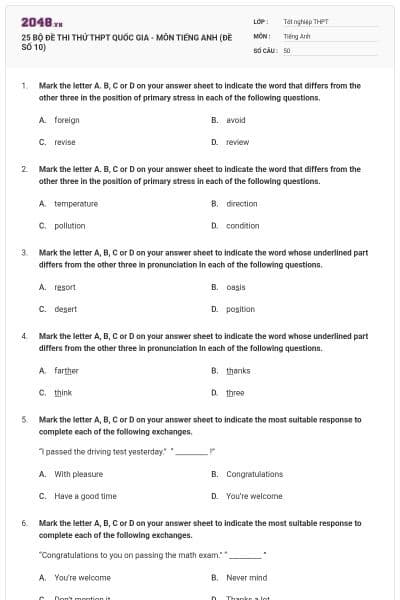
Mark the letter A. B, C or D on your answer sheet to indicate the word that differs from the other three in the position of primary stress in each of the following questions.
foreign
avoid
revise
review
Đáp án A (Trọng âm rơi vào âm tiết thứ nhất, các từ còn lại rơi vào âm thứ hai).
foreign /’fɔrɪn/ (adj): ngoại quốc.
avoid /ə’vɔɪd/ (v): tránh.
(Động từ 2 âm tiết thì trọng âm thường rơi vào âm tiết thứ 2).
revise /rɪ’vaɪs/ (v): ôn lại.
(Động từ 2 âm tiết thì trọng âm thường rơi vào âm tiết thứ 2).
review /rɪ’vju:/ (v): xem lại.
(Động từ 2 âm tiết thì trọng âm thường rơi vào âm tiết thứ 2).
Mark the letter A. B, C or D on your answer sheet to indicate the word that differs from the other three in the position of primary stress in each of the following questions.
temperature
direction
pollution
condition
Đáp án A (Trọng âm rơi vào âm tiết thứ nhất, các từ còn lại rơi vào âm thứ hai).
temperature /’tempərətʃə/ (n): nhiệt độ.
direction /dɪ’rekʃən/ (n): phương hướng.
(Đuôi “ion” trọng âm rơi vào âm tiết đứng trước nó).
pollution /pə’lʊʃən/ (n): sự ô nhiễm.
(Đuôi “ion” trọng âm rơi vào âm tiết đứng trước nó).
condition /kən’dɪʃən/ (n): điều kiện.
(Đuôi “ion” trọng âm rơi vào âm tiết đứng trước nó).
Mark the letter A, B, C or D on your answer sheet to indicate the word whose underlined part differs from the other three in pronunciation In each of the following questions.
resort
oasis
desert
position
Đáp án B (“s” được phát âm là /s/, còn lại là /z/).
A. resort /rɪ’zɔ:t/ (n): khu nghỉ dưỡng.
B. oasis /əʊ’eɪsɪs/ (n): ốc đảo.
C. position /pə’zɪʃən/ (n): vị trí.
D. desert /’dezət/ (n): sa mạc.
Mark the letter A, B, C or D on your answer sheet to indicate the word whose underlined part differs from the other three in pronunciation In each of the following questions.
farther
thanks
think
three
Đáp án A (“th” được phát âm là /ð/, còn lại là /θ/).
A. farther /faðə/ (adj): xa hơn.
B. thanks /θæŋks/ (n): cám ơn.
C. think /θɪŋk/ (v): nghĩ.
D. three /θrɪ:/: số 3.
Mark the letter A, B, C or D on your answer sheet to indicate the most suitable response to complete each of the following exchanges.
“I passed the driving test yesterday.” “ _________ !”
With pleasure
Congratulations
Have a good time
You’re welcome
Đáp án B.
A: “Em vừa đỗ kì thi lấy bằng lái xe hôm qua đấy.”
B: “Chúc mừng em!”
A. Rất vui lòng
B. Chúc mừng em
C. Chúc vui vẻ nhé
D. Không có gì
Mark the letter A, B, C or D on your answer sheet to indicate the most suitable response to complete each of the following exchanges.
“Congratulations to you on passing the math exam." “ _________ ”
You’re welcome
Never mind
Don’t mention it
Thanks a lot
Đáp án D.
A: “Chúc mừng con qua được kì thi toán nhé.”
B: “Cảm ơn mẹ nhiều ạ”
A. Không có gì
B. Không sao đâu
C. Đừng nhắc đến nó nữa
D. Cảm ơn mẹ nhiều ạ
Mark the letter A, B, C or D on your answer sheet to indicate the word(s) CLOSET in meaning to the underlined word(s) in each of the following questions.
He had never experienced such discourtesy towards the president as it occurred at the annual meeting in May.
encouragement
rudeness
politeness
measurement
Đáp án B.
A. Encouragement (n) : sự khuyến khích.
B. Rudeness (n) : sự thô lỗ = Discourtesy (n) : sự bất lịch sự.
C. Politeness (n) : sự lịch sự.
D. Measurement (n): phép đo, sự đo lường.
Dịch câu : Anh ấy chưa bao giờ trải qua sự bất lịch sự như vậy đối với tổng thống khi nó diễn ra vào cuộc họp thường niên vào tháng 5.
Mark the letter A, B, C or D on your answer sheet to indicate the word(s) CLOSET in meaning to the underlined word(s) in each of the following questions.
He didn’t bat an eyelid when he realized he failed the exam again.
didn't show surprise
didn't want to see
wasn't happy
didn't care
Đáp án A.
A. Didn’t show surprise : không thể hiện sự bất ngờ = didn’t bat an eyelid : không lo lắng khi chuyện bất ngờ, lạ thường xảy ra.
B. Didn’t want to see : không muốn nhìn thấy.
C. Wasn’t happy : không vui.
D. Didn’t care : không quan tâm.
Dịch câu : Anh ta không bất ngờ khi anh ta trượt lại bài kiểm tra.
Mark the letter A, B, C or D on your answer sheet to indicate the word(s) OPPOSITE in meaning to the underlined word(s) in each of the following questions.
He was so insubordinate that he lost his job within a week.
obedient
Disobedient
fresh
understanding
Đáp án A.
A. obedient: biết nghe lời >< insubordinate: ngỗ nghịch, không tuân theo.
B. disobedient: ngỗ nghịch.
C. fresh: tươi mới.
D. understanding: am hiểu.
Dịch câu: Anh ta quá ngang ngược đến mức anh ta mất việc trong vòng một tuần.
Mark the letter A, B, C or D on your answer sheet to indicate the word(s) OPPOSITE in meaning to the underlined word(s) in each of the following questions.
There are several different kinds of faults in reading which are usually more exaggerated with foreign learners
overemphasized
understated
overestimated
undertaken
Đáp án B.
A. overemphasized: nhấn mạnh.
B. understated: nói giảm >< exaggerated: phóng đại.
C. overestimated: đánh giá quá cao.
D. undertaken: thực hiện.
Dịch câu: Có nhiều loại lỗi khác nhau trong việc đọc mà thường được phóng đại hơn với người học nước ngoài.
Mark the letter A, B, C or D on your answer sheet to indicate the correct answer to each of the following questions.
He does morning exercises regularly _________ improve his health.
so as to
and
to
so as not to
Đáp án A/C.
So as to/To + V: để làm gì
So as not to + V: để không làm gì
And: và
Anh ấy tập thể dục thường xuyên vào buổi sáng để cải thiện sức khỏe.
Mark the letter A, B, C or D on your answer sheet to indicate the correct answer to each of the following questions.
_________ he had enough money, he refused to buy a new car.
In spite
In spite of
Despite
Although
Đáp án D.
Although + mệnh đề: mặc dù
In spite of/Despite + N/V-ing: mặc dù
Dịch nghĩa: Dù có đủ tiền nhưng anh ta vẫn từ chối mua một chiếc xe mới.
Mark the letter A, B, C or D on your answer sheet to indicate the correct answer to each of the following questions.
_________ extremely bad weather in the mountains, we re no longer considering our skiing trip.
Due to
Because
Since
Due to the fact that
Đáp án A.
Cụm từ chỉ lý do:
Because of / Due to / Owing to + V-ing / Noun / pronoun
Dịch câu: Bởi thời tiết xấu trên vùng núi nên chúng tôi không thể đi trượt tuyết.
Mark the letter A, B, C or D on your answer sheet to indicate the correct answer to each of the following questions.
He asked the children _________ too much noise.
not to make
not making
don’t make
if they don’t make
Đáp án A.
Câu trúc “yêu cầu ai làm gì/không làm gì” sử dụng “Asked somebody (not) to do something”.
Dịch nghĩa: Anh ta yêu cầu lũ trẻ không được gây ra nhiều tiếng ồn
Mark the letter A, B, C or D on your answer sheet to indicate the correct answer to each of the following questions.
"Are you still going to Florida for vacation?” “Yes, but I really _________ because I don’t have much money.”
shouldn’t
can’t
mustn’t
won’t
Đáp án A.
Somebody shouldn’t: không nên làm một hành động gì đó
Somebody can’t: không thể trên thực tế, diễn tả hành động trong thì hiện tại -> không phù hợp làm đáp án
Somebody won’t: sẽ không thể, diễn tả hành động trong thì tương lai -> không phù hợp làm đáp án
Somebody mustn’t: không được, diễn tả một hành động không cho phép -> không phù hợp làm đáp án
Dịch nghĩa: “Bạn vẫn sẽ đi nghỉ mát ở Florida à?” “Đúng vậy, nhưng tôi thật sự không nên bởi tôi không có nhiều tiền.”
Mark the letter A, B, C or D on your answer sheet to indicate the correct answer to each of the following questions.
My mother made me _________ at home at night.
staying
to stay
stayed
stay
Đáp Án B.
Cấu trúc “make + somebody + to V…”, mang nghĩa là “nhờ/yêu cầu/cho phép ai đó làm gì”
Dịch câu: Mẹ yêu cầu tôi phải ở nhà buổi tối.
Mark the letter A, B, C or D on your answer sheet to indicate the correct answer to each of the following questions.
Boys! Put your toys _________. It is time to go to bed. Don't stay _________ late.
off / on
away / up
down / off
around/ for
Đáp án: B
Giải thích:
Ta có các cụm sau:
put away something: cất cái gì đi
stay up late: thức khuya
Các cụm khác:
put off something: hoãn
put down: đặt xuống
stay on: ở lại để tiếp tục làm gì
Dịch: Con trai! Cất đồ chơi đi. Đến giờ đi ngủ rồi. Đừng thức khuya.
Mark the letter A, B, C or D on your answer sheet to indicate the correct answer to each of the following questions.
The picture was painted by Laura, _________ is being shown in an exhibition.
which
whose
who
whom
Đáp án A.
Đáp án B Whose dùng để chỉ sở hữu cho danh từ chỉ người hoặc vật, thường thay cho các từ: her, his, their, hoặc hình thức ‘s. Cấu trúc: N (person, thing) + WHOSE + N + V
Đáp án C “Who” thay thế cho danh từ chỉ người làm chủ từ trong mệnh đề quan hệ. Cấu trúc: N (person) + WHO + V + O
Đáp án D “Whom” thay thế cho danh từ chỉ người làm tân ngữ cho động từ trong mệnh đề quan hệ. Cấu trúc: N (person) + WHOM + S + V
“ Which” thay thế cho danh từ chỉ vật, làm chủ ngữ hoặc tân ngữ trong mệnh đề quan hệ. Cấu trúc: N (thing) + WHICH + V + O; N (thing) + WHICH + S + V
Dịch câu : Bức tranh đươc vẽ bởi Laura, bức mà được trưng bày ở triển lãm.
Mark the letter A, B, C or D on your answer sheet to indicate the correct answer to each of the following questions.
His pronunciation causes me a lot of _________.
difficulties
difficult
difficulty
difficultly
Đáp án C.
A. difficulties(n): sự túng bấn, sự làm khó dễ, sự phản đối
B. difficult(adj): khó khăn
C. difficulty(n): sự khó khăn, trở ngại
D. difficultly(adv): một cách khó khăn
Dịch nghĩa: Cách phát âm của anh ấy khiến tôi gặp rất nhiều khó khăn.
Mark the letter A, B, C or D on your answer sheet to indicate the correct answer to each of the following questions.
Instead _________ petrol, cars will only run _________ solar energy and electricity.
of / on
for / by
in / over
from/ upon
Đáp án A.
Instead of: Thay vì
Run on solar energy: chạy bằng năng lượng Mặt Trời.
Dịch nghĩa: Thay vì chạy bằng xăng dầu, ô tô sẽ chỉ chạy bằng năng lượng Mặt Trời và năng lượng điện.
Mark the letter A, B, C or D on your answer sheet to indicate the correct answer to each of the following questions.
Reviewers often _________ books as “hard to put down” or “hard to pick up again”.
describe
illustrate
classify
choose
Đáp án C.
describe(v): mô tả
illustrate(v): minh họa
classify(v): phân biệt
choose(v): chọn
Dịch nghĩa: Những người đánh giá thường phân loại sách “khó mà rời mắt” và loại sách “khó mà đọc lại lần nữa”.
Mark the letter A, B, C or D on your answer sheet to indicate the correct answer to each of the following questions.
It is common knowledge that sportmen _________ themselves in good fonn by regular swimming.
put
make
take
keep
Đáp án D.
keep somebody in good form: duy trì cho cơ thể ai ở trạng thái tốt.
Dịch nghĩa: Việc vận động viên thể thao duy trì hình thể của bản thân ở trạng thái tốt bằng cách bơi lội thường xuyên là một kiến thức phổ thông.
Mark the letter A, B, C or D on your answer sheet to indicate the correct answer to each of the following questions.
The rhinoceros will become _________ if people continue to hurt them.
extinct
instinct
distinct
extinction
Đáp án A.
extinct(adj): tuyệt chủng
instinct(adj): bản năng
distinct(adj): phân biệt, phân minh
extinction(n): sự tuyệt chủng
Dịch nghĩa: Tê giác sẽ tuyệt chủng nếu con người tiếp tục làm tổn hại đến chúng.
Mark the letter A, B, C or D on your answer sheet to indicate the correct answer to each of the following questions.
William won first _________ in the tennis competition.
medal
prize
reward
position
Đáp án B.
medal(n): huy chương
prize(n): giải
reward(n): thành tựu
position(n): vị trí
Dịch nghĩa: William giành giải nhất trong cuộc thi tennis.
Read the following passage and mark the letter A, B, C or D on your answer sheet to indicate the correct word or phrase that best fits each of the numbered blanks from 25 to 29. Fill in the appropriate word in question 25
How men first learnt to invent words is unknown; in other words, the origin of language is a (25) _______. All we really know is that men, unlike animals, somehow invented certain sounds to express thoughts and feelings, actions and things so that they could communicate with each other; and that later they agreed (26) _______ certain signs, called letters, which could be combined to represent those sounds, and which could be written down. These sounds, (27) _______ spoken or written in letters, are called words. Great writers are those who not only have great thoughts but also express these thoughts in words that appeal powerfully to our minds and emotions. This charming and telling use of words is what we call literary (28) _______. Above all, the real poet is a master of words. He can convey his meaning in words which sing like music, and which by their position and association can (29) _______ men to tears. We should, therefore, learn to choose our words carefully, or they will make our speech silly and vulgar.
mystery
secret
story
legend
Đáp án A
Story: câu chuyện
Secret: bí mật
Mystery: điều bí ẩn
Legend: huyền thoại
How men first learnt to invent words is unknown; in other words, the origin of language is a (25) ____.
[ Bắng cách nào lúc đầu con người đã học phát minh ra ngôn ngữ vẫn không biết; hay nói cách khác, nguồn gốc của ngôn ngữ là một điều bí ẩn.]
Read the following passage and mark the letter A, B, C or D on your answer sheet to indicate the correct word or phrase that best fits each of the numbered blanks from 25 to 29. Fill in the appropriate word in question 26
How men first learnt to invent words is unknown; in other words, the origin of language is a (25) _______. All we really know is that men, unlike animals, somehow invented certain sounds to express thoughts and feelings, actions and things so that they could communicate with each other; and that later they agreed (26) _______ certain signs, called letters, which could be combined to represent those sounds, and which could be written down. These sounds, (27) _______ spoken or written in letters, are called words. Great writers are those who not only have great thoughts but also express these thoughts in words that appeal powerfully to our minds and emotions. This charming and telling use of words is what we call literary (28) _______. Above all, the real poet is a master of words. He can convey his meaning in words which sing like music, and which by their position and association can (29) _______ men to tears. We should, therefore, learn to choose our words carefully, or they will make our speech silly and vulgar.
with
upon
at
about
Đáp án B
Cụm động từ: agree with somebody [ đồng ý với ai]
Agree on/ upon sth: đống ý về việc gì
All we really know is that men, unlike animals, somehow invented certain sounds to express thoughts and feelings, actions and things so that they could communicate with each other; and that later they agreed (26) ____ certain signs, called letters, which could be combined to represent those sounds, and which could be written down.
[ Tất cả chúng ta đều biết rằng, con người không giống như động vật, bằng cách nào đó đã phát minh ra những âm thanh nhất định để thể hiện suy nghĩ và cảm xúc, hành động và những thứ để mà họ có thể giao tiếp với nhau; và rằng sau đó họ thống nhất với những dấu hiệu, được gọi là ký tự, cái mà có thể được kết hợp để đại diện cho những âm thanh, và có thể được ghi chép lại.]
Read the following passage and mark the letter A, B, C or D on your answer sheet to indicate the correct word or phrase that best fits each of the numbered blanks from 25 to 29. Fill in the appropriate word in question 27
How men first learnt to invent words is unknown; in other words, the origin of language is a (25) _______. All we really know is that men, unlike animals, somehow invented certain sounds to express thoughts and feelings, actions and things so that they could communicate with each other; and that later they agreed (26) _______ certain signs, called letters, which could be combined to represent those sounds, and which could be written down. These sounds, (27) _______ spoken or written in letters, are called words. Great writers are those who not only have great thoughts but also express these thoughts in words that appeal powerfully to our minds and emotions. This charming and telling use of words is what we call literary (28) _______. Above all, the real poet is a master of words. He can convey his meaning in words which sing like music, and which by their position and association can (29) _______ men to tears. We should, therefore, learn to choose our words carefully, or they will make our speech silly and vulgar.
whether
however
if
though
Đáp án A
Cụm từ: whether...or...[ hoặc là cái này hoặc là cái kia]
These sounds, (27) ____ spoken or written in letters, are called words. Great writers are those who not only have great thoughts but also express these thoughts in words that appeal powerfully to our minds and emotions.
[ Những âm thanh này hoặc là được nói hay viết ở dạng ký tự, đều được gọi là từ. Những nhà văn tuyệt vời người mà không những có những ý tưởng lớn lao và còn thể hiện những ý tưởng đó trong các từ cái mà thu hút mạnh mẽ tư tưởng và cảm xúc của chúng ta.]
Read the following passage and mark the letter A, B, C or D on your answer sheet to indicate the correct word or phrase that best fits each of the numbered blanks from 25 to 29. Fill in the appropriate word in question 28
How men first learnt to invent words is unknown; in other words, the origin of language is a (25) _______. All we really know is that men, unlike animals, somehow invented certain sounds to express thoughts and feelings, actions and things so that they could communicate with each other; and that later they agreed (26) _______ certain signs, called letters, which could be combined to represent those sounds, and which could be written down. These sounds, (27) _______ spoken or written in letters, are called words. Great writers are those who not only have great thoughts but also express these thoughts in words that appeal powerfully to our minds and emotions. This charming and telling use of words is what we call literary (28) _______. Above all, the real poet is a master of words. He can convey his meaning in words which sing like music, and which by their position and association can (29) _______ men to tears. We should, therefore, learn to choose our words carefully, or they will make our speech silly and vulgar.
form
work
prose
style
Đáp án D
Prose: văn xuôi
Work: công việc
Form: hình dạng
style : phong cách
This charming and telling use of words is what we call literary (28) ____. Above all, the real poet is a master of words.
[ Sự duyên dáng và cách sử dụng từ là cái chúng ta gọi là văn phong. Trên hết, bài thơ thật sự là nghệ thuật của ngôn từ.]
Read the following passage and mark the letter A, B, C or D on your answer sheet to indicate the correct word or phrase that best fits each of the numbered blanks from 25 to 29. Fill in the appropriate word in question 29
How men first learnt to invent words is unknown; in other words, the origin of language is a (25) _______. All we really know is that men, unlike animals, somehow invented certain sounds to express thoughts and feelings, actions and things so that they could communicate with each other; and that later they agreed (26) _______ certain signs, called letters, which could be combined to represent those sounds, and which could be written down. These sounds, (27) _______ spoken or written in letters, are called words. Great writers are those who not only have great thoughts but also express these thoughts in words that appeal powerfully to our minds and emotions. This charming and telling use of words is what we call literary (28) _______. Above all, the real poet is a master of words. He can convey his meaning in words which sing like music, and which by their position and association can (29) _______ men to tears. We should, therefore, learn to choose our words carefully, or they will make our speech silly and vulgar.
break
send
take
move
Đáp án D
Cụm động từ: move sb to tears [ khiến ai đó bật khóc]
He can convey his meaning in words which sing like music, and which by their position and association can (29) ____ men to tears. We should, therefore, learn to choose our words carefully, or they will make our speech silly and vulgar.
[ Anh ấy có thể truyền đạt ý nghĩa bằng từ ngữ cái mà hát như âm nhạc, và cái mà bắng vị trí và sự sắp xếp ngôn từ có thể làm cho con người bật khóc. Vì vậy, chúng ta nên học cách chọn ngôn từ thích hợp, hoặc là chúng sẽ làm cho lời nói của chúng ta trở nên ngốc nghếch và khiếm nhã]
Read the following passage and mark the letter A, B, C, or D on your answer sheet to indicate the correct answer to each of the questions from 30 to 37.
In the course of its history, human inventions have dramatically increased the average amount of energy available for use per person. Primitive peoples in cold regions burned wood and animal dung to heat their caves, cook food, and drive off animals by fire. The first step toward the developing of more efficient fuels was taken when people discovered that they could use vegetable oils and animal fats in lieu of gathered or cut wood. Charcoal gave off more intensive heat than wood and was more easily obtainable than organic fats. The Greeks first began to use coal for metal smelting in the 4th century, but it did not come into extensive use until the Industrial Revolution.
In the 1700s, at the beginning of the Industrial Revolution, most energy used in the United States and other nations undergoing industrialization was obtained from perpetual and renewable sources, such as wood, water streams, domesticated animal labor, and wind. These were predominantly locally available supplies. By mid-1800s, 91 percent of all commercial energy consumed in the United States and European countries was obtained from wood. However, at he beginning of the 20th century, coal became a major energy source and replaced wood in industrializing countries. Although in most regions and climate zones wood was more readily accessible than coal, the latter represents a more concentrated source of energy. In 1910, natural gas and oil firmly replaced coal as the main source of fuel because they are lighter and, therefore, cheaper to transport. They burned more cleanly than coal and polluted less. Unlike coal, oil could be refined to manufacture liquid fuels for vehicles, a very important consideration in the early 1900s, when the automobile arrived on the scene.
By 1984, non-renewable fossil fuels, such as oil, coal, and natural gas, provided over 82 percent of the commercial and industrial energy used in the world. Small amounts of energy were derived from nuclear fission, and the remaining 16 percent came from burning direct perpetual and renewable fuels, such as biomass. Between 1700 and 1986, a large number of countries shifted from the use of energy from local sources to a centralized generation of hydropower and solar energy converted to electricity. The energy derived from non-renewable fossil fuels has been increasingly produced in one location and transported to another, as is the case with most automobile fuels. In countries with private, rather than public transportation, the age of non-renewable fuels has created a dependency on a finite resource that will have to be replaced.
Alternative fuel sources are numerous, and shale oil and hydrocarbons are just two examples. The extraction of shale oil from large deposits in Asian and European regions has proven to be labor consuming and costly. The resulting product is sulfur-and nitrogen-rich, and large scale extractions are presently prohibitive. Similarly, the extraction of hydrocarbons from tar sands in Alberta and Utah is complex. Semi-solid hydrocarbons cannot be easily separated from the sandstone and limestone that carry them, and modern technology is not sufficiently versatile for a large-scale removal of the material. However, both sources of fuel may eventually be needed as petroleum prices continue to rise and limitations in fossil fuel availability make alternative deposits more attractive.
What is the main topic of the passage?
Application of various fuels
Natural resources and fossil fuels
A history of energy use
A historical review of energy rates
Đáp án C
Chủ đề chính của đoạn văn là gì?
A. Ứng dụng của các nhiên liệu khác nhau
B. Tài nguyên thiên nhiên và nhiên liệu hoá thạch
C. Lịch sử của việc sử dụng năng lượng
D. Một đánh giá mang tính lịch sử về mức năng lượng
Dịch bài đọc
Trong quá trình lịch sử, các phát minh của con người đã làm tăng đáng kể lượng năng lượng có sẵn mỗi người sử dụng. Người nguyên thủy ở vùng lạnh đốt gỗ và phân động vật để sưởi ấm các hang động của chúng, nấu thức ăn và thịt thú bằng lửa. Bước đầu tiên để phát triển các nhiên liệu hiệu quả hơn đã được thực hiện khi người ta phát hiện ra rằng họ có thể sử dụng dầu thực vật và chất béo động vật thay vì nhặt hoặc chặt gỗ. Than củi cho nhiệt độ cao hơn gỗ và dễ dàng hơn chất béo hữu cơ. Người Hy Lạp lần đầu tiên bắt đầu sử dụng than đá để luyện kim vào thế kỷ thứ 4, nhưng nó đã không được sử dụng rộng rãi cho tới Cách mạng Công nghiệp.
Vào những năm 1700, khi bắt đầu Cuộc Cách mạng Công nghiệp, hầu hết năng lượng được sử dụng ở Hoa Kỳ và các quốc gia khác trải qua quá trình công nghiệp hóa đều lấy từ các nguồn năng lượng lâu dài và có thể tái tạo như gỗ, suối nước, động vật đã thuần hóa và gió. Đây là nguồn cung cấp chủ yếu ở địa phương. Vào giữa những năm 1800, 91% lượng năng lượng thương mại tiêu thụ ở Hoa Kỳ và các nước Châu Âu được lấy từ gỗ. Tuy nhiên, vào đầu thế kỷ 20, than trở thành nguồn năng lượng chính và thay thế gỗ trong các nước công nghiệp hóa. Mặc dù ở hầu hết các vùng và khu vực khí hậu, gỗ có thể tiếp cận dễ dàng hơn than, loại nhiên liệu này đại diện cho một nguồn năng lượng tập trung hơn. Năm 1910, khí đốt tự nhiên và dầu thay thế than đá như là nguồn nhiên liệu chính vì chúng nhẹ hơn, và do đó rẻ hơn để vận chuyển. Chúng đốt sạch hơn than đá và ô nhiễm ít hơn. Không giống như than đá, dầu có thể tinh chế để sản xuất nhiên liệu lỏng cho xe cộ, một cân nhắc rất quan trọng vào đầu những năm 1900 khi ô tô xuất hiện.
Đến năm 1984, nhiên liệu hóa thạch không tái tạo được, như dầu, than và khí tự nhiên, cung cấp trên 82 phần trăm năng lượng thương mại và công nghiệp được sử dụng trên thế giới. Một lượng nhỏ năng lượng xuất phát từ sự phân hạch hạt nhân, và 16% còn lại là do đốt nhiên liệu vĩnh viễn và tái tạo trực tiếp như khí ga. Từ năm 1700 đến năm 1986, một số lượng lớn nước chuyển từ việc sử dụng năng lượng địa phương sang một thế hệ thủy điện và năng lượng mặt trời được chuyển đổi thành điện. Năng lượng có nguồn gốc từ nhiên liệu hóa thạch không tái tạo được ngày càng phổ biến, được sản xuất tại một địa điểm và được vận chuyển tới một nơi khác, như trường hợp của hầu hết các nhiên liệu ô tô. Ở các nước sử dụng phương tiện giao thông tư nhân thay vì phương tiện giao thông công cộng, tuổi của các nhiên liệu không tái tạo đã tạo ra sự phụ thuộc vào nguồn tài nguyên hữu hạn mà sẽ phải được thay thế.
Nguồn nhiên liệu thay thế là rất nhiều, và dầu đá phiến sét và hydrocarbon chỉ là hai ví dụ. Việc khai thác dầu đá phiến từ các mỏ lớn ở khu vực châu Á và châu Âu thì tiêu tốn nhiều lao động và tốn kém. Sản phẩm thu được giàu sulfur và giàu nitơ, và việc chiết suất quy mô lớn hiện đang bị cấm. Tương tự, việc khai thác các hydrocarbon từ cát nhựa ở Alberta và Utah lại phức tạp. Hydro cacbon rắn không thể dễ dàng tách ra khỏi đá sa thạch và đá vôi mà mang chúng, và công nghệ hiện đại không đủ linh hoạt cho việc loại bỏ tạp chất. Tuy nhiên, cả hai nguồn nhiên liệu có thể sẽ là cần thiết vì giá xăng dầu tiếp tục gia tăng và những hạn chế trong việc cung cấp nhiên liệu hoá thạch làm cho nguồn thay thế trở nên hấp dẫn hơn.
Read the following passage and mark the letter A, B, C, or D on your answer sheet to indicate the correct answer to each of the questions from 30 to 37.
In the course of its history, human inventions have dramatically increased the average amount of energy available for use per person. Primitive peoples in cold regions burned wood and animal dung to heat their caves, cook food, and drive off animals by fire. The first step toward the developing of more efficient fuels was taken when people discovered that they could use vegetable oils and animal fats in lieu of gathered or cut wood. Charcoal gave off more intensive heat than wood and was more easily obtainable than organic fats. The Greeks first began to use coal for metal smelting in the 4th century, but it did not come into extensive use until the Industrial Revolution.
In the 1700s, at the beginning of the Industrial Revolution, most energy used in the United States and other nations undergoing industrialization was obtained from perpetual and renewable sources, such as wood, water streams, domesticated animal labor, and wind. These were predominantly locally available supplies. By mid-1800s, 91 percent of all commercial energy consumed in the United States and European countries was obtained from wood. However, at he beginning of the 20th century, coal became a major energy source and replaced wood in industrializing countries. Although in most regions and climate zones wood was more readily accessible than coal, the latter represents a more concentrated source of energy. In 1910, natural gas and oil firmly replaced coal as the main source of fuel because they are lighter and, therefore, cheaper to transport. They burned more cleanly than coal and polluted less. Unlike coal, oil could be refined to manufacture liquid fuels for vehicles, a very important consideration in the early 1900s, when the automobile arrived on the scene.
By 1984, non-renewable fossil fuels, such as oil, coal, and natural gas, provided over 82 percent of the commercial and industrial energy used in the world. Small amounts of energy were derived from nuclear fission, and the remaining 16 percent came from burning direct perpetual and renewable fuels, such as biomass. Between 1700 and 1986, a large number of countries shifted from the use of energy from local sources to a centralized generation of hydropower and solar energy converted to electricity. The energy derived from non-renewable fossil fuels has been increasingly produced in one location and transported to another, as is the case with most automobile fuels. In countries with private, rather than public transportation, the age of non-renewable fuels has created a dependency on a finite resource that will have to be replaced.
Alternative fuel sources are numerous, and shale oil and hydrocarbons are just two examples. The extraction of shale oil from large deposits in Asian and European regions has proven to be labor consuming and costly. The resulting product is sulfur-and nitrogen-rich, and large scale extractions are presently prohibitive. Similarly, the extraction of hydrocarbons from tar sands in Alberta and Utah is complex. Semi-solid hydrocarbons cannot be easily separated from the sandstone and limestone that carry them, and modern technology is not sufficiently versatile for a large-scale removal of the material. However, both sources of fuel may eventually be needed as petroleum prices continue to rise and limitations in fossil fuel availability make alternative deposits more attractive.
The author of the passage implies that in the 1700s, sources of energy were
used for commercial purposes
used in various combination
not derived from mineral deposits
it could be converted to automobile fuel.
Đáp án C
Tác giả của đoạn văn ngụ ý rằng trong những năm 1700, các nguồn năng lượng đã được
A. dùng cho mục đích thương mại
B. được sử dụng trong các kết hợp khác nhau
C. không bắt nguồn từ các mỏ khoáng sản
D. có thể chuyển thành nhiên liệu ô tô.
Read the following passage and mark the letter A, B, C, or D on your answer sheet to indicate the correct answer to each of the questions from 30 to 37.
In the course of its history, human inventions have dramatically increased the average amount of energy available for use per person. Primitive peoples in cold regions burned wood and animal dung to heat their caves, cook food, and drive off animals by fire. The first step toward the developing of more efficient fuels was taken when people discovered that they could use vegetable oils and animal fats in lieu of gathered or cut wood. Charcoal gave off more intensive heat than wood and was more easily obtainable than organic fats. The Greeks first began to use coal for metal smelting in the 4th century, but it did not come into extensive use until the Industrial Revolution.
In the 1700s, at the beginning of the Industrial Revolution, most energy used in the United States and other nations undergoing industrialization was obtained from perpetual and renewable sources, such as wood, water streams, domesticated animal labor, and wind. These were predominantly locally available supplies. By mid-1800s, 91 percent of all commercial energy consumed in the United States and European countries was obtained from wood. However, at he beginning of the 20th century, coal became a major energy source and replaced wood in industrializing countries. Although in most regions and climate zones wood was more readily accessible than coal, the latter represents a more concentrated source of energy. In 1910, natural gas and oil firmly replaced coal as the main source of fuel because they are lighter and, therefore, cheaper to transport. They burned more cleanly than coal and polluted less. Unlike coal, oil could be refined to manufacture liquid fuels for vehicles, a very important consideration in the early 1900s, when the automobile arrived on the scene.
By 1984, non-renewable fossil fuels, such as oil, coal, and natural gas, provided over 82 percent of the commercial and industrial energy used in the world. Small amounts of energy were derived from nuclear fission, and the remaining 16 percent came from burning direct perpetual and renewable fuels, such as biomass. Between 1700 and 1986, a large number of countries shifted from the use of energy from local sources to a centralized generation of hydropower and solar energy converted to electricity. The energy derived from non-renewable fossil fuels has been increasingly produced in one location and transported to another, as is the case with most automobile fuels. In countries with private, rather than public transportation, the age of non-renewable fuels has created a dependency on a finite resource that will have to be replaced.
Alternative fuel sources are numerous, and shale oil and hydrocarbons are just two examples. The extraction of shale oil from large deposits in Asian and European regions has proven to be labor consuming and costly. The resulting product is sulfur-and nitrogen-rich, and large scale extractions are presently prohibitive. Similarly, the extraction of hydrocarbons from tar sands in Alberta and Utah is complex. Semi-solid hydrocarbons cannot be easily separated from the sandstone and limestone that carry them, and modern technology is not sufficiently versatile for a large-scale removal of the material. However, both sources of fuel may eventually be needed as petroleum prices continue to rise and limitations in fossil fuel availability make alternative deposits more attractive.
According to the passage, what was the greatest advantage of oil as fuel?
it was a concentrated source of energy.
it was lighter and cheaper than coal.
it replaced wood and coal and reduced pollution.
it could be converted to automobile fuel.
Đáp án D
Theo đoạn văn, lợi thế lớn nhất của dầu với vai trò là nhiên liệu là gì?
A. nó là một nguồn năng lượng tập trung.
B. nó là nhẹ hơn và rẻ hơn than.
C. nó thay thế gỗ và than và giảm ô nhiễm.
D. có thể chuyển thành nhiên liệu ô tô.
Dẫn chứng: Unlike coal, oil could be refined to manufacture liquid fuels for vehicles, a very important consideration in the early 1900s, when the automobile arrived on the scene.
Read the following passage and mark the letter A, B, C, or D on your answer sheet to indicate the correct answer to each of the questions from 30 to 37.
In the course of its history, human inventions have dramatically increased the average amount of energy available for use per person. Primitive peoples in cold regions burned wood and animal dung to heat their caves, cook food, and drive off animals by fire. The first step toward the developing of more efficient fuels was taken when people discovered that they could use vegetable oils and animal fats in lieu of gathered or cut wood. Charcoal gave off more intensive heat than wood and was more easily obtainable than organic fats. The Greeks first began to use coal for metal smelting in the 4th century, but it did not come into extensive use until the Industrial Revolution.
In the 1700s, at the beginning of the Industrial Revolution, most energy used in the United States and other nations undergoing industrialization was obtained from perpetual and renewable sources, such as wood, water streams, domesticated animal labor, and wind. These were predominantly locally available supplies. By mid-1800s, 91 percent of all commercial energy consumed in the United States and European countries was obtained from wood. However, at he beginning of the 20th century, coal became a major energy source and replaced wood in industrializing countries. Although in most regions and climate zones wood was more readily accessible than coal, the latter represents a more concentrated source of energy. In 1910, natural gas and oil firmly replaced coal as the main source of fuel because they are lighter and, therefore, cheaper to transport. They burned more cleanly than coal and polluted less. Unlike coal, oil could be refined to manufacture liquid fuels for vehicles, a very important consideration in the early 1900s, when the automobile arrived on the scene.
By 1984, non-renewable fossil fuels, such as oil, coal, and natural gas, provided over 82 percent of the commercial and industrial energy used in the world. Small amounts of energy were derived from nuclear fission, and the remaining 16 percent came from burning direct perpetual and renewable fuels, such as biomass. Between 1700 and 1986, a large number of countries shifted from the use of energy from local sources to a centralized generation of hydropower and solar energy converted to electricity. The energy derived from non-renewable fossil fuels has been increasingly produced in one location and transported to another, as is the case with most automobile fuels. In countries with private, rather than public transportation, the age of non-renewable fuels has created a dependency on a finite resource that will have to be replaced.
Alternative fuel sources are numerous, and shale oil and hydrocarbons are just two examples. The extraction of shale oil from large deposits in Asian and European regions has proven to be labor consuming and costly. The resulting product is sulfur-and nitrogen-rich, and large scale extractions are presently prohibitive. Similarly, the extraction of hydrocarbons from tar sands in Alberta and Utah is complex. Semi-solid hydrocarbons cannot be easily separated from the sandstone and limestone that carry them, and modern technology is not sufficiently versatile for a large-scale removal of the material. However, both sources of fuel may eventually be needed as petroleum prices continue to rise and limitations in fossil fuel availability make alternative deposits more attractive.
The author of the passage implies that alternative sources of fuel are curently
being used for consumption
available in few locations
being explored
examined on a large scale
Đáp án A
Tác giả của đoạn văn ngụ ý rằng các nguồn thay thế nhiên liệu gần đây
A. được sử dụng để tiêu thụ
B. có sẵn ở vài địa điểm
C. được khám phá
D. kiểm tra ở quy mô lớn
Dẫn chứng: The extraction of shale oil from large deposits in Asian and European regions has proven to be labor consuming and costly.
Read the following passage and mark the letter A, B, C, or D on your answer sheet to indicate the correct answer to each of the questions from 30 to 37.
In the course of its history, human inventions have dramatically increased the average amount of energy available for use per person. Primitive peoples in cold regions burned wood and animal dung to heat their caves, cook food, and drive off animals by fire. The first step toward the developing of more efficient fuels was taken when people discovered that they could use vegetable oils and animal fats in lieu of gathered or cut wood. Charcoal gave off more intensive heat than wood and was more easily obtainable than organic fats. The Greeks first began to use coal for metal smelting in the 4th century, but it did not come into extensive use until the Industrial Revolution.
In the 1700s, at the beginning of the Industrial Revolution, most energy used in the United States and other nations undergoing industrialization was obtained from perpetual and renewable sources, such as wood, water streams, domesticated animal labor, and wind. These were predominantly locally available supplies. By mid-1800s, 91 percent of all commercial energy consumed in the United States and European countries was obtained from wood. However, at he beginning of the 20th century, coal became a major energy source and replaced wood in industrializing countries. Although in most regions and climate zones wood was more readily accessible than coal, the latter represents a more concentrated source of energy. In 1910, natural gas and oil firmly replaced coal as the main source of fuel because they are lighter and, therefore, cheaper to transport. They burned more cleanly than coal and polluted less. Unlike coal, oil could be refined to manufacture liquid fuels for vehicles, a very important consideration in the early 1900s, when the automobile arrived on the scene.
By 1984, non-renewable fossil fuels, such as oil, coal, and natural gas, provided over 82 percent of the commercial and industrial energy used in the world. Small amounts of energy were derived from nuclear fission, and the remaining 16 percent came from burning direct perpetual and renewable fuels, such as biomass. Between 1700 and 1986, a large number of countries shifted from the use of energy from local sources to a centralized generation of hydropower and solar energy converted to electricity. The energy derived from non-renewable fossil fuels has been increasingly produced in one location and transported to another, as is the case with most automobile fuels. In countries with private, rather than public transportation, the age of non-renewable fuels has created a dependency on a finite resource that will have to be replaced.
Alternative fuel sources are numerous, and shale oil and hydrocarbons are just two examples. The extraction of shale oil from large deposits in Asian and European regions has proven to be labor consuming and costly. The resulting product is sulfur-and nitrogen-rich, and large scale extractions are presently prohibitive. Similarly, the extraction of hydrocarbons from tar sands in Alberta and Utah is complex. Semi-solid hydrocarbons cannot be easily separated from the sandstone and limestone that carry them, and modern technology is not sufficiently versatile for a large-scale removal of the material. However, both sources of fuel may eventually be needed as petroleum prices continue to rise and limitations in fossil fuel availability make alternative deposits more attractive.
It can be inferred from the first paragraph that
coal mining was essential for primitive peoples
the Greeks used coal in industrial productions
the development of efficient fuel was a gradual process
the discovery of efficient fuels was mostly accidental
Đáp án C
Có thể suy luận từ đoạn 1 rằng:
A. Khai thác than là điều cần thiết cho các dân tộc nguyên thủy
B. Người Hy Lạp sử dụng than trong sản xuất công nghiệp
C. Sự phát triển của nhiên liệu hiệu quả là một quá trình từng bước một
D. Phát hiện ra các nhiên liệu hiệu quả chủ yếu là do tình cờ
Dẫn chứng: In the 1700s, at the beginning of the Industrial Revolution, most energy used in the United States and other nations undergoing industrialization was obtained from perpetual and renewable sources, such as wood, water streams, domesticated animal labor, and wind.
Read the following passage and mark the letter A, B, C, or D on your answer sheet to indicate the correct answer to each of the questions from 30 to 37.
In the course of its history, human inventions have dramatically increased the average amount of energy available for use per person. Primitive peoples in cold regions burned wood and animal dung to heat their caves, cook food, and drive off animals by fire. The first step toward the developing of more efficient fuels was taken when people discovered that they could use vegetable oils and animal fats in lieu of gathered or cut wood. Charcoal gave off more intensive heat than wood and was more easily obtainable than organic fats. The Greeks first began to use coal for metal smelting in the 4th century, but it did not come into extensive use until the Industrial Revolution.
In the 1700s, at the beginning of the Industrial Revolution, most energy used in the United States and other nations undergoing industrialization was obtained from perpetual and renewable sources, such as wood, water streams, domesticated animal labor, and wind. These were predominantly locally available supplies. By mid-1800s, 91 percent of all commercial energy consumed in the United States and European countries was obtained from wood. However, at he beginning of the 20th century, coal became a major energy source and replaced wood in industrializing countries. Although in most regions and climate zones wood was more readily accessible than coal, the latter represents a more concentrated source of energy. In 1910, natural gas and oil firmly replaced coal as the main source of fuel because they are lighter and, therefore, cheaper to transport. They burned more cleanly than coal and polluted less. Unlike coal, oil could be refined to manufacture liquid fuels for vehicles, a very important consideration in the early 1900s, when the automobile arrived on the scene.
By 1984, non-renewable fossil fuels, such as oil, coal, and natural gas, provided over 82 percent of the commercial and industrial energy used in the world. Small amounts of energy were derived from nuclear fission, and the remaining 16 percent came from burning direct perpetual and renewable fuels, such as biomass. Between 1700 and 1986, a large number of countries shifted from the use of energy from local sources to a centralized generation of hydropower and solar energy converted to electricity. The energy derived from non-renewable fossil fuels has been increasingly produced in one location and transported to another, as is the case with most automobile fuels. In countries with private, rather than public transportation, the age of non-renewable fuels has created a dependency on a finite resource that will have to be replaced.
Alternative fuel sources are numerous, and shale oil and hydrocarbons are just two examples. The extraction of shale oil from large deposits in Asian and European regions has proven to be labor consuming and costly. The resulting product is sulfur-and nitrogen-rich, and large scale extractions are presently prohibitive. Similarly, the extraction of hydrocarbons from tar sands in Alberta and Utah is complex. Semi-solid hydrocarbons cannot be easily separated from the sandstone and limestone that carry them, and modern technology is not sufficiently versatile for a large-scale removal of the material. However, both sources of fuel may eventually be needed as petroleum prices continue to rise and limitations in fossil fuel availability make alternative deposits more attractive.
The phrase “the latter” refers to
wood
coal
most regions
climate zones
Đáp án B
Cụm từ "the latter" dùng để chỉ
A. một khúc gỗ
B. than
C. hầu hết các vùng
D. vùng khí hậu
Dẫn chứng: Although in most regions and climate zones wood was more readily accessible than coal, the latter represents a more concentrated source of energy.
Read the following passage and mark the letter A, B, C, or D on your answer sheet to indicate the correct answer to each of the questions from 30 to 37.
In the course of its history, human inventions have dramatically increased the average amount of energy available for use per person. Primitive peoples in cold regions burned wood and animal dung to heat their caves, cook food, and drive off animals by fire. The first step toward the developing of more efficient fuels was taken when people discovered that they could use vegetable oils and animal fats in lieu of gathered or cut wood. Charcoal gave off more intensive heat than wood and was more easily obtainable than organic fats. The Greeks first began to use coal for metal smelting in the 4th century, but it did not come into extensive use until the Industrial Revolution.
In the 1700s, at the beginning of the Industrial Revolution, most energy used in the United States and other nations undergoing industrialization was obtained from perpetual and renewable sources, such as wood, water streams, domesticated animal labor, and wind. These were predominantly locally available supplies. By mid-1800s, 91 percent of all commercial energy consumed in the United States and European countries was obtained from wood. However, at he beginning of the 20th century, coal became a major energy source and replaced wood in industrializing countries. Although in most regions and climate zones wood was more readily accessible than coal, the latter represents a more concentrated source of energy. In 1910, natural gas and oil firmly replaced coal as the main source of fuel because they are lighter and, therefore, cheaper to transport. They burned more cleanly than coal and polluted less. Unlike coal, oil could be refined to manufacture liquid fuels for vehicles, a very important consideration in the early 1900s, when the automobile arrived on the scene.
By 1984, non-renewable fossil fuels, such as oil, coal, and natural gas, provided over 82 percent of the commercial and industrial energy used in the world. Small amounts of energy were derived from nuclear fission, and the remaining 16 percent came from burning direct perpetual and renewable fuels, such as biomass. Between 1700 and 1986, a large number of countries shifted from the use of energy from local sources to a centralized generation of hydropower and solar energy converted to electricity. The energy derived from non-renewable fossil fuels has been increasingly produced in one location and transported to another, as is the case with most automobile fuels. In countries with private, rather than public transportation, the age of non-renewable fuels has created a dependency on a finite resource that will have to be replaced.
Alternative fuel sources are numerous, and shale oil and hydrocarbons are just two examples. The extraction of shale oil from large deposits in Asian and European regions has proven to be labor consuming and costly. The resulting product is sulfur-and nitrogen-rich, and large scale extractions are presently prohibitive. Similarly, the extraction of hydrocarbons from tar sands in Alberta and Utah is complex. Semi-solid hydrocarbons cannot be easily separated from the sandstone and limestone that carry them, and modern technology is not sufficiently versatile for a large-scale removal of the material. However, both sources of fuel may eventually be needed as petroleum prices continue to rise and limitations in fossil fuel availability make alternative deposits more attractive.
It can be inferred from the passage that in the early 20th centurgy, energy was obtained primarily from
Fossil fuels
Nuclear fission
Hydraulic and solar sources
Burning biomass
Đáp án A
Có thể suy luận từ đoạn văn rằng trong giai đoạn đầu của thế kỉ 20, năng lượng thu được chủ yếu từ
A. Nhiên liệu hóa thạch
B. Phân hạch hạt nhân
C. Nguồn thủy lực và năng lượng mặt trời
D. Đốt khí ga
Dẫn chứng: However, at the beginning of the 20th century, coal became a major energy source and replaced wood in industrializing countries.
Read the following passage and mark the letter A, B, C, or D on your answer sheet to indicate the correct answer to each of the questions from 30 to 37.
In the course of its history, human inventions have dramatically increased the average amount of energy available for use per person. Primitive peoples in cold regions burned wood and animal dung to heat their caves, cook food, and drive off animals by fire. The first step toward the developing of more efficient fuels was taken when people discovered that they could use vegetable oils and animal fats in lieu of gathered or cut wood. Charcoal gave off more intensive heat than wood and was more easily obtainable than organic fats. The Greeks first began to use coal for metal smelting in the 4th century, but it did not come into extensive use until the Industrial Revolution.
In the 1700s, at the beginning of the Industrial Revolution, most energy used in the United States and other nations undergoing industrialization was obtained from perpetual and renewable sources, such as wood, water streams, domesticated animal labor, and wind. These were predominantly locally available supplies. By mid-1800s, 91 percent of all commercial energy consumed in the United States and European countries was obtained from wood. However, at he beginning of the 20th century, coal became a major energy source and replaced wood in industrializing countries. Although in most regions and climate zones wood was more readily accessible than coal, the latter represents a more concentrated source of energy. In 1910, natural gas and oil firmly replaced coal as the main source of fuel because they are lighter and, therefore, cheaper to transport. They burned more cleanly than coal and polluted less. Unlike coal, oil could be refined to manufacture liquid fuels for vehicles, a very important consideration in the early 1900s, when the automobile arrived on the scene.
By 1984, non-renewable fossil fuels, such as oil, coal, and natural gas, provided over 82 percent of the commercial and industrial energy used in the world. Small amounts of energy were derived from nuclear fission, and the remaining 16 percent came from burning direct perpetual and renewable fuels, such as biomass. Between 1700 and 1986, a large number of countries shifted from the use of energy from local sources to a centralized generation of hydropower and solar energy converted to electricity. The energy derived from non-renewable fossil fuels has been increasingly produced in one location and transported to another, as is the case with most automobile fuels. In countries with private, rather than public transportation, the age of non-renewable fuels has created a dependency on a finite resource that will have to be replaced.
Alternative fuel sources are numerous, and shale oil and hydrocarbons are just two examples. The extraction of shale oil from large deposits in Asian and European regions has proven to be labor consuming and costly. The resulting product is sulfur-and nitrogen-rich, and large scale extractions are presently prohibitive. Similarly, the extraction of hydrocarbons from tar sands in Alberta and Utah is complex. Semi-solid hydrocarbons cannot be easily separated from the sandstone and limestone that carry them, and modern technology is not sufficiently versatile for a large-scale removal of the material. However, both sources of fuel may eventually be needed as petroleum prices continue to rise and limitations in fossil fuel availability make alternative deposits more attractive.
The word “prohibitive” is closest in meaning to
prohibited
provided
too expensive
too expedient
Đáp án C
Từ "prohibitive" có ý nghĩa gần gũi nhất trong
A. bị cấm
B. cung cấp
C. quá đắt
D. quá thích hợp
Prohibitive (a): giá quá cao
=> Prohibitive = expensive
Dẫn chứng: The resulting product is sulfur-and nitrogen-rich, and large scale extractions are presently prohibitive.
Read the following passage and mark the letter A, B, C, or D on your answer sheet to indicate the correct answer to each of the questions from 38 to 42.
American movies create myths about college life in the United States. These stories are entertaining, but they are not true. You have to look beyond Hollywood movies to understand what college is really like.
Thanks to the movies, many people believe that college students party and socialize more than they study. Movies almost never show students working hard in class or in the library. Instead, movies show them eating, talking, hanging out, or dancing to loud music at wild parties. While it is true that American students have the freedom to participate in activities, they also have academic responsibilities. In order to succeed, they have to attend classes and study hard.
Another movie myth is that athletics is the only important extracurricular activity. In fact, there is a wide variety of nonacademic activities on campus such as special clubs, service organizations, art, and theater programs. This variety allows students to choose what interests them. Even more important, after graduation, students' résumés look better to employers if they list a few extracurricular activities.
Most students in the movies can easily afford higher education. If only this were true! While it is true that some American college students are wealthy, most are from families with moderate incomes. Up to 80% of them get some type of financial aid. Students from middle and lower-income families often work part-time throughout their college years. There is one thing that many college students have in common, but it is not something you will see in the movies. They have parents who think higher education is a priority, a necessary and important part of their children's lives.
Movies about college life usually have characters that are extreme in some way: super athletic, super intelligent, super wealthy, super glamorous, etC. Movies use these stereotypes, along with other myths of romance and adventure because audiences like going to movies that include these elements. Of course, real college students are not like movie characters at all.
So the next time you want a taste of the college experience, do not go to the movies. Look at some college websites or brochures instead. Take a walk around your local college campus. Visit a few classes. True, you may not be able to see the same people or exciting action you will see in the movies, but you can be sure that there are plenty of academic adventures going on all around you.
The story about college life in Amerian movies are not _________.
true
interesting
boring
exciting
Đáp án A
Câu chuyện vể cuộc sống sinh viên trong những bộ phim Mĩ không______.
A. đúng sự thật
B. thú vị
C. nhàm chán
D. hứng thú.
Dẫn chứng ở 2 câu đầu-đoạn 1: “American movies create myths about college life in the United States. These stories are entertaining, but they are not true” – (Phim Mĩ đã tạo ra những câu chuyện hoang đường về cuộc sống đại học ở Mĩ. Những câu chuyện đó có tính giải trí và chúng đều không đúng sự thật).
Read the following passage and mark the letter A, B, C, or D on your answer sheet to indicate the correct answer to each of the questions from 38 to 42.
American movies create myths about college life in the United States. These stories are entertaining, but they are not true. You have to look beyond Hollywood movies to understand what college is really like.
Thanks to the movies, many people believe that college students party and socialize more than they study. Movies almost never show students working hard in class or in the library. Instead, movies show them eating, talking, hanging out, or dancing to loud music at wild parties. While it is true that American students have the freedom to participate in activities, they also have academic responsibilities. In order to succeed, they have to attend classes and study hard.
Another movie myth is that athletics is the only important extracurricular activity. In fact, there is a wide variety of nonacademic activities on campus such as special clubs, service organizations, art, and theater programs. This variety allows students to choose what interests them. Even more important, after graduation, students' résumés look better to employers if they list a few extracurricular activities.
Most students in the movies can easily afford higher education. If only this were true! While it is true that some American college students are wealthy, most are from families with moderate incomes. Up to 80% of them get some type of financial aid. Students from middle and lower-income families often work part-time throughout their college years. There is one thing that many college students have in common, but it is not something you will see in the movies. They have parents who think higher education is a priority, a necessary and important part of their children's lives.
Movies about college life usually have characters that are extreme in some way: super athletic, super intelligent, super wealthy, super glamorous, etC. Movies use these stereotypes, along with other myths of romance and adventure because audiences like going to movies that include these elements. Of course, real college students are not like movie characters at all.
So the next time you want a taste of the college experience, do not go to the movies. Look at some college websites or brochures instead. Take a walk around your local college campus. Visit a few classes. True, you may not be able to see the same people or exciting action you will see in the movies, but you can be sure that there are plenty of academic adventures going on all around you.
Which of the following is NOT true?
Learning is only part of students’ college life.
There is a wide choice of extracurricular activities for college students.
Extracurricular activities are of no importance to employers.
Not all extracurricular activities are students' academic responsibilities.
Đáp án C
Câu nào sau đây không đúng?
A. Học tập chỉ là 1 phần của cuộc sống sinh viên đại học.
B. Có nhiều sự lựa chọn về hoạt động ngoại khóa dành cho sinh viên đại học.
C. Hoạt động ngoại khóa không quan trọng đối với những người đi làm.
D. Không phải tất cả hoạt động ngoại khóa đều là trách nhiệm học tập của sinh viên.
Dẫn chứng ở câu cuối đoạn 3: “Even more important, after graduation, students' résumés look better to employers if they list a few extracurricular activities” – (Thậm chí quan trọng hơn, sau khi tốt nghiệp, những bản hồ sơ xin việc trông sẽ có thiện cảm hơn đối với những nhà tuyển dụng nếu chúng liệt kê ra được một vài hoạt động ngoại khóa)
Read the following passage and mark the letter A, B, C, or D on your answer sheet to indicate the correct answer to each of the questions from 38 to 42.
American movies create myths about college life in the United States. These stories are entertaining, but they are not true. You have to look beyond Hollywood movies to understand what college is really like.
Thanks to the movies, many people believe that college students party and socialize more than they study. Movies almost never show students working hard in class or in the library. Instead, movies show them eating, talking, hanging out, or dancing to loud music at wild parties. While it is true that American students have the freedom to participate in activities, they also have academic responsibilities. In order to succeed, they have to attend classes and study hard.
Another movie myth is that athletics is the only important extracurricular activity. In fact, there is a wide variety of nonacademic activities on campus such as special clubs, service organizations, art, and theater programs. This variety allows students to choose what interests them. Even more important, after graduation, students' résumés look better to employers if they list a few extracurricular activities.
Most students in the movies can easily afford higher education. If only this were true! While it is true that some American college students are wealthy, most are from families with moderate incomes. Up to 80% of them get some type of financial aid. Students from middle and lower-income families often work part-time throughout their college years. There is one thing that many college students have in common, but it is not something you will see in the movies. They have parents who think higher education is a priority, a necessary and important part of their children's lives.
Movies about college life usually have characters that are extreme in some way: super athletic, super intelligent, super wealthy, super glamorous, etC. Movies use these stereotypes, along with other myths of romance and adventure because audiences like going to movies that include these elements. Of course, real college students are not like movie characters at all.
So the next time you want a taste of the college experience, do not go to the movies. Look at some college websites or brochures instead. Take a walk around your local college campus. Visit a few classes. True, you may not be able to see the same people or exciting action you will see in the movies, but you can be sure that there are plenty of academic adventures going on all around you.
The word “moderate” in the fourth paragraph is closest in meaning to
not high
unlimited
not steady
sensible
Đáp án A
moderate (adj): vừa phải, trung bình = A. not high: không cao.
Các đáp án còn lại:
B. unlimited (adj): không giới hạn.
C. not steady: không ổn định.
D. sensible (adj): có óc phán đoán.
Dịch: “While it is true that some American college students are wealthy, most are from families with moderate incomes”- (Trong khi đúng rằng có một số sinh viên Mĩ là giàu có, nhưng phần đông là xuất thân từ những gia đình có thu nhập trung bình).
Read the following passage and mark the letter A, B, C, or D on your answer sheet to indicate the correct answer to each of the questions from 38 to 42.
American movies create myths about college life in the United States. These stories are entertaining, but they are not true. You have to look beyond Hollywood movies to understand what college is really like.
Thanks to the movies, many people believe that college students party and socialize more than they study. Movies almost never show students working hard in class or in the library. Instead, movies show them eating, talking, hanging out, or dancing to loud music at wild parties. While it is true that American students have the freedom to participate in activities, they also have academic responsibilities. In order to succeed, they have to attend classes and study hard.
Another movie myth is that athletics is the only important extracurricular activity. In fact, there is a wide variety of nonacademic activities on campus such as special clubs, service organizations, art, and theater programs. This variety allows students to choose what interests them. Even more important, after graduation, students' résumés look better to employers if they list a few extracurricular activities.
Most students in the movies can easily afford higher education. If only this were true! While it is true that some American college students are wealthy, most are from families with moderate incomes. Up to 80% of them get some type of financial aid. Students from middle and lower-income families often work part-time throughout their college years. There is one thing that many college students have in common, but it is not something you will see in the movies. They have parents who think higher education is a priority, a necessary and important part of their children's lives.
Movies about college life usually have characters that are extreme in some way: super athletic, super intelligent, super wealthy, super glamorous, etC. Movies use these stereotypes, along with other myths of romance and adventure because audiences like going to movies that include these elements. Of course, real college students are not like movie characters at all.
So the next time you want a taste of the college experience, do not go to the movies. Look at some college websites or brochures instead. Take a walk around your local college campus. Visit a few classes. True, you may not be able to see the same people or exciting action you will see in the movies, but you can be sure that there are plenty of academic adventures going on all around you.
Which of the following could best serve as the title of the passage?
Going to College: The Only Way to Succeed in Life
Hollywood Movies: The Best About College Life.
Extracurricular Activities and Job Opportunities.
American College Life and the Movies.
Đáp án D
Câu nào sau đây có thể là tiêu đề phù hợp nhất cho đoạn văn?
A. Học đại học: Con đường duy nhất để thành công trong cuộc sống.
B. Những bộ phim Hollywood: Những điều chân thật nhất về cuộc sống đại học.
C. Hoạt động ngoại khóa và những cơ hội nghề nghiệp.
D. Cuộc sống đại học ở Mĩ và những bộ phim.
Read the following passage and mark the letter A, B, C, or D on your answer sheet to indicate the correct answer to each of the questions from 38 to 42.
American movies create myths about college life in the United States. These stories are entertaining, but they are not true. You have to look beyond Hollywood movies to understand what college is really like.
Thanks to the movies, many people believe that college students party and socialize more than they study. Movies almost never show students working hard in class or in the library. Instead, movies show them eating, talking, hanging out, or dancing to loud music at wild parties. While it is true that American students have the freedom to participate in activities, they also have academic responsibilities. In order to succeed, they have to attend classes and study hard.
Another movie myth is that athletics is the only important extracurricular activity. In fact, there is a wide variety of nonacademic activities on campus such as special clubs, service organizations, art, and theater programs. This variety allows students to choose what interests them. Even more important, after graduation, students' résumés look better to employers if they list a few extracurricular activities.
Most students in the movies can easily afford higher education. If only this were true! While it is true that some American college students are wealthy, most are from families with moderate incomes. Up to 80% of them get some type of financial aid. Students from middle and lower-income families often work part-time throughout their college years. There is one thing that many college students have in common, but it is not something you will see in the movies. They have parents who think higher education is a priority, a necessary and important part of their children's lives.
Movies about college life usually have characters that are extreme in some way: super athletic, super intelligent, super wealthy, super glamorous, etC. Movies use these stereotypes, along with other myths of romance and adventure because audiences like going to movies that include these elements. Of course, real college students are not like movie characters at all.
So the next time you want a taste of the college experience, do not go to the movies. Look at some college websites or brochures instead. Take a walk around your local college campus. Visit a few classes. True, you may not be able to see the same people or exciting action you will see in the movies, but you can be sure that there are plenty of academic adventures going on all around you.
The phrase “academic responsibilities” in the second paragraph is closest in meaning to _________ .
learning duties
training skills
caring professions
teaching methods
Đáp án A
Cụm từ “academic responsibilities” ở đoạn 2 đồng nghĩa với ______.
A. trách nhiệm học tập.
B. kĩ năng đào tạo.
C. nghề nghiệp chăm sóc.
D. kĩ năng giảng dạy.
Cụm danh từ: academic responsibilities: trách nhiệm học tập = A. learning duties.
Mark the letter A, B, C or D on your answer sheet to indicate the sentence that is closest in meaning to each of the following questions.
“You should have finished the report by now”, John told his secretary.
John reminded his secretary of finishing the report on time.
John said that his secretary had not finished the report.
John reproached his secretary for not having finished the report.
John scolded his secretary for not having finished the report.
Đáp án: C
Giải thích:
reproached (v): trách mắng
remined (v): nhắc nhở
sorried (v): xin lỗi
Ta thấy câu trực tiếp mang nghĩa trách móc, la mắng nên động từ tường thuật phù hợp là reproached
Cấu trúc reproach O for Ving: trách mắng ai vì làm gì
→ “You should have finished the report by now,” John told his secretary.
= John reproached his secretary for not having finished the report.
Dịch: John nói với thư ký của mình: “Đáng lẽ bạn đã hoàn thành bản báo cáo.”
= John đã khiển trách thư ký của anh ấy vì đã không hoàn thành báo cáo.
Mark the letter A, B, C or D on your answer sheet to indicate the sentence that is closest in meaning to each of the following questions.
If it hadn’t been for his carelessness, we would have finished the work.
If he had been more careful, we would have completed the work.
If her were careful, we would finish the work.
He was careless because he hadn’t finished the work.
Because he wasn’t careless, we didn’t finish the work.
Đáp án A.
Nghĩa câu gốc: Nếu không phải vì sự bất cẩn của anh ta, chúng tôi cũng đã hoàn thành công việc.
Đáp án A. Nếu anh ấy cẩn thận hơn, chúng tôi cũng đã hoàn thành công việc.
Các đáp án còn lại sai nghĩa câu gốc.
C. He was careless because he hadn’t finished the work. Anh ấy bất cẩn vì anh ấy đã không hoàn thành công việc.
B. If her were careful, we would finish the work. (“Her” không nên được đặt ở vị trí chủ ngữ)
D. Because he wasn’t careless, we didn’t finish the work. Bởi vì anh ấy đã không bất cẩn, chúng tôi đã không hoàn thành công việc.
Mark the letter A, B, C or D on your answer sheet to indicate the sentence that is closest in meaning to each of the following questions.
People believe that 13 is an unlucky number.
It was believed that 13 was an unlucky number.
13 is believed to be an unlucky number.
13 is believed to have been an unlucky number.
It is believed that 13 has been an unlucky number.
Đáp án B.
cấu trúc People believe that.
Nghĩa câu gốc: Mọi người tin rằng 13 là một con số không may mắn.
V1 (believe) ở hiện tại đơn, V2 (is) ở hiện tại đơn.
Đáp án là C, chuyển V2 thành dạng nguyên mẫu có To (to be)
Dịch nghĩa: 13 được cho là một con số không may mắn.
Mark the letter A, B, C or B on your answer sheet to indicate the underlined part that needs correction in each of the following questions.
You (A) must find (B) a more (C) efficiently way of (D) organizing your time.
must
a more
efficiently
organizing
Đáp án A
Ở đây ta cần tính từ, bổ nghĩa cho động từ organize.
Efficiently => efficient
Mark the letter A, B, C or B on your answer sheet to indicate the underlined part that needs correction in each of the following questions.
We were (A) advised not (B) drinking (C) the water (D) in the bottle.
advised
drinking
the water
in
Đáp án C
(to) be advised (not) to do something: được khuyên nên/không nên làm gì.
Drinking => to drink
Mark the letter A, B, C or B on your answer sheet to indicate the underlined part that needs correction in each of the following questions.
After John (A) eaten dinner, he (B) wrote several (C) letters and (D) went to bed.
eaten
wrote
letters
went to
Đáp án A
Thì quá khứ hoàn thành.
Hành động ăn đã diễn ra trước thời điểm viết thư trong quá khứ.
Eaten => had eaten
Mark the letter A, B, C or D on your answer sheet to indicate the sentence that best combines each pair of sentences in the following questions.
I didn't pay attention to the teacher. I failed to understand the lesson.
Although I paid attention to the teacher, I failed to understand the lesson.
I would have understood the lesson if I had failed to pay attention to the teacher.
I would have understood the lesson if I had paid attention to the teacher.
Unless I failed to understand the lesson, I would pay attention to the teacher.
Đáp án C
Dịch: Tôi đã không để ý đến thầy cô. Tôi đã không hiểu bài gì hết.
(Áp dụng câu ĐK loại 3 để đưa ra giả định cho điều đã không xảy ra trong quá khứ).
Mark the letter A, B, C or D on your answer sheet to indicate the sentence that best combines each pair of sentences in the following questions.
Although he was able to do the job, he wasn’t given the position.
The position wasn’t given to him in spite of his ability to do the job.
He was given neither the job nor the position.
Because he couldn’t do the job, he wasn’t given the position.
He got the position despite being unable to do the job.
Đáp án A
Mặc dù anh ấy có khả năng hoàn thành công việc, anh ấy vẫn không thể có được vị trí đó
A. Vị trí đó không thể đưa cho anh ấy mặc dù anh ấy có khả năng hoàn thành công việc
B. Anh ấy chẳng thể có được công việc cũng như vị trí
C. Bởi vì anh ấy không làm được công việc nên anh ấy không thể vào được vị trí đó
D. Anh ấy có được vị trí đó mặc dù anh không thể làm được việc