24 ĐỀ THI THỬ THPT QUỐC GIA NĂM 2019 Môn thi: TIẾNG ANH(P7)
50 câu hỏi
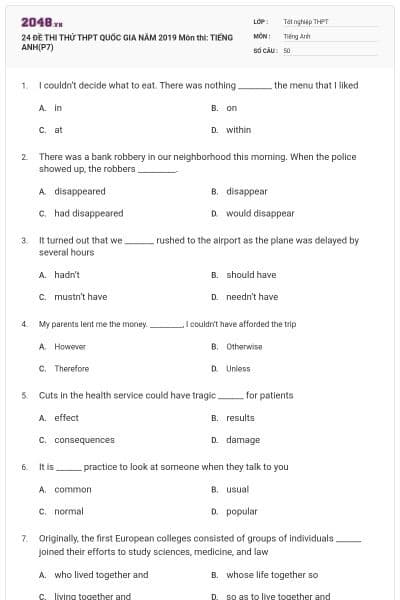
I couldn’t decide what to eat. There was nothing ________ the menu that I liked
in
on
at
within
Chọn B
Kiến thức: Giới từ
Giải thích:
A. in (pre): trong
B. on (pre): trên
C. at (pre): tại
D. within (pre): trong vòng
on the menu: trên thực đơn
Tạm dịch: Tôi không thể quyết định ăn gì. Không có món gì trên thực đơn mà tôi thích cả
There was a bank robbery in our neighborhood this morning. When the police showed up, the robbers _________.
disappeared
disappear
had disappeared
would disappear
Chọn C
Kiến thức: Thì quá khứ hoàn thành
Giải thích:
Thì quá khứ hoàn thành diễn tả hành động xảy ra trước một hành động trong quá khứ.
Cấu trúc: When S + Ved/ V2, S + had + V ed/P2
Tạm dịch: Có một vụ cướp ngân hàng ở làng chúng tôi sáng nay. Khi cảnh sát xuất hiện, những tên cướp đã không còn ở đó
It turned out that we _______ rushed to the airport as the plane was delayed by several hours
hadn’t
should have
mustn’t have
needn’t have
Chọn D
Kiến thức: Động từ khuyết thiếu
Giải thích:
hadn’t P2 (thì quá khứ hoàn thành)
should have P2: đáng lẽ ra nên làm gì trong quá khứ
mustn’t have P2: chắc hẳn đã không làm gì trong quá khứ
needn’t have P2: đáng lẽ ra không cần làm gì trong quá khứ
Tạm dịch: Hóa ra chúng tôi đã không cần vội vã tới sân bay bởi vì máy bay bị trì hoãn trong vài giờ
My parents lent me the money. _________, I couldn’t have afforded the trip
However
Otherwise
Therefore
Unless
Đáp án: B
Giải thích:
A. However: Tuy nhiên
B. Otherwise: Nếu không
C. Therefore: Do đó
D. Unless + mệnh đề = If not: nếu không
Phía sau vị trí cần điền là dấu phẩy, không có mệnh đề ngay sau đi kèm, và dựa vào nghĩa, chọn B.
Dịch: Bố mẹ tôi cho tôi vay tiền. Nếu không, tôi không đủ khả năng chi trả cho chuyến đi.
Cuts in the health service could have tragic ______ for patients
effect
results
consequences
damage
Chọn C
Kiến thức: Từ vựng
Giải thích:
A. effect (n): ảnh hưởng
B. result (n): kết quả
C. consequence (n): hậu quả
D. damage (n): tổn thương
Tạm dịch: Sự cắt giảm trong dịch vụ y tế có thể gây hậu quả bi thảm cho bệnh nhân
It is ______ practice to look at someone when they talk to you
common
usual
normal
popular
Chọn A
Kiến thức: Từ vựng
Giải thích:
A. common (a): chung
B. usual (a): thông thường
C. normal (a): bình thường
D. popular (a): phổ biến
Tạm dịch: Đó là thói quen phổ biến khi nhìn vào ai đó lúc họ nói chuyện với bạn
Originally, the first European colleges consisted of groups of individuals ______ joined their efforts to study sciences, medicine, and law
who lived together and
whose life together so
living together and
so as to live together and
Chọn A
Kiến thức: Mệnh đề quan hệ
Giải thích:
who: thay cho danh từ chỉ người; đóng vai trò chủ ngữ/ tân ngữ trong mệnh đề quan hệ.
Vế sau động từ là “joined” nên vế trước phải là “lived”.
Tạm dịch: Ban đầu, các trường đại học châu Âu đầu tiên bao gồm các nhóm cá nhân sống cùng nhau và tham gia nỗ lực nghiên cứu khoa học, y học và pháp luật
I'll give you the phone number of my hotel so that you can reach me if anything _________.
happen
happened
had happened
happens
Chọn D
Kiến thức: Câu điều kiện loại 1
Giải thích:
Câu điều kiện loại 1 diễn tả sự việc có thể xảy ra ở hiện tại hoặc tương lai.
Cấu trúc: S will/ can V (nguyên thể) if S + V (hiện tại)
Tạm dịch: Tôi sẽ cho bạn số điện thoại khách sạn của tôi để bạn có thể liên lạc với tôi nếu có bất cứ điều gì xảy ra
A quilt that looks ordinary _____ may become a work of abstract art when it is hung on a white wall
to be on bed
lies on a bed
to be lying in bed
lying on a bed
Chọn D
Kiến thức: Rút gọn mệnh thời gian
Giải thích:
Khi hai mệnh đề cùng chủ ngữ (A quilt that – it) có thể rút gọn 1 mệnh đề mang nghĩa chủ động về dạng V–ing, mang nghĩa bị động về dạng Ved/ P2.
Câu đầy đủ: A quilt that looks ordinary when it lies on a bed may become a work of abstract art when it is hung on a white wall.
Câu rút gọn: A quilt that looks ordinary lying on a bed may become a work of abstract art when it is hung on a white wall.
Tạm dịch: Một chiếc chăn trông có vẻ bình thường nằm trên giường có thể trở thành một tác phẩm nghệ thuật trừu tượng khi nó được treo trên tường trắng
Our planned visit to ______ United Kingdom fell through because we were unable to get the visas
a
an
the
no article
Chọn C
Kiến thức: Mạo từ
Giải thích: Trước tên của những nước mà có “Kingdom”, “States” hay “Republic” ta phải dùng mạo từ “the”.
Tạm dịch: Chuyến thăm theo kế hoạch của chúng tôi đến Vương quốc Anh đã thất bại vì chúng tôi không thể có được hộ chiếu
Animals were first domesticated as a source of food and later ______ as a source of clothing and transportation
raised
bought
found
tamed
Chọn D
Kiến thức: Từ vựng
Giải thích:
A. raise (v): nuôi
B. buy (v): mua
C. find (v): tìm
D. tame (v): thuần hóa, huấn luyện
Tạm dịch: Động vật lúc đầu được thuần hóa như một nguồn thực phẩm và sau đó được huấn luyện như một nguồn để làm quần áo và phương tiện vận chuyển
Hector has been ______ of murdering the Japanese visitor
blamed
charged
accused
arrested
Chọn C
Kiến thức: Từ vựng
Giải thích:
A. blame for (v): đổ lỗi
B. charge of (v): tính phí
C. accuse of(v): buộc tội
D. arrest (n): bắt giữ
Tạm dịch: Hector đã bị buộc tội vì giết chết du khách Nhật Bản
_______ are that stock price will go up in the coming months
Chances
Opportunities
Possibilities
Conditions
Chọn A
Kiến thức: Từ vựng
Giải thích:
A. Chance (n): khả năng có thể
B. Opportunity (n): cơ hội, dịp
C. Possibility (n): sự có thể
D. Condition (n): điều kiện
Tạm dịch: Rất có thể là giá cổ phiếu sẽ tăng trong những tháng tới
It was so _________ a victory that even Smith’s fans couldn’t believe it
surprised
surprising
surprise
surprisedly
Chọn B
Kiến thức: Từ loại
Giải thích:
A. surprised (tính từ bị động): đáng ngạc nhiên – mô tả cảm xúc của người do bị tác động mà có
B. surprising (tính từ chủ động): đáng ngạc nhiên – mô tả đặc điểm, tính chất của người/ vật
C. surprise (n, v): sự ngạc nhiên, làm ngạc nhiên
D. surprisedly (adv): một cách ngạc nhiên
Cần một tính từ chủ động bổ trợ nghĩa cho danh từ “victory”.
Tạm dịch: Đó là một chiến thắng đáng ngạc nhiên mà ngay cả những người hâm mộ Smith cũng không thể tin được
Mark the letter A, B, C, or D to indicate the sentence that is CLOSEST in meaning to each of the following questions
I am much worse than Josh is at physics
Josh is not quite as badly at physics as I am
Josh is no any better at physics than I am
Josh is not nearly as bad at physics as I am
Josh is the best at physics
Chọn C
Kiến thức: So sánh hơn
Giải thích:
Cấu trúc: S1 + be + adj (so sánh hơn) than S2
= S2 + be + not + as adj as + S1
Tạm dịch: Tôi kém hơn Josh rất nhiều trong môn vật lý.
A. Josh kém vật lý gần như tôi. => sai về nghĩa
B. Josh không giỏi vật lý hơn tôi chút nào. => sai về nghĩa
C. Josh hoàn toàn không kém môn vật lý như tôi.
D. Josh là người giỏi nhất môn vật lý. => sai về nghĩa
I'm sure it wasn't Mr. Phong you saw because he's on business in Ha Noi
It couldn't be Mr. Phong you saw because he's on business in Ha Noi
You mustn't have seen Mr. Phong because he's on business in Ha Noi
It can't have been Mr. Phong you saw because he's on business in Ha Noi
Mr. Phong is on business in Ha Noi, so you might have seen him
Chọn C
Kiến thức: Động từ khuyết thiếu
Giải thích:
A. couldn’t V: không thể làm gì trong quá khứ
B. mustn’t have P2: chắc hẳn đã không làm gì trong quá khứ
C. can’t have P2: không thể đã làm gì trong quá khứ (chắc chắn 99%)
D. mightn’t have P2: có thể đã không làm gì trong quá khứ
Tạm dịch: Tôi chắc chắn người bạn đã thấy không phải là anh Phong bởi vì anh ấy đang đi công tác ở Hà Nội.
= Người mà bạn đã thấy không thể là anh Phong vì anh ấy đang đi công tác ở Hà Nội
“Would anyone like to express an opinion on this matter?” said he
He asked everyone whether they would like to express an opinion on the matter
He asked everyone as if someone would like to express their opinion on the matter
He doubted that everyone would like to express their opinion on the matter
He wondered that anyone would like to express their opinion on the matter
Chọn A
Kiến thức: Câu tường thuật
Giải thích: Công thức tường thuật câu hỏi Yes/ No: S + asked + O + if/ whether + S + V (lùi thì) .
Tạm dịch: “Có ai muốn bày tỏ ý kiến về vấn đề này không?”, ông ấy nói
A. Ông ấy hỏi mọi người liệu rằng họ có muốn bày tỏ ý kiến về vấn đề này không.
B. Anh ấy hỏi mọi người như thể có ai đó muốn bày tỏ ý kiến của họ về vấn đề này. => sai về nghĩa
C. Ông ấy nghi ngờ rằng mọi người đều muốn bày tỏ ý kiến về vấn đề này. => sai về nghĩa
D. Ông ấy tự hỏi rằng có ai đó muốn bày tỏ ý kiến về vấn đề này không. => sai về nghĩa
The traffic accident caused a traffic jam. The traffic jam lasted 2 hours
The two–hour traffic jam was brought about by the traffic accident
It was the two–hour traffic jam that caused the traffic accident
There was a traffic accident caused by a two–hour traffic jam
If there weren’t that traffic accident, there wouldn’t be the two–hour traffic jam
Chọn A
Kiến thức: Mệnh đề nguyên nhân, kết quả
Giải thích: bring about (v): mang lại; cause (v): gây ra
Tạm dịch: Vụ tai nạn giao thông đã gây ra ùn tắc giao thông. Ùn tắc giao thông đã kéo dài trong 2 giờ.
A. Ùn tắc giao thông kéo dài hai giờ đã xảy ra do tai nạn giao thông.
B. Chính ùn tắc giao thông kéo dài hai giờ đã gây ra tai nạn giao thông. => sai về nghĩa
C. Có một vụ tai nạn giao thông do ùn tắc giao thông kéo dài hai giờ gây ra. => sai về nghĩa
D. sai ngữ pháp: ngữ cảnh thì quá khứ đơn (caused – lasted) => câu điều kiện loại 3
All possible means have been used to prevent air pollution. The sky is still not clear
Every possible means has been used to prevent air pollution so that the sky can be clearer
The sky is still not clear due to the fact that all possible means have been used to prevent air pollution
To prevent air pollution, every possible means has been used, and so the sky is still not clear
Every possible means has been used to prevent air pollution, yet the sky is still not clear
Chọn D
Kiến thức: Liên từ
Tạm dịch: Tất cả các phương pháp khả thi đều đã được áp dụng để ngăn ngừa ô nhiễm không khí. Bầu trời vẫn chưa sạch.
A. Mọi phương pháp khả thi đều đã được áp dụng để ngăn ngừa ô nhiễm không khí để mà bầu trời có thể sạch hơn. => sai về nghĩa
B. Bầu trời vẫn không sạch là do mọi phương pháp khả thi đều đã được áp dụng để ngăn ngừa ô nhiễm không khí. => sai về nghĩa
C. Để ngăn ngừa ô nhiễm không khí, mọi phương pháp khả thi đều đã được áp dụng, và vì vậy bầu trời vẫn không sạch hơn. => sai về nghĩa
D. Mọi phương pháp khả thi đều đã được áp dụng để ngăn ngừa ô nhiễm không khí, nhưng bầu trời vẫn chưa sạch
Read the following passage and mark the letter A, B, C, or D to indicate the correct word or phrase that best fits each of the numbered blanks.
The philosopher Aristotle said, “In poverty and other misfortunes of life, true friends are a sure refuge. They keep the young out of mischief; they comfort and aid the old in their weakness, and they incite those in the prime of life to noble deeds. “Growing up”, my mother always used to tell me “your friends are a reflection of you”. I did not quite understand this (20) ______ I started meeting individuals who kept, not so healthy friends in their lives and suddenly, as a young teenager, I learned to understand that the friends I keep in my life (21) ______ who I am and desire to be as a person and therefore I have learned to choose my friends wisely over the years. I do not care about the superficial (22) ______ such as looks, money, success or status but rather I emulate those (23) ______ bring laughter, joy, honesty and who can be there for me and also give me a firm kick in the butt when I need it. I always find it intriguing to meet friends of people I know because I can really get a sense of that person by the company they choose to (24) ________ in their life
Điền ô 20
until
when
since
while
Chọn A
Kiến thức: Liên từ
Giải thích:
A. until: cho đến khi
B. when: khi
C. since: từ khi
D. while: trong khi
I did not quite understand this (20) until I started meeting individuals who kept, not so healthy friends in their lives and suddenly, as a young teenager, I learned to understand that…
Tạm dịch: Tôi không hoàn toàn hiểu điều này cho đến khi tôi bắt đầu gặp gỡ những người sống giữ mình, không phải là những người bạn lành mạnh trong cuộc sống của họ và đột nhiên, khi còn là một thiếu niên, tôi học cách hiểu rằng...
Read the following passage and mark the letter A, B, C, or D to indicate the correct word or phrase that best fits each of the numbered blanks.
The philosopher Aristotle said, “In poverty and other misfortunes of life, true friends are a sure refuge. They keep the young out of mischief; they comfort and aid the old in their weakness, and they incite those in the prime of life to noble deeds. “Growing up”, my mother always used to tell me “your friends are a reflection of you”. I did not quite understand this (20) ______ I started meeting individuals who kept, not so healthy friends in their lives and suddenly, as a young teenager, I learned to understand that the friends I keep in my life (21) ______ who I am and desire to be as a person and therefore I have learned to choose my friends wisely over the years. I do not care about the superficial (22) ______ such as looks, money, success or status but rather I emulate those (23) ______ bring laughter, joy, honesty and who can be there for me and also give me a firm kick in the butt when I need it. I always find it intriguing to meet friends of people I know because I can really get a sense of that person by the company they choose to (24) ________ in their life
Điền ô 21
reflection
reflect
reflective
reflectively
Chọn B
Kiến thức: Từ loại
Giải thích:
A. reflection (n): sự phản ánh
B. reflect (v): phản ánh
C. reflective (a): phản chiếu
D. reflectively (adv): theo phản xạ
Sau chủ ngữ số nhiều “the friends” cần động từ nguyên thể.
I did not quite understand this until I started meeting individuals who kept, not so healthy friends in their lives and suddenly, as a young teenager, I learned to understand that the friends I keep in my life (21) reflect who I am and desire to be as a person and therefore I have learned to choose my friends wisely over the years.
Tạm dịch: Tôi không hoàn toàn hiểu điều này cho đến khi tôi bắt đầu gặp gỡ những người sống giữ mình, không phải là những người bạn lành mạnh trong cuộc sống của họ và đột nhiên, khi còn là một thiếu niên, tôi học cách hiểu rằng những người bạn tôi có trong đời phản ánh tôi là ai và mong muốn trở thành như thế nào và do đó tôi đã học cách chọn bạn bè thật khôn ngoan trong những năm qua
Read the following passage and mark the letter A, B, C, or D to indicate the correct word or phrase that best fits each of the numbered blanks.
The philosopher Aristotle said, “In poverty and other misfortunes of life, true friends are a sure refuge. They keep the young out of mischief; they comfort and aid the old in their weakness, and they incite those in the prime of life to noble deeds. “Growing up”, my mother always used to tell me “your friends are a reflection of you”. I did not quite understand this (20) ______ I started meeting individuals who kept, not so healthy friends in their lives and suddenly, as a young teenager, I learned to understand that the friends I keep in my life (21) ______ who I am and desire to be as a person and therefore I have learned to choose my friends wisely over the years. I do not care about the superficial (22) ______ such as looks, money, success or status but rather I emulate those (23) ______ bring laughter, joy, honesty and who can be there for me and also give me a firm kick in the butt when I need it. I always find it intriguing to meet friends of people I know because I can really get a sense of that person by the company they choose to (24) ________ in their life
Điền ô 22
elements
components
attributes
ingredients
Chọn C
Kiến thức: Từ vựng
Giải thích:
A. element (n): yếu tố
B. component (n): thành phần
C. attribute (n): đặc điểm, thuộc tính
D. ingredient (n): thành phần
I do not care about the superficial (22) attributes such as looks, money, success or status...
Tạm dịch: Tôi không quan tâm đến các đặc điểm hời hợt như ngoại hình, tiền bạc, thành công hay địa vị...
Read the following passage and mark the letter A, B, C, or D to indicate the correct word or phrase that best fits each of the numbered blanks.
The philosopher Aristotle said, “In poverty and other misfortunes of life, true friends are a sure refuge. They keep the young out of mischief; they comfort and aid the old in their weakness, and they incite those in the prime of life to noble deeds. “Growing up”, my mother always used to tell me “your friends are a reflection of you”. I did not quite understand this (20) ______ I started meeting individuals who kept, not so healthy friends in their lives and suddenly, as a young teenager, I learned to understand that the friends I keep in my life (21) ______ who I am and desire to be as a person and therefore I have learned to choose my friends wisely over the years. I do not care about the superficial (22) ______ such as looks, money, success or status but rather I emulate those (23) ______ bring laughter, joy, honesty and who can be there for me and also give me a firm kick in the butt when I need it. I always find it intriguing to meet friends of people I know because I can really get a sense of that person by the company they choose to (24) ________ in their life
Điền ô 23
who
whom
which
where
Chọn A
Kiến thức: Đại từ quan hệ
Giải thích:
A. who: thay cho danh từ chỉ người; đóng vai trò chủ ngữ/ tân ngữ trong mệnh đề quan hệ
B. whom: thay cho danh từ chỉ người; đóng vai trò tân ngữ trong mệnh đề quan hệ
C. which: thay cho danh từ chỉ vật; đóng vai trò chủ ngữ/ tân ngữ trong mệnh đề quan hệ
D. where: thay cho trạng từ chỉ nơi chốn, where S + V
those = those people/ friends => danh từ chỉ người
I do not care about the superficial attributes such as looks, money, success or status but rather I emulate those (23) who bring laughter, joy, honesty and who can be there for me and also give me a firm kick in the butt when I need it.
Tạm dịch: Tôi không quan tâm đến các đặc điểm hời hợt như ngoại hình, tiền bạc, thành công hay địa vị mà hơn thế tôi muốn những người mang lại tiếng cười, niềm vui, sự trung thực và những người có thể ở đó cạnh tôi và đánh thức khi tôi cần
Read the following passage and mark the letter A, B, C, or D to indicate the correct word or phrase that best fits each of the numbered blanks.
The philosopher Aristotle said, “In poverty and other misfortunes of life, true friends are a sure refuge. They keep the young out of mischief; they comfort and aid the old in their weakness, and they incite those in the prime of life to noble deeds. “Growing up”, my mother always used to tell me “your friends are a reflection of you”. I did not quite understand this (20) ______ I started meeting individuals who kept, not so healthy friends in their lives and suddenly, as a young teenager, I learned to understand that the friends I keep in my life (21) ______ who I am and desire to be as a person and therefore I have learned to choose my friends wisely over the years. I do not care about the superficial (22) ______ such as looks, money, success or status but rather I emulate those (23) ______ bring laughter, joy, honesty and who can be there for me and also give me a firm kick in the butt when I need it. I always find it intriguing to meet friends of people I know because I can really get a sense of that person by the company they choose to (24) ________ in their life
Điền ô 24
have
create
make
keep
Chọn D
Kiến thức: Từ vựng
Giải thích:
A. have (v): có
B. create (v): tạo ra
C. make (v): làm ra
D. keep (v): giữ, tiếp tục làm
I always find it intriguing to meet friends of people I know because I can really get a sense of that person by the company they choose to (24) keep in their life.
Tạm dịch: Tôi luôn thấy thú vị khi gặp gỡ bạn bè của những người mà tôi biết bởi vì tôi thực sự có thể cảm nhận được người đó qua công ty họ chọn tiếp tục làm trong cuộc sống của họ.
Dịch bài đọc:
Nhà triết học Aristotle đã nói, "Trong nghèo đói và những bất hạnh khác của cuộc sống, những người bạn thực sự là nơi nương tựa chắc chắn." Họ giữ những người trẻ tuổi tránh xa điều ác; họ an ủi và giúp đỡ người già trong lúc ốm yếu và họ giục những người ở thời kỳ đẹp nhất của cuộc đời làm những việc cao thượng. "Lớn lên đi", mẹ tôi luôn nói với tôi "bạn bè của con là sự phản ánh lại con". Tôi không hoàn toàn hiểu điều này cho đến khi tôi bắt đầu gặp gỡ những người sống giữ mình, không phải là những người bạn lành mạnh trong cuộc sống của họ và đột nhiên, khi còn là một thiếu niên, tôi học cách hiểu rằng những người bạn tôi có trong đời phản ánh tôi là ai và mong muốn trở thành như thế nào và do đó tôi đã học cách chọn bạn bè thật khôn ngoan trong những năm qua. Tôi không quan tâm đến các đặc điểm hời hợt như ngoại hình, tiền bạc, thành công hay địa vị mà hơn thế tôi muốn những người mang lại tiếng cười, niềm vui, sự trung thực và những người có thể ở đó cạnh tôi và đánh thức khi tôi cần. Tôi luôn thấy thú vị khi gặp gỡ bạn bè của những người mà tôi biết bởi vì tôi thực sự có thể cảm nhận được người đó qua công ty họ chọn tiếp tục làm trong cuộc sống của họ
Read the following passage and mark the letter A, B, C, or D on your answer sheet to indicate the correct answer to each of the questions.
Most languages have several levels of vocabulary that may be used by the same speakers. In English, at least three have been identified and described.
Standard usage includes those words and expressions understood, used, and accepted by a majority of the speakers of a language in any situation regardless of the level of formality. As such, these words and expressions are well defined and listed in standard dictionaries. Colloquialisms, on the other hand, are familiar words and idioms that are understood by almost all speakers of a language and used in informal speech or writing, but not considered acceptable for more formal situations. Almost all idiomatic expressions are colloquial language. Slang, refers to words and expressions understood by a large number of speakers but not accepted as appropriate formal usage by the majority. Colloquial expressions and even slang may be found in standard dictionaries but will be so identified. Both colloquial usage and slang are more common in speech than writing.
Colloquial speech often passes into standard speech. Some slang also passes into standard speech, but other slang expressions enjoy momentary popularity followed by obscurity. In some cases, the majority never accepts certain slang phrases but nevertheless retains them in their collective memories. Every generation seems to require its own set of words to describe familiar objects and events.
It has been pointed out by a number of linguists that three cultural conditions are necessary for the creation of a large body of slang expressions. First, the introduction and acceptance of new objects and situations in the society; second, a diverse population with a large number of subgroups; third, association among the subgroups and the majority population.
Finally, it is worth noting that the terms “standard”, “colloquial”, and “slang” exist only as abstract labels for scholars who study language. Only a tiny number of the speakers of any language will be aware that they are using colloquial or slang expressions. Most speakers of English will, during appropriate situations, select and use three types of expressions.
Which of the following could be the best title for the passage?
Standard speech
Idiomatic phrases
Different types of vocabulary
Dictionary usage
Chọn C
Kiến thức: Đọc hiểu
Giải thích:
Câu nào sau đây có thể là tiêu đề tốt nhất cho đoạn văn?
A. Nói chuẩn
B. Cụm từ đặc ngữ
C. Các loại từ ngữ khác nhau
D. Sử dụng từ điển
Read the following passage and mark the letter A, B, C, or D on your answer sheet to indicate the correct answer to each of the questions.
Most languages have several levels of vocabulary that may be used by the same speakers. In English, at least three have been identified and described.
Standard usage includes those words and expressions understood, used, and accepted by a majority of the speakers of a language in any situation regardless of the level of formality. As such, these words and expressions are well defined and listed in standard dictionaries. Colloquialisms, on the other hand, are familiar words and idioms that are understood by almost all speakers of a language and used in informal speech or writing, but not considered acceptable for more formal situations. Almost all idiomatic expressions are colloquial language. Slang, refers to words and expressions understood by a large number of speakers but not accepted as appropriate formal usage by the majority. Colloquial expressions and even slang may be found in standard dictionaries but will be so identified. Both colloquial usage and slang are more common in speech than writing.
Colloquial speech often passes into standard speech. Some slang also passes into standard speech, but other slang expressions enjoy momentary popularity followed by obscurity. In some cases, the majority never accepts certain slang phrases but nevertheless retains them in their collective memories. Every generation seems to require its own set of words to describe familiar objects and events.
It has been pointed out by a number of linguists that three cultural conditions are necessary for the creation of a large body of slang expressions. First, the introduction and acceptance of new objects and situations in the society; second, a diverse population with a large number of subgroups; third, association among the subgroups and the majority population.
Finally, it is worth noting that the terms “standard”, “colloquial”, and “slang” exist only as abstract labels for scholars who study language. Only a tiny number of the speakers of any language will be aware that they are using colloquial or slang expressions. Most speakers of English will, during appropriate situations, select and use three types of expressions.
How is slang defined by the author?
Words and phrases accepted by the majority of formal usage
Words or phrases understood by the majority but not found in standard dictionaries
Words or phrases that are understood by a restricted group of speakers
Words or phrases understood by a large number of speakers but not accepted as formal usage
Chọn D
Kiến thức: Đọc hiểu
Giải thích:
Từ lóng được tác giả định nghĩa như thế nào?
A. Các từ và cụm từ được phần lớn mọi người chấp nhận là cách sử dụng chính thức.
B. Các từ hoặc cụm từ được phần lớn mọi người hiểu nhưng không được tìm thấy trong từ điển chuẩn.
C. Các từ hoặc cụm từ được một nhóm người nói có giới hạn hiểu.
D. Các từ hoặc cụm từ được một số lượng lớn người nói hiểu nhưng không được chấp nhận là cách sử dụng chính thức.
Thông tin: Slang, refers to words and expressions understood by a large number of speakers but not accepted as appropriate formal usage by the majority.
Tạm dịch: Tiếng lóng là các từ và cách diễn đạt được một số lượng lớn người nói hiểu nhưng không được đa số họ chấp nhận là cách sử dụng chính thức phù hợp
Read the following passage and mark the letter A, B, C, or D on your answer sheet to indicate the correct answer to each of the questions.
Most languages have several levels of vocabulary that may be used by the same speakers. In English, at least three have been identified and described.
Standard usage includes those words and expressions understood, used, and accepted by a majority of the speakers of a language in any situation regardless of the level of formality. As such, these words and expressions are well defined and listed in standard dictionaries. Colloquialisms, on the other hand, are familiar words and idioms that are understood by almost all speakers of a language and used in informal speech or writing, but not considered acceptable for more formal situations. Almost all idiomatic expressions are colloquial language. Slang, refers to words and expressions understood by a large number of speakers but not accepted as appropriate formal usage by the majority. Colloquial expressions and even slang may be found in standard dictionaries but will be so identified. Both colloquial usage and slang are more common in speech than writing.
Colloquial speech often passes into standard speech. Some slang also passes into standard speech, but other slang expressions enjoy momentary popularity followed by obscurity. In some cases, the majority never accepts certain slang phrases but nevertheless retains them in their collective memories. Every generation seems to require its own set of words to describe familiar objects and events.
It has been pointed out by a number of linguists that three cultural conditions are necessary for the creation of a large body of slang expressions. First, the introduction and acceptance of new objects and situations in the society; second, a diverse population with a large number of subgroups; third, association among the subgroups and the majority population.
Finally, it is worth noting that the terms “standard”, “colloquial”, and “slang” exist only as abstract labels for scholars who study language. Only a tiny number of the speakers of any language will be aware that they are using colloquial or slang expressions. Most speakers of English will, during appropriate situations, select and use three types of expressions.
The word “obscurity” in paragraph 3 could be best replaced by _____.
disappearance
influence
qualification
tolerance
Chọn A
Kiến thức: Đọc hiểu
Giải thích:
Từ “obscurity” trong đoạn 3 có thể được thay thế tốt nhất bằng từ _____.
A. biến mất
B. ảnh hưởng
C. trình độ
D. khoan dung
Thông tin: Some slang also passes into standard speech, but other slang expressions enjoy momentary popularity followed by obscurity.
Tạm dịch: Một số từ tiếng lóng cũng chuyển thành lời nói tiêu chuẩn, nhưng những từ tiếng lóng khác lại có tính phổ biến nhất thời, sau đó thì biến mất.
Read the following passage and mark the letter A, B, C, or D on your answer sheet to indicate the correct answer to each of the questions.
Most languages have several levels of vocabulary that may be used by the same speakers. In English, at least three have been identified and described.
Standard usage includes those words and expressions understood, used, and accepted by a majority of the speakers of a language in any situation regardless of the level of formality. As such, these words and expressions are well defined and listed in standard dictionaries. Colloquialisms, on the other hand, are familiar words and idioms that are understood by almost all speakers of a language and used in informal speech or writing, but not considered acceptable for more formal situations. Almost all idiomatic expressions are colloquial language. Slang, refers to words and expressions understood by a large number of speakers but not accepted as appropriate formal usage by the majority. Colloquial expressions and even slang may be found in standard dictionaries but will be so identified. Both colloquial usage and slang are more common in speech than writing.
Colloquial speech often passes into standard speech. Some slang also passes into standard speech, but other slang expressions enjoy momentary popularity followed by obscurity. In some cases, the majority never accepts certain slang phrases but nevertheless retains them in their collective memories. Every generation seems to require its own set of words to describe familiar objects and events.
It has been pointed out by a number of linguists that three cultural conditions are necessary for the creation of a large body of slang expressions. First, the introduction and acceptance of new objects and situations in the society; second, a diverse population with a large number of subgroups; third, association among the subgroups and the majority population.
Finally, it is worth noting that the terms “standard”, “colloquial”, and “slang” exist only as abstract labels for scholars who study language. Only a tiny number of the speakers of any language will be aware that they are using colloquial or slang expressions. Most speakers of English will, during appropriate situations, select and use three types of expressions.
The word “them” in paragraph 3 refers to _____.
set of words
slang phrases
slang
slang expressions
Chọn B
Từ “them” trong đoạn 3 đề cập đến _____.
A. tạo ra từ
B. cụm từ tiếng lóng
C. tiếng lóng
D. cách diễn đạt tiếng lóng
Thông tin: In some cases, the majority never accepts certain slang phrases but nevertheless retains them in their collective memories.
Tạm dịch: Trong một số trường hợp, phần lớn mọi người không chấp nhận một số cụm từ tiếng lóng nhất định nhưng tuy nhiên vẫn giữ chúng trong ký ức chung của họ
Read the following passage and mark the letter A, B, C, or D on your answer sheet to indicate the correct answer to each of the questions.
Most languages have several levels of vocabulary that may be used by the same speakers. In English, at least three have been identified and described.
Standard usage includes those words and expressions understood, used, and accepted by a majority of the speakers of a language in any situation regardless of the level of formality. As such, these words and expressions are well defined and listed in standard dictionaries. Colloquialisms, on the other hand, are familiar words and idioms that are understood by almost all speakers of a language and used in informal speech or writing, but not considered acceptable for more formal situations. Almost all idiomatic expressions are colloquial language. Slang, refers to words and expressions understood by a large number of speakers but not accepted as appropriate formal usage by the majority. Colloquial expressions and even slang may be found in standard dictionaries but will be so identified. Both colloquial usage and slang are more common in speech than writing.
Colloquial speech often passes into standard speech. Some slang also passes into standard speech, but other slang expressions enjoy momentary popularity followed by obscurity. In some cases, the majority never accepts certain slang phrases but nevertheless retains them in their collective memories. Every generation seems to require its own set of words to describe familiar objects and events.
It has been pointed out by a number of linguists that three cultural conditions are necessary for the creation of a large body of slang expressions. First, the introduction and acceptance of new objects and situations in the society; second, a diverse population with a large number of subgroups; third, association among the subgroups and the majority population.
Finally, it is worth noting that the terms “standard”, “colloquial”, and “slang” exist only as abstract labels for scholars who study language. Only a tiny number of the speakers of any language will be aware that they are using colloquial or slang expressions. Most speakers of English will, during appropriate situations, select and use three types of expressions.
Which of the following is TRUE of standard usage?
It is limited to written language.
It is only understood by the upper classes.
It can be used in formal or informal settings.
It is constantly changing
Chọn C
Kiến thức: Đọc hiểu
Giải thích:
Điều nào sau đây là ĐÚNG của sử dụng tiêu chuẩn?
A. Nó bị giới hạn trong ngôn ngữ viết.
B. Nó chỉ được hiểu bởi tầng lớp trên.
C. Nó có thể được sử dụng trong các lời nói và văn bản trang trọng hoặc không trang trọng.
D. Nó liên tục thay đổi.
Thông tin: Standard usage includes those words and expressions understood, used, and accepted by a majority of the speakers of a language in any situation regardless of the level of formality.
Tạm dịch: Sử dụng tiêu chuẩn bao gồm những từ và cách diễn đạt được hiểu, sử dụng và được chấp nhận bởi đa số người nói ngôn ngữ đó trong mọi tình huống bất kể mức độ trang trọng.
Dịch bài đọc:
Hầu hết các ngôn ngữ đều có một số cấp độ từ vựng có thể được sử dụng bởi cùng một người nói. Trong tiếng Anh, ít nhất ba cấp độ đã được xác định và mô tả.
Sử dụng tiêu chuẩn bao gồm những từ và cách diễn đạt được hiểu, sử dụng và được chấp nhận bởi đa số người nói ngôn ngữ đó trong mọi tình huống bất kể mức độ trang trọng. Vì thế, những từ và cách diễn đạt này được xác định rõ và được ghi trong từ điển chuẩn. Mặt khác, từ và cụm từ thông tục là những từ và cách diễn đạt quen thuộc được hầu hết tất cả những người nói ngôn ngữ đó hiểu và sử dụng trong lời nói hoặc văn bản không trang trọng, nhưng không chấp nhận được trong các tình huống trang trọng hơn. Hầu như tất cả các từ đặc ngữ đều là ngôn ngữ thông tục. Tiếng lóng là các từ và cách diễn đạt được một số lượng lớn người nói hiểu nhưng không được đa số họ chấp nhận là cách sử dụng chính thức phù hợp. Ngôn từ thông tục và thậm chí cả tiếng lóng có thể được tìm thấy trong từ điển tiêu chuẩn nhưng sẽ bị đông nhất hóa. Cả cách sử dụng thông tục và tiếng lóng đều phổ biến trong ngôn ngữ nói hơn là viết.
Lời nói thông tục thường được chuyển thành lời nói tiêu chuẩn. Một số từ tiếng lóng cũng chuyển thành lời nói tiêu chuẩn, nhưng những từ tiếng lóng khác lại có tính phổ biến nhất thời, sau đó thì biến mất. Trong một số trường hợp, phần lớn mọi người không chấp nhận một số cụm từ tiếng lóng nhất định nhưng tuy nhiên vẫn giữ chúng trong ký ức chung của họ. Mọi thế hệ dường như đều đòi hỏi phải tự tạo ra các từ ngữ riêng để mô tả các đối tượng và sự kiện quen thuộc.
Một số nhà ngôn ngữ học đã chỉ ra rằng ba điều kiện văn hóa là cần thiết để tạo ra một tập lớn các cách diễn đạt tiếng lóng. Đầu tiên là giới thiệu và chấp nhận các đối tượng và tình huống mới trong xã hội; thứ hai là có dân số đa dạng với nhiều nhóm nhỏ; thứ ba là sự liên kết giữa các nhóm nhỏ và phần lớn dân số.
Cuối cùng, điều đáng chú ý là các thuật ngữ "tiêu chuẩn", "thông tục" và "tiếng lóng" chỉ là cái nhãn lý thuyết của các học giả nghiên cứu ngôn ngữ. Chỉ một số ít người nói bất kỳ ngôn ngữ nào mới nhận thức được rằng họ đang sử dụng cách diễn đạt thông tục hay tiếng lóng. Hầu hết những người nói tiếng Anh trong các tình huống thích hợp, sẽ lựa chọn và sử dụng ba cách diễn đạt này
Read the following passage and mark the letter A, B, C or D on your answer sheet to indicate the correct answer to each of the questions.
There are three valid arguments to support the preservation of endangered species. An aesthetic justification contends that biodiversity contributes to the quality of life because many of the endangered plants and animals are particularly appreciated for their unique physical beauty. The aesthetic role of nature in all its diverse forms is reflected in the art and literature of every culture, attaining symbolic status in the spiritual life of many groups. According to the proponents of the aesthetic argument, people need nature in all its diverse and beautiful forms as part of the experience of the world.
Another argument that has been put forward, especially by groups in the medical and pharmacological fields, is that of ecological self–interest. By preserving all species, we retain a balance of nature that is ultimately beneficial to humankind. Recent research on global ecosystems has been cited as evidence that every species contributes important or even essential functions that may be necessary to the survival of our own species. Some advocates of the ecological argument contend that important chemical compounds derived from rare plants may contain the key to a cure for one of the diseases currently threatening human beings. If we do not protect other species, then they cannot protect us.
Apart from human advantage in both the aesthetic and ecological arguments, the proponents of a moral justification contend that all species have the right to exist, a viewpoint stated in the United Nations World Charter for Nature, created in 1982. Furthermore, if humankind views itself as the stewards of all the creatures on Earth, then it is incumbent upon human beings to protect them, and to ensure the continued existence of all species. Moral justification has been extended by a movement called "deep ecology", the members of which rank the biosphere higher than people because the continuation of life depends on this larger perspective. To carry their argument to its logical conclusion, all choices must be made for the biosphere, not for people.
(Source: Adapted from Reading Practice for the TOEFL)
Which of the following is the main topic of the passage?
The quality of life
The preservation of species
The beauty of the world
The balance of nature
Chọn B
Kiến thức: Đọc hiểu
Giải thích:
Chủ đề chính của đoạn văn là gì?
A. Chất lượng cuộc sống
B. Việc bảo tồn các loài
C. Vẻ đẹp của thế giới D. Sự cân bằng của thiên nhiên
Read the following passage and mark the letter A, B, C or D on your answer sheet to indicate the correct answer to each of the questions.
There are three valid arguments to support the preservation of endangered species. An aesthetic justification contends that biodiversity contributes to the quality of life because many of the endangered plants and animals are particularly appreciated for their unique physical beauty. The aesthetic role of nature in all its diverse forms is reflected in the art and literature of every culture, attaining symbolic status in the spiritual life of many groups. According to the proponents of the aesthetic argument, people need nature in all its diverse and beautiful forms as part of the experience of the world.
Another argument that has been put forward, especially by groups in the medical and pharmacological fields, is that of ecological self–interest. By preserving all species, we retain a balance of nature that is ultimately beneficial to humankind. Recent research on global ecosystems has been cited as evidence that every species contributes important or even essential functions that may be necessary to the survival of our own species. Some advocates of the ecological argument contend that important chemical compounds derived from rare plants may contain the key to a cure for one of the diseases currently threatening human beings. If we do not protect other species, then they cannot protect us.
Apart from human advantage in both the aesthetic and ecological arguments, the proponents of a moral justification contend that all species have the right to exist, a viewpoint stated in the United Nations World Charter for Nature, created in 1982. Furthermore, if humankind views itself as the stewards of all the creatures on Earth, then it is incumbent upon human beings to protect them, and to ensure the continued existence of all species. Moral justification has been extended by a movement called "deep ecology", the members of which rank the biosphere higher than people because the continuation of life depends on this larger perspective. To carry their argument to its logical conclusion, all choices must be made for the biosphere, not for people.
(Source: Adapted from Reading Practice for the TOEFL)
The word "perspective" in the third paragraph could best be replaced by ________.
event
view
ideal
truth
Chọn B
Kiến thức: Đọc hiểu
Giải thích:
Từ "perspective" trong đoạn thứ ba có thể được thay thế tốt nhất bằng ______
A. sự kiện
B. tầm nhìn
C. lý tưởng
D. sự thật
Thông tin: Moral justification has been extended by a movement called "deep ecology", the members of which rank the biosphere higher than people because the continuation of life depends on this larger perspective.
Tạm dịch: Lý lẽ về mặt đạo đức được mở rộng bởi một phong trào gọi là "sinh thái sâu sắc", các thành viên của phong trào xếp hạng sinh quyển cao hơn con người vì sự tiếp tục của cuộc sống phụ thuộc vào tầm nhìn xa hơn này
Read the following passage and mark the letter A, B, C or D on your answer sheet to indicate the correct answer to each of the questions.
There are three valid arguments to support the preservation of endangered species. An aesthetic justification contends that biodiversity contributes to the quality of life because many of the endangered plants and animals are particularly appreciated for their unique physical beauty. The aesthetic role of nature in all its diverse forms is reflected in the art and literature of every culture, attaining symbolic status in the spiritual life of many groups. According to the proponents of the aesthetic argument, people need nature in all its diverse and beautiful forms as part of the experience of the world.
Another argument that has been put forward, especially by groups in the medical and pharmacological fields, is that of ecological self–interest. By preserving all species, we retain a balance of nature that is ultimately beneficial to humankind. Recent research on global ecosystems has been cited as evidence that every species contributes important or even essential functions that may be necessary to the survival of our own species. Some advocates of the ecological argument contend that important chemical compounds derived from rare plants may contain the key to a cure for one of the diseases currently threatening human beings. If we do not protect other species, then they cannot protect us.
Apart from human advantage in both the aesthetic and ecological arguments, the proponents of a moral justification contend that all species have the right to exist, a viewpoint stated in the United Nations World Charter for Nature, created in 1982. Furthermore, if humankind views itself as the stewards of all the creatures on Earth, then it is incumbent upon human beings to protect them, and to ensure the continued existence of all species. Moral justification has been extended by a movement called "deep ecology", the members of which rank the biosphere higher than people because the continuation of life depends on this larger perspective. To carry their argument to its logical conclusion, all choices must be made for the biosphere, not for people.
(Source: Adapted from Reading Practice for the TOEFL)
Which of the arguments supports animal rights?
Self–interest argument
Aesthetic justification
Moral justification
Ecological argument
Chọn C
Kiến thức: Đọc hiểu
Giải thích:
Lập luận nào ủng hộ quyền động vật?
A. Lập luận về lợi ích cá nhân
B. Lý lẽ về mặt thẩm mỹ
C. Lý lẽ về mặt đạo đức
D. Lập luận sinh thái
Thông tin: Apart from human advantage in both the aesthetic and ecological arguments, the proponents of a moral justification contend that all species have the right to exist, a viewpoint stated in the United Nations World Charter for Nature, created in 1982.
Tạm dịch: Ngoài lợi ích cho con người về cả thẩm mỹ và sinh thái, những người đề xướng lý lẽ về mặt đạo đức cho rằng tất cả các loài đều có quyền tồn tại, đó là một quan điểm đã được nêu trong Hiến chương về Tự nhiên của Liên hợp quốc viết năm 1982
Read the following passage and mark the letter A, B, C or D on your answer sheet to indicate the correct answer to each of the questions.
There are three valid arguments to support the preservation of endangered species. An aesthetic justification contends that biodiversity contributes to the quality of life because many of the endangered plants and animals are particularly appreciated for their unique physical beauty. The aesthetic role of nature in all its diverse forms is reflected in the art and literature of every culture, attaining symbolic status in the spiritual life of many groups. According to the proponents of the aesthetic argument, people need nature in all its diverse and beautiful forms as part of the experience of the world.
Another argument that has been put forward, especially by groups in the medical and pharmacological fields, is that of ecological self–interest. By preserving all species, we retain a balance of nature that is ultimately beneficial to humankind. Recent research on global ecosystems has been cited as evidence that every species contributes important or even essential functions that may be necessary to the survival of our own species. Some advocates of the ecological argument contend that important chemical compounds derived from rare plants may contain the key to a cure for one of the diseases currently threatening human beings. If we do not protect other species, then they cannot protect us.
Apart from human advantage in both the aesthetic and ecological arguments, the proponents of a moral justification contend that all species have the right to exist, a viewpoint stated in the United Nations World Charter for Nature, created in 1982. Furthermore, if humankind views itself as the stewards of all the creatures on Earth, then it is incumbent upon human beings to protect them, and to ensure the continued existence of all species. Moral justification has been extended by a movement called "deep ecology", the members of which rank the biosphere higher than people because the continuation of life depends on this larger perspective. To carry their argument to its logical conclusion, all choices must be made for the biosphere, not for people.
(Source: Adapted from Reading Practice for the TOEFL)
The author mentions all the following as justifications for the protection of endangered species EXCEPT ________.
the right to life implied by their existence
the intrinsic value of the beauty of nature
the control of pollution in the biosphere
the natural compounds needed for medicines
Chọn C
Kiến thức: Đọc hiểu
Giải thích:
Tác giả đề cập đến tất cả những điều sau đây là lý lẽ cho việc bảo vệ các loài có nguy cơ tuyệt chủng
NGOẠI TRỪ ______.
A. quyền sống bao hàm trong sự tồn tại của chúng
B. giá trị bên trong vẻ đẹp của thiên nhiên
C. kiểm soát ô nhiễm trong sinh quyển
D. các hợp chất tự nhiên cần thiết cho các loại thuốc
Read the following passage and mark the letter A, B, C or D on your answer sheet to indicate the correct answer to each of the questions.
There are three valid arguments to support the preservation of endangered species. An aesthetic justification contends that biodiversity contributes to the quality of life because many of the endangered plants and animals are particularly appreciated for their unique physical beauty. The aesthetic role of nature in all its diverse forms is reflected in the art and literature of every culture, attaining symbolic status in the spiritual life of many groups. According to the proponents of the aesthetic argument, people need nature in all its diverse and beautiful forms as part of the experience of the world.
Another argument that has been put forward, especially by groups in the medical and pharmacological fields, is that of ecological self–interest. By preserving all species, we retain a balance of nature that is ultimately beneficial to humankind. Recent research on global ecosystems has been cited as evidence that every species contributes important or even essential functions that may be necessary to the survival of our own species. Some advocates of the ecological argument contend that important chemical compounds derived from rare plants may contain the key to a cure for one of the diseases currently threatening human beings. If we do not protect other species, then they cannot protect us.
Apart from human advantage in both the aesthetic and ecological arguments, the proponents of a moral justification contend that all species have the right to exist, a viewpoint stated in the United Nations World Charter for Nature, created in 1982. Furthermore, if humankind views itself as the stewards of all the creatures on Earth, then it is incumbent upon human beings to protect them, and to ensure the continued existence of all species. Moral justification has been extended by a movement called "deep ecology", the members of which rank the biosphere higher than people because the continuation of life depends on this larger perspective. To carry their argument to its logical conclusion, all choices must be made for the biosphere, not for people.
(Source: Adapted from Reading Practice for the TOEFL)
The word "them" in the third paragraph refers to ________.
stewards
species
human beings
creatures
Chọn D
Kiến thức: Đọc hiểu
Giải thích:
Từ “them” trong đoạn thứ ba nói tới _______.
A. người quản lý
B. các loài
C. con người
D. sinh vật
Thông tin: Furthermore, if humankind views itself as the stewards of all the creatures on Earth, then it is incumbent upon human beings to protect them, and to ensure the continued existence of all species.
Tạm dịch: Hơn nữa, nếu con người tự xem mình là người quản lý của tất cả các sinh vật trên Trái Đất thì sau đó, con người phải có trách nhiệm bảo vệ chúng và đảm bảo sự tồn tại liên tục của tất cả các loài
Read the following passage and mark the letter A, B, C or D on your answer sheet to indicate the correct answer to each of the questions.
There are three valid arguments to support the preservation of endangered species. An aesthetic justification contends that biodiversity contributes to the quality of life because many of the endangered plants and animals are particularly appreciated for their unique physical beauty. The aesthetic role of nature in all its diverse forms is reflected in the art and literature of every culture, attaining symbolic status in the spiritual life of many groups. According to the proponents of the aesthetic argument, people need nature in all its diverse and beautiful forms as part of the experience of the world.
Another argument that has been put forward, especially by groups in the medical and pharmacological fields, is that of ecological self–interest. By preserving all species, we retain a balance of nature that is ultimately beneficial to humankind. Recent research on global ecosystems has been cited as evidence that every species contributes important or even essential functions that may be necessary to the survival of our own species. Some advocates of the ecological argument contend that important chemical compounds derived from rare plants may contain the key to a cure for one of the diseases currently threatening human beings. If we do not protect other species, then they cannot protect us.
Apart from human advantage in both the aesthetic and ecological arguments, the proponents of a moral justification contend that all species have the right to exist, a viewpoint stated in the United Nations World Charter for Nature, created in 1982. Furthermore, if humankind views itself as the stewards of all the creatures on Earth, then it is incumbent upon human beings to protect them, and to ensure the continued existence of all species. Moral justification has been extended by a movement called "deep ecology", the members of which rank the biosphere higher than people because the continuation of life depends on this larger perspective. To carry their argument to its logical conclusion, all choices must be made for the biosphere, not for people.
(Source: Adapted from Reading Practice for the TOEFL)
It can be inferred from the passage that the author _________.
is a member of the "deep ecology" movement
does not agree with ecological self–interest
supports all of the arguments to protect species
participated in drafting the Chapter for Nature
Chọn C
Kiến thức: Đọc hiểu
Giải thích:
Có thể suy ra từ đoạn văn rằng tác giả _______.
A. là một thành viên của phong trào "sinh thái sâu sắc"
B. không đồng ý với lợi ích sinh thái
C. ủng hộ tất cả các lý lẽ để bảo vệ các loài
D. tham gia soạn thảo Hiến chương về Tự nhiên
Read the following passage and mark the letter A, B, C or D on your answer sheet to indicate the correct answer to each of the questions.
There are three valid arguments to support the preservation of endangered species. An aesthetic justification contends that biodiversity contributes to the quality of life because many of the endangered plants and animals are particularly appreciated for their unique physical beauty. The aesthetic role of nature in all its diverse forms is reflected in the art and literature of every culture, attaining symbolic status in the spiritual life of many groups. According to the proponents of the aesthetic argument, people need nature in all its diverse and beautiful forms as part of the experience of the world.
Another argument that has been put forward, especially by groups in the medical and pharmacological fields, is that of ecological self–interest. By preserving all species, we retain a balance of nature that is ultimately beneficial to humankind. Recent research on global ecosystems has been cited as evidence that every species contributes important or even essential functions that may be necessary to the survival of our own species. Some advocates of the ecological argument contend that important chemical compounds derived from rare plants may contain the key to a cure for one of the diseases currently threatening human beings. If we do not protect other species, then they cannot protect us.
Apart from human advantage in both the aesthetic and ecological arguments, the proponents of a moral justification contend that all species have the right to exist, a viewpoint stated in the United Nations World Charter for Nature, created in 1982. Furthermore, if humankind views itself as the stewards of all the creatures on Earth, then it is incumbent upon human beings to protect them, and to ensure the continued existence of all species. Moral justification has been extended by a movement called "deep ecology", the members of which rank the biosphere higher than people because the continuation of life depends on this larger perspective. To carry their argument to its logical conclusion, all choices must be made for the biosphere, not for people.
(Source: Adapted from Reading Practice for the TOEFL)
The word “advocates” in paragraph 2 is closest in meaning to______________.
proponents
advantages
viewpoints
opponents
Chọn A
Kiến thức: Đọc hiểu
Giải thích:
Từ “advocates” trong đoạn 2 gần nghĩa nhất với _______.
A. người đề xướng
B. lợi thế
C. quan điểm
D. đối thủ
Thông tin: Some advocates of the ecological argument contend that important chemical compounds derived from rare plants may contain the key to a cure for one of the diseases currently threatening human beings.
Tạm dịch: Một số người đề xướng lập luận sinh thái cho rằng các hợp chất hóa học quan trọng có nguồn gốc từ thực vật quý hiếm có thể chứa thành phần then chốt để chữa một trong những căn bệnh hiện đang đe dọa mạng sống con người
Read the following passage and mark the letter A, B, C or D on your answer sheet to indicate the correct answer to each of the questions.
There are three valid arguments to support the preservation of endangered species. An aesthetic justification contends that biodiversity contributes to the quality of life because many of the endangered plants and animals are particularly appreciated for their unique physical beauty. The aesthetic role of nature in all its diverse forms is reflected in the art and literature of every culture, attaining symbolic status in the spiritual life of many groups. According to the proponents of the aesthetic argument, people need nature in all its diverse and beautiful forms as part of the experience of the world.
Another argument that has been put forward, especially by groups in the medical and pharmacological fields, is that of ecological self–interest. By preserving all species, we retain a balance of nature that is ultimately beneficial to humankind. Recent research on global ecosystems has been cited as evidence that every species contributes important or even essential functions that may be necessary to the survival of our own species. Some advocates of the ecological argument contend that important chemical compounds derived from rare plants may contain the key to a cure for one of the diseases currently threatening human beings. If we do not protect other species, then they cannot protect us.
Apart from human advantage in both the aesthetic and ecological arguments, the proponents of a moral justification contend that all species have the right to exist, a viewpoint stated in the United Nations World Charter for Nature, created in 1982. Furthermore, if humankind views itself as the stewards of all the creatures on Earth, then it is incumbent upon human beings to protect them, and to ensure the continued existence of all species. Moral justification has been extended by a movement called "deep ecology", the members of which rank the biosphere higher than people because the continuation of life depends on this larger perspective. To carry their argument to its logical conclusion, all choices must be made for the biosphere, not for people.
(Source: Adapted from Reading Practice for the TOEFL)
What does the author mean by the statement in the first paragraph?
"According to the proponents of the aesthetic argument, people need nature in all its diverse and beautiful forms as part of the experience of the world"?
The world is experienced by nature in various forms that are equally beautiful
People are naturally attracted to beautiful forms father than to different ones
An appreciation of the Earth requires that people have an opportunity to enjoy the diversity and beauty of nature
Nature is beautiful because it provides varied experiences for people
Chọn C
Kiến thức: Đọc hiểu
Giải thích:
Tác giả có ý nghĩa gì trong câu nói ở đoạn đầu tiên?
"Theo những người đề xướng lập luận thẩm mỹ, con người cần thiên nhiên trong tất cả các hình thức đa dạng và đẹp đẽ của nó như là một phần trải nghiệm của thế giới."?
A. Thế giới được thiên nhiên trải nghiệm dưới nhiều hình thức đẹp như nhau.
B. Con người một cách rất tự nhiên bị thu hút bởi những hình thức đẹp hơn những thứ khác.
C. Để đánh giá đúng Trái Đất đòi hỏi mọi người phải có cơ hội tận hưởng sự đa dạng và
vẻ đẹp của thiên nhiên.
D. Thiên nhiên rất đẹp vì nó cung cấp những trải nghiệm khác nhau cho con người.
Dịch bài đọc:
Có ba lập luận có căn cứ để ủng hộ việc bảo tồn các loài có nguy cơ tuyệt chủng. Lý lẽ về mặt thẩm mỹ cho rằng đa dạng sinh học góp phần trong chất lượng cuộc sống vì nhiều loài động thực vật có nguy cơ tuyệt chủng được đánh giá cao đặc biệt vì vẻ đẹp tự nhiên độc đáo của chúng. Vai trò thẩm mỹ của thiên nhiên trong tất cả các hình thức đa dạng của nó được thể hiện trong nghệ thuật và văn học của mọi nền văn hóa, đạt được vị thế biểu trưng trong đời sống tinh thần của nhiều nhóm người. Theo những người đề xướng lập luận thẩm mỹ, con người cần thiên nhiên trong tất cả các hình thức đa dạng và đẹp đẽ của nó như là một phần trải nghiệm của thế giới.
Một lập luận khác đã được đưa ra, đặc biệt là bởi các nhóm người trong lĩnh vực y tế và dược, đó là về lợi ích sinh thái. Bằng cách bảo tồn tất cả các loài, chúng ta giữ được sự cân bằng của tự nhiên và cuối cùng đem lại lợi ích cho loài người. Nghiên cứu gần đây về hệ sinh thái toàn cầu được trích dẫn làm bằng chứng cho thấy mọi loài đều đóng góp các chức năng quan trọng hoặc thậm chí là thiết yếu mà có thể cần thiết cho sự sống còn của loài người chúng ta. Một số người đề xướng lập luận sinh thái cho rằng các hợp chất hóa học quan trọng có nguồn gốc từ thực vật quý hiếm có thể chứa thành phần then chốt để chữa một trong những căn bệnh hiện đang đe dọa mạng sống con người. Nếu chúng ta không bảo vệ các loài khác, thì chúng không thể bảo vệ chúng ta.
Ngoài lợi ích cho con người về cả thẩm mỹ và sinh thái, những người đề xướng lý lẽ về mặt đạo đức cho rằng tất cả các loài đều có quyền tồn tại, đó là một quan điểm đã được nêu trong Hiến chương về Tự nhiên của Liên hợp quốc viết năm 1982. Hơn nữa, nếu con người tự xem mình là người quản lý của tất cả các sinh vật trên Trái Đất thì sau đó, con người phải có trách nhiệm bảo vệ chúng và đảm bảo sự tồn tại liên tục của tất cả các loài. Lý lẽ về mặt đạo đức được mở rộng bởi một phong trào gọi là "sinh thái sâu sắc", các thành viên của phong trào xếp hạng sinh quyển cao hơn con người vì sự tiếp tục của cuộc sống phụ thuộc vào tầm nhìn xa hơn này. Để đưa lập luận này đến kết luận hợp lý, tất cả các lựa chọn phải được thực hiện vì sinh quyển, không phải vì con người
Mark the letter A, B, C, or D on your answer sheet to indicate the word(s) OPPOSITE in meaning to the underlined word(s) in each of the following questions
My neighbors are really tight with money. They hate throwing away food, don’t eat at restaurant, and always try to find the best price
to spend money too easily
to not like spending money
to be careful with money
to save as much money as possible
Chọn A
Kiến thức: Từ trái nghĩa
Giải thích:
(v) tight with money: chắt bóp tiền
A. to spend money too easily: tiêu tiền quá dễ dàng
B. to not like spending money: không thích tiêu tiền
C. to be careful with money: cẩn thận với tiền
D. to save as much money as possible: tiết kiệm càng nhiều tiền càng tốt
=> tight with money >< to spend money too easily
Tạm dịch: Hàng xóm của tôi rất chắt bóp tiền. Họ ghét vứt đồ ăn, không ăn ở nhà hàng và luôn cố gắng tìm mức giá tốt nhất
His replies were inconsistent with his previous testimony
contradicted
compatible
enhanced
incorporated
Đáp án: B
Giải thích:
Kiến thức: Từ vựng – Từ trái nghĩa
inconsistent (adj): mâu thuẫn, không nhất quán
Xét các đáp án:
A. contradicted (adj): mâu thuẫn, trái ngược
B. compatible (adj): tương thích, phù hợp
C. enhanced (adj): tăng cường, nâng cao
D. incorporated (adj): kết hợp, hợp nhất
→ inconsistent >< compatible
Dịch: Những câu trả lời của anh ấy mâu thuẫn với lời khai trước đó của anh ấy.
Mark the letter A, B, C or D on your answer sheet to indicate the word(s) CLOSEST in meaning to the underlined word(s) in each of the following questions
The use of lasers in surgery has become relatively commonplace in recent years
comparatively
absolutely
relevantly
almost
Chọn A
Kiến thức: Từ đồng nghĩa
Giải thích:
relatively (adv): tương đối
A. comparatively (adv): tương đối
B. absolutely (adv): tuyệt đối, hoàn toàn
C. relevantly (adv): có liên quan
D. almost (adv): hầu như
=> relatively = comparatively
Tạm dịch: Việc sử dụng laser trong phẫu thuật đã trở nên tương đối phổ biến trong những năm gần đây.
Tim is thinking of leaving his present job because his manager is always getting at him
hitting
disturbing
defending
criticizing
Chọn D
Kiến thức: Từ đồng nghĩa
Giải thích:
get at sb: phê bình, chỉ trích ai đó
A. hit (v): đánh
B. disturb (v): quấy rầy
C. defend (v): bảo vệ, phòng ngự
D. criticize (v): phê bình, chỉ trích
=> get at sb = criticize
Tạm dịch: Tim đang nghĩ đến việc rời bỏ công việc hiện tại của mình bởi vì người quản lý của anh ấy luôn chỉ trích anh ấy
Lora is talking to Maria about her failure at applying for a job.
– Lora: “__________” – Maria: “Never mind, better luck next time”
I have a lot on my mind
I’ve broken your precious vase
I couldn’t keep my mind on work
I didn’t get the vacant position
Chọn D
Kiến thức: Ngôn ngữ giao tiếp
Giải thích:
Lora đang nói chuyện với Maria về thất bại của mình khi đi xin việc.
– Lora: “ __________” – Maria: “Đừng bận tâm, chúc bạn may mắn hơn vào lần tới”.
A. Tôi có rất nhiều thứ bận tâm.
B. Tôi đã làm vỡ chiếc bình quý giá của bạn.
C. Tôi không thể để tâm vào công việc.
D. Tôi đã không có được vị trí còn trống đó.
Các phản hồi A, B, C không phù hợp với ngữ cảnh
Anne is seeing Mary off at the airport.
– Anne: “Don’t fail to look after yourself, Marry!” – Marry: “_____”
Of course, you are an adult
Oh, I knew about that
The same to you
Thanks, I will
Chọn D
Kiến thức: Ngôn ngữ giao tiếp
Giải thích:
Anne đang tiễn Mary tại sân bay.
– Anne: “Nhớ chăm sóc tốt bản thân nhé, Marry!” – Marry: “______”
A. Tất nhiên, bạn là một người trưởng thành đấy
B. Ồ, tôi biết về điều đó rồi.
C. Bạn cũng thế nhé.
D. Cảm ơn, tôi sẽ (chăm sóc tốt bản thân).
Các phản hồi A, B, C không phù hợp với ngữ cảnh
She joined the company in 1995, and long before she was promoted to sales manage
joined
long before
was promoted
sales
Chọn B
Kiến thức: Từ vựng
Giải thích:
long before: trong thời gian rất lâu trước đó
before long: trong thời gian ngắn sau đó
Sửa lại: long before => before long
Tạm dịch: Cô ấy gia nhập công ty vào năm 1995, trong thời gian ngắn sau đó cô ấy được thăng chức quản lý bán hàng
An ambitious person is committed to improve his or her status at work.
is
improve
status
at
Chọn B
Kiến thức: V–ing
Giải thích:
be committed to V–ing: tận tậm, tận tụy làm gì
Sửa lại: improve => improving
Tạm dịch: Một người đầy tham vọng luôn tận tụy cải thiện địa vị của mình trong công việc.
A public spending programme is out of the question in the current economical climate
spending
is
the
economical
Chọn D
Kiến thức: Từ vựng
Giải thích:
economical (a): tiết kiệm
economic (a): thuộc về kinh tế
economic climate: môi trường kinh tế
Sửa lại: economical => economic
Tạm dịch: Một chương trình chi tiêu công là bất khả thi trong môi trường kinh tế hiện nay
Mark the letter A, B, C, or D on your answer sheet to indicate the word whose underlined part differs from the other three in pronunciation in each of the following questions
mean
dreamt
heal
release
Chọn B
Kiến thức: Phát âm '–ea'
Giải thích:
A. mean /miːn/
B. dreamt /dremt/
C. heal /hiːl/
D. release /rɪˈliːs/
Phần gạch chân đáp án B phát âm là /e/, còn lại là /iː/
Mark the letter A, B, C, or D on your answer sheet to indicate the word whose underlined part differs from the other three in pronunciation in each of the following questions
conserved
required
explained
increased
Chọn D
Kiến thức: Phát âm '–ed'
Giải thích:
Cách phát âm đuôi “ed”:
+ Đuôi “ed” được phát âm là /ɪd/ khi động từ có phát âm kết thúc là /t/ hay /d/
+ Đuôi “ed” được phát âm là /t/ khi động từ có phát âm kết thúc là /s/,/f/,/p/,/ʃ/,/tʃ/,/k/
+ Đuôi “ed” được phát âm là /d/ với các trường hợp còn lại
A. conserved / kənˈsɜːvd/
B. required /rɪˈkwaɪərd/
C. explained /ɪkˈspleɪnd/
D. increased /ɪnˈkriːst/
Phần gạch chân đáp án D phát âm là /t/, còn lại là /d/.
Mark the letter A, B, C, or D on your answer sheet to indicate the word that differs from the other three in the position of primary stress in each of the following questions
procedure
applicant
syllabus
recipe
Chọn A
Kiến thức: Trọng âm từ có 3 âm tiết
Giải thích:
A. procedure /prəˈsiːdʒə(r)/
B. applicant /ˈæplɪkənt/
C. syllabus /ˈsɪləbəs/
D. recipe /ˈresəpi/
Câu A trọng âm rơi vào âm tiết 2, còn lại rơi vào âm tiết 1
Mark the letter A, B, C, or D on your answer sheet to indicate the word that differs from the other three in the position of primary stress in each of the following questions
protect
direct
access
assess
Chọn C
Kiến thức: Trọng âm từ có 2 âm tiết
Giải thích:
A. protect /prəˈtekt/
B. direct /dəˈrekt/
C. access /ˈækses/
D. assess /əˈses/
Câu C trọng âm rơi vào âm tiết 1, còn lại rơi vào âm tiết 2.