24 ĐỀ THI THỬ THPT QUỐC GIA NĂM 2019 Môn thi: TIẾNG ANH(P6)
50 câu hỏi
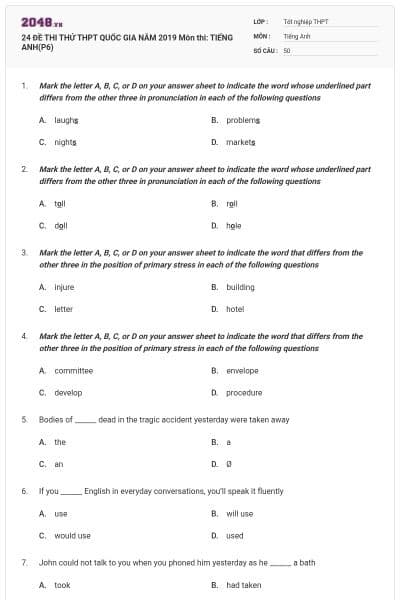
Mark the letter A, B, C, or D on your answer sheet to indicate the word whose underlined part differs from the other three in pronunciation in each of the following questions
laughs
problems
nights
markets
Chọn B
Kiến thức: Phát âm “s”
Giải thích:
Cách phát âm đuôi “s”:
+ Đuôi “s” được phát âm là /s/ khi động từ có phát âm kết thúc là /t/,/k/,/p/,/f/,/θ/
+ Đuôi “s” được phát âm là /iz/ khi động từ có phát âm kết thúc là /ʃ/,/s/,/tʃ/,/z/,/dʒ/,/ʒ/
+ Đuôi “s” được phát âm là /z/ với các trường hợp còn lại
A. laughs /lɑːfs/
B. problems /ˈprɒbləmz/
C. nights /naɪts/
D. markets /ˈmɑːkɪts/
Phần gạch chân đáp án B phát âm là /z/, còn lại là /s/.
Mark the letter A, B, C, or D on your answer sheet to indicate the word whose underlined part differs from the other three in pronunciation in each of the following questions
toll
roll
doll
hole
Chọn C
Kiến thức: Phát âm “o”
Giải thích:
A. toll /təʊl/
B. roll /rəʊl/
C. doll /dɒl/
D. hole /həʊl/
Phần gạch chân đáp án C phát âm là /ɒ/, còn lại là /əʊ/.
Mark the letter A, B, C, or D on your answer sheet to indicate the word that differs from the other three in the position of primary stress in each of the following questions
injure
building
letter
hotel
Chọn D
Kiến thức: Trọng âm từ có 2 âm tiết
Giải thích:
A. injure /ˈɪndʒə(r)/
B. building /ˈbɪldɪŋ/
C. letter /ˈletə(r)/
D. hotel /həʊˈtel/
Trọng âm đáp án D vào âm tiết thứ hai, còn lại vào âm tiết thứ nhất
Mark the letter A, B, C, or D on your answer sheet to indicate the word that differs from the other three in the position of primary stress in each of the following questions
committee
envelope
develop
procedure
Chọn B
Kiến thức: Trọng âm từ có 3 âm tiết
Giải thích:
A. committee /kəˈmɪti/
B. envelope /ˈenvələʊp/
C. develop /dɪˈveləp/
D. procedure /prəˈsiːdʒə(r)/
Trọng âm đáp án B vào âm tiết thứ nhất, còn lại vào âm tiết thứ hai
Bodies of ______ dead in the tragic accident yesterday were taken away
the
a
an
Ø
Đáp án: A
Giải thích:
Kiến thức: Mạo từ
Quy tắc: the + adj = danh từ tập họp chỉ một nhóm người => danh từ số nhiều
dead (adj): chết => the dead (n): những người chết
Dịch: Xác của những người chết trong vụ tai nạn thảm khốc ngày hôm qua đã được đem đi.
If you ______ English in everyday conversations, you’ll speak it fluently
use
will use
would use
used
Chọn A
Kiến thức: Câu điều kiện loại 1
Giải thích:
Câu điều kiện loại 1 diễn tả 1 điều kiện có thể xảy ra ở hiện tại hoặc tương lai.
Cấu trúc: If + S + V(s,es), S + will/ can/ may + V-inf (nguyên thể)
Tạm dịch: Nếu bạn sử dụng tiếng Anh trong các cuộc giao tiếp hàng ngày, bạn sẽ nói nó trôi chảy
John could not talk to you when you phoned him yesterday as he ______ a bath
took
had taken
was taking
would take
Chọn C
Kiến thức: Quá khứ tiếp diễn
Giải thích:
Thì quá khứ tiếp diễn diễn tả 1 hành động đang xảy ra tại 1 thời điểm trong quá khứ.
Dấu hiệu nhận biết: could not talk – phoned
Cấu trúc: S + was/ were + V-ing
Tạm dịch: John không thể nói chuyện với bạn khi bạn gọi anh ta ngày hôm qua bởi vì lúc đó anh ta đang tắm
Her eyes are red and puffy ______ she has been crying a lot
although
since
because of
despite
Chọn B
Kiến thức: Liên từ
Giải thích:
A. although + mệnh đề: mặc dù B. since + mệnh đề: bởi vì
C. because of + cụm danh từ/ V-ing: bởi vì D. despite + cụm danh từ/ V-ing: mặc dù
Tạm dịch: Mắt cô ấy đỏ và sưng húp lên vì cô ấy đã khóc quá nhiều
Jonas worked really hard throughout the term, so it was not merely ______ chance that he got straight A’s
off
from
by
in
Chọn C
Kiến thức: Giới từ
Giải thích: by chance = without planning to: tình cờ, không có dự định làm gì
Tạm dịch: Jonas đã học rất chăm chỉ trong suốt kì học, vì vậy chẳng có gì là tình cờ mà anh ta đã đạt kết quả tốt trong các bài thi
_______ toward shore, its shape is changed by its collision with the shallow sea bottom
During a wave rolls
As a wave rolls
A wave rolls
A wave’s rolling
Chọn B
Kiến thức: Mệnh đề thời gian
Giải thích: As + S + V: khi mà
Tạm dịch: Khi con sóng xô vào bờ, hình dạng của nó bị thay đổi bởi sự va chạm với đáy biển nông
_______ with the size of the whole earth, the highest mountain does not seem high at all
When compared
On comparing
Having compared
To compare
Đáp án: A
Giải thích:
Rút gọn mệnh đề đồng chủ ngữ dạng bị động, dùng VpII.
Dịch: Khi so sánh với kích thước của toàn bộ Trái Đất, những ngọn núi cao nhất dường như không cao chút nào.
Most teachers tend to detest ______ during classes
interrupting
being interrupted
to interrupt
to be interrupted
Chọn B
Kiến thức: V-ing/ to V
Giải thích:
Cấu trúc chủ động: detest + V-ing: ghét cái gì
Cấu trúc bị động: detest + being + P2: ghét bị cái gì
Tạm dịch: Hầu hết các thầy cô đều có xu hướng ghét việc bị ngắt lời trong giờ học
Although Ariel arrived ______, we made her welcome just the same as everyone else
expect
unexpectedly
unexpected
expectation
Chọn B
Sau động từ “arrive” ta cần 1 trạng từ chỉ thể cách để bổ nghĩa.
A. expect (v): mong đợi
B. unexpectedly (adv): 1 cách bất ngờ, bất thình lình
C. unexpected (adj): bất ngờ
D. expectation (n): sự mong đợi
Tạm dịch: Mặc dù Ariel đã đến bất ngờ, chúng tôi vẫn chào đón cô ấy giống như những người khác
Please ______ the milk carefully; I don’t want it to boil over
look at
notice
watch
examine
Chọn C
Kiến thức: Từ vựng
Giải thích:
A. look at (v): nhìn vào
B. notice (v): để ý
C. watch (v): trông coi, nhìn cái gì đó (trong 1 khoảng thời gian)
D. examine (v): kiểm tra
Tạm dịch: Làm ơn trông chừng sữa cẩn thận; tôi không muốn nó bị sôi trào ra ngoài
These days, housework has been made much easier by electrical ______.
machinery
appliances
instruments
equipment
Chọn B
Kiến thức: Từ vựng
Giải thích:
A. machinery (n): máy móc (nói chung) (danh từ không đếm được)
B. appliances (n): thiết bị (phục vụ cụ thể cho một mục đích sử dụng nào đó)
C. instruments (n): dụng cụ, nhạc cụ
D. equipment (n): những thứ cần cho một hành động, mục đích cụ thể nào đó (danh từ không đếm được)
electrical appliances: điện gia dụng
Tạm dịch: Hiện tại, việc nhà đã được làm dễ dàng hơn bởi các thiết bị điện
The island where these rare birds nest has been declared a(n) ______ where poaching is prohibited
observation
reservation
preservation
conservation
Chọn B
Kiến thức: Từ vựng
Giải thích:
A. observation (n): sự quan sát
B. reservation (n): khu bảo tồn (danh từ đếm được)
C. preservation (n): sự gìn giữ, bảo tồn (danh từ không đếm được)
D. conservation (n): sự bảo tồn, duy trì (danh từ không đếm được)
Câu có mạo từ “a(n)” nên cần điền một danh từ đếm được dạng số ít
Tạm dịch: Hòn đảo nơi những con chim quý hiếm này làm tổ, đã được tuyên bố là một khu bảo tồn nơi mà hành động săn trộm bị cấm
The play is quite suitable for children to see as there is nothing ______ in it
exceptional
excessive
exceptionable
offended
Chọn C
Kiến thức: Từ vựng
Giải thích:
A. exceptional (adj): khác thường, ngoại lệ
B. excessive (adj): quá mức, thừa
C. exceptionable (adj): gây khó chịu, xúc phạm
D. offended (adj): cảm thấy bị xúc phạm
Tạm dịch: Vở kịch thì khá phù hợp cho trẻ em xem bởi vì chẳng có gì gây khó chịu trong đó
______ drugs are highly addictive and can have unpredictable side effects
Designer
Maker
Composer
Mixer
Chọn A
Kiến thức: Từ vựng
Giải thích:
A. Designer (n): nhà thiết kế B. Maker (n): người chế tạo
C. Composer (n): nhà sáng tác D. Mixer (n): máy trộn
=> designer drug: thuốc nhân tạo, không tự nhiên, có thể gây nghiện và thường bất hợp pháp
Tạm dịch: Thuốc tổng hợp gây nghiện thường có tính gây nghiện cao và có thể có những tác dụng phụ không lường trước được
Mark the letter A, B, C, or D on your answer sheet to indicate the word(s) CLOSEST in meaning to the underlined word(s) in each of the following questions
Cows with newly born calves often show a strong urge to protect their helpless young
desire
reaction
thought
decision
Chọn A
Kiến thức: Từ đồng nghĩa
Giải thích:
urge (n): sự thôi thúc mạnh mẽ
A. desire (n): tham vọng
B. reaction (n): phản ứng
C. thought (n): suy nghĩ
D. decision (n): quyết định
=> urge = desire
Tạm dịch: Những con bò có con non mới sinh thường thể hiện sự thôi thúc mạnh mẽ phải bảo vệ đứa con bé bỏng yếu đuối của chúng
All visitors are told to watch out for pickpockets in public places
take care of
look for
pay attention to
beware of
Chọn D
Kiến thức: Từ đồng nghĩa
Giải thích:
watch out for somebody/ something: coi chừng/ cẩn thận
A. take care of: quan tâm, chăm sóc
B. look for: tìm kiếm
C. pay attention to: chú ý vào cái gì
D. beware of: cảnh giác với
=> watch out for = beware of
Tạm dịch: Tất cả du khách được khuyến cáo phải canh chừng bọn móc túi ở nơi công cộng
Mark the letter A, B, C, or D on your answer sheet to indicate the OPPOSITE in meaning to the underlined word(s) in each of the following questions
Various programs have been designed in order to facilitate the storage and analysis of research data
ease
hinder
speed
destroy
Chọn B
Kiến thức: Từ trái nghĩa
Giải thích:
facilitate (v): làm cho dễ dàng, thuận tiện
A. ease (v): làm giảm, làm dễ dàng
B. hinder (v): gây trở ngại
C. speed (v): đẩy nhanh tốc độ
D. destroy (v): phá hủy
=> facilitate >< hinder
Tạm dịch: Các chương trình đa dạng được thiết kế để làm thuận tiện việc lưu trữ và phân tích dữ liệu
It seems that the deal was made behind closed doors as no one had any clue about it
secretly
daily
transparently
frankly
Chọn C
Kiến thức: Từ trái nghĩa
Giải thích:
behind closed doors: kín, không công khai
A. secretly (adv): riêng tư
B. daily (adv): hàng ngày
C. transparently (adv): không che giấu gì
D. frankly (adv): thành thực mà nói
=> behind closed doors >< transparently
Tạm dịch: Dường như là thỏa thuận đã được tạo ra một cách bí mật bởi vì không ai có bất kỳ manh mối gì về nó
Mike and Laura are talking about their plan for the weekend.
- Mike: “I promise to go shopping with you if you help me with the housework.”
- Laura: “______ You are the last person to keep a promise.”
Come off it!
That’s great!
How come?
I hate to differ
Chọn A
Kiến thức: Ngôn ngữ giao tiếp
Giải thích:
Mike và Laura đang nói chuyện về kế hoạch của họ cho cuối tuần.
- Mike: “Tớ hứa sẽ đi mua sắm với cậu nếu cậu giúp tớ việc nhà.”
- Laura: “______ Cậu là có lẽ là người cuối cùng giữ lời hứa đấy. ”
A. Thôi đi cậu !
B. Thật tuyệt!
C. Tại sao? D. Tớ ghét không đồng ý.
Các phản hồi B, C, D không phù hợp với ngữ cảnh
Laura and Mitchell are talking about their class monitor, Susie.
- Laura: "You know, Susie’s father is very rich."
- Mitchell: "______ She wouldn’t accept his help even if it were offered."
What for?
No wonder
So what?
No doubt
Chọn C
Kiến thức: Ngôn ngữ giao tiếp
Giải thích:
Laura và Mitchell đang nói về lớp trưởng của họ, Susie
- Laura: “Cậu biết đấy, bố của Susie rất giàu có.”
- Mitchell: “____ Cô ấy sẽ không chấp nhận sự giúp đỡ của bố mình kể cả khi ông ấy đề nghị.”
A. Để làm gì?
B. Chả trách.
C. Vậy thì sao nào?
D. Không nghi ngờ gì.
Các phản hồi A, B, D không phù hợp với ngữ cảnh
Read the following passage and mark the letter Ay B, C, or D on your answer sheet to indicate the correct word or phrase that best fits each of the numbered blanks from 25 to 29.
Why do some people take revenge on others? Why aren’t we able to sort out our problems without seeking to get (25)______ with those who have hurt us? Apparently, we are (26)______ experiencing a deeply rooted part of human nature. Our desire for revenge comes from the brain’s limbic system, the most primitive part of the brain and one that we share with all animals. (27)______, when someone confronts us, we often prefer attacking verbally or physically rather than try to work out a solution together.
However, unlike animals, we also possess a highly evolved cerebral cortex which allows us to plan and analyse – and this can make revenge more than just a(n) (28) ______ reaction. A person who feels they have been wronged may even enjoy planning a creative and appropriate act of revenge. Some people suggest that taking revenge can be seen as a positive move, allowing you to work through your negative emotions. However, it can also be dangerous, and you may risk finding yourself in a situation (29)______ rapidly gets out of hand
Điền ô 25
equal
even
similar
fair
Chọn B
Kiến thức: Thành ngữ
Giải thích:
A. equal (adj): bình đẳng
B. even (adj): cân bằng, công bằng
C. similar (adj): giống nhau
D. fair (adj): công bằng, không gian lận
=> get/ be even (with somebody): trả thù, trả đũa ai
Why aren’t we able to sort out our problems without seeking to get (25) even with those who have hurt us?
Tạm dịch: Tại sao chúng ta không thể giải quyết vấn đề của chính mình mà không tìm cách trả đũa người làm tổn thương chúng ta?
Read the following passage and mark the letter Ay B, C, or D on your answer sheet to indicate the correct word or phrase that best fits each of the numbered blanks from 25 to 29.
Why do some people take revenge on others? Why aren’t we able to sort out our problems without seeking to get (25)______ with those who have hurt us? Apparently, we are (26)______ experiencing a deeply rooted part of human nature. Our desire for revenge comes from the brain’s limbic system, the most primitive part of the brain and one that we share with all animals. (27)______, when someone confronts us, we often prefer attacking verbally or physically rather than try to work out a solution together.
However, unlike animals, we also possess a highly evolved cerebral cortex which allows us to plan and analyse – and this can make revenge more than just a(n) (28) ______ reaction. A person who feels they have been wronged may even enjoy planning a creative and appropriate act of revenge. Some people suggest that taking revenge can be seen as a positive move, allowing you to work through your negative emotions. However, it can also be dangerous, and you may risk finding yourself in a situation (29)______ rapidly gets out of hand
Điền ô 26
simply
simple
simplicity
simplify
Chọn A
Kiến thức: Từ loại
Giải thích:
A. simply (adv): 1 cách dễ dàng, chỉ là
B. simple (adj): đơn giản, dễ dàng
C. simplicity (n): sự dễ dàng, đơn giản
D. simplify (v): đơn giản hóa, làm đơn giản
Cần điền trạng từ vào giữa “are – experiencing”
Apparently, we are (26) simply experiencing a deeply rooted part of human nature.
Tạm dịch: Rõ ràng là chúng ta chỉ đang trải nghiệm một phần gốc rễ sâu xa của bản chất con người
Read the following passage and mark the letter Ay B, C, or D on your answer sheet to indicate the correct word or phrase that best fits each of the numbered blanks from 25 to 29.
Why do some people take revenge on others? Why aren’t we able to sort out our problems without seeking to get (25)______ with those who have hurt us? Apparently, we are (26)______ experiencing a deeply rooted part of human nature. Our desire for revenge comes from the brain’s limbic system, the most primitive part of the brain and one that we share with all animals. (27)______, when someone confronts us, we often prefer attacking verbally or physically rather than try to work out a solution together.
However, unlike animals, we also possess a highly evolved cerebral cortex which allows us to plan and analyse – and this can make revenge more than just a(n) (28) ______ reaction. A person who feels they have been wronged may even enjoy planning a creative and appropriate act of revenge. Some people suggest that taking revenge can be seen as a positive move, allowing you to work through your negative emotions. However, it can also be dangerous, and you may risk finding yourself in a situation (29)______ rapidly gets out of hand
Điền ô 27
However
Thus
Additionally
Subsequently
Chọn B
Kiến thức: Liên từ
Giải thích:
A. However: tuy nhiên (chỉ sự đối lập)
B. Thus: do đó (chỉ kết quả)
C. Additionally: thêm vào đó, ngoài ra (thêm thông tin)
D. Subsequently: rồi thì, rồi sau đó (chỉ kết quả)
Our desire for revenge comes from the brain’s limbic system, the most primitive part of the brain and one that we share with all animals. (27) Thus, when someone confronts us, we often prefer attacking verbally or physically rather than try to work out a solution together.
Tạm dịch: Mong muốn trả thù của chúng ta đến từ hệ limbic (hệ viền) của bộ não, phần nguyên thủy nhất của bộ não và là bộ phận mà chúng ta và các loài động vật cùng sở hữu. Do đó, khi một ai đó đối đầu với chúng ta, chúng ta thường thích tấn công bằng lời nói hoặc động chân tay hơn là cố gắng tìm ra một giải pháp cùng nhau
Read the following passage and mark the letter Ay B, C, or D on your answer sheet to indicate the correct word or phrase that best fits each of the numbered blanks from 25 to 29.
Why do some people take revenge on others? Why aren’t we able to sort out our problems without seeking to get (25)______ with those who have hurt us? Apparently, we are (26)______ experiencing a deeply rooted part of human nature. Our desire for revenge comes from the brain’s limbic system, the most primitive part of the brain and one that we share with all animals. (27)______, when someone confronts us, we often prefer attacking verbally or physically rather than try to work out a solution together.
However, unlike animals, we also possess a highly evolved cerebral cortex which allows us to plan and analyse – and this can make revenge more than just a(n) (28) ______ reaction. A person who feels they have been wronged may even enjoy planning a creative and appropriate act of revenge. Some people suggest that taking revenge can be seen as a positive move, allowing you to work through your negative emotions. However, it can also be dangerous, and you may risk finding yourself in a situation (29)______ rapidly gets out of hand
Điền ô 28
distinctive
instinctive
extrinsic
inborn
Chọn B
Kiến thức: Từ vựng
Giải thích:
A. distinctive (adj): đặc biệt (phân biệt với cái khác)
B. instinctive (adj): thuộc về bản năng
C. extrinsic (adj): nằm ngoài, không phải bản chất
D. inborn (adj): bẩm sinh
and this can make revenge more than just a(n) (28) instinctive reaction.
Tạm dịch: và điều này có thể làm cho sự trả thù không chỉ còn là một phản ứng bản năng
Read the following passage and mark the letter Ay B, C, or D on your answer sheet to indicate the correct word or phrase that best fits each of the numbered blanks from 25 to 29.
Why do some people take revenge on others? Why aren’t we able to sort out our problems without seeking to get (25)______ with those who have hurt us? Apparently, we are (26)______ experiencing a deeply rooted part of human nature. Our desire for revenge comes from the brain’s limbic system, the most primitive part of the brain and one that we share with all animals. (27)______, when someone confronts us, we often prefer attacking verbally or physically rather than try to work out a solution together.
However, unlike animals, we also possess a highly evolved cerebral cortex which allows us to plan and analyse – and this can make revenge more than just a(n) (28) ______ reaction. A person who feels they have been wronged may even enjoy planning a creative and appropriate act of revenge. Some people suggest that taking revenge can be seen as a positive move, allowing you to work through your negative emotions. However, it can also be dangerous, and you may risk finding yourself in a situation (29)______ rapidly gets out of hand
Điền ô 29
who
where
when
which
Chọn D
Kiến thức: Mệnh đề quan hệ
Giải thích:
Trong mệnh đề quan hệ:
A. who: thay cho danh từ chỉ người; đóng vai trò chủ ngữ/ tân ngữ
B. where: thay cho trạng từ chỉ địa điểm; where + S + V
C. when: thay cho trạng từ chỉ thời gian; when + S + V
D. which: thay cho danh từ chỉ vật; đóng vai trò chủ ngữ/ tân ngữ
situation (n): tình huống => danh từ chỉ vật => dùng “which”
However, it can also be dangerous, and you may risk finding yourself in a situation (29) which rapidly gets out of hand.
Tạm dịch: Tuy nhiên, nó cũng có thể nguy hiểm, và bạn có thể mạo hiểm tìm thấy chính mình trong một tình huống đang nhanh chóng mất kiểm soát.
Dịch bài đọc:
Tại sao một vài người lại trả thù người khác? Tại sao chúng ta không thể giải quyết vấn đề của chính mình mà không tìm cách trả đũa người làm tổn thương chúng ta? Rõ ràng là chúng ta chỉ đang trải nghiệm một phần gốc rễ sâu xa của bản chất con người. Mong muốn trả thù của chúng ta đến từ hệ limbic (hệ viền) của bộ não, phần nguyên thủy nhất của bộ não và là bộ phận mà chúng ta và các loài động vật cùng sở hữu. Do đó, khi một ai đó đối đầu với chúng ta, chúng ta thường thích tấn công bằng lời nói hoặc động chân tay hơn là cố gắng tìm ra một giải pháp cùng nhau.
Tuy nhiên, không giống như động vật, chúng ta sở hữu một vỏ não phát triển bậc cao cái mà cho phép chúng ta lên kế hoạch và phân tích - và điều này có thể làm cho sự trả thù không chỉ còn là một phản ứng bản năng. Một người cảm thấy họ đã sai lầm thậm chí có thể thích thú với việc lên kế hoạch cho một hành động trả thù thích hợp và sáng tạo. Một vài người cho rằng trả thù có thể coi là một động thái tích cực, cho phép bạn vượt qua những cảm xúc tiêu cực của bản thân. Tuy nhiên, nó cũng có thể nguy hiểm, và bạn có thể mạo hiểm tìm thấy chính mình trong một tình huống đang nhanh chóng mất kiểm soát
Read the following passage and mark the letter A, B, C, or D on your answer sheet to indicate the correct answer to each of the questions from 30 to 34.
A leading question among anthropologists is: what exactly led to the development of human cities? Basically, modern humans have existed on earth for over 100,000 years. Yet it is only in the last 8,000 years that they have begun to gather in significant numbers and form cities. Prior to that period, humans existed in small family or tribal groups, generally consisting of fewer than 100 individuals. What, then, led humans to make the dramatic shift from living in small groups to living in large, organized cities? It seems that the development of cities required a particular set of circumstances.
First, it required a minimum population density. For much of their early history, humans existed only in small numbers. This is due to the fact that early humans relied on hunting and gathering wild foods for their survival. Even the most fertile land would only support a relatively small number of predators, so it was not until humans began to practice agriculture that they were able to gather in large enough numbers to form cities.
Furthermore, the development of a city could only be possible if a large number of people shared a common language, culture and religion. Without such unifying factors, a cooperative, peaceful existence among large numbers of people would have been impossible.
Finally, it seems that early humans needed to be faced with a large problem, which one small group of individuals could not solve on its own. Only when large-scale cooperation was needed to overcome a problem would humans come together to form cities
What is the passage mainly about?
Factors bringing about the development of human cities
How population density affects the development of human cities
Why a shared language makes a peaceful human city
Problems solved by cooperation of a large group
Chọn A
Kiến thức: Đọc hiểu
Giải thích:
Bài đọc chủ yếu nói về điều gì?
A. Những yếu tố mang lại sự phát triển của các thành phố của con người
B. Sự phân bố dày đặc dân cư ảnh hưởng như thế nào đến sự phát triển của các thành phố của con người
C. Tại sao một ngôn ngữ được chia sẻ tạo ra một thành phố con người yên bình
D. Các vấn đề được giải quyết bằng sự hợp tác của một nhóm lớn
Read the following passage and mark the letter A, B, C, or D on your answer sheet to indicate the correct answer to each of the questions from 30 to 34.
A leading question among anthropologists is: what exactly led to the development of human cities? Basically, modern humans have existed on earth for over 100,000 years. Yet it is only in the last 8,000 years that they have begun to gather in significant numbers and form cities. Prior to that period, humans existed in small family or tribal groups, generally consisting of fewer than 100 individuals. What, then, led humans to make the dramatic shift from living in small groups to living in large, organized cities? It seems that the development of cities required a particular set of circumstances.
First, it required a minimum population density. For much of their early history, humans existed only in small numbers. This is due to the fact that early humans relied on hunting and gathering wild foods for their survival. Even the most fertile land would only support a relatively small number of predators, so it was not until humans began to practice agriculture that they were able to gather in large enough numbers to form cities.
Furthermore, the development of a city could only be possible if a large number of people shared a common language, culture and religion. Without such unifying factors, a cooperative, peaceful existence among large numbers of people would have been impossible.
Finally, it seems that early humans needed to be faced with a large problem, which one small group of individuals could not solve on its own. Only when large-scale cooperation was needed to overcome a problem would humans come together to form cities
The word "circumstances" in paragraph 1 mostly means ______.
conditions
preparations
examples
events
Chọn A
Kiến thức: Đọc hiểu
Giải thích:
Từ “circumstances” trong đoạn 1 có nghĩa là?
A. conditions (n): hoàn cảnh
B. preparations (n): sự chuẩn bị
C. examples (n): ví dụ
D. events (n): sự kiện
Thông tin: It seems that the development of cities required a particular set of circumstances.
Tạm dịch: Dường như sự phát triển của các thành phố đòi hỏi một chuỗi cụ thể những hoàn cảnh
Read the following passage and mark the letter A, B, C, or D on your answer sheet to indicate the correct answer to each of the questions from 30 to 34.
A leading question among anthropologists is: what exactly led to the development of human cities? Basically, modern humans have existed on earth for over 100,000 years. Yet it is only in the last 8,000 years that they have begun to gather in significant numbers and form cities. Prior to that period, humans existed in small family or tribal groups, generally consisting of fewer than 100 individuals. What, then, led humans to make the dramatic shift from living in small groups to living in large, organized cities? It seems that the development of cities required a particular set of circumstances.
First, it required a minimum population density. For much of their early history, humans existed only in small numbers. This is due to the fact that early humans relied on hunting and gathering wild foods for their survival. Even the most fertile land would only support a relatively small number of predators, so it was not until humans began to practice agriculture that they were able to gather in large enough numbers to form cities.
Furthermore, the development of a city could only be possible if a large number of people shared a common language, culture and religion. Without such unifying factors, a cooperative, peaceful existence among large numbers of people would have been impossible.
Finally, it seems that early humans needed to be faced with a large problem, which one small group of individuals could not solve on its own. Only when large-scale cooperation was needed to overcome a problem would humans come together to form cities
The word "they" in paragraph 2 refers to ______.
predators
humans
cities
foods
Chọn B
Từ “they” trong đoạn 2 nói tới?
A. predators (n): những kẻ săn mồi
B. humans (n): con người
C. cities (n): thành phố
D. foods (n): thực phẩm
Thông tin: Even the most fertile land would only support a relatively small number of predators, so it was not until humans began to practice agriculture that they were able to gather in large enough numbers to form cities.
Tạm dịch: Ngay cả vùng đất màu mỡ nhất cũng chỉ hỗ trợ cho một số lượng động vật ăn thịt tương đối nhỏ, vì vậy mãi đến khi con người bắt đầu canh tác nông nghiệp thì họ mới có thể tập trung số lượng đủ lớn để tạo nên những thành phố
Read the following passage and mark the letter A, B, C, or D on your answer sheet to indicate the correct answer to each of the questions from 30 to 34.
A leading question among anthropologists is: what exactly led to the development of human cities? Basically, modern humans have existed on earth for over 100,000 years. Yet it is only in the last 8,000 years that they have begun to gather in significant numbers and form cities. Prior to that period, humans existed in small family or tribal groups, generally consisting of fewer than 100 individuals. What, then, led humans to make the dramatic shift from living in small groups to living in large, organized cities? It seems that the development of cities required a particular set of circumstances.
First, it required a minimum population density. For much of their early history, humans existed only in small numbers. This is due to the fact that early humans relied on hunting and gathering wild foods for their survival. Even the most fertile land would only support a relatively small number of predators, so it was not until humans began to practice agriculture that they were able to gather in large enough numbers to form cities.
Furthermore, the development of a city could only be possible if a large number of people shared a common language, culture and religion. Without such unifying factors, a cooperative, peaceful existence among large numbers of people would have been impossible.
Finally, it seems that early humans needed to be faced with a large problem, which one small group of individuals could not solve on its own. Only when large-scale cooperation was needed to overcome a problem would humans come together to form cities
Which of the following enabled people to live together in peace?
A large area of fertile land
A shared belief and value
A large and complicated problem
A group with a minimal number of members
Chọn B
Kiến thức: Đọc hiểu
Giải thích:
Cái nào trong những đáp án dưới đây cho phép con người sống cùng nhau trong hòa bình?
A. Một khu vực đất đai màu mỡ rộng lớn B. Một giá trị và niềm tin được chia sẻ
C. Một vấn đề lớn và phức tạp D. Một nhóm với số lượng tối thiểu thành viên
Thông tin: Furthermore, the development of a city could only be possible if a large number of people shared a common language, culture and religion. Without such unifying factors, a cooperative, peaceful existence among large numbers of people would have been impossible.
Tạm dịch: Hơn thế nữa, sự phát triển của một thành phố chỉ có thể xảy ra nếu một lượng lớn cư dân có chung một ngôn ngữ, văn hóa và tôn giáo. Nếu không có các yếu tố thống nhất như vậy, một tập thể, việc cùng chung sống hòa bình giữa những lượng lớn cư dân là không thể
Read the following passage and mark the letter A, B, C, or D on your answer sheet to indicate the correct answer to each of the questions from 30 to 34.
A leading question among anthropologists is: what exactly led to the development of human cities? Basically, modern humans have existed on earth for over 100,000 years. Yet it is only in the last 8,000 years that they have begun to gather in significant numbers and form cities. Prior to that period, humans existed in small family or tribal groups, generally consisting of fewer than 100 individuals. What, then, led humans to make the dramatic shift from living in small groups to living in large, organized cities? It seems that the development of cities required a particular set of circumstances.
First, it required a minimum population density. For much of their early history, humans existed only in small numbers. This is due to the fact that early humans relied on hunting and gathering wild foods for their survival. Even the most fertile land would only support a relatively small number of predators, so it was not until humans began to practice agriculture that they were able to gather in large enough numbers to form cities.
Furthermore, the development of a city could only be possible if a large number of people shared a common language, culture and religion. Without such unifying factors, a cooperative, peaceful existence among large numbers of people would have been impossible.
Finally, it seems that early humans needed to be faced with a large problem, which one small group of individuals could not solve on its own. Only when large-scale cooperation was needed to overcome a problem would humans come together to form cities
Which of the following is NOT needed for the development of a city?
a shared culture
people’s gathering
peaceful existence
large-scale collaboration
Chọn C
Kiến thức: Đọc hiểu
Giải thích:
Cái nào sau đây không cần thiết cho sự phát triển của thành phố?
A. Một nền văn hóa chung
B. Việc tập trung của con người
C. Việc cùng chung sống hòa bình
D. Sự hợp tác quy mô lớn
Thông tin: Furthermore, the development of a city could only be possible if a large number of people shared a common language, culture and religion. Without such unifying factors, a cooperative, peaceful existence among large numbers of people would have been impossible.
Only when large-scale cooperation was needed to overcome a problem would humans come together to form cities.
Tạm dịch: Hơn thế nữa, sự phát triển của một thành phố chỉ có thể xảy ra nếu một lượng lớn cư dân có chung một ngôn ngữ, văn hóa và tôn giáo. Nếu không có các yếu tố thống nhất như vậy, một tập thể, việc cùng chung sống hòa bình giữa những lượng lớn cư dân là không thể.
Chỉ khi cần phải hợp tác quy mô lớn để vượt qua vấn đề thì con người mới tập trung lại để tạo dựng những thành phố.
Dịch bài đọc:
Một câu hỏi hàng đầu giữa các nhà nhân chủng học là: chính xác điều gì dẫn đến sự phát triển của các thành phố của con người? Về cơ bản, con người hiện tại đã tồn tại trên trái đất hơn 100,000 năm. Tuy nhiên chỉ trong 8,000 năm đã qua thì họ mới bắt đầu tập trung với số lượng đáng kể và tạo dựng các thành phố. Trước thời kỳ này, con người tồn tại trong những gia đình nhỏ hoặc các nhóm bộ tộc, thường bao gồm ít hơn 100 cá nhân. Vậy điều gì, sau đó, dẫn dắt con người tạo ra sự thay đổi mạnh mẽ từ việc sống trong các nhóm nhỏ sang sống trong các thành phố lớn, có tổ chức? Dường như sự phát triển của các thành phố đòi hỏi một chuỗi cụ thể những hoàn cảnh.
Lúc đầu, nó đòi hỏi một mật độ dân số tối thiểu. Trong phần lớn lịch sử ban đầu của con người, con người chỉ tồn tại với các nhóm số lượng nhỏ. Điều này do thực tế con người thời kì đầu phụ thuộc vào việc săn bắn và hái lượm thức ăn hoang dã để sống sót. Ngay cả vùng đất màu mỡ nhất cũng chỉ hỗ trợ cho một số lượng động vật ăn thịt tương đối nhỏ, vì vậy mãi đến khi con người bắt đầu canh tác nông nghiệp thì họ mới có thể tập trung số lượng đủ lớn để tạo nên những thành phố.
Hơn thế nữa, sự phát triển của một thành phố chỉ có thể xảy ra nếu một lượng lớn cư dân có chung một ngôn ngữ, văn hóa và tôn giáo. Nếu không có các yếu tố thống nhất như vậy, một tập thể, việc cùng chung sống hòa bình giữa những lượng lớn cư dân là không thể.
Cuối cùng, dường như con người cần phải đối mặt với một vấn đề lớn hơn, cái mà một nhóm nhỏ cá nhân không thể tự giải quyết. Chỉ khi cần phải hợp tác quy mô lớn để vượt qua vấn đề thì con người mới tập trung lại để tạo dựng những thành phố
Read the following passage and mark the letter A, B, C, or D on your answer sheet to indicate the correct answer to each of the questions from 35 to 42.
Nature has always provided a stimulus for inventive minds. Early flying machines clearly were an attempt to emulate the freedom of birds. Architects and engineers have often consciously modeled buildings on forms found in nature. A more recent example of the inspiration given by nature is the invention of Velcro®. The inventor of this now common fastening device noticed that small burrs attached to his dog's coat grasped the hairs by means of tiny hooks. This led him to invent a synthetic fabric whose surfaces mimic the clasping properties of this natural seedpod.
Animals and plants have evolved solutions to the kinds of problems that often interest engineers and designers. Much current research in material science is concerned with actively examining the natural world, especially at the molecular level, for inspiration to develop materials with novel properties. This relatively new field of study is sometimes known as biomimetics, since it consciously attempts to mimic nature.
Researchers have investigated several interesting areas. For example, they have studied how the molecular structure of antler bone contributes to its amazing toughness, how the skin structure of a worm contributes to its ability to crawl, how the sea cucumber softens its skeleton and changes shape so that it can squeeze through tiny gaps in rocks, or what gives wood its high resistance to impact. These investigations have led to several breakthroughs in the development of composite materials with remarkable properties.
Predictions for future inventions that may be developed from these lines of research include so-called smart structures that design and repair themselves in a similar way to a variety of processes in the natural world. For example, engineers have envisaged bridges that would detect areas heavily stressed by vehicle movement or wind. The bridge structure would then automatically add or move material to the weak areas until the stress is reduced. The same principle might be used to repair damaged buildings. Other new materials that have been imagined are substances that would copy photosynthesis in green plants in order to create new energy sources. The potential impact of biomimetic research is so great that the twenty-first century may come to be known as the "Age of Materials."
The passage is primarily concerned with ______.
future research into the uses of Velcro
the effect of the Age of Materials on nature
the development of products based on nature
problems that preoccupy designers and engineers
Chọn C
Kiến thức: Đọc hiểu
Giải thích:
Bài đọc chủ yếu nói về .
A. nghiên cứ tương lai về việc sử dụng Velcro®
B. ảnh hưởng của thời đại vật liệu lên thiên nhiên
C. sự phát triển của các sản phẩm dựa trên thiên nhiên
D. những vấn đề khiến các nhà thiết kế và kĩ sư bận tâm
Read the following passage and mark the letter A, B, C, or D on your answer sheet to indicate the correct answer to each of the questions from 35 to 42.
Nature has always provided a stimulus for inventive minds. Early flying machines clearly were an attempt to emulate the freedom of birds. Architects and engineers have often consciously modeled buildings on forms found in nature. A more recent example of the inspiration given by nature is the invention of Velcro®. The inventor of this now common fastening device noticed that small burrs attached to his dog's coat grasped the hairs by means of tiny hooks. This led him to invent a synthetic fabric whose surfaces mimic the clasping properties of this natural seedpod.
Animals and plants have evolved solutions to the kinds of problems that often interest engineers and designers. Much current research in material science is concerned with actively examining the natural world, especially at the molecular level, for inspiration to develop materials with novel properties. This relatively new field of study is sometimes known as biomimetics, since it consciously attempts to mimic nature.
Researchers have investigated several interesting areas. For example, they have studied how the molecular structure of antler bone contributes to its amazing toughness, how the skin structure of a worm contributes to its ability to crawl, how the sea cucumber softens its skeleton and changes shape so that it can squeeze through tiny gaps in rocks, or what gives wood its high resistance to impact. These investigations have led to several breakthroughs in the development of composite materials with remarkable properties.
Predictions for future inventions that may be developed from these lines of research include so-called smart structures that design and repair themselves in a similar way to a variety of processes in the natural world. For example, engineers have envisaged bridges that would detect areas heavily stressed by vehicle movement or wind. The bridge structure would then automatically add or move material to the weak areas until the stress is reduced. The same principle might be used to repair damaged buildings. Other new materials that have been imagined are substances that would copy photosynthesis in green plants in order to create new energy sources. The potential impact of biomimetic research is so great that the twenty-first century may come to be known as the "Age of Materials."
The word “emulate” in paragraph 1 is closest in meaning to ______.
stimulate
captivate
imitate
activate
Chọn C
Kiến thức: Đọc hiểu
Giải thích:
Từ “emulate” trong đoạn 1 gần nghĩa với .
A. stimulate (v): kích thích, khuyến khích
B. captivate (v): quyến rũ
C. imitate (v): bắt chước
D. activate (v): kích hoạt
Thông tin: Early flying machines clearly were an attempt to emulate the freedom of birds.
Tạm dịch: Những cỗ máy có khả năng bay thời kỳ đầu rõ ràng là một nỗ lực để mô phỏng sự tự do của loài chim
Read the following passage and mark the letter A, B, C, or D on your answer sheet to indicate the correct answer to each of the questions from 35 to 42.
Nature has always provided a stimulus for inventive minds. Early flying machines clearly were an attempt to emulate the freedom of birds. Architects and engineers have often consciously modeled buildings on forms found in nature. A more recent example of the inspiration given by nature is the invention of Velcro®. The inventor of this now common fastening device noticed that small burrs attached to his dog's coat grasped the hairs by means of tiny hooks. This led him to invent a synthetic fabric whose surfaces mimic the clasping properties of this natural seedpod.
Animals and plants have evolved solutions to the kinds of problems that often interest engineers and designers. Much current research in material science is concerned with actively examining the natural world, especially at the molecular level, for inspiration to develop materials with novel properties. This relatively new field of study is sometimes known as biomimetics, since it consciously attempts to mimic nature.
Researchers have investigated several interesting areas. For example, they have studied how the molecular structure of antler bone contributes to its amazing toughness, how the skin structure of a worm contributes to its ability to crawl, how the sea cucumber softens its skeleton and changes shape so that it can squeeze through tiny gaps in rocks, or what gives wood its high resistance to impact. These investigations have led to several breakthroughs in the development of composite materials with remarkable properties.
Predictions for future inventions that may be developed from these lines of research include so-called smart structures that design and repair themselves in a similar way to a variety of processes in the natural world. For example, engineers have envisaged bridges that would detect areas heavily stressed by vehicle movement or wind. The bridge structure would then automatically add or move material to the weak areas until the stress is reduced. The same principle might be used to repair damaged buildings. Other new materials that have been imagined are substances that would copy photosynthesis in green plants in order to create new energy sources. The potential impact of biomimetic research is so great that the twenty-first century may come to be known as the "Age of Materials."
Which of the following is true about Velcro?
It was first used to remove dog hair from the owner’s coat
It exemplifies how a natural structure inspired a useful invention
The inventor of Velcro® was very famous before his invention
It has set a trend for tiny hooklike structures in synthetic fabric
Chọn B
Kiến thức: Đọc hiểu
Giải thích:
Câu nào sau đây nói đúng về Velcro®?
A. Nó lúc đầu được dùng để dùng để loại bỏ lông chó khỏi áo khoác của chủ sở hữu.
B. Nó minh họa một cấu trúc tự nhiên truyền cảm hứng cho một phát minh hữu dụng.
C. Nhà phát minh của Velcro® đã rất nổi tiếng trước cả khi có phát minh của anh ta.
D. Nó có một bộ các cấu trúc giống như các móc nhỏ trong vải tổng hợp
Thông tin: A more recent example of the inspiration given by nature is the invention of Velcro®.
Tạm dịch: Một ví dụ gần đây hơn về cảm hứng được tạo ra bởi thiên nhiên là phát minh của Velcro®.
Read the following passage and mark the letter A, B, C, or D on your answer sheet to indicate the correct answer to each of the questions from 35 to 42.
Nature has always provided a stimulus for inventive minds. Early flying machines clearly were an attempt to emulate the freedom of birds. Architects and engineers have often consciously modeled buildings on forms found in nature. A more recent example of the inspiration given by nature is the invention of Velcro®. The inventor of this now common fastening device noticed that small burrs attached to his dog's coat grasped the hairs by means of tiny hooks. This led him to invent a synthetic fabric whose surfaces mimic the clasping properties of this natural seedpod.
Animals and plants have evolved solutions to the kinds of problems that often interest engineers and designers. Much current research in material science is concerned with actively examining the natural world, especially at the molecular level, for inspiration to develop materials with novel properties. This relatively new field of study is sometimes known as biomimetics, since it consciously attempts to mimic nature.
Researchers have investigated several interesting areas. For example, they have studied how the molecular structure of antler bone contributes to its amazing toughness, how the skin structure of a worm contributes to its ability to crawl, how the sea cucumber softens its skeleton and changes shape so that it can squeeze through tiny gaps in rocks, or what gives wood its high resistance to impact. These investigations have led to several breakthroughs in the development of composite materials with remarkable properties.
Predictions for future inventions that may be developed from these lines of research include so-called smart structures that design and repair themselves in a similar way to a variety of processes in the natural world. For example, engineers have envisaged bridges that would detect areas heavily stressed by vehicle movement or wind. The bridge structure would then automatically add or move material to the weak areas until the stress is reduced. The same principle might be used to repair damaged buildings. Other new materials that have been imagined are substances that would copy photosynthesis in green plants in order to create new energy sources. The potential impact of biomimetic research is so great that the twenty-first century may come to be known as the "Age of Materials."
The word “novel” in paragraph 2 is closest in meaning to ______.
unique
familiar
fictitious
legendary
Chọn A
Kiến thức: Đọc hiểu
Giải thích:
Từ “novel” trong đoạn 2 gần nghĩa với?
A. unique (adj): độc đáo
B. familiar (adj): quen thuộc
C. fictitious (adj): hư cấu, giả tưởng
D. legendary (adj): mang tính huyền thoại, thần kì
Thông tin: Much current research in material science is concerned with actively examining the natural world, especially at the molecular level, for inspiration to develop materials with novel properties.
Tạm dịch: Nhiều nghiên cứu hiện tại trong khoa học vật liệu thì đang tích cực nghiên cứu thế giới tự nhiên, đặc biệt là ở cấp độ phân tử, để lấy cảm hứng phát triển những vật liệu có tính chất mới lạ
Read the following passage and mark the letter A, B, C, or D on your answer sheet to indicate the correct answer to each of the questions from 35 to 42.
Nature has always provided a stimulus for inventive minds. Early flying machines clearly were an attempt to emulate the freedom of birds. Architects and engineers have often consciously modeled buildings on forms found in nature. A more recent example of the inspiration given by nature is the invention of Velcro®. The inventor of this now common fastening device noticed that small burrs attached to his dog's coat grasped the hairs by means of tiny hooks. This led him to invent a synthetic fabric whose surfaces mimic the clasping properties of this natural seedpod.
Animals and plants have evolved solutions to the kinds of problems that often interest engineers and designers. Much current research in material science is concerned with actively examining the natural world, especially at the molecular level, for inspiration to develop materials with novel properties. This relatively new field of study is sometimes known as biomimetics, since it consciously attempts to mimic nature.
Researchers have investigated several interesting areas. For example, they have studied how the molecular structure of antler bone contributes to its amazing toughness, how the skin structure of a worm contributes to its ability to crawl, how the sea cucumber softens its skeleton and changes shape so that it can squeeze through tiny gaps in rocks, or what gives wood its high resistance to impact. These investigations have led to several breakthroughs in the development of composite materials with remarkable properties.
Predictions for future inventions that may be developed from these lines of research include so-called smart structures that design and repair themselves in a similar way to a variety of processes in the natural world. For example, engineers have envisaged bridges that would detect areas heavily stressed by vehicle movement or wind. The bridge structure would then automatically add or move material to the weak areas until the stress is reduced. The same principle might be used to repair damaged buildings. Other new materials that have been imagined are substances that would copy photosynthesis in green plants in order to create new energy sources. The potential impact of biomimetic research is so great that the twenty-first century may come to be known as the "Age of Materials."
Which of the following does the word “it” in paragraph 3 refer to?
sea cucumber
skeleton
shape
worm
Chọn A
Kiến thức: Đọc hiểu
Giải thích:
Từ “it” ở đoạn 3 đề cập đến từ nào sau đây?
A. hải sâm
B. bộ xương
C. hình dạng
D. con sâu
Thông tin: For example, they have studied how the molecular structure of antler bone contributes to its amazing toughness, how the skin structure of a worm contributes to its ability to crawl, how the sea cucumber softens its skeleton and changes shape so that it can squeeze through tiny gaps in rocks, or what gives wood its high resistance to impact.
Tạm dịch: Ví dụ, họ đã nghiên cứu làm thế nào mà cấu trúc phân tử của xương gạc nai góp phần vào sự dẻo dai đáng kinh ngạc của nó, hay làm thế nào mà cấu trúc da của một con sâu góp phần vào khả năng bò của nó, hoặc làm thế nào mà hải sâm làm mềm bộ xương của mình và thay đổi hình dạng để mà nó có thể ép mình đi qua những khoảng trống nhỏ trong đá, hoặc cái gì đem đến cho gỗ khả năng chịu đựng va đập cao
Read the following passage and mark the letter A, B, C, or D on your answer sheet to indicate the correct answer to each of the questions from 35 to 42.
Nature has always provided a stimulus for inventive minds. Early flying machines clearly were an attempt to emulate the freedom of birds. Architects and engineers have often consciously modeled buildings on forms found in nature. A more recent example of the inspiration given by nature is the invention of Velcro®. The inventor of this now common fastening device noticed that small burrs attached to his dog's coat grasped the hairs by means of tiny hooks. This led him to invent a synthetic fabric whose surfaces mimic the clasping properties of this natural seedpod.
Animals and plants have evolved solutions to the kinds of problems that often interest engineers and designers. Much current research in material science is concerned with actively examining the natural world, especially at the molecular level, for inspiration to develop materials with novel properties. This relatively new field of study is sometimes known as biomimetics, since it consciously attempts to mimic nature.
Researchers have investigated several interesting areas. For example, they have studied how the molecular structure of antler bone contributes to its amazing toughness, how the skin structure of a worm contributes to its ability to crawl, how the sea cucumber softens its skeleton and changes shape so that it can squeeze through tiny gaps in rocks, or what gives wood its high resistance to impact. These investigations have led to several breakthroughs in the development of composite materials with remarkable properties.
Predictions for future inventions that may be developed from these lines of research include so-called smart structures that design and repair themselves in a similar way to a variety of processes in the natural world. For example, engineers have envisaged bridges that would detect areas heavily stressed by vehicle movement or wind. The bridge structure would then automatically add or move material to the weak areas until the stress is reduced. The same principle might be used to repair damaged buildings. Other new materials that have been imagined are substances that would copy photosynthesis in green plants in order to create new energy sources. The potential impact of biomimetic research is so great that the twenty-first century may come to be known as the "Age of Materials."
According to the passage, what do investigations in biomimetics suggest?
Biomimetics is not promising
Biomimetics may lead to the development of new creatures
Biomimetics may lead to useful inventions
Biomimetics has provided the new material for smart structures
Chọn C
Kiến thức: Đọc hiểu
Giải thích:
Theo như đoạn văn, những nghiên cứu trong mô phỏng sinh học đưa ra điều gì?
A. Mô phỏng sinh học thì không mấy hứa hẹn.
B. Mô phỏng sinh học có thể dẫn đến sự phát triển những sinh vật mới
C. Mô phỏng sinh học có thể dẫn đến những phát minh hữu dụng.
D. Mô phỏng sinh học đã cung cấp vật liệu mới cho các cấu trúc thông minh.
Thông tin: The potential impact of biomimetic research is so great that the twenty-first century may come to be known as the "Age of Materials".
Tạm dịch: Ảnh hưởng tiềm năng của nghiên cứu mô phỏng sinh học thì lớn đến nỗi thế kỷ hai mươi mốt có thể được biết đến như là “Thời đại vật liệu”
Read the following passage and mark the letter A, B, C, or D on your answer sheet to indicate the correct answer to each of the questions from 35 to 42.
Nature has always provided a stimulus for inventive minds. Early flying machines clearly were an attempt to emulate the freedom of birds. Architects and engineers have often consciously modeled buildings on forms found in nature. A more recent example of the inspiration given by nature is the invention of Velcro®. The inventor of this now common fastening device noticed that small burrs attached to his dog's coat grasped the hairs by means of tiny hooks. This led him to invent a synthetic fabric whose surfaces mimic the clasping properties of this natural seedpod.
Animals and plants have evolved solutions to the kinds of problems that often interest engineers and designers. Much current research in material science is concerned with actively examining the natural world, especially at the molecular level, for inspiration to develop materials with novel properties. This relatively new field of study is sometimes known as biomimetics, since it consciously attempts to mimic nature.
Researchers have investigated several interesting areas. For example, they have studied how the molecular structure of antler bone contributes to its amazing toughness, how the skin structure of a worm contributes to its ability to crawl, how the sea cucumber softens its skeleton and changes shape so that it can squeeze through tiny gaps in rocks, or what gives wood its high resistance to impact. These investigations have led to several breakthroughs in the development of composite materials with remarkable properties.
Predictions for future inventions that may be developed from these lines of research include so-called smart structures that design and repair themselves in a similar way to a variety of processes in the natural world. For example, engineers have envisaged bridges that would detect areas heavily stressed by vehicle movement or wind. The bridge structure would then automatically add or move material to the weak areas until the stress is reduced. The same principle might be used to repair damaged buildings. Other new materials that have been imagined are substances that would copy photosynthesis in green plants in order to create new energy sources. The potential impact of biomimetic research is so great that the twenty-first century may come to be known as the "Age of Materials."
According to the passage, which of the following would NOT be a useful biomimetic product?
Tomatoes mimicking the structures that give sea cucumbers the ability to squeeze through cracks
Bulletproof jackets mimicking the structures that give wood its resistance to impact
Glass in windshields mimicking the structures that give antler bone its toughness
Cables mimicking the structures that give spiderwebs their flexibility and tensile strength
Chọn A
Kiến thức: Đọc hiểu
Giải thích:
Theo đoạn văn thì câu nào sau đây không là một sản phẩm mô phỏng sinh học hữu dụng?
A. Cà chua bắt chước cấu trúc cái mà đem đến cho hải sâm khả năng ép mình qua những khe hở.
B. Áo chống đạn bắt chước cấu trúc cái mà đem đến cho gỗ khả năng chịu đựng va đập.
C. Kính ở tấm chắn gió bắt chước cấu trúc cái mà đem đến cho xương gạc nai sự dẻo dai.
D. Dây cáp bắt chước cấu trúc cái mà đem đến cho mạng nhện độ bền và tính linh hoạt dẻo dai.
Read the following passage and mark the letter A, B, C, or D on your answer sheet to indicate the correct answer to each of the questions from 35 to 42.
Nature has always provided a stimulus for inventive minds. Early flying machines clearly were an attempt to emulate the freedom of birds. Architects and engineers have often consciously modeled buildings on forms found in nature. A more recent example of the inspiration given by nature is the invention of Velcro®. The inventor of this now common fastening device noticed that small burrs attached to his dog's coat grasped the hairs by means of tiny hooks. This led him to invent a synthetic fabric whose surfaces mimic the clasping properties of this natural seedpod.
Animals and plants have evolved solutions to the kinds of problems that often interest engineers and designers. Much current research in material science is concerned with actively examining the natural world, especially at the molecular level, for inspiration to develop materials with novel properties. This relatively new field of study is sometimes known as biomimetics, since it consciously attempts to mimic nature.
Researchers have investigated several interesting areas. For example, they have studied how the molecular structure of antler bone contributes to its amazing toughness, how the skin structure of a worm contributes to its ability to crawl, how the sea cucumber softens its skeleton and changes shape so that it can squeeze through tiny gaps in rocks, or what gives wood its high resistance to impact. These investigations have led to several breakthroughs in the development of composite materials with remarkable properties.
Predictions for future inventions that may be developed from these lines of research include so-called smart structures that design and repair themselves in a similar way to a variety of processes in the natural world. For example, engineers have envisaged bridges that would detect areas heavily stressed by vehicle movement or wind. The bridge structure would then automatically add or move material to the weak areas until the stress is reduced. The same principle might be used to repair damaged buildings. Other new materials that have been imagined are substances that would copy photosynthesis in green plants in order to create new energy sources. The potential impact of biomimetic research is so great that the twenty-first century may come to be known as the "Age of Materials."
As inferred from the passage, what would be the advantage of a product that mimics photosynthesis?
It could be used to create green plants
It could help to meet future energy needs
It could be an aid in repairing green areas
It could form the basis of twenty-first century materials
Chọn B
Kiến thức: Đọc hiểu
Giải thích:
Như đã đề cập từ đoạn văn, cái gì là lợi ích của sản phẩm mô phỏng sự quang hợp?
A. Nó có thể được sử dụng để tạo ra cây xanh.
B. Nó có thể giúp đáp ứng được nhu cầu năng lượng trong tương lai.
C. Nó có thể là một sự hỗ trợ trong việc tu sửa các không gian xanh.
D. Nó có thể tạo nên nền móng cơ bản của các loại vật liệu thế kỷ hai mươi mốt.
Thông tin: Other new materials that have been imagined are substances that would copy photosynthesis in green plants in order to create new energy sources.
Tạm dịch: Các vật liệu mới khác đã được tưởng tượng là các chất liệu sao chép sự quang hợp trong cây xanh để tạo ra những nguồn năng lượng mới.
Dịch bài đọc:
Thiên nhiên luôn cung cấp kích thích cho trí óc sáng tạo của con người. Những cỗ máy có khả năng bay thời kỳ đầu rõ ràng là một nỗ lực để mô phỏng sự tự do của loài chim. Các kiến trúc sư và kỹ sư thường chủ tâm tạo ra các tòa nhà có hình mẫu từ các hình thái được tìm thấy trong tự nhiên. Một ví dụ gần đây hơn về cảm hứng được tạo ra bởi thiên nhiên là phát minh của Velcro®. Nhà phát minh của thiết bị cài chặt phổ biến này đã nhận thấy rằng các gờ nhỏ gắn vào cái áo cho con chó của anh ta đã mắc vào lông nó bằng những cái móc rất nhỏ. Điều này dẫn dắt anh ta phát minh ra một loại vải tổng hợp mà bề mặt của nó bắt chước những đặc tính bám, móc của vỏ quả đậu ngoài tự nhiên.
Động vật và thực vật đã phát triển các giải pháp đối với nhiều loại vấn đề mà thường hấp dẫn các kĩ sư và các nhà thiết kế. Nhiều nghiên cứu hiện tại trong khoa học vật liệu thì đang tích cực nghiên cứu thế giới tự nhiên, đặc biệt là ở cấp độ phân tử, để lấy cảm hứng phát triển những vật liệu có tính chất mới lạ. Cái lĩnh vực nghiên cứu tương đối mới này thì thỉnh thoảng được biết đến như là mô phỏng sinh học, bởi vì nó cố gắng mô phỏng tự nhiên có ý thức.
Các nhà nghiên cứu đã nghiên cứu một vài mảng thú vị. Ví dụ, họ đã nghiên cứu làm thế nào mà cấu trúc phân tử của xương gạc nai góp phần vào sự dẻo dai đáng kinh ngạc của nó, hay làm thế nào mà cấu trúc da của một con sâu góp phần vào khả năng bò của nó, hoặc làm thế nào mà hải sâm làm mềm bộ xương của mình và thay đổi hình dạng để mà nó có thể ép mình đi qua những khoảng trống nhỏ trong đá, hoặc cái gì đem đến cho gỗ khả năng chịu đựng va đập cao. Những nghiên cứu này đã dẫn đến những bước đột phá trong sự phát triển của các vật liệu kết hợp với những tính chất vượt trội.
Những phỏng đoán về các phát minh trong tương lai cái mà có thể được phát triển từ những bước nghiên cứu này bao gồm cái gọi là các cấu trúc thông minh – cấu trúc tự thiết kế và sửa chữa theo cách giống như các quá trình trong thế giới tự nhiên. Ví dụ, các kỹ sư đã dự tính những cây cầu mà sẽ phát hiện ra các khu vực bị áp lực nặng do sự di chuyển của phương tiện hoặc gió. Cấu trúc của cầu sẽ ngay lập tức thêm hoặc di chuyển chất liệu đến những khu vực yếu cho đến khi áp lực giảm xuống. Cùng nguyên lý như vậy có thể được sử dụng để sửa chữa các tòa nhà bị hư hại. Các vật liệu mới khác đã được tưởng tượng là các chất liệu sao chép sự quang hợp trong cây xanh để tạo ra những nguồn năng lượng mới. Ảnh hưởng tiềm năng của nghiên cứu mô phỏng sinh học thì lớn đến nỗi thế kỷ hai mươi mốt có thể được biết đến như là “Thời đại vật liệu”.
Playing video games may distract often students from schoolwork.
Playing
games
distract often
schoolwork
Chọn B
Kiến thức: Vị trí của trạng từ chỉ tần suất
Giải thích:
Trạng từ chỉ tần suất (often) luôn đứng giữa trợ động từ (may) và động từ thường (distract)
Sửa: distract often => often distract
Tạm dịch: Việc chơi điện tử có thể thường gây xao nhãng học sinh khỏi việc học ở trường
A scientific principle has a life expectancy of approximately a decade before it drastically revised or replaced by newer information
expectancy
approximately
drastically revised
newer
Chọn C
Kiến thức: Câu bị động
Giải thích:
Dùng cấu trúc bị động với thì hiện tại đơn: S + am/ is/ are + P2
Sửa: drastically revised => is drastically revised
Tạm dịch: Một nguyên lý khoa học có tuổi thọ xấp xỉ một thập kỷ trước khi nó được sửa đổi mạnh mẽ hoặc bị thay thế bằng thông tin mới hơn
At first John was quite bewildered when taking over the factory but he soon ensured himself that things would go well soon
quite bewildered
taking over
ensured himself
would go well
Chọn C
Kiến thức: Sự kết hợp từ
Giải thích:
ensure somebody something: bảo đảm với ai về cái gì
ensure that S + V: bảo đảm rằng
Sửa: ensured himself => ensured
Tạm dịch: Lúc đầu John khá hoang mang khi tiếp quản nhà máy nhưng anh ta sớm đảm bảo rằng mọi thứ sẽ diễn ra tốt đẹp sớm thôi
Janet speaks English better than Daisy
Janet does not speak English as well as Daisy
Daisy speaks English better than Janet
Janet is a better speaker of English than Daisy
Daisy and Janet are not so good at speaking English
Chọn C
Kiến thức: Câu so sánh
Giải thích: speak English better = a better speaker of English
Tạm dịch: Janet nói tiếng Anh tốt hơn Daisy.
A. Janet không nói tiếng Anh tốt bằng Daisy. => sai ngữ nghĩa
B. Daisy nói tiếng Anh tốt hơn Janet. => sai ngữ nghĩa
C. Janet là một người nói tiếng Anh tốt hơn Daisy.
D. Daisy và Janet thì không giỏi nói tiếng Anh. => sai ngữ nghĩa
"I would be grateful if you did the work" he said to me
He politely asked me to do the work
He praised me because I did the work
He thanked me for doing the work
He felt thankful to me because I did the work
Đáp án: A
Giải thích:
Dịch: “Tôi sẽ rất biết ơn nếu anh làm việc đó,” anh ấy nói với tôi.
Dùng câu điều kiện loại 2 để đưa ra lời đề nghị một cách lịch sự.
Xét các đáp án:
A. Anh ấy lịch sự yêu cầu tôi làm việc.
B. Anh ấy khen tôi vì tôi đã làm việc.
C. Anh ấy cảm ơn tôi vì đã làm việc.
D. Anh ấy cảm thấy biết ơn tôi vì tôi đã làm việc.
Đáp án A phù hợp nhất về nghĩa.
It wasn't obligatory to submit my assignment today
I must have submitted my assignment today
I needn't have submitted my assignment today
I could have submitted my assignmenttoday
I shouldn’t have submitted my assignment today
Chọn B
Kiến thức: Động từ khuyết thiếu
Giải thích:
must have P2: chắc hẳn đã needn’t have P2: đáng lẽ ra không cần
could have P2: có thể đã làm gì shouldn’t have P2: đáng lẽ ra không nên
Tạm dịch: Thật ra là đã không bắt buộc để nộp bài tập của tôi hôm nay.
A. Tôi chắc hẳn đã nộp bài tập của tôi hôm nay. => sai ngữ nghĩa
B. Tôi đáng lẽ ra không cần nộp bài tập của tôi hôm nay.
C. Tôi có thể đã nộp bài tập của tôi hôm nay. => sai ngữ nghĩa
D. Tôi đáng lẽ ra không nên nộp bài tập của tôi hôm nay. => sai ngữ nghĩa
The boss scolded Laura for that minor mistake. He now feels really bad about it
The boss wishes he did not scold Laurafor that minor mistake
The boss wishes Laura had not made that minor mistake
If only the boss had not scolded Laura for that minor mistake
The boss regretted to scold Laurafor that minor mistake
Chọn C
Kiến thức: Câu ước
Giải thích:
Câu ước với “wish” thể hiện ý muốn trái với quá khứ:
S + wish(es) + S + had + P2 = If only S + had + P2: giá mà
regret + to V: hối tiếc vì phải làm gì (ở hiện tại hoặc tương lai)
Tạm dịch: Ông chủ đã mắng Laura vì một lỗi rất nhỏ. Ông ấy bây giờ cảm thấy thật tệ về việc đó.
A. sai ngữ pháp: did not scold => had not scolded
B. Ông chủ ước Laura đã không mắc lỗi nhỏ đó. => sai ngữ nghĩa
C. Giá mà ông chủ đã không mắng Laura vì lỗi nhỏ đó.
D. Ông chủ đã hối tiếc vì phải mắng Laura vì lỗi nhỏ đó. => sai ngữ nghĩa
Olga was about to say something about the end of the movie. He was stopped by his friends right then
Hardly had Olga intended to say something about the end of the movie before he was stopped by his friends
Only after Olgahad said something about the end of the movie was he stopped by his friends
Were it not for Olga’s intension of saying something about the end of the movie, he would not be stopped by his friends
It was not until Olga was stopped by his friends that he started to say something about the end of the movie
Chọn A
Kiến thức: Câu đảo ngữ
Giải thích:
Hardly + trợ động từ + S + V before + S + Ved/ V2: ngay khi ... thì...
Only after + cụm N/ V-ing/ clause + trợ động từ + S + V: chỉ sau khi
Đảo ngữ với câu điều kiện loại 2: Were it not for + cụm N, S + would/ could/ might + V-inf: nếu không phải vì
It was not until + clause + that S + V: mãi cho đến khi
Tạm dịch: Olga đã định nói gì đó về kết thúc của bộ phim. Anh ấy bị bạn bè chặn lại ngay lúc đó.
A. Olga định nói gì đó về kết thúc của bộ phim ngay trước khi anh ấy bị bạn bè chặn lại.
B. Chỉ sau khi Olga đã nói gì đó về kết thúc của bộ phim thì anh ta mới bị bạn bè chặn lại. => sai ngữ nghĩa
C. sai ngữ pháp: câu điều kiện loại 2 => loại 3
D. Mãi cho đến khi Olga bị chặn lại bởi bạn bè thì anh ta mới bắt đầu nói gì đó về kết thúc của bộ phim.
=> sai ngữ nghĩa