24 ĐỀ THI THỬ THPT QUỐC GIA NĂM 2019 Môn thi: TIẾNG ANH(P20)
50 câu hỏi
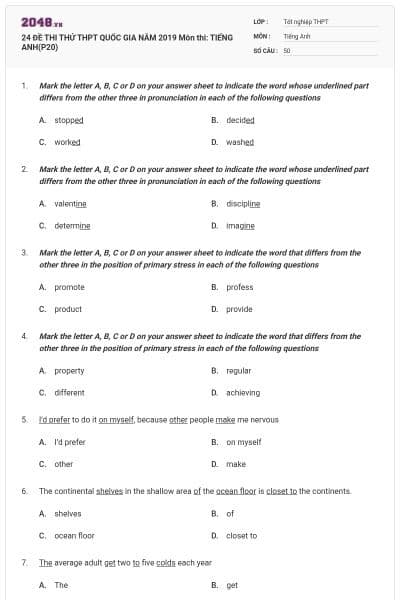
Mark the letter A, B, C or D on your answer sheet to indicate the word whose underlined part differs from the other three in pronunciation in each of the following questions
stopped
decided
worked
washed
Chọn B
Kiến thức: Phát âm '-ed'
Giải thích:
Cách phát âm đuôi “ed”:
+ Đuôi “ed” được phát âm là /ɪd/ khi động từ có phát âm kết thúc là /t/ hay /d/
+ Đuôi “ed” được phát âm là /t/ khi động từ có phát âm kết thúc là /s/,/f/,/p/,/ʃ/,/tʃ/,/k/
+ Đuôi “ed” được phát âm là /d/ với các trường hợp còn lại.
A. stopped /stɒpt/
B. decided /dɪˈsaɪdɪd/
C. worked /wɜːkt/
D. washed /wɔ∫t/
Phần gạch chân đáp án B phát âm là /ɪd/, còn lại là /t/
Mark the letter A, B, C or D on your answer sheet to indicate the word whose underlined part differs from the other three in pronunciation in each of the following questions
valentine
discipline
determine
imagine
Chọn A
Kiến thức: Phát âm '-ine'
Giải thích:
A. valentine /ˈvæləntaɪn/
B. discipline /ˈdɪsəplɪn/
C. determine /dɪˈtɜːmɪn/
D. imagine /ɪˈmædʒɪn/
Phần gạch chân đáp án A phát âm là /aɪn/, còn lại là /ɪn/
Mark the letter A, B, C or D on your answer sheet to indicate the word that differs from the other three in the position of primary stress in each of the following questions
promote
profess
product
provide
Chọn C
Kiến thức: Trọng âm từ có 2 âm tiết
Giải thích:
A. promote /prəˈməʊt/
B. profess /prəˈfes/
C. product /ˈprɒdʌkt/
D. provide /prəˈvaɪd/
Câu C trọng âm rơi vào âm tiết 1, còn lại rơi vào âm tiết 2
Mark the letter A, B, C or D on your answer sheet to indicate the word that differs from the other three in the position of primary stress in each of the following questions
property
regular
different
achieving
Chọn D
Kiến thức: Trọng âm từ có 2, 3 âm tiết
Giải thích:
A. property /ˈprɒpəti/
B. regular /ˈreɡjələ/
C. different /ˈdɪfrənt/
D. achieving /əˈtʃiːv/
Câu D trọng âm rơi vào âm tiết 2, còn lại rơi vào âm tiết 1.
I’d prefer to do it on myself, because other people make me nervous
I’d prefer
on myself
other
make
Chọn B
Kiến thức: Giới từ
Giải thích:
by myself = on my own: tự làm
Sửa: on myself => by myself
Tạm dịch: Tôi thích tự làm nó, bởi vì người khác làm tôi lo lắng
The continental shelves in the shallow area of the ocean floor is closet to the continents.
shelves
of
ocean floor
closet to
Chọn A
Kiến thức: Sự hòa hợp giữa chủ ngữ và động từ
Giải thích:
Khi chủ ngữ là N1 + of + N2, ta phải chia động từ theo N1. Ở đây động từ chia là "is" nên N1 phải là danh từ số ít.
Sửa lại: shelves => shelf
Tạm dịch: Thềm lục địa ở khu vực nông của đáy đại dương là gần lục địa nhất
The average adult get two to five colds each year
The
get
to
colds
Chọn B
Kiến thức: Sự hòa hợp giữa chủ ngữ và động từ
Giải thích: Chủ ngữ "The average adult” là danh từ số ít nên động từ trong câu phải chia số ít. Sửa lại: get => gets
Tạm dịch: Người lớn trung bình bị cảm lạnh từ 2 đến 5 lần mỗi năm
Since our train leaves at 10.30, it is _______that everyone be at the station no later than 10.15
urgent
inescapable
desired
imperative
Chọn D
Kiến thức: Từ vựng
Giải thích:
A. urgent (a): gấp, khẩn cấp
B. inescapable (a): không thể tránh được
C. desired (a): yêu cầu, đề nghị
D. imperative (a): bắt buộc
Tạm dịch: Vì chuyến tàu của chúng tôi rời bến lúc 10.39, mọi người bắt buộc phải có mặt ở nhà ga trước 10.15
Insects and bugs ____________.
make my skin march
make my skin turn
make my skin crawl
make my skin walk
Chọn C
Kiến thức: Idiom
Giải thích: make my skin crawl: khiến tôi sởn gai ốc
Tạm dịch: Côn trùng và bọ khiến cho tôi sởn gai ốc
Mrs. Robinson _______ great pride in her cooking
has
finds
gets
takes
Chọn D
Kiến thức: Cách kết hợp từ
Giải thích: take pride in= be proud of: tự hào về
Tạm dịch: Bà Robinson rất tự hào về tài nấu ăn của mình
The fastest runner took the ___________ just five metres before the finishing line
advance
lead
place
head
Chọn B
Kiến thức: Cách kết hợp từ
Giải thích: take the lead: dẫn đầu, chỉ huy
Tạm dịch: Người chạy nhanh nhất dẫn đầu chỉ 5m trước vạch đích
The teacher as well as his students____________ at the school meeting yet
arrived
hasn’t arrived
haven’t arrived
not arriving
Chọn B
Kiến thức: Sự hòa hợp giữa chủ ngữ và động từ, thì hiện tại hoàn thành
Giải thích: + Khi chủ ngữ là "S1+ as well as + S2" => động từ chia theo S1 (The teacher). + Dấu hiệu nhận biết: yet => thì hiện tại hoàn thành Cấu trúc: S + have/has + Ved/P2
Tạm dịch: Giáo viên và học sinh của thầy ấy vẫn chưa đến buổi mít-tinh của trường
If I had been absent from class yesterday, I___ the math test
would miss
would have missed
will miss
miss
Chọn B
Kiến thức: Câu điều kiện
Giải thích: Câu điều kiện loại 3 diễn tả điều giả định trái ngược với quá khứ. Cấu trúc: If + S + had Ved/P2, S + would have Ved/P2
Tạm dịch: Nếu tôi vắng mặt buổi học hôm qua, tôi đã lỡ mất bài kiểm tra toán
Tennis fans _____ tickets have been queuing all night at Wimbledon
who are hoped to buy
whom hoped to buy
hoping to buy
hoped to buy
Chọn C
Kiến thức: Rút gọn mệnh đề quan hệ
Giải thích: Cách rút gọn mệnh đề quan hệ:
+ Dùng cụm V-ing nếu mệnh đề ở dạng chủ động + Dùng cụm Ved/P2 nếu mệnh đề ở dạng bị động
Câu đầy đủ: Tennis fans who hoped to buy tickets have been queuing all night at Wimbledon.
Tạm dịch: Fan quần vợt những người hi vọng mua được vé đang xếp hàng cả đêm ở Wimbledon
We’re free most of the weekend, but we’ve got a few bits and ______to do on Sunday morning
stuff
ends
things
pieces
Chọn D
Kiến thức: Idiom
Giải thích: bits and pieces: thứ/việc lặt vặt
Tạm dịch: Chúng tôi rảnh gần hết tuần, nhưng chúng tôi có vài việc lặt vặt phải làm vào sáng chủ nhật
Ann pretended ______ me as he passed me in the street
not seeing
not to seen
not see
not to see
Chọn D
Kiến thức: to V/ V-ing
Giải thích: pretend + to V: giả vờ làm gì pretend + not to V: giả vờ không làm gì
Tạm dịch: Ann giả vờ không thấy tôi khi anh ta đi ngang qua tôi trên đường
My daughter plays _____ piano very well
the
X
X
an
Chọn A
Kiến thức: Mạo từ
Giải thích: Khi nói chơi nhạc cụ, ta dùng mạo từ "the" trước tên nhạc cụ (the piano).
Tạm dịch: Con gái tôi chơi đàn piano rất giỏi
In this course, students receive _______ in the basic English grammar
instruct
instructional
instruction
instructive
Chọn C
Kiến thức: Từ loại
Giải thích:
A. instruct (v): chỉ dẫn
B. instructional (a): có tính chất hướng dẫn
C. instruction (n): hướng dẫn, chỉ dẫn
D. instructive (a): để dạy, để truyền kiến thức Sau động từ "receive" ta cần một danh từ làm tân ngữ.
Tạm dịch: Trong khóa học này, học sinh được hướng dẫn về ngữ pháp tiếng Anh cơ bản
In the early years of the 20th century, several rebellions broke_____in the northern parts of the country.
down
up
out
into
Chọn C
Giải thích:
break down: hỏng hóc break up: chia tay, giải tán
break out: bùng nổ break into: đột nhập
Tạm dịch: Trong những năm đầu thế kỉ 20, vài cuộc nổi dậy đã bùng nổ ở nhiều nơi ở phía bắc đất nước
I have just bought a television set _ _ in Japan
which made
in which made
who is made
made
Chọn D
Kiến thức: Rút gọn mệnh đề quan hệ
Giải thích:
Cách rút gọn mệnh đề quan hệ:
+ Dùng cụm V-ing nếu mệnh đề ở dạng chủ động
+ Dùng cụm Ved/P2 nếu mệnh đề ở dạng bị động
Câu đầy đủ: I have just bought a television set which was made in Japan.
Tạm dịch: Tôi vừa mới mua máy thu hình được sản xuất ở Nhật Bản
she got the salary last week, she has complained that she is out of money
Unless
Even though
In case
As
Chọn B
Kiến thức: Liên từ
Giải thích:
A. Unless: Trừ khi
B. Even though : Mặc dù
C. In case: Phòng khi
D. As : Bởi vì
Tạm dịch: Mặc dù cô ấy lấy lương tuần trước, cô ấy cứ kêu ca rằng mình hết tiền
Marcelo: "Reese, make us some tea, would you?" - Reese: "_____________."
Go on. Make yourself at home
No, I won't, I'm afraid
Sorry, I am not
I'm afraid I can't
Chọn D
Kiến thức: Ngôn ngữ giao tiếp
Giải thích:
Marcelo: “Reese, pha trà cho chúng tôi với, nhé?” - Reese: “________.”
A. Tiếp tục đi. Cứ tự nhiên như ở nhà nhé
B. Không, tôi không thể, tôi e rằng như thế
C. Xin lỗi, tôi không
D. Tôi e là tôi không thể pha được
Các phản hồi A, B, C không phù hợp với ngữ cảnh
Esme: "Do you have a minute?" - Kailyn: "_____________."
Well, that makes sense
Yes, but please be brief
That's just great. Thanks
Sorry, I left my watch home
Chọn B
Kiến thức: Ngôn ngữ giao tiếp
Giải thích:
Esme: “Bạn có rảnh chút nào không?” - Kailyn: “_________”
A. Ồ, nghe có lý đấy.
B. Có, nhưng làm ơn nói ngắn gọn nhé
C. Thật tuyệt vời. Cảm ơn nhé
D. Xin lỗi, tôi để quên đồng hồ ở nhà mất rồi
Các phản hồi A, C, D không phù hợp với ngữ cảnh.
Mark the letter A, B, C or D on your answer sheet to indicate the word(s) CLOSEST in meaning to the underlined word(s) in each of the following questions
Our team must develop a new strategy in order to deal with the serious problem
expand
grow
arise
invent
Chọn D
Kiến thức: Từ đồng nghĩa
Giải thích:
develop (v): nghĩa ra (ý tưởng mới)
A. expand (v): mở rộng
B. grow (v): phát triển, lớn lên
C. arise (v): xuất hiện
D. invent (v): tạo ra
=> develop = invent
Tạm dịch: Đội chúng tôi phải nghĩ ra chiến dịch mới để giải quyết vấn đề nghiêm trọng này.
Several hypotheses for global warming have been suggested by the scientists
supposition
study
research
truth
Chọn A
Kiến thức: Từ đồng nghĩa
Giải thích:
hypotheses (n): các giả thuyết
A. supposition (n): giả thuyết
B. study (n): nghiên cứu
C. research (n): nghiên cứu
D. truth (n): sự thật
=> hypotheses = supposition
Tạm dịch: Vài giả thuyết về sự nóng lên toàn cầu được các nhà khoa học đề xuất
Mark the letter A, B, C or D on your answer sheet to indicate the word(s) OPPOSITE in meaning to the underlined word(s) in each of the following questions
The band had an outstanding performance at the Grand Theatre last night
good
excellent
gentle
bad
Chọn D
Kiến thức: Từ trái nghĩa
Giải thích: outstanding (a): nổi bật, xuất sắc
A. good (a): tốt
B. excellent (a): tuyệt vời
C. gentle (a):nhẹ nhàng
D. bad (a); tệ, kém => outstanding >< bad
Tạm dịch: Ban nhạc đã có một buổi biểu diễn xuất sắc ở Grand Theatre tối qua
The writer was really hot under the collar when his novel was mistaken for another
angry
worried
calm
curious
Chọn C
Kiến thức: Từ trái nghĩa
Giải thích:
hot under the collar: tức giận về điều gì đó
A. angry (a): nổi giận
B. worried (a): lo lắng
C. calm (a): bình tĩnh
D. curious (a): tò mò, hiếu kì
=> hot under the collar >< calm
Tạm dịch: Tác giả thực sự rất tức giận khi tiểu thuyết của anh ấy bị nhẫm lẫn với người khác
Bill drives more carelessly than he used to
Bill doesn’t drive as carefully as he used to
Bill doesn’t more drive carefully than he used to
Bill doesn’t drive as carefully he used to
Bill doesn’t drive as carefully as he used
Chọn A
Kiến thức: So sánh bằng
Giải thích: Với động từ “be”: S1 + be (be not) + as + adj + as + S2 Với động từ thường: S1 + V (not V) + as + adv + as + S2
Tạm dịch: Bill lái xe bất cẩn hơn anh ấy đã từng.
= A. Bill không lái xe cẩn thận bằng anh ấy đã từng.
B. sai ngữ pháp: more drive carefully
C. sai ngữ pháp: as carefully
D. sai ngữ pháp: he used
“What were you doing last night, Mr John?” asked the police
The police asked what were you doing last night, Mr John
The police asked Mr John what he had been doing the night before
The police asked Mr John what he had been done the night beforev
The police asked Mr John what had he been done the night before
Đáp án: B
Giải thích:
Kiến thức: Câu gián tiếp
Câu gián tiếp với câu hỏi có từ hỏi:
S + asked/questioned/… + từ hỏi + S + V (lùi thì)
+ Biến đổi đại từ nhân xưng: you => he
+ Biến đổi thì: thì quá tiếp diễn => thì quá khứ hoàn thành tiếp diễn
+ Biến đổi trạng từ chỉ thời gian: last night => the night before/ the previous night
Dịch: “Anh đã làm gì tối qua, anh John?” cảnh sát hỏi.
= B. Cảnh sát hỏi John anh ta đã làm gì tối hôm trước.
A. sai vì đảo “were” lên trước chủ ngữ, cho biến đổi đại từ nhân xưng, chưa lùi thì, chưa biến đổi trạng từ chỉ thời gian
C. sai vì không đưa về dạng bị động
D. sai vì đảo trợ động từ lên trước chủ ngữ, không đưa về dạng bị động
It wasn’t necessary for you to do all this work
You mustn’t have done all this work
You couldn’t have done all this work.
You couldn’t have done all this work.
You needn’t have done all this work
Chọn D
Kiến thức: Động từ khuyết thiếu
Giải thích:
mustn’t have P2: chắc chắn đã không làm gì trong quá khứ
couldn’t V: không thể làm gì trong quá khứ
may not have P2: có lẽ đã không làm gì trong quá khứ
needn’t have P2: đáng lẽ không cần làm gì trong quá khứ
Tạm dịch: Bạn không cần thiết phải làm tất cả công việc này.
= D. Bạn đã không cần làm tất cả công việc này.
A. Bạn chắc chắn là đã không làm tất cả công việc này. => sai về nghĩa
B. Bạn không thể làm tất cả công việc này. => sai về nghĩa
C. Bạn có lẽ đã không làm tất cả công việc này. => sai về nghĩa
He started computer programming as soon as he left school
No sooner had he started computer programming than he left school
Hardly had he started computer programming when he left school
No sooner had he left school than he started computer programming
After he left school, he had started computer programming
Chọn C
Kiến thức: Cấu trúc thì quá khứ hoàn thành - quá khứ đơn
Giải thích: Công thức: Hardly/ Scarely + had + S + Ved/P2 + when + S + Ved/V2
= No sooner + had + S + Ved/P2 + than + S + Ved/V2: vừa mới… thì…
Tạm dịch: Anh ta bắt đầu học lập trình ngay khi rời khỏi trường học.
= C. Anh ta vừa rời khỏi trường học thì bắt đầu học lập trình.
A. Anh ta vừa mới bắt đầu học lập trình ngay khi rời khỏi trường học. => sai về nghĩa
B. Anh ta vừa mới bắt đầu học lập trình ngay khi rời khỏi trường học. => sai về nghĩa
D. sai ngữ pháp: left => had left, had started => started
Susan did not buy that villa. She now regrets it.
Susan wishes she had bought that villa
Susan regrets having bought that villa
If only Susan didn’t buy that villa
Susan wished she hadn’t bought that villa
Chọn A
Kiến thức: Câu ước loại 3
Giải thích:
Câu điều ước loại 3 là câu ước trái với sự thật trong quá khứ.
Cấu trúc: S wish + (that) + S had Ved/P2
Tạm dịch: Susan đã không mua ngôi biệt thự đó. Bây giờ cô ấy đang tiếc nó.
= A. Susan ước rằng cô ấy đã mua ngôi biệt thự đó.
B. Susan hối tiếc vì đã mua ngôi biệt thự đó. => sai về nghĩa
C. sai ngữ pháp: didn’t buy
D. Susan ước rằng cô ấy đã không mua ngôi biệt thự đó. => sai về nghĩa
Read the following passage and mark the letter A, B, C, or D on your answer sheet to indicate the correct word or phrase that best fits each of the numbered blanks from 33 to 37.
When you first arrive in a foreign culture, often your first reaction is completely positive. Everything seems exciting, different and fascinating. It’s an (33)______. If you are just on a short holiday, you will probably never leave this phase.
(34)_______, if you stay longer, your attitude can start to change. As you start to realize (35)_____ little you really understand the new culture, life can get frustrating. People misunderstand what you are trying to say, or they may laugh at you when you say something incorrectly. Even simple things, like posting a letter, can seem very difficult to you. Thus, you are likely to get angry or upset when things go wrong.
With time, though, you start to (36)______ to become more comfortable with the differences and better able to handle frustrating situations. Your (37)______ of humor reappears. Finally, you may feel enthusiastic about the culture once again, enjoy living in it, and even prefer certain aspects of the culture to your own.
(Adapted from Navigate – Coursebook, OUP 2015)
Điền ô 33
adventure
adventurous
adventurer
adventurously
Chọn A
Kiến thức: Từ loại
Giải thích:
A. adventure (n): cuộc phiêu lưu
B. adventurous (a): thích thám hiểm
C. adventurer (n): nhà thám hiểm
D. adventurously (adv): liều lĩnh, mạo hiểm
Sau mạo từ “an” ta cần một danh từ.
It’s an (33) adventure .
Tạm dịch: Cuộc đời là một cuộc phiêu lưu
Read the following passage and mark the letter A, B, C, or D on your answer sheet to indicate the correct word or phrase that best fits each of the numbered blanks from 33 to 37.
When you first arrive in a foreign culture, often your first reaction is completely positive. Everything seems exciting, different and fascinating. It’s an (33)______. If you are just on a short holiday, you will probably never leave this phase.
(34)_______, if you stay longer, your attitude can start to change. As you start to realize (35)_____ little you really understand the new culture, life can get frustrating. People misunderstand what you are trying to say, or they may laugh at you when you say something incorrectly. Even simple things, like posting a letter, can seem very difficult to you. Thus, you are likely to get angry or upset when things go wrong.
With time, though, you start to (36)______ to become more comfortable with the differences and better able to handle frustrating situations. Your (37)______ of humor reappears. Finally, you may feel enthusiastic about the culture once again, enjoy living in it, and even prefer certain aspects of the culture to your own.
(Adapted from Navigate – Coursebook, OUP 2015)
Điền ô 34
Therefore
Or
However
Nor
Chọn C
Kiến thức: Liên từ
Giải thích:
A. Therefore: do đó
B. Or: hoặc là
C. However: tuy nhiên
D. Nor: (không…) cũng không…
(34) However, if you stay longer, your attitude can start to change.
Tạm dịch: Tuy nhiên, nếu bạn ở lại lâu hơn, thái độ của bạn có thể sẽ bắt đầu thay đổi
Read the following passage and mark the letter A, B, C, or D on your answer sheet to indicate the correct word or phrase that best fits each of the numbered blanks from 33 to 37.
When you first arrive in a foreign culture, often your first reaction is completely positive. Everything seems exciting, different and fascinating. It’s an (33)______. If you are just on a short holiday, you will probably never leave this phase.
(34)_______, if you stay longer, your attitude can start to change. As you start to realize (35)_____ little you really understand the new culture, life can get frustrating. People misunderstand what you are trying to say, or they may laugh at you when you say something incorrectly. Even simple things, like posting a letter, can seem very difficult to you. Thus, you are likely to get angry or upset when things go wrong.
With time, though, you start to (36)______ to become more comfortable with the differences and better able to handle frustrating situations. Your (37)______ of humor reappears. Finally, you may feel enthusiastic about the culture once again, enjoy living in it, and even prefer certain aspects of the culture to your own.
(Adapted from Navigate – Coursebook, OUP 2015)
Điền ô 35
whether
how
if
what
Chọn B
Kiến thức: Liên từ, từ để hỏi
Giải thích:
A. whether…or…: liệu rằng…hay…
B. how: thế nào
C. if: nếu
D. what: cái gì
As you start to realize (35) how little you really understand the new culture, life can get frustrating.
Tạm dịch: Khi bạn bắt đầu nhận ra rằng bạn hiểu nền văn hóa mới ít ỏi như nào, cuộc sống của bạn có thể trở nên chán nản
Read the following passage and mark the letter A, B, C, or D on your answer sheet to indicate the correct word or phrase that best fits each of the numbered blanks from 33 to 37.
When you first arrive in a foreign culture, often your first reaction is completely positive. Everything seems exciting, different and fascinating. It’s an (33)______. If you are just on a short holiday, you will probably never leave this phase.
(34)_______, if you stay longer, your attitude can start to change. As you start to realize (35)_____ little you really understand the new culture, life can get frustrating. People misunderstand what you are trying to say, or they may laugh at you when you say something incorrectly. Even simple things, like posting a letter, can seem very difficult to you. Thus, you are likely to get angry or upset when things go wrong.
With time, though, you start to (36)______ to become more comfortable with the differences and better able to handle frustrating situations. Your (37)______ of humor reappears. Finally, you may feel enthusiastic about the culture once again, enjoy living in it, and even prefer certain aspects of the culture to your own.
(Adapted from Navigate – Coursebook, OUP 2015)
Điền ô 36
replace
maintain
adjust
keep
Chọn C
Kiến thức: Từ vựng
Giải thích:
A. replace (v): thay thế
B. maintain (v): giữ nguyên
C. adjust (v): điều chỉnh
D. keep (v): giữ
With time, though, you start to (36) adjust to become more comfortable with the differences and better able to handle frustrating situations.
Tạm dịch: Tuy nhiên, theo thời gian, bạn bắt đầu biết điều chỉnh để trở nên thoải mái hơn với những sự khác biệt và có thể xử lý tốt hơn các tình huống gây bực bội
Read the following passage and mark the letter A, B, C, or D on your answer sheet to indicate the correct word or phrase that best fits each of the numbered blanks from 33 to 37.
When you first arrive in a foreign culture, often your first reaction is completely positive. Everything seems exciting, different and fascinating. It’s an (33)______. If you are just on a short holiday, you will probably never leave this phase.
(34)_______, if you stay longer, your attitude can start to change. As you start to realize (35)_____ little you really understand the new culture, life can get frustrating. People misunderstand what you are trying to say, or they may laugh at you when you say something incorrectly. Even simple things, like posting a letter, can seem very difficult to you. Thus, you are likely to get angry or upset when things go wrong.
With time, though, you start to (36)______ to become more comfortable with the differences and better able to handle frustrating situations. Your (37)______ of humor reappears. Finally, you may feel enthusiastic about the culture once again, enjoy living in it, and even prefer certain aspects of the culture to your own.
(Adapted from Navigate – Coursebook, OUP 2015)
Điền ô 37
taste
sense
touch
sound
Chọn B
Kiến thức: Cách kết hợp từ
Giải thích:
sense of humor: khiếu hài hước/ có óc hài hước
Your (37) sense of humor reappears.
Tạm dịch: Khả năng hài hước của bạn lại xuất hiện.
Dịch bài đọc:
Khi bạn mới tiếp xúc với một nền văn hóa, phản ứng đầu tiên của bạn thường là hoàn toàn tích cực. Mọi thứ thật thú vị, mới lạ và hấp dẫn. Đó là một cuộc phiêu lưu. Nếu bạn đang trong một kỳ nghỉ ngắn, có lẽ bạn sẽ không bao giờ muốn rời xa khoảng thời gian này.
Tuy nhiên, nếu bạn ở lại lâu hơn, thái độ của bạn có thể sẽ bắt đầu thay đổi. Khi bạn bắt đầu nhận ra rằng bạn hiểu nền văn hóa mới ít ỏi như thế nào, cuộc sống của bạn có thể trở nên chán nản. Mọi người hiểu sai những gì bạn đang nói, hoặc họ có thể cười nhạo bạn khi bạn nói điều gì đó không chính xác. Ngay cả những điều đơn giản, như gửi một lá thư, có thể là rất khó khăn đối với bạn. Vì vậy, bạn có thể tức giận hoặc buồn bã khi mọi thứ không được như ý.
Tuy nhiên, theo thời gian, bạn bắt đầu biết điều chỉnh để trở nên thoải mái hơn với những sự khác biệt và có thể xử lý tốt hơn các tình huống gây bực bội. Óc hài hước của bạn lại xuất hiện. Cuối cùng, một lần nữa bạn cảm thấy hứng thú về nền văn hoá đó, thích sống trong nó, và thậm chí thích những khía cạnh nhất định của nền văn hoá hơn nền văn hóa gốc của bạn
Choose the item (A, B, C or D) that best completes the unfinished statement.
Sometimes people add to what they say even when they don't talk. Gestures are the "silent language" of every culture. We point a finger or move another part of the body to show what we want to say. It is important to know the body language of every country or we may be misunderstood. In the United States, people greet each other with a handshake in a formal introduction. The handshake must be firm. If the handshake is weak, it is a sign of weakness or unfriendliness. Friends may place a hand on the other's arm or shoulder. Some people, usually women, greet a friend with a hug.
Space is important to Americans. When two people talk to each other, they usually stand about two and a half feet away and at an angle, so they are not facing each other directly. Americans get uncomfortable when a person stands too close. They will move back to have their space. If Americans touch another person by accident, they say, "Pardon me." or "Excuse me." Americans like to look the other person in the eyes when they are talking. If you don't do so, it means you are bored, hiding something, or are not interested. But when you are stare at someone, it is not polite. For Americans, thumbs-up means yes, very good, or well done. Thumbs down means the opposite. To call a waiter, raise one hand to head level or above. To show you want the check, make a movement with your hands as if you are signing a piece of paper. It is all right to point at things but not at people with the hand and index finger. Americans shake their index finger at children when they scold them and pat them on the head when they admire them. Learning a culture's body language is sometimes confusing. If you don't know what to do, the safest thing to do is to smile
From the passage we can learn that_______.
gestures don't mean anything while talking
It's confusing to understand a culture's body language
gestures can help us to express ourselves
American people often use body language in communication
Chọn C
Kiến thức: Đọc hiểu
Giải thích:
Từ đoạn văn chúng ta có thể học được rằng _____.
A. cử chỉ không có ý nghĩa gì trong khi nói chuyện
B. thật khó hiểu để hiểu ngôn ngữ cơ thể của một nền văn hóa
C. cử chỉ có thể giúp chúng ta thể hiện được suy nghĩ của bản thân
D. người Mỹ thường sử dụng ngôn ngữ cơ thể trong giao tiếp
Thông tin: Gestures are the "silent language" of every culture. We point a finger or move another part of the body to show what we want to say.
Tạm dịch: Cử chỉ là "ngôn ngữ im lặng” của mọi nền văn hóa. Chúng ta chỉ tay hoặc di chuyển một phần khác của cơ thể để biểu lộ những gì muốn nói
Choose the item (A, B, C or D) that best completes the unfinished statement.
Sometimes people add to what they say even when they don't talk. Gestures are the "silent language" of every culture. We point a finger or move another part of the body to show what we want to say. It is important to know the body language of every country or we may be misunderstood. In the United States, people greet each other with a handshake in a formal introduction. The handshake must be firm. If the handshake is weak, it is a sign of weakness or unfriendliness. Friends may place a hand on the other's arm or shoulder. Some people, usually women, greet a friend with a hug.
Space is important to Americans. When two people talk to each other, they usually stand about two and a half feet away and at an angle, so they are not facing each other directly. Americans get uncomfortable when a person stands too close. They will move back to have their space. If Americans touch another person by accident, they say, "Pardon me." or "Excuse me." Americans like to look the other person in the eyes when they are talking. If you don't do so, it means you are bored, hiding something, or are not interested. But when you are stare at someone, it is not polite. For Americans, thumbs-up means yes, very good, or well done. Thumbs down means the opposite. To call a waiter, raise one hand to head level or above. To show you want the check, make a movement with your hands as if you are signing a piece of paper. It is all right to point at things but not at people with the hand and index finger. Americans shake their index finger at children when they scold them and pat them on the head when they admire them. Learning a culture's body language is sometimes confusing. If you don't know what to do, the safest thing to do is to smile
If you are introduced to a stranger from the USA, you should _______.
greet him with a hug
place a hand on his shoulder
shake his hand weakly
shake his hand firmly
Chọn D
Kiến thức: Đọc hiểu
Giải thích:
Nếu bạn được giới thiệu với một người lạ đến từ Hoa Kỳ, bạn nên _______.
A. chào anh ấy bằng một cái ôm
B. đặt một tay lên vai anh ấy
C. bắt tay anh ấy một cách yếu ớt
D. bắt tay anh ấy thật chặt
Thông tin: In the United States, people greet each other with a handshake in a formal introduction. The handshake must be firm.
Tạm dịch: Ở Hoa Kỳ, trong một cuộc giới thiệu chính thức, mọi người chào nhau bằng cách bắt tay. Cái bắt tay phải chặt
Choose the item (A, B, C or D) that best completes the unfinished statement.
Sometimes people add to what they say even when they don't talk. Gestures are the "silent language" of every culture. We point a finger or move another part of the body to show what we want to say. It is important to know the body language of every country or we may be misunderstood. In the United States, people greet each other with a handshake in a formal introduction. The handshake must be firm. If the handshake is weak, it is a sign of weakness or unfriendliness. Friends may place a hand on the other's arm or shoulder. Some people, usually women, greet a friend with a hug.
Space is important to Americans. When two people talk to each other, they usually stand about two and a half feet away and at an angle, so they are not facing each other directly. Americans get uncomfortable when a person stands too close. They will move back to have their space. If Americans touch another person by accident, they say, "Pardon me." or "Excuse me." Americans like to look the other person in the eyes when they are talking. If you don't do so, it means you are bored, hiding something, or are not interested. But when you are stare at someone, it is not polite. For Americans, thumbs-up means yes, very good, or well done. Thumbs down means the opposite. To call a waiter, raise one hand to head level or above. To show you want the check, make a movement with your hands as if you are signing a piece of paper. It is all right to point at things but not at people with the hand and index finger. Americans shake their index finger at children when they scold them and pat them on the head when they admire them. Learning a culture's body language is sometimes confusing. If you don't know what to do, the safest thing to do is to smile
The word “them” in paragraph 2 refers to
Americans
children
fingers
people
Chọn B
Kiến thức: Đọc hiểu
Giải thích:
Từ "them" trong đoạn 2 đề cập đến______.
A. người Mỹ
B. trẻ em
C. ngón tay
D. mọi người
Thông tin: Americans shake their index finger at children when they scold them and pat them on the head when they admire them.
Tạm dịch: Người Mỹ lắc ngón tay trỏ khi chỉ vào trẻ em lúc họ mắng chúng và vỗ vào đầu chúng khi họ khen ngợi chúng.
Choose the item (A, B, C or D) that best completes the unfinished statement.
Sometimes people add to what they say even when they don't talk. Gestures are the "silent language" of every culture. We point a finger or move another part of the body to show what we want to say. It is important to know the body language of every country or we may be misunderstood. In the United States, people greet each other with a handshake in a formal introduction. The handshake must be firm. If the handshake is weak, it is a sign of weakness or unfriendliness. Friends may place a hand on the other's arm or shoulder. Some people, usually women, greet a friend with a hug.
Space is important to Americans. When two people talk to each other, they usually stand about two and a half feet away and at an angle, so they are not facing each other directly. Americans get uncomfortable when a person stands too close. They will move back to have their space. If Americans touch another person by accident, they say, "Pardon me." or "Excuse me." Americans like to look the other person in the eyes when they are talking. If you don't do so, it means you are bored, hiding something, or are not interested. But when you are stare at someone, it is not polite. For Americans, thumbs-up means yes, very good, or well done. Thumbs down means the opposite. To call a waiter, raise one hand to head level or above. To show you want the check, make a movement with your hands as if you are signing a piece of paper. It is all right to point at things but not at people with the hand and index finger. Americans shake their index finger at children when they scold them and pat them on the head when they admire them. Learning a culture's body language is sometimes confusing. If you don't know what to do, the safest thing to do is to smile
When your friend give you a thumbs-up, he, in fact
shows his rudeness to you
shows his anger to you
expresses his satisfaction to you
expresses his worries about you
Chọn C
Kiến thức: Đọc hiểu
Giải thích:
Khi bạn bè của bạn giơ ngón tay cái lên, thực tế, anh ấy_____.
A. thể hiện sự thô lỗ của anh ấy với bạn
B. thể hiện sự tức giận của anh ấy với bạn
C. bày tỏ sự hài lòng của anh ấy với bạn
D. bày tỏ sự lo lắng của anh ấy về bạn
Thông tin: For Americans, thumbs-up means yes, very good, or well done.
Tạm dịch: Đối với người Mỹ, giơ ngón tay cái lên có nghĩa là đồng ý, rất tốt hoặc làm tốt
Choose the item (A, B, C or D) that best completes the unfinished statement.
Sometimes people add to what they say even when they don't talk. Gestures are the "silent language" of every culture. We point a finger or move another part of the body to show what we want to say. It is important to know the body language of every country or we may be misunderstood. In the United States, people greet each other with a handshake in a formal introduction. The handshake must be firm. If the handshake is weak, it is a sign of weakness or unfriendliness. Friends may place a hand on the other's arm or shoulder. Some people, usually women, greet a friend with a hug.
Space is important to Americans. When two people talk to each other, they usually stand about two and a half feet away and at an angle, so they are not facing each other directly. Americans get uncomfortable when a person stands too close. They will move back to have their space. If Americans touch another person by accident, they say, "Pardon me." or "Excuse me." Americans like to look the other person in the eyes when they are talking. If you don't do so, it means you are bored, hiding something, or are not interested. But when you are stare at someone, it is not polite. For Americans, thumbs-up means yes, very good, or well done. Thumbs down means the opposite. To call a waiter, raise one hand to head level or above. To show you want the check, make a movement with your hands as if you are signing a piece of paper. It is all right to point at things but not at people with the hand and index finger. Americans shake their index finger at children when they scold them and pat them on the head when they admire them. Learning a culture's body language is sometimes confusing. If you don't know what to do, the safest thing to do is to smile
The word “accident” in paragraph 2 is closest in meaning to
chance
mishap
misfortune
disaster
Chọn A
Kiến thức: Đọc hiểu
Giải thích:
Từ “accident” ở đoạn 2 gần nghĩa nhất với .
A. cơ hội
B. sự bất hạnh/ rủi ro
C. vận xui
D. thảm họa
by accident = by chance: vô tình, tình cờ
=> accident = chance
Thông tin: If Americans touch another person by accident, they say, "Pardon me." or "Excuse me."
Tạm dịch: Nếu người Mỹ vô tình chạm vào người khác, họ nói "Thứ lỗi cho tôi" hoặc "Tôi xin lỗi"
Dịch bài đọc:
Đôi khi mọi người bổ sung thông tin ngay cả khi họ không nói chuyện. Cử chỉ là "ngôn ngữ im lặng” của mọi nền văn hóa. Chúng ta chỉ tay hoặc di chuyển một bộ phận khác của cơ thể để biểu lộ những gì muốn nói. Hiểu được ngôn ngữ cơ thể của mỗi quốc gia là vô cùng quan trọng, nếu không chúng ta có thể bị hiểu lầm. Ở Mỹ, trong một cuộc giới thiệu chính thức, mọi người chào nhau bằng cách bắt tay. Cái bắt tay phải chặt. Nếu bắt tay hời hợt, đó được cho là dấu hiệu của sự yếu kém hoặc không thân thiện. Bạn bè có thể khoác tay lên cánh tay hoặc vai của nhau. Một số người, thường là phụ nữ, chào bạn bè với một cái ôm.
Khoảng cách rất quan trọng đối với người Mỹ. Khi hai người nói chuyện với nhau, họ thường đứng cách nhau khoảng 2,5 feet (75cm) và không thẳng nhau, do đó, họ không trực tiếp đối diện nhau. Người Mỹ thấy khó chịu khi một người đứng quá gần mình. Họ sẽ lùi lại để tạo không gian cho bản thân. Nếu người Mỹ vô tình chạm vào người khác, họ nói "Thứ lỗi cho tôi" hoặc "Tôi xin lỗi". Người Mỹ thích nhìn vào mắt người khác khi họ đang trò chuyện. Nếu bạn không làm như vậy, nó có nghĩa là bạn cảm thấy chán, che giấu điều gì đó hoặc là không quan tâm họ. Nhưng cũng thật bất lịch sự nếu bạn nhìn chằm chằm vào một ai đó. Đối với người Mỹ, giơ ngón tay cái lên có nghĩa là đồng ý, rất tốt hoặc làm tốt. Chỉ ngón tay cái xuống dưới có nghĩa ngược lại. Để gọi người phục vụ, hãy giơ một tay lên ngang đầu hoặc cao hơn. Để thể hiện bạn muốn thanh toán, hãy di chuyển tay như thể bạn đang ký giấy. Chỉ vào mọi thứ đều nhưng không được chỉ vào người khác bằng tay và ngón tay trỏ. Người Mỹ lắc ngón tay trỏ khi chỉ vào trẻ em lúc họ mắng chúng và xoa đầu chúng khi họ khen ngợi chúng. Học ngôn ngữ cơ thể của một nền văn hóa đôi khi khó hiểu. Nếu bạn không biết phải làm gì, điều an toàn nhất để làm là mỉm cười
Read the following passage and mark the letter A, B, C, or D on your answer sheet to indicate the correct answer to each of the following questions.
Atomic were once thought to be fundamental pieces of matter, but they are in turn made of smaller subatomic particles There are three major subatomic particles neutrons, protons, and electronic. Protons and neutrons can be broken into even smaller units, but these smaller units not occur naturally in nature and are thought to only be produced in manmade particle accelerators and perhaps in extreme stellar events like supernovas. The structure of an atom can best be described as a small solar system, with the neutrons at the center and the electrons circling them in various orbits, just as the planets circle the sun. In reality, the structure of an atom is far more complex, because the laws of physics are fundamentally different at the atomic level than at the level of the observable word. The true nature of atomic structure can only be expressed accurately through complex mathematical formulas. This explanation, however, is of little use to most average people.
Protons and neutrons have nearly equal mass and size, but protons carry a positive electrical charge, while neutrons carry no charge at all. Protons and neutrons are bound together by the strong nuclear force, one of the four basic forces in the universe. Protons and neutrons give atoms some of their most basic properties. Elements are defined by two numbers: their atomic number, which is equal to the number of protons they have, and their atomic weight, which is equal to total number of their neutrons and protons. In most lighter atoms, the number of neutrons and protons is equal, and the element is stable. In heavier atoms, however, there are more neutrons than protons, and the element is unstable, eventually losing neutrons through radioactive decay until a neutral state is reached.
In paragraph 1, why does the author compare the structure of an atom to a solar system?
To provide an explanation of atomic structure that will be easily understood
To show the influence of atomic structure on the world at the observable level
To show that the complex mathematical formulas used to explain atomic structure are inaccurate
To contrast the size of atoms with the size of objects at the observable level
Chọn A
Kiến thức: Đọc hiểu
Giải thích:
Trong đoạn 1, tại sao tác giả lại so sánh cấu trúc của một nguyên tử với hệ Mặt Trời?
A. Để đưa ra một lời giải thích về cấu trúc nguyên tử một cách dễ hiểu.
B. Để chỉ ra ảnh hưởng của cấu trúc nguyên tử đến thế giới ở cấp độ quan sát được.
C. Để chỉ ra rằng các công thức toán học phức tạp được sử dụng để giải thích cấu trúc nguyên tử là không chính xác.
D. Để tương phản kích thước của các nguyên tử với kích thước của các vật thể ở mức có thể quan sát được.
Thông tin: The structure of an atom can best be described as a small solar system, with the neutrons at the center and the electrons circling them in various orbits, just as the planets circle the sun.
Tạm dịch: Cấu trúc của một nguyên tử có thể được mô tả chính xác nhất giống như một hệ mặt trời nhỏ, với các nơtron ở trung tâm và các electron quay quanh chúng theo các quỹ đạo khác nhau, giống như các hành tinh quay quanh Mặt Trời
Read the following passage and mark the letter A, B, C, or D on your answer sheet to indicate the correct answer to each of the following questions.
Atomic were once thought to be fundamental pieces of matter, but they are in turn made of smaller subatomic particles There are three major subatomic particles neutrons, protons, and electronic. Protons and neutrons can be broken into even smaller units, but these smaller units not occur naturally in nature and are thought to only be produced in manmade particle accelerators and perhaps in extreme stellar events like supernovas. The structure of an atom can best be described as a small solar system, with the neutrons at the center and the electrons circling them in various orbits, just as the planets circle the sun. In reality, the structure of an atom is far more complex, because the laws of physics are fundamentally different at the atomic level than at the level of the observable word. The true nature of atomic structure can only be expressed accurately through complex mathematical formulas. This explanation, however, is of little use to most average people.
Protons and neutrons have nearly equal mass and size, but protons carry a positive electrical charge, while neutrons carry no charge at all. Protons and neutrons are bound together by the strong nuclear force, one of the four basic forces in the universe. Protons and neutrons give atoms some of their most basic properties. Elements are defined by two numbers: their atomic number, which is equal to the number of protons they have, and their atomic weight, which is equal to total number of their neutrons and protons. In most lighter atoms, the number of neutrons and protons is equal, and the element is stable. In heavier atoms, however, there are more neutrons than protons, and the element is unstable, eventually losing neutrons through radioactive decay until a neutral state is reached.
According to paragraph 2, an atom's atomic number is determined by __________.
the sum of its protons and electrons
the difference in the mass of its neutrons and protons
the strength of the bond between its protons and neutrons
the total number of protons it has
Chọn D
Kiến thức: Đọc hiểu
Giải thích:
Theo đoạn 2, số lượng nguyên tử của một nguyên tố được xác định bởi __________.
A. tổng số proton và electron của nó
B. sự khác biệt về khối lượng giữa nơtron và proton của nó
C. sức mạnh của liên kết giữa các proton và nơtron của nó
D. tổng số proton nó có
Thông tin: Elements are defined by two numbers: their atomic number, which is equal to the number of protons they have, and their atomic weight, which is equal to total number of their neutrons and protons.
Tạm dịch: Các nguyên tố được xác định bởi hai con số: số lượng nguyên tử, bằng số lượng proton mà chúng có và trọng lượng nguyên tử, bằng tổng số nơtron và proton.
Read the following passage and mark the letter A, B, C, or D on your answer sheet to indicate the correct answer to each of the following questions.
Atomic were once thought to be fundamental pieces of matter, but they are in turn made of smaller subatomic particles There are three major subatomic particles neutrons, protons, and electronic. Protons and neutrons can be broken into even smaller units, but these smaller units not occur naturally in nature and are thought to only be produced in manmade particle accelerators and perhaps in extreme stellar events like supernovas. The structure of an atom can best be described as a small solar system, with the neutrons at the center and the electrons circling them in various orbits, just as the planets circle the sun. In reality, the structure of an atom is far more complex, because the laws of physics are fundamentally different at the atomic level than at the level of the observable word. The true nature of atomic structure can only be expressed accurately through complex mathematical formulas. This explanation, however, is of little use to most average people.
Protons and neutrons have nearly equal mass and size, but protons carry a positive electrical charge, while neutrons carry no charge at all. Protons and neutrons are bound together by the strong nuclear force, one of the four basic forces in the universe. Protons and neutrons give atoms some of their most basic properties. Elements are defined by two numbers: their atomic number, which is equal to the number of protons they have, and their atomic weight, which is equal to total number of their neutrons and protons. In most lighter atoms, the number of neutrons and protons is equal, and the element is stable. In heavier atoms, however, there are more neutrons than protons, and the element is unstable, eventually losing neutrons through radioactive decay until a neutral state is reached
The word "stable" in bold in paragraph 2 is closest in meaning to _____.
neutral
unchanging
equal
heavy
Chọn B
Kiến thức: Đọc hiểu
Giải thích:
Từ "stable" được in đậm trong đoạn 2 có nghĩa gần nhất với _____.
A. trung tính
B. không thay đổi
C. bằng
D. nặng
Thông tin: In most lighter atoms, the number of neutrons and protons is equal, and the element is stable.
Tạm dịch: Trong hầu hết các nguyên tử nhẹ hơn, số lượng nơtron và proton bằng nhau và nguyên tố này bền vững
Read the following passage and mark the letter A, B, C, or D on your answer sheet to indicate the correct answer to each of the following questions
Atomic were once thought to be fundamental pieces of matter, but they are in turn made of smaller subatomic particles There are three major subatomic particles neutrons, protons, and electronic. Protons and neutrons can be broken into even smaller units, but these smaller units not occur naturally in nature and are thought to only be produced in manmade particle accelerators and perhaps in extreme stellar events like supernovas. The structure of an atom can best be described as a small solar system, with the neutrons at the center and the electrons circling them in various orbits, just as the planets circle the sun. In reality, the structure of an atom is far more complex, because the laws of physics are fundamentally different at the atomic level than at the level of the observable word. The true nature of atomic structure can only be expressed accurately through complex mathematical formulas. This explanation, however, is of little use to most average people.
Protons and neutrons have nearly equal mass and size, but protons carry a positive electrical charge, while neutrons carry no charge at all. Protons and neutrons are bound together by the strong nuclear force, one of the four basic forces in the universe. Protons and neutrons give atoms some of their most basic properties. Elements are defined by two numbers: their atomic number, which is equal to the number of protons they have, and their atomic weight, which is equal to total number of their neutrons and protons. In most lighter atoms, the number of neutrons and protons is equal, and the element is stable. In heavier atoms, however, there are more neutrons than protons, and the element is unstable, eventually losing neutrons through radioactive decay until a neutral state is reached.
Electrons are negatively charged particles. They are bound to their atoms through electromagnetic attraction. Opposite electrical charges attract one another, so the positive charge of the proton helps to keep the negatively charged electron in orbit around the nucleus of the atom. Electrons are different from neutrons in that they cannot be broken down into smaller particles. They are also far smaller and lighter than neutrons and protons. An electron is about one thousandth of the diameter of a proton and an even smaller fraction of its mass. Electrons circle the protons and neutrons at the center of the atom in orbits. These orbits are often called electron shells. The closer the orbit is to the center of the atom, the lower its energy is. There are seven electron shells, and each higher level can hold more electrons than the previous shell. Electrons naturally seek to occupy the lowest shell possible. So, if there is space in a lower shell, an electron will drop down to occupy that space. At temperatures higher than a few hundred degrees, electrons will gain energy and move to a higher shell, but only momentarily. When the electrons drop back down to their natural shell, they emit light. This is why fires and other very hot objects seem to glow
According to the information in paragraph 2, what will happen if an atom has more neutrons than protons?
It will not have enough of a positive electrical charge to keep its electrons in orbit
Its extra neutrons will be converted into light energy
It will slowly give off neutrons until the atom becomes stable
Its nucleus will explode in a supernova
Chọn C
Kiến thức: Đọc hiểu
Giải thích: 20
Theo thông tin trong đoạn 2, điều gì sẽ xảy ra nếu một nguyên tử có nhiều nơtron hơn proton?
A. Nó sẽ không có đủ điện tích dương để giữ các electron của nó trong quỹ đạo.
B. Các nơtron thừa ra của nó sẽ được chuyển thành năng lượng ánh sáng.
C. Nó sẽ từ từ giải phóng nơtron cho đến khi nguyên tử trở về dạng bền vững.
D. Hạt nhân của nó sẽ phát nổ trong một sao băng.
Thông tin: In heavier atoms, however, there are more neutrons than protons, and the element is unstable, eventually losing neutrons through radioactive decay until a neutral state is reached.
Tạm dịch: Tuy nhiên, trong các nguyên tử nặng hơn, có nhiều nơtron hơn proton và nguyên tố này không bền vững, cuối cùng mất đi nơtron thông qua sự phân rã phóng xạ cho đến khi đạt được trạng thái cân bằng
Read the following passage and mark the letter A, B, C, or D on your answer sheet to indicate the correct answer to each of the following questions.
Atomic were once thought to be fundamental pieces of matter, but they are in turn made of smaller subatomic particles There are three major subatomic particles neutrons, protons, and electronic. Protons and neutrons can be broken into even smaller units, but these smaller units not occur naturally in nature and are thought to only be produced in manmade particle accelerators and perhaps in extreme stellar events like supernovas. The structure of an atom can best be described as a small solar system, with the neutrons at the center and the electrons circling them in various orbits, just as the planets circle the sun. In reality, the structure of an atom is far more complex, because the laws of physics are fundamentally different at the atomic level than at the level of the observable word. The true nature of atomic structure can only be expressed accurately through complex mathematical formulas. This explanation, however, is of little use to most average people.
Protons and neutrons have nearly equal mass and size, but protons carry a positive electrical charge, while neutrons carry no charge at all. Protons and neutrons are bound together by the strong nuclear force, one of the four basic forces in the universe. Protons and neutrons give atoms some of their most basic properties. Elements are defined by two numbers: their atomic number, which is equal to the number of protons they have, and their atomic weight, which is equal to total number of their neutrons and protons. In most lighter atoms, the number of neutrons and protons is equal, and the element is stable. In heavier atoms, however, there are more neutrons than protons, and the element is unstable, eventually losing neutrons through radioactive decay until a neutral state is reached.
Electrons are negatively charged particles. They are bound to their atoms through electromagnetic attraction. Opposite electrical charges attract one another, so the positive charge of the proton helps to keep the negatively charged electron in orbit around the nucleus of the atom. Electrons are different from neutrons in that they cannot be broken down into smaller particles. They are also far smaller and lighter than neutrons and protons. An electron is about one thousandth of the diameter of a proton and an even smaller fraction of its mass. Electrons circle the protons and neutrons at the center of the atom in orbits. These orbits are often called electron shells. The closer the orbit is to the center of the atom, the lower its energy is. There are seven electron shells, and each higher level can hold more electrons than the previous shell. Electrons naturally seek to occupy the lowest shell possible. So, if there is space in a lower shell, an electron will drop down to occupy that space. At temperatures higher than a few hundred degrees, electrons will gain energy and move to a higher shell, but only momentarily. When the electrons drop back down to their natural shell, they emit light. This is why fires and other very hot objects seem to glow.
The phrase "one another" in bold in paragraph 3 refers to _______.
electrons
electrical charges
particles
atoms
Chọn B
Kiến thức: Đọc hiểu
Giải thích:
Cụm từ "one another" in đậm trong đoạn 3 đề cập đến _______.
A. electron
B. các điện tích
C. các hạt
D. các nguyên tử
Thông tin: Opposite electrical charges attract one another, so the positive charge of the proton helps to keep the negatively charged electron in orbit around the nucleus of the atom.
Tạm dịch: Các điện tích trái dấu nhau thì hút nhau, vì vậy điện tích dương của proton giữ electron tích điện âm trong quỹ đạo quay xung quanh hạt nhân của nguyên tử
Read the following passage and mark the letter A, B, C, or D on your answer sheet to indicate the correct answer to each of the following questions.
Atomic were once thought to be fundamental pieces of matter, but they are in turn made of smaller subatomic particles There are three major subatomic particles neutrons, protons, and electronic. Protons and neutrons can be broken into even smaller units, but these smaller units not occur naturally in nature and are thought to only be produced in manmade particle accelerators and perhaps in extreme stellar events like supernovas. The structure of an atom can best be described as a small solar system, with the neutrons at the center and the electrons circling them in various orbits, just as the planets circle the sun. In reality, the structure of an atom is far more complex, because the laws of physics are fundamentally different at the atomic level than at the level of the observable word. The true nature of atomic structure can only be expressed accurately through complex mathematical formulas. This explanation, however, is of little use to most average people.
Protons and neutrons have nearly equal mass and size, but protons carry a positive electrical charge, while neutrons carry no charge at all. Protons and neutrons are bound together by the strong nuclear force, one of the four basic forces in the universe. Protons and neutrons give atoms some of their most basic properties. Elements are defined by two numbers: their atomic number, which is equal to the number of protons they have, and their atomic weight, which is equal to total number of their neutrons and protons. In most lighter atoms, the number of neutrons and protons is equal, and the element is stable. In heavier atoms, however, there are more neutrons than protons, and the element is unstable, eventually losing neutrons through radioactive decay until a neutral state is reached.
Electrons are negatively charged particles. They are bound to their atoms through electromagnetic attraction. Opposite electrical charges attract one another, so the positive charge of the proton helps to keep the negatively charged electron in orbit around the nucleus of the atom. Electrons are different from neutrons in that they cannot be broken down into smaller particles. They are also far smaller and lighter than neutrons and protons. An electron is about one thousandth of the diameter of a proton and an even smaller fraction of its mass. Electrons circle the protons and neutrons at the center of the atom in orbits. These orbits are often called electron shells. The closer the orbit is to the center of the atom, the lower its energy is. There are seven electron shells, and each higher level can hold more electrons than the previous shell. Electrons naturally seek to occupy the lowest shell possible. So, if there is space in a lower shell, an electron will drop down to occupy that space. At temperatures higher than a few hundred degrees, electrons will gain energy and move to a higher shell, but only momentarily. When the electrons drop back down to their natural shell, they emit light. This is why fires and other very hot objects seem to glow.
According to paragraph 3, when does an atom produce light?
When it has more electrons than its electron shells can hold
When energy is added to the outermost electron shell
When an electron drops back to its original electron shell
When an electron is transferred from one atom to another
Chọn C
Kiến thức: Đọc hiểu
Giải thích:
Theo đoạn 3, khi nào một nguyên tử phát ra ánh sáng?
A. Khi nó có nhiều electron hơn so với số lượng mà lớp electron của nó có thể giữ được.
B. Khi năng lượng được thu thêm vào lớp electron ngoài cùng.
C. Khi một electron rơi trở lại lớp electron ban đầu của nó.
D. Khi một electron được chuyển từ nguyên tử này sang nguyên tử khác.
Thông tin: When the electrons drop back down to their natural shell, they emit light.
Tạm dịch: Khi các electron rơi trở lại lớp ban đầu của mình, chúng phát ra ánh sáng
Read the following passage and mark the letter A, B, C, or D on your answer sheet to indicate the correct answer to each of the following questions.
Protons and neutrons have nearly equal mass and size, but protons carry a positive electrical charge, while neutrons carry no charge at all. Protons and neutrons are bound together by the strong nuclear force, one of the four basic forces in the universe. Protons and neutrons give atoms some of their most basic properties. Elements are defined by two numbers: their atomic number, which is equal to the number of protons they have, and their atomic weight, which is equal to total number of their neutrons and protons. In most lighter atoms, the number of neutrons and protons is equal, and the element is stable. In heavier atoms, however, there are more neutrons than protons, and the element is unstable, eventually losing neutrons through radioactive decay until a neutral state is reached.
Electrons are negatively charged particles. They are bound to their atoms through electromagnetic attraction. Opposite electrical charges attract one another, so the positive charge of the proton helps to keep the negatively charged electron in orbit around the nucleus of the atom. Electrons are different from neutrons in that they cannot be broken down into smaller particles. They are also far smaller and lighter than neutrons and protons. An electron is about one thousandth of the diameter of a proton and an even smaller fraction of its mass. Electrons circle the protons and neutrons at the center of the atom in orbits. These orbits are often called electron shells. The closer the orbit is to the center of the atom, the lower its energy is. There are seven electron shells, and each higher level can hold more electrons than the previous shell. Electrons naturally seek to occupy the lowest shell possible. So, if there is space in a lower shell, an electron will drop down to occupy that space. At temperatures higher than a few hundred degrees, electrons will gain energy and move to a higher shell, but only momentarily. When the electrons drop back down to their natural shell, they emit light. This is why fires and other very hot objects seem to glow.
Electrons are also primarily responsible for many of the chemical properties of atoms. Since electrons seek to occupy the lowest electron shell possible, they will move from one atom to another if there is a space available in a lower electron shell. For example, if there is an atom with an open space in its third shell, and it comes into contact with an atom with electrons in its fourth shell, the first atom will take one of these electrons to complete its third shell. When this happens, the two atoms will be chemically bonded to form a molecule. Furthermore, atoms sometimes lose electrons in collisions with other atoms. When this happens, the radio of protons and electrons in the atom changes, and therefore, the overall electrical charge of the atom changes as well. These atoms are called isotopes, and they have significantly different chemical properties from their parent atoms
According to the passage, all of the following are true of electrons EXCEPT __________.
they are elementary particles and cannot be broken down
they are considerably smaller than neutrons or protons
their energy levels are fixed and unchanging
they are kept in orbit by electromagnetic attraction
Chọn C
Kiến thức: Đọc hiểu
Giải thích:
Theo đoạn văn, tất cả những điều sau đây đều đúng với các electron NGOẠI TRỪ __________.
A. chúng là các hạt cơ bản và không thể bị phá vỡ
B. chúng nhỏ hơn đáng kể so với nơtron hoặc proton
C. mức năng lượng của chúng là cố định và không thay đổi
D. chúng được giữ trong quỹ đạo bởi lực hút điện từ
Read the following passage and mark the letter A, B, C, or D on your answer sheet to indicate the correct answer to each of the following questions
Protons and neutrons have nearly equal mass and size, but protons carry a positive electrical charge, while neutrons carry no charge at all. Protons and neutrons are bound together by the strong nuclear force, one of the four basic forces in the universe. Protons and neutrons give atoms some of their most basic properties. Elements are defined by two numbers: their atomic number, which is equal to the number of protons they have, and their atomic weight, which is equal to total number of their neutrons and protons. In most lighter atoms, the number of neutrons and protons is equal, and the element is stable. In heavier atoms, however, there are more neutrons than protons, and the element is unstable, eventually losing neutrons through radioactive decay until a neutral state is reached.
Electrons are negatively charged particles. They are bound to their atoms through electromagnetic attraction. Opposite electrical charges attract one another, so the positive charge of the proton helps to keep the negatively charged electron in orbit around the nucleus of the atom. Electrons are different from neutrons in that they cannot be broken down into smaller particles. They are also far smaller and lighter than neutrons and protons. An electron is about one thousandth of the diameter of a proton and an even smaller fraction of its mass. Electrons circle the protons and neutrons at the center of the atom in orbits. These orbits are often called electron shells. The closer the orbit is to the center of the atom, the lower its energy is. There are seven electron shells, and each higher level can hold more electrons than the previous shell. Electrons naturally seek to occupy the lowest shell possible. So, if there is space in a lower shell, an electron will drop down to occupy that space. At temperatures higher than a few hundred degrees, electrons will gain energy and move to a higher shell, but only momentarily. When the electrons drop back down to their natural shell, they emit light. This is why fires and other very hot objects seem to glow.
Electrons are also primarily responsible for many of the chemical properties of atoms. Since electrons seek to occupy the lowest electron shell possible, they will move from one atom to another if there is a space available in a lower electron shell. For example, if there is an atom with an open space in its third shell, and it comes into contact with an atom with electrons in its fourth shell, the first atom will take one of these electrons to complete its third shell. When this happens, the two atoms will be chemically bonded to form a molecule. Furthermore, atoms sometimes lose electrons in collisions with other atoms. When this happens, the radio of protons and electrons in the atom changes, and therefore, the overall electrical charge of the atom changes as well. These atoms are called isotopes, and they have significantly different chemical properties from their parent atoms
According to paragraph 4, which property of electrons is responsible for chemical bonding?
Their electromagnetic attraction to protons
Their tendency to occupy the lowest possible electron shell
The fact that they cannot be broken into smaller particles
Their ability to break free of their atom during a collision
Chọn B
Kiến thức: Đọc hiểu
Giải thích:
Theo đoạn 4, tính chất nào của electron đóng vai trò hình thành nên liên kết hóa học?
A. Sức hút điện từ của chúng đối với các proton
B. Xu hướng chiếm lớp electron thấp nhất có thể
C. Thực tế là chúng không thể bị vỡ thành các hạt nhỏ hơn
D. Khả năng thoát khỏi nguyên tử của chúng khi va chạm
Thông tin: Since electrons seek to occupy the lowest electron shell possible, they will move from one atom to another if there is a space available in a lower electron shell. For example, if there is an atom with an open space in its third shell, and it comes into contact with an atom with electrons in its fourth shell, the first atom will take one of these electrons to complete its third shell. When this happens, the two atoms will be chemically bonded to form a molecule.
Tạm dịch: Vì các electron tìm cách chiếm lớp electron thấp nhất có thể, chúng sẽ di chuyển từ nguyên tử này sang nguyên tử khác nếu có một khoảng trống có sẵn trong lớp electron thấp hơn. Ví dụ, nếu có một nguyên tử có không gian mở ở lớp vỏ thứ ba và nó tiếp xúc với một nguyên tử có electron ở lớp vỏ thứ tư, thì nguyên tử đầu tiên sẽ lấy một trong những electron này để hoàn thành lớp vỏ thứ ba của nó. Khi điều này xảy ra, hai nguyên tử sẽ được liên kết hóa học để tạo thành một phân tử.
Dịch bài đọc:
Nguyên tử từng được cho là những hạt cơ bản của vật chất, nhưng chúng lần lượt được cấu thành từ các hạt nhỏ hơn bên trong nguyên tử. Có ba hạt bên trong nguyên tử chính là nơtron, proton và electron. Proton và nơtron có thể bị phá vỡ thành các đơn vị nhỏ hơn, nhưng những đơn vị nhỏ hơn này không tự có trong tự nhiên và được cho là chỉ được tạo ra trong các máy gia tốc hạt nhân tạo và có lẽ trong các sự kiện liên quan đến sao như sao băng. Cấu trúc của một nguyên tử có thể được mô tả chính xác nhất giống như một hệ mặt trời nhỏ, với các nơtron ở trung tâm và các electron quay quanh chúng theo các quỹ đạo khác nhau, giống như các hành tinh quay quanh Mặt Trời. Trong thực tế, cấu trúc của một nguyên tử phức tạp hơn nhiều, bởi vì các định luật vật lý khác nhau về cơ bản ở cấp độ nguyên tử so với những từ ngữ có thể nhận thấy được. Bản chất thực sự của cấu trúc nguyên tử chỉ có thể được thể hiện chính xác thông qua các công thức toán học phức tạp. Tuy nhiên, lời giải thích này ít được sử dụng với hầu hết những người bình thường.
Proton và nơtron có khối lượng và kích thước gần bằng nhau, nhưng proton mang điện tích dương, trong khi nơtron không mang điện tích nào cả. Proton và nơtron liên kết với nhau bằng lực hạt nhân mạnh, một trong bốn lực cơ bản trong vũ trụ. Proton và nơtron tạo nên một số tính chất cơ bản nhất của nguyên tử. Các nguyên tố được xác định bởi hai con số: số lượng nguyên tử, bằng số lượng proton mà chúng có và trọng lượng nguyên tử, bằng tổng số nơtron và proton. Trong hầu hết các nguyên tử nhẹ hơn, số lượng nơtron và proton bằng nhau và nguyên tố này bền vững. Tuy nhiên, trong các nguyên tử nặng hơn, có nhiều nơtron hơn proton và nguyên tố này không bền vững, cuối cùng mất đi nơtron thông qua sự phân rã phóng xạ cho đến khi đạt được trạng thái cân bằng.
Electron là các hạt tích điện âm. Chúng gắn chặt với nguyên tử thông qua lực hút điện từ. Các điện tích trái dấu nhau thì hút nhau, vì vậy điện tích dương của proton giữ electron tích điện âm trong quỹ đạo quay xung quanh hạt nhân của nguyên tử. Electron khác với nơtron ở chỗ chúng không thể bị phân hủy thành các hạt nhỏ hơn. Chúng cũng nhỏ và nhẹ hơn nhiều so với nơtron và proton. Một electron có đường kính bằng một phần nghìn đường kính của một proton và bằng một phần nhỏ hơn nữa khối lượng của proton. Các electron quay tròn quanh các proton và nơtron ở nhân của nguyên tử theo các quỹ đạo. Những quỹ đạo này thường được gọi là lớp electron. Quỹ đạo càng gần nhân của nguyên tử thì năng lượng của nó càng thấp. Có bảy lớp electron và mỗi lớp cao hơn có thể chứa nhiều electron hơn lớp trước. Electron có cơ chế tự tìm và chiếm lớp thấp nhất có thể. Vì vậy, nếu còn không gian trong lớp electron thấp hơn, một electron sẽ rơi xuống để chiếm không gian đó. Ở nhiệt độ cao hơn vài trăm độ, các electron sẽ thu được năng lượng và di chuyển đến lớp electron cao hơn, nhưng chỉ trong giây lát. Khi các electron rơi trở lại lớp ban đầu của mình, chúng phát ra ánh sáng. Đây là lý do tại sao lửa và các vật thể rất nóng khác phát sáng.
Electron cũng đóng vai trò chính trong việc hình thành nhiều tính chất hóa học của các nguyên tử. Vì các electron tìm cách chiếm lớp electron thấp nhất có thể, chúng sẽ di chuyển từ nguyên tử này sang nguyên tử khác nếu có một khoảng trống có sẵn trong lớp electron thấp hơn. Ví dụ, nếu có một nguyên tử có không gian mở ở lớp vỏ thứ ba và nó tiếp xúc với một nguyên tử có electron ở lớp vỏ thứ tư, thì nguyên tử đầu tiên sẽ lấy một trong những electron này để hoàn thành lớp vỏ thứ ba của nó. Khi điều này xảy ra, hai nguyên tử sẽ được liên kết hóa học để tạo thành một phân tử. Hơn nữa, các nguyên tử đôi khi mất electron khi va chạm với các nguyên tử khác. Khi điều này xảy ra, phóng xạ của proton và electron trong nguyên tử thay đổi, và do đó, tổng điện tích của nguyên tử cũng thay đổi. Những nguyên tử này được gọi là đồng vị và chúng có tính chất hóa học khác biệt đáng kể so với nguyên tử mẹ của chúng