24 ĐỀ THI THỬ THPT QUỐC GIA NĂM 2019 Môn thi: TIẾNG ANH(P16)
50 câu hỏi
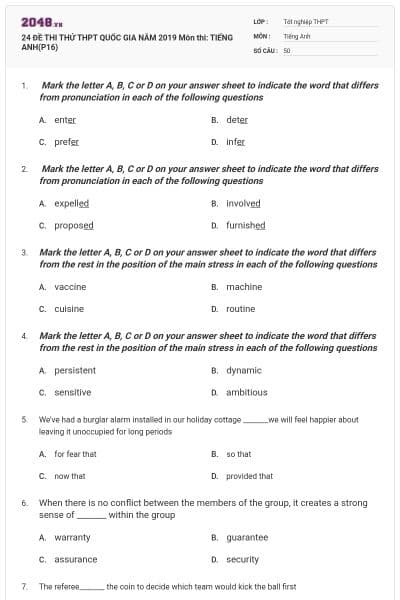
Mark the letter A, B, C or D on your answer sheet to indicate the word that differs from pronunciation in each of the following questions
enter
deter
prefer
infer
Chọn A
Kiến thức: Phát âm '-er'
Giải thích:
A. enter /ˈentə/
B. deter /dɪˈtɜː/
C. prefer /prɪˈfɜː/
D. infer /ɪnˈfɜː/
Phần gạch chân đáp án A phát âm là /ə/, còn lại là /ɜː/
Mark the letter A, B, C or D on your answer sheet to indicate the word that differs from pronunciation in each of the following questions
expelled
involved
proposed
furnished
Chọn D
Kiến thức: Phát âm '-ed'
Giải thích:
Cách phát âm đuôi “ed”:
+ Đuôi “ed” được phát âm là /ɪd/ khi động từ có phát âm kết thúc là /t/ hay /d/
+ Đuôi “ed” được phát âm là /t/ khi động từ có phát âm kết thúc là /s/,/f/,/p/,/ʃ/,/tʃ/,/k/
+ Đuôi “ed” được phát âm là /d/ với các trường hợp còn lại.
A. expelled /ɪkˈspeld/
B. involved /ɪnˈvɒlvd/
C. proposed /prəˈpəʊzd/
D. furnished /ˈfɜːnɪʃt/
Phần gạch chân đáp án D phát âm là /t/, còn lại là /d/
Mark the letter A, B, C or D on your answer sheet to indicate the word that differs from the rest in the position of the main stress in each of the following questions
vaccine
machine
cuisine
routine
Chọn A
Kiến thức: Trọng âm từ có 2 âm tiết
Giải thích:
A. vaccine /ˈvæksiːn/
B. machine /məˈʃiːn/
C. cuisine /kwɪˈziːn/
D. routine /ruːˈtiːn/
Câu A trọng âm rơi vào âm tiết 1, còn lại rơi vào âm tiết 2
Mark the letter A, B, C or D on your answer sheet to indicate the word that differs from the rest in the position of the main stress in each of the following questions
persistent
dynamic
sensitive
ambitious
Chọn C
Kiến thức: Trọng âm từ có 3 âm tiết
Giải thích:
A. persistent /pəˈsɪstənt/
B. dynamic /daɪˈnæmɪk/
C. sensitive /ˈsensətɪv/
D. ambitious /æmˈbɪʃəs/
Câu C trọng âm rơi vào âm tiết 1, còn lại rơi vào âm tiết 2
We’ve had a burglar alarm installed in our holiday cottage _______we will feel happier about leaving it unoccupied for long periods
for fear that
so that
now that
provided that
Đáp án: B
Giải thích:
A. for fear that: vì sợ rằng
B. so that: để mà
C. now that: bởi vì
D. provided that: miễn là, với điều kiện là
Dịch: Chúng tôi vừa cho lắp đặt hệ thống chống trộm trong ngôi nhà nhỏ ở ngoại ô để chúng tôi sẽ cảm thấy an tâm hơn khi để nó trống không một thời gian dài.
When there is no conflict between the members of the group, it creates a strong sense of _______ within the group
warranty
guarantee
assurance
security
Chọn D
Kiến thức: Từ vựng
Giải thích:
A. warranty (n): sự bảo đảm
B. guarantee (n): sự bảo đảm, cam đoan
C. assurance (n): sự chắc chắn
D. security (n): sự an toàn
Tạm dịch: Khi không còn xung đột giữa các thành viên của nhóm, điều đó tạo một cảm giác rất an toàn trong nhóm.
The referee_______ the coin to decide which team would kick the ball first
caught
cast
threw
tossed
Đáp án: D
Giải thích:
Kiến thức: Từ vựng
catch (v): bắt
cast (v): liệng ném
throw (v): ném, vứt
toss (v): tung
toss the coin: tung đồng xu
Dựa vào nghĩa, chọn D.
Dịch: Trọng tài tung đồng xu để quyết định đội nào sẽ đá bóng trước.
Amazon.com, Inc, is an America multinational technology company based in_______ Seattle, Washington that focuses on_______ e- commerce, cloud computing, and artificial intelligence
the/the
Ø / Ø
the/ Ø
Ø / the
Chọn B
Kiến thức: Mạo từ
Giải thích:
Seattle là tên một thành phố => không dùng mạo từ trước nó
e-commerce: thương mại điện tử => danh từ không đếm được => không dùng mạo từ
Tạm dịch: Amazon.com, Inc là một công ty công nghệ đa quốc gia của Mỹ có trụ sở tại Seattle, Washington, tập trung vào thương mại điện tử, điện toán đám mây và trí tuệ nhân tạo
There are two major factors_______ this decrease in the number of students_______ an MBA degree in their countries today
cause/seek
cause/to seek
causing/ to seek
causing/seeking
Chọn D
Kiến thức: Rút gọn mệnh đề quan hệ
Giải thích:
Cách rút gọn mệnh đề quan hệ:
+ Dùng cụm V-ing nếu mệnh đề dạng chủ động
+ Dùng cụm V ed/P2 nếu mệnh đề dạng bị động
Câu đầy đủ:There are two major factors which cause this decrease in the number of students who seek/ who are seeking an MBA degree in their countries today.
Tạm dịch: Có 2 nhân tố chính gây nên sự giảm trong số lượng sinh viên theo học bằng thạc sĩ quản trị kinh doanh tại nước mình hiện nay
The captain has not decided yet where to stop on the journey – we’ll just play it by_______ and see how we feel
mouth
ear
eye
hand
Chọn B
Kiến thức: Idiom
Giải thích: play it by ear: tùy cơ ứng biến, đến đâu tính đến đó
Tạm dịch: Đội trưởng vẫn chưa quyết định chuyến đi sẽ dừng ở đâu – chúng tôi sẽ tùy cơ ứng biến và xem chúng tôi thấy thế nào đã
What is most striking is that most authors made_______ efforts to secure proper authorization for their works
laborious
strenuous
arduous
synchronous
Chọn B
Kiến thức: Từ vựng
Giải thích:
A. laborious (a): giam khổ, cần cù
B. strenuous (a): rất cố gắng
C. arduous (a): gian khổ, mệt mỏi
D. synchronous (a): đồng bộ
Tạm dịch: Điều nổi bật nhất là hầu hết các tác giả đã rất nỗ lực, cố gắng để đảm bảo sự cho phép hoàn toàn cho các tác phẩm của họ
In sptie of his poor education, he was the most _______speaker I have ever met.
ambiguous
articulate
primitive
atmospheric
Chọn B
Kiến thức: Từ vựng
Giải thích:
A. ambiguous (a): mập mờ, tối nghĩa
B. articulate (a): có tài ăn nói lưu loát, r ràng
C. primitive (a): chất phác
D. atmospheric (a): thuộc về không khí
Tạm dịch: Mặc dù học vấn không cao, anh ấy là người nói năng lưu loát nhất mà tôi từng gặp
The receptionist didn’t know_______ whom the message was intended
with
to
for
at
Chọn C
Kiến thức: Giới từ
Giải thích:
A. with: với
B. to: đến
C. for: cho
D. at: tại
intend sth for sb: nhắm … vào ai
Tạm dịch: Nhân viên lễ tân không biết lời nhắn đó được gửi cho ai
_______, the would-be thief made quite a commotion, which alerted the soldiers who then arrested the man
When saw the bear
That they saw the bear
He had seen they bear
Upon seeing the bear
Chọn D
Kiến thức: Rút gọn 2 mệnh đề cùng chủ ngữ
Giải thích:
Khi hai mệnh đề trong cùng 1 câu có cùng chủ ngữ (the would-be thief), ta có thể rút gọn 1 mệnh đề mang nghĩa chủ động về dạng V-ing hoặc “having Ved/V3” (nếu hành động xảy ra trước hành động còn lại).
When + S + V = Upon + V_ing: khi...
Câu đầy đủ: When the would-be thief saw the bear, he made quite a commotion, which alerted the soldiers who then arrested the man.
Tạm dịch: Lúc nhìn thấy con gấu, tên trộm trở nên hỗn loạn, điều đó đã báo động cho những người lính sau đó sẽ bắt lấy hắn
If you think and behave as if you _______ better than everyone else, people may describe you as stuck – up
have been
are
will be
were
Chọn D
Kiến thức: Cấu trúc giả định với “as if”
Giải thích:
- as if + mệnh đề (hiện tại đơn): dùng với các tình huống đúng, có thật ở quá khứ, hiện tại hoặc tương lai.
- as if + mệnh đề (quá khứ đơn): dùng với các tình huống giả định (không có thật) ở hiện tại.
- as if + mệnh đề (quá khứ hoàn thành): dùng với các tình huống giả định (không có thật) ở quá khứ.
Tạm dịch: Nếu bạn nghĩ và cư xử cứ như là bạn giỏi hơn những người khác, mọi người có thể coi bạn là tự cao tự đại
Once_______ with the latest technology, many vehicle manufacturing factories are believed to reduce emissions of nitrogen oxides (NOx) drastically
being equipped
having equipped
equipped
equipping
Chọn C
Kiến thức: Rút gọn mệnh đề cùng chủ ngữ
Giải thích:
Khi 2 mệnh đề cùng chủ ngữ (many vehicle manufacturing factories) ta có thể rút gọn một mệnh đề về dạng:
- V-ing khi mệnh đề mang nghĩa chủ động
- Ved khi mệnh đề mang nghĩa bị động
Câu đầy đủ: Once many vehicle manufacturing factories are equipped with the latest technology, they are believed to reduce emissions of nitrogen oxides (NOx) drastically.
Tạm dịch: Khi được trang bị công nghệ mới nhất, nhiều nhà máy sản xuất các phương tiện giao thông được mọi người tin là giảm lượng khí NOx một cách mạnh mẽ
“Who volunteered to pick up the refreshments for today’s meeting?” – “ ________”
I was going to pick them up
I did. I’m going to get them
I was picking them up
I did. I would get them
Đáp án: B
Giải thích:
Hành động đã được sắp xếp từ trước, nên dùng thì tương lai gần.
Dịch: “Ai đã tình nguyện đi lấy đồ giải khát cho cuộc họp hôm nay?”
– “Tôi đó. Tôi sẽ đi lấy chúng.”
I’m afraid I’m not really_______ to comment on the matter which is not related to my major
qualified
qualitative
qualitative
qualitatively
Chọn A
Kiến thức: Từ loại
Giải thích:
A. qualified (a): đủ khả năng, đủ tư cách
B. quality (n): chất lượng
C. qualitative (a): thuộc về chất lượng
D. qualitatively (adv): thuộc về chất lượng
Sau động từ “to be” ta cần một tính từ.
Tạm dịch: Tôi e là tôi không đủ khả năng để bàn luận về vấn đề không liên quan đến chuyên ngành của mình
Mark the letter A, B, C or D on your answer sheet to indicate the word(s) CLOSEST in meaning to the underlined word(s) in each of the following questions
Thanks to the technological advancements, user-run programs have proliferated over the past years
decreased in number
become less expensive
become more crowded
increased in popularity
Chọn D
Kiến thức: Từ đồng nghĩa
Giải thích:
proliferate (v): tăng nhanh về mặt số lượng
A. giảm về số lượng
B. trở nên ít tốn kém đi
C. trở nên đông đúc hơn
D. tăng phổ biến
=> proliferated = increased in popularity
Tạm dịch: Nhờ có những tiến bộ công nghệ, chương trình do người dùng điều hành đã và đang tăng nhanh trong những năm qua
Their father got married to another woman 3 years after their mother’s death and they learned to accept stepmother in time
in advance
at the right time
before
eventually
Chọn B
Kiến thức: Từ đồng nghĩa
Giải thích:
in time: vừa đúng lúc, cùng lúc
A. trước
B. đúng lúc
C. trước
D. cuối cùng
=> in time = at the right time
Tạm dịch: Bố của họ kết hôn với người phụ nữ khác ba năm sau cái chết của mẹ họ và họ học cách chấp nhận mẹ kế cùng lúc đó
Choose the word or phrase OPPOSITE in meaning to the underlined part in each of the following sentences
Work efficiency has increased appreciably each year thanks to computers and their ability to multitask
unstably
unreliably
unexpectedly
marginally
Chọn D
Kiến thức: Từ trái nghĩa
Giải thích:
appreciably (adv): đáng kể, thấy r
A. unstably (adv): không bền
B. unreliably (adv): không chắc chắn
C. unexpectedly (adv): bất ngờ, đột ngột
D. marginally (adv): không đáng kể
=> appreciably >< marginally
Tạm dịch: Năng suất lao động tăng đáng kể mỗi năm nhờ có máy tính và khả năng đa nhiệm của nó
The committee, in an earlier report, was accused of sweeping financial problems under the carpet to avoid embarrassment
revealing the financial problems
solving financial problems
causing the financial problems
concealing the financial problems
Chọn A
Kiến thức: Từ trái nghĩa
Giải thích:
sweep financial problems under the carpet: che giấu những vấn đề về tài chính thay vì giải quyết nó
A. tiết lộ các vấn đề tài chính
B. giải quyết các vấn đề tài chính
C. gây ra các vấn đề tài chính
D. che giấu các vấn đề tài chính
=> sweeping financial problems under the carpet >< revealing the financial problems
Tạm dịch: Ủy ban, trong một báo cáo trước đó, đã bị buộc tội che giấu những vấn đề về tài chính để tránh sự lúng túng, bối rối.
The waiter is talking to a man in a restaurant.
- Waiter: “_______”
- Man: “No, I’m full already.”
Would you like something for dessert?
Excuse me. Is this seat free?
Excuse me. Where is your seat?
Have your booked in advance?
Chọn A
Kiến thức: Ngôn ngữ giao tiếp
Giải thích:
Nhân viên phục vụ đang nói chuyện với một người đàn ông trong nhà hàng.
- Nhân viên phục vụ: “________”
- Người đàn ông: “Không, tôi đã no rồi.”
A. Anh có muốn gì đó để ăn tráng miệng không?
B. Xin lỗi. Chỗ này còn trống không?
C. Xin lỗi. Chỗ của anh đâu?
D. Anh đã đặt chỗ trước chưa ạ?”
Các phản hồi B, C, D không phù hợp với ngữ cảnh
Two school boys are talking to each other.
Harry: “Were you chosen for our school football team?
Porter: “_______”
I hope not so!
Do you think 1 were?
No such luck!
I got a bad luck!
Chọn B
Kiến thức: Ngôn ngữ giao tiếp
Giải thích:
Hai học sinh đang nói chuyện với nhau.
Harry: Cậu có được chọn vào đội bóng đá của trường mình không?”
Porter: “_______”
A. sai ngữ pháp: I hope not!
B. Cậu nghĩ tớ có được chọn không?
C. Thật đen đủi!
D. Tớ gặp xui xẻo rồi.
Các phản hồi A, C, D không phù hợp với ngữ cảnh
Read the following passage and mark the letter A, B, C or D on your answer sheet to indicate the each of the questions.
Unlike previous generations, millennials look further than job stability, competitive salaries and benefits to be committed and loyal to a company. They are driven by a sense of shared purpose, (25) _______ means they need to have a strong sense of their part in the „bigger picture’ to bring their best results to the workplace. And (26) _______ until now businesses are mostly focused on (27) _______ key consumer needs, what becomes clear when examining the global workforce trends by 2020 is that employee experience is equally important for company success . This is easily seen in a number of tech giants and industry leaders like Google, Facebook, SAP, Tumblr, Intuit, and others. These brands build their entire (28) ______structure and organizational ethos around the experience of their employees. State-of-the-art office campuses, flexible hours and resting rooms are only some of the methods these enterprises leverage to keep their employee experience great. And more importantly, all of these are fast becoming the norm in (29) _______ to today’s workplace trends for companies that understand millennials and know that the 2020 workplace needs to be more dynamic, purpose-driven and versatile
Điền ô 25
which
who
that
whose
Chọn A
Kiến thức: Mệnh đề quan hệ
Giải thích:
Trong mệnh đề quan hệ:
- which: thay thế cho mệnh đề trước đó hoặc thay cho danh từ chỉ vật, đóng vai trò chủ ngữ/ tân ngữ
- who: thay cho danh từ chỉ người; đóng vai trò chủ ngữ/ tân ngữ
- that: thay cho “which/ who/ whom” trong mệnh đề quan hệ xác định
- whose + danh từ: dùng để chỉ sở hữu cho danh từ chỉ người hoặc vật
They are driven by a sense of shared purpose, (25) which means they need to have a strong sense of their part in the „bigger picture’ to bring their best results to the workplace.
Tạm dịch: Họ bị chi phối bởi ý niệm về mục đích chung, điều đó có nghĩa là họ cần ý thức r nhiệm vụ của mình trong tập thể để mang lại kết quả tốt nhất cho nơi mà họ làm việc
Read the following passage and mark the letter A, B, C or D on your answer sheet to indicate the each of the questions.
Unlike previous generations, millennials look further than job stability, competitive salaries and benefits to be committed and loyal to a company. They are driven by a sense of shared purpose, (25) _______ means they need to have a strong sense of their part in the „bigger picture’ to bring their best results to the workplace. And (26) _______ until now businesses are mostly focused on (27) _______ key consumer needs, what becomes clear when examining the global workforce trends by 2020 is that employee experience is equally important for company success . This is easily seen in a number of tech giants and industry leaders like Google, Facebook, SAP, Tumblr, Intuit, and others. These brands build their entire (28) ______structure and organizational ethos around the experience of their employees. State-of-the-art office campuses, flexible hours and resting rooms are only some of the methods these enterprises leverage to keep their employee experience great. And more importantly, all of these are fast becoming the norm in (29) _______ to today’s workplace trends for companies that understand millennials and know that the 2020 workplace needs to be more dynamic, purpose-driven and versatile
Điền ô 26
although
therefore
yet
thus
Chọn A
Kiến thức: Liên từ
Giải thích:
A. although: mặc dù
B. therefore: vì vậy
C. yet: nhưng
D. thus: do đó
And (26) although until now businesses are mostly focused on (27) satisfying key consumer needs, what becomes clear when examining the global workforce trends by 2020 is that employee experience is equally important for company success.
Tạm dịch: Và mặc dù cho đến nay các doanh nghiệp chủ yếu tập trung vào việc làm thỏa mãn nhu cầu của khách hàng quan trọng, qua khảo sát xu hướng lao động toàn cầu trước năm 2020 cho thấy kinh nghiệm của nhân viên cũng quan trọng không kém đối với sự thành công của công ty
Read the following passage and mark the letter A, B, C or D on your answer sheet to indicate the each of the questions.
Unlike previous generations, millennials look further than job stability, competitive salaries and benefits to be committed and loyal to a company. They are driven by a sense of shared purpose, (25) _______ means they need to have a strong sense of their part in the „bigger picture’ to bring their best results to the workplace. And (26) _______ until now businesses are mostly focused on (27) _______ key consumer needs, what becomes clear when examining the global workforce trends by 2020 is that employee experience is equally important for company success . This is easily seen in a number of tech giants and industry leaders like Google, Facebook, SAP, Tumblr, Intuit, and others. These brands build their entire (28) ______structure and organizational ethos around the experience of their employees. State-of-the-art office campuses, flexible hours and resting rooms are only some of the methods these enterprises leverage to keep their employee experience great. And more importantly, all of these are fast becoming the norm in (29) _______ to today’s workplace trends for companies that understand millennials and know that the 2020 workplace needs to be more dynamic, purpose-driven and versatile
Điền ô 27
satisfactorily
satisfactory
satisfying
satisfaction
Chọn C
Kiến thức: Từ loại
Giải thích:
A. satisfactorily (adv): một cách hài lòng
B. satisfactory (a): vừa ý, thỏa đáng
C. satisfying: dạng V-ing của động từ satisfy (làm thỏa mãn)
D. satisfaction (n): sự thỏa mãn
Giới từ + V-ing/ danh từ.
And although until now businesses are mostly focused on (27) satisfying key consumer needs, what becomes clear when examining the global workforce trends by 2020 is that employee experience is equally important for company success.
Tạm dịch: Và mặc dù cho đến nay các doanh nghiệp chủ yếu tập trung vào việc làm thỏa mãn nhu cầu của khách hàng quan trọng, qua khảo sát xu hướng lao động toàn cầu trước năm 2020 cho thấy kinh nghiệm của nhân viên cũng quan trọng không kém đối với sự thành công của công ty
Read the following passage and mark the letter A, B, C or D on your answer sheet to indicate the each of the questions.
Unlike previous generations, millennials look further than job stability, competitive salaries and benefits to be committed and loyal to a company. They are driven by a sense of shared purpose, (25) _______ means they need to have a strong sense of their part in the „bigger picture’ to bring their best results to the workplace. And (26) _______ until now businesses are mostly focused on (27) _______ key consumer needs, what becomes clear when examining the global workforce trends by 2020 is that employee experience is equally important for company success . This is easily seen in a number of tech giants and industry leaders like Google, Facebook, SAP, Tumblr, Intuit, and others. These brands build their entire (28) ______structure and organizational ethos around the experience of their employees. State-of-the-art office campuses, flexible hours and resting rooms are only some of the methods these enterprises leverage to keep their employee experience great. And more importantly, all of these are fast becoming the norm in (29) _______ to today’s workplace trends for companies that understand millennials and know that the 2020 workplace needs to be more dynamic, purpose-driven and versatile
Điền ô 28
principal
center
core
chief
Chọn C
Kiến thức: Từ vựng
Giải thích:
A. principal (a): chính, chủ yếu
B. center (n): trung tâm
C. core (a): cốt l i
D. chief (a): quan trọng chủ yếu
These brands build their entire (28) core structure and organziational ethos around the experience of their employees.
Tạm dịch: Những thương hiệu này xây dựng toàn bộ kết cấu cốt l i và cơ cấu tổ chức xung quanh kinh nghiệm của nhân viên
Read the following passage and mark the letter A, B, C or D on your answer sheet to indicate the each of the questions.
Unlike previous generations, millennials look further than job stability, competitive salaries and benefits to be committed and loyal to a company. They are driven by a sense of shared purpose, (25) _______ means they need to have a strong sense of their part in the „bigger picture’ to bring their best results to the workplace. And (26) _______ until now businesses are mostly focused on (27) _______ key consumer needs, what becomes clear when examining the global workforce trends by 2020 is that employee experience is equally important for company success . This is easily seen in a number of tech giants and industry leaders like Google, Facebook, SAP, Tumblr, Intuit, and others. These brands build their entire (28) ______structure and organizational ethos around the experience of their employees. State-of-the-art office campuses, flexible hours and resting rooms are only some of the methods these enterprises leverage to keep their employee experience great. And more importantly, all of these are fast becoming the norm in (29) _______ to today’s workplace trends for companies that understand millennials and know that the 2020 workplace needs to be more dynamic, purpose-driven and versatile
Điền ô 29
accordance
response
response
respect
Chọn B
Kiến thức: Cách kết hợp từ
Giải thích:
A. in accordance with: phù hợp với
B. in response to: để đáp lại
C. in view of: bởi vì
D. with respect to: đối với
And more importantly, all of these are fast becoming the norm in (29) response to today’s workplace trends for companies that understand millennials and know that the 2020 workplace needs to be more dynamic, purpose-driven and versatile.
Tạm dịch: Và quan trọng hơn, tất cả những điều này đang nhanh chóng trở thành chuẩn mực để đáp lại xu hướng công sở ngày nay cho các công ty hiểu về thế hệ millennials (những người trường thành trong khoảng năm 2000) và biết rằng nơi làm việc năm 2020 cần phải năng động, hướng đến mục đích và linh hoạt hơn.
Dịch đoạn văn:
Không giống như các thế hệ trước, thế hệ Millennials (chỉ những người sinh ra từ khoảng năm 1980 đến những năm đầu thập niên 2000) nhìn xa hơn về sự ổn định trong công việc, mức lương cạnh tranh, lợi ích được cam kết và trung thành với một công ty. Họ bị chi phối bởi ý niệm về mục đích chung, điều đó có nghĩa là họ cần ý thức r nhiệm vụ của mình trong tập thể để mang lại kết quả tốt nhất cho nơi mà họ làm việc. Và mặc dù cho đến nay các doanh nghiệp chủ yếu tập trung vào việc làm thỏa mãn nhu cầu của khách hàng quan trọng, qua khảo sát xu hướng lao động toàn cầu trước năm 2020 cho thấy kinh nghiệm của nhân
viên cũng quan trọng không kém đối với sự thành công của công ty. Điều này có thể dễ thấy ở nhiều ông lớn trong ngành công nghệ và công nghiệp như Google, Facebook, SAP, Tumblr, Intuit, ... Những thương hiệu này xây dựng toàn bộ kết cấu chính và cơ cấu tổ chức xung quanh kinh nghiệm của nhân viên. Khuôn viên văn phòng hiện đại, giờ giấc linh hoạt và phòng nghỉ chỉ là một số phương pháp mà các doanh nghiệp này tận dụng để giúp cho nhân viên của họ có trải nghiệm tuyệt vời. Và quan trọng hơn, tất cả những điều này đang nhanh chóng trở thành chuẩn mực để đáp lại xu hướng công sở ngày nay cho các công ty hiểu về thế hệ millennials và biết rằng nơi làm việc năm 2020 cần phải năng động, hướng đến mục đích và linh hoạt hơn
Read the following passage and mark the letter A, B, C or D on your answer sheet to indicate the correct answer to each of the questions.
Many ants forage across the countryside in large numbers and undertake mass migrations; these activities proceed because one ant lays a trail on the ground for the others to follow. As a worker ant returns home after finding a source of food, it marks the route by intermittently touching its stinger on the ground and depositing a tiny amount of trail pheromone-a mixture of chemicals that delivers diverse messages as the context changes. These trails incorporate no directional information and may be followed by other ants in either direction.
Unlike some other messages, such as the one arising from a dead ant, a food trail has to be kept secret from members of other species. It is not surprising then that ant species use a wide variety of compounds as trail pheromones. Ants can be extremely sensitive to these signals. Investigators working with the trail pheromone of the leafcutter ant Attatexana calculated that one milligram of this substance would suffice to lead a column of ants three times around Earth.
The vapor of the evaporating pheromone over the trail guides an ant along the way, and the ant detects this signal with receptors in its antennae. A trail pheromone will evaporate to furnish the highest concentration of vapor right over the trail, in what is called a vapor space. In following the trail, the ant moves to the right and left, oscillating from side to side across the line of the trail itself, bringing first one and then the other antenna onto the vapor space. In following the trail, the ant moves to the right and left, oscillating from side to side across the line of the trail itself, bringing first one and then the other antenna into the vapor space. As the ant moves to the right, its left antenna arrives in the vapor space.The signal it receives causes it to swing to the left, and the ant then pursues this new course until its right antenna reaches the vapor space. It then swings back to the right, and so weaves back and forth down the trail
The word “intermittently” in the passage is closest in meaning to _______.
lazily
happily
periodically
incorrectly
Chọn C
Kiến thức: Đọc hiểu
Giải thích:
Từ “intermittently” trong bài đọc gần nghĩa nhất với_______.
A. lười biếng
B. vui vẻ
C. một cách tuần hoàn, liên tục
D. không chính xác
Thông tin: As a worker ant returns home after finding a source of food, it marks the route by intermittently touching its stinger on the ground and depositing a tiny amount of trail pheromone-a mixture of chemicals that delivers diverse messages as the context changes.
Tạm dịch: Khi một con kiến thợ trở về tổ sau khi tìm được nguồn thức ăn, nó đánh dấu đường bằng cách liên tục chạm vào cái vòi của nó vào mặt đất và để lại một lượng nhỏ pheromone dẫn đường - một hợp chất mang nhiều lời nhắn khác nhau tùy vào từng tình huống
Read the following passage and mark the letter A, B, C or D on your answer sheet to indicate the correct answer to each of the questions.
Many ants forage across the countryside in large numbers and undertake mass migrations; these activities proceed because one ant lays a trail on the ground for the others to follow. As a worker ant returns home after finding a source of food, it marks the route by intermittently touching its stinger on the ground and depositing a tiny amount of trail pheromone-a mixture of chemicals that delivers diverse messages as the context changes. These trails incorporate no directional information and may be followed by other ants in either direction.
Unlike some other messages, such as the one arising from a dead ant, a food trail has to be kept secret from members of other species. It is not surprising then that ant species use a wide variety of compounds as trail pheromones. Ants can be extremely sensitive to these signals. Investigators working with the trail pheromone of the leafcutter ant Attatexana calculated that one milligram of this substance would suffice to lead a column of ants three times around Earth.
The vapor of the evaporating pheromone over the trail guides an ant along the way, and the ant detects this signal with receptors in its antennae. A trail pheromone will evaporate to furnish the highest concentration of vapor right over the trail, in what is called a vapor space. In following the trail, the ant moves to the right and left, oscillating from side to side across the line of the trail itself, bringing first one and then the other antenna onto the vapor space. In following the trail, the ant moves to the right and left, oscillating from side to side across the line of the trail itself, bringing first one and then the other antenna into the vapor space. As the ant moves to the right, its left antenna arrives in the vapor space.The signal it receives causes it to swing to the left, and the ant then pursues this new course until its right antenna reaches the vapor space. It then swings back to the right, and so weaves back and forth down the trail
According to the passage, how are ants guided by trail pheromones?
They avoid the vapor spaces by moving in a straight line
They concentrate on the smell of food
They follow an ant which is familiar with the trail
They sense the vapor through their antennae
Chọn D
Kiến thức: Đọc hiểu
Giải thích:
Theo bài đọc, kiến được pheromone dẫn đường như thế nào?
A. Chúng tránh không gian hơi bằng cách di chuyển theo đường thẳng.
B. Chúng tập trung vào mùi thức ăn.
C. Chúng đi theo một con kiến quen với dấu vết.
D. Chúng cảm nhận hơi bằng râu của mình.
Thông tin: The vapor of the evaporating pheromone over the trail guides an ant along the way, and the ant detects this signal with receptors in its antennae.
Tạm dịch: Hơi của pheromone bay hơi trên dấu vết chỉ dẫn một con kiến dọc đường đi và con kiến đó phát hiện ra tín hiệu này bằng các thụ quan trên râu của nó
Read the following passage and mark the letter A, B, C or D on your answer sheet to indicate the correct answer to each of the questions.
Many ants forage across the countryside in large numbers and undertake mass migrations; these activities proceed because one ant lays a trail on the ground for the others to follow. As a worker ant returns home after finding a source of food, it marks the route by intermittently touching its stinger on the ground and depositing a tiny amount of trail pheromone-a mixture of chemicals that delivers diverse messages as the context changes. These trails incorporate no directional information and may be followed by other ants in either direction.
Unlike some other messages, such as the one arising from a dead ant, a food trail has to be kept secret from members of other species. It is not surprising then that ant species use a wide variety of compounds as trail pheromones. Ants can be extremely sensitive to these signals. Investigators working with the trail pheromone of the leafcutter ant Attatexana calculated that one milligram of this substance would suffice to lead a column of ants three times around Earth.
The vapor of the evaporating pheromone over the trail guides an ant along the way, and the ant detects this signal with receptors in its antennae. A trail pheromone will evaporate to furnish the highest concentration of vapor right over the trail, in what is called a vapor space. In following the trail, the ant moves to the right and left, oscillating from side to side across the line of the trail itself, bringing first one and then the other antenna onto the vapor space. In following the trail, the ant moves to the right and left, oscillating from side to side across the line of the trail itself, bringing first one and then the other antenna into the vapor space. As the ant moves to the right, its left antenna arrives in the vapor space.The signal it receives causes it to swing to the left, and the ant then pursues this new course until its right antenna reaches the vapor space. It then swings back to the right, and so weaves back and forth down the trail
What does the word “it” in paragraph 3 refer to?
signal
ant
antenna
space
Chọn B
Kiến thức: Đọc hiểu
Giải thích:
Từ “it” trong đoạn 3 muốn nói đến_____
A. kí hiệu
B. con kiến
C. râu
D. không gian
Thông tin: The signal it receives causes it to swing to the left, and the ant then pursues this new course until its right antenna reaches the vapor space.
Tạm dịch: Tín hiệu mà nó nhận được khiến nó xoay sang trái và con kiến sau đó lại tiếp tục như vậy cho đến khi râu bên phải của nó chạm tới không gian hơi
Read the following passage and mark the letter A, B, C or D on your answer sheet to indicate the correct answer to each of the questions.
Many ants forage across the countryside in large numbers and undertake mass migrations; these activities proceed because one ant lays a trail on the ground for the others to follow. As a worker ant returns home after finding a source of food, it marks the route by intermittently touching its stinger on the ground and depositing a tiny amount of trail pheromone-a mixture of chemicals that delivers diverse messages as the context changes. These trails incorporate no directional information and may be followed by other ants in either direction.
Unlike some other messages, such as the one arising from a dead ant, a food trail has to be kept secret from members of other species. It is not surprising then that ant species use a wide variety of compounds as trail pheromones. Ants can be extremely sensitive to these signals. Investigators working with the trail pheromone of the leafcutter ant Attatexana calculated that one milligram of this substance would suffice to lead a column of ants three times around Earth.
The vapor of the evaporating pheromone over the trail guides an ant along the way, and the ant detects this signal with receptors in its antennae. A trail pheromone will evaporate to furnish the highest concentration of vapor right over the trail, in what is called a vapor space. In following the trail, the ant moves to the right and left, oscillating from side to side across the line of the trail itself, bringing first one and then the other antenna onto the vapor space. In following the trail, the ant moves to the right and left, oscillating from side to side across the line of the trail itself, bringing first one and then the other antenna into the vapor space. As the ant moves to the right, its left antenna arrives in the vapor space.The signal it receives causes it to swing to the left, and the ant then pursues this new course until its right antenna reaches the vapor space. It then swings back to the right, and so weaves back and forth down the trail
What does the passage mainly discuss?
How ants mark and follow a chemical trail
Different species of ants around the world
The information contained in pheromones
The mass migration of ants
Chọn A
Kiến thức: Đọc hiểu
Giải thích:
Bài đọc chủ yếu thảo luận về điều gì?
A. Cách kiến ra dấu và đi theo một dấu vết hóa chất
B. Những loài kiến khác nhau trên thế giới
C. Thông tin chứa đựng trong pheromone
D. Di cư hàng loạt của loài kiến
Read the following passage and mark the letter A, B, C or D on your answer sheet to indicate the correct answer to each of the questions.
Many ants forage across the countryside in large numbers and undertake mass migrations; these activities proceed because one ant lays a trail on the ground for the others to follow. As a worker ant returns home after finding a source of food, it marks the route by intermittently touching its stinger on the ground and depositing a tiny amount of trail pheromone-a mixture of chemicals that delivers diverse messages as the context changes. These trails incorporate no directional information and may be followed by other ants in either direction.
Unlike some other messages, such as the one arising from a dead ant, a food trail has to be kept secret from members of other species. It is not surprising then that ant species use a wide variety of compounds as trail pheromones. Ants can be extremely sensitive to these signals. Investigators working with the trail pheromone of the leafcutter ant Attatexana calculated that one milligram of this substance would suffice to lead a column of ants three times around Earth.
The vapor of the evaporating pheromone over the trail guides an ant along the way, and the ant detects this signal with receptors in its antennae. A trail pheromone will evaporate to furnish the highest concentration of vapor right over the trail, in what is called a vapor space. In following the trail, the ant moves to the right and left, oscillating from side to side across the line of the trail itself, bringing first one and then the other antenna onto the vapor space. In following the trail, the ant moves to the right and left, oscillating from side to side across the line of the trail itself, bringing first one and then the other antenna into the vapor space. As the ant moves to the right, its left antenna arrives in the vapor space.The signal it receives causes it to swing to the left, and the ant then pursues this new course until its right antenna reaches the vapor space. It then swings back to the right, and so weaves back and forth down the trail
Why do ants use different compounds as trail pheromones?
To protect their trail from other species
To reduce their sensitivity to some chemicals
To indicate how far away the food is
To attract different types of ants
Chọn A
Kiến thức: Đọc hiểu
Giải thích:
Tại sao loài kiến sử dụng các hợp chất khác nhau làm pheromone dẫn đường?
A. để bảo vệ dấu vết của chúng khỏi những loài khác
B. để giảm độ nhạy của chúng với một số hóa chất
C. để chỉ ra thức xa cách bao xa
D. để thu hút các loài kiến khác
Thông tin: Unlike some other messages, such as the one arising from a dead ant, a food trail has to be kept secret from members of other species. It is not surprising then that ant species use a wide variety of compounds as trail pheromones.
Tạm dịch: Không giống như những lời nhắn khác, ví dụ như lời nhắn phát ra từ một con kiến chết, một dấu vết thức ăn phải được giữ bí mật với các thành viên của các loài khác. Thật không ngạc nhiên khi các loài kiến sử dụng nhiều hợp chất khác nhau làm pheromone dẫn đường.
Dịch bài đọc:
Nhiều loài kiến tìm kiếm thức ăn trên khắp các miền quê với số lượng lớn và thực hiện di cư hàng loạt; những hoạt động này được tiến hành bởi một con kiến đặt một dấu vết trên mặt đất để những con khác đi theo. Khi một con kiến thợ trở về tổ sau khi tìm được nguồn thức ăn, nó đánh dấu đường bằng cách liên tục chạm vào cái vòi của nó vào mặt đất và để lại một lượng nhỏ pheromone dẫn đường - một hợp chất mang nhiều thông điệp khác nhau tùy vào từng tình huống. Những dấu vết này kết hợp với việc không có thông tin về hướng, những con kiến khác có thể đi theo từ mọi phía.
Không giống như những lời nhắn khác, ví dụ như thông điệp phát ra từ một con kiến chết, một dấu vết thức ăn phải được giữ bí mật với các thành viên của các loài khác. Không ngạc nhiên khi các loài kiến sử dụng
nhiều hợp chất khác nhau làm pheromone dẫn đường. Loài kiến cực kì nhạy cảm với những kí hiệu này. Những người nghiên cứu pheromone dẫn đường của loài kiến xén lá Attatexana đã ước tính rằng cứ 1 mg chất này sẽ đủ để dẫn dắt một đội hình kiến gấp 3 lần xung quanh Trái Đất.
Hơi của pheromone bay hơi trên dấu vết chỉ dẫn một con kiến dọc đường đi và con kiến đó phát hiện ra tín hiệu này bằng các thụ quan trên râu của nó. Pheromone dẫn đường sẽ bay hơi để cung cấp nồng độ hơi cao nhất ngay trên dấu vết để lại, trong cái được gọi là không gian hơi. Theo dấu vết, con kiến di chuyển sang phải và trái, đu đưa từ bên này sang bên kia qua dấu vết để lại, lần lượt đưa từng râu vào không gian hơi. Tín hiệu mà nó nhận được khiến nó xoay sang trái và con kiến sau đó lại tiếp tục như vậy cho đến khi râu bên phải của nó chạm tới không gian hơi. Sau đó nó quay ngược về bên phải, và cứ thế len lỏi theo dấu vết
Read the following passage and mark the letter A, B, C or D on your answer sheet to indicate the correct answer to each of the question.
All living cells in an animal's body require energy to power the various chemical processes going in inside them. This energy is ultimately supplied by the food that animals eat. These chemical processes are collectively referred to as metabolism, and one of the byproducts of metabolism is heat. Metabolic rates vary significantly between species. Warm-blooded animals (birds and mammals) have metabolic rates about five to ten times higher than those of similarly sized cold-blooded ones (reptiles, amphibians, and fishes). And it is precisely because birds and mammals have such high metabolic rates that they are able to keep their bodies warm.
The terms warm-blooded and cold-blooded are still in everyday use, but they are not entirely precise. Anyone who has handled a snake knows this because a snake’s body actually feels quite warm. But very little of the snake’s body heat originates internally, from its cells, most of it having been supplied from the outside, either by the sun or by a heat lamp. Instead of referring to reptiles as cold-blooded, they are best described as ectothermic, meaning “outside heat”. Similarly, birds and mammals are said to be endothermic, meaning “inside heat”.
There are advantages and disadvantages to each thermal strategy. Reptiles are usually sluggish first thing in the morning, their body temperatures having dropped during the cool of the night. Accordingly, they have to bask in the sun to raise their body temperatures, but once they have warmed up sufficiently, they can go about their business. By altering between the sun when they are too cool, and the shade when they are too warm, many reptiles are able to maintain their body temperatures at optimum levels of about 95°F or more. Endotherms, on the other hand, maintain temperatures of about 98°F all the time, so they are always ready for action.
I used to keep a crocodile. He had very sharp teeth, and I had to be careful how I handled him during the daytime, when he was warm. But I could do whatever I wanted at night, when he was cold, without any fear of being bitten. The obvious disadvantage of being ectothermic is that the animal’s activity levels are dependent upon the environment. But its low metabolic rates mean that it requires far less food, which is an advantage. I used to feed the crocodile a tiny piece of liver once a week, while the family cat demanded three meals every day. We should therefore not think that reptiles are inferior to mammals and birds; they are just different
What is the best title of the passage?
Birds and Mammals
Endotherms and Ectotherms
Advantages of Entothermism
Common Misconceptions about Reptiles
Chọn B
Kiến thức: Đọc hiểu
Giải thích:
Tiêu đề hay nhất cho bài đọc là gì?
A. Loài chim và động vật có vú
B. Động vật đẳng nhiệt và động vật biến nhiệt
C. Lợi thế của việc đẳng nhiệt
D. Quan niệm sai phổ biến về loài bò sát
Read the following passage and mark the letter A, B, C or D on your answer sheet to indicate the correct answer to each of the question.
All living cells in an animal's body require energy to power the various chemical processes going in inside them. This energy is ultimately supplied by the food that animals eat. These chemical processes are collectively referred to as metabolism, and one of the byproducts of metabolism is heat. Metabolic rates vary significantly between species. Warm-blooded animals (birds and mammals) have metabolic rates about five to ten times higher than those of similarly sized cold-blooded ones (reptiles, amphibians, and fishes). And it is precisely because birds and mammals have such high metabolic rates that they are able to keep their bodies warm.
The terms warm-blooded and cold-blooded are still in everyday use, but they are not entirely precise. Anyone who has handled a snake knows this because a snake’s body actually feels quite warm. But very little of the snake’s body heat originates internally, from its cells, most of it having been supplied from the outside, either by the sun or by a heat lamp. Instead of referring to reptiles as cold-blooded, they are best described as ectothermic, meaning “outside heat”. Similarly, birds and mammals are said to be endothermic, meaning “inside heat”.
There are advantages and disadvantages to each thermal strategy. Reptiles are usually sluggish first thing in the morning, their body temperatures having dropped during the cool of the night. Accordingly, they have to bask in the sun to raise their body temperatures, but once they have warmed up sufficiently, they can go about their business. By altering between the sun when they are too cool, and the shade when they are too warm, many reptiles are able to maintain their body temperatures at optimum levels of about 95°F or more. Endotherms, on the other hand, maintain temperatures of about 98°F all the time, so they are always ready for action.
I used to keep a crocodile. He had very sharp teeth, and I had to be careful how I handled him during the daytime, when he was warm. But I could do whatever I wanted at night, when he was cold, without any fear of being bitten. The obvious disadvantage of being ectothermic is that the animal’s activity levels are dependent upon the environment. But its low metabolic rates mean that it requires far less food, which is an advantage. I used to feed the crocodile a tiny piece of liver once a week, while the family cat demanded three meals every day. We should therefore not think that reptiles are inferior to mammals and birds; they are just different
What is TRUE according to the passage?
Many retiles can be very dangerous durng the day
Mammals have more stable temperatures than reptiles
Not all reptiles are cold-blooded
All reptiles often hibernate in winter in order to survive well
Chọn B
Kiến thức: Đọc hiểu
Giải thích:
Theo bài đọc, điều nào là ĐÚNG?
A. Nhiều bò sát có thể rất nguy hiểm vào ban ngày.
B. Động vật có vú có nhiệt độ ổn định hơn bò sát.
C. Không phải tất cả các loài bò sát đều máu lạnh.
D. Tất cả các loài bò sát thường ngủ đông vào mùa đông để sống sót tốt.
Thông tin: Reptiles are usually sluggish first thing in the morning, their body temperatures having dropped during the cool of the night. Accordingly, they have to bask in the sun to raise their body temperatures, but once they have warmed up sufficiently, they can go about their business… Endotherms, on the other hand, maintain temperatures of about 98°F all the time, so they are always ready for action.
Tạm dịch: Loài bò sát thường uể oải vào buổi sáng, nhiệt độ cơ thể chúng giảm xuống do sự mát mẻ ban đêm. Vì vậy, chúng phải phơi mình dưới ánh mặt trời để tăng nhiệt độ cơ thể, nhưng một khi chúng đã ấm lên đủ, chúng có thể tiến hành công việc của mình… Mặt khác, động vật đẳng nhiệt duy trì nhiệt độ khoảng 98° F mọi lúc, vì vậy chúng luôn sẵn sàng hành động.
Read the following passage and mark the letter A, B, C or D on your answer sheet to indicate the correct answer to each of the question.
All living cells in an animal's body require energy to power the various chemical processes going in inside them. This energy is ultimately supplied by the food that animals eat. These chemical processes are collectively referred to as metabolism, and one of the byproducts of metabolism is heat. Metabolic rates vary significantly between species. Warm-blooded animals (birds and mammals) have metabolic rates about five to ten times higher than those of similarly sized cold-blooded ones (reptiles, amphibians, and fishes). And it is precisely because birds and mammals have such high metabolic rates that they are able to keep their bodies warm.
The terms warm-blooded and cold-blooded are still in everyday use, but they are not entirely precise. Anyone who has handled a snake knows this because a snake’s body actually feels quite warm. But very little of the snake’s body heat originates internally, from its cells, most of it having been supplied from the outside, either by the sun or by a heat lamp. Instead of referring to reptiles as cold-blooded, they are best described as ectothermic, meaning “outside heat”. Similarly, birds and mammals are said to be endothermic, meaning “inside heat”.
There are advantages and disadvantages to each thermal strategy. Reptiles are usually sluggish first thing in the morning, their body temperatures having dropped during the cool of the night. Accordingly, they have to bask in the sun to raise their body temperatures, but once they have warmed up sufficiently, they can go about their business. By altering between the sun when they are too cool, and the shade when they are too warm, many reptiles are able to maintain their body temperatures at optimum levels of about 95°F or more. Endotherms, on the other hand, maintain temperatures of about 98°F all the time, so they are always ready for action.
I used to keep a crocodile. He had very sharp teeth, and I had to be careful how I handled him during the daytime, when he was warm. But I could do whatever I wanted at night, when he was cold, without any fear of being bitten. The obvious disadvantage of being ectothermic is that the animal’s activity levels are dependent upon the environment. But its low metabolic rates mean that it requires far less food, which is an advantage. I used to feed the crocodile a tiny piece of liver once a week, while the family cat demanded three meals every day. We should therefore not think that reptiles are inferior to mammals and birds; they are just different
The word “sluggish” in paragraph 3 is closest in meaning to
sleepy
cold
inactive
warm
Chọn A
Kiến thức: Đọc hiểu
Giải thích:
Từ “sluggish” ở đoạn 3 gần nghĩa nhất với______
A. ngái ngủ, uể oải
B. lạnh
C. không hoạt động
D. ấm
Thông tin: Reptiles are usually sluggish first thing in the morning, their body temperatures having dropped during the cool of the night.
Tạm dịch: Loài bò sát thường uể oải vào buổi sáng, nhiệt độ cơ thể chúng giảm xuống do sự mát mẻ ban đêm
Read the following passage and mark the letter A, B, C or D on your answer sheet to indicate the correct answer to each of the question.
All living cells in an animal's body require energy to power the various chemical processes going in inside them. This energy is ultimately supplied by the food that animals eat. These chemical processes are collectively referred to as metabolism, and one of the byproducts of metabolism is heat. Metabolic rates vary significantly between species. Warm-blooded animals (birds and mammals) have metabolic rates about five to ten times higher than those of similarly sized cold-blooded ones (reptiles, amphibians, and fishes). And it is precisely because birds and mammals have such high metabolic rates that they are able to keep their bodies warm.
The terms warm-blooded and cold-blooded are still in everyday use, but they are not entirely precise. Anyone who has handled a snake knows this because a snake’s body actually feels quite warm. But very little of the snake’s body heat originates internally, from its cells, most of it having been supplied from the outside, either by the sun or by a heat lamp. Instead of referring to reptiles as cold-blooded, they are best described as ectothermic, meaning “outside heat”. Similarly, birds and mammals are said to be endothermic, meaning “inside heat”.
There are advantages and disadvantages to each thermal strategy. Reptiles are usually sluggish first thing in the morning, their body temperatures having dropped during the cool of the night. Accordingly, they have to bask in the sun to raise their body temperatures, but once they have warmed up sufficiently, they can go about their business. By altering between the sun when they are too cool, and the shade when they are too warm, many reptiles are able to maintain their body temperatures at optimum levels of about 95°F or more. Endotherms, on the other hand, maintain temperatures of about 98°F all the time, so they are always ready for action.
I used to keep a crocodile. He had very sharp teeth, and I had to be careful how I handled him during the daytime, when he was warm. But I could do whatever I wanted at night, when he was cold, without any fear of being bitten. The obvious disadvantage of being ectothermic is that the animal’s activity levels are dependent upon the environment. But its low metabolic rates mean that it requires far less food, which is an advantage. I used to feed the crocodile a tiny piece of liver once a week, while the family cat demanded three meals every day. We should therefore not think that reptiles are inferior to mammals and birds; they are just different
What does the word “they” in paragraph 2 refer to?
cells
snakes
reptiles
mammals
Chọn C
Kiến thức: Đọc hiểu
Giải thích:
Từ “they” ở đoạn 2 nói đến cái gì?
A. tế bào
B. rắn
C. loài bò sát
D. động vật có vú
Thông tin: Instead of referring to reptiles as cold-blooded, they are best described as ectothermic, meaning “outside heat”.
Tạm dịch: Thay vì nói các loài bò sát là loài máu lạnh, chúng tốt nhất nên được gọi là động vật biến nhiệt, có nghĩa là "ngoại nhiệt" (nhiệt từ bên ngoài).
Read the following passage and mark the letter A, B, C or D on your answer sheet to indicate the correct answer to each of the question.
All living cells in an animal's body require energy to power the various chemical processes going in inside them. This energy is ultimately supplied by the food that animals eat. These chemical processes are collectively referred to as metabolism, and one of the byproducts of metabolism is heat. Metabolic rates vary significantly between species. Warm-blooded animals (birds and mammals) have metabolic rates about five to ten times higher than those of similarly sized cold-blooded ones (reptiles, amphibians, and fishes). And it is precisely because birds and mammals have such high metabolic rates that they are able to keep their bodies warm.
The terms warm-blooded and cold-blooded are still in everyday use, but they are not entirely precise. Anyone who has handled a snake knows this because a snake’s body actually feels quite warm. But very little of the snake’s body heat originates internally, from its cells, most of it having been supplied from the outside, either by the sun or by a heat lamp. Instead of referring to reptiles as cold-blooded, they are best described as ectothermic, meaning “outside heat”. Similarly, birds and mammals are said to be endothermic, meaning “inside heat”.
There are advantages and disadvantages to each thermal strategy. Reptiles are usually sluggish first thing in the morning, their body temperatures having dropped during the cool of the night. Accordingly, they have to bask in the sun to raise their body temperatures, but once they have warmed up sufficiently, they can go about their business. By altering between the sun when they are too cool, and the shade when they are too warm, many reptiles are able to maintain their body temperatures at optimum levels of about 95°F or more. Endotherms, on the other hand, maintain temperatures of about 98°F all the time, so they are always ready for action.
I used to keep a crocodile. He had very sharp teeth, and I had to be careful how I handled him during the daytime, when he was warm. But I could do whatever I wanted at night, when he was cold, without any fear of being bitten. The obvious disadvantage of being ectothermic is that the animal’s activity levels are dependent upon the environment. But its low metabolic rates mean that it requires far less food, which is an advantage. I used to feed the crocodile a tiny piece of liver once a week, while the family cat demanded three meals every day. We should therefore not think that reptiles are inferior to mammals and birds; they are just different
What can be inferred from the passage?
Reptiles cannot absorb energy from the surrounding environment
Endothermic animals are more active than ectothermic animals
Maintaining a high metabolic rate requires lots of fuel in the form of food
Reptiles cannot function properly and survive if there is no sun
Chọn D
Kiến thức: Đọc hiểu
Giải thích:
Điều gì có thể được suy ra từ bài đọc?
A. Loài bò sát không thể hấp thụ năng lượng từ môi trường xung quanh
B. Động vật đẳng nhiệt hoạt động nhanh nhẹn hơn động vật ngoài nhiệt
C. Duy trì tỉ lệ trao đổi chất cao đòi hỏi rất nhiều năng lượng dưới dạng thức ăn
D. Loài bò sát không thể hoạt động một cách thực sự và sống sót nếu không có mặt trời
Thông tin: Reptiles are usually sluggish first thing in the morning, their body temperatures having dropped during the cool of the night. Accordingly, they have to bask in the sun to raise their body temperatures, but once they have warmed up sufficiently, they can go about their business.
Tạm dịch: Loài bò sát thường uể oải vào buổi sáng, nhiệt độ cơ thể chúng giảm xuống do sự mát mẻ ban đêm. Vì vậy, chúng phải phơi mình dưới ánh mặt trời để tăng nhiệt độ cơ thể, nhưng một khi chúng đã ấm lên đủ, chúng có thể tiến hành công việc của mình
Read the following passage and mark the letter A, B, C or D on your answer sheet to indicate the correct answer to each of the question.
All living cells in an animal's body require energy to power the various chemical processes going in inside them. This energy is ultimately supplied by the food that animals eat. These chemical processes are collectively referred to as metabolism, and one of the byproducts of metabolism is heat. Metabolic rates vary significantly between species. Warm-blooded animals (birds and mammals) have metabolic rates about five to ten times higher than those of similarly sized cold-blooded ones (reptiles, amphibians, and fishes). And it is precisely because birds and mammals have such high metabolic rates that they are able to keep their bodies warm.
The terms warm-blooded and cold-blooded are still in everyday use, but they are not entirely precise. Anyone who has handled a snake knows this because a snake’s body actually feels quite warm. But very little of the snake’s body heat originates internally, from its cells, most of it having been supplied from the outside, either by the sun or by a heat lamp. Instead of referring to reptiles as cold-blooded, they are best described as ectothermic, meaning “outside heat”. Similarly, birds and mammals are said to be endothermic, meaning “inside heat”.
There are advantages and disadvantages to each thermal strategy. Reptiles are usually sluggish first thing in the morning, their body temperatures having dropped during the cool of the night. Accordingly, they have to bask in the sun to raise their body temperatures, but once they have warmed up sufficiently, they can go about their business. By altering between the sun when they are too cool, and the shade when they are too warm, many reptiles are able to maintain their body temperatures at optimum levels of about 95°F or more. Endotherms, on the other hand, maintain temperatures of about 98°F all the time, so they are always ready for action.
I used to keep a crocodile. He had very sharp teeth, and I had to be careful how I handled him during the daytime, when he was warm. But I could do whatever I wanted at night, when he was cold, without any fear of being bitten. The obvious disadvantage of being ectothermic is that the animal’s activity levels are dependent upon the environment. But its low metabolic rates mean that it requires far less food, which is an advantage. I used to feed the crocodile a tiny piece of liver once a week, while the family cat demanded three meals every day. We should therefore not think that reptiles are inferior to mammals and birds; they are just different
According to the author, the term "cold - blooded" is misleading because "cold - blooded" animals_________.
cannot survive cold temperatures even when being exposed to the sun
are more affected by heat than by cold in any environment
often have a body temperature comparable to that of warm - blooded animals
always have a higher body temperature than the temperature of the environment
Chọn C
Kiến thức: Đọc hiểu
Giải thích:
Theo tác giả, thuật ngữ "máu lạnh" là dễ gây nhầm lẫn vì động vật "máu lạnh"_________
A. không thể tồn tại ở nhiệt độ lạnh ngay cả khi tiếp xúc với ánh nắng mặt trời.
B. bị ảnh hưởng nhiều bởi nhiệt hơn là lạnh trong mọi môi trường.
C. thường có nhiệt độ cơ thể được so sánh với nhiệt độ cơ thể động vật máu nóng.
D. luôn có nhiệt độ cơ thể cao hơn nhiệt độ môi trường
Read the following passage and mark the letter A, B, C or D on your answer sheet to indicate the correct answer to each of the question.
All living cells in an animal's body require energy to power the various chemical processes going in inside them. This energy is ultimately supplied by the food that animals eat. These chemical processes are collectively referred to as metabolism, and one of the byproducts of metabolism is heat. Metabolic rates vary significantly between species. Warm-blooded animals (birds and mammals) have metabolic rates about five to ten times higher than those of similarly sized cold-blooded ones (reptiles, amphibians, and fishes). And it is precisely because birds and mammals have such high metabolic rates that they are able to keep their bodies warm.
The terms warm-blooded and cold-blooded are still in everyday use, but they are not entirely precise. Anyone who has handled a snake knows this because a snake’s body actually feels quite warm. But very little of the snake’s body heat originates internally, from its cells, most of it having been supplied from the outside, either by the sun or by a heat lamp. Instead of referring to reptiles as cold-blooded, they are best described as ectothermic, meaning “outside heat”. Similarly, birds and mammals are said to be endothermic, meaning “inside heat”.
There are advantages and disadvantages to each thermal strategy. Reptiles are usually sluggish first thing in the morning, their body temperatures having dropped during the cool of the night. Accordingly, they have to bask in the sun to raise their body temperatures, but once they have warmed up sufficiently, they can go about their business. By altering between the sun when they are too cool, and the shade when they are too warm, many reptiles are able to maintain their body temperatures at optimum levels of about 95°F or more. Endotherms, on the other hand, maintain temperatures of about 98°F all the time, so they are always ready for action.
I used to keep a crocodile. He had very sharp teeth, and I had to be careful how I handled him during the daytime, when he was warm. But I could do whatever I wanted at night, when he was cold, without any fear of being bitten. The obvious disadvantage of being ectothermic is that the animal’s activity levels are dependent upon the environment. But its low metabolic rates mean that it requires far less food, which is an advantage. I used to feed the crocodile a tiny piece of liver once a week, while the family cat demanded three meals every day. We should therefore not think that reptiles are inferior to mammals and birds; they are just different
The word "inferior" in paragraph 4 is closest in meaning to________.
always comparable
at a lower rank
very opposite
quite similar
Chọn B
Kiến thức: Đọc hiểu
Giải thích:
Từ "inferior" ở đoạn 4 gần nghĩa nhất với_________
A. luôn được so sánh
B. thấp kém hơn
C. rất trái ngược nhau
D. khá tương đồng
Thông tin: We should therefore not think that reptiles are inferior to mammals and birds; they are just different.
Tạm dịch: Do đó, chúng ta không nên nghĩ rằng các loài bò sát thua kém động vật có vú và chim; chỉ là chúng khác nhau mà thôi.
Read the following passage and mark the letter A, B, C or D on your answer sheet to indicate the correct answer to each of the question.
All living cells in an animal's body require energy to power the various chemical processes going in inside them. This energy is ultimately supplied by the food that animals eat. These chemical processes are collectively referred to as metabolism, and one of the byproducts of metabolism is heat. Metabolic rates vary significantly between species. Warm-blooded animals (birds and mammals) have metabolic rates about five to ten times higher than those of similarly sized cold-blooded ones (reptiles, amphibians, and fishes). And it is precisely because birds and mammals have such high metabolic rates that they are able to keep their bodies warm.
The terms warm-blooded and cold-blooded are still in everyday use, but they are not entirely precise. Anyone who has handled a snake knows this because a snake’s body actually feels quite warm. But very little of the snake’s body heat originates internally, from its cells, most of it having been supplied from the outside, either by the sun or by a heat lamp. Instead of referring to reptiles as cold-blooded, they are best described as ectothermic, meaning “outside heat”. Similarly, birds and mammals are said to be endothermic, meaning “inside heat”.
There are advantages and disadvantages to each thermal strategy. Reptiles are usually sluggish first thing in the morning, their body temperatures having dropped during the cool of the night. Accordingly, they have to bask in the sun to raise their body temperatures, but once they have warmed up sufficiently, they can go about their business. By altering between the sun when they are too cool, and the shade when they are too warm, many reptiles are able to maintain their body temperatures at optimum levels of about 95°F or more. Endotherms, on the other hand, maintain temperatures of about 98°F all the time, so they are always ready for action.
I used to keep a crocodile. He had very sharp teeth, and I had to be careful how I handled him during the daytime, when he was warm. But I could do whatever I wanted at night, when he was cold, without any fear of being bitten. The obvious disadvantage of being ectothermic is that the animal’s activity levels are dependent upon the environment. But its low metabolic rates mean that it requires far less food, which is an advantage. I used to feed the crocodile a tiny piece of liver once a week, while the family cat demanded three meals every day. We should therefore not think that reptiles are inferior to mammals and birds; they are just different
Why does the author mention his pet in the last paragraph?
Because he wants to advise on how to handle pets safely
Because he wants to say that keeping a reptile as pet is less expensive
Because he wants to compare reptiles’ metabolic rates with those of mammals and birds
Because he wants to illustrate that ectothermism has both advantages and disadvantages
Chọn D
Kiến thức: Đọc hiểu
Giải thích:
Tại sao tác giả đề cập đến thú cưng của mình trong đoạn văn cuối?
A. Bởi vì anh ấy muốn khuyên về cách chạm vào thú cưng an toàn
B. Bởi vì anh ấy muốn nói rằng nuôi một con bò sát làm thú cưng ít tốn kém hơn
C. Bởi vì anh ta muốn so sánh tốc độ trao đổi chất của các loài bò sát với các loài động vật có vú và loài chim
D. Bởi vì anh ta muốn minh họa rằng động vật biến nhiệt có cả ưu điểm và nhược điểm.
Thông tin: I used to keep a crocodile. He had very sharp teeth, and I had to be careful how I handled him during the daytime, when he was warm. But I could do whatever I wanted at night, when he was cold, without any fear of being bitten. The obvious disadvantage of being ectothermic is that the animal’s activity levels are dependent upon the environment. But its low metabolic rates mean that it requires far less food, which is an advantage. I used to feed the crocodile a tiny piece of liver once a week, while the family cat demanded three meals every day.
Tạm dịch: Tôi đã từng nuôi một con cá sấu. Nó có hàm răng rất sắc, và tôi phải cẩn thận với cách tôi chạm vào nó vào ban ngày, khi nó rất nóng. Nhưng tôi có thể làm bất cứ điều gì tôi muốn vào ban đêm, khi nó trở nên lạnh, mà không sợ bị cắn. Nhược điểm r ràng của việc động vật biến nhiệt là mức độ hoạt động của động vật phụ thuộc vào môi trường. Nhưng tỷ lệ trao đổi chất thấp của nó có nghĩa là nó đòi hỏi thực phẩm ít hơn nhiều, đó là một lợi thế. Tôi từng cho cá sấu ăn một miếng gan nhỏ mỗi tuần một lần, trong khi họ nhà mèo yêu cầu ba bữa mỗi ngày.
Dịch bài đọc:
Tất cả các tế bào sống trong một cơ thể động vật đều đòi hỏi năng lượng để cung cấp cho các quá trình hóa học khác nhau hoạt động ở bên trong chúng. Năng lượng này về cơ bản được cung cấp bởi thực phẩm mà động vật ăn. Các quá trình hóa học này được gọi chung là quá trình trao đổi chất và một trong những sản phẩm phụ của quá trình trao đổi chất là nhiệt. Tỷ lệ trao đổi chất khác nhau đáng kể giữa các loài. Động vật máu nóng (chim và động vật có vú) có tỷ lệ trao đổi chất cao hơn khoảng năm đến mười lần so với những loài máu lạnh có kích thước tương tự (bò sát, lưỡng cư và cá). Và chính xác thì vì chim và động vật có vú có tỷ lệ trao đổi chất cao đến mức chúng có thể giữ ấm cơ thể.
Các thuật ngữ máu nóng và máu lạnh vẫn được sử dụng hàng ngày, nhưng chúng không hoàn toàn chính xác. Bất cứ ai đã chạm vào một con rắn đều biết điều này bởi cơ thể rắn thực sự khá là ấm áp. Nhưng rất ít nhiệt cơ thể rắn bắt nguồn từ bên trong, từ các tế bào của nó, phần lớn nhiệt được cung cấp từ bên ngoài, bởi mặt trời hoặc bởi đèn nhiệt. Thay vì nói các loài bò sát là loài máu lạnh, chúng tốt nhất nên được gọi là động vật biến nhiệt, có nghĩa là "ngoại nhiệt" (nhiệt từ bên ngoài). Tương tự như vậy, các loài chim và động vật có vú được cho là động vật đẳng nhiệt, có nghĩa là "nội nhiệt" (nhiệt ở bên trong).
Có những lợi thế và bất lợi cho từng loại thân nhiệt. Loài bò sát thường uể oải vào buổi sáng, nhiệt độ cơ thể chúng giảm xuống do sự mát mẻ ban đêm. Vì vậy, chúng phải phơi mình dưới ánh mặt trời để tăng nhiệt độ cơ thể, nhưng một khi chúng đã ấm lên đủ, chúng có thể tiến hành công việc của mình. Bằng cách thay đổi giữa ánh mặt trời khi quá lạnh và bóng râm khi chúng quá ấm, nhiều loài bò sát có thể duy trì nhiệt độ cơ thể của chúng ở mức tối ưu khoảng 95° F trở lên. Mặt khác, động vật đẳng nhiệt duy trì nhiệt độ khoảng 98° F mọi lúc, vì vậy chúng luôn sẵn sàng hành động.
Tôi đã từng nuôi một con cá sấu. Nó có hàm răng rất sắc, và tôi phải cẩn thận với cách tôi chạm vào nó vào ban ngày, khi trời rất nóng. Nhưng tôi có thể làm bất cứ điều gì tôi muốn vào ban đêm, khi trời lạnh, mà không sợ bị cắn. Nhược điểm r ràng của việc động vật biến nhiệt là mức độ hoạt động của động vật phụ thuộc vào môi trường. Nhưng tỷ lệ trao đổi chất thấp của nó có nghĩa là nó đòi hỏi thực phẩm ít hơn nhiều, đó là một lợi thế. Tôi từng cho cá sấu ăn một miếng gan nhỏ mỗi tuần một lần, trong khi họ nhà mèo yêu cầu ba bữa mỗi ngày. Do đó, chúng ta không nên nghĩ rằng các loài bò sát thua kém động vật có vú và chim; chỉ là chúng khác nhau mà thôi
It is advisable that (A) students, who (B) are not good at math, not require (C) to take advanced math in (D) high school
that
who
not require
in
Chọn C
Kiến thức: Thức giả định – bị động
Giải thích:
Công thức với thức giả định:
- Chủ động: S + be + adj + that + S + V (nguyên thể)
- Bị động: S + be + adj + that + S + be + Ved
Cấu trúc trên dùng với các tính từ như: advisable, necessary, recommended, urgent, critical, important, essential, vital, mandatory, crucial,…
Sửa lại: not require => be not required
Tạm dịch: Những học sinh không giỏi toán thì không nên bị yêu cầu học toán cao cấp ở trung học phổ thông.
China, the fourth (A) largest and the most populated (B) country in the world, is on its way to becoming (C) the most domineering (D) nation on the planet today
fourth
populated
becoming
domineering
Chọn B
Kiến thức: Từ vựng
Giải thích:
populated (a): có người sinh sống
populous (a): đông dân
Sửa lại: populated => populous
Tạm dịch: Trung Quốc, đất nước rộng thứ 4 và đông dân nhất thế giới, đang trên đà trở thành quốc gia hống hách nhất hành tinh hiện nay.
Ants were the first group of eusocial predatory insects (A) that both (B) lived and foraged primarily (C) in the soil and in rotting vegetation (D) on the ground
eusocial predatory insects
both
primarily
vegetation
Chọn A
Kiến thức: Trật tự tính từ
Giải thích:
predatory (a): săn mồi
eusocial (a): sống theo đàn
=> predatory eusocial insects: côn trùng săn mồi sống theo đàn
Sửa lại: eusocial predatory insects => predatory eusocial insects
Tạm dịch: Kiến là loại côn trùng săn mồi sống theo đàn đầu tiên mà vừa sống vừa kiếm ăn chủ yếu trong đất và trong thảm thực vật mục nát trên mặt đất
It would have been better if the teacher had reminded us of the deadline
It doesn’t matter that the teacher didn't remind us of the deadline
The teacher might have reminded us of the deadline
Reminding us of the deadline was a good way for the teacher
The teacher should have reminded us of the deadline
Chọn D
Kiến thức: Câu điều kiện loại 3
Giải thích:
Câu điều kiện loại 3 diễn tả điều giả định trái ngược với quá khứ.
Công thức: S + would have Ved/ V3 if + S + had Ved/ V3
should have P2: đáng lẽ ra nên làm gì trong quá khứ
Tạm dịch: Sẽ tốt hơn nếu giáo viên nhắc nhở chúng tôi về hạn chót.
A. Giáo viên không nhắc nhở chúng tôi về hạn chót thì cũng chẳng sao. => sai về nghĩa
B. Giáo viên có thể đã nhắc nhở chúng tôi về hạn chót. => sai về nghĩa
C. Nhắc nhở chúng tôi về hạn chót là một cách tốt cho giáo viên. => sai về nghĩa
D. Giáo viên lẽ ra đã nên nhắc nhở chúng tôi về hạn chót
Just after the play started there was a power failure
Hardly had the play started when there was a power failure
No earlier had the play started than there was a power failure
Hardly did the play start then there was a power failure
No sooner did the play start before there was a power failure
Chọn A
Kiến thức: Cấu trúc với thì quá khứ hoàn thành – quá khứ đơn
Giải thích:
Công thức: Hardly/ Scarely + had + S + Ved + when/ berfore + S + V (quá khứ): vừa mới… thì…
= No sooner + had + S + Ved/ V3 + than + S + Ved/ V2
Tạm dịch: Ngay sau khi vở kịch bắt đầu, xảy ra một sự cố mất điện.
= A. Vở kịch vừa mới bắt đầu thì xảy ra một sự cố mất điện.
B. sai ngữ pháp: earlier => sooner
C. sai ngữ pháp: did the play start => had the play started, then => when
D. sai ngữ pháp: did the play start => had the play started, before => than
Many students regret not having taken the opportunity to learn English when they were at high school
Many students are sorry that they had taken the opportunity to learn English at high school.
Many students should have chosen to learn English when they were at high school
It’s a pity that many students have never been able to learn English at high school
Many students wish that they had learned English when they were at high school
Chọn D
Kiến thức: Câu ước loại 3
Giải thích:
regret + (not) having Ved/ V3: hối tiếc về việc đã xảy ra trong quá khứ
Câu điều ước loại 3 là câu ước trái với sự thật trong quá khứ.
Cấu trúc: S wish + (that) + S had Ved/P2
Tạm dịch: Nhiều học sinh hối tiếc vì đã không nắm bắt cơ hội học tiếng Anh khi họ còn học trung học phổ thông.
A. Nhiều học sinh tiếc rằng họ đã nắm bắt cơ hội học tiếng Anh khi họ còn học trung học phổ thông. => sai về nghĩa
B. Nhiều học sinh lẽ ra là nên quyết định học tiếng Anh khi họ còn học trung học phổ thông. => sai về nghĩa
C. Thật tiếc là nhiều học sinh không bao giờ có thể học tiếng Anh khi họ còn học trung học phổ thông.=> sai về nghĩa
D. Nhiều học sinh ước rằng họ đã học tiếng Anh khi họ còn học trung học phổ thông
The sooner we solve this problem, the better it will be for all concerned
If we can solve this problem soon, it will be better for all concerned
If all concerned are better, we can solve this problem soon
It would be better for all concerned if we can solve this problem soon
If we could solve this problem soon, it would be better for all concerned
Chọn A
Kiến thức: Câu so sánh kép, câu điều kiện
Giải thích:
- Câu so sánh kép: The + so sánh hơn + S + V, the + so sánh hơn + S + V (càng... càng....)
- Câu điều kiện loại 1: diễn tả khả năng có thể xảy ra ở hiện tại hoặc tương lai.
Cấu trúc: If + S + V (hiện tại), S + will/can/may + V (nguyên thể)
Tạm dịch: Chúng ta càng giải quyết vấn đề này sớm, sẽ tốt hơn cho tất cả những người có liên quan.
= A. Nếu chúng ta có thể giải quyết vấn đề sớm, sẽ tốt hơn cho tất cả những người có liên quan.
B. Nếu tất cả những người có liên quan tốt hơn, chúng ta có thể giải quyết vấn đề vấn đề này sớm. => sai về nghĩa
C. sai ngữ pháp: would => will
D. sai ngữ pháp: điều kiện loại 2 => loại 1
“If I were in your shoes, I would try to finish the pre-lab report before carrying out the experiment” said the professor to his research student.
The professor told his student that he wished he could finish the pre-lab report before carrying out the experiment
The professor advised his student to try to finish the pre-lab report before carrying out the experiment
The professor complained that his student didn’t finish the pre-lab report before carrying out the experiment
The professor regretted that his student didn't try to finish the pre-lab report before carrying out the experiment
Chọn B
Kiến thức: Câu tường thuật
Giải thích:
told + O + that: bảo
advised + O + to V: khuyên
complained about + Ving/ that + S + V: phàn nàn
regretted that + S + V/ + V-ing / + to V: hối tiếc
Tạm dịch: “Nếu tôi là cậu, tôi sẽ cố gắng hoàn thành bản báo cáo trước khi tiến hành thí nghiệm”, giáo sư nói với nghiên cứu sinh của mình.
= B. Giáo sư khuyên nghiên cứu sinh của mình cố gắng hoàn thành bản báo cáo trước khi tiến hành thí nghiệm.
A. Giáo sư nói với nghiên cứu sinh của mình rằng ông ấy ước gì ông ấy có thể hoàn thành báo cáo trước khi tiến thành thí nghiệm. => sai về nghĩa
C. Giáo sư phàn nàn rằng nghiên cứu sinh của ông đã không hoàn thành báo cáo trước khi tiến thành thí nghiệm. => sai về nghĩa
D. Giáo sư hối tiếc rằng nghiên cứu sinh của ông đã không cố gắng hoàn thành báo cáo trước khi tiến thành thí nghiệm. => sai về nghĩa