24 ĐỀ THI THỬ THPT QUỐC GIA NĂM 2019 Môn thi: TIẾNG ANH(P13)
50 câu hỏi
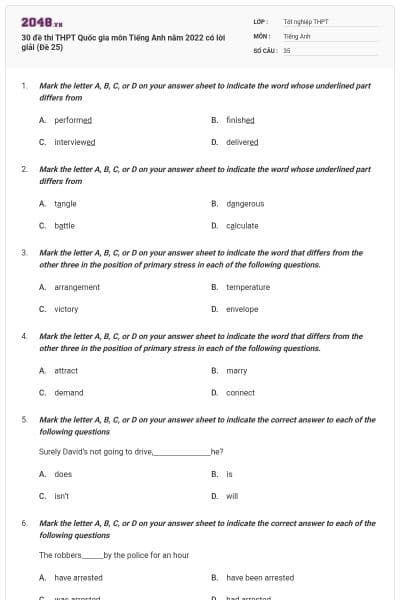
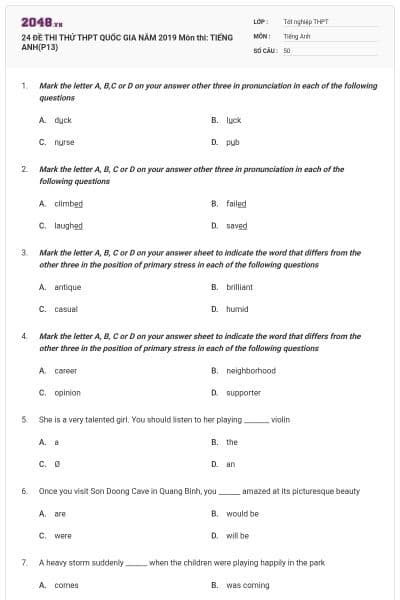
Mark the letter A, B,C or D on your answer other three in pronunciation in each of the following questions
duck
luck
nurse
pub
Chọn C
Kiến thức: Phát âm “u”
Giải thích:
A. duck /dʌk/
B. luck /lʌk/
C. nurse /nɜːs/
D. pub /pʌb/
Phần gạch chân đáp án C phát âm là /ɜː/, còn lại là /ʌ/.
Mark the letter A, B, C or D on your answer other three in pronunciation in each of the following questions
climbed
failed
laughed
saved
Chọn C
Kiến thức: Phát âm “ed”
Giải thích:
Cách phát âm đuôi “ed”:
+ Đuôi “ed” được phát âm là /id/ khi động từ có phát âm kết thúc là /t/ hay /d/
+ Đuôi “ed” được phát âm là /t/ khi động từ có phát âm kết thúc là /s/,/f/,/p/,/ʃ/,/tʃ/,/k/
+ Đuôi “ed” được phát âm là /d/ với các trường hợp còn lại
A. climbed /klaɪmd/
B. failed /feɪld/
C. laughed /lɑːft/
D. saved /seɪvd/
Phần gạch chân đáp án C phát âm là /t/, còn lại là /d/.
Mark the letter A, B, C or D on your answer sheet to indicate the word that differs from the other three in the position of primary stress in each of the following questions
antique
brilliant
casual
humid
Chọn A
Kiến thức: Trọng âm từ có 2 âm tiết
Giải thích:
A. antique /ænˈtiːk/
B. brilliant /ˈbrɪliənt/
C. casual /ˈkæʒuəl/
D. humid /ˈhjuːmɪd/
Trọng âm đáp án A vào âm tiết thứ hai, còn lại vào âm tiết thứ nhất
Mark the letter A, B, C or D on your answer sheet to indicate the word that differs from the other three in the position of primary stress in each of the following questions
career
neighborhood
opinion
supporter
Chọn B
Kiến thức: Trọng âm từ có 3 âm tiết
Giải thích:
A. career /kəˈrɪə(r)/
B. neighborhood /ˈneɪbəhʊd/
C. opinion /əˈpɪnjən/
D. supporter /səˈpɔːtə(r)/
Trọng âm đáp án B vào âm tiết thứ nhất, còn lại vào âm tiết thứ hai
She is a very talented girl. You should listen to her playing _______ violin
a
the
Ø
an
Chọn B
Kiến thức: Mạo từ
Giải thích: Công thức: play + the + tên nhạc cụ => ai đó chơi nhạc cụ nào
Tạm dịch: Cô ấy là một cô gái rất tài năng. Bạn nên nghe cô ấy đánh đàn violin
Once you visit Son Doong Cave in Quang Binh, you ______ amazed at its picturesque beauty
are
would be
were
will be
Chọn D
Kiến thức: Thì tương lai đơn
Giải thích:
Thì tương lai đơn có thể dùng để diễn tả một dự đoán kết hợp với thì hiện tại đơn.
Cấu trúc: Once/ When + S + V (hiện tại đơn), S + will + V
Tạm dịch: Một khi bạn tới thăm hang Sơn Đòong ở Quảng Bình, bạn sẽ bị ấn tượng bởi vẻ đẹp như tranh của nó
A heavy storm suddenly ______ when the children were playing happily in the park
comes
was coming
was coming
came
Chọn D
Kiến thức: Thì quá khứ đơn – thì quá khứ tiếp diễn
Giải thích:
Thì quá khứ đơn diễn tả hành động (come) xen vào một hành động khác (play) đang diễn ra trong quá khứ (thì quá khứ tiếp diễn)
Cấu trúc: S1 + Ved/ V2 + when + S1 + was/ were + V-ing
Tạm dịch: Một cơn bão lớn đột ngột tới khi bọn trẻ đang chơi vui vẻ trong công viên
He couldn’t ride his bike _____ there’s no air in one of the tyres.
since
due to
though
despite
Đáp án: A
Giải thích:
A. since + mệnh đề: bởi vì
B. due to + N/ V-ing: bởi vì
C. though + mệnh đề: mặc dù
D. despite + N/ V-ing: mặc dù
Dịch: Anh ấy không thể đạp xe bởi vì một chiếc lốp xe bị hết hơi.
The French government has discouraged grocery stores ______ providing free plastic bags to customers since 2016
against
from
with
towards
Chọn B
Kiến thức: Giới từ
Giải thích: Cấu trúc: discourage sb from V-ing: ngăn cản ai làm gì
Tạm dịch: Chính phủ Pháp đã ngăn cản các cửa hàng tiện lợi cung cấp túi nilon miễn phí cho khách hàng từ năm 2016
______, Joe was annoyed to find that he had left his key at the coffee shop
After returned to his office
To have just returned to his office
Upon returning to his office
Having been returned to his office
Chọn C
Kiến thức: Rút gọn mệnh đề cùng chủ ngữ
Giải thích:
Khi 2 mệnh đề trong câu đồng chủ ngữ (Joe), ta có thể rút gọn một mệnh đề về dạng:
- V-ing khi mệnh đề mang nghĩa chủ động
- Ved/ V3 khi mệnh đề mang nghĩa bị động
Câu đầy đủ: When Joe returned to his office, he was annoyed to find that he had left his key at the coffee shop.
Câu rút gọn: Upon returning to his office, Joe was annoyed to find that he had left his key at the coffee shop.
Tạm dịch: Khi đang quay về phòng, Joe bực mình nhận ra rằng anh ấy đã để quên chìa khoá ở quán café
When ______ the 2018 Oscar for the best Actor in a Supporting Role, Sam Rockwell thanked his mom and dad for inspiring him with the love for movies
was awarded
having awarded
awarding
awarded
Chọn D
Kiến thức: Rút gọn mệnh đề cùng chủ ngữ
Giải thích:
Khi 2 mệnh đề trong câu đồng chủ ngữ (Sam Rockwell), ta có thể rút gọn một mệnh đề về dạng:
- V-ing khi mệnh đề mang nghĩa chủ động
- Ved/ V3 khi mệnh đề mang nghĩa bị động
Câu đầy đủ: When Sam Rockwell was awarded the 2018 Oscar for the best Actor in a Supporting Role, he thanked his mom and dad for inspiring him with the love for movies.
Câu rút gọn: When awarded the 2018 Oscar for the best Actor in a Supporting Role, Sam Rockwell thanked his mom and dad for inspiring him with the love for movies.
Tạm dịch: Khi được trao giải thưởng Oscar 2018 nam diễn viên phụ xuất sắc nhất, Sam Rockwell đã cảm ơn bố mẹ anh ấy vì đã truyền cảm hứng với tình yêu các bộ phim
Please accept my apology. I didn’t mean ______ your birthday party last night
to be missed
to have missed
having missed
being missed
Chọn B
Kiến thức: V-ing/ to V
Giải thích:
mean + to V: cố ý làm gì => mean to have P2: cố ý đã làm gì
mean + V-ing: có nghĩa là...
Tạm dịch: Làm ơn chấp nhận lời xin lỗi của tôi. Tôi không cố ý bỏ lỡ bữa tiệc sinh nhật của bạn vào tối qua
The whale shark has long been considered a(n) ______ species as its natural habitat is seriously damaged owing to marine pollution.
endangered
endanger
danger
dangerous
Chọn A
Kiến thức: Từ loại
Giải thích:
A. endangered (adj): có nguy cơ tuyệt chủng
B. endanger (v): làm ai/cái gì nguy hiểm
C. danger (n): sự nguy hiểm
D. dangerous (adj): nguy hiểm
Trước danh từ “species” ta cần dùng một tính từ.
Tạm dịch: Cá mập voi từ lâu đã được xem là loài có nguy cơ bị tuyệt chủng bởi vì môi trường sống tự nhiên của chúng bị huỷ hoại nghiêm trọng vì ô nhiễm nước.
The management committee will meet several times this week to reach _____ decisions about the future of the factory
obvious
direct
brief
sensible
Chọn C
Kiến thức: Từ vựng
Giải thích:
A. obvious (adj): rõ ràng
B. direct (adj): trực tiếp
C. brief (adj): ngắn gọn
D. sensible (adj): hợp lí
Tạm dịch: Ban quản lí sẽ họp một vài lần trong tuần này để đưa ra quyết định ngắn gọn về tương lai của nhà máy
You shouldn’t work all the time. It ______ you good to go out and enjoy yourself sometimes
gives
does
helps
brings
Chọn B
Kiến thức: Sự kết hợp từ
Giải thích: do sb good to V: có lợi cho ai khi làm gì
Tạm dịch: Bạn không nên làm việc suốt ngày. Thỉnh thoảng ra ngoài và tận hưởng sẽ có lợi cho bạn
From my room on the sixth floor of the hotel, there’s a good _____ of the mountains
scene
view
sight
look
Chọn B
Kiến thức: Từ vựng
Giải thích:
A. scene (n): phong cảnh
B. view (n): cảnh quan, quang cảnh
C. sight (n): quan sát
D. look (n): cái nhìn
Tạm dịch: Từ phòng của tôi trên tầng 6 khách sạn, có quang cảnh núi rất đẹp
It’s a shame that these two plans are ____ exclusive. Implementing one will automatically rule out the other
imperceptibly
respectively
mutually
exhaustively
Chọn C
Kiến thức: Từ vựng
Giải thích:
A. imperceptibly (adv): không thể nhận biết
B. respectively (adv): tương ứng
C. mutually (adv): lẫn nhau
D. exhaustively (adv): triệt để
Tạm dịch: Thật xấu hổ khi hai kế hoạch này là loại trừ lẫn nhau. Thực hiện cái này sẽ tự động loại trừ cái kia
This young entrepreneur may stand a chance of succeeding on account of his willingness to throw ______ to the wind
forethought
discretion
prudence
caution
Chọn D
Kiến thức: Thành ngữ
Giải thích: throw caution to the wind: liều lĩnh làm gì
Tạm dịch: Doanh nhân trẻ này có thể có cơ hội thành công vì dám liều lĩnh
Alex is talking to his colleague, Tom, at tea break.
Alex: “Do you fancy a drink this evening?”
Tom: “________”
I’m afraid not. I can manage without you
Thank you. I’m glad you could go
Some other time, perhaps. I’m busy tonight
Why not? Pleased to meet you, too
Chọn C
Kiến thức: Ngôn ngữ giao tiếp
Giải thích:
Alex đang trò chuyện với đồng nghiệp của mình, Tom, trong giờ nghỉ giải lao.
Alex: “Tối nay anh có muốn đi uống gì đó không?”
Tom: “______”
A. Tôi e rằng không. Tôi không thể xoay sở nếu thiếu bạn.
B. Cảm ơn. Tôi vui vì bạn có thể đi.
C. Có thể vào lúc khác. Tối nay tôi bận rồi.
D. Tại sao không? Tôi cũng vui vì gặp bạn.
Các phản hồi A, B, D không phù hợp với ngữ cảnh
Two students are chatting in the corridor after class.
Tim: “ We should make a slide show for our history presentation next week.”
Laura: “__________”
Sorry, I have to check my diary
That’s exactly what I was going to say
I’d love to but I just can’t now
That’s true. I understand how you feel
Chọn B
Kiến thức: Ngôn ngữ giao tiếp
Giải thích:
Hai học sinh đang tán gẫu ở hành lang sau giờ học.
Tim: “Chúng ta nên làm bài trình chiếu cho buổi thuyết trình lịch sử vào tuần sau.”
Laura: “________”
A. Xin lỗi. Tôi phải kiểm tra nhật kí.
B. Đó chính xác là điều tôi đã định nói.
C. Tôi rất thích nhưng giờ tôi không thể.
D. Đúng. Tôi hiểu bạn cảm thấy thế nào.
Các phản hồi A, C, D không phù hợp với ngữ cảnh
Mark the letter A, B, C or D on your answer sheet to indicate the word(s) CLOSEST in meaning to the underlined word(s) in each of the following questions
Using public transportation means not having to hunt for a parking space when you go downtown
gain
search
discover
purchase
Chọn B
Kiến thức: Từ đồng nghĩa
Giải thích:
hunt (v): săn, tìm
A. gain (v): đạt được
B. search (v): tìm
C. discover (v): khám phá
D. purchase (v): thanh toán
=> hunt = search
Tạm dịch: Sử dụng phương tiện công cộng có nghĩa là không cần tìm chỗ để xe khi bạn xuống trung tâm
I intended to spend a romantic weekend in Bali but the weather forecast was appalling enough to put me off
stop me from going
disappoint me
discourage me from going
interrupt me
Chọn A
Kiến thức: Từ đồng nghĩa
Giải thích:
put me off: hoãn
A. stop me from going: ngăn tôi đi
B. disappoint me: làm tôi thất vọng
C. discourage me from going: không ủng hộ tôi đi
D. interrupt me: làm phiền tôi
=> put me off = stop me from going
Tạm dịch: Tôi đã định dành cuối tuần lãng mạn ở Bali nhưng dự báo thời tiết kinh khủng đã ngăn tôi đi
All of the courses I have taken, this one is the hardest but most interesting
All of the courses I have taken are easier than and as interesting as this one
All of the courses I have taken are tougher and more fascinating than this
No other course I have taken was harder nor less fascinating than this
No other course I have taken was as tough nor as fascinating as this one
Chọn D
Kiến thức: Câu so sánh
Giải thích:
Công thức so sánh nhất: S + be + THE short adj –EST/ THE MOST long adj
Công thức so sánh hơn: S1 + be + short adj –ER/ MORE long adj + than + S2
Tạm dịch: Trong tất cả các khóa học tôi đã tham gia, đây là khóa học khó nhất nhưng thú vị nhất.
A. Tất cả các khóa học tôi đã tham gia đều dễ dàng hơn và thú vị như khóa học này.
B. Tất cả các khóa học tôi đã tham gia đều khó và hấp dẫn hơn thế này.
C. Không có khóa học nào khác tôi đã học khó hơn hoặc kém hấp dẫn hơn thế này.
D. Không có khóa học nào khác tôi đã học khó và hấp dẫn như khóa học này.
Các đáp án A, B, C sai về nghĩa
“Let’s give her more information about our plan next week,” said Michael
Michael suggested giving her more information about their plan the following week
Michael proposed that he would give her more information about their plan next week
Michael blamed them for not giving her more information about their plan the following week
Michael wanted to have permission to give her more information about next week’s plan
Chọn A
Kiến thức: Câu tường thuật
Giải thích:
suggest + V_ing: đề nghị làm gì
propose that + S + V: đề xuất rằng
blame + O + for + V-ing: đổ lỗi cho ai về việc gì
want + to V: muốn làm gì
Tạm dịch: “Hãy cung cấp cho cô ấy nhiều thông tin hơn về kế hoạch của chúng ta vào tuần tới,” Michael nói.
A. Michael đề nghị cung cấp cho cô ấy nhiều thông tin hơn về kế hoạch của họ vào tuần sau.
B. sai ngữ pháp: next week
C. Michael đổ lỗi cho họ vì đã không cung cấp cho cô thêm thông tin về kế hoạch của họ vào tuần sau.
D. Michael muốn được phép cung cấp cho cô ấy nhiều thông tin hơn về kế hoạch của tuần tới.
Các đáp án C, D sai về nghĩa
It was wrong of you to criticize her in front of her colleagues
You are wrong about criticizing her in front of her colleagues
You shouldn’t have criticized her in front of her colleagues
You didn’t need to criticize her in the presence of her colleagues
You must be mistaken about criticizing her with her colleagues
Chọn B
Kiến thức: Động từ khuyết thiếu
Giải thích:
shouldn’t have + P2: đáng lẽ ra không nên làm gì (nhưng đã làm)
didn’t need + to V: đã không cần
must be Ved/ V3: phải bị/ chắc có lẽ là bị...
Tạm dịch: Bạn đã sai khi chỉ trích cô ấy trước mặt đồng nghiệp của cô ấy.
= B. Bạn đáng lẽ ra không nên chỉ trích cô ấy trước mặt các đồng nghiệp của cô ấy.
A. sai ngữ pháp: are
C. Bạn đã không cần chỉ trích cô ấy khi có mặt đồng nghiệp của cô ấy.
D. Chắc bạn đã nhầm lẫn về việc chỉ trích cô ấy với đồng nghiệp của cô ấy.
Các đáp án C, D sai về nghĩa
Read the following passage and mark the letter A, B, C or D on your answer sheet to indicate the correct answer to each of the questions from 26 to 30.
Being repeatedly late may just be accidental – or could it show a deeply rooted psychological desire to express your own superiority? When I worked in an office, meetings would often start late, usually because of a certain individual. Then they would overrun and the whole day lost its shape. But the individual was high-ranking and self-important: nobody challenged. So what are the ethics of lateness?
There’s a psychotherapist called Irvin Yalom who argues that all behaviour reflects psychology. Just as people who like to be on time are motivated by certain deep-seated beliefs, so those who make others wait are acting out an inner agenda, often based on an acute sense of power. There’s famous footage in which Silvio Berlusconi kept Angela Merkel waiting while he made a call on his mobile. It speaks volumes.
But that is when all lateness is in one’s control. What about when your train is cancelled or your flight is delayed or you had to wait longer for the plumber to arrive? In such cases, there’s not a lot of psychology involved. Or is there? Some people will genuinely worry about the impact it will have on those left waiting, while others might secretly enjoy the power of their absence.
The essential fact is that lateness means breaking a convention – you can only be late in respect of a time agreed with other people. Regardless of psychology, it has a social value. And when we treat other people’s time as less valuable than our own, we treat them as inferior
What is the main idea of the passage?
Lateness indicates superiority of important individuals
Social values of individuals are fostered through lateness
Being late can reveal a lot about people’s psychology
People with high sense of power have a tendency to be late
Chọn B
Kiến thức: Đọc hiểu
Giải thích:
Ý chính của đoạn văn là gì?
A. Sự trễ giờ biểu thị sự vượt trội của các cá nhân quan trọng.
B. Giá trị xã hội của các cá nhân được tăng lên thông qua độ trễ giờ.
C. Đi muộn có thể tiết lộ rất nhiều về tâm lý con người.
D. Những người có ý thức quyền lực cao có xu hướng bị trễ
Read the following passage and mark the letter A, B, C or D on your answer sheet to indicate the correct answer to each of the questions from 26 to 30.
Being repeatedly late may just be accidental – or could it show a deeply rooted psychological desire to express your own superiority? When I worked in an office, meetings would often start late, usually because of a certain individual. Then they would overrun and the whole day lost its shape. But the individual was high-ranking and self-important: nobody challenged. So what are the ethics of lateness?
There’s a psychotherapist called Irvin Yalom who argues that all behaviour reflects psychology. Just as people who like to be on time are motivated by certain deep-seated beliefs, so those who make others wait are acting out an inner agenda, often based on an acute sense of power. There’s famous footage in which Silvio Berlusconi kept Angela Merkel waiting while he made a call on his mobile. It speaks volumes.
But that is when all lateness is in one’s control. What about when your train is cancelled or your flight is delayed or you had to wait longer for the plumber to arrive? In such cases, there’s not a lot of psychology involved. Or is there? Some people will genuinely worry about the impact it will have on those left waiting, while others might secretly enjoy the power of their absence.
The essential fact is that lateness means breaking a convention – you can only be late in respect of a time agreed with other people. Regardless of psychology, it has a social value. And when we treat other people’s time as less valuable than our own, we treat them as inferior
What is the “speak volumes” in paragraph 2 closest in meaning to?
tells a lot
makes sounds
holds power
talks loudly
Chọn A
Kiến thức: Đọc hiểu
Giải thích:
Từ “speak volumes” ở đoạn 2 gần nghĩa nhất với?
A. nói nhiều
B. tạo ra âm thanh
C. giữ sức mạnh
D. nói to
Thông tin: It speaks volumes.
Tạm dịch: Nó nói lên rất nhiều
Read the following passage and mark the letter A, B, C or D on your answer sheet to indicate the correct answer to each of the questions from 26 to 30.
Being repeatedly late may just be accidental – or could it show a deeply rooted psychological desire to express your own superiority? When I worked in an office, meetings would often start late, usually because of a certain individual. Then they would overrun and the whole day lost its shape. But the individual was high-ranking and self-important: nobody challenged. So what are the ethics of lateness?
There’s a psychotherapist called Irvin Yalom who argues that all behaviour reflects psychology. Just as people who like to be on time are motivated by certain deep-seated beliefs, so those who make others wait are acting out an inner agenda, often based on an acute sense of power. There’s famous footage in which Silvio Berlusconi kept Angela Merkel waiting while he made a call on his mobile. It speaks volumes.
But that is when all lateness is in one’s control. What about when your train is cancelled or your flight is delayed or you had to wait longer for the plumber to arrive? In such cases, there’s not a lot of psychology involved. Or is there? Some people will genuinely worry about the impact it will have on those left waiting, while others might secretly enjoy the power of their absence.
The essential fact is that lateness means breaking a convention – you can only be late in respect of a time agreed with other people. Regardless of psychology, it has a social value. And when we treat other people’s time as less valuable than our own, we treat them as inferior
Which of the following is NOT TRUE according to the passage?
The way our minds work is responsible for the way we behave
Some people control a situation for their benefit through lateness
Lateness can have an impact on other people who are made to wait
Most people react the same when lateness is out of their control
Chọn D
Kiến thức: Đọc hiểu
Giải thích:
Điều nào sau đây KHÔNG ĐÚNG theo đoạn văn?
A. Cách làm việc của tâm trí chúng ta chịu trách nhiệm cho cách chúng ta cư xử.
B. Một số người kiểm soát một tình huống vì lợi ích của họ thông qua độ trễ.
C. Độ trễ có thể có tác động đến những người khác được chờ đợi.
D. Hầu hết mọi người phản ứng giống nhau khi độ trễ vượt khỏi tầm kiểm soát của họ.
Thông tin: Some people will genuinely worry about the impact it will have on those left waiting, while others might secretly enjoy the power of their absence.
Tạm dịch: Một số người thực sự sẽ lo lắng về tác động của nó đối với những người còn lại chờ đợi, trong khi những người khác có thể bí mật tận hưởng sức mạnh của sự vắng mặt của họ
Read the following passage and mark the letter A, B, C or D on your answer sheet to indicate the correct answer to each of the questions from 26 to 30.
Being repeatedly late may just be accidental – or could it show a deeply rooted psychological desire to express your own superiority? When I worked in an office, meetings would often start late, usually because of a certain individual. Then they would overrun and the whole day lost its shape. But the individual was high-ranking and self-important: nobody challenged. So what are the ethics of lateness?
There’s a psychotherapist called Irvin Yalom who argues that all behaviour reflects psychology. Just as people who like to be on time are motivated by certain deep-seated beliefs, so those who make others wait are acting out an inner agenda, often based on an acute sense of power. There’s famous footage in which Silvio Berlusconi kept Angela Merkel waiting while he made a call on his mobile. It speaks volumes.
But that is when all lateness is in one’s control. What about when your train is cancelled or your flight is delayed or you had to wait longer for the plumber to arrive? In such cases, there’s not a lot of psychology involved. Or is there? Some people will genuinely worry about the impact it will have on those left waiting, while others might secretly enjoy the power of their absence.
The essential fact is that lateness means breaking a convention – you can only be late in respect of a time agreed with other people. Regardless of psychology, it has a social value. And when we treat other people’s time as less valuable than our own, we treat them as inferior
It can be inferred from the reading passage that _______.
Berlusconi made Merkel wait as he wanted to show his importance
it is fashionable to be late to meetings because nobody challenges
the writer’s daily schedule was unaffected by his colleague’s lateness
nothing can be said about one’s psychology if lateness is out of control
Chọn A
Kiến thức: Đọc hiểu
Giải thích:
Có thể suy ra từ đoạn văn rằng_______.
A. Berlusconi khiến Merkel chờ đợi khi ông muốn thể hiện tầm quan trọng của mình.
B. trễ cuộc họp là thời thượng vì không ai thách thức
C. lịch trình hàng ngày của nhà văn không bị ảnh hưởng bởi độ trễ của đồng nghiệp
D. không có gì có thể nói về tâm lý của một người nếu độ trễ nằm ngoài tầm kiểm soát
Thông tin: There’s famous footage in which Silvio Berlusconi kept Angela Merkel waiting while he made a call on his mobile. It speaks volumes.
Tạm dịch: Có những cảnh quay nổi tiếng trong đó Silvio Berlusconi khiến Angela Merkel chờ đợi trong khi anh gọi điện thoại di động. Nó nói lên rất nhiều
Read the following passage and mark the letter A, B, C or D on your answer sheet to indicate the correct answer to each of the questions from 26 to 30.
Being repeatedly late may just be accidental – or could it show a deeply rooted psychological desire to express your own superiority? When I worked in an office, meetings would often start late, usually because of a certain individual. Then they would overrun and the whole day lost its shape. But the individual was high-ranking and self-important: nobody challenged. So what are the ethics of lateness?
There’s a psychotherapist called Irvin Yalom who argues that all behaviour reflects psychology. Just as people who like to be on time are motivated by certain deep-seated beliefs, so those who make others wait are acting out an inner agenda, often based on an acute sense of power. There’s famous footage in which Silvio Berlusconi kept Angela Merkel waiting while he made a call on his mobile. It speaks volumes.
But that is when all lateness is in one’s control. What about when your train is cancelled or your flight is delayed or you had to wait longer for the plumber to arrive? In such cases, there’s not a lot of psychology involved. Or is there? Some people will genuinely worry about the impact it will have on those left waiting, while others might secretly enjoy the power of their absence.
The essential fact is that lateness means breaking a convention – you can only be late in respect of a time agreed with other people. Regardless of psychology, it has a social value. And when we treat other people’s time as less valuable than our own, we treat them as inferior
What does the word “it” in paragraph 4 refer to?
fact
lateness
convention
psychology
Chọn B
Kiến thức: Đọc hiểu
Giải thích:
Từ “it” trong đoạn 4 nói tới cái gì?
A. thực tế
B. sự chậm trễ
C. quy ước
D. tâm lý
Thông tin: The essential fact is that lateness means breaking a convention – you can only be late in respect of a time agreed with other people. Regardless of psychology, it has a social value.
Tạm dịch: Một thực tế thiết yếu là độ trễ có nghĩa là phá vỡ một quy ước - bạn chỉ có thể bị trễ về thời gian đã thỏa thuận với người khác. Bất kể tâm lý, nó có một giá trị xã hội.
Dịch bài đọc:
Bị đi muộn lặp đi lặp lại có thể chỉ là tình cờ - hoặc nó có thể cho thấy một mong muốn tâm lý sâu xa để thể hiện sự vượt trội của riêng bạn? Khi tôi làm việc trong một văn phòng, các cuộc họp thường bắt đầu muộn, thường là do một cá nhân nào đó. Sau đó, các cuộc họp sẽ mất nhiều thời gian hơn dự kiến và mất cả ngày trời. Nhưng cá nhân là thứ hạng cao và tự trọng: không ai bị thách thức. Vậy chuẩn mực của sự chậm trễ là gì?
Có một nhà trị liệu tâm lý tên là Irvin Yalom, người lập luận rằng mọi hành vi đều phản ánh tâm lý. Giống như những người thích đến đúng giờ được thúc đẩy bởi những niềm tin sâu sắc nhất định, vì vậy những người khiến người khác chờ đợi đang thực hiện một chương trình nghị sự bên trong, thường dựa trên ý thức quyền lực cấp tính. Có những cảnh quay nổi tiếng trong đó Silvio Berlusconi khiến Angela Merkel chờ đợi trong khi anh gọi điện thoại di động. Nó nói lên rất nhiều.
Nhưng đó là khi toàn bộ sự chậm trễ nằm trong sự kiểm soát của một người. Thế còn khi tàu của bạn bị hủy hoặc chuyến bay của bạn bị hoãn hoặc bạn phải đợi lâu hơn để thợ sửa ống nước đến? Trong những trường hợp như vậy, không liên quan nhiều đến tâm lý. Hoặc là có? Một số người thực sự sẽ lo lắng về tác động của nó đối với những người còn lại chờ đợi, trong khi những người khác có thể bí mật tận hưởng sức mạnh của sự vắng mặt của họ.
Một thực tế thiết yếu là sự chậm trễ có nghĩa là phá vỡ một quy ước - bạn chỉ có thể bị trễ về thời gian khi đã thỏa thuận với người khác. Bất kể tâm lý thế nào, nó có một giá trị xã hội. Và khi chúng ta đối xử với người khác, thời gian của họ ít có giá trị hơn thời gian của chúng ta, chúng ta coi họ là thấp kém hơn
Read the following passage and mark the letter A, B, C or D on your answer sheet to indicate the correct word or phrase that best fits each of the numbered blanks from 31 to 35.
Most adults struggle to recall events from their first few years of life and now scientists have identified exactly when these childhood memories are lost forever. A new study into childhood amnesia has found that it tends to take (31) _______ around the age of seven. The rapid decline of memories persisting while children are five and six is owing to the change in the way memories are formed.
Before the age of seven, children tend to have an (32)________ form of recall with no sense of time and place in their memories. In older children, however, the early recollected events tend to be more adult like in their content and the way they are formed. Faster rate of forgetting in children and higher turnover of memories means early memories are less likely to survive. (33) ______, memories of younger children tend to lack autobiographical narrative leading to a process known as ‘retrieval induced forgetting’ (34) _______ the action of remembering causes other information to be forgotten. Consequently, if childhood memories can survive into the ninth or tenth year of life, they may stay a chance of (35) _______ it into adulthood
Điền ô 31
affect
effective
effect
effectively
Chọn C
Kiến thức: Từ loại
Giải thích:
A. affect (v): ảnh hưởng
B. effective (adj): hiệu quả
C. effect (n): ảnh hưởng
D. effectively (adv): một cách có hiệu quả
Cụm từ: to take effect (có tác động)
A new study into childhood amnesia has found that it tends to take effect around the age of seven.
Tạm dịch: Một nghiên cứu mới về chứng mất trí nhớ thời thơ ấu đã phát hiện ra rằng nó có xu hướng có hiệu lực vào khoảng bảy tuổi
Read the following passage and mark the letter A, B, C or D on your answer sheet to indicate the correct word or phrase that best fits each of the numbered blanks from 31 to 35.
Most adults struggle to recall events from their first few years of life and now scientists have identified exactly when these childhood memories are lost forever. A new study into childhood amnesia has found that it tends to take (31) _______ around the age of seven. The rapid decline of memories persisting while children are five and six is owing to the change in the way memories are formed.
Before the age of seven, children tend to have an (32)________ form of recall with no sense of time and place in their memories. In older children, however, the early recollected events tend to be more adult like in their content and the way they are formed. Faster rate of forgetting in children and higher turnover of memories means early memories are less likely to survive. (33) ______, memories of younger children tend to lack autobiographical narrative leading to a process known as ‘retrieval induced forgetting’ (34) _______ the action of remembering causes other information to be forgotten. Consequently, if childhood memories can survive into the ninth or tenth year of life, they may stay a chance of (35) _______ it into adulthood
Điền ô 32
unbalanced
immature
insufficient
irrational
Chọn B
Kiến thức: Từ vựng
Giải thích:
A. unbalanced (adj): không cân bằng
B. immature (adj): không trưởng thành
C. insufficient (adj): không đầy đủ
D. irrational (adj): không hợp lí
Before the age of seven, children tend to have an (32) immature form of recall with no sense of time and place in their memories.
Tạm dịch: Trước 7 tuổi, trẻ có xu hướng có dạng nhớ lại chưa trưởng thành mà không có cảm giác về thời gian và địa điểm trong ký ức
Read the following passage and mark the letter A, B, C or D on your answer sheet to indicate the correct word or phrase that best fits each of the numbered blanks from 31 to 35.
Most adults struggle to recall events from their first few years of life and now scientists have identified exactly when these childhood memories are lost forever. A new study into childhood amnesia has found that it tends to take (31) _______ around the age of seven. The rapid decline of memories persisting while children are five and six is owing to the change in the way memories are formed.
Before the age of seven, children tend to have an (32)________ form of recall with no sense of time and place in their memories. In older children, however, the early recollected events tend to be more adult like in their content and the way they are formed. Faster rate of forgetting in children and higher turnover of memories means early memories are less likely to survive. (33) ______, memories of younger children tend to lack autobiographical narrative leading to a process known as ‘retrieval induced forgetting’ (34) _______ the action of remembering causes other information to be forgotten. Consequently, if childhood memories can survive into the ninth or tenth year of life, they may stay a chance of (35) _______ it into adulthood
Điền ô 33
Besides
However
Therefore
Otherwise
Chọn A
Kiến thức: Liên từ
Giải thích:
A. Besides: bên cạnh đó
B. However: tuy nhiên
C. Therefore: vậy nên
D. otherwise: nếu không thì
(33) Besides, memories of younger children tend to lack autobiographical narrative
Tạm dịch: Bên cạnh đó, ký ức của trẻ nhỏ có xu hướng thiếu tính tự sự
Read the following passage and mark the letter A, B, C or D on your answer sheet to indicate the correct word or phrase that best fits each of the numbered blanks from 31 to 35.
Most adults struggle to recall events from their first few years of life and now scientists have identified exactly when these childhood memories are lost forever. A new study into childhood amnesia has found that it tends to take (31) _______ around the age of seven. The rapid decline of memories persisting while children are five and six is owing to the change in the way memories are formed.
Before the age of seven, children tend to have an (32)________ form of recall with no sense of time and place in their memories. In older children, however, the early recollected events tend to be more adult like in their content and the way they are formed. Faster rate of forgetting in children and higher turnover of memories means early memories are less likely to survive. (33) ______, memories of younger children tend to lack autobiographical narrative leading to a process known as ‘retrieval induced forgetting’ (34) _______ the action of remembering causes other information to be forgotten. Consequently, if childhood memories can survive into the ninth or tenth year of life, they may stay a chance of (35) _______ it into adulthood
Điền ô 34
whom
which
when
where
Chọn D
Kiến thức: Mệnh đề quan hệ
Giải thích:
Trong mệnh đề quan hệ:
- whom: thay cho danh từ chỉ người; đóng vai trò tân ngữ trong mệnh đề quan hệ
- which: thay cho danh từ chỉ vật; đóng vai trò chủ ngữ/tân ngữ trong mệnh đề quan hệ
- when: thay cho danh từ chỉ thời gian; when + S + V
- where: thay cho danh từ chỉ nơi chốn; where + S + V
Besides, memories of younger children tend to lack autobiographical narrative leading to a process known as ‘retrieval induced forgetting’ (34) where the action of remembering causes other information to be forgotten.
Tạm dịch: Bên cạnh đó, ký ức của trẻ nhỏ có xu hướng thiếu tự sự kể chuyện dẫn đến một quá trình được gọi là ‘phục hồi gây ra quên lãng’ trong đó hành động ghi nhớ khiến thông tin khác bị lãng quên
Read the following passage and mark the letter A, B, C or D on your answer sheet to indicate the correct word or phrase that best fits each of the numbered blanks from 31 to 35.
Most adults struggle to recall events from their first few years of life and now scientists have identified exactly when these childhood memories are lost forever. A new study into childhood amnesia has found that it tends to take (31) _______ around the age of seven. The rapid decline of memories persisting while children are five and six is owing to the change in the way memories are formed.
Before the age of seven, children tend to have an (32)________ form of recall with no sense of time and place in their memories. In older children, however, the early recollected events tend to be more adult like in their content and the way they are formed. Faster rate of forgetting in children and higher turnover of memories means early memories are less likely to survive. (33) ______, memories of younger children tend to lack autobiographical narrative leading to a process known as ‘retrieval induced forgetting’ (34) _______ the action of remembering causes other information to be forgotten. Consequently, if childhood memories can survive into the ninth or tenth year of life, they may stay a chance of (35) _______ it into adulthood
Điền ô 35
turning
making
transferring
getting
Chọn C
Kiến thức: Từ vựng
Giải thích:
A. turning: chuyển, thay đổi
B. making: làm
C. transferring: chuyển đổi
D. getting: lấy
Consequently, if childhood memories can survive into the ninth or tenth year of life, they may stay a chance of (35) transferring it into adulthood.
Tạm dịch: Do đó, nếu ký ức thời thơ ấu có thể tồn tại vào năm thứ chín hoặc thứ mười của cuộc đời, họ có thể có cơ hội chuyển nó sang tuổi trưởng thành.
Dịch bài đọc:
Hầu hết người trưởng thành đấu tranh để nhớ lại các sự kiện từ vài năm đầu đời và bây giờ các nhà khoa học đã xác định chính xác khi nào những ký ức tuổi thơ này bị mất mãi mãi. Một nghiên cứu mới về chứng mất trí nhớ thời thơ ấu đã phát hiện ra rằng nó có xu hướng có hiệu lực vào khoảng bảy tuổi. Sự suy giảm nhanh chóng của ký ức vẫn tồn tại trong khi trẻ em năm và sáu tuổi là do sự thay đổi trong cách hình thành ký ức.
Trước 7 tuổi, trẻ có xu hướng nhớ lại ký ức chưa trưởng thành mà không có cảm giác về thời gian và địa điểm trong ký ức. Tuy nhiên, ở trẻ lớn hơn, các sự kiện được nhớ lại sớm có xu hướng trưởng thành hơn như trong nội dung của chúng và cách chúng được hình thành. Tốc độ quên nhanh hơn ở trẻ em và lượng ký ức cao hơn có nghĩa là những ký ức ban đầu ít có khả năng tồn tại. Bên cạnh đó, ký ức của trẻ nhỏ có xu hướng thiếu tính tự sự dẫn đến một quá trình được gọi là phục hồi gây ra quên lãng trong đó hành động ghi nhớ khiến thông tin khác bị lãng quên. Do đó, nếu ký ức thời thơ ấu có thể tồn tại vào năm thứ chín hoặc thứ mười của cuộc đời, bọn trẻ có thể có cơ hội chuyển nó sang tuổi trưởng thành
Mark the letter A, B, C or D on your answer sheet to indicate the word(s) OPPOSITE in meaning to the underlined word(s) in each of the following questions
When my parents got married, they paid for their car by monthly installments over two years
bank loan
partial payment
full payment
consumer borrowing
Chọn C
Kiến thức: Từ trái nghĩa
Giải thích:
installment (n): trả góp
A. bank loan (n): vay ngân hàng
B. partial payment (n): thanh toán một phần
C. full payment (n): thanh toán toàn phần
D. consumer borrowing (n): vay tiêu dùng
=> installments >< full payment
Tạm dịch: Khi bố mẹ tôi kết hôn, họ đã trả tiền ô tô bằng trả góp hàng tháng trong hơn 2 năm
Lionel Messi was awarded the FIFA Golden Ball for a record fourth time in a row in 2013
intermittently
successively
continuously
annually
Chọn C
Kiến thức: Từ trái nghĩa
Giải thích:
in a row: diễn tả điều xảy ra liên tiếp
A. intermittently (adv): không liên tục
B. successively (adv): liên tiếp
C. continuously (adv): liên tiếp
D. annually (adv): hàng năm
=> in a row >< intermittently
Tạm dịch: Lionel Messi giành được quả bóng vàng FIFA với kỉ lục 4 lần liên tiếp trong năm 2013
They encouraged him a lot in the competition. He didn’t give up because of that
Having encouraged considerably during the competition, he didn’t stop trying
But for their great encouragement in the competition, he would have given up
Their great encouragement made it impossible for him to be in great despair
Provided that they have encouraged him, he couldn’t have thought of giving up
Đáp án: B
Giải thích:
Họ đã động viên anh ấy rất nhiều trong cuộc thi. Anh ấy không bỏ cuộc vì điều đó.
A. Sau khi đã động viên rất nhiều trong suốt cuộc thi, anh ấy đã không ngừng cố gắng.
→ sai nghĩa. Anh ấy là người được động viên chứ không phải người động viên.
Rút gọn mệnh đề trạng ngữ khi hành động trong mệnh đề trạng ngữ xảy ra trước hành động trong mệnh đề chính: lược bỏ liên từ phụ thuộc và rút gọn mệnh đề trạng ngữ thành "V-ing" (nếu hành động diễn ra nhanh chóng) hoặc "having + Vp2" (nếu hành động diễn ra tương đối lâu).
B. Nếu không nhờ có sự động viên to lớn của họ trong cuộc thi, anh ấy đã bỏ cuộc rồi.
→ đúng. Câu điều kiện loại 3: But for + N/V-ing, S + would/could + have + Vp2 + O: giả thiết 1 sự việc/hành động không có thật/ngược với quá khứ.
C. Sự động viên to lớn của họ khiến anh ấy không thể nào tuyệt vọng được.
→ sai nghĩa. Cấu trúc: make it impossible + (for sb) + to V: ai đó không thể làm gì
D. Miễn là họ động viên anh ấy, anh ấy không thể nghĩ đến việc bỏ cuộc.
→ sai cấu trúc. Câu điều kiện loại 3 diễn tả điều giả định trái ngược với quá khứ:
Cấu trúc: If/ Provided that + S + had Vp2, S + would have Vp2
Dịch: Họ đã động viên anh ấy rất nhiều trong cuộc thi. Anh ấy không bỏ cuộc vì điều đó.
= Nếu không nhờ có sự động viên to lớn của họ trong cuộc thi, anh ấy đã bỏ cuộc rồi.
His wife gave birth to their first child. He understood what true responsibility meant
Never has he understood true responsibility before he became a parent himself
Were his first child not to be born, he wouldn’t understand true responsibility
Hardly had he understood true responsibility when their first child was born
Not until he became a parent did he understand what true responsibility meant
Chọn D
Kiến thức: Câu đảo ngữ
Giải thích:
- Never + trợ động từ + S + động từ chính: chưa bao giờ
- Đảo ngữ câu điều kiện loại 2: Were + S (+ to V)…, S + would (not) V
- Hardly had + S + P2 + when + S + V (quá khứ đơn): vừa mới…thì…
- Not until + mốc thời gian/ mệnh đề quá khứ đơn + did + S + V: mãi tới khi… thì
Tạm dịch: Vợ anh ấy sinh cho họ đứa con đầu lòng. Anh ấy hiểu trách nhiệm thực sự là gì.
= D. Cho đến khi anh ấy trở thành bố thì anh ấy mới hiểu trách nhiệm thực sự là gì.
A. sai ngữ pháp: Never has he understood => Never had he understood
B. sai ngữ pháp: câu điều kiện loại 2 => loại 3
C. Ngay khi anh ấy hiểu trách nhiệm thật sự thì con đầu lòng của họ chào đời. => sai về nghĩa
Not only the author but also the editor are responsible for the content of a book.
but also
are
for
of
Chọn B
Kiến thức: Sự hòa hợp chủ ngữ - động từ
Giải thích:
Not only + S1 + but also + S2 + V(chia theo S2 – the editor)
Sửa: are => is
Tạm dịch: Không những tác giả mà cả người biên soạn phải chịu trách nhiệm cho nội dung cuốn sách
They aren’t allowed smoking in the house because of the bad smell
aren’t
smoking
because of
smell
Chọn B
Kiến thức: V-ing/ to V
Giải thích:
allow + V-ing: cho phép làm việc gì
allow + O + to V: cho phép ai làm gì
be allowed to V: được cho phép làm gì
Sửa: smoking => to smoke
Tạm dịch: Họ không được cho phép hút thuốc trong căn nhà đó bởi vì mùi khó chịu
The Prime Minister is to consider changes to sexually discrimination laws to enforce equal opportunities
is
to
discrimination
enforce
Chọn C
Kiến thức: Từ loại
Giải thích:
Trạng từ không đứng trước danh từ, mà chỉ có thể đứng trước động từ hoặc tính từ.
Sửa: discrimination (n) => discriminatory (a)
Tạm dịch: Thủ tướng đang xem xét những thay đổi luật về phân biệt giới tính để thúc đẩy các cơ hội bình đẳng
Read the following passage and mark the letter A, B, C or D on your answer sheet to indicate the correct answer to each of the questions from 43 to 50.
Homeopathy, the alternative therapy created in 1796 by Samuel Hahnemann, and now widely used all over the world, is based on the belief that the body can be stimulated to heal itself. A central principle of the “treatment” is that “like cures like”, meaning a subtance that causes certain symptoms can also help to remove those symptoms. Medicines used in homeopathy are created by heavily diluting in water the subtance in question and subsequently shaking the liquid vigorously. They can then be made into tablets and pills. Practitioners believe that the more a subtance is diluted in this way, the greater its power to treat symptoms.
However, in a new study, a working committee of medical experts at Australia’s National Health and Medical Research Council (NHMRC) has claimed that homeopathic medicines are only as effective as placebos at treating illness. Their research, involving the analysis of numerous reports from homeopathy interest groups and the public, concluded that there is no reliable evidence that homeopathy works.
Moreover, researchers uncovered no fewer than 68 ailments that homeopathic remedies had failed to treat, including asthma, sleep disturbances, cold and flu, and arthritis.
As a result of the findings, the NHMRC is urging health workers to inform their patients to be wary of anecdotal evidence that appears to support the effectiveness of homeopathic medicine. “It isn’t possible to tell whether a health treatment is effective or not simply by considering the experience of one individual or the beliefs of a health practitioner,” says the report. Experts believe that most illnesses said to have been cured by homeopathy would be cured by the body on its own without taking the medicine. Apparently, many illnesses are short-lived by their very nature which often leads to people believing that it is the homeopathy that cures them.
A more serious matter is highlighted by Professor John Dwyer of the University of New South Wales. As an immunologist, he is concerned about homeopathic vaccinations on offer for diseases such as HIV, tuberculosis, and malaria, none of which he considers effective. According to Professor John Dwyer, the concept that homeopathic vaccinations are just as good as traditional vaccinations in delusion, and those who believe it are failing to protect themselves and their children
Which could be the best title for the passage?
‘Homeopathy kills,’ say scientists
‘Avoid homeopathy,’ say scientists
Homeopathy worth trying once
Unknown effects of homeopathy
Chọn B
Kiến thức: Đọc hiểu
Giải thích:
Tiêu đề nào là tốt nhất cho bài đọc?
A. ‘Những cái chết do vi lượng đồng căn’, các nhà khoa học nói
B. ‘Tránh vi lượng đồng căn’, các nhà khoa học nói
C. Vi lượng đồng căn đáng để thử một lần
D. Tác dụng chưa biết của vi lượng đồng căn
Read the following passage and mark the letter A, B, C or D on your answer sheet to indicate the correct answer to each of the questions from 43 to 50.
Homeopathy, the alternative therapy created in 1796 by Samuel Hahnemann, and now widely used all over the world, is based on the belief that the body can be stimulated to heal itself. A central principle of the “treatment” is that “like cures like”, meaning a subtance that causes certain symptoms can also help to remove those symptoms. Medicines used in homeopathy are created by heavily diluting in water the subtance in question and subsequently shaking the liquid vigorously. They can then be made into tablets and pills. Practitioners believe that the more a subtance is diluted in this way, the greater its power to treat symptoms.
However, in a new study, a working committee of medical experts at Australia’s National Health and Medical Research Council (NHMRC) has claimed that homeopathic medicines are only as effective as placebos at treating illness. Their research, involving the analysis of numerous reports from homeopathy interest groups and the public, concluded that there is no reliable evidence that homeopathy works.
Moreover, researchers uncovered no fewer than 68 ailments that homeopathic remedies had failed to treat, including asthma, sleep disturbances, cold and flu, and arthritis.
As a result of the findings, the NHMRC is urging health workers to inform their patients to be wary of anecdotal evidence that appears to support the effectiveness of homeopathic medicine. “It isn’t possible to tell whether a health treatment is effective or not simply by considering the experience of one individual or the beliefs of a health practitioner,” says the report. Experts believe that most illnesses said to have been cured by homeopathy would be cured by the body on its own without taking the medicine. Apparently, many illnesses are short-lived by their very nature which often leads to people believing that it is the homeopathy that cures them.
A more serious matter is highlighted by Professor John Dwyer of the University of New South Wales. As an immunologist, he is concerned about homeopathic vaccinations on offer for diseases such as HIV, tuberculosis, and malaria, none of which he considers effective. According to Professor John Dwyer, the concept that homeopathic vaccinations are just as good as traditional vaccinations in delusion, and those who believe it are failing to protect themselves and their children
According to the reading passage, homeopathic medicines are ______.
prepare similarly for different diseases
made up of a variety of ingredients
suitable for a wide range of symptoms
available only in the liquid form
Chọn B
Kiến thức: Đọc hiểu
Giải thích:
Theo đoạn văn, thuốc vi lượng đồng căn ______.
A. chuẩn bị tương tự cho các bệnh khác nhau
B. được tạo thành từ một loạt các thành phần
C. thích hợp cho một loạt các triệu chứng
D. chỉ có ở dạng lỏng
Thông tin: Medicines used in homeopathy are created by heavily diluting in water the subtance in question and subsequently shaking the liquid vigorously.
Tạm dịch: Các loại thuốc được sử dụng trong vi lượng đồng căn được tạo ra bằng cách pha loãng rất nhiều trong nước, với các thành phần phụ còn chưa biết và sau đó lắc mạnh chất lỏng.
Read the following passage and mark the letter A, B, C or D on your answer sheet to indicate the correct answer to each of the questions from 43 to 50.
Homeopathy, the alternative therapy created in 1796 by Samuel Hahnemann, and now widely used all over the world, is based on the belief that the body can be stimulated to heal itself. A central principle of the “treatment” is that “like cures like”, meaning a subtance that causes certain symptoms can also help to remove those symptoms. Medicines used in homeopathy are created by heavily diluting in water the subtance in question and subsequently shaking the liquid vigorously. They can then be made into tablets and pills. Practitioners believe that the more a subtance is diluted in this way, the greater its power to treat symptoms.
However, in a new study, a working committee of medical experts at Australia’s National Health and Medical Research Council (NHMRC) has claimed that homeopathic medicines are only as effective as placebos at treating illness. Their research, involving the analysis of numerous reports from homeopathy interest groups and the public, concluded that there is no reliable evidence that homeopathy works.
Moreover, researchers uncovered no fewer than 68 ailments that homeopathic remedies had failed to treat, including asthma, sleep disturbances, cold and flu, and arthritis.
As a result of the findings, the NHMRC is urging health workers to inform their patients to be wary of anecdotal evidence that appears to support the effectiveness of homeopathic medicine. “It isn’t possible to tell whether a health treatment is effective or not simply by considering the experience of one individual or the beliefs of a health practitioner,” says the report. Experts believe that most illnesses said to have been cured by homeopathy would be cured by the body on its own without taking the medicine. Apparently, many illnesses are short-lived by their very nature which often leads to people believing that it is the homeopathy that cures them.
A more serious matter is highlighted by Professor John Dwyer of the University of New South Wales. As an immunologist, he is concerned about homeopathic vaccinations on offer for diseases such as HIV, tuberculosis, and malaria, none of which he considers effective. According to Professor John Dwyer, the concept that homeopathic vaccinations are just as good as traditional vaccinations in delusion, and those who believe it are failing to protect themselves and their children
What does the word ‘their’ in paragraph 2 refer to?
committee
NHMRC
medicines
placebos
Chọn A
Kiến thức: Đọc hiểu
Giải thích:
Từ “their” ở đoạn 2 nói tới?
A. ủy ban
B. NHMRC
C. thuốc
D. giả dược
Thông tin: However, in a new study, a working committee of medical experts at Australia’s National Health and Medical Research Council (NHMRC) has claimed that homeopathic medicines are only as effective as placebos at treating illness.Their research, involving the analysis of numerous reports from homeopathy interest groups and the public, concluded that there is no reliable evidence that homeopathy works.
Tạm dịch: Tuy nhiên, trong một nghiên cứu mới, một ủy ban làm việc của các chuyên gia y tế tại Hội đồng Nghiên cứu Y tế và Sức khỏe Quốc gia Úc (NHMRC) đã tuyên bố rằng thuốc vi lượng đồng căn chỉ có hiệu quả như giả dược trong điều trị bệnh. Nghiên cứu của họ, liên quan đến việc phân tích nhiều báo cáo từ các nhóm lợi ích vi lượng đồng căn và công chúng, kết luận rằng không có bằng chứng đáng tin cậy nào cho thấy vi lượng đồng căn hoạt động.
Read the following passage and mark the letter A, B, C or D on your answer sheet to indicate the correct answer to each of the questions from 43 to 50.
Homeopathy, the alternative therapy created in 1796 by Samuel Hahnemann, and now widely used all over the world, is based on the belief that the body can be stimulated to heal itself. A central principle of the “treatment” is that “like cures like”, meaning a subtance that causes certain symptoms can also help to remove those symptoms. Medicines used in homeopathy are created by heavily diluting in water the subtance in question and subsequently shaking the liquid vigorously. They can then be made into tablets and pills. Practitioners believe that the more a subtance is diluted in this way, the greater its power to treat symptoms.
However, in a new study, a working committee of medical experts at Australia’s National Health and Medical Research Council (NHMRC) has claimed that homeopathic medicines are only as effective as placebos at treating illness. Their research, involving the analysis of numerous reports from homeopathy interest groups and the public, concluded that there is no reliable evidence that homeopathy works.
Moreover, researchers uncovered no fewer than 68 ailments that homeopathic remedies had failed to treat, including asthma, sleep disturbances, cold and flu, and arthritis.
As a result of the findings, the NHMRC is urging health workers to inform their patients to be wary of anecdotal evidence that appears to support the effectiveness of homeopathic medicine. “It isn’t possible to tell whether a health treatment is effective or not simply by considering the experience of one individual or the beliefs of a health practitioner,” says the report. Experts believe that most illnesses said to have been cured by homeopathy would be cured by the body on its own without taking the medicine. Apparently, many illnesses are short-lived by their very nature which often leads to people believing that it is the homeopathy that cures them.
A more serious matter is highlighted by Professor John Dwyer of the University of New South Wales. As an immunologist, he is concerned about homeopathic vaccinations on offer for diseases such as HIV, tuberculosis, and malaria, none of which he considers effective. According to Professor John Dwyer, the concept that homeopathic vaccinations are just as good as traditional vaccinations in delusion, and those who believe it are failing to protect themselves and their children
The Australian study reveals that homeopathy is ______.
increasingly popular with the public
helpful in the case of respiratory infections
ineffective in treating many diseases
of great interest to a certain group of people
Chọn C
Kiến thức: Đọc hiểu
Giải thích:
Nghiên cứu của Úc tiết lộ rằng vi lượng đồng căn ______.
A. ngày càng phổ biến với công chúng
B. hữu ích trong trường hợp nhiễm trùng đường hô hấp
C. không hiệu quả trong điều trị nhiều bệnh
D. là mối quan tâm đến một nhóm người nhất định
Thông tin: Moreover, researchers uncovered no fewer than 68 ailments that homeopathic remedies had failed to treat, including asthma, sleep disturbances, cold and flu, and arthritis.
Tạm dịch: Hơn nữa, các nhà nghiên cứu đã phát hiện ra không dưới 68 căn bệnh mà các biện pháp vi lượng đồng căn đã không thể điều trị, bao gồm hen suyễn, rối loạn giấc ngủ, cảm lạnh và cúm và viêm khớp
Read the following passage and mark the letter A, B, C or D on your answer sheet to indicate the correct answer to each of the questions from 43 to 50.
Homeopathy, the alternative therapy created in 1796 by Samuel Hahnemann, and now widely used all over the world, is based on the belief that the body can be stimulated to heal itself. A central principle of the “treatment” is that “like cures like”, meaning a subtance that causes certain symptoms can also help to remove those symptoms. Medicines used in homeopathy are created by heavily diluting in water the subtance in question and subsequently shaking the liquid vigorously. They can then be made into tablets and pills. Practitioners believe that the more a subtance is diluted in this way, the greater its power to treat symptoms.
However, in a new study, a working committee of medical experts at Australia’s National Health and Medical Research Council (NHMRC) has claimed that homeopathic medicines are only as effective as placebos at treating illness. Their research, involving the analysis of numerous reports from homeopathy interest groups and the public, concluded that there is no reliable evidence that homeopathy works.
Moreover, researchers uncovered no fewer than 68 ailments that homeopathic remedies had failed to treat, including asthma, sleep disturbances, cold and flu, and arthritis.
As a result of the findings, the NHMRC is urging health workers to inform their patients to be wary of anecdotal evidence that appears to support the effectiveness of homeopathic medicine. “It isn’t possible to tell whether a health treatment is effective or not simply by considering the experience of one individual or the beliefs of a health practitioner,” says the report. Experts believe that most illnesses said to have been cured by homeopathy would be cured by the body on its own without taking the medicine. Apparently, many illnesses are short-lived by their very nature which often leads to people believing that it is the homeopathy that cures them.
A more serious matter is highlighted by Professor John Dwyer of the University of New South Wales. As an immunologist, he is concerned about homeopathic vaccinations on offer for diseases such as HIV, tuberculosis, and malaria, none of which he considers effective. According to Professor John Dwyer, the concept that homeopathic vaccinations are just as good as traditional vaccinations in delusion, and those who believe it are failing to protect themselves and their children
What is the word ‘wary’ in paragraph 3 closest in meaning to?
apprehensive
reluctant
cautious
observant
Chọn C
Kiến thức: Đọc hiểu
Giải thích:
Từ “wary” ở đoạn 3 gần nghĩa nhất với?
A. e ngại
B. miễn cưỡng
C. thận trọng
D. quan sát
Thông tin: As a result of the findings, the NHMRC is urging health workers to inform their patients to be wary of anecdotal evidence that appears to support the effectiveness of homeopathic medicine.
Tạm dịch: Do kết quả của các phát hiện, NHMRC đang kêu gọi các nhân viên y tế thông báo cho bệnh nhân của họ cảnh giác với các bằng chứng giai thoại xuất hiện để hỗ trợ hiệu quả của thuốc vi lượng đồng căn.
Read the following passage and mark the letter A, B, C or D on your answer sheet to indicate the correct answer to each of the questions from 43 to 50.
Homeopathy, the alternative therapy created in 1796 by Samuel Hahnemann, and now widely used all over the world, is based on the belief that the body can be stimulated to heal itself. A central principle of the “treatment” is that “like cures like”, meaning a subtance that causes certain symptoms can also help to remove those symptoms. Medicines used in homeopathy are created by heavily diluting in water the subtance in question and subsequently shaking the liquid vigorously. They can then be made into tablets and pills. Practitioners believe that the more a subtance is diluted in this way, the greater its power to treat symptoms.
However, in a new study, a working committee of medical experts at Australia’s National Health and Medical Research Council (NHMRC) has claimed that homeopathic medicines are only as effective as placebos at treating illness. Their research, involving the analysis of numerous reports from homeopathy interest groups and the public, concluded that there is no reliable evidence that homeopathy works.
Moreover, researchers uncovered no fewer than 68 ailments that homeopathic remedies had failed to treat, including asthma, sleep disturbances, cold and flu, and arthritis.
As a result of the findings, the NHMRC is urging health workers to inform their patients to be wary of anecdotal evidence that appears to support the effectiveness of homeopathic medicine. “It isn’t possible to tell whether a health treatment is effective or not simply by considering the experience of one individual or the beliefs of a health practitioner,” says the report. Experts believe that most illnesses said to have been cured by homeopathy would be cured by the body on its own without taking the medicine. Apparently, many illnesses are short-lived by their very nature which often leads to people believing that it is the homeopathy that cures them.
A more serious matter is highlighted by Professor John Dwyer of the University of New South Wales. As an immunologist, he is concerned about homeopathic vaccinations on offer for diseases such as HIV, tuberculosis, and malaria, none of which he considers effective. According to Professor John Dwyer, the concept that homeopathic vaccinations are just as good as traditional vaccinations in delusion, and those who believe it are failing to protect themselves and their children
People tend to believe in homeopathy because of ________.
advertisements displayed in health centers
positive feedback from a small number of people
reliable proof from recent medical reports
results of research into some alternatives therapies
Chọn C
Kiến thức: Đọc hiểu
Giải thích:
Mọi người có xu hướng tin vào vi lượng đồng căn vì ________.
A. quảng cáo được hiển thị trong các trung tâm y tế
B. phản hồi tích cực từ một số ít người
C. bằng chứng đáng tin cậy từ các báo cáo y tế gần đây
D. kết quả nghiên cứu một số liệu pháp thay thế
Thông tin: Apparently, many illnesses are short-lived by their very nature which often leads to people believing that it is the homeopathy that cures them.
Tạm dịch: Rõ ràng, nhiều căn bệnh chỉ tồn tại trong thời gian ngắn bởi bản chất của chúng thường dẫn đến việc mọi người tin rằng đó là bệnh vi lượng đồng căn chữa khỏi cho họ
Read the following passage and mark the letter A, B, C or D on your answer sheet to indicate the correct answer to each of the questions from 43 to 50.
Homeopathy, the alternative therapy created in 1796 by Samuel Hahnemann, and now widely used all over the world, is based on the belief that the body can be stimulated to heal itself. A central principle of the “treatment” is that “like cures like”, meaning a subtance that causes certain symptoms can also help to remove those symptoms. Medicines used in homeopathy are created by heavily diluting in water the subtance in question and subsequently shaking the liquid vigorously. They can then be made into tablets and pills. Practitioners believe that the more a subtance is diluted in this way, the greater its power to treat symptoms.
However, in a new study, a working committee of medical experts at Australia’s National Health and Medical Research Council (NHMRC) has claimed that homeopathic medicines are only as effective as placebos at treating illness. Their research, involving the analysis of numerous reports from homeopathy interest groups and the public, concluded that there is no reliable evidence that homeopathy works.
Moreover, researchers uncovered no fewer than 68 ailments that homeopathic remedies had failed to treat, including asthma, sleep disturbances, cold and flu, and arthritis.
As a result of the findings, the NHMRC is urging health workers to inform their patients to be wary of anecdotal evidence that appears to support the effectiveness of homeopathic medicine. “It isn’t possible to tell whether a health treatment is effective or not simply by considering the experience of one individual or the beliefs of a health practitioner,” says the report. Experts believe that most illnesses said to have been cured by homeopathy would be cured by the body on its own without taking the medicine. Apparently, many illnesses are short-lived by their very nature which often leads to people believing that it is the homeopathy that cures them.
A more serious matter is highlighted by Professor John Dwyer of the University of New South Wales. As an immunologist, he is concerned about homeopathic vaccinations on offer for diseases such as HIV, tuberculosis, and malaria, none of which he considers effective. According to Professor John Dwyer, the concept that homeopathic vaccinations are just as good as traditional vaccinations in delusion, and those who believe it are failing to protect themselves and their children
What is the word “delusion” in paragraph 4 closest in meaning to?
legend
falsehood
imagination
hallucination
Chọn B
Kiến thức: Đọc hiểu
Giải thích:
Từ “delusion” ở đoạn 4 gần nghĩa nhất với?
A. huyền thoại
B. giả dối
C. trí tưởng tượng
D. ảo giác
Thông tin: According to Professor John Dwyer, the concept that homeopathic vaccinations are just as good as traditional vaccinations in delusion, and those who believe it are failing to protect themselves and their children.
Tạm dịch: Theo giáo sư John Dwyer, khái niệm rằng tiêm chủng vi lượng đồng căn cũng tốt như tiêm chủng truyền thống trong ảo tưởng, và những người tin nó không thể bảo vệ bản thân và con cái họ
Read the following passage and mark the letter A, B, C or D on your answer sheet to indicate the correct answer to each of the questions from 43 to 50.
Homeopathy, the alternative therapy created in 1796 by Samuel Hahnemann, and now widely used all over the world, is based on the belief that the body can be stimulated to heal itself. A central principle of the “treatment” is that “like cures like”, meaning a subtance that causes certain symptoms can also help to remove those symptoms. Medicines used in homeopathy are created by heavily diluting in water the subtance in question and subsequently shaking the liquid vigorously. They can then be made into tablets and pills. Practitioners believe that the more a subtance is diluted in this way, the greater its power to treat symptoms.
However, in a new study, a working committee of medical experts at Australia’s National Health and Medical Research Council (NHMRC) has claimed that homeopathic medicines are only as effective as placebos at treating illness. Their research, involving the analysis of numerous reports from homeopathy interest groups and the public, concluded that there is no reliable evidence that homeopathy works.
Moreover, researchers uncovered no fewer than 68 ailments that homeopathic remedies had failed to treat, including asthma, sleep disturbances, cold and flu, and arthritis.
As a result of the findings, the NHMRC is urging health workers to inform their patients to be wary of anecdotal evidence that appears to support the effectiveness of homeopathic medicine. “It isn’t possible to tell whether a health treatment is effective or not simply by considering the experience of one individual or the beliefs of a health practitioner,” says the report. Experts believe that most illnesses said to have been cured by homeopathy would be cured by the body on its own without taking the medicine. Apparently, many illnesses are short-lived by their very nature which often leads to people believing that it is the homeopathy that cures them.
A more serious matter is highlighted by Professor John Dwyer of the University of New South Wales. As an immunologist, he is concerned about homeopathic vaccinations on offer for diseases such as HIV, tuberculosis, and malaria, none of which he considers effective. According to Professor John Dwyer, the concept that homeopathic vaccinations are just as good as traditional vaccinations in delusion, and those who believe it are failing to protect themselves and their children
In Professor John Dwyer’s view, homeopathic vaccinations ________.
may bring about bad consequences
do harm to people’s health
might be ridiculously expensive
are better than nothing at all
Chọn A
Kiến thức: Đọc hiểu
Giải thích:
Theo quan điểm của giáo sư John Dwyer, tiêm chủng vi lượng đồng căn ________.
A. có thể mang lại hậu quả xấu
B. gây hại cho sức khỏe con người
C. có thể đắt một cách lố bịch
D. tốt hơn là không có gì cả
Thông tin: As an immunologist, he is concerned about homeopathic vaccinations on offer for diseases such as HIV, tuberculosis, and malaria, none of which he considers effective.
Tạm dịch: Là một nhà miễn dịch học, anh ta quan tâm đến việc tiêm vắc-xin vi lượng đồng căn để cung cấp cho các bệnh như HIV, bệnh lao và sốt rét, và ông không thấy cái nào đó hiệu quả.
Dịch bài đọc:
Vi lượng đồng căn, liệu pháp thay thế được tạo ra vào năm 1796 bởi Samuel Hahnemann, và hiện được sử dụng rộng rãi trên toàn thế giới, dựa trên niềm tin rằng cơ thể có thể được kích thích để tự chữa lành. Một nguyên tắc trung tâm của phương pháp điều trị là “lấy độc trị độc”, có nghĩa là một chất gây ra các triệu chứng nhất định cũng có thể giúp loại bỏ các triệu chứng đó. Các loại thuốc được sử dụng trong vi lượng đồng căn được tạo ra bằng cách pha loãng rất nhiều trong nước chất này vẫn chưa chắc chắn và sau đó lắc mạnh chất lỏng. Sau đó chúng có thể được chế thành dạng viên và dạng nén. Các học viên tin rằng chất này càng được pha loãng theo cách này, hiệu quả điều trị các triệu chứng càng lớn.
Tuy nhiên, trong một nghiên cứu mới, một ủy ban làm việc của các chuyên gia y tế tại Hội đồng Nghiên cứu Y tế và Sức khỏe Quốc gia Úc (NHMRC) đã tuyên bố rằng thuốc vi lượng đồng căn chỉ có hiệu quả như giả dược trong điều trị bệnh. Nghiên cứu của họ, liên quan đến việc phân tích nhiều báo cáo từ các nhóm liên quan đến vi lượng đồng căn và cộng đồng, kết luận rằng không có bằng chứng đáng tin cậy nào cho thấy vi lượng đồng căn hoạt động. Hơn nữa, các nhà nghiên cứu đã phát hiện ra không dưới 68 căn bệnh mà các biện pháp vi lượng đồng căn đã không thể điều trị, bao gồm hen suyễn, rối loạn giấc ngủ, cảm lạnh và cúm và viêm khớp.
Kết quả của các phát hiện này là, NHMRC đang kêu gọi các nhân viên y tế thông báo cho bệnh nhân của họ cảnh giác với các bằng chứng không chính xác cái mà có vẻ ủng hộ hiệu quả của thuốc vi lượng đồng căn. Báo cáo cho biết, điều này có thể cho biết liệu điều trị sức khỏe có hiệu quả hay không chỉ đơn giản bằng cách xem xét kinh nghiệm của một cá nhân hoặc niềm tin của một người hành nghề y tế. Các chuyên gia tin rằng hầu hết các bệnh được cho là đã được chữa khỏi bằng vi lượng đồng căn sẽ tự được chữa khỏi bằng chính cơ thể mà không cần dùng thuốc. Rõ ràng, nhiều căn bệnh chỉ tồn tại trong thời gian ngắn bởi bản chất của chúng cái mà thường dẫn đến việc mọi người tin rằng chính vi lượng đồng căn chữa khỏi cho họ.
Một vấn đề nghiêm trọng hơn được nhấn mạnh bởi Giáo sư John Dwyer của Đại học New South Wales. Là một nhà miễn dịch học, ông quan tâm đến việc tiêm vắc-xin vi lượng đồng căn để cung cấp cho các bệnh như HIV, bệnh lao và sốt rét, không bệnh nào trong số đó coi là hiệu quả. Theo giáo sư John Dwyer, khái niệm tiêm chủng vi lượng đồng căn cũng tốt như tiêm chủng truyền thống là ảo tưởng, và những người này tin rằng nó không thể bảo vệ bản thân và con cái họ