20 Đề ôn thi Tiếng Anh chuẩn cấu trúc có lời giải chi tiết (Đề số 10)
50 câu hỏi
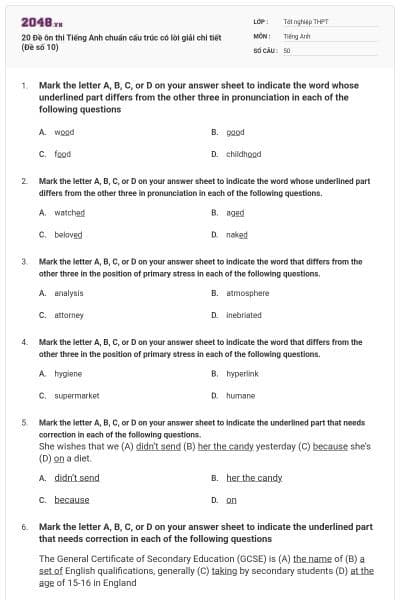
Mark the letter A, B, C, or D on your answer sheet to indicate the word whose underlined part differs from the other three in pronunciation in each of the following questions
wood
good
food
childhood
Đáp án C
Giải thích: Đáp án C phát âm là /uː/, các đáp án còn lại là /ʊ/
A. /wʊd/: củi, gỗ
B. /ɡʊd/: tốt
C. /fuːd/: đồ ăn
D. /ˈtʃaɪldhʊd/: thời ấu thơ
Mark the letter A, B, C, or D on your answer sheet to indicate the word whose underlined part differs from the other three in pronunciation in each of the following questions.
watched
aged
beloved
naked
Đáp án A
Giải thích: Phần gạch chân đáp án A phát âm là /t/, các đáp án còn lại phát âm là /id/
A. /wɒtʃt/: xem (TV...)
B. /eɪdʒid/: cổ xưa, lâu rồi
C. /bɪˈlʌvɪd/: yêu quý, mến thương
D. /ˈneɪkɪd/: trần truồng
Mark the letter A, B, C, or D on your answer sheet to indicate the word that differs from the other three in the position of primary stress in each of the following questions.
analysis
atmosphere
attorney
inebriated
Đáp án B
Giải thích: Đáp án B có trọng âm 1, các đáp án khác trọng âm 2.
A. /əˈnæləsɪs/: phân tích
B. /ˈætməsfɪə/: không khí
C. /əˈtɜːni/: luật sư
D. /ɪˈniːbrieɪtɪd/: say rượu
Mark the letter A, B, C, or D on your answer sheet to indicate the word that differs from the other three in the position of primary stress in each of the following questions.
hygiene
hyperlink
supermarket
humane
Đáp án D
Giải thích: Đáp án D có trọng âm 2, các đáp án khác trọng âm 1
A. /ˈhaɪdʒiːn/: vệ sinh sạch sẽ
B. /ˈhaɪpəlɪŋk/: siêu liên kết
C. /ˈsuːpəmɑːkɪt/: siêu thị
D. /hjuːˈmeɪn/: nhân đạo, nhân văn
Mark the letter A, B, C, or D on your answer sheet to indicate the underlined part that needs correction in each of the following questions.
She wishes that we (A) didn’t send (B) her the candy yesterday (C) because she’s (D) on a diet.
didn’t send
her the candy
because
on
Đáp án A
Giải thích: yesterday => câu ước chỉ một điều không có thật ở quá khứ. => hadn’t sent
*Công thức: S + wish(es) + S + had + V3/-ed
Dịch nghĩa: Cô ấy ước rằng chúng tôi đã không gửi cô ấy kẹo ngày hôm qua bởi vì cô ấy đang ăn kiêng
Mark the letter A, B, C, or D on your answer sheet to indicate the underlined part that needs correction in each of the following questions
The General Certificate of Secondary Education (GCSE) is (A) the name of (B) a set of English qualifications, generally (C) taking by secondary students (D) at the age of 15-16 in England
the name
a set of
taking
at the age
Đáp án C
Giải thích: “by secondary students” => rút gọn câu bị động => taken
Dịch nghĩa: Giấy chứng nhận chung về giáo dục trung học (GCSE) là tên của một bộ các chứng chỉ tiếng Anh, cái mà được thi bởi học sinh trung học ở độ tuổi 15-16 tại Anh
Mark the letter A, B, C, or D on your answer sheet to indicate the underlined part that needs correction in each of the following questions.
The world is becoming more (A) industrialized and the number of animal (B) species that have become (C) extinct (D) have increased.
industrialized
species
extinct
have
Đáp án: D
Giải thích:
Kiến thức: Sự hòa hợp giữa chủ ngữ và động từ
Câu này có sự mâu thuẫn giữa chủ ngữ "the number" (số ít) và động từ "have" (số nhiều). Vì "the number" là số ít, nên động từ phải chia theo dạng số ít, tức là "has" chứ không phải "have".
Sửa: have → has
Dịch: Thế giới đang ngày càng công nghiệp hóa và số lượng các loài động vật đã tuyệt chủng đã tăng lên.
Phân biệt:
"The number of" và "a number of" đều liên quan đến số lượng, nhưng chúng có cách sử dụng và ý nghĩa khác nhau:
The number of:
Cách sử dụng: Dùng để chỉ một số lượng xác định và cụ thể. "The number of" thường đi kèm với danh từ số ít vì chủ ngữ chính là "number" (số ít).
Ví dụ:
The number of students in the class is 30. (Số lượng học sinh trong lớp là 30.)
Lưu ý: Sau "the number of", động từ phải chia theo số ít vì "number" là danh từ số ít.
A number of:
Cách sử dụng: Dùng để chỉ một số lượng không xác định hoặc một nhóm lớn, thường mang nghĩa là "nhiều". "A number of" luôn đi kèm với danh từ số nhiều, vì vậy động từ theo sau phải chia ở dạng số nhiều.
Ví dụ:
A number of students are absent today. (Nhiều học sinh vắng mặt hôm nay.)
Lưu ý: Sau "a number of", động từ phải chia theo số nhiều.
Tóm lại:
The number of → số ít (số lượng cụ thể).
A number of → số nhiều (một số lượng lớn hoặc không xác định).
If you knew he was ill, why _________ you _________ to see him?
didn’t / come
wouldn’t / come
should / come
would / come
Đáp án B
Giải thích: Câu điều kiện loại II => diễn tả việc không có thật ở hiện tại
If + S + V2/ Ved, S +would/ Could/ Should...+ V
Dịch nghĩa: Nếu bạn biết anh ấy ốm, tại sao lại không tới thăm
I enjoy _________ busy. I don’t like it when there is nothing _________.
being / to do
to be / doing
to be / to do
being / doing
Đáp án A
Giải thích: enjoy + Ving: tận hưởng việc gì; there is nothing to V: không có gì để làmbr> Dịch nghĩa: Tôi thích sự bận rộn. Tôi không thích những khi không có gì để làm
Women no longer have to do hard work nowadays as they used to, _________?
are they
aren’t they
do they
don’t they
Đáp án C
Giải thích: Đây là mệnh đề chính trong câu “Women no longer have to do hard work nowadays” => thì hiện tại đơn có yếu tố phủ định “no longer” => câu hỏi đuôi ở thì hiện tại đơn, dạng khẳng định.
Dịch nghĩa: Ngày nay, phụ nữ không còn phải làm việc nặng nhọc như họ đã từ làm, phải không?
The local were not very friendly towards us, in fact there was a distinctly _________ atmosphere
hostile
offensive
rude
abrupt
Đáp án A
Giải thích:
A. thù địch
B. tấn công
C. thô lỗ
D. đột ngột
Dịch nghĩa: Người địa phương không thân thiện với chúng ta, trên thực tế có một bầu không khí khá là thù địch, không thích
He sent his children to the park so that he could have some _________.
fresh and quiet
quiet and peace
peace and quiet
fresh and peace
Đáp án C
Giải thích: peace and quite là một thành ngữ chỉ sự yên tĩnh, tĩnh lặng sau những giây phút mệt mỏi, ồn ào.
Dịch nghĩa: Anh ấy đưa bọn trẻ tới công viên để mà anh ấy có thể tận hưởng những phút giây yên tĩnh
Peter has been studying for almost three years and he will have this degree and return to his country in ______ six months
others
the other
other
another
Đáp án D
Giải thích:
Một danh từ đứng sau hạn định từ (determiner) another luôn phải ở số ít chứ không được ở số nhiều. Tuy nhiên, ta phải dùng danh từ số nhiều với hạn định từ another khi ngay trước danh từ đó là 1 con số: another + number (số đếm) + N (ở số nhiều)
Ví dụ: another three questions (ba câu hỏi nữa)
Dịch nghĩa: Peter đã học gần ba năm và anh ta sẽ có tấm bằng này và trở về đất nước của mình trong 6 tháng nữa
Never before ______ such a severe flood in this mountainous area.
do I see
I have seen
I had seen
have I seen
Đáp án D
Giải thích: câu đảo ngữ với “never before” => dấu hiện nhận biết của thì Hiện tại hoàn thành
*Cấu trúc: Never + trợ động từ + chủ ngữ + động từ + ....
Dịch nghĩa: Tôi chưa bao giờ nhìn thấy lũ lụt nghiêm trọng ở vùng đồi núi này
The goal is to make higher education available to everyone who is will and capable ______ his financial situation.
regardless of
owing to
in terms of
with reference to
Đáp án A
Giải thích:
A. bất kể
B. bởi vì = due to
C. xét về khía cạnh
D. có sự tham khảo
Dịch nghĩa: Mục đích là để giáo dục đại học có sẵn cho tất cả những người có ý chí và có năng lực bất kể tình hình tài chính của mình như thế nào
______ the table, Mr. Robert called the family for support
Being laid
Having laid
Have laid
Having lying
Đáp án B
Giải thích: Chủ điểm ngữ pháp liên quan tới Hiện tại phân từ ( Having PII, S V O) dùng để diễn tả 2 hành động có cùng chủ ngữ xảy ra theo thứ tự trước/sau.
Dịch: Sau khi đặt bàn, ông Robert đã gọi gia đình đến để hỗ trợ
We needed some snow; so we _______ our minds to go abroad
set in
made up
turned out
brought into
Đáp án B
Giải thích: make up one’s mind: tạo nên suy nghĩ của ai đó, quyết định làm gì.
Các đáp án còn lại:
A. (to) set in: bắt đầu
C (to) turn out: hoá ra, thành ra
D. (to) bring into: đưa vào, đề cập đến
Dịch nghĩa: Chúng tôi cần tuyết, nên chúng tôi quyết địh đi nước ngoài
Many young people have objected to _________ marriage, which is decided by the parents of the bride and groom
shared
agreed
sacrificed
contractual
Đáp án D
Giải thích: contractual marriage: hôn nhân hợp đồng
Dịch nghĩa: Rất nhiều người trẻ tuổi phản đối hôn nhân hợp đồng, cái mà được quyết định bởi bố mẹ của cô dâu chú rể
Their efforts were much __________ when they won 2 medals in bodybuilding and billiards
considered
required
expended
appreciated
Đáp án D
Giải thích:
A. cân nhắc
B. cần, yêu cầu
C. hao phí
D. trân trọng
Dịch nghĩa: Nỗ lực của họ rất đáng trân trọng khi họ thắng 2 huy chương của môn thể hình và bi-a.
Mark the letter A, B, C, or D on your answer sheet to indicate the most suitable response to complete each of the following exchanges
Helen and Mary are talking about Mary’s result at school.
- Helen: “Your parents must be proud of your result at school!”
-Mary: “_______.”
Thanks. It’s certainly encouraging
I’m glad you like it
Sorry to hear that
Of course
Đáp án A
Giải thích: Ai đó khen thì mình phải cám ơn.
Dịch nghĩa: Helen: “Bố mẹ bạn chắc hẳn phải tự hào về kết quả học tập ở trường lắm.”
Mary: “Cám ơn bạn. Điều đó chắc chắn khích lệ tôi rất nhiều.”
Mark the letter A, B, C, or D on your answer sheet to indicate the most suitable response to complete each of the following exchanges
Laura and David are talking about the benefits of swimming.
- Laura: “I think swimming helps us exercise all our muscles.”
- David: “_______.”
You can do it. Thanks anyway
There is no doubt about it
Not at all. You can make it
Yes, swimming does, too
Đáp án B
Giải thích:
A. Bạn có thể làm được điều đó. Dù sao cũng cám ơn.
B. Không nghi ngờ gì về điều đó
C. không hẳn là thế. Bạn có thể tạo ra nó.
D. Ừ, bơi cũng thế.
Dịch nghĩa: Laura: “Tôi nghĩ bơi giúp chúng ta rèn luyện các cơ của mình.”
David: “Không nghi ngờ gì về điều đó.” => HOÀN TOÀN ĐỒNG Ý
Mark the letter A, B, C, or D on your answer sheet to indicate the word CLOSEST in meaning to the underlined word in each of the following questions.
By the end of the storm, the hikers had depleted their emergency stores.
lost
greatly dropped
destroyed
used almost all of
Đáp án D
Giải thích: deplete: cạn kiệt
A. mất
B. giảm đáng kể
C. phá hủy
D. sử dụng hầu hết tất cả
Dịch nghĩa: Vào cuối cơn bão, những người đi bộ đường dài đã cạn kiệt dự trữ khẩn cấp.
Mark the letter A, B, C, or D on your answer sheet to indicate the word CLOSEST in meaning to the underlined word in each of the following questions
Domestic chores will no longer be a burden thanks to the inventions of laborsaving devices.
Official
Household
Foreign
Schooling
Đáp án B
Giải thích: Domestic: thuộc về trong gia đình, trong nhà.
A. Chính thức
B. Gia đình
C. Bên ngoài
D. Trường học
Dịch nghĩa: Các việc vặt trong nhà sẽ không còn là gánh nặng nhờ những phát minh của các thiết bị lao động
Mark the letter A, B, C, or D on your answer sheet to indicate the word(s) OPPOSITE in meaning to the underlined word(s) in each of the following questions.
After her husband's tragic accident, she took up his position at the university.
incredible
boring
mysterious
comic
Đáp án D
Giải thích: tragic: bi thương, thảm khốc
A. không thể tin được
B. nhàm chán
C. huyền bí
D. truyện tranh, buồn cười
Dịch nghĩa: Sau tai nạn thảm khốc của chồng, cô đảm nhiệm vị trí của anh ấy tại trường đại học
Mark the letter A, B, C, or D on your answer sheet to indicate the word(s) OPPOSITE in meaning to the underlined word(s) in each of the following questions.
Doctors have criticized the government for failing to invest enough in the health service
praised
blamed
accused
commented
Đáp án A
Giải thích: criticize: chỉ trích
A. khen ngợi
B. đổ lỗi
C. buộc tội
D. bình luận
Dịch nghĩa: Các bác sĩ chỉ trích chính phủ vì đã không viện trợ đủ dịch vụ y tế
Mark the letter A, B, C, or D on your answer sheet to indicate the sentence that is closest in meaning to each of the following questions
Due to the fact that the demand for tea was very high in the 19th century, its price increased much
It was not until the 19th century that the demand for tea started to increase
In the 19th century the price for tea didn’t increase despite the demand
The demand for tea was so high in the 19th century that its price increased much.
It was its price that decreased the demand for tea in the 19th century.
Đáp án C
Giải thích:
A. Mãi cho đến thế kỷ 19, nhu cầu về chè bắt đầu gia tăng. => SAI NGHĨA
B. Trong thế kỷ 19 giá của trà không tăng bất chấp nhu cầu cao. => SAI NGHĨA
C. Nhu cầu chè cao rất trong thế kỷ 19 đến nỗi mà giá của nó đã tăng lên rất nhiều.
D. Giá của nó làm giảm nhu cầu trà vào thế kỷ 19. => SAI NGHĨA
Dịch nghĩa: Do nhu cầu về trà rất cao trong thế kỷ 19, nên giá của nó đã tăng lên rất nhiều
Mark the letter A, B, C, or D on your answer sheet to indicate the sentence that is closest in meaning to each of the following questions
He started to study at 2 o’clock. He is still studying now
He has been studying since 2 o’clock
He has been studying for 2 hours
He was studying since 2 o’clock
He usually studies for 2 hours
Đáp án A
Giải thích:
A. Anh ấy đã đang học từ lúc 2 giờ.
B. Anh ấy đã đang học trong hai tiếng đồng hồ => SAI THÌ
C. Anh ấy đã học từ lúc 02 giờ. => SAI THÌ
D. Anh ấy thường học trong 2 tiếng đồng hồ. => SAI NGHĨA
Dịch nghĩa: Anh ấy bắt đầu học lúc 2 giờ. Anh ấy vẫn đang học bây giờ
Mark the letter A, B, C, or D on your answer sheet to indicate the sentence that is closest in meaning to each of the following questions
“It’s a surprising gift. Thank you very much, Mary.” said Mr Pike.
Mr Pike promised to give Mary a surprising gift
Mr Pike congratulated Mary on a surprising gift
Mr Pike thanked Mary though he did not really like gift.
Mr Pike thanked Mary for the surprising gift.
Đáp án D
Giải thích:
A. Ông Pike hứa sẽ cho Mary một món quà bất ngờ. => SAI NGHĨA
B. Ông Pike chúc mừng Mary về một món quà bất ngờ. => SAI NGHĨA
C. Pike cảm ơn Mary mặc dù ông không thực sự thích món quà. => SAI NGHĨA
D. Ông Pike cám ơn Mary vì một món quà đáng bất ngờ.
Dịch nghĩa: "Đó là một món quà bất ngờ . Cảm ơn bạn rất nhiều, Mary. "Ông Pike nói.
Mark the letter A, B, C, or D on your answer sheet to indicate the sentence that best combines each pair of sentences in the following questions:
Mr Andy is repairing the refrigerator in the kitchen at the moment.
The refrigerator is being repaired in the kitchen at the moment by Mr Andy
The refrigerator is repaired in the kitchen by Mr Andy at the moment
The refrigerator is being repaired in the kitchen by Mr Andy at the moment
The refrigerator is being repaired at the moment by Mr Andy in the kitchen
Đáp án C
Giải thích: trong câu bị động, trạng từ chỉ thời gian đứng trước, by + chủ ngữ đứng sau.
Dịch nghĩa: Ông Andy đang sửa cái tủ lạnh trong phòng bếp ngay lúc này
Mark the letter A, B, C, or D on your answer sheet to indicate the sentence that best combines each pair of sentences in the following questions
Provided your handwriting is legible, the examiner will accept your answer.
Although the examiner cannot read your handwriting, he will accept your answer
Whatever your handwriting, the examiner will accept your answer
The examiner will accept your answer if your handwriting is beautiful
So long as the examiner can read your handwriting, he will accept your answer
Đáp án D
Giải thích:
A. Mặc dù người kiểm tra không thể đọc được chữ viết tay của bạn, anh ta sẽ chấp nhận câu trả lời của bạn.
=> SAI NGHĨA
B. Dù chữ viết tay của bạn như thế nào, người kiểm tra sẽ chấp nhận câu trả lời của bạn.
=> SAI NGHĨA
C. Người kiểm tra sẽ chấp nhận câu trả lời của bạn nếu chữ viết tay của bạn đẹp.
=> SAI NGHĨA
D. Miễn là người kiểm tra có thể đọc được chữ viết tay của bạn, anh ta sẽ chấp nhận câu trả lời của bạn.
Dịch nghĩa: Trong trường hợp chữ viết tay của bạn là rõ ràng, người kiểm tra sẽ chấp nhận câu trả lời của bạn
Read the following passage and mark the letter A, B, C, or D on your answer sheet to indicate the correct word or phrase that best fits each of the numbered blanks from 31 to 35.
Most educational specialists believe that early schooling should provide children with an (31) ________ of their own abilities and the self-confidence to use their abilities. One approach recognized by many (32) ________ as promoting these qualities is the Montessori method, first practiced by Maria Montessori of Italy in the early 1900s. Nancy McCormick Rambusch is credited with (33) ________ the method in the United States, where today there are over 400 Montessori schools.
The method helps children learn for themselves by (34) ________ them with instructional materials and tasks that facilitate acts of discovery and manipulation. Through such exploration, children develop their sense of touch and learn (35) ________ to do everyday tasks without adult assistance. Other benefits include improvement in language skills, and acquaintance with elements of science, music, and art
Điền ô số 31
awareness
attitude
attention
knowledge
Đáp án A
Câu hỏi từ vựng.
A. awareness (n): sự nhận thức
B. attitude (n): thái độ
C. attention (n): sự chú ý
D. knowledge (n): kiến thức
Dịch nghĩa: Hầu hết các chuyên gia giáo dục tin rằng việc đi học sớm nên cung cấp cho trẻ em một sự nhận thức về khả năng của mình và sự tự tin để sử dụng những khả năng của mình
DỊCH BÀI
Hầu hết các chuyên gia giáo dục tin rằng việc đi học sớm nên cung cấp cho trẻ em nhận thức về khả năng của mình và sự tự tin để sử dụng khả năng của mình. Một phương pháp tiếp cận được nhiều chuyên gia công nhận là việc thúc đẩy những phẩm chất này là phương pháp Montessori, được thực hiện bởi Maria Montessori của Ý vào đầu những năm 1900. Nancy McCormick Rambusch được tín nhiệm trong việc phổ biến phương pháp này tại Hoa Kỳ, nơi hiện nay có hơn 400 trường học Montessori.
Phương pháp này giúp trẻ tự học bằng cách cung cấp cho chúng các tài liệu giảng dạy và các nhiệm vụ tạo điều kiện cho các hành vi khám phá và vận dụng. Thông qua thăm dò, trẻ em phát triển cảm giác liên lạc và học cách làm các công việc hàng ngày mà không cần sự trợ giúp của người lớn. Các lợi ích khác bao gồm nâng cao kỹ năng ngôn ngữ, và làm quen với các yếu tố của khoa học, âm nhạc và nghệ thuật
Read the following passage and mark the letter A, B, C, or D on your answer sheet to indicate the correct word or phrase that best fits each of the numbered blanks from 31 to 35.
Most educational specialists believe that early schooling should provide children with an (31) ________ of their own abilities and the self-confidence to use their abilities. One approach recognized by many (32) ________ as promoting these qualities is the Montessori method, first practiced by Maria Montessori of Italy in the early 1900s. Nancy McCormick Rambusch is credited with (33) ________ the method in the United States, where today there are over 400 Montessori schools.
The method helps children learn for themselves by (34) ________ them with instructional materials and tasks that facilitate acts of discovery and manipulation. Through such exploration, children develop their sense of touch and learn (35) ________ to do everyday tasks without adult assistance. Other benefits include improvement in language skills, and acquaintance with elements of science, music, and art
Điền ô số 32
researcher
teacher
tutors
experts
Đáp án D
Câu hỏi từ vựng.
A. researcher (n): nhà nghiên cứu
B. teacher (n): giáo viên
C. tutors: gia sư
D. experts: chuyên gia
Đáp án A và B sai vì sau many danh từ phải ở dạng số nhiều.
Dịch nghĩa: Một phương pháp được nhiều chuyên gia công nhận để thúc đẩy những phẩm chất này là phương pháp Montessori, được thực hiện lần đàu tiên bởi Maria Montessori của Ý vào đầu những năm 1900
Read the following passage and mark the letter A, B, C, or D on your answer sheet to indicate the correct word or phrase that best fits each of the numbered blanks from 31 to 35.
Most educational specialists believe that early schooling should provide children with an (31) ________ of their own abilities and the self-confidence to use their abilities. One approach recognized by many (32) ________ as promoting these qualities is the Montessori method, first practiced by Maria Montessori of Italy in the early 1900s. Nancy McCormick Rambusch is credited with (33) ________ the method in the United States, where today there are over 400 Montessori schools.
The method helps children learn for themselves by (34) ________ them with instructional materials and tasks that facilitate acts of discovery and manipulation. Through such exploration, children develop their sense of touch and learn (35) ________ to do everyday tasks without adult assistance. Other benefits include improvement in language skills, and acquaintance with elements of science, music, and art
Điền ô số 33
popular
popularity
popularize
popularizing
Đáp án D
Ở vị trí này ta cần một danh động từ. => Chọn D. popularizing
popular (adj): phổ biến => popularity (n): sự phổ biến => popularize (v): làm cho phổ biến
Dịch nghĩa: Nancy McCormick Rambusch được tin tưởng trong việc phổ biến phương pháp này tại Hoa Kỳ, nơi hiện nay có hơn 400 trường năng khiếu
Read the following passage and mark the letter A, B, C, or D on your answer sheet to indicate the correct word or phrase that best fits each of the numbered blanks from 31 to 35.
Most educational specialists believe that early schooling should provide children with an (31) ________ of their own abilities and the self-confidence to use their abilities. One approach recognized by many (32) ________ as promoting these qualities is the Montessori method, first practiced by Maria Montessori of Italy in the early 1900s. Nancy McCormick Rambusch is credited with (33) ________ the method in the United States, where today there are over 400 Montessori schools.
The method helps children learn for themselves by (34) ________ them with instructional materials and tasks that facilitate acts of discovery and manipulation. Through such exploration, children develop their sense of touch and learn (35) ________ to do everyday tasks without adult assistance. Other benefits include improvement in language skills, and acquaintance with elements of science, music, and art
Điền ô số 34
giving
instructing
sending
providing
Đáp án D
Câu hỏi từ vựng.
(to) provide sombody with something: cung cấp cho ai cái gì
Các đáp án còn lại:
A. (to) give: cho
B. (to) instruct: hướng dẫn
C. (to) send: gửi
Dịch nghĩa: Phương pháp này giúp trẻ học cho mình bằng cách cung cấp cho chúng những tài liệu hướng dẫn và các nhiệm vụ tạo điều kiện cho các hành vi khám phá và thao tác
Read the following passage and mark the letter A, B, C, or D on your answer sheet to indicate the correct word or phrase that best fits each of the numbered blanks from 31 to 35.
Most educational specialists believe that early schooling should provide children with an (31) ________ of their own abilities and the self-confidence to use their abilities. One approach recognized by many (32) ________ as promoting these qualities is the Montessori method, first practiced by Maria Montessori of Italy in the early 1900s. Nancy McCormick Rambusch is credited with (33) ________ the method in the United States, where today there are over 400 Montessori schools.
The method helps children learn for themselves by (34) ________ them with instructional materials and tasks that facilitate acts of discovery and manipulation. Through such exploration, children develop their sense of touch and learn (35) ________ to do everyday tasks without adult assistance. Other benefits include improvement in language skills, and acquaintance with elements of science, music, and art
Điền ô số 35
how
what
that
which
Đáp án A
how to V: làm cái gì như thế nào
Đại từ quan hệ that thay thế cho cả danh từ chỉ người và vật. That không dùng trong mệnh đề quan hệ không xác định.
Which là đại từ quan hệ thay thế cho danh từ chỉ vật.
Dịch nghĩa: Thông qua việc khám phá, trẻ em phát triển về xúc giác và học cách làm những công việc hàng ngày như thế nào mà không cần sự trợ giúp của người lớn
Read the following passage and mark the letter A, B, C, or D on your answer sheet to indicate the correct answer to each of the questions from 36 to 42.
When we moved to our new house near the sea, I was eight years old. Even before that I had spent every summer messing about on boats. My dad had taught me to sail before I learnt to ride a bike so I knew how I wanted to spend my time at the new house- I was going to get my own boat and sail it everyday. The house was only a few meters from the water's edge, and in rough weather the waves would come crashing into the front garden. I used to sit with my nose pressed to the glass, fascinated by the power of the ocean. I grew up watching the skies to see if it was going to rain; would I be going sailing that afternoon or not?
Of course I sometimes wished I could live in the town like my friends. I used to get irritated with my parents, who had taken early retirement because they seemed incapable of getting anywhere on time. Dad drove me the eight miles to school everyday, but I was often late because he had been walking on the cliffs earlier in the morning and had lost track of time. When I was taking my university entrance exams, I used to stay over at a friend’s in town, just in case. All in all, I was lucky to grow up by the sea and I still love to sail
At the age of eight, the writer's house was ___________.
in the town
by the sea
on boat
under the mountain
Đáp án B
Ở tuổi tám, nhà của nhà văn là ___________.
A. Trong thị trấn
B. gần biển
C. trên thuyền
D. dưới núi
Giải thích: “When we moved to our new house near the sea, I was eight years old.” (Khi chúng tôi chuyển đến căn nhà mới gần biển, tôi lên 8 tuổi.
DỊCH BÀI
Khi chúng tôi chuyển đến nhà mới gần biển, tôi đã tám tuổi. Ngay cả trước đó tôi đã dành mỗi mùa hè lộn xộn trên thuyền. Bố tôi đã dạy tôi đi thuyền trước khi học lái xe đạp vì vậy tôi biết tôi muốn dành thời gian ở nhà mới như thế nào - tôi sẽ đi thuyền của riêng tôi và đi thuyền hàng ngày. Ngôi nhà chỉ cách bờ biển vài mét, và trong thời tiết khắc nghiệt, những con sóng sẽ đâm vào khu vườn phía trước. Tôi thường ngồi với mũi của tôi ép vào ly, bị cuốn hút bởi sức mạnh của đại dương. Tôi lớn lên nhìn bầu trời để xem nếu trời sắp mưa; tôi sẽ đi thuyền vào buổi chiều hay không?
Tất nhiên đôi khi tôi ước mình có thể sống trong thị trấn như bạn bè của tôi. Tôi đã từng bị kích thích với bố mẹ tôi, người đã nghỉ hưu sớm vì họ dường như không thể đi được bất cứ lúc nào. Bố lái xe cho tôi tám dặm đến trường hàng ngày, nhưng tôi thường là muộn vì ông đã đi bộ trên các vách đá sớm vào buổi sáng và đã mất theo dõi thời gian. Khi tôi đang dự kỳ thi vào đại học, tôi đã từng ở lại một người bạn trong thành phố, chỉ trong trường hợp. Trong tất cả, tôi đã may mắn lớn lên ở biển và tôi vẫn thích đi thuyền buồm
Read the following passage and mark the letter A, B, C, or D on your answer sheet to indicate the correct answer to each of the questions from 36 to 42.
When we moved to our new house near the sea, I was eight years old. Even before that I had spent every summer messing about on boats. My dad had taught me to sail before I learnt to ride a bike so I knew how I wanted to spend my time at the new house- I was going to get my own boat and sail it everyday. The house was only a few meters from the water's edge, and in rough weather the waves would come crashing into the front garden. I used to sit with my nose pressed to the glass, fascinated by the power of the ocean. I grew up watching the skies to see if it was going to rain; would I be going sailing that afternoon or not?
Of course I sometimes wished I could live in the town like my friends. I used to get irritated with my parents, who had taken early retirement because they seemed incapable of getting anywhere on time. Dad drove me the eight miles to school everyday, but I was often late because he had been walking on the cliffs earlier in the morning and had lost track of time. When I was taking my university entrance exams, I used to stay over at a friend’s in town, just in case. All in all, I was lucky to grow up by the sea and I still love to sail
The word “rough” is closest in meaning to ____________.
careful
forceful
easy
mild
Đáp án B
Giải thích: Rough (dữ dội, hung hãn, mạnh mẽ) = forceful.
Easy: dễ dàng
Careful: cẩn thận
Mild: nhẹ nhàng
Read the following passage and mark the letter A, B, C, or D on your answer sheet to indicate the correct answer to each of the questions from 36 to 42.
When we moved to our new house near the sea, I was eight years old. Even before that I had spent every summer messing about on boats. My dad had taught me to sail before I learnt to ride a bike so I knew how I wanted to spend my time at the new house- I was going to get my own boat and sail it everyday. The house was only a few meters from the water's edge, and in rough weather the waves would come crashing into the front garden. I used to sit with my nose pressed to the glass, fascinated by the power of the ocean. I grew up watching the skies to see if it was going to rain; would I be going sailing that afternoon or not?
Of course I sometimes wished I could live in the town like my friends. I used to get irritated with my parents, who had taken early retirement because they seemed incapable of getting anywhere on time. Dad drove me the eight miles to school everyday, but I was often late because he had been walking on the cliffs earlier in the morning and had lost track of time. When I was taking my university entrance exams, I used to stay over at a friend’s in town, just in case. All in all, I was lucky to grow up by the sea and I still love to sail
The writer's father retired early because ___________.
he walked on the cliffs every morning
he lost track of time
he had to drive his kid to school everyday
he was unable to get anywhere on time
Đáp án D
Cha của người viết đã về hưu sớm vì ___________.
A. Ông ấy leo lên vách đá mỗi sáng
B. Ông ấy mất khái niệm về thời gian
C. Ông ấy phải lái xe đưa bọn trẻ con đi học mỗi ngày
D. Ông ấy không thể đi đến bất cứ nơi nào đúng giờ.
Giải thích: “I used to get irritated with my parents, who had taken early retirement because they seemed incapable of getting anywhere on time.” (Tôi đã từng hay bực mình với bố mẹ mình, người nghỉ hưu sớm bởi họ dường như chẳng bao giờ đến được đâu cho đúng giờ.)
Read the following passage and mark the letter A, B, C, or D on your answer sheet to indicate the correct answer to each of the questions from 36 to 42.
When we moved to our new house near the sea, I was eight years old. Even before that I had spent every summer messing about on boats. My dad had taught me to sail before I learnt to ride a bike so I knew how I wanted to spend my time at the new house- I was going to get my own boat and sail it everyday. The house was only a few meters from the water's edge, and in rough weather the waves would come crashing into the front garden. I used to sit with my nose pressed to the glass, fascinated by the power of the ocean. I grew up watching the skies to see if it was going to rain; would I be going sailing that afternoon or not?
Of course I sometimes wished I could live in the town like my friends. I used to get irritated with my parents, who had taken early retirement because they seemed incapable of getting anywhere on time. Dad drove me the eight miles to school everyday, but I was often late because he had been walking on the cliffs earlier in the morning and had lost track of time. When I was taking my university entrance exams, I used to stay over at a friend’s in town, just in case. All in all, I was lucky to grow up by the sea and I still love to sail
The following are true EXCEPT ___________.
the waves came crashing into the writer's front garden in bad weather
the write moved to a new house when he was 8
the writer didn't know how to sail
the distance from the writer's house to school was 8 miles
Đáp án C
Những điều sau đây đúng là ngoại trừ ___________.
A. các sóng đến đâm vào khu vườn phía trước của nhà văn trong thời tiết xấu
B. nhà văn chuyển tới nhà mới vào năm 8 tuổi.
C. nhà văn không biết làm thế nào để chèo thuyền.
D. khoảng cách từ ngôi nhà của nhà văn đến trường học là 8 dặm
Giải thích: “My dad had taught me to sail before I learnt to ride a bike...” (Bố tôi đã dạy tôi chèo thuyền từ trước khi tôi học đạp xe đạp...)
Read the following passage and mark the letter A, B, C, or D on your answer sheet to indicate the correct answer to each of the questions from 36 to 42.
When we moved to our new house near the sea, I was eight years old. Even before that I had spent every summer messing about on boats. My dad had taught me to sail before I learnt to ride a bike so I knew how I wanted to spend my time at the new house- I was going to get my own boat and sail it everyday. The house was only a few meters from the water's edge, and in rough weather the waves would come crashing into the front garden. I used to sit with my nose pressed to the glass, fascinated by the power of the ocean. I grew up watching the skies to see if it was going to rain; would I be going sailing that afternoon or not?
Of course I sometimes wished I could live in the town like my friends. I used to get irritated with my parents, who had taken early retirement because they seemed incapable of getting anywhere on time. Dad drove me the eight miles to school everyday, but I was often late because he had been walking on the cliffs earlier in the morning and had lost track of time. When I was taking my university entrance exams, I used to stay over at a friend’s in town, just in case. All in all, I was lucky to grow up by the sea and I still love to sail
Growing up by the sea, the writer felt___________.
unlucky
irritated
excited
lucky
Đáp án A
Lớn lên gần biển, nhà văn cảm thấy ___
A. không may mắn
B. khó chịu
C. vui thích
D. may mắn
Giải thích: “All in all, I was lucky to grow up by the sea and I still love to sail.” (Cuối cùng thì, tôi đã rất may mắn lớn lên gần biển, và tôi vẫn rất yêu thích việc chèo thuyền
Read the following passage and mark the letter A, B, C, or D on your answer sheet to indicate the correct answer to each of the questions from 36 to 42.
When we moved to our new house near the sea, I was eight years old. Even before that I had spent every summer messing about on boats. My dad had taught me to sail before I learnt to ride a bike so I knew how I wanted to spend my time at the new house- I was going to get my own boat and sail it everyday. The house was only a few meters from the water's edge, and in rough weather the waves would come crashing into the front garden. I used to sit with my nose pressed to the glass, fascinated by the power of the ocean. I grew up watching the skies to see if it was going to rain; would I be going sailing that afternoon or not?
Of course I sometimes wished I could live in the town like my friends. I used to get irritated with my parents, who had taken early retirement because they seemed incapable of getting anywhere on time. Dad drove me the eight miles to school everyday, but I was often late because he had been walking on the cliffs earlier in the morning and had lost track of time. When I was taking my university entrance exams, I used to stay over at a friend’s in town, just in case. All in all, I was lucky to grow up by the sea and I still love to sail
The writer learnt to sail _____________.
before learning to ride a bike
when his family moved to a new house
before going to school
when he/ she was eight
Đáp án A
Người viết đã học chèo thuyền_____________.
A. Trước khi học lái xe đạp
B. khi gia đình chuyển đến ngôi nhà mới
C. trước khi đi học
D. khi anh ta / cô ta lên tám
Giải thích: "My dad had taught me to sail before I learnt to ride a bike...” (Bố tôi đã dạy tôi chèo thuyền từ trước khi tôi học đạp xe đạp...)
Read the following passage and mark the letter A, B, C, or D on your answer sheet to indicate the correct answer to each of the questions from 36 to 42.
When we moved to our new house near the sea, I was eight years old. Even before that I had spent every summer messing about on boats. My dad had taught me to sail before I learnt to ride a bike so I knew how I wanted to spend my time at the new house- I was going to get my own boat and sail it everyday. The house was only a few meters from the water's edge, and in rough weather the waves would come crashing into the front garden. I used to sit with my nose pressed to the glass, fascinated by the power of the ocean. I grew up watching the skies to see if it was going to rain; would I be going sailing that afternoon or not?
Of course I sometimes wished I could live in the town like my friends. I used to get irritated with my parents, who had taken early retirement because they seemed incapable of getting anywhere on time. Dad drove me the eight miles to school everyday, but I was often late because he had been walking on the cliffs earlier in the morning and had lost track of time. When I was taking my university entrance exams, I used to stay over at a friend’s in town, just in case. All in all, I was lucky to grow up by the sea and I still love to sail
When taking the university entrance exams, ___________.
the writer's family moved to a new house by the sea
the writer had to live in a friend's house
the weather was terrible
the writer's father drove him/ her to university
Đáp án B
Khi thi đại học, ___________.
A. gia đình nhà văn chuyển sang một ngôi nhà mới bên bờ biển
B. các nhà văn phải sống trong nhà của một người bạn
C. thời tiết là khủng khiếp
D. cha của người viết lái xe đưa anh ta lên đại học
Giải thích: “When I was taking my university entrance exams, I used to stay over at a friend's in town, just in case.” (Khi tôi đi thi đại học, tôi đã phải ở lại nhà bạn trong thành phố, phòng trường hợp ko may.)
Read the following passage and mark the letter A, B, C, or D on your answer sheet to indicate the correct answer to each of the questions from 43 to 50.
Although noise, commonly defined as unwanted sound, is a widely recognized form of pollution, it is very difficult to measure because the discomfort experienced by different individuals is highly subjective and, therefore, variable. Exposure to lower levels of noise may be slightly irritating, whereas exposure to higher levels may actually cause hearing loss. Particularly in congested urban areas, the noise produced as a by-product of our advancing technology causes physical and psychological harm, and detracts from the quality of life for those who are exposed to it.
Unlike the eyes, which can be covered by the eyelids against strong light, the ear has no lid, and is, therefore, always open and vulnerable; noise penetrates without protection.
Noise causes effects that the hearer cannot control and to which the body never becomes accustomed. Loud noises instinctively signal danger to any organism with a hearing mechanism, including human beings. In response, heartbeat and respiration accelerate, blood vessels constrict, the skin pales, and muscles tense. In fact, there is a general increase in functioning brought about by the flow of adrenaline released in response to fear, and some of these responses persist even longer than the noise, occasionally as long as thirty minutes after the sound has ceased.
Because noise is unavoidable in a complex, industrial society, we are constantly responding in the same way that we would respond to danger. Recently, researchers have concluded that noise and our response may be much more than an annoyance. It may be a serious threat to physical and psychological health and well-being, causing damage not only to the ear and brain but also to the heart and stomach. We have long known that hearing loss is America’s number one nonfatal health problem, but now we are learning that some of us with heart disease and ulcers may be victims of noise as well. Fetuses exposed to noise tend to be overactive, they cry easily, and they are more sensitive to gastrointestinal problems after birth. In addition, the psychic effect of noise is very important. Nervousness, irritability, tension, and anxiety increase affecting the quality of rest during sleep, and the efficiency of activities during waking hours, as well as the way that we interact with each other
Which of the following is the author’s main point?
Hearing loss is America’s number one nonfatal health problem
Loud noises signal danger
Noise may pose a serious threat to our physical and psychological health
The ear is not like the eye
Đáp án C
Giải thích:
Dòng nào sau đây là ý chính của tác giả?
A. Mất thính giác là vấn đề sức khoẻ không đe dọa đến tính mạng số một ở Mỹ.
B. Tiếng ồn phát ra tín hiệu nguy hiểm.
C. Tiếng ồn có thể gây ra mối đe dọa nghiêm trọng đối với sức khoẻ thể chất và tâm lý của chúng ta.
D. Tai không giống với mắt.
Trong đoạn 1, tác giả chỉ ra “Particularly in congested urban areas, the noise produced as a by-product of our advancing technology causes physical and psychological harm, and detracts from the quality of life for those who are exposed to it.” (Đặc biệt ở các khu đô thị đông đúc, tiếng ồn, phát sinh như là sản phẩm phụ của công nghệ tiên tiến, gây ra những tổn hại về thể chất và tâm lý, và làm giảm chất lượng cuộc sống của những người tiếp xúc với nó.)
Ở đoạn 2, tác giả chỉ ra những phản ứng của cơ thể đối với tiếng ồn “Noise causes effects that the hearer cannot control and to which the body never becomes accustomed. (Tiếng ồn gây ra những phản ứng mà người nghe không thể kiểm soát được và cơ thể không bao giờ có thể quen thuộc với chúng.)
Đến đoạn 3, tác giả chỉ ra những tác hại của tiếng ồn đối với con người “Recently, researchers have concluded that noise and our response may be much more than an annoyance. It may be a serious threat to physical and psychological health and well-being” (Gần đây, các nhà nghiên cứu đã kết luận rằng tác hại của tiếng ồn và phản ứng của chúng ta có thể nhiều hơn là sự khó chịu. Nó có thể là một mối đe dọa nghiêm trọng đối với sức khoẻ thể chất và tâm lý và hạnh phúc của chúng ta.)
=> Ý chính của tác giả trong văn bản này là “Tiếng ồn có thể gây ra mối đe dọa nghiêm trọng đối với sức khoẻ thể chất và tâm lý của chúng ta.”
DỊCH BÀI
Mặc dù tiếng ồn, thường được định nghĩa là âm thanh không mong muốn, là một hình thức ô nhiễm được thừa nhận rộng rãi, nó rất khó để đo lường bởi vì sự khó chịu của các cá nhân khác nhau là chủ quan và, vì vậy, nó rất đa dạng. Tiếp xúc với mức độ tiếng ồn thấp có thể gây khó chịu một chút, trong khi tiếp xúc ở mức cao hơn có thể gây ra tình trạng mất thính giác. Đặc biệt ở các khu đô thị đông đúc, tiếng ồn, phát sinh như là sản phẩm phụ của công nghệ tiên tiến, gây ra những tổn hại về thể chất và tâm lý, và làm giảm chất lượng cuộc sống của những người tiếp xúc với nó.
Không giống như mắt, có thể được bao phủ bởi mí mắt giúp chống lại ánh sáng mạnh mẽ, tai không có thứ gì che đậy, và do đó, nó luôn luôn mở và dễ bị tổn thương; tiếng ồn xâm nhập mà không cần thông qua màn bảo vệ. Tiếng ồn gây ra những phản ứng mà người nghe không thể kiểm soát được và cơ thể không bao giờ quen thuộc với chúng. Những âm thanh ồn ào theo bản năng báo hiệu sự nguy hiểm cho bất cứ sinh vật nào bằng cơ chế lắng nghe, bao gồm cả con người. Đáp lại, nhịp tim và hô hấp tăng lên, các mạch máu co lại, da trở nên nhợt nhạt và cơ căng lên. Trên thực tế, có một sự gia tăng chung trong các chức năng do luồng adrenaline phát ra do phản ứng sợ hãi, và một số phản ứng vẫn tồn tại lâu hơn tiếng ồn, đôi khi là ba mươi phút sau khi âm thanh dừng lại. Bởi vì tiếng ồn là điều không thể tránh khỏi trong một xã hội công nghiệp phức tạp, chúng ta liên tục phản ứng lại nó theo cách mà chúng ta sẽ phản ứng lại với nguy hiểm. Gần đây, các nhà nghiên cứu đã kết luận rằng tác hại của tiếng ồn và phản ứng của chúng ta có thể nhiều hơn là sự khó chịu. Nó có thể là một mối đe dọa nghiêm trọng đối với sức khoẻ thể chất và tâm lý và hạnh phúc của chúng ta, nó gây tổn thương không chỉ ở tai và não mà còn cho tim và dạ dày. Từ lâu chúng ta biết rằng mất thính giác là vấn đề sức khoẻ không nguy hiểm đến tính mạng số một của Hoa Kỳ, nhưng bây giờ chúng ta đang được nghe rằng một số trong chúng ta có bệnh tim và loét dạ dày cũng có thể là nạn nhân của tiếng ồn. Các thai nhi tiếp xúc với tiếng ồn thường có phản ứng quá khích, chúng dễ khóc và nhạy cảm hơn với các vấn đề về đường tiêu hóa sau khi sinh. Ngoài ra, ảnh hưởng tấm lí của tiếng ồn cũng rất quan trọng. Sự bồn chồn, cáu kỉnh căng thẳng, và lo lắng tăng lên ảnh hưởng đến chất lượng của sự thư giãn trong khi ngủ, và hiệu quả của các hoạt động trong thời gian thức giấc, cũng như cách mà chúng ta tương tác với nhau
Read the following passage and mark the letter A, B, C, or D on your answer sheet to indicate the correct answer to each of the questions from 43 to 50.
Although noise, commonly defined as unwanted sound, is a widely recognized form of pollution, it is very difficult to measure because the discomfort experienced by different individuals is highly subjective and, therefore, variable. Exposure to lower levels of noise may be slightly irritating, whereas exposure to higher levels may actually cause hearing loss. Particularly in congested urban areas, the noise produced as a by-product of our advancing technology causes physical and psychological harm, and detracts from the quality of life for those who are exposed to it.
Unlike the eyes, which can be covered by the eyelids against strong light, the ear has no lid, and is, therefore, always open and vulnerable; noise penetrates without protection.
Noise causes effects that the hearer cannot control and to which the body never becomes accustomed. Loud noises instinctively signal danger to any organism with a hearing mechanism, including human beings. In response, heartbeat and respiration accelerate, blood vessels constrict, the skin pales, and muscles tense. In fact, there is a general increase in functioning brought about by the flow of adrenaline released in response to fear, and some of these responses persist even longer than the noise, occasionally as long as thirty minutes after the sound has ceased.
Because noise is unavoidable in a complex, industrial society, we are constantly responding in the same way that we would respond to danger. Recently, researchers have concluded that noise and our response may be much more than an annoyance. It may be a serious threat to physical and psychological health and well-being, causing damage not only to the ear and brain but also to the heart and stomach. We have long known that hearing loss is America’s number one nonfatal health problem, but now we are learning that some of us with heart disease and ulcers may be victims of noise as well. Fetuses exposed to noise tend to be overactive, they cry easily, and they are more sensitive to gastrointestinal problems after birth. In addition, the psychic effect of noise is very important. Nervousness, irritability, tension, and anxiety increase affecting the quality of rest during sleep, and the efficiency of activities during waking hours, as well as the way that we interact with each other
According to the passage, what is noise?
A byproduct of technology
Physical and psychological harm
Congestion
Unwanted sound
Đáp án D
Theo đoạn văn, tiếng ồn là gì?
A. Một sản phẩm phụ của công nghệ
B. Tổn thương về thể chất và tâm lý
C. Sự tắc nghẽn
D. Những âm thanh không mong muốn
Thông tin ở câu: “Although noise, commonly defined as unwanted sound, is a widely recognized form of pollution,...” (Mặc dù tiếng ồn, thường được định nghĩa là âm thanh không mong muốn, là một hình thức ô nhiễm được thừa nhận rộng rãi,...)
Read the following passage and mark the letter A, B, C, or D on your answer sheet to indicate the correct answer to each of the questions from 43 to 50.
Although noise, commonly defined as unwanted sound, is a widely recognized form of pollution, it is very difficult to measure because the discomfort experienced by different individuals is highly subjective and, therefore, variable. Exposure to lower levels of noise may be slightly irritating, whereas exposure to higher levels may actually cause hearing loss. Particularly in congested urban areas, the noise produced as a by-product of our advancing technology causes physical and psychological harm, and detracts from the quality of life for those who are exposed to it.
Unlike the eyes, which can be covered by the eyelids against strong light, the ear has no lid, and is, therefore, always open and vulnerable; noise penetrates without protection.
Noise causes effects that the hearer cannot control and to which the body never becomes accustomed. Loud noises instinctively signal danger to any organism with a hearing mechanism, including human beings. In response, heartbeat and respiration accelerate, blood vessels constrict, the skin pales, and muscles tense. In fact, there is a general increase in functioning brought about by the flow of adrenaline released in response to fear, and some of these responses persist even longer than the noise, occasionally as long as thirty minutes after the sound has ceased.
Because noise is unavoidable in a complex, industrial society, we are constantly responding in the same way that we would respond to danger. Recently, researchers have concluded that noise and our response may be much more than an annoyance. It may be a serious threat to physical and psychological health and well-being, causing damage not only to the ear and brain but also to the heart and stomach. We have long known that hearing loss is America’s number one nonfatal health problem, but now we are learning that some of us with heart disease and ulcers may be victims of noise as well. Fetuses exposed to noise tend to be overactive, they cry easily, and they are more sensitive to gastrointestinal problems after birth. In addition, the psychic effect of noise is very important. Nervousness, irritability, tension, and anxiety increase affecting the quality of rest during sleep, and the efficiency of activities during waking hours, as well as the way that we interact with each other
Why is noise difficult to measure?
All people do not respond to it in the same way
It causes hearing loss
It is unwanted
People become accustomed to it
Đáp án A
Tại sao tiếng ồn khó đo lường?
A. Mọi người không phản ứng với nó theo một cách giống nhau.
B. Nó gây mất thính giác.
C. Nó không được mong muốn
D. Người ta trở nên quen thuộc với nó.
Thông tin ở câu: “... it is very difficult to measure because the discomfort experienced by different individuals is highly subjective and, therefore, variable” (nó rất khó để đo lường bởi vì sự khó chịu của các cá nhân khác nhau là chủ quan và, vì vậy, nó rất đa dạng.)
Read the following passage and mark the letter A, B, C, or D on your answer sheet to indicate the correct answer to each of the questions from 43 to 50.
Although noise, commonly defined as unwanted sound, is a widely recognized form of pollution, it is very difficult to measure because the discomfort experienced by different individuals is highly subjective and, therefore, variable. Exposure to lower levels of noise may be slightly irritating, whereas exposure to higher levels may actually cause hearing loss. Particularly in congested urban areas, the noise produced as a by-product of our advancing technology causes physical and psychological harm, and detracts from the quality of life for those who are exposed to it.
Unlike the eyes, which can be covered by the eyelids against strong light, the ear has no lid, and is, therefore, always open and vulnerable; noise penetrates without protection.
Noise causes effects that the hearer cannot control and to which the body never becomes accustomed. Loud noises instinctively signal danger to any organism with a hearing mechanism, including human beings. In response, heartbeat and respiration accelerate, blood vessels constrict, the skin pales, and muscles tense. In fact, there is a general increase in functioning brought about by the flow of adrenaline released in response to fear, and some of these responses persist even longer than the noise, occasionally as long as thirty minutes after the sound has ceased.
Because noise is unavoidable in a complex, industrial society, we are constantly responding in the same way that we would respond to danger. Recently, researchers have concluded that noise and our response may be much more than an annoyance. It may be a serious threat to physical and psychological health and well-being, causing damage not only to the ear and brain but also to the heart and stomach. We have long known that hearing loss is America’s number one nonfatal health problem, but now we are learning that some of us with heart disease and ulcers may be victims of noise as well. Fetuses exposed to noise tend to be overactive, they cry easily, and they are more sensitive to gastrointestinal problems after birth. In addition, the psychic effect of noise is very important. Nervousness, irritability, tension, and anxiety increase affecting the quality of rest during sleep, and the efficiency of activities during waking hours, as well as the way that we interact with each other
The word congested in paragraph 1 could best be replaced by ________ .
hazardous
crowded
polluted
rushed
Đáp án B
Từ congested trong đoạn 1 có thể được thay thế bằng ________ .
A. hazardous (adj): nguy hiểm
B. crowded (adj): đông đúc
C. polluted (adj): bị ô nhiễm
D. rushed (adj): gấp gáp
congested (adj): bị tắc nghẽn ≈ crowded
Read the following passage and mark the letter A, B, C, or D on your answer sheet to indicate the correct answer to each of the questions from 43 to 50.
Although noise, commonly defined as unwanted sound, is a widely recognized form of pollution, it is very difficult to measure because the discomfort experienced by different individuals is highly subjective and, therefore, variable. Exposure to lower levels of noise may be slightly irritating, whereas exposure to higher levels may actually cause hearing loss. Particularly in congested urban areas, the noise produced as a by-product of our advancing technology causes physical and psychological harm, and detracts from the quality of life for those who are exposed to it.
Unlike the eyes, which can be covered by the eyelids against strong light, the ear has no lid, and is, therefore, always open and vulnerable; noise penetrates without protection.
Noise causes effects that the hearer cannot control and to which the body never becomes accustomed. Loud noises instinctively signal danger to any organism with a hearing mechanism, including human beings. In response, heartbeat and respiration accelerate, blood vessels constrict, the skin pales, and muscles tense. In fact, there is a general increase in functioning brought about by the flow of adrenaline released in response to fear, and some of these responses persist even longer than the noise, occasionally as long as thirty minutes after the sound has ceased.
Because noise is unavoidable in a complex, industrial society, we are constantly responding in the same way that we would respond to danger. Recently, researchers have concluded that noise and our response may be much more than an annoyance. It may be a serious threat to physical and psychological health and well-being, causing damage not only to the ear and brain but also to the heart and stomach. We have long known that hearing loss is America’s number one nonfatal health problem, but now we are learning that some of us with heart disease and ulcers may be victims of noise as well. Fetuses exposed to noise tend to be overactive, they cry easily, and they are more sensitive to gastrointestinal problems after birth. In addition, the psychic effect of noise is very important. Nervousness, irritability, tension, and anxiety increase affecting the quality of rest during sleep, and the efficiency of activities during waking hours, as well as the way that we interact with each other
The word it in the first paragraph refers to ________ .
The quality of life
our advancing technology
the noise
physical and psychological harm
Đáp án C
Từ it trong đoạn đầu đề cập đến ________.
A. chất lượng cuộc sống
B. tiến bộ khoa học kỹ thuật
C. tiếng ồn
D. tổn thương về thể chất và tâm lí
Thông tin ở câu: “...the noise produced as a by-product of our advancing technology causes physical and psychological harm, and detracts from the quality of life for those who are exposed to it.” (...tiếng ồn, phát sinh như là sản phẩm phụ của công nghệ tiên tiến, gây ra những tổn hại về thể chất và tâm lý, và làm giảm chất lượng cuộc sống của những người tiếp xúc với nó.)
=> Dựa theo nghĩa của câu, it ở đây thay thế cho danh từ noise ở phía trước
Read the following passage and mark the letter A, B, C, or D on your answer sheet to indicate the correct answer to each of the questions from 43 to 50.
Although noise, commonly defined as unwanted sound, is a widely recognized form of pollution, it is very difficult to measure because the discomfort experienced by different individuals is highly subjective and, therefore, variable. Exposure to lower levels of noise may be slightly irritating, whereas exposure to higher levels may actually cause hearing loss. Particularly in congested urban areas, the noise produced as a by-product of our advancing technology causes physical and psychological harm, and detracts from the quality of life for those who are exposed to it.
Unlike the eyes, which can be covered by the eyelids against strong light, the ear has no lid, and is, therefore, always open and vulnerable; noise penetrates without protection.
Noise causes effects that the hearer cannot control and to which the body never becomes accustomed. Loud noises instinctively signal danger to any organism with a hearing mechanism, including human beings. In response, heartbeat and respiration accelerate, blood vessels constrict, the skin pales, and muscles tense. In fact, there is a general increase in functioning brought about by the flow of adrenaline released in response to fear, and some of these responses persist even longer than the noise, occasionally as long as thirty minutes after the sound has ceased.
Because noise is unavoidable in a complex, industrial society, we are constantly responding in the same way that we would respond to danger. Recently, researchers have concluded that noise and our response may be much more than an annoyance. It may be a serious threat to physical and psychological health and well-being, causing damage not only to the ear and brain but also to the heart and stomach. We have long known that hearing loss is America’s number one nonfatal health problem, but now we are learning that some of us with heart disease and ulcers may be victims of noise as well. Fetuses exposed to noise tend to be overactive, they cry easily, and they are more sensitive to gastrointestinal problems after birth. In addition, the psychic effect of noise is very important. Nervousness, irritability, tension, and anxiety increase affecting the quality of rest during sleep, and the efficiency of activities during waking hours, as well as the way that we interact with each other
According to the passage, people respond to loud noises in the same way that they respond to ________.
annoyance
danger
damage
disease
Đáp án B
Theo đoạn văn, mọi người phản ứng tiếng ồn lớn theo cùng một cách mà họ phản ứng với ________.
A. annoyance (n): sự khó chịu
B. danger (n): mối nguy hiểm
C. damage (n): hư hại
D. disease (n): dịch bệnh
Thông tin ở câu: “Because noise is unavoidable in a complex, industrial society, we are constantly responding in the same way that we would respond to danger.” (Bởi vì tiếng ồn là điều không thể tránh khỏi trong một xã hội công nghiệp phức tạp, chúng ta liên tục phản ứng lại nó theo cách mà chúng ta sẽ phản ứng lại với nguy hiểm.)
Read the following passage and mark the letter A, B, C, or D on your answer sheet to indicate the correct answer to each of the questions from 43 to 50.
Although noise, commonly defined as unwanted sound, is a widely recognized form of pollution, it is very difficult to measure because the discomfort experienced by different individuals is highly subjective and, therefore, variable. Exposure to lower levels of noise may be slightly irritating, whereas exposure to higher levels may actually cause hearing loss. Particularly in congested urban areas, the noise produced as a by-product of our advancing technology causes physical and psychological harm, and detracts from the quality of life for those who are exposed to it.
Unlike the eyes, which can be covered by the eyelids against strong light, the ear has no lid, and is, therefore, always open and vulnerable; noise penetrates without protection.
Noise causes effects that the hearer cannot control and to which the body never becomes accustomed. Loud noises instinctively signal danger to any organism with a hearing mechanism, including human beings. In response, heartbeat and respiration accelerate, blood vessels constrict, the skin pales, and muscles tense. In fact, there is a general increase in functioning brought about by the flow of adrenaline released in response to fear, and some of these responses persist even longer than the noise, occasionally as long as thirty minutes after the sound has ceased.
Because noise is unavoidable in a complex, industrial society, we are constantly responding in the same way that we would respond to danger. Recently, researchers have concluded that noise and our response may be much more than an annoyance. It may be a serious threat to physical and psychological health and well-being, causing damage not only to the ear and brain but also to the heart and stomach. We have long known that hearing loss is America’s number one nonfatal health problem, but now we are learning that some of us with heart disease and ulcers may be victims of noise as well. Fetuses exposed to noise tend to be overactive, they cry easily, and they are more sensitive to gastrointestinal problems after birth. In addition, the psychic effect of noise is very important. Nervousness, irritability, tension, and anxiety increase affecting the quality of rest during sleep, and the efficiency of activities during waking hours, as well as the way that we interact with each other
Look at the verb accelerate in paragraph 3. Which of the following is the closest meaning to it?
cease
rise
swell
increase
Đáp án D
Nhìn vào động từ accelerate ở đoạn 3. Từ nào sau đây là gần nghĩa nhất với nó?
A. cease (v): ngưng
B. rise (v): tăng lên
C. swell (v): sưng lên
D. increase (v): tăng
accelerate (v): tăng nhanh hơn ≈ increase
Read the following passage and mark the letter A, B, C, or D on your answer sheet to indicate the correct answer to each of the questions from 43 to 50.
Although noise, commonly defined as unwanted sound, is a widely recognized form of pollution, it is very difficult to measure because the discomfort experienced by different individuals is highly subjective and, therefore, variable. Exposure to lower levels of noise may be slightly irritating, whereas exposure to higher levels may actually cause hearing loss. Particularly in congested urban areas, the noise produced as a by-product of our advancing technology causes physical and psychological harm, and detracts from the quality of life for those who are exposed to it.
Unlike the eyes, which can be covered by the eyelids against strong light, the ear has no lid, and is, therefore, always open and vulnerable; noise penetrates without protection.
Noise causes effects that the hearer cannot control and to which the body never becomes accustomed. Loud noises instinctively signal danger to any organism with a hearing mechanism, including human beings. In response, heartbeat and respiration accelerate, blood vessels constrict, the skin pales, and muscles tense. In fact, there is a general increase in functioning brought about by the flow of adrenaline released in response to fear, and some of these responses persist even longer than the noise, occasionally as long as thirty minutes after the sound has ceased.
Because noise is unavoidable in a complex, industrial society, we are constantly responding in the same way that we would respond to danger. Recently, researchers have concluded that noise and our response may be much more than an annoyance. It may be a serious threat to physical and psychological health and well-being, causing damage not only to the ear and brain but also to the heart and stomach. We have long known that hearing loss is America’s number one nonfatal health problem, but now we are learning that some of us with heart disease and ulcers may be victims of noise as well. Fetuses exposed to noise tend to be overactive, they cry easily, and they are more sensitive to gastrointestinal problems after birth. In addition, the psychic effect of noise is very important. Nervousness, irritability, tension, and anxiety increase affecting the quality of rest during sleep, and the efficiency of activities during waking hours, as well as the way that we interact with each other
It can be inferred from this passage that the eye ________.
responds to fears
enjoys greater protection than the ear
increases function
is damaged by noise
Đáp án B
Có thể suy ra từ đoạn văn này rằng mắt ________.
A. phản ứng với sự sợ hãi
B. hưởng nhiều sự bảo vệ hơn tai
C. tăng các chức năng
D. bị tổn thương bởi tiếng ồn
Thông tin ở câu: “Unlike the eyes, which can be covered by the eyelids against strong light, the ear has no lid, and is, therefore, always open and vulnerable; noise penetrates without protection...” (Không giống như mắt, có thể được bao phủ bởi mí mắt chống lại ánh sáng mạnh mẽ, tai không có thứ gì che đậy, và do đó, nó luôn luôn mở và dễ bị tổn thương; tiếng ồn xâm nhập mà không cần thông qua màn bảo vệ...)