20 câu trắc nghiệm Toán 10 Kết nối tri thức Bài 9. Tích của một vectơ với một số (Đúng sai - trả lời ngắn) có đáp án
20 câu hỏi
Phần I. Trắc nghiệm nhiều phương án lựa chọn
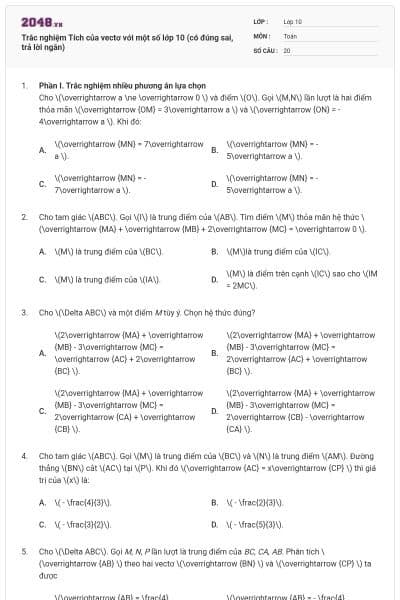
\(\overrightarrow {MN} = 7\overrightarrow a \).
\(\overrightarrow {MN} = - 5\overrightarrow a \).
\(\overrightarrow {MN} = - 7\overrightarrow a \).
\(\overrightarrow {MN} = - 5\overrightarrow a \).
Đáp án đúng là: C
Ta có \(\overrightarrow {MN} = \overrightarrow {ON} - \overrightarrow {OM} = - 4\overrightarrow a - 3\overrightarrow a = - 7\overrightarrow a \).
\(M\) là trung điểm của \(BC\).
\(M\)là trung điểm của \(IC\).
\(M\) là trung điểm của \(IA\).
\(M\) là điểm trên cạnh \(IC\) sao cho \(IM = 2MC\).
Đáp án đúng là: B
Vì \(I\) là trung điểm của \(AB\) nên \(\overrightarrow {MA} + \overrightarrow {MB} = 2\overrightarrow {MI} \).
\(\overrightarrow {MA} + \overrightarrow {MB} + 2\overrightarrow {MC} = \overrightarrow 0 \Leftrightarrow 2\overrightarrow {MI} + 2\overrightarrow {MC} = \overrightarrow 0 \Leftrightarrow \overrightarrow {MI} + \overrightarrow {MC} = \overrightarrow 0 \Leftrightarrow \)\(M\)là trung điểm của \(IC\).
\(2\overrightarrow {MA} + \overrightarrow {MB} - 3\overrightarrow {MC} = \overrightarrow {AC} + 2\overrightarrow {BC} \).
\(2\overrightarrow {MA} + \overrightarrow {MB} - 3\overrightarrow {MC} = 2\overrightarrow {AC} + \overrightarrow {BC} \).
\(2\overrightarrow {MA} + \overrightarrow {MB} - 3\overrightarrow {MC} = 2\overrightarrow {CA} + \overrightarrow {CB} \).
\(2\overrightarrow {MA} + \overrightarrow {MB} - 3\overrightarrow {MC} = 2\overrightarrow {CB} - \overrightarrow {CA} \).
Đáp án đúng là: C
\[2\overrightarrow {MA} + \overrightarrow {MB} - 3\overrightarrow {MC} = 2\overrightarrow {MC} + 2\overrightarrow {CA} + \overrightarrow {MC} + \overrightarrow {CB} - 3\overrightarrow {MC} = 2\overrightarrow {CA} + \overrightarrow {CB} \].
\( - \frac{4}{3}\).
\( - \frac{2}{3}\).
\( - \frac{3}{2}\).
\( - \frac{5}{3}\).
Đáp án đúng là: C
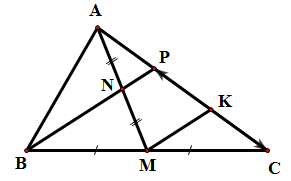
Kẻ \(MK\,{\rm{//}}\,BP\,\left( {K \in AC} \right)\). Do \(M\) là trung điểm của \(BC\) nên suy ra \(K\) là trung điểm của \(CP\).
Vì \(MK{\rm{//}}BP \Rightarrow MK{\rm{//}}NP\) mà \(N\) là trung điểm của \(AM\) nên suy ra \(P\) là trung điểm của \(AK\).
Do đó: \(AP = PK = KC\). Vậy \(\overrightarrow {AC} = - \frac{3}{2}\overrightarrow {CP} \Rightarrow x = - \frac{3}{2}\).
\(\overrightarrow {AB} = \frac{4}{3}\overrightarrow {BN} - \frac{2}{3}\overrightarrow {CP} \).
\(\overrightarrow {AB} = - \frac{4}{3}\overrightarrow {BN} + \frac{2}{3}\overrightarrow {CP} \).
\(\overrightarrow {AB} = - \frac{4}{3}\overrightarrow {BN} - \frac{2}{3}\overrightarrow {CP} \).
\(\overrightarrow {AB} = - \frac{2}{3}\overrightarrow {BN} - \frac{4}{3}\overrightarrow {CP} \).
Đáp án đúng là: C
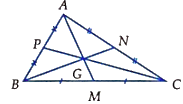
Gọi \(G\) là trọng tâm của tam giác \(ABC\).
Ta có \(\overrightarrow {AB} = \overrightarrow {AM} + \overrightarrow {MB} = 3\overrightarrow {GM} + \left( {\overrightarrow {GB} - \overrightarrow {GM} } \right) = 2\overrightarrow {GM} + \overrightarrow {GB} \)
\( = \overrightarrow {GB} + \overrightarrow {GC} + \overrightarrow {GB} = 2\overrightarrow {GB} + \overrightarrow {GC} = - \frac{4}{3}\overrightarrow {BN} - \frac{2}{3}\overrightarrow {CP} \).
\(p = \frac{5}{4};q = \frac{3}{4}\).
\(p = - \frac{4}{3};q = \frac{2}{3}\).
\(p = - \frac{4}{3};q = - \frac{2}{3}\).
\(p = \frac{5}{4};q = - \frac{3}{4}\).
Đáp án đúng là: D
Ta có \(\overrightarrow {DN} = \overrightarrow {DA} + \overrightarrow {AN} = \overrightarrow {CB} + \frac{1}{2}\overrightarrow {AE} = \overrightarrow {AB} - \overrightarrow {AC} + \frac{1}{4}\left( {\overrightarrow {AB} + \overrightarrow {AC} } \right) = \frac{5}{4}\overrightarrow {AB} - \frac{3}{4}\overrightarrow {AC} \).
Vậy \(p = \frac{5}{4},q = - \frac{3}{4}\).
\(\frac{5}{{12}}\overrightarrow {AB} + \frac{7}{{12}}\overrightarrow {AC} \).
\(\frac{7}{{12}}\overrightarrow {AB} - \frac{5}{{12}}\overrightarrow {AC} \).
\(\frac{7}{{12}}\overrightarrow {AB} + \frac{5}{{12}}\overrightarrow {AC} \).
\(\frac{5}{{12}}\overrightarrow {AB} - \frac{7}{{12}}\overrightarrow {AC} \).
Đáp án đúng là: C
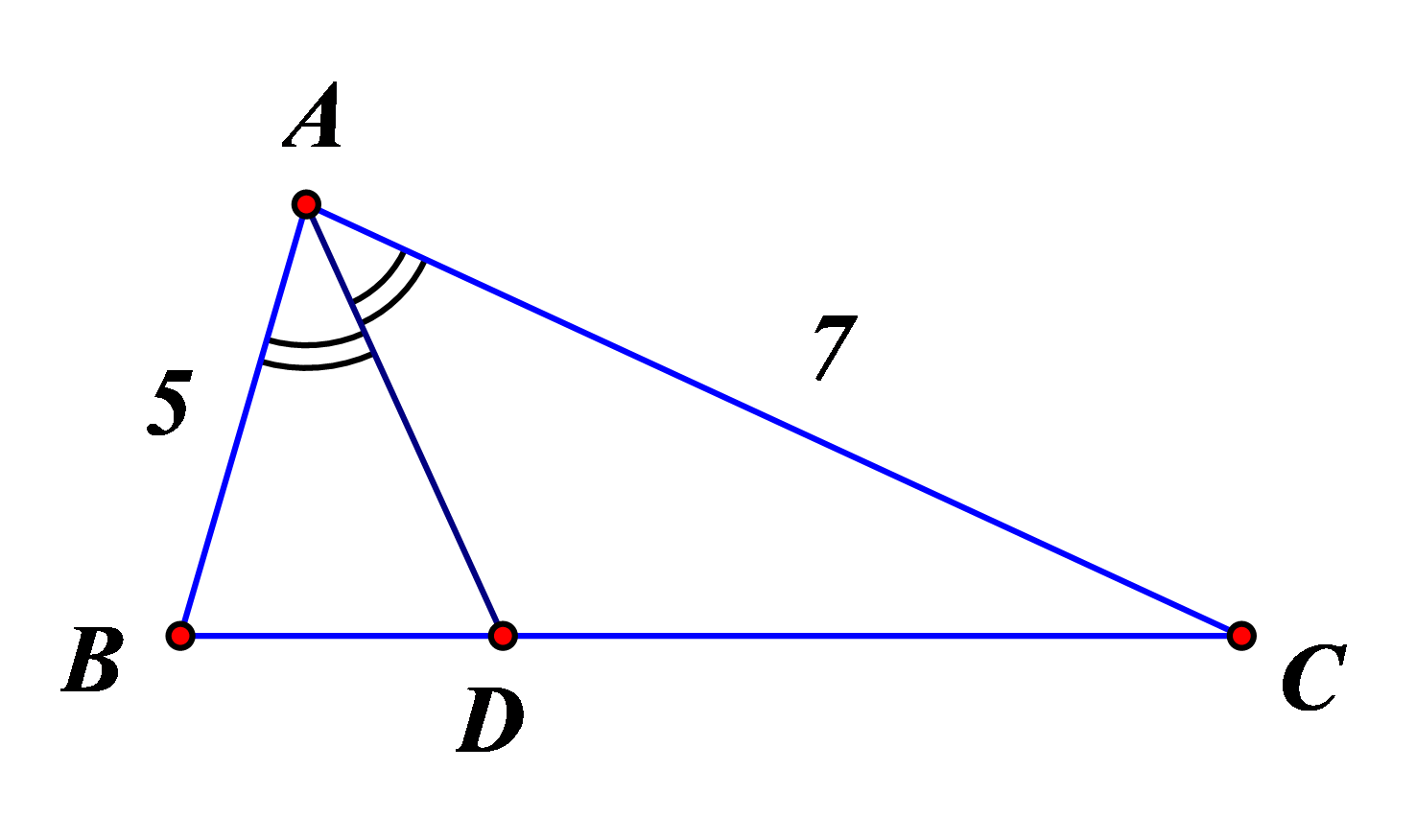
Vì \(AD\) là phân giác trong của tam giác \(ABC\) nên:
\(\frac{{BD}}{{DC}} = \frac{{AB}}{{AC}} = \frac{5}{7} \Rightarrow \overrightarrow {BD} = \frac{5}{7}\overrightarrow {DC} \)
\( \Leftrightarrow \overrightarrow {AD} - \overrightarrow {AB} = \frac{5}{7}\left( {\overrightarrow {AC} - \overrightarrow {AD} } \right)\)
\( \Leftrightarrow \overrightarrow {AD} = \frac{7}{{12}}\overrightarrow {AB} + \frac{5}{{12}}\overrightarrow {AC} \).
\(\overrightarrow {GM} = \frac{1}{6}\overrightarrow {BC} \).
\(\overrightarrow {GM} = \frac{1}{6}\overrightarrow {CA} \).
\(\overrightarrow {GM} = \frac{1}{6}\overrightarrow {AB} \).
\(\overrightarrow {GM} = \frac{1}{3}\overrightarrow {CB} \).
Đáp án đúng là: A
\(2\overrightarrow {MA} + \overrightarrow {MB} + 3\overrightarrow {MC} = 2\left( {\overrightarrow {MA} + \overrightarrow {MB} + \overrightarrow {MC} } \right) + \overrightarrow {MC} - \overrightarrow {MB} = 6\overrightarrow {MG} + \overrightarrow {BC} = \overrightarrow 0 \Rightarrow \overrightarrow {GM} = \frac{1}{6}\overrightarrow {BC} \).
Đường tròn ngoại tiếp tam giác ABC.
Đường tròn tâm G bán kính là 1.
Đường tròn tâm G bán kính là 2.
Đường tròn tâm G bán kính là 6.
Đáp án đúng là: C
Ta có \(\overrightarrow {MA} + \overrightarrow {MB} + \overrightarrow {MC} = 3\overrightarrow {MG} \Rightarrow 3\left| {\overrightarrow {MG} } \right| = 6 \Leftrightarrow \left| {\overrightarrow {MG} } \right| = 2\).
Vậy tập hợp điểm M là đường tròn tâm G bán kính là 2.
\(m = \frac{5}{6}\).
\(m = \frac{1}{3}\).
\(m = \frac{1}{2}\).
\(m = \frac{2}{5}\).
Đáp án đúng là: B
Ta có A, K, D thẳng hàng \( \Leftrightarrow \overrightarrow {AD} = n\overrightarrow {AK} = n\left( {\overrightarrow {AI} + \overrightarrow {IK} } \right)\) (1)
Ta có \(\overrightarrow {BE} = 2\overrightarrow {BD} = 2\left( {\overrightarrow {BA} + \overrightarrow {AD} } \right) = 2\overrightarrow {BA} + 2\overrightarrow {AD} \).
Suy ra \(2\overrightarrow {AD} = \overrightarrow {BE} - 2\overrightarrow {BA} = \overrightarrow {BA} + \overrightarrow {AE} - 2\overrightarrow {BA} = \overrightarrow {AB} + \overrightarrow {AE} \)
\( = \overrightarrow {AB} + \frac{1}{2}\left( {\overrightarrow {AB} + \overrightarrow {AC} } \right) = \frac{3}{2}\overrightarrow {AB} + \frac{1}{2}\overrightarrow {AC} \)
\( = 3\overrightarrow {AI} + \frac{3}{2}\overrightarrow {AJ} = 3\overrightarrow {AI} + \frac{3}{2}\left( {\overrightarrow {AI} + \overrightarrow {IJ} } \right) = \frac{9}{2}\overrightarrow {AI} + \frac{3}{2}\overrightarrow {IJ} \).
Mà \(\overrightarrow {IK} = m\overrightarrow {IJ} \) nên \(2\overrightarrow {AD} = \frac{9}{2}\overrightarrow {AI} + \frac{3}{{2m}}\overrightarrow {IK} \Rightarrow \overrightarrow {AD} = \frac{9}{4}\overrightarrow {AI} + \frac{3}{{4m}}\overrightarrow {IK} \) (2)
Từ (1) và (2) \( \Rightarrow \frac{9}{4} = \frac{3}{{4m}} \Leftrightarrow m = \frac{1}{3}\).
Phần II. Trắc nghiệm đúng, sai
Cho bốn điểm \(A,B,C,D\) có \(M,N\) là trung điểm của \(AB,CD\).
a) \(\overrightarrow {MA} + \overrightarrow {MB} = \vec 0\).
b) \(\overrightarrow {NC} + \overrightarrow {ND} = \vec 0{\rm{. }}\)
c) \(\overrightarrow {MN} = \overrightarrow {MA} + \overrightarrow {AC} \).
d) \(2\overrightarrow {MN} = \overrightarrow {AC} + \overrightarrow {BD} {\rm{. }}\)
a) Đúng. Do \(M\) là trung điểm của \(AB\) nên ta có \(\overrightarrow {MA} + \overrightarrow {MB} = \vec 0\).
b) Đúng. Do \(N\) là trung điểm của \(CD\) nên ta có \(\overrightarrow {NC} + \overrightarrow {ND} = \vec 0\).
c) Sai. Theo quy tắc cộng, ta có \(\overrightarrow {MN} = \overrightarrow {MA} + \overrightarrow {AN} = \overrightarrow {MA} + \overrightarrow {AC} + \overrightarrow {CN} \). (1)
d) Đúng. Ta lại có \(\overrightarrow {MN} = \overrightarrow {MB} + \overrightarrow {BD} + \overrightarrow {DN} \). (2)
Cộng hai đẳng thức (1), (2) vế theo vế, ta được
\(2\overrightarrow {MN} = \left( {\overrightarrow {MA} + \overrightarrow {MB} } \right) + \left( {\overrightarrow {AC} + \overrightarrow {BD} } \right) + \left( {\overrightarrow {CN} + \overrightarrow {DN} } \right)\).
Kết hợp với kết quả ở ý a) và b), ta suy ra được \(2\overrightarrow {MN} = \overrightarrow {AC} + \overrightarrow {BD} \).
Gọi \[AN,{\rm{ }}CM\] là các đường trung tuyến của tam giác \[ABC\] và G là trọng tâm.
a) \[\overrightarrow {AN} = \overrightarrow {AB} + \overrightarrow {AC} \,.\]
b) \[\overrightarrow {CM} = \frac{3}{2}\overrightarrow {GC} \,.\]
c) \[\overrightarrow {MN} = \frac{1}{2}\left( {\overrightarrow {BC} - \overrightarrow {BA} } \right)\,.\]
d) \[\overrightarrow {AB} = \frac{4}{3}\overrightarrow {AN} + \frac{2}{3}\overrightarrow {CM} \].
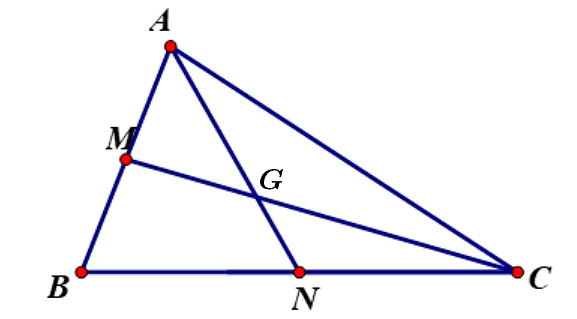
a) Sai. Theo tính chất trung điểm đoạn thẳng BC ta có \[\overrightarrow {AN} = \frac{1}{2}\left( {\overrightarrow {AB} + \overrightarrow {AC} } \right)\].
b) Sai. Vì G là trọng tâm tam giác \[ABC\] nên \[\overrightarrow {CM} = \frac{3}{2}\overrightarrow {CG} \].
c) Đúng. Do M, N lần lượt là trung điểm của cạnh AB và BC nên MN là đường trung bình của tam giác \[ABC\], do đó ta có \[\overrightarrow {MN} = \frac{1}{2}\overrightarrow {AC} = \frac{1}{2}\left( {\overrightarrow {BC} - \overrightarrow {BA} } \right)\].
d) Đúng. Ta có \[\overrightarrow {AN} = \frac{1}{2}\left( {\overrightarrow {AB} + \overrightarrow {AC} } \right) = \frac{1}{2}\overrightarrow {AB} + \frac{1}{2}\overrightarrow {AC} \];
\[\overrightarrow {CM} = \overrightarrow {CA} + \overrightarrow {AM} \Rightarrow \frac{1}{2}\overrightarrow {CM} = \frac{1}{2}\overrightarrow {CA} + \frac{1}{2}\overrightarrow {AM} \].
Suy ra
\[\overrightarrow {AN} + \frac{1}{2}\overrightarrow {CM} = \frac{1}{2}\overrightarrow {AB} + \frac{1}{2}\overrightarrow {AC} + \frac{1}{2}\overrightarrow {CA} + \frac{1}{2}\overrightarrow {AM} = \frac{1}{2}\overrightarrow {AB} + \frac{1}{2}\overrightarrow {AC} - \frac{1}{2}\overrightarrow {AC} + \frac{1}{2} \cdot \frac{1}{2}\overrightarrow {AB} = \frac{3}{4}\overrightarrow {AB} \].
Do đó \[\overrightarrow {AB} = \frac{4}{3}\overrightarrow {AN} + \frac{2}{3}\overrightarrow {CM} \].
Cho hình bình hành \(ABCD\) và các điểm \(M,N,P\) thoả mãn \(\overrightarrow {AM} = \frac{1}{2}\overrightarrow {AB} \), \(\overrightarrow {AN} = \frac{1}{6}\overrightarrow {AC} ,\) \(\overrightarrow {AP} = \frac{1}{4}\overrightarrow {AD} \).
a) \(\overrightarrow {AN} = \frac{1}{6}\left( {\overrightarrow {AB} + \overrightarrow {AD} } \right)\).
b) \(\overrightarrow {MN} = \frac{1}{3}\overrightarrow {AB} + \frac{1}{6}\overrightarrow {AD} .\)
c) \(\overrightarrow {MP} = \frac{1}{3}\overrightarrow {AD} - \frac{1}{2}\overrightarrow {AB} \).
d) Ba điểm \(M,N,P\) thẳng hàng.
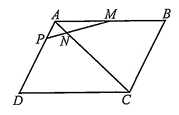
a) Đúng. Ta có \(\overrightarrow {AN} = \frac{1}{6}\overrightarrow {AC} = \frac{1}{6}\left( {\overrightarrow {AB} + \overrightarrow {AD} } \right)\).
b) Sai. Ta có \(\overrightarrow {MN} = \overrightarrow {AN} - \overrightarrow {AM} = \frac{1}{6}\left( {\overrightarrow {AB} + \overrightarrow {AD} } \right) - \frac{1}{2}\overrightarrow {AB} = \frac{{ - 1}}{3}\overrightarrow {AB} + \frac{1}{6}\overrightarrow {AD} .\)
c) Sai. Ta có \(\overrightarrow {MP} = \overrightarrow {AP} - \overrightarrow {AM} = \frac{1}{4}\overrightarrow {AD} - \frac{1}{2}\overrightarrow {AB} \).
d) Đúng. Ta có \(\overrightarrow {MN} = \frac{1}{6}\left( {\overrightarrow {AD} - 2\overrightarrow {AB} } \right) = \frac{1}{6} \cdot 4 \cdot \frac{1}{4}\left( {\overrightarrow {AD} - 2\overrightarrow {AB} } \right) = \frac{2}{3}\overrightarrow {MP} \).
Suy ra \(\overrightarrow {MN} ,\overrightarrow {MP} \) cùng phương. Vậy ba điểm \(M,N,P\) thẳng hàng.
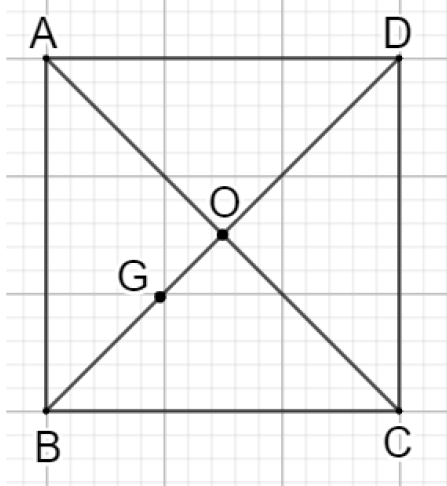
Cho hình vuông \(ABCD\) tâm \(O\) cạnh \(a\). \(G\) là trọng tâm tam giác \(ABC\).
a) \(\overrightarrow {AC} = - 2\overrightarrow {AO} \).
b) \(\overrightarrow {AB} + \overrightarrow {AD} = 2\overrightarrow {AO} \).
c) \(\overrightarrow {OA} + \overrightarrow {OB} + \overrightarrow {OC} + \overrightarrow {OD} = \overrightarrow 0 \).
d) \(\left| {\overrightarrow {GA} + \overrightarrow {GB} + \overrightarrow {GC} + \overrightarrow {GD} } \right| = 2a\).
a) Sai. \(AC = 2AO\) và vectơ \(\overrightarrow {AC} , \overrightarrow {AO} \) là hai vectơ cùng hướng nên \(\overrightarrow {AC} = 2\overrightarrow {AO} \).
b) Đúng. Theo quy tắc hình bình hành ta có \(\overrightarrow {AB} + \overrightarrow {AD} = \overrightarrow {AC} \).
Mặt khác \(\overrightarrow {AC} = 2\overrightarrow {AO} \). Vậy \(\overrightarrow {AB} + \overrightarrow {AD} = 2\overrightarrow {AO} \).
c) Đúng. \(O\) là trung điểm của \(AC\) và \(BD\) nên \(\overrightarrow {OA} + \overrightarrow {OC} = \overrightarrow 0 , \overrightarrow {OB} + \overrightarrow {OD} = \overrightarrow 0 \).
Vậy \(\overrightarrow {OA} + \overrightarrow {OB} + \overrightarrow {OC} + \overrightarrow {OD} = \overrightarrow 0 \).
d) Sai.
\(\overrightarrow {GA} + \overrightarrow {GB} + \overrightarrow {GC} + \overrightarrow {GD} = \overrightarrow {GO} + \overrightarrow {OA} + \overrightarrow {GO} + \overrightarrow {OB} + \overrightarrow {GO} + \overrightarrow {OC} + \overrightarrow {GO} + \overrightarrow {OD} \)
\( = 4\overrightarrow {GO} + \left( {\overrightarrow {OA} + \overrightarrow {OB} + \overrightarrow {OC} + \overrightarrow {OD} } \right) = 4\overrightarrow {GO} \).
Nên suy ra \(\left| {\overrightarrow {GA} + \overrightarrow {GB} + \overrightarrow {GC} + \overrightarrow {GD} } \right| = 4\left| {\overrightarrow {GO} } \right| = 4GO\).
Vì hình vuông \(ABCD\) có tâm \(O\) cạnh \(a\), \(G\) là trọng tâm tam giác \(ABC\) nên \(GO = \frac{1}{3}BO = \frac{1}{6}BD = \frac{{a\sqrt 2 }}{6}\).
Vậy \(\left| {\overrightarrow {GA} + \overrightarrow {GB} + \overrightarrow {GC} + \overrightarrow {GD} } \right| = \frac{{2a\sqrt 2 }}{3}\).
Cho \(\Delta ABC\) nội tiếp đường tròn tâm \(O,H\) là trực tâm tam giác, \(D\) là điểm đối xứng của \(A\) qua \(O\).
a) \(BD{\rm{//}}CH\).
b) \(CD{\rm{//}}BH\).
a) \(\overrightarrow {HA} + \overrightarrow {HB} + \overrightarrow {HC} = 3\overrightarrow {HO} \).
b) \(\overrightarrow {OA} + \overrightarrow {OB} + \overrightarrow {OC} = 3\overrightarrow {OH} \).
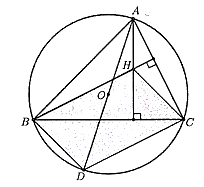
a) Đúng. Xét tam giác \(ABD\) nội tiếp đường tròn đường kính \(AD\) nên \(AB \bot BD\); mặt khác \(AB \bot CH\) nên \(BD{\rm{//}}CH\) (1).
b) Đúng. Tương tự, tam giác \(ACD\) nội tiếp đường tròn đường kính \(AD\) nên \(AC \bot CD\); mặt khác \(AC \bot BH\) nên \(CD{\rm{//}}BH\) (2).
c) Sai. Từ (1) và (2) suy ra \(BDCH\) là hình bình hành.
Khi đó, \(\overrightarrow {HA} + \overrightarrow {HB} + \overrightarrow {HC} = \overrightarrow {HA} + \overrightarrow {HD} = 2\overrightarrow {HO} \) (vì \(O\) là trung điểm \(AD\)).
d) Sai. Ta có \(\overrightarrow {OA} + \overrightarrow {OB} + \overrightarrow {OC} = \overrightarrow {OH} + \overrightarrow {HA} + \overrightarrow {OH} + \overrightarrow {HB} + \overrightarrow {OH} + \overrightarrow {HC} \)
\( = 3\overrightarrow {OH} + \left( {\overrightarrow {HA} + \overrightarrow {HB} + \overrightarrow {HC} } \right) = 3\overrightarrow {OH} + 2\overrightarrow {HO} = \overrightarrow {OH} {\rm{. }}\)
Phần III. Trắc nghiệm trả lời ngắn
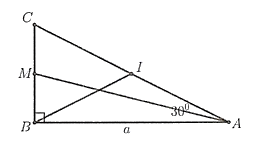
Xét \(\Delta ABC\) vuông tại \(B\) có: \(\tan A = \frac{{BC}}{{AB}} \Rightarrow BC = AB \cdot \tan A = a\tan 30^\circ = \frac{{a\sqrt 3 }}{3}\),
Gọi \(M\) là trung điểm của \(BC\), ta có:
\(\left| {\overrightarrow {AB} + \overrightarrow {AC} } \right| = \left| {2\overrightarrow {AM} } \right| = 2\left| {\overrightarrow {AM} } \right| = 2AM = 2\sqrt {A{B^2} + B{M^2}} \)\( = 2\sqrt {{a^2} + {{\left( {\frac{{a\sqrt 3 }}{6}} \right)}^2}} = \frac{{a\sqrt {39} }}{3}.\)
Vậy \(m = 39\).
Đáp án: 39.
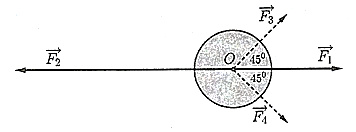
Một vật đang ở vị trí \(O\) chịu hai lực tác dụng ngược chiều nhau là \({\vec F_1}\) và \(\overrightarrow {{F_2}} \), trong đó độ lớn lực \({\vec F_2}\) lớn gấp đôi độ lớn lực \({\vec F_1}\). Người ta muốn vật dừng lại nên cần tác dụng vào vật hai lực \({\vec F_3},{\vec F_4}\) có phương hợp với lực \({\vec F_1}\) các góc \(45^\circ \) như hình vẽ, chúng có độ lớn bằng nhau và bằng \(20\;{\rm{N}}\). Hỏi độ lớn của lực \(\overrightarrow {{F_2}} \) bằng bao nhiêu Newton (làm tròn kết quả đến hàng phần mười)?
Ta có \(\overrightarrow {{F_2}} = - 2{\vec F_1}\).
Để vật trở về trạng thái cân bằng thì hợp lực bằng \(\vec 0\)
\( \Leftrightarrow {\vec F_1} + {\vec F_2} + {\vec F_3} + {\vec F_4} = \vec 0 \Leftrightarrow {\vec F_1} - 2{\vec F_1} + {\vec F_3} + {\vec F_4} = \vec 0 \Leftrightarrow \overrightarrow {{F_3}} + {\vec F_4} = {\vec F_1}\).
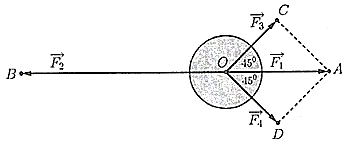
Đặt \({\vec F_1} = \overrightarrow {OA} ,\overrightarrow {{F_2}} = \overrightarrow {OB} ,{\vec F_3} = \overrightarrow {OC} ,\overrightarrow {{F_4}} = \overrightarrow {OD} \).
Ta có \({\vec F_3} + {\vec F_4} = {\vec F_1} \Leftrightarrow \overrightarrow {OC} + \overrightarrow {OD} = \overrightarrow {OA} \). Do đó \(OCAD\) là hình bình hành.
Mặt khác \(OC = OD = 20\) và \(\widehat {COD} = 45^\circ + 45^\circ = 90^\circ \) nên \(OCAD\) là hình vuông.
Khi đó \(\left| {{{\vec F}_1}} \right| = OA = 20\sqrt 2 \;{\rm{N}},\left| {\overrightarrow {{F_2}} } \right| = 2\left| {{{\vec F}_1}} \right| = 40\sqrt 2 \;{\rm{N}} \approx {\rm{56,6}}\,\,{\rm{N}}\).
Đáp án: 56,6.
\(3\overrightarrow {IA} + 2\overrightarrow {IC} - 2\overrightarrow {ID} = \vec 0 \Leftrightarrow 3\overrightarrow {IA} + 2\left( {\overrightarrow {IC} - \overrightarrow {ID} } \right) = \vec 0\)
\( \Leftrightarrow 3\overrightarrow {IA} + 2\overrightarrow {DC} = \vec 0 \Leftrightarrow - 3\overrightarrow {AI} + 2\overrightarrow {AB} = \vec 0 \Leftrightarrow \overrightarrow {AI} = \frac{2}{3}\overrightarrow {AB} \).
\(\overrightarrow {JA} - 2\overrightarrow {JB} + 2\overrightarrow {JC} = \vec 0 \Leftrightarrow \overrightarrow {AJ} - 2\left( {\overrightarrow {JC} - \overrightarrow {JB} } \right) = \vec 0 \Leftrightarrow \overrightarrow {AJ} = 2\overrightarrow {BC} \Leftrightarrow \overrightarrow {AJ} = 2\overrightarrow {AD} \).
\(\overrightarrow {IO} = \overrightarrow {AO} - \overrightarrow {AI} = \frac{1}{2}\overrightarrow {AC} - \frac{2}{3}\overrightarrow {AB} = \frac{1}{2}\left( {\overrightarrow {AB} + \overrightarrow {AD} } \right) - \frac{2}{3}\overrightarrow {AB} = - \frac{1}{6}\overrightarrow {AB} + \frac{1}{2}\overrightarrow {AD} \).
\(\overrightarrow {IJ} = \overrightarrow {AJ} - \overrightarrow {AI} = 2\overrightarrow {AD} - \frac{2}{3}\overrightarrow {AB} = - \frac{2}{3}\overrightarrow {AB} + 2\overrightarrow {AD} \).
Ta có: \(\left\{ {\begin{array}{*{20}{l}}\begin{array}{l}\overrightarrow {IO} = - \frac{1}{6}\overrightarrow {AB} + \frac{1}{2}\overrightarrow {AD} \\\overrightarrow {IJ} = - \frac{2}{3}\overrightarrow {AB} + 2\overrightarrow {AD} \end{array}\end{array} \Leftrightarrow \left\{ {\begin{array}{*{20}{l}}\begin{array}{l}6\overrightarrow {IO} = - \overrightarrow {AB} + 3\overrightarrow {AD} \\\frac{3}{2}\overrightarrow {IJ} = - \overrightarrow {AB} + 3\overrightarrow {AD} \end{array}\end{array} \Rightarrow 6\overrightarrow {IO} = \frac{3}{2}\overrightarrow {IJ} \Leftrightarrow \overrightarrow {IJ} = 4\overrightarrow {IO} } \right.} \right.\).
Đáp án: 4.
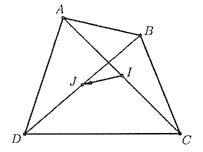
Ta có \(\left\{ \begin{array}{l}\overrightarrow {IJ} = \overrightarrow {IA} + \overrightarrow {AB} + \overrightarrow {BJ} \left( 1 \right)\\\overrightarrow {IJ} = \overrightarrow {IC} + \overrightarrow {CD} + \overrightarrow {DJ} \left( 2 \right)\end{array} \right.\).
Cộng theo vế (1) và (2), ta được:
\(2\overrightarrow {IJ} = \left( {\overrightarrow {IA} + \overrightarrow {IC} } \right) + \left( {\overrightarrow {AB} + \overrightarrow {CD} } \right) + \left( {\overrightarrow {BJ} + \overrightarrow {DJ} } \right) = \vec 0 + \overrightarrow {AB} + \overrightarrow {CD} + \vec 0 = \overrightarrow {AB} + \overrightarrow {CD} \).
Suy ra \(k = 2\).
Đáp án: 2.
Cho tứ giác \(ABCD\). Gọi \(I,J\) theo thứ tự là trung điểm của \(AB,CD\) và \(IJ = \frac{5}{4}\). Gọi \(M,N\) theo thứ tự là trung điểm của \(BC,AC\). Tính \(\left| {\overrightarrow {AM} + \overrightarrow {BN} + \overrightarrow {CI} } \right|\).
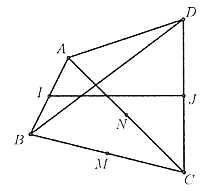
Ta có \(2\overrightarrow {AM} = \overrightarrow {AB} + \overrightarrow {AC} \) (1), \(2\overrightarrow {BN} = \overrightarrow {BA} + \overrightarrow {BC} \) (2), \(2\overrightarrow {CI} = \overrightarrow {CA} + \overrightarrow {CB} \) (3).
Cộng theo vế (1), (2), (3): \(2\left( {\overrightarrow {AM} + \overrightarrow {BN} + \overrightarrow {CI} } \right) = \left( {\overrightarrow {AB} + \overrightarrow {BA} } \right) + \left( {\overrightarrow {AC} + \overrightarrow {CA} } \right) + \left( {\overrightarrow {BC} + \overrightarrow {CB} } \right) = \vec 0{\rm{. }}\)
Suy ra \(\overrightarrow {AM} + \overrightarrow {BN} + \overrightarrow {CI} = \vec 0\).
Do vậy \(\left| {\overrightarrow {AM} + \overrightarrow {BN} + \overrightarrow {CI} } \right| = 0\).
Đáp án: 0.