20 câu trắc nghiệm Toán 10 Kết nối tri thức Bài 11. Tích vô hướng của hai vectơ (Đúng sai - trả lời ngắn) có đáp án
20 câu hỏi
Phần I. Trắc nghiệm nhiều phương án lựa chọn
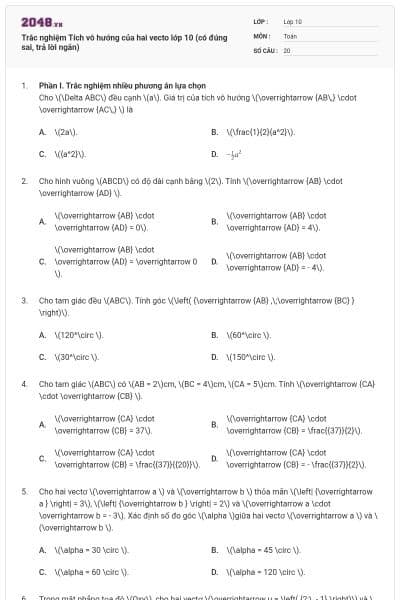
\(2a\).
\(\frac{1}{2}{a^2}\).
\({a^2}\).
Đáp án đúng là: B
Ta có \(\overrightarrow {AB\,} \cdot \overrightarrow {AC\,} \)\( = \left| {\overrightarrow {AB\,} } \right| \cdot \left| {\overrightarrow {AC\,} } \right| \cdot \cos \left( {\overrightarrow {AB\,} ,\overrightarrow {AC\,} } \right)\)\[ = AB \cdot AC \cdot \cos \widehat {BAC}\]\[ = a \cdot a \cdot \cos 60^\circ \]\[ = \frac{1}{2}{a^2}\].
\(\overrightarrow {AB} \cdot \overrightarrow {AD} = 0\).
\(\overrightarrow {AB} \cdot \overrightarrow {AD} = 4\).
\(\overrightarrow {AB} \cdot \overrightarrow {AD} = \overrightarrow 0 \).
\(\overrightarrow {AB} \cdot \overrightarrow {AD} = - 4\).
Đáp án đúng là: A
Vì \(ABCD\) là hình vuông nên \(AB \bot AD\) do đó \(\overrightarrow {AB} \cdot \overrightarrow {AD} = 0\).
\(120^\circ \).
\(60^\circ \).
\(30^\circ \).
\(150^\circ \).
Đáp án đúng là: A
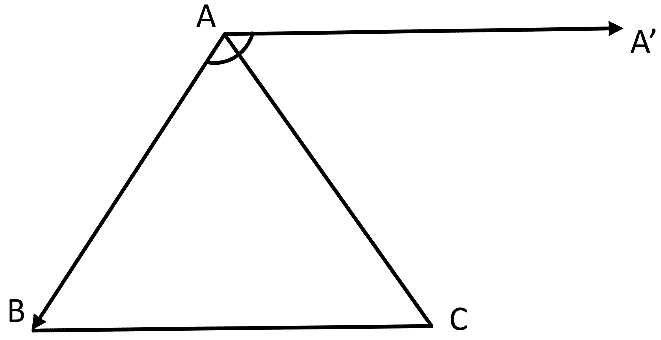
Dựng vectơ \[\overrightarrow {AA'} = \overrightarrow {BC} \] khi đó ta có \(\left( {\overrightarrow {AB} ,\;\overrightarrow {BC} } \right) = \left( {\overrightarrow {AB} ,\;\overrightarrow {AA'} } \right) = \widehat {BAA'}\).
Vì \[\overrightarrow {AA'} = \overrightarrow {BC} \Rightarrow BC{\rm{//}}AA' \Rightarrow \widehat {CAA'} = \widehat {ACB} = \widehat {BAC}\;\; = 60^\circ \].
Do đó \(\left( {\overrightarrow {AB} ,\;\overrightarrow {BC} } \right) = \left( {\overrightarrow {AB} ,\;\overrightarrow {AA'} } \right) = \widehat {BAA'} = \widehat {BAC}\; + \widehat {CAA'}\; = 60^\circ + 60^\circ = 120^\circ \).
\(\overrightarrow {CA} \cdot \overrightarrow {CB} = 37\).
\(\overrightarrow {CA} \cdot \overrightarrow {CB} = \frac{{37}}{2}\).
\(\overrightarrow {CA} \cdot \overrightarrow {CB} = \frac{{37}}{{20}}\).
\(\overrightarrow {CA} \cdot \overrightarrow {CB} = - \frac{{37}}{2}\).
Đáp án đúng là: B
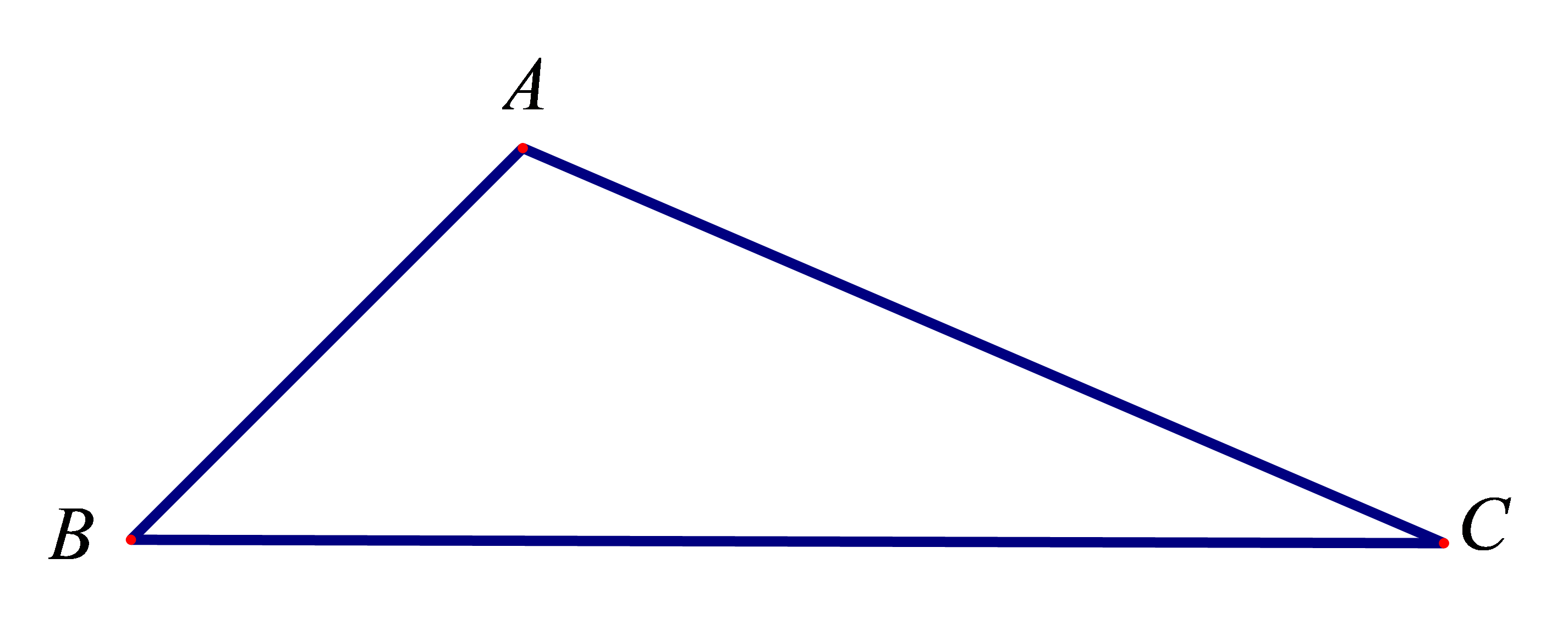
Ta có \[\left( {\overrightarrow {CA} ,\overrightarrow {CB} } \right) = \widehat {ACB}\].
Áp dụng định lí côsin cho tam giác \(ABC\) có
\(\cos \widehat {ACB} = \frac{{A{C^2} + B{C^2} - A{B^2}}}{{2AC \cdot BC}}\) \( = \frac{{{5^2} + {4^2} - {2^2}}}{{2 \cdot 5 \cdot 4}} = \frac{{37}}{{40}}\).
Do đó \(\overrightarrow {CA} \cdot \overrightarrow {CB} = \left| {\overrightarrow {CA} } \right| \cdot \left| {\overrightarrow {CB} } \right|\cos \left( {\overrightarrow {CA} ,\overrightarrow {CB} } \right)\)\( = CA \cdot CB \cdot \cos \widehat {ACB}\)\( = 5 \cdot 4 \cdot \frac{{37}}{{40}} = \frac{{37}}{2}\).
\(\alpha = 30 \circ \).
\(\alpha = 45 \circ \).
\(\alpha = 60 \circ \).
\(\alpha = 120 \circ \).
Đáp án đúng là: D
Ta có \(\cos \alpha = \frac{{\overrightarrow a \cdot \overrightarrow b }}{{\left| {\overrightarrow a } \right| \cdot \left| {\overrightarrow b } \right|}} = \frac{{ - 3}}{{3 \cdot 2}} = - \frac{1}{2} \Rightarrow \alpha = 120 \circ \).
\(1\).
\( - 1\).
\(5\).
\( - 5\).
Đáp án đúng là: B
Ta có \(\overrightarrow u \cdot \overrightarrow v = 2 \cdot 1 + \left( { - 1} \right) \cdot 3 = - 1\).
\(k = 7\).
\(k = 8\).
\(k = 10\).
\(k = - 10\).
Đáp án đúng là: C
Do \(\overrightarrow u = \overrightarrow i - 5\overrightarrow j \) nên \(\overrightarrow u = \left( {1; - 5} \right)\), \(\overrightarrow v = k\overrightarrow i + 2\overrightarrow j \) nên \(\overrightarrow v = \left( {k;2} \right)\).
Vectơ \(\overrightarrow u \) và vectơ \(\overrightarrow v \) vuông góc nên \(\overrightarrow u \cdot \overrightarrow v = 0 \Leftrightarrow 1 \cdot k + \left( { - 5} \right) \cdot 2 = 0 \Leftrightarrow k - 10 = 0 \Leftrightarrow k = 10\).
\(16\).
\(34\).
\(8\).
\(2\sqrt 2 \).
Đáp án đúng là: B
Ta có \(\overrightarrow a + \overrightarrow b = \left( {3;5} \right)\).
\(\left| {\overrightarrow u } \right| = \left| {{{\left( {\overrightarrow a + \overrightarrow b } \right)}^2}} \right| = {\left| {\overrightarrow a + \overrightarrow b } \right|^2}\). Do đó, \(\left| {\overrightarrow u } \right| = {\sqrt {{3^2} + {5^2}} ^2} = 34\).
\(y = - 9\).
\(\left[ \begin{array}{l}y = - 1\\y = 9\end{array} \right.\).
\(\left[ \begin{array}{l}y = 1\\y = - 9\end{array} \right.\).
\(y = - 1\).
Đáp án đúng là: D
Ta có \(\cos \left( {\overrightarrow a ,\overrightarrow b } \right) = \frac{{\overrightarrow a \cdot \overrightarrow b }}{{\left| {\overrightarrow a } \right| \cdot \left| {\overrightarrow b } \right|}} = \frac{{3 - 2y}}{{\sqrt 5 \cdot \sqrt {9 + {y^2}} }}\).
Góc giữa hai vectơ \(\overrightarrow a \) và \(\overrightarrow b \) bằng \(45^\circ \), suy ra \(\cos \left( {\overrightarrow a ,\overrightarrow b } \right) = \frac{{3 - 2y}}{{\sqrt 5 \cdot \sqrt {9 + {y^2}} }} = \frac{{\sqrt 2 }}{2}\) \(\left( 1 \right)\).
\(\left( 1 \right) \Leftrightarrow \sqrt {90 + 10{y^2}} = 6 - 4y \Leftrightarrow \left\{ \begin{array}{l}6 - 4y \ge 0\\90 + 10{y^2} = {\left( {6 - 4y} \right)^2}\end{array} \right.\)\( \Leftrightarrow \left\{ \begin{array}{l}y \le \frac{3}{2}\\{y^2} - 8y - 9 = 0\end{array} \right. \Leftrightarrow y = - 1\).
Một người dùng một lực \(\overrightarrow F \) có độ lớn là 90 N làm một vật dịch chuyển một đoạn 100 m.
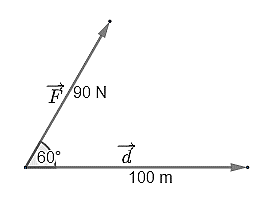
Biết lực \(\overrightarrow F \) hợp với hướng dịch chuyển một góc \(60^\circ \). Tính công sinh bởi lực \(\overrightarrow F \).
\(5400\,\,{\rm{(J)}}\).
\(4500\,\,{\rm{(J)}}\).
\(1500\,\,{\rm{(J)}}\).
\(450\,{\rm{(J)}}\).
Đáp án đúng là: B
Công sinh bởi lực \(\vec F\) được tính bằng công thức
\(A = \overrightarrow F \cdot \overrightarrow d = \left| {\overrightarrow F } \right| \cdot \left| {\overrightarrow d } \right|{\rm{cos}}\left( {\overrightarrow F ,\overrightarrow d } \right) = 90 \cdot 100 \cdot {\rm{cos}}60^\circ = 4500\,\,\left( {\rm{J}} \right)\).
Vậy công sinh bởi lực \(\vec F\) có độ lớn bằng 4500 (J).
Phần II. Trắc nghiệm đúng, sai
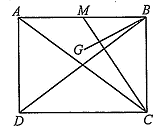
a) \(\overrightarrow {CM} = \frac{1}{2}\overrightarrow {BA} - 3\overrightarrow {BC} \).
b) \(\overrightarrow {BG} = \frac{3}{2}\overrightarrow {BA} + \frac{1}{3}\overrightarrow {BC} .\)
c) \(\overrightarrow {BC} \cdot \overrightarrow {BA} = 0\).
d) \(\overrightarrow {BG} \cdot \overrightarrow {CM} = - {a^2}.\)
a) Sai. Ta có \(\overrightarrow {CM} = \overrightarrow {BM} - \overrightarrow {BC} = \frac{1}{2}\overrightarrow {BA} - \overrightarrow {BC} \).
b) Sai. Vì \(G\) là trọng tâm của tam giác \(ACM\) nên
\(3\overrightarrow {BG} = \overrightarrow {BA} + \overrightarrow {BM} + \overrightarrow {BC} = \overrightarrow {BA} + \frac{1}{2}\overrightarrow {BA} + \overrightarrow {BC} = \frac{3}{2}\overrightarrow {BA} + \overrightarrow {BC} \Rightarrow \overrightarrow {BG} = \frac{1}{2}\overrightarrow {BA} + \frac{1}{3}\overrightarrow {BC} .\)
c) Đúng. Vì \(ABCD\) là hình chữ nhật nên \(BA \bot BC\), suy ra \(\overrightarrow {BC} \cdot \overrightarrow {BA} = 0\).
d) Sai. Ta có \(\overrightarrow {BG} \cdot \overrightarrow {CM} = \left( {\frac{1}{2}\overrightarrow {BA} + \frac{1}{3}\overrightarrow {BC} } \right) \cdot \left( {\frac{1}{2}\overrightarrow {BA} - \overrightarrow {BC} } \right) = \frac{1}{4}{\overrightarrow {BA} ^2} - \frac{1}{3}\overrightarrow {BA} \cdot \overrightarrow {BC} - \frac{1}{3}{\overrightarrow {BC} ^2}\)
\( = \frac{1}{4} \cdot {\left( {4a} \right)^2} - \frac{1}{3} \cdot 0 - \frac{1}{3} \cdot {\left( {3a} \right)^2} = {a^2}.\) (\(BC = AD = 3a\)).
Cho tam giác \(ABC\) có \(A\left( {1;2} \right)\), \(B\left( { - 1;1} \right)\), \(C\left( {5; - 1} \right)\).
a) \(\overrightarrow {AB} = \left( { - 2; - 1} \right)\).
b) \(\overrightarrow {AC} = \left( {8; - 6} \right)\).
c) \(\overrightarrow {AB} \cdot \overrightarrow {AC} = 10\).
d) \[\cos A = - \frac{1}{{\sqrt 5 }}\].
a) Đúng. \(\overrightarrow {AB} = \left( { - 2; - 1} \right)\).
b) Sai. \(\overrightarrow {AC} = \left( {4; - 3} \right)\).
c) Sai. \(\overrightarrow {AB} \cdot \overrightarrow {AC} = \left( { - 2} \right) \cdot 4 + \left( { - 1} \right) \cdot \left( { - 3} \right) = - 5\).
d) Đúng. Ta có \(\cos A = \frac{{\overrightarrow {AB} \cdot \overrightarrow {AC} }}{{AB \cdot AC}} = \frac{{ - 5}}{{\sqrt {{{\left( { - 2} \right)}^2} + {{\left( { - 1} \right)}^2}} \cdot \sqrt {{4^2} + {{\left( { - 3} \right)}^2}} }} = \frac{{ - 5}}{{\sqrt 5 \cdot \sqrt {25} }} = - \frac{1}{{\sqrt 5 }}\).
Cho tam giác \(ABC\) có \(AB = 2a,AC = 3a,\,\widehat {BAC} = 60^\circ \). Gọi \(I\) là trung điểm đoạn thẳng \(BC\). Điểm \(J\) thuộc đoạn \(AC\) thỏa mãn \(12AJ = 7AC\).
a) \(\overrightarrow {AB} \cdot \overrightarrow {AC} = 4{a^2}\).
b) \(\overrightarrow {AI} = \frac{3}{2}\overrightarrow {AB} + \frac{3}{2}\overrightarrow {AC} \).
c) \(\overrightarrow {BJ} = - \overrightarrow {AB} + \frac{7}{{12}}\overrightarrow {AC} \).
d) \(AI \bot BJ\).
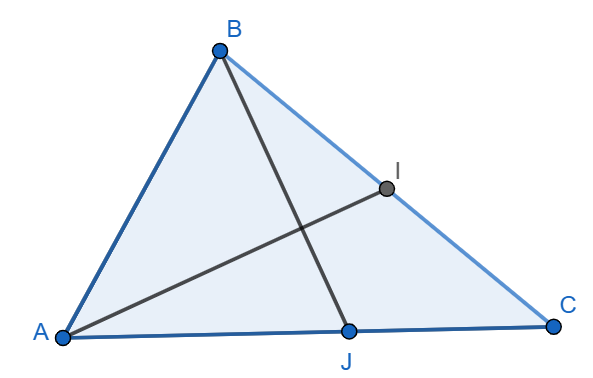
a) Sai. \(\overrightarrow {AB} \cdot \overrightarrow {AC} = AB \cdot AC\cos \widehat {BAC} = 2a \cdot 3a \cdot \cos 60^\circ = 3{a^2}\).
b) Sai. Do \(I\) là trung điểm \(BC\) nên \(\overrightarrow {AI} = \frac{1}{2}\left( {\overrightarrow {AB} + \overrightarrow {AC} } \right) = \frac{1}{2}\overrightarrow {AB} + \frac{1}{2}\overrightarrow {AC} \).
c) Đúng. Vì \(J \in AC\) và \(12AJ = 7AC\) nên \(\overrightarrow {AJ} = \frac{7}{{12}}\overrightarrow {AC} \).
Khi đó, \(\overrightarrow {BJ} = \overrightarrow {BA} + \overrightarrow {AJ} = - \overrightarrow {AB} + \frac{7}{{12}}\overrightarrow {AC} \).
d) Đúng. Ta có \(\overrightarrow {AI} \cdot \overrightarrow {BJ} = \frac{1}{2}\left( {\overrightarrow {AB} + \overrightarrow {AC} } \right)\left( { - \overrightarrow {AB} + \frac{7}{{12}}\overrightarrow {AC} } \right)\)
\( = \frac{1}{2}\left( { - {{\overrightarrow {AB} }^2} + \frac{7}{{12}}\overrightarrow {AB} \cdot \overrightarrow {AC} - \overrightarrow {AB} \cdot \overrightarrow {AC} + \frac{7}{{12}}{{\overrightarrow {AC} }^2}} \right)\)
\( = \frac{1}{2}\left( { - 4{a^2} + \frac{7}{{12}} \cdot 3{a^2} - 3{a^2} + \frac{7}{{12}} \cdot 9{a^2}} \right) = 0\).
Vậy \(AI \bot BJ\).
Trong mặt phẳng tọa độ \(Oxy\), cho hai điểm \(A\left( {1\,;2} \right),B\left( { - 4\,;3} \right)\). Gọi \(M\left( {t;\,0} \right)\) là một điểm thuộc trục hoành.
a) \(\overrightarrow {AB} = \left( { - 5;1} \right)\).
b) \(\overrightarrow {MA} = \left( {t - 1; - 2} \right)\).
c) \(\overrightarrow {MA} \cdot \overrightarrow {MB} = {t^2} + 3t + 4\).
d) Có hai giá trị của \(t\) để \(\widehat {AMB} = 90^\circ \).
a) Đúng. \(\overrightarrow {AB} = \left( { - 4 - 1;3 - 2} \right) = \left( { - 5;1} \right)\).
b) Sai. Ta có \[\overrightarrow {MA} = \left( {1 - t;\;2 - 0} \right) = \left( {1 - t;\;2} \right)\].
c) Sai. \[\overrightarrow {MB} = \left( { - 4 - t;\;3 - 0} \right) = \left( { - 4 - t;\;3} \right)\]
\[\overrightarrow {MA} \cdot \overrightarrow {MB} = \left( {1 - t} \right) \cdot \left( { - 4 - t} \right) + 2 \cdot 3 = - 4 - t + 4t + {t^2} + 6 = {t^2} + 3t + 2\].
d) Đúng. Để \(\widehat {AMB} = 90^\circ \) thì \(\overrightarrow {MA} \bot \overrightarrow {MB} \Leftrightarrow \overrightarrow {MA} \cdot \overrightarrow {MB} = 0 \Leftrightarrow {t^2} + 3t + 2 = 0 \Leftrightarrow \left[ \begin{array}{l}t = - 1\\t = - 2\end{array} \right.\).
Vậy có hai giá trị của \(t\) để \(\widehat {AMB} = 90^\circ \).
Hai người cùng kéo một xe goòng. Người thứ nhất và người thứ hai lần lượt tác dụng vào chiếc xe goòng bằng hai lực \(\overrightarrow {{F_1}} ,\overrightarrow {{F_2}} \) (hai lực vuông góc nhau, phương lực \(\overrightarrow {{F_2}} \) song song mặt đường) như hình vẽ và lực tổng hợp hợp với phương ngang (mặt đường) một góc \(30^\circ \). Người thứ nhất kéo một lực là \[40\sqrt 3 \] (N), người thứ hai kéo một lực là \[80\] (N).
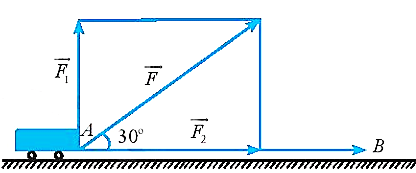
a) \(\left| {\overrightarrow {{F_1}} } \right| = 80,\left| {\overrightarrow {{F_2}} } \right| = 40\sqrt 3 \).
b) \(\left( {\overrightarrow {{F_2}} ,\overrightarrow F } \right) = 30^\circ \).
c) Độ lớn của \(\overrightarrow F \) bằng \(40\sqrt 7 \) (N).
d) Công sinh ra khi kéo vật đi một khoảng dài \(50\) (m) là \(a\sqrt b \) (J) thì tổng \(a + b = 1021\).
a) Sai. Người thứ nhất kéo một lực là \[40\sqrt 3 \,\,{\rm{(N)}} \Rightarrow \left| {\overrightarrow {{F_1}} } \right| = 40\sqrt 3 \], người thứ hai kéo một lực là \[80\,\,{\rm{(N)}} \Rightarrow \left| {\overrightarrow {{F_2}} } \right| = 80\].
b) Đúng. Lực tổng hợp, hợp với phương ngang (mặt đường) một góc \(30^\circ \) và phương lực \(\overrightarrow {{F_2}} \) song song mặt đường nên \(\left( {\overrightarrow {{F_2}} ,\overrightarrow F } \right) = 30^\circ \).
c) Đúng. Ta có lực tổng hợp của hai người là \(\overrightarrow F = \overrightarrow {{F_1}} + \overrightarrow {{F_2}} \).
Suy ra độ lớn của \(\overrightarrow F \) là: \(F = \sqrt {{F_1}^2 + {F_2}^2} = 40\sqrt 7 \,{\rm{(N)}}\).
d) Đúng. Công sinh ra khi kéo vật là
\[A = \overrightarrow F \cdot \overrightarrow d = \left| {\overrightarrow F } \right| \cdot \left| {\overrightarrow d } \right| \cdot \cos \left( {\overrightarrow F ,\overrightarrow d } \right) = 40\sqrt 7 \cdot 5 \cdot \cos 30^\circ = 1000\sqrt {21} \,{\rm{(J)}} = a\sqrt b {\rm{(J)}} \Rightarrow \left\{ \begin{array}{l}a = 1000\\b = 21\end{array} \right.\].
Khi đó \(a + b = 1021\).
Phần III. Trắc nghiệm trả lời ngắn
Cho hai vectơ \(\overrightarrow a \) và \(\overrightarrow b \). Biết \(\left| {\overrightarrow a } \right| = 3,\left| {\overrightarrow b } \right| = 2\) và \(\left( {\overrightarrow a ,\overrightarrow b } \right) = 120^\circ \). Tính \(\left| {\overrightarrow a - 2\overrightarrow b } \right|\) (kết quả làm tròn đến hàng phần chục).
Ta có \[\overrightarrow a \cdot \overrightarrow b = \left| {\overrightarrow a } \right| \cdot \left| {\overrightarrow b } \right| \cdot \cos \left( {\overrightarrow a ,\overrightarrow b } \right) = 3 \cdot 2 \cdot \cos 120^\circ = - 3\].
\[{\left| {\overrightarrow a - 2\overrightarrow b } \right|^2} = {\left( {\overrightarrow a - 2\overrightarrow b } \right)^2} = {\overrightarrow a ^2} - 4\overrightarrow a \cdot \overrightarrow b + 4{\overrightarrow b ^2} = {\left| {\overrightarrow a } \right|^2} - 4\overrightarrow a \cdot \overrightarrow b + 4{\left| {\overrightarrow b } \right|^2} = {3^2} - 4 \cdot \left( { - 3} \right) + 4 \cdot {2^2} = 37\]
\[ \Rightarrow \left| {\overrightarrow a - 2\overrightarrow b } \right| = \sqrt {37} \approx 6,1\].
Đáp án: 6,1.
Ta có \(\Delta ABC\) vuông tại \(A\) có \(AB = \frac{{AC}}{{\tan B}} = \frac{2}{{\tan 30^\circ }} = 2\sqrt 3 .\)
Suy ra \(BC = \sqrt {A{B^2} + A{C^2}} = \sqrt {{{\left( {2\sqrt 3 } \right)}^2} + {2^2}} = 4.\)
\(P = \overrightarrow {AM} \cdot \overrightarrow {BM} = \frac{1}{2}\left( {\overrightarrow {AB} + \overrightarrow {AC} } \right) \cdot \frac{1}{2}\overrightarrow {BC} = \frac{1}{4}\left( {\overrightarrow {AB} \cdot \overrightarrow {BC} + \overrightarrow {AC} \cdot \overrightarrow {BC} } \right)\)
\( = \frac{1}{4}\left( { - AB \cdot BC \cdot \cos B + AC \cdot BC \cdot \cos C} \right)\)\( = \frac{1}{4}\left( { - 2\sqrt 3 \cdot 4 \cdot \cos 30^\circ + 2 \cdot 4 \cdot \cos 60^\circ } \right) = - 2.\)
Đáp án: −2.
Do điểm \(M\) nằm trên đường thẳng \(AB\) nên hai vectơ \(\overrightarrow {AB} \), \(\overrightarrow {BM} \) cùng phương.
Suy ra tồn tại số thực \(t\) sao cho \(\overrightarrow {BM} = t\overrightarrow {AB} \) \[\left( 1 \right)\].
Ta có \(\overrightarrow {BM} = \left( {a - 5;b} \right)\), \(\overrightarrow {AB} = \left( {7; - 1} \right)\) \[\left( 2 \right)\].
Từ \[\left( 1 \right)\] và \[\left( 2 \right)\] ta có \[\left\{ \begin{array}{l}a - 5 = 7t\\b = - t\end{array} \right. \Leftrightarrow \left\{ \begin{array}{l}a = 5 + 7t\\b = - t\end{array} \right.\].
Suy ra \[M\left( {5 + 7t; - t} \right)\].
Ta có \[\overrightarrow {OA} = \left( { - 2;1} \right)\], \(\overrightarrow {OM} = \left( {5 + 7t; - t} \right)\).
Mặt khác ta lại có \(\left( {\overrightarrow {OA} ,\overrightarrow {OM} } \right) = 135^\circ \)\( \Leftrightarrow \cos \left( {\overrightarrow {OA} ,\overrightarrow {OM} } \right) = - \frac{{\sqrt 2 }}{2}\)\( \Leftrightarrow \frac{{\overrightarrow {OA} \cdot \overrightarrow {OM} }}{{OA \cdot OM}} = - \frac{{\sqrt 2 }}{2}\)
\( \Leftrightarrow \frac{{ - 10 - 15t}}{{\sqrt 5 \cdot \sqrt {{{\left( {5 + 7t} \right)}^2} + {t^2}} }} = - \frac{{\sqrt 2 }}{2}\)\( \Leftrightarrow \frac{{2 + 3t}}{{\sqrt {5 + 14t + 10{t^2}} }} = \frac{1}{{\sqrt 2 }}\) (1)
Bình phương hai vế ta được \({\left( {\frac{{2 + 3t}}{{\sqrt {5 + 14t + 10{t^2}} }}} \right)^2} = \frac{1}{2}\)
Suy ra \(8{t^2} + 10t + 3 = 0\).
Giải phương trình bậc hai ta có \(\left[ \begin{array}{l}t = - \frac{1}{2}\\t = - \frac{3}{4}\end{array} \right.\).
Thử lại ta có \(t = - \frac{1}{2}\) là nghiệm của phương trình (1).
Vậy \(M\left( {\frac{3}{2};\frac{1}{2}} \right)\). Suy ra \(a + b = 2\).
Đáp án: 2.
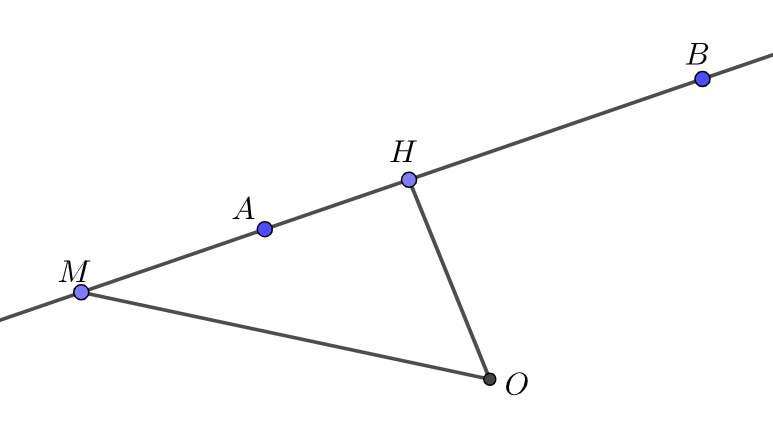
Máy bay \(M\) chuyển động theo đường thẳng đi qua hai điểm \(A,B\) nên ta có \(M,A,B\) thẳng hàng hay \(\overrightarrow {AM} = \left( {a + 5;b - 5} \right),\overrightarrow {AB} = \left( {7;1} \right)\) cùng phương.
Khi đó, ta có \(\frac{{a + 5}}{7} = \frac{{b - 5}}{1} \Leftrightarrow a - 7b = - 40\) (1).
Mặt khác ta có khoảng cách từ máy bay đến trạm không lưu là \(OM\), \(OM\) nhỏ nhất khi \(M\) là hình chiếu của \(O\) trên \(AB\) hay \(\overrightarrow {OM} \bot \overrightarrow {AB} \) \(\left( {M \equiv H} \right)\)\( \Rightarrow \overrightarrow {OM} \cdot \overrightarrow {AB} = 0 \Rightarrow 7a + b = 0\) (2).
Từ (1) và (2) ta có hệ phương trình \(\left\{ \begin{array}{l}a - 7b = - 40\\7a + b = 0\end{array} \right. \Leftrightarrow \left\{ \begin{array}{l}a = - \frac{4}{5}\\b = \frac{{28}}{5}\end{array} \right.\). Vậy \(20a - 15b = - 100\).
Đáp án: −100.
Một vật nằm trên mặt phẳng ngang chịu tác dụng của hai lực \[\overrightarrow {{F_1}} \] có phương song song với mặt phẳng ngang và \[\overrightarrow {{F_2}} \] theo phương tạo với mặt phẳng ngang một góc \[60^\circ \](như hình vẽ). Biết rằng độ lớn của các lực là \[\left| {\overrightarrow {{F_1}} } \right| = 50\,{\rm{N}}\], \[\left| {\overrightarrow {{F_2}} } \right| = 30\,{\rm{N}}\]. Ta nhận thấy vật di chuyển theo phương nằm ngang một quãng đường \[28\]m.
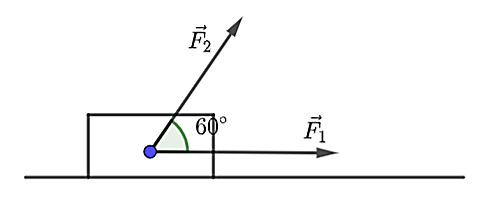
Tính công sinh ra (đơn vị: Jun) bởi lực \(\overrightarrow F \) là hợp lực của hai lực \(\overrightarrow {{F_1}} \) và \(\overrightarrow {{F_2}} \) nói trên.
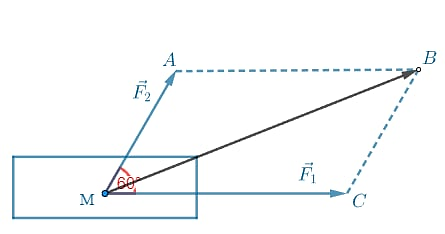
Dựng hình bình hành \(ABCM.\) Ta có \(\overrightarrow {{F_1}} + \overrightarrow {{F_2}} = \overrightarrow {MA} + \overrightarrow {MC} = \overrightarrow {MB} \).
Suy ra độ lớn của tổng hợp lực tác dụng lên vật là: \[\left| {\overrightarrow F } \right| = \left| {\overrightarrow {{F_1}} + \overrightarrow {{F_2}} } \right| = \left| {\overrightarrow {MB} } \right| = MB\].
Xét tam giác \(CMB\) có
\(M{B^2} = M{C^2} + B{C^2} - 2MC \cdot BC \cdot \cos \widehat {MCB} = {50^2} + {30^2} - 2 \cdot 50 \cdot 30 \cdot \cos 120^\circ = 4900\).
Suy ra \(\left| {\overrightarrow F } \right| = \sqrt {4900} = 70\) N.
Góc tạo bởi lực \(\vec F\) và phương chuyển động là \(\widehat {BMC}\) với
\(\cos \widehat {BMC} = \frac{{M{B^2} + M{C^2} - B{C^2}}}{{2MB \cdot MC}} = \frac{{{{70}^2} + {{50}^2} - {{30}^2}}}{{2 \cdot 70 \cdot 50}} = \frac{{13}}{{14}}\).
Gọi \(MD\) là quãng đường vật di chuyển, khi đó công sinh bởi lực \(\vec F\) là:
\(A = \overrightarrow F \cdot \overrightarrow {MD} = \left| {\overrightarrow F } \right| \cdot \left| {\overrightarrow {MD} } \right| \cdot \cos \widehat {BMC} = 70 \cdot 28 \cdot \frac{{13}}{{14}} = 1820\;\)J.
Đáp án: 1820.