15 Đề ôn thi thpt Quốc Gia môn Tiếng Anh có lời giải chi tiết (Đề số 4)
50 câu hỏi
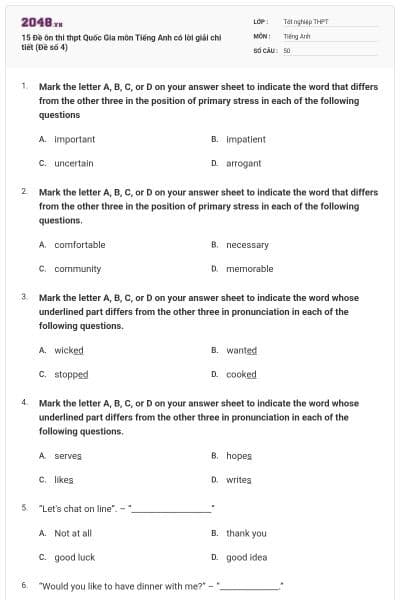
Mark the letter A, B, C, or D on your answer sheet to indicate the word that differs from the other three in the position of primary stress in each of the following questions
important
impatient
uncertain
arrogant
Chọn D
important | ɪmˈpɔrtənt |
impatient | ɪmˈpeɪʃənt |
uncertain | ənˈsɜrtən |
arrogant | ˈɛrəgənt |
Mark the letter A, B, C, or D on your answer sheet to indicate the word that differs from the other three in the position of primary stress in each of the following questions.
comfortable
necessary
community
memorable
Chọn C
comfortable | ˈkʌmfərtəbəl |
necessary | ˈnɛsəˌsɛri |
community | kə’mju:nəti |
memorable | ˈmɛmərəbəl |
Mark the letter A, B, C, or D on your answer sheet to indicate the word whose underlined part differs from the other three in pronunciation in each of the following questions.
wicked
wanted
stopped
cooked
Chọn B
wicked | ˈwɪkt |
wanted | ‘wɑntid |
stopped | stɑpt |
cooked | kʊkt |
Mark the letter A, B, C, or D on your answer sheet to indicate the word whose underlined part differs from the other three in pronunciation in each of the following questions.
serves
hopes
likes
writes
Chọn A
serves |
| sɜrvz |
hopes |
| hoʊps |
likes |
| laɪks |
writes |
| raɪts |
“Let's chat on line”. – “___________________”
Not at all
thank you
good luck
good idea
Chọn D
Not at all: không có gì
Good luck: chúc may mắn
Thank you: cảm ơn
Good idea: ý tưởng tuyệt vời
“Would you like to have dinner with me?” – “______________.”
Yes, I’d love to
Yes, so do I
I’m very happy
Yes, it is
Chọn A
Yes, I’d love to: có tôi rất muốn
Yes, so do I: có tôi cũng vậy
I’m very happy: tôi rất vui
Yes, it is: phải, là nó
She was the child of a broken marriage
broken
disastrous
happy
failed
Chọn C
Broken: tan vỡ
Disastrous: thảm khốc, bất hạnh
Happy: hạnh phúc
Failed: thất bại
She seems to have the right attitude for the job
favorable
aggressive
positive
responsible
Chọn B
Favorable: có ý tốt
Aggressive: năng nổ, xông xáo
Positive: tích cực
Responsible: trách nhiệm
In some industrial zones, the production processes may result in serious environmental problem
enormous
little
minor
petty
Chọn A
Enormous: lớn
Little: nhỏ bé
Minor, petty: nhỏ, bé, không quan trọng, không nghiêm trọng
The government should do more to protect the environment
pollute
preserve
damage
harm
Chọn B
Pollute: gây ô nhiễm
Preserve: bảo tồn
Damage: phá hoại
Harm: gây hại
Having finished her degree, __________________
she started to work for an international company
It took her 2 years to find a good job
the students carried out many experiments
her job came up to her expectation
Chọn A
The United States consists of fifty states, ______ has its own government
each
each of which
each of them
each of that
Chọn B
An endangered species is a species____ population is so small that it is in danger of extinction
what
which
whose
who
Đáp án: C
Giải thích:
Kiến thức: Mệnh đề quan hệ
what: dùng trong mệnh đề danh từ
E.g: What you have said is completely right.
which: đại từ quan hệ thay thế cho chủ ngữ hoặc tân ngữ chỉ vật
whose: đại từ quan hệ thay thế cho tính từ sở hữu trước danh từ đó
who: đại từ quan hệ thay thế cho chủ ngữ chỉ ngưởi
Trong câu này, đại từ quan hệ cần điền vào là “whose” để thay thế cho tính từ sở hữu.
Dịch: Loài có nguy cơ tuyệt chủng là loài mà số lượng của nó ít đến nỗi mà có nguy cơ bị tuyệt chủng.
Do you know the boy ______ at the party last week?
we talked about
about him we talked
we talk about him
who we talked about him
Chọn A
Câu mệnh đề
The exercises which we are doing ______ very difficult.
is
has been
are
was
Chọn C
Câu hiện tại đơn: nói về sự vật sự việc ở hiện tại
The man ______ on the chair behind me kept talking during the film, ______ really annoyed me
having sat/ that
sitting/ which
to sit/ what
to be sitting/ who
Chọn B
Câu mệnh đề dạng rút gọn ở dạng chủ động
Which: bổ sung nghĩa cho câu trước đó
The _____________ friendly products are designed not to harm the natural environment.
environment
environmental
environmentally
environmentalist
Chọn C
"Excuse me. Where is the _________office of OXFAM located?"
leading
head
central
summit
Chọn C
Central office: trụ sở chính
It is not always easy to make a good ______ at the last minute.
decide
decision
decisive
decisively
Chọn B
Decide: động từ quyết định
Decision: danh từ sự quyết định
Decisive: tính từ thuộc về quyết định
Decisively: trạng từ
A survey was ______ to study the effects of smoking on young adults.
commented
filled
conducted
carried
Chọn C
Commented: được nhận xét
Filled: được lấp đầy
Conducted: được tổ chức
Carried: được mang theo
The better the weather is, ______.
the most crowded the beaches get
the most the beaches get crowded
the more crowded the beaches get
The more the beaches get crowded
Chọn C
Câu so sánh “càng…càng…”
The V_er + S + V, the more + S + V
The book ______ you gave me is very interesting.
when
which
who
where
Chọn B
When: thay thế từ chỉ thời gian
Which: thay thế từ chỉ đồ vật
Who: thay thế từ chỉ người
Where: thay thế từ chỉ địa điểm
Read the following passage and mark the letter A, B, C, or D on your answer sheet to indicate the correct word or phrase that best fits each of the numbered blanks from 23 to 28.
If you're an environmentalist, plastic is a word you tend to say with a sneer or a snarl. It has become a symbol of our wasteful, throw-away society. But there seems little doubt it is here to stay, and the truth is, of course, that plastic has brought enormous (23)__________, even environmental ones. It’s not really the plastics themselves that are the evil ─ it's the way society chooses to use and (24)__________ them.
Almost all the 50 or so different kinds of modern plastic are made from oil, gas or coal ─ non-renewable natural (25)__________.We (26)__________ well over three million tones of the stuff in Britain each year and, sooner or later, most of it is thrown away. A high (27)__________ of our annual consumption is in the form of packaging, and this (28)__________ about seven percent by weight of our domestic refuse.
Điền vào ô 23
savings
pleasures
benefits
profits
Chọn C
Savings: sự tiết kiệm
Pleasures: sự thoải mái
Benefits: lợi ích
Profits: lợi nhuận
Read the following passage and mark the letter A, B, C, or D on your answer sheet to indicate the correct word or phrase that best fits each of the numbered blanks from 23 to 28.
If you're an environmentalist, plastic is a word you tend to say with a sneer or a snarl. It has become a symbol of our wasteful, throw-away society. But there seems little doubt it is here to stay, and the truth is, of course, that plastic has brought enormous (23)__________, even environmental ones. It’s not really the plastics themselves that are the evil ─ it's the way society chooses to use and (24)__________ them.
Almost all the 50 or so different kinds of modern plastic are made from oil, gas or coal ─ non-renewable natural (25)__________.We (26)__________ well over three million tones of the stuff in Britain each year and, sooner or later, most of it is thrown away. A high (27)__________ of our annual consumption is in the form of packaging, and this (28)__________ about seven percent by weight of our domestic refuse.
Điền vào ô 24
abuse
endanger
store
dispose
Chọn A
Abuse: lạm dụng
Endanger: gặp nguy hiểm
Store: lưu trữ
Dispose: vứt bỏ
Read the following passage and mark the letter A, B, C, or D on your answer sheet to indicate the correct word or phrase that best fits each of the numbered blanks from 23 to 28.
If you're an environmentalist, plastic is a word you tend to say with a sneer or a snarl. It has become a symbol of our wasteful, throw-away society. But there seems little doubt it is here to stay, and the truth is, of course, that plastic has brought enormous (23)__________, even environmental ones. It’s not really the plastics themselves that are the evil ─ it's the way society chooses to use and (24)__________ them.
Almost all the 50 or so different kinds of modern plastic are made from oil, gas or coal ─ non-renewable natural (25)__________.We (26)__________ well over three million tones of the stuff in Britain each year and, sooner or later, most of it is thrown away. A high (27)__________ of our annual consumption is in the form of packaging, and this (28)__________ about seven percent by weight of our domestic refuse.
Điền vào ô 25
processes
resources
products
fuels
Chọn B
Process: quá trình
Resource: nguồn, tài nguyên
Product: sản phẩm
Fuel: hóa thạch
Read the following passage and mark the letter A, B, C, or D on your answer sheet to indicate the correct word or phrase that best fits each of the numbered blanks from 23 to 28.
If you're an environmentalist, plastic is a word you tend to say with a sneer or a snarl. It has become a symbol of our wasteful, throw-away society. But there seems little doubt it is here to stay, and the truth is, of course, that plastic has brought enormous (23)__________, even environmental ones. It’s not really the plastics themselves that are the evil ─ it's the way society chooses to use and (24)__________ them.
Almost all the 50 or so different kinds of modern plastic are made from oil, gas or coal ─ non-renewable natural (25)__________.We (26)__________ well over three million tones of the stuff in Britain each year and, sooner or later, most of it is thrown away. A high (27)__________ of our annual consumption is in the form of packaging, and this (28)__________ about seven percent by weight of our domestic refuse.
Điền vào ô 26
import
consign
remove
consume
Chọn D
Import: nhập khẩu
Consign: ủy thác
Remove: vứt bỏ
Consume: tiêu thụ
Read the following passage and mark the letter A, B, C, or D on your answer sheet to indicate the correct word or phrase that best fits each of the numbered blanks from 23 to 28.
If you're an environmentalist, plastic is a word you tend to say with a sneer or a snarl. It has become a symbol of our wasteful, throw-away society. But there seems little doubt it is here to stay, and the truth is, of course, that plastic has brought enormous (23)__________, even environmental ones. It’s not really the plastics themselves that are the evil ─ it's the way society chooses to use and (24)__________ them.
Almost all the 50 or so different kinds of modern plastic are made from oil, gas or coal ─ non-renewable natural (25)__________.We (26)__________ well over three million tones of the stuff in Britain each year and, sooner or later, most of it is thrown away. A high (27)__________ of our annual consumption is in the form of packaging, and this (28)__________ about seven percent by weight of our domestic refuse.
Điền vào ô 27
amount
proportion
portion
rate
Chọn A
Amount: tổng
Proportion: tỉ lệ
Portion: phần chia
Rate: tỷ lệ
Read the following passage and mark the letter A, B, C, or D on your answer sheet to indicate the correct word or phrase that best fits each of the numbered blanks from 23 to 28.
If you're an environmentalist, plastic is a word you tend to say with a sneer or a snarl. It has become a symbol of our wasteful, throw-away society. But there seems little doubt it is here to stay, and the truth is, of course, that plastic has brought enormous (23)__________, even environmental ones. It’s not really the plastics themselves that are the evil ─ it's the way society chooses to use and (24)__________ them.
Almost all the 50 or so different kinds of modern plastic are made from oil, gas or coal ─ non-renewable natural (25)__________.We (26)__________ well over three million tones of the stuff in Britain each year and, sooner or later, most of it is thrown away. A high (27)__________ of our annual consumption is in the form of packaging, and this (28)__________ about seven percent by weight of our domestic refuse.
Điền vào ô 28
makes
carries
takes
constitutes
Chọn D
Constitutes: cấu thành, chiếm
Make: tạo ra
Take: lấy
Carry: mang
Read the following passage and mark the letter A, B, C, or D on your answer sheet to indicate the correct answer to each of the questions from 29 to 33
In the world today, particularly in the two most industrialized areas, North America and Europe, recycling is big news. People are talking about it, practicing it, and discovering new ways to be sensitive to the environment. Recycling means finding was to use products a second time. The motto of the recycling movement is "Reduce, Reuse, Recycle". The first step is to reduce garbage. In stores, a shopper has to buy products in blister packs, boxes and expensive plastic wrappings. A hamburger from a fast food restaurant comes in lots of packaging. usually paper, a box, and a bag. All that packaging is wasted resources. People should try to buy things that are wrapped simply, and to reuse cups and utensils. Another way to reduce waste is to buy high-quality products. When low quality appliances break, many customers throw them away and buy new ones - a loss of more resources and more energy. For example, if a customer buys a high-quality appliance that can be easily repaired, the manufacturer receives an important message. In the same way, if a customer chooses a product with less packaging, that customer sends an important message to the manufacturers. To reduce garbage, the throwaway must stop.
The second step is to reuse. It is better to buy juices and soft drinks in returnable bottles. After customers empty the bottles, they return them to the store. The manufacturers of the drinks collect the bottles, wash them, and then fill them again. The energy that is necessary to make new bottles is saved. In some parts of the world, returning bottles for money is a common practice. In those places, the garbage dumps have relatively little glass and plastic from throwaway bottles.
The third step is being environmentally sensitive is to recycle. Spent motor oil can be cleaned and used again. Aluminum cans are expensive to make. It takes the same amount of energy to make one aluminum can as it does to run a color TV set for three hours. When people collect and recycle aluminum (for new cans), they help save one of the world's precious resources.
What is the main topic of the passage?
How to reduce garbage disposal
What people often understand about the term 'recycle’
What is involved in the recycling movement
How to live sensitively to the environment
Chọn C
Chủ đề chính của đoạn văn là:
A. Làm thế nào để giảm lượng rác thải được thải ra
B. Mọi người thường hiểu về từ “tái chế” như thế nào
C. Những gì diễn ra trong chu trình tái chế
D. Làm thế nào để sống tốt hơn với môi trường thiên nhiên
Trên thế giới ngày nay, đặc biệt là ở hai khu vực công nghiệp hóa nhất, Bắc Mỹ và Châu Âu, tái chế là một vấn đề lớn. Mọi người đều nói về nó, thực hành nó và tìm cách thân thiện với môi trường. Tái chế nghĩa là sử dụng sản phẩm lần thứ hai. Phương châm của phong trào tái chế là "Giảm thiểu, tái sử dụng, tái chế". Bước đầu tiên là giảm rác thải. Trong các cửa hàng, người mua sắm phải mua các sản phẩm trong vỉ, hộp và bao bì bằng nhựa đắt tiền. Một chiếc bánh hamburger từ một nhà hàng thức ăn nhanh có rất nhiều bao bì, thường là giấy, một cái hộp và một cái túi. Tất cả bao bì đó là tài nguyên lãng phí. Những người mua nên cố gắng mua những thứ được bọc đơn giản, và sử dụng lại chén và đồ dùng. Cách khác để giảm chất thải là mua các sản phẩm chất lượng cao. Khi thiết bị chất lượng thấp bị hỏng, nhiều khách hàng vứt chúng đi và mua những thứ mới - mất nhiều tài nguyên hơn và nhiều năng lượng hơn. Ví dụ: nếu khách hàng mua một thiết bị chất lượng cao có thể dễ dàng được sửa chữa, nhà sản xuất nhận được một thông điệp quan trọng. Cũng như vậy, nếu khách hàng chọn sản phẩm có ít bao bì hơn, khách hàng đó sẽ gửi một thông điệp quan trọng tới nhà sản xuất. Để giảm rác thải, ta phải dừng việc lãng phí.
Bước thứ hai là sử dụng lại. Nên mua nước trái cây và nước giải khát trong chai có thể tái sử dụng. Sau khi khách hàng dùng hết chai, họ trả lại cho cửa hàng. Các nhà sản xuất của đồ uống thu thập các chai, rửa chúng, và sau đó đổ đầy chúng một lần nữa. Năng lượng cần thiết để làm cho chai mới đều được bảo lưu. Ở một số nơi trên thế giới, trả lại chai để tiết kiệm tiền là một thực tế phổ biến. Ở những nơi đó, các bãi rác có ít chai thủy tinh và nhựa.
Bước thứ ba là tái chế. Dầu động cơ đã qua sử dụng có thể được làm sạch và sử dụng lại. Lon nhôm rất tốn kém để thực hiện tái chế. Phải mất cùng một lượng năng lượng để làm một lon nhôm mới với chạy TV màu trong ba giờ. Khi mọi người thu thập và tái chế nhôm (cho các lon mới), họ đã giúp tiết kiệm một trong những nguồn tài nguyên quý giá của thế giới.
Read the following passage and mark the letter A, B, C, or D on your answer sheet to indicate the correct answer to each of the questions from 29 to 33
In the world today, particularly in the two most industrialized areas, North America and Europe, recycling is big news. People are talking about it, practicing it, and discovering new ways to be sensitive to the environment. Recycling means finding was to use products a second time. The motto of the recycling movement is "Reduce, Reuse, Recycle". The first step is to reduce garbage. In stores, a shopper has to buy products in blister packs, boxes and expensive plastic wrappings. A hamburger from a fast food restaurant comes in lots of packaging. usually paper, a box, and a bag. All that packaging is wasted resources. People should try to buy things that are wrapped simply, and to reuse cups and utensils. Another way to reduce waste is to buy high-quality products. When low quality appliances break, many customers throw them away and buy new ones - a loss of more resources and more energy. For example, if a customer buys a high-quality appliance that can be easily repaired, the manufacturer receives an important message. In the same way, if a customer chooses a product with less packaging, that customer sends an important message to the manufacturers. To reduce garbage, the throwaway must stop.
The second step is to reuse. It is better to buy juices and soft drinks in returnable bottles. After customers empty the bottles, they return them to the store. The manufacturers of the drinks collect the bottles, wash them, and then fill them again. The energy that is necessary to make new bottles is saved. In some parts of the world, returning bottles for money is a common practice. In those places, the garbage dumps have relatively little glass and plastic from throwaway bottles.
The third step is being environmentally sensitive is to recycle. Spent motor oil can be cleaned and used again. Aluminum cans are expensive to make. It takes the same amount of energy to make one aluminum can as it does to run a color TV set for three hours. When people collect and recycle aluminum (for new cans), they help save one of the world's precious resources.
People can do the following to reduce waste EXCEPT________
buy high-quality product
buy simply-wrapped things
reuse cups
buy fewer hamburgers
Chọn D
Mọi nười có thể làm những việc phía dưới để giảm lượng rác thải TRỪ:
A. Mua sản phẩm chất lượng cao
B. Mua những vật được bọc đơn giản
C. Tái sử dụng cốc
Mua ít hamburger
Read the following passage and mark the letter A, B, C, or D on your answer sheet to indicate the correct answer to each of the questions from 29 to 33
In the world today, particularly in the two most industrialized areas, North America and Europe, recycling is big news. People are talking about it, practicing it, and discovering new ways to be sensitive to the environment. Recycling means finding was to use products a second time. The motto of the recycling movement is "Reduce, Reuse, Recycle". The first step is to reduce garbage. In stores, a shopper has to buy products in blister packs, boxes and expensive plastic wrappings. A hamburger from a fast food restaurant comes in lots of packaging. usually paper, a box, and a bag. All that packaging is wasted resources. People should try to buy things that are wrapped simply, and to reuse cups and utensils. Another way to reduce waste is to buy high-quality products. When low quality appliances break, many customers throw them away and buy new ones - a loss of more resources and more energy. For example, if a customer buys a high-quality appliance that can be easily repaired, the manufacturer receives an important message. In the same way, if a customer chooses a product with less packaging, that customer sends an important message to the manufacturers. To reduce garbage, the throwaway must stop.
The second step is to reuse. It is better to buy juices and soft drinks in returnable bottles. After customers empty the bottles, they return them to the store. The manufacturers of the drinks collect the bottles, wash them, and then fill them again. The energy that is necessary to make new bottles is saved. In some parts of the world, returning bottles for money is a common practice. In those places, the garbage dumps have relatively little glass and plastic from throwaway bottles.
The third step is being environmentally sensitive is to recycle. Spent motor oil can be cleaned and used again. Aluminum cans are expensive to make. It takes the same amount of energy to make one aluminum can as it does to run a color TV set for three hours. When people collect and recycle aluminum (for new cans), they help save one of the world's precious resources.
Why is it a waste when customers buy low-quality products?
Because people will soon throw them away
Because they have to be repaired many times
Because customers change their ideas all the time
Because they produce less energy
Chọn A
Tại sao lại lãng phí khi khách hàng mua sản phẩm kém chất lượng?
A. Vì họ sẽ nhanh chóng vứt chúng đi
B. Vì họ phải sửa chữa nhiều lần
C. Vì khách hàng luôn thay đổi quyết định
D. Vì họ sản sinh ra ít năng lượng
Read the following passage and mark the letter A, B, C, or D on your answer sheet to indicate the correct answer to each of the questions from 29 to 33
In the world today, particularly in the two most industrialized areas, North America and Europe, recycling is big news. People are talking about it, practicing it, and discovering new ways to be sensitive to the environment. Recycling means finding was to use products a second time. The motto of the recycling movement is "Reduce, Reuse, Recycle". The first step is to reduce garbage. In stores, a shopper has to buy products in blister packs, boxes and expensive plastic wrappings. A hamburger from a fast food restaurant comes in lots of packaging. usually paper, a box, and a bag. All that packaging is wasted resources. People should try to buy things that are wrapped simply, and to reuse cups and utensils. Another way to reduce waste is to buy high-quality products. When low quality appliances break, many customers throw them away and buy new ones - a loss of more resources and more energy. For example, if a customer buys a high-quality appliance that can be easily repaired, the manufacturer receives an important message. In the same way, if a customer chooses a product with less packaging, that customer sends an important message to the manufacturers. To reduce garbage, the throwaway must stop.
The second step is to reuse. It is better to buy juices and soft drinks in returnable bottles. After customers empty the bottles, they return them to the store. The manufacturers of the drinks collect the bottles, wash them, and then fill them again. The energy that is necessary to make new bottles is saved. In some parts of the world, returning bottles for money is a common practice. In those places, the garbage dumps have relatively little glass and plastic from throwaway bottles.
The third step is being environmentally sensitive is to recycle. Spent motor oil can be cleaned and used again. Aluminum cans are expensive to make. It takes the same amount of energy to make one aluminum can as it does to run a color TV set for three hours. When people collect and recycle aluminum (for new cans), they help save one of the world's precious resources.
What best describes the process of reuse?
The bottles are collected, washed, returned and filled again
The bottles are filled again after being returned, collected and washed
The bottles are washed, retuned, filled again and collected
The bottles are collected, returned filled again and washed
Chọn B
After customers empty the bottles, they return them to the store. The manufacturers of the drinks collect the bottles, wash them, and then fill them again.
Miêu tả tốt nhất về quá trình tái sử dụng là:
A. Chai được thu thập, rửa, quay lại đồ đầy 1 lần nữa
B. Chai được đổ đầy 1 lần nữa sau khi được quay lại, thu thập và rửa
C. Chai được rửa, quay lại, đổ đầy lại và thu thập
D. Chai được thu thập, quay lại, đổ đầy và rửa
Read the following passage and mark the letter A, B, C, or D on your answer sheet to indicate the correct answer to each of the questions from 29 to 33
In the world today, particularly in the two most industrialized areas, North America and Europe, recycling is big news. People are talking about it, practicing it, and discovering new ways to be sensitive to the environment. Recycling means finding was to use products a second time. The motto of the recycling movement is "Reduce, Reuse, Recycle". The first step is to reduce garbage. In stores, a shopper has to buy products in blister packs, boxes and expensive plastic wrappings. A hamburger from a fast food restaurant comes in lots of packaging. usually paper, a box, and a bag. All that packaging is wasted resources. People should try to buy things that are wrapped simply, and to reuse cups and utensils. Another way to reduce waste is to buy high-quality products. When low quality appliances break, many customers throw them away and buy new ones - a loss of more resources and more energy. For example, if a customer buys a high-quality appliance that can be easily repaired, the manufacturer receives an important message. In the same way, if a customer chooses a product with less packaging, that customer sends an important message to the manufacturers. To reduce garbage, the throwaway must stop.
The second step is to reuse. It is better to buy juices and soft drinks in returnable bottles. After customers empty the bottles, they return them to the store. The manufacturers of the drinks collect the bottles, wash them, and then fill them again. The energy that is necessary to make new bottles is saved. In some parts of the world, returning bottles for money is a common practice. In those places, the garbage dumps have relatively little glass and plastic from throwaway bottles.
The third step is being environmentally sensitive is to recycle. Spent motor oil can be cleaned and used again. Aluminum cans are expensive to make. It takes the same amount of energy to make one aluminum can as it does to run a color TV set for three hours. When people collect and recycle aluminum (for new cans), they help save one of the world's precious resources.
What are the two things mentioned as examples of recycling?
Aluminum cans and plastic wrappings
Hamburger wrappings and spent motor oil
Aluminum cans and spent motor oil
TV sets and aluminum cans
Chọn C
Spent motor oil can be cleaned and used again. Aluminum cans are expensive to make.
Read the following passage and mark the letter A, B, C, or D on your answer sheet to indicate the correct answer to each of the questions from 34 to 40.
An air pollutant is defined as a compound added directly or indirectly by humans to the atmosphere in such quantities as to affect humans, animals, vegetation, or materials adversely. Air pollution requires a very flexible definition that permits continuous change. When the first air pollution laws were established in England in the fourteenth century, air pollutants were limited to compounds that could be seen or smelled - a far cry from the extensive list of harmful substances known today. As technology has developed and knowledge of the health aspects of various chemicals has increased, the list of air pollutants has lengthened. In the future, even water vapor might be considered an air pollutant under certain conditions.
Many of the more important air pollutants, such as sulfur oxides, carbon monoxide, and nitrogen oxides, are found in nature. As the Earth developed, the concentration of these pollutants was altered by various chemical reactions; they became components in biogeochemical cycles. These serve as an air purification scheme by allowing the compounds to move from the air to the water or soil. On a global basis, nature's output of these compounds dwarfs that resulting from human activities.
However, human production usually occurs in a localized area, such as a city. In such a region, human output may be dominant and may temporarily overload the natural purification scheme of the cycles. The result is an increased concentration of noxious chemicals in the air. The concentrations at which the adverse effects appear will be greater than the concentrations that the pollutants would have in the absence of human activities. The actual concentration need not be large for a substance to be a pollutant; in fact, the numerical value tells us little until we know how much of an increase this represents over the concentration that would occur naturally in the area. For example, sulfur dioxide has detectable health effects at 0.08 parts per million (ppm), which is about 400 times its natural level. Carbon monoxide, however, has a natural level of 0.1 ppm and is not usually a pollutant until its level reaches about 15 ppm.
What does the passage mainly discuss?
The economic impact of air pollution
What constitutes an air pollutant
How much harm air pollutants can cause
The effects of compounds added to the atmosphere
Chọn B
Vần đề chính được đề cập trong bài là:
A. Ảnh hưởng kinh tế của chất ô nhiễm không khí
B. Những thành phần cấu thành một chất ô nhiễm không khí
C. Chất ô nhiễm không khí có thể gây tác hại nhiều như thế nào
D. Ảnh hưởng của hợp chất được thêm váo trong không khí
Chất ô nhiễm không khí được định nghĩa là hợp chất được thêm trực tiếp hoặc gián tiếp bởi con người vào bầu không khí với số lượng có thể gây ảnh hưởng đến con người, động vật, thực vật hoặc vật liệu một cách tiêu cực. Ô nhiễm không khí đòi hỏi một định nghĩa rất linh hoạt cho phép thay đổi liên tục. Khi luật ô nhiễm không khí đầu tiên được thành lập ở Anh vào thế kỷ 14, các chất ô nhiễm không khí được giới hạn trong các hợp chất có thể nhìn thấy hoặc ngửi được – khác xa với danh sách các chất độc hại được biết đến ngày nay. Khi công nghệ đã phát triển và kiến thức về các khía cạnh sức khỏe của các hóa chất khác nhau đã tăng lên, danh sách các chất gây ô nhiễm không khí đã kéo dài hơn. Trong tương lai, thậm chí hơi nước có thể được coi là một chất ô nhiễm không khí dưới một số điều kiện nhất định.
Nhiều chất ô nhiễm không khí quan trọng hơn, chẳng hạn như ôxit lưu huỳnh, cacbon monoxit, và nitơ oxit, đã được tìm thấy trong tự nhiên. Khi Trái đất phát triển, nồng độ của những chất gây ô nhiễm đã bị thay đổi bởi các phản ứng hóa học khác nhau; chúng đã trở thành thành phần trong chu kỳ sinh hóa. Chúng phục vụ như một chương trình lọc không khí bằng cách cho phép các hợp chất di chuyển từ không khí đến nước hoặc đất. Trên cơ sở toàn cầu, sản lượng thiên nhiên của các hợp chất này đang thu nhỏ lại do các hoạt động của con người.
Tuy nhiên, sản xuất của con người thường xảy ra ở một khu vực địa phương, chẳng hạn như một thành phố. Trong khu vực đó, sản lượng của con người có thể chiếm ưu thế và có thể tạm thời quá tải chu kỳ thanh lọc tự nhiên. Kết quả là sự gia tăng nồng độ các hóa chất độc hại trong không khí. Nồng độ mà tại đó các tác dụng phụ xuất hiện sẽ lớn hơn nồng độ mà tại đó các chất ô nhiễm sẽ có khi không có hoạt động của con người. Nồng độ thực tế không cần phải lớn mới trở thành chất gây ô nhiễm; trên thực tế, giá trị về con số cho chúng ta biết rất ít cho đến khi chúng ta biết mức tăng trưởng vượt quá sự phân bố tự nhiên trong khu vực. Ví dụ, sulfur dioxide có thể gây ảnh hưởng tới sức khỏe ở mức 0,08 phần triệu (ppm), gấp khoảng 400 lần mức tự nhiên của nó. Tuy nhiên, carbon monoxide có mức độ tự nhiên 0,1 ppm và thường không phải là chất gây ô nhiễm cho đến khi đạt đến mức khoảng 15 ppm.
Read the following passage and mark the letter A, B, C, or D on your answer sheet to indicate the correct answer to each of the questions from 34 to 40.
An air pollutant is defined as a compound added directly or indirectly by humans to the atmosphere in such quantities as to affect humans, animals, vegetation, or materials adversely. Air pollution requires a very flexible definition that permits continuous change. When the first air pollution laws were established in England in the fourteenth century, air pollutants were limited to compounds that could be seen or smelled - a far cry from the extensive list of harmful substances known today. As technology has developed and knowledge of the health aspects of various chemicals has increased, the list of air pollutants has lengthened. In the future, even water vapor might be considered an air pollutant under certain conditions.
Many of the more important air pollutants, such as sulfur oxides, carbon monoxide, and nitrogen oxides, are found in nature. As the Earth developed, the concentration of these pollutants was altered by various chemical reactions; they became components in biogeochemical cycles. These serve as an air purification scheme by allowing the compounds to move from the air to the water or soil. On a global basis, nature's output of these compounds dwarfs that resulting from human activities.
However, human production usually occurs in a localized area, such as a city. In such a region, human output may be dominant and may temporarily overload the natural purification scheme of the cycles. The result is an increased concentration of noxious chemicals in the air. The concentrations at which the adverse effects appear will be greater than the concentrations that the pollutants would have in the absence of human activities. The actual concentration need not be large for a substance to be a pollutant; in fact, the numerical value tells us little until we know how much of an increase this represents over the concentration that would occur naturally in the area. For example, sulfur dioxide has detectable health effects at 0.08 parts per million (ppm), which is about 400 times its natural level. Carbon monoxide, however, has a natural level of 0.1 ppm and is not usually a pollutant until its level reaches about 15 ppm.
It can be inferred from the first paragraph that _____.
water vapor is an air pollutant in localized areas
most air pollutants today can be seen or smelled
the definition of air pollution will continue to change
a substance becomes an air pollutant only in cities
Chọn C
Air pollution requires a very flexible definition that permits continuous change.
Read the following passage and mark the letter A, B, C, or D on your answer sheet to indicate the correct answer to each of the questions from 34 to 40.
An air pollutant is defined as a compound added directly or indirectly by humans to the atmosphere in such quantities as to affect humans, animals, vegetation, or materials adversely. Air pollution requires a very flexible definition that permits continuous change. When the first air pollution laws were established in England in the fourteenth century, air pollutants were limited to compounds that could be seen or smelled - a far cry from the extensive list of harmful substances known today. As technology has developed and knowledge of the health aspects of various chemicals has increased, the list of air pollutants has lengthened. In the future, even water vapor might be considered an air pollutant under certain conditions.
Many of the more important air pollutants, such as sulfur oxides, carbon monoxide, and nitrogen oxides, are found in nature. As the Earth developed, the concentration of these pollutants was altered by various chemical reactions; they became components in biogeochemical cycles. These serve as an air purification scheme by allowing the compounds to move from the air to the water or soil. On a global basis, nature's output of these compounds dwarfs that resulting from human activities.
However, human production usually occurs in a localized area, such as a city. In such a region, human output may be dominant and may temporarily overload the natural purification scheme of the cycles. The result is an increased concentration of noxious chemicals in the air. The concentrations at which the adverse effects appear will be greater than the concentrations that the pollutants would have in the absence of human activities. The actual concentration need not be large for a substance to be a pollutant; in fact, the numerical value tells us little until we know how much of an increase this represents over the concentration that would occur naturally in the area. For example, sulfur dioxide has detectable health effects at 0.08 parts per million (ppm), which is about 400 times its natural level. Carbon monoxide, however, has a natural level of 0.1 ppm and is not usually a pollutant until its level reaches about 15 ppm.
For which of the following reasons can natural pollutants play an important role in controlling air pollution?
They function as part of a purification process
They occur in greater quantities than other pollutants
They are less harmful to living beings than other pollutants
They have existed since the Earth developed
Chọn A
Lí do nào dưới đây chất ô nhiễm tự nhiên có thể đóng vai trò quan trọng trong việc kiểm soát ô nhiễm không khí:
Many of the more important air pollutants, such as sulfur oxides, carbon monoxide, and
nitrogen oxides, are found in nature. As the Earth developed, the concentration of these
pollutants was altered by various chemical reactions; they became components in
biogeochemical cycles.
A. Chúng đóng vai trò là một phần của quá trình thanh lọc
B. Chúng chiếm số lượng lớn hơn những chất ô nhiễm
C. Chúng ít có hại với vật thể sống hơn các chất ô nhiễm khác
D. Chúng đã tồn tại từ khi Trái Đất phát triển
Read the following passage and mark the letter A, B, C, or D on your answer sheet to indicate the correct answer to each of the questions from 34 to 40.
An air pollutant is defined as a compound added directly or indirectly by humans to the atmosphere in such quantities as to affect humans, animals, vegetation, or materials adversely. Air pollution requires a very flexible definition that permits continuous change. When the first air pollution laws were established in England in the fourteenth century, air pollutants were limited to compounds that could be seen or smelled - a far cry from the extensive list of harmful substances known today. As technology has developed and knowledge of the health aspects of various chemicals has increased, the list of air pollutants has lengthened. In the future, even water vapor might be considered an air pollutant under certain conditions.
Many of the more important air pollutants, such as sulfur oxides, carbon monoxide, and nitrogen oxides, are found in nature. As the Earth developed, the concentration of these pollutants was altered by various chemical reactions; they became components in biogeochemical cycles. These serve as an air purification scheme by allowing the compounds to move from the air to the water or soil. On a global basis, nature's output of these compounds dwarfs that resulting from human activities.
However, human production usually occurs in a localized area, such as a city. In such a region, human output may be dominant and may temporarily overload the natural purification scheme of the cycles. The result is an increased concentration of noxious chemicals in the air. The concentrations at which the adverse effects appear will be greater than the concentrations that the pollutants would have in the absence of human activities. The actual concentration need not be large for a substance to be a pollutant; in fact, the numerical value tells us little until we know how much of an increase this represents over the concentration that would occur naturally in the area. For example, sulfur dioxide has detectable health effects at 0.08 parts per million (ppm), which is about 400 times its natural level. Carbon monoxide, however, has a natural level of 0.1 ppm and is not usually a pollutant until its level reaches about 15 ppm.
According to the passage, human-generated air pollution in localized regions _____.
can be dwarfed by nature's output of pollutants
can overwhelm the natural system that removes pollutants
will damage areas outside of the localized regions
will react harmfully with natural pollutants
Chọn B
Nói tới bài viết, chất ô nhiễm không khí do con người tạo ra trong một khu vực xác định:
In such a region, human output may be dominant and may temporarily overload the natural purification scheme of the cycles.
A. Có thể ít hơn bởi sản lượng tự nhiên của chất ô nhiễm
B. Có thể quá tải với hệ thống tự nhiên loại bỏ các chất gây ô nhiễm
C. Có thể phá hủy vùng bên ngoài khu vực
D. Dẫn đến các phản ứng có hại với chất ô nhiễm thiên nhiên
Read the following passage and mark the letter A, B, C, or D on your answer sheet to indicate the correct answer to each of the questions from 34 to 40.
An air pollutant is defined as a compound added directly or indirectly by humans to the atmosphere in such quantities as to affect humans, animals, vegetation, or materials adversely. Air pollution requires a very flexible definition that permits continuous change. When the first air pollution laws were established in England in the fourteenth century, air pollutants were limited to compounds that could be seen or smelled - a far cry from the extensive list of harmful substances known today. As technology has developed and knowledge of the health aspects of various chemicals has increased, the list of air pollutants has lengthened. In the future, even water vapor might be considered an air pollutant under certain conditions.
Many of the more important air pollutants, such as sulfur oxides, carbon monoxide, and nitrogen oxides, are found in nature. As the Earth developed, the concentration of these pollutants was altered by various chemical reactions; they became components in biogeochemical cycles. These serve as an air purification scheme by allowing the compounds to move from the air to the water or soil. On a global basis, nature's output of these compounds dwarfs that resulting from human activities.
However, human production usually occurs in a localized area, such as a city. In such a region, human output may be dominant and may temporarily overload the natural purification scheme of the cycles. The result is an increased concentration of noxious chemicals in the air. The concentrations at which the adverse effects appear will be greater than the concentrations that the pollutants would have in the absence of human activities. The actual concentration need not be large for a substance to be a pollutant; in fact, the numerical value tells us little until we know how much of an increase this represents over the concentration that would occur naturally in the area. For example, sulfur dioxide has detectable health effects at 0.08 parts per million (ppm), which is about 400 times its natural level. Carbon monoxide, however, has a natural level of 0.1 ppm and is not usually a pollutant until its level reaches about 15 ppm.
The word “localized” in the third paragraph is closest in meaning to _____.
specified
circled
surrounded
encircled
Chọn A
Từ “localized” gần nghĩa với từ nào:
Specified: cụ thể
Circled: khoanh tròn
Surrounded: bao quanh
Encircled: vòng quanh
Read the following passage and mark the letter A, B, C, or D on your answer sheet to indicate the correct answer to each of the questions from 34 to 40.
An air pollutant is defined as a compound added directly or indirectly by humans to the atmosphere in such quantities as to affect humans, animals, vegetation, or materials adversely. Air pollution requires a very flexible definition that permits continuous change. When the first air pollution laws were established in England in the fourteenth century, air pollutants were limited to compounds that could be seen or smelled - a far cry from the extensive list of harmful substances known today. As technology has developed and knowledge of the health aspects of various chemicals has increased, the list of air pollutants has lengthened. In the future, even water vapor might be considered an air pollutant under certain conditions.
Many of the more important air pollutants, such as sulfur oxides, carbon monoxide, and nitrogen oxides, are found in nature. As the Earth developed, the concentration of these pollutants was altered by various chemical reactions; they became components in biogeochemical cycles. These serve as an air purification scheme by allowing the compounds to move from the air to the water or soil. On a global basis, nature's output of these compounds dwarfs that resulting from human activities.
However, human production usually occurs in a localized area, such as a city. In such a region, human output may be dominant and may temporarily overload the natural purification scheme of the cycles. The result is an increased concentration of noxious chemicals in the air. The concentrations at which the adverse effects appear will be greater than the concentrations that the pollutants would have in the absence of human activities. The actual concentration need not be large for a substance to be a pollutant; in fact, the numerical value tells us little until we know how much of an increase this represents over the concentration that would occur naturally in the area. For example, sulfur dioxide has detectable health effects at 0.08 parts per million (ppm), which is about 400 times its natural level. Carbon monoxide, however, has a natural level of 0.1 ppm and is not usually a pollutant until its level reaches about 15 ppm.
According to the passage, the numerical value of the concentration level of a substance is only useful if _____.
the other substances in the area are known
it is in a localized area
the natural level is also known
it can be calculated quickly
Chọn C
Trong bài viết, con số về sự phân bố của một chất chỉ hữu ích nếu:
A. các chất khác trong khu vực được biết đến
B. nó đang ở trong một khu vực địa phương hóa
C. mức độ tự nhiên cũng được cho biết
D. nó có thể được tính toán nhanh chóng
Read the following passage and mark the letter A, B, C, or D on your answer sheet to indicate the correct answer to each of the questions from 34 to 40.
An air pollutant is defined as a compound added directly or indirectly by humans to the atmosphere in such quantities as to affect humans, animals, vegetation, or materials adversely. Air pollution requires a very flexible definition that permits continuous change. When the first air pollution laws were established in England in the fourteenth century, air pollutants were limited to compounds that could be seen or smelled - a far cry from the extensive list of harmful substances known today. As technology has developed and knowledge of the health aspects of various chemicals has increased, the list of air pollutants has lengthened. In the future, even water vapor might be considered an air pollutant under certain conditions.
Many of the more important air pollutants, such as sulfur oxides, carbon monoxide, and nitrogen oxides, are found in nature. As the Earth developed, the concentration of these pollutants was altered by various chemical reactions; they became components in biogeochemical cycles. These serve as an air purification scheme by allowing the compounds to move from the air to the water or soil. On a global basis, nature's output of these compounds dwarfs that resulting from human activities.
However, human production usually occurs in a localized area, such as a city. In such a region, human output may be dominant and may temporarily overload the natural purification scheme of the cycles. The result is an increased concentration of noxious chemicals in the air. The concentrations at which the adverse effects appear will be greater than the concentrations that the pollutants would have in the absence of human activities. The actual concentration need not be large for a substance to be a pollutant; in fact, the numerical value tells us little until we know how much of an increase this represents over the concentration that would occur naturally in the area. For example, sulfur dioxide has detectable health effects at 0.08 parts per million (ppm), which is about 400 times its natural level. Carbon monoxide, however, has a natural level of 0.1 ppm and is not usually a pollutant until its level reaches about 15 ppm.
Which of the following is best supported by the passage?
To effectively control pollution, local government should regularly review their air pollution laws
One of the most important steps in preserving natural lands is to better enforce air pollution laws
Scientists should be consulted in order to establish uniform limits for all air pollutants
Human activities have been effective in reducing air pollution
Chọn D
Những ý kiến nào có trong bài viết:
A. Để kiểm soát ô nhiễm hiệu quả, chính quyền địa phương nên thường xuyên xem xét lại luật về ô nhiễm không khí của họ.
B. Một trong những bước quan trọng nhất trong việc bảo tồn đất tự nhiên là thực thi tốt hơn luật về ô nhiễm không khí.
C. Các nhà khoa học nên được tư vấn để thiết lập các giới hạn thống nhất cho tất cả các chất gây ô nhiễm không khí.
D. Các hành động của con người đã có hiệu quả trong việc giảm ô nhiễm không khí
“I will help you with the housework”, Mai said.
Mai promised to help me with the housework
Mai asked me to help her with the housework
Mai begged to help me with the housework
Mai insisted on helping me with the housework
Chọn A
Mai nói:”tôi sẽ giúp bạn cùng làm việc nhà”.
A. Mai hứa giúp tôi cùng làm việc nhà
B. Mai yêu cầu tôi giúp cô ấy cùng làm việc nhà
C. Mai cầu xin giúp tôi cùng làm việc nhà
Mai nhất quyết giúp tôi cùng việc nhà
There is not a single corner of Hue that my friend hasn't visited.
My friend has visited only a single part of Hue
My friend has visited every part of Hue already
My friend hasn't visited most parts of Hue
My friend hasn't visited any parts of Hue
Chọn B
Chẳng có ngóc ngách nào của Huế mà bạn tôi chưa tới tham quan
A. Bạn tôi đã tham quan 1 phần Huế
B. Bạn tôi đã tham quan mọi thứ ở Huế
C. Bạn tôi chưa tham quan hầu hết Huế
D. Bạn tôi chưa tham quan Huế tí gì
This is the first time I have gone out for a picnic.
I have ever gone out for a picnic
I have never gone out for a picnic before
I had never gone out for a picnic before
All are correct
Chọn B
Đây là lần đầu tiên tôi ra ngoài đi picnic
A. Tôi đã ra ngoài đi picnic
B. Tôi chưa đi picnic lần nào trước kia
C. Tôi đã từng chưa đi picnic lần nào trước kia
Mark the letter A, B, C, or D on your answer sheet to indicate the underlined part that needs correction in each of the following questions.
The man for who the police are looking robbed the bank yesterday
who
are
robbed
the
Who => whom vì giới từ for được đổi lên đầu
Mark the letter A, B, C, or D on your answer sheet to indicate the underlined part that needs correction in each of the following questions.
The man that you are looking for living next door.
The
that
are
living
Chọn D
Living => is living vì cụm ”that you are looking for” chỉ để bổ nghĩa cho câu
Mark the letter A, B, C, or D on your answer sheet to indicate the underlined part that needs correction in each of the following questions.
It is complicated because pollution is caused by things when benefit people
complicated
because
is caused
when
Chọn D
When => that vì đại từ quan hệ thay thế cho từ chỉ vật và ta có câu có nghĩa:
Việc rất phức tạp vì ô nhiễm gây ra bởi những thứ mang lại lợi ích cho con người.
Although he was able to do the job, he wasn’t given the position.
The position wasn’t given to him in spite of his ability to do the job
He was given neither the job nor the position.
Because he couldn’t do the job, he wasn’t given the position.
He got the position despite being unable to do the job.
Chọn A
Mặc dù anh ấy có khả năng hoàn thành công việc, anh ấy vẫn không thể có được vị trí đó
A. Vị trí đó không thể đưa cho anh ấy mặc dù anh ấy có khả năng hoàn thành công việc
B. Anh ấy chẳng thể có được công việc cũng như vị trí
C. Bởi vì anh ấy không làm được công việc nên anh ấy không thể vào được vị trí đó
Anh ấy có được vị trí đó mặc dù anh không thể làm được việc
A waitress served us. She was very impolite and impatient.
A waitress, who served us, was very impolite and impatient
A waitress, which served us, was very impolite and impatient
A waitress who served us was very impolite and impatient
A waitress whom served us, was very impolite and impatient
Chọn A
B. Sai vì which k thay thế từ chỉ người
C. Sai vì “a waitress” đã xác định
D. Sai vì whom không thay thế từ ở vị trí chủ ngữ
He was suspected of stealing credit cards. The police have investigated him for days.
He has been investigated for days, suspected to have stolen credit cards
Suspecting to have stolen credit cards, he has been investigated for days
Having suspected of stealing credit cards, he has been investigated for days
Suspected of stealing credit cards, he has been investigated for days
Chọn D
Anh ấy bị nghi ngờ ăn cắp thẻ tín dụng. Cảnh sát đã điều tra anh ấy nhiều ngày.
Các câu A, B, C đều bị sai cấu trúc.
The girl packed the vase in polyester foam. She didn’t want it to get broken in the post.
The girl packed the vase in polyester foam so that it wouldn’t get broken in the post
The girl packed the vase in polyester foam so it didn’t get broken in the post
The girl packed the vase in polyester foam so as it wouldn’t get broken in the post
The girl packed the vase in polyester foam for it didn’t get broken in the post
Chọn A
Cô gái gói lọ hoa trong bọt polyester. Cô ấy không muốn lọ hoa bị võ khi gửi đi.
Các câu A, B, C đều bị sai cấu trúc.