15 Đề ôn thi thpt Quốc Gia môn Tiếng Anh có lời giải chi tiết (Đề số 1)
50 câu hỏi
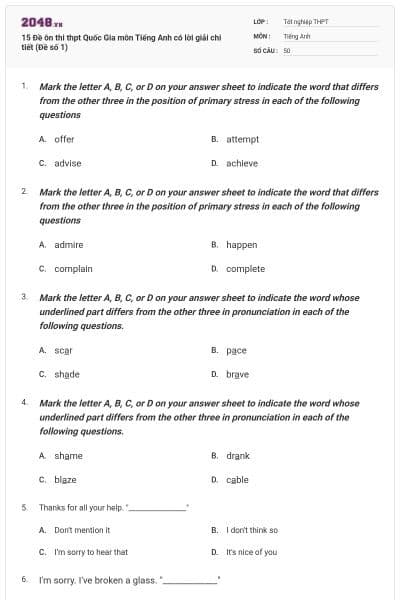
Mark the letter A, B, C, or D on your answer sheet to indicate the word that differs from the other three in the position of primary stress in each of the following questions
offer
attempt
advise
achieve
Đáp án A
Offer /ˈɔfər/
Attempt /əˈtɛmpt/
Advise /ædˈvaɪz/
Achieve /əˈʧiv/
Mark the letter A, B, C, or D on your answer sheet to indicate the word that differs from the other three in the position of primary stress in each of the following questions
admire
happen
complain
complete
Đáp án B
Admire /ædˈmaɪr/
Happen /ˈhæpən/
Complain /kəmˈpleɪn/
Complete /kəmˈplit/
Mark the letter A, B, C, or D on your answer sheet to indicate the word whose underlined part differs from the other three in pronunciation in each of the following questions.
scar
pace
shade
brave
Đáp án A
Scar /skar/
Pace /peɪs/
Shade /ʃeɪd/
Brave /breɪv/
Mark the letter A, B, C, or D on your answer sheet to indicate the word whose underlined part differs from the other three in pronunciation in each of the following questions.
shame
drank
blaze
cable
Đáp án B
Shame /ʃeɪm/
Drank /dræŋk/
Blaze /bleɪz/
Cable /ˈkeɪbəl/
Thanks for all your help. "________________"
Don't mention it
I don't think so
I’m sorry to hear that
It's nice of you
Đáp án: A
Giải thích:
Dịch:
“Cảm ơn về tất cả những sự giúp đỡ của bạn”.
“________.”
A. Không có gì
B. Tôi không nghĩ vậy
C. Tôi rất lấy làm tiếc khi nghe điều đó
D. Bạn thật là tốt bụng
Đáp án A dùng để đáp lại lời cảm ơn.
I'm sorry. I've broken a glass. "_____________"
Why don't you try again?
That’s quite all right
I can't do that
I don't have it
Đáp án B
Mark the letter A, B, C, or D on your answer sheet to indicate the word(s) OPPOSITE in meaning to the underlined word(s) in each of the following questions.
That is a rich family.
hard-up
wealthy
well-to-do
land-owning
Đáp án A
Rich: giàu
Hard-up: nghèo
Wealthy: giàu (nhiều tiền, tài sản)
Well-to-do: giàu (well-to-do family)
Land-owning: giàu (do có nhiều đất)
Mark the letter A, B, C, or D on your answer sheet to indicate the word(s) OPPOSITE in meaning to the underlined word(s) in each of the following questions.
These boys are mischievous.
well-behaved
naughty
fractious
disobedient
Đáp án A
Mischievious: hư, ranh mãnh
Well-behaved: ngoan, cư xử đúng mực
Naughty: hư, không nghe lời
Fractious: ương bướng, cau có
Disobedient: không nghe lời
Mark the letter A, B, C, or D on your answer sheet to indicate the word(s) CLOSEST in meaning to the underlined word(s) in each of the following questions.
They have a good relationship.
harmonious
failed
broken
fragile
Đáp án A
Harmonious: hòa thuận, hòa hợp
Failed: mờ nhạt, phai mờ
Broken: bị tan vỡ
Fragile: mỏng manh, dễ vỡ
Mark the letter A, B, C, or D on your answer sheet to indicate the word(s) CLOSEST in meaning to the underlined word(s) in each of the following questions.
They have a poor relationship.
friendly
difficult
healthy
strong
Đáp án A
Friendly: thân thiện
Difficult: khó khăn
Healthy: tốt, mạnh
Strong: mạnh khỏe
Now I _____________ Havard University.
am attending
attend
was attending
attended
Đáp án A
“Now”: câu sử dụng thì hiện tại tiếp diễn
He has been selling motorcycles_________.
in ten years
for ten years
ten years ago
since ten years
Đáp án B
Câu sử dụng thì hiện tại hoàn thành và for + 1 khoảng thời gian
He fell down when he _________towards the church.
run
runs
was running
had run
Đáp án C
Câu là 1 hành động đang diễn ra 1 hành động khác xen vào => thì quá khứ tiếp diễn
Columbus_________America more then 400 years ago.
he has gone
has discovered
had discovered
discovered
Đáp án D
Một hành động diễn ra trong quá khứ và kết thúc trong quá khứ => thì quá khứ
We _________there when our father died.
still lived
lived still
was still living
were still living
Đáp án D
Một hành động đang diễn ra ở 1 thời điểm trong quá khứ => thì quá khứ tiếp diễn
By Christmas, I_________for you for 6 months.
shall work
Shall have been working
have been working
shall be working
Đáp án B
“By Christmas”: câu sử dụng thì tương lai hoàn thành tiếp diễ
___________is a family unit that consists of a father, a mother, and their children.
nuclear family
single-parent family
extended family
big family
Đáp án: A
Giải thích:
Kiến thức: Từ vựng
A. Nuclear family: Gia đình hạt nhân – bao gồm bố, mẹ và con cái (không bao gồm ông bà, cô chú bác...)
B. Single-parent family: Gia đình đơn thân – chỉ có cha hoặc mẹ nuôi con
C. Extended family: Gia đình mở rộng – bao gồm nhiều thế hệ sống chung như ông bà, cô chú, bác...
D. Big family: Gia đình đông người (không phải thuật ngữ chính thức trong xã hội học).
Dựa vào nghĩa chọn A.
Dịch: Gia đình hạt nhân là kiểu gia đình bao gồm cha, mẹ và con cái.
We are a very _______family and support each other through any crisis.
old-established
close-knit
hard-up
well-to-do
Đáp án B
Close-knit: gắn bó, giúp đỡ lẫn nhau
Hard-up: nghèo khó
Well-to-do: giàu có
Her family and friends have given her lots of _______.
supports
support
supporters
supportive
Đáp án B
She was brought up in a ________ family. She can’t understand the financial problem we are facing.
kind
wealthy
broke
poor
Đáp án B
Kind: tử tế
Wealthy: giàu có
Broke: tan vỡ
Poor: nghèo
Mark enjoys having fun by causing trouble. He's a very _________boy.
stubborn
mischievous
spoiled
bright
Đáp án B
Stubborn: ngoan cố
Mischievious: hư, nghịch ngợm
Spoiled: hư vì được nuông chiều
Bright: thông minh
My family consist __________five people. my parents, my two younger brothers and I.
of
over
up
bright
Đáp án A
Consist of: bao gồm
Read the following passage and mark the letter A, B, C, or D on your answer sheet to indicate the correct word or phrase that best fits each of the numbered blanks from 23 to 27.
Many people today would like the traditional two-parent family back, that is to say, they want a man and a woman to (23)____________ for life; they also think the man should support the family, and the woman should stay home with the children. However, few families now (24)____________ in the this category. In fact, if more women decide to have children on their own, the single-parent household may become more typical than the traditional family in many countries. Also, couples may decide to have more children, or they might take in foster children or (25)____________ . And because people are staying single and living longer, there may be more one-person households.
(26)____________ the other hand, some people believe that similar events happen again and again in history. if this is true, people may go back to the traditional (27)____________ or nuclear family of the past. Others think that the only certainty in history is change. in other words, the structure of the future family could begin to change faster and faster and in more and more ways.
Điền vào ô 23
marry
wed
engage
gather
Đáp án A
Marry: kết hôn
Wed: cưới
Engage: đính hôn
Gather: đoàn tụ
Read the following passage and mark the letter A, B, C, or D on your answer sheet to indicate the correct word or phrase that best fits each of the numbered blanks from 23 to 27.
Many people today would like the traditional two-parent family back, that is to say, they want a man and a woman to (23)____________ for life; they also think the man should support the family, and the woman should stay home with the children. However, few families now (24)____________ in the this category. In fact, if more women decide to have children on their own, the single-parent household may become more typical than the traditional family in many countries. Also, couples may decide to have more children, or they might take in foster children or (25)____________ . And because people are staying single and living longer, there may be more one-person households.
(26)____________ the other hand, some people believe that similar events happen again and again in history. if this is true, people may go back to the traditional (27)____________ or nuclear family of the past. Others think that the only certainty in history is change. in other words, the structure of the future family could begin to change faster and faster and in more and more ways.
Điền vào ô 24
belong
crowd
group
fall
Đáp án D
Fall in: thuộc vào 1 nhóm, loại
Read the following passage and mark the letter A, B, C, or D on your answer sheet to indicate the correct word or phrase that best fits each of the numbered blanks from 23 to 27.
Many people today would like the traditional two-parent family back, that is to say, they want a man and a woman to (23)____________ for life; they also think the man should support the family, and the woman should stay home with the children. However, few families now (24)____________ in the this category. In fact, if more women decide to have children on their own, the single-parent household may become more typical than the traditional family in many countries. Also, couples may decide to have more children, or they might take in foster children or (25)____________ . And because people are staying single and living longer, there may be more one-person households.
(26)____________ the other hand, some people believe that similar events happen again and again in history. if this is true, people may go back to the traditional (27)____________ or nuclear family of the past. Others think that the only certainty in history is change. in other words, the structure of the future family could begin to change faster and faster and in more and more ways.
Điền vào ô 25
bring up
feel
adapt
adopt
Đáp án D
Bring up: nuôi nấng
Feel: cảm thấy
Adapt: thích nghi
Adopt: nhận nuôi
Read the following passage and mark the letter A, B, C, or D on your answer sheet to indicate the correct word or phrase that best fits each of the numbered blanks from 23 to 27.
Many people today would like the traditional two-parent family back, that is to say, they want a man and a woman to (23)____________ for life; they also think the man should support the family, and the woman should stay home with the children. However, few families now (24)____________ in the this category. In fact, if more women decide to have children on their own, the single-parent household may become more typical than the traditional family in many countries. Also, couples may decide to have more children, or they might take in foster children or (25)____________ . And because people are staying single and living longer, there may be more one-person households.
(26)____________ the other hand, some people believe that similar events happen again and again in history. if this is true, people may go back to the traditional (27)____________ or nuclear family of the past. Others think that the only certainty in history is change. in other words, the structure of the future family could begin to change faster and faster and in more and more ways.
Điền vào ô 26
in
at
on
for
Đáp án C
On the other hand: mặt khác
Read the following passage and mark the letter A, B, C, or D on your answer sheet to indicate the correct word or phrase that best fits each of the numbered blanks from 23 to 27.
Many people today would like the traditional two-parent family back, that is to say, they want a man and a woman to (23)____________ for life; they also think the man should support the family, and the woman should stay home with the children. However, few families now (24)____________ in the this category. In fact, if more women decide to have children on their own, the single-parent household may become more typical than the traditional family in many countries. Also, couples may decide to have more children, or they might take in foster children or (25)____________ . And because people are staying single and living longer, there may be more one-person households.
(26)____________ the other hand, some people believe that similar events happen again and again in history. if this is true, people may go back to the traditional (27)____________ or nuclear family of the past. Others think that the only certainty in history is change. in other words, the structure of the future family could begin to change faster and faster and in more and more ways.
Điền vào ô 27
extended
extensive
enlarged
big
Đáp án A
Extended family: gia đình gồm bố mẹ co cái và ông bà, cô dì,…
Read the following passage and mark the letter A, B, C, or D on your answer sheet to indicate the correct answer to each of the questions from 28 to 34.
FAMILY LIFE IN THE UNITED STATES
Family life in the United States is changing. Fifty or sixty years ago, the wife was called a “housewife”. She cleaned, cooked, and cared for the children. The husband earned the money for the family. He was usually out working all day. He came home tired in the evening, so he did not do much housework. And he did not see the children very much, except on weekends.
These days, however, more and more women work outside the home. They cannot stay with the children all day. They, too, come home tired in the evening. They do not want to spend the evening cooking dinner and cleaning up. They do not have time to clean the house and do the laundry. So who is going to do the housework now? Who is going to take care of the children?
Many families solve the problem of housework by sharing it. In these families, the husband and wife agree to do different jobs around the house, or they take turns doing each job. For example, the husband always cooks dinner and the wife always does the laundry. Or the wife cooks dinner on some nights and the husband cooks dinner on other nights.
Then there is the question of the children. In the past, many families got help with child care from grandparents. Now families usually do not live near their relatives. The grandparents are often too far away to help in a regular way. More often, parents have to pay for child care help. The help may be a babysitter or a day-care center. The problem with t his kind of help is the high cost. It is possible only for couples with jobs that pay well.
Parents may get another kind of help form the companies they work for. Many companies now let people with children work part-time. That way, parents can spend more time with their children. Some husbands may even stop working for a while to stay with the children. For these men there is a new word. they are called “househusbands”. In the USA more and more men are becoming househusbands every year.
These changes in the home mean changes in the family. Fathers can learn to understand their children better, and the children can get to know their fathers better. Husbands and wives may also find changes in their marriage. They, too, may have a better understanding of each other.
Sixty years ago, most women _____.
went out to work
had no children
did not do much housework
were housewives
Đáp án D
Fifty or sixty years ago, the wife was called a “housewife”.
60 năm trước, hầu hết phụ nữ….
A. ra ngoài làm việc.
B. không có con.
C.không làm quá nhiều việc nhà.
D. là những bà mẹ nội trợ.
CUỘC SỐNG GIA ĐÌNH TẠI MỸ
Cuộc sống gia đình ở Hoa Kỳ đang thay đổi. Năm mươi hay sáu mươi năm trước, người vợ được gọi là “Bà nội trợ”. Cô làm sạch, nấu chín, và chăm sóc cho trẻ em. Người chồng kiếm tiền dành cho gia đình. Anh ấy thường làm việc cả ngày. Anh ta về nhà mệt mỏi vào buổi tối, nên anh ta không làm nhiều việc nhà. Và anh ta không gặp mấy đứa trẻ nhiều lắm, ngoại trừ những ngày cuối tuần. Ngày nay, ngày càng nhiều phụ nữ làm việc bên ngoài nhà. Họ không thể ở lại với những đứa trẻ cả ngày. Họ cũng về nhà mệt mỏi vào buổi tối. Họ không muốn dành cả buổi tối để nấu ăn tối và dọn dẹp. Họ không có thời gian dọn dẹp nhà cửa và giặt giũ. Vậy ai sẽ làm việc nhà bây giờ? Ai sẽ chăm sóc bọn trẻ?
Nhiều gia đình giải quyết vấn đề nhà cửa bằng cách chia sẻ nó. Trong những gia đình này, người chồng và vợ đồng ý làm các công việc khác nhau quanh nhà, hoặc họ thay phiên nhau làm mỗi công việc. Ví dụ, người chồng luôn nấu bữa tối và vợ luôn giặt quần áo. Hoặc vợ nấu bữa tối vào một số đêm và người chồng nấu bữa tối vào những đêm khác.
Tiếp đó là về bọn trẻ. Trong quá khứ, nhiều gia đình đã được giúp đỡ về chăm sóc trẻ em từ ông bà. Bây giờ các gia đình thường không sống gần người thân của họ. Ông bà thường quá xa để giúp đỡ một cách thường xuyên. Nhiều khi, cha mẹ phải trả tiền giữ trẻ. Sự giúp đỡ có thể là người giữ trẻ hoặc trung tâm chăm sóc ban ngày. Vấn đề với loại trợ giúp của anh ấy là chi phí cao. Nó chỉ có thể cho các cặp vợ chồng có thu nhập cao.
Phụ huynh có thể nhận được một loại trợ giúp khác từ các công ty mà họ làm việc cho. Nhiều công ty bây giờ cho phép những người có con làm việc bán thời gian. Bằng cách đó, cha mẹ có thể dành nhiều thời gian hơn với con cái của họ. Một số người chồng thậm chí có thể nghỉ làm trong một thời gian để ở với trẻ em. Đối với đàn ông, ta có một từ mới. Họ được gọi là "người đàn ông nội trợ". Ở Mỹ ngày càng nhiều nam giới trở thành những người nội trợ mỗi năm.
Những thay đổi này trong nhà có nghĩa là những thay đổi trong gia đình. Người cha có thể học cách hiểu trẻ em tốt hơn, và các em có thể làm quen với cha của chúng tốt hơn. Chồng và vợ cũng có thể tìm thấy những thay đổi trong cuộc hôn nhân của họ. Họ cũng có thể hiểu rõ hơn về nhau hơn.
Read the following passage and mark the letter A, B, C, or D on your answer sheet to indicate the correct answer to each of the questions from 28 to 34.
FAMILY LIFE IN THE UNITED STATES
Family life in the United States is changing. Fifty or sixty years ago, the wife was called a “housewife”. She cleaned, cooked, and cared for the children. The husband earned the money for the family. He was usually out working all day. He came home tired in the evening, so he did not do much housework. And he did not see the children very much, except on weekends.
These days, however, more and more women work outside the home. They cannot stay with the children all day. They, too, come home tired in the evening. They do not want to spend the evening cooking dinner and cleaning up. They do not have time to clean the house and do the laundry. So who is going to do the housework now? Who is going to take care of the children?
Many families solve the problem of housework by sharing it. In these families, the husband and wife agree to do different jobs around the house, or they take turns doing each job. For example, the husband always cooks dinner and the wife always does the laundry. Or the wife cooks dinner on some nights and the husband cooks dinner on other nights.
Then there is the question of the children. In the past, many families got help with child care from grandparents. Now families usually do not live near their relatives. The grandparents are often too far away to help in a regular way. More often, parents have to pay for child care help. The help may be a babysitter or a day-care center. The problem with t his kind of help is the high cost. It is possible only for couples with jobs that pay well.
Parents may get another kind of help form the companies they work for. Many companies now let people with children work part-time. That way, parents can spend more time with their children. Some husbands may even stop working for a while to stay with the children. For these men there is a new word. they are called “househusbands”. In the USA more and more men are becoming househusbands every year.
These changes in the home mean changes in the family. Fathers can learn to understand their children better, and the children can get to know their fathers better. Husbands and wives may also find changes in their marriage. They, too, may have a better understanding of each other.
Nowadays, there are __________.
more women going out to work than before
more and more women staying with the children all day
more work outside the home than before
more housewives than before
Đáp án A
These days, however, more and more women work outside the home.
Ngày nay, có….
A. ngày càng nhiều phụ nữ đi làm hơn trước.
B. ngày càng nhiều phụ nữ ở nhà trông trẻ hơn.
C. nhiều công việc bên ngoài hơn trước.
D. nhiều bà mẹ nội trợ hơn trước
Read the following passage and mark the letter A, B, C, or D on your answer sheet to indicate the correct answer to each of the questions from 28 to 34.
FAMILY LIFE IN THE UNITED STATES
Family life in the United States is changing. Fifty or sixty years ago, the wife was called a “housewife”. She cleaned, cooked, and cared for the children. The husband earned the money for the family. He was usually out working all day. He came home tired in the evening, so he did not do much housework. And he did not see the children very much, except on weekends.
These days, however, more and more women work outside the home. They cannot stay with the children all day. They, too, come home tired in the evening. They do not want to spend the evening cooking dinner and cleaning up. They do not have time to clean the house and do the laundry. So who is going to do the housework now? Who is going to take care of the children?
Many families solve the problem of housework by sharing it. In these families, the husband and wife agree to do different jobs around the house, or they take turns doing each job. For example, the husband always cooks dinner and the wife always does the laundry. Or the wife cooks dinner on some nights and the husband cooks dinner on other nights.
Then there is the question of the children. In the past, many families got help with child care from grandparents. Now families usually do not live near their relatives. The grandparents are often too far away to help in a regular way. More often, parents have to pay for child care help. The help may be a babysitter or a day-care center. The problem with t his kind of help is the high cost. It is possible only for couples with jobs that pay well.
Parents may get another kind of help form the companies they work for. Many companies now let people with children work part-time. That way, parents can spend more time with their children. Some husbands may even stop working for a while to stay with the children. For these men there is a new word. they are called “househusbands”. In the USA more and more men are becoming househusbands every year.
These changes in the home mean changes in the family. Fathers can learn to understand their children better, and the children can get to know their fathers better. Husbands and wives may also find changes in their marriage. They, too, may have a better understanding of each other.
The word “laundry” in paragraph 2 is closest in meaning to______.
tidying up
cooking and washing up
washing and ironing
Shopping
Đáp án C
Từ “laundry” gần nghĩa với từ nào:
Tidy up: dọn dẹp
Wash: rửa, giặt giũ quần áo
Iron: là, ủi đồ
Laundry: giặt quần áo
Read the following passage and mark the letter A, B, C, or D on your answer sheet to indicate the correct answer to each of the questions from 28 to 34.
FAMILY LIFE IN THE UNITED STATES
Family life in the United States is changing. Fifty or sixty years ago, the wife was called a “housewife”. She cleaned, cooked, and cared for the children. The husband earned the money for the family. He was usually out working all day. He came home tired in the evening, so he did not do much housework. And he did not see the children very much, except on weekends.
These days, however, more and more women work outside the home. They cannot stay with the children all day. They, too, come home tired in the evening. They do not want to spend the evening cooking dinner and cleaning up. They do not have time to clean the house and do the laundry. So who is going to do the housework now? Who is going to take care of the children?
Many families solve the problem of housework by sharing it. In these families, the husband and wife agree to do different jobs around the house, or they take turns doing each job. For example, the husband always cooks dinner and the wife always does the laundry. Or the wife cooks dinner on some nights and the husband cooks dinner on other nights.
Then there is the question of the children. In the past, many families got help with child care from grandparents. Now families usually do not live near their relatives. The grandparents are often too far away to help in a regular way. More often, parents have to pay for child care help. The help may be a babysitter or a day-care center. The problem with t his kind of help is the high cost. It is possible only for couples with jobs that pay well.
Parents may get another kind of help form the companies they work for. Many companies now let people with children work part-time. That way, parents can spend more time with their children. Some husbands may even stop working for a while to stay with the children. For these men there is a new word. they are called “househusbands”. In the USA more and more men are becoming househusbands every year.
These changes in the home mean changes in the family. Fathers can learn to understand their children better, and the children can get to know their fathers better. Husbands and wives may also find changes in their marriage. They, too, may have a better understanding of each other.
It can be inferred from paragraph 4 that__________.
couples with low-paid jobs can’t afford the cost of a babysitter or a day-care center
grandparents can help care the children in a regular way
all couples with jobs can pay for help from a babysitter or a day-care center
in the past, grandparents did not help the couples with child care
Đáp án B
In the past, many families got help with child care from grandparents.
Điều được nhắc tới trong đoạn 4 là:
A. các cặp đôi không thể chi trả cho nguười trông trẻ và nhà giữ trẻ.
B. ông bà có thể chăm sóc lũ trẻ thưởng xuyên.
C. tất cả các cặp đôi có công việc hỗ trợ phí cho nhà trông trẻ và nhà giữ trẻ.
D. trong quá khứ, ông bà không giúp việc trông trẻ
Read the following passage and mark the letter A, B, C, or D on your answer sheet to indicate the correct answer to each of the questions from 28 to 34.
FAMILY LIFE IN THE UNITED STATES
Family life in the United States is changing. Fifty or sixty years ago, the wife was called a “housewife”. She cleaned, cooked, and cared for the children. The husband earned the money for the family. He was usually out working all day. He came home tired in the evening, so he did not do much housework. And he did not see the children very much, except on weekends.
These days, however, more and more women work outside the home. They cannot stay with the children all day. They, too, come home tired in the evening. They do not want to spend the evening cooking dinner and cleaning up. They do not have time to clean the house and do the laundry. So who is going to do the housework now? Who is going to take care of the children?
Many families solve the problem of housework by sharing it. In these families, the husband and wife agree to do different jobs around the house, or they take turns doing each job. For example, the husband always cooks dinner and the wife always does the laundry. Or the wife cooks dinner on some nights and the husband cooks dinner on other nights.
Then there is the question of the children. In the past, many families got help with child care from grandparents. Now families usually do not live near their relatives. The grandparents are often too far away to help in a regular way. More often, parents have to pay for child care help. The help may be a babysitter or a day-care center. The problem with t his kind of help is the high cost. It is possible only for couples with jobs that pay well.
Parents may get another kind of help form the companies they work for. Many companies now let people with children work part-time. That way, parents can spend more time with their children. Some husbands may even stop working for a while to stay with the children. For these men there is a new word. they are called “househusbands”. In the USA more and more men are becoming househusbands every year.
These changes in the home mean changes in the family. Fathers can learn to understand their children better, and the children can get to know their fathers better. Husbands and wives may also find changes in their marriage. They, too, may have a better understanding of each other.
The word “they” in paragraph 5 refers to ______.
husbands who stop working to stay with the children
fathers who spend more time with their children
parents who work part-time
children who spend more time with fathers than
Đáp án A
Some husbands may even stop working for a while to stay with the children… they are called “househusbands”.
Từ “they” trong đoạn 5 nhắc tới:
A. người chồng nghỉ việc ở nhà với con.
B. người bố dành nhiều thời gian với con.
C. bố mẹ làm việc bán thời gian.
D. những đứa trẻ dành nhiều thời gian cho bố của chúng
Read the following passage and mark the letter A, B, C, or D on your answer sheet to indicate the correct answer to each of the questions from 28 to 34.
FAMILY LIFE IN THE UNITED STATES
Family life in the United States is changing. Fifty or sixty years ago, the wife was called a “housewife”. She cleaned, cooked, and cared for the children. The husband earned the money for the family. He was usually out working all day. He came home tired in the evening, so he did not do much housework. And he did not see the children very much, except on weekends.
These days, however, more and more women work outside the home. They cannot stay with the children all day. They, too, come home tired in the evening. They do not want to spend the evening cooking dinner and cleaning up. They do not have time to clean the house and do the laundry. So who is going to do the housework now? Who is going to take care of the children?
Many families solve the problem of housework by sharing it. In these families, the husband and wife agree to do different jobs around the house, or they take turns doing each job. For example, the husband always cooks dinner and the wife always does the laundry. Or the wife cooks dinner on some nights and the husband cooks dinner on other nights.
Then there is the question of the children. In the past, many families got help with child care from grandparents. Now families usually do not live near their relatives. The grandparents are often too far away to help in a regular way. More often, parents have to pay for child care help. The help may be a babysitter or a day-care center. The problem with t his kind of help is the high cost. It is possible only for couples with jobs that pay well.
Parents may get another kind of help form the companies they work for. Many companies now let people with children work part-time. That way, parents can spend more time with their children. Some husbands may even stop working for a while to stay with the children. For these men there is a new word. they are called “househusbands”. In the USA more and more men are becoming househusbands every year.
These changes in the home mean changes in the family. Fathers can learn to understand their children better, and the children can get to know their fathers better. Husbands and wives may also find changes in their marriage. They, too, may have a better understanding of each other.
The changes in the American home mentioned in this passage may ______
help families
not happen
cause problems for a marriage
not change the children at all
Đáp án A
These changes in the home mean changes in the family. Fathers can learn to understand their
children better, and the children can get to know their fathers better.
Sự thay đổi trong gia đình Mỹ có thể:
A. giúp đỡ gia đình.
B. chẳng xay ra chuyện gì.
C. gây ra những vấn đề trong hôn nhân.
D. k thay đổi bọn trẻ
Read the following passage and mark the letter A, B, C, or D on your answer sheet to indicate the correct answer to each of the questions from 28 to 34.
FAMILY LIFE IN THE UNITED STATES
Family life in the United States is changing. Fifty or sixty years ago, the wife was called a “housewife”. She cleaned, cooked, and cared for the children. The husband earned the money for the family. He was usually out working all day. He came home tired in the evening, so he did not do much housework. And he did not see the children very much, except on weekends.
These days, however, more and more women work outside the home. They cannot stay with the children all day. They, too, come home tired in the evening. They do not want to spend the evening cooking dinner and cleaning up. They do not have time to clean the house and do the laundry. So who is going to do the housework now? Who is going to take care of the children?
Many families solve the problem of housework by sharing it. In these families, the husband and wife agree to do different jobs around the house, or they take turns doing each job. For example, the husband always cooks dinner and the wife always does the laundry. Or the wife cooks dinner on some nights and the husband cooks dinner on other nights.
Then there is the question of the children. In the past, many families got help with child care from grandparents. Now families usually do not live near their relatives. The grandparents are often too far away to help in a regular way. More often, parents have to pay for child care help. The help may be a babysitter or a day-care center. The problem with t his kind of help is the high cost. It is possible only for couples with jobs that pay well.
Parents may get another kind of help form the companies they work for. Many companies now let people with children work part-time. That way, parents can spend more time with their children. Some husbands may even stop working for a while to stay with the children. For these men there is a new word. they are called “househusbands”. In the USA more and more men are becoming househusbands every year.
These changes in the home mean changes in the family. Fathers can learn to understand their children better, and the children can get to know their fathers better. Husbands and wives may also find changes in their marriage. They, too, may have a better understanding of each other.
This article is about ____ .
American men as househusbands
housewives in America
how more American women are working
how family life in America is changing
Đáp án D
Bài viết nói về:
A. đàn ông nội trợ Mỹ.
B. người vợ nội trợ Mỹ.
C. cách nhiều phụ nữ Mỹ đang làm việc.
D. sự thay đổi trong cuộc sống gia đình Mỹ
Read the following passage and mark the letter A, B, C, or D on your answer sheet to indicate the correct answer to each of the questions from 28 to 34.
FAMILY LIFE IN THE UNITED STATES
Family life in the United States is changing. Fifty or sixty years ago, the wife was called a “housewife”. She cleaned, cooked, and cared for the children. The husband earned the money for the family. He was usually out working all day. He came home tired in the evening, so he did not do much housework. And he did not see the children very much, except on weekends.
These days, however, more and more women work outside the home. They cannot stay with the children all day. They, too, come home tired in the evening. They do not want to spend the evening cooking dinner and cleaning up. They do not have time to clean the house and do the laundry. So who is going to do the housework now? Who is going to take care of the children?
Many families solve the problem of housework by sharing it. In these families, the husband and wife agree to do different jobs around the house, or they take turns doing each job. For example, the husband always cooks dinner and the wife always does the laundry. Or the wife cooks dinner on some nights and the husband cooks dinner on other nights.
Then there is the question of the children. In the past, many families got help with child care from grandparents. Now families usually do not live near their relatives. The grandparents are often too far away to help in a regular way. More often, parents have to pay for child care help. The help may be a babysitter or a day-care center. The problem with t his kind of help is the high cost. It is possible only for couples with jobs that pay well.
Parents may get another kind of help form the companies they work for. Many companies now let people with children work part-time. That way, parents can spend more time with their children. Some husbands may even stop working for a while to stay with the children. For these men there is a new word. they are called “househusbands”. In the USA more and more men are becoming househusbands every year.
These changes in the home mean changes in the family. Fathers can learn to understand their children better, and the children can get to know their fathers better. Husbands and wives may also find changes in their marriage. They, too, may have a better understanding of each other.
What does the companies in USA do to help parents?
Pay them more
pay for hiring babysitter
allow parents to work less than the usual
help them to bring up their children
Đáp án D
Many companies now let people with children work part-time.
A. chi tiêu nhiều hơn.
B. chi trả cho thuê người trông trẻ.
C. cho phép bố mẹ làm việc ít hơn bình thường.
D. giúp họ nuối nấng con cái
Read the following passage and mark the letter A, B, C, or D on your answer sheet to indicate the correct answer to each of the questions from 35 to 42.
The nuclear family, consisting of a mother, father, and their children, may be more an American ideal than an American reality. Of course, the so-called traditional American family was always more varied than we had been led to believe, reflecting the very different racial, ethnic, class, and religious customs among different American groups.
The most recent government statistics reveal that only about one third of all current American families fit the traditional mold and another third consists of married couples who either have no children or have none still living at home. Of the final one third, about 20 percent of the total number of American households are single people, usually women over sixty-five years of age. A small percentage, about 3 percent of the total, consists of unmarried people who choose to live together; and the rest, about 7 percent are single, usually divorced parents, with at least one child. Today, these varied family types are typical, and therefore, normal. Apparently, many Americans are achieving supportive relationships in family forms other than the traditional one.
With what topic is the passage mainly concerned?
The traditional American family
The nuclear family
The current American family
The ideal family
Đáp án C
The nuclear family, consisting of a mother, father, and their children, may be more an American ideal than an American reality.
Đoạn văn chủ yếu nói về:
A. kiểu gia đình truyền thống Mỹ.
B. kiểu gia đình nhỏ.
C. kiểu gia đình Mỹ gần đây.
D. kiểu gia đình lý tưởng
Gia đình nhỏ, bao gồm một người mẹ, cha và con cái của họ, có thể là một hình mẫu lý tưởng hơn là một hình ảnh thực tế của Mỹ. Tất nhiên, cái gọi là gia đình truyền thống Mỹ luôn luôn đa dạng hơn chúng ta đã biết, chúng phản ánh rất khác nhau chủng tộc, dân tộc, tầng lớp và tôn giáo giữa các nhóm người Mỹ khác nhau.
Số liệu thống kê gần đây nhất của chính phủ cho thấy chỉ có khoảng một phần ba tổng số hiện tại các gia đình Mỹ phù hợp với khuôn mẫu truyền thống và một phần ba khác bao gồm các cặp vợ chồng hoặc không có con hoặc không còn sống ở nhà. Trong một phần ba cuối cùng, khoảng 20 phần trăm tổng số hộ gia đình người Mỹ là những người độc thân, thường là phụ nữ trên 65 tuổi. Một tỷ lệ nhỏ, khoảng 3 phần trăm của tổng số, bao gồm chưa lập gia đình và những người chọn sống cùng nhau; và phần còn lại, khoảng 7% là người độc thân, thường là những cha mẹ đơn thân, với ít nhất một đứa trẻ. Ngày nay, các loại gia đình đa dạng này là điển hình, nên chúng rất bình thường trong cuộc sống. Rõ ràng, nhiều người Mỹ đang đạt được các mối quan hệ tốt hơn trong các hình thức gia đình khác với truyền thống.
Read the following passage and mark the letter A, B, C, or D on your answer sheet to indicate the correct answer to each of the questions from 35 to 42.
The nuclear family, consisting of a mother, father, and their children, may be more an American ideal than an American reality. Of course, the so-called traditional American family was always more varied than we had been led to believe, reflecting the very different racial, ethnic, class, and religious customs among different American groups.
The most recent government statistics reveal that only about one third of all current American families fit the traditional mold and another third consists of married couples who either have no children or have none still living at home. Of the final one third, about 20 percent of the total number of American households are single people, usually women over sixty-five years of age. A small percentage, about 3 percent of the total, consists of unmarried people who choose to live together; and the rest, about 7 percent are single, usually divorced parents, with at least one child. Today, these varied family types are typical, and therefore, normal. Apparently, many Americans are achieving supportive relationships in family forms other than the traditional one.
The writer implies that _____.
there have always been a wide variety of family arrangement in the United States
racial, ethnic, and religious groups have preserved the traditional family structure
the ideal American family is the best structure
fewer married couples are having children
Đáp án A
Người viết đã chứng minh rằng.
A. có nhiều kiểu gia đình ở Mỹ.
B. chủng tộc, dân tộc, và tôn giáo đã bảo tồn cấu trúc gia đình truyền thống.
C. gia đình Mỹ lí tưởng là cấu trúc tốt nhất.
D. ngày càng ít cặp vợ chồng có con
Read the following passage and mark the letter A, B, C, or D on your answer sheet to indicate the correct answer to each of the questions from 35 to 42.
The nuclear family, consisting of a mother, father, and their children, may be more an American ideal than an American reality. Of course, the so-called traditional American family was always more varied than we had been led to believe, reflecting the very different racial, ethnic, class, and religious customs among different American groups.
The most recent government statistics reveal that only about one third of all current American families fit the traditional mold and another third consists of married couples who either have no children or have none still living at home. Of the final one third, about 20 percent of the total number of American households are single people, usually women over sixty-five years of age. A small percentage, about 3 percent of the total, consists of unmarried people who choose to live together; and the rest, about 7 percent are single, usually divorced parents, with at least one child. Today, these varied family types are typical, and therefore, normal. Apparently, many Americans are achieving supportive relationships in family forms other than the traditional one.
The word 'current' in line 7 could best be replaced by which of the following?
typical
present
perfect
traditional
Đáp án B
Từ “current” có thể thay thế bằng từ nào:
Typical: điển hình
Present: hiện tại
Perfect: hoàn hảo
Traditional: truyền thống
Read the following passage and mark the letter A, B, C, or D on your answer sheet to indicate the correct answer to each of the questions from 35 to 42.
The nuclear family, consisting of a mother, father, and their children, may be more an American ideal than an American reality. Of course, the so-called traditional American family was always more varied than we had been led to believe, reflecting the very different racial, ethnic, class, and religious customs among different American groups.
The most recent government statistics reveal that only about one third of all current American families fit the traditional mold and another third consists of married couples who either have no children or have none still living at home. Of the final one third, about 20 percent of the total number of American households are single people, usually women over sixty-five years of age. A small percentage, about 3 percent of the total, consists of unmarried people who choose to live together; and the rest, about 7 percent are single, usually divorced parents, with at least one child. Today, these varied family types are typical, and therefore, normal. Apparently, many Americans are achieving supportive relationships in family forms other than the traditional one.
In the passage, married couples whose children have grown or who have no children represent _____.
1/3 percent of households
20 percent of households
7 percent of households
3 percent of households
Đáp án A
only about one third of all current American families fit the traditional mold and another third consists of married couples who either have no children or have none still living at home.
Read the following passage and mark the letter A, B, C, or D on your answer sheet to indicate the correct answer to each of the questions from 35 to 42.
The nuclear family, consisting of a mother, father, and their children, may be more an American ideal than an American reality. Of course, the so-called traditional American family was always more varied than we had been led to believe, reflecting the very different racial, ethnic, class, and religious customs among different American groups.
The most recent government statistics reveal that only about one third of all current American families fit the traditional mold and another third consists of married couples who either have no children or have none still living at home. Of the final one third, about 20 percent of the total number of American households are single people, usually women over sixty-five years of age. A small percentage, about 3 percent of the total, consists of unmarried people who choose to live together; and the rest, about 7 percent are single, usually divorced parents, with at least one child. Today, these varied family types are typical, and therefore, normal. Apparently, many Americans are achieving supportive relationships in family forms other than the traditional one.
Who generally constitutes a one-person household?
A single man in his twenties
An elderly man
A single woman in her late sixties
A divorced woman
Đáp án C
Of the final one third, about 20 percent of the total number of American households are single people, usually women over sixty-five years of age.
Những người sống 1 mình thường là:
A. đàn ông 20 tuổi.
B. ông già.
C. phụ nữ đơn thân trên 60.
D. phụ nữ đã li hôn
Read the following passage and mark the letter A, B, C, or D on your answer sheet to indicate the correct answer to each of the questions from 35 to 42.
The nuclear family, consisting of a mother, father, and their children, may be more an American ideal than an American reality. Of course, the so-called traditional American family was always more varied than we had been led to believe, reflecting the very different racial, ethnic, class, and religious customs among different American groups.
The most recent government statistics reveal that only about one third of all current American families fit the traditional mold and another third consists of married couples who either have no children or have none still living at home. Of the final one third, about 20 percent of the total number of American households are single people, usually women over sixty-five years of age. A small percentage, about 3 percent of the total, consists of unmarried people who choose to live together; and the rest, about 7 percent are single, usually divorced parents, with at least one child. Today, these varied family types are typical, and therefore, normal. Apparently, many Americans are achieving supportive relationships in family forms other than the traditional one.
What is nuclear family?
a social unit composed of two parents and one or more childre
a family consisting of a family nucleus and various relatives, as grandparents
a family in which a parent brings up a child or children alone, without a partner
a hard-up family
Đáp án A
The nuclear family, consisting of a mother, father, and their children
Read the following passage and mark the letter A, B, C, or D on your answer sheet to indicate the correct answer to each of the questions from 35 to 42.
The nuclear family, consisting of a mother, father, and their children, may be more an American ideal than an American reality. Of course, the so-called traditional American family was always more varied than we had been led to believe, reflecting the very different racial, ethnic, class, and religious customs among different American groups.
The most recent government statistics reveal that only about one third of all current American families fit the traditional mold and another third consists of married couples who either have no children or have none still living at home. Of the final one third, about 20 percent of the total number of American households are single people, usually women over sixty-five years of age. A small percentage, about 3 percent of the total, consists of unmarried people who choose to live together; and the rest, about 7 percent are single, usually divorced parents, with at least one child. Today, these varied family types are typical, and therefore, normal. Apparently, many Americans are achieving supportive relationships in family forms other than the traditional one.
Unmarried people living together represent_______.
3 percent
20 percent
7 percent
1/3 percent
Đáp án A
A small percentage, about 3 percent of the total, consists of unmarried people
Mark the letter A, B, C, or D on your answer sheet to indicate the sentence that is closest in meaning to each of the following questions.
I haven't met my grandparents for five years.
I often met my grandparents five years ago
I last met my grandparents five years ago
I have met my grandparents for five years
I didn't meet my grandparents five years ago
Đáp án B
Câu có nghĩa: Tôi không gặp ông bà tôi đã 5 năm
=> Lần cuối tôi gặp ông bà là 5 năm trước
Mark the letter A, B, C, or D on your answer sheet to indicate the sentence that is closest in meaning to each of the following questions.
We survived that accident because we were wearing our seat belts.
But for our seat belts, we would have survived that accident
Had we not been wearing our seat belts, we wouldn't have survived that accident
Without our seat belts, we could have survived that accident
If we weren't wearing our seat belts, we couldn't have survived that accident
Đáp án B
Câu có nghĩa: Chúng tôi sống sót khỏi tai nạn vì chúng tôi đang đeo dây an toàn
=> Nếu chúng tôi k đeo dây an toàn, chúng tôi không thể sống sót
Mark the letter A, B, C, or D on your answer sheet to indicate the sentence that is closest in meaning to each of the following questions.
"No, I won't go to work at the weekend," said Sally.
Sally refused to go to work at the weekend
Sally promised to go to work at the weekend
Sally apologized for not going to work at the weekend
Sally regretted not going to work at the weekend
Đáp án A
Câu có nghĩa: Sally nói rằng:”Không, tôi sẽ không làm việc vào cuối tuần”
=> Sally từ chối làm việc vào cuối tuần
Mark the letter A, B, C, or D on your answer sheet to indicate the underlined part that needs correction in each of the following questions.
My mother always get up early to prepare breakfast for everyone in the family.
get
to prepare
everyone
the family
Đáp án A
Get => gets
Mark the letter A, B, C, or D on your answer sheet to indicate the underlined part that needs correction in each of the following questions.
I prefer living in a nuclear family than a joint one.
living
nuclear
than
one
Đáp án C
Prefer doing sth to doing sth: thích làm gì hơn làm gì
Mark the letter A, B, C, or D on your answer sheet to indicate the underlined part that needs correction in each of the following questions.
He comes from a large family, all of them now live in Australia.
comes
large
them
live
Đáp án B
Large => extended
Mark the letter A, B, C, or D on your answer sheet to indicate the sentence that best combines each pair of sentences in the following questions.
Some kinds of fish live in fresh water. Others live in sea water.
Some kinds of fish live in fresh water, for others live in sea water
Some kinds of fish live in fresh water, and others live in sea water
Some kinds of fish live in fresh water, or others live in sea water
Some kinds of fish live in fresh water, so others live in sea water
Đáp án: B
Giải thích:
Đề bài gồm hai mệnh đề độc lập:
Một số loài cá sống ở nước ngọt.
Những loài khác sống ở nước mặn.
Hai mệnh đề này bổ sung thông tin cho nhau (không mang tính nguyên nhân, kết quả hay lựa chọn), do đó cần liên kết bằng từ nối mang ý nghĩa bổ sung.
and: và → phù hợp để nối hai mệnh đề bổ sung.
for: bởi vì → không hợp nghĩa.
or: hoặc → sai logic vì hai mệnh đề không phải lựa chọn thay thế.
so: vì thế → sai quan hệ logic vì không có nguyên nhân – kết quả ở đây.
Dựa vào quan hệ bổ sung thông tin, chọn B.
Dịch: Một số loài cá sống ở nước ngọt, và những loài khác sống ở nước mặn.Mark the letter A, B, C, or D on your answer sheet to indicate the sentence that best combines each pair of sentences in the following questions.
My mother is very busy with her work at the office. She still takes good care of us
In spite of being very busy with her work at the office, my mother takes good care of us
Because my mother is very busy with her work at the office, she takes good care of u
My mother is so busy with her work at the office that she cannot take good care of us
My mother is too busy with her work at the office to take good care of us
Đáp án A
Câu có nghĩa: Mẹ tôi rất bận với công việc. Cô ấy vẫn chăm sóc tốt cho chúng tôi
=> Mặc dù bận rộn với công việc nhưng mẹ vẫn chăm sóc tốt cho chúng tôi