Topic 7: Life stories
56 câu hỏi
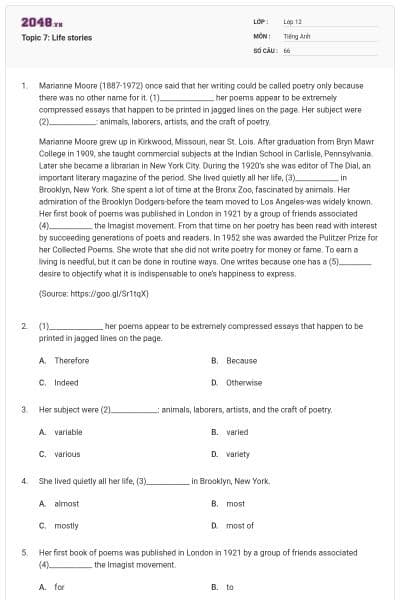
Marianne Moore (1887-1972) once said that her writing could be called poetry only because there was no other name for it. (1)_______________ her poems appear to be extremely compressed essays that happen to be printed in jagged lines on the page. Her subject were (2)_____________: animals, laborers, artists, and the craft of poetry.
Marianne Moore grew up in Kirkwood, Missouri, near St. Lois. After graduation from Bryn Mawr College in 1909, she taught commercial subjects at the Indian School in Carlisle, Pennsylvania. Later she became a librarian in New York City. During the 1920’s she was editor of The Dial, an important literary magazine of the period. She lived quietly all her life, (3)____________ in Brooklyn, New York. She spent a lot of time at the Bronx Zoo, fascinated by animals. Her admiration of the Brooklyn Dodgers-before the team moved to Los Angeles-was widely known. Her first book of poems was published in London in 1921 by a group of friends associated (4)____________ the Imagist movement. From that time on her poetry has been read with interest by succeeding generations of poets and readers. In 1952 she was awarded the Pulitzer Prize for her Collected Poems. She wrote that she did not write poetry for money or fame. To earn a living is needful, but it can be done in routine ways. One writes because one has a (5)_________ desire to objectify what it is indispensable to one’s happiness to express.
(Source: https://goo.gl/Sr1tqX)
Therefore
Because
Indeed
Otherwise
Marianne Moore (1887-1972) đã từng nói rằng sáng tác của bà có thể được gọi là thơ chỉ vì không có cái tên nào khác cho nó. Quả thực những bài thơ của bà dường như là những bài tiểu luận cô đọng dưới dạng những dòng thơ lởm chởm và được in ra trên trang sách. Chủ đề của bà gồm nhiều thể loại khác nhau: động vật, người lao động, nghệ sĩ, và các thủ thuật trong thơ.
Marianne Moore lớn lên ở Kirkwood, Missouri, gần St Louis. Sau khi tốt nghiệp trường cao đẳng Bryn Mawr vào năm 1909, bà đã dạy các môn học về thương mại tại Trường học Ấn Độ ở Carlisle, Pennsylvania. Sau đó bà trở thành một thủ thư tại thành phố New York. Vào những năm 1920, bà là biên tập viên của The Dial, một tạp chí văn học quan trọng của thời kỳ này. Bà đã sống lặng lẽ suốt cuộc đời, chủ yếu ở Brooklyn, New York. Bà dành rất nhiều thời gian tại Sở thú Bronx, bị mê hoặc bởi động vật. Sự ngưỡng mộ của bà đối với Brooklyn Dodgers - trước cả khi nhóm chuyển đến Los Angeles - được biết đến rộng rãi. Cuốn sách đầu tiên của bà về thơ đã được xuất bản ở Luân Đôn vào năm 1921 bởi một nhóm bạn kết hợp với phong trào trừu tượng. Từ thời gian đó, thơ của bà đã được biết đến cùng với sự quan tâm của các thế hệ các nhà thơ và độc giả. Năm 1952, bà được trao giải Pulitzer cho Tuyển tập các bài thơ của bà. Bà đã từng viết rằng bà không viết thơ “vì tiền bạc hay danh vọng. Để kiếm sống là cần thiết, nhưng nó có thể được thực hiện theo những cách thông thường. Một người viết vì người đó có một mong muốn cụ thể hóa những điều không thể thiếu để diễn tả hạnh phúc.”
Đáp án C
Kiến thức về liên từ
A. Therefore: do đó, do vậy
B. Because: bởi vì
C. Indeed: quả thực, Thực sự
D. Otherwise: hoặc là
Căn cứ vào nghĩa của câu sau: “Marianne Moore (1887-1972) once said that her writing could be called poetry only because there was no other name for it. (1) _________ her poems appear to be extremely compressed essays that happen to be printed in jagged lines on the page.”
(Marianne Moore (1887-1972) đã từng nói rằng sáng tác của bà có thể được gọi là thơ chỉ vì không có cái tên nào khác cho nó. Quả thực những bài thơ của bà dường như là những bài tiểu luận cô đọng dưới dạng những dòng thơ lởm chởm và được in ra trên trang sách.)
Her subject were (2)_____________: animals, laborers, artists, and the craft of poetry.
variable
varied
various
variety
Đáp án B
Kiến thức về từ loại
A. variable /’veəriəbl/(a): có thể thay đổi được, có thể thay biến đổi được
B. varied /’veərid/(a): chứa, gồm nhiều loại khác nhau ở trong đó hoặc thay đổi thường xuyên giữa đa dạng các loại (nhấn mạnh đến tính đa dạng, pha tạp nhiều loại của sự vật, hiện tượng)
C. various /veriəs/(a): nhiều thứ khác nhau (nhấn mạnh đến số lượng của sự vật, hiện tượng đó là có nhiều hoặc trên phạm vi rộng của các yếu tố khác nhau)
D. variety /və’raiəti/(n): sự đa dạng
Căn cứ vào nghĩa của câu sau:
“Her subject were (2) _________: animals, laborers, artists, and the craft of poetry.”
(Chủ đề của bà chứa nhiều loại khác nhau: động vật, người lao động, nghệ sĩ, và các thủ thuật trong thơ.)
=> Câu này đang ám chỉ đến tính đa dạng và có chứa nhiều loại khác nhau nên ta dùng B.
almost
most
mostly
most of
Đáp án C
Kiến thức về lượng từ
Căn cứ vào nghĩa của câu sau: “She lived quietly all her life, (3) _________ in Brooklyn, New York.” (Bà đã sống lặng lẽ suốt cuộc đời, chủ yếu ở Brooklyn, New York.)
MOST
- MOST (hầu hết, hầu như): dùng trước danh từ không xác định
Ví dụ:
+ Most volunteers are high school or college students.
(Hầu hết tình nguyện viên là học sinh trung học hoặc là sinh viên đại học.)
Lưu ý:
Most + N
Most of + the/ my, your, our, his, her, their… + N
Ví dụ:
+ Most of the volunteers are high school or college students. (Hầu hết tình nguyện viên đều là học sinh trung học hoặc là sinh viên đại học.)
MOSTLY
- MOSTLY (chủ yếu là): dùng như một trạng từ
Ví dụ:
+ The volunteers are mostly high school or college students.
(Tình nguyện viên chủ yếu là học sinh trung học hoặc là sinh viên đại học.)
ALMOST
- ALMOST (gần như): dùng như một trạng từ bổ nghĩa cho động từ, tính từ, danh từ
Ví dụ:
+ I almost finished the exam, but in the end I ran out of time.
(Tôi gần làm xong bài kiểm tra nhưng cuối cùng tôi đã bị hết giờ.)
=> Almost bổ trợ cho động từ “finished”
+ It is almost 9 o’clock. (Đã gần 9 giờ rồi.)
=> Almost bổ trợ cho danh từ “9 o’clock”
+ He is almost certain to be late. (Anh ấy gần như chắc chắn là sẽ bị muộn.)
=> Almost bổ nghĩa cho tính từ “certain”
- ALMOST (gần như): dùng trước các cụm danh từ bắt đầu bằng các từ: all, every, no, any, nothing, no one….
Ví dụ:
+ Almost everyone uses the Internet these days.
(Hầu như ngày nay người nào cũng dùng Internet.)
+ I buy a newspaper almost every day.
(Gần như ngày nào tôi cũng mua báo.)
+ Almost all of the students passed the exam.
(Hầu hết mọi sinh viên đều thi đỗ.)
+ I was disappointed because almost no one came to my art exhibition – (Tôi đã thất vọng vì gần như chẳng có ai đến xem triển lãm nghệ thuật của tôi.)
+ There’s almost nothing in the fridge so I’d better go shopping.
(Gần như chẳng có gì trong tủ lạnh vì thế tốt nhất là tôi nên đi mua sắm.)
for
to
with
about
Đáp án C
Kiến thức về giới từ
To be associated with st: gắn liền với, có liên quan tới
One writes because one has a (5)_________ desire to objectify what it is indispensable to one’s happiness to express.
firing
burning
flaming
dreaming
Đáp án B
Kiến thức về cụm từ cố định
A burning desire: một khao khát cháy bỏng
Amy Johnson was born in 1903 and grew up in Hull, England. The pioneering British aviator is one of the inspiring female figurehead of the 20th century. After university, Amy got a badly-paid (1)_____managed to save enough money to take flying lessons. She went on to qualify as a pilot, (2)___ receiving her license in 1929. In 1930, (3)_______only flown for seventy-five hours, she persuaded a rich businessperson to give her money to buy a plane, and set off alone for Darwin, Australia, in the hope of breaking the record for flying solo from England to Australia in fourteen days. Amy was the first woman to make this flight, (4) _______ took her nineteen days. She failed to breathe record, but was welcomed home as a hero.
Over the next ten years, Amy made many record-breaking flights. During these years, she was admired for her skill and courage, and she is still fondly remembered as Britain’s first “Queen of the Air”. She is also remembered in many ways, one of which is the British Women Pilot’s Association award - a scholarship to help outstanding women pilots (5)______their careers.
employment
work
career
job
Amy Johnson sinh năm 1903 và lớn lên ở Hull, Anh. Nữ phi công tiên phong người Anh là một trong những nhân vật truyền cảm hứng của thế kỷ 20. Sau khi tốt nghiệp đại học, cô nhận được một công việc được trả lương thấp và phải nỗ lực tiết kiệm tiền để tham gia khoá học bay. Cô tiếp tục cố gắng để có đủ tư cách và điều kiện trở thành một phi công, cuối cùng cô đã nhận được tấm bằng chứng nhận vào năm 1929. Vào năm 1930, mặc dù chỉ bay 75 giờ nhưng cô đã thuyết phục được một doanh nhân giàu có cho cô tiền để mua máy bay, và một mình lên đường tới Darwin, Australia, với hi vọng phá vỡ kỉ lục bay một mình từ Anh đến Úc trong vòng 14 ngày. Amy là người phụ nữ đầu tiên thực hiện chuyến bay này, mất 19 ngày. Cô đã thất bại khi đã không phá vỡ được kỉ lục, nhưng được chào đón ở quê nhà như một người anh hùng.
Trong 10 năm tiếp theo, Amy đã thực hiện nhiều chuyến bay và lập nên vô số kỉ lục. Trong suốt những năm này, cô được ngưỡng mộ bởi tài năng và lòng dũng cảm, và cô vẫn luôn được nhớ đến như là ‘Nữ hoàng hàng không’ đầu tiên ở Anh. Cô cũng được tưởng nhớ đến bằng nhiều cách, một trong số đó là giải thưởng ‘Hiệp hội phi công nữ Anh Quốc’- một học bổng giúp các nữ phi công xuất sắc phát triển sự nghiệp.
Đáp án D
Chủ đề về WORK
Kiến thức về từ vựng
Ta có sự khác nhau giữa các từ:
employment: sự thuê mướn, tình trạng có việc làm
work vừa là động từ, vừa là danh từ chỉ công việc nói chung
career là danh từ chỉ sự nghiệp hoặc công việc mà bạn đã làm trong một thời gian dài. Nó có thể bao gồm nhiều nghề nghiệp (jobs) khác nhau qua từng năm
job là danh từ chỉ một vị trí, nhiệm vụ
Tạm dịch: After university, Amy got a badly paid (26) managed to save enough money to take flying lessons.
(Sau khi học đại học, Amy đã nhận được một công việc được trả lương rất thấp để đủ tiết kiệm tiền để tham gia các khóa học bay.)
recently
lastly
finally
lately
Đáp án C
Kiến thức về từ vựng
A. recently /ˈriːsəntli/ (adv): gần đây
B. lastly /ˈlɑːstli/ (adv): cuối cùng (để chỉ cái gì đó xuất hiện cuối cùng trong một danh sách dài)
C. finally /ˈfaɪnəli/ (adv): cuối cùng (nói đến một sự việc xảy ra trong một thời gian dài, qua nhiều khó khăn)
D. lately /ˈleɪtli/ (adv): gần đây
Tạm dịch: She went on to qualify as a pilot, (27) receiving her license in 1929.
(Bà tiếp tục theo học đào tạo để trở thành phi công, cuối cùng bà ấy cũng đã được nhận giấy phép vào năm 1929.)
although
however
despite
if
Đáp án A
Kiến thức về liên từ
A. although /ɔːlˈðəʊ/: mặc dù (+ clause)
B. however /haʊˈevər/: tuy nhiên
C. despite /dɪˈspaɪt/: mặc dù (+ N/V-ing)
D. if /ɪf/: nếu
Tạm dịch: In 1930, (28) only flown for seventy-five hours, she persuaded a rich businessperson to give her money to buy a plane, and set off alone for Darwin, Australia, in the hope of breaking the record for flying solo from England to Australia in fourteen days.
(Năm 1930, mặc dù chỉ được bay trong 75 giờ, bà đã thuyết phục một doanh nhân giàu có cho tiền để mua một chiếc máy bay, và lên đường một mình đến Darwin, Australia, với hy vọng phá vỡ kỷ lục bay solo từ Anh sang Úc trong mười bốn ngày.)
=> Vị trí này chỉ A thỏa mãn, vì đó là dạng rút gọn hai vế khi cùng chủ ngữ và động từ ở thể bị động: Although + Vp2 + O, S + V + OCác cấu trúc khác cần lưu ý:
Set off: khởi hành
Break the record: phá vỡ kỷ lục
what
that
which
who
Kiến thức về mệnh đề quan hệ
Tạm dịch: Amy was the first woman to make this flight, (29) took her nineteen days. She failed to breathe record, but was welcomed home as a hero.
(Amy là người phụ nữ đầu tiên thực hiện chuyến bay này, điều này đã mất của bà ấy 19 ngày. Bà ấy đã thất bại trong việc phá vỡ kỷ lục, nhưng vẫn được chào đón như một anh hùng.)
Ở đây, ta cần một đại từ quan hệ dùng để thay thế cả mệnh đề đứng trước nên ta dùng which.
She is also remembered in many ways, one of which is the British Women Pilot’s Association award - a scholarship to help outstanding women pilots (5)______their careers.
end
start
change
further
Đáp án D
Kiến thức về từ vựng
A. end /end/ (v): kết thúc, hết
B. start /stɑːt/ (v): bắt đầu
C. change /tʃeɪndʒ/ (v): thay đổi
D. further /ˈfɜːðər/ (v): đẩy mạnh, xúc tiến
Tạm dịch: She is also remembered in many ways, one of which is the British Women Pilot’s Association award - a scholarship to help outstanding women pilots (30) their careers.
(Bà cũng được nhớ đến theo nhiều cách, một trong số đó là Giải thưởng hiệp hội của nữ phi công Anh- một học bổng giúp các nữ phi công xuất sắc đẩy mạnh phát triển sự nghiệp của họ.)
The Nobel Prizes were established by the Swedish inventor, Alfred Bernhard Nobel. Nobel was the inventor of dynamite. (1) ____ his invention brought him much wealth and fame, Nobel realized how destructive dynamite could be. His own brother was (2) ____ in an explosion while working in the laboratory. Nobel thus spent a lot of time and energy promoting world peace to reduce the need to use dynamite in war. He also advocated the settlement of conflicts through diplomatic means.
Before Nobel died, he (3) ____ his money to establish a fund. Every year, the interest from this fund was to be given to the person who has done the most good for mankind in that year. There are (4) ____ in the fields of physics, chemistry, medicine and literature. The most prestigious award, however, is the Nobel Peace Prize. This is given to the person who has done the most to promote world peace. One of the most (5) ____ persons to have received the award was Mahatma Gandhi of India.
Since
Although
However
Even if
Giải thưởng Nobel được thành lập bởi nhà phát minh người Thuỵ Điển, Alfred Bernhard Nobel. Nobel là người phát minh ra thuốc nổ. Mặc dù phát minh của ông mang lại cho ông rất nhiều tiền bạc, sự giàu có và danh tiếng, nhưng Nobel đã nhận ra sức tàn phá cực lớn mà thuốc nổ có thể đem lại. Anh trai của ông đã bị giết chết trong một vụ nổ khi đang làm việc trong phòng thí nghiệm. Do đó Nobel dành rất nhiều thời gian và công sức để đẩy mạnh hoà bình thế giới và giảm đi nhu cầu sử dụng thuốc nổ trong chiến tranh. Ông cũng ủng hộ việc giải quyết các mâu thuẫn xung đột thông bằng biện pháp ngoại giao.
Trước khi Nobel qua đời, ông đã gửi số tiền ông có được để thành lập một quỹ. Hàng năm, tiền lãi từ quỹ này sẽ được trao cho người đã đóng góp những điều tốt nhất cho nhân loại trong năm đó. Có các giải thưởng trong những lĩnh vực như Vật Lý, Hoá Học, Y Học và Văn Học. Tuy nhiên, giải thưởng uy tín và danh giá nhất là giải thưởng Nobel Hoà Bình. Nó được trao cho người đóng góp nhiều nhất để thúc đẩy hoà bình thế giới. Một trong những người nổi tiếng nhất đã nhận được giải thưởng này là Mahatma Gandhi của Ấn Độ.
Đáp án B
A. Since (adv); kể từ khi, bởi vì.
B. Although (con): mặc dù.
C. However (adv): tuy nhiên.
D. Even if (con): thâm chí nếu.
Căn cứ vào nghĩa của câu:
The Nobel Prizes were established by the Swedish inventor, Alfred Bernhard Nobel. Nobel was the inventor of dynamite. (1) ____ his invention brought him much wealth and fame, Nobel realized how destructive dynamite could be.
destroyed
caused
killed
murdered
Đáp án C
A. destroy /dɪˈstrɔɪ/ (v): phá hủy.
B. cause /kɔːz/ (v): gây ra.
C. kill /kɪl/ (v): giết.
D. murder /ˈmɜː.dər/: ám sát, giết người (thường dung trong những phi vụ pháp lý).
Căn cứ vào nghĩa của câu:
His own brother was (2) ____ in an explosion while working in the laboratory…
(Anh trai của ông ấy đã bị giết trong một vụ nổ trong khi làm việc trong phòng thí nghiệm.)
gave away
made off
handed over
came into
Đáp án A
A. give away (v): khuyên tặng, khuyên góp.
B. make off with st = run off with st: cuỗng cái gì rồi chạy mất.
C. hand st over (v): đưa cái gì cho ai.
D. come into = inherit (v): thừa kế.
Căn cứ vào nghĩa của câu:
Before Nobel died, he (3) ____ his money to establish a fund.
(Trước khi Nobel chết, ông ấy đã khuyên góp hết tiền của ông ấy để thành lập một quỹ.)
medals
presents
grants
awards
Đáp án D
A. medal /ˈmed.əl/ (n): huy chương.
B. present /ˈprez.ənt/ (n): quà tặng.
C. grant /ɡrɑːnt/ (n): tài trợ.
D. award /əˈwɔːd/ (n): giải thưởng.
Căn cứ vào nghĩa của câu:
There are (4) ____ in the fields of physics, chemistry, medicine and literature.
(Có rất nhiều giải thưởng trong các lĩnh vực vật lý, hóa học, y học và văn học.)
One of the most (5) ____ persons to have received the award was Mahatma Gandhi of India.
legendary
illustrative
helpful
famous
Đáp án D
A. legendary /ˈledʒ.ən.dri/ (a): huyền thoại.
B. illustrative /ˈɪl.ə.strə.tɪv/ (a): có tính minh họa.
C. helpful /ˈhelp.fəl/ (a): hữu ích.
D. famous /ˈfeɪ.məs /(a): nổi tiếng.
Căn cứ vào nghĩa của câu:
This is given to the person who has done the most to promote world peace. One of the most (5) ____ persons to have received the award was Mahatma Gandhi of India.
(Nó được trao cho người đã đóng góp nhiều nhất để thúc đẩy hòa bình thế giới. Một trong những người nổi tiếng nhất đã nhận được giải thưởng là Mahatma Gandhi của Ấn Độ.)
Alexander Hamilton was born on January 11, 1755 or 1757 in the West Indies. Due to his mother’s lack of marital status, Hamilton was not seen as a legitimate child and was thus denied access to church schools. When his mother died he was adopted by a merchant in Nevis, where he worked as a clerk. During his time in Nevis, Hamilton continued to write; one of his essays impressed the community leaders so much that they worked together and collected funds to send Hamilton to the colonies.
Hamilton served in the revolutionary war, during which time he worked his way through battles and earned himself a place aiding General Washington. After the war, Hamilton was elected into the Congress of the Confederation. He was dissatisfied with the decentralized government that was set up and the inability to raise money from the states to pay the soldiers.
Hamilton was involved in the Constitution Convention but did not fully agree with the document; despite his disagreements, he promoted the document because he believed it was a vast improvement over the Articles of Confederation. He pushed the ratification of the Constitution, teaming up with John Jay and James Madison to write the Federalist papers, which were often cited when pushing for the Constitution’s ratification.
Alexander Hamilton was appointed as the country’s first Secretary of The Treasury on September 11, 1789. During his time as Secretary of the Treasury Hamilton helped write economic policies, develop the funding of state debts, establish the national bank, create a national currency, a system of tariffs, and a peaceful trade relationship with Britain. After his time in politics finished, Alexander Hamilton went back to New York to practice law. He died in a duel with Aaron Burr in Weehawken, New Jersey on July 12, 1804.
(Source: https://poole.ncsu.edu/)
Which best serves as the title for the passage?
A brief history of Alexander Hamilton.
Founding Fathers of the United States.
Pursuing your dream no matter what.
An unbecoming historical figure.
Đáp án A
Câu nào sau đây thích hợp nhất làm tiêu đề cho đoạn văn?
A. Một lịch sử ngắn gọn của Alexander Hamilton
B. Cha sáng lập Hoa Kỳ
C. Theo đuổi ước mơ của bạn không có vấn đề gì
D. Một nhân vật lịch sử không thành công
Căn cứ vào thông tin các đoạn:
Alexander Hamilton was born on January 11, 1755 or 1757 in the West Indies. i
He died in a duel with Aaron Burr in Weehawken, New Jersey on July 12,1804.
(Anh ta chết trong một cuộc đấu tay đôi với Aaron Burr ở Weehawken, New Jersey vào ngày 12 tháng 7 năm 1804.)
Ta thấy, mở đầu đoạn văn đề cập đến thời điểm Alexander Hamilton được sinh ra, kết thúc bằng thời điểm ông ấy mất. Và từ nội dung suy ra từ toàn bài đọc là toàn bộ cuộc đời của ông ấy nên ta có thể suy ra, bài đọc là tiểu sử của Alexander Hamilton.
According to paragraph 1, what can be concluded from Alexander Hamilton’s childhood?
Hamilton had a miserable youth which left him a pessimistic attitude to life.
Hamilton boasted an incomplete yet happy childhood at an Caribbean orphanage.
He experienced a series of misfortunes but still thrived and overcame them all.
His hard time from childhood became the incentives for him to join the army.
Đáp án C
Theo đoạn 1, những gì có thể được kết luận từ thời thơ ấu của Alexander Hamilton?
A. Hamilton có một tuổi trẻ khốn khổ khiến anh ta có thái độ bi quan với cuộc sống
B. Hamilton tự hào về một tuổi thơ không trọn vẹn nhưng hạnh phúc tại một trại trẻ mồ côi Caribbean
C. Ông đã trải qua một loạt những bất hạnh nhưng vẫn phát triển mạnh và vượt qua tất cả
D. Thời gian khó khăn từ thời thơ ấu đã trở thành động lực để anh gia nhập quân đội
Căn cứ vào thông tin đoạn một:
Due to his mother’s lack of marital status, Hamilton was not seen as a legitimate child and was thus denied access to church schools. When his mother died he was adopted by a merchant in Nevis, where he worked as a clerk. During his time in Nevis, Hamilton continued to write; one of his essays impressed the community leaders so much that they worked together and collected funds to send Hamilton to the colonies.
(Do mẹ anh ấy không có tình trạng hôn nhân hợp pháp, Hamilton không được coi là một đứa trẻ hợp pháp và do đó bị từ chối tiếp cận các trường học nhà thờ. Khi mẹ anh qua đời, anh được một thương gia ở Nevis nhận nuôi, nơi anh làm việc như một nhân viên bán hàng. Trong thời gian ở Nevis, Hamilton tiếp tục viết; một trong những bài tiểu luận của anh ấy gây ấn tượng với các nhà lãnh đạo cộng đồng đến mức họ đã làm việc cùng nhau và thu gom tiền để gửi Hamilton đến các thuộc địa.)
The word “elected” in paragraph 2 is closest in meaning to ______.
locked
transferred
appointed
voted
Đáp án D
Từ “elected” trong đoạn 2 có nghĩa gần nhất với .
A. khóa
B. chuyển
C. bổ nhiệm
D. bình chọn
Từ đồng nghĩa: elect (bầu chọn) = vote
After the war, Hamilton was elected into the Congress of the Confederation.
The word “it” in paragraph 3 refers to _______.
government
document
ratification
Confederation
Đáp án B
Từ “it” trong đoạn 3 nói đến .
A. chính quyền
B. tài liệu
C. phê chuẩn
D. Liên minh
Từ “it” ở đây dùng để thay thế cho danh từ tài liệu được nhắc tới trước đó.
Hamilton was involved in the Constitution Convention but did not fully agree with the document; despite his disagreements, he promoted the document because he believed it was a vast improvement over the Articles of Confederation.
(Hamilton đã tham gia công ước Hiến pháp nhưng không hoàn toàn đồng ý với tài liệu này; bất chấp sự bất đồng của mình, anh ta vẫn khuyến khích tài liệu này vì anh ta tin rằng nó là một sự cải thiện to lớn các điều khoản của Liên minh.)
According to paragraph 4, how did Alexander Hamilton perform on his work as a treasurer?
He worked reluctantly because he was frustrated about not being in the front lines.
He was a vital contributor to the country’s financial mechanisms and systems.
Hamilton’s actions and campaigns angered the vice president Aaron Burr.
Hamilton’s motives to work so diligently were not entirely philanthropic.
Đáp án B
Theo đoạn 4, Alexander Hamilton đã làm việc như thế nào trong công việc của mình là một thủ quỹ?
A. Anh ấy làm việc một cách miễn cưỡng vì thất vọng vì không được ra tiền tuyến
B. Ông là người đóng góp quan trọng cho đất nước, cơ chế và hệ thống tài chính
C. Các hành động và chiến dịch của Hamilton đã chọc giận phó tổng thống Aaron Burr
D. Động lực Hamilton Hamilton làm việc siêng năng không hoàn toàn là từ thiện
Căn cứ vào thông tin đoạn bốn:
During his time as Secretary of the Treasury Hamilton helped write economic policies, develop the funding of state debts, establish the national bank, create a national currency, a system of tariffs, and a peaceful trade relationship with Britain.
(Trong thời gian làm bộ trưởng tài chính Hamilton đã giúp viết các chính sách kinh tế, phát triển quỹ nợ quốc gia, thành lập ngân hàng quốc gia, tạo ra đồng tiền quốc gia, hệ thống thuế quan, và mối quan hệ thương mại hòa bình với Anh.)
Anna Gomez is a successful TV sports presenter, but most people still think of her as the famous women’s ice-skating champion who won several important competitions when she was younger. “As a child, my dream was actually to become a ballet dancer – I didn’t own any skates until I was nine, and didn’t become really keen on skating until I was fourteen,” says Anna. She went on to university, where, despite ice-skating almost all the time, she left with an excellent degree. “I felt I owed it to my parents. They supported me through university, and expected me to do well there – I didn’t feel I could disappoint them.”
In a sport where most stars become famous as teenagers, Anna was unusual in being in her twenties before she won any major titles. “When I was younger, I got very angry at competitions, shouting at judges if I disagreed with them. That made me unpopular, especially with other skaters. My technique was just as good as theirs and I had a very encouraging coach at the time. The problem was in my head – I just didn’t think I had what it takes to be a champion. That changed as I won more competitions, and I was performing at my best by the age of twenty-five.”
Anna retired from professional ice-skating five years later, having accomplished great success during that period. “It was a difficult decision. As you get near the end of your career, people always ask when you’re going to stop. At the time, I wasn’t sure that I was actually ready to give up. But, looking back, I’m glad I stopped when I did. You shouldn’t think too much about the past – just move on to the next thing.”
What is the writer doing in the text?
discussing the influence of Anna’s early life on her career
giving Anna’s reasons for choosing to become a TV presenter
describing the progress of Anna’s professional life in sport
explaining why Anna was such a successful ice-skater
Đáp án C
Chủ đề về ANNA GOMEZ
Tác giả thể hiện điều gì trong đoạn văn trên?
A. Bàn luận về sự ảnh hưởng của cuộc sống Anna khi còn nhỏ lên sự nghiệp của cô ấy.
B. Đưa ra những nguyên nhân tại sao Anna chọn trở thành người dẫn chương trình truyền hình.
C. Mô tả sự tiến triển về sự nghiệp thể thao của Anna.
D. Giải thích tại sao Anna là một người trượt băng thành công đến như vậy.
What do we learn about Anna’s time at university?
Her parents expected her to do better in her studies.
She spent too much time ice-skating.
She managed to get good results.
Her parents wanted her to keep up her ice-skating.
Đáp án C
Chúng ta rút ra được gì từ khoảng thời gian học đại học của Anna?
Xét các đáp án:
A. Cha mẹ của cô ấy mong đợi cô ấy học hành tốt hơn.
B. Cô ấy dành quá nhiều thời gian vào việc trượt băng.
C. Cô ấy đã cố gắng để đạt được điểm số cao.
D. Cha mẹ của cô ấy muốn cô ấy theo đuổi việc trượt băng.
Căn cứ vào thông tin ở đoạn 1:
- “She went on to university, where, despite ice-skating almost all the time, she left with an excellent degree. “I felt I owed it to my parents. They supported me through university, and expected me to do well there– I didn’t feel I could disappoint them.”
(Cô ấy tiếp tục học lên đại học, nơi mà mặc dù cô ấy luyện tập việc trượt băng suốt ngày, nhưng cô ấy vẫn không có được một tấm bằng loại xuất sắc.”Tôi cảm thấy tôi nợ cha mẹ tôi về điều đó. Họ đã hỗ trợ tôi trong suốt thời gian học đại học và mong muốn tôi học tập tốt - tôi không cảm thấy rằng mình có thể làm họ thất vọng)
=> Khi học ở đại học, tác giả đã rất cố gắng nhưng vẫn không đạt loại xuất sắc. Và tác giả cảm thấy mình có lỗi với bố mẹ, những người mà luôn hỗ trợ và đặt kì vọng nhiều ở tác giả. Vì thế mà tác giả nghĩ mình không được để cho bố mẹ thất vọng.Cấu trúc khác cần lưu ý:
Owe sth to sb: biết ơn/mắc nợ ai đó vì điều gì
Why does Anna believe she failed to win competitions as a teenager?
She annoyed too many people
She was not confident enough in her ability.
She needed to improve her technique.
She did not have the right coach.
Đáp án B
Tại sao Anna lại tin rằng cô ấy không thể thắng một giải thưởng khi cô ấy còn trẻ?
A. Cô ấy bực rất nhiều người.
B. Cô ấy đã không đủ tự tin vào khả năng của cô ấy.
C. Cô ấy cần phải cải thiện kỹ thuật của bản thân.
D. Cô ấy đã không có được một người huấn luyện viên tốt.
Căn cứ vào thông tin ở đoạn 2:
- “In a sport where most stars become famous as teenagers, Anna was unusual in being in her twenties before she won any major titles. “When I was younger, I got very angry at competitions, shouting at judges if I disagreed with them. That made me unpopular, especially with other skaters. My technique was just as good as theirs and I had a very encouraging coach at the time. The problem was in my head – I just didn’t think I had what it takes to be a champion.”
(Trong thể thao, nơi mà hầu hết các ngôi sao đều trở nên nổi tiếng khi còn rất trẻ, Anna là một trường hợp ngoại lệ khi cô ấy hai mươi tuổi mới thắng một giải thưởng quan trọng. “Khi tôi còn trẻ, tôi đã rất tức giận ở những cuộc thi, và hét vào mặt giám khảo nếu tôi không đồng ý với những ý kiến của họ. Điều đó khiến tôi không được nhiều người ưa chuộng, đặc biệt là với những vận động viên trượt băng khác. Kỹ thuật của tôi thì cũng tốt như họ vậy và tôi có được một người huấn luyện viên luôn khích lệ vào khi đó. Vấn đề là suy nghĩ của tôi - Tôi chỉ không nghĩ rằng tôi có những gì cần thiết để trở thành một nhà vô địch.)
What does Anna say about her retirement from skating?
She has no regrets about giving up what she did.
She had wanted to stop for a long time.
She was persuaded by others that she should retire.
She missed some things about her life as an ice-skater.
Đáp án A
Anna nói gì về việc nghỉ hưu của cô ấy khỏi việc trượt băng?
A. Cô ấy đã không hối hận về việc đã từ bỏ những gì mà cô ấy đã làm.
B. Cô ấy đã muốn dừng lại trong một thời gian dài.
C. Cô ấy đã được thuyết phục bởi những người khác rằng cô ấy nên nghỉ hưu.
D. Cô ấy đã bỏ lỡ một vài điều trong cuộc sống của cô ấy khi cô ấy còn là một vận động viên trượt băng.
Căn cứ vào thông tin ở đoạn cuối:
- “Anna retired from professional ice-skating five years later, having accomplished great success during that period. “It was a difficult decision. As you get near the end of your career, people always ask when you’re going to stop. At the time, I wasn’t sure that I was actually ready to give up. But, looking back, I’m glad I stopped when I did. You shouldn’t think too much about the past – just move on to the next thing.”
What of the following is true about Anna?
It was not easy when she decided to retire.
She used to be a ballet dancer.
Her parents’ desire is her becoming an ice-skater.
She always knew when to stop her sport career.
Đáp án A
Điều nào sau đây là không đúng về Anna?
A. Thật không dễ dàng cho cô ấy khi quyết định nghỉ hưu.
B. Cô ấy đã từng là một vũ công múa ba lê.
C. Mong muốn của cha mẹ cô ấy là muốn cô ấy trở thành một vận động viên trượt băng.
D. Cô ấy luôn luôn biết được khi nào là lúc nên dừng sự nghiệp thể thao của mình.
Căn cứ vào thông tin ở đoạn cuối:
- “It was a difficult decision. As you get near the end of your career, people always ask when you’re going to stop. At the time, I wasn’t sure that I was actually ready to give up. But, looking back, I’m glad I stopped when I did. You shouldn’t think too much about the past – just move on to the next thing.”
(Đó là một quyết định khó khăn. Khi mà bạn đi vào giai đoạn cuối của sự nghiệp, mọi người luôn hỏi bạn rằng bạn dự định khi nào sẽ dừng lại. Vào lúc đó, tôi không chắc rằng tôi có thực sự muốn từ bỏ hay không. Nhưng, nhìn lại thì, tôi đã rất vui vì mình đã dừng lại những gì mà mình đã làm trong quá khứ. Bạn không nên nghĩ quá nhiều về quá khứ - chỉ cần tiến lên về phía trước.)
Scientist and inventor George Washington Carver was born into slavery during the American Civil War. After the war, he worked diligently to get an education. He managed to get an advanced degree in Botany, which is the study of plants. After he finished his college degree, he worked in the South. He taught people about botany and about how it could be used to improve farming.
Carver learned that there was a problem with cotton farming in the South. Cotton takes nutrients from the soil. If cotton is planted year after year, the quality of the soil decreases. Carver knew that plants like peanuts and sweet potatoes are different from cotton. They add nutrients to the soil rather than take nutrients from the soil. Carver told farmers that it was a bad idea to grow only cotton and no other crops each year. He told them that they should also grow plants like peanuts and sweet potatoes, which improve the quality of the soil. Many farmers followed the advice that Carver offered them. The result was that the production on their farms increased. This increased production of peanuts and sweet potatoes improved the quality of the soil.
However, when production of peanuts and sweet potatoes increased, a new problem developed. The new problem was that there were too much peanuts and sweet potatoes. To solve this problem, Carver began working in a laboratory to find new uses for peanuts and sweet potatoes. He developed hundreds of products that could be made from peanuts and sweet potatoes. These hundreds of products included food products, medicines, plastics and fertilizer.
(Heratsischool.weekly.com/unloads/9/8/0/0/9800425/angl_2.pdf)
Which of the following is NOT stated in paragraph 1 about George Washington Carver?
The period when he was born
Who his parents were
What he studied in school
What kind of work he did
Đáp án B
Điều nào sau đây KHÔNG được nêu trong đoạn 1 về George Washington Carver?
A. Thời kỳ ông ấy sinh ra
B. Bố mẹ ông là ai
C. Những gì ông ấy học ở trường
D. Ông ấy đã làm công việc gì
Căn cứ vào thông tin sau trong đoạn văn:
- Scientist and inventor George Washington Carver was born into slavery during the American Civil War.
(Nhà khoa học và nhà phát minh George Washington Carver được sinh ra trong cảnh nô lệ trong cuộc Nội chiến Hoa Kỳ.) => phương án A đúng
- After the war, he worked diligently to get an education. He managed to get an advanced degree in Botany, which is the study of plants.
(Sau chiến tranh, anh làm việc siêng năng để có được một nền giáo dục. Ông đã đạt được một bằng cấp cao về Thực vật học, đó là nghiên cứu về thực vật.) => phương án C đúng
- After he finished his college degree, he worked in the South. He taught people about botany and about how it could be used to improve farming.
(Sau khi học xong đại học, ông ấy làm việc ở miền Nam. Ông đã dạy mọi người về thực vật học và về cách nó có thể được sử dụng để cải thiện việc canh tác.) => phương án D đúng
Cấu trúc: manage to V = succeed in V-ing : thành công trong….
From the passage, we know that in botany, one might NOT study _____________.
oak treed
roses
corn
sharks
Đáp án D
Từ đoạn văn, chúng ta biết rằng trong thực vật học, người ta có thể KHÔNG nghiên cứu.
A. cây sồi
B. hoa hồng
C. ngô
D. cá mập
Cá mập là động vật nên ta chọn câu D
It can be inferred from paragraph 2 that _______________.
peanuts and sweet potatoes are good for the soil, while cotton is not
peanuts and sweet potatoes and cotton are all good for the soil
cotton is good for the soil, while peanuts and sweet potatoes are not
neither peanuts and sweet potatoes nor cotton is good for the soil
Đáp án A
Có thể được suy ra từ đoạn 2 rằng _____________.
A. đậu phộng và khoai lang tốt cho đất, trong khi bông thì không
B. đậu phộng và khoai lang và bông đều tốt cho đất
C. bông tốt cho đất, trong khi đậu phộng và khoai lang thì không
D. không phải đậu phộng và khoai lang hay bông đều tốt cho đất
Căn cứ vào thông tin sau tróng đoạn văn:
Cotton takes nutrients from the soil. If cotton is planted year after year, the quality of the soil decreases. Carver knew that plants like peanuts and sweet potatoes are different from cotton. They add nutrients to the soil rather than take nutrients from the soil.
(Bông lấy chất dinh dưỡng từ đất. Nếu bông được trồng năm này qua năm khác, chất lượng đất giảm. Carver biết rằng các loại cây như đậu phộng và khoai lang khác với bông. Chúng bổ sung chất dinh dưỡng vào đất hơn là lấy chất dinh dưỡng từ đất.)
The underlined word “them” in paragraph 2 refers to ______________.
nutrients
farmers
crops
plants
Đáp án B
Từ được gạch chân “them” trong đoạn 2 đề cập đến ____________.
A. nutrients /’nju:triənt/ (n): chất dinh dưỡng
B. farmers /’fɑ:mə/ (n): người nông dân
C. crops /krɔp/ (n): vụ mùa
D. plants /plɑ:nt/ (n): thực vật
Căn cứ vào thông tin sau trong đoạn văn:
Carver told farmers that it was a bad idea to grow only cotton and no other crops each year. He told them that they should also grow plants like peanuts and sweet potatoes, which improve the quality of the soil.
(Carver nói với nông dân rằng đó là một ý tưởng tồi khi chỉ trồng bông và không có cây trồng nào khác mỗi năm. Ông nói với họ rằng họ cũng nên trồng các loại cây như đậu phộng và khoai lang, giúp cải thiện chất lượng đất.)
According to paragraph 3, what problem developed from the production of peanuts and sweet potatoes?
There were too many ways to use peanuts and sweet potatoes.
Carver did not have a laboratory to study peanuts and sweet potatoes.
Peanuts and sweet potatoes did not improve the quality of the soil.
There were too may peanuts and sweet potatoes.
Đáp án D
Theo đoạn 3, vấn đề gì đã phát sinh từ việc sản xuất lạc và khoai lang?
A. Có quá nhiều cách để sử dụng đậu phộng và khoai lang.
B. Carver không có phòng thí nghiệm để nghiên cứu đậu phộng và khoai lang.
C. Đậu phộng và khoai lang không cải thiện chất lượng đất.
D. Có quá nhiều đậu phộng và khoai lang.
Căn cứ vào thông tin sau trong đoạn văn:
However, when production of peanuts and sweet potatoes increased, a new problem developed. The new problem was that there were too much peanuts and sweet potatoes.
(Tuy nhiên, khi sản lượng đậu phộng và khoai lang tăng lên, một vấn đề mới phát triển. Vấn đề mới là có quá nhiều đậu phộng và khoai lang.
Nikola Tesla led an extraordinary life. He is a man who came from nowhere yet became world famous; claimed to be devoted solely to discovery but relished the role of a showman; attracted the attention of many women but never married; and generated ideas that transformed daily life and created multiple fortunes but died nearly penniless.
In the popular imagination, Tesla played the part of a mad scientist. He claimed that he had developed a motor that ran on cosmic rays; that he was working on a new non-Einsteinian physics that would supply a new form of energy; that he had discovered a new technique for photographing thoughts; and that he had developed a new ray, alternately labeled the death ray and the peace ray, with vastly greater military potential than Nobel’s munitions.
His money long gone, Tesla spent his later years moving from place to place, leaving behind unpaid bills. Eventually, he settled in at a New York hotel. Always living alone, he frequented the local park, where he was regularly seen feeding and tending to the pigeons, with which he claimed to share a special affinity. On the morning of Jan. 7, 1943, he was found dead in his room by a hotel maid at age 86.
Today the name Tesla is still very much in circulation. The airport in Belgrade bears his name, as does the world’s best-known electric car, and the magnetic field strength of MRI scanners is measured in Teslas. Tesla was a real-life Prometheus: the mythical Greek titan who raided heaven to bring fire to mankind, yet in punishment was chained to a rock where each day an eagle ate his liver.
(Source: https://theconversation.com/)
What does the passage mainly discuss?
Tesla’s last years.
Challenges in Tesla’s life.
An overrated genius.
Tesla’s early success.
Đoạn văn chủ yếu thảo luận về điều gì?
A. Những năm đã qua của Tesla
B. Những thách thức trong cuộc sống của Tesla
C. Một thiên tài được đánh giá cao
D. Thành công ban đầu của Tesla
Căn cứ vào thông tin đoạn đầu:
Nikola Tesla led an extraordinary life. He is a man who came from nowhere yet became world famous; claimed to be devoted solely to discovery but relished the role of a showman; attracted the attention of many women but never married; and generated ideas that transformed daily life and created multiple fortunes but died nearly penniless.
(Nikola Tesla đã có một cuộc sống phi thường. Ông ta là một người đến từ nơi nào chưa trở nên nổi tiếng; đã tuyên bố là cống hiến toàn bộ cho sự khám phá nhưng thưởng thức vai trò của một người biểu diễn; thu hút sự quan tâm của nhiều phụ nữ nhưng không bao giờ kết hôn; và tạo ra những ý tưởng làm thay đổi cuộc sống hàng ngày và tạo ra nhiều vận may nhưng đã chết với gần như không một xu dính túi.)
=> Như vậy, đoạn văn đang nói về cuộc đời của Nikola Tesla.
The word “He” in paragraph 1 is closest in meaning to ______.
Nobel
Mad scientist
Showman
Nikola Tesla
Đáp án D
Từ “he” trong đoạn 1 có nghĩa gần nhất với .
A. Nobel
B. nhà khoa học điên
C. Showman
D. Nikola Tesla
Từ “he” ở đây dùng để thay thế cho nhân vật Nikola Tesla.
Nikola Tesla led an extraordinary life. He is a man who came from nowhere yet became world famous; (Nikola Tesla đã có một cuộc sống phi thường. Ông ta là một người đến từ nơi nào, chưa trở nên nổi tiếng;)
According to paragraph 2, which is NOT mentioned as one of the ideas proposed by Nikola Tesla?
The powerful “death” ray.
Machine to read mental imagery.
AC alternating current.
A new energy that defied Einstein’s physics
Đáp án C
Theo đoạn 2, điều nào không được đề cập là một trong những ý tưởng được đề xuất bởi Nikola Tesla?
A. Tia “tử thần” mạnh mẽ
B. Máy đọc hình ảnh tinh thần
C. Dòng điện xoay chiều
D. Một năng lượng mới thách thức vật lý của Einstein
Căn cứ vào thông tin đoạn hai:
that he was working on a new non-Einsteinian physics that would supply a new form of energy; that he had discovered a new technique for photographing thoughts; and that he had developed a new ray, alternately labeled the death ray and the peace ray, with vastly greater military potential than Nobel’s munitions.
(rằng ông ta đang nghiên cứu một vật lý phi Einstein mới, điều đó sẽ cung cấp một dạng năng lượng mới;rằng anh đã phát hiện ra một kỹ thuật mới để chụp ảnh suy nghĩ; và rằng ông đã phát triển một tia mới, được gắn nhãn lần lượt là tia tử thần và tia hòa bình, với tiềm năng quân sự lớn hơn nhiều so với đạn dược của Nobel.)
The word “affinity” in paragraph 3 refers to _______.
aversion
kinship
sympathy
relationship
Đáp án B
Từ “affinity” trong đoạn 3 ám chỉ đến ___________.
A. ác cảm
B. quan hệ họ hàng thân thuộc của những người trong cùng một gia đình; cảm giác gần gũi với ai vì có cùng cội nguồn, quan điểm, thái độ,…
C. sự cảm thông
D. mối quan hệ nói chung giữa người với người, vật với vật được nối kết với nhau
=> Từ đồng nghĩa: affinity (mối quan hệ họ hàng thân thuộc của những người trong cùng một gia đình hay gia phả; cảm xúc thân thuộc và thấu hiểu nhau) ~ kinship
Always living alone, he frequented the local park, where he was regularly seen feeding and tending to the pigeons, with which he claimed to share a special affinity.
(Luôn sống một mình, anh thường lui tới công viên địa phương, nơi anh thường xuyên được nhìn thấy là cho ăn và chăm sóc những chú chim bồ câu, cái mà anh đã khẳng định là có cùng một mối xúc cảm gần gũi đặc biệt với chúng.)
According to paragraph 4, what did the writer imply when likening Tesla to Prometheus?
Tesla’s inventions led to the devices used today but not all of his futuristic visions came to fruition.
Tesla scaled great heights to bring conveniences to the human, yet had to die nearly penniless and alone.
Tesla’s theoretical works were too revolutionary and bizarre to the point of being ridiculed by other scientists.
Nikola Tesla was a visionary mad genius who changed the history of humanity with his inventions.
Đáp án B
Theo đoạn 4, người viết đã ám chỉ điều gì khi ví Tesla với Prometheus?
A. Những phát minh của Tesla đã dẫn đến các thiết bị được sử dụng ngày nay nhưng không phải tất cả các tầm nhìn tương lai của ông đều hướng đến kết quả
B. Tesla đã mở rộng tầm cao để mang lại sự tiện lợi cho con người, nhưng đã phải chết với gần như không một xu dính túi và cô độc một mình
C. Các tác phẩm lý thuyết của Tesla quá cách mạng và kỳ quái đến mức bị chế giễu bởi các nhà khoa học khác
D. Nikola Tesla là một thiên tài điên khùng có tầm nhìn, người đã thay đổi lịch sử nhân loại bằng các phát minh của mình
Căn cứ vào thông tin đoạn bốn:
Tesla was a real-life Prometheus: the mythical Greek titan who raided heaven to bring fire to mankind, yet in punishment was chained to a rock where each day an eagle ate his liver.
(Tesla là một Prometheus ngoài đời thực: người khổng lồ huyền thoại người Hy Lạp đã đột kích thiên đường để mang lửa đến cho loài người, nhưng bị phạt là bị xích vào một tảng đá nơi mỗi ngày một con đại bàng đến ăn gan của anh ta.)
In the 1930s, a lot of people in the USA were out of work. Among these people was a man named Alfred Butts. He always had an interest in word games and so, to fill his time, he planned a game which he called “Lexico”. However, he was not completely satisfied with the game, so he made a number of changes to it and, in time, changed its name from “Lexico” to “Alph” and then to “Criss Cross”. He wanted to make some money from his new game but he didn’t have any real commercial success. In 1939, Butts happened to meet a man called Jim Brunot who showed an interest in the new game. The two men worked together on developing the game and in 1948 it was offered for sale in the United States under its new name - “Scrabble”. At first, it didn’t sell very well. In the first year it sold just 2,250 sets and by 1951 it had only reached 8,500 sets a year. Then, in 1952 the manager of Macy’s department store in New York, Jack Strauss, happened to play “Scrabble” while he was on holiday. He thought it was a wonderful game and, when he went back to work after his holiday, he insisted that Macy’s should stock the game and make an effort to call the public’s attention to it. As a result, “Scrabble” became a big success in the United States and it soon spread to Australia and then to other English-speaking countries.
The text is mainly about ____.
“Lexico”
three men
a word game
Alfred Butts
Đáp án C
Văn bản chủ yếu nói về ____
A. Lexico.
B. ba người đàn ông.
C. một trò chơi chữ.
D. Alfred Butts.
- Xuyên suốt đoạn văn đều đề cập đến một trò chơi chữ.
Alfred Butts invented the game “Lexico” ____.
to make himself famous
to make spelling simpler
when he was out of work and looking for a job
when he was playing word games to pass the time
Đáp án D
Alfred Butts đã phát minh ra trò chơi “Lexico” ____.
A. để làm cho mình nổi tiếng
B. để làm cho đánh vần đơn giản hơn.
C. khi anh ấy nghỉ làm và tìm việc.
D. khi anh đang chơi trò chơi chữ để giết thời gian.
Căn cứ vào nghĩa của câu:
He always had an interest in word games and so, to fill his time, he planned a game which he called “Lexico”…
(Anh ấy luôn có hứng thú với các trò chơi chữ và vì vậy, để giết thời gian của mình, anh ấy đã lên kế hoạch cho một trò chơi mà anh ấy gọi là “Lexico ”.)
According to the passage, it was ____ who made “Scrabble” popular.
Alfred Butts
Jack Strauss
Alfred Butts and Jim Brunot
Jack Strauss and Jim Brunot
Đáp án B
Theo đoạn văn, chính ____ đã khiến "Scrabble ’trở nên phổ biến.
A. Alfred Butts
B. Jack Strauss
C. Alfred Butts và Jim Brunot
D. Jack Strauss và Jim Brunot
Căn cứ vào nghĩa của câu:
In the first year it sold just 2,250 sets and by 1951 it had only reached 8,500 sets a year. Then, in 1952 the manager of Macy’s department store in New York, Jack Strauss, happened to play “Scrabble” while he was on holiday. He thought it was a wonderful game and, when he went back to work after his holiday, he insisted that Macy’s should stock the game and make an effort to call the public’s attention to it. As a result, “Scrabble” became a big success in the United States and it soon spread to Australia and then to other English-speaking countries.
(Trong năm đầu tiên, nó chỉ bán được 2.250 bộ và đến năm 1951, nó chỉ đạt được 8.500 bộ mỗi năm. , vào năm 1952, người quản lý của cửa hàng bách hóa Macy ở New York, Jack Strauss, tình cờ chơi trò chơi Scrabble, khi anh đang đi nghỉ. Anh nghĩ đó là một trò chơi tuyệt vời và khi anh đi làm trở lại sau kỳ nghỉ, anh khăng khăng rằng Macy nên chơi trò chơi và nỗ lực kêu gọi sự chú ý của công chúng đến nó. Kết quả là, “Scrabble” đã trở thành một thành công lớn ở Hoa Kỳ và nó nhanh chóng lan sang Úc và sau đó đến các quốc gia nói tiếng Anh khác.)
When did Alfred Butts first put his game on the market?
In 1939.
In 1948.
Before 1939.
Between 1939 and 1948.
Đáp án B
Khi nào Alfred Butts lần đầu tiên đưa trò chơi của mình ra thị trường?
A. Năm 1939.
B. Năm 1948.
C. Trước năm 1939.
D. Từ năm 1939 đến 1948.
Căn cứ vào nghĩa của câu:
The two men worked together on developing the game and in 1948 it was offered for sale in the United States under its new name - “Scrabble”.
(Hai người đã làm việc cùng nhau để phát triển trò chơi và vào năm 1948, nó đã được rao bán ở Hoa Kỳ dưới tên mới - “Scrabble”.)
From the passage we can learn that ____.
some inventions can be made by accident
inventions must be made very carefully
inventions can only be made jointly
only famous people can make inventions
Đáp án A
Từ đoạn văn chúng ta có thể thấy rằng ____.
A. một số phát minh có thể được thực hiện một cách tình cờ.
B. phát minh phải được thực hiện rất cẩn thận.
C. phát minh chỉ có thể được thực hiện cùng nhau.
D. chỉ những người nổi tiếng mới có thể tạo ra phát minh.
=> Qua đoạn văn, ta thấy rằng phát minh này không phải là do Butts tự mày mò nghiên cứu để tạo ra nó; mà là do dịp tình cờ gặp Brunot nên cả hai cùng nhau nảy ra ý tưởng này. Mặc dù không thể nói hoàn toàn là phát minh này do tình cờ, nhưng nó cũng là một phát minh được tạo ra mang tính chất tình cờ. Ban đầu, phát minh này được tạo ra đơn giản để giết thời gian, nhưng sau đó nó đã trở nên nổi tiếng và phổ biến ở nhiều nước.
=> Và từ đó, ta có thể học được rằng một số phát minh được tạo ra là do tình cờ, nhờ vào dịp, cơ hội nào đó trong cuộc sống mà họ chợt nảy sinh ý tưởng chứ không phải là có kế hoạch, dự định tạo ra các phát minh do chính họ ngay từ ban đầu.
The Broadway hit “Hamilton” earned $1.9 million in ticket sales per week, according to The New York Times. “Hamilton” was awarded the 2016 Pulitzer Prize in Drama and it won 11 Tony awards out of 16 nominations, according to broadway.com.
Lin-Manuel Miranda, 37, who created the show and starred as Alexander Hamilton, grew up in New York, immersed in music and performance art, although his family could rarely afford Broadway show tickets, according to published biographies. He watched “Les Miserables” at age 7, and fell in love with the art form. He starred in “Pirates of Penzance” during high school, and took a liking to hip-hop and R&B.
Miranda went to Wesleyan University, where he studied theater, appeared on stage and drafted his own work. He was cast as the lead in the 2007 off-Broadway musical “In the Heights,” which eventually went to Broadway in 2008. That show earned four Tony Awards and was nominated for the drama category of the Pulitzer Prize, according to published reports. Miranda was encouraged to be a lawyer at a young age, but he always shined when performing, according to playbill.com. As a young adult, he came to a dilemma that would change his life.
He was substitute teaching at Hunter College High School, his alma mater, and was offered a position as a part-time English teacher there. He was torn between taking the safe job or pursuing writing. Miranda turned to his father and asked, “What should I do? Should I keep teaching or should I just kind of sub and do gigs to pay the rent and really throw myself into writing full time?”
His father answered his question in a letter: “I really want you to keep the job - that’s the smart “parent thing” to do - but when I was 17, I was a manager at Sears in Puerto Rico, and I basically threw it all away to go to New York (and) I didn’t speak a lot of English. It made no sense, but it was what I needed to do. It makes no sense to leave your job to be a writer, but I have to tell you to do it. You have to pursue that if you want." Miranda declined the part-time teaching job, threw himself into writing and “Hamilton!” was born.
(Source: https://www.readingeagle.com/)
Which best serves as the title for the passage?
The birth of national phenomenon of a musical.
Lin-Manuel Miranda has led a genius life.
Lessons from Lin-Manuel Miranda’s life story.
Opening up about the deepest past and secret.
Đáp án C
Câu nào thích hợp nhất làm tiêu đề cho đoạn văn?
A. Sự ra đời của hiện tượng quốc gia của một vở nhạc kịch
B. Lin-Manuel Miranda đã có một cuộc sống thiên tài
C. Bài học từ câu chuyện cuộc đời của Lin-Manuel Miranda
D. Mở ra về quá khứ sâu sắc và bí mật
Suy ra từ nội dung bài đọc, ta thấy bài văn đang nói về cuộc đời của Lin-Manuel Miranda, và sự lựa chọn nghề nghiệp với lời khuyên của cha mình. Từ đó ta có thể rút ra cho ta được một bài học là phải theo đuổi những điều mình cảm thấy thích, vì như thế mới có thể mang lại thành công, giống như nhân vật trong bài.
The word “it” in paragraph 1 refers to _____.
ticket
“Hamilton”
Pulitzer Prize
Broadway
Đáp án B
Từ “it” trong đoạn 1 đề cập đến .
A. vé
B. “Hamilton”
C. Giải thưởng Pulitze
D. Sân khấu
Từ “it” ở đây dùng để thay thế cho danh từ riêng “Hamilton” được nhắc tới trước đó.
“Hamilton” was awarded the 2016 Pulitzer Prize in Drama and it won 11 Tony awards out of 16 nominations, according to broadway.com.
(“Hamilton” đã được trao giải Pulitzer 2016 về kịch và nó đã giành được 11 Tony giải thưởng trong số 16 đề cử, theo broadway.com.)
The word “starred” in paragraph 2 can be replaced by _______.
performed
cast
role-played
staged
Đáp án A
Từ “starred” trong đoạn 2 có thể được thay thế bằng ________.
A. đóng một vai trong phim, kịch,…
B. phân đóng vai
C. giả vờ đóng một ai khác (như một kỹ năng học tập)
D. dàn dựng
=> Từ đồng nghĩa: Star (đóng vai chính) ~ perform
Tạm dịch: Lin-Manuel Miranda, 37, who created the show and starred as Alexander Hamilton, grew up in New York.
(Lin-Manuel Miranda, 37 tuổi, người tạo ra chương trình và là người đóng vai chính là Alexander Hamilton, lớn lên trong Newyork,)
According to paragraph 3, what can be said about Lin-Manuel Miranda’s first work?
It was the play that put Lin’s name on the global map.
The script for “In the Heights” was Lin’s schoolwork.
It was a testament to Lin’s flair for the theatre art.
It was a masterpiece that earned Lin a Pulitzer Prize.
Đáp án C
Theo đoạn 3, có thể nói gì về tác phẩm đầu tiên của Lin-Manuel Miranda?
A. Chính vở kịch này đã đưa tên tuổi của Lin lên tầm toàn cầu
B. Kịch bản “In the Heights” là bài học của Lin
C. Đó là một minh chứng cho sự tinh tế của Lin với nghệ thuật sân khấu
D. Đó là một kiệt tác đã mang về cho Lin giải thưởng Pulitzer
Căn cứ vào thông tin đoạn ba:
Miranda was encouraged to be a lawyer at a young age, but he always shined when performing, according to playbill.com.
(Miranda đã được khuyến khích trở thành luật sư từ nhỏ, nhưng anh ấy luôn tỏa sáng khi biểu diễn, theo playbill.com.)
What does the phrase “alma mater” in paragraph 4 mean?
The mother goddess who offers nourishment.
The anthem of a school, college, or university.
The college that provides generous scholarship.
The school that a person formerly attended.
Đáp án D
Cụm từ “alma mater” trong đoạn 4 có nghĩa là gì?
A. Nữ thần mẹ là người nuôi dưỡng
B. Bài quốc ca của một trường học, cao đẳng hoặc đại học
C. Các trường đại học cung cấp các học bổng hào phóng
D. Ngôi trường mà một người trước đây đã theo học
Cụm từ “alma mater” dùng để thay thế cho cụm từ trường cũ của ông ấy được nhắc tới trước đó.
He was substitute teaching at Hunter College High School, his alma mater, and was offered a position as a part-time English teacher there.
(Ông là giảng viên thay thế tại trường trung học Hunter College, trường cũ của ông, và được đề nghị vào vị trí như một giáo viên tiếng Anh bán thời gian ở đó.)
According to paragraph 5, what was the father’s attitude towards Lin’s predicament?
Being relatable and supportive of his son’s passion.
Advising Lin-Manuel Miranda to act and think his age.
Showing indifference to the final decision of his son.
Giving a sardonic suggestion to his son’s future plan.
Đáp án A
Theo đoạn 5, thái độ của cha đối với tình trạng khó khăn của Lin là gì?
A. Tin tưởng và ủng hộ niềm đam mê của con trai mình
B. Khuyên Lin-Manuel Miranda hành động và suy nghĩ về tuổi của mình
C. Thể hiện sự thờ ơ với quyết định cuối cùng của con trai mình
D. Đưa ra một lời đề nghị mỉa mai cho con trai của anh ấy kế hoạch tương lai
His father answered his question in a letter: “I really want you to keep the job - that’s the smart “parent thing” to do - but when I was 17, I was a manager at Sears in Puerto Rico, and I basically threw it all away to go to New York (and) I didn’t speak a lot of English. It made no sense, but it was what I needed to do. It makes no sense to leave your job to be a writer, but I have to tell you to do it. You have to pursue that if you want.”
(Cha anh ấy đã trả lời câu hỏi của anh ấy trong một lá thư: “Tôi thực sự muốn bạn giữ công việc - đó là những điều thông minh phụ huynh phải làm - nhưng khi tôi 17, tôi là quản lý tại Sears ở Puerto Rico, và về cơ bản tôi đã bỏ tất cả đi để đến New York (và) tôi không nói được nhiều tiếng Anh. Nó không có ý nghĩa, nhưng nó là những gì tôi cần làm. Thật vô nghĩa khi bỏ công việc của bạn để trở thành một nhà văn, nhưng tôi phải nói với bạn để làm điều đó. Bạn phải theo đuổi điều đó nếu bạn muốn.”)
The following statements are true, EXCEPT _______.
Lin-Manuel Miranda graduated from the Hunter College Highschool.
The musical “Hamilton” has received both Tony award and Pulitzer Prize.
Lin-Manuel Miranda’s family has a deep history and background with arts.
Lin-Manuel Miranda sought and value the advice from his father.
Đáp án C
Các tuyên bố sau đây là đúng, ngoại trừ ____________.
A. Lin-Manuel Miranda tốt nghiệp trường trung học Hunter College
B. Nhạc kịch “Hamilton” đã nhận được cả giải Tony và giải Pulitzer
C. Gia đình Lin-Manuel Miranda có một lịch sử sâu sắc và nền tảng với nghệ thuật
D. Lin-Manuel Miranda tìm kiếm và đánh giá cao lời khuyên từ cha mình
=> Theo các thông tin sau:
+ Đáp án B: “Hamilton” was awarded the 2016 Pulitzer Prize in Drama and it won 11 Tony awards out of 16 nominations, according to broadway.com.
(“Hamilton” đã được trao giải Pulitzer 2016 về kịch và nó đã giành được 11 Tony giải thưởng trong số 16 đề cử, theo broadway.com.)
+ Đáp án A: He was substitute teaching at Hunter College High School, his alma mater, and was offered a position as a part-time English teacher there.
(Ông là giáo viên thay thế tại trường trung học Hunter College, trường cũ của ông, và được đề nghị vào vị trí như một giáo viên tiếng Anh bán thời gian ở đó.)
+ Đáp án C: He was torn between taking the safe job or pursuing writing. Miranda turned to his father and asked, “What should I do?”
(Anh ta bị giằng xé giữa việc đảm nhận công việc an toàn hoặc theo đuổi nghề viết lách. Miranda đã hỏi ý kiến cha mình: “Con nên làm gì đây?)
His father answered his question in a letter: … You have to pursue that if you want.” Miranda declined the part-time teaching job, threw himself into writing and “Hamilton!” was born.
What is the overall tone of the passage?
Introspective
Empathetic
Incendiary
Laudatory
Đáp án D
Giọng điệu tổng thể của đoạn văn là gì?
A. Tự suy xét nội tâm
B. Đồng cảm
C. Kích động
D. Tán dương
The Broadway hit “Hamilton” earned $1.9 million in ticket sales per week, according to The New York Times. “Hamilton” was awarded the 2016 Pulitzer Prize in Drama and it won 11 Tony awards out of 16 nominations, according to broadway.com.
(The Broadway hit “Hamilton” đã kiếm được 1,9 triệu đô la tiền bán vé mỗi tuần, theo Thời báo York. “Hamilton” đã được trao giải Pulitzer 2016 về kịch và nó đã giành được 11 giải thưởng Tony trong số 16 đề cử, theo broadway.com.)
Miranda was encouraged to be a lawyer at a young age, but he always shined when performing, according to playbill.com.
(Miranda đã được khuyến khích trở thành luật sư từ nhỏ, nhưng anh ấy luôn tỏa sáng khi biểu diễn, theo playbill.com.)
Từ hai thông tin trên, ta có thể thấy bài văn đang có ý khen ngợi Miranda và tác phẩm đầu tay của ông.
Andrew Jackson Beard lived an extraordinary life for a black American inventor. Unlike the vast majority of inventors who never profit from their patents, he profited from his inventions. Andrew Beard was born a slave on a plantation in Woodland, Alabama, in 1849, shortly before slavery ended. He received emancipation at age 15 and he married at age 16. Andrew Beard was a farmer, carpenter, blacksmith, a railroad worker, a businessman and finally an inventor.
He grew apples as a farmer near Birmingham, Alabama for five years before he built and operated a flour mill in Hardwicks, Alabama. His work in agriculture led to tinkering with improvement for plows. In 1881, he patented his first invention, an improvement to the double plow, and sold the patent rights for $4,000 in 1884. His design allowed for the distance between the plow plates to be adjusted. That amount of money would be the equivalent of almost $100,000 today. In 1887, Andrew Beard patented a second plow and sold it for $5,200. This patent was for a design that allowed the pitch of the blades of plows or cultivators to be adjusted. The amount he received would be the equivalent of about $130,000 today.
In 1897, Andrew Beard patented an improvement to railroad car couplers. His improvement came to be called the Jenny Coupler. It was one of many that aimed to improve the knuckle coupler patented by Eli Janney in 1873 (patent US138405). The knuckle coupler did the dangerous job of hooking railroad cars together, which formerly was done by manually placing a pin in a link between the two cars. Beard, himself had lost a leg in a car coupling accident. As an ex-railroad worker, Andrew Beard had the right idea that probably saved countless lives and limbs. Beard received three patents for automatic car couplers. These are US594059 granted November 23, 1897, US624901 granted May 16, 1899, and US807430 granted on May 16, 1904.
While there were thousands of patents filed at the time for car couplers, Andrew Beard received $50,000 for the patent rights to his Jenny coupler. This would be just shy of 1.5 million dollars today. Congress enacted the Federal Safety Appliance Act at that time to enforce using automatic couplers. Andrew Jackson Beard was inducted into the National Inventors Hall of Fame in 2006 in recognition of his revolutionary Jenny coupler.
(Source: https://www.transportation.gov/)
Which best serves as the title for the passage?
The life of Andrew Beard.
Scaling the strata mountain.
Nothing to be proud of.
From slave to inventor.
Đáp án D
Câu nào sau đây thích hợp nhất làm tiêu đề cho đoạn văn?
A. Cuộc đời của Andrew Beard
B. Mở rộng quy mô vùng núi
C. Không có gì để tự hào
D. Từ một nô lệ đến một nhà phát minh
Căn cứ vào thông tin đoạn đầu:
Beard was born a slave on a plantation in Woodland, Alabama, in 1849, shortly before slavery ended. He received emancipation at age 15 and he married at age 16. Andrew Beard was a farmer, carpenter, blacksmith, a railroad worker, a businessman and finally an inventor.
(Beard được sinh ra là một nô lệ trong một đồn điền ở vùng Woodland, Alabama, vào năm 1849, ngay trước thời kỳ nô lệ kết thúc. Ông đã được giải phóng ở tuổi 15 và ông kết hôn ở tuổi 16. Andrew Beard là một nông dân, thợ mộc, thợ rèn, một công nhân đường sắt, một doanh nhân và cuối cùng là một nhà phát minh.)
Như vậy đoạn văn đang nói về sự phát triển về nghề nghiệp trọng cuộc đời của Andrew Beard từ một nô lệ đến một nhà phát minh.
The word “emancipation” in paragraph 1 is closest in meaning to _______.
enfranchisement
enslavement
abolition
manumission
Đáp án D
Từ “emancipation /iˌmæn.sɪˈpeɪ.ʃən/” trong đoạn 1 có nghĩa gần nhất với __________.
A. enfranchisement /ɪnˈfræntʃaɪzmənt/ (n): Sự cho được quyền bầu cử
B. enslavement /ɪnˈsleɪv.mənt/ (n): tình trạng bị nô dịch
C. abolition /ˌæb.əˈlɪʃ.ən/ (n): sự bãi bỏ
D. manumission /ˌmænjuˈmɪʃn/ (n): sự giải phóng nô lệ
Từ đồng nghĩa emancestion = manumission
He received emancipation at age 15 and he married at age 16.
(Ông đã được giải phóng ở tuổi 15 và ông kết hôn ở tuổi 16.)
According to paragraph 2, what is NOT correct about period of plow inventions of Beard?
Andrew Beard’s time on the farm had shown him a need for an improved plow design.
Beard’s second invention brought back a larger amount of money than his first version.
Beard’s witnesses of farmer’s tragedies sparked his great epiphany for new plow design.
By 1888, Andrew Jackson Beard had already patented two inventions for plows.
Đáp án C
Theo đoạn 2, điều nào không đúng về thời kỳ phát minh máy cày của Beard?
A. Thời gian làm việc ở nông trại của Andrew Beard đã khiến ông ta thấy cần một thiết kế máy cày cải tiến
B. Phát minh thứ hai của Beard đã mang về một số tiền lớn hơn so với phiên bản đầu tiên
C. Sự chứng kiến của Beard về bi kịch của người nông dân đã làm dấy lên trong ông một thiết kế lưỡi máy cày mới
D. Đến trước năm 1888, Andrew Jackson Beard đã được cấp bằng sáng chế cho hai phát minh máy cày
Căn cứ vào thông tin đoạn hai:
His work in agriculture led to tinkering with improvement for plows. In 1881, he patented his first invention, an improvement to the double plow, and sold the patent rights for $4,000 in 1884. …. In 1887, Andrew Beard patented a second plow and sold it for $5,200.
(Công việc của ông trong lĩnh vực nông nghiệp đã dẫn đến sự cải tiến cho máy cày. Năm 1881, ông đã được cấp bằng sáng chế cho phát minh đầu tiên của mình, một cải tiến cho chiếc máy cày đôi và được bán quyền sáng chế với giá 4.000 đô la vào năm 1884. …. Năm 1887, Andrew Beard đã được cấp bằng sáng chế cho một chiếc máy cày thứ hai và bán nó với giá 5.200 đô la.)
The word “it” in paragraph 2 refers to _____.
patent
money
invention
plow
Đáp án D
Từ “it” trong đoạn 2 đề cập đến ___.
A. bằng sáng chế
B. tiền
C. sự phát minh
D. máy cày
Từ “it” ở đây dùng để thay thế cho danh từ máy cày được nhắc tới trước đó.
In 1887, Andrew Beard patented a second plow and sold it for $5,200.
According to paragraph 3, which is one of the patent years of Beard’s modified couplers?
1884
1873
1897
1905
Đáp án C
Theo đoạn 3, đâu là một trong những năm Beard được cấp bằng sáng chế về khớp nối?
A. 1884
B. 1873
C. 1897
D. 1905
Căn cứ vào thông tin đoạn ba:
Beard received three patents for automatic car couplers. These are ƯS594059 granted November 23, 1897, US624901 granted May 16,1899, and US807430 granted on May 16,1904.
(Beard đã nhận được ba bằng sáng chế cho khớp nối xe tự động. Lần lượt là ƯU594059 được cấp ngày 23 tháng 11 năm 1897, US624901 cấp ngày 16 tháng 5 năm 1899 và US807430 được cấp vào ngày 16 tháng 5năm 1904.)
Which of the following statements is TRUE, according to the passage?
Beard is the inventor of the automatic railroad coupler, also known as the knuckle coupler.
Andrew Beard spent the first sixteen years of his life as a slave on a small farm in Alabama.
Beard’s automated coupling of railroad cars has been credited with saving many lives.
Beard invested the money he made from his plow inventions into a profitable real-estate business.
Đáp án C
Phát biểu nào sau đây là đúng, theo đoạn văn?
A. Beard là người phát minh ra khớp nối đường sắt tự động, còn được gọi là khớp nối đốt ngón tay
B. Andrew Beard đã trải qua mười sáu năm đầu đời làm nô lệ tại một trang trại nhỏ ở Alabama
C. Khớp nối tự động của xe ô tô đường sắt đã được ghi nhận là cứu nhiều mạng sống
D. Beard đã đầu tư số tiền anh ta kiếm được từ các phát minh cày của mình vào kinh doanh bất động sản sinh lãi
Căn cứ vào thông tin đoạn ba:
As an ex-railroad worker, Andrew Beard had the right idea that probably saved countless lives and limbs. (Như một công nhân đường sắt cũ, Andrew Beard đã có một ý tưởng đúng đắn, cái mà có lẽ đã cứu sống vô số mạng người và tay chân.)
The word “inducted” in paragraph 4 is closest in meaning to _______.
appointed
installed
informed
admitted
Đáp án D
Từ “inducted” trong đoạn 4 có nghĩa gần nhất với .
A. bổ nhiệm
B. cài đặt
C. thông báo
D. nhận vào, cho vào
=> Từ đồng nghĩa: induct (giới thiệu vào, đưa vào) = admit
Andrew Jackson Beard was inducted into the National Inventors Hall of Fame in 2006 in recognition of his revolutionary Jenny coupler.
(Andrew Jackson Beard được đưa vào đại sảnh vinh danh các nhà phát minh quốc gia năm 2006 với sự công nhận về khớp nối Jenny mang tính cách mạng của mình.)
Which of the following can be inferred from the passage?
Beard ‘s invention of the Jenny automatic car coupler revolutionized railroad safety.
Despite having late formal training, Beard became an accomplished inventor.
Andrew Jackson Beard was a genius of Einstein level but achieved no success in life.
Writers have always been obsessed with the mystery and intrigue that surrounds Beard.
Đáp án A
Điều nào sau đây có thể được suy ra từ đoạn văn?
A. Phát minh của Beard về khớp nối xe tự động Jenny đã cách mạng hóa sự an toàn đường sắt
B. Mặc dù được đào tạo chính thức muộn, Beard đã trở thành một nhà phát minh tài ba
C. Andrew Jackson Beard là một thiên tài về trình độ Einstein nhưng không đạt được thành công nào trong cuộc sống
D. Nhà văn luôn bị ám ảnh bởi những bí ẩn và mưu mô xung quanh Beard
Căn cứ vào thông tin các đoạn:
As an ex-railroad worker, Andrew Beard had the right idea that probably saved countless lives and limbs. (Như một công nhân đường sắt cũ, Andrew Beard đã có ý tưởng đúng đắn, cái mà có lẽ đã cứu sống vô số người và tay chân.)
Andrew Jackson Beard was inducted into the National Inventors Hall of Fame in 2006 in recognition of his revolutionary Jenny coupler.
(Andrew Jackson Beard được đưa vào đại sảnh vinh danh các nhà phát minh quốc gia năm 2006 với sự công nhận về khớp nối Jenny mang tính cách mạng của mình.)
Bạn có thích hoạt động này không?