Topic 38: Research (Phần 2)
50 câu hỏi
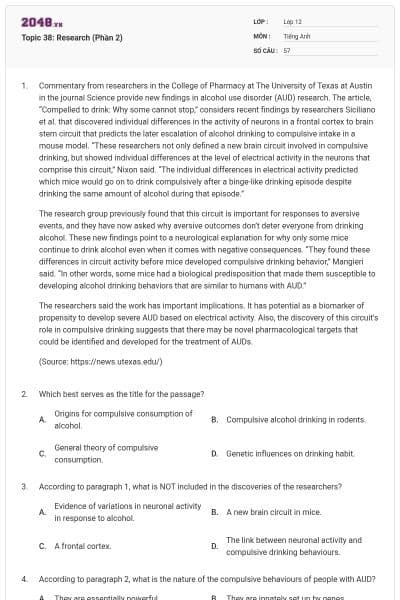
Commentary from researchers in the College of Pharmacy at The University of Texas at Austin in the journal Science provide new findings in alcohol use disorder (AUD) research. The article, “Compelled to drink: Why some cannot stop,” considers recent findings by researchers Siciliano et al. that discovered individual differences in the activity of neurons in a frontal cortex to brain stem circuit that predicts the later escalation of alcohol drinking to compulsive intake in a mouse model. “These researchers not only defined a new brain circuit involved in compulsive drinking, but showed individual differences at the level of electrical activity in the neurons that comprise this circuit,” Nixon said. “The individual differences in electrical activity predicted which mice would go on to drink compulsively after a binge-like drinking episode despite drinking the same amount of alcohol during that episode.”
The research group previously found that this circuit is important for responses to aversive events, and they have now asked why aversive outcomes don’t deter everyone from drinking alcohol. These new findings point to a neurological explanation for why only some mice continue to drink alcohol even when it comes with negative consequences. “They found these differences in circuit activity before mice developed compulsive drinking behavior,” Mangieri said. “In other words, some mice had a biological predisposition that made them susceptible to developing alcohol drinking behaviors that are similar to humans with AUD.”
The researchers said the work has important implications. It has potential as a biomarker of propensity to develop severe AUD based on electrical activity. Also, the discovery of this circuit’s role in compulsive drinking suggests that there may be novel pharmacological targets that could be identified and developed for the treatment of AUDs.
(Source: https://news.utexas.edu/)
Which best serves as the title for the passage?
Origins for compulsive consumption of alcohol.
Compulsive alcohol drinking in rodents.
General theory of compulsive consumption.
Genetic influences on drinking habit.
Đáp án A
Câu nào sau đây thích hợp nhất làm tiêu đề cho đoạn văn?
A. Nguồn gốc của việc tiêu thụ rượu bắt buộc
B. Uống rượu bắt buộc ở loài gặm nhấm
C. Học thuyết chung của sự tiêu thụ bắt buộc
D. Ảnh hưởng di truyền đến thói quen uống rượu
Căn cứ vào thông tin đoạn đầu:
The article, “Compelled to drink: Why some cannot stop,” considers recent findings by researchers Siciliano et al. that discovered individual differences in the activity of neurons in a frontal cortex to brain stem circuit that predicts the later escalation of alcohol drinking to compulsive intake in a mouse model.
(Các bài báo, “Buộc phải uống: Tại sao một số người không thể dừng lại”, xem xét những phát hiện gần đây của các nhà nghiên cứu Siciliano và cộng sự đã phát hiện ra sự khác biệt độc đáo trong hoạt động của các tế bào thần kinh ở vỏ não trước mạch não dự đoán sự leo thang sau đó của việc uống rượu đến việc uống bắt buộc trong một con chuột thí nghiệm.)
=> Như vậy, đoạn văn đang muốn nói về nguồn gốc của việc uống rượu bắt buộc.
According to paragraph 1, what is NOT included in the discoveries of the researchers?
Evidence of variations in neuronal activity in response to alcohol.
A new brain circuit in mice.
A frontal cortex.
The link between neuronal activity and compulsive drinking behaviours.
Đáp án C
Theo đoạn 1, những gì không được bao gồm trong những khám phá của các nhà nghiên cứu?
A. Bằng chứng về sự thay đổi trong hoạt động của tế bào thần kinh trong phản ứng với rượu
B. Một mạch não mới ở chuột
C. Một vỏ não phía trước
D. Mối liên hệ giữa hoạt động thần kinh và hành vi uống ép buộc
Căn cứ vào thông tin đoạn đầu:
“These researchers not only defined a new brain circuit involved in compulsive drinking, but showed individual differences at the level of electrical activity in the neurons that comprise this circuit,” Nixon said. “The individual differences in electrical activity predicted which mice would go on to drink compulsively after a binge-like drinking episode despite drinking the same amount of alcohol during that episode.”
(“Những nhà nghiên cứu này không chỉ định nghĩa một mạch não mới liên quan đến việc uống ép buộc, mà còn cho thấy sự khác biệt độc đáo ở mức độ hoạt động điện trong các tế bào thần kinh bao gồm mạch này,” Nixon nói. “Sự khác biệt độc đáo trong hoạt động điện dự đoán những con chuột sẽ tiếp tục uống một cách gượng ép sau một lần uống giống như uống cùng một lượng rượu trong lần đó.”)
According to paragraph 2, what is the nature of the compulsive behaviours of people with AUD?
They are essentially powerful.
They are innately set up by genes.
They are acquired through experience.
They are normal for a person to have.
Đáp án B
Theo đoạn 2, bản chất của các hành vi cưỡng chế của người có AUD?
A. Chúng cơ bản là mạnh mẽ.
B. Chúng được thiết lập bẩm sinh bởi gen.
C. Chúng có được thông qua kinh nghiệm.
D. Chúng là bình thường đối với một người có.
Căn cứ vào thông tin đoạn hai:
“They found these differences in circuit activity before mice developed compulsive drinking behavior,” Mangieri said. In other words, some mice had a biological predisposition that made them susceptible to developing alcohol drinking behaviors that are similar to humans with AUD.”
(Họ đã nhận thấy những sự khác biệt trong hoạt động mạch trước khi chuột phát triển hành vi uống ép buộc,” Mangieri nói. Nói cách khác, một số con chuột có khuynh hướng sinh học khiến chúng dễ bị phát triển các hành vi uống rượu tương tự như con người có AUD.)
The word “It” in paragraph 3 refers to _______.
Circuit
Work
Group
Activity
Đáp án B
Từ “it” trong đoạn 3 đề cập đến ________.
A. Mạch
B. Công việc
C. Nhóm
D. Hoạt động
Từ “it” ở đây dùng để thay thế cho danh từ công việc được nhắc tới trước đó.
The researchers said the work has important implications. It has potential as a biomarker of propensity to develop severe AUD based on electrical activity.
(Các nhà nghiên cứu cho biết công việc có ý nghĩa quan trọng. Nó có tiềm năng như một dấu ấn sinh học của xu hướng để phát triển AUD dựa trên hoạt động điện.)
The word “propensity” in paragraph 3 can be replaced by ______.
appetite
liability
weakness
inclination
Đáp án D
Từ “propensity” trong đoạn 3 có thể được thay thế bằng ________.
A. sự ngon miệng
B. trách nhiệm pháp lý
C. khuyết điểm
D. xu hướng
Từ đồng nghĩa propensity (xu hướng) = inclination
The researchers said the work has important implications. It has potential as a biomarker of propensity to develop severe AUD based on electrical activity.
(Các nhà nghiên cứu cho biết công việc có ý nghĩa quan trọng. Nó có tiềm năng như một dấu ấn sinh học của xu hướng để phát triển AUD dựa trên hoạt động điện.)
As cases of coronavirus infection proliferate around the world and governments take extraordinary measures to limit the spread, there is still a lot of confusion about what exactly the virus does to people’s bodies. The symptoms — fever, cough, shortness of breath — can signal any number of illnesses, from flu to strep to the common cold.
The virus is spread through droplets transmitted into the air from coughing or sneezing, which people nearby can take in through their nose, mouth or eyes. The viral particles in these droplets travel quickly to the back of your nasal passages and to the mucous membranes in the back of your throat, attaching to a particular receptor in cells, beginning there. Coronavirus particles have spiked proteins sticking out from their surfaces, and these spikes hook onto cell membranes, allowing the virus’s genetic material to enter the human cell. That genetic material proceeds to “hijack the metabolism of the cell and say, in effect, ‘Don’t do your usual job. Your job now is to help me multiply and make the virus,’” said Dr. William Schaffner.
As copies of the virus multiply, they burst out and infect neighboring cells. The virus then “crawls progressively down the bronchial tubes,” Dr. Schaffner said. When the virus reaches the lungs, their mucous membranes become inflamed. That can damage the alveoli or lung sacs and they have to work harder to carry out their function of supplying oxygen to the blood that circulates throughout our body and removing carbon dioxide from the blood so that it can be exhaled. The swelling and the impaired flow of oxygen can cause those areas in the lungs to fill with fluid, pus and dead cells. Pneumonia, an infection in the lung, can occur.
(Source: https://www.nytimes.com/)
What is the topic of the passage?
Lungs are the only body part affected.
Scientists’ speculations on the virus.
How coronavirus causes infection.
What is still not known about the virus?
Đáp án C
Đáp án nào là chủ đề của đoạn văn?
A. Phổi là phần duy nhất của cơ thể bị ảnh hưởng
B. Sự nghiên cứu của các nhà khoa học về con vi rút
C. Vi rút corona gây ra sự truyền nhiễm như thế nào
D. Những thứ vẫn còn chưa được biết tới về con vi rút corona
Căn cứ vào thông tin trong bài:
“As cases of coronavirus infection proliferate around the world and governments take extraordinary measures to limit the spread, there is still a lot of confusion about what exactly the virus does to people’s bodies.”
(Khi mà các ca nhiễm vi rút corona xuất hiện nhanh chóng ở trên toàn thế giới và chính phủ cũng đưa ra những biện pháp đặc biệt để hạn chế sự lây lan, vẫn còn có rất nhiều sự hiểu nhầm về những gì con vi rút đang thực sự gây ra cho cơ thể của con người.)
“The virus is spread through droplets transmitted into the air from coughing or sneezing, which people nearby can take in through their nose, mouth or eyes.”
(Con vi rút lan rộng thông qua các hạt nhỏ li ti truyền trong không khí từ việc ho và hắt xì, điều mà những người ngồi gần có thể hấp thụ vào trong cơ thể thông qua mũi, miệng, hoặc là mắt.)
=> Như vậy ta thấy chủ đề chính của đoạn văn này nói về cách mà con virus gây truyền nhiễm như thế nào.
The word “proliferate” in paragraph 1 is closest in meaning to ______.
unfurl
broaden
scatter
mushroom
Đáp án D
Từ “proliferate” trong đoạn 1 gần nghĩa với _______.
A. unfurl /ʌnˈfɜːl/: trải ra
B. broaden (v): mở rộng
C. scatter /ˈskæt.ər/ (v): phân tán
D. mushroom /ˈmʌʃ.ruːm/ (v): phát triển nhanh
Từ đồng nghĩa: Proliferate (xuất hiện nhanh chóng) = Mushroom
According to paragraph 2, what is NOT the mentioned activities of coronavirus in human body?
It uses the protein spikes studded in the membrane to latch onto host cells.
It takes over the replication machinery in human cells to make more viruses.
It spreads through the exposure to infected person’s respiratory secretions.
It journeys through the nasal cavity and anchors itself to the back of one’s throat.
Đáp án C
Theo như đoạn 2, điều nào sau đây không được đề cập như là các hoạt động của con vi rút trong cơ thể của con người?
A. Nó sử dụng gai Protein bám vào trong màng để xâm nhập vào các tế bào của vật chủ
B. Nó giành lấy quyền kiểm soát của bộ máy tái tạo trong tế bào của con người để tạo ra nhiều con vi rút hơn
C. Nó lan rộng thông qua sự tiếp xúc các chất bài tiết liên quan đến hệ hô hấp
D. Nó di chuyển qua khoang mũi và tự mình bám chặt vào phía sau cổ họng của một người nào đó
Căn cứ vào thông tin trong đoạn 2:
- Coronavirus particles have spiked proteins sticking out from their surfaces, and these spikes hook onto cell membranes, allowing the virus’s genetic material to enter the human cell.
(Các hạt vi rút corona có các protein có gai đi ra từ bề mặt của chúng, và những thứ này gai nhọn bám vào màng tế bào, cho phép vi rút của vật liệu di truyền đi vào tế bào người.) => A đúng
- That genetic material proceeds to “hijack the metabolism of the cell and say, in effect, ‘Don’t do your usual job. Your job now is to help me multiply and make the virus,’” said Dr. William Schaffner.
(Vật liệu di truyền này tiến hành để chiếm quyền điều khiển quá trình trao đổi chất của tế bào và thực tế là ‘Đừng làm công việc bình thường của bạn. Công việc của bạn bây giờ là giúp tôi nhân lên và tạo ra virus’ William Schaffner nói.)
=> B đúng
- “The virus is spread through droplets transmitted into the air from coughing or sneezing, which people nearby can take in through their nose, mouth or eyes.”
(Vi rút này lây lan qua các giọt truyền vào không khí do ho hoặc hắt hơi, mà những người gần đó có thể hít vào qua mũi, miệng hoặc mắt.)
=> Như vậy ta thấy việc lây lan qua đường hô hấp là hoạt động xảy ra bên ngoài cơ thể con người chứ không phải bên trong cơ thể con người.=> C sai.
- The viral particles in these droplets travel quickly to the back of your nasal passages and to the mucous membranes in the back of your throat, attaching to a particular receptor in cells, beginning there.
(Các hạt gây ra bởi vi rút trong những giọt này di chuyển nhanh chóng đến trong đường mũi của bạn và đến chất nhầy màng ở bên trong cổ họng của bạn, gắn vào một thụ thể đặc biệt trong các tế bào, bắt đầu sinh sống ở đó.) => D đúngThe word “it” in paragraph 3 refers to _______.
blood
carbon dioxide
oxygen
alveoli
Từ “it” trong đoạn văn thứ 3 đề cập tới ___________ .
A. Máu
B. Khí CO2
C. Khí Oxy
D. Túi phổi
Căn cứ vào thông tin trong đoạn 3:
“That can damage the alveoli or lung sacs and they have to work harder to carry out their function of supplying oxygen to the blood that circulates throughout our body and removing carbon dioxide from the blood so that it can be exhaled.”
(Điều đó có thể phá hủy túi phổi hoặc là túi của lá phổi và chúng phải hoạt động vất vả hơn để thực hiện chức năng cung cấp khí Oxy cho máu cái mà tuần hoàn khắp cơ thể của chúng ta và giúp loại khí CO2 ra khỏi máu để mà khí CO2 có thể được thải ra bên ngoài.)
According to paragraph 3, what is the described organ system that the coronavirus affect?
The respiratory system.
The circulatory system.
The lymphatic system.
The endocrine system.
Đáp án A
Theo như đoạn 3, cái nào sau đây được mô tả như là hệ thống cơ quan mà bị ảnh hưởng bởi con vi rút corona?
A. The respiratory /ˈres.pə.rə.tɔːr.i/ system: hệ hô hấp
B. The circulatory /ˈsɝː.kjə.lə.tɔːr.i/ system: hệ tuần hoàn
C. The lymphatic /lɪmˈfæt.ɪk/ system: hệ bạch huyết
D. The endocrine /ˈen.də.krɪn/ system: hệ nội tiết
Căn cứ vào thông tin trong đoạn 3:
“That can damage the alveoli or lung sacs and they have to work harder to carry out their function of supplying oxygen to the blood that circulates throughout our body and removing carbon dioxide from the blood so that it can be exhaled.”
(Điều đó có thể phá hủy túi phổi hoặc là túi của lá phổi và chúng phải hoạt động vất vả hơn để thực hiện chức năng cung cấp khí Oxy cho máu cái mà tuần hoàn khắp cơ thể của chúng ta và giúp loại khí CO2 ra khỏi máu vì vậy khí CO2 có thể được thải ra bên ngoài.)
=> Như vậy ta thấy vi rút corona gây ảnh hưởng đến hệ hô hấp của chúng ta.
In all the debate about conservation of natural landscapes, we must not forget that the 19th century also saw the development of interest in the cultural past. Although archaeology was around 100 years old at this point, at least in the Old World, it was largely an exercise in treasure hunting - digging up the treasures of the past as curiosities for museums or for the private collections of those who funded the dig.
Changes in attitudes and law throughout the 19th century meant that monuments and artefacts were becoming part of the study of the past, no longer merely trinkets and curiosities, but indicators of a culture’s development and identity. Modern archaeology would not arrive until the 20th century and the concept of an archaeological landscape is younger still. The first laws to protect and conserve cultural heritage came into place in the late 19th and early 20th centuries in the developed countries. In the US, the first such law was the Antiquities Act in 1906 which gave the office of president the power to set aside areas of land as protected cultural assets, known as “National Monuments”. This law was in place until 1979 when it was replaced with the Archaeological Resources Protection Act but several other laws came into place before then that required archaeologists to label and give proper contexts to monuments and artefacts.
There was also a global movement to protect by law and provide resources and funds for monuments that were nationally important, but also those deemed significant to human civilization as a whole. Founded in 1945, has many responsibilities, one of the most important as far as archaeological conservation is concerned is the World Heritage List. The list began in 1975 as a recognition of globally important sites. The first 12 added on that first day included: L’Anse Aux Meadows in Canada, The Galapagos Islands, Quito in Ecuador, Krakow, and Mesa Verde National Park in the US. Today, there are over 1,000 cultural monuments and natural landscapes on this list.
In the 21st century, it is common for countries to have laws in place to protect monuments, sites, and landscapes of cultural or historical importance and government-established charities or government departments assigned to their management, upkeep or conservation. The threats to them and their conservation go beyond the issues of the 19th century (plunder and theft).
(Source: https://www.environmentalscience.org/)
What does the passage mainly discuss?
Subdivisions of conservation.
Conservation unwritten ethics.
Conservation success stories.
Archaeological conservation.
Đáp án D
Đoạn văn chủ yếu thảo luận là gì?
A. Phân khu bảo tồn
B. Bảo tồn đạo đức bất thành văn
C. Câu chuyện bảo tồn thành công
D. Bảo tồn khảo cổ
Căn cứ vào thông tin đoạn đầu:
In all the debate about conservation of natural landscapes, we must not forget that the 19th century also saw the development of interest in the cultural past. Although archaeology /ˌɑː.kiˈɒl.ə.dʒi/ was around 100 years old at this point, at least in the Old World, it was largely an exercise in treasure hunting.
(Trong tất cả các cuộc tranh luận về bảo tồn cảnh quan thiên nhiên, chúng ta không được quên rằng thế kỷ 19 cũng chứng kiến sự phát triển của mối quan tâm đến văn hóa trong quá khứ. Mặc dù khảo cổ học đã được khoảng 100 tuổi vào thời điểm này, ít nhất là ở Thế giới cũ, nó chủ yếu là những chuyến truy tìm kho báu)
→ Như vậy đoạn văn đang nói về việc bảo tồn khảo cổ.
The word “it” in paragraph 1 refers to _____.
conservation
exercise
development
archaeology
Đáp án D
Từ “it” trong đoạn 1 đề cập đến ________.
A. sự bảo tồn
B. bài thể dục
C. sự phát triển
D. khảo cổ học
Từ “it” ở đây dùng để thay thế cho danh từ khảo cổ học được nhắc tới trước đó.
In all the debate about conservation of natural landscapes, we must not forget that the 19th century also saw the development of interest in the cultural past. Although archaeology was around 100 years old at this point, at least in the Old World, it was largely an exercise in treasure hunting.
(Trong tất cả các cuộc tranh luận về bảo tồn cảnh quan thiên nhiên, chúng ta không được quên rằng thế kỷ 19 cũng chứng kiến sự phát triển của mối quan tâm đến văn hóa trong quá khứ. Mặc dù khảo cổ học đã khoảng 100 tuổi vào thời điểm này, ít nhất là ở Thế giới cũ, nó chủ yếu là những chuyến truy tìm kho báu.)
The word “indicators” in paragraph 2 is closest in meaning to _______.
touchstones
standards
guidelines
benchmarks
Đáp án A
Từ “indicators” /ˈɪn.dɪ.keɪ.tər/ trong đoạn 2 có nghĩa gần nhất với _____.
A. tiêu chuẩn, nguyên lí (được thiết lập để thông qua đó cái gì sẽ được đánh giá)
B. tiêu chuẩn (chất lượng), quy tắc về đạo đức
C. hướng dẫn
D. điểm chuẩn
Từ đồng nghĩa indicator (chỉ số) = touchstone
Changes in attitudes and law throughout the 19th century meant that monuments /ˈmɒn.jə.mənt/ and artefacts /ˈɑː.tə.fækt/ were becoming part of the study of the past, no longer merely trinkets /ˈtrɪŋ.kɪt/ and curiosities /ˌkjʊə.riˈɒs.ə.ti/, but indicators of a culture’s development and identity.
(Những thay đổi về thái độ và luật pháp trong suốt thế kỷ 19 có nghĩa là các di tích và đồ tạo tác đã trở thành một phần của nghiên cứu về quá khứ, không còn chỉ là đồ trang sức và sự tò mò, mà là các chỉ số về sự phát triển và bản sắc của một nền văn hóa.)
According to paragraph 2, which event is correctly matched with its time of occurrence?
The science of archaeology was brought into the modern era in the 19th century.
The Antiquities Act was signed into law by the US Congress in 1906.
The Environmental Protection Agency was established in 1960s.
The Archaeological Resources Protection Act was amended in 1979.
Đáp án B
Theo đoạn 2, sự kiện nào chính xác với thời gian xảy ra của nó?
A. Thế kỉ 19, khoa học khảo cổ học được đưa vào kỷ nguyên hiện đại.
B. Đạo luật cổ vật đã được quốc hội Hoa Kỳ đưa vào luật năm 1906.
C. Cơ quan bảo vệ môi trường được thành lập vào những năm 1960.
D. Đạo luật bảo vệ tài nguyên khảo cổ đã được sửa đổi vào năm 1979.
Căn cứ vào thông tin đoạn hai:
In the US, the first such law was the Antiquities Act in 1906 which gave the office of president the power to set aside areas of land as protected cultural assets,
(Ở Mỹ, luật đầu tiên như vậy là Đạo luật cổ vật năm 1906 đã trao cho văn phòng tổng thống quyền dùng các khu vực đất đai làm tài sản văn hóa được bảo vệ,)
According to paragraph 3, what is NOT mentioned about the World Heritage List?
Nowadays, there are more than 1000 properties on the World Heritage List.
The Galapagos Islands, Quito in Ecuador and Krakow are included in the index.
In November 1972, the UNESCO inaugurated the list by adopting a treaty.
The first published list of protected places consisted of 12 World Heritage Sites.
Đáp án C
Theo đoạn 3, những gì KHÔNG được đề cập về danh sách di sản thế giới?
A. Ngày nay, có hơn 1000 di sản trong danh sách di sản thế giới.
B. Quần đảo Galapagos, Quito ở Ecuador và Krakow được bao gồm trong danh sách.
C. Vào tháng 11 năm 1972, UNESCO đã ra mắt danh sách bằng cách thông qua một hiệp ước.
D. Danh sách các địa điểm được bảo vệ được công bố đầu tiên bao gồm 12 di sản thế giới.
Căn cứ vào thông tin đoạn ba:
The first 12 added on that first day included: L’Anse Aux Meadows in Canada, The Galapagos Islands, Quito in Ecuador, Krakow, and Mesa Verde National Park in the US. Today, there are over 1,000 cultural monuments and natural landscapes on this list.
(12 nơi đầu tiên được thêm vào ngày đầu tiên đó bao gồm: Aux Meadows ở Canada, Quần đảo Galapagos, Quito ở Ecuador, Krakow và vườn quốc gia Mesa Verde ở Mỹ. Ngày nay, có hơn 1.000 di tích văn hóa và cảnh quan thiên nhiên trong danh sách này.)
Which of the following statements is TRUE, according to the passage?
Archaeology is a discipline in branch of history which has existed for over 1000 years.
The action to safeguard world’s special places does not stop at national scale.
In this day and age, the laws on the conservation of historical entities are uncommon.
Archaeological conservation is the study of how and why past societies collapsed.
Đáp án B
Phát biểu nào sau đây là đúng, theo đoạn văn?
A. Khảo cổ học là một môn học trong nhánh của lịch sử đã tồn tại hơn 1000 năm.
B. Hành động bảo vệ những nơi đặc biệt của thế giới không dừng lại ở quy mô quốc gia.
C. Trong thời đại ngày nay, luật bảo tồn các thực thể lịch sử là không phổ biến.
D. Bảo tồn khảo cổ học là nghiên cứu về cách thức và lý do tại sao các xã hội trong quá khứ sụp đổ.
Căn cứ vào thông tin đoạn ba:
There was also a global movement to protect by law and provide resources and funds for monuments that were nationally important, but also those deemed significant to human civilization as a whole.
(Ngoài ra còn có một phong trào toàn cầu để bảo vệ bởi pháp luật và cung cấp các nguồn lực và quỹ cho những di tích quan trọng của quốc gia, nhưng cũng là những di tích được coi là quan trọng đối với văn minh con người nói chung.)
The word “plunder” in paragraph 4 is closest in meaning to _______.
pillage
larceny
heist
robbery
Đáp án A
Từ “plunder” trong đoạn 4 có nghĩa gần nhất với ________.
A. pillage /ˈpɪl.ɪdʒ/ cướp phá (trong chiến tranh)
B. larceny /ˈlɑː.sən.i/ (n) = theft: sự ăn cắp
C. heist /haɪst/ (n): trộm cắp
D. robbery /ˈrɒb.ər.i/: cướp
The threats to them and their conservation go beyond the issues of the 19th century (plunder and theft).
Các mối đe dọa đối với họ và sự bảo tồn của họ vượt xa các vấn đề của thế kỷ 19 (cướp bóc và trộm cắp).
Which of the following can be inferred from the passage?
People has taken the learning about past societies and the development of the human race more seriously.
Heritage is our legacy from the past, what we live with today, and what we pass on to future generations.
Archaeological conservation uncovers primary resources for understanding and interpreting the past.
More and more global citizens are awaken to the values of human’s architectural masterpieces.
Đáp án A
Điều nào sau đây có thể được suy ra từ đoạn văn?
A. Mọi người đã học hỏi về các xã hội trong quá khứ và sự phát triển của loài người một cách nghiêm túc hơn.
B. Di sản là tài sản của chúng ta từ quá khứ, những gì chúng ta sống cùng ngày nay và những gì chúng ta truyền lại cho các thế hệ tương lai.
C. Bảo tồn khảo cổ phát hiện ra các nguồn tài nguyên chính để hiểu và giải thích quá khứ.
D. Ngày càng có nhiều công dân toàn cầu thức tỉnh với các giá trị của kiệt tác kiến trúc con người.
Căn cứ vào thông tin đoạn hai:
Changes in attitudes and law throughout the 19th century meant that monuments and artefacts were becoming part of the study of the past, no longer merely trinkets and curiosities, but indicators of a culture’s development and identity.
(Những thay đổi về thái độ và luật pháp trong suốt thế kỷ 19 có nghĩa là các di tích và đồ tạo tác đã trở thành một phần của nghiên cứu về quá khứ, không còn chỉ là đồ trang sức và sự tò mò, mà là các chỉ số về sự phát triển và bản sắc của một nền văn hóa.)
Without regular supplies of some hormones our capacity to behave would be seriously impaired; without others we would soon die. Tiny amounts of some hormones can modify our moods and our action, our inclination to eat or drink, our aggressiveness or submissiveness, and our reproductive and parental behavior. And hormones do more than influence adult behavior; early in life they help to determine the development of bodily form and may even determine an individual’s behavioral capacities. Later in life the changing outputs of some endocrine glands and the body’s changing sensitivity to some hormones are essential aspects of the phenomena of aging.
Communication within the body and the consequent integration of behavior were considered the exclusive province of the nervous system up to the beginning of the present century. The emergence of endocrinology as a separate discipline can probably be traced to the experiments of Bayliss and Starling on the hormone secretion. This substance is secreted from cells in the intestinal walls when food enters the stomach; it travels through the bloodstream and stimulates the pancreas to liberate pancreatic juice, which aids in digestion. By showing that special cells secrete chemical agents that are conveyed by the bloodstream and regulate distant target organs or tissues, Bayliss and Starling demonstrated that chemical integration can occur without participation of the nervous system.
William Bayliss and Ernest Henry Starling, two British physiologists, discovered and introduced the word hormone. In 1979, The Bayliss and Starling Society was founded as a forum for research scientists with specific interest in the chemistry, physiology and function of central and autonomic peptides. The Society also offered the travelling fellowship award for members who wanted to attend national and international academic conferences. Sometimes, the Society help schools to organize science fairs for secondary students and give them incentives to fall for related subjects.
The term “hormone” was first used with reference to secretion. Starling derived the term from the Greek hormone, meaning “to excited or set in motion.” The term “endocrine” was introduced shortly thereafter, “Endocrine” is used to refer to glands that secrete products into the bloodstream. The term “endocrine” contrasts with “exocrine” which is applied to glands that secrete their products through ducts to the site of action. Examples of exocrine glands are the tear glands, the sweat glands, and the pancreas, which secretes pancreatic juice through a duct into intestine. Exocrine glands are also called duct glands, while endocrine glands are called ductless.
(https://www.passeidireto.com)
Which of the following is NOT mentioned as an effect of hormones?
Modification of behavior
Sensitivity to hunger and thirst
Aggressive feelings
Maintenance of blood pressure
Đáp án D
Chủ đề
Điều nào sau đây KHÔNG được đề cập là một ảnh hưởng của nội tiết tố?
A. Sự thay đổi của hành vi
B. Độ nhạy cảm với cơn đói và cơn khát
C. Các cảm xúc xông xáo
D. Sự duy trì của huyết áp
Căn cứ vào các thông tin trong đoạn 1:
- “Tiny amounts of some hormones can modify our moods and our action, our inclination to eat or drink, our aggressiveness or submissiveness, and our reproductive and parental behavior.”
(Những lượng nhỏ của nội tiết tố có thể thay đổi tâm trạng và hành động của chúng ta, thiên hướng ăn và uống, tính xông xáo hay sự quy phục, và các hành vi sinh sản và hành vi làm cha mẹ của chúng ta.)
What is the author’s main purpose in the passage?
To explain the specific functions of various hormones
To provide general information about hormones
To explain how the term “hormone” evolved
To report on experiments in endocrinology
Đáp án B
Mục đích chính của tác giả trong đoạn văn là gì?
A. Để giải thích những chức năng đặc trưng của nhiều nội tiết tố khác nhau
B. Để cung cấp thông tin chung về nội tiết tố
C. Để giải thích rằng thuật ngữ “nội tiết tố” đã phát triển như thế nào
D. Để báo cáo về các thí nghiệm về nội tiết
The passage supports which of the following conclusions?
The human body requires large amounts of most hormones.
Synthetic hormones can replace a person’s natural supply of hormones if necessary.
The quantity of hormones produced and their effects on the body are related to a person’s age.
The short child of tall parents very likely had a hormone.
Đáp án C
Đoạn văn ủng hộ kết luận nào dưới đây?
A. Cơ thể con người đòi hỏi những lượng lớn của hầu hết nội tiết tố.
B. Nội tiết tố nhân tạo có thể thay thế nguồn cung cấp nội tiết tố tự nhiên của một người nếu cần thiết.
C. Số lượng nội tiết tố được sản xuất và tác động của chúng trên cơ thể có liên quan đến độ tuổi của một người.
D. Đứa trẻ thấp mà có bố mẹ cao rất có thể có nội tiết tố.
Căn cứ vào các thông tin trong đoạn 1:
- “And hormones do more than influence adult behavior; early in life they help to determine the development of bodily form and may even determine an individual’s behavioral capacities. Later in life the changing outputs of some endocrine glands and the body’s changing sensitivity to some hormones are essential aspects of the phenomena of aging.”
(Và nội tiết tố không chỉ ảnh hưởng hành vi trưởng thành; lúc ta còn bé chúng giúp quyết định sự phát triển hình dáng cơ thể và thậm chí có lẽ còn quyết định hiệu suất hành vi của một cá nhân. Về sau sản lượng các tuyến nội tiết thay đổi và độ nhạy cảm của cơ thể với vài nội tiết tố thay đổi là những phương diện quan trọng của những hiện tượng lão hóa.)
It can be inferred from the passage that, before the Bayliss and Starling experiments, most people believed that chemical integration occurred only ________ .
during sleep
in the endocrine glands
under control of the nervous system
during strenuous exercise
Đáp án C
Có thể suy ra từ đoạn văn rằng, trước những thí nghiệm Bayliss và Starling, hầu hết mọi người tin rằng sự hợp nhất hóa học chỉ xảy ra __________.
A. trong lúc ngủ
B. trong các tuyến nội tiết
C. dưới sự kiểm soát của hệ thần kinh
D. trong thời gian tập các bài thể dục căng thẳng
Căn cứ vào các thông tin trong đoạn 2:
- “Communication within the body and the consequent integration of behavior were considered the exclusive province of the nervous system up to the beginning of the present century.”
(Sự giao tiếp giữa cơ thể và kết quả hợp nhất của hành vi được coi là lĩnh vực riêng của hệ thần kinh cho tới đầu thế kỉ hiện tại.)
- “Bayliss and Starling demonstrated that chemical integration can occur without participation of the nervous system.”
(Bayliss và Starling đã chứng minh rằng sự hợp nhất hóa học có thể diễn ra mà không cần sự tham gia của hệ thần kinh.)
The highlighted word "liberate" in the passage is closet meaning to ________.
emancipate
discharge
surrender
save
Đáp án B
Từ “liberate” /ˈlɪb.ər.eɪt/ được tô đậm trong đoạn văn gần nghĩa nhất với __________.
A. giải phóng (ai đó khỏi sự kiểm soát của ai)
B. thải ra
C. đầu hàng
D. cứu vãn
Căn cứ vào các thông tin trong đoạn 2:
“This substance is secreted from cells in the intestinal walls when food enters the stomach; it travels through the bloodstream and stimulates the pancreas to liberate pancreatic juice, which aids in digestion.”
(Chất này được tiết từ các tế bào trong thành ruột khi thức ăn được đưa vào dạ dày; nó chảy qua dòng máu và kích thích tuyến tụy giải phóng dịch tụy, thứ mà hỗ trợ tiêu hóa.)
According to the passage, another term for exocrine lands is ________.
duct glands
endocrine glands
ductless glands
intestinal glands
Đáp án A
Theo như đoạn văn, thuật ngữ khác dùng cho tuyến ngoại tiết là __________.
A. tuyến ống
B. tuyến nội tiết
C. tuyến không ống
D. tuyến ruột
Căn cứ vào các thông tin trong đoạn 3:
“Exocrine glands are also called duct glands …”
(Các tuyến ngoại tiết còn được gọi là các tuyến ống …)
Which of the following is NOT mentioned as the main objectives of William Bayliss and Ernest Starling Society?
providing a place for academic exchange
study chemistry and physiology
grant travelling for academic purposes
teach science for secondary students
Đáp án D
Điều nào sau đây KHÔNG được đề cập là mục tiêu chính của William Bayliss và Ernest Starling Society?
A. cung cấp một nơi để trao đổi học thuật
B. nghiên cứu hóa học và sinh lý học
C. cấp đi du lịch cho mục đích học tập
D. dạy khoa học cho học sinh trung học
Căn cứ vào thông tin sau:
William Bayliss and Ernest Henry Starling, two British physiologists, discovered and introduced the word hormone. In 1979, The Bayliss and Starling Society was founded as a forum for research scientists with specific interest in the chemistry, physiology and function of central and autonomic peptides. The Society also offered the travelling fellowship award for members who wanted to attend national and international academic conferences. Sometimes, the Society help schools to organize science fairs for secondary students and give them incentives to fall for related subjects.
(William Bayliss và Ernest Henry Starling, hai nhà sinh lý học người Anh, đã phát hiện và giới thiệu từ hormone. Năm 1979, Hội Bayliss và Starling được thành lập như một diễn đàn dành cho các nhà khoa học nghiên cứu với mối quan tâm đặc biệt về hóa học, sinh lý và chức năng của các peptide trung ương và tự trị. Hội cũng cung cấp giải thưởng học bổng du lịch cho các thành viên muốn tham dự các hội nghị học thuật trong nước và quốc tế. Đôi khi, Hội giúp các trường tổ chức các hội chợ khoa học cho học sinh cấp hai và khuyến khích họ say mê các môn học liên quan.)
The highlighted word “them” in the passage refers to ________ .
schools
students
science fairs
subjects
Đáp án B
Từ “them” trong đoạn văn ám chỉ?
Sometimes, the Society help schools to organize science fairs for secondary students and give them incentives to fall for related subjects.
(Đôi khi, Hội giúp các trường tổ chức các hội chợ khoa học cho học sinh cấp hai và khuyến khích họ say mê các môn học liên quan.)
An individual’s personality is the complex of mental characteristics that makes them unique from other people. It includes all of the patterns of thought and emotions that cause us to do and say things in particular ways. At a basic level, personality is expressed through our temperament or emotional tone. However, personality also colors our values, beliefs, and expectations. There are many potential factors that are involved in shaping a personality. These factors are usually seen as coming from heredity and the environment. Research by psychologists over the last several decades has increasingly pointed to hereditary factors being more important, especially for basic personality traits such as emotional tone. However, the acquisition of values, beliefs, and expectations seem to be due more to socialization and unique experiences, especially during childhood.
Some hereditary factors that contribute to personality development do so as a result of interactions with the particular social environment in which people live. For instance, your genetically inherited physical and mental capabilities have an impact on how others see you and, subsequently, how you see yourself. Likewise, your health and physical appearance are likely to be very important in your personality development. You may be frail or robust. You may have a learning disability. You may be slender in a culture that considers obesity attractive or vice versa. These largely hereditary factors are likely to cause you to feel that you are nice-looking, ugly, or just adequate. Likewise, skin color, gender, and sexual orientation are likely to have a major impact on how you perceive yourself. Whether you are accepted by others as being normal or abnormal can lead you to think and act in a socially acceptable or marginal and even deviant way.
There are many potential environmental influences that help to shape personality. Child rearing practices are especially critical. In the dominant culture of North America, children are usually raised in ways that encourage them to become self-reliant and independent. Children are often allowed to act somewhat like equals to their parents. Children are given allowances and small jobs around the house to teach them how to be responsible for themselves. In contrast, children in China are usually encouraged to think and act as a member of their family and to suppress their own wishes when they are in conflict with the needs of the family. Independence and self-reliance are viewed as an indication of family failure and are discouraged.
(https://www.researchgate.net)
According to recent studies, what factor is the most important in shaping an individual’s basic personality traits?
Transmission of traits from parents to children
Learning to behave in a socially acceptable way
Very special events or activities that affect him/her
The period of a person’s life when they a child
Theo các nghiên cứu gần đây, yếu tố nào là quan trọng nhất trong việc hình thành những đặc điểm tính cách cơ bản của cá nhân?
A. Truyền đặc điểm từ cha mẹ sang con cái
B. Học cách cư xử theo cách được xã hội chấp nhận
C. Các sự kiện hoặc hoạt động rất đặc biệt ảnh hưởng đến anh ấy / cô ấy
D. Thời kỳ của một người sống khi họ còn nhỏ
Căn cứ vào thông tin:
Research by psychologists over the last several decades has increasingly pointed to hereditary /hɪˈred.ɪ.tər.i/ factors being more important, especially for basic personality traits such as emotional tone.
(Nghiên cứu bởi nhà tâm lý học trong nhiều thập kỷ qua đã ngày càng chỉ ra các yếu tố di truyền quan trọng hơn, đặc biệt là những đặc điểm tính cách cơ bản như tông màu cảm xúc.)
Dịch bài đọc
Tính cách của một cá nhân là phức hợp các đặc điểm tinh thần khiến họ trở nên độc đáo so với những người khác. Nó bao gồm tất cả các kiểu suy nghĩ và cảm xúc khiến chúng ta làm và nói những điều theo những cách cụ thể. Ở cấp độ cơ bản, tính cách được thể hiện thông qua tính khí hoặc tông màu cảm xúc của chúng ta. Tuy nhiên, tính cách cũng tô màu cho các giá trị, niềm tin và kỳ vọng của chúng ta. Có nhiều yếu tố tiềm ẩn liên quan đến việc hình thành nên tính cách. Những yếu tố này thường được coi là bắt nguồn từ di truyền và môi trường. Nghiên cứu của các nhà tâm lý học trong nhiều thập kỷ qua ngày càng chỉ ra rằng các yếu tố di truyền quan trọng hơn, đặc biệt là đối với các đặc điểm tính cách cơ bản như tông màu cảm xúc. Tuy nhiên, việc tiếp thu các giá trị, niềm tin và kỳ vọng dường như là do quá trình xã hội hóa và những trải nghiệm độc đáo, đặc biệt là trong thời thơ ấu.
Một số yếu tố di truyền góp phần vào sự phát triển tính cách là kết quả của các tương tác với môi trường xã hội cụ thể mà mọi người đang sống. Ví dụ, khả năng thể chất và tinh thần được thừa hưởng về mặt di truyền của bạn có tác động đến cách người khác nhìn nhận bạn và sau đó là cách bạn nhìn nhận bản thân. Tương tự như vậy, sức khỏe và ngoại hình của bạn có thể rất quan trọng trong quá trình phát triển tính cách của bạn. Bạn có thể yếu đuối hoặc khỏe mạnh. Bạn có thể bị khuyết tật học tập. Bạn có thể mảnh mai trong một nền văn hóa coi béo phì là hấp dẫn hoặc ngược lại. Những yếu tố di truyền này có thể khiến bạn cảm thấy mình đẹp, xấu hoặc chỉ đủ tiêu chuẩn. Tương tự như vậy, màu da, giới tính và khuynh hướng tình dục có thể có tác động lớn đến cách bạn nhận thức về bản thân. Việc bạn được người khác chấp nhận là bình thường hay bất thường có thể khiến bạn suy nghĩ và hành động theo cách được xã hội chấp nhận hoặc theo cách thiểu số và thậm chí là lệch lạc.
Có nhiều ảnh hưởng tiềm ẩn từ môi trường giúp hình thành tính cách. Các phương pháp nuôi dạy trẻ em đặc biệt quan trọng. Trong nền văn hóa thống trị của Bắc Mỹ, trẻ em thường được nuôi dạy theo cách khuyến khích chúng trở nên tự lập và độc lập. Trẻ em thường được phép hành động ngang hàng với cha mẹ. Trẻ em được trợ cấp và làm những công việc nhỏ trong nhà để dạy chúng cách tự chịu trách nhiệm. Ngược lại, trẻ em ở Trung Quốc thường được khuyến khích suy nghĩ và hành động như một thành viên trong gia đình và kìm nén mong muốn của riêng mình khi chúng xung đột với nhu cầu của gia đình. Sự độc lập và tự lực bị coi là dấu hiệu của sự thất bại trong gia đình và không được khuyến khích.
(https://www.researchgate.net)
According to the passage, sometimes heredity and environment _____.
are interesting research topics
include values, beliefs and expectations
interact in personality development
are not well recognized in the society
Đáp án C
Theo đoạn văn, đôi khi di truyền và môi trường __________.
A. là những chủ đề nghiên cứu thú vị
B. bao gồm các giá trị, niềm tin và kỳ vọng
C. tương tác trong phát triển nhân cách
D. không được công nhận trong xã hội
Căn cứ vào thông tin:
Some hereditary factors that contribute to personality development do so as a result of interactions with the particular social environment in which people live.
(Một số yếu tố di truyền góp phần phát triển nhân cách là kết quả của tương tác với môi trường xã hội cụ thể mà mọi người sống.)
What is NOT mentioned as a hereditary factor?
Health
Learning abilities
Physical contact
Mental capabilities
Đáp án C
Điều gì KHÔNG được đề cập như một yếu tố di truyền?
A. Sức khỏe
B. Khả năng học tập
C. Tiếp xúc vật lý
D. Khả năng tâm thần
Căn cứ vào thông tin:
For instance, your genetically inherited physical and mental capabilities /ˌkeɪ.pəˈbɪl.ə.tis/ have an impact on how others see you and, subsequently, how you see yourself. Likewise, your health and physical appearance are likely to be very important in your personality development. You may be frail or robust. You may have a learning disability.
(Chẳng hạn, khả năng thể chất và tinh thần được di truyền có ảnh hưởng đến cách người khác nhìn thấy bạn và sau đó, cách bạn nhìn nhận bản thân. Tương tự như vậy, sức khỏe và ngoại hình của bạn có thể rất quan trọng trong sự phát triển tính cách của bạn. Bạn có thể yếu đuối hoặc mạnh mẽ. Bạn có thể không có khả năng học tập.)
Which of the followings can best replace the word “perceive” in the second paragraph?
Look at
See
Watch
Understand
Đáp án B
Những từ nào sau đây có thể thay thế tốt nhất từ “perceive” trong phần hai đoạn văn?
A. Nhìn vào
B. see
C. Xem
D. Hiểu
Từ vựng: perceive = see (v): nhận thấy, nhận thức
Căn cứ vào ngữ cảnh của câu:
You may be slender in a culture that considers obesity attractive or vice versa. These largely hereditary factors are likely to cause you to feel that you are nice-looking, ugly, or just adequate. Likewise, skin color, gender, and sexual orientation are likely to have a major impact on how you perceive yourself.
(Bạn có thể mảnh khảnh trong một nền văn hóa coi béo phì hấp dẫn hoặc ngược lại. Những yếu tố di truyền chủ yếu này có khả năng khiến bạn cảm thấy rằng bạn trông đẹp, xấu, hoặc vừa đủ. Tương tự như vậy, màu da, giới tính và xu hướng tình dục có thể có tác động lớn đến cách bạn nhìn nhận về bản thân.)
According to the passage, how your self-image _____.
is fulfilled with your appearance
increased in the process of socialization
is limited with your learning disability
is affected by the way others see you
Đáp án D
Theo đoạn văn, hình ảnh của bản thân bạn __________.
A. được thực hiện với diện mạo của bạn như thế nào
B. gia tăng trong quá trình xã hội hóa như thế nào
C. bị hạn chế với khiếm khuyết học tập của bạn như thế nào
D. bị ảnh hưởng bởi cách người khác nhìn thấy bạn ra sao
=> Căn cứ vào thông tin đầu đoạn 2 như sau:
“Some hereditary factors that contribute to personality development do so as a result of interactions with the particular social environment in which people live. For instance, your genetically inherited physical and mental capabilities have an impact on how others see you and, subsequently, how you see yourself.”
(Một số yếu tố di truyền góp phần phát triển nhân cách do sự tương tác với môi trường xã hội cụ thể nơi con người sống. Chẳng hạn, khả năng thể chất và tinh thần di truyền theo gen của bạn có tác động đến cách người khác nhìn thấy bạn và sau đó, cách bạn nhìn nhận bản thân.)
According to the passage, concepts like beauty or ugliness _____.
are related to skin colors
change from time to time
only appear recently
are different in societies
Đáp án D
Theo đoạn văn, các khái niệm như vẻ đẹp hay sự xấu xí __________.
A. có liên quan đến màu da
B. thay đổi theo thời gian
C. chỉ xuất hiện gần đây
D. là khác nhau trong các xã hội
Căn cứ vào thông tin:
These largely hereditary factors are likely to cause you to feel that you are nice-looking, ugly, or just adequate.
(Những yếu tố di truyền chủ yếu có khả năng khiến bạn cảm thấy rằng bạn ưa nhìn, xấu xí, hoặc vừa đủ.)
According to the passage, what is the most important environmental factor in personality development?
What a child looks like
Which country a child is born in
How a child is brought up
When a child starts school
Đáp án C
Theo đoạn văn, yếu tố môi trường quan trọng nhất trong phát triển nhân cách?
A. Một đứa trẻ trông như thế nào
B. Một đứa trẻ được sinh ra ở nước nào
C. Một đứa trẻ được nuôi dưỡng như thế nào
D. Khi một đứa trẻ bắt đầu đi học
Căn cứ vào thông tin:
There are many potential environmental influences that help to shape personality. Child rearing practices are especially critical. In the dominant culture of North America, children are usually raised in ways that encourage them to become self-reliant and independent. Children are often allowed to act somewhat like equals to their parents. Children are given allowances and small jobs around the house to teach them how to be responsible for themselves. In contrast, children in China are usually encouraged to think and act as a member of their family and to suppress their own wishes when they are in conflict with the needs of the family. Independence and self-reliance are viewed as an indication of family failure and are discouraged.
(Có nhiều ảnh hưởng môi trường tiềm năng giúp hình thành nhân cách. Cách thức nuôi dạy trẻ là đặc biệt quan trọng. Trong văn hóa thống trị của Bắc Mỹ, trẻ em thường được nuôi dưỡng theo cách khuyến khích chúng tự lực và tự lập. Trẻ em thường được phép hành động có phần nào giống như cha mẹ của chúng. Trẻ em được trợ cấp và giao các công việc nhỏ xung quanh nhà để dạy chúng cách tự chịu trách nhiệm. Ngược lại, trẻ em ở Trung Quốc thường được khuyến khích suy nghĩ và hành động như một thành viên trong gia đình và kìm nén mong muốn của chính mình khi những mong muốn đó mâu thuẫn với nhu cầu của gia đình. Độc lập và tự chủ được xem là một dấu hiệu của sự thất bại trong gia đình và không được khuyến khích.)
According to the passage, what is valued in one society may _____ .
originate from its culture
be unimportant in another
contrast to another value
show the social equality
Đáp án B
Theo đoạn văn, những gì có giá trị trong một xã hội có thể _____.
A. bắt nguồn từ văn hóa của nó
B. không quan trọng trong một nền văn hóa khác
C. tương phản với giá trị khác
D. thể hiện sự bình đẳng xã hội
=> Căn cứ vào thông tin đoạn cuối:
"In the dominant culture of North America, children are usually raised in ways that encourage them to become self-reliant and independent. Children are often allowed to act somewhat like equals to their parents. Children are given allowances and small jobs around the house to teach them how to be responsible for themselves. In contrast, children in China are usually encouraged to think and act as a member of their family and to suppress their own wishes when they are in conflict with the needs of the family. Independence and self-reliance are viewed as an indication of family failure and are discouraged."
(Trong văn hóa thống trị của Bắc Mỹ, trẻ em thường được nuôi dưỡng theo cách khuyến khích chúng không phụ thuộc và tự lập. Trẻ em thường được phép hành động hơi giống như cha mẹ của chúng. Trẻ em được cho trợ cấp và các công việc nhỏ xung quanh nhà để dạy chúng cách tự chịu trách nhiệm. Ngược lại, trẻ em ở Trung Quốc thường được khuyến khích suy nghĩ và hành động như một thành viên trong gia đình và kìm nén mong muốn của chúng khi mâu thuẫn với nhu cầu của gia đình. Độc lập và tự lực được xem là một dấu hiệu của sự thất bại trong gia đình và không được khuyến khích.)
=> Qua đây, ta thấy rõ một giá trị trong nền văn hóa Bắc Mỹ đó là tính độc lập và tự lực lại không quan trọng, không được khuyến khích trong nền văn hóa Trung Quốc. Do đó, suy ra rằng có những thứ được coi trọng, có giá trị trong nền văn hóa này, trong xã hội này nhưng lại không quan trọng trong một nền văn hóa, xã hội khác.
Rogue waves are extremely large waves that are more than double the average height of most waves. According to mathematical calculations and various personal accounts, rogue waves can reach remarkable heights. They appear unexpectedly in calm waters and can do major damage, even to large ships. Unlike tsunamis, which are practically undetectable in deep water, rogue waves only occur far out at sea. Stories about rogue waves have circulated amongst sailors for centuries, but it was not until recently that scientists confirmed they actually exist. What they still are not sure of, however, is what causes them.
Some instances of rogue waves have been explained by the interactions of normal wave patterns with ocean currents. Scientists believe that it is possible for waves to reach the heights described when they come into contact with strong ocean currents. The wave heights increase significantly when a normal wave reaches a current head on. In other words, the wave is built up by the power of the current. This explanation was first proposed after scientists observed a high incidence of rogue waves in the ocean surrounding the southern tip of Africa. In fact, since 1990, at least twenty ships have encountered the waves, which reportedly reached up to 190 feet. The waves are thought to be caused by wave interactions with the strong Agulhas Current, which runs southbound along the east coast of the continent.
Ocean currents may be responsible for rogue waves in some parts of the world, but scientists have confirmed their existence even in areas that are not affected by strong currents. In those cases, scientists think that the waves are caused by wave reinforcement. Wave reinforcement is when two or more waves join together to form one massive wave. When the waves are joined, each height is added to the others. For example, if a ten-foot wave comes into contact with a fifteen-foot wave, the resulting wave will be twenty-five feet tall. According to some evidence, it is possible that many waves can join together, which would create rogue waves. Scientists still do not understand which circumstances cause wave reinforcement, but many propose that the reason rogue waves appear suddenly is because they are formed by multiple smaller waves randomly.
(https://en.wikipedia.org/wiki/Rogue_wave)
The passage mainly discusses __________.
the theories of how rogue waves are formed
instances of rogue waves that have been explained
the increasingly high waves
the circumstances causing wave reinforcement
Đáp án A
Đoạn văn chủ yếu bàn luận về __________.
A. Các học thuyết về việc sóng độc đã được hình thành như thế nào.
B. Các thực thể của sóng độc được giải thích.
C. Các cơn sóng ngày càng cao.
D. Các trường hợp gây ra gia cố sóng.
Căn cứ vào thông tin trong bài:
- “Stories about rogue waves have circulated amongst sailors for centuries, but it was not until recently that scientists confirmed they actually exist. What they still are not sure of, however, is what causes them.”
(Các câu chuyện về sóng độc đã truyền tới tai các thủy thủ trong hàng thế kỷ nay, nhưng mãi đến gần đây các nhà khoa học mới khẳng định rằng chúng là có thật. Tuy nhiên, có một điều mà các nhà khoa học không chắc chắn đó là điều gì đã gây ra sóng độc.)
- “Some instances of rogue waves have been explained by the interactions of normal wave patterns with ocean currents.”
(Một vài thực thể sóng độc đã được giải thích bởi sự tương tác giữa sóng thường và các dòng hải lưu của đại dương.)
- “Ocean currents may be responsible for rogue waves in some parts of the world, but scientists have confirmed their existence even in areas that are not affected by strong currents.”
(Các dòng hải lưu có thể là nguyên nhân gây ra sóng độc ở một vài nơi trên thế giới, nhưng các nhà khoa học đã khẳng định rằng nó vẫn tồn tại ở ngay cả những khu vực mà không bị ảnh hưởng bởi các dòng hải lưu mạnh.)
Why does the author mention tsunamis?
To explain why rogue waves cannot be predicted
To describe the similar mechanism that causes rogue waves
To note that rogue waves and tsunamis are unrelated
To show that rogue waves are comparable to tsunamis
Đáp án C
Tại sao tác giả lại nhắc đến sóng thần?
A. Để giải thích việc tại sao các đợt sóng độc không thể dự báo trước.
B. Để mô tả cơ chế giống với việc gây ra trận sóng độc.
C. Để nhấn mạnh rằng sóng độc và sóng thần là không hề liên quan với nhau.
D. Để cho thấy rằng sóng độc tương đương với sóng thần.
Căn cứ vào thông tin ở đoạn 1:
- “They appear unexpectedly in calm waters and can do major damage, even to large ships. Unlike tsunamis, which are practically undetectable in deep water, rogue waves only occur far out at sea.”
(Chúng xuất hiện bất thình lình trong khi nước đang phẳng lặng và có thể gây ra thiệt hại lớn, thậm chí một con thuyền lớn cũng có thể bị phá hủy. Không giống như sóng thần, cái mà trên thực tế có thể không phát hiện được ở vùng biển sâu, sóng độc thì chỉ xảy ra một cách bất thường trên biển.)
Which of the following is NOT true, according to the passage?
Rogue waves can appear unexpectedly in calm waters.
Scientists confirmed that rogue waves actually exist only recently.
Rogue waves and tsunamis are mostly undetectable in deep water.
Rogue waves can reach remarkable heights.
Đáp án C
Điều nào sau đây không đúng theo như đoạn văn?
A. Sóng độc có thể xuất hiện một cách bất ngờ trong vùng biển lặng.
B. Các nhà khoa học khẳng định rằng sóng độc ngày nay thật sự có tồn tại.
C. Sóng độc và sóng thần hầu như không thể phát hiện trong vùng biển sâu.
D. Sóng độc có thể đạt được độ cao khác thường.
Căn cứ vào thông tin đoạn 1:
“Unlike tsunamis, which are practically undetectable in deep water, rogue waves only occur far out at sea.”
(Không giống như sóng thần, cái mà trên thực tế có thể không phát hiện được ở vùng biển sâu, sóng độc thì chỉ xảy ra một cách bất thường trên biển.)
The author uses the Agulhas Current as an example of ____.
how currents become stronger through their contact with ocean waves.
how multiple waves are built up by ocean currents.
a current that flows in the northern region of Africa.
a current that does not affect the wave height in the region.
Đáp án B
Tác giả đã sử dụng dòng hải lưu Agulhas như là một sự minh họa cho ______ .
A. Các dòng hải lưu trở nên mạnh hơn thông qua sự liên kết với các dòng hải lưu của đại dương như thế nào.
B. Các cơn sóng bất kỳ được tạo nên từ những dòng hải lưu đại dương như thế nào.
C. Một dòng hải lưu chảy từ vùng phía bắc Châu Phi.
D. Một dòng hải lưu không ảnh hưởng đến độ cao của sóng trong khu vực.
Căn cứ vào thông tin trong đoạn 2:
“This explanation was first proposed after scientists observed a high incidence of rogue waves in the ocean surrounding the southern tip of Africa. In fact, since 1990, at least twenty ships have encountered the waves, which reportedly reached up to 190 feet. The waves are thought to be caused by wave interactions with the strong Agulhas Current, which runs southbound along the east coast of the continent.”
(Lời giải thích đó đầu tiên được đưa ra sau khi các nhà khoa học chứng kiến một phạm vi ảnh hưởng lớn của sóng độc trong đại dương bao quanh cực nam Châu Phi. Sự thật thì, kể từ năm 1990, có ít nhất hai mươi con tàu đã đối mặt với sóng độc cao đến 190 feet. Người ta nghĩ rằng các con sóng ấy được gây ra bởi sự tác động của sóng cùng với dòng hải lưu Agulhas, cái mà chạy dọc về hướng nam men theo bờ biển phía tây của lục địa.)
The phrase "come into contact with” in the second paragraph mostly means ____.
come in
enter
meet
make up
Đáp án C
Cụm từ “come into contact with” ở đoạn văn thứ hai gần nghĩa với ______ .
A. Bước vào
B. Tiến vào
C. Gặp gỡ
D. Bịa chuyện, dựng chuyện
Căn cứ vào thông tin ở đoạn 2:
Scientists believe that it is possible for waves to reach the heights described when they come into contact with strong ocean currents.
(Các nhà khoa học tin rằng rất có thể các con sóng có thể đạt tới độ cao được mô tả khi mà chúng gặp những dòng hải lưu của đại dương.)
The author discusses wave reinforcement in order to ____.
propose another theory for what causes rogue waves.
suggest that ocean currents cannot be responsible for rogue waves.
demonstrate how rogue waves are created closer to land.
explain how multiple waves are able to interact at sea.
Đáp án A
Tác giả đã thảo luận về gia cố sóng để __________.
A. Đề xuất một giả thuyết khác về việc cái gì đã gây ra sóng độc.
B. Cho rằng dòng hải lưu không thể gây ra sóng độc.
C. Chứng minh làm thế nào sóng độc được tạo ra gần đất liền hơn.
D. Giải thích cách nhiều sóng có thể tương tác trên biển
Căn cứ vào thông tin ở đoạn cuối:
In those cases, scientists think that the waves are caused by wave reinforcement. Wave reinforcement is when two or more waves join together to form one massive wave.
(Trong những trường hợp đó, các nhà khoa học nghĩ rằng những con sóng được gây ra bởi gia cố sóng. Gia cố sóng là khi hai hoặc nhiều sóng kết hợp với nhau để hình thành một con sóng khổng lồ.)
The word "which" in the third paragraph refers to ____.
some evidence
many waves joining together
creating rogue waves
wave reinforcement
Đáp án B
Từ “which” trong đoạn văn thứ ba đề cập đến ______ .
A. Một vài chứng cứ
B. Rất nhiều con sóng hợp lại với nhau
C. Tạo ra các cơn sóng giả
D. Gia cố sóng
Căn cứ vào thông tin ở đoạn 3:
“According to some evidence, it is possible that many waves can join together, which would create rogue waves.”
(Theo như một vài chứng cứ thì có khả năng là rất nhiều con sóng hợp lại với nhau, điều đó sẽ gây ra sóng độc.)
Which of the following is given definition in the passage?
Rogue waves
Personal accounts
Wave patterns
Ocean currents
Đáp án A
Điều nào sau đây được định nghĩa trong đoạn văn?
A. Sóng độc
B. Tài khoản cá nhân
C. Các dạng sóng
D. Các dòng hải lưu đại dương
Căn cứ vào thông tin trong bài:
“Rogue waves are extremely large waves that are more than double the average height of most waves.”
(Những cơn sóng độc là những con sóng cực kỳ lớn cao gấp đôi những con sóng bình thường.)
Until the twentieth century cigarettes were not an important threat to public health. Men used tobacco mainly in the form of cigars. They chewed tobacco, piped tobacco, and snuffed. Most women did not use tobacco at all.
The cigarette industry began in 1870s with the development of the cigarette manufacturing machine. This made it possible to produce great numbers of cigarettes very quickly, and it reduced the price.
Today cigarette smoking is a widespread habit. About forty-three percent of the adult men and thirty-one percent of the adult women in the United States smoke cigarettes regularly. It is encouraging to note, however, that millions of people have quits smoking. Seventy-five percent of the male population and forty-six percent of the female population have smoked cigarettes for some time during their lives, but twenty-six percent of these men and eleven percent of women have stopped smoking. The number of persons who have given up smoking is increasing. Men as a group smoke more than women. Among both men and women the age group with the highest proportion of smokers is the age group 24-44.
Income, education, and occupation all play a part in determining a person’s smoking habit. City people smoke more than people living on farms. Well-educated men with high incomes are less likely to smoke cigarettes than men with fewer years of schooling and lower incomes. On the other hand, if a well-educated man with a higher income smokes, he’s likely to smoke more packs of cigarettes per day.
The situation is somewhat different for women. There are slightly more smokers among women with higher family incomes and higher education than among the lower income and lower educational groups. These more highly educated women tend to smoke more heavily.
Among teenagers the picture is similar. There are fewer teenager smokers from upper-income, well-educated families, and also fewer from families living in farm areas. High school students who are preparing for college are less likely to smoke than those who don’t plan to continue their education after high school. Children are most likely to start smoking if one or both of their parents smoke.
(http://www.koolearn.com/shiti/list-2-3-122317-356.html)
The underlined word “it” in the second paragraph refers to ________________.
the beginning of cigarette industry in 1870s
the cigarette manufacturing machine
producing great numbers of cigarettes quickly
reducing the price of cigarettes
Đáp án B
Từ gạch chân “it” trong đoạn 2 ám chỉ đến _____________.
A. sự bắt đầu của ngành công nghiệp vào những năm 1870.
B. nhà máy sản xuất thuốc lá
C. việc tạo ra một lượng lớn thuốc lá nhanh chóng
D. việc giảm giá thuốc lá
=> Căn cứ vào thông tin trong đoạn 2 như sau:
"The cigarette industry began in 1870s with the development of the cigarette manufacturing machine. This made it possible to produce great numbers of cigarettes very quickly, and it reduced the price."
(Công nghiệp thuốc lá bắt đầu vào những năm 1870 với sự phát triển của máy sản xuất thuốc lá. Điều này đã làm khả thi việc sản xuất số lượng lớn thuốc lá nhanh chóng, và nó cũng đã làm giảm giá thành.)
=> Do đó, “it” ở đây ám chỉ đến “the cigarette manufacturing machine”- máy sản xuất thuốc lá.
Which group of people smoked more according to the passage?
The group of women
The group of teenagers
The group of men
The group of old people
Đáp án C
What is the percentage of women who have stopped smoking?
43%
31%
46%
11%
Đáp án D
Tỷ lệ phụ nữ đã ngừng hút thuốc là bao nhiêu?
A. 43%
B. 31%
C. 46%
D. 11%
Căn cứ vào thông tin sau trong đoạn văn:
Seventy-five percent of the male population and forty-six percent of the female population have smoked cigarettes for some time during their lives, but twenty-six percent of these men and eleven percent of women have stopped smoking.
(Bảy mươi lăm phần trăm dân số nam và bốn mươi sáu phần trăm dân số nữ đã hút thuốc trong một lúc nào đó trong cuộc đời của họ, nhưng hai mươi sáu phần trăm những người đàn ông này và mười một phần trăm phụ nữ đã bỏ thuốc.)
The following factors will be likely to decide whether a person smokes EXCEPT ______.
Income and sex
Education and occupation
Sex and age
Health and habit
Đáp án D
Các yếu tố sau đây có khả năng quyết định liệu một người có hút thuốc hay không NGOẠI TRỪ ___________.
A. Thu nhập và giới tính
B. Giáo dục và nghề nghiệp
C. Giới tính và tuổi tác
D. Sức khỏe và thói quen
Căn cứ vào thông tin sau trong đoạn văn:
- Income, education, and occupation all play a part in determining a person’s smoking habit.
(Thu nhập, giáo dục và nghề nghiệp đều góp phần quyết định thói quen hút thuốc của một người.)
=> phương án A và B đúng.
- Men as a group smoke more than women. Among both men and women the age group with the highest proportion of smokers is the age group 24-44.
(Đàn ông là nhóm hút thuốc nhiều hơn phụ nữ. Trong số cả nam và nữ, nhóm tuổi có tỷ lệ người hút thuốc cao nhất là nhóm 24-44.)
=> phương án C đúng.
The phrase “On the other hand” is used in the passage _____________.
to introduce something different from the thing already mentioned.
to add something that is not really important.
to express agreement with the information given before.
to indicate a change in the way of dealing with information
Đáp án A
Cụm từ “On the other hand” được sử dụng trong đoạn văn __________.
A. để giới thiệu một cái gì đó khác với những điều đã được đề cập.
B. để thêm một cái gì đó không thực sự quan trọng.
C. để thể hiện sự đồng ý với thông tin được đưa ra trước đó.
D. để chỉ ra sự thay đổi trong cách xử lý thông tin.
Căn cứ vào thông tin sau trong đoạn văn:
Well-educated men with high incomes are less likely to smoke cigarettes than men with fewer years of schooling and lower incomes. On the other hand, if a well-educated man with a higher income smokes, he’s likely to smoke more packs of cigarettes per day.
(Những người đàn ông có học thức với thu nhập cao thường ít hút thuốc hơn những người đàn ông có học vấn và thu nhập thấp. Mặt khác, nếu một người đàn ông có học thức, có thu nhập cao hơn hút thuốc, anh ta có khả năng hút nhiều gói thuốc lá mỗi ngày.)
Câu trước nói rằng những người đàn ông có học vấn và thu nhập cao thường ít hút thuốc hơn nhưng câu sau lại nói họ hút nhiều hơn.
According to the passage, if a teenager doesn’t plan to go to college, and if his parents both smoke, he will ___________.
probably not smoke in the future
probably start to smoke in the future
persuade his parents to give up smoking
hate his parents as well as other smokers
Đáp án B
Theo đoạn văn, nếu một thiếu niên không có kế hoạch đi học đại học, và nếu cả cha mẹ của anh ta hút thuốc, anh ta sẽ __________.
A. có thể không hút thuốc trong tương lai
B. có thể bắt đầu hút thuốc trong tương lai
C. thuyết phục bố mẹ bỏ hút thuốc
D. ghét bố mẹ cũng như những người hút thuốc khác
Căn cứ vào thông tin sau trong đoạn văn:
High school students who are preparing for college are less likely to smoke than those who don’t plan to continue their education after high school. Children are most likely to start smoking if one or both of their parents smoke.
(Học sinh trung học đang chuẩn bị vào đại học sẽ ít hút thuốc hơn những người không có kế hoạch tiếp tục học hành sau trung học. Trẻ em có nhiều khả năng bắt đầu hút thuốc nếu một hoặc cả hai cha mẹ hút thuốc.)
The underlined word “picture” in the last paragraph probably means ______________.
situation
photo
painting
teenager
Đáp án A
Từ được gạch chân “picture” trong đoạn cuối có lẽ có nghĩa là _______.
A. situation /sitju’eiʃn/ (n): hoàn cảnh, trạng thái
B. photo /’foutou/ (n): hình chụp
C. painting /’peintiɳ/ (n): hội họa, bức tranh
D. teenager /’ti:neidʒə/ (n): thanh thiếu niên
Căn cứ vào ngữ cảnh của đoạn văn:
Among teenagers the picture is similar. There are fewer teenager smokers from upper-income, well-educated families, and also fewer from families living in farm areas.
(Trong số thanh thiếu niên cũng có tình trạng tương tự. Có ít người hút thuốc ở tuổi vị thành niên có thu nhập cao, gia đình có học thức cao và cũng ít hơn thanh thiếu niên đến từ các gia đình sống ở khu vực nông trại.)
Which of the following is NOT true, according to the passage?
It wasn’t until the twentieth century that cigarettes became an important threat to public.
More and more people are giving up smoking.
A poorly-educated woman with lower income is more likely to smoke than a well-educated woman with high income.
There are the most smokers in the age group of 24-44.
Đáp án C
Điều nào sau đây là KHÔNG đúng, theo đoạn văn?
A. Đến tận thế kỷ XX, thuốc lá đã trở thành mối đe dọa quan trọng đối với công chúng.
B. Ngày càng có nhiều người từ bỏ thuốc lá.
C. Một phụ nữ có trình độ học vấn thấp, có thu nhập thấp sẽ dễ hút thuốc hơn một phụ nữ có trình độ học vấn cao với thu nhập cao.
D. Có nhiều người hút thuốc nhất trong độ tuổi 24-44.
Căn cứ vào thông tin sau trong đoạn văn:
These more highly educated women tend to smoke more heavily.
(Những phụ nữ có trình độ học vấn cao hơn có xu hướng hút thuốc lá nhiều hơn.)
Bạn có thích hoạt động này không?