Topic 32: Conservation
54 câu hỏi
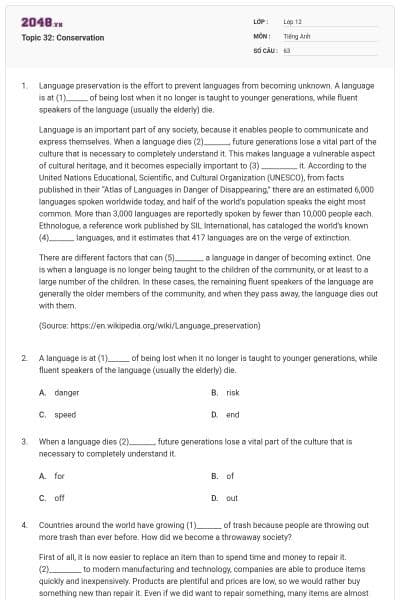
Language preservation is the effort to prevent languages from becoming unknown. A language is at (1)______ of being lost when it no longer is taught to younger generations, while fluent speakers of the language (usually the elderly) die.
Language is an important part of any society, because it enables people to communicate and express themselves. When a language dies (2)_______, future generations lose a vital part of the culture that is necessary to completely understand it. This makes language a vulnerable aspect of cultural heritage, and it becomes especially important to (3) __________ it. According to the United Nations Educational, Scientific, and Cultural Organization (UNESCO), from facts published in their “Atlas of Languages in Danger of Disappearing,” there are an estimated 6,000 languages spoken worldwide today, and half of the world’s population speaks the eight most common. More than 3,000 languages are reportedly spoken by fewer than 10,000 people each. Ethnologue, a reference work published by SIL International, has cataloged the world’s known (4)_______ languages, and it estimates that 417 languages are on the verge of extinction.
There are different factors that can (5)________ a language in danger of becoming extinct. One is when a language is no longer being taught to the children of the community, or at least to a large number of the children. In these cases, the remaining fluent speakers of the language are generally the older members of the community, and when they pass away, the language dies out with them.
(Source: https://en.wikipedia.org/wiki/Language_preservation)
A language is at (1)______ of being lost when it no longer is taught to younger generations, while fluent speakers of the language (usually the elderly) die.
danger
risk
speed
end
Bảo tồn ngôn ngữ là nỗ lực để ngăn chặn ngôn ngữ không bị mất đi. Một ngôn ngữ có nguy cơ bị mất khi nó không còn được dạy cho các thế hệ trẻ, trong khi người nói thông thạo ngôn ngữ (thường là người già) đều đã chết.
Ngôn ngữ là một phần quan trọng của bất kỳ xã hội nào, bởi vì nó cho phép mọi người giao tiếp và thể hiện bản thân. Khi một ngôn ngữ mất đi, các thế hệ tương lai sẽ mất đi một phần quan trọng của nền văn hóa, cái mà hoàn toàn cần thiết để hiểu được nó. Điều này làm cho ngôn ngữ trở thành một khía cạnh dễ bị tổn hại của di sản văn hóa, và nó trở nên đặc biệt quan trọng để bảo tồn. Theo Tổ chức Giáo dục, Khoa học và Văn hóa Liên Hợp Quốc (UNESCO), từ các số liệu được công bố trong “Bản đồ Ngôn ngữ có Nguy cơ biến mất”, hiện có khoảng 6.000 ngôn ngữ được sử dụng rộng rãi trên toàn thế giới, và một nửa dân số thế giới nói 8 thứ tiếng phổ biến nhất. Theo báo cáo, hơn 3.000 ngôn ngữ được nói bởi ít hơn 10.000 người. Ethnologue, một cuốn sách tham khảo được xuất bản bởi SIL International, đã liệt kê các ngôn ngữ sống được biết đến của thế giới, và ước tính có 417 ngôn ngữ đang trên bờ vực tuyệt chủng.
Có những yếu tố khác nhau có thể khiến một ngôn ngữ có nguy cơ biến mất. Một là khi một ngôn ngữ không còn được dạy cho trẻ em của cộng đồng, hoặc ít nhất là cho một số lượng lớn trẻ em. Trong những trường hợp này, những người nói thông thạo ngôn ngữ còn lại nói chung là những thành viên lớn tuổi của cộng đồng, và khi họ qua đời, ngôn ngữ sẽ chết cùng với họ.
Đáp án B
Kiến thức về cụm từ cố định
To be in danger of = to be at risk of: có nguy cơ, bị đe dọa
for
of
off
out
Đáp án D
Kiến thức về giới từ
A. die for st: hi sinh cho cái gì
B. die of illness/disease: chết vì ốm/bệnh tật
C. die off: chết lần lượt, chết dần chết mòn
D. die out: biến mất, mất hẳn, tuyệt chủng
Căn cứ vào nghĩa của các câu sau:
“Language is an important part of any society, because it enables people to communicate and express themselves. When a language dies (2)_________, future generations lose a vital part of the culture that is necessary to completely understand it.”
(Ngôn ngữ là một phần quan trọng của bất cứ xã hội nào bởi vì nó giúp con người có thể giao tiếp và diễn đạt bản thân. Nếu một ngôn ngữ biến mất thì các thế hệ tương lai sẽ mất đi một phần rất quan trọng của văn hóa thứ vô cùng cần thiết để hiểu hết về nó.)
preserve
conserve
maintain
reserve
Đáp án A
Kiến thức về từ vựng
A. preserve /prɪˈzɜːv/(v): giữ gìn, bảo quản (cái gì) theo đúng nguyên trạng vốn có của nó hoặc giữ trong điều kiện tốt.
B. conserve /kənˈsɜːv/(v): về cơ bản “conserve” và “preserve” tương đối giống nhau, cái khác nhau bản chất là ở chỗ: “conserve” không có nghĩa là bảo vệ cái gì đó khỏi nguy cơ biến mất mà giữ gìn, bảo vệ cái gì đó có giá trị sử dụng lâu dài, cần duy trì để sử dụng trong tương lai. Khi dùng “conserve”, người nói đề cập đến vấn đề giữ gìn, bảo vệ nhưng mang hàm ý giá trị sử dụng trong đó.
C. maintain /meɪnˈteɪn/(v): giữ cái gì đó không bị giảm sút, khỏi gián đoạn, khỏi thay đổi; duy trì theo trạng thái hiện tại, theo trạng thái mong muốn.
D. reserve /rɪˈzɜːv/(v): giữ một cái gì đó để sau này sử dụng đến, và ở hiện tại nó không được sử dụng bởi bất kỳ ai, và bất cứ lý do gì.
Căn cứ vào thông tin trong câu sau: “This makes language a vulnerable aspect of cultural heritage, and it becomes especially important to (3)__________ it.”
Ethnologue, a reference work published by SIL International, has cataloged the world’s known (4)_______ languages, and it estimates that 417 languages are on the verge of extinction.
alive
living
live
life
Đáp án B
Kiến thức về từ loại
A. alive /əˈlaɪv/ (a): sống, còn sống, chưa chết; sống động
B. living /’liviŋ/ (a): sống, đang sống, đang tồn tại; vẫn đang được sử dụng, nói
C. live /liv/ (v): sống, ở, cư trú
D. life /laɪf/ (n): cuộc sống
Căn cứ vào danh từ “ languages”.
=> Trước danh từ cần tính từ nên ta loại phương án C và D.
=> Ta dùng cụm từ: Living languages: những ngôn ngữ đang được dùng cho đến ngày nay.
Tạm dịch: “ Ethnologue, a reference work published by SIL International, has cataloged the world’s known (4)_________ languages, and it estimates that 417 languages are on the verge of extinction.”
(Ethnologue, một cuốn sách tham khảo được xuất bản bởi SIL International, đã liệt kê những ngôn ngữ vẫn còn được dùng cho đến ngày nay trên thế giới và ước tính có 417 ngôn ngữ đang trên bờ vực tuyệt chủng.)
lead
take
put
bring
Đáp án C
Kiến thức về cụm từ cố định
Put st in danger of becoming extinction: làm cho cái gì đó có nguy cơ biến mất hoàn toàn.
Countries around the world have growing (1)_______ of trash because people are throwing out more trash than ever before. How did we become a throwaway society?
First of all, it is now easier to replace an item than to spend time and money to repair it. (2)_________ to modern manufacturing and technology, companies are able to produce items quickly and inexpensively. Products are plentiful and prices are low, so we would rather buy something new than repair it. Even if we did want to repair something, many items are almost impossible to repair. These products contain many tiny, complicated parts. Some even contain small computer chips. It’s easier to throw these items away and buy new ones than to fix them.
Another (3)__________ factor is our love of disposable products. As busy people, we are always looking for ways to save time and make our lives easier. Why should we use cloth kitchen towels? It’s easier to use paper towel once and toss it (4)_______. Companies manufacture thousands of different kinds of disposable items: paper plates, plastic cups, cameras, and razors for shaving, to name a few. The problem is that disposable products also contribute to our trash problem.
Our appetite for new products also contributes to the problem. We are addicted to (5)___________ things. As consumers, we want the latest clothes, the best TVs, and cellphones with west features. Companies tell us to buy, buy, and buy. Advertisements persuade us wer is better. The result is that we throw away useful possessions to make room for new ones.
(Source: http://www.planetthoughts.org)
mounts
tops
hills
mountains
Các quốc gia trên thế giới ngày càng phát triển những núi rác vì mọi người đang vứt rác nhiều hơn bao giờ hết. Chúng ta trở thành một xã hội với việc vứt bỏ rác như thế nào?
Trước hết, hiện nay thật sẽ dễ dàng thay thế một món đồ mới hơn là tốn thời gian và tiền bạc để sửa chữa nó. Nhờ công nghệ sản xuất hiện đại, các công ty có thể sản xuất các mặt hàng một cách nhanh chóng và ít tốn kém. Các sản phẩm phong phú và giá cả thấp, vì vậy chúng ta thà mua một cái gì đó mới hơn là sửa chữa lại cái cũ. Ngay cả khi chúng ta muốn sửa chữa một món đồ, thì nhiều vật dụng gần như không thể sửa chữa được. Những sản phẩm này chứa nhiều chi tiết nhỏ, phức tạp. Một số thậm chí còn chứa các chip máy tính nhỏ. Sẽ dễ dàng hơn khi vứt những thứ này đi và mua những thứ mới hơn là sửa chúng.
Một yếu tố góp phần khác là tình yêu của chúng ta với các sản phẩm dùng một lần. Là những người bận rộn, chúng ta luôn tìm cách để tiết kiệm thời gian và làm cho cuộc sống của chúng ta dễ dàng hơn. Tại sao chúng ta nên sử dụng khăn bếp vải? Sử dụng khăn giấy một lần và quăng nó đi thì dễ hơn. Các công ty sản xuất hàng ngàn loại mặt hàng dùng một lần khác nhau: đĩa giấy, cốc nhựa, máy ảnh và dao cạo để cạo râu. Vấn đề là các sản phẩm dùng một lần cũng góp phần tạo nên vấn đề rác thải của chúng ta.
Sự thèm muốn của chúng ta đối với các sản phẩm mới cũng góp phần vào vấn đề này. Chúng ta nghiện mua đồ. Là người tiêu dùng, chúng ta thường muốn những bộ quần áo mới nhất, TV tốt nhất, và điện thoại di động với các tính năng phương Tây. Các công ty yêu cầu chúng ta mua, mua và mua. Các chuyên mục quảng cáo thuyết phục chúng ta ăn vận đẹp hơn. Kết quả là chúng ta vứt đi những tài sản hữu ích để nhường chỗ cho những cái mới.
Đáp án D
Kiến thức về cụm từ cố định
A. mounts /maʊnt/ (n): núi, mép, viền, khung
B. tops /tɒp/ (n): chóp, đỉnh, ngọn, phần cao nhất
C. hills /hɪl/ (n): đồn, gò, đống, mô đất
D. mountains /ˈmaʊn.tɪnz/ (n): núi, đống
Ta có cụm từ cố định: Mountains of trash/gold/debts: Đống rác/vàng/nợ
Due
Thanks
According
Owing
Đáp án B
Kiến thức về liên từ
Ta có cụm giới từ:
Due to /dʒuː/: vì, do, bởi vì
Thanks to /θæŋk/: nhờ vào, nhờ có
According to /əˈkɔrdɪŋ/: theo, căn cứ vào…
Owing to /əʊnɪŋ/ (prep): vì, do, bởi vì
Căn cứ vào nghĩa của câu: “(2)_________to modern manufacturing and technology, companies are able to produce items quickly and inexpensively.”
(Nhờ công nghệ và sản xuất hiện đại, các công ty có thể sản xuất các mặt hàng một cách nhanh chóng và ít tốn kém.)
contributing
contributor
contribute
contribution
Đáp án A
Kiến thức về từ loại
A. contributing /kənˈtrɪbjətɪŋ/ (a): góp phần vào, đóng góp vào
B. contributor /kənˈtrɪbjətər/ (n): người đóng góp
C. contribute /kənˈtribjut/ (v): đóng góp, góp phần
D. contribution /ˌkɒntrɪˈbjuːʃən/ (n): sự đóng góp, vật đóng góp
Trong câu: “Another (3)__________ factor is our love of disposable products.”
(Một yếu tố góp phần khác là tình yêu của chúng ta về các sản phẩm dùng một lần.)
factor là danh từ, ta cần 1 tính từ đứng trước.in
at
out
away
Đáp án C
Kiến thức về giới từTa có cụm giới từ: “toss out” /tɒs aʊt/ = “throw away” /θrou əˈweɪ/: vứt bỏ, ném bỏ
buying
being bought
buy
bought
Đáp án A
Kiến thức về cấu trúc
Ta có cấu trúc: “To be addicted to + something/doing something”: Nghiện cái gì, nghiện làm gì
At its narrowest point, Vietnam is only 30 miles (48 kilometers) wide. Two of Vietnam’s largest rivers, the Mekong in the south and the Red in the north, end at the South China Sea in huge swampy plains called (1)________ . These regions are home to most of the country’s people and provide (2)________ ground to grow rice and many other crops.
Vietnam’s mountainous terrain, forests, wetlands, and long coastline contain many different habitats that support a great (3)________ of wildlife. Some 270 types of mammals, 180 reptiles, 80 amphibians, and 800 bird species reside in Vietnam.
Many rare and unusual animals live in Vietnam, (4)________ giant catfish, Indochinese tigers, Saola antelopes, and Sumatran rhinos. The government has set up 30 parks and reserves to protect its animals, but their survival is (5) ________doubt because much of their habitat has been cleared for lumber or to grow crops.
deltas
outlets
basins
river-mouths
Nơi hẹp nhất của Việt Nam chỉ rộng khoảng 30 dặm (48 km). Hai trong số những con sông lớn nhất của Việt Nam, đó là sông Mê Kông ở phía Nam và sông Hồng ở phía Bắc, kết thúc ở Biển Đông trong vùng đồng bằng đầm lầy rộng lớn gọi là đồng bằng châu thổ. Những vùng này là nơi ở của hầu hết mọi người dân trên đất nước và cung cấp đất đai màu mỡ để trồng lúa và nhiều loại cây trồng khác.
Địa hình đồi núi, rừng, vùng đất ngập nước và bờ biển dài của Việt Nam chứa nhiều môi trường sống khác nhau để hỗ trợ nhiều loại động vật hoang dã. Có 270 loài động vật có vú, 180 loài bò sát, 80 loài lưỡng cư và 800 loài chim đang cư trú ở Việt Nam.
Nhiều loài động vật quý hiếm sống ở Việt Nam, bao gồm cá trê khổng lồ, hổ Đông Dương, linh dương Saola và tê giác Sumatra. Chính phủ đã thiết lập 30 công viên và khu bảo tồn để bảo vệ động vật của mình, nhưng sự nghi ngờ về sự sống sót của chúng là do phần lớn môi trường sống của chúng đã bị mất hết do chặt cây để lấy gỗ hoặc để trồng trọt.
Đáp án A
Chủ đề về VIETNAM
Kiến thức về từ vựng
A. delta /’deltə/ (n): đồng bằng châu thổ
B. outlet /’aʊtlet/ (n): cửa sông
C. basin /’beisn/ (n): lưu vực, bể, bồn
D. river-mouth: cửa sông
Tạm dịch: “Two of Vietnam’s largest rivers, the Mekong in the south and the Red in the north, end at the South China Sea in huge swampy plains called (1)__________”
(Hai trong số những con sông lớn nhất của Việt Nam, sông Mê Kông ở phía nam và sông Hồng ở phía bắc, kết thúc ở Biển Đông trong vùng đồng bằng đầm lầy rộng lớn gọi là đồng bằng châu thổ.).
fertile
safe
harvesting
productive
Đáp án A
Kiến thức về từ vựng
A. fertile /’fɜ:tail/ (a): màu mỡ, phì nhiêu
B. safe /seif/ (a): an toàn
C. harvesting /ˈhɑːvɪstɪŋ/ (n): việc thu hoạch
D. productive /prə’dʌktiv/ (a): năng xuất
Tạm dịch: “These regions are home to most of the country’s people and provide (2) __________ ground to grow rice and many other crops.”
(Những vùng này là nơi ở của hầu hết mọi người dân trên đất nước và cung cấp đất đai màu mỡ để trồng lúa và nhiều loại cây trồng khác.)
many
different
number
variety
Đáp án D
Kiến thức về từ vựng
variety (of something): đề cập đến nhiều kiểu/thứ trong cùng một loại có đặc tính hoặc chất lượng riêng biệt => rất nhiều, đa dạng, phong phú… muôn vàn kiểu/thứ trong cùng một loại.
Tạm dịch: “Vietnam’s mountainous terrain, forests, wetlands, and long coastline contain many different habitats that support a great (3) __________ of wildlife.”
(Địa hình đồi núi của Việt Nam, rừng, vùng đất ngập nước và bờ biển dài chứa nhiều môi trường sống khác nhau hỗ trợ nhiều loại động vật hoang dã.)
consisting
including
covering
containing
Đáp án B
Kiến thức về cách sử dụng từ
Tạm dịch: “Many rare and unusual animals live in Vietnam, (4) __________ giant catfish, Indochinese tigers, Saola antelopes, and Sumatran rhinos.”
Nhiều loài động vật quý hiếm sống ở Việt Nam, bao gồm cá da trơn khổng lồ, hổ Đông Dương, linh dương Sao la và tê giác Sumatra.)
The government has set up 30 parks and reserves to protect its animals, but their survival is (5) ________doubt because much of their habitat has been cleared for lumber or to grow crops.
in
of
out of
beyond
Đáp án A
Kiến thức về cụm từ
- to be in doubt: nghi ngờ, hoài nghi
Tạm dịch: “The government has set up 30 parks and reserves to protect its animals, but their survival is (5)__________ doubt because much of their habitat has been cleared for lumber or to grow crops.”
Chính phủ đã thiết lập 30 công viên và khu bảo tồn để bảo vệ động vật của mình, nhưng sự nghi ngờ về sự sống sót của chúng là do phần lớn môi trường sống của chúng đã bị mất hết do chặt cây để lấy gỗ hoặc để trồng trọt.
There are a number of initiatives, some already introduced and some in the pipeline, that are specifically designed to ensure that the economic value of nature is recognised.
One example is reduced emissions from deforestation and forest degradation, under which forest owners are paid not to cut down trees. A number of governments across the world have committed hundreds of millions of dollars to these projects. Another is habitat banking, the market for which currently stands at around $3bn in the US, where companies that degrade natural areas are forced to restore nature elsewhere. Trade in forest conservation obligations in Brazil and ground-water salinity credits in Australia have also proved successful. Alongside these schemes and those like them, there are various compensation arrangements that make those causing environmental damage pay for it, just like carbon credits that currently exist. Exemptions from these various taxes, charges and fees, as well as subsidies, are also used to encourage environmentally responsible behaviour.
There is also growing pressure for companies to begin incorporating the costs of the damage that they do to the Earth’s natural resources into their profit and loss accounts. Only by incorporating these costs into their accounts, many argue, will companies be forced to reduce their impact on the natural world. "Directors’ bonuses don’t have to be included in company accounts from a pure profit and loss point of view, but they are. Environmental externalities should be the same," says Pavan Sukhdev, a career banker and team leader of the United Nations’ The Economics of Ecosystems and Biodiversity study.
“This is not a straightforward process and needs standard methodologies accepted by everyone, but it could be achieved within 10 years.” The next step would be to incorporate environmental assets into national accounts.
(Source: https://www.bbc.com/)
Which best serves as the title for the passage?
Environmental ethics clashing with business profits.
Economic strategies and policies for damage limitation.
Preserving the environment while strengthening the economy.
The economic benefits of preserving the natural world.
Đáp án B
Câu nào sau đây thích hợp nhất làm tiêu đề cho đoạn văn?
A. Xung đột giữa đạo đức môi trường với lợi nhuận kinh doanh
B. Các chiến lược và chính sách kinh tế để hạn chế thiệt hại
C. Giữ gìn môi trường đồng thời củng cố nền kinh tế
D. Lợi ích kinh tế của việc bảo tồn thế giới tự nhiên
Căn cứ vào thông tin đoạn đầu:
There are a number of initiatives, some already introduced and some in the pipeline, that are specifically designed to ensure that the economic value of nature is recognised.
(Có rất nhiều sáng kiến, một số đã được giới thiệu và một số thì đang được phát triển, điều đó được thiết kế đặc biệt để đảm bảo rằng giá trị kinh tế của tự nhiên được công nhận.)
Như vậy, đoạn văn đang nói về các biện pháp, sáng kiến để hạn chế thiệt hại cho tự nhiên.
The word “degrade” in paragraph 2 is closest in meaning to ______.
debase
disgrace
cheapen
humiliate
Đáp án A
Từ “degrade” trong đoạn 2 có nghĩa gần nhất với____.
A. làm xấu đi
B. ô nhục
C. giảm giá
D. nhục nhã
Từ đồng nghĩa degrade (làm suy thoái) = debase
Another is habitat banking, the market for which currently stands at around $3bn in the US, where companies that degrade natural areas are forced
to restore nature elsewhere.
(Một cách khác là ngân hàng môi trường sống, giá cả cho cách này hiện ở mức khoảng 3 tỷ đô la Mỹ, nơi các công ty làm suy thoái các khu vực tự nhiên ở nơi này và bị ép buộc để khôi phục thiên nhiên ở nơi khác.)
According to paragraph 2, what is NOT mentioned as a way to mitigate damage on the nature?
Exempting or reducing export and import tariff for environmental-friendly products.
Having landholders sign contracts promising not to cut trees in exchange for the cash.
Funding conservation actions compensating for other unavoidable environmental impacts.
Launching a service that allows users to track changes in forest cover across the world.
Đáp án D
Theo đoạn 2, những gì không được đề cập như một cách để giảm thiểu thiệt hại với thiên nhiên?
A. Miễn hoặc giảm thuế xuất khẩu và nhập khẩu đối với các sản phẩm thân thiện với môi trường
B. Chủ đất ký hợp đồng hứa sẽ không chặt cây để đổi lấy tiền mặt
C. Tài trợ cho các hành động bù đắp cho các tác động môi trường không thể tránh khỏi khác
D. Ra mắt dịch vụ cho phép người dùng theo dõi các thay đổi về độ che phủ rừng trên toàn thế giới
Căn cứ vào thông tin đoạn hai:
One example is reduced emissions from deforestation and forest degradation, under which forest owners are paid not to cut down trees. A number of governments across the world have committed hundreds of millions of dollars to these projects.
(Một ví dụ là giảm phát thải từ mất rừng và suy thoái rừng, theo đó rừng chủ sở hữu rừng sẽ được trả tiền để không chặt cây. Nhiều chính phủ trên khắp thế giới đã cam kết hàng trăm triệu đô la cho các dự án này.)
Exemptions from these various taxes, charges and fees, as well as subsidies, are also used to encourage environmentally responsible behaviour.
(Miễn các loại thuế, phí và lệ phí khác nhau cũng như trợ cấp, cũng được sử dụng để khuyến khích hành vi có trách nhiệm với môi trường.)
Alongside these schemes and those like them, there are various compensation arrangements that make those causing environmental damage pay for it, just like carbon credits that currently exist.
(Bên cạnh những kế hoạch và những cái tương tự như vậy, có nhiều thỏa thuận bồi thường khác nhau khiến cho những người gây ra thiệt hại môi trường trả tiền cho nó, giống như các khoản tín dụng carbon hiện đang tồn tại.)
The word “they” in paragraph 3 refers to _______.
costs
bonuses
accounts
companies
Đáp án A
Từ “they” trong đoạn 3 nói đến____.
A. chi phí
B. tiền thưởng
C. tài khoản
D. công ty
Từ “they” ở đây dùng để thay thế cho danh từ chi phí được nhắc tới trước đó.
Only by incorporating these costs into their accounts, many argue, will companies be forced to reduce their impact on the natural world. "Directors’ bonuses don’t have to be included in company accounts from a pure profit and loss point of view, but they are.
(Chỉ bằng cách kết hợp nhiều chi phí vào tài khoản của họ, nhiều ý kiến cho rằng, các công ty sẽ buộc phải giảm tác động của họ đối với thế giới tự nhiên. "Tiền thưởng của giám đốc không cần phải được đưa vào tài khoản công ty từ lợi nhuận thuần túy và mất quan điểm, nhưng chúng thì phải có.)
According to paragraph 3, why do companies have to include green fee in their financial records?
It helps internalise the use of environmental aspects into firms’ or households’ decisions.
Companies can collapse unless they are consistent with EU environmental legislation.
Green technologies and ecological modernisation are the future development trends.
Companies are preparing for more stringent regulation in protecting the natural assets.
Đáp án A
Theo đoạn 3, tại sao các công ty phải bao gồm chi phí liên quan đến môi trường trong hồ sơ tài chính của họ?
A. Nó giúp bao gồm việc sử dụng các khía cạnh môi trường vào các quyết định của các công ty hoặc hộ gia đình.
B. Các công ty có thể sụp đổ trừ khi chúng phù hợp với luật pháp môi trường của EU
C. Công nghệ xanh và hiện đại hóa sinh thái là xu hướng phát triển trong tương lai
D. Các công ty đang chuẩn bị cho quy định nghiêm ngặt hơn trong việc bảo vệ tài sản tự nhiên
=> Căn cứ vào thông tin đoạn 3 như sau:
" There is also growing pressure for companies to begin incorporating the costs of the damage that they do to the Earth’s natural resources into their profit and loss accounts. Only by incorporating these costs into their accounts, many argue, will companies be forced to reduce their impact on the natural world. "Directors’ bonuses don’t have to be included in company accounts from a pure profit and loss point of view, but they are. Environmental externalities should be the same," says Pavan Sukhdev, a career banker and team leader of the United Nations’ The Economics of Ecosystems and Biodiversity study."
(Áp lực ngày càng tăng đối với các công ty để bắt đầu kết hợp các chi phí thiệt hại mà họ đã gây ra cho tài nguyên thiên nhiên của Trái Đất vào tài khoản lợi nhuận và thua lỗ của mình. Nhiều ý kiến cho rằng, chỉ bằng cách kết hợp các chi phí này vào tài khoản của họ thì các công ty sẽ buộc phải giảm tác động của họ đối với thế giới tự nhiên. Ông Sukhdev, một nhân viên ngân hàng và trưởng nhóm của Nghiên cứu Kinh tế về Hệ sinh thái và Đa dạng sinh học Liên Hợp Quốc cho rằng: “Tiền thưởng của giám đốc lẽ ra không cần phải được đưa vào tài khoản công ty từ quan điểm lợi nhuận và thua lỗ thuần túy, nhưng chúng đang như vậy. Những yếu tố ảnh hưởng ngoại lai thuộc về môi trường nên được như nhau.”)
=> Như vậy, có thể thấy ở đây các công ty đã phải tính các chi phí liên quan đến môi trường, cụ thể là chi phí thiệt hại do chính họ gây ra cho môi trường vào hồ sơ tài chính (chính là tài khoản lợi nhuận và thua lỗ của họ) là vì điều này sẽ giúp họ buộc phải có ý thức hơn để giảm tác động lên môi trường tự nhiên. Điều này có nghĩa là nó giúp các công ty, cũng như hộ gia đình cân nhắc các quyết định liên quan đến môi trường trước khi hành động để tránh gây thiệt hại cho thế giới tự nhiên.
Nature photographer Joel Sartore is passionate about endangered species. He uses his camera to make people aware of environmental problems. They tell the stories of animals that may disappear unless we work fast to save them.
Sartore’s latest project is called Photo Ark. The goal of the project is to make a photographic record of the world’s biodiversity. As Sartore says, “For many of Earth’s creatures, time is running out.”
When asked how he became interested in saving endangered species, Joel said “When I was a child, I read about Martha, the very last passenger pigeon. Martha died in 1914. I was shocked. In the past, there were 5 billion passenger pigeons – probably more than any other bird. But here was the last one, and there was no way to save it. How did we let this happen? I couldn’t understand it. I still feel the same way. I want to prevent this from ever happening again.” Photography is the best way to show problems to the world. It gets people to care about the problem. It’s not enough to just show pretty animals in a beautiful landscape. Now, we must show the threats to these animals as well. The good news is that there are many ways to publish stories and photographs on environmental issues. Self-publishing on the Web is one way to do this. Even nonprofessional photographers can help to make us aware of these problems.
The best title of the passage can be “_________”.
Animals in the Frame
How to Capture Animals
Nature Photography
Saving Endangered Species
Đáp án D
Chủ đề về ANIMALS
Tiêu đề thích hợp nhất cho đoạn văn có thể là?
A. Động vật trong những khung ảnh
B. Làm thế nào để bắt động vật
C. Chụp ảnh thiên nhiên
D. Cứu các loài động vật có nguy cơ tuyệt chủng
Căn cứ vào thông tin trong bài:
The word “them” in paragraph 1 refers to _________.
stories
animals
problems
species
Đáp án B
Từ “them” trong đoạn 1 ám chỉ cái gì?
A. Những câu chuyện
B. Động vật
C. Những vấn đề
D. Nhiều loài
Căn cứ vào đoạn 1: “They tell the stories of animals that may disappear unless we work fast to save them.”
(Chúng nói lên câu chuyện của những động vật có thể biến mất trừ khi chúng ta hành động nhanh chóng để cứu chúng.)
The phrase “running out” in paragraph 2 almost means _________.
having none left soon
getting out of the area
running too fast
being excessive
Đáp án A
Cụm từ “running out” trong đoạn 2 gần như có nghĩa là:
Xét các đáp án:
A. chẳng mấy chốc nữa sẽ không còn thứ gì
B. Getting out of the area: tránh ra khỏi vùng
C. Running too fast: chạy quá nhanh
D. Being excessive: quá mức
Tạm dịch: “As Sartore says, “For many of Earth’s creatures, time is running out.”
(Như Sartore nói, “Đối với nhiều sinh vật trên Trái Đất, thời gian đang sắp hết rồi”.)
According to the passage, which of the following best describes Joel Sartore’s interest in saving endangered species?
general
scientific
artistic
burning
Đáp án D
Theo đoạn văn, điều nào sau đây miêu tả đúng nhất niềm yêu thích của Joel Sartore trong việc cứu các loài động vật có nguy cơ tuyệt chủng?
Xét các đáp án:
A. Chung chung, bình thường
B. Có tính khoa học
C. Có nghệ thuật, khéo léo
D. Thiết tha, mãnh liệt
Căn cứ vào thông tin ở đoạn 3:
Tạm dịch: “When asked how he became interested in saving endangered species, Joel said “When I was a child, I read about Martha, the very last passenger pigeon. Martha died in 1914. I was shocked. In the past, there were 5 billion passenger pigeons – probably more than any other bird. But here was the last one, and there was no way to save it. How did we let this happen? I couldn’t understand it. I still feel the same way. I want to prevent this from ever happening again.”
(Khi được hỏi sao anh ta trở nên quan tâm đến việc cứu các loài có nguy cơ tuyệt chủng, Joel nói rằng “Khi tôi còn là một đứa trẻ, tôi đã đọc về Martha, con bồ câu viễn khách cuối cùng. Martha chết năm 1914. Tôi đã bị sốc. Ngày xưa, có 5 tỷ con bồ câu viễn khách - có lẽ nhiều hơn bất kỳ loài chim nào khác. Nhưng đây là con chim cuối cùng, và không có cách nào để cứu nó. Làm thế nào mà chúng ta đã để điều này xảy ra? Tôi không thể hiểu được. Tôi vẫn cảm thấy như vậy. Tôi muốn ngăn điều này xảy ra lần nữa.)
The last paragraph discusses _________.
which endangered species should be pictured.
how photography helps to save endangered species.
how to take photographs of animals on environmental issues.
what nonprofessional photographers can help save the Earth.
Đáp án B
Đoạn văn cuối thảo luận về điều gì?
Xét các đáp án:
A. Những loài có nguy cơ tuyệt chủng nên được chụp lại
B. Làm thế nào nhiếp ảnh giúp cứu các loài có nguy cơ tuyệt chủng
C. Làm thế nào để chụp ảnh động vật về các vấn đề môi trường
D. Những nhiếp ảnh gia không chuyên nghiệp có thể giúp gì để cứu Trái Đất
Căn cứ vào thông tin ở đoạn cuối:
Photography is the best way to show problems to the world. It gets people to care about the problem. It’s not enough to just show pretty animals in a beautiful landscape. Now, we must show the threats to these animals as well. The good news is that there are many ways to publish stories and photographs on environmental issues. Self-publishing on the Web is one way to do this. Even non-professional photographers can help to make us aware of these problems.
(Việc chụp ảnh là cách tốt nhất để thể hiện vấn đề với thế giới. Nó khiến mọi người quan tâm đến vấn đề. Việc chỉ đưa ra hình ảnh của những động vật xinh đẹp trong quang cảnh lộng lẫy vẫn là chưa đủ. Bây giờ, chúng ta cũng phải cho thấy các mối đe dọa đối với những động vật này. Tin tốt là có nhiều cách để xuất bản các câu chuyện và hình ảnh về các vấn đề môi trường. Tự xuất bản trên Web là một cách để làm điều này. Ngay cả các nhiếp ảnh gia không chuyên nghiệp cũng có thể giúp chúng ta nhận thức được những vấn đề này.)
Naturalists in the developed countries were largely split between conservationists and preservationists. This battle is no better demonstrated in the US than during the Progressive Era of 1890-1920.
While the existing economic paradigm was one of laissez-faire economics that many felt was damaging the natural environment and integrity of natural resources, the conservationist movement led by Theodore Roosevelt was deeply concerned about the wastage and harm it was doing to the land, leading to a large number of game species in the US on the brink of extinction in less than a century. Then there were the preservationists who argued that the proposals of the emerging conservationists did not go far enough. This was certainly the view of John Muir who believed that there was still too much concern for the economic value of land rather than the need for preservation of pristine landscapes. Muir’s Sierra Club made a stand with the development of the Hetch Hetchy Dam in Yosemite, arguing that the land should be kept pristine and the valley protected.
As president, Roosevelt pushed strongly for conservation issues which may be the reason they eventually won the day. During his term in office, around 230m acres of land were put under Federal protection, established the US Forestry Service, and created five national parks, and several national forests. That’s not to say that preservationists did not have their victories. In the 1960s, the Wilderness Actset aside large tracts of land with minimal human impact and of particular cultural, scientific, or natural interest. In these areas, logging, mining and other industrial activities are prohibited and there are strong protections in place to maintain the integrity of natural water sources partly for the ecosystem and partly for industrial and commercial developments downstream of the water flow.
(Source: https://www.environmentalscience.org/)
Which best serves as the title for the passage?
The war between preservation and conservation.
The birth of natural conservation in the modern age.
The most topical conservation areas of concern.
The history, present and future of conservation.
Đáp án A
Câu nào thích hợp nhất làm tiêu đề cho đoạn văn?
A. Cuộc chiến giữa sự bảo tồn và sự bảo quản
B. Sự ra đời của bảo tồn tự nhiên trong thời đại hiện đại
C. Các khu vực bảo tồn nhiệt đới quan tâm nhất
D. Lịch sử, hiện tại và tương lai của bảo tồn
1. Preserve: Giữ gìn, bảo quản (cái gì, ai) theo đúng nguyên trạng vốn có của nó hoặc giữ trong điều kiện tốt.
2. Conserve: không có nghĩa là bảo vệ cái gì đó khỏi nguy cơ biến mất mà giữ gìn, bảo vệ cái gì đó có giá trị sử dụng lâu dài, cần duy trì để sử dụng trong tương lai.
Căn cứ vào thông tin đoạn đầu:
Naturalists in the developed countries were largely split between conservationists and preservationists. This battle is no better demonstrated in the US than during the Progressive Era of 1890-1920.
(Các nhà tự nhiên học ở các nước phát triển phần lớn bị chia rẽ giữa các nhà bảo tồn và nhà bảo quản. Trận chiến này không được thể hiện tốt hơn ở Mỹ so với Thời đại tiến bộ năm 1890-1920.)
Như vậy, đoạn văn đang nói về cuộc chiến giữa sự bảo tồn và sự bảo quản.
The word “split” in paragraph 1 can be replaced by ______.
severed
shared
allotted
divided
Đáp án D
Từ “split” trong đoạn 1 có thể được thay thế bằng ______.
A. cắt đứt
B. chia sẻ
C. phân bổ
D. chia
Từ đồng nghĩa split (chia rẽ) = divide
Naturalists in the developed countries were largely split between conservationists and preservationists.
(Các nhà tự nhiên học ở các nước phát triển phần lớn bị chia rẽ giữa các nhà bảo tồn và nhà bảo quản.)
According to paragraph 2, what was the difference between conservationists and preservationists?
The former focused on the optimisation of resources while the latter promoted capitalism-based restoration.
The former held that there is nothing but natural elements while the latter concerned with a cognitive approach to reality.
The former supported good management practice of resources while the latter felt land should remain untouched.
Their views were intrinsically similar and only utilised different interpretations of the same terms.
Đáp án C
Theo đoạn 2, sự khác biệt giữa những người theo chủ nghĩa bảo vệ và những người theo chủ nghĩa bảo tồn là gì?
A. Người trước tập trung vào việc tối ưu hóa các nguồn tài nguyên trong khi người sau thúc đẩy sự phục hồi dựa trên chủ nghĩa tư bản.
B. Người trước cho rằng mọi yếu tố đều thuộc về tự nhiên trong khi người sau liên quan đến cách tiếp cận của nhận thức đối với thực tế.
C. Người trước ủng hộ việc quản lý tốt các nguồn tài nguyên trong khi người sau cảm thấy chúng nên được để nguyên trạng.
D. Quan điểm của họ về bản chất là giống nhau và chỉ có các cách diễn đạt khác nhau về cùng một thuật ngữ.
Căn cứ thông tin đoạn 2:
Then there were the preservationists who argued that the proposals of the emerging conservationists did not go far enough. This was certainly the view of John Muir who believed that there was still too much concern for the economic value of land rather than the need for preservation of pristine landscapes. Muir’s Sierra Club made a stand with the development of the Hetch Hetchy Dam in Yosemite, arguing that the land should be kept pristine and the valley protected.
(Sau đó, có những người bảo tồn lập luận rằng các đề xuất của các nhà bảo vệ mới nổi không đi đủ xa. Đây là quan điểm của John Muir, người tin rằng vẫn còn quá nhiều lo ngại về giá trị kinh tế của đất đai hơn là nhu cầu bảo tồn cảnh quan nguyên sơ. Câu lạc bộ Sierra của Muir có chung lập trường với sự phát triển của đập Hetch Hetchy ở Yosemite, lập luận rằng vùng đất này cần được giữ nguyên sơ và thung lũng được bảo tồn.)
The word “it” in paragraph 2 refers to _______.
natural environment
existing economic paradigm
integrity of natural resources
conservationist movement
Đáp án B
Từ “it” mệnh đề trong đoạn 2 đề cập đến______.
A. môi trường tự nhiên
B. mô hình kinh tế hiện có
C. toàn vẹn tài nguyên thiên nhiên
D. phong trào bảo tồn
Từ “it” dùng để thay thế cho danh từ mô hình kinh tế hiện có được nhắc tới trước đó.
While the existing economic paradigm was one of laissez-faire economics that many felt was damaging the natural environment and integrity of natural resources, the conservationist movement led by Theodore Roosevelt was deeply concerned about the wastage and harm it was doing to the land, leading to a large number of game species in the US on the brink of extinction in less than a century.
(Trong khi mô hình kinh tế hiện tại là một trong những nền kinh tế tự do mà nhiều người cảm thấy là hủy hoại môi trường tự nhiên và tính toàn vẹn của tài nguyên thiên nhiên, phong trào bảo quản do Theodore Roosevelt lãnh đạo đã quan tâm sâu sắc về sự lãng phí và tác hại của nó với đất, dẫn đến một số lượng lớn các loài ở Mỹ đang đứng trên bờ vực tuyệt chủng trong chưa đầy một thế kỷ.)
According to paragraph 3, which side had the last laugh in the clash of ideologies?
Both have yet to lose
Conservationism
Preservationism
Naturalism
Đáp án B
Theo đoạn 3, cuối cùng bên nào đã thắng trong cuộc đụng độ của ý thức hệ?
A. Cả hai bên vẫn chưa thua
B. Bảo quản
C. Bảo tồn
D. Chủ nghĩa tự nhiên
Căn cứ vào thông tin đoạn ba:
As president, Roosevelt pushed strongly for conservation issues which may be the reason they eventually won the day.
(Là chủ tịch, Roosevelt thúc đẩy mạnh mẽ các vấn đề bảo quản, điều này có thể là lý do giúp chúng chiến thắng cuối cùng.)
The gathering of thousands of individuals representing the myriad religions of the world for the Parliament of World Religions in Melbourne this year is a testament to the power that religion has to bring people together, to unite them in a search for truth, and to inspire them to work towards the betterment of this world. And this year the Parliament is focusing on issues of the environment through some of its subthemes.
In our day we are struggling with a number of issues related to the environment such as climate change, the pollution of the air, oceans, seas, and waterways, and the challenges of feeding a growing global population. While many of these issues are relatively new so that our forebears did not address them explicitly, our religious traditions do offer us worldviews and principles that aid us in finding solutions to our contemporary problems.
One of the basic guiding principles that forms an Islamic vision of humanity’s relationship with the environment is our role as God’s deputies on earth. Islam considers human beings to be vice gerents or deputies of God on earth. Our mission as God’s deputies means that we are charged with the responsibility to care for and maintain the world. On the other hand, the fact that God has placed the world at our disposal means that we may benefit from what it has to offer us. In both cases, we must collaborate with our brothers and sisters in humanity.
One of the key characteristics of humankind’s role as deputies in the world is balance. We must find a balance between benefiting from the blessings that the world has to offer us, and preserving the order that God has established. We must find a balance between securing our own needs while not depriving others of theirs, whether those others reside in different parts of the world, such as less powerful nations, or in different times, such as our children and grandchildren.
If we take seriously our role as God’s deputies on earth, not just by benefiting from the environment, but by preserving it and ensuring that other communities and generations will have the same possibilities to drink clean water, breath fresh air, and live in a world that is in harmony with itself and with ourselves, we may hope to be among those who are beloved to God due to their care for His creation.
(Source: https://www.abc.net.au/)
Which best serves as the title for the passage?
The role of religion in preserving the environment.
Preserving nature isn’t about aesthetics but about necessity.
What are our moral obligations to the wildlife animals?
Only a new worldview can help us face our ecological crises.
Đáp án A
Tiêu đề phù hợp nhất cho đoạn văn là gì?
A. Vai trò của tôn giáo trong việc bảo vệ môi trường.
B. Bảo vệ thiên nhiên không phải về thẩm mỹ mà vì sự cần thiết.
C. Nghĩa vụ đạo đức của chúng ta đối với động vật hoang dã là gì?
D. Chỉ một thế giới quan mới có thể giúp chúng ta đối mặt với sự khủng hoảng sinh thái.
Căn cứ thông tin đoạn 1:
The gathering of thousands of individuals representing the myriad religions of the world for the Parliament of World Religions in Melbourne this year is a testament to the power that religion has to bring people together, to unite them in a search for truth, and to inspire them to work towards the betterment of this world. And this year the Parliament is focusing on issues of the environment through some of its subthemes.
(Sự tập hợp của hàng ngàn cá nhân đại diện cho vô số tôn giáo trên thế giới tại Nghị viện Tôn giáo Thế giới tại Melbourne năm nay là một minh chứng cho sức mạnh mà tôn giáo phải kết nối mọi người lại với nhau, để hợp nhất họ tìm kiếm sự thật và truyền cảm hứng cho họ để làm việc hướng tới sự tốt đẹp hơn của thế giới này. Và năm nay, Quốc hội đang tập trung vào các vấn đề của môi trường thông qua một số chủ đề của nó.)
The word “testament” in paragraph 1 is closest in meaning to _______.
tribute
testimony
evidence
statement
Đáp án C
Từ “testament” trong đoạn 1 gần nghĩa nhất với từ:
A. vật cống nạp
B. sự chứng nhận
C. bằng chứng
D. sự trình bày
Từ đồng nghĩa : testament (chứng cứ, minh chứng) = evidence
The gathering of thousands of individuals representing the myriad religions of the world for the Parliament of World Religions in Melbourne this year is a testament to the power that religion has to bring people together, to unite them in a search for truth, and to inspire them to work towards the betterment of this world.
(Sự tập hợp của hàng ngàn cá nhân đại diện cho vô số tôn giáo trên thế giới tại Nghị viện Tôn giáo Thế giới tại Melbourne năm nay là một minh chứng cho sức mạnh mà tôn giáo phải kết nối mọi người lại với nhau, để hợp nhất họ tìm kiếm sự thật và truyền cảm hứng cho họ để làm việc hướng tới sự tốt đẹp hơn của thế giới này.)
The word “forebears” in paragraph 2 is closest in meaning to _______.
ancestors
researchers
preachers
priests
Đáp án A
Từ “forebears” trong đoạn 1 gần nghĩa nhất với từ:
A. tổ tiên
B. người tìm kiếm
C. người thuyết giáo
D. linh mục
Từ đồng nghĩa: forebears (tổ tiên, bậc tiền bối) = ancestors
While many of these issues are relatively new so that our forebears did not address them explicitly, our religious traditions do offer us worldviews and principles that aid us in finding solutions to our contemporary problems.
(Trong khi nhiều trong số những vấn đề này tương đối mới vì vậy các bậc tiền bối của chúng ta không giải quyết chúng một cách rõ ràng, nhưng truyền thống tôn giáo của chúng ta cung cấp cho chúng ta thế giới quan và các nguyên tắc hỗ trợ chúng ta tìm giải pháp cho các vấn đề đương đại.)
According to paragraph 3, what is NOT humanity’s mission entrusted by God according to the Islam?
Tending and supporting every single elements of the everlasting world.
Managing, directing, or ruling the earth as the God’s mortal representatives.
Co-existing with other beings on the Earth on the basis of give and take.
Sacrificing oneself for another disregarding the sins and merits
Đáp án D
Ở đoạn 3, theo như người Hồi giáo cái gì không phải là nhiệm vụ của loài người được Chúa giao phó?
A. Chăm sóc và hỗ trợ mọi yếu tố riêng lẻ của thế giới bất diệt.
B. Quản lý, hướng dẫn hoặc lãnh đạo trái đất như những đại diện lớn của Chúa.
C. Cùng tồn tại với những người khác trên trái đất dựa trên nền tảng của cho và nhận.
D. Hy sinh bản thân cho người khác không được coi là tội ác và đáng trọng.
One of the basic guiding principles that forms an Islamic vision of humanity’s relationship with the environment, which is our role as God’s deputies on earth. Islam considers human beings to be vice gerents or deputies of God on Earth. Our mission as God’s deputies means that we are charged with the responsibility to care for and maintain the world. On the other hand, the fact that God has placed the world at our disposal means that we may benefit from what it has to offer us. In both cases, we must collaborate with our brothers and sisters in humanity.
(Một trong những nguyên tắc hướng dẫn cơ bản hình thành tầm nhìn Hồi giáo về mối quan hệ của loài người với môi trường, đó là vai trò của chúng ta với tư cách là đại biểu của Chúa trên trái đất. Hồi giáo coi con người là phó tướng hoặc đại biểu của Thiên Chúa trên Trái Đất. Nhiệm vụ của chúng ta với tư cách là đại biểu của Chúa có nghĩa là chúng tôi có trách nhiệm chăm sóc và duy trì thế giới. Mặt khác, việc Chúa đặt thế giới theo ý của chúng ta có nghĩa là chúng ta có thể được hưởng lợi từ những gì nó đã cung cấp cho chúng ta. Trong cả hai trường hợp, chúng ta phải hợp tác với anh chị em của chúng ta trong nhân loại.)
According to paragraph 4, what can we deduce from the balance feature of our holy responsibility?
Holy apostles and satanic followers are splitting into two streams of environmentalism.
Humanity are not meant to appropriate the world for their own purposes to the exclusion of others.
Humankind will be held accountable if they intentionally cause corruption or harm.
A shift away from traditional faiths could be considered evil or bad for nature.
Đáp án B
Theo đoạn 4, chúng ta có thể giảm được gì từ đặc điểm cân bằng trong trách nhiệm linh thiêng của chúng ta?
A. Người lãnh đạo linh thiêng và những người theo sau xấu xa đang tách ra thành hai nguồn của thuyết môi trường.
B. Lòng nhân đạo không có nghĩa là hòa hợp với thế giới vì mục đích riêng để loại trừ người khác.
C. Loài người sẽ phải chịu trách nhiệm nếu họ cố ý gây ra sự hư hỏng hoặc gây hại.
D. Một sự thay đổi từ niềm tin truyền thống có thể được xem như tội lỗi hoặc điều tồi tệ với tự nhiên.
Căn cứ thông tin đoạn 4:
One of the key characteristics of humankind’s role as deputies in the world is balance. We must find a balance between benefiting from the blessings that the world has to offer us, and preserving the order that God has established. We must find a balance between securing our own needs while not depriving others of theirs, whether those others reside in different parts of the world, such as less powerful nations, or in different times, such as our children and grandchildren.
(Một trong những đặc điểm chính của vai trò là đại biểu của nhân loại trên thế giới là sự cân bằng. Chúng ta phải tìm sự cân bằng giữa việc hưởng lợi từ các phước lành mà thế giới phải ban cho chúng ta và giữ gìn trật tự mà Thiên Chúa đã thiết lập. Chúng ta phải tìm sự cân bằng giữa việc đảm bảo các nhu cầu của chính mình trong khi không tước đoạt quyền lợi của những người khác, cho dù những người khác cư trú ở các khu vực khác nhau trên thế giới, chẳng hạn như các quốc gia ít mạnh hơn, hoặc trong các thời điểm khác nhau, như con cháu chúng ta.)
Which of the following statements is TRUE, according to the passage?
Human must first destroy the environment in order to reconstruct it in a better state.
Parliament of World Religions convening this year pivots on the education for peace and justice.
Bubonic disease is one of the environmental concerns for the contemporary society.
God bestowed rights upon all beings and we don’t have the authority to deprive even animals of them.
Đáp án D
Theo đoạn văn, câu nào sau đây đúng:
A. Loài người phải phá hủy môi trường trước tiên để xây dựng lại nó với một tình trạng tốt hơn.
B. Nghị viện Tôn giáo Thế giới triệu tập năm nay chủ yếu về giáo dục về hòa bình và sự công bằng.
C. Bệnh dịch hạch là một trong những sự liên quan đến môi trường trong xã hội hiện thời.
D. Chúa ban cho tất cả các loài quyền và chúng ta không có quyền tước đoạt của loài nào kể cả động vật.
Căn cứ thông tin đoạn 4:
One of the key characteristics of humankind s role as deputies in the world is balance. We must find a balance between benefiting from the blessings that the world has to offer us, and preserving the order that God has established. We must find a balance between securing our own needs while not depriving others of theirs, whether those others reside in different parts of the world, such as less powerful nations, or in different times, such as our children and grandchildren.
(Một trong những đặc điểm chính của vai trò là đại biểu của nhân loại trên thế giới là sự cân bằng. Chúng ta phải tìm sự cân bằng giữa việc hưởng lợi từ các phước lành mà thế giới phải ban cho chúng ta và giữ gìn trật tự mà Thiên Chúa đã thiết lập. Chúng ta phải tìm sự cân bằng giữa việc đảm bảo các nhu cầu của chính mình trong khi không tước đoạt quyền lợi của những người khác, cho dù những người khác cư trú ở các khu vực khác nhau trên thế giới, chẳng hạn như các quốc gia ít mạnh hơn, hoặc trong các thời điểm khác nhau, như con cháu chúng ta.)
The word “it” in paragraph 5 refers to _____.
humankind
environment
harmony
population
Đáp án B
Từ “It” trong đoạn 5 đề cập đến __________ .
A. loài người
B. môi trường
C. sự hài hòa
D. dân số
If we take seriously our role as God s deputies on earth, not just by benefiting from the environment, but by preserving it and ensuring that other communities and generations will have the same possibilities to drink clean water, breath fresh air, and live in a world that is in harmony with itself and with ourselves, we may hope to be among those who are beloved to God due to their care for His creation.
(Nếu chúng ta thực hiện ngiêm túc vai trò là đại biểu của Chúa trên trái đất, không chỉ bằng cách hưởng lợi từ môi trường, mà bằng cách bảo tồn nó và đảm bảo rằng các cộng đồng và thế hệ khác sẽ có cùng khả năng uống nước sạch, hít thở không kí trong lành và sống trong thế giới hòa hợp với chính nó và với chính chúng ta, chúng ta có thể hy vọng trở thành một trong những người được Chúa yêu mến nhờ sự chăm sóc của họ cho sự sáng tạo của Ngài.)
Which of the following can be inferred from the passage?
We must pay attention to the consequences of unnatural interventions for ecosystems.
Religion in its currently prevailing forms might already be too devalued.
Through religion, we may be united in combating the environmental crises .
Religion is deceptive and we should not look to it for inspiration, support, and resolve.
Đáp án C
Câu nào sau đây được suy ra từ đoạn văn :
A. Chúng ta phải chú ý tới hậu quả của sự can thiệp không tự nhiên đối với hệ sinh thái.
B. Tôn giáo với dạng thịnh hành hiện thời có thể đã quá mất giá.
C. Thông qua tôn giáo, chúng ta có thể liên kết chiến đấu với khủng hoảng môi trường.
D. Tôn giáo là lừa đảo và chúng ta không nên mong đợi nó truyền cảm hứng, hỗ trợ và giải quyết.
Dựa trên thông tin đoạn 2:
In our day we are struggling with a number of issues related to the environment such as climate change, the pollution of the air, oceans, seas, and waterways, and the challenges of feeding a growing global population. While many of these issues are relatively new so that our forebears did not address them explicitly, our religious traditions do offer us worldviews and principles that aid us in finding solutions to our contemporary problems.
(Trong thời đại của chúng ta, chúng ta đang phải vật lộn với một số vấn đề liên quan đến môi trường như biến đổi khí hậu, ô nhiễm không khí, đại dương, biển và đường thủy, và những thách thức trong việc nuôi dưỡng dân số toàn cầu ngày càng tăng. Mặc dù nhiều trong số những vấn đề này tương đối mới để các bậc tiền bối của chúng ta không giải quyết chúng một cách rõ ràng, nhưng truyền thống tôn giáo của chúng ta cung cấp cho chúng ta thế giới quan và các nguyên tắc hỗ trợ chúng ta tìm giải pháp cho các vấn đề đương đại.)
National parks protect the best of our natural heritage: stunning landscapes, extraordinary wildlife and majestic forests. Together with other protected areas they form the basis of our economic and social wellbeing, attract millions of visitors annually, and help to protect Australia’s unique wildlife by acting as a refuge for threatened species. Future generations deserve the right to see these natural values intact and protected as we do today.
Our national parks form the cornerstone of biodiversity conservation in Australia, containing vital habitat that provides safe havens in which animals and plants can survive and thrive. Together with other protected areas, they provide a ‘backbone’ of core conservation areas that can be linked by conservation efforts across different tenures, supporting a diverse, healthy and resilient environment. A well-connected landscape is essential for saving NSW’s 1,000 threatened species, 70% of which occur in our national parks. In addition our protected areas provide life-sustaining services vital for the wellbeing of our environment and society, such as protection of urban water catchments and climate amelioration.
National Parks provide a major boost to Australia’s economy, with nature-based tourism bringing $23 billion into the country every year. Regional communities in particular benefit from the 35.5 million people who visit NSW’s national parks each year, through job creation and money spent on accommodation, fuel and food. The Great Barrier Reef alone attracts more than $6 billion a year in tourist-spending and supports over 63,000 jobs. Furthermore, from ancient aboriginal rock-art sites, to the buildings left over from early European settlements, our national parks also serve as a natural history book dating back thousands of years. Our national parks protect these vital and fragile places; areas where the traces of a history extending back more than 22,000 years can remain undisturbed.
Natural areas have a profound effect on our physical and emotional health and wellbeing. In our increasingly frenetic world, our national parks are important sanctuaries where people can take time out, enjoy nature, get fit, relax and revitalise, whilst nature’s inherent beauty serves as a source of artistic, creative and spiritual inspiration. Research on the benefits of contact with the natural environment show that it is likely to have a significant positive psychological effect, serving to reduce stress, anger, frustration and aggression, providing an opportunity for social bonding, and serving as a place for learning and mental stimulation. Children in particular display long-term benefits of playing outdoors.
(Source: https://npansw.org/)
Which best serves as the title for the passage?
Difference between national parks and sanctuaries.
Legislative history of national parks.
The hidden world of national parks.
Why are national parks so important?
Đáp án D
Câu nào sau đây thích hợp nhất làm tiêu đề cho đoạn văn?
A. Sự khác biệt giữa các vườn quốc gia và khu bảo tồn
B. Lịch sử lập pháp của các vườn quốc gia
C. Thế giới ẩn của các công viên quốc gia
D. Tại sao các vườn quốc gia rất quan trọng?
Căn cứ vào thông đoạn đầu:
National parks protect the best of our natural heritage: stunning landscapes, extraordinary wildlife and majestic forests. Together with other protected areas they form the basis of our economic and social wellbeing, attract millions of visitors annually, and help to protect Australia’s unique wildlife by acting as a refuge for threatened species.
(Các vườn quốc gia bảo vệ di sản thiên nhiên của chúng ta tốt nhất: phong cảnh tuyệt đẹp, động vật hoang dã đặc biệt và những khu rừng hùng vĩ. Cùng với các khu vực được bảo vệ khác, chúng tạo thành nền tảng cho nền kinh tế của chúng ta và phúc lợi xã hội, thu hút hàng triệu du khách hàng năm và giúp bảo vệ động vật hoang dã độc đáo của Úc bằng cách đóng vai trò là nơi ẩn náu cho các loài bị đe dọa.)
Như vậy, đoạn văn đang giải thích về tầm quan trọng của vườn quốc gia.
The word “refuge” in paragraph 1 is best replaced by _______.
shelter
den
lair
nest
Đáp án A
Từ “refuge” trong đoạn 1 được thay thế thích hợp nhất bằng ______.
A. nơi trú ẩn
B. hang thú dữ
C. hang ổ
D. tổ
Từ refuge (nơi ẩn náu) = shelter
Together with other protected areas they form the basis of our economic and social wellbeing, attract millions of visitors annually, and help to protect Australia’s unique wildlife by acting as a refuge for threatened species.
(Cùng với các khu vực được bảo vệ khác, chúng tạo thành nền tảng cho nền kinh tế của chúng ta và phúc lợi xã hội, thu hút hàng triệu du khách hàng năm và giúp bảo vệ động vật hoang dã độc đáo của Úc bằng cách đóng vai trò là nơi ẩn náu cho các loài bị đe dọa.)
The word “intact” in paragraph 1 is best replaced by _______.
solid
complete
faultless
undamaged
Từ “intact” trong đoạn 1 được thay thế thích hợp nhất bằng __________ .
A. chất rắn
B. hoàn thành
C. không có lỗi
D. không bị hư hại
Từ intact (nguyên vẹn) = undamaged
Future generations deserve the right to see these natural values intact and protected as we do today.
(Các thế hệ tương lai xứng đáng được nhìn thấy những giá trị tự nhiên còn nguyên vẹn và được bảo vệ như chúng ta thấy ngày hôm nay.)
According to paragraph 2, what is true about the role of national parks in the conservation of organism variety
They act as the pioneering area of the biodiverse regions.
They serve as the basis for the biodiversity conservation.
They play important part in marketing environmentalism.
They are the side project of biodiversity campaigns.
Đáp án B
Theo đoạn 2, điều nào sau đây là đúng về vai trò của các vườn quốc gia trong bảo tồn giống sinh vật?
A. Chúng đóng vai trò là khu vực tiên phong của các khu vực đa dạng sinh học
B. Chúng làm cơ sở cho việc bảo tồn đa dạng sinh học
C. Chúng đóng một phần quan trọng trong chủ nghĩa môi trường tiếp thị
D. Chúng là dự án phụ của các chiến dịch đa dạng sinh học
Căn cứ vào thông đoạn hai:
Our national parks form the cornerstone of biodiversity conservation in Australia, containing vital habitat that provides safe havens in which animals and plants can survive and thrive. Together with other protected areas, they provide a ‘backbone’ of core conservation areas that can be linked by conservation efforts across different tenures, supporting a diverse, healthy and resilient environment.
(Các công viên quốc gia của chúng ta tạo thành nền tảng của bảo tồn đa dạng sinh học ở Úc, chứa đựng môi trường sống quan trọng, nơi cung cấp nơi trú ẩn an toàn trong đó động vật và thực vật có thể tồn tại và phát triển. Cùng với các khu vực được bảo vệ khác, chúng là “xương sống” của các khu vực bảo tồn cốt lõi, nơi mà có thể được liên kết bởi nỗ lực bảo tồn trên các giai đoạn khác nhau, hỗ trợ một môi trường đa dạng, lành mạnh và kiên cường.)
According to paragraph 3, what are the mentioned aspects of benefits brought about by national reserves?
Economic and social values.
Health and wellbeing values.
Economic and cultural values.
Natural and social values.
Đáp án C
Theo đoạn 3, các khía cạnh được đề cập của lợi ích mang lại từ dự trữ quốc gia là gì?
A. Giá trị kinh tế và xã hội
B. Giá trị sức khỏe và phúc lợi
C. Giá trị kinh tế và văn hóa
D. Giá trị tự nhiên và xã hội
Căn cứ vào thông đoạn ba:
National Parks provide a major boost to Australia’s economy,
(Vườn quốc gia tạo ra một sự thúc đẩy lớn cho nền kinh tế Úc,)
Furthermore, from ancient aboriginal rock-art sites, to the buildings left over from early European settlements, our national parks also serve as a natural history book dating back thousands of years.
(Hơn nữa, từ các nơi nghệ thuật đá của thổ dân cổ đại, đến các tòa nhà còn sót lại từ các khu định cư đầu tiên của người châu Âu, các vườn quốc gia của chúng tôi cũng giống như một lẽ cuốn sách lịch sử tự nhiên có niên đại hàng ngàn năm.)
The word “it” in paragraph 4 refers to _____.
contact
wellbeing
inspiration
environment
Từ “it” mệnh đề trong đoạn 4 đề cập đến __________ .
A. sự tiếp xúc
B. phúc lợi
C. cảm hứng
D. môi trường
Từ “it” ở đây dùng để thay thế cho danh từ môi trường được nhắc tới trước đó.
Research on the benefits of contact with the natural environment show that it is likely to have a significant positive psychological effect, serving to reduce stress, anger, frustration and aggression, providing an opportunity for social bonding, and serving as a place for learning and mental stimulation.
(Nghiên cứu về lợi ích của việc tiếp xúc với môi trường tự nhiên cho thấy nó có khả năng có tác động tâm lý tích cực đáng kể, giúp giảm căng thẳng, giận dữ, thất vọng và sự hung hăng, tạo cơ hội cho sự gắn kết xã hội và phục vụ như một nơi học tập và kích thích tinh thần.)
The following statements are true, EXCEPT ________.
National parks are immensely huge storehouses of endangered natural biodiversity.
The Great Barrier Reef procures more than $6 million per annum from ecological tourism.
The inclusion of historic structures within the range of a park prevents them from destruction.
National parks are an outstanding example of the healing powers of nature.
Đáp án B
Các tuyên bố sau đây là đúng, ngoại trừ __________ .
A. Các công viên quốc gia là những kho chứa vô cùng lớn về đa dạng sinh học tự nhiên đang bị đe dọa
B. Rạn san hô Great Barrier thu lại hơn 6 triệu đô la mỗi năm từ du lịch sinh thái
C. Việc bao gồm các cấu trúc lịch sử trong phạm vi của một công viên ngăn cản chúng khỏi sự phá hủy
D. Vườn quốc gia là một ví dụ nổi bật về khả năng chữa bệnh của thiên nhiên
Căn cứ vào thông các đoạn:
Our national parks protect these vital and fragile places; areas where the traces of a history extending back more than 22,000 years can remain undisturbed.
(Công viên quốc gia của chúng tôi bảo vệ những nơi quan trọng và dễ bị hư hại; các khu vực, nơi dấu vết của một lịch sử kéo dài hơn 22.000 năm có thể không bị xáo trộn.)
National parks protect the best of our natural heritage: stunning landscapes, extraordinary wildlife and majestic forests.
(Các vườn quốc gia bảo vệ di sản thiên nhiên của chúng ta tốt nhất: phong cảnh tuyệt đẹp, động vật hoang dã đặc biệt và những khu rừng hùng vĩ.)
Natural areas have a profound effect on our physical and emotional health and wellbeing.
(Các khu vực tự nhiên có ảnh hưởng sâu sắc đến sức khỏe thể chất và tinh thần của chúng ta.)
Which of the following can be inferred from the passage?
Besides protecting biodiversity, national parks also deliver economic, social, cultural and health benefits.
The park system’s extensive outdoor laboratory has been a perfect breeding ground for scientific discoveries.
National parks are the responsibility of governments and not relevant to a normal citizen’s life.
A trip or two to a national park with family and friends is always an enhancing and enriching experience.
Đáp án A
Điều nào sau đây có thể được suy ra từ đoạn văn?
A. Bên cạnh việc bảo vệ đa dạng sinh học, các vườn quốc gia cũng mang đến những lợi ích về kinh tế, xã hội, văn hóa và y tế
B. Hệ thống công viên phòng thí nghiệm ngoài trời rộng rãi là một nơi sinh sản hoàn hảo cho những khám phá khoa học
C. Công viên quốc gia là trách nhiệm của chính phủ và không liên quan đến cuộc sống của một công dân bình thường
D. Một hoặc hai chuyến đi đến một công viên quốc gia với gia đình và bạn bè luôn là một sự tăng cường và làm giàu cho kinh nghiệm bản thân
Căn cứ vào thông các đoạn:
Our national parks form the cornerstone of biodiversity conservation in Australia, …
(Các công viên quốc gia của chúng ta tạo thành nền tảng của bảo tồn đa dạng sinh học ở Úc, …)
National Parks provide a major boost to Australia’s economy,
(Vườn quốc gia tạo ra một sự thúc đẩy lớn cho nền kinh tế Úc,)
Furthermore, from ancient aboriginal rock-art sites, to the buildings left over from early European settlements, our national parks also serve as a natural history book dating back thousands of years.
(Hơn nữa, từ các nơi nghệ thuật đá của thổ dân cổ đại, đến các tòa nhà còn sót lại từ các khu định cư đầu tiên của người châu Âu, các vườn quốc gia của chúng tôi cũng giống như một lẽ cuốn sách lịch sử tự nhiên có niên đại hàng ngàn năm.)
Natural areas have a profound effect on our physical and emotional health and wellbeing.
(Các khu vực tự nhiên có ảnh hưởng sâu sắc đến sức khỏe thể chất và tinh thần của chúng ta.)
Zoos used to be primarily a place for people to see wild animals they had never seen. Now, however, zoos serve a new purpose – to be captive-breeding programs for endangered animals. There are less than a hundred Sumatran rhinos worldwide, and three were born in Cincinnati Zoo. When old enough, one of the males was sent to Way Kamabas National Park in Sumatra and this helped to start the process of re-populating his species in the wild and saving it from the extinction.
Other zoos have started captive-breeding programs as well. Zoos have saved the Arabian onyx, the black-footed ferret, the red wolf, the Guam rail, and the California condor. But the cost of the programs for saving the threatened animals is not cheap. The condor program alone costs up to $2 million a year. While it is mostly large-city zoos involved in captive breeding, smaller zoos do their part. The Miller Park Zoo in Bloomington, Illinois, is working on breeding the endangered, and small. Mount Graham red squirrel.
Zoos have always been involved in animal conservation to some degree, but the question of which animals to save is a big one. Endangered animals may not be the most exciting to see in a zoo, and to di conservation work the zoos must survive financially. Space is a problem as well. A zoo might be able to save a small number of large animals or a large number of small ones. Currently, the most threatened group of animals is amphibians. Zoos realize that visitors may not want to see frogs, salamanders, or other small animals and may only pay to see rhinos, lions, and tigers. Some scientists believe zoos should be less tourist attractions and more conservation sanctuaries.
Thus, although zoos continue to do good work, they still confront tricky questions. There are a limited number of animals that can be cared for in zoos, and that means many species on the edge of extinction may not survive. The Sumatran orangutan and a thousand other threatened species have not made it into a captive-breeding program, but the species will continue to exist. How? In the Frozen Zoo. Cells from these animals are stored in the San Diego Zoo Institute for Conservation Research in liquid nitrogen. Only one animal in the Frozen Zoo is presently extinct, but many others are at dire risk. In the Frozen Zoo, however, the cells of animals will be preserved for study through their genetic material.
(Adapted from Reading Explorer 5, Nancy Douglas et al., 2912)
What is the main idea of this passage?
Like the circus, zoos used to be a place for people to see lions and other wild animals.
Zoos are preserving endangered animals in many ways, including the Frozen Zoo.
Zoos today save endangered animals but must decide which species to save.
Zoos are now finding answers to the question of which animals to keep and care for.
Đáp án C
Chủ đề về ZOOS
Nội dung chính của đoạn văn này là gì?
A. Giống như rạp xiếc, các sở thú từng là nơi để mọi người nhìn thấy sư tử và các động vật hoang dã khác.
B. Sở thú đang bảo vệ các loài động vật đang gặp nguy hiểm theo nhiều cách, bao gồm cả Sở thú đông lạnh.
C. Sở thú ngày nay cứu những động vật đang gặp nguy hiểm nhưng phải quyết định sẽ cứu loài nào.
D. Sở thú hiện đang tìm câu trả lời cho câu hỏi động vật nào cần bảo vệ và chăm sóc.
=> Để trả lời được câu hỏi này, đòi hỏi phải nắm được thông tin của toàn bài văn.
- Tác giả đưa ra dẫn chứng về rất nhiều loài động vật mà các sở thú đã cứu:
“Zoos have saved the Arabian onyx, the black-footed ferret, the red wolf, the Guam rail, and the California condor.”
(Các sở thú đã cứu loài dê rừng Ả Rập, chồn chân đen, sói đỏ, gà nước ở đảo Guam và kền kền khoang đỏ ở California.)
- Chi phí cho chương trình cứu trợ động vật rất đắt. Bảo tồn các loài động vật nhỏ ví dụ như động vật lưỡng cư có thể dễ dàng hơn nhưng sẽ không thu hút được khách thăm quan, sẽ không kiếm được tiền để bảo vệ các loài động vật khác.
“Space is a problem as well. A zoo might be able to save a small number of large animals or a large number of small ones. Currently, the most threatened group of animals is amphibians. Zoos realize that visitors may not want to see frogs, salamanders, or other small animals and may only pay to see rhinos, lions, and tigers.”
(Không gian cũng là một vấn đề. Một sở thú có thể có thể cứu một số lượng nhỏ các loài động vật lớn hoặc một số lượng lớn những động vật nhỏ. Các sở thú nhận ra rằng du khách có thể không muốn ngắm ếch, kỳ nhông hoặc các động vật nhỏ khác và có lẽ học chỉ trả tiền để xem tê giác, sư tử và hổ.)
=> Khác tham quan chỉ trả tiền để xem các loài động vật lớn nhưng các sở thú sẽ không đủ không gian để nuôi nhốt chúng. Chính vì vậy, các sở thú luôn phải đối mặt với quyết định nên cứu loài nào.
What are the Arabian Oryx, the black-footed ferret, the red wolf, the Guam rail, and the California condor?
animals that zoos have saved
zoos in different parts of the world
examples of threatened species
names of captive-breeding programs
Đáp án A
Dê rừng Ả Rập, chồn chân đen, sói đỏ, gà nước ở đảo Guam và kền kền khoang đỏ ở California là gì?
A. động vật mà sở thú đã cứu
B. sở thú ở những nơi khác nhau trên thế giới
C. ví dụ về các loài bị đe dọa
D. tên của các chương trình nhân giống trong điều kiện nuôi nhốt
Căn cứ vào thông tin:
"Other zoos have started captive-breeding programs as well. Zoos have saved the Arabian onyx, the black-footed ferret, the red wolf, the Guam rail, and the California condor. But the cost of the programs for saving the threatened animals is not cheap."
(Các sở thú khác cũng đã bắt đầu các chương trình nhân giống trong điều kiện nuôi nhốt. Các sở thú đã cứu loài dê rừng Ả Rập, chồn chân đen, sói đỏ, gà nước ở đảo Guam và kền kền khoang đỏ ở California. Nhưng chi phí của các chương trình cứu trợ động vật bị nguy hiểm không hề rẻ.)
=> Dê rừng Ả Rập, chồn chân đen, sói đỏ, gà nước ở đảo Guam và kền kền khoang đỏ ở California là những động vật mà các sở thú đã cứu sống.
In paragraph three, what can be inferred from this statement?
Endangered animals may not be the most exciting to see in a zoo, and to do conservation work the zoos must survive financially.
conservation work is not exciting but saving endangered animals is important.
Zoos can survive financially by saving animals that people do not want to see.
Realistically, zoos have to be primarily places for the public to visit and enjoy.
Though endangered animals are not exciting to see, zoos need to save them.
Đáp án C
Trong đoạn ba, có thể được suy ra điều gì từ phát biểu sau ?
“Những loài động vật có nguy cơ tuyệt chủng có thể không phải là loài thú vị nhất để nhìn ngắm trong sở thú, và để làm công việc bảo tồn các sở thú phải vượt qua vấn đề tài chính.”
A. Công việc bảo tồn không thú vị nhưng cứu động vật đang bị đe dọa là rất quan trọng.
B. Sở thú có thể tồn tại về mặt tài chính bằng cách cứu những động vật mà mọi người không muốn nhìn thấy.
C. Trên thực tế, các sở thú phải là nơi chủ yếu để công chúng đến thăm quan và tận hưởng.
D. Mặc dù động vật có nguy cơ tuyệt chủng không thú vị để nhìn ngắm, nhưng sở thú cần phải cứu chúng.
What are two important factors for zoos in deciding which animals to save?
location and size
money and space
time and cost
number and kind
Đáp án B
Đâu là hai yếu tố quan trọng cho sở thú trong việc quyết định cứu loài nào?
A. vị trí và kích thước
B. tiền và không gian
C. thời gian và chi phí
D. số lượng và loại
Căn cứ vào thông tin đoạn 3:
"Zoos have always been involved in animal conservation to some degree, but the question of which animals to save is a big one. Endangered animals may not be the most exciting to see in a zoo, and to do conservation work the zoos must survive financially. Space is a problem as well. A zoo might be able to save a small number of large animals or a large number of small ones."
(Sở thú luôn tham gia bảo tồn động vật ở một mức độ nào đó, nhưng câu hỏi về việc cứu loài động vật nào là một vấn đề lớn. Động vật có nguy cơ tuyệt chủng có thể không phải là loài thú vị nhất để ngắm nhìn trong sở thú, và để làm công việc bảo tồn, các sở thú phải tồn tại về mặt tài chính. Không gian cũng là một vấn đề. Một sở thú có thể có thể cứu một số lượng nhỏ các loài động vật lớn hoặc một số lượng lớn những động vật nhỏ.)
=> Để có thể quyết định cứu sống các loài động vật đang gặp nguy hiểm, các sở thú phải cân nhắc đến 2 vấn đề lớn là “finance/ momey” và “space”.
What is currently the most threatened species?
orangutans
amphibians
squirrels
rhinos
Đáp án B
Những loài hiện đang gặp nguy hiểm nhiều nhất là?
A. loài đười ươi
B. động vật lưỡng cư
C. sóc
D. tê giác
Căn cứ vào thông tin trong đoạn 3:
Currently, the most threatened group of animals is amphibians.
(Hiện tại, nhóm động vật bị đe dọa nhiều nhất là động vật lưỡng cư.)
What prompts zoos today to question whether they should save big or small animals?
Saving large animals is more cost effective, but the public may not support the programs.
The future function of zoos should be to attract tourists or to preserve animals.
Tourist will pay money to save tigers, lions and rhinos or small animals like frogs.
Small animals can be saved more easily but the public might not support the programs.
Đáp án D
Điều gì khiến các sở thú ngày nay phải đặt ra câu hỏi liệu họ nên cứu động vật lớn hay động vật nhỏ?
A. Cứu động vật lớn có hiệu quả hơn về chi phí, nhưng mọi người có thể không ủng hộ các kế hoạch này.
B. Nhiệm vụ tương lai của sở thú là thu hút khách du lịch hay bảo tồn động vật.
C. Du khách sẽ trả tiền để cứu hổ, sư tử và tê giác hay để cứu động vật nhỏ như ếch.
D. Động vật nhỏ có thể được cứu dễ dàng hơn nhưng có thể không ủng hộ kế hoạch này.
Căn cứ vào thông tin:
- "But the cost of the programs for saving the threatened animals is not cheap. The condor program alone costs up to $2 million a year…..The Miller Park Zoo in Bloomington, Illinois, is working on breeding the endangered, and small."
(Nhưng chi phí cho các chương trình cứu động vật gặp nguy hiểm không hề nhỏ. Chỉ riêng chương trình cứu kền kền có giá lên tới 2 triệu đô la một năm….. Sở thú Miller Park ở Bloomington, Illinois, đang làm việc để nhân giống loài có nguy cơ tuyệt chủng và nhỏ.)
=> Sở thú Miller Park bắt đầu cứu các loài động vật bằng cách nhân giống các loài vật nhỏ trước => điều này chứng tỏ các loài vật nhỏ có thể được cứu dễ dàng hơn.
- Currently, the most threatened group of animals is amphibians. Zoos realize that visitors may not want to see frogs, salamanders, or other small animals and may only pay to see rhinos, lions, and tigers.
(Hiện tại, nhóm động vật bị nguy hiểm nhất là động vật lưỡng cư. Các sở thú nhận ra rằng du khách có thể không muốn ngắm ếch, kỳ nhông hoặc các động vật nhỏ khác và có lẽ học chỉ trả tiền để xem tê giác, sư tử và hổ.)
=> Tuy là cứu các loài động vật nhỏ dễ hơn nhưng khách tham quan không ủng hộ động vật nhỏ mà trả tiền để ngắm các loài động vật lớn hơn => nếu chỉ bảo tồn động vật nhỏ, các sở thú sẽ không đủ chi phí để tiếp tục duy trì công việc bảo tồn động vật gặp nguy hiểm.
The underlined word “confront” in the passage is closet in meaning to ___________.
ask
respond to
come to
face
Đáp án D
Từ “confront” được in đậm trong đoạn văn có nghĩa gần nhất với ___________.
A. hỏi
B. trả lời
C. đi đến
D. đối mặt với
Căn cứ vào thông tin:
"Thus, although zoos continue to do good work, they still confront tricky questions. There are a limited number of animals that can be cared for in zoos, and that means many species on the edge of extinction may not survive."
(Do đó, mặc dù các sở thú tiếp tục làm tốt công việc bảo tồn, họ vẫn phải đối mặt với những câu hỏi khó. Số lượng động vật có thể được chăm sóc trong các sở thú bị hạn chế, và điều đó có nghĩa là nhiều loài đang trên bờ tuyệt chủng có thể sẽ không còn sống sót.)
=> confront /kənˈfrənt/ (v): đối đầu, đối mặt với = face (v).
What is the purpose of the Frozen Zoo?
to give people a way to remember extinct species
to give zoos a way to bring extinct animals back to life
to allow science to study animals that are extinct
to distinguish the endangered animals from the safe ones
Đáp án C
Mục đích của sở thú đông lạnh là gì?
A. để cung cấp cho mọi người một cách để nhớ đến các loài đã bị tuyệt chủng
B. để giúp cho sở thú đưa động vật tuyệt chủng trở lại với cuộc sống
C. cho phép khoa học nghiên cứu động vật đã tuyệt chủng
D. để phân biệt động vật có nguy cơ tuyệt chủng với các loài an toàn.
Căn cứ vào thông tin:
“ The Sumatran orangutan and a thousand other threatened species have not made it into a captive-breeding program, but the species will continue to exist. How? In the Frozen Zoo. Cells from these animals are stored in the San Diego Zoo Institute for Conservation Research in liquid nitrogen. Only one animal in the Frozen Zoo is presently extinct, but many others are at dire risk. In the Frozen Zoo, however, the cells of animals will be preserved for study through their genetic material.”
(Đười ươi Sumatra và một nghìn loài gặp nguy hiểm đã không được đưa vào chương trình nhân giống trong điều kiện nuôi nhốt, nhưng các loài này vẫn sẽ tiếp tục tồn tại. Bằng cách nào? Trong sở thú đông lạnh. Các tế bào từ những động vật này được lưu trữ trong nitơ lỏng tại viện nghiên cứu sự bảo tồn San Diego. Chỉ có một loài động vật trong sở thú đông lạnh hiện đã bị tuyệt chủng, nhưng nhiều loài khác đang có nguy cơ tuyệt chủng rất cao. Tuy nhiên, trong Sở thú đông lạnh, các tế bào của động vật sẽ được bảo tồn để nghiên cứu thông qua vật liệu di truyền của chúng.)
=> Mục đích của sở thú đông lạnh là bảo quản các tế bào và gen của các loài động vật đã tuyệt chủng để các nhà khoa học có thể nghiên cứu chúng.
Bạn có thích hoạt động này không?