Topic 31: Global warming
62 câu hỏi
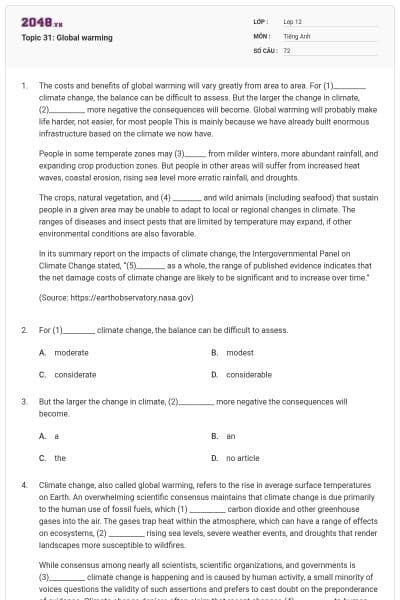
The costs and benefits of global warming will vary greatly from area to area. For (1)_________ climate change, the balance can be difficult to assess. But the larger the change in climate, (2)__________ more negative the consequences will become. Global warming will probably make life harder, not easier, for most people This is mainly because we have already built enormous infrastructure based on the climate we now have.
People in some temperate zones may (3)______ from milder winters, more abundant rainfall, and expanding crop production zones. But people in other areas will suffer from increased heat waves, coastal erosion, rising sea level more erratic rainfall, and droughts.
The crops, natural vegetation, and (4) ________ and wild animals (including seafood) that sustain people in a given area may be unable to adapt to local or regional changes in climate. The ranges of diseases and insect pests that are limited by temperature may expand, if other environmental conditions are also favorable.
In its summary report on the impacts of climate change, the Intergovernmental Panel on Climate Change stated, “(5)________ as a whole, the range of published evidence indicates that the net damage costs of climate change are likely to be significant and to increase over time.”
(Source: https://earthobservatory.nasa.gov)
moderate
modest
considerate
considerable
Các chi phí và lợi ích của sự nóng lên toàn cầu sẽ khác nhau rất lớn từ khu vực này đến khu vực khác. Đối với sự thay đổi khí hậu vừa phải, sự cân bằng là khó có thể đánh giá. Nhưng sự thay đổi khí hậu càng lớn thì càng có nhiều hậu quả tiêu cực. Khí hậu toàn cầu nóng có lẽ sẽ làm cho cuộc sống khó khăn hơn, chứ không hề dễ dàng hơn, đối với hầu hết mọi người. Điều này chủ yếu là do chúng ta đã xây dựng khối cơ sở hạ tầng khổng lồ dựa trên khí hậu mà chúng ta đang có.
Người dân ở một số vùng ôn đới có thể hưởng lợi từ những mùa đông ôn hòa hơn, lượng mưa dồi dào hơn và mở rộng phát triển mùa màng theo vùng. Nhưng người dân ở các khu vực khác sẽ chịu sóng nhiệt gia tăng, xói lở bờ biển, mực nước biển dâng cao hơn lượng mưa thất thường và hạn hán.
Các loại cây trồng, thảm thực vật tự nhiên, và động vật thuần hóa và động vật hoang dã (bao gồm cả hải sản) duy trì con người trong một khu vực nhất định có thể không thích nghi với những thay đổi khí hậu của địa phương hoặc của vùng miền. Các loại dịch bệnh và côn trùng gây hại bị giới hạn bởi nhiệt độ có thể phát triển mạnh, nếu các điều kiện môi trường khác cũng thuận lợi.
Trong báo cáo tóm tắt về tác động của biến đổi khí hậu, Hội đồng Liên Chính phủ về Biến đổi khí hậu đã nói, "Tổng thể, số các bằng chứng được công bố cho thấy rằng chi phí thiệt hại do sự biến đổi khí hậu là rất đáng kể và ngày một tăng lên theo thời gian.
Đáp án A
Kiến thức về từ vựng
A. moderate /ˈmodəreit/ (a): vừa phải, mức độ, chừng mực, điều độ
B. modest /ˈmɒdɪst/ (a): khiêm tốn, nhún nhường, bình thường, giản dị
C. considerate /kənˈsɪdərət/ (a): thận trọng, chu đáo, ý tứ
D. considerable /kənˈsɪdərəbəl/ (a): đáng kể, to tát, lớn lao
- Căn cứ cào nghĩa của câu: “For (1)_________ climate change, the balance can be difficult to assess.” (Đối với sự thay đổi khí hậu vừa phải, sự cân bằng là khó có thể đánh giá)
a
an
the
no article
Đáp án C
Kiến thức về ngữ pháp- Ta có cấu trúc so sánh kép: the + comparative + S + V, the + comparative + S + V: càng… càng
differ
benefit
vary
collect
Đáp án B
Kiến thức về từ vựng
A. differ /ˈdɪfər/ (v):
B. benefit /ˈbenɪfɪt/ (v):
C. vary /ˈveəri/ (v):
D. collect /kəˈlekt/ (v):
- Căn cứ vào nghĩa của câu: “People in some temperate zones may (3)______ from milder winters, more abundant rainfall, and expanding crop production zones.”
(Người dân ở một số vùng ôn đới có thể hưởng lợi từ những mùa đông ôn hòa hơn, lượng mưa dồi dào hơn và mở rộng phát triển mùa màng theo vùng.)
domesticate
domesticated
domestication
domesticating
Đáp án B
Kiến thức về từ loại
A. domesticate /dəˈmestɪkeɪt/ (v): thuần hóa, thuần phục
B. domesticated /dəˈmestɪkeɪtɪd/ (a): được thuần hóa
C. domestication /dəˌmestɪˈkeɪʃən/ (n): sự thuần hóa
D. domesticating /dəˈmes.tɪ.keɪtɪŋ/ (n): đang thuần hóa, thuần phục
Trong câu: “The crops, natural vegetation, and (4)____________ and wild animals (including seafood) that sustain people in a given area may be unable to adapt to local or regional changes in climate.”, “animals” là một danh từ, ta cần một tính từ đứng trước 1 danh từ, bổ nghĩa cho danh từ, trong câu này, từ đó sẽ tương đương về từ loại với từ “wild”.
In its summary report on the impacts of climate change, the Intergovernmental Panel on Climate Change stated, “(5)________ as a whole, the range of published evidence indicates that the net damage costs of climate change are likely to be significant and to increase over time.”
Taken
Made
Had
Created
Đáp án A
Kiến thức về cụm động từ
- Ta có cụm từ: “taken as a whole”: Nói chung, nhìn chung, tổng quát, khái quát, tổng thể
- Căn cứ vào nghĩa của câu: “_______as a whole, the range of published evidence indicates that the net damage costs of climate change are likely to be significant and to increase over time.”
(Tổng thể, số các bằng chứng được công bố cho thấy rằng chi phí thiệt hại do sự biến đổi khí hậu là rất đáng kể và ngày một tăng lên theo thời gian.)
Climate change, also called global warming, refers to the rise in average surface temperatures on Earth. An overwhelming scientific consensus maintains that climate change is due primarily to the human use of fossil fuels, which (1) __________ carbon dioxide and other greenhouse gases into the air. The gases trap heat within the atmosphere, which can have a range of effects on ecosystems, (2) __________ rising sea levels, severe weather events, and droughts that render landscapes more susceptible to wildfires.
While consensus among nearly all scientists, scientific organizations, and governments is (3)__________ climate change is happening and is caused by human activity, a small minority of voices questions the validity of such assertions and prefers to cast doubt on the preponderance of evidence. Climate change deniers often claim that recent changes (4) __________ to human activity can be seen as part of the natural variations in Earth’s climate and temperature, and that it is difficult or impossible to establish a direct connection between climate change and any single weather event, such as a hurricane. While the latter is generally true, decades of data and analysis support the reality of climate change and the human factor in this process. In any case, economists agree that acting to reduce fossil fuel emissions would be far less expensive than (5) __________ with the consequences of not doing so.
(http://www.takepart.com/flashcards/what-is-climate-change/index.html)
returns
repeats
releases
retakes
Biến đổi khí hậu, hay còn được gọi là sự nóng lên toàn cầu, ám chỉ đến sự gia tăng nhiệt độ trung bình trên Trái đất. Một sự nhất trí về mặt khoa học áp đảo xác nhận rằng biến đổi khí hậu chủ yếu là do con người sử dụng nhiên liệu hóa thạch, cái mà giải phóng carbon dioxide và các khí nhà kính khác vào không khí. Các khí này bẫy nhiệt trong khí quyển, cái mà có thể có ảnh hưởng đến các hệ sinh thái, bao gồm mực nước biển dâng cao, sự kiện thời tiết khắc nghiệt và hạn hán, cái mà khiến các cảnh quan dễ bị cháy hơn.
Trong khi sự nhất trí giữa hầu hết các nhà khoa học, tổ chức khoa học và chính phủ cho rằng biến đổi khí hậu đang xảy ra và do hoạt động của con người gây ra, một số ít người đặt câu hỏi về tính hợp lệ của những khẳng định đó và có xu hướng nghi ngờ về ưu thế của những bằng chứng. Những người phủ nhận biến đổi khí hậu thường cho rằng những thay đổi gần đây, được quy do hoạt động của con người, có thể được coi là một phần của sự biến đổi tự nhiên trong khí hậu và nhiệt độ Trái đất, và rất khó hoặc không thể thiết lập mối liên hệ trực tiếp giữa biến đổi khí hậu và bất kỳ sự kiện thời tiết đơn lẻ nào, chẳng hạn như một cơn bão. Mặc dù điều này nói chung là đúng, nhiều dữ liệu và phân tích ủng hộ thực tế của biến đổi khí hậu và yếu tố con người trong quá trình này. Trong mọi trường hợp, các nhà kinh tế đồng ý rằng hành động để giảm phát thải nhiên liệu hóa thạch sẽ ít tốn kém hơn nhiều so với việc giải quyết hậu quả của việc không làm như vậy.
Đáp án C
Kiến thức về từ vựng
A. returns /rɪˈtɜːnz/ (v): trở lại, trở về
B. repeats /rɪˈpiːts/ (v): nhắc lại, lặp lại
C. releases /rɪˈliːsiz/ (v): làm nhẹ, thải ra, thả ra
D. retakes /ˌriːˈteɪks/ (v): lấy lại, chiếm lại, giành lại
Tạm dịch: Climate change, also called global warming, refers to the rise in average surface temperatures on Earth. An overwhelming scientific consensus maintains that climate change is due primarily to the human use of fossil fuels, which (1) ________carbon dioxide and other greenhouse gases into the air.
(Biến đổi khí hậu, còn được gọi là sự nóng lên toàn cầu, nói đến sự gia tăng nhiệt độ bề mặt trung bình trên Trái Đất. Một sự đồng thuận mạnh mẽ giữa các nhà khoa học cho rằng biến đổi khí hậu chủ yếu là do con người sử dụng nhiên liệu hóa thạch, thứ thải ra khí carbon dioxide và các khí nhà kính khác vào không khí.)
The gases trap heat within the atmosphere, which can have a range of effects on ecosystems, (2) __________ rising sea levels, severe weather events, and droughts that render landscapes more susceptible to wildfires.
including
making
consisting
containing
Đáp án A
Kiến thức về từ vựng
A. including /ɪnˈkluːdɪŋ/ (v): bao gồm => mang ý liệt kê
B. making /meɪkɪŋ/ (v): làm cho, thực hiện
C. consisting /kənˈsɪstɪŋ/ + of: gồm có
D. containing /kənˈteɪnɪŋ/ (v): chứa đựng, bao hàm
Tạm dịch: The gases trap heat within the atmosphere, which can have a range of effects on ecosystems, (2) ______________ rising sea levels, severe weather events, and droughts that render landscapes more susceptible to wildfires.
(Các khí đó giữ nhiệt trong bầu khí quyển, điều này có thể gây ra một loạt các tác động đến các hệ sinh thái, bao gồm mực nước biển dâng cao, các sự kiện thời tiết cực đoan và hạn hán khiến cảnh vật dễ bị cháy rừng hơn.)
which
what
this
that
Đáp án D
A. which + clause: cái mà, điều mà => đại từ quan hệ thay thế cho danh từ hoặc cả mệnh đề trước đó
=> Loại đáp án A vì từ cần điền không thay thế cho điều gì.
B. what + clause: cái mà => tạo thành mệnh đề danh ngữ đóng vai trò làm tân ngữ/ chủ ngữ trong câu.
=> Loại đáp án B vì chỉ dùng “what” khi mệnh đề phía sau thiếu tân ngữ.
C. this: cái này, chuyện này => dùng để thay thế cho danh từ hoặc mệnh đề trước đó. This không đi với mệnh đề => loại đáp án C vì đằng sau chỗ cần điền là mệnh đề
D. that + clause: rằng => tạo thành mệnh đề danh ngữ bổ sung chủ ngữ trong câu => đúng với ý của câu.
Tạm dịch: While consensus among nearly all scientists, scientific organizations, and governments is (3)______________ climate change is happening and is caused by human activity, a small minority of voices questions the validity of such assertions and prefers to cast doubt on the preponderance of evidence.
(Trong khi sự nhất trí giữa gần như tất cả các nhà khoa học, tổ chức khoa học và chính phủ rằng biến đổi khí hậu đang xảy ra và do hoạt động của con người gây ra, một số ít người lên tiếng đặt câu hỏi về tính đúng đắn của những khẳng định đó và nghi ngờ về phần lớn bằng chứng.)
attributed
contributed
believed
talked
Đáp án A
Kiến thức về từ vựng
A. attributed /əˈtrɪbjuːtid/ (v): (+ to) cho là do, quy cho
B. contributed /kənˈtrɪbjuːtid/ (v): (+ to) đóng góp, góp phần
C. believed /bɪˈliːvd/ (v): tin vào
D. talked /tɔːkt/ (v): nói chuyện, chuyện trò
=> contribute to sth: đóng góp, góp phần vào chuyện gì
Tạm dịch: Climate change deniers often claim that recent changes (4) _____________ to human activity can be seen as part of the natural variations in Earth’s climate and temperature, and that it is difficult or impossible to establish a direct connection between climate change and any single weather event, such as a hurricane.
(Những người phủ nhận sự biến đổi khí hậu thường cho rằng những thay đổi gần đâycái mà được quy là do hoạt động của con người có thể được coi là một phần của biến đổi tự nhiên của khí hậu và nhiệt độ trên Trái Đất, và để thiết lập mối liên hệ trực tiếp giữa biến đổi khí hậu và bất kỳ sự kiện thời tiết nào ví dụ như một cơn bão thì rất khó hay không thể thực hiện được.)
In any case, economists agree that acting to reduce fossil fuel emissions would be far less expensive than (5) __________ with the consequences of not doing so.
facing
solving
treating
dealing
Đáp án D
Kiến thức về từ vựng
A. facing /feɪsɪŋ/ (v): đương đầu, đối phó
B. solving /sɒlvɪŋ/ (v): giải quyết
C. treating /triːtɪŋ/ (v): đối xử, đối đãi
D. dealing /diːlɪŋ/ (v): đối phó, giải quyết, xử lý
=> to deal with sth/sb: đương đầu, đối phó với ai/ chuyện gì
Tạm dịch:
In any case, economists agree that acting to reduce fossil fuel emissions would be far less expensive than (5) ___________ with the consequences of not doing so.
(Trong mọi trường hợp, các nhà kinh tế học đồng ý rằng hành động để làm giảm sự sản sinh ra nhiên liệu hóa thạch sẽ ít tốn kém hơn nhiều so với việc giải quyết hậu quả của việc nếu không làm như vậy.)
The leaves of most plants are green, because the leaves are full of chemicals which are that colour. The most important of these chemicals is called “chlorophyll” and it (1) __________ plants to make food so they can grow using water, air and light from the sun. this way that a plant makes food for itself is called “photosynthesis” and it is one of the most important processes taking place on the (2) __________ planet.
(3) __________ photosynthesis there would be no plants or people on Earth. Dinosaurs would not have been able to breathe and the air and oceans would be very different from those we have today. So the green chemical chlorophyll is really important. All leaves contain chlorophyll, but sometimes not all of the leaf has chlorophyll in it. Some leaves have green and white or green and yellow stripes or (4)______. Only the green bits have chlorophyll and only those bits can make food by photosynthesis.
If you’re really good at noticing things, you might have seen plants and trees with red or purple leaves – and the leaves are that colour all year round, not just in autumn. These leaves are still full of the important green chemical, chlorophyll, just like any other ordinary green leaf. (5) _________________, they also have lots of other chemicals that are red or purple – so much of them that they no longer look green. But deep down inside the leaves, the chlorophyll is still there and it’s still green.
(http://theconversation.com/curious-kids-why-are-leaves-green-86160)
allows
forces
lets
makes
Lá của hầu hết các loại cây đều có màu xanh, vì lá chứa đầy chất hóa học có màu đó. Điều quan trọng nhất là chất này được gọi là “chất diệp lục” và nó cho phép thực vật tạo ra thức ăn để chúng có thể phát triển bằng cách sử dụng nước, không khí và ánh sáng từ mặt trời. Cách mà một loại cây tạo ra thức ăn cho chính nó được gọi là “quang hợp”, và đó là một trong những quá trình quan trọng nhất diễn ra trên toàn hành tinh.
Nếu không có quang hợp thì sẽ không có thực vật hay con người trên Trái Đất. Khủng long sẽ không thể thở và không khí và đại dương sẽ rất khác với những gì chúng ta đang có ngày nay. Vì vậy, diệp lục thực sự quan trọng. Tất cả các lá đều chứa diệp lục, nhưng đôi khi không phải tất cả các lá đều chứa diệp lục trong đó. Một số lá có sọc hoặc đốm màu xanh lá cây và trắng hoặc xanh lá cây và vàng. Chỉ những chiếc lá màu xanh lá cây có chất diệp lục và chỉ những lá đó mới có thể tạo ra thức ăn bằng cách quang hợp.
Nếu bạn thực sự giỏi trong việc chú ý mọi thứ, bạn có thể đã nhìn thấy một số loại cây có lá màu đỏ hoặc tím - và lá mang màu đó quanh năm, chứ không phải chỉ trong mùa thu. Những chiếc lá này vẫn chứa đầy diệp lục, giống như bất kỳ loại lá màu xanh thông thường khác. Tuy nhiên, chúng cũng chứa rất nhiều hóa chất khác có màu đỏ hoặc tím - vì vậy rất nhiều trong số chúng không còn mang màu xanh nữa. Nhưng sâu bên trong những chiếc lá đó, diệp lục vẫn tồn tại và nó vẫn là màu xanh.
Đáp án A
Kiến thức về từ vựng
A. allows /əˈlaʊz/ (v): cho phép
B. forces /fɔːsiz/ (v): cưỡng ép, bắt buộc
C. lets /lets/ (v): để cho, cho phép
D. makes /meɪks/ (v): làm cho, thực hiện
Các cấu trúc:
- allow sb/ sth to do sth: cho phép ai làm gì = let sb/ sth do sth
- make sb/ sth do sth: làm cho ai, khiến ai như thế nào
Tạm dịch: The leaves of most plants are green, because the leaves are full of chemicals which are that colour. The most important of these chemicals is called “chlorophyll” and it (1) _______ plants to make food so they can grow using water, air and light from the Sun.
(Lá của hầu hết các loại cây đều có màu xanh, vì lá chứa đầy chất hóa học có màu đó. Chất quan trọng nhất trong số các chất hóa học này được gọi là “chất diệp lục” và nó cho phép thực vật tạo ra nguồn dinh dưỡng để chúng có thể phát triển bằng cách sử dụng nước, không khí và ánh sáng từ Mặt Trời.)
this way that a plant makes food for itself is called “photosynthesis” and it is one of the most important processes taking place on the (2) __________ planet.
whole
very
normal
traveling
Đáp án A
Kiến thức về từ vựng
A. whole /həʊl/ (adj): trọn vẹn, toàn bộ
B. very /ˈveri/ (adv): thực sự, rất
C. normal /ˈnɔːml/ (adj): thông thường, bình thường
D. travelling /ˈtrævəlɪŋ/ (adj): (thuộc) sự đi đường, (thuộc) sự du lịch
Tạm dịch: This way that a plant makes food for itself is called “photosynthesis” and it is one of the most important processes taking place on the (2) ____________ planet.
(Cách mà một loài thực vật tự tạo ra thức ăn cho mình được gọi là “quá trình quang hợp” và đó là một trong những quá trình quan trọng nhất diễn ra trên toàn bộ hành tinh.)
Unless
With
Without
Though
Đáp án C
Kiến thức về liên từ
A. Unless + S + V, S + V: Trừ khi, nếu không
B. With + N/ V-ing: cùng với
C. Without + N/ V-ing: không có, mà không
D. Though + S + V, S + V: mặc dù, dẫu
=> Loại đáp án A và D vì đằng sau liên từ cần điền là một danh từ, không phải là mệnh đề.
Tạm dịch:
(3) ________ photosynthesis there would be no plants or people on Earth. Dinosaurs would not have been able to breathe and the air and oceans would be very different from those we have today. So the green chemical chlorophyll is really important.
(Nếu không có quang hợp thì sẽ không có thực vật hay con người trên Trái Đất. Khủng long sẽ không thể thở và không khí, các đại dương sẽ rất khác với những gì chúng ta có ngày nay. Vì vậy, chất diệp lục màu xanh là thực sự quan trọng.)
=> Xét về nghĩa của câu ta chọn đáp án C.
places
spots
areas
locations
Đáp án B
Kiến thức về từ vựng
A. places /pleɪsiz/ (n): chỗ, vị trí, địa vị
B. spots /spɒts/ (n): chấm tròn, đốm
C. areas /ˈeəriəz/ (n): vùng, khu vực
D. locations /ləʊˈkeɪʃnz/ (n): địa điểm hoặc vị trí
Tạm dịch: All leaves contain chlorophyll, but sometimes not all of the leaf has chlorophyll in it. Some leaves have green and white or green and yellow stripes or (4) __________. Only the green bits have chlorophyll and only those bits can make food by photosynthesis.
(Tất cả các lá đều chứa diệp lục, nhưng đôi khi không phải tất cả các lá đều chứa toàn bộ chất diệp lục. Một số lá có sọc hoặc các đốm màu xanh và trắng hoặc xanh và vàng. Chỉ những chỗ màu xanh lá cây có chất diệp lục và chỉ những chỗ đó có thể tạo ra dinh dưỡng bằng cách quang hợp.)
So
Consequently
Thus
However
Đáp án D
Kiến thức về liên từ
A. So: vì vậy, cho nên
B. Consequently: do đó, vì vậy, bởi vậy
C. Thus: do đó, vì thế
D. However: tuy nhiên, tuy thế
=> Đáp án A, B, C dùng để chỉ 2 mệnh đề mang ý nghĩa nguyên nhân – kết quả, còn đáp án D dùng để chỉ hai mệnh đề có ý tương phản, đối lập nhau.
Tạm dịch: If you’re really good at noticing things, you might have seen plants and trees with red or purple leaves – and the leaves are that colour all year round, not just in autumn. These leaves are still full of the important green chemical, chlorophyll, just like any other ordinary green leaf. (5) ____________, they also have lots of other chemicals that are red or purple – so much of them that they no longer look green.
(Nếu bạn thực sự giỏi quan sát mọi thứ, bạn có thể nhìn thấy thực vật và cây có lá màu đỏ hoặc tím - và nó có màu này quanh năm, không chỉ trong mùa thu. Những chiếc lá này vẫn chứa đầy chất diệp lục quan trọng, giống như bất kỳ loại lá xanh thông thường khác. Tuy nhiên, chúng cũng có rất nhiều chất hóa học khác có màu đỏ hoặc tím – vì thế rất nhiều trong số chúng không màu xanh nữa.)
Glaciers are melting, sea levels are rising, cloud forests are dying. More alarmingly, wildlife is scrambling to keep (1) ____. It’s becoming clear that humans have caused most of the past century’s warming by (2) ____ heat-trapping gases as we power our modern lives. Called greenhouse gases, their levels are higher now than in the last 650,000 years.
We call the result global warming, but it is causing a set of changes to the Earth’s climate, or long-term weather patterns, that varies from place to place. As the Earth spins each day, the new heat swirls with it, (3) ____ up moisture over the oceans, rising here, settling there. It’s changing the rhythms of climate that all living things have come to rely upon.
What will we do to slow this warming? How will we cope (4) ____ the changes we’ve already set into (5) ____? While we struggle to figure it all out, the face of the Earth as we know it-coasts, forests, farms and snow-capped mountains-hangs in the balance.
(https://www.nationalgeographic.com)
space
pace
rhythms
step
Băng đang tan chảy, mực nước biển dâng cao, rừng sương mù đang chết dần. Đáng báo động hơn, động vật hoang dã cũng đang gặp nguy hiểm ở mức độ tương tự. Rõ ràng là con người đã gây ra hầu hết sự ấm lên của thế kỷ trước bằng cách giải phóng các khí bẫy nhiệt khi chúng ta cung cấp năng lượng cho cuộc sống hiện đại của chúng ta. Được gọi là khí nhà kính, mức độ của chúng bây giờ cao hơn so với 650.000 năm trước.
Chúng ta gọi kết quả đó là sự nóng lên toàn cầu, nhưng nó đang gây ra một loạt các thay đổi đối với khí hậu Trái đất, hoặc các kiểu thời tiết dài hạn, cái mà thay đổi theo từng nơi. Vì Trái đất quay tròn mỗi ngày, sức nóng mới xoáy theo nó, hút độ ẩm ở các đại dương, dâng lên ở đây, lắng xuống ở đó. Nó đang thay đổi nhịp điệu của khí hậu, cái mà tất cả các sinh vật sống đều phải phụ thuộc.
Chúng ta sẽ làm gì để làm chậm sự nóng lên này? Chúng ta sẽ đối phó với những thay đổi mà chúng ta đã bắt đầu như thế nào? Trong khi chúng ta đấu tranh để tìm ra câu trả lời cho tất cả những điều đó, bộ mặt của Trái đất như chúng ta biết - là bờ biển, rừng, trang trại và những ngọn núi phủ tuyết – không ai biết điều gì sẽ xảy ra với chúng.
Đáp án B
Cụm từ: Keep pace: theo kịp
Tạm dịch: Glaciers are melting, sea levels are rising, cloud forests are dying. More alarmingly, wildlife is scrambling to keep (1) ____ .
(Băng đang tan chảy, mực nước biển đang dâng cao, rừng mây đang chết dần. Đáng báo động hơn, động vật hoang dã đang tranh giành nhau để theo kịp.)
relieving
publishing
releasing
unraveling
Đáp án C
Kiến thức về từ vựng
A. relieving /ri’li:viη/ (a): cứu trợ; cứu viện
B. publishing /’pʌbli∫iη/ (n): công việc xuất bản; nghề xuất bản
C. releasing /ri’li:siη/ (v): giải phóng, làm bớt, làm thoát khỏi (đau đớn, bệnh tật…)
D. unraveling /,ʌn’rævliη / (v): tháo ra, gỡ ra
Tạm dịch:
It’s becoming clear that humans have caused most of the past century’s warming by (2) ____ heat-trapping gases as we power our modern lives.
(Rõ ràng con người đã gây ra hầu hết sự ấm lên của thế kỷ trước bằng cách giải phóng các khí bẫy nhiệt khi chúng ta cung cấp năng lượng cho cuộc sống hiện đại.)
pick
to pick
picking
picks
Đáp án C
Căn cứ vào hai vế sau có “rising” và “settling” nên ta chọn câu C
Tạm dịch: As the Earth spins each day, the new heat swirls with it, (3) ____ up moisture over the oceans, rising here, settling there.
(Khi Trái Đất quay tròn mỗi ngày, sức nóng mới xoáy theo nó, hút độ ẩm trên các đại dương, trỗi dậy ở đây, định cư ở đó.)
with
on
at
to
Đáp án A
Kiến thức về giới từ
A. with: với
B. on: trên
C. at: dùng trước địa điểm, giờ….
D. to: đến
Tạm dịch: What will we do to slow this warming? How will we cope (4) ____ the changes we’ve already set into (5) ____?
(Chúng ta sẽ làm gì để làm chậm sự nóng lên này? Chúng ta sẽ đối phó với những thay đổi mà chúng ta đã (5) ____ như thế nào?)
fluctuation
direction
movement
motion
Đáp án D
Kiến thức về thành ngữ
Set into motion: bắt đầu chuyển động một cái gì đó
Tạm dịch: What will we do to slow this warming? How will we cope with the changes we’ve already set into (5) ____?
(Chúng ta sẽ làm gì để làm chậm sự nóng lên này? Chúng ta sẽ đối phó với những thay đổi mà chúng ta đã làm cho nó chuyển động như thế nào?)
Lead researcher on the atlas, Dr Zoë Randle, said the northerly migration of species of moths and butterflies is a phenomenon observed in northern Europe in recent decades. She said moths are proof that human-made climate change is happening now. Great Britain has observed the arrival of new species too, such as the Clifden Nonpareil, Tree-lichen Beauty and Black-spotted Chestnut. The atlas records that 38 per cent of all moth species in Britain and Ireland have spread to other areas in the last 50 years, most as a result of global warming. The book lists 893 species in all and the scientists’ analysis of distribution records over the period 1970-2016 in particular showed that 31 per cent of 390 larger moth species decreased significantly in Britain.
Intensive agriculture has caused the decline of many moth species through the destruction of wildlife-rich habitats and use of fertilizers and pesticides. Widespread environmental pollution such as artificial light at night and chemicals in the air and soil, are altering plant and animal communities in ways that are still not fully understood. Human-made climate change has facilitated the spread of moths to new parts of Britain and Ireland that were formerly too cold, while at the same time posing a long-term risk to species found in cool and restricted habitats such as mountainsides.
The atlas is based on more than 25 million records sourced from Butterfly Conservation’s National Moth Recording Scheme and the Moths Ireland database. These date from the 18th century through to 2016, meaning this volume contains 275 years of moth-recording effort by the public. Dr Randle said the same system of comprehensive recording is not yet available in Ireland as it is in Britain, but anecdotally she believes the same patterns are emerging in Ireland.
(Source: https://www.irishtimes.com/)
Which best serves as the title for the passage?
Global warming bringing new species of moths to Ireland.
Multiple adverse effects of climate change on the living species.
The very first signal for the bleak future of human being.
The migration of moths is a part of natural cycle.
Đáp án A
Câu nào sau đây là thích hợp nhất làm tiêu đề cho đoạn văn?
A. Sự nóng lên toàn cầu đưa các loài bướm đêm mới đến Ireland
B. Nhiều tác động bất lợi của biến đổi khí hậu đối với các loài sinh vật
C. Tín hiệu đầu tiên cho tương lai ảm đạm của con người
D. Sự di cư của bướm đêm là một phần của chu kỳ tự nhiên
Căn cứ vào thông tin đoạn đầu:
Lead researcher on the atlas, Dr Zoe Randle, said the northerly migration of species of moths and butterflies is a phenomenon observed in northern Europe in recent decades. She said moths are proof that human-made climate change is happening now.
(Trưởng nhóm nghiên cứu về bản đồ, Tiến sĩ Zoe Randle, cho biết sự di cư về phía bắc của các loài bướm đêm và bướm là một hiện tượng được quan sát thấy ở Bắc Âu trong những thập kỷ gần đây. Cô ấy cho biết bướm đêm là bằng chứng cho thấy sự thay đổi khí hậu do con người tạo ra đang xảy ra.)
Như vậy, đoạn văn đang nói về việc biến đổi khí hậu gây ảnh hưởng đến loài bướm đêm phải di cư.
According to paragraph 1, the following statements are true about the migration of moths, EXCEPT _______.
Britain and Ireland have over a third of all moth species flying to other regions.
Both the migrations of Tree-lichen Beauty and Black-spotted Chestnut have been documented.
Britain is the final destination for the journey of every species of moth family.
The atlas boasts a total of 893 moth species being registered from 1970 to 2016.
Đáp án C
Theo đoạn 1, các tuyên bố sau đây là đúng về việc di cư của loài bướm đêm, ngoại trừ_____.
A. Anh và Ireland có hơn một phần ba số loài bướm đêm bay đến các khu vực khác
B. Cả hai sự di cư của Tree-lichen Beauty và Black-spotted Chestnut đã được ghi nhận
C. Nước Anh là điểm đến cuối cùng cho hành trình của mọi loài gia đình bướm đêm
D. Bản đồ tự hào có tổng số 893 loài bướm đêm được ghi nhận từ năm 1970 đến năm 2016
Căn cứ vào thông tin đoạn đầu:
The atlas records that 38 per cent of all moth species in Britain and Ireland have spread to other areas in the last 50 years, most as a result of global warming.
(Bản đồ ghi lại rằng 38% tất cả các loài bướm đêm ở Anh và Ireland đã lan sang các khu vực khác trong 50 năm qua, hầu hết là kết quả của sự nóng lên toàn cầu.)
Great Britain has observed the arrival of new species too, such as the Clifden Nonpareil, Tree-lichen Beauty and Black-spotted Chestnut.
(Vương quốc Anh đã quan sát sự xuất hiện của các loài mới cũng vậ
y, chẳng hạn như Clifden Nonpareil, Tree-lichen Beauty và Black-spotted Chestnut.) The book lists 893 species in all and the scientists’ analysis of distribution records over the period 1970-2016 in particular showed that 31 per cent of 390 larger moth species decreased significantly in Britain.
(Cuốn sách liệt kê 893 loài trong tất cả và các nhà khoa học phân tích hồ sơ về sự phân phối trong giai đoạn 1970-2016 nói riêng, cho thấy 31% trong số 390 loài bướm đêm lớn hơn đã giảm đáng kể ở Anh.)
According to paragraph 2, what is NOT mentioned as one of the causes for the devastation of moth populations?
Soil contaminations.
Extensive farming.
Anthropogenic warming effects.
Photo pollution.
Đáp án B
Theo đoạn 2, điều nào không được nhắc đến như một trong những nguyên nhân gây ra sự sụt giảm số lượng loài bướm?
A. Ô nhiễm đất
B. Thâm canh mở rộng.
C. Hiệu ứng nóng lên dưới tác động của con người
D. Ô nhiễm ánh sáng
Căn cứ thông tin đoạn 2:
Intensive agriculture has caused the decline of many moth species through the destruction of wildlife-rich habitats and use of fertilizers and pesticides. Widespread environmental pollution such as artificial light at night and chemicals in the air and soil, are altering plant and animal communities in ways that are still not fully understood. Human-made climate change has facilitated the spread of moths to new parts of Britain and Ireland that were formerly too cold, while at the same time posing a long-term risk to species found in cool and restricted habitats such as mountainsides.
The word “anecdotally” in paragraph 3 is closest in meaning to ______.
logically
impartially
emotionally
subjectively
Đáp án D
Từ “anecdotally” trong đoạn 3 có nghĩa gần nhất với_____.
A. logic
B. vô tư
C. cảm xúc
D. một cách chủ quan
Từ đồng nghĩa anecdotally (chủ quan) = subjectively
Dr Randle said the same system of comprehensive recording is not yet available in Ireland as it is in Britain, but anecdotally she believes the same patterns are emerging in Ireland.
(Tiến sĩ Randle cho biết hệ thống ghi âm toàn diện tương tự chưa có sẵn ở Ireland vì nó là ở Anh, nhưng chủ quan cô tin rằng những mô hình tương tự đang xuất hiện ở Ireland.)
The word “it” in paragraph 3 refers to _______.
atlas
system
effort
butterfly
Đáp án B
Từ “it” trong đoạn 3 nói đến_____.
A. tập bản đồ
B. hệ thống
C. cố gắng
D. bướm
Từ “it” trong đoạn văn dùng để thay thế cho danh từ hệ thống được nhắc tới trước đó.
Dr Randle said the same system of comprehensive recording is not yet available in Ireland as it is in Britain, but anecdotally she believes the same patterns are emerging in Ireland.
(Tiến sĩ Randle cho biết hệ thống ghi âm toàn diện tương tự chưa có sẵn ở Ireland vì nó là ở Anh, nhưng theo giai thoại, cô tin rằng những mô hình tương tự đang xuất hiện ở Ireland.)
A number of scientists are emphasizing the tremendous challenger that will soon be posed when the depletion of fossil fuel supplies coincides with an alarming increase in the global population. They highlight agriculture, which is heavily dependent not only on gasoline to fuel machinery but also on the petrochemicals without which today’s synthetic fertilizers and pesticides could not be manufactured. But for the latter two, crop yields would be only a fraction of what they are. To assume that an abundant source of renewable energy will be a panacea is to ignore these vital non-fuel uses of petrochemicals.
Then there is the challenge posed to the current levels of mobility. As a fuel, gasoline has an unrivalled portability compared to electricity, which requires bulky batteries, and hydrogen, which is notoriously difficult to store. Biofuels might seem like an alternative but the energy (currently in the form of fossil fuels) consumed when converting corn into bioethanol, for instance, greatly exceeds the output when the fuels is utilized. In any case, once the crisis in the food supply looms large it will not make sense to divert food crops to other uses.
There seems to be a widespread belief that the era of oil dependency is coming to an end. There is a widespread complacency resting on the assumption that the experts will come up with a technological remedy making for a completely pain-free transition. Scientists such as Walter Youngquist argue that tis assumption may be mistaken and that the remaining resources might only support half of the current global population. In his opinion, the absence of a realistic alternative to fossil fuels will mean, amongst other things, that the first priority will be to curb the demand for food.
(http://www.fullspace.digitalcounterrevolution.co.uk/ecpe-practice-read…)
The underlined word “which” in the first paragraph refers to _______________.
machinery
petrochemicals
fertilizers
pesticides
Đáp án B
Từ được gạch chân “which” trong đoạn đầu tiên đề cập đến _________.
A. machinery /mə’ʃi:nəri/ (n): máy móc
B. petrochemicals /pɛtrəʊˈkɛmɪkəl/ (n): hóa dầu
C. fertilizers /’fə:tilaizə/ (n): phân bón
D. pesticides /’pestisaid/ (n): thuốc trừ sâu
Căn cứ vào ngữ cảnh của đoạn văn:
A number of scientists are emphasizing the tremendous challenger that will soon be posed when the depletion of fossil fuel supplies coincides with an alarming increase in the global population. They highlight agriculture, which is heavily dependent not only on gasoline to fuel machinery but also on the petrochemicals without which today’s synthetic fertilizers and pesticides could not be manufactured.
(Một số nhà khoa học đang nhấn mạnh thách thức to lớn sẽ sớm được đặt ra khi sự cạn kiệt nguồn cung cấp nhiên liệu hóa thạch trùng với sự gia tăng đáng báo động trong dân số toàn cầu. Họ nhấn mạnh nông nghiệp, vốn không chỉ phụ thuộc nhiều vào xăng dầu vào máy móc nhiên liệu mà còn phụ thuộc vào hóa dầu, cái mà không có phân bón tổng hợp và thuốc trừ sâu ngày nay không thể sản xuất.)
The aim of the passage is to _______________.
describe realistic alternatives to fossil fuels
criticize scientists who are pessimistic
highlight the seriousness of the situation
outline a pain-free transition to a new era
Đáp án C
Mục đích của đoạn văn là để _____________.
A. mô tả các lựa chọn thay thế thực tế cho nhiên liệu hóa thạch
B. chỉ trích các nhà khoa học bi quan
C. làm nổi bật tính nghiêm trọng của tình huống
D. phác thảo một quá trình chuyển đổi không đau đớn sang một kỷ nguyên mới
Căn cứ vào bài văn ta thấy rằng tác giả nhấn mạnh tính nghiêm trọng của việc cạn kiệt nguồn nhiên liệu hóa thạch.
According to the passage, all the current alternatives to gasoline ____________.
can supply more energy
will be much better for the environment
are less convenient
will have an adverse impact on agriculture
Đáp án C
Theo đoạn văn, tất cả các lựa chọn thay thế hiện tại cho xăng _______.
A. có thể cung cấp nhiều năng lượng hơn
B. sẽ tốt hơn cho môi trường
C. kém thuận tiện
D. sẽ có tác động xấu đến nông nghiệp
Căn cứ vào thông tin sau trong đoạn văn:
As a fuel, gasoline has an unrivalled portability compared to electricity, which requires bulky batteries, and hydrogen, which is notoriously difficult to store. Biofuels might seem like an alternative but the energy (currently in the form of fossil fuels) consumed when converting corn into bioethanol, for instance, greatly exceeds the output when the fuels is utilized. In any case, once the crisis in the food supply looms large it will not make sense to divert food crops to other uses.
Là một loại nhiên liệu, xăng có tính di động vô song so với điện, đòi hỏi pin cồng kềnh và hydro, rất khó để lưu trữ. Nhiên liệu sinh học có vẻ như là một sự thay thế nhưng năng lượng (hiện ở dạng nhiên liệu hóa thạch) tiêu thụ khi chuyển đổi ngô thành ethanol sinh học, chẳng hạn, vượt quá sản lượng khi sử dụng nhiên liệu. Trong mọi trường hợp, một khi cuộc khủng hoảng trong nguồn cung cấp thực phẩm xuất hiện lớn, sẽ không có ý nghĩa để chuyển hướng cây lương thực sang sử dụng khác.
According to Walter Youngquist, our most important step will be to ____________.
reduce the birth rate globally
boost agricultural yields
find new synthetic fertilizers
protect our fossil fuel reserves
Đáp án A
Theo Walter Youngquist, bước quan trọng nhất của chúng ta sẽ là ____.
A. giảm tỷ lệ sinh trên toàn cầu
B. tăng năng suất nông nghiệp
C. tìm phân bón tổng hợp mới
D. bảo vệ dự trữ nhiên liệu hóa thạch của chúng ta
Căn cứ vào thông tin sau trong đoạn văn:
Scientists such as Walter Youngquist argue that tis assumption may be mistaken and that the remaining resources might only support half of the current global population. In his opinion, the absence of a realistic alternative to fossil fuels will mean, amongst other things, that the first priority will be to curb the demand for food.
(Các nhà khoa học như Walter Youngquist cho rằng giả định này có thể bị nhầm lẫn và các tài nguyên còn lại chỉ có thể hỗ trợ một nửa dân số toàn cầu hiện nay. Theo ông, việc không có sự thay thế thực tế cho nhiên liệu hóa thạch sẽ có nghĩa là, trong số những điều khác, ưu tiên hàng đầu sẽ là kiềm chế nhu cầu thực phẩm.)
Có nghĩa là phải giảm dân số thế giới.
It is stated in the passage that the general population _________________.
consume more than they really need
do not realize that fossil fuels supplies are being depleted
are becoming increasingly concerned about the future
assume that things will continue to get better
Đáp án D
Được nêu trong đoạn văn rằng người dân __________ .
A. tiêu thụ nhiều hơn họ thực sự cần
B. không nhận ra rằng nguồn cung cấp nhiên liệu hóa thạch đang cạn kiệt
C. ngày càng quan tâm đến tương lai
D. cho rằng mọi thứ sẽ tiếp tục tốt hơn
Căn cứ vào thông tin sau trong đoạn văn:
There seems to be a widespread belief that the era of oil dependency is coming to an end. There is a widespread complacency resting on the assumption that the experts will come up with a technological remedy making for a completely pain-free transition.
(Dường như có một niềm tin rộng rãi rằng thời đại phụ thuộc dầu mỏ sắp kết thúc. Có một sự tự mãn lan rộng dựa trên giả định rằng các chuyên gia sẽ đưa ra một phương thuốc công nghệ tạo ra sự chuyển đổi hoàn toàn không đau đớn.)
The temperature of the earth is rising at nearly twice the rate it was 50 years ago. This rapid rate and pattern of warming, scientists have concluded, cannot be explained by natural cycles alone. The only way to explain the pattern is to include the effect of greenhouse gases (GHGs) emitted by humans.
To come to a conclusion on climate change, the United Nations formed a group of scientists called the Intergovernmental Panel on Climate Change, or IPCC. The IPCC meets every few years to review the latest scientific findings and write a report summarizing all that is known about global warming. Each report represents a consensus, or agreement, among hundreds of leading scientists.
One of the first things the IPCC learned is that there are several greenhouse gases responsible for warming, and humans emit them in a variety of ways. Most come from the combustion of fossil fuels in cars, factories and electricity production. The gas responsible for the most warming is carbon dioxide, also called CO2. Other contributors include methane released from landfills and agriculture, especially from the digestive systems of grazing animals, nitrous oxide from fertilizers, gases used for refrigeration and industrial processes, and the loss of forests that would otherwise store CO2.
Different greenhouse gases have very different heat-trapping abilities. Some of them can even trap more heat than CO2. A molecule of methane produces more than 20 times the warming of a molecule of CO2. Nitrous oxide is 300 times more powerful than CO2.
Other gases, such as chlorofluorocarbons, or CFCs, which have been banned in much of the world because they also degrade the ozone layer, have heat-trapping potential thousands of times greater than CO2. But because their concentrations are much lower than CO2, none of these gases adds as much warmth to the atmosphere as CO2 does.
In order to understand the effects of all the gases together, scientists tend to talk about all greenhouse gases in terms of the equivalent amount of CO2. Since 1990, yearly emissions have gone up by about 6 billion metric tons of “carbon dioxide equivalent” worldwide, more than a 20 percent increase.
(Source: https://www.nationalgeographic.com/)
Which of the following best serves as the title for the passage?
Greenhouse gases and global warming
Fossil fuels and global warming
Causes of global warming
Effects of global warming
Đáp án C
Lựa chọn nào sau đây là tiêu đề hay nhất cho đoạn văn?
A. Khí nhà kính và sự nóng lên toàn cầu
B. Nhiên liệu hóa thạch và sự nóng lên toàn cầu
C. Nguyên nhân của sự nóng lên toàn cầu
D. Ảnh hưởng của sự nóng lên toàn cầu
Căn cứ nội dung đoạn 1:
The temperature of the earth is rising at nearly twice the rate it was 50 years ago. This rapid rate and pattern of warming, scientists have concluded, cannot be explained by natural cycles alone. The only way to explain the pattern is to include the effect of greenhouse gases (GHGs) emitted by humans.
(Nhiệt độ của trái đất đang tăng gần gấp đôi so với tốc độ 50 năm trước. Các nhà khoa học đã kết luận tốc độ nhanh chóng và hình mẫu của sự nóng lên này không thể được giải thích chỉ bởi chu kỳ tự nhiên. Cách duy nhất để giải thích mô hình này phải bao gồm hiệu ứng của các khí nhà kính (GHG) phát ra bởi con người.
The word “consensus” in paragraph 2 probably means _____.
an opinion that all members of a group agree with
a situation where people have different opinions
a conversation or discussion in which two or more people disagree
a lack of agreement between facts, opinions, actions
Đáp án A
Từ “consensus” trong đoạn 2 có thể có nghĩa là _____.
A. một ý kiến mà tất cả các thành viên của một nhóm đồng ý
B. một tình huống mà mọi người có ý kiến khác nhau
C. một cuộc trò chuyện hoặc thảo luận trong đó hai hoặc nhiều người không đồng ý
D. thiếu sự thỏa thuận giữa các sự kiện, ý kiến, hành động
Kiến thức từ vựng: consensus (n) = nhận thức chung
Each report represents a consensus, or agreement, among hundreds of leading scientists.
(Mỗi báo cáo đại diện cho một sự đồng thuận, hoặc thỏa thuận, trong số hàng trăm nhà khoa học hàng đầu.)
According to paragraph 2, what is the main work of IPCC every few years?
Concluding on climate change
Forming a group of scientists
Meeting every few years
Reviewing the latest scientific findings
Đáp án D
Theo đoạn 2, công việc chính của IPCC vài năm một lần là gì?
A. Kết luận về biến đổi khí hậu
B. Hình thành một nhóm các nhà khoa học
C. Gặp gỡ vài năm một lần
D. Xem xét các kết quả khoa học mới nhất
Căn cứ thông tin đoạn 2:
The IPCC meets every few years to review the latest scientific findings and write a report summarizing all that is known about global warming.
The word “contributors” in paragraph 3 mostly means _______.
humans
gases responsible for global warming
fossil fuels
cars and factories
Đáp án B
Từ “contributors” trong đoạn 3 chủ yếu có nghĩa là _______.
A. con người
B. khí chịu trách nhiệm cho sự nóng lên toàn cầu
C. nhiên liệu hóa thạch
D. xe ô tô và nhà máy
Kiến thức từ mới và cấu trúc câu, câu chứa từ “contributors” nói tiếp về các loại khí gây nóng lên toàn cầu. Bản thân từ này cũng có nghĩa là “vật đóng góp vào…”:
The gas responsible for the most warming is carbon dioxide, also called CO2. Other contributors include methane released from landfills and agriculture, especially from the digestive systems of grazing animals, nitrous oxide from fertilizers, gases used for refrigeration and industrial processes, and the loss of forests that would otherwise store CO2.
(Khí chịu trách nhiệm cho sự nóng lên nhất là các-bon đi-ô-xít, còn được gọi là CO2. Những nguồn đóng góp khác bao gồm khí mê-tan phát thải từ bãi chôn lấp và nông nghiệp, đặc biệt là từ hệ thống tiêu hóa của động vật ăn cỏ, nitơ ô-xít từ phân bón, khí sử dụng cho quá trình làm lạnh và công nghiệp, và mất rừng.)
Which of the following is NOT mentioned in paragraph 3 as a reason for warming?
Carbon dioxide
Methane
Nitrous oxide
Carbon monoxide
Đáp án D
Điều nào sau đây KHÔNG được đề cập trong đoạn 3 như một nguyên nhân gây nóng lên?
A. Các-bon đi-ô-xít
B. Mê-tan
C. Nitơ ô-xít
D. Các-bon mô-nô-xít
Căn cứ thông tin đoạn 3, chỉ có phương án D – khí các-bon mô-nô-xít không được nói đến:
The gas responsible for the most warming is carbon dioxide, also called CO2. Other contributors include methane released from landfills and agriculture, especially from the digestive systems of grazing animals, nitrous oxide from fertilizers, gases used for refrigeration and industrial processes, and the loss of forests that would otherwise store CO2.
(Khí chịu trách nhiệm cho sự nóng lên nhất là các-bon đi-ô-xít, còn được gọi là CO2. Những nguồn đóng góp khác bao gồm khí mê-tan phát thải từ bãi chôn lấp và nông nghiệp, đặc biệt là từ hệ thống tiêu hóa của động vật ăn cỏ, nitơ ô-xít từ phân bón, khí sử dụng cho quá trình làm lạnh và công nghiệp, và mất rừng.
The word “which” in paragraph 5 refers to which of the following?
Other gases
chlorofluorocarbons
ozone layer
CO2
Đáp án B
Từ “which” trong đoạn 5 đề cập đến từ nào sau đây?
A. Các loại khí khác
B. chlorofluorocarbons
C. tầng ôzôn
D. CO2
Kiến thức ngữ pháp và cấu trúc câu:
Other gases, such as chlorofluorocarbons, or CFCs, which have been banned in much of the world because they also degrade the ozone layer, have heat-trapping potential thousands of times greater than CO2.
(Các loại khí khác, chẳng hạn như chlorofluorocarbons hoặc CFC đã bị cấm ở nhiều nơi trên thế giới vì chúng cũng làm suy giảm tầng ôzôn, có khả năng giữ nhiệt lớn hơn CO2 hàng ngàn lần.)
It can be inferred from paragraph 5 that CO2 _____.
adds the most warmth to the atmosphere
has lower concentration than other gases
traps less heat than thousands of other gases
degrades the ozone layer
Đáp án A
Có thể được suy ra từ đoạn 5 rằng CO2 __________ .
A. gây ra nhiều nhiệt nhất vào bầu không khí
B. có nồng độ thấp hơn các loại khí khác
C. giữ ít nhiệt hơn hàng nghìn loại khí khác
D. làm suy giảm tầng ôzôn
Căn cứ thông tin đoạn 5:
But because their concentrations are much lower than CO2, none of these gases adds as much warmth to the atmosphere as CO2 does.
(Nhưng vì nồng độ của chúng thấp hơn nhiều so với CO2, không khí nào trong số các loại khí này làm tăng thêm độ ấm cho khí quyển như CO2.)
According to the passage, which of the following is TRUE?
The temperature of the earth is rising by natural cycles alone.
Humans emit greenhouse gases in the combustion of fossil fuels in cars only.
CO2 is not the gas trapping the most heat.
Since 1990, the amount of CO2 emitted itself was 6 billion metric tons.
Đáp án C
Theo đoạn văn, thông tin nào sau đây là ĐÚNG?
A. Nhiệt độ của trái đất đang tăng lên chỉ bởi chu kỳ tự nhiên.
B. Con người chỉ phát ra khí nhà kính trong quá trình đốt nhiên liệu hóa thạch trong xe hơi.
C. CO2 không phải là khí gây ra nhiệt cao nhất.
D. Từ năm 1990, bản thân lượng CO2 bị phát thải là 6 tỷ tấn.
Căn cứ thông tin các đoạn:
Đoạn 1 giải thích ý A sai: The temperature of the earth is rising at nearly twice the rate it was 50 years ago. This rapid rate and pattern of warming, scientists have concluded, cannot be explained by natural cycles alone.
(Nhiệt độ của trái đất đang tăng gần gấp đôi so với tốc độ 50 năm trước. Các nhà khoa học đã kết luận tốc độ nhanh chóng và hình mẫu của sự nóng lên này không thể được giải thích chỉ bởi chu kỳ tự nhiên.)
Đoạn 3 giải thích ý B sai: One of the first things the IPCC learned is that there are several greenhouse gases responsible for warming, and humans emit them in a variety of ways. Most come from the combustion of fossil fuels in cars, factories and electricity production.
(Một trong những điều đầu tiên mà IPCC ghi nhận được là có một số khí nhà kính chịu trách nhiệm cho sự nóng lên, và con người phát thải ra chúng theo nhiều cách khác nhau. Phần lớn đến từ việc đốt nhiên liệu hóa thạch trong xe hơi, nhà máy và sản xuất điện.)
Đoạn 4 giải thích ý C đúng: Different greenhouse gases have very different heat-trapping abilities. Some of them can even trap more heat than CO2. A molecule of methane produces more than 20 times the warming of a molecule of CO2. Nitrous oxide is 300 times more powerful than CO2.
(Các khí nhà kính khác nhau có khả năng giữ nhiệt rất khác nhau. Một vài trong số các khí này thậm chí có thể giữ nhiều nhiệt hơn CO2. Một phân tử mêtan tạo ra hơn 20 lần sự nóng lên của một phân tử CO2. Ô-xít ni-tơ mạnh gấp 300 lần CO2.)
Đoạn cuối giải thích ý D sai, đây là lượng CO2 sau khi quy đổi từ các khí thải khác sang chứ không phải bản thân nó: Since 1990, yearly emissions have gone up by about 6 billion metric tons of “carbon dioxide equivalent” worldwide, more than a 20 percent increase.
(Từ năm 1990, lượng phát thải hàng năm đã tăng khoảng 6 tỷ tấn “tương đương các-bon đi-ô-xít” trên toàn thế giới, tăng hơn 20%.
As places transformed, so did the people. When researchers at Yale University and the University of Westminster studied what images people associated with climate change, they found a shift this decade. When they began their study in 2003, the majority of people surveyed thought of melting polar ice. By 2016, more and more people had weather top of mind.
Climate, to be clear, is not weather. It’s the difference between a trend and a one-off event. But with wetter storms and hotter summers unfolding over the course of the decade, people were making new connections between climate change and the weather. Seeing climate change through the lens of something they experience every day opens the door for people to see the weight of the issue over their own lives. “Americans are just beginning to connect the dots and to say, wait a second, what’s going on here,” says Anthony Leiserowitz, a lead author of the study and director of the Yale Program on Climate Change Communication. “There’s been this increasing dawning of awareness among many Americans that climate change is actually starting to harm people here and now.”
New renewable energy projects outpaced new fossil fuel installations in worldwide growth for the first time in 2015. In a pivotal moment for the whole planet, every country on Earth agreed to take on climate change when they adopted the Paris climate accord in 2015. That committed countries to reducing their greenhouse gas emissions enough to keep the Earth from warming beyond roughly 1.5 degrees Celsius above pre-industrial levels, a threshold that could be catastrophic for people and ecosystems if it’s crossed. It was the culmination of years of political wrangling. “It is rare to have the opportunity in a lifetime to change the world,” former French president François Hollande told delegates gathered on the final day of negotiations. “Seize it so that the planet can live on, so that humanity can live on.”
But cooperation, even when the health of the whole planet is on the line, can be a fragile, fleeting thing. After Donald Trump was elected president in 2016, he began the process of formally withdrawing the US from the Paris accord. One by one, Trump backtracked on existing federal efforts to cut down on pollution, too. The words “climate change” began disappearing from government websites and documents.
(Source: https://www.theverge.com/)
Which best serves as the title for the passage?
Changing hearts and minds.
Race to save the planet.
Climate change slaps us in the face.
The new definition of normal.
Đáp án A
Câu nào sau đây là thích hợp nhất làm tiêu đề cho đoạn văn?
A. Sự thay đổi trong con tim và lý trí.
B. Cuộc đua để cứu hành tinh
C. Biến đổi khí hậu ảnh hưởng đến chúng ta
D. Định nghĩa mới về bình thường
Căn cứ vào thông tin đoạn đầu:
When researchers at Yale University and the University of Westminster studied what images people associated with climate change, they found a shift this decade. When they began their study in 2003, the majority of people surveyed thought of melting polar ice. By 2016, more and more people had weather top of mind.
(Khi các nhà nghiên cứu tại Đại học Yale và Đại học Westminster nghiên cứu những hình ảnh mọi người kết hợp với biến đổi khí hậu, họ đã nhận thấy một sự thay đổi trong thập kỷ này. Họ bắt đầu nghiên cứu vào năm 2003, phần lớn những người được khảo sát đã nghĩ đến việc băng ở 2 cực bị tan chảy. Vào năm 2016, ngày càng có nhiều người hứng thú với vấn đề thời tiết.)
=> Như vậy, đoạn văn đang đề cập đến sự thay đổi của con người trong hiểu biết về thời tiết.
The word “they” in paragraph 1 refers to _____.
people
researchers
places
images
Đáp án B
Từ “they” trong đoạn 1 đề cập đến_____.
A. người
B. nhà nghiên cứu
C. nơi
D. hình ảnh
Từ “they” ở đây dùng để thay thế cho danh từ nhà nghiên cứu được nhắc tới trước đó.
When researchers at Yale University and the University of Westminster studied what images people associated with climate change, they found a shift this decade. When they began their study in 2003, the majority of people surveyed thought of melting polar ice. By 2016, more and more people had weather top of mind.
(Khi các nhà nghiên cứu tại Đại học Yale và Đại học Westminster nghiên cứu những hình ảnh mọi người kết hợp với biến đổi khí hậu, họ đã tìm thấy một sự thay đổi trong thập kỷ này. Họ bắt đầu nghiên cứu vào năm 2003, phần lớn những người được khảo sát đã nghĩ đến việc băng ở 2 cực bị tan chảy. Vào năm 2016, ngày càng có nhiều người hứng thú với vấn đề thời tiết.)
According to paragraph 2, what is prompting the realisation of people about warming effect?
The constant warnings of the governments and researchers over the media.
The increasing frequency of people being engaged in outdoors activities.
The unexpectedly transitory nature of many extreme weather phenomenon.
Explicit linkage between the wider patterns of change and a weather event.
Đáp án D
Theo đoạn 2, điều gì đang thúc đẩy nhận thức của mọi người về hiệu ứng nóng lên?
A. Những cảnh báo liên tục của chính phủ và các nhà nghiên cứu trên các phương tiện truyền thông
B. Tần suất ngày càng tăng của những người tham gia các hoạt động ngoài trời
C. Bản chất tạm thời bất ngờ của nhiều hiện tượng thời tiết cực đoan
D. Liên kết rõ ràng giữa các kiểu thay đổi rộng hơn và sự kiện thời tiết
Căn cứ vào thông tin đoạn hai:
But with wetter storms and hotter summers unfolding over the course of the decade, people were making new connections between climate change and the weather. Seeing climate change through the lens of something they experience every day opens the door for people to see the weight of the issue over their own lives.
(Nhưng với những cơn bão ẩm hơn và mùa hè nóng hơn đang diễn ra trong suốt thập kỷ này, mọi người đang tạo ra sự kết nối mới giữa biến đổi khí hậu và thời tiết. Nhìn thấy sự thay đổi khí hậu qua lăng kính của một cái gì đó họ trải nghiệm mỗi ngày mở ra cho mọi người thấy tầm quan trọng của vấn đề với cuộc sống của chính họ.)
According to paragraph 3, what is the result of heightened awareness of global citizens?
It makes the youth come up with potential solving suggestions.
It leads to concerted actions between countries and individuals.
It induces the international boycott of fossil fuel utilisation.
It has no tangible effect on the governments around the world.
Đáp án B
Theo đoạn 3, kết quả của việc ý thức của công dân trên thế giới được nâng cao là gì?
A. Điều này giúp cho giới trẻ đưa ra các đề xuất có khả năng giải quyết vấn đề.
B. Điều này dẫn đến các hành động phối hợp giữa các quốc gia và cá nhân.
C. Điều này dẫn phát sự tẩy chay quốc tế đối với nhiên liệu hóa thạch.
D. Điều này không có tác động cụ thể nào đối với các chính phủ trên thế giới.
Căn cứ thông tin đoạn 3:
In a pivotal moment for the whole planet, every country on Earth agreed to take on climate change when they adopted the Paris climate accord in 2015.
(Vào thời điểm then chốt của toàn thế giới, mọi quốc gia trên Trái đất đều đồng ý thực hiện chống lại thay đổi khí hậu khi họ thông qua hiệp định khí hậu Paris năm 2015.)
Đáp án C nếu sử dụng từ nhẹ hơn từ “boycott” (tẩy chay) thì có thể đúng về mặt ý.
The word “wrangling” in paragraph 3, is closest in meaning to _______.
turmoil
struggle
dispute
power
Đáp án C
Từ “wrangling” trong đoạn 3, có nghĩa gần nhất với______.
A. sự rối loạn
B. cuộc đấu tranh
C. cuộc tranh luận
D. sức mạnh
Từ đồng nghĩa wrangling (cuộc tranh luận) = dispute
It was the culmination of years of political wrangling.
(Đó là đỉnh cao của cuộc tranh luận chính trị kéo dài nhiều năm.)
Which of the following statements is TRUE, according to the passage?
Yale University participated in the survey on people’s views concerning climate change.
The whiplash from the US’s changing policy galvanized grassroots opposition.
The public, the local and the governing bodies in Paris displayed discord in solutions.
The milestone of 30 Celsius degree for world’s average temperature is last straw.
Đáp án A
Phát biểu nào sau đây là đúng, theo đoạn văn?
A. Đại học Yale đã tham gia cuộc khảo sát về quan điểm của mọi người về vấn đề biến đổi khí hậu
B. Sự trừng phạt từ chính sách thay đổi cơ sở mạ kẽm của Hoa Kỳ
C. Công chúng, địa phương và các cơ quan quản lý ở Paris thể hiện sự bất hòa trong các giải pháp
D. Cột mốc 30 độ C đối với nhiệt độ trung bình của thế giới là rơm cuối cùng
Căn cứ vào thông tin đoạn đầu:
When researchers at Yale University and the University of Westminster studied what images people associated with climate change, they found a shift this decade. When they began their study in 2003, the majority of people surveyed thought of melting polar ice. By 2016, more and more people had weather top of mind.
(Khi các nhà nghiên cứu tại Đại học Yale và Đại học Westminster nghiên cứu những hình ảnh mọi người liên quan đến biến đổi khí hậu, họ đã tìm thấy một sự thay đổi trong thập kỷ này. Họ bắt đầu nghiên cứu vào năm 2003, phần lớn những người được khảo sát đã nghĩ đến việc băng ở 2 cực bị tan chảy. Vào năm 2016, ngày càng có nhiều người hứng thú với vấn đề thời tiết.)
The word “backtracked” in paragraph 4 is closest in meaning to _______.
rescinding
upsetting
capsizing
exchanging
Đáp án A
Từ “backtracked” trong đoạn 4 có nghĩa gần nhất với ______.
A. bãi bỏ, thủ tiêu
B. buồn bã
C. lật úp
D. trao đổi
Từ đồng nghĩa backtrack (bãi bỏ) = rescind
One by one, Trump backtracked on existing federal efforts to cut down on pollution, too. The words “climate change” began disappearing from government websites and documents.
(Từng bước một, Trump bãi bỏ những nỗ lực liên bang hiện có để cắt giảm ô nhiễm. Dòng chữ “biến đổi khí hậu” đã bắt đầu biến mất trên trang web và tài liệu của chính phủ.)
Which of the following can be inferred from the passage?
The ugly lifeblood of industrialization can no longer be hidden away in pipelines.
Public interest in and concern about climate change has subsided dramatically.
Alongside clearer physical patterns of climate change, attitudes are also shifting.
Each little shift in the average increases the likelihood of extreme hot events.
Đáp án C
Điều nào sau đây có thể được suy ra từ đoạn văn?
A. Huyết mạch xấu xí của công nghiệp hóa không còn có thể được che giấu trong các đường ống
B. Sự quan tâm và lo ngại của công chúng về biến đổi khí hậu đã giảm đi đáng kể
C. Bên cạnh các mô hình vật lý rõ ràng hơn về biến đổi khí hậu, thái độ của mọi người cũng đang thay đổi
D. Mỗi thay đổi nhỏ trong trung bình làm tăng khả năng xảy ra các sự kiện cực kỳ nóng
Căn cứ vào thông tin đoạn hai:
But with wetter storms and hotter summers unfolding over the course of the decade, people were making new connections between climate change and the weather.
(Nhưng với những cơn bão ẩm hơn và mùa hè nóng hơn đang diễn ra trong suốt thập kỷ này, mọi người đang tạo ra sự kết nối mới giữa biến đổi khí hậu và thời tiết.)
“There’s been this increasing dawning of awareness among many Americans that climate change is actually starting to harm people here and now.”
“Có một sự hiểu biết ngày càng tăng ở nhiều người Mỹ về việc biến đổi khí hậu đang thực sự bắt đầu gây hại cho con người ở đây và bây giờ.”
Globally we use more energy than ever before, and the demand is rapidly growing. Economic expansion of emerging market economies, population growth and our increasing use of energy-consuming devices are among the most important contributing factors.
About one-third of the radiation hitting Earth’s atmosphere is reflected back out into space by clouds, ice, snow, sand and other reflective surfaces. The other two-thirds is absorbed by the Earth’s surface and the atmosphere. As the land, oceans and atmosphere heat up, they re-emit energy as infrared thermal radiation, which passes through the atmosphere. Heat-trapping gases like carbon dioxide (CO2) absorb this infrared radiation and prevent it from dissipating into space, giving rise to what we know as the greenhouse effect. The accumulation of CO2 and other greenhouse gases in the atmosphere is the dominating driver of recent climate change. CO2 is estimated to be responsible for 64 % of man-made global warming. Other greenhouse gases are released in much smaller amounts but still contribute significantly to the overall warming effect, as they are much more potent heat-trapping gases than CO2.
The EU is taking action on many levels. One example is on fluorinated gases that are contributing less than CO2 but still a particular point of concern in addressing climate change. They are used in several types of products, such as in refrigeration, air-conditioning and heat pump equipment. While fluorinated gases are released into the atmosphere in smaller quantities than other greenhouse gases, they are extremely potent – they produce a warming effect 23 000 times greater than CO2. For this reason the EU has decided to control their use. The EU’s regulation on fluorinated greenhouse gases aims at cutting the Union’s emissions by two-thirds compared to 2014 levels.
Chemicals are not only part of the problem – they are also part of the solution. Sustainable energy sources like solar power rely on chemical innovation using, for example, nanomaterials. One of the main challenges with renewable energy is how to increase its viability with the help of energy storage solutions. For example, solar panels have the best conditions in the desert, but that is not where most people live. Windmills also produce power during the night, which is when our energy consumption is at its lowest. In other words, technologies to improve energy storage and transportation is one of the important areas of research where innovation is needed.
(Source: https://chemicalsinourlife.echa.europa.eu/)
The passage mainly discusses_________.
Inspiration behind global protests.
Disagreement between activists and scientists.
Controversial environmental policies.
Chemicals and global warming.
Đáp án D
Đoạn văn chủ yếu thảo luận về ______.
A. Cảm hứng đằng sau các cuộc biểu tình toàn cầu
B. Bất đồng giữa các nhà hoạt động và nhà khoa học
C. Chính sách môi trường gây tranh cãi
D. Hóa chất và sự nóng lên toàn cầu
Căn cứ vào thông tin đoạn đầu:
Globally we use more energy than ever before, and the demand is rapidly growing. Economic expansion of emerging market economies, population growth and our increasing use of energy-consuming devices are among the most important contributing factors.
(Trên toàn cầu, chúng ta sử dụng nhiều năng lượng hơn bao giờ hết và nhu cầu đang tăng nhanh. Sự mở rộng kinh tế của các nền kinh tế thị trường mới nổi, sự tăng trưởng dân số và nhu cầu sử dụng các thiết bị tiêu thụ năng lượng ngày càng tăng là một trong những nhân tố góp phần quan trọng nhất)
Như vậy, đoạn văn đang nói về các nhân tố góp phần vào sự nóng lên toàn cầu.
The word “emerging” in paragraph 1 can be replaced by _______.
beginning
problematic
provisional
developing
Đáp án D
Từ “emerging” trong đoạn 1 có thể được thay thế bằng______.
A. bắt đầu
B. có vấn đề
C. tạm thời
D. đang phát triển
Từ đồng nghĩa emerging (mới nổi) = developing
Economic expansion of emerging market economies, population growth and our increasing use of energy-consuming devices are among the most important contributing factors.
(Sự mở rộng kinh tế của các nền kinh tế thị trường mới nổi, tăng trưởng dân số và nhu cầu sử dụng các thiết bị tiêu thụ năng lượng ngày càng tăng là một trong những nhân tố góp phần quan trọng nhất)
According to paragraph 2, why does part of the energy received from the sun remain on Earth?
The carbon dioxide absorbs and re-emits the thermal radiation from the Earth’s surface.
The infrared radiation is not capable of escaping the ozone layer with the help of human tools.
The heat is hindered from dispelling by clouds, ice, snow and sand.
Human forcefully keep the extra thermal energy for future use.
Đáp án A
Theo đoạn 2, tại sao một phần năng lượng nhận được từ mặt trời vẫn còn trên Trái Đất?
A. Khí carbon dioxide hấp thụ và phát lại bức xạ nhiệt từ bề mặt Trái Đất
B. Bức xạ hồng ngoại không có khả năng thoát khỏi tầng ozone với sự trợ giúp của các công cụ của con người
C. Nhiệt bị cản trở khỏi việc xua tan bởi mây, băng, tuyết và cát
D. Con người giữ năng lượng nhiệt thêm để sử dụng trong tương lai
Căn cứ vào thông tin đoạn hai:
Heat-trapping gases like carbon dioxide (C02) absorb this infrared radiation and prevent it from dissipating into space, giving rise to what we know as the greenhouse effect.
(Các loại khí giữ nhiệt như carbon dioxide (C02) hấp thụ bức xạ hồng ngoại này và ngăn không cho nó tan vào không gian, làm phát sinh thứ mà chúng ta gọi là hiệu ứng nhà kính.)
The word “potent” in paragraph 2 can be replaced by _______.
energetic
dormant
active
lethargic
Đáp án C
Từ “potent” trong đoạn 2 có thể được thay thế bằng______.
A. tràn đầy năng lượng
B. không hoạt động
C. tích cực
D. thờ ơ
=> Từ đồng nghĩa potent (mạnh) = active
Other greenhouse gases are released in much smaller amounts but still contribute significantly to the overall warming effect, as they are much more potent heat-trapping gases than C02.
(Các khí nhà kính khác được phát ra với số lượng nhỏ hơn nhiều nhưng vẫn đóng góp đáng kể vào hiệu ứng làm ấm tổng thể, vì chúng là khí bẫy nhiệt mạnh hơn nhiều so với C02.)
The word “They” in paragraph 3 refers to _____
reflective surfaces
fluorinated gases
greenhouse gases
energy sources
Đáp án B
Từ “they” trong đoạn 3 nói đến______.
A. bề mặt phản chiếu
B. khí flo
C. khí nhà kính
D. nguồn năng lượng
Từ “they” ở đây dùng để thay thế cho danh từ khí flo được nhắc tới trước đó.
One example is on fluorinated gases that are contributing less than C02 but still a particular point of concern in addressing climate change. They are used in several types of products, such as in refrigeration, air- conditioning and heat pump equipment.
(Một ví dụ là về khí flo góp phần ít hơn khí C02 nhưng vẫn là một điểm quan tâm đặc biệt trong việc giải quyết thay đổi khí hậu. Chúng được sử dụng trong một số loại sản phẩm, như trong điện lạnh, điều hòa không khí và thiết bị bơm nhiệt.)
According to paragraph 3, what action has the EU take in reponse to global warming?
They keep track the emission of fluorinated gases to curb its release to an optimal level.
They analyse the statistics of each year’s carbon footprint of the world.
They introduce new legislations concerning the consumption of plastic.
They dismiss the issue as a natural process and neglect its evident impacts
Đáp án A
Theo đoạn 3, hành động nào đã khiến EU phản ứng lại sự nóng lên toàn cầu?
A. Họ theo dõi sự phát thải của khí flo để hạn chế sự giải phóng của nó đến mức tối ưu
B. Họ phân tích số liệu thống kê của dấu chân carbon mỗi năm trên thế giới
C. Họ giới thiệu các luật pháp mới liên quan đến việc tiêu thụ nhựa
D. Họ coi vấn đề là một quá trình tự nhiên và bỏ qua các tác động rõ ràng của nó
Căn cứ vào thông tin đoạn ba:
While fluorinated gases are released into the atmosphere in smaller quantities than other greenhouse gases, they are extremely potent - they produce a warming effect 23 000 times greater than CO2. For this reason the EU has decided to control their use.
(Trong khi khí flo được thải vào bầu khí quyển với số lượng ít hơn các khí nhà kính khác, chúng cực kỳ mạnh - chúng tạo ra hiệu ứng nóng lên gấp 23 000 lần so với CO2. Vì lý do này, EU đã quyết định kiểm soát việc sử dụng chúng.)
Which of the following statements is TRUE, according to the passage?
Solar energy is easier to harness in the dynamic and populated cities.
There is a broad consensus that human activity is the main cause of global warming.
CO2 is reported to account for more than two-thirds of artificial warming effect.
Methane is the most powerful heat-trapping chemical substance.
Đáp án B
Phát biểu nào sau đây là đúng, theo đoạn văn?
A. Năng lượng mặt trời dễ khai thác hơn ở các thành phố năng động và đông dân cư
B. Có sự đồng thuận rộng rãi rằng hoạt động của con người là nguyên nhân chính của sự nóng lên toàn cầu
C. C02 được cho là chiếm hơn hai phần ba hiệu ứng làm ấm nhân tạo
D. Metan là chất hóa học giữ nhiệt mạnh nhất
Căn cứ vào thông tin đoạn đầu:
Economic expansion of emerging market economies, population growth and our increasing use of energy-consuming devices are among the most important contributing factors.
(Sự mở rộng kinh tế của các nền kinh tế thị trường mới nổi, tăng trưởng dân số và nhu cầu sử dụng các thiết bị tiêu thụ năng lượng ngày càng tăng là một trong những nhân tố góp phần quan trọng nhất)
Which of the following can be inferred from the passage?
We are coming closer to the next Ice Age more than ever.
The physical environment holds the capability of shaping life’s grand patterns.
Chemistry has to play a pivotal role in addressing the issue of climate change.
Most people do not believe in the occurrence of global warming despite abundant evidence.
Đáp án C
Điều nào sau đây có thể được suy ra từ đoạn văn?
A. Chúng ta đang đến gần Kỷ băng hà tiếp theo hơn bao giờ hết
B. Môi trường vật chất giữ khả năng định hình các mô hình lớn của cuộc sống
C. Hóa học phải đóng một vai trò quan trọng trong việc giải quyết vấn đề biến đổi khí hậu
D. Hầu hết mọi người không tin vào sự xuất hiện của sự nóng lên toàn cầu mặc dù chứng cớ rất phong phú
Căn cứ vào thông tin đoạn cuối:
Chemicals are not only part of the problem - they are also part of the solution. Sustainable energy sources like solar power rely on chemical innovation using, for example, nanomaterials.
(Hóa chất không chỉ là một phần của vấn đề - mà chúng còn là một phần của giải pháp. Các nguồn năng lượng bền vững như năng lượng mặt trời dựa vào sử dụng đổi mới hóa học, ví dụ, vật liệu nano)
Rains that are almost biblical, heat waves that don’t end - there’s been a change in the weather lately. What’s going on?
Extreme weather is an unusual weather event such as rainfall, a drought or a heat wave in the wrong place or at the wrong time. In theory, they are very rare. But these days, our TV screens are constantly showing such extreme weather events. Take just three news stories from 2010: 28 centimetres of rain fell on Rio de Janeiro in 24 hours, Nashville, USA, had 33 centimetres of rain in two days and there was record rainfall in Pakistan.
The effects of this kind of rainfall are dramatic and lethal. In Rio de Janeiro, landslides followed, burying hundreds of people. In Pakistan, the floods affected 20 million people. Meanwhile, other parts of the world suffer devastating droughts. Australia, Russia and East Africa have been hit in the last ten years. And then there are unexpected heat waves, such as in 2003 in Europe. That summer, 35,000 deaths were said to be heat-related.
Peter Miller, a National Geographic columnist, says what is happening to our weather is probably a mixture of numerous factors. On the one hand, the most important influences on weather events are natural cycles in the climate. Two of the most famous weather cycles, EI Nino and La Nina, originate in the Pacific Ocean. The heat from the warm ocean rises high into the atmosphere and affects weather all around the world. On the other hand, the temperature of the Earth’s oceans is slowly but steadily going up. And this is a result of human activity. We are producing greenhouse gases that trap heat in the Earth’s atmosphere. This heat warms up the atmosphere, land and oceans. Warmer oceans produce more water vapour - think of heating a pan of water in your kitchen. Turn up the heat, it produces steam more quickly. Satellite data tells us that the water vapour in the atmosphere has gone up by four percent in 25 years. This warm, wet air turns into the rain, storms, hurricanes and typhoons that we are increasingly experiencing.
Climate scientist, Michael Oppenheimer, says that we need to face the reality of climate change. And we also need to act now to save lives and money in the future.
(https://www.ngllife.com/wild-weather)
The article says extreme weather is ________.
becoming more common
not a natural occurrence
difficult for scientists to understand
always affecting places where lots of people live
Đáp án A
Chủ đề về WEATHER
Bài báo nói rằng thời tiết cực đoan ________.
A. đang trở nên phổ biến hơn
B. không phải là hiện tượng tự nhiên
C. khó hiểu đối với các nhà khoa học
D. luôn ảnh hưởng đến những nơi có nhiều người sinh sống
Căn cứ vào thông tin:
"In theory, they are very rare. But these days, our TV screens are constantly showing such extreme weather events. Take just three news stories from 2010: 28 centimetres of rain fell on Rio de Janeiro in 24 hours, Nashville, USA, had 33 centimetres of rain in two days and there was record rainfall in Pakistan."
(Về lý thuyết, thời tiết cực đoan rất hiếm xảy ra. Nhưng những ngày gần đây, màn hình TV của chúng ta liên tục chiếu các sự kiện tượng thời tiết cực đoan. Ví dụ như 3 tin tức từ năm 2010: 28 cm mưa rơi trên Rio de trong suốt 24 giờ, tại Columbia, Hoa Kỳ, đã có 33 cm mưa trong hai ngày và có lượng mưa kỷ lục ở Pakistan.)
=> Ngày nay, các hiện tượng thời tiết cực đoan ngày càng diễn ra nhiều hơn chứng tỏ nó đang trở nên phổ biến hơn.
Extreme weather can be caused by _______.
very hot and rainy summers
routine environmental phenomena
human beings’ manufacturing industry
both natural and manmade activities
Đáp án D
Thời tiết cực đoan có thể được gây ra bởi _______.
A. mùa hè nóng và mưa
B. hiện tượng môi trường thông thường
C. các ngành công nghiệp sản xuất của con người
D. cả hoạt động tự nhiên và của con người
Căn cứ vào thông tin:
Peter Miller, a National Geographic columnist, says what is happening to our weather is probably a mixture of numerous factors. On the one hand, the most important influences on weather events are natural cycles in the climate......On the other hand, the temperature of the Earth’s oceans is slowly but steadily going up. And this is a result of human activity.
(Peter Miller, một chuyên gia Địa lý Quốc gia, cho biết những gì đang xảy ra với thời tiết của chúng ta có lẽ là do nhiều yếu tố gây nên. Một mặt, ảnh hưởng quan trọng nhất đến các sự kiện thời tiết là sự tuần hoàn tự nhiên trong khí hậu......Mặt khác, nhiệt độ của các đại dương Trái đất đang tăng lên tuy chậm nhưng tăng đều. Và đây là kết quả của hoạt động của con người.
=> Cả hoạt động của tự nhiên và của con người gây ra sự biến đổi thời tiết.
The underlined word “lethal” in the passage is closest in meaning to ______.
harmless
deadly
beneficial
modest
Đáp án B
Từ in đậm "lethal" trong đoạn văn có nghĩa gần nhất với ______.
A. harmless /ˈhɑːmləs/ (adj): không có hại, vô hại
B. deadly /ˈdedli/ (adj): gây chết người, trí mạng
C. beneficial /ˌbenɪˈfɪʃl/ (adj): có ích; có lợi; tốt
D. modest /ˈmɒdɪst/ (adj): khiêm tốn, giản dị
Căn cứ vào thông tin:
"The effects of this kind of rainfall are dramatic and lethal. In Rio de Janeiro, landslides followed, burying hundreds of people. In Pakistan, the floods affected 20 million people."
(Những ảnh hưởng của loại mưa này là rất lớn và gây chết người. Tại Rio de Janeiro, kèm theo sau bởi lở đất, chôn vùi hàng trăm người. Tại Pakistan, lũ lụt ảnh hưởng đến 20 triệu người.)
=> lethal (adj): gây chết người = deadly.
By writing ‘Australia, Russia and East Africa have been hit in the last ten years’ in paragraph 3, the author means ________.
these countries also have drought in the last ten years.
these countries have made some records in changing the climate.
they are very populous areas in the world.
they are also severely affected by extreme weather.
Đáp án D
Bằng cách viết nước Úc, Nga và Đông Phi đã bị tấn công trong mười năm qua, ở đoạn 3, tác giả ngụ ý ____.
A. những nước này cũng bị hạn hán trong mười năm qua.
B. các quốc gia này đã lập một số kỷ lục trong việc thay đổi khí hậu.
C. họ là những khu vực rất đông dân cư trên thế giới.
D. họ cũng bị ảnh hưởng nặng nề bởi thời tiết khắc nghiệt.
Căn cứ vào các thông tin:
- Extreme weather is an unusual weather event such as rainfall, a drought" ...
(Thời tiết khắc nghiệt là những sự kiện thời tiết bất thường ví dụ như các trận mưa rào, hạn hán...).
- "Meanwhile, other parts of the world suffer devastating droughts. Australia, Russia and East Africa have been hit in the last ten years."
(Trong khi đó, những nơi khác trên thế giới phải chịu hạn hán tàn khốc. Úc, Nga và Đông Phi đã bị tấn công trong mười năm qua.)
=> Úc, Nga và Đông Phi được tác giả nhắc đến để làm dẫn chứng cho các nước phải chịu hạn hán tàn khốc hay chính là thời tiết cực đoan
=> 3 nước này cũng phải chịu ảnh hưởng bởi thời tiết cực đoan.
The underlined word “this” in the passage refers to ______.
the production of greenhouse gases
the heat from the ocean
the growth of ocean temperature
trapping heat in the atmosphere
Đáp án C
Từ được gạch chân "this" trong đoạn văn nói đến ______.
A. sự tạo ra khí nhà kính
B. sức nóng từ đại dương
C. sự tăng lên của nhiệt độ đại dương
D. nhiệt bị giữ lại trong khí quyển
Căn cứ vào thông tin:
"On the other hand, the temperature of the Earth’s oceans is slowly but steadily going up. And this is a result of human activity."
(Mặt khác, nhiệt độ của các đại dương Trái đất đang tăng lên tuy chậm nhưng tăng đều. Và đây là kết quả của hoạt động của con người.)
=> Từ "this" được dùng đầu câu để thay thế cho sự việc nhắc đến ở câu ngay trước đó chính là "the growth of temperature of the Earth"
What happened after pouring rain in Rio de Janeiro?
a bad summer
a severe drought
slides of a large mass of dirt and rock
a period of hot weather
Đáp án C
Điều gì đã xảy ra sau khi mưa rào ở Rio de Janeiro?
A. một mùa hè khủng khiếp
B. hạn hán nghiêm trọng
C. sự sụt lở của một khối lớn đất và đá
D. thời kỳ nắng nóng
Căn cứ vào thông tin:
"The effects of this kind of rainfall are dramatic and lethal. In Rio de Janeiro, landslides followed, burying hundreds of people."
(Những ảnh hưởng của loại mưa này là rất lớn và gây chết người. Tại Rio de Janeiro, kèm theo sau bởi lở đất, đã chôn vùi hàng trăm người.)
=> Tại Rio de Janeiro, lở đất đá xảy ra sau khi có mưa rào.
Which of the following is considered normal?
greenhouse gases
rising sea level
heat-related deaths
EI Nino and La Nina
Đáp án D
Điều nào sau đây được coi là bình thường?
A. khí nhà kính
B. mực nước biển dâng cao
C. tử vong liên quan đến nhiệt
D. EI Nino và La Nina
Căn cứ vào thông tin:
"On the one hand, the most important influences on weather events are natural cycles in the climate. Two of the most famous weather cycles, EI Nino and La Nina, originate in the Pacific Ocean."
(Một mặt, ảnh hưởng quan trọng nhất đến các sự biến đổi thời tiết là vòng tuần hoàn tự nhiên trong khí hậu. Hai trong số các vòng tuần hoàn thời tiết nổi tiếng nhất là EI Nino và La Nina, bắt nguồn từ Thái Bình Dương.)
- We are producing greenhouse gases that trap heat in the Earth’s atmosphere. This heat warms up the atmosphere, land and oceans… This warm, wet air turns into the rain, storms, hurricanes and typhoons that we are increasingly experiencing.
(Chúng ta đang tạo ra khí nhà kính làm cho nhiệt bị giữu lại trong bầu khí quyển Trái Đất. Sức nóng này làm nóng bầu không khí, đất và đại dương ... Không khí ấm áp, ẩm ướt này biến thành mưa, dông bão, lốc xoáy và bão mà chúng ta đang ngày càng gặp phải.)
=> Loại đáp án A, B, C vì đó là những kết quả của hoạt động của con người gây ra hiện tượng thời tiết cực đoan, ảnh hưởng nghiêm trọng đến con người => không phải là điều bình thường.
Đáp án D đúng vì như tác giả đã viết, EI Nino và La Nina là 2 hiện tượng của vòng tuần hoàn tự nhiên.
According to Michael Oppenheimer ________.
we cannot do anything to change the fact of climate change.
we can limit the effects of extreme weather.
we do not understand the reasons behind extreme weather.
we can adapt to the changes of global weather.
Đáp án B
Theo như Michael Oppenheimer ________.
A. chúng ta không thể làm gì để thay đổi biến đổi khí hậu.
B. chúng ta có thể hạn chế ảnh hưởng của thời tiết cực đoan.
C. chúng ta không hiểu lý do đằng sau thời tiết cực đoan.
D. chúng ta có thể thích nghi với sự thay đổi của thời tiết toàn cầu.
Căn cứ vào thông tin đoạn cuối:
“Climate scientist, Michael Oppenheimer, says that we need to face the reality of climate change. And we also need to act now to save lives and money in the future.”
(Nhà khí tượng học, Michael Oppenheimer, nói rằng chúng ta cần đối mặt với thực tế của biến đổi khí hậu. Và chúng ta cũng cần phải hành động ngay để cứu sự sống và tiền bạc trong tương lai.)
=> Nhà khí tượng học Michael Oppenheimer kêu gọi mọi người phải hành động ngay để cứu tương lai của chúng ta bởi vì nguyên nhân gây ra hiện tượng cực đoan một phần là do con người
=> điều này chứng tỏ con người hoàn toàn có thể hạn chế được các ảnh hưởng của hiện tượng thời tiết cực đoan.
Bạn có thích hoạt động này không?