Topic 3: Relationships (Phần 2)
16 câu hỏi
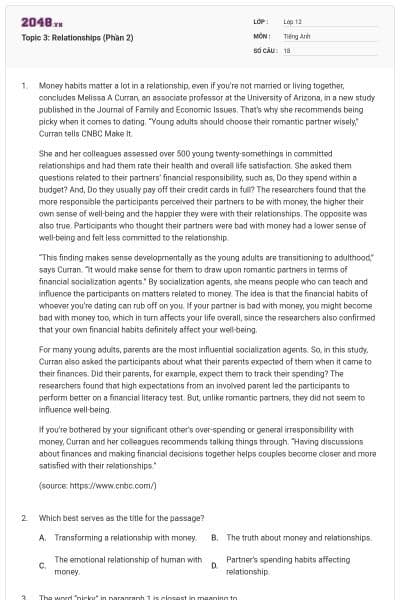
Money habits matter a lot in a relationship, even if you’re not married or living together, concludes Melissa A Curran, an associate professor at the University of Arizona, in a new study published in the Journal of Family and Economic Issues. That’s why she recommends being picky when it comes to dating. “Young adults should choose their romantic partner wisely,” Curran tells CNBC Make It.
She and her colleagues assessed over 500 young twenty-somethings in committed relationships and had them rate their health and overall life satisfaction. She asked them questions related to their partners’ financial responsibility, such as, Do they spend within a budget? And, Do they usually pay off their credit cards in full? The researchers found that the more responsible the participants perceived their partners to be with money, the higher their own sense of well-being and the happier they were with their relationships. The opposite was also true. Participants who thought their partners were bad with money had a lower sense of well-being and felt less committed to the relationship.
“This finding makes sense developmentally as the young adults are transitioning to adulthood,” says Curran. “It would make sense for them to draw upon romantic partners in terms of financial socialization agents.” By socialization agents, she means people who can teach and influence the participants on matters related to money. The idea is that the financial habits of whoever you’re dating can rub off on you. If your partner is bad with money, you might become bad with money too, which in turn affects your life overall, since the researchers also confirmed that your own financial habits definitely affect your well-being.
For many young adults, parents are the most influential socialization agents. So, in this study, Curran also asked the participants about what their parents expected of them when it came to their finances. Did their parents, for example, expect them to track their spending? The researchers found that high expectations from an involved parent led the participants to perform better on a financial literacy test. But, unlike romantic partners, they did not seem to influence well-being.
If you’re bothered by your significant other’s over-spending or general irresponsibility with money, Curran and her colleagues recommends talking things through. “Having discussions about finances and making financial decisions together helps couples become closer and more satisfied with their relationships.”
(source: https://www.cnbc.com/)
Which best serves as the title for the passage?
Transforming a relationship with money.
The truth about money and relationships.
The emotional relationship of human with money.
Partner’s spending habits affecting relationship.
Đáp án D
Câu nào sau đây thích hợp nhất làm tiêu đề cho đoạn văn?
A. Chuyển đổi mối quan hệ với tiền bạc
B. Sự thật về tiền bạc và các mối quan hệ
C. Mối quan hệ tình cảm của con người với tiền bạc
D. Thói quen chi tiêu của bạn đời ảnh hưởng đến mối quan hệ
Căn cứ vào thông tin đoạn đầu:
Money habits matter a lot in a relationship, even if you’re not married or living together, concludes Melissa A Curran, an associate professor at the University of Arizona, in a new study published in the Journal of Family and Economic Issues.
(Thói quen tiền bạc rất quan trọng trong một mối quan hệ, ngay cả khi bạn không kết hôn hoặc sống cùng nhau, Melissa A Curran kết luận, phó giáo sư tại Đại học Arizona, trong một nghiên cứu mới được công bố trên Tạp chí các vấn đề về kinh tế và gia đình.)
=> Từ thông tin trên, có thể suy ra đoạn văn đang muốn nói đến vấn đề tiền tiền bạn có ảnh hưởng đến mối quan hệ của bạn.
The word “picky” in paragraph 1 is closest in meaning to _______.
discerning
eclectic
easygoing
palpable
Đáp án A
Từ “picky” trong đoạn 1 có nghĩa gần nhất với .
A. sáng suốt
B. chiết trung
C. dễ dãi
D. rõ ràng
Từ đồng nghĩa picky (kén chọn) = discerning
That’s why she recommends being picky when it comes to dating.
(Đó là lý do tại sao cô ấy khuyên bạn nên kén chọn khi nói đến hẹn hò.)
According to paragraph 2, what is NOT correct about the research of Melissa A Curran?
Partner’s financial behavior affects relationship satisfaction and sense of commitment.
The investigation conducted on 20 young people with widely different lifestyles.
It is not an individual work but Curran’s collaboration with her colleagues on the project.
The research involved inquiring about the accountability of individuals’ partners.
Đáp án B
Theo đoạn 2, điều nào không đúng về nghiên cứu của Melissa A Curran?
A. Hành vi tài chính của bạn đời ảnh hưởng đến sự hài lòng mối quan hệ và ý thức của sự cam kết
B. Cuộc điều tra được tiến hành trên 20 người trẻ tuổi với lối sống rộng rãi khác nhau
C. Nó không phải là một công trình cá nhân mà là sự hợp tác của Curran với các đồng nghiệp của cô trong dự án
D. Nghiên cứu liên quan đến tìm hiểu về trách nhiệm giải trình của các cá nhân
Căn cứ vào thông tin đoạn hai:
She and her colleagues assessed over 500 young twenty-somethings in committed relationships.
(Cô và các đồng nghiệp đã đánh giá hơn 500 thanh niên trong độ tuổi 20 trong các mối quan hệ chính thức.)
She asked them questions related to their partners’ financial responsibility, such as, Do they spend within a budget? And, Do they usually pay off their credit cards in full?
(Cô ấy hỏi họ những câu hỏi liên quan đến trách nhiệm tài chính của bạn đời của họ, chẳng hạn như, họ có chi tiêu tiết kiệm không? Và, họ có thường thanh toán thẻ tín dụng của họ đầy đủ?)
The researchers found that the more responsible the participants perceived their partners to be with money, the higher their own sense of well-being and the happier they were with their relationships. The opposite was also true. Participants who thought their partners were bad with money had a lower sense of well-being and felt less committed to the relationship.
(Các nhà nghiên cứu thấy rằng những người tham gia nhận thấy bạn đời của càng có trách nhiệm với tiền, thì cảm giác hạnh phúc của chính họ càng cao và họ càng vui vẻ hơn với các mối quan hệ của họ. Điều ngược lại cũng đúng. Những người tham gia nghĩ rằng các bạn đời của họ không sử dụng tiền thông minh có cảm giác hạnh phúc ít hơn và cảm thấy ít hơn cam kết với mối quan hệ hơn.)
According to paragraph 3, what can be generalized about the conclusion of the finding?
Receiving financial support from one’s partner is normal for any relationship.
Being money-smart is the gift that not everyone has in life.
Dating an over-spender can actually lower your quality of life.
Giving the significant other expensive gifts will increase relationship satisfaction.
Đáp án C
Theo đoạn 3, những gì có thể được khái quát về kết luận của phát hiện này?
A. Nhận được hỗ trợ tài chính từ bạn đời của bạn là điều bình thường đối với mọi mối quan hệ
B. Thông minh về tiền bạc là món quà mà không phải ai cũng có trong cuộc sống
C. Hẹn hò với một người chi tiêu quá mức thực sự có thể làm giảm chất lượng cuộc sống của bạn
D. Tặng những món quà đắt tiền khác sẽ làm tăng sự hài lòng trong mối quan hệ
Căn cứ vào thông tin đoạn ba:
If your partner is bad with money, you might become bad with money too, which in turn affects your life overall, since the researchers also confirmed that your own financial habits definitely affect your well-being.
(Nếu bạn đời của bạn không sử dụng tiền thông minh, bạn cũng có thể trở nên như vậy, điều này ảnh hưởng đến cuộc sống của bạn, vì các nhà nghiên cứu cũng xác nhận rằng chính thói quen tài chính của bạn chắc chắn ảnh hưởng đến hạnh phúc của bạn.)
The word “track” in paragraph 4 is closest in meaning to _______.
trail
register
pursue
record
Đáp án D
Từ “track” trong đoạn 4 có nghĩa gần nhất với .
A. đường mòn
B. đăng ký
C. theo đuổi
D. ghi lại
Từ đồng nghĩa track (theo dõi) = record
Curran also asked the participants about what their parents expected of them when it came to their finances. Did their parents, for example, expect them to track their spending?
(Curran cũng hỏi những người tham gia về những gì cha mẹ họ mong đợi ở họ khi nói đến tài chính của họ. Ví dụ có phải cha mẹ của họ, mong họ sẽ theo dõi chi tiêu của họ?)
Which of the following statements is TRUE, according to the passage
Melissa A Curran is a reporter at the Journal of Family and Economic Issues.
People should prioritize being with someone with positive influence on financial habits.
The people who cannot take control of relationship will not be able to deal with money.
Most of the teenagers are still in dating or non-cohabiting relationships.
Đáp án B
Phát biểu nào sau đây là đúng, theo đoạn văn?
A. Melissa A Curran là phóng viên của tạp chí các vấn đề kinh tế và gia đình
B. Mọi người nên ưu tiên ở bên một người có ảnh hưởng tích cực đến thói quen tài chính
C. Những người không thể kiểm soát mối quan hệ sẽ không thể giao dịch với tiền
D. Hầu hết thanh thiếu niên vẫn đang trong mối quan hệ hẹn hò hoặc không chung sống
Căn cứ vào thông tin đoạn ba:
If your partner is bad with money, you might become bad with money
too, which in turn affects your life overall, since the researchers also confirmed that your own financial habits definitely affect your well-being.
(Nếu bạn đời của bạn không sử dụng tiền thông minh, bạn cũng có thể trở nên như vậy, điều này ảnh hưởng đến cuộc sống của bạn, vì các nhà nghiên cứu cũng xác nhận rằng chính thói quen tài chính của bạn chắc chắn ảnh hưởng đến hạnh phúc của bạn.)
The word “their” in paragraph 5 refers to _____.
discussions’
decisions’
finances’
couples’
Đáp án D
Từ “their” trong đoạn 5 đề cập đến .
A. thảo luận
B. quyết định
C. tài chính
D. cặp đôi
Từ “their” ở đây dùng để chỉ sự sở hữu của danh từ cặp đôi được nhắc tới trước đó.
“Having discussions about finances and making financial decisions together helps couples become closer and more satisfied with their relationships.”
(Có những cuộc thảo luận về tài chính và đưa ra các quyết định tài chính cùng nhau giúp các cặp đôi trở nên gần gũi và hài lòng hơn với các mối quan hệ của họ.)
Which of the following can be inferred from the passage?
The way one’s romantic partner spends and saves affects a person’s well-being.
Being good with money is not the same thing as having a lot of money.
Problems related to finances also represent issues of power and control.
Money problems can cause drama in the relationship, and lead to its ending.
Đáp án A
Điều nào sau đây có thể được suy ra từ đoạn văn?
A. Cách bạn đời của một người chi tiêu và tiết kiệm ảnh hưởng đến hạnh phúc của một người
B. Sử dụng tiền tốt không giống như có nhiều tiền
C. Các vấn đề liên quan đến tài chính cũng đại diện cho các vấn đề về quyền lực và kiểm soát
D. Vấn đề tiền bạc có thể gây ra kịch tính trong mối quan hệ và dẫn đến kết thúc của nó
Căn cứ vào thông tin đoạn hai:
The researchers found that the more responsible the participants perceived their partners to be with money, the higher their own sense of well-being and the happier they were with their relationships. The opposite was also true. Participants who thought their partners were bad with money had a lower sense of well-being and felt less committed to the relationship.
(Các nhà nghiên cứu thấy rằng những người tham gia nhận thấy bạn đời của càng có trách nhiệm với tiền, thì cảm giác hạnh phúc của chính họ càng cao và họ càng vui vẻ hơn với các mối quan hệ của họ. Điều ngược lại cũng đúng. Những người tham gia nghĩ rằng các bạn đời của họ không sử dụng tiền thông minh có cảm giác hạnh phúc ít hơn và cảm thấy ít hơn cam kết với mối quan hệ hơn.)
Read the following passage and mark the letter A, B, C, or D to indicate the correct answer to each of the questions from 1 to 8.
It is natural for young people to be critical of their parents at times and to blame them for most of the misunderstandings between them. They have always complained, more or less justly, that their parents are out of touch with modern ways; that they are possessive and dominant; that they do not trust their children to deal with crises; that they talk too much about certain problems, and that they have no sense of humor, at least in parent-child relationships. I think it is true that parents often underestimate their teenage children and also forget how they themselves felt when they were young.
Young people often irritate their parents with their choices in clothes and hairstyles, in entertainers and music. This is not their motive. They feel cut off from the adult world into which they have not yet been accepted. So they create a culture and society of their own. Then, if it turns out that their music or entertainers of vocabulary or clothes or hairstyles irritate their parents, this gives them additional enjoyment. They feel they are superior, at least in a small way, and that they are leaders in style and taste.
Sometimes you are resistant and proud because you do not want your parents to approve of what you do. If they approve, it looks as if you are betraying your own age group. But in that case, you are assuming that you are the underdog; you cannot win; but at least you keep your honor. This is a passive way of looking at things. It is natural enough after long years of childhood, when you were completely under your parents’ control. But it ignores the fact that you are now beginning to be responsible for yourself.
If you plan to control your life, cooperation can be part of that plan. You can charm others, especially your parents, into doing things the way you want. You can impress others with your sense of responsibility and initiative, so that they will give you the authority to do what you want to do.
(202.194.48.102/englishonline/wsjs/ss/GraduateEnglish/…/gexec2r.htm)The author of the passage is primarily addressing __________.
parents
newspaper readers
teenagers’ advisors
teenagers
Đáp án D
Tác giả đoạn văn chủ yếu đề cập đến __________.
A. cha mẹ.
B. độc giả báo.
C. Cố vấn của thanh thiếu niên.
D. thanh thiếu niên.
- Xoay quanh bài đọc tác giả chủ yếu đề cập nhiều nhất đến thanh thiếu niên ở tất cả các đoạn.
Dịch bài đọc
Đôi khi, những người trẻ tuổi thường chỉ trích cha mẹ mình và đổ lỗi cho họ về hầu hết những hiểu lầm giữa họ. Họ luôn phàn nàn, ít nhiều là đúng, rằng cha mẹ họ không theo kịp những cách thức hiện đại; rằng họ chiếm hữu và thống trị; rằng họ không tin tưởng con cái mình có thể giải quyết khủng hoảng; rằng họ nói quá nhiều về một số vấn đề nhất định và rằng họ không có khiếu hài hước, ít nhất là trong mối quan hệ cha mẹ - con cái. Tôi nghĩ đúng là cha mẹ thường đánh giá thấp con cái tuổi teen của mình và cũng quên mất cảm giác của chính họ khi còn nhỏ.
Những người trẻ tuổi thường làm cha mẹ khó chịu với những lựa chọn về quần áo và kiểu tóc, về nghệ sĩ giải trí và âm nhạc. Đây không phải là động cơ của họ. Họ cảm thấy bị tách biệt khỏi thế giới người lớn mà họ vẫn chưa được chấp nhận. Vì vậy, họ tạo ra một nền văn hóa và xã hội của riêng mình. Sau đó, nếu âm nhạc hoặc nghệ sĩ giải trí, từ vựng hoặc quần áo hoặc kiểu tóc của họ làm cha mẹ họ khó chịu, điều này sẽ mang lại cho họ thêm niềm vui. Họ cảm thấy mình vượt trội, ít nhất là ở một khía cạnh nhỏ, và rằng họ là người dẫn đầu về phong cách và thị hiếu.
Đôi khi bạn phản kháng và kiêu hãnh vì bạn không muốn cha mẹ chấp thuận những gì bạn làm. Nếu họ chấp thuận, có vẻ như bạn đang phản bội lại nhóm tuổi của mình. Nhưng trong trường hợp đó, bạn đang cho rằng mình là kẻ yếu thế; bạn không thể chiến thắng; nhưng ít nhất bạn vẫn giữ được danh dự của mình. Đây là cách nhìn nhận thụ động về mọi thứ. Điều này khá tự nhiên sau nhiều năm tháng thơ ấu, khi bạn hoàn toàn nằm dưới sự kiểm soát của cha mẹ. Nhưng nó lại bỏ qua thực tế là giờ đây bạn đang bắt đầu tự chịu trách nhiệm cho chính mình.
Nếu bạn có kế hoạch kiểm soát cuộc sống của mình, sự hợp tác có thể là một phần của kế hoạch đó. Bạn có thể quyến rũ người khác, đặc biệt là cha mẹ bạn, để họ làm mọi việc theo cách bạn muốn. Bạn có thể gây ấn tượng với người khác bằng tinh thần trách nhiệm và sáng kiến của mình, để họ trao cho bạn thẩm quyền để làm những gì bạn muốn làm.
The first paragraph is mainly about ___________.
the teenagers’ criticism of their parents
misunderstandings between teenagers and their parents
the dominance of the parents over their children
the teenagers’ ability to deal with crises
Đáp án A
Đoạn đầu tiên chủ yếu nói về ___________.
A. lời phê bình của thanh thiếu niên với cha mẹ họ.
B. hiểu lầm giữa thanh thiếu niên và cha mẹ của họ.
C. sự kiểm soát của cha mẹ đối với con cái của họ.
D. thanh thiếu niên có khả năng đối phó với khủng hoảng.
Căn cứ vào nghĩa của câu:
It is natural for young people to be critical of their parents at times and to blame them for most of the misunderstandings between them. They have always complained, more or less justly, that their parents are out of touch with modern ways; that they are possessive and dominant; that they do not trust their children to deal with crises; that they talk too much about certain problems, and that they have no sense of humor, at least in parent-child relationships. I think it is true that parents often underestimate their teenage children and also forget how they themselves felt when they were young.
(Đôi khi, những người trẻ tuổi thường chỉ trích cha mẹ và đổ lỗi cho họ vì hầu hết những hiểu lầm giữa họ. Họ luôn phàn nàn, ít nhiều công bằng rằng cha mẹ của họ không cập nhật với những cách thức hiện đại; Sở hữu và chiếm ưu thế, rằng họ không tin tưởng con cái mình để giải quyết vấn đề, chúng nói quá nhiều về một số vấn đề nhất định và họ không có khiếu hài hước, ít nhất là trong các mối quan hệ cha mẹ của con cái. Tôi nghĩ rằng cha mẹ thường đúng đánh giá thấp những đứa trẻ tuổi vị thành niên của họ và cũng quên đi cảm giác của chính họ khi còn trẻ.)
Teenagers tend to have strange clothes and hairstyles mainly because they ________.
want to show their existence by creating a culture of their own
have a strong desire to be leaders in style and taste
have no other way to enjoy themselves better
just have a wish to irritate their parents and live on their own
Đáp án A
Thanh thiếu niên có xu hướng có quần áo và kiểu tóc lạ chủ yếu vì họ___________
A. muốn thể hiện sự tồn tại của họ bằng cách tạo ra một nền văn hóa của riêng họ.
B. có một mong muốn mạnh mẽ để trở thành nhà lãnh đạo trong phong cách và khẩu vị.
C. không có cách nào khác để tận hưởng bản thân tốt hơn.
D. chỉ muốn chọc tức bố mẹ và sống theo cách của mình.
Căn cứ vào nghĩa của câu:
Young people often irritate their parents with their choices in clothes and hairstyles, in entertainers and music. This is not their motive. They feel cut off from the adult world into which they have not yet been accepted. So they create a culture and society of their own.
(Những người trẻ tuổi thường gây khó chịu cho cha mẹ của họ với sự lựa chọn của họ trong quần áo và kiểu tóc, trong giải trí và âm nhạc. Đây không phải là động cơ của họ. Họ cảm thấy bị tách biệt khỏi thế giới người lớn mà họ chưa được chấp nhận. Vì vậy, họ tạo ra một nền văn hóa và xã hội của riêng họ.)
The word “which” in the passage refers to _____________.
their motive
adult world
culture
society
Đáp án B
Từ “which” trong đoạn văn nói đến ____________.
A. động lực của họ.
B. thế giới trưởng thành.
C. văn hóa.
D. xã hội.
Căn cứ vào nghĩa của câu:
Young people often irritate their parents with their choices in clothes and hairstyles, in entertainers and music. This is not their motive. They feel cut off from the adult world into which they have not yet been accepted. So they create a culture and society of their own.
(Những người trẻ tuổi thường gây khó chịu cho cha mẹ của họ với sự lựa chọn của họ trong quần áo và kiểu tóc, trong giải trí và âm nhạc. Đây không phải là động cơ của họ. Họ cảm thấy bị tách biệt khỏi thế giới người lớn mà họ chưa được chấp nhận. Vì vậy, họ tạo ra một nền văn hóa và xã hội của riêng họ.)
Teenagers do not want their parents to approve of whatever they do because they _______
have already been accepted into the adult world
feel that they are superior to the adults
are not likely to win over the adults
have a desire to be independent
Đáp án B
Thanh thiếu niên không muốn cha mẹ chấp thuận bất cứ điều gì họ làm vì họ__________
A. đã được chấp nhận vào thế giới người lớn.
B. cảm thấy rằng họ vượt trội so với người lớn.
C. không có khả năng chiến thắng người lớn.
D. có khát vọng độc lập.
Căn cứ vào nghĩa của câu:
Young people often irritate their parents with their choices in clothes and hairstyles, in entertainers and music. This is not their motive. They feel cut off from the adult world into which they have not yet been accepted. So they create a culture and society of their own. Then, if it turns out that their music or entertainers of vocabulary or clothes or hairstyles irritate their parents, this gives them additional enjoyment. They feel they are superior, at least in a small way, and that they are leaders in style and taste.
(Những người trẻ tuổi thường gây khó chịu cho cha mẹ của họ với sự lựa chọn quần áo và kiểu tóc, trong giải trí và âm nhạc. Đây không phải là động cơ của họ. Họ cảm thấy bị cắt đứt khỏi thế giới người lớn mà họ chưa được chấp nhận. Vì vậy, họ tạo ra một nền văn hóa và xã hội của riêng họ. Khi đó, nếu vốn từ về âm nhạc hoặc giải trí của họ hoặc quần áo hoặc kiểu tóc gây khó chịu cho cha mẹ của họ, thì điều này mang lại cho họ thêm sự thích thú. Họ cảm thấy họ vượt trội, ít nhất là theo một cách nhỏ bé, và rằng họ là những nhà lãnh đạo trong phong cách và thị hiếu.)
Sometimes you are resistant and proud because you do not want your parents to approve of what you do. If they approve, it looks as if you are betraying your own age group. But in that case, you are assuming that you are the underdog; you cannot win; but at least you keep your honor.
(Đôi khi bạn chống đối và tự hào vì bạn không muốn cha mẹ chấp thuận những gì bạn làm. Nếu họ chấp thuận, có vẻ như bạn đang phản bội nhóm tuổi của chính mình. Nhưng trong trường hợp đó, bạn đang cho rằng bạn là kẻ yếu; bạn không thể thắng nhưng ít nhất bạn giữ được danh dự của mình.)
=> Bọn trẻ thuong gây khó chịu cho cha mẹ về viec lựa chọn quần áo, kiểu tóc, âm nhac. Đây không phải là động cơ của chúng. Chúng muốn làm thế để tách ra khỏi the giới người lớn, cái thế giới mà chúng chưa được chào đón. Vì thế để khẳng định bản thân mình là vượt trội chúng đã tạo ra thế giới của chúng, cái thế giới mà mọi thứ đều khiến cha mẹ khó chịu. Nhưng mà cha mẹ cang khó chiu thì chúng càng thấy vui. Vì như thế chúng sẽ cảm thấy mình vượt trội theo 1 cách nhỏ bé. Chúng không muốn cha mẹ chấp nhận những cái đó. Nếu cha mẹ chấp nhận thi hoá ra chúng lại thua. Vì muc đich tao ra thế giới cua riêng chúng là để làm cha me bực mình, để khẳng định chúng “superior” hơn.
? Như vậy cái việc chúng không muốn cha mẹ chấp thuận không phải là chúng khao khat độc lập. Mà chỉ là chúng muốn thể hiện “ta đây” theo cách của chúng mà thôi.
What does the phrase “the underdog” in the passage probably mean?
the victor
the loser
the inferior dog
someone lying below
Đáp án B
Cụm từ “underdog” trong đoạn văn có nghĩa là gì?
A. kẻ chiến thắng.
B. kẻ thua cuộc.
C. con chó thấp kém.
D. có người nằm bên dưới.
- underdog= the loser: kẻ thua cuộc, kẻ hèn hạ.
To improve parent-child relationship, the author suggests __________.
children behave more responsibly
teenagers be persistent in having their own ways
parents learn modern styles and tastes
parents give children more autonomy
Đáp án A
Để cải thiện mối quan hệ cha-con, tác giả gợi ý __________.
A. trẻ cư xử có trách nhiệm hơn.
B. thanh thiếu niên kiên trì theo cách riêng của họ.
C. cha mẹ nên học phong cách hiện đại và thị hiếu.
D. cha mẹ cho con tự chủ hơn.
Căn cứ vào nghĩa của câu:
If you plan to control your life, cooperation can be part of that plan. You can charm others, especially your parents, into doing things the way you want. You can impress others with your sense of responsibility and initiative, so that they will give you the authority to do what you want to do.
(Nếu bạn có kế hoạch kiểm soát cuộc sống của mình, hợp tác có thể là một phần của kế hoạch đó. Bạn có thể tươi cười với người khác, đặc biệt là cha mẹ của bạn, làm mọi thứ theo cách bạn muốn. Bạn có thể gây ấn tượng với người khác bằng tinh thần trách nhiệm và sáng kiến của mình, để họ sẽ trao cho bạn quyền để làm những gì bạn muốn làm.)
In discussing parent-child relationships, the author seems _________.
supportive of the adult world
critical of the society
sympathetic with teenagers
pessimistic about any solution
Đáp án C
Khi thảo luận về mối quan hệ cha-con, tác giả dường như _________.
A. ủng hộ thế giới người lớn.
B. phê phán xã hội.
C. thông cảm với thanh thiếu niên.
D. bi quan về bất kỳ giải pháp nào.
- Tác giả không đổ lỗi cho cha mẹ hay thanh thiếu nên. Trong lập luận của mình, tác giả đưa ra quan điểm cá nhân rằng có nhiều yếu tố khách quan và chủ quan. Đồng thời cũng đưa ra giải pháp và lời khuyên, đặc biệt là thanh thiếu niên.
Bạn có thích hoạt động này không?