Topic 28: Nature in danger
65 câu hỏi
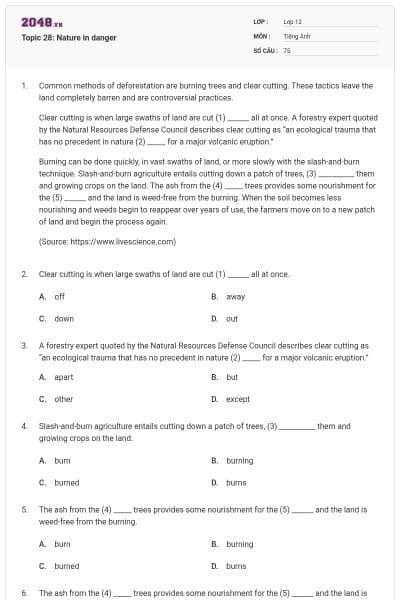
Common methods of deforestation are burning trees and clear cutting. These tactics leave the land completely barren and are controversial practices.
Clear cutting is when large swaths of land are cut (1) ______ all at once. A forestry expert quoted by the Natural Resources Defense Council describes clear cutting as “an ecological trauma that has no precedent in nature (2) _____ for a major volcanic eruption.”
Burning can be done quickly, in vast swaths of land, or more slowly with the slash-and-burn technique. Slash-and-burn agriculture entails cutting down a patch of trees, (3) __________ them and growing crops on the land. The ash from the (4) _____ trees provides some nourishment for the (5) ______ and the land is weed-free from the burning. When the soil becomes less nourishing and weeds begin to reappear over years of use, the farmers move on to a new patch of land and begin the process again.
(Source: https://www.livescience.com)
off
away
down
out
Những cách thức thường thấy của chặt phá rừng là đốt cây và chặt sạch. Những cách thức này bỏ lại vùng đất hoàn toàn cằn cỗi và là thực tiễn gây tranh cãi rất nhiều.
Chặt sạch là khi một vạt đất rộng lớn bị chặt đốn hết sạch cây cối một cách đồng thời . Một phần trích dẫn mang tính chuyên môn về quản lý rừng bởi Hiệp hội Bảo vệ Nguồn tài nguyên Thiên nhiên mô tả chặt sạch là “một tổn thương về sinh thái mà chưa từng có trong tự nhiên trước đây trừ trường hợp phun trào núi lửa lớn”.
Đốt rừng có thể được thực hiện một cách nhanh chóng, trên diện tích đất rất lớn, hoặc diễn ra chậm hơn với kỹ thuật chặt-và-đốt. Làm nông nghiệp theo kiểu chặt-và-đốt liên quan đến việc cắt đi một mảng cây cối, đốt chúng và trồng mùa vụ trên khoảng đất đó. Lượng tro lấy được từ cây bị đốt cung cấp chất dinh dưỡng cho cây và mảnh đất đó sẽ không có cỏ do việc đốt cháy nó. Khi đất trở nên ít màu mỡ hơn và cỏ dại bắt đầu xuất hiện lại qua nhiều năm sử dụng, người nông dân di chuyển đến vạt đất mới và bắt đầu lại quá trình đó một lần nữa.
Đáp án C
Kiến thức về giới từ
A. off : tắt, ra khỏi
B. away: ở xa
C. down: xuống, ở phía dưới
D. out: ở ngoài
Tạm dịch: “Clear cutting is when large swaths of land are cut (1) ______all at once.”
(Khai thác trắng là khi những dải đất lớn bị chặt (1)___ tất cả cùng một lúc.)
A forestry expert quoted by the Natural Resources Defense Council describes clear cutting as “an ecological trauma that has no precedent in nature (2) _____ for a major volcanic eruption.”
apart
but
other
except
Đáp án D
Kiến thức về giới từ
A. apart: ngoài ra
B. but: nhưng
C. other: khác
D. except: ngoại trừ
Tạm dịch: “… describes clear cutting as “an ecological trauma that has no precedent in nature (2)_____ for a major volcanic eruption.”
(… mô tả khai thác trắng như là một chấn thương sinh thái không có tiền lệ trong tự nhiên (2) _____ một vụ phun trào núi lửa lớn.
burn
burning
burned
burns
Đáp án B
Kiến thức về từ loại
A. burn /bɜːn/ (v): đốt cháy
B. burning (V-ing): đang đốt cháy
C. burned (V-ed): đã bị đốt cháy
D. burns
=> Căn cứ vào liên từ “and” nên vị trí trống cần một V-ing để 2 vế giữa “and” cân nhau. Ta loại phương án A, C, D.
Tạm dịch: “Slash-and-burn agriculture entails cutting down a patch of trees, (3) ____ them and growing crops on the land.”
(Đốt phá rừng làm nương rẫy đòi hỏi phải chặt hạ một mảng cây, (3) ____ chúng và trồng trọt trên đất.)
Cấu trúc khác cần lưu ý:
Slash-and-burn: Đốt phá rừng làm nương rẫy
burn
burning
burned
burns
Đáp án C
Kiến thức về từ loại
A. burn /bɜːn/ (v): đốt cháy
B. burning (V-ing): đang đốt cháy
C. burned (V-ed/adj): đã bị đốt cháy
D. burns
Căn cứ vào danh từ “trees” nên vị trí trống cần một tính từ. Ta loại phương án A, D.
Tạm dịch: “The ash from the (4)______ trees provides some nourishment for the (5) ____ and the land is weed-free from the burning.”
(Tro từ cây (4) _____ cung cấp một số dinh dưỡng cho (5)____ và đất không có cỏ vì đã bị đốt.)
plants
plantation
vegetables
vegetation
Đáp án A
Kiến thức về từ vựng
A. plants /plɑːnts/ (n): thực vật
B. plantation /plænˈteɪʃən/ (n): vườn ươm, đồn điền
C. vegetables /ˈvedʒtəbəlz/ (n): rau
D. vegetation /ˌvedʒɪˈteɪʃən/ (n): thảm thực vật
Tạm dịch: “The ash from the burned trees provides some nourishment for the (5) ____ and the land is weed-free from the burning.”
(Tro từ cây đã bị đốt cung cấp một số dinh dưỡng cho (5)____ và đất không có cỏ vì đã bị đốt.)
NATURAL DESTRUCTION
For all the talk of what humankind has done to cause destruction to the planet, we should not forget that nature itself is a (1) ________ force, capable of doing damage on a huge scale. The greenhouse effect and the hole in the ozone layer are indeed made worse by the industrialized society we live in. however, we must remember that there are certain species of plant and animal which, quite naturally, (2)__________ off gases that are very harmful to the atmosphere. And only 50 years ago in London, hundreds of people die from the smog which hung over the River Thames. What is interesting here is that smoke and gases from industry, vehicles and fossil fuels were ingredients in this deadly mixture. The other vital ingredient, though, was the completely natural fog, and who would have thought that could be (3) __________ ?
In the early days of the industrial revolution, poets, painters and philosophers described how the polluted (4) __________ skies made them think of the end of the world. Towards the end of the nineteenth century, the volcanic eruption of Krakatoa nearly made it happen. Thousands of tons of dust and ash were thrown into the air and, for years afterwards, there were red sunsets caused by the light filtering through this natural pollution. Remembering scientists’ pet theory about the dinosaurs (5) __________ out because of a huge volcanic eruption, we were lucky that humankind survived this time.
heavy
muscular
powerful
natural
Sau tất cả những cuộc thảo luận về điều mà con người đã làm gây ra sự phá hủy cho hành tinh của chúng ta, chúng ta không nên quên đi rằng bản thân thiên nhiên là một thế lực vô cùng mạnh mẽ, có khả năng gây ra thiệt hại trên quy mô lớn. Hiệu ứng nhà kính và lỗ thủng tầng ozone bị làm trầm trọng thêm bởi xã hội công nghiệp hóa mà chúng ta đang sống. Tuy nhiên, chúng ta phải nhớ rằng cũng có những loài cây và con vật nhất định, một cách khá là tự nhiên, tỏa ra những khí mà rất có hại cho bầu khí quyển. Và ngay chỉ 50 năm trước ở London, hàng trăm người đã chết vì làn khói có ở sông Thames. Điều thú vị ở đây là khói và khí từ công nghiệp, xe cộ và nhiên liệu hóa thạch là thành phần của hỗn hợp gây chết người này. Mặc dù vậy nhưng có một thành phần quan trọng khác là loại sương mù hoàn toàn tự nhiên, và có ai sẽ nghĩ rằng nó có thể gây hại?
Trong những ngày đầu tiên của cuộc cách mạng công nghiệp, các nhà thơ, họa sĩ và triết gia đã miêu tả cách mà bầu trời ô nhiễm của đô thị khiến họ nghĩ về ngày tận thế của thế giới. Vào khoảng trước cuối của thế kỉ thứ mười chín, sự phun trào núi lửa của Krakatoa khiến nó gần như xảy ra. Hàng nghìn tấn bụi và tro bị thổi vào bầu không khí, và trong nhiều năm sau đó, xuất hiện hiện tượng hoàng hôn đỏ gây ra bởi ánh sáng thấu qua lớp ô nhiễm tự nhiên này. Nhớ về giả thuyết của các nhà khoa học về cái chết của loài khủng long là do một trận phun trào núi lửa lớn, chúng ta thật may mắn vì loài người còn được tồn tại đến ngày hôm nay.
Đáp án C
Kiến thức về từ vựng
A. heavy /’hevi/ (a): nặng
B. muscular /’mʌskjulə/ (a): thuộc) bắp thịt, (thuộc) cơ
C. powerful /’pauəful/ (a): hùng mạnh, hùng cường, mạnh mẽ
D. natural /’nætʃrəl/ (a): (thuộc) tự nhiên, (thuộc) thiên nhiên
Tạm dịch: For all the talk of what humankind has done to cause destruction to the planet, we should not forget that nature itself is a (1) ____ force, capable of doing damage on a huge scale.
(Đối với tất cả các cuộc nói chuyện về những việc loài người đã làm để gây ra sự hủy diệt của hành tinh, chúng ta không nên quên rằng chính thiên nhiên là một lực lượng hùng mạnh, có khả năng gây sát thương trên quy mô lớn.)
take
give
throw
run
Đáp án B
Kiến thức về cụm động từ
A. take off: cởi, cất cánh
B. give off: chia, phân phối, cạn kiệt, phát ra sự ô nhiễm hoặc điều gì đó khó chịu
C. throw off: loại bỏ, thoát khỏi
D. run off: sao chép tài liệu
Tạm dịch: However, we must remember that there are certain species of plant and animal which, quite naturally, (2) ____ off gases that are very harmful to the atmosphere.
(Tuy nhiên, chúng ta phải nhớ rằng có một số loài thực vật và động vật, hoàn toàn tự nhiên, thải ra loại khí có hại cho không khí.)
The other vital ingredient, though, was the completely natural fog, and who would have thought that could be (3) __________ ?
poisoned
harmful
environmental
chemical
Đáp án B
Kiến thức về từ vựng
A. poisoned /’pɔinznid/ (a): bị nhiễm trùng, bị nhiễm độc
B. harmful /’hɑ:mful/ (a): gây tai hại, có hại
C. environmental /in,vairən’mentl/ (a): thuộc về môi trường
D. chemical /’kemikəl/ (a): thuộc hóa học
Tạm dịch: The other vital ingredient, though, was the completely natural fog, and who would have thought that could be (3) ____?
(Thành phần quan trọng khác, mặc dù, là sương mù hoàn toàn tự nhiên, và ai sẽ nghĩ rằng nó có thể gây hại?)
urban
rural
busy
global
Đáp án A
Kiến thức về từ vựng
A. urban /’ə:bən / (a): (thuộc) thành phố, (thuộc) thành thị
B. rural /’ruərəl/ (a): (thuộc) nông thôn, thôn dã
C. busy /’bizi/ (a): bận rộn, bận
D. global /’gloubəl/ (a): toàn cầu
Tạm dịch: In the early days of the industrial revolution, poets, painters and philosophers described how the polluted (4) ____ skies made them think of the end of the world.
(Trong những ngày đầu của cuộc cách mạng công nghiệp, các nhà thơ, họa sĩ và nhà triết học đã mô tả cách bầu trời đô thị bị ô nhiễm khiến họ nghĩ về ngày tận thế.)
Remembering scientists’ pet theory about the dinosaurs (5) __________ out because of a huge volcanic eruption, we were lucky that humankind survived this time.
killing
dying
fading
going
Đáp án B
Kiến thức về cụm động từ
Die out: biến mất, trở nên tuyệt chủng
Go out: ra ngoài
Tạm dịch: Remembering scientists’ pet theory about the dinosaurs (5) ____ out because of a huge volcanic eruption, we were lucky that humankind survived this time.
(Ghi nhớ lý thuyết thú cưng của các nhà khoa học về những con khủng long bị tuyệt chủng vì một trận phun trào núi lửa khổng lồ, chúng ta đã may mắn khi loài người sống sót lần này.)
Climate change is caused by the (1) ______ high levels of dangerous chemicals in the atmosphere, particularly carbon dioxide. It is estimated that average global temperatures will rise (2) _______ between two and six degrees by the end of this century. We all know the effects could be catastrophic, but are we (3) _______ of the possible solutions? Crazy as it sounds, a group of academics from British universities is making a plan to build a 12-mile pipe, held up by a huge balloon, that would pump (4) ____ quantities of toxic chemicals, such as sulphur dioxide, into the atmosphere. Surprisingly, there is good science behind the idea. The chemicals would form a (5) ____ layer around the Earth that would reflect sunlight and so cool the Earth, much like the effects of a volcanic eruption.
absolutely
extremely
interestingly
repeatedly
Biến đổi khí hậu được gây ra bởi mức độ cực kì cao của các hóa chất nguy hiểm trong bầu khí quyển, đặc biệt là carbon dioxide. Người ta ước tính rằng nhiệt độ trung bình toàn cầu sẽ tăng từ 2 đến 6 độ vào cuối thế kỷ này. Chúng ta đều biết những ảnh hưởng có thể là thảm họa, nhưng chúng ta có nbiết được các giải pháp có thể không? Nghe có vẻ điên rồ, một nhóm các học giả từ các trường đại học Anh đang lên kế hoạch xây dựng một đường ống dài 12 dặm, được giữ bởi một quả bóng khổng lồ, cái mà sẽ bơm một lượng lớn hóa chất độc hại, như lưu huỳnh dioxide, vào khí quyển. Đáng ngạc nhiên, có tác dụng về mặt khoa học tốt đằng sau ý tưởng đó. Các hóa chất sẽ tạo thành một lớp bảo vệ xung quanh Trái Đất, cái mà sẽ phản chiếu ánh sáng mặt trời và làm mát Trái Đất, giống như tác động của một vụ phun trào núi lửa.
Đáp án B
Kiến thức về từ vựng
A. absolutely /æbsə’luːtli/ (adv): tuyệt đối
B. extremely /iks’tri:mli/ (adv): vô cùng
C. interestingly /’intristiηli/ (adv): thú vị, hấp dẫn
D. repeatedly /ri’pi:tidli/ (adv): lặp đi lặp lại nhiều lần
Tạm dịch: Climate change is caused by the (1) __________ high levels of dangerous chemicals in the atmosphere, particularly carbon dioxide.
(Biến đổi khí hậu được gây ra bởi mức độ vô cùng cao của các hóa chất nguy hiểm trong khí quyển, đặc biệt là carbon dioxide.)
by
with
for
in
Đáp án A
Kiến thức về giới từ
A. by: vào, tính với
B. with: với
C. for: cho
D. in: trong
Tạm dịch: It is estimated that average global temperatures will rise (2) ____ between two and six degrees by the end of this century.
(Người ta ước tính rằng nhiệt độ trung bình toàn cầu sẽ tăng từ hai đến sáu độ vào cuối thế kỷ này.)
able
capable
aware
fond
Đáp án C
Cấu trúc:
To be able to do sth = To be capable of V-ing : có thể làm gì
Be aware of sth: nhận thức điều gì
(Be) fond of V-ing: thích làm gì đó
Tạm dịch: We all know the effects could be catastrophic, but are we (3) ____ of the possible solutions?
(Chúng ta đều biết những ảnh hưởng có thể là thảm họa, nhưng chúng ta có nhận thức được các giải pháp có thể không?)
great
enormous
extreme
absolute
Đáp án B
Kiến thức về từ vựng
A. great /greit/ (a): lớn, to lớn, vĩ đại
B. enormous / i’nɔ:məs/ (a): rất nhiều; cực kỳ lớn; khổng lồ
C. extreme /iks’tri:m/ (a): vô cùng, tột bực
D. absolute /’æbsəlu:t/ (a): tuyệt đối, hoàn toàn
Tạm dịch: Crazy as it sounds, a group of academics from British universities is making a plan to build a 12-mile pipe, held up by a huge balloon, that would pump (4) ____ quantities of toxic chemicals, such as sulphur dioxide, into the atmosphere.
(Nghe có vẻ điên rồ, một nhóm các học giả từ các trường đại học ở Anh đang lên kế hoạch xây dựng một đường ống dài 12 dặm, được giữ bởi một quả bóng khổng lồ, sẽ bơm ra lượng cực kỳ lớn hóa chất độc hại, như lưu huỳnh điôxit vào khí quyển.)
=> Enormous quantities of sth: lượng cái gì cực kỳ lớn, rất nhiều.
The chemicals would form a (5) ____ layer around the Earth that would reflect sunlight and so cool the Earth, much like the effects of a volcanic eruption.
protecting
protected
protective
protection
Đáp án C
Kiến thức về từ loại
A. protecting: dạng V-ing của động từ “protect”
B. protected: dạng V2/3 của động từ “protect”
C. protective /prə’tektiv/ (a): bảo vệ, bảo hộ, che chở
D. protection /prə’tek∫n/ (n): sự bảo vệ, sự bảo hộ, sự che chở; sự bảo trợ
Căn cứ vào từ “layer” vì vậy khoảng trống phải là một tính từ
Tạm dịch: The chemicals would form a (5) ____ layer around the earth that would reflect sunlight and so cool the earth, much like the effects of a volcanic eruption.
(Các hóa chất sẽ tạo thành một lớp bảo vệ xung quanh trái đất sẽ phản chiếu ánh sáng mặt trời và làm mát trái đất, giống như tác động của một vụ phun trào núi lửa.)
“What we’re seeing in Australia, in a completely different environment, are fires that are approaching or even exceeding the magnitude of things that we only saw in the most remote forested regions in the world,” said Ross Bradstock, the director of the Center for Environmental Risk Management of Bushfires at the University of Wollongong in New South Wales. The numbers from Australia dwarf those from some of the most high-profile fires in recent years. The bushfires in southeastern Australia this season have burned about eight times as much land as the 2018 fires in California, which covered nearly two million acres and were the worst in that state’s recorded history.
In Australia’s history, most bad fire seasons have coincided with the warming of an El Niño pattern. But that is not the case this time, showing how much this season stands out and the danger the country faces with more unpredictable weather patterns in the future. “While scientists have long predicted that climate change would bring longer and more intense fire seasons”, Dr. Bradstock said, “Under his projections, Australia would not have seen this kind of devastation for another 40 to 50 years”.
“I guess I’m as shocked as anyone about what’s unfolding and, probably, like everyone else who’s involved and affected, we’ll very quickly recalibrate thinking about what we’re doing,” he said. Recalibrating means expecting these phenomenal fires to continue to occur, particularly as Australia’s drought shows few signs of ending and temperatures are expected to continue to climb after the warmest decade on record.
“We would be extremely foolish, given all the evidence and the magnitude of this event, to just laugh it off as a one-off phenomenon,” Dr. Bradstock said. “I think we have to get ready to deal with a season like this again in the not-too-distant future.”
(Source: https://www.nytimes.com/)
Which best serves as the title for the passage?
Here is what the future looks like
The immense amount of land being burned.
Climate change helped set the table.
Protecting the world’s biodiversity.
Đáp án A
Câu nào thích hợp nhất để làm tiêu đề cho đoạn văn?
A. Đây là những gì tương lai sẽ trở thành
B. Lượng đất khổng lồ bị đốt cháy
C. Biến đổi khí hậu đã giúp thiết lập bảng
D. Bảo vệ đa dạng sinh học thế giới
Căn cứ vào thông tin đoạn cuối:
“We would be extremely foolish, given all the evidence and the magnitude of this event, to just laugh it off as a one-off phenomenon,” Dr. Bradstock said. “I think we have to get ready to deal with a season like this again in the not-too-distant future.”
(“Chúng ta sẽ vô cùng ngu ngốc, khi đưa ra tất cả bằng chứng và tầm quan trọng của sự kiện này, chỉ để giả vờ xem nó như một hiện tượng một lần và không quan trọng, bác sĩ Bradstock nói. Tôi nghĩ rằng chúng ta phải sẵn sàng để đối mặt với một mùa như thế này một lần nữa trong tương lai không xa.”)
Như vậy, đoạn văn đang dự báo về tương lai của con người sẽ lại gặp thêm một vụ cháy như vụ vừa xảy ra tại Úc.
According to paragraph 1, what can be concluded about the Australia’s megafire?
The scientists around the world are puzzled by the scale of the incidence.
The natural habitats in Australia have been transformed beyond recognition.
The modern world has never seen anything quite like these Australia fires.
The accident offers the global citizens a chance to showcase their awareness.
Đáp án C
Theo đoạn 1, những gì có thể được kết luận về vụ cháy lớn ở Úc?
A. Các nhà khoa học trên thế giới đang bối rối trước quy mô của phạm vi tác động
B. Môi trường sống tự nhiên ở Úc đã bị biến đổi ngoài tầm hiểu biết của con người
C. Thế giới hiện đại chưa bao giờ thấy bất cứ điều gì giống như những đám cháy ở Úc này
D. Vụ tai nạn mang đến cho công dân toàn cầu cơ hội thể hiện nhận thức của họ
Căn cứ vào thông tin đoạn một:
The bushfires in southeastern Australia this season have burned about eight times as much land as the 2018 fires in California, which covered nearly two million acres and were the worst in that state’s recorded history.
(Vụ cháy rừng ở miền đông nam Úc mùa này đã đốt cháy đất đai gấp tám lần so với vụ hỏa hoạn ở bang California năm 2018, bao trùm gần hai triệu mẫu Anh và là vụ cháy tồi tệ nhất trong lịch sử được ghi lại của bang.)
According to paragraph 2, what did Dr. Bradstock imply about the bushfire?
Human is the main catalyst for the Australian fires.
The blazes were not expected to be this bad so soon.
Megablaze of the same scale will happen in half a century.
Climate change would bring more intense wildfires.
Đáp án B
Theo đoạn 2, tiến sĩ Bradstock đã ám chỉ điều gì về vụ cháy rừng?
A. Con người là chất xúc tác chính cho các đám cháy ở Úc
B. Vụ cháy không được dự đoán sẽ tệ như vậy sớm
C. Vụ cháy lớm có cùng quy mô sẽ xảy ra trong nửa thế kỷ
D. Biến đổi khí hậu sẽ mang lại những trận cháy rừng dữ dội hơn
Căn cứ vào thông tin đoạn hai:
“While scientists have long predicted that climate change would bring longer and more intense fire seasons”, Dr. Bradstock said, “Under his projections, Australia would not have seen this kind of devastation for another 40 to 50 years”.
(“Trong khi các nhà khoa học từ lâu đã dự đoán rằng biến đổi khí hậu sẽ mang lại mùa nóng lâu hơn và dữ dội hơn, tiến sĩ Bradstock nói, “Theo dự đoán của ông, Úc sẽ không chứng kiến sự tàn phá này thêm 40 đến 50 năm nữa.)
The word “unfolding” in paragraph 3 is closest in meaning to ______.
evolving
opening
unravelling
happening
Đáp án D
Từ “unfolding” trong đoạn 3 có nghĩa gần nhất với ______.
A. tiến hóa
B. mở
C. làm sáng tỏ
D. xảy ra
Từ đồng nghĩa unfold (diễn ra) = happen
“I guess I’m as shocked as anyone about what’s unfolding and, probably, like everyone else who’s involved and affected, we’ll very quickly recalibrate thinking about what we’re doing,” he said.
(“Tôi đoán là tôi đã bị sốc như bất cứ ai về những gì mà đang diễn ra và có lẽ, giống như mọi người khác, người mà có liên quan và bị ảnh hưởng, chúng tôi sẽ nhanh chóng tính toán lại suy nghĩ về những gì chúng tôi đang làm,” ông nói.)
The word “it” in paragraph 4 refers to _______.
evidence
event
magnitude
season
Đáp án B
Từ “it” trong đoạn 4 đề cập đến _________.
A. bằng chứng
B. sự kiện
C. cường độ
D. mùa
Từ “it” ở đây dùng để thay thế cho danh từ sự kiện được nhắc tới trước đó.
“We would be extremely foolish, given all the evidence and the magnitude of this event, to just laugh it off as a one-off phenomenon,” Dr. Bradstock said.
(“Chúng ta sẽ vô cùng ngu ngốc, đưa ra tất cả bằng chứng và tầm quan trọng của sự kiện này, chỉ để giả vờ xem nó như một hiện tượng một lần và không quan trọng, bác sĩ Bradstock nói.)
Thousands of emergency service workers battling out of control fires across New South Wales, Australia are bracing for worsening conditions next week. Stopping the spread of fires around the state will be the top priority on Sunday, with weather conditions expected to deteriorate after that.
“Tuesday, particularly, will be a day of concern,” Rural Fire Service spokesman Greg Allan said. “There will be high temperatures, very strong winds, and low humidity.” While no fires reached emergency level on Saturday, Mr Allan stressed that people needed to remain alert. “It’s still a very dangerous situation,” he said.
More than 2 million hectares of bush land has been destroyed by flames this fire season. With RFS Commissioner Shane Fitzsimmons warning the worst might still be ahead. Mr Fitzsimmons said there may not be much respite for tiring firefighters, with no signs of significant rainfall until late January or early February. Over 100 bushfires burned across the state on Saturday, and almost half of them were out of control, with a huge – larger than Sydney – having formed north-west of the city. Another fire at Green Wattle Creek, south-west of Sydney, is still burning uncontrollably, having already destroyed 5400 hectares of bush land.
Efforts are being made to keep the situation from getting out of hand. More than 2100 personnel are fighting the fires across the state and a group of 21 specialty firefighters form the US has arrived in Australia, following 21of their Canadian counterparts. While the Canadians are being distributed to the north of the state, the Americans will be assigned to areas in the Sydney Basin or southern New South Wales. Additionally, a total fire ban was in place for eight regions across the state, including Sydney, Far North Coast, Greater Hunter, the Illawarra and Central Rangers. “Right across all fire grounds, our crews, although exhausted, are working extremely hard to slow the spread of fire,” said Mr. Allan.
(Adapted from metro.co.uk)
What is the passage mainly about?
Levels of fire in Australia
Australia’s ongoing fire crisis
Australia specialty firefighters
Climate conditions in Australia
Đáp án B
Ý chính của bài là gì?
Xét các đáp án:
A. Mức độ cháy ở Úc
B. Cuộc khủng hoảng hỏa hoạn ở Úc
C. Đặc sản lính cứu hỏa của Úc
D. Điều kiện khí hậu ở Úc
According to the passage, all of the following are mentioned by Mr. Greg Allan as weather conditions in Australia on Tuesday EXCEPT __________.
high temperatures
strong winds
low humidity
significant rainfall
Đáp án D
Theo đoạn văn, tất cả những điều sau đây được ông Greg Allan nhắc đến là điều kiện thời tiết tại Úc vào thứ ba NGOẠI TRỪ _________.
Xét các đáp án:
A. nhiệt độ cao
B. gió to
C. độ ẩm thấp
D. lượng mưa đáng kể
Căn cứ vào thông tin đoạn 2:
“Tuesday, particularly, will be a day of concern,” Rural Fire Service spokesman Greg Allan said. “There will be high temperatures, very strong winds, and low humidity.”
(Thứ ba, đặc biệt, sẽ là một ngày đáng quan tâm, phát ngôn viên của Sở cứu hỏa nông thôn, ông Greg Allan nói. Sẽ có nhiệt độ cao, gió rất mạnh và độ ẩm thấp.)
In the passage, it is stated by Mr. Allan that ____________
firefighters are too tired and cannot fight fires.
the situation will improve after Tuesday.
there will be little rainfall in the next few months.
it is important that people remain alert.
Đáp án D
Trong đoạn văn, ông Allan đã tuyên bố rằng _____________.
Xét các đáp án:
A. lính cứu hỏa quá mệt mỏi và không thể chống cháy.
B. tình hình sẽ được cải thiện sau thứ ba.
C. sẽ có lượng mưa nhỏ trong vài tháng tới.
D. điều quan trọng là mọi người vẫn cảnh giác.
Căn cứ vào thông tin đoạn 2:
While no fires reached emergency level on Saturday, Mr Allan stressed that people needed to remain alert. “It’s still a very dangerous situation,” he said.
(Trong khi không có đám cháy nào đạt đến mức khẩn cấp vào thứ Bảy, ông Allan nhấn mạnh rằng mọi người vẫn cần phải cảnh giác. “Đây là một tình huống rất nguy hiểm”, ông nói.)
The word “them” in paragraph 3 refers to __________________.
firefighters
signs
bushfires
bush land
Đáp án C
Từ “them” trong đoạn 3 đề cập đến____________.
Xét các đáp án:
A. lính cứu hỏa
B. dấu hiệu
C. cháy rừng
D. đất rừng
Căn cứ vào thông tin đoạn 4:
Over 100 bushfires burned across the state on Saturday, and almost half of them were out of control, with a huge – larger than Sydney – having formed north-west of the city.
(Hơn 100 đám cháy đã được đốt cháy trên toàn bang vào thứ Bảy và gần một nửa trong số đó đã vượt khỏi tầm kiểm soát, với số lượng lớn - lớn hơn Sydney - đã hình thành về phía tây bắc thành phố.)
The word “respite” in paragraph 3 is closet in meaning to _______________.
reward
rest
delay
success
Đáp án B
Từ “respite” trong đoạn 3 gần nghĩa nhất với từ _______________.
Xét các đáp án:
A. phần thưởng, sự đền ơn
B. sự nghỉ ngơi, sự thanh thản
C. trì hoãn
D. thành công
Căn cứ vào thông tin đoạn 4:
Mr Fitzsimmons said there may not be much respite for tiring firefighters, with no signs of significant rainfall until late January or early February.
(Ông Fitzsimmons cho biết có thể không có nhiều thời gian nghỉ ngơi cho những người lính cứu hỏa mệt mỏi, không có dấu hiệu mưa đáng kể nào cho đến cuối tháng 1 hoặc đầu tháng 2.)
Deforestation has important global consequences. Forests sequester carbon in the form of wood and other biomass as the trees grow, taking up carbon dioxide from the atmosphere. When forests are burned, their carbon is returned to the atmosphere as carbon dioxide, a greenhouse gas that has the potential to alter global climate, and the trees are no longer present to sequester more carbon.
In addition, most of the planet’s valuable biodiversity is within forests, particularly tropical ones. Moist tropical forests such as the Amazon have the greatest concentrations of animal and plant species of any terrestrial ecosystem; perhaps two-thirds of Earth’s species live only in these forests. As deforestation proceeds, it has the potential to cause the extinction of increasing numbers of these species.
On a more local scale, the effects of forest clearing, selective logging, and fires interact. Selective logging increases the flammability of the forest because it converts a closed, wetter forest into a more open, drier one. This leaves the forest vulnerable to the accidental movement of fires from cleared adjacent agricultural lands and to the killing effects of natural droughts. As wildfires, logging, and droughts continue, the forest can become progressively more open until all the trees are lost. Additionally, the burning of tropical forests is generally a seasonal phenomenon and can severely impact air quality. Record-breaking levels of air pollution have occurred in Southeast Asia as the result of burning for oil palm plantations.
In the tropics, much of the deforested land exists in the form of steep mountain hillsides. The combination of steep slopes, high rainfall, and the lack of tree roots to bind the soil can lead to disastrous landslides that destroy fields, homes, and human lives. With the significant exception of the forests destroyed for the oil palm industry, many of the humid forests that have been cleared are soon abandoned as croplands or only used for low-density grazing because the soils are extremely poor in nutrients. The vegetation that contains most of the nutrients is often burned, and the nutrients literally “go up in smoke” or are washed away in the next rain.
Although forests may regrow after being cleared and then abandoned, this is not always the case, especially if the remaining forests are highly fragmented. Such habitat fragmentation isolates populations of plant and animal species from each other, making it difficult to reproduce without genetic bottlenecks, and the fragments may be too small to support large or territorial animals. Furthermore, deforested lands that are planted with commercially important trees lack biodiversity and do not serve as habitats for native plants and animals, many of which are endangered species.
(Source: https://www.britannica.com/science/deforestation)
What does the passage mainly discuss?
Effects of deforestation
History of deforestation
Modern deforestation
Habitat for wildlife
Đáp án A
Đoạn văn chủ yếu thảo luận về vấn đề gì?
A. Tác động của nạn phá rừng
B. Lịch sử phá rừng
C. Phá rừng hiện đại
D. Môi trường sống cho động vật hoang dã
Căn cứ thông tin giới thiệu trong đoạn 1:
Deforestation has important global consequences. Forests sequester carbon in the form of wood and other biomass as the trees grow, taking up carbon dioxide from the atmosphere. When forests are burned, their carbon is returned to the atmosphere as carbon dioxide, a greenhouse gas that has the potential to alter global climate, and the trees are no longer present to sequester more carbon.
(Phá rừng gây ra những hậu quả toàn cầu nghiêm trọng. Rừng giữ lại các-bon dưới dạng gỗ và sinh khối khác khi cây phát triển, hấp thụ khí các-bon-đi-ô-xít từ khí quyển. Khi rừng bị đốt cháy, các-bon của chúng được trả về khí quyển dưới dạng khí các-bon-đi-ô-xít, một loại khí nhà kính có khả năng làm thay đổi khí hậu toàn cầu, và cây cối không còn tồn tại để giữ thêm các-bon.)
What does the author imply in paragraph 2?
Deforestation is only happening in tropical forests such as the Amazon, which have the greatest concentrations of animal and plant species of any terrestrial ecosystem.
Two-thirds of Earth’s species are affected if deforestation proceeds.
Continuous deforestation can put increasing numbers of these species on the edge of extinction.
Đáp án D
Tác giả có ngụ ý gì trong đoạn 2?
A. Sự phá rừng là do hầu hết đa dạng sinh học có giá trị của hành tinh nằm trong rừng.
B. Phá rừng chỉ xảy ra trong các khu rừng nhiệt đới như Amazon, nơi có mật độ các loài động vật và thực vật lớn nhất của bất kỳ hệ sinh thái trên cạn nào.
C. Hai phần ba số loài của Trái Đất bị ảnh hưởng nếu rừng tiếp tục bị tàn phá.
D. Phá rừng liên tục có thể đặt một số lượng ngày càng tăng các loài trên bờ vực tuyệt chủng.
Căn cứ thông tin đoạn 2:
As deforestation proceeds, it has the potential to cause the extinction of increasing numbers of these species.
(Khi việc phá rừng tiếp diễn, nó có khả năng khiến cho một số lượng ngày càng tăng các loài bị tuyệt chủng.)
What does the word “This” in paragraph 3 refer to?
Forest clearing
Selective logging
Fires
Forest
Đáp án B
Từ “This” trong đoạn 3 ám chỉ điều gì?
A. Chặt phá rừng
B. Đốn gỗ có chọn lọc
C. Đám cháy
D. Rừng
Kiến thức từ vựng và ngữ pháp:
Selective logging increases the flammability of the forest because it converts a closed, wetter forest into a more open, drier one. This leaves the forest vulnerable to the accidental movement of fires from cleared adjacent agricultural lands and to the killing effects of natural droughts.
(Khai thác gỗ có chọn lọc làm tăng tính dễ cháy của rừng bởi vì nó biến đổi một khu rừng kín, ẩm ướt thành một khu rừng khô và thoáng hơn. Điều này khiến rừng dễ bị tổn thương do sự di chuyển ngẫu nhiên của đám cháy từ các vùng đất nông nghiệp liền kề bị chặt phá và các tác động chết người của hạn hán tự nhiên.)
Which of the following is NOT true according to paragraph 3?
There is some interaction between effects of forest clearing, selective logging, and fires.
Selective logging makes it more vulnerable for the forest to catch fire from adjacent agricultural lands.
Forest can become progressively more open when wildfires, logging, and droughts continue.
Burning of tropical forests is generally a seasonal phenomenon, so it does not severely impact air quality.
Đáp án D
Thông tin nào sau đây KHÔNG đúng theo thông tin đoạn 3?
A. Có một số tương tác giữa các tác động của khai thác rừng, khai thác gỗ chọn lọc và cháy rừng.
B. Việc khai thác gỗ có chọn lọc làm cho rừng dễ bị bắt lửa từ các vùng đất nông nghiệp liền kề.
C. Rừng có thể ngày càng mở rộng hơn khi cháy rừng khi mà khai thác gỗ và hạn hán tiếp tục.
D. Đốt các khu rừng nhiệt đới thường là hiện tượng theo mùa, do đó nó không ảnh hưởng nghiêm trọng đến chất lượng không khí.
Căn cứ thông tin đoạn 3:
Additionally, the burning of tropical forests is generally a seasonal phenomenon and can severely impact air quality. Record-breaking levels of air pollution have occurred in Southeast Asia as the result of burning for oil palm plantations.
(Ngoài ra, việc đốt các khu rừng nhiệt đới thường là hiện tượng theo mùa và có thể ảnh hưởng nghiêm trọng đến chất lượng không khí. Mức độ phá kỷ lục về ô nhiễm không khí đã được ghi nhận ở Đông Nam Á là kết quả của việc đốt rừng để trồng cọ dầu.)
The word “significant” in paragraph 4 can be best replaced by ______.
notifiable
insatiable
noticeable
inseparable
Đáp án C
Từ “significant” trong đoạn 4 có thể được thay thế tốt nhất bởi từ ______.
A. có thể khai báo
B. không thể thỏa mãn
C. đáng chú ý
D. không thể tách rời
Kiến thức từ vựng: significant (đáng kể, dễ thấy) = noticeable
With the significant exception of the forests destroyed for the oil palm industry, many of the humid forests that have been cleared are soon abandoned as croplands or only used for low-density grazing because the soils are extremely poor in nutrients.
(Ngoại trừ những khu rừng bị phá hủy trong ngành công nghiệp cọ dầu dễ thấy, nhiều khu rừng ẩm ướt đã bị xóa sổ và sớm bị bỏ hoang như đất trồng trọt hoặc chỉ được sử dụng để chăn thả mật độ thấp vì đất rất nghèo chất dinh dưỡng.)
Paragraph 4 mentions all of the following information EXCEPT ______.
Disastrous landslides convert the deforested land into the form of steep mountain hillsides.
Landslides that destroy fields, homes, and human lives are due to the combination of steep slopes, high rainfall, and the lack of tree roots to bind the soil.
Soil in many humid forests becomes very poor in nutrients because the forests have been cleared, and are soon abandoned.
The nutrients contained in vegetation are burned and fly away, or are washed away by rain.
Đáp án A
Đoạn 4 đề cập đến tất cả các thông tin sau trừ ______.
A. Các vụ lở đất thảm họa biến đổi đất rừng bị phá thành dạng sườn đồi núi dốc.
B. Lở đất phá hủy các cánh đồng, nhà cửa và cuộc sống của con người là do sự kết hợp của các sườn dốc, lượng mưa lớn và thiếu rễ cây để giữ đất.
C. Đất trong nhiều khu rừng ẩm trở nên rất nghèo các chất dinh dưỡng vì rừng đã bị chặt phá, và sớm bị bỏ hoang.
D. Các chất dinh dưỡng chứa trong thảm thực vật được đốt cháy và bay đi, hoặc bị cuốn trôi bởi mưa.
Căn cứ thông tin đoạn 4:
In the tropics, much of the deforested land exists in the form of steep mountain hillsides. The combination of steep slopes, high rainfall, and the lack of tree roots to bind the soil can lead to disastrous landslides that destroy fields, homes, and human lives.
(Ở vùng nhiệt đới, phần lớn đất đai bị tàn phá tồn tại dưới dạng các sườn đồi núi dốc đứng. Sự kết hợp của các sườn dốc, lượng mưa lớn và thiếu rễ cây để giữ đất có thể dẫn đến sạt lở đất, tàn phá những cánh đồng, nhà cửa và đời sống con người.)
What does the phrase “genetic bottlenecks” mostly mean?
A change in the statistical distribution of weather patterns
A sharp reduction in the size of a population due to environmental events or human activities
The total number of genetic characteristics in the genetic makeup of a species
The body’s response caused by its immune system being activated by antigens
Đáp án B
Cụm từ “genetic bottlenecks” có ý nghĩa gì?
A. Sự thay đổi trong phân bố thống kê các mẫu thời tiết
B. Giảm mạnh về quy mô dân số do các sự kiện môi trường hoặc hoạt động của con người
C. Tổng số đặc điểm di truyền trong cấu trúc di truyền của một loài
D. Phản ứng của cơ thể gây ra bởi hệ miễn dịch của nó được kích hoạt bởi các kháng nguyên
Kiến thức về từ vựng:
Such habitat fragmentation isolates populations of plant and animal species from each other, making it difficult to reproduce without genetic bottlenecks, and the fragments may be too small to support large or territorial animals.
(Sự phân tán môi trường sống như vậy sẽ cô lập các quần thể thực vật và động vật khỏi nhau, làm cho nó khó tái tạo mà không bị giảm sút số lượng do tác động của môi trường, và các mảng môi trường sống này có thể là quá nhỏ để cung cấp chỗ trú ngụ cho số lượng động vật lớn hoặc của toàn lãnh thổ.)
What is the author’s attitude to the matter mentioned in the passage?
Admiration
Criticism
Neutral
Sarcasm
Đáp án C
Thái độ của tác giả đối với vấn đề được đề cập trong đoạn văn là gì?
A. Ngưỡng mộ
B. Phê Bình
C. Trung lập
D. Mỉa mai
Đọc kỹ, nắm ý chính mỗi đoạn và toàn bài để chọn thái độ đúng của tác giả đối với vấn đề nêu trong bài.
Deforestation is the clearing, destroying, or otherwise removal of trees through deliberate, natural or accidental means. It can occur in any area densely populated by trees and other plant life, but the majority of it is currently happening in the Amazon rainforest. The loss of trees and other vegetation can cause climate change, desertification, soil erosion, fewer crops, flooding, increased greenhouse gases in the atmosphere, and a host of problems for indigenous people.
Deforestation occurs for a number of reasons, including: farming, mostly cattle due to its quick turn around; and logging for materials and development. It has been happening for thousands of years, arguably since man began converting from hunter/gatherer to agricultural based societies, and required larger, unobstructed tracks of land to accommodate cattle, crops, and housing. It was only after the onset of the modern era that it became an epidemic.
One of the most dangerous and unsettling effects of deforestation is the loss of animal and plant species due to their loss of habitat; not only do we lose those known to us, but also those unknown, potentially an even greater loss. Seventy percent of Earth’s land animals and plants live in forests, and many cannot survive the deforestation that destroys their homes. The trees of the rainforest that provide shelter for some species also provide the canopy that regulates the temperature, a necessity for many others. Its removal through deforestation would allow a more drastic temperature variation from day to night, much like a desert, which could prove fatal for current inhabitants.
In addition to the loss of habitat, the lack of trees also allows a greater amount of greenhouse gases to be released into the atmosphere. Presently, the tropical rainforests of South America are responsible for 20% of Earth’s oxygen and they are disappearing at a rate of 4 hectares a decade. If these rates are not stopped and reversed, the consequences will become even more severe.
The trees also help control the level of water in the atmosphere by helping to regulate the water cycle. With fewer trees left, due to deforestation, there is less water in the air to be returned to the soil. In turn, this causes dryer soil and the inability to grow crops, an ironic twist when considered against the fact that 80% of deforestation comes from small-scale agriculture and cattle ranching.
Further effects of deforestation include soil erosion and coastal flooding. In addition to their previously mentioned roles, trees also function to retain water and topsoil, which provides the rich nutrients to sustain additional forest life. Without them, the soil erodes and washes away, causing farmers to move on and perpetuate the cycle. The barren land which is left behind in the wake of these unsustainable agricultural practices is then more susceptible to flooding, specifically in coastal regions. Coastal vegetation lessens the impact of waves and winds associated with a storm surge. Without this vegetation, coastal villages are susceptible to damaging floods.
(Source: https://www.pachamama.org/)
What does the passage mainly discuss?
The definition of deforestation.
The negative impacts of deforestation.
The reasons why deforestation occurs frequently.
The effective solutions to solve the deforestation all over the world.
Đáp án B
Đoạn văn này chủ yếu thảo luận về điều gì?
A. Định nghĩa về nạn phá rừng.
B. Những tác động tiêu cực của nạn phá rừng.
C. Những nguyên nhân vì sao nạn phá rừng lại xảy ra thường xuyên.
D. Những giải pháp hiệu quả để xử lý nạn phá rừng trên khắp thế giới.
Căn cứ thông tin đoạn 1:
The loss of trees and other vegetation can cause climate change, desertification, soil erosion, fewer crops, flooding, increased greenhouse gases in the atmosphere, and a host of problems for indigenous people.
(Tình trạng mất cây và thảm thực vật khác có thể gây ra biến đổi khí hậu, sa mạc hóa, xói mòn đất, ít vụ mùa, lũ lụt, tăng khí nhà kính trong bầu khí quyển, và một loạt các vấn đề cho người dân bản địa.)
Như vậy, đoạn văn đang thảo luận về các tác động tiêu cực của nạn phá rừng lên môi trường và con người.
The word “indigenous” in the first paragraph probably means _________.
foreign
agrarian
native
mountainous
Đáp án C
Từ “indigenous” trong đoạn 1 có thể có nghĩa là ________.
A. nước ngoài
B. nông dân
C. bản địa
D. vùng núi
Từ đồng nghĩa: indigenous (bản địa) = native
The loss of trees and other vegetation can cause climate change, desertification, soil erosion, fewer crops, flooding, increased greenhouse gases in the atmosphere, and a host of problems for indigenous people. (Tình trạng mất cây và thảm thực vật khác có thể gây ra biến đổi khí hậu, sa mạc hóa, xói mòn đất, ít vụ mùa, lũ lụt, tăng khí nhà kính trong bầu khí quyển, và một loạt các vấn đề cho người dân bản địa.)
Which of the following is NOT stated as the reason of deforestation in paragraph 2?
cutting trees for wood
ranching cattle
cultivating
hunting for food.
Đáp án D
Câu nào trong các câu sau không được nhắc đến như là nguyên nhân của nạn phá rừng trong đoạn 2?
A. chặt cây lấy gỗ
B. chăn nuôi gia súc
C. trồng trọt
D. săn bắt lấy thức ăn
Căn cứ thông tin đoạn 2:
Deforestation occurs for a number of reasons, including: farming, mostly cattle due to its quick turn around; and logging for materials and development. It has been happening for thousands of years, arguably since man began converting from hunter/gatherer to agricultural based societies, and required larger, unobstructed tracks of land to accommodate cattle, crops, and housing. It was only after the onset of the modern era that it became an epidemic.
(Nạn phá rừng xảy ra vì một số lý do, bao gồm: chăn nuôi, chủ yếu là gia súc do sự quay vòng nhanh; và khai thác gỗ làm vật liệu và phát triển. Nó đã xảy ra hàng ngàn năm, được cho là kể từ khi con người bắt đầu chuyển đổi từ săn bắt/ hái lượm sang xã hội dựa trên nông nghiệp, và yêu cầu những thửa đất rộng lớn, không bị cản trở để chứa gia súc, cây trồng và nhà ở. Chỉ sau khi bắt đầu thời hiện đại, nó đã trở thành một đại dịch.)
What does the word “others” in the third paragraph refer?
canopy
species
rainforest
trees
Đáp án B
Từ “others” trong đoạn 3 đề cập đến từ nào?
A. vòm cây
B. các loài
C. rừng mưa nhiệt đới
D. nhiều cây
Từ “others” thay thế cho danh từ các loài ở câu trước.
The trees of the rainforest that provide shelter for some species also provide the canopy that regulates the temperature, a necessity for many others.
(Những cây rừng nhiệt đới cung cấp nơi trú ẩn cho một số loài thì cũng cung cấp tán cây điều chỉnh nhiệt độ, một điều cần thiết cho nhiều loài khác.)
The following are negative effects of deforestation, EXCEPT __________.
Myriad flora and fauna species have been eradicated before we discover them.
The alteration of temperature in a complete day is becoming more radical due to the loss of trees.
The soil is infertile to grow crops because of the shortage of rain and erosion.
More and more animals have to find a place of refuge under the canopy of leaves.
Đáp án D
Những câu sau đây là tác hại của nạn phá rừng, ngoại trừ _______.
A. Nhiều loài thực vật và động vật đã bị tuyệt chủng trước khi chúng ta tìm ra chúng.
B. Sự biến đổi nhiệt độ trong 1 ngày hoàn chỉnh đang trở nên khắc nghiệt hơn vì sự mất rừng.
C. Đất không còn màu mỡ để canh tác vụ mùa bởi vì thiếu mưa và xói mòn.
D. Ngày càng nhiều động vật phải tìm nơi trú ẩn dưới vòm lá cây.
Căn cứ thông tin đoạn 3, 4, 5:
One of the most dangerous and unsettling effects of deforestation is the loss of animal and plant species due to their loss of habitat; not only do we lose those known to us, but also those unknown, potentially an even greater loss.
(Một trong những tác động nguy hiểm nhất và bất ổn nhất của nạn phá rừng là sự mất mát của các loài động vật và thực vật do mất môi trường sống; chúng ta không chỉ mất những loài đã được biết đến, mà còn cả những loài vẫn chưa biết, có khả năng sự mất mát còn lớn hơn nữa.)
Its removal through deforestation would allow a more drastic temperature variation from day to night, much like a desert, which could prove fatal for current inhabitants.
(Việc loại bỏ vòm cây thông qua phá rừng sẽ khiến cho sự biển đổi nhiệt độ mạnh hơn từ ngày sang đêm, giống như một sa mạc, có thể gây tử vong cho cư dân hiện tại.)
With fewer trees left, due to deforestation, there is less water in the air to be returned to the soil. In turn, this causes dryer soil and the inability to grow crops, an ironic twist when considered against the fact that 80% of deforestation comes from small-scale agriculture and cattle ranching.
(Với ít cây còn lại, do mất rừng, sẽ có ít nước trong không khí được trả lại đất. Đổi lại, điều này khiến cho đất khô và không có khả năng trồng trọt, một điều mỉa mai khi trong thực tế rằng 80% nạn phá rừng đến từ nông nghiệp quy mô nhỏ và chăn nuôi gia súc.)
Further effects of deforestation include soil erosion and coastal flooding.
(Những ảnh hưởng xa hơn của nạn phá rừng bao gồm xói mòn đất và lũ lụt ở vùng duyên hải).
The word “perpetuate” in the last paragraph is closest in meaning to _________.
maintain
stop
prevent
start
Đáp án A
Từ “perpetuate” trong đoạn cuối gần nghĩa nhất với từ _________.
A. duy trì
B. dừng lại
C. ngăn cản
D. bắt đầu
Từ đồng nghĩa: perpetuate (duy trì) = maintain
In addition to their previously mentioned roles, trees also function to retain water and topsoil, which provides the rich nutrients to sustain additional forest life. Without them, the soil erodes and washes away, causing farmers to move on and perpetuate the cycle.
(Ngoài các vai trò đã đề cập trên đây của chúng, cây cũng có chức năng giữ nước và lớp đất trên bề mặt, cung cấp các chất dinh dưỡng phong phú để duy trì cuộc sống của rừng bổ sung. Nếu không có chúng, đất sẽ bị xói mòn và rửa trôi, khiến nông dân phải tiếp tục di chuyển và duy trì chu trình này.)
Coastal regions are mentioned in the last paragraph as an example of regions that ________.
are easy to be vulnerable in a storm surge.
are left behind because of the reduction of forests.
are not much influenced by flood.
often experience droughts or erosion.
Đáp án A
Vùng duyên hải được đề cập trong đoạn cuối như là 1 ví dụ về các vùng mà ___________.
A. dễ dàng bị tổn thương trong 1 cơn bão.
B. bị bỏ lại bởi vì sự suy giảm của rừng.
C. không bị ảnh hưởng nhiều bởi lũ lụt.
D. thường chứng kiến cảnh hạn hán hay xói mòn.
Căn cứ vào thông tin đoạn cuối:
The barren land which is left behind in the wake of these unsustainable agricultural practices is then more susceptible to flooding, specifically in coastal regions. Coastal vegetation lessens the impact of waves and winds associated with a storm surge. Without this vegetation, coastal villages are susceptible to damaging floods.
(Vùng đất cằn cỗi bị bỏ lại sau sự trỗi dậy của những hoạt động nông nghiệp không bền vững này thì dễ bị ngập lụt hơn, đặc biệt là ở các vùng ven biển. Thảm thực vật ven biển làm giảm tác động của sóng và gió ltừ một cơn bão. Nếu không có thảm thực vật này, các làng ven biển dễ bị lũ lụt gây hại.)
The paragraph following the last paragraph in the passage may probably discuss _______.
a number of disadvantages that deforestation puts local people at.
some drastic measures that should be taken to deal with deforestation.
the reality of deforestation in some specific countries.
some scientists’ perspectives about deforestation.
Đáp án A
Đoạn văn sau đoạn cuối cùng trong bài văn này có thể thảo luận về _________.
A. một loạt các bất lợi mà nạn phá rừng gây ra cho người dân bản địa
B. một vài biện pháp quyết liệt nên được thực hiện để giải quyết nạn phá rừng.
C. thực trạng của nạn phá rừng ở một vài đất nước cụ thể.
D. quan điểm của các nhà khoa học về nạn phá rừng.
Căn cứ vào thông tin đoạn 1 và các đoạn khác trong bài:
Trong đoạn 1, nội dung chính của bài đọc là các tác động tiêu cực của nạn phá rừng như: biến đổi khí hậu, sa mạc hóa, xói mòn đất, ít vụ mùa, lũ lụt, tăng khí nhà kính trong bầu khí quyển, và một loạt các vấn đề cho người dân bản địa. Trong các đoạn văn tiếp theo, tác giả đã nói về các tác động trên ngoại trừ những vấn đề mà nạn phá rừng gây ra cho người dân bản địa. Vì vậy, đoạn sau đoạn cuối trong bài sẽ nói về các vấn đề đó.
Birds are even more disrupted by their noisy neighbours than had been thought previously, researchers have found. And human activities could be preventing birds from reproducing and even developing normal social behaviour and keeping the peace.
A study by Queen’s University Belfast found that when European robins were subjected to human produced noises their behaviour changed. Background noise appeared to mask the communication of crucial information between birds. While aggressive communication is common and birds respond to it, interference through noise can lead to the birds mistaking the signals.
Birds can end up in situations all too familiar to humans. “The birds receive incomplete information on their opponent’s intent and do not appropriately adjust their response,” explained Arnott. “Where song is disguised by background noise, in some cases the male ends up fighting more vigorously than he should, but at other times gives in too easily.”Arnott said the purpose of birdsong was twofold – to attract mates and defend territory. Birds already face an array of human-made dangers, from pesticides and intensive farming to shooting and poisoning. But noise had often been overlooked, the paper in Biology Letters found.
A spokesperson for the RSPB said: “Everyone is becoming increasingly concerned that nature is in crisis in the UK, with one in 10 of our wildlife species at threat of extinction. Many of our birds’ populations are already facing a serious crisis as a result of habitat loss, climate change and other human activities. This report is a good reminder that the way we live and our lifestyle has an impact on our natural world, and that we need to protect our natural world if we want to let nature sing.”
For birds, the extra burden of noise pollution adds to extraordinary decline in species, including among once common birds, in recent decades due to such activities as agricultural practice and pesticide use. In the experiment the team used playbacks of robin song to stimulate responses from birds who were territory holders. Simple or complex songs were used in either the presence or absence of noise. The researchers found that song complexity was used as a signal of aggressive intent; birds demonstrated higher aggressive intent towards complex rather than simple song. This process was disrupted by the presence of added noise.
(Source: https://www.theguardian.com/)
Which best serves as the title for the passage?
The adverse effects of light pollution.
One does not simply adapt to noise pollution.
Birds do not habituate to artificial environment.
Noise pollution creates havoc for birds.
Đáp án D
Câu nào sau đây thích hợp nhất làm tiêu đề cho đoạn văn?
A. Các tác động bất lợi của ô nhiễm ánh sáng
B. Một người không chỉ đơn giản là thích ứng với ô nhiễm tiếng ồn
C. Chim không quen với môi trường nhân tạo
D. Ô nhiễm tiếng ồn tạo ra sự tàn phá cho loài chim
Căn cứ vào thông đoạn đầu:
Birds are even more disrupted by their noisy neighbours than had been thought previously, researchers have found. And human activities could be preventing birds from reproducing and even developing normal social behaviour and keeping the peace.
(Các nhà nghiên cứu đã nhận thấy loài chim thậm chí còn bị quấy rầy bởi những người hàng xóm ồn ào hơn những gì họ nghĩ trước đây. Và các hoạt động của con người có thể ngăn không cho chim sinh sản và thậm chí phát triển các hành vi xã hội bình thường và giữ hòa bình.)
Như vậy, đoạn văn đang nói về vấn đề ô nhiễm tiếng ồn gây ảnh hưởng đến cho loài chim.
The word “reproducing” in paragraph 1 is closest in meaning to _______.
procreating
cultivating
spawning
replicating
Đáp án A
Từ “reproducing” trong đoạn 1 có nghĩa gần nhất với _________.
A. sinh sản
B. trồng trọt
C. xuất hiện
D. nhân rộng
Từ đồng nghĩa reproduce (sinh sản) = procreating
And human activities could be preventing birds from reproducing and even developing normal social behaviour and keeping the peace.
(Và các hoạt động của con người có thể ngăn không cho chim sinh sản và thậm chí phát triển các hành vi xã hội bình thường và giữ hòa bình.)
The word “mask” in paragraph 2 is closest in meaning to _______.
enhance
disguise
protect
obscure
Đáp án D
Từ “mask” trong đoạn 2 có nghĩa gần nhất với_____ .
A. tăng cường
B. ngụy trang
C. bảo vệ
D. che đậy
Từ đồng nghĩa mask (che giấu) = obscure
Background noise appeared to mask the communication of crucial information between birds.
(Tiếng ồn nền xuất hiện để che giấu sự giao tiếp của thông tin quan trọng giữa các loài chim.)
The word “it” in paragraph 2 refers to _____.
noise
behaviour
information
communication
Đáp án D
Từ “it” trong đoạn 2 đề cập đến____ .
A. tiếng ồn
B. hành vi
C. thông tin
D. giao tiếp
Từ “it” được dùng để thay thế cho danh từ sự giao tiếp được nhắc tới trước đó.
While aggressive communication is common and birds respond to it, interference through noise can lead to the birds mistaking the signals.
(Trong khi sự giao tiếp tích cực là phổ biến và loài chim phản ứng với nó, sự nhiễu tiếng ồn có thể dẫn đến những con chim bị nhầm tín hiệu.)
According to paragraph 3, what is NOT mentioned as an anthropogenic threat to birds?
Noise generated by human activity.
Habitat clearance and fragmentation.
Hunting, trapping and intoxicating.
Industrial farming with chemical pesticides.
Đáp án B
Theo đoạn 3, điều gì không được đề cập là mối đe dọa nhân tạo đối với chim?
A. Tiếng ồn do hoạt động của con người tạo ra
B. Giải phóng mặt bằng và phân mảnh sinh cảnh
C. Săn bắn, gài bẫy và làm say
D. Nông nghiệp công nghiệp với thuốc trừ sâu hóa học
Căn cứ vào thông đoạn ba:
Birds already face an array of human-made dangers, from pesticides and intensive farming to shooting and poisoning. But noise had often been overlooked, the paper in Biology Letters found.
(Những con chim đối mặt với một loạt các mối nguy hiểm do con người tạo ra, từ thuốc trừ sâu và thâm canh để săn bắn và đánh thuốc độc. Nhưng Biology Letters đã nhận ra rằng tiếng ồn thường bị bỏ qua.)
According to paragraph 5, what did the research find out from the experiment?
Excessive noise can damage children’s ability to learn.
Man-made noise doesn’t prevent birds from communicate properly.
Bird song structure enables birds to assess their opponents.
Complexity of their songs is used for claiming territory.
Đáp án C
Theo đoạn 5, nghiên cứu đã tìm ra điều gì từ thí nghiệm?
A. Tiếng ồn quá mức có thể làm hỏng khả năng học tập của trẻ
B. Tiếng ồn do con người tạo ra không ngăn cản chim giao tiếp đúng cách
C. Cấu trúc bài hát chim cho phép chim đánh giá đối thủ của họ
D. Độ phức tạp của các bài hát của họ được sử dụng để yêu cầu lãnh thổ
Căn cứ vào thông đoạn năm:
The researchers found that song complexity was used as a signal of aggressive intent; birds demonstrated higher aggressive intent towards complex rather than simple song. This process was disrupted by the presence of added noise.
(Các nhà nghiên cứu thấy rằng sự phức tạp của bài hát được sử dụng như một tín hiệu của ý định tích cực; chim thể hiện ý định hung hăng cao hơn đối với các bài hát phức tạp hơn là bài hát đơn giản. Quá trình này đã bị gián đoạn bởi sự hiện diện của tiếng ồn.)
Which of the following statements is TRUE, according to the passage?
The surrounding noise always enhances the meaning of birdsong.
The mechanism of bird singing holds two important functions.
In the UK, 20% of the animals and plants are on the brink of extinction.
The Queen’s University Belfast’s report has no actual significance.
Đáp án B
Phát biểu nào sau đây là đúng, theo đoạn văn?
A. Tiếng ồn xung quanh luôn làm tăng ý nghĩa của tiếng chim kêu
B. Cơ chế hót của chim giữ hai chức năng quan trọng
C. Ở Anh, 20% động vật và thực vật đang trên bờ vực tuyệt chủng
D. Báo cáo Đại học Belfast ở Queen không có ý nghĩa thực sự
Căn cứ vào thông đoạn ba:
Arnott said the purpose of birdsong was twofold – to attract mates and defend territory.
(Arnott nói rằng mục đích của tiếng chim hót có hai mặt - thu hút bạn tình và bảo vệ lãnh thổ.)
Which of the following can be inferred from the passage?
Human-made noise may have implications for the survival and population numbers of birds.
Unsustainable exploitation of the natural world threatens food and water security of birds.
Noise pollution generally receives less attention than water quality and air quality issues.
Different breeds of birds have distinguished response pattern for the same type of noise.
Đáp án A
Điều nào sau đây có thể được suy ra từ đoạn văn?
A. Tiếng ồn do con người tạo ra có thể có ý nghĩa đối với sự sống sót và số lượng của các loài chim
B. Khai thác không bền vững trong thế giới tự nhiên đe dọa an ninh lương thực và nước của chim
C. Ô nhiễm tiếng ồn thường nhận được ít sự quan tâm hơn các vấn đề về chất lượng nước và không khí
D. Các giống chim khác nhau có kiểu phản ứng phân biệt cho cùng một loại tiếng ồn
Căn cứ vào thông các đoạn:
And human activities could be preventing birds from reproducing and even developing normal social behaviour and keeping the peace.
(Và các hoạt động của con người có thể ngăn không cho chim sinh sản và thậm chí phát triển các hành vi xã hội bình thường và giữ hòa bình.)
Many of our birds’ populations are already facing a serious crisis as a result of habitat loss, climate change and other human activities.
(Nhiều số lượng các loài chim của chúng ta đang phải đối mặt với một cuộc khủng hoảng nghiêm trọng do mất môi trường sống, biến đổi khí hậu và các vấn đề khác do các hoạt động của con người.)
The blazes, which have been burning across Australia for months, have razed homes and wiped out entire towns. Across Australia, nearly 18 million acres of land have been burned – much of it bushland, forests and national parks, home to the country’s beloved and unique wildlife. Nearly half a billion animals have been impacted by the fires in NSW alone, with millions potentially dead, according to ecologists at the University of Sydney. That figure includes birds, reptiles, and mammals, except bats. It also excludes insects and frogs. The total number of animals affected nationwide could be as high as a billion, according to Christopher Dickman, the University of Sydney ecologist who led the report.
"The scale of these fires is unprecedented," said Dieter Hochuli, an environmental sciences professor at the University of Sydney. “There are substantial concerns about the capacity of these (ecosystems) to rebound from the fires.”
Some animals, like koalas and kangaroos for instance, are primarily killed by being incinerated in flames or choking on smoke. Nearly a third of all koalas in NSW have died and about a third of their habitat has been destroyed. Photos from the ground show koalas with singed fur, raw patches of burnt flesh, and blistered paws. Even if they are rescued and treated, sometimes their injuries are simply too extensive to survive. Wombats have also been hit hard – they don’t cope well with heat or stress, and panic at the smell of smoke. The small, stubby-legged marsupials can’t run very fast or far, and are largely at the mercy of the flames.
Smaller mammals and reptiles can escape the blazes by burrowing underground or hiding in rocks – but afterward, there is no food or shelter left, only certain predators that are drawn to fire because they know it brings easy prey. Koalas and kangaroos are spread out across the country, so they’re not in danger of going extinct due to the blazes. But other animals that live in niche environments and have smaller populations may have been wiped out entirely; these include the eastern bristlebird, the mountain pygmy possum and the corroboree frog.
These animals’ recovery depends not only on their population size, but also on the condition of their habitat. For instance, plants grow slower in high-altitude alpine regions, meaning it could be a very long time before species are able to return.
(Source: https://edition.cnn.com/)
Which best serves as the title for the passage?
The self-fulfilling prophecy.
The fire that no one expected.
The Australian megafire’s impact.
Transforming the unique landscape.
Đáp án C
Câu nào thích hợp nhất để làm tiêu đề cho đoạn văn?
A. Lời tiên tri tự hoàn thành
B. Ngọn lửa mà không ai ngờ tới
C. Các tác động của đám cháy lớn ở Úc
D. Biến đổi cảnh quan độc đáo
Căn cứ vào thông tin đoạn đầu:
The blazes, which have been burning across Australia for months, have razed homes and wiped out entire towns.
(Những ngọn lửa, cái mà đã cháy trên khắp nước Úc trong nhiều tháng, đã phá hủy nhà cửa và xóa sổ toàn thị trấn.)
Như vậy ta có thể suy ra đoạn văn đang nói về những tác động của các đám cháy ở Úc.
The word “razed” in paragraph 1 is closest in meaning to _______.
destroyed
smoldered
bulldozed
kindled
Đáp án A
Từ “razed” trong đoạn 1 có nghĩa gần nhất với__________ .
A. phá hủy
B. âm ỉ
C. ủi đất
D. héo
=> Từ đồng nghĩa: Raze (phá hủy) = destroy
The blazes, which have been burning across Australia for months, have razed homes and wiped out entire towns.
(Những ngọn lửa, cái mà đã cháy trên khắp nước Úc trong nhiều tháng, đã phá hủy nhà cửa và xóa sổ toàn thị trấn.)
The word “It” in paragraph 1 refers to _____.
Land
Capacity
Figure
Wildlife
Đáp án C
Từ “it” trong đoạn 1 đề cập đến_____ .
A. Đất
B. Công suất
C. Con số
D. Động vật hoang dã
Từ “it” ở đây dùng để thay thế cho danh từ con số được nhắc tới trước đó.
That figure includes birds, reptiles, and mammals, except bats. It also excludes insects and frogs.
(Con số đó bao gồm chim, bò sát và động vật có vú, trừ dơi. Nó cũng không bao gồm côn trùng và ếch.)
The word “unprecedented” in paragraph 2 is closest in meaning to _______.
unrivaled
unexampled
atypical
original
Đáp án B
Từ “unprecedented” có trong đoạn 2 có nghĩa gần nhất với_______.
A. vô song
B. không có tiền lệ
C. không điển hình
D. nguyên bản
Từ đồng nghĩa unprecedented (chưa từng có) = unexampled
“The scale of these fires is unprecedented,” said Dieter Hochuli, an environmental sciences professor at the University of Sydney.
(“Quy mô của những đám cháy này là chưa từng có”, Dieter Hochuli, một giáo sư ngành khoa học môi trường tại Đại học Sydney cho biết.)
According to paragraph 3, how are the koalas and kangaroos killed in the NSW event?
They are preyed on by the carnivores.
They are hunted by opportunistic poachers.
They are too traumatized to function properly.
They are killed directly by the fires.
Đáp án D
Theo đoạn 3, gấu túi và chuột túi bị giết như thế nào trong sự kiện ở bang NSW?
A. Chúng bị ăn thịt bởi những động vật ăn thịt
B. Chúng bị săn lùng bởi những kẻ săn trộm cơ hội
C. Chúng quá bi thảm để hoạt động đúng
D. Chúng bị giết trực tiếp bởi đám cháy
Căn cứ vào thông tin đoạn ba:
Some animals, like koalas and kangaroos for instance, are primarily killed by being incinerated in flames or choking on smoke. Nearly a third of all koalas in NSW have died and about a third of their habitat has been destroyed.
(Một số động vật, chẳng hạn như gấu túi và chuột túi, chủ yếu bị giết bằng cách bị thiêu hủy trong ngọn lửa hoặc bị nghẹt thở bởi khói. Gần một phần ba số gấu túi ở NSW đã chết và khoảng một phần ba môi trường sống của chúng đã bị phá hủy.)
According to paragraph 4, what is the problem for the “other animals” that makes them different from koalas or kangaroos?
If their habitats are destroyed, they are a goner.
They have more difficult recovering conditions.
They had it worse than the others due to low heat-resistance.
If their populations are too low, they will be neglected.
Đáp án A
Theo đoạn 4, vấn đề của “các động vật khác” khiến chúng khác với gấu túi hay chuột túi là gì?
A. Nếu môi trường sống của chúng bị phá hủy, chúng là một con vật không còn hy vọng sống gì nữa
B. Chúng có điều kiện phục hồi khó khăn hơn
C. Chúng bị bệnh nặng hơn những con khác do khả năng chịu nhiệt thấp.
D. Nếu dân số của chúng quá thấp, chúng sẽ bị bỏ rơi
Căn cứ vào thông tin đoạn bốn:
Smaller mammals and reptiles can escape the blazes by burrowing underground or hiding in rocks - but afterward, there is no food or shelter left, only certain predators that are drawn to fire because they know it brings easy prey. Koalas and kangaroos are spread out across the country, so they’re not in danger of going extinct due to the blazes. But other animals that live in niche environments and have smaller populations may have been wiped out entirely; these include the eastern bristlebird, the mountain pygmy possum and the corroboree frog.
The following statements are true, EXCEPT________.
Some species don’t die from the flames or smoke, but instead from the fire’s aftermath.
Every corner of the world has been impacted by the bushfire originating from Australia.
The true number of animals being affected by the incidence is higher than half a billion.
Flames, food and predators are all listed as reasons for the suffering of many animals.
Đáp án B
Những câu sau đều đúng, ngoại trừ _________.
A. Một số loài không chết vì lửa hoặc khói, mà vì hệ luỵ từ vụ cháy.
B. Mọi nơi trên thế giới đều bị ảnh hưởng bởi vụ cháy rừng bắt nguồn từ Úc.
C. Số lượng động vật thực sự bị ảnh hưởng bởi tỷ lệ mắc bệnh cao hơn nửa tỷ.
D. Ngọn lửa, thức ăn và động vật ăn thịt được liệt kê là lí do khiến các loài vật rơi vào cảnh khó khăn.
Giải thích:
Câu A đúng vì “Smaller mammals and reptiles can escape the blazes by burrowing underground or hiding in rocks – but afterward, there is no food or shelter left, only certain predators that are drawn to fire because they know it brings easy prey.”
(Các động vật có vú và bò sát nhỏ hơn có thể thoát khỏi đám cháy bằng cách chui xuống lòng đất hoặc trốn trong đá - nhưng sau đó, lại không còn thức ăn hay nơi trú ẩn, mà chỉ có các loài động vật săn mồi thu hút bởi ngọn lửa vì chúng biết rằng nó mang lại con mồi dễ săn.)
Câu C đúng vì “Nearly half a billion animals have been impacted by the fires in NSW alone, with millions potentially dead, according to ecologists at the University of Sydney. That figure includes birds, reptiles, and mammals, except bats. It also excludes insects and frogs. The total number of animals affected nationwide could be as high as a billion”
(Gần nửa tỷ động vật đã bị ảnh hưởng bởi các vụ hỏa hoạn ở riêng bang NSW, với hàng triệu trong số chúng có khả năng chết, theo các nhà sinh thái học tại Đại học Sydney. Con số đó bao gồm các loài chim, bò sát và động vật có vú, ngoại trừ dơi. Nó cũng loại trừ các loài côn trùng và ếch. Tổng số động vật bị ảnh hưởng trên toàn quốc có thể lên tới một tỷ)
Câu D đúng vì trong bài có nhắc đến các yếu tố “fire”, “food” và “predator” khiến sự sinh tồn của các loài vật gặp khó khăn.
What will the next paragraph possibly discuss?
Balance as the built-in attribute of ecosystems.
Animals’ preparation for natural disasters.
The depletion of natural resources.
The possibility of animals’ recovery.
Đáp án D
Đoạn tiếp theo có thể thảo luận về điều gì?
A. Cân bằng như là thuộc tính tích hợp của hệ sinh thái
B. Động vật chuẩn bị cho thiên tai
C. Sự cạn kiệt tài nguyên thiên nhiên
D. Khả năng phục hồi của động vật
Ta thấy toàn bộ đoạn văn đề bài cho đã lần lượt nói về những tác động của vụ cháy ở Úc với động vật, nên có thể suy ra đoạn văn tiếp theo có thể sẽ nói về việc động vật phục hồi như thế nào sau vụ cháy ấy.
Plastic bags are used by everybody. From a vegetable vendor to a designer store, everyone seems to use them. Even though they are one of the modern conveniences that we seem to be unable to do without, they are responsible for causing pollution, killing wildlife, and using up the precious resources of the Earth. But, most of us are blissfully unaware of the repercussions that are occurring and will take place in the future because of the plastic bags.
Every once in a while, the government passes out an order banning store owners from providing plastic bags to customers for carrying their purchases, with little lasting effect. Plastic bags are very popular with both retailers as well as consumers because they are cheap, strong, lightweight, functional, as well as a hygienic means of carrying food as well as other goods. About a hundred billion plastic bags are used every year in the U.S. alone. And then, when one considers the huge economies and populations of India, China, Europe, and other parts of the world, the numbers can be staggering. The problem is further exacerbated by the developed countries shipping off their plastic waste to developing countries like India.
Once they are used, most bags go into landfills. Each year, more and more bags are ending up littering the environment. Once they become litter, plastic bags find their way into our waterways, parks, beaches, and streets. And, if they are burned, they infuse the air with toxic fumes. About 100,000 animals, such as dolphins, turtles, whales, penguins are killed every year due to these bags. Many animals ingest plastic bags, mistaking them for food, and therefore, die. And worse, the ingested plastic bag remains intact even after the death and decomposition of the animal. Thus, it lies around in the landscape where another victim may ingest it. One of the worst environmental effects is that they are non-biodegradable. The decomposition takes about 400 years. No one will live so long to witness the decomposition of plastic! Thus, save the environment for the future generations as well as animals.
Petroleum products are diminishing and getting more expensive by the day, since we have used this non-renewable resource increasingly. And to make plastic, about 60-100 million barrels of oil are needed every year around the world. Surely, this precious resource should not be wasted on producing plastic bags, should it? Petroleum is vital for our modern way of life. It is necessary for our energy requirements - for our factories, transportation, heating, lighting, and so on. Without viable alternative sources of energy yet on the horizon, if the supply of petroleum were to be turned off, it would lead to practically the entire world grinding to a halt.
So, what can be done? A tote bag can make a good substitute for carrying groceries and the shopping. You can keep the bag with the cashier, and then put your purchases into it instead of the usual plastic bag. Recycling the bags you already have is another good idea. These can come into use for various purposes, like holding your garbage, instead of purchasing new ones. While governments may be working out ways to lessen the impact of plastic bags on the environment; however, each of us should shoulder some of the responsibility for this problem, which ultimately harms us. Plastics are not only non-biodegradable, but are one of the major pollutants of the sea. For a clean and green environment, try to use alternatives to plastic whenever and wherever possible. Cut down your use of plastic, and do your bit to save our planet.
(Source: https://helpsavenature.com/)
Which of the following could be the best tittle of the passage?
Plastic pollution – Problems and solutions.
Harmful effects of plastic bags on the environment.
Plastic pollution – What should we do?
Plastic bags – New threat for the environment.
Đáp án A
Câu nào trong các câu sau có thể là tiêu đề phù hợp nhất cho đoạn văn?
A. Ô nhiễm nhựa – Vấn đề và giải pháp.
B. Những tác hại của túi nhựa lên môi trường.
C. Ô nhiễm nhựa – Chúng ta nên làm gì?
D. Túi nhựa – mối đe doạ mới cho môi trường.
Căn cứ vào ý chính của từng đoạn:
Tác giả cung cấp cho chúng ta thực trạng về vấn đề ô nhiễm nhựa, hậu quả và các giải pháp để làm giảm mức độ ô nhiễm. Vì vậy, đáp án A sẽ là tiêu đề phù hợp nhất.
Dịch bài đọc
Mọi người đều sử dụng túi nhựa. Từ người bán rau đến cửa hàng thiết kế, dường như ai cũng sử dụng chúng. Mặc dù chúng là một trong những tiện ích hiện đại mà chúng ta dường như không thể thiếu, nhưng chúng lại gây ô nhiễm, giết chết động vật hoang dã và sử dụng hết các nguồn tài nguyên quý giá của Trái đất. Nhưng hầu hết chúng ta đều không hề hay biết về những hậu quả đang và sẽ xảy ra trong tương lai do túi nhựa.
Thỉnh thoảng, chính phủ lại ban hành lệnh cấm chủ cửa hàng cung cấp túi nhựa cho khách hàng để họ mang theo hàng hóa mua sắm, nhưng hiệu quả không lâu dài. Túi nhựa rất được cả người bán lẻ cũng như người tiêu dùng ưa chuộng vì chúng rẻ, bền, nhẹ, tiện dụng và là phương tiện vệ sinh để đựng thực phẩm cũng như các hàng hóa khác. Chỉ riêng tại Hoa Kỳ, mỗi năm có khoảng một trăm tỷ túi nhựa được sử dụng. Và sau đó, khi người ta xem xét nền kinh tế và dân số khổng lồ của Ấn Độ, Trung Quốc, Châu Âu và các nơi khác trên thế giới, con số này có thể rất đáng kinh ngạc. Vấn đề càng trở nên trầm trọng hơn khi các nước phát triển vận chuyển rác thải nhựa của họ đến các nước đang phát triển như Ấn Độ.
Sau khi sử dụng, hầu hết các loại túi đều được đưa vào bãi rác. Mỗi năm, ngày càng có nhiều túi rác thải ra môi trường. Khi đã trở thành rác thải, túi nhựa sẽ tìm đường vào các tuyến đường thủy, công viên, bãi biển và đường phố của chúng ta. Và nếu chúng bị đốt cháy, chúng sẽ thải ra không khí những khí độc. Khoảng 100.000 loài động vật, chẳng hạn như cá heo, rùa, cá voi, chim cánh cụt bị giết mỗi năm vì những chiếc túi này. Nhiều loài động vật nuốt phải túi nhựa, nhầm chúng là thức ăn, và do đó, chết. Và tệ hơn nữa, túi nhựa đã nuốt phải vẫn còn nguyên vẹn ngay cả sau khi động vật chết và phân hủy. Do đó, nó nằm xung quanh trong cảnh quan nơi một nạn nhân khác có thể ăn phải. Một trong những tác động môi trường tồi tệ nhất là chúng không thể phân hủy sinh học. Quá trình phân hủy mất khoảng 400 năm. Không ai có thể sống lâu như vậy để chứng kiến quá trình phân hủy của nhựa! Vì vậy, hãy bảo vệ môi trường cho các thế hệ tương lai cũng như động vật.
Các sản phẩm dầu mỏ đang ngày càng cạn kiệt và đắt đỏ hơn vì chúng ta đã sử dụng ngày càng nhiều nguồn tài nguyên không tái tạo này. Và để sản xuất nhựa, cần khoảng 60-100 triệu thùng dầu mỗi năm trên toàn thế giới. Chắc chắn, nguồn tài nguyên quý giá này không nên bị lãng phí vào việc sản xuất túi nhựa, phải không? Dầu mỏ rất quan trọng đối với lối sống hiện đại của chúng ta. Dầu mỏ cần thiết cho nhu cầu năng lượng của chúng ta - cho các nhà máy, phương tiện giao thông, hệ thống sưởi ấm, chiếu sáng, v.v. Nếu chưa có nguồn năng lượng thay thế khả thi nào xuất hiện, nếu nguồn cung dầu mỏ bị cắt đứt, thì hầu như toàn bộ thế giới sẽ phải dừng lại.
Vậy, chúng ta có thể làm gì? Một chiếc túi tote có thể thay thế tốt cho việc đựng đồ tạp hóa và mua sắm. Bạn có thể giữ chiếc túi ở quầy thu ngân, sau đó cho đồ mua vào đó thay vì túi nhựa thông thường. Tái chế những chiếc túi bạn đã có cũng là một ý tưởng hay. Chúng có thể được sử dụng cho nhiều mục đích khác nhau, chẳng hạn như đựng rác thay vì mua túi mới. Mặc dù chính phủ có thể đang tìm cách giảm tác động của túi nhựa đối với môi trường; tuy nhiên, mỗi chúng ta đều phải gánh một phần trách nhiệm đối với vấn đề này, vấn đề cuối cùng sẽ gây hại cho chúng ta. Nhựa không chỉ không phân hủy sinh học mà còn là một trong những chất gây ô nhiễm chính của biển. Để có một môi trường sạch và xanh, hãy cố gắng sử dụng các giải pháp thay thế cho nhựa bất cứ khi nào và bất cứ nơi nào có thể. Giảm thiểu việc sử dụng nhựa và góp phần cứu lấy hành tinh của chúng ta.
(Nguồn: https://helpsavenature.com/)
What is the synonym of the word “repercussions” in the first paragraph?
situation
interference
contamination
consequence
Đáp án D
Từ đồng nghĩa của từ “repercussions” trong đoạn 1 là từ nào?
A. tình huống
B. sự can thiệp
C. sự ô nhiễm
D. hậu quả
Từ đồng nghĩa: repercussions (hậu quả) = consequence
But, most of us are blissfully unaware of the repercussions that are occurring and will take place in the future because of the plastic bags.
(Tuy nhiên, hầu hết chúng ta không biết gì về hậu quả đang xảy ra và sẽ diễn ra trong tương lai vì các túi nhựa này).
According to the second paragraph, what is NOT true about the reality of plastic bags?
The more population a country has, the more complicated the plastic pollution is.
Plastic bags are often used because of their convenience.
Importing plastic waste from developed countries makes the problem more sophisticated.
The governments do not prohibit the use of plastic bags at the stores.
Đáp án D
Theo đoạn 2, câu nào là không đúng về thực trạng của túi nhựa?
A. Đất nước càng đông dân thì ô nhiễm nhựa càng nghiêm trọng.
B. Túi nhựa thường được dùng vì sự tiện lợi của chúng.
C. Việc nhập khẩu rác thải nhựa từ các nước phát triển làm cho vấn đề nghiêm trọng hơn.
D. Chính phủ không nghiêm cấm sử dụng túi nhựa ở các cửa hàng.
Căn cứ thông tin đoạn 2:
Every once in a while, the government passes out an order banning store owners from providing plastic bags to customers for carrying their purchases, with little lasting effect. Plastic bags are very popular with both retailers as well as consumers because they are cheap, strong, lightweight, functional, as well as a hygienic means of carrying food as well as other goods. About a hundred billion plastic bags are used every year in the U.S. alone. And then, when one considers the huge economies and populations of India, China, Europe, and other parts of the world, the numbers can be staggering. The problem is further exacerbated by the developed countries shipping off their plastic waste to developing countries like India.
(Thỉnh thoảng, chính phủ ra lệnh cấm các chủ cửa hàng cung cấp túi nhựa cho khách hàng để thực hiện việc chứa đựng hàng hoá của họ, với ít hiệu quả lâu dài. Túi nhựa rất phổ biến với cả các nhà bán lẻ cũng như với người tiêu dùng bởi vì chúng rẻ, chắc, nhẹ, chức năng, cũng như các phương tiện vệ sinh để mang thực phẩm cũng như các hàng hóa khác. Khoảng một trăm tỷ túi ni-lông được sử dụng hàng năm chỉ riêng tại Hoa Kỳ. Và rồi, khi ta xem xét các nền kinh tế và dân số khổng lồ của Ấn Độ, Trung Quốc, châu Âu và các nơi khác trên thế giới, những con số có thể đáng kinh ngạc. Vấn đề càng trở nên trầm trọng hơn bởi các nước phát triển vận chuyển chất thải nhựa của họ đến các nước đang phát triển như Ấn Độ.)
The following are the negative effects of plastic bags on the environment, EXCEPT ______.
They make water, soil and air polluted.
Marine animals may die because of eating plastic bags.
It takes plastic bags a very long time to be biodegraded.
People do not live long enough to check whether plastic bags are decomposed or not.
Đáp án D
Những câu sau đây là tác hại của túi nhựa lên môi trường, ngoại trừ __________.
A. Chúng làm cho đất, nước và không khí bị ô nhiễm.
B. Các động vật dưới nước có thể chết vì ăn nhầm túi nhựa.
C. Phải mất rất nhiều thời gian thì các túi nhựa mới bị phân huỷ.
D. Con người không sống đủ lâu để kiểm tra liệu túi nhựa có bị phân huỷ hay không.
Căn cứ thông tin đoạn 3:
Once they are used, most bags go into landfills. Each year, more and more bags are ending up littering the environment. Once they become litter, plastic bags find their way into our waterways, parks, beaches, and streets. And, if they are burned, they infuse the air with toxic fumes. About 100,000 animals, such as dolphins, turtles, whales, penguins are killed every year due to these bags. Many animals ingest plastic bags, mistaking them for food, and therefore, die. And worse, the ingested plastic bag remains intact even after the death and decomposition of the animal. Thus, it lies around in the landscape where another victim may ingest it. One of the worst environmental effects is that they are non-biodegradable. The decomposition takes about 400 years. No one will live so long to witness the decomposition of plastic!
(Một khi chúng được sử dụng, hầu hết các túi sẽ đi vào bãi rác. Mỗi năm, ngày càng có nhiều túi được kết thúc bằng việc xả rác môi trường. Một khi chúng trở thành rác rưởi, túi ny-lon tìm đường vào các tuyến đường thủy, công viên, bãi biển và đường phố của chúng ta. Và, nếu chúng bị đốt cháy, chúng sẽ truyền vào không khí với khói độc. Khoảng 100.000 động vật, chẳng hạn như cá heo, rùa, cá voi, chim cánh cụt bị giết mỗi năm do các túi này. Nhiều loài động vật ăn phải túi nhựa, nhầm chúng với thức ăn, và do đó, bị chết. Và tệ hơn, túi nhựa ăn vào vẫn còn nguyên vẹn ngay cả sau cái chết và sự phân hủy của con vật. Vì vậy, nó nằm xung quanh trong cảnh quan nơi một nạn nhân khác có thể ăn nó. Một trong những tác động môi trường tồi tệ nhất là chúng không thể phân hủy sinh học. Quá trình phân hủy mất khoảng 400 năm. Không ai sống quá lâu như vậy để chứng kiến sự phân hủy của nhựa).
Như vậy, việc con người không sống đủ lâu để chứng kiến túi nhựa bị phân huỷ không phải là tác hại của chúng lên môi trường.
The word “intact” in paragraph 3 is closest in meaning to ______________.
undamaged
broken
harmful
dangerous
Đáp án A
Từ “intact” trong đoạn 3 gần nghĩa nhất với từ nào?
A. nguyên vẹn, không bị phá huỷ
B. phá vỡ
C. gây hại
D. nguy hiểm
Từ đồng nghĩa: intact (nguyên vẹn) = undamaged
And worse, the ingested plastic bag remains intact even after the death and decomposition of the animal.
(Và tệ hơn, túi nhựa ăn vào vẫn còn nguyên vẹn ngay cả sau cái chết và sự phân hủy của con vật.)
According to the passage, petroleum is described as a resource that _____________.
increases the cost of products.
is wasted on many energy demands of life.
is indispensable in almost all activities of the modern world.
is replaced by other alternatives in producing plastic bags.
Đáp án C
Theo như đoạn văn, dầu mỏ được mô tả là 1 nguồn tài nguyên mà _________.
A. làm tăng giá của sản phẩm.
B. bị lãng phí vào các nhu cầu năng lượng của cuộc sống.
C. không thể thiếu trong hầu hết các hoạt động của thế giới hiện đại.
D. được thay thế bởi các nguồn năng lượng thay thế khác trong sản xuất túi nhựa.
Căn cứ thông tin đoạn 4:
Petroleum products are diminishing and getting more expensive by the day, since we have used this non-renewable resource increasingly. And to make plastic, about 60-100 million barrels of oil are needed every year around the world. Surely, this precious resource should not be wasted on producing plastic bags, should it? Petroleum is vital for our modern way of life. It is necessary for our energy requirements - for our factories, transportation, heating, lighting, and so on. Without viable alternative sources of energy yet on the horizon, if the supply of petroleum were to be turned off, it would lead to practically the entire world grinding to a halt.
(Các sản phẩm dầu mỏ đang giảm dần và ngày càng đắt đỏ hơn vì chúng ta đã sử dụng nguồn tài nguyên không tái tạo này ngày càng tăng. Và để sản xuất nhựa, cần khoảng 60-100 triệu thùng dầu mỗi năm trên khắp thế giới. Chắc chắn, nguồn tài nguyên quý giá này không nên lãng phí vào sản xuất túi nhựa, phải không? Dầu khí rất quan trọng cho lối sống hiện đại của chúng ta. Nó là cần thiết cho các yêu cầu năng lượng - cho các nhà máy, giao thông vận tải, sưởi ấm, ánh sáng, và những thứ như thế. Nếu không có nguồn năng lượng thay thế khả thi nào trên thế giới, nếu việc cung cấp xăng dầu bị cạn kiệt, nó sẽ dẫn đến thực tế toàn bộ thế giới sẽ dừng lại.)
What does the word “it” in the last paragraph refer to?
the cashier
the bag
the shopping
a good substitute
Đáp án B
Từ “it” trong đoạn cuối đề cập đến danh từ nào?
A. người thu tiền
B. cái túi
C. việc mua sắm
D. một vật thay thế tốt
Căn cứ thông tin đoạn cuối:
Từ “it” thay thế cho danh từ the bag.
A tote bag can make a good substitute for carrying groceries and the shopping. You can keep the bag with the cashier, and then put your purchases into it instead of the usual plastic bag.
(Một cái túi đi chợ có thể là 1 thay thế tốt để mang hàng hoá và đồ mua sắm. Bạn có thể để cái túi chỗ người tính tiền, và sau đó đặt hàng hoá của bạn vào nó thay vì túi nhựa thông thường.)
What does the author suggest in the last paragraph?
Plastic bags should be limited as much as possible to save the Earth from their harmful impacts.
Each individual should reuse their plastic bags to save money for other purchases.
The governments should cooperate with every citizen in cleaning the plastic bags in the polluted oceans.
It is easier to keep the environment clean at first than to save it after it is polluted.
Đáp án A
Tác giả đề xuất gì trong đoạn cuối?
A. Túi nhựa nên bị hạn chế nhiều nhất có thể để bảo vệ Trái Đất khỏi những tác hại của chúng.
B. Mỗi cá nhân nên tái sử dụng túi nhựa của họ để tiết kiệm tiền mua hàng hoá.
C. Chính phủ nên hợp tác với mọi công dân trong việc dọn sạch túi nhựa trong các đại dương bị ô nhiễm.
D. Giữ cho môi trường trong sạch ngay lúc đầu dễ hơn là bảo vệ nó sau khi đã bị ô nhiễm.
Căn cứ thông tin đoạn cuối:
A tote bag can make a good substitute for carrying groceries and the shopping. You can keep the bag with the cashier, and then put your purchases into it instead of the usual plastic bag. Recycling the bags you already have is another good idea. These can come into use for various purposes, like holding your garbage, instead of purchasing new ones. While governments may be working out ways to lessen the impact of plastic bags on the environment; however, each of us should shoulder some of the responsibility for this problem, which ultimately harms us. Plastics are not only non-biodegradable, but are one of the major pollutants of the sea. For a clean and green environment, try to use alternatives to plastic whenever and wherever possible. Cut down your use of plastic, and do your bit to save our planet.
(Một cái túi đi chợ có thể là 1 thay thế tốt để mang hàng hoá và đồ mua sắm. Bạn có thể để cái túi chỗ người tính tiền, và sau đó đặt hàng hoá của bạn vào nó thay vì túi nhựa thông thường. Tái chế chiếc túi bạn đã có là một ý tưởng hay. Những chiếc túi này có thể được sử dụng cho các mục đích khác nhau, như đựng rác thải, thay vì mua những cái mới. Trong khi các chính phủ có thể đang tìm cách giảm thiểu tác động của túi nilon lên môi trường; tuy nhiên, mỗi người chúng ta phải gánh vác trách nhiệm đối với vấn đề này, cái mà cuối cùng cũng sẽ gây hại cho chúng ta. Nhựa không chỉ không phân hủy sinh học mà còn là một trong những chất ô nhiễm chính của biển. Để môi trường xanh và sạch, hãy thử sử dụng các giải pháp thay thế cho nhựa bất cứ khi nào và bất cứ nơi nào có thể. Cắt giảm việc sử dụng nhựa của bạn, và đóng góp 1 chút công sức để cứu hành tinh của chúng ta.)
Bạn có thích hoạt động này không?