Topic 22: Life in the future
60 câu hỏi
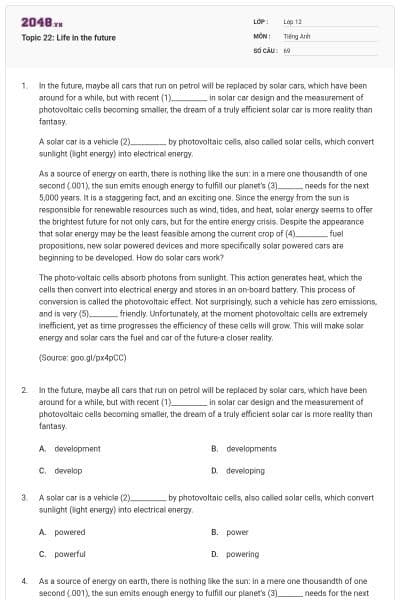
In the future, maybe all cars that run on petrol will be replaced by solar cars, which have been around for a while, but with recent (1)__________ in solar car design and the measurement of photovoltaic cells becoming smaller, the dream of a truly efficient solar car is more reality than fantasy.
A solar car is a vehicle (2)__________ by photovoltaic cells, also called solar cells, which convert sunlight (light energy) into electrical energy.
As a source of energy on earth, there is nothing like the sun: in a mere one thousandth of one second (.001), the sun emits enough energy to fulfill our planet’s (3)_______ needs for the next 5,000 years. It is a staggering fact, and an exciting one. Since the energy from the sun is responsible for renewable resources such as wind, tides, and heat, solar energy seems to offer the brightest future for not only cars, but for the entire energy crisis. Despite the appearance that solar energy may be the least feasible among the current crop of (4)_________ fuel propositions, new solar powered devices and more specifically solar powered cars are beginning to be developed. How do solar cars work?
The photo-voltaic cells absorb photons from sunlight. This action generates heat, which the cells then convert into electrical energy and stores in an on-board battery. This process of conversion is called the photovoltaic effect. Not surprisingly, such a vehicle has zero emissions, and is very (5)________ friendly. Unfortunately, at the moment photovoltaic cells are extremely inefficient, yet as time progresses the efficiency of these cells will grow. This will make solar energy and solar cars the fuel and car of the future-a closer reality.
(Source: goo.gl/px4pCC)
In the future, maybe all cars that run on petrol will be replaced by solar cars, which have been around for a while, but with recent (1)__________ in solar car design and the measurement of photovoltaic cells becoming smaller, the dream of a truly efficient solar car is more reality than fantasy.
development
developments
develop
developing
Trong tương lai, có lẽ tất cả những chiếc xe chạy bằng xăng sẽ được thay thế bởi những chiếc xe chạy bằng năng lượng mặt trời, loại xe đã tồn tại một thời gian qua, nhưng với những phát triển gần đây trong thiết kế xe năng lượng mặt trời và việc đo lường các tế bào quang điện trở nên nhỏ hơn, giấc mơ về một chiếc xe năng lượng mặt trời trở nên thực tế hơn là tưởng tượng.
Một chiếc xe năng lượng mặt trời là một chiếc xe được vận hành bởi các tế bào quang điện, còn được gọi là các tế bào năng lượng mặt trời, thứ mà chuyển đổi ánh sáng mặt trời (năng lượng ánh sáng) thành năng lượng điện.
Là một nguồn năng lượng trên trái đất, không có gì giống như mặt trời: chỉ trong một phần nghìn giây (0,001), mặt trời phát ra đủ năng lượng để đáp ứng nhu cầu năng lượng của hành tinh chúng ta trong 5.000 năm tới. Đó là một thực tế đáng kinh ngạc, và là một điều thú vị. Vì năng lượng từ mặt trời chịu trách nhiệm cho các nguồn năng lượng tái tạo như gió, thủy triều và nhiệt, năng lượng mặt trời dường như cung cấp tương lai tươi sáng nhất cho không chỉ xe hơi mà còn cho toàn bộ cuộc khủng hoảng năng lượng. Mặc dù sự xuất hiện năng lượng mặt trời có thể là ít khả thi nhất trong số các đề xuất nhiên liệu thay thế hiện nay, các thiết bị năng lượng mặt trời mới và đặc biệt là những chiếc xe chạy bằng năng lượng mặt trời đang bắt đầu được phát triển. Vậy, xe năng lượng mặt trời làm việc như thế nào?
Các tế bào quang điện hấp thụ photon từ ánh sáng mặt trời. Hoạt động này tạo ra nhiệt, mà sau đó các tế bào chuyển thành năng lượng điện và lưu trữ trong một khối pin. Quá trình chuyển đổi này được gọi là hiệu ứng quang điện. Không ngạc nhiên, khi một chiếc xe như vậy có lượng khí thải bằng không, và rất thân thiện với môi trường. Thật không may, tại thời điểm các tế bào quang điện cực kỳ kém hiệu quả, nhưng khi thời gian tiến triển thì hiệu quả của các tế bào này sẽ tăng lên. Điều này sẽ làm cho năng lượng mặt trời và xe chạy bằng nhiên liệu năng lượng mặt trời và chiếc xe trong tương lai thành một thực tế gần gũi hơn.
Đáp án B
Kiến thức về từ loại
A. development /dɪˈveləpmənt/ (singular n): sự phát triển
B. developments /dɪˈveləpmənt/ (plural n): sự phát triển
C. develop /dɪˈveləp/ (v): phát triển, mở mang, mở rộng
D. developing /dɪˈveləpɪŋ/ (a): đang phát triển, trên đà phát triển
Trong câu: “In the future, maybe all cars that run on petrol will be replaced by solar cars, which have been around for a while, but with recent (1)__________ in solar car design and the measurement of photovoltaic cells becoming smaller, the dream of a truly efficient solar car is more reality than fantasy.”
(Trong tương lai, có lẽ tất cả những chiếc xe chạy bằng xăng sẽ được thay thế bởi những chiếc xe chạy bằng năng lượng mặt trời, loại xe đã tồn tại một thời gian qua, nhưng với những phát triển gần đây trong thiết kế xe năng lượng mặt trời và việc đo lường các tế bào quang điện trở nên nhỏ hơn, giấc mơ về một chiếc xe năng lượng mặt trời trở nên thực tế hơn là tưởng tượng.)
Căn cứ vào tính từ “recent” nên vị trí trống cần một danh từ (Theo quy tắc, sau tính từ là danh từ) nên ta loại phương án C và D.
Căn cứ vào nghĩa của câu ta chọn được phương án là B.
A solar car is a vehicle (2)__________ by photovoltaic cells, also called solar cells, which convert sunlight (light energy) into electrical energy.
powered
power
powerful
powering
Đáp án A
Kiến thức về từ loại
A. powered /paʊərd/ (a): được trang bị, được vận hành, được hỗ trợ bằng
B. power /paʊər/ (n): năng lực, sức mạnh, nội lực, thế lực, hỗ trợ (v): cấp nguồn, nối điện, cấp lực
C. powerful /ˈpaʊəfəl/ (a): mạnh mẽ, hùng mạnh, mạnh khỏe
D. powering /paʊərɪŋ/ (gerund): năng lực, sức mạnh, nội lực
- Căn cứ vào nghĩa của câu: “A solar car is a vehicle (2) __________ by photovoltaic cells, also called solar cells, which convert sunlight (light energy) into electrical energy.”
Một chiếc xe năng lượng mặt trời là một chiếc xe được vận hành bởi các tế bào quang điện, còn được gọi là các tế bào năng lượng mặt trời, thứ mà chuyển đổi ánh sáng mặt trời (năng lượng ánh sáng) thành năng lượng điện.
=> Vị trí trống cần một động từ ở dạng Vp2 nên phương án đúng là A.
energetic
energetics
energetically
energy
Đáp án D
Kiến thức về từ loại
A. energetic /ˌenəˈdʒetɪk/ (a): mạnh mẽ, mãnh liệt, đầy nghị lực
B. energetics /ˌenəˈdʒetɪks/ (n): năng lượng học
C. energetically /ˌenəˈdʒetɪkəli/ (adv): mạnh mẽ, hăng hái
D. energy /ˈenədʒi/ (n): năng lượng, sinh lực, sức lực
Trong câu: “As a source of energy on earth, there is nothing like the sun: in a mere one thousandth of one second (.001), the sun emits enough energy to fulfill our planet’s (3) _______ needs for the next 5,000 years.”
ta cần một danh từ - “năng lượng” (vì theo quy tắc sau sở hữu cách là danh từ)
(Là một nguồn năng lượng trên trái đất, chỉ duy nhất mặt trời: trong vỏn vẹn một phần nghìn của một giây (0,001), mặt trời phát ra đủ năng lượng để đáp ứng nhu cầu về năng lượng cho hành tinh của chúng ta trong 5.000 năm tới)
alternatives
alternation
alternatively
alternative
Đáp án D
Kiến thức về từ loại
A. alternatives /ɒlˈtɜːnətɪvs/ (n): sự lựa chọn giữa hai hoặc nhiều khả năng
B. alternation /ˌɒltəˈneɪʃən/ (n): sự đan xen, sự xen kẽ, sự luân phiên
C. alternatively /ɒlˈtɜːnətɪvli/ (adv): như một sự lựa chọn
D. alternative /ɒlˈtɜːnətɪv/ (a): có thể chọn để thay thế cho một vật khác
- Trong câu: “Despite the appearance that solar energy may be the least feasible among the current crop of (4) _________ fuel propositions, new solar powered devices and more specifically solar powered cars are beginning to be developed.”
(Mặc dù sự xuất hiện năng lượng mặt trời có thể là ít khả thi nhất trong số các đề xuất nhiên liệu thay thế hiện nay, các thiết bị năng lượng mặt trời mới và đặc biệt là những chiếc xe chạy bằng năng lượng mặt trời đang bắt đầu được phát triển.)
“fuel propositions” là một cụm danh từ, ta cần một tính từ đứng trước.environmentally
environmental
environmentalist
environment
Đáp án A
Kiến thức về từ loại
A. environmentally /ɪnˌvaɪrənˈmentəli/ (adv): về phương diện môi trường
B. environmental /ɪnˌvaɪrənˈmentəl/ (a): thuộc về môi trường
C. environmentalist /ɪnˌvaɪrənˈmentəlɪst/ (n): nhà môi trường học
D. environment /ɪnˈvaɪrənmənt/ (n): môi trường, môi sinh
Trong câu: “Not surprisingly, such a vehicle has zero emissions, and is very (5)________ friendly.”
(Không ngạc nhiên, khi một chiếc xe như vậy có lượng khí thải bằng không, và rất thân thiện với môi trường.)
từ “friendly” là tính từ. Ta cần một trạng từ đứng trước tính từ, bổ nghĩa cho tính từ.
THE CAR OF THE FUTURE
Driving along the motorway in busy traffic, the driver suddenly presses a button on his steering wheel. The car is now driving itself. This may (1) _________________ like something from the future, but driverless cars are already in reality on California’s roads. Many cars can already park themselves on the roadside, brake automatically when the car needs to slow down, and warn the driver (2) __________ they are slipping out of the right lane, so going driverless is just the next step towards automated driving.
Driverless cars are equipped with fast broadband, allowing them to overtake other cars (3), and even communicate with traffic lights as they approach junctions. Being stuck in traffic jams could become a thing of the past, as driverless cars will be able to drive at speed (4) ___________ to each other.
More than fifty million people die or are injured in road accidents every year, and the majority of these accidents is caused by human (5) _________________. Google’s driverless car sticks of to the speed limit and doesn’t get tired. So wouldn’t it be a great idea if all cars were driverless.
(ww.english-grammar.at)
look
sound
feel
sense
Lái xe dọc theo đường cao tốc trong dòng xe cộ tấp nập, tài xế bất ngờ nhấn nút “khởi động” trên vô lăng. Chiếc xe hiện đang tự lái. Dù điều này nghe có vẻ giống như đến từ tương lai nhưng thực tế, những chiếc ô tô không người lái đã có mặt trên các con đường ở California. Nhiều xe ô tô đã có thể tự đỗ bên lề đường, tự động phanh khi xe cần giảm tốc độ và cảnh báo người lái nếu họ vượt ra khỏi làn đường bên phải, vậy nên đi trên những ô tô không người lái chỉ là bước tiếp theo của việc lái xe tự động.
Những chiếc ô tô không người lái được trang bị băng thông rộng và nhanh, cho phép chúng vượt qua những chiếc xe khác khi tiến đến gần hơn, thậm chí là hiểu và tuân theo đèn giao thông khi đến gần giao lộ. Việc bị mắc kẹt trong ùn tắc giao thông sẽ đi vào quá khứ, vì những chiếc ô tô tự động có thể lái xe với tốc độ giữ an toàn cho nhau.
Hơn năm mươi triệu người chết hoặc bị thương trong các vụ tai nạn đường bộ mỗi năm, phần lớn các vụ tai nạn này là do lỗi của con người. Những chiếc xe không người lái của Google được giới hạn tốc độ và hoạt động không mệt mỏi. Vì vậy, toàn bộ xe ô tô đều không có người lái sẽ là một ý tưởng tuyệt vời.
Đáp án B
Kiến thức về từ vựng
A. look /lʊk/ (v): nhìn
B. sound /saʊnd/ (v): nghe
C. feel /fiːl/ (v): cảm nhận
D. sense /sens/: cảm giác
Tạm dịch: “The car is now driving itself. This may (1) ________ like something from the future, but driverless cars are already in reality on California’s roads.”
(Xe ô tô bây giờ có thể tự lái. Điều này nghe giống thứ gì đó từ tương lai, nhưng xe tự lái đã có thực trên những cung đường của California.)
Many cars can already park themselves on the roadside, brake automatically when the car needs to slow down, and warn the driver (2) __________ they are slipping out of the right lane, so going driverless is just the next step towards automated driving.
if
where
why
what
Đáp án A
Kiến thức về liên từ
A. If: nếu
B. where: nơi mà
C. why: tại sao
D. what: cái mà
“Many cars can already park themselves on the roadside, brake automatically when the car needs to slow down, and warn the driver (2) __________ they are slipping out of the right lane, so going driverless is just the next step towards automated driving.”
(Nhiều xe đã có thể tự đỗ bên lề đường, phanh tự động khi xe cần giảm tốc độ, và cảnh báo người lái xe nếu họ vượt ra bên ngoài làn đường bên phải, thế nên xe không người lái chỉ là bước tiếp theo sau việc lái xe tự động)
nicely
quickly
harmlessly
safely
Đáp án D
Kiến thức về từ vựng
A. nicely /ˈnaɪsli/ (adv): một cách tốt đẹp
B. quickly /ˈkwɪkli/ (adv): một cách nhanh chóng
C. harmlessly /ˈhɑːrmləsli/ (adv): một cách vô hại
D. safely /ˈseɪfli/ (adv): một cách an toàn
Tạm dịch: “Driverless cars are equipped with fast broadband, allowing them to overtake other cars _____________, and even communicate with traffic lights as they approach junctions.”
(Những ô tô tự lái được trang bị băng thông nhanh, cho phép chúng bắt kịp những chiếc xe khác một cách an toàn, và thậm chí tương tác với đèn giao thông khi chúng đến gần các nút giao.)
Being stuck in traffic jams could become a thing of the past, as driverless cars will be able to drive at speed (4) ___________ to each other.
too closer
much closer
very closely
so closet
Đáp án B
Kiến thức về cấu trúc ngữ pháp
too + adj + to V: quá … để
far/much + adj-er + than: hơn (so sánh hơn)
Tạm dịch: “Being stuck in traffic jams could become a thing of the past, as driverless cars will be able to drive at speed ___________ to each other.”
(Bị mắc kẹt trong ùn tắc giao thông có thể trở thành một điều của quá khứ, vì xe tự lái có thể đi với tốc độ gần nhau hơn rất nhiều.)
inaccuracy
offence
error
crime
Đáp án C
Kiến thức về từ vựng
A. inaccuracy /ɪnˈækjərəsi/ (n): sự không chính xác, sai
B. offence /ə’fens/ (n): sự vi phạm, sự xúc phạm, sự làm bực mình, sự làm mất lòng
C. error /ˈerər/ (n): lỗi, sai lầm.
D. crime /kraim/: tội ác
=> Ta dùng cụm: Human error: lỗi lầm do con người gây ra
Tạm dịch: “More than fifty million people die or are injured in road accidents every year, and the majority of these accidents is caused by human _______________.”
Where smart cities were once regarded purely as a vision of the future, they are now becoming a reality in numerous urban centres across the globe. From Dubai, Singapore, Amsterdam, Copenhagen, and Madrid to Southampton in the UK, we’re already beginning to see smart cities provide inhabitants with improved living conditions, easier mobility and cleaner, safer environments, by using cloud computing to power services. But as with all public sector initiatives, smart city services need to be delivered as cost effectively as possible to minimise the taxpayer burden. Often, key decision makers are met with obstacles when it comes to deploying smart services, preventing smart cities initiatives from reaching their full potential – or worse, blocking them altogether.
Central to the functioning of most ‘normal’ city ecosystems is the underlying data they run on. Regardless as to whether that data is stored on local servers or using cloud storage, when that data is fragmented or incomplete, identifying emerging trends for strategic planning and cost reduction becomes extremely difficult – and because of this, authorities have to adopt an entirely reactive approach. Conversely, in a smart city environment, connected sensors forming an Internet of Things (IoT) provide valuable data for analysis and, in turn, insight into the specific city’s behavioural trends. With this level of information, services can be optimised to reduce costs and risk, increase urban flows and manage assets. Importantly, they can also provide real-time connections and interactions between the city’s businesses, local governments, service providers and citizens.
In this way, operations and services are elevated through the integration and connection of physical devices via IoT networks, ultimately transforming how a city runs.
(Source: https://www.techradar.com/)
Which best serves as the title for the passage?
A question of data.
Alignment of minds.
Smart city’s supporters.
The same old route.
Đáp án A
Câu nào sau đây thích hợp nhất làm tiêu đề cho đoạn văn?
A. Một câu hỏi về dữ liệu
B. Sự sắp xếp về tâm trí
C. Những người ủng hộ thành phố thông minh
D. Tuyến cũ giống nhau
=> Suy ra từ nội dung toàn bài đọc, ta thấy đoạn văn đang đề cập đến việc các thành phố sử dụng cơ sở dữ liệu để hoạt động.
According to paragraph 1, which statement is correct about the current situation for smart cities?
Smart cities promise technological convenience so high service fees are not a problem.
Dubai, Amsterdam and Hampton are among the cities advancing the title of “smart”.
There still exist many challenges for the institution and development of smart cities.
The already successful smart city in the world were the works of policy-makers.
Đáp án C
Theo đoạn 1, phát biểu nào là đúng về tình hình hiện tại của những thành phố thông minh?
A. Thành phố thông minh hứa hẹn sự tiện lợi về công nghệ nên phí dịch vụ cao không phải là vấn đề
B. Dubai, Amsterdam và Hampton là một trong những thành phố tiến lên danh hiệu “thông minh”
C. Vẫn còn tồn tại nhiều thách thức đối với thể chế và sự phát triển của các thành phố thông minh
D. Thành phố thông minh đã thành công trên thế giới là công trình của các nhà hoạch định chính sách
Căn cứ vào thông tin đoạn một:
But as with all public sector initiatives, smart city services need to be delivered as cost effectively as possible to minimise the taxpayer burden. Often, key decision makers are met with obstacles when it comes to deploying smart services, preventing smart cities initiatives from reaching their full potential - or worse, blocking them altogether.
(Nhưng như với tất cả các sáng kiến của khu vực công, dịch vụ thành phố thông minh cần được cung cấp với chi phí hiệu quả nhất có thể để giảm thiểu người nộp thuế gánh nặng. Thông thường, những người ra quyết định quan trọng gặp phải trở ngại khi triển khai dịch vụ thông minh, ngăn chặn các sáng kiến của thành phố thông minh phát huy hết tiềm năng của chúng - hoặc tệ hơn là ngăn chặn chúng hoàn toàn)
The word “they” in paragraph 2 refers to _______.
environments
ecosystems
services
initiatives
Đáp án B
Từ “they” trong đoạn 2 đề cập đến _________.
A. môi trường
B. hệ sinh thái
C. dịch vụ
D. sáng kiến
=> Từ “they” ở đây dùng để thay thế cho danh từ hệ sinh thái được nhắc tới trước đó.
Central to the functioning of most ‘normal’ city ecosystems is the underlying data they run on.
(Trọng tâm chức năng của hầu hết các hệ sinh thái thành phố bình thường là dữ liệu cơ bản mà chúng sử dụng để hoạt động.)
According to paragraph 2, what is the matter that the author want to emphasise?
Human’s urge to share information.
The importance of data network.
The possibilities of tech disasters.
The caliber of artificial intelligence.
Đáp án B
Theo đoạn 2, vấn đề mà tác giả muốn nhấn mạnh là gì?
A. Sự thôi thúc của con người để chia sẻ thông tin
B. Tầm quan trọng của mạng dữ liệu
C. Các khả năng của thảm họa công nghệ
D. Tầm cỡ của trí tuệ nhân tạo
Căn cứ vào thông tin đoạn hai:
Central to the functioning of most ‘normal’ city ecosystems is the underlying data they run on. Regardless as to whether that data is stored on local servers or using cloud storage, when that data is fragmented or incomplete, identifying emerging trends for strategic planning and cost reduction becomes extremely difficult - and because of this, authorities have to adopt an entirely reactive approach.
(Trọng tâm chức năng của hầu hết các hệ sinh thái thành phố bình thường là dữ liệu cơ bản mà chúng sử dụng để hoạt động. Bất kể dữ liệu đó được lưu trữ trên máy chủ cục bộ hay sử dụng lưu trữ đám mây, khi dữ liệu đó bị phân mảnh hoặc không đầy đủ, việc xác định các xu hướng mới nổi để hoạch định chiến lược và giảm chi phí trở nên vô cùng khó khăn - và vì điều này, chính quyền phải chấp nhận một tiếp cận phản ứng hoàn toàn.)
The word “elevated” in paragraph 3 can be replaced by ______.
demoted
controlled
dignified
upgraded
Đáp án D
Từ “elevated” trong đoạn 3 có thể được thay thế bằng ________.
A. giáng chức
B. kiểm soát
C. làm cho nghiêm túc
D. nâng cấp
Từ đồng nghĩa elevated (nâng lên) = upgrade
In this way, operations and services are elevated through the integration and connection of physical devices via IoT networks, ultimately transforming how a city runs.
(Theo cách này, các hoạt động và dịch vụ được nâng lên thông qua việc tích hợp và kết nối các thiết bị vật lý thông qua mạng IoT, cuối cùng biến đổi cách một thành phố vận hành.)
During the past half-century, our species has embarked on a remarkable social experiment. For the first time in human history, great numbers of people – at all ages, in all places, of every political persuasion – have begun settling down as singletons. Until the second half of the last century, most of us married young and parted only at death. If death came early, we remarried quickly; if late, we moved in with family, or they with us. Now we marry later. We divorce, and stay single for years or decades.
The rise of living alone has produced significant social benefits, too. Young and middle-aged solos have helped to revitalise cities, because they are more likely to spend money, socialise and participate in public life. Contemporary solo dwellers in the US are primarily women: about 18 million, compared with 14 million men. The majority, more than 16 million, are middle-aged adults between the ages of 35 and 64. The elderly account for about 11 million of the total. Young adults between 18 and 34 number increased more than 5 million, compared with 500,000 in 1950, making them the fastest-growing segment of the solo-dwelling population.
Despite fears that living alone may be environmentally unsustainable, solos tend to live in apartments rather than in big houses, and in relatively green cities rather than in car-dependent suburbs. There’s good reason to believe that people who live alone in cities consume less energy than if they coupled up and decamped to pursue a single-family home.
(Adapted from https://www.theguardian.com/lifeandstyle)
The best title for this passage could be ___________.
the rise in solo living
figures about solo dwellers in the US
the increase in divorce
solos have tendency to live in small houses
Đáp án A
Chủ đề về LIFE IN THE FUTURE
Tiêu đề tốt nhất cho đoạn văn này có thể là ______________.
A. Số người sống độc thân tăng
B. Số liệu về người sống độc thân ở Mỹ
C. Số vụ ly hôn tăng
D. người độc thân thích sống trong những ngôi nhà nhỏ
Căn cứ vào thông tin toàn bài:
Thông tin “số người độc thân ở Mỹ; ly hôn; thích sống trong nhà nhỏ” đều được đề cập trong bài nhưng chưa bao quát toàn bài.
Dịch bài đọc:
Trong nửa thế kỷ qua, loài người chúng ta đã bắt đầu một cuộc thử nghiệm xã hội đáng chú ý. Lần đầu tiên trong lịch sử loài người, rất nhiều người - ở mọi lứa tuổi, ở mọi nơi, thuộc mọi khuynh hướng chính trị - đã bắt đầu ổn định cuộc sống độc thân. Cho đến nửa sau của thế kỷ trước, hầu hết chúng ta kết hôn khi còn trẻ và chỉ chia tay khi chết. Nếu chết sớm, chúng ta tái hôn nhanh chóng; nếu chết muộn, chúng ta chuyển đến sống với gia đình hoặc họ chuyển đến sống với chúng ta. Bây giờ chúng ta kết hôn muộn hơn. Chúng ta ly hôn và sống độc thân trong nhiều năm hoặc nhiều thập kỷ.
Sự gia tăng của tình trạng sống một mình cũng mang lại những lợi ích xã hội đáng kể. Những người độc thân trẻ tuổi và trung niên đã giúp hồi sinh các thành phố, vì họ có nhiều khả năng chi tiêu tiền bạc, giao lưu và tham gia vào đời sống công cộng hơn. Những người sống một mình hiện đại ở Hoa Kỳ chủ yếu là phụ nữ: khoảng 18 triệu người, so với 14 triệu nam giới. Phần lớn, hơn 16 triệu người, là những người trưởng thành trung niên trong độ tuổi từ 35 đến 64. Người cao tuổi chiếm khoảng 11 triệu trong tổng số. Số lượng người trẻ tuổi từ 18 đến 34 tuổi tăng hơn 5 triệu người, so với 500.000 người vào năm 1950, khiến họ trở thành nhóm dân số sống một mình tăng trưởng nhanh nhất.
Mặc dù lo ngại rằng sống một mình có thể không bền vững về mặt môi trường, những người sống một mình có xu hướng sống trong căn hộ thay vì trong những ngôi nhà lớn, và ở những thành phố tương đối xanh hơn thay vì ở những vùng ngoại ô phụ thuộc vào ô tô. Có lý do chính đáng để tin rằng những người sống một mình ở thành phố tiêu thụ ít năng lượng hơn so với khi họ kết đôi và chuyển đi để theo đuổi một ngôi nhà gia đình đơn lẻ.
(Chuyển thể từ https://www.theguardian.com/lifeandstyle)
Which statement is probably TRUE according to the information in paragraph 1?
From the beginning of the last century, people married at young age and only death separated them.
Until the second half of the last century, a large number of people married young and parted only at death.
From the beginning of last century, people have begun settling down as singletons.
Until the second half of the last century, people divorce, and stay single for years or decades
Đáp án B
Phát biểu nào có lẽ là ĐÚNG theo đoạn 1?
A. Từ đầu thế kỉ trước, con người đã kết hôn sớm và chỉ cái chết mới chia rẽ được họ
B. Tận cho đến nửa sau của thế kỉ trước, một số lượng lớn người kết hôn sớm và chỉ chia xa khi chết.
C. Từ đầu thế kỉ trước, con người đã bắt đầu sống độc thân.
D. Tận đến nửa sau của thế kỉ trước, con người ly hôn và sống độc thân trong nhiều năm liền.
Căn cứ vào thông tin đoạn 1:
Tạm dịch: “Until the second half of the last century, most of us married young and parted only at death.”
(Cho đến nửa sau của thế kỷ trước, hầu hết chúng ta kết hôn trẻ và chỉ chia tay khi chết)
The word “them” in paragraph 2 refers to_______________?
singletons
the elderly
predecessors
young adults
Đáp án D
Từ “ them” trong đoạn 2 thay thế cho từ _____________
A. những người độc thân
B. người già
C. tổ tiên
D. những người trẻ
Căn cứ vào thông tin đoạn 1:
Tạm dịch: “Young adults between 18 and 34 number increased more than 5 million, compared with 500,000 in 1950, making them the fastest-growing segment of the solo-dwelling population.”
(Thanh niên từ 18 đến 34 tuổi tăng hơn 5 triệu, so với 500.000 vào năm 1950, khiến họ trở thành phân khúc phát triển nhanh nhất của dân số độc thân)
In the 2rd paragraph, the writer suggests that __________.
The elderly take up for a large number of the total solo dwellers
In the US, more male choose to live alone than female
Solos dwellers have helped to renew cities as they seem to spend money, socialize and take part in public life
There are fewer middle-aged solos than the elderly who live alone
Đáp án C
Trong đoạn 2, tác giả gợi ý rằng ______________________
A. Người già chiếm một số lượng lớn trong tổng dân số sống độc thân.
B. Ở Mỹ, nhiều đàn ông chọn sống độc thân hơn phụ nữ.
C. Những người sống độc thân đã giúp tái sinh lại thành phố vì họ dường như tiêu nhiều tiền, giao tiếp và tham gia các hoạt động xã hội.
D. Có nhiều người trung tuổi sống độc thân hơn là người già.
Căn cứ vào thông tin đoạn 2:
Tạm dịch: “The rise of living alone has produced significant social benefits, too. Young and middle-aged solos have helped to revitalise cities, because they are more likely to spend money, socialise and participate in public life.”
(Sự nổi lên của việc sống một mình cũng đã tạo ra nhiều lợi ích xã hội đáng ghi nhận. Người sống đơn thân trẻ hoặc trung tuổi góp phần thổi sức sống mới cho các thành phố, vì họ có xu hướng tiêu dùng, giao thiệp và tham gia vào đời sống cộng đồng hơn.)
The word “decamped” in paragraph 3 means _______________.
coupled up
quitted
lived separately
lived together
Đáp án C
Từ “decamped” trong đoạn 3 có nghĩa là _______________
A. coupled up (v): kết đôi/ kết hôn
B. quitted (v): từ bỏ
C. lived separately: sống riêng/ ly thân
D. lived together (v): sống chung
Căn cứ vào thông tin đoạn 2:
Tạm dịch: “There’s good reason to believe that people who live alone in cities consume less energy than if they coupled up and decamped to pursue a single-family home.”
(Có lý do chính đáng để tin rằng người sống một mình ở các thành phố tiêu thụ ít năng lượng hơn khi họ sống chung với nhau rồi lại li thân để xây tổ ấm đơn thân của riêng mình)
By the end of the third millennium, people will all have access to basic utilities like electricity and the internet. As a type of civilization, the overall energy consumption of everyone in the 30th century will be at a level of around 4×10²⁶ watts. In other words, the energy utilization in a world full of working class consumers will be comparable to the luminosity of our parent star. So, the people of the future will inevitably need to fully harness the output of the Sun through the use of a vast array of satellite mega-structures that encircle the celestial body and capture the radiation it emits.
In requiring everyone to work together, the inclusive attitude of the future will cause everyone to grow much closer to one another, improving interpersonal relationships in neighborhoods the world over. By the year 3000, the whole of humanity will become a sort of poly-amorous society of mono-ethnic global citizens, living in a complex egalitarian intercontinental cooperative. Everyone will be part of multicultural communities within communities. Companies and credit unions will even be owned by their employees. People will all be very conscientious. Everyone will support the global economy, as well as ecology, of the world.
Humans will inhabit artificial urban jungles filled with buildings and sidewalks, while the other animals will inhabit natural rural jungles filled with wilderness and trails. Friends will walk through the crowded streets of the mega-cities of the future holding hands with one another. Public displays of affection will be customary among everyone. Casual bisexual encounters will be the norm. Everyone will care about everyone else. People will all accept each other, and help each other out, more and more as time goes on.
The point is that eventually, everyone will finally get along. Humanity will progress to a point of collective compatibility as everyone sufficiently integrates and assimilates. From now until the year 3000, the several thousand languages currently spoken will reduce down to only about a hundred. More importantly, the nation-state members of the UN will all use the same form of electronic currency. As the countries of the world unify more and more, the metric system will become the universal standard of measurement. Things will become increasingly more common among everyone. This will bring everyone closer and closer together, each step of the way. In the end, cultural memes will all eventually just blend together in the great melting pot that is the world.
People will also change physically, along with mentally, too though. For instance, there will be an increase in both height and longevity, among people in general. In the year 3000 people will be about six feet tall, and live to be 120 years old, on average. They will experience a slight reduction in the size of their mouths, too. Improvements in nutritional science will revolutionize the world of medicine and alter the course of human evolution. Everyone will be genetically screened as an embryo to weed out defects and correct mistakes in their personal genome. 8th scale transhuman cyborgs will even go so far as to have 7th scale robotic integrations, with microscopic machines making them better. This will be terribly important because there will be very little diversity in the gene pool of the superhumans of the future, who are all bred to be what is considered ideal.
(Source: https://medium.com/)
Which of the following could be the best title of the passage?
The energy consumption in the third millennium.
The life in the year 3000.
The changes of humans in the far future.
The way people live in the 30th century.
Đáp án B
Câu nào trong các câu sau có thể là tiêu đề phù hợp nhất cho đoạn văn?
A. Mức tiêu thụ năng lượng ở thiên niên kỷ thứ 3.
B. Cuộc sống trong năm 3000.
C. Những thay đổi của nhân loại trong tương lai xa.
D. Cách con người sống trong thế kỷ 30.
Căn cứ vào thông tin cả đoạn văn:
Đoạn văn này đang nói về thế giới trong năm 3000 nên câu B sẽ là tiêu đề phù hợp nhất.
The word “harness” in the first paragraph is closest in meaning to _______.
separate
replace
exploit
absorb
Đáp án C
Từ “harness” trong đoạn 1 gần nghĩa nhất với từ _________.
A. tách ra
B. thay thế
C. khai thác
D. hấp thụ
Từ đồng nghĩa: harness (thai thác) = exploit
So, the people of the future will inevitably need to fully harness the output of the Sun through the use of a vast array of satellite mega-structures that encircle the celestial body and capture the radiation it emits.
(Vì vậy, người dân trong tương lai chắc chắn sẽ cần phải khai thác hoàn toàn năng lượng toả ra của Mặt Trời thông qua việc sử dụng một loạt các cấu trúc vệ tinh bao quanh thiên thể này và hấp thụ bức xạ phát ra.)
According to paragraph 2, how can the attitude of the future affect the world?
It improves the distance in the relationship of neighborhood.
It enhances the diversity of cultures in the society.
It brings people closer to others both in nations and in the world.
It supports the global economy and ecology of the world.
Đáp án C
Theo đoạn 2, thái độ của thế hệ tương lai có thể ảnh hưởng như thế nào đến thế giới?
A. Nó làm tăng khoảng cách trong mối quan hệ của tình làng xóm.
B. Nó nâng cao sự đa dạng văn hoá trong xã hội.
C. Nó đưa mọi người đến gần nhau hơn cả trong nước và trên thế giới.
D. Nó hỗ trợ nền kinh tế và sinh thái học của thế giới.
Căn cứ thông tin đoạn 2:
In requiring everyone to work together, the inclusive attitude of the future will cause everyone to grow much closer to one another, improving interpersonal relationships in neighborhoods the world over.
(Khi mọi người cần phải làm việc cùng nhau, thái độ hòa nhập của thế hệ tương lai sẽ khiến mọi người đến gần nhau hơn, cải thiện mối quan hệ giữa các cá nhân trong các làng xóm trên toàn thế giới.)
The word “conscientious” in paragraph 2 could be best replaced by _________.
careful
dishonest
careless
indolent
Đáp án A
Từ “conscientious” trong đoạn 2 có thể được thay thế bởi __________.
A. cẩn thận, tận tâm
B. không chân thành
C. bất cẩn
D. lười nhác
Từ đồng nghĩa: conscientious (tận tâm) = careful
Companies and credit unions will even be owned by their employees. People will all be very conscientious. Everyone will support the global economy, as well as ecology, of the world.
(Các công ty và các tổ chức tín dụng thậm chí sẽ được sở hữu bởi chính nhân viên của họ. Mọi người sẽ rất tận tâm. Mọi người sẽ ủng hộ nền kinh tế toàn cầu, cũng như nền sinh thái học của thế giới.)
According to paragraph 3, which of the following is NOT true?
People and animals will live in their favourite environment.
People will not express their emotion in public.
It is not strange for men and women to compete with each other.
People are safe to walk through the crowded streets with their friends.
Đáp án B
Theo đoạn 3, câu nào là không đúng?
A. Con người và động vật sẽ sống trong môi trường yêu thích của họ.
B. Mọi người sẽ không thể hiện tình cảm ở nơi công cộng.
C. Không có gì là lạ khi nam với nữ cạnh tranh lẫn nhau.
D. Mọi người được an toàn khi đi bộ qua các con phố đông đúc với bạn bè.
Căn cứ thông tin đoạn 3:
Humans will inhabit artificial urban jungles filled with buildings and sidewalks, while the other animals will inhabit natural rural jungles filled with wilderness and trails. Friends will walk through the crowded streets of the mega-cities of the future holding hands with one another. Public displays of affection will be customary among everyone. Casual bisexual encounters will be the norm. Everyone will care about everyone else. People will all accept each other, and help each other out, more and more as time goes on.
(Con người sẽ sống trong các khu đô thị nhân tạo tràn ngập các tòa nhà và vỉa hè, trong khi những động vật còn lại sẽ sống trong những khu rừng tự nhiên hoang dã và những con đường mòn ở vùng sâu vùng xa. Những người bạn sẽ cùng nhau tay trong tay đi bộ qua những con phố đông đúc của những thành phố lớn trong tương lai. Việc thể hiện tình cảm công khai sẽ được coi như một phong tục của tất cả mọi người. Các cuộc cạnh tranh trực tiếp giữa nam và nữ cũng là bình thường. Mọi người sẽ quan tâm đến nhau. Mọi người cũng sẽ chấp nhận lẫn nhau, và giúp đỡ lẫn nhau nhiều và nhiều hơn nữa khi thời gian trôi qua.)
The word “that” in paragraph 4 refers to __________.
cultural memes
each step of the way
the great melting pot
the metric system
Đáp án C
Từ “that” trong đoạn 4 đề cập đến ________.
A. các bản sao văn hoá
B. từng bước
C. chiếc nồi nóng chảy tuyệt vời
D. hệ mét
Căn cứ thông tin đoạn 4:
Từ “that” thay thế cho “the great melting pot”.
In the end, cultural memes will all eventually just blend together in the great melting pot that is the world. (Cuối cùng, các bản sao văn hóa cũng sẽ hòa trộn với nhau trong một chiếc nồi nóng chảy tuyệt vời, đó là thế giới.)
The author described the reduction in number of languages in paragraph 4 as an evidence of ___________.
the compatibility of humans in the future
the standard of measurement
the development of electronic currency
the popularity of things
Đáp án A
Tác giả mô tả sự giảm xuống về số lượng của các ngôn ngữ trong đoạn 4 như là một bằng chứng của _____.
A. sự tương đồng của nhân loại trong tương lai.
B. tiêu chuẩn của sự đo lường.
C. sự phát triển của tiền tệ điện tử.
D. sự phổ biến của mọi thứ
Căn cứ thông tin đoạn 4:
The point is that eventually, everyone will finally get along. Humanity will progress to a point of collective compatibility as everyone sufficiently integrates and assimilates. From now until the year 3000, the several thousand languages currently spoken will reduce down to only about a hundred.
(Vấn đề là, cuối cùng rồi mọi người cũng sẽ hòa thuận. Nhân loại sẽ tiến tới cùng chung một điểm tương đồng khi mọi người hoà nhập và đồng hóa. Từ nay đến năm 3000, hàng ngàn ngôn ngữ hiện đang được sử dụng sẽ giảm xuống chỉ còn khoảng một trăm ngôn ngữ.)
What can be the main idea of the last passage?
Robots will be advanced to be superhumans of the future.
People’s longevity will be increased in the future.
Science is the main factor to the change of humans’ appearance.
Humans’ physical and mentality will alter in the future.
Đáp án D
Câu nào trong các câu sau có thể là ý chính của đoạn cuối?
A. Robot sẽ được cải tiến để trở thành các siêu nhân trong tương lai.
B. Tuổi thọ của con người sẽ được tăng lên trong tương lai.
C. Khoa học là nhân tố chính trong sự thay đổi về hình dáng con người.
D. Thể chất và tinh thần của con người sẽ thay đổi trong tương lai.
Căn cứ thông tin đoạn cuối (đặc biệt là câu đầu tiên):
People will also change physically, along with mentally, too though. For instance, there will be an increase in both height and longevity, among people in general. In the year 3000 people will be about six feet tall, and live to be 120 years old, on average. They will experience a slight reduction in the size of their mouths, too. Improvements in nutritional science will revolutionize the world of medicine and alter the course of human evolution. Everyone will be genetically screened as an embryo to weed out defects and correct mistakes in their personal genome. 8th scale transhuman cyborgs will even go so far as to have 7th scale robotic integrations, with microscopic machines making them better. This will be terribly important because there will be very little diversity in the gene pool of the superhumans of the future, who are all bred to be what is considered ideal.
(Tuy nhiên, mọi người cũng sẽ thay đổi cả về thể chất và tinh thần. Ví dụ, sẽ có 1 sự gia tăng về cả chiều cao và tuổi thọ của người dân nói chung. Trong năm 3000, người dân trung bình sẽ cao khoảng 6 feet, và sống đến 120 tuổi. Họ cũng sẽ trải qua sự giảm nhẹ về kích thước của miệng. Những cải tiến trong khoa học dinh dưỡng sẽ cải cách thế giới y học và làm thay đổi quá trình tiến hóa của con người. Tất cả mọi người sẽ được sàng lọc về mặt di truyền khi còn là một phôi thai để loại trừ các khuyết tật và chữa trị các dị tật trong bộ gen cá nhân của họ. Những nhân vật viễn tưởng siêu quy mô lần thứ 8 thậm chí vượt xa đến mức sẽ tích hợp robot cấp độ thứ 7 với các máy vi mô giúp chúng trở nên tốt hơn. Điều này sẽ cực kỳ quan trọng vì sẽ có rất ít sự đa dạng trong nhóm gen của những siêu nhân trong tương lai, những người luôn được coi là lý tưởng.)
You’ll be able to purchase high-quality emotions online. Emotion-sharing experiences are the latest fad in 2045. Imagine your friend at Glastonbury can post a photo on Instagram and with it comes bundled a faint twinkling of what she was feeling right there in that moment, so you too can share emotionally in her social experience.
Recently, techniques for direct brain stimulation, like opt genetics, have made it possible to not only read but also write information into single neurons. At the moment data transfer rates are still very slow, the best we can do is a few bits per second, but this could well increase to kilobits or maybe reach broadband speeds by 2045. This means the range of human perception could expand beyond its current design limitations. One could foresee a new and extraordinary world where there is a virtual marketplace for trading high quality emotions – where artists looking for a particularly high strength brew of melancholy, or actors needing to channel regret or compassion for their next play, could purchase emotions online.
Our cities will be made from living, dynamic materials that respond to the environment. In 30 years, tall buildings made of glass and twisted steel will be seen as relics from a bygone era, in the same way we think now of 1970s concrete tower blocks: ugly, out-dated and unfit for contemporary purpose. The urban environment of 2045 blends architecture with living materials that are mouldable, adaptable, responsive and disposable.
Entirely new synthetic life forms, or biological machines, made of engineered living cells from bacteria, fungi and algae will grow and evolve with the changing needs of a building’s inhabitants. They breathe in pollutants, clean wastewater, and use sunlight to make useful chemicals, energy, heat and vibrant vertical gardens. We will start to see a convergence between biology and technology, to the point where there is no longer a perceptible difference between the two. Today, synthetic biology labs are looking at the full diversity of what nature has to offer and using this to mix, match and edit genomes to design synthetic life forms. Right now, this field is just getting started and the science of synthetic biology is going to be tougher than most will admit.
We will use invisibility cloaks to “disappear” ugly objects. Invisibility has forever been a tantalizing prospect. The key to cloaking lies in the way the electromagnetic spectrum (including visible light) interacts with objects. The human eye picks up electromagnetic radiation that falls and scatters from objects and we perceive this as light. In recent decades, scientists figured out using mathematics that it might just be possible to imagine a new class of artificial materials made of intricate tiny features with light bending properties. They named them metamaterials.
Using nanotechnology engineering, scientists have since shown cloaking actually works – in principle at least, for a narrow range of colours and only from certain viewing angles. The future applications of cloaking are highly uncertain and will likely be determined by the fads and social contagion of the time. They may be used in everything from novelty gimmicks to making unsightly construction sites and power stations seemingly ‘disappear’.
(Source: https://www.telegraph.co.uk/technology/news)
Which of the following is the main idea of the passage?
Emotion sharing in 2045
Architecture with living materials
Predicted life of 2045
Invisibility cloaks of the future
Đáp án C
Thông tin nào sau đây là ý chính của đoạn văn?
A. Chia sẻ cảm xúc vào năm 2045
B. Kiến trúc với vật liệu sống
C. Dự đoán cuộc sống vào năm 2045
D. Áo choàng tàng hình của tương lai
Căn cứ thông tin đoạn mở đầu:
You’ll be able to purchase high-quality emotions online. Emotion-sharing experiences are the latest fad in 2045. Imagine your friend at Glastonbury can post a photo on Instagram and with it comes bundled a faint twinkling of what she was feeling right there in that moment, so you too can share emotionally in her social experience.
(Bạn sẽ có thể mua cảm xúc chất lượng cao trực tuyến. Hãy tưởng tượng bạn bè của bạn tại Glastonbury có thể đăng ảnh trên Instagram và nó đi kèm với một chút lấp lánh về những gì cô ấy cảm thấy ngay tại thời điểm đó, vì vậy bạn cũng có thể chia sẻ cảm xúc đối với những gì cô ấy trải qua về mặt xã hội.)
The word “perception” in the second paragraph mostly means _____.
the way you notice things, especially with the senses
the act of bringing something into use
the act of communicating with somebody
the process of becoming aware of something
Đáp án A
Từ “perception” trong đoạn văn thứ hai có nghĩa là _____.
A. cách bạn nhận thấy mọi thứ, đặc biệt là với các giác quan
B. hành động đưa thứ gì đó vào sử dụng
C. hành động giao tiếp với ai đó
D. quá trình trở nên nhận biết điều gì đó
Kiến thức từ vựng: perception = sự nhận thức, cảm nhận
This means the range of human perception could expand beyond its current design limitations.
(Điều này có nghĩa là phạm vi nhận thức của con người có thể mở rộng ra ngoài giới hạn thiết kế.)
What does the author imply in the third paragraph?
Our cities will be made of glass and twisted steel.
Our cities architecture will be living materials that are mouldable, adaptable, responsive and disposable.
Our cities will be made of concrete tower blocks.
Our cities will be in the same way as it is now.
Đáp án B
Tác giả ngụ ý gì trong đoạn thứ ba?
A. Thành phố của chúng ta sẽ được làm bằng thủy tinh và thép xoắn.
B. Kiến trúc thành phố của chúng ta sẽ là những vật liệu sống có thể thay đổi, thích ứng, đáp ứng và dùng một lần.
C. Thành phố của chúng ta sẽ được làm bằng các khối tháp bê tông.
D. Các thành phố của chúng ta sẽ giống như bây giờ.
Căn cứ thông tin đoạn 3:
The urban environment of 2045 blends architecture with living materials that are mouldable, adaptable, responsive and disposable.
(Môi trường đô thị của năm 2045 kết hợp kiến trúc với các vật liệu sống có thể thay đổi, thích nghi, phản ứng nhanh nhạy và dùng một lần.)
The word “They” in the third paragraph refers to ______.
bacteria
biological machines
fungi and algae
building’s inhabitants
Đáp án B
Từ “They” trong đoạn thứ ba đề cập đến ______.
A. vi khuẩn
B. cỗ máy sinh học
C. nấm và tảo
D. cư dân của tòa nhà
Kiến thức ngữ pháp, cấu trúc câu và suy luận:
Entirely new synthetic life forms, or biological machines, made of engineered living cells from bacteria, fungi and algae will grow and evolve with the changing needs of a building’s inhabitants. They breathe in pollutants, clean wastewater, and use sunlight to make useful chemicals, energy, heat and vibrant vertical gardens.
(Các dạng sống tổng hợp hoàn toàn mới, hoặc các cỗ máy sinh học, được tạo ra từ các tế bào sống đã được thay đổi cấu trúc gen từ vi khuẩn, nấm và tảo sẽ phát triển và thích hợp với nhu cầu thay đổi của các cư dân trong một tòa nhà. Chúng hút các chất gây ô nhiễm, làm sạch nước thải, và sử dụng ánh sáng mặt trời để tạo ra các hóa chất hữu ích, năng lượng, nhiệt và các khu vườn thẳng đứng sôi động.)
The word “perceptible” in the third paragraph is closest in meaning to ______.
understandable
credible
profitable
remarkable
Đáp án D
Từ “perceptible” trong đoạn thứ ba gần nghĩa nhất với từ ______.
A. dễ hiểu
B. đáng tin cậy
C. lợi nhuận
D. đáng chú ý
Kiến thức từ đồng nghĩa: perceptible (dễ nhận thấy) = remarkable
We will start to see a convergence between biology and technology, to the point where there is no longer a perceptible difference between the two.
(Chúng ta sẽ bắt đầu thấy sự hội tụ giữa sinh học và công nghệ đến mức không còn sự khác biệt nào có thể nhận thấy được giữa hai lĩnh vực này.)
Which of the following information is TRUE according to the fourth paragraph?
Biological machines will grow and evolve with the changing needs of a building’s structure.
There will be no convergence between biology and technology.
Designing synthetic life forms has been done for ages.
Science of synthetic biology is just getting started, and is likely more difficult than expected.
Đáp án D
Thông tin nào sau đây là ĐÚNG theo thông tin trong đoạn thứ tư?
A. Cỗ máy sinh học sẽ phát triển phù hợp với nhu cầu thay đổi cấu trúc của tòa nhà.
B. Sẽ không có sự hội tụ giữa sinh học và công nghệ.
C. Thiết kế các dạng sống tổng hợp đã được thực hiện từ lâu.
D. Khoa học sinh học tổng hợp chỉ mới bắt đầu, và có thể khó khăn hơn dự kiến.
Căn cứ thông tin đoạn 4:
Entirely new synthetic life forms, or biological machines, made of engineered living cells from bacteria, fungi and algae will grow and evolve with the changing needs of a building’s inhabitants. They breathe in pollutants, clean wastewater, and use sunlight to make useful chemicals, energy, heat and vibrant vertical gardens. We will start to see a convergence between biology and technology, to the point where there is no longer a perceptible difference between the two. Today, synthetic biology labs are looking at the full diversity of what nature has to offer and using this to mix, match and edit genomes to design synthetic life forms. Right now, this field is just getting started and the science of synthetic biology is going to be tougher than most will admit.
(Các dạng sống tổng hợp hoàn toàn mới, hoặc các máy sinh học, được chế tạo từ các tế bào sống được thiết kế từ vi khuẩn, nấm và tảo sẽ phát triển và thích hợp với nhu cầu thay đổi của cư dân của một tòa nhà. Chúng hút các chất gây ô nhiễm, làm sạch nước thải, và sử dụng ánh sáng mặt trời để tạo ra các hóa chất hữu ích, năng lượng, nhiệt và các khu vườn thẳng đứng sôi động. Chúng ta sẽ bắt đầu thấy sự hội tụ giữa sinh học và công nghệ đến mức không còn sự khác biệt nào có thể nhận thấy được giữa hai lĩnh vực này. Ngày nay, các phòng thí nghiệm sinh học tổng hợp đang xem xét sự đa dạng đầy đủ về những gì thiên nhiên cung cấp và sử dụng để pha trộn, kết hợp và chỉnh sửa bộ gen để thiết kế các dạng sống tổng hợp. Ngay bây giờ, lĩnh vực này chỉ mới bắt đầu và khoa học về sinh học tổng hợp sẽ khó khăn hơn những gì hầu hết mọi người nhìn nhận.)
According to the fifth paragraph, human eyes can see things and objects thanks to the fact that _____.
invisibility cloaks interact with objects
things and objects are made of artificial materials
the human eye picks up electromagnetic radiation from objects
the objects have light bending properties
Đáp án C
Theo đoạn thứ năm, mắt người có thể nhìn thấy mọi thứ và đồ vật nhờ _____.
A. áo choàng tàng hình tương tác với vật thể
B. đồ vật và vật thể được làm bằng vật liệu nhân tạo
C. mắt người tiếp nhận bức xạ điện từ từ vật thể
D. các đối tượng có tính chất uốn nhẹ
Căn cứ thông tin đoạn 5:
The key to cloaking lies in the way the electromagnetic spectrum (including visible light) interacts with objects. The human eye picks up electromagnetic radiation that falls and scatters from objects and we perceive this as light.
Chìa khóa để che giấu nằm trong cách phổ điện từ (bao gồm cả ánh sáng nhìn thấy được) tương tác với các đối tượng. Mắt người nhận bức xạ điện từ chiếu vào và phân tán từ các vật thể và chúng ta nhận thấy điều này là ánh sáng.
What can be inferred from the last paragraph?
Shown cloaking may work, but its application is unsure.
Shown cloaking may work, but its application is sure.
Shown cloaking may not work, and will not be applied.
Shown cloaking may not work due to the fads and social contagion of the time.
Đáp án A
Điều gì có thể được suy ra từ đoạn cuối?
A. Kỹ thuật che giấu có thể hoạt động, nhưng việc sử dụng nó không chắc chắn.
B. Kỹ thuật che giấu có thể hoạt động, nhưng việc sử dụng nó là chắc chắn.
C. Kỹ thuật che giấu có thể không hoạt động và sẽ không được áp dụng.
D. Kỹ thuật che giấu có thể không hoạt động do thị hiếu và sự lan truyền xã hội của thời đại.
Căn cứ thông tin đoạn cuối:
Using nanotechnology engineering, scientists have since shown cloaking actually works – in principle at least, for a narrow range of colours and only from certain viewing angles. The future applications of cloaking are highly uncertain and will likely be determined by the fads and social contagion of the time. They may be used in everything from novelty gimmicks to making unsightly construction sites and power stations seemingly ‘disappear’.
(Sử dụng kỹ thuật công nghệ nano, các nhà khoa học đã cho thấy kỹ thuật che giấu thực sự hoạt động, về nguyên tắc ít nhất là đối với một phạm vi hẹp của màu sắc và chỉ từ các góc nhìn nhất định. Các ứng dụng trong tương lai của kỹ thuật che giấu là rất không chắc chắn và có thể sẽ được xác định bởi các sở thích nhất thời và sự lan truyền trong xã hội của thời đại. Chúng có thể được sử dụng trong mọi thứ từ những mánh lới quảng cáo mới lạ để làm cho các trang web xây dựng khó coi đến việc gần như “biến mất” của các nhà máy điện.)
According to the report, we can expect some pretty remarkable changes to our homes and our personal spaces, overlooked things that make up so much of our daily routine. As human populations soar, our cities and homes will have to adapt; interior living spaces will change as a cloud changes, easily reconfigured and rearranged to suit our fickle tastes, or accommodate different purposes.
Imagine walls and floors made of a malleable “skin,” and embedded with tiny sensors and actuators so that the shape and size of living spaces can quickly change, or even be divided into smaller rooms; imagine fully programmable “smart homes” that can be controlled remotely, and provide feedback to their owners - yes, there’ll even be an app for that.
Virtual decorations will alter with changing tastes, moods and whims; and the entire interior surface of the home will be implanted with LED technology - television screens and computer displays will form and unform in any room, as needed. Even our furniture will be adaptable, molding to custom fit our bodies, responding to changes in posture, or disappearing altogether when not needed.
It will be the ultimate evolution of the “Internet of Things.” Misplaced something? Can’t find your keys? No problem. Just use an online search function to find it. Hate the color of that accent wall? Delete it. Need more storage space? Watch new shelves appear, as if by magic.
And the amenities are fantastic. Every home will come standard with a 3D printer; they’ll be able to churn out just about anything you could wish, using downloadable patterns, probably including even complex electronic devices. They may even print out your meals, designed and programmed by the world’s master chefs.
Walk-in “medical pods,” meanwhile, will contribute to the decentralization of healthcare - their imaging sensors will diagnose your ills and, for the more easily treatable maladies, dispense drugs, inject antibiotics, and recommend health regimens. It may even be possible to undergo remote, robot-mediated surgery, in the comfort of your own home.
This barely scratches the surface. Imagine homes whose very building material is salted with dormant limestone-producing bacteria, which awaken upon contact with moisture and repair any cracks or structural damage.
There will be “digestion tanks” full of anaerobic bacteria, to dispose of our waste; and our homes will produce, store, and reuse their own energy, using “microbial fuel cell stacks” and more efficient solar panels to generate electricity, and power-banks like the Tesla power wall to store it against future use. Personal homes will be almost fully independent of a dangerously overtaxed energy grid.
One hundred years in the future, our houses will be, in almost all respects, semi-living, artificial organisms - closed systems with a metabolism, sensory apparatus, immune response, and an approximation to a nervous system. We’ll be living in homes that are practically alive.
(Source: https://futurism.com)
Which of the following does the passage mainly discuss?
Smart living – our home in the future
LED technology - television screens and computer displays
A new standard with a 3D printer
Our home – a semi-living, artificial organisms
Đáp án A
Đoạn văn chủ yếu bàn về thông tin nào sau đây?
A. Cuộc sống thông minh - nhà của chúng ta trong tương lai.
B. Công nghệ LED - màn hình tivi và màn hình máy tính.
C. Tiêu chuẩn mới với máy in 3D.
D. Nhà của chúng ta - một sinh vật nhân tạo bán sinh vật.
Căn cứ thông tin toàn bài đã được khái quát trong đoạn mở đầu:
According to the report, we can expect some pretty remarkable changes to our homes and our personal spaces, overlooked things that make up so much of our daily routine. As human populations soar, our cities and homes will have to adapt; interior living spaces will change as a cloud changes, easily reconfigured and rearranged to suit our fickle tastes, or accommodate different purposes.
(Theo báo cáo, chúng ta có thể mong đợi một số thay đổi khá đáng kể cho ngôi nhà và không gian cá nhân, những thứ dường như bị bỏ quên, tạo nên quá nhiều thói quen hàng ngày của chúng ta. Khi dân số tăng cao, các thành phố và gia đình của chúng ta sẽ phải thích ứng; không gian sống trong nhà sẽ thay đổi như những thay đổi của một đám mây, dễ dàng cấu hình lại và sắp xếp lại cho phù hợp với sở thích hay thay đổi của chúng ta, hoặc phù hợp với các mục đích khác nhau.)
The word "overlooked" in paragraph 1 is closest in meaning to ______.
forbidden
foregone
foreseen
forgotten
Đáp án D
Từ “overlooked” trong đoạn 1 gần nghĩa nhất với _____.
A. cấm đoán
B. đi trước
C. đoán trước
D. bị lãng quên
Kiến thức từ đồng nghĩa, từ vựng: overlooked (bị bỏ sót, quên) = forgotten
Which of the following is NOT mentioned in paragraph 3 as an advantage of technology to change our house?
movable walls
implanted LED
television screens and computer displays
furniture
Đáp án D
Thông tin nào sau đây KHÔNG được đề cập trong đoạn 3 như một lợi thế của công nghệ để thay đổi ngôi nhà của chúng ta?
A. tường di động.
B. LED được cấy ghép.
C. màn hình truyền hình và màn hình máy tính.
D. đồ nội thất.
Căn cứ thông tin đoạn 3:
Virtual decorations will alter with changing tastes, moods and whims; and the entire interior surface of the home will be implanted with LED technology - television screens and computer displays will form and unform in any room, as needed. Even our furniture will be adaptable, molding to custom fit our bodies, responding to changes in posture, or disappearing altogether when not needed.
(Đồ trang trí ảo sẽ thay đổi bằng cách thay đổi thị hiếu, tâm trạng và ý tưởng; và toàn bộ bề mặt bên trong của ngôi nhà sẽ được cấy ghép bằng công nghệ LED - màn hình tivi và màn hình máy tính sẽ hình thành và thay đổi trong bất kỳ phòng nào, nếu cần. Ngay cả đồ nội thất của chúng ta cũng sẽ có thể thích nghi, tạo dáng để tùy chỉnh phù hợp với cơ thể của chúng ta, đáp ứng với những thay đổi trong tư thế, hoặc biến mất hoàn toàn khi không cần thiết.)
=> Ta thấy rằng những lợi thế của công nghệ bao gồm: LED được cấy ghép, màn hình truyền hình và màn hình máy tính là đã rõ ràng. Và 1 lợi thế khác đó là các bức tường di động - có thể di chuyển được. Thực ra đây cũng là 1 lợi thế từ LED được cấy ghép. Vì trên bài có chi tiết "và toàn bộ bề mặt bên trong của ngôi nhà sẽ được cấy ghép bằng công nghệ LED - màn hình tivi và màn hình máy tính sẽ hình thành và thay đổi trong bất kỳ phòng nào" => Tường nhà cũng là một loại bề mặt, do đó nó sẽ được cấy ghép công nghệ LED và có thể thay đổi bất kỳ phòng nào => Tường nhà di động - có thể di chuyển được.
+ Nội thất cũng là một yếu tố được nhắc đến, nhưng nó không phải là 1 trong những lợi thế của công nghệ, mà thực tế nó có thể dễ dàng sử dụng và có những tiện lợi nhận được từ công nghệ LED tạo ra.
The word "molding" in paragraph 4 can be best replaced by ______.
forming
framing
adapting
producing
Đáp án C
Từ “molding” trong đoạn 4 có thể được thay thế tốt nhất bởi _____.
A. hình thành
B. đóng khung
C. thích nghi
D. sản xuất
Kiến thức từ vựng, từ đồng nghĩa: molding (tạo dáng, thích nghi) = adapting
Even our furniture will be adaptable, molding to custom fit our bodies, responding to changes in posture, or disappearing altogether when not needed.
(Ngay cả đồ nội thất của chúng ta cũng sẽ có thể thích nghi, tạo dáng để tùy chỉnh phù hợp với cơ thể của chúng ta, đáp ứng với những thay đổi trong tư thế, hoặc biến mất hoàn toàn khi không cần thiết.)
Remote, robot-mediated surgery has been mentioned in paragraph 6 as an example of _____.
way to decentralize of healthcare
technology applied in healthcare
diagnosis of your ills
recommendation of health regimens
Đáp án B
Phẫu thuật từ xa, robot trung gian đã được đề cập trong đoạn 6 là một ví dụ về _____.
A. cách phân cấp chăm sóc sức khỏe
B. công nghệ áp dụng trong chăm sóc sức khỏe
C. chẩn đoán bệnh của bạn
D. khuyến nghị của các phác đồ sức khỏe
Căn cứ thông tin đoạn 6:
Walk-in “medical pods,” meanwhile, will contribute to the decentralization of healthcare - their imaging sensors will diagnose your ills and, for the more easily treatable maladies, dispense drugs, inject antibiotics, and recommend health regimens. It may even be possible to undergo remote, robot-mediated surgery, in the comfort of your own home.
(Trong khi đó, các “bộ phận y tế” sẽ đóng góp vào sự phân cấp về chăm sóc sức khỏe - các cảm biến hình ảnh của họ sẽ chẩn đoán bệnh của bạn và phân phối thuốc, tiêm kháng sinh và giới thiệu các phác đồ sức khỏe đối với các bệnh lý dễ điều trị hơn. Thậm chí có thể trải qua một cuộc phẫu thuật từ xa thông qua robot trong sự thoải mái tại nhà riêng của bạn.)
The word "They" in paragraph 5 refers to ______.
downloadable patterns
complex electronic devices
3D printer
world’s master chefs
Đáp án C
Từ “They” trong đoạn 5 ám chỉ _____.
A. các mẫu có thể tải về
B. các thiết bị điện tử phức tạp
C. Máy in 3D
D. các đầu bếp trứ danh thế giới
Kiến thức ngữ pháp, mẫu câu:
Every home will come standard with a 3D printer; they’ll be able to churn out just about anything you could wish, using downloadable patterns, probably including even complex electronic devices. They may even print out your meals, designed and programmed by the world’s master chefs.
(Mỗi ngôi nhà sẽ đạt tiêu chuẩn với một máy in 3D; chúng sẽ có thể khuấy động mọi thứ bạn muốn bằng cách sử dụng các mẫu có thể tải xuống, có thể bao gồm cả các thiết bị điện tử phức tạp. Chúng thậm chí có thể in ra các bữa ăn của bạn, được thiết kế và lập trình bởi các đầu bếp bậc thầy trên thế giới.)
Which of the following about our future home is NOT mentioned in the passage?
Interior living spaces will be easily reconfigured and rearranged to suit our tastes, or accommodate different purposes.
New shelves will be printed by 3D printer to give us more storage space.
We can search online to find our missing keys or things.
Our home will have more efficient solar panels to generate electricity, and power-banks
Đáp án B
Thông tin nào sau đây về nhà tương lai của chúng ta KHÔNG được đề cập trong đoạn văn?
A. Không gian sống nội thất sẽ dễ dàng được cấu hình lại và sắp xếp lại cho phù hợp với thị hiếu của chúng ta hoặc phù hợp với các mục đích khác nhau.
B. Kệ mới sẽ được in bằng máy in 3D để cung cấp thêm không gian lưu trữ cho chúng ta.
C. Chúng ta có thể tìm kiếm trực tuyến chìa khóa hoặc những thứ bị mất của chúng ta.
D. Nhà của chúng ta sẽ có các tấm pin mặt trời hiệu quả hơn để tạo ra điện và các ổ lưu điện.
Căn cứ thông tin toàn bài:
Đoạn 1 đề cập đến thông tin trong phương án A:
As human populations soar, our cities and homes will have to adapt; interior living spaces will change as a cloud changes, easily reconfigured and rearranged to suit our fickle tastes, or accommodate different purposes.
(Khi dân số tăng cao, các thành phố và gia đình của chúng ta sẽ phải thích ứng; không gian sống trong nhà sẽ thay đổi như những thay đổi của một đám mây, dễ dàng cấu hình lại và sắp xếp lại cho phù hợp với sở thích hay thay đổi của chúng ta, hoặc phù hợp với các mục đích khác nhau.)
Đoạn 4 đề cập đến thông tin trong phương án C:
It will be the ultimate evolution of the “Internet of Things.” Misplaced something? Can’t find your keys? No problem. Just use an online search function to find it. Hate the color of that accent wall? Delete it. Need more storage space? Watch new shelves appear, as if by magic.
(Nó sẽ là sự phát triển cao nhất của “Internet vạn vật”. Để sai vị trí, không thể tìm thấy chìa khóa của bạn? Không vấn đề gì. Chỉ cần sử dụng chức năng tìm kiếm trực tuyến để tìm nó. Ghét màu của bức tường tương phản đó? Xóa đi. Cần thêm dung lượng lưu trữ? Hãy xem cái kệ mới xuất hiện, như thể có phép thuật.)
Đoạn 8 đề cập đến thông tin trong phương án D:
There will be “digestion tanks” full of anaerobic bacteria, to dispose of our waste; and our homes will produce, store, and reuse their own energy, using “microbial fuel cell stacks” and more efficient solar panels to generate electricity, and power-banks like the Tesla powerwall to store it against future use. Personal homes will be almost fully independent of a dangerously overtaxed energy grid.
(Sẽ có “bể tiêu hóa” chứa đầy vi khuẩn kỵ khí để xử lý chất thải của chúng ta; và nhà của chúng ta sẽ sản xuất, lưu trữ và tái sử dụng năng lượng của chính chúng, sử dụng “ngăn xếp tế bào nhiên liệu vi sinh” và các tấm pin mặt trời hiệu quả hơn để tạo ra điện và các ổ lưu điện như Tesla powerwall để lưu trữ điện trong tương lai. Các ngôi nhà cá nhân sẽ gần như hoàn toàn độc lập khỏi một mạng lưới năng lượng quá tải nguy hiểm.)
Which of the following can be inferred from the passage?
The more advanced technology becomes, the more we have to pay attention to our home.
Advanced technology will soon replace human labor at home.
Our home will be practically smart and human totally depend on it.
Advance of technology can be applied to change everything in our home, and to make our life more comfortable and safer than ever before.
Đáp án D
Điều nào sau đây có thể được suy ra từ đoạn văn?
A. Công nghệ càng tiên tiến hơn, chúng ta càng phải chú ý đến ngôi nhà.
B. Công nghệ tiên tiến sẽ sớm thay thế lao động của con người ở nhà.
C. Nhà của chúng ta sẽ thực sự thông minh và con người hoàn toàn phụ thuộc vào nó.
D. Sự tiến bộ của công nghệ có thể được áp dụng để thay đổi mọi thứ trong nhà của chúng ta, và làm cho cuộc sống của chúng ta thoải mái hơn và an toàn hơn bao giờ hết.
Căn cứ thông tin toàn bài, khái quát ý chính để chọn phương án đúng. Ý chính phần nào được kết luận lại ở đoạn cuối:
One hundred years in the future, our houses will be, in almost all respects, semi-living, artificial organisms - closed systems with a metabolism, sensory apparatus, immune response, and an approximation to a nervous system. We’ll be living in homes that are practically alive.
(Một trăm năm sau, ngôi nhà của chúng ta sẽ là một sinh vật nhân tạo bán sống ở hầu hết mọi khía cạnh - hệ thống trao đổi chất khép kín, bộ cảm biến, phản ứng miễn dịch và tiệm cận đến một hệ thần kinh. Chúng ta sẽ sống trong những ngôi nhà sống trên thực tế.)
The era of “smart cities”, controlled by an ecosystem of sensors, cameras and algorithms, is fast approaching. In China, state media claim 500 are under construction. In Canada, Alphabet has plans for turning parts of Toronto into a timber-framed tech town as a prototype. Incremental steps are also making cities smarter. Last week, Transport for London announced plans to track Tube passengers through WiFi to monitor congestion. In the US, fast-food drive-throughs will trial number plates scanners to make ordering faster. Individually these services can improve daily life. Integrating them will create something more powerful than the sum of its parts.
Though convenience and safety are the end goals, serious questions about how city authorities will both store and share vast bodies of data must be answered. The fact that surveillance is built into key transport infrastructure will also make it increasingly difficult to avoid without disrupting daily life. The smart city risks creating a panopticon in the name of an easier and better life. The risks of anonymity disappearing will be increased by the use of different data sets, making it more likely that identifiable characteristics may appear. Closely linked to this is the question of data storage and sharing. The treasure trove of personal information will be a tempting target for hackers. This information might also be used by law enforcement, feeding into the existing dangers of mass surveillance and profiling, as is already the case in China.
These concerns have long been levelled at social media and internet-enabled home appliances. Smart city surveillance can be even more insidious. Users can avoid Facebook or hardware such as Alexa. Avoiding basic infrastructure will be near impossible without seriously affecting day-to-day life. TfL has put up signs warning customers of the WiFi tracking, yet the only choice is between tracking and having no signal. Reports on the facial recognition at airports in America suggest that avoiding being automatically scanned will be tough as well. As these systems become more closely enmeshed, avoiding snooping will become increasingly tricky.
The inevitable rise of smart cities is not inherently negative. Harnessing the power of technology and data can potentially help urban environments adapt to challenges such as climate change and overcrowding. Politicians, programmers and academics must work to ensure that does not come at the cost of all-seeing, 24-hour surveillance.
(Source: https://www.ft.com)
Which best serves as the title for the passage?
Being overly advanced displays various benefits.
Following the footprints of ancient civilisation.
Building the cities of the future on other planets.
The cities of the future can become a dystopian.
Đáp án D
Câu nào sau đây thích hợp nhất làm tiêu đề cho đoạn văn?
A. Quá cao cấp hiển thị các lợi ích khác nhau
B. Theo dấu chân của nền văn minh cổ đại
C. Xây dựng các thành phố của tương lai trên các hành tinh khác
D. Các thành phố của tương lai có thể trở thành một nơi không tốt
Căn cứ vào thông tin toàn bài đọc ta thấy, tác giả đang đề cập đến nhiều hậu quả không mong muốn có thể có của các thành phố thông minh tương lai như theo dõi, thông tin cá nhân gặp nguy hiểm, nên ta có thể suy ra thành phố của tương lai có thể là một nơi không tốt như ta vốn tưởng tượng.
The word “Incremental” in paragraph 1 is closest in meaning to _______.
Small
Extra
Consistent
Sudden
Đáp án A
Từ “Incremental” trong đoạn 1 có nghĩa gần nhất với ___________.
A. Nhỏ
B. Thêm
C. Thích hợp
D. Đột ngột
=> Từ đồng nghĩa incremental (nhỏ) = small
In Canada, Alphabet has plans for turning parts of Toronto into a timber-framed tech town as a prototype. Incremental steps are also making cities smarter.
(Ở Canada, Alphabet có kế hoạch để biến các khu vực của Toronto thành một thị trấn công nghệ khung gỗ như một nguyên mẫu. Các bước đi nhỏ cũng làm cho các thành phố trở nên thông minh hơn.)
The word “them” in paragraph 1 refers to _____.
plates
scanners
passengers
services
Đáp án D
Từ “them” trong đoạn 1 đề cập đến _______.
A. tấm
B. máy quét
C. hành khách
D. dịch vụ
Từ “them” ở đây dùng để thay thế cho danh từ dịch vụ được nhắc tới trước đó.
Individually these services can improve daily life. Integrating them will create something more powerful than the sum of its parts.
(Cá nhân các dịch vụ này có thể cải thiện cuộc sống hàng ngày. Tích hợp chúng lại sẽ tạo ra một cái gì đó mạnh mẽ hơn tổng các bộ phận của nó.)
According to paragraph 2, what is the mentioned unwanted consequence for the future of high-tech societies?
People would become dependent on mass surveillance.
Smart cities could cost citizens any sense of privacy.
It would be more difficult to travel to another country.
The Internet would be overflowing with misinformation.
Đáp án B
Theo đoạn 2, tương lai của một xã hội công nghệ cao mang đến hậu quả không mong muốn nào?
A. Mọi người quá lệ thuộc vào sự giúp đỡ của phương tiện giám sát.
B. Người dân ở các thành phố thông minh phải trả giá bằng cảm giác riêng tư của bản thân.
C. Việc đi du lịch đến một quốc gia khác sẽ trở nên khó khăn hơn.
D. Internet sẽ tràn ngập những thông tin sai lệch.
Căn cứ thông tin đoạn 2:
The smart city risks creating a panopticon in the name of an easier and better life. The risks of anonymity disappearing will be increased by the use of different data sets, making it more likely that identifiable characteristics may appear. Closely linked to this is the question of data storage and sharing. The treasure trove of personal information will be a tempting target for hackers. This information might also be used by law enforcement, feeding into the existing dangers of mass surveillance and profiling, as is already the case in China.
(Thành phố thông minh có nguy cơ tạo ra một “nhà tù” nhân danh một cuộc sống dễ dàng và tốt đẹp hơn. Khả năng việc ẩn danh càng ngày càng khó khăn khi sử dụng các bộ dữ liệu khác nhau, dẫn đến nhiều cách nhận biết đặc điểm nhận dạng. Thêm vào đó là về việc lưu trữ và chia sẻ dữ liệu. Kho tàng thông tin cá nhân sẽ là mục tiêu hấp dẫn cho tin tặc. Thông tin này cũng có thể được sử dụng bởi các cơ quan thực thi pháp luật, dẫn đến những nguy cơ hiện có của việc giám sát và lập hồ sơ hàng loạt, như Trung Quốc đang thực hiện.)
According to paragraph 3, what is the other problem regarding the mass surveillance system?
The incompetent users.
The handiness of devices.
The price of opting out.
The tech-savvy extremists.
Đáp án C
Theo đoạn 3, vấn đề khác liên quan đến hệ thống giám sát hàng loạt là gì?
A. Người dùng bất tài
B. Sự tiện dụng của các thiết bị
C. Cái giá của việc lựa chọn
D. Những kẻ cực đoan công nghệ
Căn cứ vào thông tin đoạn ba:
TfL has put up signs warning customers of the WiFi tracking, yet the only choice is between tracking and having no signal.
(TfL đã đưa ra các dấu hiệu cảnh báo khách hàng về theo dõi WiFi, tuy nhiên lựa chọn duy nhất là giữa theo dõi và không có tín hiệu.)
The word “Harnessing” in paragraph 4 is closest in meaning to _______.
Managing
Producing
Abusing
Utilising
Đáp án D
Từ “Harnessing” trong đoạn 4 có nghĩa gần nhất với_______.
A. Quản lý
B. Sản xuất
C. Lạm dụng
D. Sử dụng
Từ đồng nghĩa harness (khai thác) = utilise
The inevitable rise of smart cities is not inherently negative. Harnessing the power of technology and data can potentially help urban environments adapt to challenges such as climate change and overcrowding.
(Sự gia tăng không thể tránh khỏi của các thành phố thông minh vốn không phải là tiêu cực. Khai thác sức mạnh của công nghệ và dữ liệu có khả năng giúp môi trường đô thị thích nghi với các thách thức như là biến đổi khí hậu và tình trạng có quá tải người tại một nơi.)
Which of the following statements is TRUE, according to the passage?
Digital transformation of smart infrastructure requires full level of automation.
Social media have continually received criticism concerning privacy issues.
Many smart-city opportunities remain underutilised despite immense effort.
People would capitalise on vehicle plate number to solve traffic jams problem.
Đáp án B
Theo bài văn, câu nào dưới đây là đúng?
A. Chuyển đổi kỹ thuật số của cơ sở hạ tầng thông minh đòi hỏi tự động hóa ở mức độ tối đa.
B. Phương tiện truyền thông xã hội đã liên tục nhận được những lời chỉ trích liên quan đến các vấn đề bảo mật riêng tư.
C. Nhiều cơ hội trong thành phố thông minh vẫn chưa được sử dụng hết khả năng dù cho có nhiều nỗ lực.
D. Mọi người sẽ tận dụng biển số xe để giải quyết vấn đề ùn tắc giao thông.
Căn cứ thông tin đoạn 3:
These concerns have long been levelled at social media and internet-enabled home appliances.
(Những mối lo ngại này từ lâu đã được chĩa vào các phương tiện truyền thông xã hội và các thiết bị gia dụng có kết nối internet.)
Which of the following can be inferred from the passage?
Integrated technologies must not become tools of mass surveillance.
Modern cities need to stay competitive in the face of globalisation.
Getting the smart cities projects past the pilot stage can be a real hurdle.
The potential to improve life quality has driven the demand for smart cities
Đáp án A
Có thể suy ra điều gì từ cả bài văn?
A. Công nghệ tích hợp không được trở thành công cụ giám sát hàng loạt.
B. Các thành phố hiện đại cần duy trì tính cạnh tranh trong bối cảnh toàn cầu hóa.
C. Đưa các dự án thành phố thông minh vượt qua giai đoạn thử nghiệm có thể là một thử thách lớn.
D. Tiềm năng cải thiện chất lượng cuộc sống đã thúc đẩy nhu cầu về các thành phố thông minh.
Giải thích:
Bài văn tuy nói về smart cities nhưng chỉ tập trung diễn giải một mặt trong đó là về data (dữ liệu) và các mối lo ngại liên quan đến mặt này.
Câu B sai vì bài văn không nhắc đến sự cạnh tranh giữa các thành phố.
Câu C sai vì để chứng minh đây là thử thách lớn cần xem xét nhiều mặt của vấn đề hơn để kết luận, ở đây chỉ có nói về data.
Câu D sai vì bài văn chỉ nói đến việc thành phố cải thiện chất lượng cuộc sống chứ chưa nói về nguồn gốc của thành phố.
Hardly a week goes by without some advance in technology that would have seemed incredible 50 years ago. And we can expect the rate of change to accelerate rather than slow down within our lifetime. The developments in technology are bound to have a dramatic effect on the future of work. By 2010, new technology will have revolutionized communications. People will be transmitting messages down telephone lines that previously would have been sent by post. Not only postmen but also clerks and secretaries will vanish in a paper-free society. All the routine tasks they perform. will be carried on a tiny silicon chip so that they will be as obsolete as the horse and cart after the invention of the motor car. one change will make thousands, if not millions, redundant.
Even people in traditional professions, where expert knowledge has been the key, are unlikely to escape the effects of new technology. Instead of going to a solicitor, you might go to a computer which is programmed with all the most up-to-date legal information. Doctors, too, will find that an electronic competitor will be able to carry out a much quicker and more accurate diagnosis and recommend more efficient courses of treatment. In education, teachers will be largely replaced by teaching machines far more knowledgeable than any human being. Most learning will take place in the home via video conferencing. Children will still go to school though, until another place is created where they can make friends and develop social skills.
What can we do to avoid the threat of unemployment? We shouldn’t hide our heads in the sand. Unions will try to stop change but they will be fighting a losing battle. People should get computer literate as this just might save them from professional extinction. After all, there will be a few jobs left in law, education and medicine for those few individuals who are capable of writing and programming the software of the future. Strangely enough, there will still be jobs like rubbish collection and cleaning as it is tough to programme tasks which are largely unpredictable.
(http://forum.english.best)
According to the writer, the rate of change in technology______.
will remain the same
will slow down
will speed up
cannot be predicted
Đáp án C
Chủ đề về SOME ADVANCE IN TECHNOLOGY
Theo tác giả, tốc độ thay đổi trong công nghệ sẽ __________ ?
A. Sẽ duy trì tương tự
B. Sẽ chậm lại
C. Sẽ tăng tốc
D. Không thể được dự đoán trước
Căn cứ vào thông tin ở đoạn 1:
“Hardly a week goes by without some advance in technology that would have seemed incredible 50 years ago. And we can expect the rate of change to accelerate rather than slow down within our lifetime.”
(Hầu như không có một tuần nào trôi qua mà không có sự tiến bộ trong công nghệ, thứ mà có vẻ như không thể tin được vào 50 năm trước. Và chúng ta có thể mong đợi tốc độ thay đổi sẽ tăng tốc thay vì chậm lại trong suốt cuộc đời.)
The word “obsolete” in the first paragraph is closet in meaning to ______.
out of date
out of work
out of order
out of practice
Đáp án A
Từ “obsolete” trong đoạn văn 1 gần nghĩa với:
A. Lỗi thời
B. Thất nghiệp
C. Hỏng (máy)
D. Không rèn luyện, bỏ thực tập
Căn cứ vào thông tin ở đoạn 1:
“All the routine tasks they perform will be carried on a tiny silicon chip so that they will be as obsolete as the horse and cart after the invention of the motor car.”
(Tất cả các nhiệm vụ thông thường mà họ làm sẽ được thực hiện trên một con chip silicon nhỏ để mà họ sẽ lỗi thời y như ngựa và xe kéo sau khi phát minh ra xe cơ giới.)
Từ đồng nghĩa: Obsolete (lỗi thời) = Out of date
From the passage, we can infer that ______.
professionals won’t be affected by new technology
doctors won’t be as efficient as computers in the future
computers cannot replace lawyers in the future
experts will know less in the future
Đáp án B
Từ đoạn văn, ta có thể suy ra rằng:
A. Các nhà nghề sẽ không bị ảnh hưởng bởi công nghệ mới
B. Trong tương lai bác sĩ sẽ không hiệu quả như máy tính
C. Máy tính không thể thay thế luật sư trong tương lai
D. Các chuyên gia sẽ biết ít hơn trong tương lai
Căn cứ vào thông tin ở đoạn:
- “Doctors, too, will find that an electronic competitor will be able to carry out a much quicker and more accurate diagnosis and recommend more efficient courses of treatment.”
(Các bác sĩ cũng sẽ thấy rằng một đối thủ cạnh tranh điện tử sẽ có thể thực hiện chẩn đoán nhanh hơn và chính xác hơn và đề xuất các cách điều trị hiệu quả hơn.)
Which is NOT one of the writer’s predictions?
Professionals won’t escape change.
Children will probably not be taught in schools.
Professionals will know less than today.
Computers could make fairer judgments.
Đáp án C
Câu nào không phải là một trong những dự đoán của tác giả?
A. Các nhà nghề sẽ không thoát khỏi sự thay đổi
B. Những đứa trẻ có khả năng không được dạy ở trường học nữa
C. Các nhà nghề sẽ biết ít hơn ngày nay
D. Máy tính có thể phán xét công bằng hơn
Căn cứ vào thông tin ở đoạn 2:
“Even people in traditional professions, where expert knowledge has been the key, are unlikely to escape the effects of new technology. Instead of going to a solicitor, you might go to a computer which is programmed with all the most up-to-date legal information. Doctors, too, will find that an electronic competitor will be able to carry out a much quicker and more accurate diagnosis and recommend more efficient courses of treatment. In education, teachers will be largely replaced by teaching machines far more knowledgeable than any human being. Most learning will take place in the home via video conferencing. Children will still go to school though, until another place is created where they can make friends and develop social skills.
(Ngay cả những người trong các ngành nghề truyền thống, nơi kiến thức chuyên môn là chìa khóa, cũng không có khả năng thoát khỏi những ảnh hưởng của công nghệ mới. Thay vì đến gặp luật sư, bạn có thể đến một máy tính được lập trình với tất cả các thông tin pháp lý cập nhật nhất. Các bác sĩ cũng sẽ thấy rằng một đối thủ cạnh tranh điện tử sẽ có thể thực hiện chẩn đoán nhanh hơn và chính xác hơn và đề xuất các cách điều trị hiệu quả hơn. Trong giáo dục, giáo viên sẽ được thay thế phần lớn bằng các thiết bị dạy học có kiến thức hơn nhiều so với bất kỳ con người nào. Hầu hết việc học sẽ diễn ra trong nhà thông qua hội nghị video. Trẻ em vẫn sẽ đến trường, cho đến khi một nơi khác được tạo ra nơi chúng có thể kết bạn và phát triển các kỹ năng xã hội.)
According to the passage, in the future children ______.
won’t be taught in schools
will learn more than at present
won’t have contact with teachers
will still learn life skills at schools.
Đáp án D
Theo đoạn văn, trong tương lai những đứa trẻ sẽ _____ .
A. Không được dạy ở trường
B. Học nhiều hơn ở hiện tại
C. Không có tương tác với giáo viên
D. Vẫn học những kỹ năng cuộc sống ở trường
Căn cứ vào thông tin trong đoạn 2:
“In education, teachers will be largely replaced by teaching machines far more knowledgeable than any human being. Most learning will take place in the home via video conferencing. Children will still go to school though, until another place is created where they can make friends and develop social skills.”
(Trong giáo dục, giáo viên sẽ được thay thế phần lớn bằng máy móc dạy học có kiến thức hơn nhiều so với bất kỳ con người nào. Hầu hết việc học sẽ diễn ra trong nhà thông qua hội nghị video. Trẻ em vẫn sẽ đến trường, cho đến khi một nơi khác được tạo ra nơi chúng có thể kết bạn và phát triển các kỹ năng xã hội.)
According to the writer of the passage, people should right now ______
join a union
become cleaners
change their jobs
prepare for the future
Đáp án D
Theo tác giả của đoạn văn, ngay bây giờ con người ____ .
A. Tham gia công đoàn
B. Trở thành người dọn dẹp
C. Thay đổi công việc của họ
D. Chuẩn bị cho tương lai
Căn cứ vào thông tin ở đoạn 3:
“Unions will try to stop change but they will be fighting a losing battle. People should get computer literate as this just might save them from professional extinction.”
(Các công đoàn sẽ cố gắng ngăn chặn sự thay đổi nhưng họ sẽ chiến đấu trong một trận thua. Con người nên biết sử dụng máy tính vì điều này có thể cứu họ khỏi sự tuyệt chủng chuyên nghiệp.)
The phrase “hide our heads in the sand” in the passage probably means ______.
take care of our heads
ignore an unpleasant situation and wait
look ahead and get ready
refuse to fight a battle with others
Đáp án B
Cụm từ “hide our heads in the sand” trong đoạn văn có thể có nghĩa là:
A. Chăm sóc đầu của chúng ta
B. Phớt lờ tình huống khó chịu và chờ đợi
C. Nhìn về phía trước và sẵn sàng
D. Từ chối đánh một cuộc chiến với những người khác
Căn cứ vào thông tin ở đoạn 3:
“What can we do to avoid the threat of unemployment? We shouldn’t hide our heads in the sand.”
(Chúng ta có thể làm gì để tránh nguy cơ thất nghiệp? Chúng ta không nên chối bỏ sự thật.)
Which of the following is true, according to the passage?
We have witnessed so many progresses in technology for more than 50 years.
People who work in communications will develop both in technology and in vast number.
In a modern world solicitors prove their important role in protecting human rights.
Plays with only be used as a means of educating children.
Đáp án A
Theo đoạn văn, câu nào là đúng?
A. Chúng ta đã chứng kiến rất nhiều tiến bộ trong công nghệ trong hơn 50 năm.
B. Những người làm việc trong truyền thông sẽ phát triển cả về công nghệ và số lượng lớn.
C. Trong một thế giới hiện đại, luật sư chứng minh vai trò quan trọng của họ trong việc bảo vệ quyền con người.
D. Trò chơi chỉ được sử dụng như một phương tiện giáo dục trẻ em.
Căn cứ vào thông tin ở đoạn văn:
- “Hardly a week goes by without some advance in technology that would have seemed incredible 50 years ago… The developments in technology are bound to have a dramatic effect on the future of work. By 2010, new technology will have revolutionized communications…”
Bạn có thích hoạt động này không?