Topic 21: Jobs (Phần 2)
56 câu hỏi
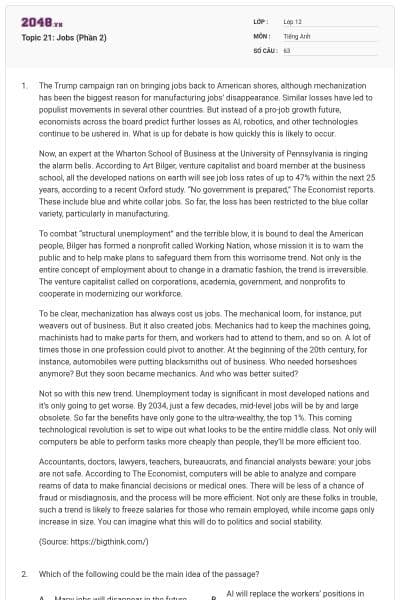
The Trump campaign ran on bringing jobs back to American shores, although mechanization has been the biggest reason for manufacturing jobs’ disappearance. Similar losses have led to populist movements in several other countries. But instead of a pro-job growth future, economists across the board predict further losses as AI, robotics, and other technologies continue to be ushered in. What is up for debate is how quickly this is likely to occur.
Now, an expert at the Wharton School of Business at the University of Pennsylvania is ringing the alarm bells. According to Art Bilger, venture capitalist and board member at the business school, all the developed nations on earth will see job loss rates of up to 47% within the next 25 years, according to a recent Oxford study. “No government is prepared,” The Economist reports. These include blue and white collar jobs. So far, the loss has been restricted to the blue collar variety, particularly in manufacturing.
To combat “structural unemployment” and the terrible blow, it is bound to deal the American people, Bilger has formed a nonprofit called Working Nation, whose mission it is to warn the public and to help make plans to safeguard them from this worrisome trend. Not only is the entire concept of employment about to change in a dramatic fashion, the trend is irreversible. The venture capitalist called on corporations, academia, government, and nonprofits to cooperate in modernizing our workforce.
To be clear, mechanization has always cost us jobs. The mechanical loom, for instance, put weavers out of business. But it also created jobs. Mechanics had to keep the machines going, machinists had to make parts for them, and workers had to attend to them, and so on. A lot of times those in one profession could pivot to another. At the beginning of the 20th century, for instance, automobiles were putting blacksmiths out of business. Who needed horseshoes anymore? But they soon became mechanics. And who was better suited?
Not so with this new trend. Unemployment today is significant in most developed nations and it’s only going to get worse. By 2034, just a few decades, mid-level jobs will be by and large obsolete. So far the benefits have only gone to the ultra-wealthy, the top 1%. This coming technological revolution is set to wipe out what looks to be the entire middle class. Not only will computers be able to perform tasks more cheaply than people, they’ll be more efficient too.
Accountants, doctors, lawyers, teachers, bureaucrats, and financial analysts beware: your jobs are not safe. According to The Economist, computers will be able to analyze and compare reams of data to make financial decisions or medical ones. There will be less of a chance of fraud or misdiagnosis, and the process will be more efficient. Not only are these folks in trouble, such a trend is likely to freeze salaries for those who remain employed, while income gaps only increase in size. You can imagine what this will do to politics and social stability.
(Source: https://bigthink.com/)
Which of the following could be the main idea of the passage?
Many jobs will disappear in the future.
AI will replace the workers’ positions in almost jobs.
Manufacturing jobs are predicted to be the first ones to disappear.
Changing jobs is not a new trend in the future.
Đáp án A
Câu nào trong các câu sau có thể là ý chính của đoạn văn?
A. Nhiều công việc sẽ biến mất trong tương lai.
B. Trí thông minh nhân tạo sẽ thay thế vị trí của các công nhân trong hầu hết các công việc.
C. Công việc sản xuất được dự đoán sẽ là những công việc đầu tiên biến mất.
D. Thay đổi công việc không còn là một xu hướng mới trong tương lai.
Căn cứ thông tin đoạn 1:
The Trump campaign ran on bringing jobs back to American shores, although mechanization has been the biggest reason for manufacturing jobs’ disappearance. Similar losses have led to populist movements in several other countries. But instead of a pro-job growth future, economists across the board predict further losses as AI, robotics, and other technologies continue to be ushered in. What is up for debate is how quickly this is likely to occur.
(Các chiến dịch Trump khởi động nhằm mục tiêu mang việc làm trở lại bờ biển Mỹ, mặc dù cơ giới hóa là lý do lớn nhất cho sự biến mất của các công việc sản xuất. Những tổn thất tương tự đã dẫn đến phong trào dân túy ở một số quốc gia khác. Nhưng thay vì một tương lai tăng trưởng nghề nghiệp, các nhà kinh tế trên thế giới dự đoán những tổn thất xa hơn vì trí thông minh nhân tạo, robot, và các công nghệ khác tiếp tục được đưa vào sử dụng. Cái cần tranh luận là điều này có khả năng xảy ra nhanh đến mức nào.)
It can be inferred from paragraph 2 that “blue and white collar jobs” are related to ______.
people whose uniforms’ colors are blue and white.
people who are distinguished by the colors of their collars.
people who do physical work in industry and who work in an office.
people (mainly women) who do low-paid jobs, for example in offices and restaurants.
Đáp án C
Có thể suy ra từ đoạn 2 rằng “blue and white collar jobs” có liên quan đến ____________.
A. những người mặc đồng phục trắng và xanh dương.
B. những người được phân biệt qua màu sắc của cổ áo.
C. những người lao động chân tay trong ngành công nghiệp và những nhân viên văn phòng.
D. những người (chủ yếu là phụ nữ) làm những công việc với mức lương thấp như ở văn phòng hay nhà hàng.
Căn cứ thông tin đoạn 2:
These include blue and white collar jobs. So far, the loss has been restricted to the blue collar variety, particularly in manufacturing.
(Những mất mát này gồm cả các công nhân nhà máy và nhân viên văn phòng. Cho đến nay, sự mất mát đang bị giới hạn ở nhiều công việc tay chân, đặc biệt là trong sản xuất.)
The word “irreversible” in paragraph 3 is closest in meaning to _________.
impermanent
remediable
reparable
unalterable
Đáp án D
Từ “irreversible” trong đoạn 3 gần nghĩa nhất với từ __________.
A. tạm thời
B. có thể sửa chữa được
C. có thể đền bù được
D. không thể thay đổi được
Từ đồng nghĩa: irreversible (không thể thay đổi được) = unalterable
Not only is the entire concept of employment about to change in a dramatic fashion, the trend is irreversible.
(Không chỉ toàn bộ khái niệm về việc làm sắp thay đổi theo kiểu thời trang ấn tượng, mà xu hướng này là không thể thay đổi được).
According to the passage, which of the following is NOT true about jobs in the future?
AI, robots and technologies continuously used will put more labourers out of their jobs.
Every country has applied many policies to prepare for the massive loss of jobs in the next 25 years.
Many different organizations are called to cooperate in renovating the workforce.
Working Nation is an organization founded to warn the public and make plans to save people from job loss.
Đáp án B
Theo đoạn văn, câu nào là không đúng về nghề nghiệp trong tương lai?
A. Trí thông minh nhân tạo, robot và các công nghệ khác tiếp tục được sử dụng sẽ khiến nhiều người lao động mất việc làm.
B. Mỗi đất nước đã áp dụng nhiều chính sách để chuẩn bị cho sự mất việc đồng loạt trong 25 năm tới.
C. Nhiều tổ chức khác nhau được kêu gọi hợp tác trong việc đổi mới lực lượng lao động.
D. “Working Nation” là một tổ chức được thành lập để cảnh báo công chúng và lập kế hoạch để bảo vệ con người khỏi mất việc.
Căn cứ vào các thông tin sau:
But instead of a pro-job growth future, economists across the board predict further losses as AI, robotics, and other technologies continue to be ushered in. What is up for debate is how quickly this is likely to occur.
(Nhưng thay vì một tương lai tăng trưởng nghề nghiệp, các nhà kinh tế trên thế giới dự đoán những tổn thất xa hơn vì trí thông minh nhân tạo, robot, và các công nghệ khác tiếp tục được đưa vào sử dụng. Cái cần tranh luận là điều này có khả năng xảy ra nhanh đến mức nào.)
According to Art Bilger, venture capitalist and board member at the business school, all the developed nations on earth will see job loss rates of up to 47% within the next 25 years, according to a recent Oxford study. “No government is prepared,” The Economist reports.
(Theo Art Bilger, một nhà đầu tư mạo hiểm và thành viên hội đồng quản trị tại trường kinh doanh, tất cả các quốc gia phát triển trên trái đất sẽ chứng kiến tỷ lệ mất việc làm lên đến 47% trong vòng 25 năm tới, theo một nghiên cứu gần đây của Oxford. “Không có chính phủ nào được chuẩn bị cho điều này,” tờ The Economist đưa tin.)
The venture capitalist called on corporations, academia, government, and nonprofits to cooperate in modernizing our workforce.
(Nhà tư bản mạo hiểm kêu gọi các tập đoàn, học viện, chính phủ và các tổ chức phi lợi nhuận hợp tác hiện đại hóa lực lượng lao động của chúng ta.)
Bilger has formed a nonprofit called Working Nation, whose mission it is to warn the public and to help make plans to safeguard them from this worrisome trend.
(Bilger đã thành lập một tổ chức phi lợi nhuận gọi là “Working Nation”, có sứ mệnh cảnh báo công chúng và giúp lập kế hoạch bảo vệ họ khỏi xu hướng đáng lo ngại này.)
According to paragraph 4, what is the advantage of mechanization?
Although mechanization drives people out of work, it also creates more jobs.
People can change their jobs to be more suitable with the society.
People will no longer need the useless like horseshoes.
Workers will spend less time on manufacturing with the help of machines.
Đáp án A
Theo đoạn 4, lợi ích của sự cơ giới hoá là gì?
A. Mặc dù sự cơ giới hoá khiến nhiều người mất việc nhưng nó cũng tạo ra nhiều việc hơn.
B. Nhiều người có thể thay đổi công việc để phù hợp hơn với xã hội.
C. Nhiều người sẽ không còn cần những thứ vô dụng như móng ngựa nữa.
D. Công nhân sẽ sử dụng ít thời gian hơn trong sản xuất với sự giúp đỡ của máy móc.
Căn cứ thông tin đoạn 4:
To be clear, mechanization has always cost us jobs. The mechanical loom, for instance, put weavers out of business. But it also created jobs. Mechanics had to keep the machines going, machinists had to make parts for them, and workers had to attend to them, and so on.
(Rõ ràng rằng sự cơ giới hóa luôn luôn được đánh đổi bằng chính công ăn việc làm của chúng ta. Ví dụ, máy dệt cơ khí sẽ loại bỏ người thợ dệt ra khỏi ngành này. Nhưng nó cũng tạo ra công ăn việc làm. Thợ máy phải giữ cho máy móc hoạt động, các thợ chế tạo máy phải chế tạo các bộ phận cho máy móc, và công nhân phải có mặt làm cùng với máy móc, vân vân).
The word “obsolete” in paragraph 5 could be best replaced by __________.
outdated
modern
fashionable
adventurous
Đáp án A
Từ “obsolete” trong đoạn 5 có thể được thay thế bởi từ __________.
A. lạc hậu
B. hiện đại
C. thời trang
D. mạo hiểm
Từ đồng nghĩa: obsolete (quá hạn, lỗi thời) = outdated
Unemployment today is significant in most developed nations and it’s only going to get worse. By 2034, just a few decades, mid-level jobs will be by and large obsolete.
(Thất nghiệp ngày nay khá nghiêm trọng ở hầu hết các quốc gia phát triển và nó chỉ sẽ tồi tệ hơn. Đến năm 2034, chỉ một vài thập kỷ tới, công việc ở mức trung cấp sẽ qua đi và trở nên lỗi thời.)
What does the word “they” in paragraph 5 refer to?
people
tasks
computers
the entire middle class
Đáp án C
Từ “they” trong đoạn 5 đề cập đến từ nào?
A. mọi người
B. nhiệm vụ
C. máy tính
D. toàn bộ tầng lớp trung lưu
Căn cứ thông tin đoạn 5:
This coming technological revolution is set to wipe out what looks to be the entire middle class. Not only will computers be able to perform tasks more cheaply than people, they’ll be more efficient too.
(Cuộc cách mạng công nghệ sắp tới này được thiết lập để quét sạch những gì được cho là toàn bộ tầng lớp trung lưu. Các máy tính sẽ có thể thực hiện nhiệm vụ không những rẻ hơn so với con người, mà chúng cũng sẽ hiệu quả hơn.)
Why does the author mention in the last paragraph that accountants, doctors, lawyers, teachers, bureaucrats, and financial analysts are not safe jobs?
Because they are easy to make mistakes or misdiagnosis in doing their jobs.
Because the salaries paid for these jobs may be frozen in the future.
Because computers are likely to analyze and process a great amount of data with high accuracy.
Because these jobs directly influence politics and social stability.
Đáp án C
Tại sao tác giả đề cập trong đoạn cuối rằng kế toán, bác sĩ, luật sư, giáo viên, công chức và nhà phân tích tài chính là các công việc không an toàn?
A. Bởi vì những người này dễ mắc lỗi hay sai sót trong công việc của họ.
B. Bởi vì lương của những nghề này có thể bị đóng băng trong tương lai.
C. Bởi vì máy tính có thể phân tích và xử lý một lượng dữ liệu lớn với độ chính xác cao.
D. Bởi vì những nghề này có ảnh hưởng trực tiếp đến chính trị và sự ổn định xã hội.
Căn cứ vào thông tin đoạn cuối:
Accountants, doctors, lawyers, teachers, bureaucrats, and financial analysts beware: your jobs are not safe. According to The Economist, computers will be able to analyze and compare reams of data to make financial decisions or medical ones. There will be less of a chance of fraud or misdiagnosis, and the process will be more efficient.
(Kế toán, bác sĩ, luật sư, giáo viên, công chức và nhà phân tích tài chính hãy cẩn thận: công việc của bạn không an toàn. Theo tờ The Economist, các máy tính sẽ có thể phân tích và so sánh rất nhiều dữ liệu để đưa ra các quyết định tài chính hoặc các kết quả y tế. Sẽ có ít cơ hội gian lận hoặc chẩn đoán sai, và quy trình sẽ hiệu quả hơn.)
There’s a direct link between employee satisfaction and customer satisfaction. Employees are the driving factor behind customer satisfaction. Employee interactions set the tone for a positive or negative customer experience. When employees aren’t happy at work, their interactions with customers can, and almost always will, suffer. Over the course of time, this can have serious repercussions for a business. The place where this becomes the most critical is any business where employees are directly interacting with customers, such as retail or food service. Historically underpaid and overworked, employees in these jobs are tasked with spending their entire shifts serving customers.
This is where employee experience comes in. If even a fraction of a customer experience budget was spent on employee experience, there would be a huge return on investment. One of the easiest ways to enhance employee experience is to ask for and welcome employees’ feedback. They have great insight into customer needs. After all, they’re the ones who are directly interacting with customers and hearing their criticisms and compliments firsthand. Employees can be your biggest asset when it comes to customer satisfaction.
A large part of employee experience revolves around understanding what employees need and want and gaining insight into their work preferences. Another critical piece of the employee experience is training and development. Employees should be equipped with the skills they need to excel at their jobs and have opportunities to continue to learn and develop. They should be able to check in and touch base with their managers to keep track of their progress and discuss any questions or concerns as they arise.
Showing employees that you value the work they’re doing is one of the easiest ways to boost their motivation. It can be as simple as saying thank you, to publicly acknowledging and celebrating their contributions. It’s not just the younger generations who crave recognition - no one likes to feel like the work they’re doing is going unnoticed.
It’s time to shift the mindset from employees working just to work, to acknowledging that they’re valuable contributors to a company’s success. Employees need to understand how important their role is and how their work fits into the bigger picture. They need to feel like their voices are being heard and they have respect from their managers. Most importantly, they need to be able to come to work and know that the next eight hours won’t be pure torture.
(Source: https://www.forbes.com/)
The passage mainly discuss ________.
The link between pay and job satisfaction.
The importance of job satisfaction in today’s workplace.
Job gratification in organisational behaviours.
How employee satisfaction affects customer satisfaction.
Đáp án D
Đoạn văn chủ yếu thảo luận về .
A. Mối liên hệ giữa lương và sự hài lòng trong công việc
B. Tầm quan trọng của sự hài lòng trong công việc tại nơi làm việc ngày hôm nay
C. Sự hài lòng trong công việc trong hành vi tổ chức
D. Sự hài lòng của nhân viên ảnh hưởng đến sự hài lòng của khách hàng như thế nào
Căn cứ vào thông tin đoạn đầu:
There’s a direct link between employee satisfaction and customer satisfaction. Employees are the driving factor behind customer satisfaction. Employee interactions set the tone for a positive or negative customer experience.
(Có một liên kết trực tiếp giữa sự hài lòng của nhân viên và sự hài lòng của khách hàng. Nhân viên là yếu tố thúc đẩy sự hài lòng của khách hàng. Tương tác của nhân viên tạo cho trải nghiệm khách hàng là tiêu cực hoặc tích cực.)
Như vậy, đoạn văn đang đề cập đến việc sự hài lòng của nhân viên ảnh hưởng đến sự hài lòng của khách hàng như thế nào
The word “repercussions” in paragraph 1 can be replaced by _______.
rips-off
consequences
echoes
by-products
Đáp án B
Từ “repercussions” trong đoạn 1 có thể được thay thế bằng .
A. xé toạc
B. hậu quả
C. tiếng vang
D. sản phẩm phụ
Từ đồng nghĩa repercussion (hậu quả) = consequence
Over the course of time, this can have serious repercussions for a business.
(Theo thời gian, điều này có thể có hậu quả nghiêm trọng cho một doanh nghiệp.)
According to paragraph 1, what is most suitable generalisation for the relationship between worker satisfaction and client satisfaction?
Happy employees equal happy customers whereas unhappy employees lead to unhappy customers.
No customers will show interest in the well-being of the waiters or servers.
The customers only want to see a miserable and poorly paid employees for their own gratification.
The standard of the company and the qualifications of the worker set the criteria for their clientele.
Đáp án A
Theo đoạn 1, sự khái quát nào là phù hợp nhất cho mối quan hệ giữa sự hài lòng của người nhân viên và sự hài lòng của khách hàng?
A. Nhân viên vui vẻ bằng với khách hàng vui vẻ trong khi nhân viên không vui dẫn đến khách hàng không vui
B. Không có khách hàng nào sẽ thể hiện sự quan tâm đến sức khỏe của người phục vụ
C. Các khách hàng chỉ muốn nhìn thấy một nhân viên khốn khổ và được trả lương thấp cho sự hài long của chính họ
D. Tiêu chuẩn của công ty và trình độ của người lao động đặt ra các tiêu chí cho khách hàng của họ
Căn cứ vào thông tin đoạn đầu:
Employee interactions set the tone for a positive or negative customer experience. When employees aren’t happy at work, their interactions with customers can, and almost always will, suffer.
(Tương tác của nhân viên tạo cho trải nghiệm khách hàng là tiêu cực hoặc tích cực. Khi nhân viên không vui vẻ tại nơi làm việc, sự tương tác của họ với khách hàng có thể, và hầu như sẽ luôn luôn chịu đựng.)
The word “asset” in paragraph 2 can be replaced by _______.
estate
money
wealth
tool
Đáp án C
Từ “asset” trong đoạn 2 có thể được thay thế bằng __________ .
A. bất động sản; tài sản ai đó để lại khi chết đi
B. tiền
C. tài sản ai đó có
D. công cụ
=> Từ đồng nghĩa: asset (tài sản sở hữu) = wealth
Employees can be your biggest asset when it comes to customer satisfaction.
(Nhân viên có thể là tài sản lớn nhất của bạn khi nói đến sự hài lòng của khách hàng.)
The word “their” in paragraph 4 refers to _____.
employees
employers
ways
generations
Đáp án A
Từ “their” trong đoạn 4 đề cập đến .
A. nhân viên
B. người chủ
C. cách thức
D. các thế hệ
Từ “their” ở đây dùng để thay thế cho sở hữu của danh từ nhân viên được nhắc tới trước đó.
Showing employees that you value the work they’re doing is one of the easiest ways to boost their motivation. It can be as simple as saying thank you, to publicly acknowledging and celebrating their contributions.
(Cho nhân viên thấy rằng bạn coi trọng công việc họ đang làm là một trong những cách dễ nhất để thúc đẩy động lực của họ. Nó có thể đơn giản như nói lời cảm ơn, công khai thừa nhận và tán dương những đóng góp của họ.)
According to paragraph 3, what are the employees NOT advised to do for better working experience?
They should have brief talks with their superiors to understand their own performance.
They should be allowed to have a friendly and touchy-feely relationship with their seniors.
They should be trained so as to work not only professionally but also progressively and creatively.
They should be encouraged to consult with their managers any problems or issues.
Đáp án B
Theo đoạn 3, nhân viên không nên làm gì cho kinh nghiệm làm việc tốt hơn?
A. Họ nên có cuộc nói chuyện ngắn với cấp trên để biết hiệu suất làm việc của chính họ
B. Họ nên được phép có một mối quan hệ thân thiện và cảm động với các bậc tiền bối của họ
C. Họ nên được đào tạo để làm việc không chỉ chuyên nghiệp mà còn tiến bộ và sáng tạo
D. Họ nên được khuyến khích tham khảo ý kiến của người quản lý của họ về bất kỳ vấn đề nào
Căn cứ vào thông tin đoạn ba:
Employees should be equipped with the skills they need to excel at their jobs and have opportunities to continue to learn and develop. They should be able to check in and touch base with their managers to keep track of their progress and discuss any questions or concerns as they arise.
(Nhân viên cần được trang bị những kỹ năng, họ cần có để nổi trội trong công việc của mình và có cơ hội tiếp tục học hỏi và phát triển. Họ nên có thể kiểm tra và liên lạc với các người quản lý của mình để theo dõi tiến trình của họ và thảo luận bất kỳ câu hỏi nào hoặc mối quan tâm khi chúng phát sinh.)
Which of the following statements is TRUE, according to the passage?
Collecting report on the lifestyles and nightlives of the employees will do the company good.
Gaining profits should be the target of corporations nowadays instead of customer services.
The employees hold great knowledge when it comes to understanding the customers.
Only the Millennial and Gen Z employees will go as far as to demand company to invest talent and treat them fairly
Đáp án C
Phát biểu nào sau đây là đúng, theo đoạn văn?
A. Báo cáo thu thập về lối sống và cuộc sống về đêm của nhân viên sẽ làm cho công ty tốt
B. Thu được lợi nhuận nên là mục tiêu của các tập đoàn hiện nay thay vì dịch vụ khách hàng
C. Các nhân viên nắm giữ thông tin tuyệt vời, nó đến từ việc hiểu khách hàng
D. Chỉ có nhân viên trong thế hệ Y và thế hệ Z sẽ đáp ứng được những yêu cầu công ty để đầu tư vào tài năng và đối xử công bằng với họ
Căn cứ vào thông tin đoạn hai:
They have great insight into customer needs. After all, they’re the ones who are directly interacting with customers and hearing their criticisms and compliments firsthand. Employees can be your biggest asset when it comes to customer satisfaction.
(Họ có cái nhìn sâu sắc về nhu cầu của khách hàng. Sau cùng, họ là những người trực tiếp tương tác với khách hàng và tận mắt nghe những lời chỉ trích và khen ngợi của họ. Nhân viên có thể là tài sản lớn nhất của bạn khi nói đến sự hài lòng của khách hàng.)
Which of the following can be inferred from the passage?
The career ladder is hard to climb, especially with a manual underpaid job.
A business’s efforts can so easily be ruined by bad social statuses of its employees.
Employee loyalty and commitment influence the image of the company in the eye of its business partners.
Employee satisfaction raises productivity and betters service, thus customer satisfaction and loyalty.
Đáp án D
Điều nào sau đây có thể được suy ra từ đoạn văn?
A. Nấc thang nghề nghiệp rất khó để leo lên, đặc biệt là với một công việc được trả lương thủ công
B. Những nỗ lực của một doanh nghiệp có thể dễ dàng bị hủy hoại bởi địa vị xã hội xấu của nhân viên
C. Lòng trung thành và cam kết của nhân viên ảnh hưởng đến hình ảnh của công ty trong mắt công ty đối tác kinh doanh
D. Sự hài lòng của nhân viên làm tăng năng suất và dịch vụ, vì vậy ảnh hưởng đến sự hài lòng của khách hàng và lòng trung thành
Căn cứ vào thông tin đoạn đầu:
There’s a direct link between employee satisfaction and customer satisfaction. Employees are the driving factor behind customer satisfaction. Employee interactions set the tone for a positive or negative customer experience.
(Có một liên kết trực tiếp giữa sự hài lòng của nhân viên và sự hài lòng của khách hàng. Nhân viên là yếu tố thúc đẩy sự hài lòng của khách hàng. Tương tác của nhân viên tạo cho trải nghiệm khách hàng là tiêu cực hoặc tích cực.)
The fresh data released by the Centre for Monitoring Indian Economy (CMIE) showed that unemployment rate in the month of October jumped to 8.5 per cent, which is the highest in over three years. A new academic research paper released by the Centre of Sustainable Employment also concluded that there has been a marked decline in total employment in India between 2011-12 and 2017-18, reported The Indian Express.
The research paper by Santosh Mehrotra and Jaiati K Parida stated as, "However, due to sharp increases in enrollment at every level of education over the noughties, it was expected that post -2012 total employment would increase, particularly in the non-farm sectors. But unfortunately, total employment during 2011-12 and 2017-18 declined by 9 million. The research further states that this happened for the first time in India’s history.
It is really ironical noting that Coimbatore Municipal Corporation posted a vacancy for 549 sanitary workers. What followed was that 7000 highly qualified applicants even some of them with engineering and graduate degrees applied for the job. The Corporation witnessed the overwhelming turnout of 7000 candidates. Similarly, few month back, Chennai witnessed an unusual event when around 4600 of youth sent their application for 14 posts like sweepers and sanitary workers. The applicants had professional qualification like B.Tech, M.Tech, Master of Business Administration.
Though the government constantly has been refuting the grim of job data but the facts and figures can’t be avoided any more. Therefore, now the government should take an initiative to overcome the high prevalence of unemployment and figure out the derivers of the job crisis. In this regard, it is worth to mention a book titled ‘Job crisis in India’ written by business journalist Raghavan Jagnnathan. The author in his book pointed out factors and reasons behind this decline of employment. He attributed that the absence of skills required in the highly technical nature of jobs is big factor. Another aspect of this is that in the majority of cases the skills or training acquired by the youths do not match or suit the core demand of the job. So at first the government must step up for reformation, innovation and renovation of the standard of the education in universities and colleges.
(Source: https://www.thehansindia.com/)
Which best serves as the title for the passage?
Employment rates taking an unexpected turn.
Working from sweatshops to famed factories.
Disruption awaiting in education sector.
A full-blown unemployment crisis is looming.
Đáp án D
Câu nào thích hợp nhất làm tiêu đề cho đoạn văn?
A. Tỷ lệ việc làm đang có một bước ngoặt bất ngờ
B. Làm việc từ công xưởng nhỏ đến các nhà máy nổi tiếng
C. Sự gián đoạn chờ đợi trong ngành giáo dục
D. Một cuộc khủng hoảng thất nghiệp toàn diện đang xuất hiện
Căn cứ vào thông tin đoạn đầu:
The fresh data released by the Centre for Monitoring Indian Economy (CMIE) showed that unemployment rate in the month of October jumped to 8.5 per cent, which is the highest in over three years. A new academic research paper released by the Centre of Sustainable Employment also concluded that there has been a marked decline in total employment in India between 2011-12 and 2017-18, reported The Indian Express.
(Dữ liệu mới được đưa ra bởi trung tâm theo dõi kinh tế Ấn Độ (CMIE) cho thấy tỷ lệ thất nghiệp trong tháng 10 đã tăng vọt lên 8,5%, cao nhất so với ba năm. Một bài nghiên cứu học thuật mới được phát hành bởi trung tâm việc làm bền vững cũng kết luận rằng đã có sự sụt giảm rõ rệt về tổng số việc làm ở Ấn Độ giữa 2011-2012 và 2017-2018, The Indian Express báo cáo.)
=> Như vậy, ta có thể thấy bài văn đang nói về việc tỷ lệ thất nghiệp ở Ấn Độ đang tăng cao và tổng số việc làm thì giảm mạnh, suy ra đây là một cuộc khủng hoảng về việc làm.
The word “marked” in paragraph 1 is closest in meaning to _______.
striking
memorable
unusual
appreciable
Đáp án A
Từ “marked” trong đoạn 1 có nghĩa gần nhất với __________ .
A. nổi bật
B. đáng nhớ
C. bất thường
D. đáng trân trọng
Từ đồng nghĩa marked (rõ rệt) = striking
A new academic research paper released by the Centre of Sustainable Employment also concluded that there has been a marked decline in total employment in India between 2011-12 and 2017-18, reported The Indian Express.
(Một bài nghiên cứu học thuật mới được phát hành bởi Trung tâm việc làm bền vững cũng kết luận rằng đã có sự sụt giảm rõ rệt về tổng số việc làm ở Ấn Độ giữa 2011-2012 và 2017-2018, The Indian Express báo cáo.)
The word “this” in paragraph 2 refers to __________ .
The projected number of child labour.
The soar of higher education admission.
The reliance on research for policy-making.
The decrease of overall employment.
Đáp án D
Từ “this” trong đoạn 2 đề cập đến __________ .
A. Số lượng lao động trẻ em dự kiến
B. Sự tăng vọt của tuyển sinh giáo dục đại học
C. Sự phụ thuộc vào nghiên cứu cho việc hoạch định chính sách
D. Sự sụt giảm của tổng số việc làm
Từ “this” ở đây dùng để thay thế cho cụm sự sụt giảm của tổng số việc làm được nhắc tới trước đó.
But unfortunately, total employment during 2011-12 and 2017-18 declined by 9 million. The research further states that this happened for the first time in India’s history.
(Nhưng chẳng may, tổng số việc làm trong giai đoạn 2011-2012 và 2017-2018 đã giảm đi 9 triệu. Các nghiên cứu thêm tuyên bố rằng điều này đã xảy ra lần đầu tiên trong lịch sử của Ấn Độ.)
What does the phrase “the noughties” in paragraph 2 most likely mean?
the first three years of the 2000s.
the century from 2001 to 2100.
the years from 2000 to 2010.
the decade from 2000 to 2009.
Đáp án D
Cụm từ “the noughties” trong đoạn 2 có nghĩa gần nhất với từ _______.
A. Ba năm đầu tính từ năm 2000.
B. Thế kỷ từ 2001 đến 2100.
C. Những năm từ 2000 đến 2010.
D. Thập kỷ từ năm 2000 đến 2009.
Giải thích:
Dựa vào định nghĩa thì “noughties” là thập kỷ đầu của thế kỷ, tức là trong vòng 10 năm. Theo đoạn văn thì từ này chỉ thập kỷ đầu của thế kỷ 21 từ ngày 01 tháng 01 năm 2000 đến ngày 31 tháng 12 năm 2009.
According to paragraph 3, what can be concluded from the statistical information?
The world economic plight is affecting the Indian education sector.
It is evident that the country is drastically suffering from job crisis.
It is humble of technical students to start from the bottom of the ladder.
Most of the current corporates function on the grounds of nepotism.
Đáp án B
Theo đoạn 3, những gì có thể được kết luận từ các thông tin thống kê?
A. Hoàn cảnh kinh tế thế giới đang ảnh hưởng đến ngành giáo dục Ấn Độ
B. Rõ ràng là đất nước đang bị khủng hoảng công việc nghiêm trọng
C. Thật khiêm tốn để sinh viên kỹ thuật để bắt đầu sự nghiệp từ những công việc chân tay
D. Hầu hết các tập đoàn hiện tại hoạt động trên cơ sở gia đình trị
Căn cứ vào thông tin đoạn ba:
It is really ironical noting that Coimbatore Municipal Corporation posted a vacancy for 549 sanitary workers. What followed was that 7000 highly qualified applicants even some of them with engineering and graduate degrees applied for the job. The Corporation witnessed the overwhelming turnout of 7000 candidates. Similarly, few month back, Chennai witnessed an unusual event when around 4600 of youth sent their application for 14 posts like sweepers and sanitary workers.
(Điều thực sự đáng chú ý là tập đoàn thành phố Coimbatore đã đăng một tuyển dụng 549 công nhân vệ sinh. Điều tiếp theo là 7000 ứng viên có trình độ cao thậm chí một số trong số họ với bằng kỹ sư và đã tốt nghiệp xin vào công việc đó. Tổng công ty chứng kiến số lượng ứng cử viên áp đảo của 7000 ứng viên. Tương tự, vài tháng trước, Chennai đã chứng kiến một sự kiện bất thường khi khoảng 4600 thanh niên gửi đơn đăng ký cho 14 vị trí là quét rác và công nhân vệ sinh.)
According to paragraph 4, what is NOT mentioned as the advisable action for the governing body?
Identify the roots of unemployment problems.
Stop turning a blind eye to the worrisome figures.
Invest a large sum of money for graduates to train abroad.
Strategise to counter-measure the growth of the jobless.
Đáp án C
Theo đoạn 4, những gì không được đề cập là hành động được khuyến nghị cho cơ quan chủ quản?
A. Xác định nguồn gốc của vấn đề thất nghiệp
B. Ngừng nhắm mắt làm ngơ trước những con số đáng lo ngại
C. Đầu tư một khoản tiền lớn cho sinh viên tốt nghiệp để đào tạo ở nước ngoài
D. Chiến lược cho sự gia tăng người thất nghiệp
Căn cứ vào thông tin đoạn bốn:
Therefore, now the government should take an initiative to overcome the high prevalence of unemployment and figure out the derivers of the job crisis.
(Vì vậy, bây giờ chính phủ nên chủ động để vượt qua tỷ lệ thất nghiệp cao và tìm ra nguồn gốc của cuộc khủng hoảng việc làm.)
So at first the government must step up for reformation, innovation and renovation of the standard of the education in universities and colleges.
(Vì vậy, lúc đầu chính phủ phải đẩy mạnh cải cách, đổi mới và đổi mới tiêu chuẩn của giáo dục trong các trường đại học và cao đẳng.)
Which of the following statements is TRUE, according to the passage?
The Centre for Monitoring Indian Economy is headed by Raghavan Jagnnathan.
7000 people responded to the cleaner recruitment of Coimbatore Municipal Corporation.
Raghavan wrote that most graduates have enough skills to compete in the knowledge market.
The last thing the government should do is to improve the educational standard.
Đáp án B
Phát biểu nào sau đây là đúng, theo đoạn văn?
A. Trung tâm theo dõi nền kinh tế Ấn Độ do Raghavan Jagnnathan đứng đầu
B. 7000 người đã ứng tuyển vào tuyển dụng nhân viên dọn vệ sinh của tập đoàn thành phố Coimbatore
C. Raghavan viết rằng hầu hết sinh viên tốt nghiệp có đủ kỹ năng để cạnh tranh trong thị trường tri thức
D. Điều cuối cùng chính phủ nên làm là cải thiện tiêu chuẩn giáo dục
Căn cứ vào thông tin đoạn ba:
It is really ironical noting that Coimbatore Municipal Corporation posted a vacancy for 549 sanitary workers. What followed was that 7000 highly qualified applicants even some of them with engineering and graduate degrees applied for the job. The Corporation witnessed the overwhelming turnout of 7000 candidates.
(Điều thực sự đáng chú ý là tập đoàn thành phố Coimbatore đã đăng một tuyển dụng 549 công nhân vệ sinh. Điều tiếp theo là 7000 ứng viên có trình độ cao thậm chí một số trong số họ với bằng kỹ sư và đã tốt nghiệp xin vào công việc đó. Tổng công ty chứng kiến số lượng ứng cử viên áp đảo của 7000 ứng viên.)
Which of the following can be inferred from the passage?
The recent employment growth in India plunged significantly according to new report.
The slowdown of jobs in India is the signal for the country’s imminent economic boom.
The employability of Indian menial workers continues to be painfully low in recent years.
Companies and businesses must design a proper solution for this job crisis as soon as possible.
Đáp án A
Điều nào sau đây có thể được suy ra từ đoạn văn?
A. Tăng trưởng việc làm gần đây ở Ấn Độ đã giảm đáng kể theo báo cáo mới
B. Sự chậm lại của việc làm ở Ấn Độ là tín hiệu cho sự bùng nổ kinh tế sắp xảy ra của đất nước
C. Khả năng tuyển dụng lao động nam Ấn Độ tiếp tục ở mức thấp trong những năm gần đây
D. Các công ty và doanh nghiệp phải thiết kế một giải pháp thích hợp cho cuộc khủng hoảng việc làm này càng sớm càng tốt
Căn cứ vào thông tin đoạn một:
A new academic research paper released by the Centre of Sustainable Employment also concluded that there has been a marked decline in total employment in India between 2011-12 and 2017-18, reported The Indian Express.
(Một bài nghiên cứu học thuật mới được phát hành bởi trung tâm việc làm bền vững cũng kết luận rằng đã có sự sụt giảm rõ rệt về tổng số việc làm ở Ấn Độ giữa 2011-2012 và 2017-2018, The Indian Express báo cáo.)
How busy is too busy? For some it means having to miss the occasional long lunch; for others, it means missing lunch altogether. For a few, it is not being able to take a “sickie” once a month. Then there is a group of people for whom working every evening and weekend is normal, and frantic is the tempo of their lives. For most senior executives, workloads swing between extremely busy and frenzied. The vice-president of the management consultancy AT Kearney and its head of telecommunications for the Asia-Pacific region, Neil Plumridge, says his work weeks vary from a “manageable” 45 hours to 80 hours, but average 60 hours.
Three warning signs alert Plumridge about his workload: sleep, scheduling and family. He knows he has too much on when he gets less than six hours of sleep for three consecutive nights; when he is constantly having to reschedule appointments; “and the third one is on the family side”, says Plumridge, the father of a three-year-old daughter, and expecting a second child in October. “If I happen to miss a birthday or anniversary, I know things are out of control.” Being “too busy” is highly subjective. But for any individual, the perception of being too busy over a prolonged period can start showing up as stress: disturbed sleep, and declining mental and physical health. National workers’ compensation figures show stress causes the most lost time of any workplace injury. Employees suffering stress are off work an average of 16.6 weeks. The effects of stress are also expensive.
Comcare, the Federal Government insurer, reports that in 2003-04, claims for psychological injury accounted for 7% of claims but almost 27% of claim costs. Experts say the key to dealing with stress is not to focus on relief – a game of golf or a massage – but to reassess workloads. Neil Plumridge says he makes it a priority to work out what has to change; that might mean allocating extra resources to a job, allowing more time or changing expectations. The decision may take several days. He also relies on the advice of colleagues, saying his peers coach each other with business problems. “Just a fresh pair of eyes over an issue can help,” he says.
Executive stress is not confined to big organizations. Vanessa Stoykov has been running her own advertising and public relations business for seven years, specializing in work for financial and professional services firms. Evolution Media has grown so fast that it debuted on the BRW Fast 100 list of fastest-growing small enterprises last year – just after Stoykov had her first child. Stoykov thrives on the mental stimulation of running her own business. “Like everyone, I have the occasional day when I think my head’s going to blow off,” she says. Because of the growth phase the business is in, Stoykov has to concentrate on short-term stress relief – weekends in the mountains, the occasional “mental health” day – rather than delegating more work. She says: “We’re hiring more people, but you need to train them, teach them about the culture and the clients, so it’s actually more work rather than less.”
(Source: www.ielts-mentor.com)
Which of the following could be the title of the passage?
The stress of workplace
The average of working hours of senior executives
Some major groups of busy people
The warning signs of workload
Đáp án A
Câu nào trong các câu sau có thể là tiêu đề cho đoạn văn?
A. Áp lực ở nơi làm việc
B. Giờ làm việc trung bình của các nhà quản trị cấp cao
C. Những nhóm người bận rộn chính
D. Những cảnh báo của khối lượng công việc
Căn cứ vào thông tin toàn bài:
Đoạn 1: Mức độ được coi là bận rôn đối với nhiều nhóm người khác nhau.
Đoạn 2: Những cảnh báo về khối lượng công việc và giải pháp.
Đoạn 3: Áp lực quản trị ở các tổ chức, công ty.
Như vậy, toàn bài đang nói về áp lực ở nơi làm việc nên câu A là tiêu đề phù hợp nhất.
The word “consecutive” in paragraph 2 mostly means ____________.
interrupted
solitary
successive
intermittent
Đáp án C
Từ “consecutive” trong đoạn 2 gần như có nghĩa là ____________.
A. gián đoạn
B. một mình
C. liên tiếp
D. không liên tục
Từ đồng nghĩa: consecutive (liên tục) = successive
Three warning signs alert Plumridge about his workload: sleep, scheduling and family. He knows he has too much on when he gets less than six hours of sleep for three consecutive nights; when he is constantly having to reschedule appointments; “and the third one is on the family side”, says Plumridge, the father of a three-year-old daughter, and expecting a second child in October.
(Ba tín hiệu cảnh báo Plumridge về khối lượng công việc của ông ấy là: giấc ngủ, lịch trình công việc và gia đình. Ông ấy biết mình đang phải làm việc quá nhiều khi ông ấy có 3 đêm liên tiếp ngủ ít hơn 6 tiếng; khi ông ấy liên tục phải điều chỉnh lịch các cuộc họp; và mặt thứ 3 là về phía gia đình, ông Plumridge, bố của một đứa con gái 3 tuổi và đang chờ đợi đứa con thứ 2 vào tháng 10, cho biết).
According to the vice-president of the management consultancy AT Kearney and its head of telecommunications for the Asia-Pacific region, Neil Plumridge, what is NOT the warning sign about his workload?
not having enough time to sleep
continuously rearranging his appointments
not being able to attend his family’s celebrations
spending too much time for his family and children
Đáp án D
Theo phó chủ tịch của Công ty tư vấn quản lý AT Kearney và người đứng đầu bộ phận viễn thông khu vực Châu Á – Thái Bình Dương, Neil Plumridge, câu nào sau đây không phải là tín hiệu cảnh báo về khối lượng công việc của ông ấy?
A. không đủ thời gian để ngủ
B. liên tiếp sắp xếp lại các cuộc hẹn
C. không thể tham dự các lễ kỉ niệm trong gia đình
D. sử dụng quá nhiều thời gian cho gia đình và con cái của ông ấy
Từ khóa: Neil Plumridge/ not true/ the warning sign about his workload
Căn cứ vào thông tin đoạn 2:
Three warning signs alert Plumridge about his workload: sleep, scheduling and family. He knows he has too much on when he gets less than six hours of sleep for three consecutive nights; when he is constantly having to reschedule appointments; “and the third one is on the family side”, says Plumridge, the father of a three-year-old daughter, and expecting a second child in October. “If I happen to miss a birthday or anniversary, I know things are out of control.”
(Ba tín hiệu cảnh báo Plumridge về khối lượng công việc của ông ấy là: giấc ngủ, lịch trình công việc và gia đình. Ông ấy biết mình đang phải làm việc quá nhiều khi ông ấy có 3 đêm liên tiếp ngủ ít hơn 6 tiếng; khi ông ấy liên tục phải điều chỉnh lịch các cuộc họp; và mặt thứ 3 là về phía gia đình, ông Plumridge, bố của một đứa con gái 3 tuổi và đang chờ đợi đứa con thứ 2 vào tháng 10, cho biết. “Nếu tôi bỏ lỡ một ngày sinh nhật hay một lễ kỉ niệm, tôi biết mọi thứ đang vượt ngoài tầm kiểm soát”).
As mentioned in paragraph 2, the following sentences are true about the work stress, EXCEPT _____________.
Disturbed sleep and reducing mental and physical health are the symptom of being too busy.
The lost time caused by stress ranks last in comparison with other workplace injuries.
The cost paid for psychological injury was rather high.
Relief is not the effective way to cope with stress.
Đáp án B
Như đã đề cập trong đoạn 2, những câu sau đây là đúng về áp lực công việc, ngoại trừ ____________.
A. giấc ngủ bị xáo trộn và suy giảm sức khỏe thể chất và tinh thần là triệu chứng của việc quá bận rộn.
B. Thời gian bị mất do áp lực xếp sau cùng so với các thương tổn khác ở nơi làm việc.
C. Chi phí chi trả cho các sang chấn tâm lý là khá cao.
D. Việc giải tỏa không phải là cách hữu hiệu để giải quyết áp lực.
Từ khóa: true/ the work stress/ except
Căn cứ vào thông tin đoạn 2:
But for any individual, the perception of being too busy over a prolonged period can start showing up as stress: disturbed sleep, and declining mental and physical health. National workers’ compensation figures show stress causes the most lost time of any workplace injury. Employees suffering stress are off work an average of 16.6 weeks. The effects of stress are also expensive. Federal Government insurer, reports that in 2003-04, claims for psychological injury accounted for 7% of claims but almost 27% of claim costs. Experts say the key to dealing with stress is not to focus on relief – a game of golf or a massage – but to reassess workloads.
(Nhưng với bất kì cá nhân nào, các dấu hiệu về việc quá bận rộn trong một thời gian dài có thể bắt đầu xuất hiện dưới dạng các căng thẳng: giấc ngủ bị xáo trộn và sự suy giảm sức khỏe thể chất và tinh thần. Số liệu bồi thường cho công nhân cả nước chỉ ra rằng áp lực gây mất thời gian nhiều nhất so với bất kì thương tổn nào ở nơi làm việc. Nhân viên bị căng thẳng nghỉ làm trung bình 16.6 tuần. Những tác động của căng thẳng cũng rất tốn kém. Công ty bảo hiểm của Chính phủ Liên bang báo cáo rằng trong 2 năm 2003 – 2004, các yêu cầu bồi thường cho sang chấn tâm lý chiếm 7% tổng số ca, nhưng chiếm gần 27% chi phí đền bù. Các nhà chuyên gia cho biết chìa khóa để đương đầu với căng thẳng không phải là tập trung vào việc giải tỏa – một trận golf hay mát xa – mà là đánh giá lại khối lượng công việc).
The word “reassess” in the second paragraph is closest in meaning to __________.
re-evaluate
consider
reduce
estimate
Đáp án A
Từ “reassess” trong đoạn 2 gần nghĩa nhất với từ ____________.
A. đánh giá lại
B. xem xét
C. làm giảm
D. ước tính
Từ đồng nghĩa: reassess (đánh giá lại) = re-evaluate
Experts say the key to dealing with stress is not to focus on relief – a game of golf or a massage – but to reassess workloads.
(Các nhà chuyên gia cho biết chìa khóa để đương đầu với căng thẳng không phải là tập trung vào việc giải tỏa – một trận golf hay mát xa – mà là đánh giá lại khối lượng công việc).
What does the word “he” in paragraph 2 refer to?
Comcare, the Federal Government insurer
Expert
Neil Plumridge, The vice-president of the management consultancy AT Kearney
Employee
Đáp án C
Từ “he” trong đoạn 2 đề cập đến từ nào?
A. Comcare, Công ty Bảo hiểm Liên bang
B. chuyên gia
C. Neil Plumridge, phó chủ tịch của Công ty tư vấn quản lý AT Kearney
D. Người lao động
Căn cứ thông tin đoạn 2:
Neil Plumridge says he makes it a priority to work out what has to change; that might mean allocating extra resources to a job, allowing more time or changing expectations. The decision may take several days. He also relies on the advice of colleagues, saying his peers coach each other with business problems.
(Neil Plumridge nói rằng ông ấy ưu tiên việc tìm ra những gì phải thay đổi; điều đó có thể là phân bổ thêm nguồn lực cho 1 công việc, cho phép thêm nhiều thời gian hay thay đổi kì vọng. Quyết định đưa ra có thể mất vài ngày. Ông ấy cũng dựa vào lời khuyên của các đồng nghiệp, ông ấy nói rằng các đồng nghiệp của ông chỉ bảo cho nhau về các vấn đề kinh doanh).
According to the last paragraph, what measure does Vanessa Stoykov take to reduce work stress?
delegating more work
taking brief vacations on weekends
hiring more people
allowing more time or changing expectations
Đáp án B
Theo đoạn văn cuối, giải pháp nào mà Vanessa Stoykov đã thực hiện để làm giảm căng thẳng công việc?
A. giao phó nhiều việc hơn
B. đi nghỉ vào các cuối tuần
C. thuê thêm nhiều lao động
D. cho phép thêm thời gian hay thay đổi kì vọng
Từ khóa: measure/ Vanessa Stoykov/ reduce work stress
Căn cứ thông tin đoạn 3:
Because of the growth phase the business is in, Stoykov has to concentrate on short-term stress relief – weekends in the mountains, the occasional “mental health” day – rather than delegating more work. She says: “We’re hiring more people, but you need to train them, teach them about the culture and the clients, so it’s actually more work rather than less.”
(Bởi vì đang là giai đoạn tăng trưởng của công việc kinh doanh, Stoykov phải tập trung vào việc giảm các áp lực ngắn hạn – những ngày cuối tuần ở vùng núi, thỉnh thoảng có một ngày chăm sóc sức khỏe tinh thần – hơn là giao phó thêm nhiều việc. Cô ấy cho biết: “chúng tôi đang thuê thêm rất nhiều người lao động, nhưng bạn cần phải đào tạo họ, dạy cho họ về văn hóa và khách hàng, vì vậy, đó thực sự là có nhiều việc hơn chứ không phải ít hơn”).
It can be inferred from the passage that _______________.
stress appears in almost every position in workplace.
employees working in big organizations will suffer more stress than others.
the more the business grows, the more stress people get.
good colleagues can help to reduce stress.
Đáp án A
Có thể suy ra từ đoạn văn rằng ____________.
A. áp lực xuất hiện ở hầu hết các vị trí ở nơi làm việc.
B. những người lao động làm việc ở các tổ chức lớn sẽ chịu áp lực nhiều hơn những tổ chức khác.
C. kinh doanh càng phát triển, mọi người càng bị áp lực hơn.
D. các đồng nghiệp giỏi có thể giúp làm giảm áp lực.
Căn cứ các thông tin trong bài:
For most senior executives, workloads swing between extremely busy and frenzied.
(Với hầu hết các nhà quản trị cấp cao, khối lượng công việc dao động giữa cực kì bận rộn và điên cuồng).
Employees suffering stress are off work an average of 16.6 weeks.
(Nhân viên bị căng thẳng nghỉ làm trung bình 16.6 tuần.)
Executive stress is not confined to big organizations.
(Áp lực quản trị không chỉ giới hạn ở các tổ chức lớn).
Parents in most cases want the best for their children, and to ensure this, they are pushed to actively engage in their children’s lives, to ensure that they are making the right choices. Some parents, however, go to the extent of wanting to have the upper hand even when it comes to taking major decisions, such as choosing a career.
Local comedian and actor, Michael Sengazi, was obliged by his parents to pursue a career in law, a path he followed when he joined University of Kigali, but deep down he knew this wasn’t his dream career. This is why after graduating he chose to follow his passion —comedy. His parents failed to understand how a qualified lawyer could decide to go for comedy because they didn’t see it as a ‘well-paying job’. He had a challenge of convincing them to bless his journey. “So, I asked them to give me one year to try and see if comedy would work out for me. I worked hard and my parents realised that I could achieve big things, and they gave me the freedom to pursue the career.”
Bienvenue Muragwa, a career consultant at The Southern New Hampshire University based in Rwanda, says that parents are only allowed to guide the child during the career guidance process, but not take the final decision. “Parents are not allowed to choose or take the final decision for their children as the performance of the student is the assessing parameter of the career to be pursued,” he explains.
Shalom Azabe, a graduate in general counselling at Kampala Christian University, says in most African countries, not only Rwanda, children are overly dependent on their parents, yet this shouldn’t be the case. She recommends picking a leaf from westerners who endeavour to learn their children’s interests, something she says aides them in career guidance for the child. “Normally, a child starts to demonstrate a choice in career at 14 years of age. This is when parents need to sit down and make analysis that would help them guide their child in choosing the fitting option to undertake. This is in fact considered as over-protection as parents want to exercise their authority on their kids unwillingly, yet this affects them psychologically, and when the kid later on fails, they encounter a regret of pursuing studies that were not their choice in the first place,” Azabe said.
(Source: https://www.newtimes.co.rw/)
Which best serves as the title for the passage?
Taking every career development opportunities.
Why children should listen to their predecessors.
The major influence of parents on children’s future.
Should parents choose their children’s career?
Đáp án D
Câu nào thích hợp nhất làm tiêu đề cho đoạn văn?
A. Nắm bắt mọi cơ hội phát triển nghề nghiệp
B. Tại sao trẻ nên lắng nghe lời người lớn hơn
C. Ảnh hưởng lớn của cha mẹ đối với tương lai của trẻ
D. Cha mẹ có nên chọn nghề nghiệp cho con?
Căn cứ vào thông tin đoạn đầu:
Parents in most cases want the best for their children, and to ensure this, they are pushed to actively engage in their children’s lives, to ensure that they are making the right choices. Some parents, however, go to the extent of wanting to have the upper hand even when it comes to taking major decisions, such as choosing a career.
(Cha mẹ trong hầu hết các trường hợp muốn điều tốt nhất cho con cái của họ, và để đảm bảo điều này, họ được thúc đẩy đến mức tích cực tham gia vào cuộc sống của con cái họ, để đảm bảo rằng chúng có những lựa chọn đúng đắn. Tuy nhiên, một số cha mẹ lại đi đến mức muốn chiếm thế thượng phong ngay cả khi nói đến việc đưa ra quyết định lớn, chẳng hạn như chọn nghề nghiệp.)
Như vậy đoạn văn đang muốn nói về việc cha mẹ can thiệp vào việc lựa chọn nghề nghiệp của con cái.
The word “they” in paragraph 1 refers to _____.
cases
children
decisions
parents
Đáp án D
Từ “they” trong đoạn 1 đề cập đến .
A. trường hợp
B. trẻ em
C. quyết định
D. cha mẹ
Từ “they” ở đây dùng để thay thế cho danh từ cha mẹ được nhắc tới trước đó.
Parents in most cases want the best for their children, and to ensure this, they are pushed to actively engage in their children’s lives, to ensure that they are making the right choices.
(Cha mẹ trong hầu hết các trường hợp muốn điều tốt nhất cho con cái của họ, và để đảm bảo điều này, họ được thúc đẩy đến tích cực tham gia vào cuộc sống của con cái họ, để đảm bảo rằng chúng có những lựa chọn đúng đắn.)
According to paragraph 2, what does the comedian’s case emphasize about parents’ attitude?
Parents think they are doing the right thing of steering their children in the right direction.
Parents should understand their children and recognise that they are individuals with personal dreams.
Parents should instil an attitude of self belief by being positive and a little bit exaggerating.
Parents prioritize maintaining a mature parent-child relationship over their children’s future jobs.
Đáp án B
Theo đoạn 2, từ trường hợp diễn viên hài kịch nhấn mạnh gì về thái độ của cha mẹ?
A. Cha mẹ nghĩ rằng họ đang làm điều đúng đắn khi điều khiển con cái đi đúng hướng
B. Cha mẹ nên hiểu con mình và nhận ra rằng chúng là những cá nhân có ước mơ riêng
C. Cha mẹ nên thấm nhuần thái độ tự tin bằng cách tích cực và một chút cường điệu
D. Cha mẹ nên ưu tiên duy trì mối quan hệ cha mẹ và con cái trưởng thành hơn việc làm trong tương lai của con cái
Căn cứ vào thông tin đoạn hai:
Local comedian and actor, Michael Sengazi, was obliged by his parents to pursue a career in law, a path he followed when he joined University of Kigali, but deep down he knew this wasn’t his dream career. This is why after graduating he chose to follow his passion - comedy. His parents failed to understand how a qualified lawyer could decide to go for comedy because they didn’t see it as a ‘well-paying job’. (Diễn viên hài và diễn viên địa phương, Michael Sengazi bị cha mẹ bắt buộc phải theo đuổi nghề luật, một con đường anh đi theo khi anh học tại đại học Kigali, nhưng sâu trong lòng anh ấy biết đây không phải là ước mơ nghề nghiệp của anh ấy. Đây là lý do tại sao sau khi tốt nghiệp, anh chọn theo đuổi niềm đam mê của mình. Ba mẹ anh ấy không hiểu làm thế nào một luật sư có trình độ có thể quyết định đi diễn hài vì họ đã không xem nó như một “công việc được trả lương cao”.)
The word “parameter” in paragraph 3 can be replaced by_______.
constant
restriction
framework
criterion
Đáp án D
Từ “parameter” trong đoạn 3 có thể được thay thế bằng .
A. hằng số
B. hạn chế
C. khung
D. tiêu chí
Từ đồng nghĩa parameter (thông số) = criterion
“Parents are not allowed to choose or take the final decision for their children as the performance of the student is the assessing parameter of the career to be pursued,” he explains.
“Cha mẹ không được phép chọn hoặc đưa ra quyết định cuối cùng cho con cái của họ vì hiệu suất của học sinh là thông số đánh giá của sự nghiệp được theo đuổi,”ông giải thích.
According to paragraph 4, what action helps parents to provide better career advices for children?
Analysing the most suitable career option for children.
Holding unrealistic expectations for the youth.
Seeking to understand teenagers’ hobbies and passions.
Regularly attending parent/teacher meetings.
Đáp án C
Theo đoạn 4, hành động nào giúp cha mẹ đưa ra lời khuyên về nghề nghiệp tốt hơn cho trẻ?
A. Phân tích lựa chọn nghề nghiệp phù hợp nhất cho trẻ em
B. Giữ những kỳ vọng không thực tế cho giới trẻ
C. Tìm kiếm để hiểu sở thích và đam mê của thanh thiếu niên
D. Thường xuyên tham dự các cuộc họp phụ huynh giữa giáo viên
Căn cứ vào thông tin đoạn bốn:
She recommends picking a leaf from westerners who endeavour to learn their children’s interests, something she says aides them in career guidance for the child.
(Cô ấy khuyên nên bắt chước những người phương Tây, người nỗ lực học hỏi sở thích của con cái họ, một cái gì đó cô nói giúp họ trong việc định hướng nghề nghiệp cho đứa trẻ.)
The word “endeavor” in paragraph 4 can be replaced by _______.
try
toil
struggle
dream
Đáp án A
Từ “endeavor” trong đoạn 4 có thể được thay thế bằng __________ .
A. cố gắng
B. công việc
C. đấu tranh
D. mơ ước
Từ đồng nghĩa endeavor (nỗ lực) = try
She recommends picking a leaf from westerners who endeavour to learn their children’s interests, something she says aides them in career guidance for the child.
(Cô ấy khuyên nên bắt chước những người phương Tây, người nỗ lực học hỏi sở thích của con cái họ, một cái gì đó cô nói giúp họ trong việc định hướng nghề nghiệp cho đứa trẻ.)
Which of the following statements is TRUE, according to the passage?
Children have aspirations as well as abilities to choose the best career option to pursue.
Fourteen is the milestone where children’s first realisation of career choices manifest.
Michael Sengazi has successfully pursued the lawyer path in an international corporate.
Shalom Azabe is currently the most esteemed professor at Kampala Christian University.
Đáp án B
Phát biểu nào sau đây là đúng, theo đoạn văn?
A. Trẻ em có khát vọng cũng như khả năng lựa chọn lựa chọn nghề nghiệp tốt nhất để theo đuổi
B. Mười bốn tuổi là một cột mốc khi mà trẻ em lần đầu tiên nhận ra sự lựa chọn nghề nghiệp
C. Michael Sengazi đã theo đuổi thành công con đường luật sư trong một công ty quốc tế
D. Shalom Azabe hiện là giáo sư được kính trọng nhất tại đại học Kampala Christian
Căn cứ vào thông tin đoạn cuối:
Normally, a child starts to demonstrate a choice in career at 14 years of age. This is when parents need to sit down and make analysis that would help them guide their child in choosing the fitting option to undertake.
(Thông thường, một đứa trẻ bắt đầu thể hiện sự lựa chọn trong sự nghiệp ở tuổi 14. Đây là khi các bậc cha mẹ cần ngồi xuống và phân tích để định hướng con mình trong việc lựa chọn các lựa chọn phù hợp để theo đuổi.)
Which of the following can be inferred from the passage?
Parents should keep discussions and decisions open to their children regarding career choices.
Children and teenagers absorb their parents attitudes and expectations of them as they grow up.
Parents are always a positive influence in decisions affecting a young person’s vocational development.
Adolescents are averse to parental guidance in the area of career choice and vocational development.
Đáp án A
Điều nào sau đây có thể được suy ra từ đoạn văn?
A. Cha mẹ nên giữ các cuộc thảo luận và quyết định mở cho con cái của họ về lựa chọn sự nghiệp
B. Trẻ em và thiếu niên tiếp thu thái độ và sự kỳ vọng của cha mẹ chúng khi chúng lớn lên
C. Cha mẹ luôn có ảnh hưởng tích cực trong các quyết định ảnh hưởng đến sự phát triển nghề nghiệp của một người trẻ
D. Thanh thiếu niên không thích sự hướng dẫn của cha mẹ trong việc lựa chọn và phát triển nghề nghiệp
Căn cứ vào thông tin đoạn cuối:
This is in fact considered as over-protection as parents want to exercise their authority on their kids unwillingly, yet this affects them psychologically, and when the kid later on fails, they encounter a regret of pursuing studies that were not their choice in the first place, Azabe said.
(Đây thực tế được coi là sự bảo vệ quá mức khi cha mẹ muốn sử dụng quyền của họ đối với con cái của họ một cách miễn cưỡng, nhưng điều này ảnh hưởng đến trẻ em về mặt tâm lý và khi đứa trẻ gặp thất bại sau này, chúng sẽ cảm thấy hối tiếc khi theo đuổi các việc học mà không phải là lựa chọn của chúng ở lần đầu tiên, Azabe nói.)
From their inception, most rural neighborhoods in colonial North America included at least one carpenter, joiner, sawyer, and cooper in woodworking; a weaver and a tailor for clothing production; a tanner, currier, and cordwainer (shoemaker) for fabricating leather objects; and a blacksmith for metalwork. Where stone was the local building material, a mason was sure to appear on the list of people who paid taxes. With only an apprentice as an assistant, the rural artisan provided the neighborhood with common goods from furniture to shoes to farm equipment in exchange for cash or for “goods in kind” from the customer’s field, pasture, or dairy. Sometimes artisans transformed material provided by the customer wove cloth of yam spun at the farm from the wool of the family sheep; made chairs or tables from wood cut in the customer’s own woodlot; produced shoes or leather breeches from cow, deer, or sheepskin tanned on the farm.
Like their farming neighbors, rural artisans were part of an economy seen, by one historian, as “an orchestra conducted by nature.” Some tasks could not be done in the winter, others had to be put off during harvest time, and still others waited on raw materials that were only produced seasonally. As the days grew shorter, shop hours kept pace, since few artisans could afford enough artificial light to continue work when the sun went down.
To the best of their ability, colonial artisans tried to keep their shops as efficient as possible and to regularize their schedules and methods of production for the best return on their investment in time, tools, and materials. While it is pleasant to imagine a woodworker, for example, carefully matching lumber, joining a chest together without resort to nails or glue, and applying all thought and energy to carving beautiful designs on the finished piece, the time required was not justified unless the customer was willing to pay extra for the quality - and few in rural areas were. Artisans, therefore, often found it necessary to employ as many shortcuts and economics as possible while still producing satisfactory products.
What aspect of rural colonial North America does the passage mainly discuss?
Farming practices
The work of artisans
The character of rural neighborhoods
Types of furniture that were popular
Đáp án B
Những khía cạnh của nông thôn thuộc địa Bắc Mỹ mà đoạn văn chủ yếu thảo luận?
A. Thực hiện cach tác
B. Công việc của thợ thủ công
C. Đặc điểm của khu phố nông thôn
D. Các loại đồ nội thất phổ biến
=> Ngay từ đoạn đầu tiên, nội dung của nó đã nêu ra được nội dung chính của bài:
đó là công việc của các thợ thủ công: từ thợ mộc, thợ cưa đến thợ dệt, thợ may, thợ làm giày, thợ rèn… cho đến cách mà các thợ biến đổi vật liệu hàng hóa và ở đoạn 2, cũng nêu vai trò của các nhà thợ thủ công giống như các ‘người hàng xóm’ làm nông của họ. Các thợ thủ công được nhắc xuyên suốt bài văn.
The word “inception” in the passage is closest in meaning to ____.
investigation
location
beginning
records
Đáp án C
Từ ngữ “inceptsion” trong đoạn văn có nghĩa gần nhất với ____.
A. investigation /in,vesti’gei∫ən/ (n): cuộc điều tra
B. location /ləʊ’kei∫ən/ (n): vị trí, địa điểm
C. beginning /bi’giniŋ/ (n): phần đầu, điểm khởi đầu
D. record /’rekɔ:d/ (n): hồ sơ, kỉ lục
Căn cứ vào ngữ cảnh trong câu:
From their inception, most rural neighborhoods in colonial North America included at least one carpenter, joiner, sawyer, and cooper in woodworking;
(Từ khi thành lập, hầu hết các khu vực nông thôn ở Bắc Mỹ thuộc địa bao gồm ít nhất một thợ mộc, thợ nối, thợ cưa và hợp tác trong ngành gỗ; một thợ dệt và một thợ may để sản xuất quần áo;)
=> inception ~ beginning
The word "fabricating" in the passage is closest in meaning to ____.
constructing
altering
selecting
demonstrating
Đáp án A
Từ ngữ “fabricating” trong đoạn văn có nghĩa gần nhất với ____.
A. xây dựng
B. thay thế
C. lựa chọn
D. chứng minh
Căn cứ vào ngữ cảnh trong câu:
‘a tanner, currier, and cordwainer (shoemaker) for fabricating leather objects;’
(thợ thuộc da, thợ cuộn tròn da, thợ giữ dây (thợ đóng giày) để chế tạo da các đồ vật;)
=> constructing ~ fabricating
According to the passage, from whose skin were shoes produced?
pig
deer
buffalo
dog
Đáp án B
Theo đoạn văn, từ da của ai mà giày được sản xuất?
A. pig /pig/ (n): lợn, heo
B. deer /diə[r]/ (n): hươu, nai
C. buffalo /’bʌfələʊ/ (n): con trâu
D. dog /dɔ:g/ (n): chó
Căn cứ vào thông tin cuối đoạn 1:
‘produced shoes or leather breeches from cow, deer, or sheepskin tanned on the farm.’
(giày hoặc quần da được sản xuất từ da bò, hươu, hoặc da cừu rám nắng trong trang trại.)
It can be inferred from the passage that the use of artificial light in colonial times was ____.
especially helpful to woodworkers
popular in rural areas
continuous in winter
expensive
Đáp án D
Có thể suy ra rằng việc sử dụng ánh sáng nhân tạo trong thời thuộc địa là ____.
A. đặc biệt hữu ích cho thợ mộc
B. phổ biến ở nông thôn
C. liên tục trong mùa đông
D. đắt đỏ, tốn kém
Căn cứ vào thông tin:
As the days grew shorter, shop hours kept pace, since few artisans could afford enough artificial light to continue work when the sun went down.
(Khi ngày trở nên ngắn hơn, giờ cửa hàng giữ nhịp độ, vì rất ít nghệ nhân có thể đủ ánh sáng nhân tạo để tiếp tục làm việc khi mặt trời lặn.)
Loại câu A vì (‘While it is pleasant to imagine a woodworker, for example’) thợ mộc chỉ là ví dụ về việc sử dụng ánh sáng nhân tạo.
Loại câu B vì căn cứ vào thông tin bên trên ít thợ thủ công có thể chi trả cho ánh sáng nhân tạo => phổ biến ở nông thôn là ánh sáng mặt trời.
Loại C vì không có thông tin.
Áp dụng thông tin và phương pháp loại => Đáp án D
Why did colonial artisans want to "regularize their schedules"?
To enable them to produce high quality products
To enable them to duplicate an item many times
To impress their customers
To keep expenses low
Đáp án A
Tại sao các thợ thủ công thuộc địa muốn “thường xuyên hóa lịch trình của họ”?
A. Để cho phép họ sản xuất sản phẩm chất lượng cao
B. Để cho phép chúng nhân đôi một mặt hàng nhiều lần
C. Để gây ấn tượng với khách hàng của họ
D. Để giữ chi phí thấp
Căn cứ vào thông tin:
regularize their schedules and methods of production for the best return on their investment in time, tools, and materials
(thường xuyên hóa lịch trình và phương pháp sản xuất của họ để thu được lợi nhuận tốt nhất cho khoản đầu tư của họ về thời gian, công cụ và vật liệu.)
The word "few" in the passage refers to ____.
woodworkers
finished pieces
customers
chests
Đáp án C
Từ “few” trong đoạn văn nói đến ____.
A. thợ mộc
B. thành phẩm
C. khách hàng
D. rương
Căn cứ vào thông tin:
the time required was not justified unless the customer was willing to pay extra for the quality - and few in rural areas were.
(thời gian yêu cầu là không chính đáng trừ khi khách hàng sẵn sàng trả thêm tiền cho chất lượng - và rất ít khách hàng ở khu vực nông thôn làm điều đó.)
It can be inferred that the artisans referred to in the passage usually produced products that were ____.
simple
delicate
beautifully decorated
exceptionally long-lasting
Đáp án D
Có thể suy ra rằng các thợ thủ công được đề cập trong đoạn văn thường sản xuất các sản phẩm là ____.
A. đơn giản
B. tinh tế
C. trang trí đẹp
D. đặc biệt bền bỉ
Căn cứ vào thông tin:
While it is pleasant to imagine a woodworker, for example, carefully matching lumber, joining a chest together without resort to nails or glue, and applying all thought and energy to carving beautiful designs on the finished piece.
(Nhưng thật dễ chịu khi tưởng tượng một người thợ gỗ, ví dụ, ghép gỗ cẩn thận, ghép một cái rương lại với nhau mà không cần dùng đến đinh hay keo dán, và dùng tất cả suy nghĩ và năng lượng để chạm khắc các thiết kế đẹp trên sản phẩm hoàn thiện.) => Loại C vì thiết kế đẹp trên sản phẩm cuối cùng
=> chỉ là một phần nhỏ. Loại A vì xuyên suốt quá trình làm ra sản phẩm cầu kì, không đơn giản.
Loại B vì không có thông tin trong bài.
Dựa vào các thông tin và phép loại trừ => Đáp án D
Although experts agree that traditional meetings are essential for making certain decisions and developing strategy, many employees view them as one of the most unnecessary parts of the workday. The result is not only hundreds of billions of wasted dollars, but the worsening of what psychologists call “meeting recovery syndrome”: time spent cooling off and regaining focus after a useless meeting.
It’s isn’t anything novel that workers feel fatigued after a meeting, but only in recent decades have scientists deemed the condition worthy of further investigation. Meeting recovery syndrome (MRS) is most easily understood as a slow replenishment of our limited mental resources. When an employee sits through an ineffective meeting their brain power is essentially being drained away, says Joseph A. Allen, a professor at the University of Utah. If they last too long, fail to engage employees or turn into lectures with little to no personal interactions, meetings will significantly diminish employees’ psychological stamina. Taking time to recover a must, but doing so comes at the expense of productivity.
As humans, when we transition from one task to another – such as from sitting in a meeting to doing normal work – it takes an effortful cognitive switch. We must make a big mental effort to stop the previous task and then expend significant mental energy to move on to the other. Some can bounce back from horrible meetings rather quickly, while others carry their fatigue until the end of the workday. It’s even worse when a worker has several meetings that are separated by only 30 minutes.
While no counter-MRS measures have been tested, Allen says one trick that might work is for employees to identify things or locations that quickly change their mood from negative to positive. As simple as it sounds, finding a personal happy place, going there and then coming straight back to work might be the key to reducing recovery time. Another solution is to ask ourselves if our meetings are even necessary in the first place. If all that’s on the agenda is a quickly catch-up, or some non-urgent information sharing, it may better for managers to send an e-mail to his or her subordinates instead. Most important, however, if for organizations to awaken to the concept of meetings being flexible, says Allen. We have to get rid of the acceptance of meetings as sites of pain, when they should be places of gain.” Allen says.
(Adapted from bbc.com)
The word “novel” in paragraph 2 is closet in meaning to __________.
thunderous
groundbreaking
hammering
magnificent
Đáp án B
Từ “novel”trong đoạn 2 có nghĩa là ______________.
A. thunderous /’θʌndərəs/ (a): giông tố, ầm ầm, vang như sấm
B. groundbreaking /’graʊndbreɪkɪŋ/ (a): đột phá
C. hammering /’hæməriɳ/ (a): sự quai búa, sự nện búa, trận đòn
D. magnificent /mæg’nifisnt/ (a): tráng lệ, nguy nga, lộng lẫy
Căn cứ vào thông tin sau trong đoạn văn:
It’s isn’t anything novel that workers feel fatigued after a meeting, but only in recent decades have scientists deemed the condition worthy of further investigation.
(Nó không phải bất cứ cái gì mới lạ mà người lao động cảm thấy mệt mỏi sau một cuộc họp, nhưng chỉ trong những thập kỷ gần đây, các nhà khoa học mới coi điều kiện này đáng để nghiên cứu thêm.)
Which of the following is NOT TRUE, according to paragraph 2?
An ineffective meeting reduces brain power.
Employees need time to recover after a bad meeting.
MRS has only been further investigated by researchers recently.
Employees are more productive when recovering from MRS.
Đáp án D
Điều nào sau đây KHÔNG ĐÚNG, theo đoạn 2?
A. Một cuộc họp không hiệu quả làm giảm sức mạnh của não.
B. Nhân viên cần thời gian để phục hồi sau một cuộc họp tồi tệ.
C. MRS chỉ mới được nghiên cứu thêm gần đây bởi các nhà nghiên cứu.
D. Nhân viên làm việc hiệu quả hơn khi phục hồi từ MRS.
Căn cứ vào thông tin sau trong đoạn văn:
It’s isn’t anything novel that workers feel fatigued after a meeting, but only in recent decades have scientists deemed the condition worthy of further investigation.
(Nó không phải là bất cứ cái gì mới lạ mà người lao động cảm thấy mệt mỏi sau một cuộc họp, nhưng chỉ trong những thập kỷ gần đây, các nhà khoa học mới coi điều kiện này đáng để nghiên cứu thêm.)
=> Phương án C sai
When an employee sits through an ineffective meeting their brain power is essentially being drained away, says Joseph A. Allen, a professor at the University of Utah.
(Khi một nhân viên ngồi trong một cuộc họp không hiệu quả, sức mạnh não bộ của họ về cơ bản bị rút cạn, Joseph A. Allen, giáo sư tại Đại học Utah nói.)
=> Phương án A sai
Taking time to recover a must, but doing so comes at the expense of productivity.
(Dành thời gian để phục hồi là cần thiết, nhưng làm như vậy phải trả giá bằng năng suất.)
=> Phương án B sai
What can be inferred from the passage?
More interactive meetings are less mentally exhausting.
Experts consider meetings a complete waste of money.
Switching between tasks is very physically demanding.
Companies should only communicate using e-mails.
Đáp án A
Những gì có thể được suy ra từ đoạn văn?
A. Cuộc họp tương tác nhiều ít mệt mỏi hơn về tinh thần.
B. Các chuyên gia coi các cuộc họp là một sự lãng phí tiền bạc.
C. Chuyển đổi giữa các công việc đòi hỏi rất nhiều về thể chất.
D. Các công ty chỉ nên giao tiếp bằng e-mail.
Căn cứ vào thông tin sau trong đoạn văn:
Ta loại phương án B vì không được đề cập trong đoạn văn
As humans, when we transition from one task to another – such as from sitting in a meeting to doing normal work – it takes an effortful cognitive switch.
(Là con người, khi chúng ta chuyển từ nhiệm vụ này sang nhiệm vụ khác - chẳng hạn như từ ngồi trong một cuộc họp sang làm công việc bình thường - cần phải nỗ lực chuyển đổi nhận thức.)
=> Phương án C sai
If all that’s on the agenda is a quickly catch-up, or some non-urgent information sharing, it may better for managers to send an e-mail to his or her subordinates instead.
(Nếu tất cả những gì trong đề tài thảo luận nhanh chóng được bắt kịp hoặc một số thông tin chia sẻ không khẩn cấp, thì tốt hơn là các nhà quản lý nên gửi e-mail cho cấp dưới của mình.)
=> Phương án D sai
What does Joseph A. Allen suggest employees do to quickly regain mental stamina?
Have meetings that are separated by 30 minutes
Try to interact more with others in the meeting
Go somewhere that makes them feel better.
Think of meetings as a happy place.
Đáp án C
Joseph A. Allen đề nghị nhân viên làm gì để nhanh chóng lấy lại sức chịu đựng về tinh thần?
A. Có các cuộc họp cách nhau 30 phút
B. Cố gắng tương tác nhiều hơn với những người khác trong cuộc họp
C. Đi đâu đó khiến họ cảm thấy tốt hơn.
D. Hãy nghĩ về các cuộc họp như một nơi hạnh phúc.
Căn cứ vào thông tin sau trong đoạn văn:
While no counter-MRS measures have been tested, Allen says one trick that might work is for employees to identify things or locations that quickly change their mood from negative to positive. As simple as it sounds, finding a personal happy place, going there and then coming straight back to work might be the key to reducing recovery time.
(Mặc dù chưa có biện pháp chống MRS nào được thử nghiệm, Allen cho biết một mẹo có thể có hiệu quả là nhân viên xác định những thứ hoặc địa điểm nhanh chóng thay đổi tâm trạng của họ từ tiêu cực sang tích cực. Nghe có vẻ đơn giản, việc tìm một nơi hạnh phúc cá nhân, đến đó và sau đó quay trở lại làm việc có thể là chìa khóa để giảm thời gian phục hồi.)
The word “bounce back” in paragraph 4 can be best replaced by ___________.
encourage
upgrade
recover
develop
Đáp án C
Từ “bounce back” trong đoạn 4 có thể được thay thế bằng __________
A. encourage /in’kʌridʤ/ (v): khuyến khích, cổ vũ, động viên
B. upgrade /ʌp’greid/ (v): nâng cao chất lượng (sản phẩm)
C. recover /’ri:’kʌvə/ (v): lấy lại, giành lại, tìm lại được
D. develop /di’veləp/ (v): phát triển, mở mang, mở rộng
Căn cứ vào ngữ cảnh của đoạn văn:
Some can bounce back from horrible meetings rather quickly, while others carry their fatigue until the end of the workday.
(Một số có thể phục hồi từ các cuộc họp khủng khiếp khá nhanh chóng, trong khi những người khác mang theo sự mệt mỏi của họ cho đến cuối ngày làm việc.)
=> bounce back: phục hồi
In which case should managers only send e-mails to their employees?
When a meeting is too costly to organize.
When no urgent information needs to be communicated.
When their employees are too exhausted to join meetings.
When a meeting is necessary but too time-consuming.
Đáp án B
Trong trường hợp nào các nhà quản lý chỉ nên gửi e-mail cho nhân viên của họ?
A. Khi một cuộc họp quá tốn kém để tổ chức.
B. Khi không có thông tin khẩn cấp cần được truyền đạt.
C. Khi nhân viên của họ quá mệt mỏi để tham gia các cuộc họp.
D. Khi một cuộc họp là cần thiết nhưng quá tốn thời gian.
Căn cứ vào thông tin sau trong đoạn văn:
If all that’s on the agenda is a quickly catch-up, or some non-urgent information sharing, it may better for managers to send an e-mail to his or her subordinates instead.
(Nếu tất cả những gì trong đề tài thảo luận nhanh chóng được bắt kịp hoặc một số thông tin chia sẻ không khẩn cấp, thì tốt hơn là các nhà quản lý nên gửi e-mail cho cấp dưới của mình.)
The word “they” in paragraph 2 refers to by ___________.
employees
lectures
interaction
meetings
Đáp án D
Từ “they” trong đoạn 2 đề cập đến____________
A. employees /ɪmˈplɔɪeɪ/ (n): nhân viên
B. lectures /’lektʃə/ (n): bài diễn thuyết; bài thuyết trình
C. interaction /intər’ækʃən/ (n): sự tương tác
D. meetings /’mi:tiɳ/ (n): cuộc hội họp, hội nghị
Căn cứ vào ngữ cảnh của đoạn văn:
When an employee sits through an ineffective meeting their brain power is essentially being drained away, says Joseph A. Allen, a professor at the University of Utah. If they last too long, fail to engage employees or turn into lectures with little to no personal interactions, meetings will significantly diminish employees’ psychological stamina.
(Khi một nhân viên ngồi trong một cuộc họp không hiệu quả, sức mạnh não bộ của họ về cơ bản bị rút cạn, Joseph A. Allen, giáo sư tại Đại học Utah nói. Nếu chúng kéo dài quá lâu, không thu hút được nhân viên hoặc biến thành các bài giảng mà không có nhiều tương tác cá nhân, các cuộc họp sẽ làm giảm đáng kể sức chịu đựng tâm lý của nhân viên.)
Which of the following best serves as a title for the passage?
Employees’ Negative Attitude Towards Meetings
A Workplace Disease And How We Can Stop It
The Reason Why Meetings Make Us Feel Tired
How To Make Meetings More Interactive
Đáp án B
Điều nào sau là một tiêu đề tốt nhất cho đoạn văn?
A. Thái độ tiêu cực của nhân viên đối với các cuộc họp
B. Bệnh tại nơi làm việc và làm thế nào chúng ta có thể ngăn chặn nó
C. Lý do tại sao các cuộc họp làm cho chúng ta cảm thấy mệt mỏi
D. Làm thế nào để tương tác nhiều hơn ở các cuộc họp
Cả đoạn văn tác giả nói về “Hội chứng phục hồi hội họp”. Nó là một căn bệnh ảnh hưởng về tinh thần của nhân viên. Tác giả còn nêu cách để ngăn chặn và phòng tránh nó.
Bạn có thích hoạt động này không?