Topic 2: Friendship
57 câu hỏi
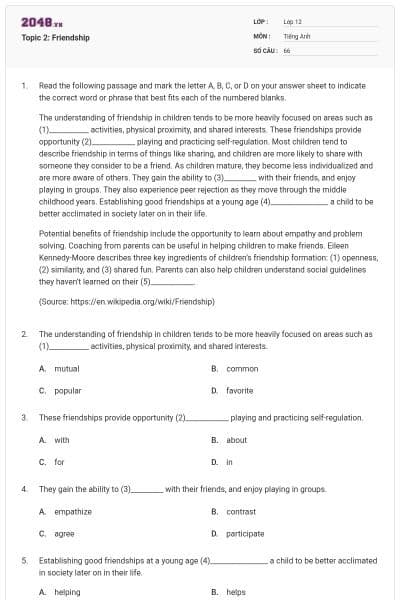
Read the following passage and mark the letter A, B, C, or D on your answer sheet to indicate the correct word or phrase that best fits each of the numbered blanks.
The understanding of friendship in children tends to be more heavily focused on areas such as (1)___________ activities, physical proximity, and shared interests. These friendships provide opportunity (2)____________ playing and practicing self-regulation. Most children tend to describe friendship in terms of things like sharing, and children are more likely to share with someone they consider to be a friend. As children mature, they become less individualized and are more aware of others. They gain the ability to (3)_________ with their friends, and enjoy playing in groups. They also experience peer rejection as they move through the middle childhood years. Establishing good friendships at a young age (4)________________ a child to be better acclimated in society later on in their life.
Potential benefits of friendship include the opportunity to learn about empathy and problem solving. Coaching from parents can be useful in helping children to make friends. Eileen Kennedy-Moore describes three key ingredients of children’s friendship formation: (1) openness, (2) similarity, and (3) shared fun. Parents can also help children understand social guidelines they haven’t learned on their (5)____________.
(Source: https://en.wikipedia.org/wiki/Friendship)
mutual
common
popular
favorite
Cách hiểu về tình bạn ở trẻ nhỏ có xu hướng tập trung nhiều hơn vào các điểm như các hoạt động chung, sự gần gũi về thể chất và sở thích chung. Những tình bạn này tạo cơ hội để chơi và luyện tập sự tự điều chỉnh hành vi. Hầu hết trẻ em có xu hướng mô tả tình bạn xét theo những thứ như chia sẻ, và trẻ em có nhiều khả năng chia sẻ với một người mà họ cho là bạn. Khi trẻ trưởng thành, chúng trở nên ít cá nhân hơn và ý thức hơn về người khác. Chúng có được khả năng đồng cảm với bạn bè của mình, và thích chơi theo nhóm. Chúng cũng trải qua những mâu thuẫn bạn bè cùng trang lứa khi chúng đi qua tuổi thiếu niên. Xây dựng tình bạn đẹp khi còn nhỏ sẽ giúp trẻ được thích nghi tốt hơn với cuộc sống của chúng trong xã hội sau này.
Lợi ích tiềm năng của tình bạn bao gồm cơ hội để hiểu về sự đồng cảm và giải quyết vấn đề. Sự chỉ bảo từ cha mẹ có thể hữu ích trong việc giúp trẻ kết bạn. Eileen Kennedy-Moore mô tả ba thành phần chính của sự hình thành tình bạn của trẻ em: (1) sự cởi mở, (2) nét tương đồng, và (3) chia sẻ niềm vui. Cha mẹ cũng có thể giúp trẻ hiểu các nguyên tắc xã hội mà chúng chưa thể tự học được.
Đáp án B
Kiến thức về từ vựng
A. mutual /ˈmjuːtʃuəl/(a): lẫn nhau, qua lại
B. common /ˈkɒmən/(a): chung, thông thường
C. popular /ˈpɒpjələr/(a): đại chúng, phổ biến, nổi tiếng
D. favorite /ˈfeɪvərɪt/(a): được ưa thích
=> Căn cứ vào nghĩa của câu sau:
“The understanding of friendship in children tends to be more heavily focused on areas such as (1)___________ activities, physical proximity, and shared expectations.
(Cách hiểu về tình bạn ở trẻ nhỏ có xu hướng tập trung nhiều hơn vào các điểm như các hoạt động chung, sự gần gũi về thể chất và chung sở thích.)
=> common activities: hoạt động chung
with
about
for
in
Đáp án C
Kiến thức về giới từ
A. with (prep): với
B. about (prep): về việc gì
C. for (prep): cho, dành cho
D. in (prep): trong
=> Cấu trúc: Provide sth for sb/sth/doing sth: cung cấp cái gì cho ai/cái gì/việc làm gì
Tạm dịch: “These friendships provide opportunity (2)____________ playing and practicing self-regulation.”
(Những tình bạn này đã cung cấp cơ hội cho việc chơi và thực hành việc tự điều chỉnh chính mình.)
empathize
contrast
agree
participate
Đáp án A
Kiến thức về cấu trúc
A. empathize with sb = to be able to understand how someone else feels: đồng cảm với
B. contrast with st: trái ngược với cái gì
C. agree with sb: đồng ý với ai
D. participate in = take part in = involve in = join: tham gia vào
Căn cứ vào nghĩa của câu: “They gain the ability to (3)_________ with their friends, and enjoy playing in groups.” (Chúng có được khả năng đồng cảm với bạn bè của mình, và thích chơi theo nhóm.)
Establishing good friendships at a young age (4)________________ a child to be better acclimated in society later on in their life.
helping
helps
help
helped
Đáp án B
Kiến thức về sự hòa hợp giữa chủ ngữ và động từ
Chủ ngữ là danh động từ (Ving) thì động từ chia ở dạng số ít.
Parents can also help children understand social guidelines they haven’t learned on their (5)____________.
mind
own
brain
toes
Đáp án B
Kiến thức về cụm từ cố định
On one’s own = by oneself: một mình, tự mình
On one’s toes: sẵn sàng hành động; cảnh giác
Căn cứ vào nghĩa của câu: “Parents can also help children understand social guidelines they haven’t learned on their (5)____________.”
(Cha mẹ cũng có thể giúp trẻ hiểu các nguyên tắc xã hội mà chúng chưa thể tự học được.)
That’s all well and good, but if a potential new friend doesn’t see the same joyous charms in you, it’s (1)_________that anything deep and lasting will come of it. That said, there’s no telling when and where a friendship will develop. Often, they arise from a shared interest or hobby, and people are typically drawn together (2)________ they’re in the same stage of life, like new parents or retirees. People of similar backgrounds and cultures also tend to come together by bonding (3)______ shared lifelong experiences. Although most of these relationships take time to get really deep, occasionally friendship is more like a lightning (4) __________. “Sometimes you can be in a big group of new people and you catch someone’s eye and it’s like ‘boom!’ – instant friendship,” Degges-White says about an experience she’s termed the “clicking phenomenon.” “It’s kind of like that burst of ‘love at first sight,’ but it’s a friendship, not (5)_________ .”
(Source: https://people.howstuffworks.com/what-is-friendship.htm)
unlikely
impossibly
improbably
potentially
Tất cả những điều đó đều rất tốt, nhưng nếu một người bạn mới tiềm năng không nhìn thấy những nét hấp dẫn và cảm giác hạnh phúc tương tự trong bạn, thì khả năng rằng sẽ chẳng có bất kỳ thứ gì sâu sắc và bền vững sẽ đến với nó cả. Điều đó nói lên rằng, không biết khi nào và từ nơi đâu một tình bạn sẽ phát triển. Thông thường, chúng nảy sinh từ một mối quan tâm hoặc sở thích chung, và mọi người thường bị cuốn hút nhau bởi vì họ ở trong cùng một giai đoạn của cuộc đời, giống như những người mới làm cha làm mẹ hoặc những người về hưu. Những người có lai lịch và văn hóa tương tự cũng có xu hướng đến với nhau bằng cách gắn kết thông qua những kinh nghiệm suốt đời đã từng được trải qua . Mặc dù hầu hết các mối quan hệ này cần có thời gian để thực sự trở nên sâu sắc, nhưng đôi khi tình bạn giống như một cuộc bãi công chớp nhoáng hơn. “Đôi khi bạn có thể ở trong một nhóm có rất nhiều người xa lạ và bạn nhanh chóng thu hút được sự chú ý của ai đó và nó giống như một sự ‘bùng nổ!’ - tình bạn trong chốc lát được hình thành ngay”, Degges-White nói về một trải nghiệm mà cô gọi là “hiện tượng nhấp chuột”. “Nó kiểu giống như ‘tiếng sét ái tình’ vậy, nhưng đây là tình bạn, không phải là tình yêu.”
Đáp án A
Kiến thức về trạng từ
A. unlikely /ʌnˈlaɪkli/ (a): không có khả năng xảy ra
B. impossibly /ɪmˈpɑːsəbli/ (adv): không thể nào; rất khó để giải quyết
C. improbably /ɪmˈprɑːbəbli/ (adv): không có khả năng đúng, không có khả năng xảy ra
D. potentially /pəˈtenʃəli/ (adv): có khả năng phát triển thành cái gì
=> Đứng sau động từ “to be” chỉ có thể là một tính từ
=> Ta có cấu trúc sau: It’s unlikely (that) + clause: không thể có khả năng rằng….
=> Các đáp án còn lại chỉ đóng vai trò làm trạng ngữ của câu hoặc trạng từ bổ nghĩa cho động từ
Tạm dịch: That’s all well and good, but if a potential new friend doesn’t see the same joyous charms in you, it’s (1) _________ that anything deep and lasting will come of it.
(Tất cả những điều đó đều rất tốt, nhưng nếu một người bạn mới tiềm năng không nhìn thấy những nét hấp dẫn và cảm giác hạnh phúc tương tự trong bạn, thì khả năng rằng sẽ chẳng có bất kỳ thứ gì sâu sắc và bền vững sẽ đến với nó cả.)
although
as soon as
because
therefore
Đáp án C
Kiến thức về liên từ
A. although + clause: mặc dù
B. as soon as: ngay khi, ngay sau khi
C. because + clause: bởi vì
D. therefore: do đó, do vậy
Tạm dịch: That said, there’s no telling when and where a friendship will develop. Often, they arise from a shared interest or hobby, and people are typically drawn together (2)________ they’re in the same stage of life, like new parents or retirees.
(Điều đó nói lên rằng, không biết khi nào và từ nơi đâu một tình bạn sẽ phát triển. Thông thường, chúng nảy sinh từ một mối quan tâm hoặc sở thích chung, và mọi người thường bị cuốn hút nhau bởi vì họ ở trong cùng một giai đoạn của cuộc đời, giống như những người mới làm cha làm mẹ hoặc những người về hưu.)
up
over
in
down
Đáp án B
Kiến thức về giới từ
A. up (prep): lên phía trên
B. over (prep): bên trên, trên bề mặt; vượt qua; bằng cách, thông qua
C. in (prep): bên trong
D. down (prep): xuống phía dưới
=> Xét nghĩa, ta dùng giới từ “over” ở đây với nghĩa là: Over = by means of sth: bằng cách, thông qua cái gì
Tạm dịch: People of similar backgrounds and cultures also tend to come together by bonding (3)______ shared lifelong experiences.
(Những người có lai lịch và văn hóa tương tự cũng có xu hướng đến với nhau bằng cách gắn kết thông qua những kinh nghiệm suốt đời đã từng được trải qua.)
storm
thunder
sky
strike
Đáp án D
Kiến thức về cụm từ cố định
A. storm /stɔːrm/ (n): bão giông
B. thunder /ˈθʌndər/ (n): sấm sét
C. sky /skaɪ/ (n): bầu trời
D. strike /straɪk/ (n): cuộc đình công
=> Ta có cụm danh từ sau: Lightning strike (n): cuộc bãi công chớp nhoáng (các nhân viên bỏ việc đột xuất mà không báo trước vì bất đồng, lương thưởng,…)
Tạm dịch: Although most of these relationships take time to get really deep, occasionally friendship is more like a lightning (4) __________. “Sometimes you can be in a big group of new people and you catch someone’s eye and it’s like ‘boom!’ – instant friendship,” Degges-White says about an experience she’s termed the “clicking phenomenon.”
(Mặc dù hầu hết các mối quan hệ này cần có thời gian để thực sự trở nên sâu sắc, nhưng đôi khi tình bạn giống như một cuộc bãi công chớp nhoáng hơn. “Đôi khi bạn có thể ở trong một nhóm có rất nhiều người xa lạ và bạn nhanh chóng thu hút được sự chú ý của ai đó và nó giống như một sự ‘bùng nổ!’ - tình bạn trong chốc lát được hình thành ngay, ”Degges-White nói về một trải nghiệm mà cô gọi là" hiện tượng nhấp chuột".)
=> Dùng cụm “lightning strike” ở đây ý nói tình bạn đôi khi chỉ trong chớp nhoáng đã có thể tan vỡ và trở thành người xa lạ với nhau, cùng với đó là câu phía sau để thể hiện rằng tình bạn đôi khi lại chỉ cần một ánh mắt, một cái nhìn cũng có thể dễ dàng từ người dưng trở thành những người bạn của nhau.
“It’s kind of like that burst of ‘love at first sight,’ but it’s a friendship, not (5)_________ .”
romance
romantic
romantically
romanticism
Đáp án A
Kiến thức về từ loại
A. romance /ˈrəʊmæns/ (n): tình yêu đôi lứa; ngôn tình, câu chuyện lãng mạn
B. romantic /rəʊˈmæntɪk/ (a/n): tính lãng mạn; người lãng mạn, giàu trí tưởng tượng và cảm xúc
C. romantically /rəʊˈmæntɪkli/ (adv): một cách lãng mạn, viển vông
D. romanticism /rəʊˈmæntɪsɪzəm/ (n): chủ nghĩa lãng mạn
=> Vị trí cần điền là một danh từ, vì để cân giữa hai vế với câu trước có cùng chủ ngữ là danh từ “a friendship”
=> Xét nghĩa, ta chọn A
Tạm dịch: “Sometimes you can be in a big group of new people and you catch someone’s eye and it’s like ‘boom!’ – instant friendship,” Degges-White says about an experience she’s termed the “clicking phenomenon’’. ”It’s kind of like that burst of ‘love at first sight,’ but it’s a friendship, not (5) _______."
(“Đôi khi bạn có thể ở trong một nhóm có rất nhiều người xa lạ và bạn nhanh chóng thu hút được sự chú ý của ai đó và nó giống như một sự ‘bùng nổ!’ - tình bạn trong chốc lát được hình thành ngay,”Degges-White nói về một trải nghiệm mà cô gọi là “hiện tượng nhấp chuột”. “Nó kiểu giống như ‘tiếng sét ái tình’ vậy, nhưng đây là tình bạn, không phải là tình yêu.")
One thing adults, and especially parents, don’t always understand is that friendships are a key part of teenagers’ lives. As young people grow up and become more independent, the more (1) ____ to spend time out with friends. One typical problem is when parents decide to move to a new area because of work. This can be a very upsetting (2) ____ for teenagers. They are bound to feel lonely and this is likely to make them miserable, too. It may take some time for them to develop new relationships, so parents should be patient. They should also try to be (3) ____ about how much time teenagers spend with their friends. It is natural for teenagers to want to be out when they can. If they hear only criticism of their behaviour, it is likely to lead to a lot of (4) ____. Encourage teenagers to develop friendships with people they have something in common with. And remember that (5) ____ is the best policy when it comes to talking to teens on any subjects at all, including their friendships.
claim
act
demand
order
Một điều mà người lớn, đặc biệt là các bậc cha mẹ, không phải lúc nào cũng hiểu rằng tình bạn là một phần quan trọng trong cuộc sống của trẻ em. Càng lớn lên, bọn trẻ càng trở nên tự lập và nhu cầu dành thời gian cho bạn bè cũng nhiều hơn. Một vấn đề điển hình là khi cha mẹ quyết định chuyển đến một khu vực mới vì công việc. Đây có lẽ là một trải nghiệm khó chịu đối với bọn trẻ. Chúng nhất định sẽ cảm thấy cô đơn và điều này cũng có thể sẽ khiến chúng đau khổ. Cha mẹ nên kiên nhẫn bởi có lẽ sẽ mất một thời gian để chúng phát triển các mối quan hệ mới. Họ cũng nên cố gắng thoải mái về việc bọn trẻ dành bao nhiêu thời gian với bạn bè. Bất cứ đứa trẻ nào cũng muốn ra ngoài chơi mỗi khi có thể. Tranh cãi sẽ xảy ra nếu bọn trẻ bị chỉ trích về hành vi của mình. Thay vào đó, hãy khuyến khích bọn trẻ kết bạn với những người có cùng điểm tương đồng với chúng. Hãy nhớ rằng thật thà là thượng sách khi nói chuyện với trẻ em về mọi lĩnh vực, bao gồm cả mối quan hệ bạn bè.
Đáp án C
Kiến thức về từ vựng
Xét các đáp án:
A. claim (n): sự đòi hỏi một số tiền (bảo hiểm, bồi thường,…), lời tuyên bố, sự khẳng định
B. act (n): việc làm, hành vi, hành động
C. demand (n): sự đòi hỏi, sự yêu cầu, nhu cầu
D. order (n): sự đặt hàng, đơn đặt hàng, trình tự, thứ tự, mệnh lệnh
Tạm dịch: One thing adults, and especially parents, don’t always understand is that friendships are a key part of teenagers’ lives. As young people grow up and become more independent, the more (1) ________ to spend time out with friends.
(Điều mà người lớn và đặc biệt là cha mẹ, luôn không hiểu rằng tinh bạn là một phần quan trọng trong cuộc sống của thanh thiếu niên. Khi những người trẻ lớn lên và trở nên tự lập hơn thì nhu cầu dành thời gian cho bạn bè càng nhiều lên.)
experiment
experience
exercise
encounter
Đáp án B
Kiến thức về từ vựng
A. experiment (n): thí nghiệm
B. experience (n): sự từng trải, kinh nghiệm, sự trải nghiệm, cảm giác (đối với một chuyện gì đó xảy ra)
C. exercise (n): bài tập
D. encounter (n): sự chạm trán, cuộc đọ sức
Tạm dịch: One typical problem is when parents decide to move to a new area because of work. This can be a very upsetting (2) ________ for teenagers.
(Một vấn đề điển hình là khi cha mẹ quyết định chuyển đến một nơi khác vì công việc. Đó có thể là một cảm giác rất khó chịu đối với thanh thiếu niên.)
relaxed
scared
bored
annoyed
Đáp án A
Kiến thức về từ vựng, adj + preposition
A. relaxed (a): thanh thản, thoải mái, không cảm thấy căng thẳng
B. scared (a): hoảng sợ
C. bored (a): buồn chán
D. annoyed (a): khó chịu, bực mình
- be relaxed about
- be scared of
- get/be bored with/of
- be annoyed at/with/to
Tạm dịch: They are bound to feel lonely and this is likely to make them miserable, too. It may take some time for them to develop new relationships, so parents should be patient.
They should also try to be (3) __________ about how much time teenagers spend with their friends.
(Chúng chắc chắn sẽ cảm thấy cô đơn và điều này cũng làm cho chúng đau khổ. Có thể mất một thời gian để chúng tạo dựng các mối quan hệ mới vì vậy cha mẹ nên kiên nhẫn. Chúng cũng nên được thoải mái về thời gian dành cho bạn mình.)
actions
arguments
approaches
effects
Đáp án B
Kiến thức về từ vựng
Xét các đáp án:
A. action (n): hành động, hành vi
B. argument (n): cuộc tranh cãi
C. approach (n): sự đến gần, sự lại gần, sự tiếp cận
D. effect (n): sự ảnh hưởng, sự tác động
Tạm dịch: It is natural for teenagers to want to be out when they can. If they hear only criticism of their behaviour, it is likely to lead to a lot of (4) __________.
(Điều đó là đương nhiên đối với thanh thiếu niên muốn ra ngoài khi học có thể. Nếu chúng nghe thấy những chỉ trích về hành vi của mình rất có thể sẽ dẫn đến rất nhiều cuộc tranh cãi.)
And remember that (5) ____ is the best policy when it comes to talking to teens on any subjects at all, including their friendships.
honesty
attraction
jealousy
obedience
Đáp án A
Kiến thức về từ vựng
A. honesty (n): tính trung thực, tính lương thiện
B. attraction (n): sự hấp dẫn, sự thu hút
C. jealousy (n): lòng ghen tỵ, sự đố kỵ
D. obedience (n): sự vâng lời, nghe lời
Tạm dịch: Encourage teenagers to develop friendships with people they have something in common with. And remember that (5) __________ is the best policy when it comes to talking to teens on any subjects at all, including their friendships.
(Hãy khuyến khích thanh thiếu niên phát triển tình bạn với những người mà họ có điểm chung. Và hãy nhớ rằng sự chân thành là cách tốt nhất khi nói chuyện với thanh thiếu niên về bất kì chủ đề nào kể cả tình bạn của chúng.)
In “How many hours does it take to make a friend?” (2018), Jeffrey A. Hall describes the types of encounters that build a friendship.
His study found that hours of time spent together was linked with closer friendships, as was time spent enjoying leisure activities together. Specifically, he found that the chance of making a “casual friend,” as opposed to a mere acquaintance, was greater than 50 percent when people spent approximately 43 hours together within three weeks of meeting. He further found that casual friends evolve into friends at some point between 57 hours after three weeks, and 164 hours over three months. Hall’s research also demonstrated, however, that when it comes to time spent developing friendships, quality is more important than quantity. And when it comes to conversation, topics matter. When it comes to building quality relationships, the duration of conversation is not as important as the content. Meaningful conversation is the key to bonding with others.
Hall found that when it comes to developing friendships, sharing daily life through catching up and joking around promotes closeness; small talk does not. Consider the inane topics that often come up when you are trapped in an elevator with an acquaintance. Discussing the weather or speculating on how many stops you will make before finally reaching the lobby does not facilitate bonding. Nor does mere proximity. Hall found that obligatory time spent together, such as in a classroom or workplace, does not promote closeness. Friendships require an efficient use of time together. Someone who remembers the details of your life and asks questions about your family, your job, your latest vacation, etc., is much more likely on his or her way to becoming someone you consider a friend, as opposed to an acquaintance.
(source: https://www.psychologytoday.com/)
Which best serves as the title for the passage?
The priceless gift of time.
The cluttered social life.
A world of online acquaintances.
From best friends to acquaintances.
Trong cuốn sách “Mất bao nhiêu giờ để kết bạn” (2018), Jeffrey A. Hall mô tả các loại gặp gỡ, cái mà xây dựng lên một tình bạn.
Nghiên cứu của ông cho thấy rằng thời gian dành cho nhau có liên quan đến tình bạn thân thiết hơn, như là thời gian để tận hưởng các hoạt động giải trí cùng nhau. Cụ thể, ông thấy rằng cơ hội để kết bạn với một “người bạn bình thường”, trái ngược với một người quen đơn thuần, là lớn hơn 50% khi ta dành khoảng 43 giờ bên nhau trong vòng ba tuần gặp mặt. Ông cũng phát hiện thêm rằng những người “bạn bình thường” trở thành bạn bè vào một thời điểm nào đó trong khoảng 57 giờ sau ba tuần, và 164 giờ trong ba tháng. Tuy nhiên nghiên cứu của Hall cũng đã chứng minh rằng khi bàn về thời gian để phát triển tình bạn, chất lượng quan trọng hơn số lượng. Và khi bàn về những cuộc trò chuyện, chủ đề quan trọng. Khi bàn về việc xây dựng mối quan hệ “chất lượng” thì thời lượng của cuộc trò chuyện không quan trọng bằng nội dung. Cuộc trò chuyện có ý nghĩa là chìa khóa để gắn kết mọi người.
Hall nhận thấy rằng khi bàn đến việc phát triển tình bạn, chia sẻ cuộc sống hàng ngày thông qua việc theo đuổi và đùa giỡn thúc đẩy sự gần gũi; những mẫu hội thoại ngắn thì không. Hãy xem xét các chủ đề ngớ ngẩn, cái mà thường xuất hiện khi bạn bị mắc kẹt trong thang máy với một người quen. Bàn bạc về thời tiết hoặc suy tính xem sẽ đến bao nhiêu nơi trước khi quyết định sẽ không ảnh hưởng đến mối quan hệ. Cũng không chỉ là sự gần gũi. Hall thấy rằng thời gian bắt buộc dành cho nhau, chẳng hạn như trong lớp học hoặc nơi làm việc, không thúc đẩy sự gần gũi. Tình bạn đòi hỏi phải sử dụng hiệu quả thời gian cùng nhau. Một người, người mà nhớ các chi tiết về cuộc sống của bạn và đặt ra các câu hỏi về gia đình, công việc, kỳ nghỉ mới nhất của bạn,… rất có khả năng trở thành người mà bạn coi rằng họ sẽ là bạn bè chứ không đơn giản là một người quen.
Đáp án A
Câu nào sau đây thích hợp nhất làm tiêu đề cho đoạn văn?
A. Món quà vô giá của thời gian
B. Đời sống xã hội lộn xộn
C. Một thế giới của những người quen trực tuyến
D. Từ bạn thân đến người quen
=> Căn cứ vào thông tin đoạn đầu:
His study found that hours of time spent together was linked with closer friendships, as was time spent enjoying leisure activities together.
(Nghiên cứu của ông ấy cho thấy rằng thời gian dành cho nhau có liên quan đến tình bạn thân thiết hơn, như là thời gian dành để tận hưởng các hoạt động giải trí cùng nhau.)
=> Như vậy, đoạn văn đang nói về tác dụng của những khoảng thời gian bên nhau trong một tình bạn.
The word “he” in paragraph 2 refers to _______.
classmate
friend
acquaintance
Jeffrey
Đáp án D
Từ “he” trong đoạn 2 nói đến .
A. Một bạn học cùng lớp
B. bạn
C. người quen
D. Jeffrey
Từ “he” ở đây dùng để thay thế cho danh từ riêng “Jeffrey” được nhắc tới trước đó.
In “How many hours does it take to make a friend?” (2018), Jeffrey A. Hall describes the types of encounters that build a friendship. His study found that hours of time spent together was linked with closer friendships, as was time spent enjoying leisure activities together. Specifically, he found that …
(Trong cuốn sách “Mất bao nhiêu giờ để kết bạn?” (2018), Jeffrey A. Hall mô tả các loại những cuộc gặp gỡ, cái mà xây dựng một tình bạn. Nghiên cứu của ông ấy cho thấy rằng thời gian dành cho nhau, cũng như là thời gian dành để tận hưởng các hoạt động giải trí cùng nhau có liên quan đến tình bạn thân thiết hơn. Cụ thể, ông ấy nhận thấy rằng …)
According to paragraph 2, what conclusion can be drawn from the finding of Jeffrey A. Hall?
Constant contact exhausting, the pressure to be positive all day long is draining.
Even in our fast-paced world, you can create friendships that truly last a lifetime.
Both quantity and quality of time spent together contribute to spark true friendships.
Individuals are motivated to engage in conversations that form and strengthen relationships.
Đáp án C
Theo đoạn 2, kết luận nào có thể được rút ra từ phát hiện của Jeffrey Hall?
A. Tiếp xúc liên tục đến kiệt sức, áp lực phải tích cực suốt cả ngày đến héo mòn.
B. Ngay cả trong thế giới phát triển nhanh của chúng ta, bạn có thể tạo ra tình bạn thực sự tồn tại lâu dài.
C. Cả số lượng và chất lượng thời gian dành cho nhau đều góp phần khơi dậy tình bạn chân chính.
D. Các cá nhân được thúc đẩy để tham gia vào các cuộc trò chuyện, cái mà hình thành và củng cố các mối quan hệ
Căn cứ vào thông tin đoạn hai:
His study found that hours of time spent together was linked with closer friendships, as was time spent enjoying leisure activities together. Specifically, he found that the chance of making a “casual friend,” as opposed to a mere acquaintance, was greater than 50 percent when people spent approximately 43 hours together within three weeks of meeting. He further found that casual friends evolve into friends at some point between 57 hours after three weeks, and 164 hours over three months. Hall’s research also demonstrated, however, that when it comes to time spent developing friendships, quality is more important than quantity. And when it comes to conversation, topics matter. When it comes to building quality relationships, the duration of conversation is not as important as the content.
(Nghiên cứu của ông ấy cho thấy rằng thời gian dành cho nhau, cũng như là thời gian dành để tận hưởng các hoạt động giải trí cùng nhau có liên quan đến tình bạn thân thiết hơn. Cụ thể, ông nhận thấy rằng cơ hội làm một người bạn bình thường, trái ngược với một người quen đơn thuần, lớn hơn 50% khi mọi người dành khoảng 43 giờ bên nhau trong vòng ba tuần gặp mặt. Ông còn phát hiện ra rằng những người bạn bình thường phát triển thành bạn bè vào một thời điểm nào đó giữa 57 giờ sau ba tuần và 164 giờ trong ba tháng. Tuy nhiên, nghiên cứu của Hall cũng đã chứng minh rằng khi nói đến thời gian dành cho việc phát triển tình bạn, chất lượng quan trọng hơn số lượng. Và khi nói đến cuộc trò chuyện, chủ đề là quan trọng. Khi nói đến việc xây dựng các mối quan hệ chất lượng, thời gian cuộc hội thoại không quan trọng bằng nội dung.)
The word “inane” in paragraph 3 is closest in meaning to ______.
silly
small
regular
normal
Đáp án A
Từ “inane /ɪˈneɪn/ ” trong đoạn 3 có nghĩa gần nhất với .
A. ngớ ngẩn
B. nhỏ
C. đều đặn
D. bình thường
Từ đồng nghĩa inane (ngu ngốc, vớ vẩn) = silly
Consider the inane topics that often come up when you are trapped in an elevator with an acquaintance. (Hãy xem xét các chủ đề vớ vẩn, cái mà thường xuyên xảy ra khi bạn bị mắc kẹt trong thang máy với một người quen.)
According to paragraph 3, what kind of setting can foster real amity?
High-fiving with a stranger on the street.
Travelling with your friend on holiday.
Boarding the same lift as your neighbour.
Discussing with classmate for the class project.
Đáp án B
Theo đoạn 3, tình huống nào sau đây có thể thúc đẩy tình bạn thực sự?
A. Cao hứng với một người lạ trên đường phố.
B. Đi du lịch với bạn của bạn vào kỳ nghỉ.
C. Lên cùng tháng máy như hàng xóm của bạn.
D. Thảo luận với bạn cùng lớp về dự án ở lớp.
=> Căn cứ vào thông tin đoạn ba:
“Hall found that when it comes to developing friendships, sharing daily life through catching up and joking around promotes closeness; small talk does not. Consider the inane topics that often come up when you are trapped in an elevator with an acquaintance. […]. Hall found that obligatory time spent together, such as in a classroom or workplace, does not promote closeness. Friendships require an efficient use of time together. Someone who remembers the details of your life and asks questions about your family, your job, your latest vacation, etc., is much more likely on his or her way to becoming someone you consider a friend, as opposed to an acquaintance.”
(Hall nhận thấy rằng khi nói đến việc phát triển tình bạn, chia sẻ cuộc sống hàng ngày thông qua việc bắt kịp và đùa giỡn xung quanh sẽ thúc đẩy sự gắn kết; còn nói chuyện xã giao ngắn gọn thì không [….]. Hall thấy rằng thời gian buộc phải dành cho nhau, chẳng hạn như trong lớp học hoặc nơi làm việc, không thúc đẩy sự gần gũi. Tình bạn đòi hỏi phải sử dụng hiệu quả thời gian cùng nhau. Một người, người mà nhớ các chi tiết về cuộc sống của bạn và đặt ra các câu hỏi về gia đình, công việc, kỳ nghỉ mới nhất của bạn,… rất có khả năng trở thành người mà bạn coi rằng họ sẽ là một người bạn thực sự, chứ không đơn thuần là một người quen."
=> Do đó, xét các tình huống thì chỉ có đáp án B là phù hợp nhất vì nó thể hiện được một tình bạn đúng nghĩa, tình bạn thực sự khi cả hai cùng dành thời gian đi du lịch cùng nhau. Còn các tình huống còn lại chỉ đơn thuần là người quen, người qua đường hay đơn thuần là người bạn cùng lớp khi phải dành thời gian vì công việc, nghĩa vụ - điều không giúp thúc đẩy sự gần gũi.
“Evidence has piled up to show that our relationships, including friendships, affect our health at a much deeper level, tweaking not just our psychology and motivation but the function and structure of our organs and cells,” writes science journalist Lydia Denworth in the book “Friendship: The Evolution, Biology, and Extraordinary Power of Life’s Fundamental Bond” (W.W. Norton), out now. The average American claims to have about four close friends, and the great majority of us have between two and six. Only 5 percent of those studied had more than eight, while 5 percent had no close friends.
Still, 20 percent of us call ourselves lonely — and the health implications are overwhelming. We’ve known about the fallout of loneliness since a 1988 Science paper concluded that being lonely “constitute[s] a major risk factor for health” equivalent to obesity, smoking and lack of physical exercise. According to Denworth’s research, lack of social contact in the elderly costs Medicare $6.7 billion a year.
There are purely positive relationships, which make up about half of our social networks, and then purely negative ones, which are rare. And then there are the uncomfortably ambivalent ones that land in-between — aka “frenemies.” These ambivalent bonds make up about half of our social networks, but the research on them is pretty stark: “Ambivalent relationships are bad for us,” writes Denworth. These relationships are reportedly causing levels of inflammation, aging, blood pressure and even greater artery calcification. This is true for even not so intimate relationships, such as colleagues and neighbors, too. Sadly, about 50 percent of married view their spouses ambivalently, according to Brigham Young University researchers. According to the book, it takes between 40 and 60 hours to create a casual friendship and over 200 hours to become a “best friend.”
(source: https://nypost.com/)
What is main topic of the passage?
Friendship is important to our ongoing health.
Longevity is determined by the number of friends.
Identifying the connection and making it a priority.
Life dissatisfaction resulted from the social media.
Trong cuốn sách “Tình bạn: Sự tiến hóa, Sinh học và Sức mạnh phi thường của các mối quan hệ cơ bản trong cuộc sống”, nhà báo khoa học Lydia Denworth đã viết : “ Có hàng loạt chứng cứ chỉ ra rằng những mối quan hệ bao gồm tình bạn có ảnh hưởng sâu sắc đến mức độ sức khỏe của chúng ta. Nó điều chỉnh tâm lý, hành vi lẫn chức năng và cấu trúc của tế bào và các cơ quan trong cơ thể. Trung bình mỗi người Mỹ có khoảng 4 người bạn thân, và phần lớn chúng ta có từ 2 đến 6 người. Chỉ 5 % trong số đó có hơn 8 người, và 5% không có bạn thân nào.
Tuy nhiên, 20% trong số chúng ta nói rằng bản thân mình cô đơn và tác động lên sức khỏe là quá lớn. Kể từ năm 1988, chúng ta đã biết về hậu quả của sự cô đơn khi một tờ báo khoa học kết luận rằng “Sự cô đơn gây nên tác nhân có hại cho sức khỏe”, như béo phì, hút thuốc lá và thiếu vận động. Theo nghiên cứu của Denworth, việc thiếu đi kết nối xã hội ở người già đã làm hệ thống chăm sóc sức khỏe cộng đồng tiêu tốn 6,7 tỉ đô la mỗi năm.
Những mối quan hệ hoàn toàn tích cực chiếm khoảng một nửa số mối quan hệ xã hội của chúng ta, rất hiếm những mối quan hệ hoàn toàn tiêu cực. Có những người hai mặt, nửa nọ nửa kia một gây khó chịu gọi là “frenemy”. Tuy điều này chiếm một nửa trong số các mối quan hệ trên Internet, nghiên cứu về chúng khá là đơn giản. Denworth viết rằng “Những mối quan hệ hai mặt gây ảnh hưởng xấu đến chúng ta”. Nó tác động tiêu cực đến mức độ của bệnh viêm nhiễm, lão hóa, huyết áp và thậm chí là vôi hóa. Điều này vẫn đúng đối với những mối quan hệ không quá thân mật, chẳng hạn như đồng nghiệp và hàng xóm. Đáng buồn thay, khoảng 50% trong số những người đã kết hôn cho rằng người bạn đời của mình sống giả tạo, hai mặt. Theo như cuốn sách, mất khoảng từ 40 đến 60 giờ đồng hồ để hình thành mối quan hệ bạn bè bình thường và 200 giờ để trở thành bạn thân.
Chủ đề chính của đoạn văn là gì?
A. Tình bạn rất quan trọng đối với sức khỏe đang diễn ra của chúng ta.
B. Tuổi thọ được xác định bởi số lượng bạn bè.
C. Xác định kết nối và làm cho nó ưu tiên.
D. Sự bất mãn trong cuộc sống do truyền thông xã hội.
Căn cứ vào thông tin:
Evidence has piled up to show that our relationships, including friendships, affect our health at a much deeper level, tweaking not just our psychology and motivation but the function and structure of our organs and cells.
(Bằng chứng đã chồng chất cho thấy các mối quan hệ của chúng tôi, bao gồm cả tình bạn, ảnh hưởng đến sức khỏe của chúng tôi ở mức độ sâu sắc hơn, điều chỉnh không chỉ tâm lý và động lực của chúng tôi mà cả chức năng và cấu trúc của các cơ quan và tế bào của chúng ta) và
the research on them is pretty stark: “Ambivalent relationships are bad for us,”
(nghiên cứu về chúng khá rõ ràng: mối quan hệ mâu thuẫn là xấu đối với chúng ta)
=> Đáp án A
According to paragraph 1, what stance does Lydia Denworth take in her book?
Friendships manifest in many forms including relatives and spouses.
Men have more of a struggle than women in keeping friends.
Friends are not only good for the soul but also are good for the body.
Different opinions on a good friendships though conflicting are all true.
Đáp án C
Theo đoạn 1, Lydia Denworth có lập trường gì trong cuốn sách của mình?
A. Tình bạn thể hiện dưới nhiều hình thức bao gồm cả người thân và vợ chồng.
B. Đàn ông có nhiều khó khăn hơn phụ nữ trong việc giữ bạn bè.
C. Bạn bè không chỉ tốt cho tâm hồn mà còn tốt cho cơ thể.
D. Những ý kiến khác nhau về một tình bạn tốt mặc dù mâu thuẫn đều đúng.
Căn cứ vào thông tin:
“Evidence has piled up to show that our relationships, including friendships, affect our health at a much deeper level, tweaking not just our psychology and motivation but the function and structure of our organs and cells,” writes science journalist Lydia Denworth.
(“Bằng chứng đã chồng chất cho thấy các mối quan hệ của chúng tôi, bao gồm cả tình bạn, ảnh hưởng đến sức khỏe của chúng tôi ở mức độ sâu sắc hơn, điều chỉnh không chỉ tâm lý và động lực của chúng tôi mà cả chức năng và cấu trúc của các cơ quan và tế bào của chúng ta,” nhà báo khoa học Lydia Denworth viết)
=> Đáp án C
The word “implications” in paragraph 2 can be replaced by______.
aftermaths
innuendoes
entanglement
consequences
Đáp án D
Có thể thay thế từ “implications” trong đoạn 2 bằng _______.
A. aftermaths: một tình huống là kết quả, hậu quả của cái gì để lại (như chiến tranh, tai nạn, thảm họa,…)
B. innuendoes: lời nói cạnh gió, ám chỉ; lời đánh giá mang tính gián tiếp, nói bóng nói gió
C. entanglement: sự vướng víu; mối quan hệ khó khăn và phức tạp với một ai/quốc gia khác
D. consequences: kết quả của cái gì đã xảy ra (của các tình huống nói chung và thường là tiêu cực)
=> Theo ngữ cảnh và nghĩa trong câu:
"Still, 20 percent of us call ourselves lonely — and the health implications are overwhelming."
(Tuy nhiên, 20% trong số chúng ta nói rằng bản thân mình cô đơn và những tác động có thể có lên sức khỏe là quá lớn.)
=> Implication (n): sự ám chỉ, ngụ ý; tác động hay kết quả có thể có của một hành động hoặc sự việc gì
=> Trong câu này “implication” mang nghĩa thứ hai, đó là những tác động/kết quả có thể có của một sự việc. Theo sắc thái đó là kết quả của một sự việc/hành động nói chung và mang tính tiêu cực nên ta chọn D.
According to paragraph 3, what is NOT true about friendships?
Distanced relationships are also affected by the “frenemy” rule.
There is a correlation between the rate of frenemies and their drawbacks.
Not all social ties in human life are created equal and alike.
Unhealthy relationships have negative effects over a variety of measures.
Đáp án B
Theo đoạn 3, điều gì là KHÔNG đúng về tình bạn?
A. Mối quan hệ xa cách cũng bị ảnh hưởng bởi quy tắc frenemy.
B. Có mối tương quan giữa tỷ lệ frenemy và nhược điểm của chúng.
C. Không phải tất cả các mối quan hệ xã hội trong cuộc sống của con người được tạo ra bằng nhau và giống nhau.
D. Mối quan hệ không lành mạnh có tác động tiêu cực đối với nhiều biện pháp khác nhau.
Căn cứ vào thông tin:
There are purely positive relationships, which make up about half of our social networks, and then purely negative ones, which are rare. And then there are the uncomfortably ambivalent ones that land in-between — aka “frenemies.”
(Có những mối quan hệ hoàn toàn tích cực, chiếm khoảng một nửa số mạng xã hội của chúng tôi, và sau đó là những mối quan hệ hoàn toàn tiêu cực, rất hiếm. Và sau đó, có những người xung quanh khó chịu rơi vào giữa - hay còn gọi là “những người vừa bạn vừa thù”) => Loại A
According to the book, it takes between 40 and 60 hours to create a casual friendship and over 200 hours to become a “best friend.”
(Theo cuốn sách, phải mất từ 40 đến 60 giờ để tạo ra một tình bạn giản dị và hơn 200 giờ để trở thành một người bạn thân nhất.) => Loại C
These relationships are reportedly causing levels of inflammation, aging, blood pressure and even greater artery calcification. This is true for even not so intimate relationships, such as colleagues and neighbors, too.
(Những mối quan hệ này được báo cáo gây ra mức độ viêm, lão hóa, huyết áp và thậm chí vôi hóa động mạch lớn hơn. Điều này đúng cho cả những mối quan hệ không quá thân mật, chẳng hạn như đồng nghiệp và hàng xóm.)
=> Loại D
=> Đáp án B
The word “them” in paragraph 3 refers to _______.
networks
frenemies
spouses
bonds
Đáp án B
Từ “them” trong đoạn 3 đề cập đến _______.
A. mạng lưới
B. người bạn đố kị, vừa bạn vừa thù
C. vợ, chồng
D. trái phiếu
(And then there are the uncomfortably ambivalent ones that land in-between — aka “frenemies.” These ambivalent bonds make up about half of our social networks, but the research on them is pretty stark: “ambivalent relationships are bad for us,” writes Denworth.)
Và sau đó, có những người xung quanh khó chịu rơi vào giữa - hay còn gọi là “kẻ vừa bạn vừa thù”. Những mối liên kết không rõ ràng này chiếm khoảng một nửa số mạng xã hội của chúng ta, nhưng nghiên cứu về họ khá rõ ràng: mối quan hệ không rõ ràng là xấu đối với chúng tôi, ông Denworth viết.)
If you think you left the cliques behind in high school, think again. When it comes to building friendships, men are more likely to return to their clique-y roots than women, according to a recent study published in the journal PLOS One. Researchers found that, in general, men seek to join all-male cliques, clubs or teams, while women prefer a more select, one-on-one relationship with a few close female friends. “Much of male friendship is about coalition building,” said Tamas David-Barett, lead author of the research paper, and member of the experimental psychology department at the University of Oxford.
After analyzing the profile pictures of nearly 112,000 Facebook users worldwide, David-Barett and his co-authors found that men were more likely to post a profile picture showing themselves with a large group of male friends. The study notes that such pictures are “arguably an essential element of the male-male coalition competition.” Conversely, women almost never posted a large group profile picture, but tended to display a photo with only one other female friend. As the paper explained, women “appear more often to focus their social capital on only one person at a time.”
So why are men and women different in the way they make friends? One hypothesis is the difference between the male and female brain. Typically, women tend to have a larger deep limbic system than their male counterparts. The limbic system is a network of nerves in the brain connected to instinct and mood. The limbic system controls basic emotions such as happiness and fear. Because this system tends to be larger in women, females are more in touch with their feelings and have an increased ability to connect individually with others.
According to the Wall Street Journal, other research indicates that females tend to build friendships off of emotional connections and are more apt to share intimate conversations. The male friendship, however, is established by doing things together, such as watching the game or hosting a barbecue. “Female friendships are characterized as more face-to-face. Women want to share and exchange,” said Irene Levine, a friendship expert. “They want to bond. Men, however, want to do things together. They want to go to spectator sports; they want to participate in sports together. They do things that are more side-by-side.”
(source: https://www.deseret.com/)
What does the passage mainly discuss?
Favouring bromances over romances.
True friends in a world of online acquaintances.
The challenges of male friendships.
The difference between male and female friendships.
Nếu bạn nghĩ mình đã bỏ quên lũ bạn ở trường trung học của mình, hãy nghĩ lại đi. Theo một nghiên cứu gần đây được công bố trên tạp chí PLOS One, khi xét về việc xây dựng tình bạn, nam giới thường có khả năng quay lại với nhóm bạn cũ của mình hơn phụ nữ. Các nhà nghiên cứu thấy rằng, nhìn chung đàn ông thường tìm đến các hội nhóm, các câu lạc bộ hoặc bè lũ toàn nam giới để tham gia, trong khi phụ nữ lại thích lựa chọn mối quan hệ một – một với một vài người bạn nữ thân thiết hơn. “Phần lớn tình bạn của nam giới có tính chất xây dựng sự liên kết” – Tamas David-Barret cho biết, anh cũng là tác giả chính của bài nghiên cứu và là thành viên của khoa tâm lý thực nghiệm tại Đại học Oxford.
Sau khi phân tích ảnh đại diện của gần 112.000 người dùng facebook trên toàn thế giới, David-Barret và các cộng sự của mình thấy rằng đàn ông có khả năng hơn sẽ đăng ảnh đại diện có cá nhân mình với một nhóm lớn các bạn nam. Các nghiên cứu lưu ý rằng những hình ảnh như vậy được cho là một “yếu tố thiết yếu của cuộc đua liên minh nam-nam”. Ngược lại, phụ nữ gần như không bao giờ đăng một bức ảnh đại diện với nhóm bạn lớn, nhưng họ lại có xu hướng phô bày một bức ảnh cùng với chỉ một người bạn nữ khác. Như bài báo đã giải thích, phụ nữ “thường xuất hiện tập trung vào nguồn vốn xã hội của họ với một người nào đó vào một thời điểm”.
Vậy tại sao đàn ông và phụ nữ lại khác nhau trong cách họ kết bạn? Một giả thuyết cho rằng đó là sự khác biệt giữa bộ não của nam giới và nữ giới. Thông thường, phụ nữ có xu hướng có một hệ thống limbic sâu rộng hơn so với các đồng nghiệp nam của họ. Hệ thống limbic là một mạng lưới các dây thần kinh trong não kết nối với bản năng và tâm trạng. Hệ thống limbic kiểm soát những cảm xúc cơ bản như vui vẻ và sợ hãi. Bởi vì hệ thống này có xu hướng thường lớn hơn ở nữ giới nên họ thường tiếp cận cảm xúc của họ nhiều hơn và tăng khả năng kết nối cá nhân của họ với người khác.
Theo tạp chí Wall Street, nghiên cứu khác chỉ ra rằng phụ nữ có xu hướng xây dựng tình bạn từ các kết nối cảm xúc và có nhiều khả năng chia sẻ những cuộc nói chuyện thân mật của họ. Tuy nhiên, tình bạn giữa nam giới được thiết lập bằng cách làm mọi việc cùng nhau, như là xem các trò chơi hoặc tự tổ chức một bữa tiệc nướng. “Tình bạn giữa nữ giới được mô tả là gặp gỡ trực tiếp nhiều hơn. Họ muốn chia sẻ và trao đổi”, Irene Levine – một chuyên gia về tình bạn cho biết. “Họ muốn gắn kết. Tuy nhiên, đàn ông lại muốn làm mọi thứ cùng nhau, họ muốn đi xem thể thao cùng nhau, muốn chơi thể thao cùng nhau. Họ làm những việc khiến họ trở nên gần nhau hơn”.
Đáp án D
Đoạn văn chủ yếu thảo luận về gì?
A. Yêu thích tình cảm anh em hơn là sự lãng mạn
Bromance là từ ghép của hai chữ “brother” hay “bros” (anh em) và “romance” (sự lãng mạn), nghĩa là “tình cảm anh em”. Bromance để chỉ tình cảm thân thiết trên mức tình bạn nhưng dưới mức tình yêu giữa hai người con trai.
B. Những người bạn thật sự trong một thế giới của những người quen trực tuyến
C. Những thách thức của tình bạn nam
D. Sự khác biệt giữa tình bạn nam và nữ
Căn cứ vào thông tin đoạn đầu:
When it comes to building friendships, men are more likely to return to their clique-y roots than women, according to a recent study published in the journal PLOS One. Researchers found that, in general, men seek to join all- male cliques, clubs or teams, while women prefer a more select, one-on-one relationship with a few close female friends. “Much of male friendship is about coalition building,” said Tamas David-Barett.
(Khi nói đến việc xây dựng tình bạn, đàn ông có khả năng xây dựng mối quan hệ rộng rãi hơn phụ nữ, theo một nghiên cứu gần đây được công bố trên tạp chí PLOS One. Các nhà nghiên cứu nhận thấy rằng, nói chung, đàn ông tìm cách tham gia tất cả các câu lạc bộ nam, câu lạc bộ hoặc đội, trong khi phụ nữ thích mối quan hệ - một mối quan hệ với một vài bạn nữ thân thiết. “Phần lớn tình bạn nam là về xây dựng liên minh,” Tamas David-Barett nói.)
Như vậy, đoạn văn đang nói về những điểm khác nhau giữa tình bạn nam và tình bạn nữ.
The word “coalition” in paragraph 1 can be replaced by _______.
trade
synthesis
league
alignment
Đáp án C
Từ “coalition” trong đoạn 1 có thể được thay thế bằng_____ .
A. thương mại
B. tổng hợp
C. liên minh
D. căn chỉnh
Từ đồng nghĩa coalition (liên minh) = league
“Much of male friendship is about coalition building,” said Tamas David-Barett.
(“Phần lớn tình bạn nam là về xây dựng liên minh,” Tamas David-Barett nói.)
According to paragraph 2, what does the statistics imply about the distinction between males and females?
Men tend to hang out more in a group while women typically prefer to go out with one good friend.
Male-male friendships are less fragile than female-female friendships, even after long time losing contact.
Women are more likely to refrain from taunting and humor for fear that it may hurt their friend’s feelings.
Male friendships are characterised by rivalry while women tend to be judgmental toward other people.
Đáp án A
Theo đoạn 2, số liệu thống kê ngụ ý gì về sự khác biệt giữa đàn ông và phụ nữ?
A. Đàn ông có xu hướng đi chơi nhiều hơn trong một nhóm trong khi phụ nữ thường thích đi chơi với một người bạn tốt
B. Tình bạn nam-nam ít mong manh hơn tình bạn nữ-nữ, ngay cả sau thời gian dài mất liên lạc
C. Phụ nữ có nhiều khả năng kiềm chế và chế nhạo vì sợ rằng điều đó có thể làm tổn thương tình cảm bạn bè của họ
D. Tình bạn nam được đặc trưng bởi sự ganh đua trong khi phụ nữ có xu hướng phán xét người khác
Căn cứ vào thông tin đoạn hai:
David-Barett and his co-authors found that men were more likely to post a profile picture showing themselves with a large group of male friends.
(David-Barett và đồng tác giả của ông đã phát hiện ra rằng đàn ông có thường đăng một bức ảnh có mình với một nhóm bạn nam lớn.)
Conversely, women almost never posted a large group profile picture, but tended to display a photo with only one other female friend.
(Ngược lại, phụ nữ hầu như không bao giờ đăng một bức ảnh của một nhóm lớn, nhưng có xu hướng đăng một bức ảnh với chỉ một người bạn nữ khác.)
According to paragraph 4, what can be concluded from the Wall Street Journal’s information?
Women tend to invest more in maintaining their friendships than their male counterparts.
Men have reciprocity with material goods and services rather than leisure activities.
Men’s friendships tend to be less intimate and less supportive than those between women.
Men are prone to share activities whereas women are liable to share feelings.
Đáp án D
Theo đoạn 4, những gì có thể được kết luận từ thông tin của Wall Street Journal?
A. Phụ nữ có xu hướng đầu tư nhiều hơn vào việc duy trì tình bạn hơn so với nam giới
B. Đàn ông có đi có lại với hàng hóa và dịch vụ vật chất hơn là các hoạt động giải trí
C. Tình bạn nam giới có xu hướng ít thân mật và ít hỗ trợ hơn so với những người phụ nữ
D. Đàn ông có xu hướng chia sẻ các hoạt động trong khi phụ nữ có khả năng chia sẻ cảm xúc
Căn cứ vào thông tin đoạn bốn:
According to the Wall Street Journal, other research indicates that females tend to build friendships off of emotional connections and are more apt to share intimate conversations. The male friendship, however, is established by doing things together, such as watching the game or hosting a barbecue.
(Theo tạp chí Wall Street, nghiên cứu khác chỉ ra rằng phụ nữ có xu hướng xây dựng tình bạn với các kết nối cảm xúc và có nhiều khả năng để chia sẻ các cuộc trò chuyện thân mật. Tuy nhiên, tình bạn nam được thiết lập bằng cách làm mọi thứ cùng nhau, chẳng hạn như xem trò chơi hoặc tổ chức tiệc nướng.)
The following statements are true, EXCEPT _______.
A difference in cerebral structure between men and women lead to a dissimilarity between them.
The limbic system plays a major role in regulating arousal, the level of awareness, and activity.
David-Barett and his colleagues examined approximately 112,000 Facebook users’ avatars.
Males generally function in a large circle of friends while females opt for a selective one.
Đáp án B
Các tuyên bố sau đây là đúng, ngoại trừ____ .
A. Sự khác biệt về cấu trúc não giữa nam và nữ dẫn đến sự khác biệt giữa họ
B. Hệ thống điều khiển cảm xúc trong não đóng vai trò chính trong việc điều chỉnh kích thích, mức độ nhận thức và hoạt động
C. David-Barett và các đồng nghiệp đã kiểm tra ảnh đại diện của khoảng 112.000 người dùng Facebook
D. Nam giới thường hoạt động trong một nhóm bạn lớn trong khi nữ giới chọn một nhóm chọn lọc
Căn cứ vào thông tin các đoạn:
So why are men and women different in the way they make friends? One hypothesis is the difference between the male and female brain.
(Vậy tại sao đàn ông và phụ nữ lại khác nhau trong cách họ kết bạn? Một giả thuyết cho là do sự khác biệt giữa não của nam và nữ.)
After analyzing the profile pictures of nearly 112,000 Facebook users worldwide, David-Barett and his co-authors found men were more likely to post a profile picture showing themselves with a large group of male friends.
(Sau khi phân tích ảnh đại diện của gần 112.000 người dùng Facebook trên toàn thế giới, David-Barett và đồng tác giả của ông phát hiện ra rằng đàn ông có thường đăng một bức ảnh có mình với một nhóm bạn nam lớn.)
Conversely, women almost never posted a large group profile picture, but tended to display a photo with only one other female friend.
(Ngược lại, phụ nữ hầu như không bao giờ đăng một bức ảnh của một nhóm lớn, nhưng có xu hướng đăng một bức ảnh với chỉ một người bạn nữ khác.)
The word “hypothesis” in paragraph 3 can be replaced by _______.
hunch
speculation
doctrine
credence
Đáp án B
Từ “hypothesis” trong đoạn 3 có thể được thay thế bằng .
A. linh cảm
B. sự suy đoán
C. giáo lý
D. uy tín
Từ đồng nghĩa hypothesis (giả thuyết) = speculation
One hypothesis is the difference between the male and female brain.
(Một giả thuyết cho là do sự khác biệt giữa não của nam và nữ.)
The word “They” in paragraph 4 refers to _____.
Men
Users
Women
Friends
Đáp án A
Từ “they” trong đoạn 4 đề cập đến ____.
A. Đàn ông
B. Người dùng
C. Phụ nữ
D. Bạn bè
Women want to share and exchange,” said Irene Levine, a friendship expert. “They want to bond. Men, however, want to do things together. They want to go to …..”
(Phụ nữ muốn chia sẻ và trao đổi, Irene Levine, một chuyên gia về tình bạn cho hay. Họ muốn gắn kết. Tuy nhiên, đàn ông, muốn làm mọi thứ cùng nhau. Họ muốn đi đến ….)
Which of the following can be inferred from the passage?
Gossip can increase the bond between people and sense of belonging to a group.
Men prioritizing their platonic relationships could be morphing into something of a lifestyle choice.
Women focus on disclosure and nurturance while men focus on competition and partnership.
Friendships involving at least one female are more satisfying than friendships that do not.
Đáp án C
Điều nào sau đây có thể được suy ra từ đoạn văn?
A. Tin đồn có thể làm tăng sự gắn kết giữa mọi người và ý thức thuộc về một nhóm
B. Đàn ông ưu tiên các mối quan hệ đơn phương của họ có thể biến thành một sự lựa chọn lối sống
C. Phụ nữ tập trung vào sự chia sẻ và nuôi dưỡng trong khi đàn ông tập trung vào cạnh tranh và hợp tác
D. Tình bạn liên quan đến ít nhất một nữ thỏa mãn hơn tình bạn không
Căn cứ vào thông tin đoạn cuối:
“Female friendships are characterized as more face-to-face. Women want to share and exchange,” said Irene Levine, a friendship expert. “They want to bond. Men, however, want to do things together. They want to go to spectator sports; they want to participate in sports together. They do things that are more side-by-side.”
(“Tình bạn nữ được đặc trưng bởi sự gặp mặt trực tiếp nhiều hơn. Phụ nữ muốn chia sẻ và trao đổi,” Irene Levine, một chuyên gia về tình bạn đã nói. “Họ muốn gắn kết. Tuy nhiên, đàn ông muốn làm mọi thứ cùng với nhau. Họ muốn tham gia các môn thể thao khán giả; họ muốn tham gia thể thao cùng nhau. Họ làm những thứ bên cạnh nhau nhiều hơn.”)
TOPIC: FRIENDSHIP
Do you feel like your teenager is spending most of the day glued to a phone screen? You’re not too far off. A new survey from the Pew Research Center reveals the surprising ways that technology intersects with teen friendships—and the results show that 57 percent of teens have made at least one new friend online. Even more surprisingly, only 20 percent of those digital friends ever meet in person.
While teens do connect with their friends face-to-face outside of school, they spend 55 percent of their day texting with friends, and only 25 percent of teens are spending actual time with their friends on a daily basis (outside of school hallways). These new forms of communication are key in maintaining friendships day-to-day —27 percent of teens instant message their friends every day, 23 percent connect through social media every day, and 7 percent even video chat daily. Text messaging remains the main form of communication —almost half of survey respondents say it’s their chosen method of communication with their closest friend.
While girls are more likely to text with their close friends, boys are meeting new friends (and maintaining friendships) in the gaming world—89 percent play with friends they know, and 54 percent play with online-only friends. Whether they’re close with their teammates or not, online gamers say that playing makes them feel “more connected” to friends they know, or gamers they’ve never met.
When making new friends, social media has also become a major part of the teenage identity—62 percent of teens are quick to share their social media usernames when connecting with a new friend (although 80 percent still consider their phone number the best method of contact). Despite the negative consequences—21 percent of teenage users feel worse about their lives because of posts they see on social media—teens also have found support and connection through various platforms. In fact, 68 percent of teens received support during a challenging time in their lives via social media platforms.
Just as technology has become a gateway for new friendships, or a channel to stay connected with current friends, it can also make a friendship breakup more public. The study reveals that girls are more likely to block or unfriend former allies, and 68 percent of all teenage users report experiencing “drama among their friends on social media.”
(Source: https://www.realsimple.com/)
What is the main idea of the passage?
Social media affects friendship too much.
Teenagers are making and keeping friends in a surprising way.
The difference of making new friends between girls and boys.
Social media connects friendship.
Bạn có cảm thấy như thanh thiếu niên của bạn đang sử dụng hầu hết thời gian trong ngày dán mắt vào một màn hình điện thoại? Bạn không quá xa xôi. 1 cuộc khảo sát mới do trung tâm nghiên cứu Pew thực hiện cho thấy những cách đáng ngạc nhiên mà công nghệ can thiệp vào tình bạn và kết quả chỉ ra rằng 57% thanh thiếu niên đã kết bạn với ít nhất 1 người bạn trực tuyến. Thậm chí đáng ngạc nhiên hơn, chỉ có 20% số người bạn trực tuyến đó đã từng gặp mặt ngoài đời.
Mặc dù giới trẻ thực sự có kết nối trực tiếp với bạn bè của họ bên ngoài trường học, nhưng họ dành 55% thời gian trong ngày để nhắn tin với bạn bè và chỉ có 25% thanh thiếu niên thực sự dành thời gian cho bạn bè mình hàng ngày (ngoài hành lang trường học). Những loại hình giao tiếp mới này đóng 1 vai trò quan trọng trong việc giữ gìn tình bạn. 27 phần trăm thanh thiếu niên nhắn tin tức thời cho bạn bè của họ mỗi ngày, 23 phần trăm kết nối thông qua phương tiện truyền thông xã hội mỗi ngày, và 7% giới trẻ sử dụng video chat hằng ngày. Nhắn tin văn bản vẫn là hình thức truyền thông chính – hơn một nửa số người được hỏi cho biết đó là phương thức giao tiếp được họ lựa chọn với người bạn thân nhất của họ.
Trong khi các cô gái thường hay nhắn tin với bạn bè thân thiết hơn, các chàng trai lại đang gặp gỡ những người bạn mới (và duy trì tình bạn) trong thế giới game - 89% trong số họ chơi với bạn bè họ biết và 54% chỉ chơi với bạn bè trực tuyến. Cho dù họ có gần gũi với đồng đội hay không, các game thủ trực tuyến đều nói rằng việc chơi game khiến họ cảm thấy “kết nối nhiều hơn” với bạn bè họ biết hoặc những game thủ mà họ chưa từng gặp.
Khi kết bạn mới, truyền thông xã hội cũng trở thành một phần quan trọng trong bản sắc tuổi teen - 62 % thanh thiếu niên nhanh chóng chia sẻ tên người dùng truyền thông xã hội của họ khi kết nối với một người bạn mới (mặc dù 80% vẫn xem số điện thoại của họ là phương thức liên lạc tốt nhất). Mặc dù có những hậu quả tiêu cực - 21% người dùng tuổi teen cảm thấy tồi tệ hơn về cuộc sống của họ vì các bài đăng họ thấy trên truyền thông xã hội — thanh thiếu niên cũng tìm thấy sự hỗ trợ và kết nối thông qua nhiều nền tảng khác nhau. Trong thực tế, 68 phần trăm thanh thiếu niên nhận được hỗ trợ trong thời gian gặp khó khăn trong cuộc sống của họ thông qua các nền tảng truyền thông xã hội.
Công nghệ cũng đã trở thành 1 cánh cổng cho những tình bạn mới hoặc là 1 kênh để kết nối bạn bè hiện tại, nó cũng có thể làm cho việc chia tay tình bạn trở nên công khai hơn. Nghiên cứu chỉ ra rằng các cô gái thường dễ chặn hay huỷ kết bạn với những đồng minh cũ hơn và 68% những người dùng thanh thiếu niên cho biết từng trải qua kịch tính với bạn bè trên phương tiện truyền thông mạng xã hội.
Đáp án B
Ý chính của đoạn văn này là gì?
A. Phương tiện truyền thông mạng xã hội ảnh hưởng quá nhiều đến tình bạn.
B. Giới trẻ đang kết bạn và giữ tình bạn theo 1 cách rất đáng ngạc nhiên.
C. Sự khác nhau về cách kết bạn giữa nam và nữ.
D. Phương tiện truyền thông mạng xã hội kết nối tình bạn.
Căn cứ vào thông tin đoạn đầu tiên:
A new survey from the Pew Research Center reveals the surprising ways that technology intersects with teen friendships—and the results show that 57 percent of teens have made at least one new friend online. Even more surprisingly, only 20 percent of those digital friends ever meet in person.
(1 cuộc khảo sát mới do trung tâm nghiên cứu Pew thực hiện cho thấy những cách đáng ngạc nhiên mà công nghệ can thiệp vào tình bạn và kết quả chỉ ra rằng 57% thanh thiếu niên đã kết bạn với ít nhất 1 người bạn trực tuyến. Thậm chí đáng ngạc nhiên hơn, chỉ có 20% số người bạn trực tuyến đó đã từng gặp mặt ngoài đời.)
The word “digital” in the first paragraph is closest in meaning to ___________.
analogue
numeracy
numerous
online
Đáp án D
Từ “digital” trong đoạn 1 gần nghĩa nhất với từ __________
A. vật tương tự
B. sự giỏi toán
C. nhiều
D. trực tuyến
Xét nghĩa trong bài: digital friends (những người bạn kĩ thuật số) = online friends (những người bạn trực tuyến).
According to the passage, what percentage of teens spend actual time with their friends?
25%
55%
27%
23%
Đáp án A
Theo bài đọc, tỉ lệ thanh thiếu niên thực sự dành thời gian cho bạn bè mình là bao nhiêu?
A. 25%
B. 55%
C. 27%
D. 23%
Căn cứ thông tin đoạn 2:
While teens do connect with their friends face-to-face outside of school, they spend 55 percent of their day texting with friends, and only 25 percent of teens are spending actual time with their friends on a daily basis (outside of school hallways).
(Mặc dù giới trẻ thực sự có kết nối trực tiếp với bạn bè của họ bên ngoài trường học, nhưng họ dành 55% thời gian trong ngày để nhắn tin với bạn bè và chỉ có 25% thanh thiếu niên thực sự dành thời gian cho bạn bè mình hàng ngày (ngoài hành lang trường học).
The following sentences are true, EXCEPT _______________.
According to the survey, more than half of teens have ever made new friends online.
Teens only meet face-to-face one fifth of online friends they have made.
Most teenagers use video chat to maintain relationship with friends.
New forms of communication play an important role in keeping friendships.
Đáp án C
Những câu sau đây là đúng, ngoại trừ ____________
A. Theo đoạn văn, hơn 1 nửa thanh thiếu niên đã từng kết bạn trưc tuyến.
B. Giới trẻ chỉ gặp mặt 1/5 người bạn trực tuyến mà họ đã làm quen.
C. Hầu hết thanh thiếu niên sử dụng video chat để duy trì tình bạn.
D. Những loại hình giao tiếp mới đóng 1 vai trò quan trọng trong việc giữ gìn tình bạn.
Căn cứ thông tin đoạn 2:
(….) and 7 percent even video chat daily. (và 7% giới trẻ sử dụng video chat hằng ngày).
- Câu A đúng vì căn cứ thông tin: the results show that 57 percent of teens have made at least one new friend online. (kết quả chỉ ra rằng 57% thanh thiếu niên đã kết bạn với ít nhất 1 người bạn trực tuyến.)
- Câu B đúng vì căn cứ thông tin: only 20 percent of those digital friends ever meet in person. (chỉ có 20% số người bạn trực tuyến đó đã từng gặp mặt ngoài đời.)
- Câu D đúng vì căn cứ thông tin: These new forms of communication are key in maintaining friendships day-to-day (những loại hình giao tiếp mới này là chìa khoá để duy trì tình bạn hằng ngày).
The word “they” in paragraph 3 refers to_____________.
friends
online gamers
their teammates
online-only friends
Đáp án B
Từ “they” trong đoạn 3 đề cập đến __________.
A. những người bạn
B. những game thủ trực tuyến
C. thành viên cùng đội của họ
D. chỉ những người bạn trực tuyến
=> Từ “they” thay thế cho cụm từ “những game thủ trực tuyến” trong câu phía trước.
Whether they’re close with their teammates or not, online gamers say that playing makes them feel “more connected” to friends they know, or gamers they’ve never met.
(Cho dù họ có gần gũi với đồng đội hay không, thì các game thủ trực tuyến cũng nói rằng việc chơi game khiến họ cảm thấy “kết nối nhiều hơn” với bạn bè họ biết hay những game thủ mà họ chưa từng gặp.)
What can be inferred from the passage?
Boys are more likely to meet new friends than girls.
Most teens are not easy to give others their usernames when making new friends.
The majority of teenage users agree that social media has negative consequences in their lives.
Thanks to social media, more than two thirds of teens are supported when they face with challenges in their lives.
Đáp án D
Có thể suy ra điều gì từ đoạn văn?
A. Con trai thì dễ kết bạn mới hơn con gái.
B. Hầu hết thanh thiếu niên không dễ dàng cho người khác tên người dùng của họ khi kết bạn mới.
C. Đa số người dùng thanh thiếu niên đồng ý rằng phương tiện truyền thông mạng xã hội có ảnh hưởng tiêu cực đến cuộc sống của họ.
D. Nhờ vào phương tiện truyền thông mạng xã hội, có hơn 2/3 giới trẻ được hỗ trợ khi họ gặp khó khăn trong cuộc sống.
Căn cứ vào thông tin đoạn 4:
In fact, 68 percent of teens received support during a challenging time in their lives via social media platforms.
(Sự thật, 68% giới trẻ được nhận hỗ trợ trong thời gian khó khăn của cuộc sống thông qua các phương tiện truyền thông mạng xã hội.
What is the synonym of the word “breakup” in the last paragraph?
termination
divorce
commencing
popularity
Đáp án A
Từ đồng nghĩa của “breakup” trong đoạn cuối là gì?
A. sự đổ vỡ, chấm dứt
B. sự chia ly
C. sự bắt đầu
D. tính phổ biến
Từ đồng nghĩa: breakup (sự tan vỡ) = termination
What does the writer mean when saying “68 percent of all teenage users report experiencing “drama among their friends on social media””?
Most teenagers take part in drama on social media.
Most friends on social media of teens are reported in drama.
Most teenagers use their experience in drama with their friends on social media.
Most teenagers have ever had conflicts with friends on social media.
Đáp án D
Tác giả có ý gì khi nói “68% những người dùng thanh thiếu niên cho biết từng có kinh nghiệm kịch tính với bạn bè trên phương tiện truyền thông mạng xã hội”?
A. Hầu hết thanh thiếu niên tham gia vào các vở kịch trên phương tiện truyền thông mạng xã hội.
B. Hầu hết bạn bè trên phương tiện truyền thông mạng xã hội được báo cáo trong vở kịch.
C. Hầu hết thanh thiếu niên sử dụng kinh nghiệm của họ trong các vở kịch với bạn bè trên phương tiện truyền thông mạng xã hội.
D. Hầu hết thanh thiếu niên từng có mâu thuẫn với bạn bè trên phương tiện truyền thông mạng xã hội.
Căn cứ vào thông tin đoạn cuối:
Just as technology has become a gateway for new friendships, or a channel to stay connected with current friends, it can also make a friendship breakup more public. The study reveals that girls are more likely to block or unfriend former allies, and 68 percent of all teenage users report experiencing "drama among their friends on social media.
(Công nghệ cũng đã trở thành 1 cánh cổng cho những tình bạn mới hoặc là 1 kênh để kết nối bạn bè hiện tại, nó cũng có thể làm cho việc chia tay tình bạn trở nên công khai hơn. Nghiên cứu chỉ ra rằng các cô gái thường dễ chặn hay huỷ kết bạn với những đồng minh cũ hơn và 68% những người dùng thanh thiếu niên cho biết từng trải qua kịch tính với bạn bè trên phương tiện truyền thông mạng xã hội).
Social networking sites such as Facebook and MySpace do not help you make more genuine close friends, according to a survey by researchers who studied how the websites are changing the nature of friendship networks. Although social networking on the internet helps people to collect hundreds or even thousands of acquaintances, the researchers believe that face to face contact is nearly always necessary to form truly close friendships.
“Although the numbers of friends people have on these sites can be massive, the actual number of close friends is approximately the same in the face to face real world,” said psychologist Will Reader, from Sheffield Hallam University. Social networking websites such as Facebook, Bebo and MySpace have taken off rapidly in recent years. Facebook was launched initially in 2004 for Harvard University members but has since expanded to more than 34 million users worldwide. MySpace, which was set up in 2003, has more than 200 million users and was bought by Rupert Murdoch’s News Corporation in 2005 for $580m (£285m).
Previous research has suggested that a person’s conventional friendship group consists of around 150 people, with five very close friends but larger numbers of people whom we keep in touch with less regularly. This figure is so consistent that scientists have suggested it is determined by the cognitive constraints of keeping up with large numbers of people. But Dr. Reader and his team have found that social networking sites do allow people to stretch this figure. The team asked more than 200 people to fill in questionnaires about their online networking, asking for example how many online friends they had, how many of these were close friends and how many they had met face to face. The team found that although the sites allowed contact with hundreds of acquaintances, as with conventional friendship networks, people tend to have around five close friends. Ninety per cent of contacts whom the subjects regarded as close friends were people they had met face to face. “People see face to face contact as being absolutely imperative in forming close friendships,” added Dr. Reader. He told the British Association Festival of Science in York that social networking sites allow people to broaden their list of nodding acquaintances because staying in touch online is easy. “What social network sites can do is decrease the cost of maintaining and forming these social networks because we can post information to multiple people,” he said.
But to develop a real friendship we need to see that the other person is trustworthy, said Dr. Reader. "What we need is to be absolutely sure that a person is really going to invest in us, is really going to be there for us when we need them … It’s very easy to be deceptive on the internet."
(Source: https://www.theguardian.com/)
Which of the following could best describe the main idea of the passage?
Social networking sites help modern people to expand their friend list.
Can we make real friends online?
Meeting their friends face-to-face is the best way to make close friends.
Social networking sites play an important role in making true friends.
Sau cuộc khảo sát về việc internet đã thay đổi bản chất của mối quan hệ bạn bè như thế nào, các nhà nghiên cứu đã chỉ ra rằng mạng xã hội như Facebook và MySpace chẳng giúp ích gì trong việc xây dựng tình bạn các thân thiết. Mặc dù mạng xã hội giúp con người có thêm hàng trăm, thậm chí hàng nghìn mối quan hệ đi chăng nữa, những nhà nghiên cứu vẫn luôn tin rằng sự tiếp xúc trực tiếp thường có ích hơn trong việc hình thành tình bạn thân thiết.
Nhà tâm lý học Will Reader, từ Đại học Sheffield Hallam cho biết: “Mặc dù chúng ta có thể quen rất nhiều người thông qua mạng internet, số lượng bạn bè thân thiết trên thực tế gần như tương đương với cuộc sống bên ngoài”. Các trang mạng xã hội như Facebook, Bebo và MySpace đã gặt hái nhiều thành công trong những năm gần đây. Facebook bắt đầu hoạt động phục vụ cho những thành viên của đại học Harvard từ năm 2004, tuy nhiên kể từ đó, nó được mở rộng và số lượng người sử dụng trên khắp thế giới lên đến con số 34 triệu. Được thành lập vào năm 2003, MySpace sở hữu hơn 200 triệu người dùng, nó đã được tập đoàn truyền thông của Rupert Murdoch mua vào năm 2005 với giá 580 triệu đô (tương đương 285 triệu bảng Anh).
Những nghiên cứu trước đây chỉ ra rằng một nhóm bạn bè có khoảng 150 người, trong số họ có 5 người chơi thân với nhau, đa phần còn lại ít liên lạc thường xuyên hơn. Con số này chính xác đến nỗi các nhà khoa học cho rằng nó được xác định bởi những hạn chế về nhận thức trong việc theo kịp với nhiều người. Tuy nhiên, tiến sĩ Reader và nhóm nghiên cứu của ông đã phát hiện ra rằng con số này có thể tăng lên thông qua việc sử dụng các trang mạng xã hội. Nhóm nghiên cứu đã yêu cầu hơn 200 người điền vào biểu mẫu câu hỏi để xem họ có bao nhiêu người bạn trên mạng internet, bao nhiêu trong số đó là bạn thân và bao nhiêu người họ đã gặp mặt trực tiếp. Nhóm nghiên cứu nhận thấy rằng mặc dù các trang web cho phép người dùng liên lạc với hàng trăm người, nhưng thông thường, chúng ta dường như chỉ có khoảng năm người bạn thân. 90% trong số những người được xem như là bạn thân là người mà bạn gặp trực tiếp ngoài đời. Tiến sĩ Reader nói rằng: “Mọi người coi việc gặp gỡ trực tiếp là điều cần thiết trong việc xây dựng tình bạn thân thiết”. Ông nói với Liên đoàn Khoa học của Hiệp hội Anh rằng chúng ta quen biết được nhiều người hơn thông qua các trang mạng xã hội bởi vì việc giữ liên lạc trực tuyến rất dễ dàng. Ông nói rằng: “Các trang mạng xã hội có thể giúp giảm chi phí trong việc hình thành và duy trì các mối quan hệ này bởi vì chúng ta có thể chia sẻ thông tin cho mọi người”.
Thế nhưng, để phát triển một tình bạn thực sự, chúng ta cần cảm thấy tin tưởng đối phương, tiến sĩ Reader nói. “Điều chúng ta cần là hoàn toàn chắc chắn rằng một người thực sự dành thời gian cho chúng ta, sẽ luôn ở bên cạnh ta mỗi khi cần … Chúng ta rất dễ bị lừa trên internet.”
Đáp án C
Điều nào sau đây có thể diễn tả đúng nhất ý chính của đoạn văn?
A. Các trang mạng xã hội giúp người hiện đại mở rộng danh sách bạn bè của họ.
B. Chúng ta có thể kết bạn trực tuyến thật không?
C. Gặp gỡ bạn bè trực tiếp là cách tốt nhất để kết bạn.
D. Các trang mạng xã hội đóng vai trò quan trọng trong việc kết bạn thật sự.
Căn cứ vào thông tin đoạn đầu:
Although social networking on the internet helps people to collect hundreds or even thousands of acquaintances, the researchers believe that face to face contact is nearly always necessary to form truly close friendships.
(Mặc dù mạng xã hội trên internet giúp mọi người có thêm hàng trăm hoặc thậm chí hàng ngàn người quen, nhưng các nhà nghiên cứu tin rằng gặp gỡ bạn bè trực tiếp gần như luôn luôn cần thiết để hình thành tình bạn thực sự thân thiết.)
Như vậy, đoạn văn đang nói về tác dụng của việc gặp gỡ bạn bè trực tiếp trong việc kết bạn.
The following are true about online friendship, EXCEPT _________.
The number of online friends you can make on Facebook is more than that on MySpace.
The number of close friends we have in the real world is nearly as many as that on social networking sites.
With the help of social networking sites, people can have myriad acquaintances.
Although the number of online friends is rather massive, each person only has some close friends.
Đáp án A
Sau đây là những sự thật về tình bạn trực tuyến, ngoại trừ____ .
A. Số lượng bạn bè trực tuyến bạn có thể có trên Facebook nhiều hơn số lượng trên MySpace.
B. Số lượng bạn bè thân thiết chúng ta có trong thế giới thực nhiều như số lượng trên các trang web mạng xã hội.
C. Với sự giúp đỡ của các trang mạng xã hội, mọi người có thể có vô số người quen.
D. Mặc dù số lượng bạn bè trực tuyến khá lớn, nhưng mỗi người chỉ có một số
bạn bè thân thiết.
Căn cứ vào thông tin các đoạn:
“Although the numbers of friends people have on these sites can be massive, the actual number of close friends is approximately the same in the face to face real world,” said psychologist Will Reader, from Sheffield Hallam University.
(“Mặc dù số lượng bạn bè mọi người có trên các trang này có thể rất lớn, nhưng số lượng bạn bè thân thiết thực sự gần như bằng số lượng có trên thế giới thực”, nhà tâm lý học Will Reader cho biết, từ Đại học Sheffield Hallam.)
Although social networking on the internet helps people to collect hundreds or even thousands of acquaintances, the researchers believe that face to face contact is nearly always necessary to form truly close friendships.
The team found that although the sites allowed contact with hundreds of
acquaintances, as with conventional friendship networks, people tend to have around five close friends. (Nhóm đã nhận thấy rằng mặc dù các trang web cho phép liên hệ với hàng trăm người quen biết, như với các mạng lưới tình bạn thông thường, mọi người có xu hướng có khoảng năm người bạn bè thân thiết.)
The word “constraints” in paragraph 3 is closest in meaning to __________________.
availability
motivation
inhibition
stimulation
Đáp án C
Từ " constraints" trong đoạn 3 có nghĩa gần nhất với .
A. sự sẵn có
B. động lực
C. sự giới hạn, sự ngăn chặn một quá trình hay hành động
D. kích thích
=> Từ đồng nghĩa: constraint (hạn chế) = inhibition
This figure is so consistent that scientists have suggested it is determined
by the cognitive constraints of keeping up with large numbers of people.
(Con số này phù hợp đến nỗi các nhà khoa học cho rằng nó được xác định bởi những hạn chế về nhận thức để theo kịp số lượng lớn người.)
What does the word “they” in paragraph 3 refer to?
close friends
online friends
social networking sites
200 people
Đáp án D
Từ “they” trong đoạn 3 chỉ về điều gì?
A. bạn thân
B. bạn trực tuyến
C. các trang mạng xã hội
D. 200 người
=> Từ “they” ở đây dùng để thay thế cho cụm từ 200 người ở trước đó.
The team asked more than 200 people to fill in questionnaires about their online networking, asking for example how many online friends they had, how many of these were close friends and how many they had met face to face.
(Nhóm này đã yêu cầu hơn 200 người điền vào bảng câu hỏi về mạng trực tuyến của họ, hỏi ví dụ họ có bao nhiêu người bạn trực tuyến, bao nhiêu trong số họ là bạn thân và họ đã gặp mặt trực tiếp bao nhiêu người.)
According to the passage, Dr. Reader and his team have found that _______________.
People tend to make as many online friends as they can.
Nine out of ten people considered as close friends are those having face-to-face contacts.
People only want to keep the conventional number of online friends.
Many people agree to make close friends online because it is easy to keep touch with them.
Đáp án B
Theo đoạn văn, tiến sĩ Reader và nhóm của ông đã nhận thấy rằng .
A. Mọi người có xu hướng kết bạn càng nhiều càng tốt.
B. Chín phần mười trong tổng số những người thường được coi là bạn thân là những người có sự gặp gỡ trực tiếp.
C. Mọi người chỉ muốn giữ số lượng bạn bè trực tuyến thông thường.
D. Nhiều người đồng ý kết bạn trực tuyến vì dễ dàng giữ liên lạc với họ.
Căn cứ vào thông tin đoạn ba:
Ninety per cent of contacts whom the subjects regarded as close friends were people they had met face to face.
(90% người liên hệ, người mà được đối tượng coi là bạn thân là những người họ đã gặp mặt trực tiếp.)
The word “deceptive” in the last sentence could best be replaced by ___________.
deceitful
faithful
indistinct
definite
Đáp án A
Từ “deceptive” trong câu cuối cùng có thể được thay thế bằng____ .
A. gian dối
B. chung thủy
C. không rõ ràng
D. xác định
Từ đồng nghĩa deceptive (lừa gạt) = deceitful
It’s very easy to be deceptive on the internet. (Rất dễ bị lừa trên internet.)
What does the author imply in the last paragraph?
Mutual trust is the major quality that a friendship should have.
A friend in need is a friend indeed.
Give-and-take is really necessary in friendship.
Money is absolutely important in friendship.
Đáp án B
Tác giả ngụ ý gì trong đoạn cuối?
A. Sự tin tưởng lẫn nhau là phẩm chất chính mà một tình bạn nên có.
B. Một người ở bên bạn khi cần là một người bạn thực sự.
C. Cho và nhận là thực sự cần thiết trong tình bạn.
D. Tiền là hoàn toàn quan trọng trong tình bạn.
Căn cứ vào thông tin đoạn cuối:
But to develop a real friendship we need to see that the other person is trustworthy, said Dr. Reader. "What we need is to be absolutely sure that a person is really going to invest in us, is really going to be there for US when we need them…
(Nhưng để phát triển một tình bạn thực sự, chúng ta cần nhận thấy rằng người kia đáng tin cậy, tiến sĩ nói. "Điều chúng ta cần là hoàn toàn chắc chắn là một người sẽ thực sự dành thời gian cho chúng ta, thực sự sẽ ở bên ta khi chúng ta cần họ …)
Which of the following most accurately reflects the author’s opinion of making a close online friend?
positive
supportive
neutral
skeptical
Đáp án D
Điều nào sau đây phản ánh chính xác nhất ý kiến của tác giả về việc kết thúc
bạn trực tuyến?
A. tích cực
B. hỗ trợ
C. trung lập
D. hoài nghi
=> Căn cứ vào thông tin đoạn cuối:
It’s very easy to be deceptive on the internet. (Rất dễ bị lừa trên internet.)
The human desire for companionship may feel boundless, but research suggests that our social capital is finite. Social scientists have used a number of ingenious approaches to gauge the size of people’s social networks; these have returned estimates ranging from about 250 to about 5,500 people. An undergraduate thesis from MIT focusing exclusively on Franklin D. Roosevelt, a friendly guy with an especially social job, suggested that he might have had as many as 22,500 acquaintances. Looking more specifically at friendship, a study using the exchange of Christmas cards as a proxy for closeness put the average person’s friend group at about 121 people.
However vast our networks may be, our inner circle tends to be much smaller. The average American trusts only 10 to 20 people. Moreover, that number may be shrinking: From 1985 to 2004, the average number of confidants that people reported having decreased from three to two. This is both sad and consequential, because whoever has strong social relationships tends to live longer than those who don’t.
So what should you do if your social life is lacking? Just follow the research. To begin with, don’t dismiss the humble acquaintance. Even interacting with people with whom one has weak social ties has a meaningful influence on well-being. Beyond that, building deeper friendships may be largely a matter of putting in time.
A recent study out of the University of Kansas found that it takes about 50 hours of socializing to go from acquaintance to casual friend, an additional 40 hours to become a “real” friend, and a total of 200 hours to become a close friend. If that sounds like too much effort, reviving dormant social ties can be especially rewarding. Reconnected friends can quickly recapture much of the trust they previously built, while offering each other a dash of novelty drawn from whatever they’ve been up to in the meantime. And if all else fails, you could start randomly confiding in people you don’t know that well in hopes of letting the tail wag the relational dog. The academic literature is clear: Longing for closeness and connection is pervasive. Which suggests that most of us are stumbling through the world pining for companionship that could be easily provided by the lonesome stumblers all around us.
(source: https://www.theatlantic.com/)
Which best serves as the title for the passage?
Why you should prioritize friendship.
A study characterises our circles of friendships.
The limitations of friendship.
How to make friends, according to science.
Nghiên cứu cho thấy rằng khát khao tình bạn của con người là vô biên dẫu cuộc sống xã hội là hữu hạn. Các nhà khoa học xã hội đã tiếp cận một cách khéo léo để đánh giá quy mô mạng xã hội của ước tính 250 – 5000 người. Một luận án từ đại học MIT về Franklin D. Roosevelt, một anh chàng thân thiện với một công việc xã hội đặc biệt, đã chỉ ra rằng anh ta có thể có tới 22.500 người quen. Để nhìn nhận cụ thể hơn về tình bạn, một nghiên cứu sử dụng việc trao đổi thiệp Giáng sinh như một minh chứng gần gũi đã cho thấy trung bình có khoảng 121 thành viên trong một nhóm bạn.
Tuy số lượng người quen nhiều là thế, con số thực sự bên trong có thể ít hơn. Trung bình một người Mỹ chỉ tin tưởng từ 10 đến 20 người. Con số này có thể thu hẹp lại: Từ năm 1985 đến năm 2004, theo như báo cáo ghi nhận, con số này đã giảm từ 3 về 2. Đây là một điều đáng buồn và tiêu cực bởi bất kì ai có nhiều mối quan hệ xã hội tốt đẹp thường sống lâu hơn những người khác.
Vậy, bạn nên làm gì khi thiếu đi các mối quan hệ xã hội? Hãy làm theo nghiên cứu sau đây. Đầu tiên, đừng xem nhẹ các mối quan nhỏ nhặt bởi ngay cả việc tương tác với những người thuộc tầng lớp xã hội thấp kém cũng có thể tác động tích cực đến hạnh phúc của mỗi chúng ta. Ngoài ra, việc xây dựng tình bạn sâu sắc, gắn bó đòi hỏi chúng ta phải dành nhiều thời gian.
Một nghiên cứu gần đây của đại học Kansas chỉ ra rằng mất khoảng 50 tiếng để một người xa lạ trở thành người quen, thêm 40 tiếng để thực sự trở thành bạn bè, và tổng cộng gần 200 tiếng để trở thành bạn bè thân thiết. Nếu như điều đó có vẻ cần quá nhiều nỗ lực, hãy thử gây dựng lại các mối quan hệ bạn bè. Kết nối lại với bạn bè có thể nhanh chóng lấy lại phần lớn niềm tin đã xây dựng trước đó, đồng thời mang đến cho nhau nhiều điều mới lạ từ những gì họ đã trải qua cùng nhau. Bạn có thể tâm sự với bất kì ai mà bạn không hề quen biết nếu bạn gặp thất bại trong cuộc sống – ví dụ trên làm rõ ý kiến về tìm người gắn bó và tương tác với nhau đang diễn ta tràn lan. Hầu hết chúng ta đang loay hoay để tìm bạn đồng hành luôn ở bên cạnh chúng ta trên cuộc đời này.
Đáp án D
Chủ đề chính của đoạn văn là gì?
A. Tại sao bạn nên ưu tiên tình bạn.
B. Một nghiên cứu đặc trưng cho vòng tròn tình bạn của chúng ta.
C. Những hạn chế của tình bạn.
D. Cách kết bạn, theo khoa học.
Căn cứ vào thông tin: (xuyên suốt các đoạn)
The human desire for companionship may feel boundless, but research suggests that our social capital is finite.
(Mong muốn đồng hành của con người có thể cảm thấy vô biên, nhưng nghiên cứu cho thấy vốn xã hội của chúng ta là hữu hạn.) &
So what should you do if your social life is lacking? Just follow the research.
(Vậy bạn nên làm gì nếu cuộc sống xã hội của bạn thiếu thốn? Chỉ cần làm theo nghiên cứu.) &
Even interacting with people with whom one as weak social ties has a meaningful influence on well-being.
(Ngay cả việc tương tác với những người mà mối quan hệ xã hội yếu kém cũng có ảnh hưởng có ý nghĩa đối với hạnh phúc.) &
The academic literature is clear: Longing for closeness and connection is pervasive.
(Các tài liệu học thuật là rõ ràng: Mong muốn gần gũi và kết nối là phổ biến.)
Giải thích: Xuyên suốt các đoạn là những nghiên cứu để tình bạn, đưa ra tầm quan trọng của tinh bạn (một ý nhỏ) để đưa ra, thúc đẩy người đọc kết bạn. => Đáp án D
According to paragraph 1, what is the purpose for mentioning an MIT thesis as an example?
To show that human and social bonds do not exist in isolation from each other.
To highlight a note-worthy case of ceiling limit for an individual’s social output.
To illustrate that different human relationships involve different degrees of effort.
To explain the proneness to vulnerability of unnecessarily wide social network.
Đáp án B
Theo đoạn 1, mục đích để đề cập đến một luận án MIT là một ví dụ là gì?
A. Để chỉ ra rằng sự gắn kết giữa con người và xã hội không tồn tại trong sự cô lập với nhau.
B. Để làm nổi bật một trường hợp đáng chú ý là giới hạn cho mối quan hệ xã hội của một cá nhân.
C. Để minh họa rằng các mối quan hệ khác nhau của con người liên quan đến mức độ nỗ lực khác nhau.
D. Để giải thích mức độ dễ bị tổn thương của mạng xã hội rộng không cần thiết.
Căn cứ vào thông tin:
Social scientists have used a number of ingenious approaches to gauge the size of people’s social networks; these have returned estimates ranging from about 250 to about 5,500 people. An undergraduate thesis from MIT focusing exclusively on Franklin D. Roosevelt, a friendly guy with an especially social job, suggested that he might have had as many as 22,500 acquaintances.
(Các nhà khoa học xã hội đã sử dụng một số cách tiếp cận khéo léo để đánh giá quy mô của con người mạng lưới xã hội; những người này đã có được ước tính mối quan hệ từ khoảng 250 đến khoảng 5.500 người. Một luận án đại học từ MIT tập trung hoàn toàn vào Franklin D. Roosevelt, một anh chàng thân thiện với một công việc xã hội đặc biệt, cho rằng anh ta có thể có tới 22.500 người quen.)
Giải thích: Franklin D. Roosevelt có một mạng lưới xã hội đáng chú ý và vượt xa hơn so với người binh thường
=> Đáp án B
The word “those” in paragraph 2 refers to _____.
networks
confidants
relationships
people
Đáp án D
Từ “those” trong đoạn 2 đề cập đến _____.
A. mạng lưới
B. người tâm sự, thân tín
C. mối quan hệ
D. người
Căn cứ vào ngữ cảnh:
This is both sad and consequential, because whoever has strong social relationships tends to live longer than those who don’t.
(Điều này vừa buồn vừa đem lại kết quả, bởi vì bất cứ ai có mối quan hệ xã hội mạnh mẽ đều có xu hướng sống lâu hơn so với những người không có.) => Đáp án D
The word “dismiss” in paragraph 3 is closest in meaning to _______.
disperse
disregard
abandon
forget
Đáp án B
Từ “dismiss” trong đoạn 3 có nghĩa gần nhất với _______.
A. phân tán
B. không cân nhắc, xem xét hoặc phớt lờ đi vì xem nó là không quan trọng, coi thường nó (hoàn toàn là do yếu tố chủ quan chủ tâm làm vậy)
C. từ bỏ, ruồng bỏ
D. quên, hoàn toàn không nghĩ gì đến ai/cái gì (đơn giản vì không thể nhớ được nó; mang tính khách quan vì không cố ý để quên)
Căn cứ vào ngữ cảnh:
To begin with, don’t dismiss the humble acquaintance.
(Quan trọng nhất là đừng bỏ qua những người quen khiêm tốn.)
=> Dismiss (v): bỏ qua, lãng quên vì xem họ không quan trọng hoặc không đáng để cân nhắc, xem xét hay nghĩ về ~ disregard
*Note: To begin with = first: đầu tiên là; quan trọng nhất là
According to paragraph 4, why does the author suggest “…you could start randomly confiding in people you don’t know that well…” ?
Because letting others in on something is the best way to start a conversation.
Because people are always attracted to those we have bared our soul to.
Because a little bit of self-disclosure can have an unexpectedly decisive effect.
Because the deeper the secret we tell, the more likeable we will become.
Đáp án C
Theo đoạn 4, tại sao tác giả lại gợi ý “… bạn có thể bắt đầu tâm sự một cách ngẫu nhiên với những người mà bạn không biết rõ …”?
A. Bởi vì để người khác vào một cái gì đó là cách tốt nhất để bắt đầu một cuộc trò chuyện.
B. Bởi vì mọi người luôn bị thu hút bởi những người mà chúng ta đã giữ linh hồn của mình.
C. Bởi vì một chút sự tự tiết lộ có thể có tác dụng quyết định bất ngờ.
D. Bởi vì bí mật mà chúng ta nói càng sâu, chúng ta sẽ càng trở nên dễ thương hơn.
Căn cứ vào thông tin:
And if all else fails, you could start randomly confiding in people you don’t know that well in hopes of letting the tail wag the relational dog.
(Và nếu có những thất bại khác trong cuộc sống, bạn có thể bắt đầu tâm sự một cách ngẫu nhiên với những người mà bạn không hề quen biết biết, với hy vọng rằng những thành tố nhỏ nhặt lại quyết định và ảnh hưởng đến cái lớn, cái bao quát.)
=> Thành ngữ trên cho ta hiểu rằng có những ngoại lệ khiến ta bất ngờ trong cuộc sống khi mà có những lúc không phải lúc nào cũng cái lớn áp đảo, quyết định và kiểm soát cái nhỏ; mà có những lúc các thành tố nhỏ lẻ lại mang tính quyết định và ảnh hưởng đến cái lớn. Nói cách khác, sẽ có những tình huống sẽ có ảnh hưởng và tác dụng ngược so với những điều hiển nhiên mà ta thường thấy.
=> Xét trong ngữ cảnh này, cụ thể là: con người thường tìm đến người bạn thân hữu của mình để tâm sự và giải bày, sẻ chia cùng họ khi gặp khó khăn, với hi vọng được an ủi, động viên và giúp đỡ. Nhưng ngoại lệ là, đôi khi ta có thể ngẫu nhiên để hàn huyên tâm sự với một người lạ, người mà ta không hề quen biết, lại có thể giúp ích cho ta trong khi làm điều tương tự với người bạn thân hữu của họ lại không có tiến triển gì hơn. Nói cách khác, tác giả chỉ ra điều trên là bởi vì một chút sự tự tiết lộ có thể có tác dụng quyết định bất ngờ.
The word “dormant” in paragraph 4 is closest in meaning to _______.
latent
inert
asleep
frisky
Đáp án A
Từ “dormant” trong đoạn 4 có nghĩa gần nhất với _______.
A. tiềm ẩn, ẩn dật
B. trơ
C. buồn ngủ
D. đáng sợ
Căn cứ vào thông tin:
If that sounds like too much effort, reviving dormant social ties can be especially rewarding.
(Nếu điều đó có vẻ như quá nhiều nỗ lực, làm sống lại các mối quan hệ xã hội không hoạt động có thể đặc biệt bổ ích.)
latent ~ dormant => Đáp án A
The following statements are true, EXCEPT _______.
Social scientists are very creative in their methods to measure a person’s sociability.
If one has a large number of relationships, it must mean that they are all superficial.
Most of the studies listed are instructive on socialising methods and recommendations.
A normal person require a number of 200 hours on average to form a close friendship.
Đáp án B
Các tuyên bố sau đây là đúng, NGOẠI TRỪ _______.
A. Các nhà khoa học xã hội rất sáng tạo trong các phương pháp của họ để đo lường tính xã hội của một người.
B. Nếu một người có số lượng lớn các mối quan hệ, điều đó có nghĩa là tất cả họ đều hời hợt.
C. Hầu hết các nghiên cứu được liệt kê là hướng dẫn về các phương pháp và khuyến nghị xã hội hóa.
D. Một người bình thường cần trung bình 200 giờ để hình thành một tình bạn thân thiết.
Căn cứ vào thông tin:
- Social scientists have used a number of ingenious approaches to gauge the size of people’s social networks.
(Các nhà khoa học xã hội đã sử dụng một số cách tiếp cận khéo léo để đánh giá quy mô của con người mạng lưới xã hội) => Loại A
- … and a total of 200 hours to become a close friend.
(và tổng cộng 200 giờ để trở thành một người bạn thân thiết.) => Loại D
- So what should you do if your social life is lacking? Just follow the research. To begin with, don’t dismiss the humble acquaintance…. Beyond that, building deeper friendships may be largely a matter of putting in time.
(Vậy bạn nên làm gì nếu cuộc sống xã hội của bạn thiếu thốn? Chỉ cần làm theo nghiên cứu. Để bắt đầu, don lồng bỏ người quen khiêm tốn… Ngoài ra, xây dựng tình bạn sâu sắc hơn có thể phần lớn là vấn đề đặt thời gian.) => Liệt kê cách để xã hội hóa => Loại C
- B không có thông tin không bài => Đáp án B
Which of the following can be inferred from the passage?
Individuals’ ability to manage human relationships is limited.
Social capital turns more complicated as a person grows older.
Friendship is one of life features that is often taken for granted.
Every human relationship in life has an expiration date.
Đáp án A
Điều nào sau đây có thể được suy ra từ đoạn văn?
A. Khả năng quản lý các mối quan hệ của con người bị hạn chế.
B. Vốn xã hội trở nên phức tạp hơn khi một người già đi.
C. Tình bạn là một trong những đặc điểm cuộc sống thường được coi là điều hiển nhiên.
D. Mọi mối quan hệ của con người trong cuộc sống đều có ngày hết hạn.
Căn cứ vào thông tin:
The human desire for companionship may feel boundless, but research suggests that our social capital is finite. (about 250 to about 5,500 people.)
(Mong muốn đồng hành của con người có thể cảm thấy vô biên, nhưng nghiên cứu cho thấy vốn xã hội của chúng ta là hữu hạn. (khoảng 250 đến khoảng 5.500 người.)) => Đáp án A
Bạn có thích hoạt động này không?