Topic 17: Culture ( Phần 3)
16 câu hỏi
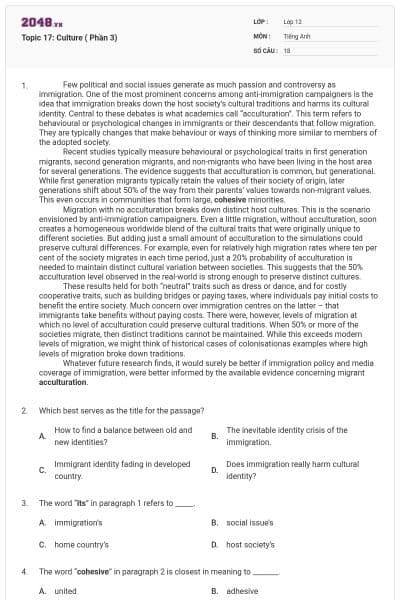
Few political and social issues generate as much passion and controversy as immigration. One of the most prominent concerns among anti-immigration campaigners is the idea that immigration breaks down the host society’s cultural traditions and harms its cultural identity. Central to these debates is what academics call “acculturation”. This term refers to behavioural or psychological changes in immigrants or their descendants that follow migration. They are typically changes that make behaviour or ways of thinking more similar to members of the adopted society.
Recent studies typically measure behavioural or psychological traits in first generation migrants, second generation migrants, and non-migrants who have been living in the host area for several generations. The evidence suggests that acculturation is common, but generational. While first generation migrants typically retain the values of their society of origin, later generations shift about 50% of the way from their parents’ values towards non-migrant values. This even occurs in communities that form large, cohesive minorities.
Migration with no acculturation breaks down distinct host cultures. This is the scenario envisioned by anti-immigration campaigners. Even a little migration, without acculturation, soon creates a homogeneous worldwide blend of the cultural traits that were originally unique to different societies. But adding just a small amount of acculturation to the simulations could preserve cultural differences. For example, even for relatively high migration rates where ten per cent of the society migrates in each time period, just a 20% probability of acculturation is needed to maintain distinct cultural variation between societies. This suggests that the 50% acculturation level observed in the real-world is strong enough to preserve distinct cultures.
These results held for both “neutral” traits such as dress or dance, and for costly cooperative traits, such as building bridges or paying taxes, where individuals pay initial costs to benefit the entire society. Much concern over immigration centres on the latter – that immigrants take benefits without paying costs. There were, however, levels of migration at which no level of acculturation could preserve cultural traditions. When 50% or more of the societies migrate, then distinct traditions cannot be maintained. While this exceeds modern levels of migration, we might think of historical cases of colonisationas examples where high levels of migration broke down traditions.
Whatever future research finds, it would surely be better if immigration policy and media coverage of immigration, were better informed by the available evidence concerning migrant acculturation.
Which best serves as the title for the passage?
How to find a balance between old and new identities?
The inevitable identity crisis of the immigration.
Immigrant identity fading in developed country.
Does immigration really harm cultural identity?
Đáp án D
Câu nào sau đây thích hợp nhất làm tiêu đề cho đoạn văn?
A. Làm thế nào để tìm được sự cân bằng giữa bản sắc cũ và mới?
B. Cuộc khủng hoảng bản sắc không thể tránh khỏi của nhập cư
C. Bản sắc của người nhập cư mờ dần ở các nước phát triển
D. Nhập cư có thực sự gây hại cho bản sắc văn hóa?
Căn cứ vào thông tin đoạn đầu:
Few political and social issues generate as much passion and controversy as immigration. One of the most prominent concerns among anti-immigration campaigners is the idea that immigration breaks down the host society’s cultural traditions and harms its cultural identity. Central to these debates is what academics call “acculturation”.
(Rất ít vấn đề chính trị và xã hội tạo ra nhiều hứng khởi và sự tranh cãi như nhập cư. Một trong những mối quan tâm nổi bật nhất của các nhà vận động chống nhập cư là ý tưởng rằng nhập cư phá vỡ truyền thống văn hóa của xã hội nước sở tại và làm tổn hại bản sắc văn hóa của nó. Trọng tâm của những cuộc tranh luận này là điều mà các học giả gọi là sự đồng hòa.)
Như vậy, đoạn văn đang nói về vấn đề liệu rằng nhập cư có phá vỡ truyền thống văn hóa của xã hội nước sở tại và làm tổn hại bản sắc văn hóa của nó hay không.
The word “its” in paragraph 1 refers to _____.
immigration’s
social issue’s
home country’s
host society’s
Đáp án D
Từ “its” trong đoạn 1 đề cập đến_____.
A. của sự nhập cư
B. của vấn đề xã hội
C. của quê hương
D. của xã hội sở tại
Từ “its” dùng để thay thế cho danh từ xã hội sở tại được nhắc tới trước đó.
One of the most prominent concerns among anti-immigration campaigners is the idea that immigration breaks down the host society’s cultural traditions and harms its cultural identity.
(Một trong những mối quan tâm nổi bật nhất của các nhà vận động chống nhập cư là ý tưởng rằng nhập cư phá vỡ truyền thống văn hóa của xã hội sở tại và làm tổn hại bản sắc văn hóa của nó.)
The word “cohesive” in paragraph 2 is closest in meaning to _______.
united
adhesive
viscous
combined
Đáp án A
Từ “cohesive” /kəʊˈhiː.sɪv/ trong đoạn 2 có nghĩa gần nhất với_____.
A. đoàn kết
B. kết dính
C. nhớt
D. kết hợp
Từ đồng nghĩa cohesive (gắn kết) = united
This even occurs in communities that form large, cohesive minorities.
(Điều này thậm chí xảy ra trong các cộng đồng, mà hình thành các nhóm thiểu số lớn, gắn kết.)
According to paragraph 3, why is the absence of acculturation such a gloomy vision?
Economic reasons for migration decisions are strongly emphasized.
Countries cannot maintain their singularity with many distinctive cultures coexisting.
Cultural homogeneity plays a major role for the unity of immigrant groups.
The adoption of foreign culture is harmful to the governing of the host countries.
Đáp án B
Theo đoạn 3, tại sao thiếu sự đồng hóa lại khiến viễn cảnh tăm tối đến như vậy?
A. Lý do kinh tế cho các quyết định di cư được nhấn mạnh
B. Các quốc gia không thể duy trì nét độc đáo của mình khi nhiều nền văn hóa đặc trưng cùng tồn tại
C. Sự đồng nhất về văn hóa đóng một vai trò chính cho sự thống nhất của các nhóm người nhập cư
D. Việc tiếp nhận văn hóa nước ngoài có hại cho sự quản lí của các nước sở tại
Căn cứ vào thông tin đoạn ba:
Migration with no acculturation breaks down distinct host cultures. This is the scenario envisioned by anti-immigration campaigners. Even a little migration, without acculturation, soon creates a homogeneous worldwide blend of the cultural traits that were originally unique to different societies.
(Di cư mà không đồng hóa phá vỡ các nét đặc trưng của văn hóa sở tại. Đây là viễn cảnh được hình dung bởi các nhà vận động chống nhập cư. Ngay cả di cư nhỏ, mà không có đồng hóa, cũng sớm tạo ra một sự pha trộn đồng nhất trên toàn thế giới của các đặc điểm văn hóa, cái mà ban đầu là duy nhất với các xã hội khác nhau.)
According to paragraph 4, under what circumstance does acculturation have no effect on original culture?
A quarter of immigrants choose to build a community in the same place.
Less than 50% of the population migrates to another region in a short period.
More than half of the immigrating society move to settle in another residence.
The government of immigrating side officially arranges the collective moving
Đáp án C
Theo đoạn 4, trong trường hợp nào thì sự đồng hóa không có ảnh hưởng đến văn hóa gốc?
A. Một phần tư người nhập cư chọn xây dựng một cộng đồng ở cùng một nơi
B. Ít hơn 50% dân số di cư đến một khu vực khác trong một thời gian ngắn
C. Hơn một nửa xã hội nhập cư chuyển đến định cư ở nơi cư trú khác
D. Chính phủ của phía nhập cư chính thức sắp xếp việc di chuyển tập thể
Căn cứ vào thông tin đoạn bốn:
There were, however, levels of migration at which no level of acculturation could preserve cultural traditions. When 50% or more of the societies migrate, then distinct traditions cannot be maintained.
(Tuy nhiên, có một số mức độ di cư mà tại đó không có mức độ đồng hóa nào có thể bảo tồn truyền thống văn hóa. Khi từ 50% trở lên xã hội di cư, truyền thống riêng biệt không thể được duy trì.)
Which of the following statements is TRUE, according to the passage?
An immigrant’s host country and adopted country can be two different places.
Acculturation in simple term is to switch from original cultural traits to some of new society.
Researches on acculturation only observe the two first generations of immigrants.
Pro-immigration side believes that cultural integration is detrimental to the host nation.
Đáp án B
Phát biểu nào sau đây là đúng, theo đoạn văn?
A. Một nước chủ nhà nhập cư và nước tiếp nhận có thể là hai nơi khác nhau
B. Thuật ngữ đồng hóa đơn giản là để chuyển từ các đặc điểm văn hóa ban đầu sang một số đặc điểm văn hóa mới
C. Các nghiên cứu về đồng hóa chỉ quan sát hai thế hệ di dân đầu tiên
D. Phía di dân tin rằng hội nhập văn hóa là bất lợi cho quốc gia sở tại
Căn cứ vào thông tin đoạn đầu:
This term refers to behavioural or psychological changes in immigrants or their descendants that follow migration. They are typically changes that make behaviour or ways of thinking more similar to members of the adopted society.
(Thuật ngữ này đề cập đến sự thay đổi về hành vi hoặc tâm lý ở người nhập cư hoặc con cháu của họ, người mà đi theo di cư. Chúng điển hình là những thay đổi mà khiến hành vi hoặc cách suy nghĩ giống với các thành viên của xã hội tiếp nhận.)
The word “acculturation” in paragraph 5 is closest in meaning to _______.
digestion
adjustment
understanding
assimilation
Đáp án D
Từ “acculturation” trong đoạn 5 có nghĩa gần nhất với __________ .
A. sự tiêu hóa
B. sự điều chỉnh
C. sự hiểu
D. sự đồng hóa
Từ đồng nghĩa acculturation (sự tiếp biến về văn hóa) = assimilation
Whatever future research finds, it would surely be better if immigration policy and media coverage of immigration, were better informed by the available evidence concerning migrant acculturation.
(Dù nghiên cứu trong tương lai tìm thấy gì đi chăng nữa, chắc chắn sẽ tốt hơn nếu chính sách nhập cư và truyền thông về nhập cư được thông báo tốt hơn bằng các bằng chứng có sẵn liên quan đến đồng hóa của sự di cư.)
Which of the following can be inferred from the passage?
Acculturation can prevent immigration from destroying host national identities.
How the parent and the child interact with mainstream culture are essentially different.
The problems of unplanned migration poses to the host countries are unsolvable.
Cultural identity influences the decision to migrate and to adapt to the host country’s culture.
Đáp án A
Điều nào sau đây có thể được suy ra từ đoạn văn?
A. Sự đồng hóa có thể ngăn chặn người nhập cư phá hủy bản sắc dân tộc sở tại
B. Cách cha mẹ và đứa trẻ tương tác với văn hóa chính thống về cơ bản là khác nhau
C. Các vấn đề di cư không có kế hoạch đặt ra cho các quốc gia sở tại là không thể giải quyết được
D. Bản sắc văn hóa ảnh hưởng đến quyết định di cư và thích nghi với văn hóa nước sở tại
Căn cứ vào thông tin đoạn ba:
Migration with no acculturation breaks down distinct host cultures. This is the scenario envisioned by anti-immigration campaigners. Even a little migration, without acculturation, soon creates a homogeneous worldwide blend of the cultural traits that were originally unique to different societies.
(Di cư không có sự tiếp biến về văn hóa phá vỡ các nền văn hóa sở tại đặc biệt. Đây là viễn cảnh được hình dung bởi các nhà vận động chống nhập cư. Ngay cả một chút di chuyển, mà không tiếp biến về văn hóa, sớm tạo ra một sự pha trộn đồng nhất trên toàn thế giới của các đặc điểm văn hóa, cái mà ban đầu là duy nhất với xã hội khác nhau.)
Hamams, or bath houses, are a traditional part of Turkish culture. They represent an important piece of Turkey’s long history and serve as a window into the past. However, these bath houses are quickly disappearing because of the changing habits of the Turkish people.
Hamams hold a strong place in the history of Turkey and many date back hundreds of years. Traditionally, all kinds of people went to hamams because Islam has strict laws for cleanliness. Believers must wash themselves regularly, particularly before their daily prayers. As most people in Turkey didn’t have access to running water in their homes, the hamam was the perfect to get clean, relax, and catch up with friends.
Today, however, the tradition of going to the humam is quickly dying out for many young people. Now almost everyone has running water in their bathrooms, so they prefer to bathe at home. As a result, Turkish people are not going to humans as often as they used to. These days, instead of relying on locals, many hamams are trying to attract foreign tourists.
Some of the best hamams in Turkey are located in Istanbul, the country’s largest city. The Cagaloglu hamam is a great example. It was a gift to the people from the Sultan in 1741 and is one of the last old hamams to be built during the Ottoman Empire. Many visitors are impressed by the high domed ceilings, marble floors, and marble walls used throughout.
A typical session at a hamam can last well over an hour. Visitors will be welcomed into camekan, or entrance hall. There they will be able to relax with friends and chat over a cup of tea. They will also be able to change into the customary pestemal, or Turkish towel, which wraps around the waist like a skirt. When ready, visitors will head into the hararet, or hot room. There they will lie on the hot floor and be scrubbed clean and massaged by one of the in-house masseurs or masseuses. Men and women always bathe separately, but their experience are very similar.
Although many hamams are in danger of closing, they will always remain a part of Turkish culture. An experience in one of Istanbul’s famous bath houses is not to be misses on any visit to Turkey. It will certainly leave you refreshed, relaxed, and squeaky clean for your next adventure.
What can be the best title for the passage?
The traditional Baths of Turkey
The Custom of Bathing
The Famous Turkish Bath Houses
The Restoration of an Old Hamam
Đáp án A
Chủ đề về BATH HOUSESĐâu có thể là tiêu đề tốt nhất cho đoạn văn?
A. Phòng tắm truyền thống của Thổ Nhĩ Kỳ
B. Phong tục tắm
C. Nhà tắm nổi tiếng của Thổ Nhĩ Kỳ
D. Sự phục hồi của nhà tắm truyền thống
=> Câu hỏi yêu cầu nắm được nội dung thông tin của toàn bài văn.
- Đoạn văn 1 và 2 tác giả giới thiệu về nhà tắm truyền thống và sự quan trọng của nó đối với người dân cũng như đất nước Thổ Nhĩ Kỳ. (represent an important piece, a window into the past, people get clean before daily prayers…)
- Đoạn văn thứ ba, tác giả nói về sự biến mất dần của nhà tắm truyền thống do thói quen của người dân thay đổi.
- Tiếp theo tác giả liệt kê những dịch vụ mà nhà tắm truyền thống cung cấp cho khách trải nghiệm.
=> Tất cả đều nói về nhà tắm truyền thống ở Thổ Nhĩ Kỳ. Vì vậy, tiêu đề phù hợp nhất là đáp án A. The traditional Baths of Turkey
According to the passage, why are hamams disappearing?
They are too old to be preserved
The number of foreign tourists is decreasing.
They are closing their doors to visitors.
The habits of the Turkish people are changing.
Đáp án D
Theo đoạn văn, tại sao nhà tắm truyền thống biến mất?
A. Chúng quá cũ để được bảo tồn
B. Số lượng khách du lịch nước ngoài đang giảm.
C. Họ đang đóng cửa với du khách.
D. Thói quen của người Thổ Nhĩ Kỳ đang thay đổi.
Căn cứ vào thông tin:
"Hamams, or bath houses, are a traditional part of Turkish culture. They represent an important piece of Turkey’s long history and serve as a window into the past. However, these bath houses are quickly disappearing because of the changing habits of the Turkish people.
(“Hamam”, hay nhà tắm, là một phần truyền thống của văn hóa Thổ Nhĩ Kỳ. Chúng đại diện cho một phần quan trọng của lịch sử lâu đời Thổ Nhĩ Kỳ và được ví như cánh cửa sổ để kết nối vào quá khứ. Tuy nhiên, những nhà tắm này đang nhanh chóng biến mất vì thói quen của người Thổ Nhĩ Kỳ đang thay đổi.)
The word “Believers” in paragraph 2 is closest in meaning to _________ .
church goers
worshippers
truth tellers
devotees
Đáp án B
Từ “Believers” trong đoạn 2 có nghĩa gần nhất với _________.
A. người đi nhà thờ
B. những người sùng bái đạo
C. người nói sự thật
D. người hâm mộ
Căn cứ vào thông tin:
"Traditionally, all kinds of people went to hamams because Islam has strict laws for cleanliness. Believers must wash themselves regularly, particularly before their daily prayers."
(Theo truyền thống, tất cả mọi người đi đến nhà tắm truyền thống vì Hồi giáo có luật nghiêm ngặt về sự sạch sẽ. Các tín đồ phải rửa mình thường xuyên, đặc biệt là trước sự cầu nguyện hàng ngày của họ.)
=> Believers /bɪˈliːvəz/ (n): tín đồ, người sùng đạo = worshipers (n)
According to the passage, why were humams important places for Islamic people?
They would pray at hamams before bathing.
They had to wash themselves before their daily prayers
They met with other followers at hamams for social chattin
They could relax there before their prayers every day.
Đáp án B
Theo đoạn văn, tại sao nhà tắm truyền thống lại là nơi quan trọng đối với người Hồi giáo?
A. Họ sẽ cầu nguyện tại nhà tắm truyền thống trước khi tắm.
B. Họ phải làm sạch bản thân trước những lời cầu nguyện hàng ngày
C. Họ gặp được những người theo đạo khác tại nhà tắm truyền thống để trò chuyện xã giao.
D. Họ có thể thư giãn ở đó trước khi cầu nguyện mỗi ngày.
Căn cứ vào thông tin:
"Hamams hold a strong place in the history of Turkey and many date back hundreds of years. Traditionally, all kinds of people went to hamams because Islam has strict laws for cleanliness. Believers must wash themselves regularly, particularly before their daily prayers. As most people in Turkey didn’t have access to running water in their homes, the hamam was the perfect to get clean."
(Nhà tắm truyền thống giữ một vị trí quan trọng trong lịch sử của Thổ Nhĩ Kỳ và có từ hàng trăm năm trước. Theo truyền thống, tất cả mọi người đi đến nhà tắm truyền thống vì Hồi giáo có luật nghiêm ngặt về sự sạch sẽ. Các tín đồ phải rửa mình thường xuyên, đặc biệt là trước sự cầu nguyện hàng ngày của họ. Bởi vì hầu hết người ở Thổ Nhĩ Kỳ không được cung cấp nguồn nước ở nhà của họ, nhà tắm truyền thống là một nơi hoàn hảo để tắm sạch sẽ.)
The phrase “dying out” in paragraph 3 mostly means _________ .
worsening
disappearing
lessening
submerging
Đáp án B
Cụm từ "dying out" trong đoạn 3 gần như có nghĩa là _________.A. trở nên xấu hơn
B. biến mất
C. làm giảm đi
D. làm ngập nước
Căn cứ vào thông tin:
"Today, however, the tradition of going to the hamam is quickly dying out for many young people. Now almost everyone has running water in their bathrooms, so they prefer to bathe at home. As a result, Turkish people are not going to hamams as often as they used to."
(Tuy nhiên, ngày nay, truyền thống đi đến nhà tắm chung đang nhanh chóng mất đi đối với nhiều người trẻ. Bây giờ hầu như tất cả mọi người đều có nước trong phòng tắm của họ, vì vậy họ thích tắm ở nhà hơn. Vì vậy, người Thổ Nhĩ Kỳ không đến với nhà tắm truyền thống thường xuyên như trước đây nữa.)
=> die out (v): mất đi, biến mất = disappear (v).
According to the passage, there are some of the best hamams located in _________ .
Istanbul
Sultan
Cagaloglu
largest cities in Turkey
Đáp án A
Theo đoạn văn, có một số nhà tắm truyền thống tốt nhất nằm ở _________.
A. Istanbul
B. Sultan
C. Cagaloglu
D. thành phố lớn nhất ở Thổ Nhĩ Kỳ
Căn cứ vào thông tin:
"Some of the best hamams in Turkey are located in Istanbul, the country’s largest city. The Cagaloglu hamam is a great example. It was a gift to the people from the Sultan in 1741 and is one of the last old hamams to be built during the Ottoman Empire."
(Một số nhà tắm truyền thống tốt nhất ở Thổ Nhĩ Kỳ nằm ở Istanbul, thành phố lớn nhất của đất nước. Nhà tắm truyền thống ở Cagaloglu là một ví dụ tuyệt vời. Đó là một món quà cho những người đến từ Sultan vào năm 1741 và là một trong những nhà tắm truyền thống cuối cùng được xây dựng trong Đế chế Ottoman.)
Which of the following is true about hamams?
A typical session at a hamam can last no more than 60 minutes.
Traditionally, only men went to hamams as they were considered noble.
Many young locals still like going to hamams to preserve the tradition.
At hamams, visitors will be massaged by masseurs or masseuses.
Đáp án D
Điều nào sau đây đúng về nhà tắm truyền thống?
A. Một phiên thông thường tại nhà tắm truyền thống có thể kéo dài không quá 60 phút.
B. Theo truyền thống, chỉ có đàn ông đi nhà tắm truyền thống vì họ được coi là quý tộc.
C. Nhiều người dân địa phương trẻ vẫn thích đến nhà tắm truyền thống để giữ gìn truyền thống.
D. Tại nhà tắm truyền thống, du khách sẽ được mát xa bởi nhân viên mát xa nam hoặc nhân viên mát xa nữ.
Căn cứ vào các thông tin:
- A typical session at a hamam can last well over an hour.
(Một phiên thông thường tại nhà tắm truyền thống có thể kéo dài đến hơn một tiếng đồng hồ.)
=> Đáp án A không đúng.
- There they will lie on the hot floor and be scrubbed clean and massaged by one of the in-house masseurs or masseuses
(Tại đó, họ sẽ được nằm trên một sàn nhà nóng, được kì cọ sạch sẽ và được mát xa bởi một trong những nhân viên mát xa nam hoặc nhân viên mát xa nữ.)
=> Đáp án D đúng.
- Men and women always bathe separately, but their experience are very similar.
(Đàn ông và phụ nữ luôn tắm riêng biệt nhưng đều có các trải nghiệm như nhau.)
=> Cả đàn ông và phụ nữ đều có thể đến nhà tắm truyền thống và có trải nghiệm như nhau => Đáp án B không đúng.
=> Đáp án D. (vì đáp án A không được nhắc đến trong bài.)
Which of the following is NOT true about hamams?
The Cagaloglu hamam has floors and walls made of marble.
People change into Turkish towels at a hamam
Hamams will soon stop serving foreign visitors to Turkey.
People relax with friends and chat over a cup of tea before bathing.
Đáp án B
Điều nào sau đây là KHÔNG đúng về nhà tắm truyền thống?
A. Nhà tắm truyền thống tại Cagaloglu có sàn và tường làm bằng đá cẩm thạch.
B. Mọi người chuyển sang sử dụng khăn Thổ Nhĩ Kỳ tại nhà tắm truyền thống.
C. Nhà tắm truyền thống sẽ sớm ngừng phục vụ du khách nước ngoài đến Thổ Nhĩ Kỳ.
D. Mọi người thư giãn với bạn bè và trò chuyện bên tách trà trước khi tắm.
Căn cứ vào các thông tin:
- The Cagaloglu hamam is a great example. Many visitors are impressed by the high domed ceilings, marble floors, and marble walls used throughout.
(Nhà tắm truyền thống tại Cagaloglu là một ví dụ tuyệt vời. Nhiều du khách bị ấn tượng bởi trần nhà hình vòm cao, sàn và tường được sử dụng hoàn toàn bằng đá cẩm thạch.)
- There they will be able to relax with friends and chat over a cup of tea.
(Ở đó, họ sẽ có thể thư giãn và trò chuyện với bạn bè cùng một tách trà.)
“They will also be able to change into the customary pestemal, or Turkish towel, which wraps around the waist like a skirt.”
(Họ cũng có thể chuyển sang mặc khăn bông tắm , hoặc khăn tắm Thổ Nhĩ Kỳ, cái mà quấn quanh eo như cái váy.)
=> Chuyển sang quấn khăn tắm là chỉ một sự lựa chọn của du khách, ai thích thì có thể làm như vậy và đáp án B không ám chỉ đó là sự lựa chọn duy nhất nên B không sai.
=> Các đáp án A, B, D đều đúng về nhà tắm truyền thống. Còn đáp án C không đúng về nhà tắm truyền thống vì:
- These days, instead of relying on locals, many hamams are trying to attract foreign tourists.
(Hiện nay, thay vì trông chờ vào người dân địa phương, các nhà tắm truyền thống cố gắng thu hút khách du lịch nước ngoài.)
Bạn có thích hoạt động này không?