Topic 17: Culture ( Phần 2)
74 câu hỏi
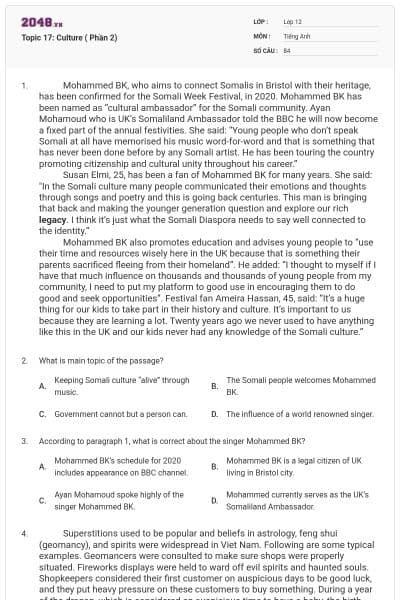
Mohammed BK, who aims to connect Somalis in Bristol with their heritage, has been confirmed for the Somali Week Festival, in 2020. Mohammed BK has been named as “cultural ambassador” for the Somali community. Ayan Mohamoud who is UK’s Somaliland Ambassador told the BBC he will now become a fixed part of the annual festivities. She said: “Young people who don’t speak Somali at all have memorised his music word-for-word and that is something that has never been done before by any Somali artist. He has been touring the country promoting citizenship and cultural unity throughout his career.”
Susan Elmi, 25, has been a fan of Mohammed BK for many years. She said: "In the Somali culture many people communicated their emotions and thoughts through songs and poetry and this is going back centuries. This man is bringing that back and making the younger generation question and explore our rich legacy. I think it’s just what the Somali Diaspora needs to say well connected to the identity.”
Mohammed BK also promotes education and advises young people to “use their time and resources wisely here in the UK because that is something their parents sacrificed fleeing from their homeland”. He added: “I thought to myself if I have that much influence on thousands and thousands of young people from my community, I need to put my platform to good use in encouraging them to do good and seek opportunities”. Festival fan Ameira Hassan, 45, said: “It’s a huge thing for our kids to take part in their history and culture. It’s important to us because they are learning a lot. Twenty years ago we never used to have anything like this in the UK and our kids never had any knowledge of the Somali culture.”
What is main topic of the passage?
Keeping Somali culture “alive” through music.
The Somali people welcomes Mohammed BK.
Government cannot but a person can.
The influence of a world renowned singer.
Đáp án A
Chủ đề chính của đoạn văn là gì?
A. Giữ cho văn hóa Somalia /səˈmɑː.li.ə/ ( a country in East Africa) “sống” qua âm nhạc
B. Người Somalia chào đón Mohammed BK
C. Chính phủ không thể nhưng một người có thể
D. Ảnh hưởng của một ca sĩ nổi tiếng thế giới
Căn cứ vào thông tin đoạn đầu:
Mohammed BK, who aims to connect Somalis /səˈmɑː.li/ in Bristol with their heritage, has been confirmed for the Somali Week Festival, in 2020. Mohammed BK has been named as “cultural ambassador” for the Somali community.
(Mohammed BK, người muốn kết nối Somalia ở Bristol với di sản của họ, đã được được xác nhận cho Tuần lễ Somalia, năm 2020. Mohammed BK đã được mệnh danh là " đại sứ văn hóa"cho cộng đồng Somalia.)
=> Như vậy, đoạn văn đang nói về việc giữ gìn văn hóa Somali.
According to paragraph 1, what is correct about the singer Mohammed BK?
Mohammed BK’s schedule for 2020 includes appearance on BBC channel.
Mohammed BK is a legal citizen of UK living in Bristol city.
Ayan Mohamoud spoke highly of the singer Mohammed BK.
Mohammed currently serves as the UK’s Somaliland Ambassador.
Đáp án C
Theo đoạn 1, điều gì là đúng về ca sĩ Mohammed BK?
A. Lịch biểu diễn của Mohammed BK năm 2020 bao gồm sự xuất hiện trên kênh BBC.
B. Mohammed BK là một công dân hợp pháp của Vương quốc Anh sống ở thành phố Bristol.
C. Ayan Mohamoud đã ca ngợi ca sĩ Mohammed BK.
D. Mohammed hiện đang là Đại sứ Somaliland Vương quốc Anh
Căn cứ vào thông tin đoạn đầu:
Ayan Mohamoud who is UK’s Somaliland Ambassador told the BBC he will now become a fixed part of the annual festivities. She said: “Young people who don’t speak Somali at all have memorised his music word-for-word and that is something that has never been done before by any Somali artist. He has been touring the country promoting citizenship and cultural unity throughout his career.”
(Ayan Mohamoud, đại sứ Somaliland của vương quốc Anh, đã nói với đài BBC rằng anh ấy sẽ trở thành một phần cố định của các lễ hội hàng năm. Cô ấy nói: “Giới trẻ người không nói tiếng Somali đã ghi nhớ từng chữ trong âm nhạc của anh ấy và đó là điều chưa từng được thực hiện trước đây bởi bất kỳ nghệ sĩ Somalia nào. Anh ấy đã đi lưu diễn khắp đất nước thúc đẩy quyền công dân và sự thống nhất văn hóa trong suốt sự nghiệp của mình.”)
The word “legacy” in paragraph 2 is closest in meaning to ______.
present
benefaction
birthright
heritage
Đáp án D
Từ “legacy” /ˈleɡ.ə.si/ trong đoạn 2 có nghĩa gần nhất với______.
A. hiện tại
B. việc thiện, việc nghĩa
C. quyền thừa kế
D. di sản
Từ đồng nghĩa legacy (tài sản) = heritage
This man is bringing that back and making the younger generation question and explore our rich legacy. (Người đàn ông này đang mang điều đó trở lại và làm cho thế hệ trẻ thắc mắc và khám phá di sản phong phú của chúng ta.)
The word “they” in paragraph 3 refers to _______.
people
kids
parents
opportunities
Đáp án B
Từ “they” trong đoạn 3 đề cập đến______.
A. người
B. trẻ em
C. cha mẹ
D. cơ hội
=> Từ “they” ở đây dùng để thay thế cho danh từ đứa trẻ được nhắc tới trước đó.
Festival fan Ameira Hassan, 45, said: "It’s a huge thing for our kids to take part in their history and culture. It’s important to us because they are learning a lot.
According to paragraph 3, what is the pedagogical philosophy of Mohammed BK?
The aim of education is to ensure students’ acquisition of fundamental knowledge.
The youth should grasp every possibility and tool needed to learn to their fullest potential.
Knowledge is required to be transmitted to students in a systematic, disciplined way.
Learning is rooted in the questions of learners that arise through experiencing the world.
Đáp án B
Theo đoạn 3, triết lý sư phạm của Mohammed BK là gì?
A. Mục đích của giáo dục là đảm bảo học sinh tiếp thu kiến thức cơ bản.
B. Giới trẻ nên nắm bắt mọi cơ hội và công cụ cần thiết để tận dụng hết khả năng của mình để học tập.
C. Kiến thức là cần thiết để truyền cho sinh viên một cách có hệ thống, kỷ luật
D. Học tập bắt nguồn từ những câu hỏi của người học phát sinh thông qua việc trải nghiệm thế giới
Căn cứ vào thông tin đoạn ba:
“ Mohammed BK also promotes education and advises young people to ”use their time and resources wisely here in the UK because that is something their parents sacrificed fleeing from their homeland“. He added: ”I thought to myself if I have that much influence on thousands and thousands of young people from my community, I need to put my platform to good use in encouraging them to do good and seek opportunities“. Festival fan Ameira Hassan, 45, said: ”It’s a huge thing for our kids to take part in their history and culture. It’s important to us because they are learning a lot. Twenty years ago we never used to have anything like this in the UK and our kids never had any knowledge of the Somali culture“.”
(Mohammed BK cũng khuyến khích giáo dục và khuyên các bạn trẻ “sử dụng thời gian và năng lực của họ một cách khôn ngoan ở đây tại vương quốc Anh bởi vì đó là điều mà cha mẹ của họ đã hy sinh khi chạy trốn khỏi quê hương của họ.” Ông nói thêm: “Tôi đã nghĩ rằng nếu tôi có ảnh hưởng lớn đến hàng ngàn người trẻ ở cộng đồng của tôi, tôi cần phải tận dụng nền tảng đó của mình để khuyến khích họ làm điều tốt và tìm kiếm cơ hội”. Người hâm mộ lễ hội, Ameira Hassan, 45 tuổi, đã nói: "Đó là một cơ hội rất lớn dành cho những đứa trẻ của chúng tôi để tham gia vào lịch sử và văn hóa của chúng. Nó quan trọng đối với chúng tôi vì chúng đang học hỏi được rất nhiều. Hai mươi năm trước chúng tôi chưa bao giờ có bất cứ điều gì như thế này trong Vương quốc Anh và những đứa trẻ của chúng tôi chưa bao giờ có bất kỳ kiến thức nào về văn hóa Somalia.")
=> Như vậy, triết lý sư phạm của Mohammed BK là giới trẻ nên nắm bắt mọi cơ hội và công cụ cần thiết để tận dụng hết khả năng của mình để học tập.
Superstitions used to be popular and beliefs in astrology, feng shui (geomancy), and spirits were widespread in Viet Nam. Following are some typical examples. Geomancers were consulted to make sure shops were properly situated. Fireworks displays were held to ward off evil spirits and haunted souls. Shopkeepers considered their first customer on auspicious days to be good luck, and they put heavy pressure on these customers to buy something. During a year of the dragon, which is considered an auspicious time to have a baby, the birth rate jumped 8 percent in the first half of the year.
Despite official disapproval of such superstitious practices, some Vietnamese, regardless of their religion, level of education, or ideology, might have been influenced at one time or another by such practices as astrology, geomancy and sorcery. Diviners and other specialists in the occult remain popular demand because they are believed to be able to diagnose supernatural causes of illness, establish lucky dates for personal undertakings, or predict the future. Moreover, many seem to believe that individual destiny was guided by astrological phenomena. By consulting one’s horoscope, one could make the most of auspicious tines and avoid disaster. It is not unusual, for example, for a couple to consult an astrologer before marrying. He would determine if the betrothed were suitable matched and even fix the date of the ceremony.
According to the passage, why were firework displays originally held?
To welcome a new year
To show the beauty of light
To test technology development
To protect people against evil spir
Đáp án D
Theo đoạn văn, tại sao màn bắn pháo hoa được tổ chức ban đầu?
Xét các đáp án:
A. Để chào đón một năm mới
B. Để thể hiện vẻ đẹp của ánh sáng
C. Để kiểm tra sự phát triển của công nghệ
D. Để bảo vệ con người chống lại linh hồn của ma quỷ
Căn cứ vào thông tin đoạn 1:
Superstitions used to be popular and beliefs in astrology, feng shui (geomancy), and spirits were widespread in Viet Nam. Following are some typical examples. Geomancers were consulted to make sure shops were properly situated. Fireworks displays were held to ward off evil spirits and haunted souls. Shopkeepers considered their first customer on auspicious days to be good luck, and they put heavy pressure on these customers to buy something.
(Sự mê tín từng là phổ biến và tín ngưỡng trong chiêm tinh học, phong thủy (phong thủy) và tinh thần là phổ biến ở Việt Nam. Sau đây là một số ví dụ điển hình. Geomancer đã được tư vấn để đảm bảo cửa hàng đã được đặt đúng. Màn bắn pháo hoa được tổ chức để xua đuổi tà ma và những linh hồn bị ma ám.
Chủ cửa hàng coi khách hàng đầu tiên của họ vào những ngày tốt lành là may mắn, và họ đặt nặng áp lực với những khách hàng này khi mua một thứ gì đó.)
Shopkeepers would be very upset if their first customer _____________.
bought only few items
did not buy anything
insisted in getting a bargain
delayed the payment
Đáp án B
Chủ cửa hàng sẽ rất khó chịu nếu khách hàng đầu tiên của họ _________.
Xét các đáp án:
A. chỉ mua một vài món
B. không mua bất cứ thứ gì
C. khăng khăng đòi lấy món hời
D. trì hoãn việc thanh toán
Căn cứ vào thông tin đoạn 1:
Shopkeepers considered their first customer on auspicious days to be good luck, and they put heavy pressure on these customers to buy something.
(Chủ cửa hàng coi khách hàng đầu tiên của họ vào những ngày tốt lành là may mắn, và họ luôn đặt nặng áp lực với những khách hàng này khi mua một thứ gì đó.)
In a year of the dragon, from ____, the number of newborn baby increased by eight per cent.
January to Jun
July to December
March to September
May to October
Đáp án A
Trong năm con rồng, từ tháng ______, số em bé sơ sinh tăng thêm tám phần trăm.
Xét các đáp án:
A. tháng 1 đến tháng 6
B. tháng 7 đến tháng 12
C. tháng 3 đến tháng 9
D.tháng 5 đến tháng 10
Căn cứ vào thông tin cuối đoạn 1:
During a year of the dragon, which is considered an auspicious time to have a baby, the birth rate jumped 8 percent in the first half of the year.
(Trong năm con rồng, được coi là một thời gian tốt lành để sinh con, tỷ lệ sinh đã tăng 8% trong nửa năm đầu.)
What is true about superstitions in Vietnam?
Well-educated people do not believe in superstitions.
Different religions show different levels of beliefs.
Geomancy is the most popular form.
The government does not promote them.
Đáp án D
Điều nào dưới là đúng về mê tín ở Việt Nam?
Xét các đáp án:
A. Những người có học thức không tin vào những điều mê tín.
B. Các tôn giáo khác nhau cho thấy mức độ tín ngưỡng khác nhau.
C. Phong thủy là hình thức phổ biến nhất.
D. Chính phủ không thúc đẩy họ.
Căn cứ vào thông tin đoạn 2:
Despite official disapproval of such superstitious practices, some Vietnamese, regardless of their religion, level of education, or ideology, might have been influenced at one time or another by such practices as astrology, geomancy and sorcery.
(Mặc dù chính thức không chấp thuận các hành vi mê tín như vậy, một số người Việt Nam, bất kể tôn giáo, trình độ học vấn, hay ý thức hệ, có thể bị ảnh hưởng lúc này hay lúc khác bởi những việc mê tín dị đoan về chiêm tinh, phong thủy hay ma quỷ.)
What is NOT mentioned as an ability of diviners?
Working as a doctor
Predicting the future
Seeing a person’s past
Choosing lucky dates
Đáp án C
Điều gì KHÔNG được đề cập đến như một khả năng của các nhà tiên tri?
Xét các đáp án:
A. Làm bác sĩ
B. Dự đoán tương lai
C. Nhìn thấy quá khứ một người
D. Chọn ngày may mắn
Căn cứ vào thông tin đoạn 2:
Diviners and other specialists in the occult remain popular demand because they are believed to be able to diagnose supernatural causes of illness, establish lucky dates for personal undertakings, or predict the future.
(Những người tiên đoán và các chuyên gia huyền bí khác vẫn còn phổ biến nhu cầu bởi vì họ được cho là có thể chẩn đoán nguyên nhân gây bệnh siêu nhiên, chọn một ngày may mắn cho công việc kinh doanh cá nhân, hoặc dự đoán tương lai.)
When living and working in another country, there are numerous things to consider apart from the more obvious ones of climate, language, religion, currency, etc. Some important considerations are less obvious. For example, do you have a pet or do you enjoy a hobby such as horse riding? Your animal or hobby may be perceived in a completely different light in another culture so it’s important to consider the significance given to specific animals in different parts of the world and general perceptions towards them.
One example which is often mentioned in popular press is the case of dogs. In some cultures, like the US or UK, dogs are loved and considered a great pet to have at home and with the family. In other cultures, such as those where Islam is the majority religion, dogs may be perceived as dirty or dangerous. Muslims’ treatment of dogs is still a matter of debate amongst Islamic scholars . While these animals are widely considered by many Western cultures to be ‘man’s best friend’, the Koran describes them as unhygienic. Muslims will therefore avoid touching a dog unless he can wash his hands immediately afterwards, and they will almost never keep a dog in their home.
In Iran, for instance, a cleric once denounced ‘the moral depravity’ of dog owners and even demanded their arrest. If you are an international assignee living and working in Saudi Arabia or another Arabic country, you should remember this when inviting Arab counterparts to your house in case you have a dog as a pet. This is just one example of how Islam and other cultural beliefs can impact on aspects of everyday life that someone else may not even question. A Middle Eastern man might be very surprised when going to Japan, for instance, and seeing dogs being dressed and pampered like humans and carried around in baby prams!
Dogs are not the only animals which are perceived quite differently from one culture to another. In India, for example, cows are sacred and are treated with the utmost respect. Conversely in Argentina, beef is a symbol of national pride because of its tradition and the high quality of its cuts. An Indian working in Argentina who has not done his research or participated in a cross cultural training programme such as Doing Business in Argentina may be surprised at his first welcome dinner with his Argentinean counterparts where a main dish of beef would be served.
It is therefore crucial to be aware of the specific values assigned to objects or animals in different cultures to avoid faux-pas or cultural misunderstandings, particularly when living and working in another culture. Learning how people value animals and other symbols around the world is one of the numerous cultural examples discussed in Communicaid’s intercultural training courses. Understanding how your international colleagues may perceive certain animals can help you ensure you aren’t insensitive and it may even provide you with a good topic for conversation.Which of the following could be the main idea of the passage?
Dogs and different beliefs in the world
Perceptions of animals across cultures
Muslims and their opinions about animals
What should be learnt before going to another country
Đáp án B
Câu nào trong các câu sau có thể là ý chính của đoạn văn?
A. Loài chó và những tín ngưỡng khác nhau trên thế giới.
B. Những quan điểm về loài vật ở các nền văn hoá.
C. Tín đồ Hồi giáo và các quan điểm khác nhau về các loài vật.
D. Những gì nên học trước khi đến một đất nước khác.
Căn cứ thông tin đoạn 1:
Your animal or hobby may be perceived in a completely different light in another culture so it’s important to consider the significance given to specific animals in different parts of the world and general perceptions towards them.
(Động vật hoặc sở thích của bạn có thể được nhận thức với một quan điểm hoàn toàn khác trong nền văn hóa khác, vì vậy điều quan trọng là phải xem xét ý nghĩa của các động vật cụ thể ở các nơi khác nhau trên thế giới và nhận thức chung đối với chúng.)
According to paragraph 2, which sentence is INCORRECT?
Dogs are well-treated and loved in the US and UK.
Muslims are those considering dogs as their best pets at home.
People whose religion is Islam don’t like having dogs in their home.
The dog is a typical example of different views in the world about animals.
Đáp án B
Theo đoạn 2, câu nào là không đúng?
A. Loài chó được đối xử tốt và được yêu thương ở Mỹ và Anh.
B. Tín đồ Hồi giáo là những người xem loài chó là những con thú nuôi tốt nhất trong nhà.
C. Những người mà tôn giáo của họ là Đạo Hồi không thích nuôi chó trong nhà.
D. Loài chó là ví dụ điển hình của các quan điểm khác nhau trên thế giới về loài vật.
Căn cứ thông tin đoạn 2:
One example which is often mentioned in popular press is the case of dogs. In some cultures, like the US or UK, dogs are loved and considered a great pet to have at home and with the family. In other cultures, such as those where Islam is the majority religion, dogs may be perceived as dirty or dangerous. Muslims’ treatment of dogs is still a matter of debate amongst Islamic scholars. While these animals are widely considered by many Western cultures to be ‘man’s best friend’, the Koran describes them as unhygienic. Muslims will therefore avoid touching a dog unless he can wash his hands immediately afterwards, and they will almost never keep a dog in their home.
(Một ví dụ thường được đề cập trong báo chí phổ biến là trường hợp của chó. Trong một số nền văn hóa, như Mỹ hay Anh, chó được yêu thương và được coi là một vật nuôi tuyệt vời trong nhà và với gia đình. Trong các nền văn hóa khác, chẳng hạn như những nơi mà Hồi giáo là tôn giáo chính, chó có thể bị coi là bẩn hoặc nguy hiểm. Việc đối xử với chó của người Hồi giáo vẫn là vấn đề tranh luận giữa các học giả Hồi giáo. Trong khi những con vật này được nhiều nền văn hóa phương Tây coi là ‘người bạn tốt nhất’, thì kinh Koran mô tả chúng là không hợp vệ sinh. Người Hồi giáo do đó sẽ tránh chạm vào một con chó trừ khi anh có thể rửa tay ngay sau đó, và họ hầu như không bao giờ giữ một con chó trong nhà của họ.)
The word “unhygienic” in the second paragraph is closest in meaning to ____________.
unreliable
undependable
unhealthy
unacceptable
Đáp án C
Từ “unhygienic” trong đoạn 2 gần nghĩa nhất với từ _____________.
A. không đáng tin
B. không thể trông mong được
C. không lành mạnh, sạch sẽ
D. không thể chấp nhận được
Từ đồng nghĩa: unhygienic (không vệ sinh, không sạch sẽ) = unhealthy
While these animals are widely considered by many Western cultures to be ‘man’s best friend’, the Koran describes them as unhygienic. Muslims will therefore avoid touching a dog unless he can wash his hands immediately afterwards, and they will almost never keep a dog in their home.
(Trong khi những con vật này được nhiều nền văn hóa phương Tây coi là ‘người bạn tốt nhất’, thì kinh Koran mô tả chúng là không hợp vệ sinh. Người Hồi giáo do đó sẽ tránh chạm vào một con chó trừ khi anh có thể rửa tay ngay sau đó, và họ hầu như không bao giờ giữ một con chó trong nhà của họ.)
What does the word “this” in paragraph 3 refer to?
you are an international assignee
you are living and working in Saudi Arabia or another Arabic country
you are having a dog as pet.
a cleric once denounced the moral depravity of dog owners and even demanded their arrest
Đáp án D
Từ “this” trong đoạn 3 đề cập đến điều gì?
A. Bạn là một người được uỷ nhiệm quốc tế.
B. Bạn đang sống và làm việc ở Ả Rập Xê Út hay một quốc gia Ả Rập khác.
C. Bạn đang nuôi một con chó làm thú cưng.
D. Một giáo sĩ đã từng tố cáo ‘sự đồi bại về đạo đức’ của những người nuôi chó và thậm chí còn yêu cầu bắt giữ họ.
Căn cứ thông tin đoạn 3:
Từ “This” đang đề cập đến việc “một giáo sĩ đã từng tố cáo ‘sự đồi bại về đạo đức’ của những người nuôi chó và thậm chí còn yêu cầu bắt giữ họ”.
In Iran, for instance, a cleric once denounced ‘the moral depravity’ of dog owners and even demanded their arrest. If you are an international assignee living and working in Saudi Arabia or another Arabic country, you should remember this when inviting Arab counterparts to your house in case you have a dog as a pet.
(Ví dụ, ở Iran, một giáo sĩ đã từng tố cáo ‘sự đồi bại về đạo đức’ của những người nuôi chó và thậm chí còn yêu cầu bắt giữ họ. Nếu bạn là một người được uỷ nhiệm quốc tế sinh sống và làm việc tại Ả Rập Xê Út hoặc một quốc gia Ả Rập khác, bạn nên nhớ điều này khi mời các đối tác Ả Rập đến nhà của bạn trong trường hợp bạn có nuôi một con chó.)
The word “pampered” in the third paragraph could be best replaced by ______.
indulged
made up
taken care of
respected
Đáp án A
Từ “pampered” trong đoạn 3 có thể được thay thế tốt nhất bởi từ __________.
A. nuông chiều
B. trang điểm
C. chăm sóc
D. tôn trọng
Từ đồng nghĩa: pampered (nuông chiều) = indulged
A Middle Eastern man might be very surprised when going to Japan, for instance, and seeing dogs being dressed and pampered like humans and carried around in baby prams!
(Ví dụ, một người đàn ông Trung Đông có thể rất ngạc nhiên khi đến Nhật Bản và thấy chó được mặc quần áo và nuông chiều như con người và mang đi dạo trong xe đẩy em bé!)
The author mentioned cows in paragraph 4 as an example of _________.
a symbol of a nation for its high quality of nutrients.
sacred animals in Argentina.
the animals that are differently perceived in numerous cultures.
which may cause surprise for Argentinian people at dinner.
Đáp án C
Tác giả đề cập đến loài bò trong đoạn 4 như là một ví dụ của _____________.
A. một biểu tượng của một quốc gia nhờ vào chất lượng cao về dinh dưỡng.
B. loài vật linh thiêng ở Argentina.
C. loài vật mà được quan niệm khác nhau ở nhiều nền văn hoá.
D. những gì có thể gây ngạc nhiên cho người Argentina trong bữa tối.
Căn cứ vào thông tin đoạn 4:
Dogs are not the only animals which are perceived quite differently from one culture to another. In India, for example, cows are sacred and are treated with the utmost respect. Conversely in Argentina, beef is a symbol of national pride because of its tradition and the high quality of its cuts. An Indian working in Argentina who has not done his research or participated in a cross cultural training programme such as Doing Business in Argentina may be surprised at his first welcome dinner with his Argentinean counterparts where a main dish of beef would be served.
(Chó không phải là động vật duy nhất được nhận thức khá khác nhau từ một nền văn hóa khác. Ví dụ, ở Ấn Độ, bò là loài vật thiêng liêng và được đối xử với sự tôn trọng tối đa. Ngược lại ở Argentina, thịt bò là một biểu tượng của niềm tự hào dân tộc vì truyền thống của nó và chất lượng cao của các lát cắt thịt của nó. Một người Ấn Độ làm việc tại Argentina, người mà chưa thực hiện nghiên cứu hoặc tham gia chương trình đào tạo văn hóa đa dạng như Kinh doanh ở Argentina có thể ngạc nhiên trước bữa ăn tối chào đón đầu tiên với các đối tác Argentina của mình nơi mà món chính là thịt bò sẽ được phục vụ.)
What does the author suggest in the last paragraph?
It’s important to value the objects or animals in different countries before going there.
To avoid cultural shocks, people should not live or work in another culture.
Understanding different perceptions of animals will help you avoid faux-pas in another nation.
Talking about different perceptions with others will help you overcome insensitivity
Đáp án C
Tác giả đã đề xuất điều gì trong đoạn cuối?
A. Đánh giá các vật thể hay loài vật ở các quốc gia khác trước khi đến đó là rất quan trọng.
B. Để tránh cú sốc văn hoá, mọi người không nên sống và làm việc ở một nền văn hoá khác.
C. Hiểu các quan điểm khác nhau về loài vật sẽ giúp cho bạn tránh được sự hiểu nhầm ở một quốc gia khác.
D. Nói chuyện về các quan điểm khác nhau với người khác sẽ giúp bạn vượt qua tính không nhạy cảm.
Căn cứ vào thông tin đoạn cuối:
It is therefore crucial to be aware of the specific values assigned to objects or animals in different cultures to avoid faux-pas or cultural misunderstandings, particularly when living and working in another culture. Learning how people value animals and other symbols around the world is one of the numerous cultural examples discussed in Communicaid’s intercultural training courses. Understanding how your international colleagues may perceive certain animals can help you ensure you aren’t insensitive and it may even provide you with a good topic for conversation.
(Do đó, điều quan trọng là phải nhận thức được các giá trị cụ thể đã quy định cho các đối tượng hoặc động vật trong các nền văn hóa khác nhau để tránh sự hiểu lầm về văn hóa, đặc biệt khi sống và làm việc trong một nền văn hóa khác. Học cách con người coi trọng động vật và các biểu tượng khác trên thế giới là một trong nhiều ví dụ văn hóa được thảo luận trong các khóa đào tạo liên văn hóa của Communicaid. Hiểu được cách các đồng nghiệp quốc tế của bạn có thể nhận thức về một số động vật nhất định có thể giúp bạn đảm bảo bạn không vô ý và thậm chí có thể cung cấp cho bạn một chủ đề tốt cho cuộc trò chuyện.)
It can be inferred from the passage that ___________.
there are many things to research before going to live and work in another country.
respecting other cultures is a good way to have a successful life abroad.
you should not be surprised if other counterparts consider your sacred animals as food.
people will change their perceptions of animals when living in another culture.
Đáp án A
Có thể suy ra từ đoạn văn rằng ____________.
A. có rất nhiều thứ cần phải nghiên cứu trước khi đến sống và làm việc ở 1 quốc gia khác.
B. tôn trọng các nền văn hoá khác là một cách hay để có một cuộc sống thành công ở nước ngoài.
C. bạn không nên ngạc nhiên nếu đối tác coi các loài vật linh thiêng của bạn là thức ăn.
D. mọi người sẽ thay đổi quan điểm của họ về các loài vật khi sống ở một nền văn hoá khác.
Căn cứ vào thông tin đoạn 1 và đoạn cuối:
Ngay trong đoạn 1, tác giả đã đề cập rằng “When living and working in another country, there are numerous things to consider apart from the more obvious ones of climate, language, religion, currency, etc. Some important considerations are less obvious”
(Khi sống và làm việc ở một quốc gia khác, có rất nhiều điều cần xem xét ngoài những điều rõ ràng hơn về khí hậu, ngôn ngữ, tôn giáo, tiền tệ, vv. Một số cân nhắc quan trọng ít rõ ràng hơn).
Và trong đoạn cuối, tác giả đề xuất rằng “It is therefore crucial to be aware of the specific values assigned to objects or animals in different cultures to avoid faux-pas or cultural misunderstandings, particularly when living and working in another culture. Learning how people value animals and other symbols around the world is one of the numerous cultural examples discussed in Communicaid’s intercultural training courses”
(Do đó, điều quan trọng là phải nhận thức được các giá trị cụ thể đã quy định cho các đối tượng hoặc động vật trong các nền văn hóa khác nhau để tránh sự hiểu lầm về văn hóa, đặc biệt khi sống và làm việc trong một nền văn hóa khác. Học cách con người coi trọng động vật và các biểu tượng khác trên thế giới là một trong nhiều ví dụ văn hóa được thảo luận trong các khóa đào tạo liên văn hóa của Communicaid.)
Belgium is a very old country, with a fascinating mixture of old customs and modern laws. Belgium weddings may be performed as a civil ceremony or as a religious ceremony.
Traditionally, when a couple in Belgium wishes to announce their marriage, the wedding invitations are printed on two sheets of paper, one from the bride’s family and one sheet from the groom’s family. These wedding invitations symbolize the union of the two families and the partnership of the new union.
An ancient Belgium custom that is designed to unite the two families calls for the bride to stop as she walks up the aisle and to hand her mother a single flower. The two then embrace. Then, during the recessional, the bride and groom walk to the groom’s mother and the new bride hands her new mother-in-law a single flower and the two of them embrace, symbolizing the bride’s acceptance of her new mother.
One of the most important and enduring traditions of the Belgium wedding is for the bride to carry a specially embroidered handkerchief that has her name embroidered on it. After the wedding this handkerchief is framed and hung on the wall in a place of honor. When the next female member of the bride’s family is to be wed, the handkerchief is removed from its frame, the new bride’s name is embroidered onto it, and it is passed down. The wedding handkerchief is passed from generation to generation, and is considered an important family heirloom.
During the wedding mass, the bride and the groom are enthroned in two large chairs placed near the altar, symbolizing that on this day and in this place they are the king and the queen. At the conclusion of the ceremony, the groom slips the wedding ring onto the third finger of his bride’s left hand. The ring, being an endless circle, symbolizes never-ending love, and the third finger of the left hand is believed to hold the vein that travels to the heart, symbolizing love. At the conclusion of the ceremony, the bride and groom share their first kiss as husband and wife. The kiss is considered a symbolic act of sharing each other’s spirit as the couple each breathes in a portion of their new mate’s soul.
The bridesmaids traditionally take up a collection of coins and as the bride and groom exit the church, the bridesmaids toss the coins to the poor outside the church. Giving gifts of money to the poor helps to insure prosperity for the new bride and groom.
Following the wedding the bride and groom are off on their honeymoon. In ancient times the honeymoon, which was celebrated by the drinking of mead, or honey wine, would last 28 days, one complete cycle of the moon. This was to make sure that the bride’s family did not try to steal their daughter back from her new husband.
Which of the following could be the best title of the passage?
Belgium’s wedding customs and traditions
The bride’s and groom’s traditional activities in their wedding day
The differences between an ancient wedding and a modern one in Belgium
Belgium’s wedding ceremony
Đáp án A
Câu nào trong các câu sau có thể là tiêu đề phù hợp nhất của đoạn văn?
A. Phong tục và truyền thống đám cưới ở Bỉ.
B. Các hoạt động truyền thống của cô dâu và chú rể trong ngày cưới.
C. Những sự khác nhau giữa đám cưới cổ và đám cưới hiện đại ở Bỉ.
D. Lễ cưới ở Bỉ.
Căn cứ vào thông tin đoạn 1:
Belgium is a very old country, with a fascinating mixture of old customs and modern laws. Belgium weddings may be performed as a civil ceremony or as a religious ceremony.
(Bỉ là một quốc gia rất cổ xưa với sự kết hợp hài hòa giữa phong tục cũ và luật lệ hiện đại. Các đám cưới ở Bỉ có thể được thực hiện như một buổi lễ dân sự hoặc như một buổi lễ tôn giáo.)
What does the word “them” in the third paragraph refer to?
the bride and her mother
the bride and the groom
the bride and her mother-in-law
the groom and his mother-in-law
Đáp án C
Từ “them” trong đoạn 3 đề cập đến điều gì?
A. cô dâu và mẹ cô ấy
B. cô dâu và chú rể
C. cô dâu và mẹ chồng
D. chú rể và mẹ vợ
Căn cứ thông tin đoạn 3:
Từ “them” trong đoạn 3 đề cập đến cô dâu và mẹ chồng.
Then, during the recessional, the bride and groom walk to the groom’s mother and the new bride hands her new mother-in-law a single flower and the two of them embrace, symbolizing the bride’s acceptance of her new mother.
(Sau đó, trong bài thánh ca tiễn sau khi làm lễ, cô dâu và chú rể đi đến mẹ của chú rể và cô dâu mới đưa cho mẹ chồng cô ấy một bông hoa duy nhất và hai người họ ôm nhau, tượng trưng cho sự chấp nhận cô dâu của người mẹ mới của cô ấy.)
The following is true about Belgium’s wedding, EXCEPT ____________.
The weddings in Belgium are not only a civil event but also a religious one
The wedding invitations are the symbol of both the bride’s and the groom’s families.
Each mother of the couple is given a single flower in their children’s wedding.
The bride often hugs her mother-in-law before embracing her mother.
Đáp án D
Các câu sau là đúng về đám cưới ở Bỉ, ngoại trừ ___________.
A. Những đám cưới ở Bỉ không chỉ là sự kiện dân sự mà còn là sự kiện tôn giáo.
B. Thiệp mời đám cưới là biểu tượng của cả gia đình cô dâu và chú rể.
C. Mỗi người mẹ của cặp đôi mới cưới được tặng một bông hoa duy nhất vào ngày cưới của con họ.
D. Cô dâu thường ôm mẹ chồng trước khi ôm mẹ cô ấy.
Căn cứ vào các thông tin sau:
Belgium weddings may be performed as a civil ceremony or as a religious ceremony.
(Các đám cưới ở Bỉ có thể được thực hiện như một buổi lễ dân sự hoặc như một buổi lễ tôn giáo.)
These wedding invitations symbolize the union of the two families and the partnership of the new union. (Những lời mời đám cưới này tượng trưng cho sự kết hợp của hai gia đình và quan hệ đối tác của sự hợp nhất mới).
An ancient Belgium custom that is designed to unite the two families calls for the bride to stop as she walks up the aisle and to hand her mother a single flower. The two then embrace. Then, during the recessional, the bride and groom walk to the groom’s mother and the new bride hands her new mother-in-law a single flower and the two of them embrace, symbolizing the bride’s acceptance of her new mother.
(Một phong tục cổ ở Bỉ được thiết kế để đoàn kết hai gia đình kêu gọi cô dâu dừng lại khi cô đi lên lối đi và để đưa cho mẹ cô một bông hoa duy nhất. Cả hai sau đó ôm nhau. Sau đó, trong bài thánh ca tiễn sau khi làm lễ, cô dâu và chú rể đi đến mẹ của chú rể và cô dâu mới đưa cho mẹ chồng cô ấy một bông hoa duy nhất và hai người họ ôm nhau, tượng trưng cho sự chấp nhận cô dâu của người mẹ mới của cô ấy.)
It can be inferred from the passage that the wedding handkerchief ___________.
is prepared for the bride by her mother before the wedding.
is highly appreciated in the home of Belgian people.
is only replaced by another person in their house
is embroidered in most important occasions in Belgium
Đáp án B
Có thể suy ra từ đoạn văn rằng chiếc khăn tay cưới __________.
A. được chuẩn bị cho cô dâu bởi người mẹ trước ngày cưới.
B. rất được coi trọng ở trong gia đình người Bỉ.
C. chỉ được thay thế bởi một người khác trong nhà họ.
D. được thêu trong hầu hết các dịp ở Bỉ.
Căn cứ vào thông tin đoạn 4:
One of the most important and enduring traditions of the Belgium wedding is for the bride to carry a specially embroidered handkerchief that has her name embroidered on it. After the wedding this handkerchief is framed and hung on the wall in a place of honor. When the next female member of the bride’s family is to be wed, the handkerchief is removed from its frame, the new bride’s name is embroidered onto it, and it is passed down. The wedding handkerchief is passed from generation to generation, and is considered an important family heirloom.
(Một trong những truyền thống quan trọng và lâu dài nhất của đám cưới Bỉ là cho cô dâu mang theo một chiếc khăn tay thêu đặc biệt có thêu tên của cô trên đó. Sau đám cưới chiếc khăn tay này được đóng khung và treo trên tường ở một nơi danh dự. Khi người phụ nữ tiếp theo của gia đình cô dâu được cưới, chiếc khăn tay được lấy ra khỏi khung, tên cô dâu mới được thêu lên nó, và nó được truyền lại. Khăn tay cưới được truyền từ thế hệ này sang thế hệ khác, và được coi là một vật gia truyền quan trọng trong gia đình.)
The word “heirloom” in paragraph 4 is closest in meaning to __________.
inheritance
dowry
representation
pride
Đáp án A
Từ “heirloom” trong đoạn 4 gần nghĩa nhất với từ __________.
A. của di truyền, gia tài
B. của hồi môn
C. sự tượng trưng
D. niềm tự hào
Từ đồng nghĩa: heirloom (vật gia truyền) = inheritance
The wedding handkerchief is passed from generation to generation, and is considered an important family heirloom.
(Khăn tay cưới được truyền từ thế hệ này sang thế hệ khác, và được coi là một vật gia truyền quan trọng trong gia đình.)
According to paragraph 5, what is CORRECT about the wedding ring?
It is worn onto the third finger of the bride’s right hand.
The groom wears the ring for his mate at the beginning of the ceremony.
The ring represents the boundless love of the couple.
The ring is presented by the queen and the king of their country.
Đáp án C
Theo đoạn 5, câu nào là đúng về nhẫn cưới?
A. Nó được đeo trên ngón tay thứ 3 trên tay phải của cô dâu.
B. Chú rể đeo chiếc nhẫn cho người bạn đời vào lúc bắt đầu buổi lễ.
C. Chiếc nhẫn tượng trưng cho tình yêu vô tận của cặp đôi.
D. Chiếc nhẫn được trao tặng bởi nữ hoàng và đức vua của đất nước họ.
Căn cứ thông tin đoạn 5:
At the conclusion of the ceremony, the groom slips the wedding ring onto the third finger of his bride’s left hand. The ring, being an endless circle, symbolizes never-ending love, and the third finger of the left hand is believed to hold the vein that travels to the heart, symbolizing love.
(Vào lúc kết thúc buổi lễ, chú rể đeo chiếc nhẫn cưới lên ngón tay thứ ba trên tay trái của cô dâu. Chiếc nhẫn, là một vòng tròn vô tận, tượng trưng cho tình yêu không bao giờ kết thúc, và ngón tay thứ ba của bàn tay trái được cho là giữ tĩnh mạch truyền đến trái tim, tượng trưng cho tình yêu.)
The word “insure” in paragraph 6 could be best replaced by ___________.
express
indemnify
determine
affirm
Đáp án B
Từ “insure” trong đoạn 6 có thể được thay thế bởi từ _________.
A. thể hiện
B. bảo đảm
C. xác định
D. khẳng định
Từ đồng nghĩa: insure (bảo đảm) = indemnify
The bridesmaids traditionally take up a collection of coins and as the bride and groom exit the church, the bridesmaids toss the coins to the poor outside the church. Giving gifts of money to the poor helps to insure prosperity for the new bride and groom.
(Các phù dâu theo truyền thống sẽ lấy một bộ sưu tập tiền xu và khi cô dâu và chú rể bước ra khỏi nhà thờ, các phù dâu tung tiền xu cho người nghèo bên ngoài nhà thờ. Tặng quà cho người nghèo giúp bảo đảm sự thịnh vượng cho cô dâu và chú rể mới.)
The author mentioned honeymoon in the past in the last paragraph as a period that _______.
the bride and the groom live far from each other.
lasts for a fortnight after wedding.
protects the new bride from her family’s effort to take her back
the new couple serves the guests honey wine.
Đáp án C
Tác giả đề cập đến tuần trăng mật trong quá khứ ở đoạn cuối như là một thời kì mà __________.
A. cô dâu và chú rể sống xa nhau.
B. diễn ra trong 2 tuần sau đám cưới.
C. bảo vệ cô dâu khỏi nỗ lực mang cô về lại nhà của gia đình cô.
D. cặp đôi mới cưới mời các vị khách rượu mật ong.
Căn cứ vào thông tin đoạn cuối:
Following the wedding the bride and groom are off on their honeymoon. In ancient times the honeymoon, which was celebrated by the drinking of mead, or honey wine, would last 28 days, one complete cycle of the moon. This was to make sure that the bride’s family did not try to steal their daughter back from her new husband.
(Sau đám cưới, cô dâu và chú rể sẽ đi nghỉ trăng mật . Vào thời cổ đại, tuần trăng mật được tổ chức bởi việc uống rượu mật ong sẽ kéo dài 28 ngày, một chu kỳ hoàn chỉnh của mặt trăng. Điều này là để đảm bảo rằng gia đình của cô dâu không cố gắng ăn cắp con gái của họ trở lại từ người chồng mới của cô.)
The comings and goings of teenagers, while a frequent source of tension in the parent–child relationship, are a crucial experience in the construction of social identities. For this age group, mobility is not just a practice that is socially determined – by social background, residential environment and schooling – but also a specific experience that durably shapes their relationships with the spaces and the social world they encounter.
Although mobility is a socialised practice, based on habits forged in the domestic, residential and school environments, it is itself a specific experience in teenage socialisation. At this age, mobility plays an important role in individuals’ learning of behaviours and ways of being, gradually reshaping the dispositions acquired during primary socialisation.
First of all, mobility affects teenagers’ ways of being and behaving within their peer group, which play an increasingly important role in teenage socialisation. At this age, peers become more and more involved in mobility practices: they are one of the key reasons for mobility but, above all, they become preferred partners in self-mobility situations.
Furthermore, the movements of teenagers, alone or in groups, gradually reshapes their dispositions vis-à-vis mobility, particularly those acquired in the domestic sphere. At this age, experiences in mobility have lasting effects on the future practices of teenagers. They sometimes help modify the dispositions of teenagers regarding transport modes. We could cite, among other examples, the case of a girl whose fear of the metro gradually diminished as a result of occasional trips with her best friend, who was more familiar with this mode of transport. These experiences also influence the spatial amplitude of future mobility, in particular preferences for travel within or outside one’s area of residence.
Lastly, mobility allows teenagers to discover the public domain, when it gives rise to interactions that take place under the gaze of an incidental audience and which are therefore subject to specific rules. In the course of their travels, teenagers gradually become familiar with these rules, and they mutually adapt their behaviours to those of other citizens so as to eventually find their place within the public domain. Listening to music on mobile phones on public transport, for example, is appropriate to a greater or lesser extent, depending on the circumstances at the time.
What is the subject of the passage?
Traveltime budgets and mobility in urban areas.
Delivering new concept for urban citizens.
Teenage mobility as a socialising practice.
The growing and changing pattern of urban mobility culture.
Đáp án C
Chủ đề của đoạn văn là gì?
A. Khối thời gian đi lại và tính di động trong khu vực đô thị
B. Cung cấp khái niệm mới cho công dân đô thị
C. Tính di động ở thiếu niên như một thực tiễn xã hội
D. Mô hình phát triển và thay đổi của văn hóa di động đô thị
Căn cứ vào thông tin đoạn đầu:
For this age group, mobility is not just a practice that is socially determined - by social background, residential environment and schooling - but also a specific experience that durably shapes their relationships with the spaces and the social world they encounter.
(Đối với nhóm tuổi này, tính di động không chỉ là một thực tiễn được xác định - bởi nền tảng xã hội, môi trường dân cư và trường học – mà còn là một kinh nghiệm cụ thể giúp định hình lâu dài mối quan hệ của chúng với không gian và xã hội mà chúng gặp phải.)
Như vậy, đoạn văn đang nói về tính di động ở thanh thiếu niên.
The word “forged” in paragraph 2 is closest in meaning to _______.
matured
acquired
gifted
formed
Đáp án D
Từ “forged” trong đoạn 2 có nghĩa gần nhất với______.
A. trưởng thành
B. thu được
C. năng khiếu
D. hình thành
Từ đồng nghĩa forge (rèn) = form
Although mobility is a socialised practice, based on habits forged in the domestic, residential and school environments, it is itself a specific experience in teenage socialisation.
(Mặc dù tính di động là một thực tiễn xã hội hóa, dựa trên thói quen được rèn trong gia đình, môi trường dân cư và trường học, bản thân nó là một kinh nghiệm cụ thể trong xã hội hóa thanh thiếu niên.)
According to paragraph 3, in what way can peers become one of the main reasons for mobility?
One friend can recommend a certain type of transportation for another.
Teenagers employ mobility to meet up with friends or go to a friend’s house.
Teenagers constantly compete with each other even in terms of mobility.
The parents’ supervision weaken when teenagers travel with their friends
Đáp án B
Theo đoạn 3, bằng cách nào những người đồng trang lứa có thể trở thành một trong những lý do chính cho tính di động?
A. Một người bạn có thể giới thiệu một loại phương tiện giao thông nhất định cho người khác
B. Thanh thiếu niên sử dụng khả năng di chuyển để gặp gỡ bạn bè hoặc đến nhà bạn bè
C. Thanh thiếu niên liên tục cạnh tranh với nhau ngay cả về khả năng di chuyển
D. Sự giám sát của cha mẹ trở nên suy yếu khi thanh thiếu niên đi du lịch với bạn bè của họ
Căn cứ vào thông tin đoạn ba:
At this age, peers become more and more involved in mobility practices: they are one of the key reasons for mobility but, above all, they become preferred partners in self-mobility situations.
(Ở độ tuổi này, những người đồng trang lứa ngày càng liên quan nhiều hơn vào những thực tiễn di động: chúng là một trong những lý do chính của tính di động nhưng, trên hết, họ trở thành đối tác ưa thích trong các các tình huống tự di chuyển.)
The word “diminished” in paragraph 4 is closest in meaning to _______.
abated
overcome
struck
increased
Đáp án A
Từ “diminished” trong đoạn 4 có nghĩa gần nhất với ______.
A. dịu đi, bớt đi
B. khắc phục
C. đánh
D. tăng
Từ đồng nghĩa diminish (giảm) = abate
We could cite, among other examples, the case of a girl whose fear of the metro gradually diminished as a result of occasional trips with her best friend, who was more familiar with this mode of transport.
(Trong số các ví dụ khác, chúng tôi có thể trích dẫn, trường hợp của một cô gái, nỗi sợ tàu điện ngầm của cô ấy đã giảm dần là kết quả của các chuyến đi thường xuyên với người bạn thân nhất của mình, người đã quen thuộc hơn với phương thức vận chuyển này.)
The word “this” in paragraph 4 refers to _____.
metro
mode of transport
girl
mobility
Đáp án A
Từ “this” trong đoạn 4 đề cập đến______.
A. tàu điện ngầm
B. phương thức vận chuyển
C. cô gái
D. tính di động
Từ “this” ở đây dùng để thay thế cho danh từ tàu điện ngầm được nhắc tới trước đó.
We could cite, among other examples, the case of a girl whose fear of the metro gradually diminished as a result of occasional trips with her best friend, who was more familiar with this mode of transport.
(Trong số các ví dụ khác, chúng tôi có thể trích dẫn, trường hợp của một cô gái, nỗi sợ tàu điện ngầm của cô ấy đã giảm dần là kết quả của các chuyến đi thường xuyên với người bạn thân nhất của mình, người đã quen thuộc hơn với phương thức vận chuyển này.)
Which of the following statements is TRUE, according to the passage?
Children’s modes of transportation are greatly influenced by their parents’ dispositions.
Out-of-home activity participation increases with age with both sexes.
In public domain, teenagers are no longer interacting with familiar individuals but with strangers
Teenagers’ mobilities during holidays are determined by their dispositions in day-to-day mobility
Đáp án C
Theo bài văn, câu nào dưới đây là đúng?
A. Sự lựa chọn phương thức di chuyển của con cái bị ảnh hưởng rất lớn bởi bố mẹ của chúng.
B. Sự tham gia hoạt động bên ngoài nhà tăng theo tuổi ở cả hai giới.
C. Trong phạm vi công cộng, thanh thiếu niên không còn tương tác với các cá nhân quen thuộc mà với người lạ.
D. Phương tiện thiếu niên dùng để di động trong các ngày lễ được xác định bởi phương tiện mà họ đi lại hàng ngày.
Căn cứ thông tin đoạn 5:
Lastly, mobility allows teenagers to discover the public domain, when it gives rise to interactions that take place under the gaze of an incidental audience and which are therefore subject to specific rules. In the course of their travels, teenagers gradually become familiar with these rules, and they mutually adapt their behaviours to those of other citizens so as to eventually find their place within the public domain. Listening to music on mobile phones on public transport, for example, is appropriate to a greater or lesser extent, depending on the circumstances at the time.
(Cuối cùng, việc di chuyển giúp cho thanh thiếu niên khám phá về khu vực công cộng, khi nó phát sinh những tương tác diễn ra dưới cái nhìn của đối tượng ngẫu nhiên và do đó cần phải tuân theo các quy tắc được định sẵn. Trong quá trình di chuyển, thanh thiếu niên dần làm quen với các quy tắc ngầm này, và họ sẽ điều chỉnh hành vi của mình theo như những người khác để đảm bảo vị trí của bản thân trong môi trường tập thể. Ví dụ, nghe nhạc trên di động khi đang đi phương tiện công cộng là bình thường theo một cách nào đó, tuỳ thuộc vào hoàn cảnh lúc đó.)
=> Thông tin được highlight cho thấy việc di chuyển/tính di động của thanh niên trong phạm vi công cộng - nói một cách dễ hiểu hơn là khi thanh thiếu niên đi ra xa hội, sẽ va chạm nhiều với những người chưa từng quen biết, gặp gỡ nhiều người lạ, do đó đã khiến họ phải tuân theo những quy tắc cụ thể, tùy từng tình huống nhất định. Nói cách khác, trong phạm vi công cộng, thanh thiếu niên không còn tương tác với các cá nhân quen thuộc mà với người lạ.
According to paragraph 5, what is the possible reason for teenagers’ effort to adapt in public domain?
They actually enjoy the sleeping time in the public transport because of sleep deprivation.
The adjusted behaviours are like a mutual agreement between transport participants.
They fear that others consider their presence in the public space to be problematic.
The indiscriminate gazes from strangers put teenagers under constant pressure.
Đáp án B
Theo đoạn 5, lý do có thể khiến thanh thiếu niên nỗ lực thích nghi trong phạm vi công cộng là gì?
A. Họ thực sự tận hưởng thời gian ngủ trên phương tiện giao thông công cộng vì thiếu ngủ
B. Các hành vi được điều chỉnh giống như một thỏa thuận chung giữa những người tham gia di chuyển
C. Họ sợ rằng những người khác coi sự hiện diện của họ trong không gian công cộng là có vấn đề
D. Những ánh mắt bừa bãi từ người lạ khiến thanh thiếu niên chịu áp lực liên tục
Căn cứ vào thông tin đoạn năm:
In the course of their travels, teenagers gradually become familiar with these rules, and they mutually adapt their behaviours to those of other citizens so as to eventually find their place within the public domain.
(Trong quá trình du lịch, thanh thiếu niên dần quen với những điều này các quy tắc và họ điều chỉnh lẫn nhau giữa các hành vi của họ với người khác để cuối cùng tìm ra vị trí của họ trong phạm vi công cộng.)
Which of the following can be inferred from the passage?
Dispositions in mobility are only structured by teenagers’ residential context and geographical location.
Teenagers’ choices of mobility are majorly restricted by their age.
Private vehicles are highly regarded in comparison to public transportation.
The links between mobility and socialisation in adolescence are numerous and highly dynamic.
Đáp án D
Có thể suy ra điều gì từ cả bài văn?
A. Xu hướng trong việc di chuyển được cấu trúc bởi bối cảnh dân cư và vị trí địa lý của thiếu niên.
B. Thanh thiếu niên lựa chọn phương tiện di động bị hạn chế chủ yếu bởi tuổi của họ.
C. Phương tiện cá nhân được yêu thích cao hơn so với phương tiện công cộng.
D. Mối liên kết giữa di chuyển và giao lưu ở tuổi thanh thiếu niên rất đa dạng và linh động.
For hundreds of years, giving flowers have been a social means of communication. In the United States, flowers are often given during rites of passage, for commemorating special occasions or as a heartfelt gift between loved ones and friends. Flower gifting also occurs in most countries around the world. However, the meanings and traditions often vary.
While students traditionally gave their favorite teacher an apple in past years, in China, teachers are given flowers. Peonies are by far the flower most often given in China. They are also quite popularly used for weddings. Strangely, potted plants are not considered a pleasant gift among Asian cultures. The people believe that like a plant confined by a pot, the gift symbolizes a binding or restriction.
In Russia, in lieu of giving birthday presents, the guest of honor receives a single flower or an unwrapped bouquet. Floral arrangements or baskets are not given. Russians celebrate a holiday known as Woman’s Day. Traditional gifts include red roses, hyacinths or tulips. When there is a funeral or other occasion where someone wishes to express sympathy, carnations, lilies or roses are given in circular configurations, which signify the transition of birth, life and death to rebirth. In this instance, the color of choice is commonly yellow. For joyous occasions, arrangements and bouquets generally contain an odd number of flowers.
In the times of ancient Rome, brides carried flowers to scare away evil spirits and encourage fertility. The Dutch believed that flowers were food for the soul. When invited to someone’s home in Great Britain, it is tradition to bring a gift of flowers. All types are acceptable except white lilies, which are usually seen at funerals. Not unlike the United States, red roses are a symbol of love. Flowers are generally gifted in odd numbered increments regardless of the occasion. However, the Brits also have superstitions regarding the number 13, so the number is avoided.
In the southern region of the continent, flowers are traditionally given during Christmas. Egyptians are much more conservative and restrict flower gifting to funerals and weddings. While certain flowers may have significant meanings for some, flowers in Las Vegas and across the United States flowers are an accepted gift for any reason desired.
What does the topic mainly discuss?
The fascinating tradition of giving flowers.
The different meaning of flowers in different cultures.
The comparison of giving flowers between Asian and European cultures.
The kinds of flowers people often give others in different cultures.
Đáp án A
Đoạn văn này chủ yếu thảo luận về chủ đề gì?
A. Truyền thống thú vị về việc tặng hoa.
B. Nghĩa khác nhau của các loài hoa trong các nền văn hoá khác nhau.
C. Sự so sánh việc tặng hoa giữa văn hoá Châu Á và Châu Âu.
D. Những loại hoa mọi người thường tặng trong các văn hoá khác nhau.
Căn cứ vào thông tin đoạn 1:
Flower gifting also occurs in most countries around the world. However, the meanings and traditions often vary.
(Tặng hoa cũng xuất hiện ở hầu hết các nước trên thế giới. Tuy nhiên, ý nghĩa và truyền thống thường khác nhau).
What does the word “They” in paragraph 2 refer to?
Students
Teachers
Flowers
Peonies
Đáp án D
Từ “They” trong đoạn 2 đề cập đến từ nào?
A. Học sinh
B. Giáo viên
C. Hoa
D. Hoa mẫu đơn
“They” là đại từ thay thế cho danh từ hoa mẫu đơn trong câu trước.
Peonies are by far the flower most often given in China. They are also quite popularly used for weddings. (Hoa mẫu đơn là loài hoa từ lâu vẫn thường được tặng nhất ở Trung Quốc. Chúng cũng được sử dụng khá phổ biến trong các đám cưới.)
Why should not you give a potted plant to an Asian?
Because the Asian prefer to be given flowers.
As this gift is often given at weddings in Asia.
Since this gift is believed to symbolize a binding and limitation in Asia.
Because the Asian students like to give an apple or flowers to others.
Đáp án C
Tại sao bạn không nên tặng 1 chậu cây cho 1 người Châu Á?
A. Tại vì người Châu Á thích được tặng hoa hơn.
B. Bởi vì món quà này thường được tặng vào đám cưới ở Châu Á.
C. Bởi vì món quà này được cho là biểu tượng của sự bó buộc và sự giới hạn ở Châu Á.
D. Bởi vì sinh viên Châu Á thích tặng táo hay hoa cho người khác.
Căn cứ thông tin đoạn 2:
Strangely, potted plants are not considered a pleasant gift among Asian cultures. The people believe that like a plant confined by a pot, the gift symbolizes a binding or restriction.
(Lạ lùng là những chậu cây không được coi là 1 món quà dễ chịu ở các nền văn hoá ở Châu Á. Người ta tin rằng nó giống như 1 cái cây bị giam giữ bởi cái chậu, món quà này tượng trưng cho sự bó buộc và sự giới hạn)
According to the passage, the following flowers are given at Woman’s Day in Russia, EXCEPT ___________.
red roses
hyacinths
tulips
yellow roses
Đáp án D
Theo đoạn văn, những loài hoa sau thường được tặng vào ngày Quốc Tế Phụ nữ ở Nga, ngoại trừ ___________.
A. hoa hồng đỏ
B. hoa lan dạ hương
C. hoa tulip
D. hoa hồng vàng
Căn cứ thông tin đoạn 3:
Russians celebrate a holiday known as Woman’s Day. Traditional gifts include red roses, hyacinths or tulips. When there is a funeral or other occasion where someone wishes to express sympathy, carnations, lilies or roses are given in circular configurations, which signify the transition of birth, life and death to rebirth. In this instance, the color of choice is commonly yellow.
(Người Nga tổ chức 1 ngày lễ gọi là ngày Quốc tế Phụ nữ. Những món quà truyền thống bao gồm hoa hồng đỏ, hoa lan dạ hương hay hoa tulip. Khi có đám tang hay các dịp khác mà người ta thường muốn bày tỏ sự cảm thông thì hoa cẩm chướng, hoa huệ tây hay hoa hồng được kết theo hình tròn, có ý nghĩa là sự chuyển giao giữa sự sinh ra, lớn lên và chết đi để tái sinh. Trong dịp này, màu sắc thường được chọn là màu vàng).
What could the word “fertility” in paragraph 4 best be replaced by?
fecundity
good spirit
happiness
loyalty
Đáp án A
Từ “fertility” trong đoạn 4 có thể được thay thế tốt nhất bằng từ nào?
A. sự mắn đẻ
B. tinh thần tốt
C. hạnh phúc
D. sự thuỷ chung
Từ đồng nghĩa: fertility (khả năng sinh sản) = fecundity
In the times of ancient Rome, brides carried flowers to scare away evil spirits and encourage fertility. (Trong thời La Mã cổ đại, cô dâu thường mang hoa để xua đuổi các linh hồn ma quỷ và khuyến khích khả năng sinh sản).
The word “superstitions” in paragraph 4 is closest in meaning to __________.
deep-seated belief
unfounded belief
religious belief
traditional belief
Đáp án B
Từ “superstitions” trong đoạn 4 gần nghĩa nhất với từ ____________.
A. niềm tin lâu đời
B. niềm tin vô căn cứ
C. niềm tin tôn giáo
D. niềm tin truyền thống
Từ đồng nghĩa: superstitions (mê tín) =unfounded belief.
Flowers are generally gifted in odd numbered increments regardless of the occasion. However, the Brits also have superstitions regarding the number 13, so the number is avoided.
(Hoa thường được tặng theo số lẻ bất kể vào dịp nào. Tuy nhiên, người Anh cũng có mê tín về số 13, vì vậy số này được tránh tặng).
In which country should not people bring white lilies to other houses?
China
Russia
Great Britain
United States
Đáp án C
Ở đất nước nào người ta không nên mang hoa huệ tây trắng đến nhà người khác?
A. Trung Quốc
B. Nga
C. Anh
D. Hoa Kỳ
Căn cứ thông tin đoạn 4:
When invited to someone’s home in Great Britain, it is tradition to bring a gift of flowers. All types are acceptable except white lilies, which are usually seen at funerals.
(Khi được mời tới nhà ai đó ở Anh, mang quà là hoa là nét truyền thống. Tất cả các loại hoa đều được chấp nhận ngoại trừ hoa huệ tây trắng, loài hoa thường thấy ở các đám tang).
It can be inferred from the passage that _______________.
People can give flowers to the American in any occasion.
Egyptians are rather comfortable when receiving flowers at funerals and weddings.
Flowers given in Britain are in even numbers in any case.
At the funerals in any cultures, flowers are gifted in circular configurations
Đáp án A
Có thể suy ra từ đoạn văn rằng ______________.
A. Người ta có thể tặng hoa cho người Mỹ vào bất kì dịp nào.
B. Người Ai Cập khá thoải mái trong việc nhận hoa ở đám tang và đám cưới.
C. Hoa ở nước Anh được tặng theo số chẵn ở mọi trường hợp.
D. Ở đám tang ở bất kì văn hoá nào, hoa được tặng theo hình vòng tròn.
Căn cứ thông tin đoạn cuối:
In the southern region of the continent, flowers are traditionally given during Christmas. Egyptians are much more conservative and restrict flower gifting to funerals and weddings. While certain flowers may have significant meanings for some, flowers in Las Vegas and across the United States flowers are an accepted gift for any reason desired.
(Ở khu vực phía nam của châu lục, hoa thường được tặng theo truyền thống vào dịp Giáng sinh. Người Ai Cập thận trọng hơn nhiều và giới hạn việc tặng hoa vào đám tang hay đám cưới. Trong khi 1 số loài hoa thường có những ý nghĩa khác nhau, hoa ở Las Vegas và xuyên suốt nước Mỹ là 2 món quà được chấp nhận cho bất kì lý do nào).
Certain birds are, more often than not, considered bad luck, or even a sign of impending death. For example, all over the world, both crows and ravens have some connection to war, and death. In early times, crows and ravens were thought to accompany the gods of war, or be signs of the gods’ approaching arrival. This idea later changed. Crows in particular were thought to be harbingers of ill fortune or, in some cases, guides to the afterlife. Woe be it to the person who saw a single crow or raven flying overhead, for this was most certainly a portent of death in the near future.
Interestingly, though potentially bad luck for people individually, the raven is considered to be good luck for the crown of England. So much so, in fact, that a “raven master” is, even today, an actual government position in London. He takes care of the ravens there and also clips their wings, ensuring that these birds can never fly far from the seat of the British government. This way, the kingdom will never fall to ill fortune.
Another bird that is thought to play a part in forecasting the fortunes of people is the swallow. Depending on how and when it is seen, the swallow can be a harbinger of either good or ill fortune. Perhaps inspired by the swallow’s red-brown breast, Christian people initially related the swallow to the death of Jesus Christ. Thus, people who saw a swallow fly through their house considered it a portent of death. Later, however, farmers began to consider swallows signs of good fortune. Any barn that has swallows living in it is sure to be blessed in the following year. Farmers also have to beware of killing a swallow; that would be certain to end any good luck they might have had.
Though many people think these superstitions are old wives’ tales, there is actually some evidence to support them. For example, crows and ravens, being scavengers, appear at the aftermath of battles. Thus, large numbers of crows and ravens could be good indications of war in an area. As well, swallows feed on insects that can cause infections in cattle. Thus, a farmer who has many swallows in his barn may actually have healthier animals on his farm. Therefore, the next time you feel inclined to laugh at an old wives’ tale, maybe you had better find out if there is any truth to it first!
Which of the following could be the best title of the passage?
The crows and their predictions
The different beliefs in birds
Superstitions about birds
Are birds bad lucks?
Đáp án C
Câu nào trong các câu sau có thể là tiêu đề phù hợp nhất cho bài đọc?
A. Loài quạ và các sự báo của chúng.
B. Những niềm tin khác nhau về các loài chim.
C. Những mê tín về các loài chim.
D. Liệu các loài chim có phải là điềm gở?
Căn cứ vào các thông tin trong bài:
Certain birds are, more often than not, considered bad luck, or even a sign of impending death.
(Một số loài chim thường xuyên được coi là điềm gở, hoặc thậm chí là điềm báo của cái chết sắp diễn ra.)
Interestingly, though potentially bad luck for people individually, the raven is considered to be good luck for the crown of England.
(Thú vị là, mặc dù có khả năng mang lại xui xẻo cho từng cá nhân, loài quạ lại được coi là may mắn cho vương quốc Anh).
Depending on how and when it is seen, the swallow can be a harbinger of either good or ill fortune.
(Tùy thuộc vào cách thức và thời điểm được nhìn thấy, loài chim én có thể là điềm báo về vận mệnh tốt hay xấu). …
Như vậy bài đọc này đang nói về các mê tín khác nhau về loài chim nên tiêu đề phù hợp nhất là C.
What does the phrase “this idea” in the first paragraph refer to?
Crows and ravens have some connection to war and death.
Crows and ravens were thought to accompany the gods of war.
Certain birds are often considered bad luck.
Crows and ravens were thought to be the sign of the gods’ departure.
Đáp án B
Cụm từ “this idea” trong đoạn 1 đề cập đến điều gì?
A. Các loài quạ có một vài mối liên hệ tới chiến tranh và cái chết.
B. Các loài quạ được cho là đồng hành cùng các vị thần chiến tranh.
C. Một số loài chim thường được coi là điềm gở.
D. Các loài quạ được cho là tín hiệu về sự rời khỏi của các vị thần.
Căn cứ vào thông tin đoạn 1:
In early times, crows and ravens were thought to accompany the gods of war, or be signs of the gods’ approaching arrival. This idea later changed. Crows in particular were thought to be harbingers of ill fortune or, in some cases, guides to the afterlife.
(Trong thời gian đầu, các loài quạ được cho là đồng hành cùng các vị thần chiến tranh hay là điềm báo các vị thần sắp đến. Sau này, quan niệm đó đã thay đổi. Loài quạ nói riêng được cho là loài báo hiệu vận rủi, hay trong 1 số trường hợp, là người chỉ dẫn sang thế giới bên kia).
The word “portent” in paragraph 1 is closest in meaning to _________.
augury
suddenness
confidence
conviction
Đáp án A
Từ “portent” trong đoạn 1 gần nghĩa nhất với từ ________.
A. điềm báo
B. sự đột ngột
C. sự bí mật
D. sự kết án
Từ đồng nghĩa: portent (điềm báo) = augury
Woe be it to the person who saw a single crow or raven flying overhead, for this was most certainly a portent of death in the near future.
(Thật khốn khổ thay cho ai nhìn thấy 1 con quạ bay ngang trên đầu, vì đây chắc chắn là điềm báo cho một cái chết trong tương lai gần).
According to the passage, which of the following is TRUE about the ravens?
They are driven away by people all over the world.
The ravens are taken care of and videoed in England.
The ravens are captured near the seats of the British government.
The British realm will be fallen to bad chance if there are no ravens nearby.
Đáp án D
Theo đoạn văn, câu nào là đúng về loài quạ?
A. Chúng bị xua đuổi bởi tất cả mọi người trên thế giới.
B. Loài quạ được chăm sóc và ghi hình ở nước Anh.
C. Loài quạ bị bắt gần trụ sở chính phủ nước Anh.
D. Vương quốc Anh sẽ gặp vận xấu nếu không còn con quạ nào gần đó.
Từ khóa: TRUE/ the ravens
Căn cứ thông tin đoạn 2:
Interestingly, though potentially bad luck for people individually, the raven is considered to be good luck for the crown of England. So much so, in fact, that a “raven master” is, even today, an actual government position in London. He takes care of the ravens there and also clips their wings, ensuring that these birds can never fly far from the seat of the British government. This way, the kingdom will never fall to ill fortune.
(Thú vị là, mặc dù có khả năng mang lại xui xẻo cho từng cá nhân, loài quạ lại được coi là may mắn cho vương quốc Anh. Trên thực tế, có 1 “bậc thầy về quạ”, thậm chí ngày nay đó còn là 1 chức vụ chính thức ở Luân Đôn. Ông ta chăm sóc các con quạ ở đó và còn cắt cả cánh của chúng để đảm bảo là chúng không bay quá xa khỏi trụ sở của chính phủ Anh. Bằng cách này, vương quốc sẽ không bao giờ bị rơi vào vận rủi).
As mentioned in the passage, the swallow originally was considered as ___________.
the death of Jesus Christ
good luck for farmers
crop failure for the farmers
good blessedness for the following year
Đáp án A
Như đã được đề cập trong đoạn văn, chim én ban đầu được coi là ________.
A. cái chết của Chúa Jesus Christ (Giêsu Kitô)
B. may mắn cho nông dân
C. vụ mùa thất bát cho nông dân
D. phúc lành cho một năm kế tiếp
Từ khóa: the swallow/ originally
Căn cứ vào thông tin đoạn 3:
Perhaps inspired by the swallow’s red-brown breast, Christian people initially related the swallow to the death of Jesus Christ.
(Có lẽ là vì bộ ngực màu nâu đỏ của chim én, người Thiên Chúa giáo ban đầu liên tưởng loài chim này đến cái chết của Chúa Jesus Christ).
The word “aftermath” in the last paragraph could be best replaced by ____________.
happiness
consequence
beginning
completion
Đáp án B
Từ “aftermath” trong đoạn cuối có thể được thay thế bởi ___________.
A. niềm hạnh phúc
B. hậu quả
C. bắt đầu
D. sự hoàn thành
Từ đồng nghĩa: aftermath (hậu quả) = consequence
For example, crows and ravens, being scavengers, appear at the aftermath of battles.
What evidence supports the belief in the superstitions mentioned in the passage?
Swallows protect the animals on the farm from contagious pests.
The swallows often come at the beginning of a new year.
Ravens’ appearance at the end the battle means that the war has stopped.
Farmers prefer having swallows to seeing crows in their barns.
Đáp án A
Bằng chứng nào ủng hộ cho niềm tin trong các mê tín được đề cập trong đoạn văn?
A. Chim én bảo vệ các con vật trên trang trại khỏi các loài côn trùng truyền nhiễm.
B. Chim én thường xuất hiện khi bắt đầu 1 năm mới.
C. Sự xuất hiện của loài quạ ở cuối trận chiến có nghĩa là chiến tranh đã kết thúc.
D. Nông dân thích có chim én ở trang trại của họ hơn là nhìn thấy quạ.
Từ khóa: evidence/ supports
Căn cứ vào thông tin đoạn cuối:
As well, swallows feed on insects that can cause infections in cattle. Thus, a farmer who has many swallows in his barn may actually have healthier animals on his farm.
(Đồng thời, chim én ăn các loại côn trùng có thể gây bệnh truyền nhiễm ở gia súc. Vì vậy, người nông dân nào có nhiều chim én ở trong chuồng thực sự có thể có những con vật khỏe mạnh hơn trên trang trại).
Which of the following most accurately reflects the author’s suggestion in the last paragraph?
The old wives’ tales are more often used for fun than the truth.
Although some superstitions are based on reality, people should not believe in them.
People should not make fun of the superstition.
Farmers should protect the swallows to prevent bad lucks.
Đáp án C
Câu nào trong các câu sau thể hiện chính xác nhất đề xuất của tác giả trong đoạn cuối?
A. Những chuyện mê tín thường được dùng để mua vui hơn là sự thật.
B. Mặc dù một vài chuyện mê tín dựa vào thực tế, mọi người không nên tin chúng.
C. Mọi người không nên chế nhạo chuyện mê tín.
D. Nông dân nên bảo vệ chim én để tránh gặp điềm gở.
Từ khóa: the author’s suggestion
Căn cứ thông tin đoạn cuối:
Therefore, the next time you feel inclined to laugh at an old wives’ tale, maybe you had better find out if there is any truth to it first!
(Vì vậy, lần tới nếu bạn cảm thấy muốn cười nhạo 1 chuyện mê tín nào đó, có lẽ bạn nên tìm hiểu xem có sự thật nào về nó không trước đã).
Marriage is an ancient religious and legal practice celebrated around the world. However, wedding customs vary from country to country.
The Wedding Dress: In many countries, it is customary for the bride to wear a white dress as a symbol of purity. The tradition of wearing a special white dress only for the wedding ceremony started around 150 years ago. Before that, most women could not afford to buy a dress that they would only wear once. Now, bridal dresses can be bought in a variety of styles. In some Asian countries and in the Middle East, colors of joy and happiness like red or orange other than white are worn by the bride or used as part of the wedding ceremony.
The Wedding Rings: In many cultures, couples exchange rings, usually made of gold or silver and worn on the third finger of the left or right hand, during the marriage ceremony. The circular shape of the ring is symbolic of the couple’s eternal union. In Brazil, it is traditional to have the rings engraved with the bride’s name on the groom’s ring, an vice versa.
Flowers: Flowers play an important role in most weddings. Roses are said to be the flowers of love, and because they usually bloom in June, this has become the most popular month for weddings in many countries. After the wedding ceremony, in many countries the bride throws her bouquet into a crowd of well-wishers – usually her single female friends. The person who catches this bouquet will be the next one to marry.
Gifts: In Chinese cultures, wedding guests give gifts of money to the newly-weds in small red envelopes. Money is also an appropriate gift at Korean and Japanese wedding. In many Western countries, for example in the U.K, wedding guests give the bride and groom household items that they may need for their new home. In Russia, rather than receiving gifts, the bride and groom provide gifts to their guests instead.
With the continued internationalization of the modern world, wedding customs that originated in one part of the world are crossing national boundaries and have been incorporated into marriage ceremonies in other countries.
Which of the following is the best title of the passage?
Wedding ceremonies
Wedding customs
Wedding day
Wedding history
Đáp án B
Đâu là tiêu đề thích hợp nhất cho đoạn văn này?
A. Nghi lễ cưới
B. Phong tục cưới hỏi
C. Ngày cưới
D. Lịch sử đám cưới
Căn cứ vào thông tin đoạn 1:
Marriage is an ancient religious and legal practice celebrated around the world. However, wedding customs vary from country to country.
(Hôn nhân là một nghi thức cổ xưa về tôn giáo và pháp lý được tổ chức trên khắp thế giới. Tuy nhiên, những phong tục cưới thì khác nhau giữa các quốc gia.)
The tradition of wearing a special dress only on one’s wedding day is ____.
about 150 years ago
over a century ago
less than 100 years ago
less than 200 years ago
Đáp án A
Truyền thống chỉ mặc một chiếc váy đặc biệt trong một ngày cưới là ______.
A. khoảng 150 năm trước
B. hơn một thế kỷ trước
C. ít hơn 100 năm trước
D. ít hơn 200 năm trước
Căn cứ vào thông tin đoạn 2:
The Wedding Dress: In many countries, it is customary for the bride to wear a white dress as a symbol of purity. The tradition of wearing a special white dress only for the wedding ceremony started around 150 years ago.
(Váy cưới: Ở nhiều quốc gia, theo thông lệ, cô dâu mặc váy trắng là biểu tượng của sự thuần khiết. Truyền thống mặc một chiếc váy trắng đặc biệt chỉ dành cho lễ cưới bắt đầu khoảng 150 năm trước.)
In some cultures, the bride wears a white dress as a traditional symbol of ____.
modesty
secrecy
purity
security
Đáp án C
Ở một số nền văn hóa, cô dâu mặc váy trắng như một biểu tượng truyền thống của ______.
A. tính khiêm tốn
B. bí mật
C. sự thuần khiết
D. sự an toàn
Căn cứ vào thông tin đoạn 2:
The Wedding Dress: In many countries, it is customary for the bride to wear a white dress as a symbol of purity.
(Váy cưới: Ở nhiều quốc gia, theo thông lệ, cô dâu mặc váy trắng là biểu tượng của sự thuần khiết.)
In some Asian and Middle Eastern countries, which colour is NOT considered to be suitable for a wedding?
red
orange
white
blue
Đáp án D
Ở một số quốc gia châu Á và Trung Đông, màu nào KHÔNG được coi là phù hợp cho một đám cưới?
A. màu đỏ
B. màu cam
C. màu trắng
D. màu xanh da trời
Căn cứ vào thông tin đoạn 2:
Before that, most women could not afford to buy a dress that they would only wear once. Now, bridal dresses can be bought in a variety of styles. In some Asian countries and in the Middle East, colors of joy and happiness like redor orange other than white are worn by the bride or used as part of the wedding ceremony.
(Trước đó, hầu hết phụ nữ không thể mua một chiếc váy mà họ sẽ chỉ mặc một lần. Bây giờ, váy cô dâu có thể được mua theo nhiều phong cách. Ở một số nước châu Á và Trung Đông, màu sắc của niềm vui và hạnh phúc như màu đỏ cam khác với màu trắng được cô dâu mặc hoặc sử dụng như một phần của lễ cưới.)
The phrase “eternal union” in paragraph 3 is closest in meaning to ____.
never-ending relationship
lovely relationship
temporary relationship
healthy relationship
Đáp án A
Cụm từ “eternal union ”trong đoạn 3 gần nghĩa nhất với từ ______.
A. mối quan hệ không bao giờ kết thúc
B. mối quan hệ đáng yêu
C. mối quan hệ tạm thời
D. mối quan hệ lành mạnh
Căn cứ vào thông tin đoạn 3:
The Wedding Rings: In many cultures, couples exchange rings, usually made of gold or silver and worn on the third finger of the left or right hand, during the marriage ceremony. The circular shape of the ring is symbolic of the couple’s eternal union.
(Nhẫn cưới: Trong nhiều nền văn hóa, các cặp đôi trao nhau nhẫn, thường được làm bằng vàng hoặc bạc và đeo ở ngón áp út của bàn tay trái hoặc tay phải, trong lễ cưới. Hình tròn của chiếc nhẫn là biểu tượng cho mối quan hệ vĩnh cửu của cặp đôi.)
The word “this" in paragraph 4 refers to which of the following?
role
love
June
rose
Đáp án C
Từ “this” trong đoạn 4 nói đến từ nào sau đây?
A. vai trò
B. tình yêu
C. tháng 6
D. hoa hồng
Căn cứ vào thông tin đoạn 4:
Flowers: Flowers play an important role in most weddings. Roses are said to be the flowers of love, and because they usually bloom in June, this has become the most popular month for weddings in many countries.
(Hoa: Hoa đóng một vai trò quan trọng trong hầu hết các đám cưới. Hoa hồng được cho là bông hoa của tình yêu, và vì chúng thường nở vào tháng 6, đây đã trở thành tháng phổ biến nhất cho đám cưới ở nhiều quốc gia.)
According to the passage, in which country would the wedding guests give the bride and groom money as a present?
Brazil
the U.K
China
Russia
Đáp án C
Theo đoạn văn, khách dự tiệc cưới ở nước nào sẽ tặng tiền cho cô dâu chú rể như một món quà?
A. Brazil
B. nước Anh
C. Trung Quốc
D. Nga
Căn cứ vào thông tin đoạn 5:
Gifts: In Chinese cultures, wedding guests give gifts of money to the newly-weds in small red envelopes. Money is also an appropriate gift at Korean and Japanese wedding. In many Western countries, for example in the U.K, wedding guests give the bride and groom household items that they may need for their new home. In Russia, rather than receiving gifts, the bride and groom provide gifts to their guests instead.
(Quà tặng: Trong các nền văn hóa Trung Hoa, khách dự tiệc cưới tặng tiền cho những cặp đôi mới cưới trong những phong bì nhỏ màu đỏ. Tiền cũng là một món quà thích hợp trong đám cưới của Hàn Quốc và Nhật Bản. Ở nhiều nước phương Tây, ví dụ như ở nước Anh, khách dự tiệc cưới tặng cô dâu chú rể những vật dụng gia đình mà họ có thể cần cho ngôi nhà mới của họ. Ở Nga, thay vì nhận quà, cô dâu và chú rể lại tặng quà cho khách của họ.)
Which of the following information is TRUE according to the passage?
Nowadays, every bride can afford to buy a wedding dress to wear only once.
It is believed that any person who catches the bride’s bouquet will be the next to marry.
It is customary to write the groom’s name on the bride’s wedding ring.
Thanks to globalization, one country’s wedding customs may be added to other countries.
Đáp án D
Thông tin nào sau đây là ĐÚNG theo đoạn văn?
A. Ngày nay, mọi cô dâu đều có thể mua một chiếc váy cưới chỉ mặc một lần.
B. Người ta tin rằng bất cứ ai bắt được bó hoa của cô dâu sẽ là người tiếp theo kết hôn.
C. Người ta thường viết tên chú rể lên nhẫn cưới của cô dâu.
D. Nhờ toàn cầu hóa, phong tục cưới hỏi của một quốc gia có thể được thêm vào các quốc gia khác.
Căn cứ vào thông tin đoạn cuối:
With the continued internationalization of the modern world, wedding customs that originated in one part of the world are crossing national boundaries and have been incorporated into marriage ceremonies in other countries.
(Với sự tiếp tục quốc tế hóa của thế giới hiện đại, phong tục cưới hỏi bắt nguồn từ một phần của thế giới đang vượt qua biên giới quốc gia và đã được kết hợp vào các nghi lễ kết hôn ở các quốc gia khác.)
Carols were first sung in Europe thousands of years ago, but these were not Christmas Carols. They were pagan songs, sung at the Winter Solstice celebrations as people danced round stone circles. Carols used to be written and sung during all four seasons, but only the tradition of singing them at Christmas has really survived.
Early Christians took over the pagan solstice celebrations for Christmas and gave people Christian songs to sing instead of pagan ones. However, not many people liked them as they were all written and sung in Latin, a language that the normal people couldn’t understand. This was changed by St. Francis of Assisi when, in 1223, he started his Nativity Plays in Italy. The people in the plays sang songs or ‘canticles’ that told the story during the plays. Sometimes, the choruses of these new carols were in Latin; but normally they were all in a language that the people watching the play could understand and join in! The new carols spread to France, Spain, Germany and other European countries.
The earliest carol, like this, was written in 1410. Sadly only a very small fragment of it still exists. Most Carols from this time and the Elizabethan period are untrue stories, very loosely based on the Christmas story, about the holy family and were seen as entertaining rather than religious songs. They were usually sung in homes rather than in churches! Traveling singers or Minstrels started singing these carols and the words were changed for the local people wherever they were traveling.
Before carol singing in public became popular, there were sometimes official carol singers called ‘Waits’. These were bands of people led by important local leaders who had the only power in the towns and villages to take money from the public. Also, at this time, many orchestras and choirs were being set up in the cities of England and people wanted Christmas songs to sing, so carols once again became popular.
New carols services were created and became popular, as did the custom of singing carols in the streets. Both of these customs are still popular today! One of the most popular types of Carols services are Carols by Candlelight services. At this service, the church is only lit by candlelight and it feels very Christmassy! Carols by Candlelight services are held in countries all over the world.
What is the topic of the passage?
The history of Christmas carols.
Nine lessons and carols.
The twelve days of Christmas.
Stories behind some Christmas songs.
Đáp án A
Chủ đề
Tiêu đề của bài đọc là gì?
A. Lịch sử của những khúc ca Giáng sinh
B. Chín bài học và những khúc thánh ca
C. Mười hai ngày Giáng sinh
D. Câu chuyện đằng sau những bài hát Giáng sinh.
Đây là câu hỏi đòi hỏi chúng ta nắm được ý tưởng chính của toàn bài. Vì vậy khi gặp câu này nên để làm cuối
=> Suy ra từ toàn bài: Bài đọc viết về nguồn gốc của những khúc thánh ca (được viết lần đầu tiên ở đâu, khi nào); mục đích sáng tác, số lượng, ngôn ngữ, sự phổ biến đã thay đổi như thế nào theo thời gian
The word “them” in paragraph 1 is closest in meaning to _______.
celebrations
carols
seasons
countries
Đáp án B
Từ “them” trong đoạn 1 gần nghĩa nhất với từ ________________.
A. Lễ kỉ niệm
B. Những khúc ca
C. Các mùa
D. Các nước
Căn cứ vào thông tin trong câu sau:
Carols used to be written and sung during all four seasons, but only the tradition of singing them at Christmas has really survived.”
(Những khúc ca đã từng được viết và hát trong suốt bốn mùa, nhưng chỉ có truyền thống hát chúng vào Giáng sinh mới thực sự tiếp tục tồn tại. )
According to paragraph 2, why did people start to open up to Christmas carols?
The pagan songs from which they evolved were already a long-lived and deep-rooted practice.
Christmas carols carried cozy connotations of ancient traditions.
St. Francis of Assisi incorporated in his works common languages instead of Latin.
The choruses of carols at that time were like romantic proses.
Đáp án C
Theo đoạn 2, tại sao mọi người bắt đầu mở lòng với những bài ca Giáng sinh?
A. Những bài hát ngoại đạo mà từ đó họ phát triển ra đã là một thông lệ lâu đời.
B. Những bài hát mừng Giáng sinh mang ý nghĩa ấm cúng của truyền thống cổ xưa.
C. Thánh Francis của Assisi đã kết hợp các tác phẩm của mình được viết bằng ngôn ngữ chung thay vì bằng ngôn ngữ Latin.
D. Những điệp khúc của những khúc ca mừng thời đó giống như những lời ca lãng mạn.
Căn cứ vào thông tin trong đoạn văn sau:
“Early Christians took over the pagan solstice celebrations for Christmas and gave people Christian songs to sing instead of pagan ones. However, not many people liked them as they were all written and sung in Latin, a language that the normal people couldn’t understand. This was changed by St. Francis of Assisi when, in 1223, he started his Nativity Plays in Italy. The people in the plays sang songs or ‘canticles’ that told the story during the plays. Sometimes, the choruses of these new carols were in Latin; but normally they were all in a language that the people watching the play could understand and join in! The new carols spread to France, Spain, Germany and other European countries.”
(Những người đầu tiên theo đạo Kitô đã tiếp quản các lễ kỷ niệm ngày lễ Giáng sinh và tặng mọi người những bài hát Kitô giáo để hát thay vì những bài ngoại đạo. Tuy nhiên, không nhiều người thích chúng vì tất cả đều được viết và hát bằng ngôn ngữ Latin, một ngôn ngữ mà người bình thường không thể hiểu được. Điều này đã được thay đổi bởi Thánh Francis của Assisi khi vào năm 1223, ông bắt đầu vở kịch Giáng sinh ở Ý. Những người trong các vở kịch hát những bài hát hoặc những bài thánh ca mà kể về một câu chuyện trong suốt cả vở kịch. Đôi khi, các điệp khúc của những bài hát kiểu mới này là tiếng Latin; nhưng thông thường tất cả đều được viết ở một ngôn ngữ mà những người xem kịch có thể hiểu và tham gia! Những khúc ca kiểu mới này được truyền bá sang Pháp, Tây Ban Nha, Đức và các nước châu Âu khác.)
The word “fragment” in paragraph 3 is closest in meaning to _______.
chunk
selection
extract
fraction
Đáp án D
Từ “fragment /ˈfræɡ.mənt/” trong đoạn 3 sát nghĩa nhất với_____________.
A. chunk /tʃʌŋk/ (n): khúc, tảng
B. selection /səˈlek.ʃən/ (n): sự lựa chọn
C. extract /ˈek.strækt/ (n): đoạn trích, phần chiết
D. fraction /ˈfræk.ʃən/ (n): phần nhỏ
Căn cứ vào ngữ cảnh của câu sau:
“The earliest carol, like this, was written in 1410. Sadly, only a very small fragment of it still exist”
(Bài hát mừng đầu tiên như thế được viết vào năm 1410. Đáng buồn là chỉ một phần nhỏ của nó vẫn còn tồn tại )
According to paragraph 4, who had the authority to take money from the public?
beggars
singers
performers
council leaders
Đáp án D
Theo đoạn 4, ai có quyền được thu tiền từ công chúng?A. beggars /ˈbeɡ.ɚz/ (n): những người ăn xin
B. singers /ˈsɪŋ.ɚz/ (n): những ca sĩ
C. performers /pəˈfɔː.mərz/ (n): những người biểu diễn
D. council leaders /ˈkaʊn.səlˈliː.dərz/ (n): lãnh đạo hội đồng
Căn cứ vào thông tin của đoạn 4:
“Before carol singing in public became popular, there were sometimes official carol singers called “Waits”. These were bands of people led by important local leaders who had the only power in the towns and villages to take money from the public”
(Trước khi việc hát khúc ca mừng ở nơi công cộng trở nên phổ biến, đôi khi có những ca sĩ hát Carol chính thức có tên là “Waits”. Đây là những nhóm người được dẫn dắt bởi các nhà lãnh đạo quan trọng của địa phương, những người có quyền lực duy nhất trong các thị trấn và làng mạc có thể thu tiền từ công chúng.)
The following statements are true, EXCEPT ________.
Homes were the preferred venue for carol singing compared to churches.
The initial Christmas songs were broadly welcomed by the people.
Pagan songs celebrating Winter Solstice were the precursor of the carols.
A large proportion of the early carols were lost throughout the time.
Đáp án B
Các câu dưới đây đều đúng, TRỪ _________?A. So với ở nhà thờ thì nhà là địa điểm được ưa thích hơn để hát mừng.
B. Những bài ca Giáng sinh đầu tiên được tiếp nhận rộng rãi bởi mọi người.
C. Những bài hát ngoại đạo kỉ niệm Đông chí là tiền thân của những khúc hát mừng.
D. Một phần lớn các khúc hát mừng đầu tiên đã bị mất theo thời gian.
=> Tìm câu có thông tin sai lệch so với bài đọc
Căn cứ vào thông tin ở các đoạn:
- “Most Carols from this time and the Elizabethan period are untrue stories, very loosely based on the Christmas story, about the holy family and were seen as entertaining rather than religious songs. They were usually sung in homes rather than churches!”
(Hầu hết những bài hát mừng từ thời điểm này và thời kỳ Elizabeth là những câu chuyện không có thật, mơ hồ dựa trên câu chuyện về Giáng sinh, về gia đình thánh và được xem là một cách để giải trí hơn là về tôn giáo. Chúng thường được hát trong nhà hơn là ở nhà thờ!) => Đáp án A loại
- “Carols were first sung in Europe thousands of years ago, but these were not Christmas Carols. They were pagan songs, sung at the Winter Solstice celebrations as people danced round stone circles.”
(Những khúc ca được hát lần đầu tiên ở châu Âu từ hàng ngàn năm trước, nhưng đây không phải là những bài hát mừng Giáng sinh. Chúng là những bài hát ngoại đạo, được hát trong lễ hội Đông chí khi mọi người nhảy múa xung quanh những vòng tròn đá.)
=> Đáp án C loại
- “The earliest carol, like this, was written in 1410. Sadly only a very small fragment of it still exist.”
(Bài hát mừng đầu tiên như thế được viết vào năm 1410. Đáng buồn là chỉ một phần nhỏ của nó vẫn còn tồn tại.)
=> Đáp án D loại
- “Early Christians took over the pagan solstice celebrations for Christmas and gave people Christian songs to sing instead of pagan ones. However, not many people liked them as they were all written and sung in Latin, a language that the normal people couldn’t understand.”
(Những người đầu tiên theo đạo Kitô giáo đã tiếp quản các lễ kỷ niệm ngày lễ Giáng sinh và tặng mọi người những bài hát Kitô giáo để hát thay vì những bài ngoại đạo. Tuy nhiên, không nhiều người thích chúng vì tất cả đều được viết và hát bằng tiếng Latin, một ngôn ngữ mà người bình thường không thể hiểu được ) => Đáp án đúng là B
The word “customs” in paragraph 5 refers to _____.
carols
candles
traditions
singers
Đáp án C
Từ “custom” ở đoạn 5 đề cập đến _____________.
A. Những khúc ca mừng
B. Những cây nến
C. Những truyền thống
D. Những ca sĩ
Từ đồng nghĩa: custom = tradition: phong tục, truyền thống
Dựa vào ngữ cảnh của câu sau:
“New carols services were created and became popular, as did the custom of singing carols in the streets. Both of these customs are still popular today!”
(Những nghi lễ hát mừng kiểu mới được tạo ra và trở nên phổ biến cũng như tục lệ hát các bài hát mừng trên đường phố. Cả hai tục lệ này vẫn còn phổ biến ngày nay!)
Which of the following can be inferred from the passage?
The carol tradition has been through many ups and downs, favours and disfavours.
As generations passed, carol composing became more synonymous with the Christmas holiday.
Where carols originated, who wrote them and how they evolved are unclear.
The concept of carol in its origins is actually closely related to Christmas.
Đáp án A
Câu nào trong các câu sau có thể suy ra từ bài đọc?
A. Truyền thống hát mừng đã trải qua nhiều thăng trầm, có cả sự ủng hộ và phản đối.
B. Khi các thế hệ nối tiếp nhau, việc soạn nhạc cho những khúc ca hát mừng dần đi liền với ngày lễ Giáng sinh.
C. Những khúc ca mừng bắt nguồn từ đâu, ai sáng tác chúng và cách chúng phát triển là những thứ chưa rõ ràng.
D. Khái niệm những bài hát mừng trong nguồn gốc của nó thực sự có liên quan mật thiết tới Giáng sinh.
Đây là câu hỏi đòi hỏi chúng ta nắm được các ý chính của từng đoạn trong bài đọc.
=> Suy ra từ đoạn 2, 3: Các đoạn viết về những khúc ca đầu tiên đã nhận được sự không ủng hộ và đã dần thay đổi như thế nào để nhận được sự yêu mến của mọi người và trở nên phổ biến sang các đất nước khác trên thế giới.
Once restricted to luxury or super-tech buildings, home automation is proving to be an increasingly fundamental and affordable addition to architectural projects. The idea is to connect devices, which in turn connect and talk through a centralized control unit, accessible by computers, tablets, and mobile phones.
For example, home automation users can turn the lights on or off at specific times each day, adjust the heater or air conditioner to turn on a few minutes before they arrive home. In addition to these immediate effects, monitoring applications can also provide accurate home information by generating detailed reports on equipment that could be working better or spending less. That is, in addition to smartphones and personal computers, appliances and sensors are able to identify patterns, process information, and perform tasks both through commands and automatically. Although it sounds like a science fiction script, these are technologies that are not so far from us.
Artificial intelligence can be used to automate threat detection and perhaps more proactively alert us if something looks wrong, such as heat sensors and video cameras setting off alarms and calling firefighters in the event of a short circuit. Through facial recognition algorithms on social media, the system itself can tell if someone outside your circle of acquaintances is trying to access your space and send a message to your mobile phone. This type of technology can improve the efficiency of security systems and reduce false alarms.
Automation can be useful for people with disabilities and for the elderly. People with Parkinson’s disease or other motor diseases can trigger switches without touching them, and motion sensors can trigger safety lights automatically. Blood pressure sensors and blood sugar levels can be incorporated into these systems, providing peace of mind to close relatives. The ability to automate repetitive housekeeping can free time for more important things. For example, an internet-connected refrigerator can check for missing items and make purchases online.
It is important to mention that these systems must be highly protected, as a single attempt to break into this centralized system can lead to the invasion of privacy and the loss of valuable confidential information. Still, most people who have experienced life in an automated space will likely be uncomfortable returning to traditional systems.
Which best serves as the title for the passage?
Home automation has the potential to be in our future.
Home automation is the next futuristic technology after Internet of Things.
The market for smart houses are on high demand.
Home automation feels like a prison with overwhelming security.
Đáp án A
Câu nào sau đây là thích hợp nhất làm tiêu đề cho đoạn văn?
A. Nhà thông minh có tiềm năng trong tương lai của chúng ta
B. Nhà thông minh là công nghệ tương lai tiếp theo sau Internet vạn vật
c. Thị trường nhà thông minh đang có nhu cầu cao
D. Nhà thông minh cảm thấy giống như một nhà tù với an ninh áp đảo
Căn cứ vào thông tin đoạn đầu:
Once restricted to luxury or super-tech buildings, home automation is proving to be an increasingly fundamental and affordable addition to architectural projects.
(Từng bị giới hạn trong các tòa nhà sang trọng hoặc siêu công nghệ, nhà thông minh đang chứng tỏ là một bổ sung ngày càng cơ bản và giá cả phải chăng cho các dự án kiến trúc.)
Như vậy, ta có thể thấy đoạn văn đang đề cập đến những tiềm năng trong tương lai của nhà thông minh.
According to paragraph 2, which is NOT the advantage of home automation?
It can aggregate the data on the use of gadget and devices in the house.
It can schedule the functioning time for household appliances.
It can notify the applications’ companies when they go out of order.
It can provide detailed information on how to optimalise the house potential.
Đáp án C
Theo đoạn 2, điều nào không phải là lợi thế của nhà thông minh?
A. Nó có thể tổng hợp dữ liệu về việc sử dụng các thiết bị gia dụng trong nhà
B. Nó có thể lên kế hoạch thời gian hoạt động cho các thiết bị gia dụng
c. Nó có thể thông báo cho các công ty của ứng dụng khi chúng không hoạt động
D. Nó có thể cung cấp thông tin chi tiết về cách tối ưu hóa tiềm năng ngôi nhà
Căn cứ vào thông tin đoạn hai:
For example, home automation users can turn the lights on or off at specific times each day, adjust the heater or air conditioner to turn on a few minutes before they arrive home.
(Ví dụ, người sử dụng nhà thông minh có thể bật hoặc tắt đèn vào những thời điểm cụ thể mỗi ngày, điều chỉnh máy sưởi hoặc điều hòa để bật vài phút trước khi họ về đến nhà.)
In addition to these immediate effects, monitoring applications can also provide accurate home information by generating detailed reports on equipment that could be working better or spending less. (Ngoài những tác động tức thời này, các ứng dụng giám sát cũng có thể cung cấp thông tin nhà cửa chính xác bằng cách tạo ra các báo cáo chi tiết về thiết bị, cái mà có thể hoạt động tốt hơn hoặc chi tiêu ít hơn.)
The word “they” in paragraph 2 refers to _____.
lights
projects
buildings
users
Đáp án D
Từ “they” trong đoạn 2 đề cập đến____.
A. đèn
B. dự án
C. các tòa nhà
D. người sử dùng
Từ “they” ở đây dùng để thay thế cho danh từ người sử dụng được nhắc tới trước đó.
For example, home automation users can turn the lights on or off at specific times each day, adjust the heater or air conditioner to turn on a few minutes before they arrive home.
(Ví dụ, người sử dụng nhà thông minh có thể bật hoặc tắt đèn vào những thời điểm cụ thể mỗi ngày, điều chỉnh máy sưởi hoặc điều hòa để bật vài phút trước khi họ về đến nhà.)
According to paragraph 3, how can the smart house system identify the visitors of one’s place?
Through facial recognition technology and social networking’s database.
Through one’s friendlist and interactions in social media platforms.
Through an array of specific passwords customised for each individual.
Through appointment system comparing the visitor’s picture with face recognition system.
Đáp án A
Theo đoạn 3, làm thế nào hệ thống nhà thông minh có thể xác định được khách đến một nơi nào?
A. Thông qua công nghệ nhận dạng khuôn mặt và cơ sở dữ liệu mạng xã hội
B. Thông qua danh sách bạn bè và các tương tác trong các nền tảng truyền thông xã hội
C. Thông qua một loạt các mật khẩu cụ thể được tùy chỉnh cho từng cá nhân
D. Thông qua hệ thống cuộc hẹn so sánh hình ảnh khách đến với hệ thống nhận diện khuôn mặt
Căn cứ vào thông tin đoạn ba:
Through facial recognition algorithms on social media, the system itself can tell if someone outside your circle of acquaintances is trying to access your space and send a message to your mobile phone.
(Thông qua các thuật toán nhận dạng khuôn mặt trên phương tiện truyền thông, hệ thống có thể cho biết nếu ai đó bên ngoài phạm vi quen biết của bạn đang cố gắng tiếp cận vào không gian của bạn và gửi tin nhắn đến điện thoại di động của bạn.)
The word “repetitive” in paragraph 4 can be replaced by _______.
varied
tedious
exhausting
normal
Đáp án B
Từ “repetitive” trong đoạn 4 có thể được thay thế bằng____.
A. đa dạng
B. tẻ nhạt
c. kiệt sức
D. bình thường
Từ đồng nghĩa repetitive (lặp đi lặp lại) = tedious
The ability to automate repetitive housekeeping can free time for more important things.
(Khả năng dọn dẹp lặp đi lặp lại tự động có thể giải thoát thời gian cho những việc quan trọng hơn.)
Which of the following statements is TRUE, according to the passage?
It is possible to control the lighting system but not the heating system with home automation.
The tech-enhanced house system does not require too strict a security measure
Home automation facilitates processes without unnecessarily complicating the users’ life
Modern architects are turning away from the home automation style to neoclassical one.
Đáp án C
Phát biểu nào sau đây là đúng, theo đoạn văn?
A. Có thể điều khiển hệ thống chiếu sáng nhưng không điều khiển hệ thống sưởi với nhà thông minh
B. Hệ thống nhà được cải tiến công nghệ không yêu cầu một biện pháp bảo mật quá nghiêm ngặt
C. Nhà thông minh tạo điều kiện cho các quá trình mà không làm phức tạp cuộc sống của người dùng một cách không cần thiết
D. Các kiến trúc sư hiện đại đang chuyển từ phong cách nhà thông minh sang phong cách tân cổ điển
Căn cứ vào thông tin đoạn bốn:
Automation can be useful for people with disabilities and for the elderly. People with Parkinson’s disease or other motor diseases can trigger switches without touching them, and motion sensors can trigger safety lights automatically. Blood pressure sensors and blood sugar levels can be incorporated into these systems, providing peace of mind to close relatives.
(Tự động hóa có thể hữu ích cho người khuyết tật và người già. Người mắc bệnh Parkinson hoặc các bệnh về vận động khác có thể kích hoạt công tắc mà không cần chạm vào chúng, và cảm biến chuyển động có thể kích hoạt đèn an toàn một cách tự động. Cảm biến huyết áp và mức độ lượng đường trong máu có thể được kết hợp vào các hệ thống này, mang lại sự yên tâm cho người thân.)
The word “confidential” in paragraph 5 can be replaced by _______.
recorded
public
quiet
secret
Đáp án D
Từ “confidential” trong đoạn 5 có thể được thay thế bằng____.
A. ghi lại
B. công cộng
C. yên tĩnh
D. bí mật
Từ đồng nghĩa confidential (bí mật) = secret
It is important to mention that these systems must be highly protected, as a single attempt to break into this centralized system can lead to the invasion of privacy and the loss of valuable confidential information.
(Điều quan trọng là phải đề cập rằng các hệ thống này phải được bảo vệ cao, vì một nỗ lực duy nhất để đột nhập vào hệ thống tập trung này có thể dẫn đến sự xâm phạm quyền riêng tư và mất các thông tin bí mật có giá trị.)
The passage implies that ______.
Devices and gadgets equipped in the futuristic home are actually not future-proof.
Experience from home automation helps understand its potential and life-improving elements.
Smart houses still display various drawbacks due to technological loopholes.
It is advisable to invest in the home automation industry with its promising prospect.
Đáp án B
Đoạn văn ngụ ý rằng ____.
A. Các thiết bị và tiện ích được trang bị trong nhà tương lai thực sự không phải là sản phẩm có khả năng lỗi thời trong tương lai
B. Trải nghiệm từ nhà thông minh giúp hiểu được tiềm năng của nó và các yếu tố cải thiện cuộc sống
C. Nhà thông minh vẫn cho thấy những hạn chế khác nhau do các lỗ hổng công nghệ.
D. Nên đầu tư vào ngành công nghiệp nhà thông minh với triển vọng đầy hứa hẹn Future-proof là một từ để mô tả về một sản phấm, dịch vụ hay hệ thống công nghệ nào đó mà không có khả năng lỗi thời trong tương lai.
Bạn có thích hoạt động này không?