Topic 12: Books ( Phần 2)
16 câu hỏi
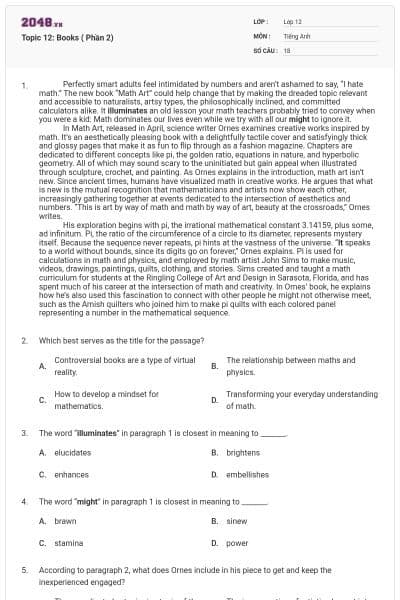
Perfectly smart adults feel intimidated by numbers and aren’t ashamed to say, “I hate math.” The new book “Math Art” could help change that by making the dreaded topic relevant and accessible to naturalists, artsy types, the philosophically inclined, and committed calculators alike. It illuminates an old lesson your math teachers probably tried to convey when you were a kid: Math dominates our lives even while we try with all our might to ignore it.
In Math Art, released in April, science writer Ornes examines creative works inspired by math. It’s an aesthetically pleasing book with a delightfully tactile cover and satisfyingly thick and glossy pages that make it as fun to flip through as a fashion magazine. Chapters are dedicated to different concepts like pi, the golden ratio, equations in nature, and hyperbolic geometry. All of which may sound scary to the uninitiated but gain appeal when illustrated through sculpture, crochet, and painting. As Ornes explains in the introduction, math art isn’t new. Since ancient times, humans have visualized math in creative works. He argues that what is new is the mutual recognition that mathematicians and artists now show each other, increasingly gathering together at events dedicated to the intersection of aesthetics and numbers. “This is art by way of math and math by way of art, beauty at the crossroads,” Ornes writes.
His exploration begins with pi, the irrational mathematical constant 3.14159, plus some, ad infinitum. Pi, the ratio of the circumference of a circle to its diameter, represents mystery itself. Because the sequence never repeats, pi hints at the vastness of the universe. “It speaks to a world without bounds, since its digits go on forever,” Ornes explains. Pi is used for calculations in math and physics, and employed by math artist John Sims to make music, videos, drawings, paintings, quilts, clothing, and stories. Sims created and taught a math curriculum for students at the Ringling College of Art and Design in Sarasota, Florida, and has spent much of his career at the intersection of math and creativity. In Ornes’ book, he explains how he’s also used this fascination to connect with other people he might not otherwise meet, such as the Amish quilters who joined him to make pi quilts with each colored panel representing a number in the mathematical sequence.
Which best serves as the title for the passage?
Controversial books are a type of virtual reality.
The relationship between maths and physics.
How to develop a mindset for mathematics.
Transforming your everyday understanding of math.
Đáp án D
Câu nào sau đây thích hợp nhất làm tiêu đề cho đoạn văn?
A. Sách gây tranh cãi là một loại thực tế ảo
B. Mối quan hệ giữa toán học và vật lý
C. Làm thế nào để phát triển một tư duy cho toán học
D. Sự chuyển đổi của sự hiểu biết hàng ngày của bạn về toán học
Căn cứ vào thông tin đoạn đầu:
Perfectly smart adults feel intimidated by numbers and aren’t ashamed to say, “I hate math.” The new book “Math Art” could help change that by making the dreaded topic relevant and accessible to naturalists, artsy types, the philosophically inclined, and committed calculators alike.
(Những người trưởng thành thông minh cảm thấy bị đe dọa bởi những con số và bị xấu hổ khi nói: “Tôi ghét toán học.” Cuốn sách “nghệ thuật toán học” mới có thể giúp thay đổi điều đó bằng cách làm cho chủ đề đáng sợ trở nên phù hợp và dễ tiếp cận cho đến những người theo chủ nghĩa tự nhiên, những kiểu nghệ thuật, những người có khuynh hướng triết học và những người tính toán tận tâm như nhau.)
=> Như vậy, đoạn văn đang nói đến sự chuyển đổi của sự hiểu biết hàng ngày của bạn về toán học.
The word “illuminates” in paragraph 1 is closest in meaning to _______.
elucidates
brightens
enhances
embellishes
Đáp án A
Từ “illuminates” trong đoạn 1 có nghĩa gần nhất với ___________.
A. làm sáng tỏ
B. sáng
C. tăng cường
D. tôn tạo
Từ đồng nghĩa illuminate (làm rõ) = elucidate
It illuminates an old lesson your math teachers probably tried to convey when you were a kid:
(Nó làm rõ một bài học trước đây mà các giáo viên toán của bạn có thể đã cố gắng truyền đạt khi bạn còn là một đứa trẻ:)
The word “might” in paragraph 1 is closest in meaning to _______.
brawn
sinew
stamina
power
Đáp án D
Từ “might” trong đoạn 1 có nghĩa gần nhất với_________ .
A. cơ bắp
B. gân guốc
C. sức chịu đựng
D. sức mạnh
Từ đồng nghĩa might (sức mạnh) = power
Math dominates our lives even while we try with all our might to ignore it.
(Toán học thống trị cuộc sống của chúng ta ngay cả khi chúng ta cố gắng hết sức để phớt lờ nó.)
According to paragraph 2, what does Ornes include in his piece to get and keep the inexperienced engaged?
The complicated yet gripping topic of the golden ratio.
The incorporation of artistic element into examples.
His unusual way of interpretation of math conjectures.
His prominence from previous works and researches.
Đáp án B
Theo đoạn 2, Ornes bao gồm những gì trong tác phẩm của mình để khiến và giữ cho những người thiếu kinh nghiệm hứng thú?
A. Chủ đề phức tạp nhưng hấp dẫn của tỷ lệ vàng
B. Sự kết hợp của yếu tố nghệ thuật vào các ví dụ
C. Cách giải thích khác thường của ông về phỏng đoán toán học
D. Sự nổi bật của ông từ các công trình và nghiên cứu trước đây
Căn cứ vào thông tin đoạn hai:
All of which may sound scary to the uninitiated but gain appeal when illustrated through sculpture, crochet, and painting.
(Tất cả trong số đó có thể nghe có vẻ đáng sợ với những người không thạo nhưng có được sự hấp dẫn khi được minh họa thông qua đường nét, sự đan móc và bức vẽ.)
The word “It” in paragraph 3 refers to _____.
Ratio
Universe
Diameter
Pi
Đáp án D
Từ “it” trong đoạn 3 đề cập đến .
A. Tỷ lệ
B. Vũ trụ
C. Đường kính
D. Pi
Từ “it” ở đây dùng để thay thế cho danh từ số pi được nhắc tới trước đó.
Because the sequence never repeats, pi hints at the vastness of the universe. "It speaks to a world without bounds, since its digits go on forever."
(Bởi vì trình tự không bao giờ lặp lại, số pi gợi ý về sự rộng lớn của vũ trụ. “Nó nói về một thế giới không có giới hạn, vì các chữ số của nó cứ kéo dài mãi mãi.”)
According to paragraph 3, what is NOT stated by the author about the Pi number?
Pi number is defined as the ratio of a circle’s circumference to its diameter.
Not only in mathematics field, Pi number also has its place in the physics world.
We devise the concept of Pi number as a way to respond to external stimuli.
Its decimal representation never ends and never settles into a permanently repeating pattern.
Đáp án C
Theo đoạn 3, tác giả không nêu gì về số Pi?
A. Số Pi được định nghĩa là tỷ lệ chu vi của đường tròn với đường kính của nó
B. Không chỉ trong lĩnh vực toán học, số Pi cũng có chỗ đứng trong thế giới vật lý
C. Chúng tôi nghĩ ra khái niệm số Pi như một cách để đáp ứng với các kích thích bên ngoài
D. Biểu diễn thập phân của nó không bao giờ kết thúc và không phải một mô hình lặp lại
Căn cứ vào thông tin đoạn ba:
Pi, the ratio of the circumference of a circle to its diameter, represents mystery itself. Because the sequence never repeats, pi hints at the vastness of the universe. "It speaks to a world without bounds, since its digits go on forever,"
(Pi, tỷ lệ chu vi của một vòng tròn so với đường kính của nó, đại diện cho bí ẩn của bản thân nó. Bởi vì trình tự không bao giờ lặp lại, số pi gợi ý về sự rộng lớn của vũ trụ. “Nó nói về một thế giới không có giới hạn, vì các chữ số của nó cứ kéo dài mãi mãi”)
Pi is used for calculations in math and physics, (Pi được sử dụng để tính toán trong toán học và vật lý,)
The following statements are true, EXCEPT_______.
Sims is a math professor the Ringling College of Art and Design in Sarasota, Florida.
Ornes’ book received tremendous attention due to him being former Fields medalist.
Math is a subject that most people will flinch from despite its prevalence in daily life.
Amish women collaborated with Ornes to produce a quilt coded with Pi number.
Đáp án B
Các tuyên bố sau đây là đúng, ngoại trừ____________.
A. Sims là giáo sư toán học của trường cao đẳng nghệ thuật và thiết kế Ringling ở Sarasota, Florida
B. Cuốn sách của Ornes, nhận được sự chú ý rất lớn do ông là nhà cựu huy chương của trường
C. Toán học là một môn học mà hầu hết mọi người sẽ nao núng mặc dù nó phổ biến trong cuộc sống hàng ngày
D. Phụ nữ Amish hợp tác với Ornes để sản xuất một chiếc chăn có mã số Pi
Căn cứ vào thông tin các đoạn:
Sims created and taught a math curriculum for students at the Ringling College of Art and Design in Sarasota,
(Sims đã tạo ra và dạy một chương trình toán cho học sinh tại trường cao đẳng nghệ thuật và thiết kế Ringling ở Sarasota,)
In Ornes’ book, he explains how he’s also used this fascination to connect with other people he might not otherwise meet, such as the Amish quilters who joined him to make pi quilts with each colored panel representing a number in the mathematical sequence.
(Trong cuốn sách của Ornes, anh ấy giải thích cách anh ấy sử dụng niềm đam mê này để kết nối với những người khác, mà anh ta có thể không gặp, chẳng hạn như những người làm chăn Amish, người đã tham gia cùng anh ta để tạo ra những chiếc chăn có mã số pi với mỗi bảng màu đại diện cho một số trong chuỗi toán học.)
Math dominates our lives even while we try with all our might to ignore it.
Which of the following can be inferred from the passage?
The new book “Math Art” bespeaks a perfect blending of mathematics and aesthetics.
The book shows that solving problems with numbers is an entry way to philosophical exploration.
Ornes’ book has broken false barriers between two disparate topics of life and death.
A famous mathematician will undoubtedly have a large fanbase of craftsmen.
Đáp án A
Điều nào sau đây có thể được suy ra từ đoạn văn?
A. Cuốn sách “nghệ thuật toán học” mới đã đưa ra một sự pha trộn hoàn hảo giữa toán học và thẩm mỹ
B. Cuốn sách cho thấy việc giải quyết các vấn đề với các con số là một cách để khám phá triết học
C. Cuốn sách của Ornes đã phá vỡ những rào cản sai lầm giữa hai chủ đề khác nhau giữa sự sống và cái chết
D. Một nhà toán học nổi tiếng chắc chắn sẽ có một lượng lớn thợ thủ công
Căn cứ vào thông tin đoạn hai:
In Math Art, released in April, science writer Ornes examines creative works inspired by math. It’s an aesthetically pleasing book with a delightfully tactile cover and satisfyingly thick and glossy pages that make it as fun to flip through as a fashion magazine.
(Trong cuốn sách “nghệ thuật toán học”, phát hành vào tháng 4, nhà văn khoa học Ornes kiểm tra các tác phẩm sáng tạo lấy cảm hứng từ toán học. Nó là một cuốn sách đầy tính thẩm mỹ với phần bìa thú vị và những trang giấy dày và bóng, làm cho nó thú vị để đọc như một tạp chí thời trang.)
Hardcover and paperback are two types of books and bookbinding processes. A hardcover book is also called a hardback or hardbound. On the other hand, a paperback also goes by the names softback and soft cover. Paperbacks can be further classified as trade paperbacks and mass-market paperbacks.
Paperback book, as its name implies, has a soft card or a thick paper cover over the pages. This type of covering is less heavy but prone to folding, bending, and wrinkles with use and over time. Hardcover books are characterized with a thick and rigid covering. This covering allows protection for the pages and makes the book durable and usable for a long time. Oftentimes, a hardcover book has a dust that protects the books from dust and other wear and tear. Some books are even made durable by using leather or calfskin as a book covering.
In terms of manufacturing and purchasing books, hardcover books are more expensive due to the materials and processes. Pages of hardcover books are acid-free paper. This type of paper allows preservation of the ink and is ideal for books in use and preserving them for a long time. On the other hand, paperbacks use cheap paper, usually newsprint. The reason for this is to lower production costs and being readily made available for the masses. The paper in a hardcover book is usually stitched together before being glued, stapled, or sewn to the book’s spine. Due to the stitches, a hardcover book can have signatures, a place where the binding threads are visible. Meanwhile, a paperback book’s pages are glued together and glued again to the spine. This makes the pages loose or separated while being in use.
Hardcover books are often applied to academic books, references books, commercial, and bestsellers that have enjoyed financial success. Other books in the hardcover version are books of collectible value. Publishers often release a hardcover version of the book to show investment so that they can project a high return of investment. This is a large contrast regarding paperbacks. Paperback books are done for new or succeeding editions, reprinting of books or books with little profit margin. Publishers use the paperback editions to stretch the profit for the book. The first release or first edition of a literary work is purposefully done as a hardcover book followed by paperback versions.
What is the main topic of the passage?
Difference between hardcover and paperback.
Why people favour paperback over hardcover.
The biggest dilemma existed for book collectors.
The story behind book manufacturing process.
Đáp án A
Chủ đề chính của đoạn văn là gì?
A. Sự khác biệt giữa bìa cứng và bìa mềm
B. Tại sao mọi người ủng hộ bìa mềm hơn bìa cứng
C. Vấn đề nan giải lớn nhất tồn tại đối với các nhà sưu tập sách
D. Câu chuyện đằng sau quy trình sản xuất sách
Căn cứ vào thông tin đoạn đầu:
Hardcover and paperback are two types of books and bookbinding processes. A hardcover book is also called a hardback or hardbound. On the other hand, a paperback also goes by the names softback and soft cover.
(Bìa cứng và bìa mềm là hai loại sách và quy trình đóng sách. Một cuốn sách bìa cứng cũng được gọi là hardback hoặc hardbound. Mặt khác, một bìa mềm cũng có softback and soft cover.)
Ta thấy đầu bài văn tác giả đề cập đến 2 loại bìa sách, và từ thông tin ở các đoạn sau ta thấy tác giả đang so sánh 2 loại bìa này.a
The word “classified” in paragraph 1 hold the same meaning as _______.
allocated
labelled
categorised
codified
Đáp án C
Từ “classified” trong đoạn 1 có cùng nghĩa với________.
A. phân bổ
B. dán nhãn
C. phân loại
D. mã hóa
Từ đồng nghĩa classify (phân loại) = categorise
Paperbacks can be further classified as trade paperbacks and mass- market paperbacks.
(Bìa mềm có thể được phân loại thêm là bìa mềm thương mại và bìa mềm thị trường đại chúng.)
The word “wrinkles” in paragraph 2 hold the same meaning as _______.
creases
puckers
furrows
ruffles
Đáp án A
Từ “wrinkles” trong đoạn 2 có cùng nghĩa với______.
A. gấp nếp
B. dúm dó
C. luống cày
D. xù lông
Từ đồng nghĩa wrinkle (nhăn) = crease
This type of covering is less heavy but prone to folding, bending, and wrinkles with use and over time. (Loại bìa này ít nặng hơn nhưng dễ bị gấp, uốn và nhăn khi sử dụng và theo thời gian.)
According to paragraph 3, what is the characteristic of paperback?
Paperbacks are open for customisation and are never produced in large quantities.
Their pages are often held together with glue rather than stitches or staples.
One of the major advantages of paperback book over hardcover is its durability.
Paperbacks are made with high-grade materials to preserve the paper from damage.
Đáp án B
Theo đoạn 3, đặc điểm của bìa mềm là gì?
A. Bìa mềm được mở để tùy biến và không bao giờ được sản xuất với số lượng lớn
B. Các trang của họ thường được giữ bằng keo chứ không phải là khâu hoặc ghim
C. Một trong những ưu điểm chính của sách bìa mềm so với bìa cứng là độ bền của nó
D. Bìa mềm được làm bằng vật liệu cao cấp để bảo quản giấy khỏi bị hư hại
Căn cứ vào thông tin đoạn ba:
Meanwhile, a paperback book’s pages are glued together and glued again to the spine. This makes the pages loose or separated while being in use.
(Trong khi đó, các trang sách của một cuốn sách bìa mềm được dán lại với nhau và dán vào gáy. Điều này làm cho các trang dễ bị lỏng hoặc tách ra trong khi sử dụng.)
According to paragraph 4, which category of book sis NOT typically published as hardcover?
Bestsellers by famous authors.
References books.
Academic books.
Comic books from Japan.
Đáp án D
Theo đoạn 4, loại sách nào thường không được xuất bản dưới dạng bìa cứng?
A. Sách bán chạy nhất của các tác giả nổi tiếng
B. Sách tham khảo
C. Sách học thuật
D. Truyện tranh từ Nhật Bản
Căn cứ vào thông tin đoạn bốn:
Hardcover books are often applied to academic books, references books, commercial, and bestsellers that have enjoyed financial success.
(Sách bìa cứng thường được áp dụng cho sách học thuật, sách tham khảo, sách thương mại và sách bán chạy nhất đã đạt được thành công về tài chính.)
The word “they” in paragraph 4 refers to _____.
books
publishers
bestsellers
editions
Đáp án B
Từ “they” trong đoạn 4 đề cập đến_______ .
A. sách
B. nhà xuất bản
C. sách bán chạy nhất
D. phiên bản
Từ “they” ở đây dùng để thay thế cho danh từ nhà xuất bản được nhắc tới trước đó.
Publishers often release a hardcover version of the book to show investment so that they can project a high return of investment.
(Các nhà xuất bản thường phát hành phiên bản bìa cứng của cuốn sách để chỉ ra sự đầu tư để họ có thể dự kiến lợi tức đầu tư cao.)
The following statements are true, EXCEPT ________.
Releasing hardcover versions of highly anticipated books before paperback ones is not a marketing tactic.
Hardcover books’ collectability is one of the reasons for their value besides their beauty and durability.
Hardcover books have a hard and thick protective cover and that is why they are termed as hardcover.
A lot of work goes into making a hardback so they tend to be more expensive than paperback ones.
Đáp án A
Các câu sau đây là đúng, ngoại trừ ________ .
A. Phát hành phiên bản bìa cứng của những cuốn sách rất được mong đợi trước những cuốn sách bìa mềm không phải là một chiến thuật tiếp thị
B. Khả năng thu thập của sách bìa cứng là một trong những lý do cho giá trị của chúng bên cạnh vẻ đẹp và độ bền
C. Sách bìa cứng có bìa bảo vệ cứng và dày và đó là lý do tại sao chúng được gọi là bìa cứng
D. Rất nhiều việc cần làm để tạo ra một bìa cứng để chúng có xu hướng đắt hơn so với bìa mềm
Căn cứ vào thông tin các đoạn:
Hardcover books are characterized with a thick and rigid covering.
(Sách bìa cứng được đặc trưng với một lớp bao phủ dày và cứng.)
In terms of manufacturing and purchasing books, hardcover books are more expensive due to the materials and processes. Pages of hardcover books are acid-free paper. This type of paper allows preservation of the ink and is ideal for books in use and preserving them for a long time.
(Về mặt sản xuất và mua sách, sách bìa cứng đắt hơn do vật liệu và quy trình. Các trang sách bìa cứng là giấy chống axit. Loại giấy này cho phép bảo quản mực và rất lý tưởng cho sách để sử dụng và bảo quản chúng trong một thời gian dài.)
What is the overall tone of the passage?
Biased
Vitrolic
Informative
Speculative
Đáp án C
Giọng điệu tổng thể của đoạn văn là gì?
A. Thiên vị
B. Cay độc
C. Cung cấp nhiều thông tin
D. Tự biện
Căn cứ vào thông tin toàn đoạn văn, ta thấy đoạn văn đang cung cấp cho ta rất nhiều thông tin về sách bìa mềm và sách bìa cứng. Nên ta suy ra, giọng điệu của đoạn văn là cung cấp thông tin.
Bạn có thích hoạt động này không?