Đề thi Tiếng anh mới 9 Giữa kì 1 có đáp án (Đề 4)
39 câu hỏi
From each number, pick out the word whose underlined part is pronounced differently from the others. (1.0m)
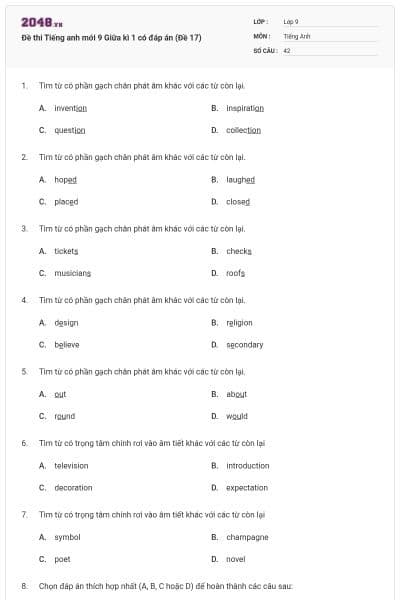
out
round
about
would
Đáp án D
Giải thích: đáp án D phát âm là /ʊ/, còn lại là /aʊ/
From each number, pick out the word whose underlined part is pronounced differently from the others.
chair
check
machine
child
Đáp án C
Giải thích: đáp án C phát âm là /ʃ/, còn lại là /tʃ/
From each number, pick out the word whose underlined part is pronounced differently from the others.
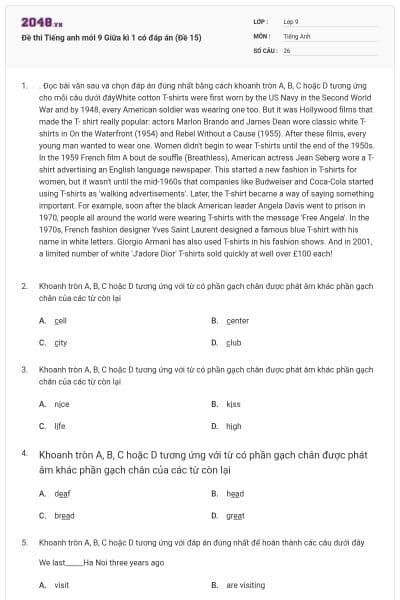
too
soon
good
food
Đáp án C
Giải thích: đáp án C phát âm là /u/ còn lại là /u:/
From each number, pick out the word whose underlined part is pronounced differently from the others.
though
enough
cough
rough
Đáp án A
Giải thích: đáp án A là âm câm, còn lại là âm /f/
From each number, pick out the word whose underlined part is pronounced differently from the others.
happy
hour
high
hotel
Đáp án B
Giải thích: đáp án B là âm câm, còn lại là âm /h/
Choose the correct option A,B,C or D to complete the sentences. (2.0ms)
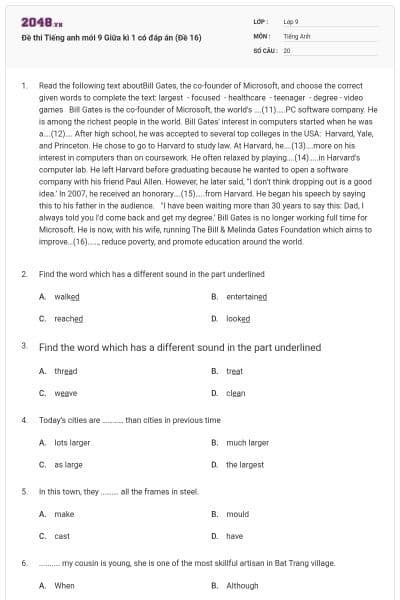
I have no idea what ……………….. the traditional drums.
to buy
buy
bought
buys
Đáp án A
Giải thích: what to V: cái để làm gì
Dịch: Tôi không biết cái để mua trống truyền thống.
Minh’s father often takes him ………………. the park every summer.
on
to
in
after
Đáp án B
Giải thích: take sb to st: đưa ai đi đâu
Dịch: Bố Minh thường đưa anh ấy tới công viên mỗi mùa hè.
A: I won the first prize in the English speaking contest. - B: ..................
Stay calm. Everything will be alright!
Congratulation!
If I were you I would get some sleep.
I understand how you feel.
Đáp án B
Dịch:
A: Tớ thắng giải nhất của cuộc thi nói tiếng anh rồi.
B: Chúc mừng cậu nha!
My father gave up smoking two years ago.
liked
continued
stopped
enjoyed
Đáp án: C
Giải thích:
Kiến thức: Cụm động từ - Từ đồng nghĩa
give up (phr.v): từ bỏ
Xét các đáp án:
A. like (v): thích
B. continue (v): tiếp tục
C. stop (v): dừng lại
D. enjoy (v): thích
→ gave up = stopped
Dịch: Bố tôi đã bỏ thuốc lá cách đây hai năm.
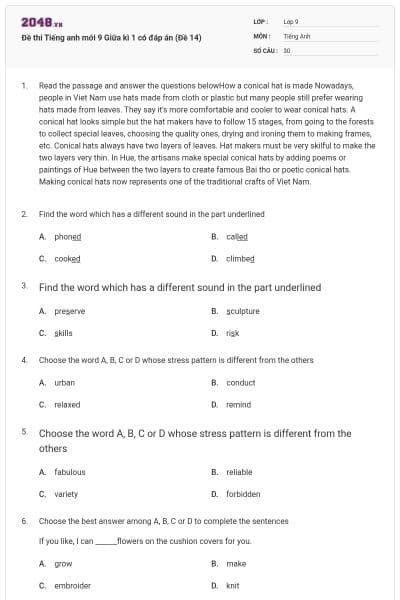
....................... my cousin is young, she is one of the most skillful artisan in Bat Trang village.
When
Although
Whereas
In order to
Đáp án A
Giải thích:
- when: khi
- although: mặc dù
- whereas: trong khi đấy
- in order to: để nhằm mục đích
Dịch: Khi chị/em họ của tôi còn trẻ, cô ấy từng là một trong những thợ thủ công khéo léo nhất làng Bát Tràng.
The amusement centre is so small that they cannot ................... the demand of the local residents.
keep up with
face up to
deal about
set up
Đáp án A
Giải thích: keep up with: bắt kịp với
Dịch: Trung tâm giải trí thì quá nhỏ đến nỗi mà nó không thể bắt kịp được với nhu cầu của cư dân địa phương.
Karachi is ...................... city in the world population.
the two largest
the two larger
the second largest
the second larger
Đáp án C
Giải thích: the second largest: lớn thứ 2
Dịch: Karachi là thành phố lớn thứ hai trên dân số thế giới.
He wondered ....................... his parents what he really thought.
whether he tell
whether tell
whether to tell
whether telling
Đáp án C
Giải thích: wonder whether to V: tự hỏi liệu có nên làm gì
Dịch: Anh ấy tự hỏi liệu có nên nói với bố mẹ anh ấy cái mà anh thực sự nghĩ.
My parents once took me to Bat Trang village. I could make my own ...................... there. I really enjoyed it.
pottery
lacquer
painting
sculpture
Đáp án A
Giải thích:
- pottery: đồ gốm
- lacquer: sơn mài
- painting: vẽ
- sculpture: điêu khắc
Dịch: Bố mẹ tôi từng một lần đưa tôi tới làng Bát Tràng. Tôi có thể tự tạo đồ gốm ở đó. Tôi thực sự rất thích nó.
...................... he’s spent a lot of money to decorate his shop, he cannot make any more profit.
In order to
Although
So that
Because of
Đáp án B
Giải thích:
- In order to: để nhằm mục đích
- Although: mặc dù
- So that: để mà
- Because of: bởi vì
Dịch: Mặc dù anh ấy dành rất nhiều tiền vào việc trang trí quán, nhưng anh ấy không tạo được bất kì lợi nhuận nào cả.
Give the correct form of the verbs.
My brother often (go) ……………….. to school by bike every day.
Đáp án: goes
Giải thích: dùng thì hiện tại đơn (vì có “every day”) và chủ ngữ số ít
Dịch: Anh/em trai tôi thường đi xe đạp đến trường hàng ngày.
If we use water carefully, more people (have ) ……………….. fresh water.
Đáp án: will have
Giải thích: Câu điều kiện loại 1: If+mệnh đề ở hiện tại, S+will…+Vinf
Dịch: Nếu chúng ta sử dụng nước một cách cẩn thận thì nhiều người hơn sẽ có nước sạch.
My father enjoys (watch) ……………….. television in the evenings.
Đáp án: watching
Giải thích: enjoy Ving: thích làm gì
Dịch: Bố tôi thích xem ti vi vào buổi tối.
Tuan and Huong (not/go) ……………….. to the cinema last night.
Đáp án: didn’t go
Giải thích: last night =>chia thì Quá khứ đơn
Dịch: Tuấn và Hương không tới rạp chiếu phim đêm qua.
She said to me she (will) ……………….. do it if necessary.”
Đáp án: would
Giải thích: dạng gián tiếp lùi 1 thì
Dịch: Cô ấy nói với tôi rằng cô sẽ làm nó nếu cần thiết.
Bat Trang pottery (develop) ………………….. since the 7th century
Đáp án: has developed
Giải thích: mệnh đề trước since chia thì hiện tại hoàn thành
Dịch: Gốm Bát Tràng phát triền từ thế kỉ thứ 7.
Lots of Vietnamese girls like (wear) ………….…….. conical hats and ao dai.
Đáp án: wearingGiải thích: like Ving: thích làm gì
Dịch: Nhiều cô gái Việt Nam thích đội nón và mặc áo dài.
The children (play) ……………….. football at the moment.
Đáp án: are playing
Giải thích: at the moment =>thì hiện tại tiếp diễn
Dịch: Lũ trẻ đang chơi đá bóng.
When I (come) ……………….. home from work yesterday, my mother was cooking dinner.
Đáp án: came
Giải thích: một hành động đang xảy ra trong quá khứ thì 1 hành động khác xen vào, hành động đang xảy ra chia thì Quá khứ tiếp diễn, hành động xen vào chia Quá khứ đơn
Dịch: Khi tôi về nhà từ chỗ làm hôm qua thì mẹ tôi đang nấu bữa tối.
I don’ know many English words. I wish I (know) ……………….. more English words.
Đáp án: knew
Giải thích: câu ước ở hiện tại lùi 1 thì về quá khứ đơn
Dịch: Tôi không biết nhiều từ tiếng Anh lắm. Tôi ước là tôi biết nhiều từ hơn.
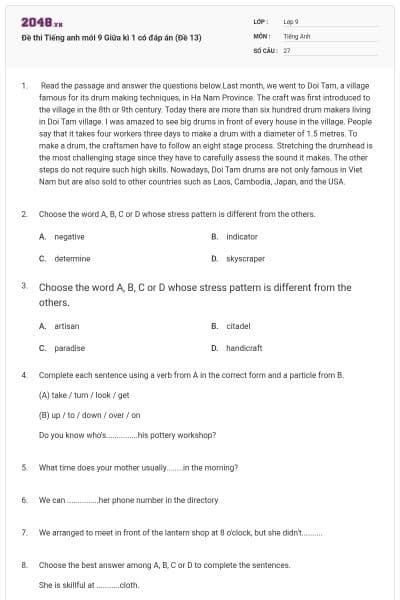
* Answer the questions:
When was the craft first introduced to the village?
.......................................................................................................
Đáp án: It was first introduced to the village in the 8th or 9th century.
Giải thích: Dựa vào câu “The craft was first introduced to the village in the 8th or 9th century”
Dịch: Nó lần đầu tiên được ra mắt với làng vào thế kỉ 8 hoặc 9.
How many stages do the craftsmen have to follow to make a drum?
.......................................................................................................
Đáp án: There are eight stages.
Giải thích: Dựa vào câu “To make a drum, the craftsmen have to follow an eight stage process.”
Dịch: Để làm một cái trống, những người thợ thủ công phải tuân thủ quá trình 8 giai đoạn.
Are Doi Tam drums sold to Japan, and the USA?
.......................................................................................................
Đáp án: Yes, they are.
Giải thích: Dựa vào câu “Nowadays, Doi Tam drums are not only famous in Viet Nam but are also sold to other countries such as Laos, Cambodia, Japan, and the USA.”
Dịch: Ngày nay, trống Đồi Tâm không chỉ nổi tiếng ở Việt Nam mà nó còn được bán ở những nước khác như Lào, Campuchia, Nhật và Mỹ.
Where is Doi Tam village?
.......................................................................................................
Đáp án: It’s in Ha Nam.
Giải thích: Dựa vào câu “Last month, we went to Doi Tam, a village famous for its drum making techniques, in Ha Nam Province.”
Dịch: Tháng trước chúng tôi đến Đồi Tâm, một ngôi làng nổi tiếng vì kĩ thuật làm trống ở tỉnh Hà Nam.
Read the following passage and circle the letter A, B, C or D to indicate the correct word (1.0m)
My village is (1)……… Hoa Binh Province. It is a very beautiful and (2)………… place where people (3)…………… flowers and vegetables only. It is very famous for its pretty roses and picturesque scenery. The air is quite fresh; however, the smell of roses makes people feel cool. In spring, my village looks like a carpet with plenty of (4) ………. Tourists come to visit it so often. Nowadays, with electricity and labor-saving devices, it doesn’t take the villagers (5)…………. time to water the roses. And even at night, People can walk along the path and enjoy the fresh smell of the flowers.
My village is (1)……… Hoa Binh Province.
on
for
in
at
Đáp án C
Giải thích: in+tỉnh
Dịch: Làng tôi ở tỉnh Hòa Bình.
It is a very beautiful and (2)………… place
peace
peaceful
peacefully
quite
Đáp án B
Giải thích: chỗ trống ở đây cần một tính từ, các từ còn lại là danh từ, trạng từ
Dịch: Nó là một nơi đẹp và yên bình.
where people (3)…………… flowers and vegetables only.
grow
buy
grew
bought
Đáp án A
Giải thích: grow: trồng
Dịch: Nó là một nơi đẹp và yên bình nơi mà con người chỉ trồng rau và hoa.
In spring, my village looks like a carpet with plenty of (4) ……….
colors
marks
spots
styles
Đáp án A
Giải thích: colors: những màu sắc
Dịch: Vào mùa xuân, làng tôi như một tấm thảm với nhiều màu sắc.
Nowadays, with electricity and labor-saving devices, it doesn’t take the villagers (5)…………. time to water the roses.
many
a few
a lot
much
Đáp án D
Giải thích:
- many: nhiều (đi với danh từ đếm được)
- a few: một vài (đi với danh từ đếm được)
- a lot (of): nhiều (đi với cả danh từ đếm được và không đếm)
- much: nhiều (đi với danh từ không đếm được)
Dịch: Ngày nay với những thiết bị điện và tiết kiệm lao đông, nó không làm cho dân làng phải mất nhiều thời gian để tưới hoa hồng nữa.
Rewrite the following sentences without changing their original meanings. (2ms)
I have no idea when I should take that English test. TO
→ I have ........................................................................................
Đáp án: I have no idea when to take that English test.
Giải thích: when to V: khi nào để lam gì
Dịch: Tôi không biết khi nào nên làm bài kiểm tra tiếng anh đấy.
Do you try calling a helpline?” the teacher asked Ngoc. IF
→ The teacher asked Ngoc ……………………………………………………
Đáp án: The teacher asked Ngoc if she could try calling a helpline?
Giải thích: S+asked+sb+if/whether+mệnh đề lùi 1 thì
Dịch: Giáo viên hỏi Ngọc có thể gọi cho tổng đài giúp đỡ được không.
His parents raised him very strictly. UP
→ His parents ………………………………………………………………….
Đáp án: His parents brought him up very strictly.
Giải thích: bring up = raise: nuôi dưỡng
Dịch: Bố mẹ anh ấy đã nuôi anh ấy rất nghiêm khắc.
Should I tell this to her?” he asked himself. WHETHER
→ He wondered ………………………………………………………………
Đáp án: He wondered whether to tell this to her.
Giải thích: wonder whether to V: phân vân làm gì
Dịch: Anh ấy phân vân liệu có nên nói điều này cho cô ấy không.
It’s the first time Mary has gone to Viet Nam. BEFORE
->Mary has …………………………………………………………………….
Đáp án: Mary has never gone to Viet Nam before.
Dịch: Mary chưa từng đến Việt Nam trước đó.
Bạn có thích hoạt động này không?