Đề kiểm tra Giới hạn của hàm số lớp 11 (có lời giải) - Đề 1
22 câu hỏi
\(5\).
\(2\).
\( - 6\).
\(3\).
Ta có \(\mathop {\lim }\limits_{x \to {x_0}} \left[ {3f\left( x \right) - 4g\left( x \right)} \right]\)\( = \mathop {\lim }\limits_{x \to {x_0}} 3f\left( x \right) - \mathop {\lim }\limits_{x \to {x_0}} 4g\left( x \right)\)\( = 3\mathop {\lim }\limits_{x \to {x_0}} f\left( x \right) - 4\mathop {\lim }\limits_{x \to {x_0}} g\left( x \right)\)\( = - 6\).
\[2\].
\[1\].
\[ + \infty \].
\[0\].
Chọn D
Ta có: \[\mathop {\lim }\limits_{x \to 1} \left( {2{x^2} - 3x + 1} \right) = 0\].
\(L = - \infty \).
\(L = 0\).
\(L = + \infty \).
\(L = 1\).
Chọn B
Ta có \(L = \mathop {\lim }\limits_{x \to 3} \frac{{x - 3}}{{x + 3}}\)\( = \frac{{3 - 3}}{{3 + 3}} = 0\).
\( + \infty \).
\(2\).
\(1\).
\(3\).
Chọn B
\(\mathop {\lim }\limits_{x \to 1} \left( {3{x^2} - 2x + 1} \right) = {3.1^2} - 2.1 + 1 = 2.\)
\[5\].
\[9\].
\[0\].
\[7\].
Chọn B
Ta có \(\mathop {\lim }\limits_{x \to - 1} \left( {{x^2} - x + 7} \right)\)\[ = {\left( { - 1} \right)^2} - \left( { - 1} \right) + 7 = 9\].
\(\frac{1}{3}\).
\(\frac{1}{7}\).
\(7\).
\(3\).
Chọn D
Ta có \(\mathop {\lim }\limits_{x \to - 2} \frac{{2\left| {x + 1} \right| - 5\sqrt {{x^2} - 3} }}{{2x + 3}} = \frac{{2 - 5}}{{ - 1}} = 3\).
\(\mathop {\lim }\limits_{x \to 1} \frac{{x - 3}}{{{{\left( {x - 1} \right)}^2}}}\)
\(\mathop {\lim }\limits_{x \to 1} \frac{{x - 2}}{{{{\left( {x - 1} \right)}^2}}}\)
\(\mathop {\lim }\limits_{x \to 1} \frac{{ - x - 1}}{{{{\left( {x - 1} \right)}^2}}}\)
\(\mathop {\lim }\limits_{x \to 1} \frac{{x + 1}}{{{{\left( {x - 1} \right)}^2}}}\)
Chọn D
Ta có \({\left( {x - 1} \right)^2} \ge 0,\,\forall x \ne 1\)
Do đó để giới hạn bằng \( + \infty \) thì giới hạn của tử phải dương
Vậy \(\mathop {\lim }\limits_{x \to 1} \frac{{x + 1}}{{{{\left( {x - 1} \right)}^2}}} = + \infty .\)
A không tồn tại.
\(A = 1725\).
\(A = 1527\).
\(A = 1275\).
Có: \(\mathop {\lim }\limits_{x \to 1} f\left( x \right) = \mathop {\lim }\limits_{x \to 1} \frac{{x + {x^2} + {x^3} + ... + {x^{50}} - 50}}{{x - 1}}\) \( = \mathop {\lim }\limits_{x \to 1} \left[ {1 + \left( {x + 1} \right) + \left( {{x^2} + x + 1} \right) + .... + \left( {{x^{49}} + {x^{48}} + ... + 1} \right)} \right]\)
\( = 1 + 2 + 3 + ..... + 50 = 25\left( {1 + 50} \right) = 1275.\)
Vậy \(\mathop {\lim }\limits_{x \to 1} f\left( x \right) = 1275\).
\[\mathop {\lim }\limits_{x \to + \infty } \frac{{ - 3x + 4}}{{x - 2}}\].
\[\mathop {\lim }\limits_{x \to {2^ - }} \frac{{ - 3x + 4}}{{x - 2}}\].
\[\mathop {\lim }\limits_{x \to {2^ + }} \frac{{ - 3x + 4}}{{x - 2}}\].
\[\mathop {\lim }\limits_{x \to - \infty } \frac{{ - 3x + 4}}{{x - 2}}\].
Chọn C
Dễ thấy \[\mathop {\lim }\limits_{x \to + \infty } \frac{{ - 3x + 4}}{{x - 2}} = - 3\]; \[\mathop {\lim }\limits_{x \to - \infty } \frac{{ - 3x + 4}}{{x - 2}} = - 3\] (loại).
Vì \[\mathop {\lim }\limits_{x \to {2^ + }} \left( { - 3x + 4} \right) = - 2;\;\mathop {\lim }\limits_{x \to {2^ + }} \left( {x - 2} \right) = 0;\;x - 2 > 0,\forall x > 2\]nên \[\mathop {\lim }\limits_{x \to {2^ + }} \frac{{ - 3x + 4}}{{x - 2}} = - \infty \]

Học thông minh hơn mỗi ngày
Xem toàn bộ 22 câu hỏi và nhiều hơn nữa với tài khoản miễn phí
\( + \infty \).
\( - \infty \).
\(\frac{2}{3}\).
\(\frac{1}{3}\).
Chọn B
\(\left\{ \begin{array}{l}\mathop {\lim }\limits_{x \to {1^ + }} \left( { - 2x + 1} \right) = - 1\\\mathop {\lim }\limits_{x \to {1^ + }} \left( {x - 1} \right) = 0\\x \to {1^ + } \Rightarrow x - 1 > 0\end{array} \right. \Rightarrow \mathop {\lim }\limits_{x \to {1^ + }} \frac{{ - 2x + 1}}{{x - 1}} = - \infty \)
\(\mathop {\lim }\limits_{x \to - \infty } \left( {\sqrt {{x^2} - x + 1} + x - 2} \right) = - \frac{3}{2}\).
\(\mathop {\lim }\limits_{x \to - {1^ - }} \frac{{3x + 2}}{{x + 1}} = - \infty \).
\(\mathop {\lim }\limits_{x \to + \infty } \left( {\sqrt {{x^2} - x + 1} + x - 2} \right) = + \infty \).
\(\mathop {\lim }\limits_{x \to - {1^ + }} \frac{{3x + 2}}{{x + 1}} = - \infty \).
Ta có: \(\mathop {\lim }\limits_{x \to - \infty } \left( {\sqrt {{x^2} - x + 1} + x - 2} \right)\)\( = \mathop {\lim }\limits_{x \to - \infty } \frac{{{x^2} - x + 1 - {{\left( {x - 2} \right)}^2}}}{{\sqrt {{x^2} - x + 1} - \left( {x - 2} \right)}}\)\( = \mathop {\lim }\limits_{x \to - \infty } \frac{{3x - 3}}{{\sqrt {{x^2} - x + 1} - x + 2}}\)\( = \mathop {\lim }\limits_{x \to - \infty } \frac{{3 - \frac{3}{x}}}{{ - \sqrt {1 - \frac{1}{x} + \frac{1}{{{x^2}}}} - 1 + \frac{2}{x}}}\)\( = - \frac{3}{2}\)\( \Rightarrow \) đáp án A đúng.
\[\mathop {\lim }\limits_{x \to + \infty } \left( {\sqrt {{x^2} - x + 1} + x - 2} \right) = \mathop {\lim }\limits_{x \to + \infty } x\left( {\sqrt {1 - \frac{1}{x} + \frac{1}{{{x^2}}}} + 1 - \frac{2}{x}} \right)\].
Do \(\mathop {\lim }\limits_{x \to + \infty } x = + \infty \) và \(\mathop {\lim }\limits_{x \to + \infty } \left( {\sqrt {1 - \frac{1}{x} + \frac{1}{{{x^2}}}} + 1 - \frac{2}{x}} \right) = 2 > 0\) nên \[\mathop {\lim }\limits_{x \to + \infty } x\left( {\sqrt {1 - \frac{1}{x} + \frac{1}{{{x^2}}}} + 1 - \frac{2}{x}} \right) = + \infty \]\( \Rightarrow \) đáp án C đúng.
Do \(\mathop {\lim }\limits_{x \to - {1^ - }} \left( {3x + 2} \right) = - 1 < 0\) và \(x + 1 < 0\) với \(\forall x < - 1\) nên \(\mathop {\lim }\limits_{x \to - {1^ - }} \frac{{3x + 2}}{{x + 1}} = + \infty \)\( \Rightarrow \) đáp án B sai.
Do \(\mathop {\lim }\limits_{x \to - {1^ + }} \left( {3x + 2} \right) = - 1 < 0\) và \(x + 1 > 0\) với \(\forall x > - 1\) nên \(\mathop {\lim }\limits_{x \to - {1^ - }} \frac{{3x + 2}}{{x + 1}} = - \infty \)\( \Rightarrow \) đáp án D đúng.
8.
4.
24.
12.
Chọn D
Do hàm số \(f\left( x \right)\) có giới hạn hữu hạn khi \(x\) dần tới \( - 2\) nên \(x = - 2\) là nghiệm của phương trình \({x^2} + ax + b = 0\), do đó ta \(4 - 2a + b = 0\).
Ta viết lại hàm số \(f\left( x \right) = \left\{ \begin{array}{l}\frac{{x - 2 + a}}{{x - 2}},x < - 2\\x + 1,x \ge - 2\end{array} \right.\)
Mặt khác hàm số tồn tại giới hạn
\[ \Leftrightarrow \mathop {\lim }\limits_{x \to - {2^ - }} f\left( x \right) = \mathop {\lim }\limits_{x \to - {2^ + }} f\left( 2 \right) \Leftrightarrow \frac{{ - 2 - 2 + a}}{{ - 2 - 2}} = - 1 \Leftrightarrow a = 8 \Rightarrow b = 12\]
Do đó \(3a - b = 12\).
|
a) Đúng |
b) Sai |
c) Sai |
d) Sai |
Vì \(\mathop {\lim }\limits_{x \to - \infty } \frac{{\sqrt {{x^4} - x} }}{{1 - 2x}} = \mathop {\lim }\limits_{x \to - \infty } \frac{{ - x.\sqrt {{x^2} - \frac{1}{x}} }}{{x\left( {\frac{1}{x} - 2x} \right)}} = \mathop {\lim }\limits_{x \to - \infty } \frac{{\sqrt {{x^2} - \frac{1}{x}} }}{{\frac{1}{x} - 2x}} = + \infty \). Vậy A đúng.
|
a) Đúng |
b) Sai |
c) Đúng |
d) Sai |
a) Ta có: \(\mathop {\lim }\limits_{x \to - 2} \left( {{x^2} - x + 3} \right) = {( - 2)^2} - ( - 2) + 3 = 9\).
b) Ta có: \(\mathop {\lim }\limits_{x \to 6} \sqrt {\frac{1}{{x + 3}}} = \sqrt {\frac{1}{{6 + 3}}} = \frac{1}{3}\).
c) Ta có: \(\mathop {\lim }\limits_{x \to 2} \frac{{{x^2} - 3x + 2}}{{x - 2}} = \mathop {\lim }\limits_{x \to 2} \frac{{(x - 2)(x - 1)}}{{x - 2}} = \mathop {\lim }\limits_{x \to 2} (x - 1) = 2 - 1 = 1\).
d) Ta có: \(\mathop {\lim }\limits_{x \to - 1} \frac{{2{x^2} + 3x + 1}}{{{x^2} - 1}} = \mathop {\lim }\limits_{x \to - 1} \frac{{(2x + 1)(x + 1)}}{{(x - 1)(x + 1)}} = \mathop {\lim }\limits_{x \to - 1} \frac{{2x + 1}}{{x - 1}} = \frac{{ - 2 + 1}}{{ - 1 - 1}} = \frac{1}{2}\).
|
a) Sai |
b) Đúng |
c) Đúng |
d) Sai |
a) Ta có: Giới hạn\(\mathop {\lim }\limits_{x \to - 2} f(x) = - 4\)
b) Xét dãy số \(\left( {{x_n}} \right)\) bất kì sao cho \({x_n} < - 1\) và \({x_n} \to - 1\), ta có: \(f\left( {{x_n}} \right) = {x_n} - 2\).
Khi đó: \(\mathop {\lim }\limits_{x \to - {1^ - }} f(x) = \lim f\left( {{x_n}} \right) = - 1 - 2 = - 3\).
c) Xét dãy số \(\left( {{x_n}} \right)\) bất kì sao cho \({x_n} > - 1\) và \({x_n} \to - 1\), ta có: \(f\left( {{x_n}} \right) = \sqrt {x_n^2 + 1} \).
Khi đó: \(\mathop {\lim }\limits_{x \to - {1^ + }} f(x) = \lim f\left( {{x_n}} \right) = \sqrt {{{( - 1)}^2} + 1} = \sqrt 2 \).
d) Vì \(\mathop {\lim }\limits_{x \to - {1^ - }} f(x) \ne \mathop {\lim }\limits_{x \to - {1^ + }} f(x)\) (hay \( - 3 \ne \sqrt 2 \) ) nên không tồn tại \(\mathop {\lim }\limits_{x \to - 1} f(x)\).
|
a) Đúng |
b) Sai |
c) Sai |
d) Đúng |
a) \(\mathop {\lim }\limits_{x \to 0} \left( { - 5{x^3} - 4x + 2} \right) = - 5 \cdot {0^3} - 4 \cdot 0 + 2 = 2\).
b) \(\mathop {\lim }\limits_{x \to - 1} \frac{{2x - 3{x^2}}}{{4x + 1}} = \frac{{2 \cdot ( - 1) - 3 \cdot {{( - 1)}^2}}}{{4 \cdot ( - 1) + 1}} = \frac{5}{3}\).
c) \(\mathop {\lim }\limits_{x \to - 5} \frac{{{x^2} + 2x - 15}}{{x + 5}} = \mathop {\lim }\limits_{x \to - 5} \frac{{(x + 5)(x - 3)}}{{x + 5}} = \mathop {\lim }\limits_{x \to - 5} (x - 3) = - 5 - 3 = - 8\).
d) \(\mathop {\lim }\limits_{x \to - 4} \frac{{{x^2} + 3x - 4}}{{{x^2} + 4x}} = \mathop {\lim }\limits_{x \to - 4} \frac{{(x - 1)(x + 4)}}{{x(x + 4)}} = \mathop {\lim }\limits_{x \to - 4} \frac{{x - 1}}{x} = \frac{{ - 4 - 1}}{{ - 4}} = \frac{5}{4}\).
\(\mathop {\lim }\limits_{x \to - {1^ + }} f(x) = \mathop {\lim }\limits_{x \to - {1^ + }} \left( {3 - 2{x^2}} \right) = 1;\mathop {\lim }\limits_{x \to - {1^ - }} f(x) = \mathop {\lim }\limits_{x \to - {1^ - }} (3x + 4) = 1;\mathop {\lim }\limits_{x \to - 1} f(x) = 1\).
\(\mathop {\lim }\limits_{x \to 4} \frac{{\sqrt x - 2}}{{x - 4}} = \mathop {\lim }\limits_{x \to 4} \frac{{\sqrt x - 2}}{{(\sqrt x - 2)(\sqrt x + 2)}} = \mathop {\lim }\limits_{x \to 4} \frac{1}{{\sqrt x + 2}} = \frac{1}{4}.\)
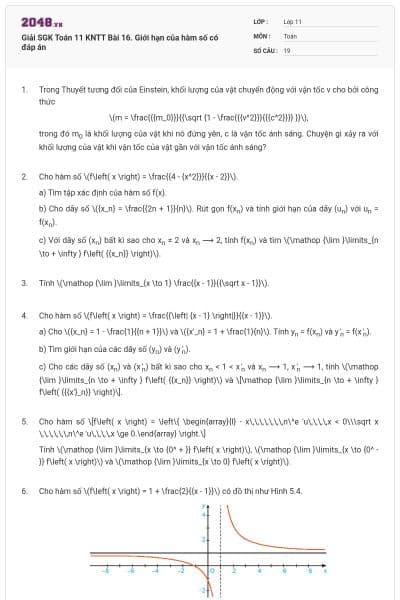
Rõ ràng \({(x - 1)^2} > 0,{(x - 1)^2} \to 0\) khi \(x \to 1\). Theo quy tắc giới hạn vô cực (của thương hai hàm số), ta có \(\mathop {\lim }\limits_{x \to 1} \frac{{f(x)}}{{{{(x - 1)}^2}}} = + \infty \).
\(\mathop {\lim }\limits_{x \to {1^ - }} (x - 1)\sqrt {\frac{{x + 2}}{{1 - {x^2}}}} = - \mathop {\lim }\limits_{x \to {1^ - }} \sqrt {\frac{{(x + 2){{(1 - x)}^2}}}{{1 - {x^2}}}} = - \mathop {\lim }\limits_{x \to {1^ - }} \sqrt {\frac{{(x + 2)(1 - x)}}{{1 + x}}} = 0.\)
Ta có \(\mathop {\lim }\limits_{x \to - \infty } \left( {{x^2} - 1} \right)g(x) = \mathop {\lim }\limits_{x \to - \infty } {x^2}\left[ {\left( {1 - \frac{1}{{{x^2}}}} \right)g(x)} \right] = + \infty \)
(do \(\mathop {\lim }\limits_{x \to - \infty } {x^2} = + \infty \) và \(\mathop {\lim }\limits_{x \to - \infty } \left[ {\left( {1 - \frac{1}{{{x^2}}}} \right)g(x)} \right] = 1 > 0\) ).
Áp dụng định lí: Nếu hàm số \(y = f(x)\) liên tục trên đoạn \[\left[ {a;b} \right]\] và \(f(a)f(b) < 0\) thì tồn tại ít nhất một điểm \(c \in (a;b)\) sao cho \[f\left( c \right) = 0\].
Bạn có thích hoạt động này không?
Hãy lưu hoặc chia sẻ nội dung này đến mọi người.
Gợi ý cho bạn

Ý tưởng của bạn, bài học của bạn
Tự thiết kế đề thi, bài giảng hoặc flashcard theo cách riêng.