Đề kiểm tra Cuối kì 1 Tiếng Anh 9 có đáp án (Mới nhất) - Đề 10
19 câu hỏi
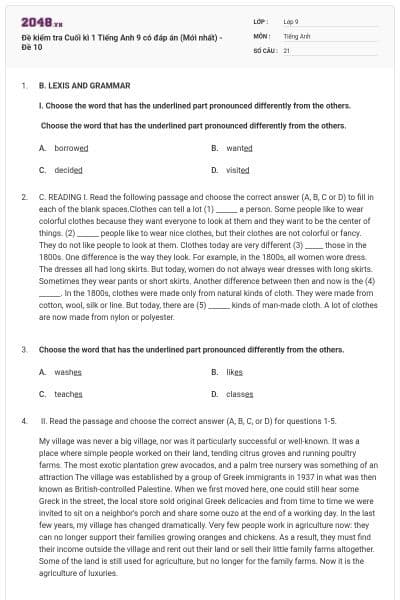
B. LEXIS AND GRAMMAR
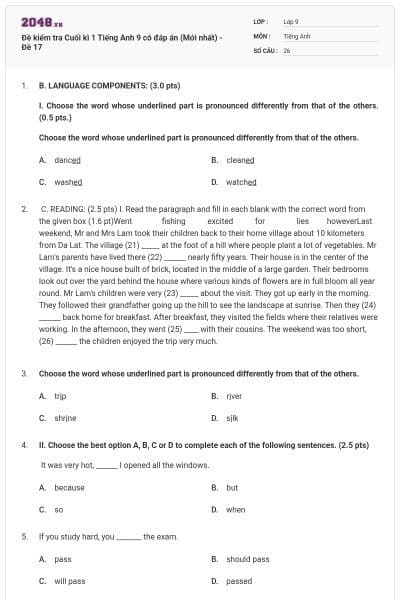
I. Choose the word that has the underlined part pronounced differently from the others.
Choose the word that has the underlined part pronounced differently from the others.
borrowed
wanted
decided
visited
Đáp án đúng là: A
Đáp án A phát âm là /d/, các đáp án còn lại phát âm là /ɪd/.
Choose the word that has the underlined part pronounced differently from the others.
washes
likes
teaches
classes
Đáp án đúng là: B
Đáp án B phát âm là /s/, các đáp án còn lại phát âm là /ɪz/.
II. Choose the correct answer (A, B, C or D) to complete each of the following sentences.
Mr. Long played soccer very ________ when he was young.
good
goodly
well
welly
Đáp án đúng là: C
Bổ ngữ cho động từ cần trạng từ.
Dịch: Ông Long chơi đá bóng rất tốt khi ông ấy còn trẻ.
Living in a big city is much ________ than living in the countryside.
convenient
convenienter
more convenient
most convenient
Đáp án: C
Giải thích:
Kiến thức:So sánh hơn
Câu có từ khóa “than” → đây là câu so sánh hơn giữa hai điều:
living in a big city và living in the countryside.
Tính từ convenient (tiện lợi) là tính từ dài (≥ 2 âm tiết)
→ So sánh hơn dùng cấu trúc: more + adj + than
Dịch: Sống ở một thành phố lớn thì tiện lợi hơn nhiều so với sống ở nông thôn.
Clothes can tell a lot (1) ______ a person.
about
at
with
on
Đáp án đúng là: A
Tell about: kể về
Dịch: Quần áo có thể nói lên rất nhiều về một con người.
Dịch bài
Quần áo có thể nói lên rất nhiều điều về một người. Một số người thích mặc quần áo nhiều màu sắc vì họ muốn mọi người nhìn vào họ và họ muốn trở thành trung tâm của mọi thứ. Những người khác thích mặc quần áo đẹp, nhưng quần áo của họ không nhiều màu sắc hoặc cầu kỳ. Họ không thích mọi người nhìn vào họ. Quần áo ngày nay rất khác so với quần áo vào những năm 1800. Một điểm khác biệt là cách chúng trông như thế nào. Ví dụ, vào những năm 1800, tất cả phụ nữ đều mặc váy. Tất cả các loại váy đều có váy dài. Nhưng ngày nay, phụ nữ không phải lúc nào cũng mặc váy có váy dài. Đôi khi họ mặc quần hoặc váy ngắn. Một điểm khác biệt nữa giữa thời đó và bây giờ là vải. Vào những năm 1800, quần áo chỉ được làm từ các loại vải tự nhiên. Chúng được làm từ cotton, len, lụa hoặc vải sợi. Nhưng ngày nay, có rất nhiều loại vải nhân tạo. Rất nhiều quần áo hiện được làm từ nylon hoặc polyestereach other
another
others
other
Đáp án đúng là: D
Trong 4 đáp án trên chỉ có other đi trước danh từ chỉ số nhiều.
Dịch: Những người khác thích mặc đồ tốt nhưng quần áo họ không sặc sỡ hay bóng bẩy.
at
to
from
in
Đáp án đúng là: C
Different from: khác với
Dịch: Quần áo ngày rất khác với chúng ở những năm 1800.
cloth
clothing
clothe
clothes
Đáp án đúng là: A
- cloth: vải
- clothing: quần áo
- clothe: mặc quần áo cho
- clothes: quần áo
Dịch: Điểm khác nữa giữa thời trước và ngày nay là chất vải.
many
lot of
any
few
Đáp án đúng là: A
- many: nhiều (đi với danh từ số nhiều đếm được)
- không có lot of
- any: một vài (đi với danh từ đếm được lẫn không đếm)
- few: hầu như không (đi với danh từ đếm được số nhiều)
Dịch: Ngày nay, có rất nhiều loại vải nhân tạo.
II. Read the passage and choose the correct answer (A, B, C, or D) for questions 1-5.
My village was never a big village, nor was it particularly successful or well-known. It was a place where simple people worked on their land, tending citrus groves and running poultry farms. The most exotic plantation grew avocados, and a palm tree nursery was something of an attraction The village was established by a group of Greek immigrants in 1937 in what was then known as British-controlled Palestine. When we first moved here, one could still hear some Greck in the street, the local store sold original Greek delicacies and from time to time we were invited to sit on a neighbor's porch and share some ouzo at the end of a working day. In the last few years, my village has changed dramatically. Very few people work in agriculture now: they can no longer support their families growing oranges and chickens. As a result, they must find their income outside the village and rent out their land or sell their little family farms altogether. Some of the land is still used for agriculture, but no longer for the family farms. Now it is the agriculture of luxuries.
What was TRUE about the writer's village?
It was a big village.
It was successful.
It was famous.
It was established by the Greek.
Đáp án đúng là: D
Dựa vào câu “The village was established by a group of Greek…”
Dịch: Làng được thành lập bởi một nhóm người Hy Lạp…
According to the passage, what did the people in the village NOT do?
Worked on their land.
Tended citrus groves.
Raised cattle on the farms.
Grew avocados.
Đáp án đúng là: C
Dựa vào câu “…running poultry farms.”
Dịch: …nuôi gia cầm.
The founders of the village were immigrants from _________.
Palestine
Greece
Britain
family farms
Đáp án đúng là: B
Dựa vào câu “The village was established by a group of Greek immigrants in 1937…”
Dịch: Làng được thành lập bởi một nhóm người nhập cư Hy Lạp năm 1937…
The change is very fast.
The change is very slow.
The change is normal.
There is not much change
Đáp án đúng là: A
Dựa vào câu “In the last few years, my village has changed dramatically.”
Dịch: Trong những năm vừa qua, làng tôi thay đổi một cách chóng mặt.
How do the villagers earn their living now?
They grow oranges and chickens
They run family farms.
They work in the inside villages.
They hire out their land or sell their farms.
Đáp án đúng là: D
Dẫn chứng ở câu “As a result, they must find their income outside the village and rent out their land or sell their little family farms altogether.”
Dịch: Do đó, họ phải tìm thu nhập bên ngoài làng và cho thuê đất hoặc bán toàn bộ trang trại gia đình nhỏ của mìnhD. WRITING:
I. Finish the second sentence so that it means the same as the first.
It's two years since we last spoke to Mrs. Mai.
We .......................................................
Đáp án đúng là: We last spoke to Mrs. Mai two years ago.
It’s … since = S + last + Vqk …
Dịch: Chúng tôi nói chuyện với cô Mai lần cuối là 2 năm trước.
I don't have enough time to finish this work
I wish ...................................................
Đáp án đúng là: I wish I had enough time to finish this work.
Câu ước ở hiện tại lùi 1 thì về quá khứ đơn.
Dịch: Tôi ước tôi có đủ thời gian hoàn thành công việc.
They can't make tea with cold water.
Tea can ………………………………
Đáp án đúng là: Tea can be made with cold water.
Bị động: tobe + Vp2
Dịch: Trà có thể được pha với nước lạnh.
"What is your favorite subject?" the teacher said to Nam.
The teacher …………………………..
Đáp án đúng là: The teacher asked Nam what his favorite subject was.
Câu gián tiếp mệnh đề chuyển về dạng khẳng định và lùi 1 thì.
Dịch: Giáo viên hỏi Nam môn học nào mà anh ấy yêu thích.
II. Write a paragraph (within 60-80 words) about the following topic:
"Is it good for children to live in the countryside?
Nowadays, more and more people choose to live in big cities especially young ones but living in the countryside is not a bad option. There are many advantages when you live in the countryside. It is very important for a child to grow up in a healthy environment. Children need fresh air, not polluted by the huge amount of cars and factories of the modern city. In the country, they can spend more time exercising and walking with their friends. Another important aspect of this is that parents will have more time to spend with their children as a result of eliminating traffic jams and decreasing driving time as a whole. To sum up, living in the countryside is still good for children in some ways.
Dịch: Ngày nay, ngày càng có nhiều người chọn sống ở các thành phố lớn đặc biệt là những người trẻ tuổi nhưng sống ở nông thôn là một lựa chọn không tồi. Có rất nhiều lợi ích khi bạn sống ở nông thôn. Nó rất quan trọng để một đứa trẻ lớn lên trong một môi trường lành mạnh. Trẻ em cần không khí trong lành, không bị ô nhiễm bởi lượng ô tô và nhà máy khổng lồ của thành phố hiện đại. Ở trong nước, họ có thể dành nhiều thời gian hơn để tập thể dục và đi dạo cùng bạn bè. Một khía cạnh quan trọng khác của điều này là cha mẹ sẽ có nhiều thời gian hơn để dành cho con cái của họ, do đó giảm thiểu được tình trạng tắc đường và giảm thời gian lái xe nói chung. Tóm lại, ở một khía cạnh nào đó, sống ở nông thôn vẫn tốt cho trẻ em.