31 câu hỏi
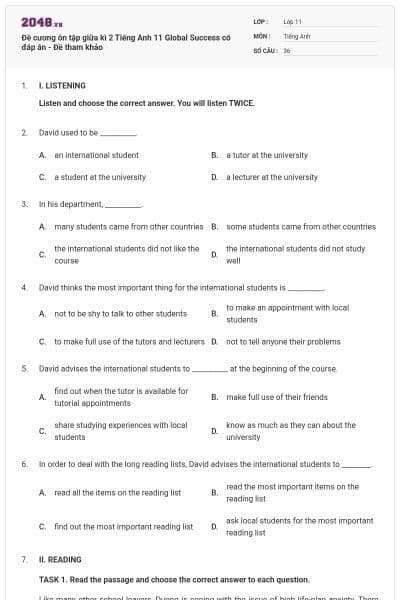
an international student
a tutor at the university
a student at the university
a lecturer at the university
Hướng dẫn giải:
Đáp án đúng: C
Dịch nghĩa: David từng là một sinh viên tại trường đại học.
Thông tin: Yes, I was in AERD, that's the department of Agricultural Extension and Rural Development.
(Tớ học ở khoa AERD – tức là khoa Khuyến nông và Phát triển Nông thôn.)
many students came from other countries
some students came from other countries
the international students did not like the course
the international students did not study well
Hướng dẫn giải:
Đáp án đúng: A
Dịch nghĩa: Ở khoa của anh ấy, có nhiều sinh viên đến từ các quốc gia khác.
Thông tin:
John: …You've just completed an MSc course on which a large proportion of the students were international students. Is that right?
David: That's it.
(John: Cậu vừa hoàn thành khóa học Thạc sĩ, mà trong đó có khá nhiều sinh viên quốc tế đúng không?
David: Ừ, đúng rồi.)
not to be shy to talk to other students
to make an appointment with local students
to make full use of the tutors and lecturers
not to tell anyone their problems
Hướng dẫn giải:
Đáp án đúng: C
Dịch nghĩa: David nghĩ điều quan trọng nhất đối với sinh viên quốc tế là tận dụng tối đa sự hỗ trợ của trợ giảng và giảng viên.
Thông tin: I think the most basic thing is to make full use of the tutors and lecturers.
(Tớ nghĩ điều quan trọng nhất là phải tận dụng tối đa sự hỗ trợ của giảng viên và trợ giảng.)
find out when the tutor is available for tutorial appointments
make full use of their friends
share studying experiences with local students
know as much as they can about the university
Hướng dẫn giải:
Đáp án đúng: A
Dịch nghĩa: David khuyên sinh viên quốc tế nên tìm hiểu thời gian thầy cô có thể gặp để xin tư vấn vào đầu khóa học.
Thông tin: I think they should find out at the beginning of the course the time at which the tutor is going to be available for tutorial appointments and then make full use of them.
(Tớ nghĩ ngay từ đầu khóa, họ nên tìm hiểu xem thầy cô có lịch gặp sinh viên lúc nào và tận dụng các buổi hướng dẫn càng nhiều càng tốt.)
read all the items on the reading list
read the most important items on the reading list
find out the most important reading list
ask local students for the most important reading list
Hướng dẫn giải:
Đáp án đúng: B
Dịch nghĩa: Để xử lý danh sách đọc dài, David khuyên sinh viên quốc tế nên đọc những tài liệu quan trọng nhất trong danh sách.
Thông tin: Try to find out which are the most important items on the list - ask the lecturer or tutor if necessary, and then, if your time is limited, spend it reading those books thoroughly.
(Hãy tìm xem tài liệu nào là quan trọng nhất – nếu cần thì hỏi thầy cô. Rồi nếu thời gian ít, hãy tập trung đọc kỹ những cuốn quan trọng đó.)
Nội dung bài nghe:
John: Now David, can I get this right? You've just completed an MSc course on which a large proportion of the students were international students. Is that right?
David: That's it. Yes, I was in AERD, that's the department of Agricultural Extension and Rural Development.
John: And how do you think the students from other countries got along on that course?
David: Pretty well.
John: What advice would you give students, particularly international students, based on your experience as a student here?
David: I think the most basic thing is to make full use of the tutors and lecturers. Maybe some of the overseas students are a bit too shy to take questions or problems to tutors.
John: What do you think they should do?
David: I think they should find out at the beginning of the course the time at which the tutor is going to be available for tutorial appointments and then make full use of them.
John: So, any problems, they should tell the tutor as soon as possible? Let's move on, what about the amount of reading that you have to do as a university student?
David: Yes. It looks pretty daunting at first, with those long reading lists. Don't think that the students have to read everything that’s listed. Try to find out which are the most important items on the list - ask the lecturer or tutor if necessary, and then, if your time is limited, spend it reading those books thoroughly.
John: OK, that’s very helpful, David. Thank you very much.
David: No, not at all.
Dịch bài nghe:
John: Này David, để tớ hiểu cho đúng nhé. Cậu vừa hoàn thành khóa học Thạc sĩ, mà trong đó có khá nhiều sinh viên quốc tế đúng không?
David: Ừ, đúng rồi. Tớ học ở khoa AERD – tức là khoa Khuyến nông và Phát triển Nông thôn.
John: Thế sinh viên nước ngoài học chung có hòa đồng và theo kịp khóa học không?
David: Khá ổn đấy.
John: Vậy dựa trên kinh nghiệm của mình, cậu có lời khuyên gì cho sinh viên – đặc biệt là sinh viên quốc tế – khi học ở đây không?
David: Tớ nghĩ điều quan trọng nhất là phải tận dụng tối đa sự hỗ trợ của giảng viên và trợ giảng. Một số bạn nước ngoài hơi ngại, không dám đem câu hỏi hay vấn đề của mình hỏi thầy cô.
John: Theo cậu thì họ nên làm gì?
David: Tớ nghĩ ngay từ đầu khóa, họ nên tìm hiểu xem thầy cô có lịch gặp sinh viên lúc nào và tận dụng các buổi hướng dẫn càng nhiều càng tốt.
John: Vậy nghĩa là có vấn đề gì thì nói với thầy cô ngay lập tức? Rồi, chuyển sang chuyện khác nhé. Còn về lượng tài liệu phải đọc ở đại học thì sao?
David: Ờ, lúc đầu nhìn vào danh sách đọc dài ngoằng thì đúng là hơi choáng thật. Nhưng đừng nghĩ là phải đọc hết tất cả. Hãy tìm xem tài liệu nào là quan trọng nhất – nếu cần thì hỏi thầy cô. Rồi nếu thời gian ít, hãy tập trung đọc kỹ những cuốn quan trọng đó.
John: Ừ, lời khuyên đó rất hữu ích. Cảm ơn cậu nhiều nhé, David.
David: Ôi, không có gì đâu.
Anxiety of many school-leavers about their future jobs
The supporting roles of parents and teachers in guiding school-leavers to pursue their dreams
Contrasting views on future education choices between a school-leaver and her parents
The misunderstanding of choosing a university between a school-leaver and her parents
Hướng dẫn giải:
Đáp án đúng: C
Dịch nghĩa: Đoạn văn chủ yếu nói về điều gì? - Những quan điểm trái ngược về lựa chọn học tiếp của một học sinh vừa tốt nghiệp và bố mẹ cô ấy
Thông tin: She has finished high school this year and wants to get work immediately; however, it’s difficult for her to go ahead with her plan due to her parents’ objections.
(Cô đã hoàn thành chương trình phổ thông năm nay và muốn đi làm ngay lập tức; tuy nhiên, thật khó để cô thực hiện kế hoạch đó vì bố mẹ phản đối.)
Low-qualified individuals’
Ordinary people’s
Duong’s parents’
School-leavers’
Hướng dẫn giải:
Đáp án đúng: A
Dịch nghĩa: Từ “their” ở dòng 9 có nghĩa là của ai? - Của những người có trình độ thấp
Thông tin: …people with low qualifications rarely earn others’ respect and have fewer opportunities to get promotions in their career ladder.
(...người có trình độ học vấn thấp thường ít được tôn trọng và có ít cơ hội thăng tiến hơn trong sự nghiệp.)

Học thông minh hơn mỗi ngày
Xem toàn bộ 31 câu hỏi và nhiều hơn nữa với tài khoản miễn phí
Because of her homeroom teacher’s advice
Because of her impressive academic performance
Because of her parents’ hardship
Because of social prejudice
Hướng dẫn giải:
Đáp án đúng: D
Dịch nghĩa: Tại sao bố mẹ Dương lại cố ép cô theo ý họ? - Vì định kiến xã hội
Thông tin: In Viet Nam’s society, it’s a common practice that people with low qualifications rarely earn others’ respect and have fewer opportunities to get promotions in their career ladder. That’s why her parents strongly expect that her distinguished academic result of the national entrance examination can help her win a place at a popular economic university despite her family’s state of financial crisis.
(Trong xã hội Việt Nam, người có trình độ học vấn thấp thường ít được tôn trọng và có ít cơ hội thăng tiến hơn trong sự nghiệp. Đó là lý do tại sao bố mẹ cô kỳ vọng rằng kết quả học tập xuất sắc cùng điểm thi đại học cao có thể giúp cô giành được một suất vào một trường đại học kinh tế nổi tiếng, dù gia đình đang gặp khủng hoảng tài chính.)
Trying to win a place at a popular economic university
Finding a part-time job while studying at university
Selecting a university with reasonable costs
Choosing a university that awards scholarships to top students
Hướng dẫn giải:
Đáp án đúng: A
Dịch nghĩa: Điều nào sau đây KHÔNG phải là lời khuyên của thầy Trung? - Cố gắng giành một suất vào trường đại học kinh tế nổi tiếng
Thông tin: He advised her to give in to her parents’ demand by choosing a university with reasonable fees and scholarships offered to excellent students. Meanwhile, she can obtain a part-time job to relieve the cost burden…
(Thầy khuyên cô nên nhượng bộ bố mẹ bằng cách chọn một trường đại học có mức học phí hợp lý và cung cấp học bổng cho sinh viên giỏi. Đồng thời, cô có thể làm thêm để giảm bớt gánh nặng chi phí…)
Duong has had a lot of practical experience since her graduation.
Duong prefers going straight to university to training for a stable job.
Duong can make her own decision without her teacher’s advice.
Duong’s parents might be convinced by her new idea once again.
Hướng dẫn giải:
Đáp án đúng: D
Dịch nghĩa: Câu nào sau đây đúng theo bài đọc? - Cha mẹ Dương có thể bị thuyết phục bởi ý kiến mới của cô ấy thêm một lần nữa.
Thông tin: Now she is taking his advice into account and ready to persuade her parents to change their minds one more time.
(Hiện tại, cô đang cân nhắc lời khuyên của thầy và sẵn sàng thuyết phục bố mẹ thay đổi quan điểm thêm một lần nữa.)
Dịch bài đọc:
Giống như nhiều học sinh cuối cấp khác, Dương đang phải đối mặt với tình trạng lo lắng cao độ về kế hoạch tương lai của mình. Hiện có hai lựa chọn thông thường mà cô có thể cân nhắc: đi làm ngay hoặc đăng ký vào hệ thống đại học. Cô đã hoàn thành chương trình phổ thông năm nay và muốn đi làm ngay lập tức; tuy nhiên, thật khó để cô thực hiện kế hoạch đó vì bố mẹ phản đối.
Trong xã hội Việt Nam, người có trình độ học vấn thấp thường ít được tôn trọng và có ít cơ hội thăng tiến hơn trong sự nghiệp. Đó là lý do tại sao bố mẹ cô kỳ vọng rằng kết quả học tập xuất sắc cùng điểm thi đại học cao có thể giúp cô giành được một suất vào một trường đại học kinh tế nổi tiếng, dù gia đình đang gặp khủng hoảng tài chính.
Ngược lại, cô không muốn tạo thêm gánh nặng cho gia đình với học phí đắt đỏ và khoản vay nợ lớn dành cho sinh viên trong bốn năm đại học. Cô đã nhiều lần thuyết phục bố mẹ cho phép mình tìm một công việc ổn định để phụ giúp gia đình, nhưng họ vẫn chưa đồng ý.
Hôm qua, cô có buổi tư vấn với thầy Trung, giáo viên chủ nhiệm. Thầy khuyên cô nên nhượng bộ bố mẹ bằng cách chọn một trường đại học có mức học phí hợp lý và cung cấp học bổng cho sinh viên giỏi. Đồng thời, cô có thể làm thêm để giảm bớt gánh nặng chi phí, tích lũy kinh nghiệm và làm đẹp CV trong tương lai.
Hiện tại, cô đang cân nhắc lời khuyên của thầy và sẵn sàng thuyết phục bố mẹ thay đổi quan điểm thêm một lần nữa.
Hướng dẫn giải:
Đáp án đúng: F/ False
Dịch nghĩa: Mỗi sinh viên đều hào hứng về việc vào đại học.
Thông tin: While most students are excited about it, they should also be aware of the difference between university and school.
(Mặc dù hầu hết sinh viên đều rất hào hứng, họ cũng cần nhận thức được sự khác biệt giữa đại học và phổ thông.)
Hướng dẫn giải:
Đáp án đúng: T/ True
Dịch nghĩa: Học sinh được cung cấp hỗ trợ và tài liệu để hoàn thành các bài tập do giáo viên giao ở trường.
Thông tin: Teachers give you regular assignments and provide support and resources to help you complete them.
(Giáo viên giao bài tập thường xuyên và cung cấp hỗ trợ, tài liệu để giúp bạn hoàn thành.)
Hướng dẫn giải:
Đáp án đúng: F/ False
Dịch nghĩa: Sinh viên đại học thường gặp những người có cùng xuất thân, nên họ không cần cải thiện kỹ năng xã hội.
Thông tin: By contrast, at university, you not only have more contacts, but you also meet people from different backgrounds. Therefore, you need better social skills…
(Ngược lại, ở đại học, bạn có nhiều mối quan hệ hơn và tiếp xúc với những người có xuất thân khác nhau. Do đó, bạn cần kỹ năng xã hội tốt hơn…)
Hướng dẫn giải:
Đáp án đúng: T/ True
Dịch nghĩa: Học sinh trung học có cha mẹ chăm lo các công việc hằng ngày như nấu ăn và đi chợ.
Thông tin: You don't have to worry about things such as shopping or cooking for yourself. You have your parents take care of your physical and mental well-being.
(Bạn không phải lo lắng việc đi chợ hay nấu ăn cho bản thân. Cha mẹ là người đảm bảo cho bạn cả sức khỏe thể chất lẫn tinh thần.)
Dịch bài đọc:
Vào đại học là một cột mốc quan trọng đối với người trẻ. Mặc dù hầu hết sinh viên đều rất hào hứng, họ cũng cần nhận thức được sự khác biệt giữa đại học và phổ thông.
Ở trường phổ thông, phần lớn việc học của bạn diễn ra ngay trong lớp. Giáo viên giao bài tập thường xuyên và cung cấp hỗ trợ, tài liệu để giúp bạn hoàn thành. Trong khi đó, ở đại học, phần lớn việc học của bạn là tự học và làm các dự án mà bạn phải tự lên kế hoạch và hoàn thành đúng hạn. Bạn có trách nhiệm tự xem lại bài giảng, đọc sách giáo khoa và nghiên cứu tài liệu bằng cách tìm thông tin trong thư viện hoặc trên mạng.
Các mối quan hệ ở trường phổ thông thường chỉ xoay quanh bạn bè trong trường hoặc trong lớp. Bạn chủ yếu tương tác trong môi trường học đường, vì vậy nhóm bạn của bạn khá nhỏ và quen thuộc. Ngược lại, ở đại học, bạn có nhiều mối quan hệ hơn và tiếp xúc với những người có xuất thân khác nhau. Do đó, bạn cần kỹ năng xã hội tốt hơn để giải quyết những xung đột có thể xảy ra khi giao tiếp với người khác.
Là một học sinh phổ thông, bạn sống với cha mẹ – những người chăm sóc và hỗ trợ bạn hằng ngày. Bạn không phải lo lắng việc đi chợ hay nấu ăn cho bản thân. Cha mẹ là người đảm bảo cho bạn cả sức khỏe thể chất lẫn tinh thần. Nhưng khi lên đại học, bạn có thể phải rời xa nhà và bắt đầu sống tự lập. Bạn cần rèn luyện kỹ năng sống để có thể tự quản lý cuộc sống của chính mình.
Hướng dẫn giải:
Đáp án đúng: She was praised for raising $40,000 for wildlife protection.
Dịch nghĩa: Cô ấy đã được khen ngợi vì quyên góp được 40.000 đô la cho việc bảo vệ động vật hoang dã.
Hướng dẫn giải:
Đáp án đúng: Lucas is the only member to have still preserved this conservation project.
Dịch nghĩa: Lucas là thành viên duy nhất vẫn còn tham gia trong dự án bảo tồn này.
Hướng dẫn giải:
Đáp án đúng: People use explosives to catch fish and other sea animals.
Cấu trúc: Mệnh đề To-infinitive chỉ mục đích: to + verb-infinitive
Dịch nghĩa: Người ta dùng chất nổ để bắt cá và các động vật biển khác.
Hướng dẫn giải:
Đáp án đúng: Having studied very hard, my brother passed the exam easily.
Cấu trúc: Mệnh đề phân từ hoàn thành: having + V-ed/V3
Dịch nghĩa: Vì đã học rất chăm chỉ nên anh trai tôi đã vượt qua kỳ thi một cách dễ dàng.
Hướng dẫn giải:
Đáp án đúng: It is at university that good life skills can help students become more independent.
Cấu trúc: Câu chẻ nhấn mạnh trạng ngữ: It + be + adv + that + S + V…
Dịch nghĩa: Chính ở đại học mà các kỹ năng sống tốt có thể giúp sinh viên trở nên độc lập hơn.
Hướng dẫn giải:
Đáp án đúng: He denied saying that he would take responsibility for the project.
Cấu trúc: S + deny + verb-ing / having + V3/V-ed
Dịch nghĩa: Anh ấy phủ nhận việc đã nói rằng mình sẽ chịu trách nhiệm cho dự án.
society
information
traditional
encouragement
Hướng dẫn giải:
Đáp án đúng: B
Đáp án B có trọng âm rơi vào âm tiết thứ 3, các đáp án còn lại trọng âm rơi vào âm tiết thứ 2.
undergraduate
opportunity
qualification
university
Hướng dẫn giải:
Đáp án đúng: C
Đáp án C có trọng âm rơi vào âm tiết thứ 4, các đáp án còn lại trọng âm rơi vào âm tiết thứ 3.
reliable
independent
responsible
decisiveness
Hướng dẫn giải:
Đáp án đúng: B
Đáp án B có trọng âm rơi vào âm tiết thứ 3, các đáp án còn lại trọng âm rơi vào âm tiết thứ 2.
to rebuild
of having rebuilt
to being rebuilt
for having rebuilt
Hướng dẫn giải:
Đáp án đúng: D
Cấu trúc: S + admire + O + for + V-ing/ having + V3/V-ed…
Dịch nghĩa: Chúng tôi ngưỡng mộ người Nhật vì đã xây dựng lại thành phố Fukushima sau thảm họa.
moving
being moved
to move
to be moved
Hướng dẫn giải:
Đáp án đúng: C
Cấu trúc: S + decided + to V-infinitive…
Dịch nghĩa: Sau khi con cái họ trưởng thành, họ quyết định chuyển đến một căn hộ chung cư trong thành phố.
that hosts
hosting
to host
hosted
Hướng dẫn giải:
Đáp án đúng: C
Cấu trúc: Mệnh đề To-infinitive chỉ thứ tự: the first + to + verb-infinitive
Dịch nghĩa: Thành phố đầu tiên tổ chức Thế vận hội Mùa hè hai lần là Paris, Pháp.
see and do
to see and do
seeing and doing
can see and do
Hướng dẫn giải:
Đáp án đúng: B
Cấu trúc: Mệnh đề To-infinitive miêu tả cụm danh từ với so sánh nhất:
the + superlative adj + to + verb-infinitive
Dịch nghĩa: Những điều thú vị nhất dành cho du khách xem và làm ở thành phố bạn là gì?
to visit
visited
visiting
being visited
Hướng dẫn giải:
Đáp án đúng: A
Cấu trúc: Mệnh đề To-infinitive miêu tả cụm danh từ với so sánh nhất:
the + superlative adj + to + verb-infinitive
Dịch nghĩa: Nằm trên một cây cầu bắc qua sông Thu Bồn, Chùa Cầu là một trong những địa điểm thú vị nhất để tham quan ở Hội An.
about whom
who
whom
from whom
Hướng dẫn giải:
Đáp án đúng: A
Cấu trúc: Nhấn mạnh tân ngữ chỉ người:
S + talk about + O => O + about whom + S + talk…
Dịch nghĩa: Người phụ nữ mà chúng ta đang nói đến là một giáo sư.
choose
choosing
chose
chosen
Hướng dẫn giải:
Đáp án đúng: D
Cấu trúc: S + be + proud of + V-ing/ having V3/V-ed…
Dịch nghĩa: Bố mẹ tôi tự hào vì đã chọn những trường tốt nhất trong khu vực cho tôi và các anh em.
Having
Having been
Have
Had
Hướng dẫn giải:
Đáp án đúng: A
Cấu trúc: Mệnh đề phân từ hoàn thành: having + V-ed/V3
Dịch nghĩa: Sau khi đã nghiên cứu kỹ tờ quảng cáo, anh trai tôi quyết định đăng ký khóa học quản lý khách sạn.
Bạn có thích hoạt động này không?
Ý kiến của bạn sẽ giúp chúng tôi đề xuất nội dung phù hợp hơn.
![[Năm 2022] Đề thi thử môn Vật lí THPT Quốc gia có lời giải - Đề số 21](/_next/image?url=https%3A%2F%2Fvideo.vietjack.com%2Fupload%2Fimages%2Fvj-image%2Fimage-3izficdefgfoel0s9j8s-1786772791.jpg&w=3840&q=75)
![[Năm 2022] Đề thi thử môn Vật lí THPT Quốc gia có lời giải - Đề số 20](/_next/image?url=https%3A%2F%2Fvideo.vietjack.com%2Fupload%2Fimages%2Fvj-image%2Fimage-emy0gtcksawvorajezvv-1786772460.jpg&w=3840&q=75)