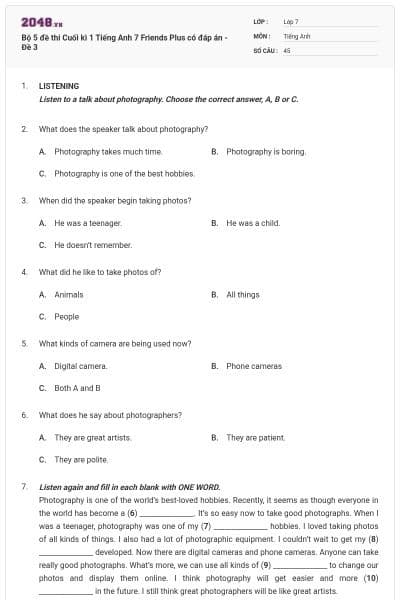
Bộ 5 đề thi Cuối kì 1 Tiếng Anh 7 Friends Plus có đáp án - Đề 3
40 câu hỏi
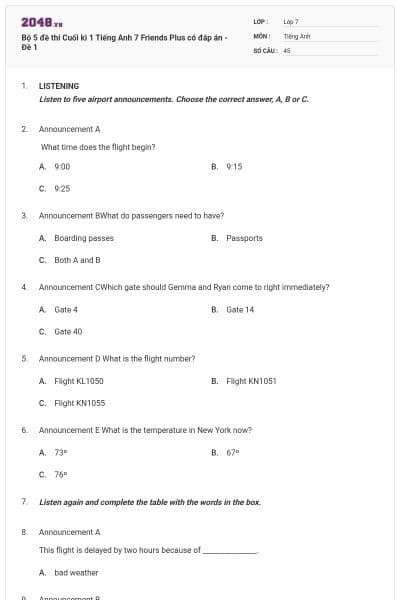
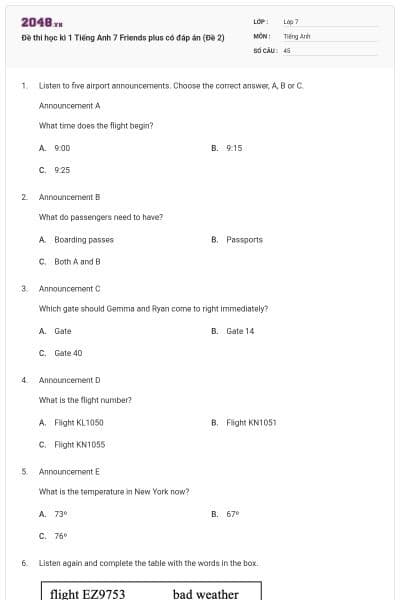
LISTENING
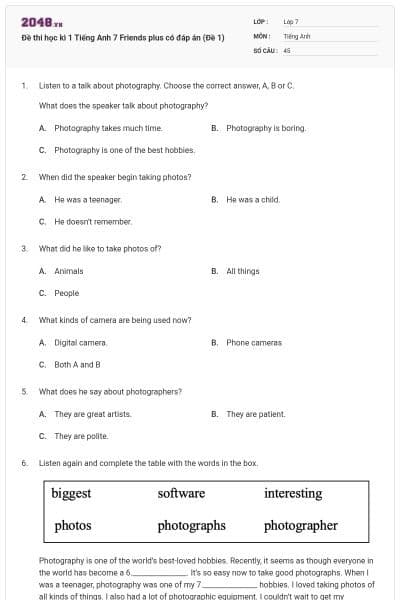
Listen to a talk about photography. Choose the correct answer, A, B or C.
Photography takes much time.
Photography is boring.
Photography is one of the best hobbies.
Diễn giả nói gì về nhiếp ảnh?
A. Nhiếp ảnh mất nhiều thời gian.
B. Nhiếp ảnh thật nhàm chán.
C. Nhiếp ảnh là một trong những sở thích tốt nhất.
Thông tin: Photography is one of the world’s best-loved hobbies.
(Nhiếp ảnh là một trong những sở thích được yêu thích nhất trên thế giới.)
Chọn C
He was a teenager.
He was a child.
He doesn’t remember.
Người nói bắt đầu chụp ảnh khi nào?
A. Anh ấy là một thiếu niên.
B. Anh ấy là một đứa trẻ.
C. Anh ấy không nhớ.
Thông tin: When I was a teenager, photography was one of my biggest hobbies.
(Khi tôi còn là một thiếu niên, chụp ảnh là một trong những sở thích lớn nhất của tôi.)
Chọn A
Animals
All things
People
Anh ấy thích chụp ảnh gì?
A. Động vật
B. Vạn vật
C. Con người
Thông tin: I loved taking photos of all kinds of things.
(Tôi thích chụp ảnh mọi thứ.)
Chọn B
Digital camera.
Phone cameras
Both A and B
Những loại máy ảnh nào đang được sử dụng hiện nay?
A. Máy ảnh kỹ thuật số.
B. Camera điện thoại
C. Cả A và B
Thông tin: Now there are digital cameras and phone cameras.
(Bây giờ có máy ảnh kỹ thuật số và máy ảnh điện thoại.)
Chọn C
They are great artists.
They are patient.
They are polite.
Anh ấy nói gì về các nhiếp ảnh gia?
A. Họ là những nghệ sĩ tuyệt vời.
B. Họ kiên nhẫn.
C. Họ lịch sự.
Thông tin: I still think great photographers will be like great artists.
(Tôi vẫn nghĩ những nhiếp ảnh gia tuyệt vời sẽ giống như những nghệ sĩ vĩ đại.)
ChọnA
Listen again and fill in each blank with ONE WORD.
Photography is one of the world’s best-loved hobbies. Recently, it seems as though everyone in the world has become a (6) _______________. It’s so easy now to take good photographs. When I was a teenager, photography was one of my (7) _______________ hobbies. I loved taking photos of all kinds of things. I also had a lot of photographic equipment. I couldn’t wait to get my (8) _______________ developed. Now there are digital cameras and phone cameras. Anyone can take really good photographs. What’s more, we can use all kinds of (9) _______________ to change our photos and display them online. I think photography will get easier and more (10) _______________ in the future. I still think great photographers will be like great artists.
Sau mạo từ “a” cần danh từ số ít.
photographer (n): nhiếp ảnh gia
Photography is one of the world’s best-loved hobbies. Recently, it seems as though everyone in the world has become a (6) photographer.
(Nhiếp ảnh là một trong những sở thích được yêu thích nhất trên thế giới. Gần đây, có vẻ như tất cả mọi người trên thế giới đã trở thành một nhiếp ảnh gia.)
Đáp án: photographer
Sau tính từ sở hữu “my” và trước danh từ “hobbies” cần tính từ.
biggest (adj): lớn nhất
When I was a teenager, photography was one of my (7) biggest hobbies.
(Khi tôi còn là một thiếu niên, chụp ảnh là một trong những sở thích lớn nhất của tôi.)
Đáp án: biggest
Sau tính từ sở hữu “my” cần danh từ.
photos (n): những bức ảnh
I couldn’t wait to get my (8) photos developed.
(Tôi không thể chờ để nhận được những bức ảnh hoàn thiện.)
Đáp án: photos
Sau giới từ “of” cần danh từ.
software (n): phần mềm
What’s more, we can use all kinds of (9) software to change our photos and display them online.
(Hơn nữa, chúng ta có thể sử dụng tất cả các loại phần mềm để thay đổi ảnh của mình và hiển thị chúng trực tuyến.)
Đáp án: software
Cấu trúc so sánh hơn với tính từ dài: more + adj
interesting (adj): thú vị
I think photography will get easier and more (10) interesting in the future.
(Tôi nghĩ nhiếp ảnh sẽ trở nên dễ dàng hơn và thú vị hơn trong tương lai.)
Đáp án: interesting
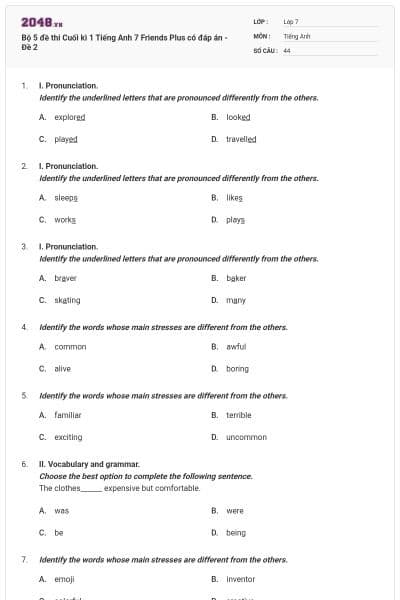
PRONUNCIATION
Choose the word whose bold part is pronounced differently from others.
explored
lived
admired
looked
Các quy tắc khi phát âm từ có đuôi “-ed”
- Phát âm là /ɪd/: với các động từ kết thúc bằng âm /t/ hoặc /d/ (theo phiên âm).
- Phát âm là /t/: với các động từ kết thúc bằng âm vô thanh như là /k/, /p/, /s/, /f/, /tʃ/, /ʃ/.
- Phát âm là /d/: với các động từ kết thúc bằng các âm còn lại.
A. explored /ɪkˈsplɔː(r)d/
B. lived /lɪvd/
C. admired /ədˈmaɪə(r)d/
D. looked /lʊkt/
Phần được gạch chân ở phương án D được phát âm /t/, các phương án còn lại phát âm /d/.
Chọn D
Choose the word whose bold part is pronounced differently from others.
booked
travelled
liked
stopped
Các quy tắc khi phát âm từ có đuôi “-ed”
- Phát âm là /ɪd/: với các động từ kết thúc bằng âm /t/ hoặc /d/ (theo phiên âm).
- Phát âm là /t/: với các động từ kết thúc bằng âm vô thanh như là /k/, /p/, /s/, /f/, /tʃ/, /ʃ/.
- Phát âm là /d/: với các động từ kết thúc bằng các âm còn lại.
A. booked /bʊkt/
B. travelled /ˈtrævld/
C. liked /laɪkt/
D. stopped /stɒpt/
Phần được gạch chân ở phương án B được phát âm /d/, các phương án còn lại phát âm /t/.
Chọn B
Choose the word whose bold part is pronounced differently from others.
needed
crooked
laughed
visited
Các quy tắc khi phát âm từ có đuôi “-ed”
- Phát âm là /ɪd/: với các động từ kết thúc bằng âm /t/ hoặc /d/ (theo phiên âm).
- Phát âm là /t/: với các động từ kết thúc bằng âm vô thanh như là /k/, /p/, /s/, /f/, /tʃ/, /ʃ/.
- Phát âm là /d/: với các động từ kết thúc bằng các âm còn lại.
A. needed /niːdɪd/
B. crooked /ˈkrʊkɪd/
C. laughed /lɑːft/
D. visited /ˈvɪzɪtɪd/
Phần được gạch chân ở phương án C được phát âm /t/, các phương án còn lại phát âm /ɪd/.
Chọn C
Choose the bold word that has a different stress pattern from the others.
alive
funny
tiny
awful
A. alive /əˈlaɪv/
B. funny /ˈfʌni/
C. tiny /ˈtaɪni/
D. awful /ˈɔːfl/
Phương án A có trọng âm 2, các phương án còn lại có trọng âm 1.
Chọn A
Choose the bold word that has a different stress pattern from the others.
dinosaur
unfriendly
personal
pyramid
A. dinosaur /ˈdaɪnəsɔː(r)/
B. unfriendly /ʌnˈfrendli/
C. personal /ˈpɜːsənl/
D. pyramid /ˈpɪrəmɪd/
Phương án B có trọng âm 2, các phương án còn lại có trọng âm 1.
Chọn B
USE OF ENGLISH
Choose the word or phrase that best completes each sentence.
was
were
be
Dấu hiệu nhận biết: last Sunday (Chủ nhật tuần trước) => thì quá khứ đơn với động từ “be”: S (số ít) + was
The woman was at the supermarket last Sunday.
(Chủ nhật tuần trước người phụ nữ này đã ở siêu thị.)
Chọn A
cruel
poor
rich
A. cruel (adj): độc ác
B. poor (adj): nghèo
C. rich (adj): giàu có
In the past, poor people couldn’t attend universities.
(Trong quá khứ, người nghèo không thể học đại học.)
Chọn B
was
be
were
Dấu hiệu nhận biết thì quá khứ đơn: when he was a child (khi anh ấy còn bé)
there were + danh từ số nhiều
There were many toys in his bedroom when he was a child.
(Có nhiều đồ chơi trong phòng ngủ của anh ấy khi anh ấy còn bé.)
Chọn C
met
stayed
gave
A. met (V2): đã gặp
B. stayed (Ved): đã ở lại
C. gave (V2): đưa cho
My sister stayed there for one hour and waited for him.
(Chị tôi đã ở đây khoảng 1 tiếng và chờ đợi anh ấy.)
Chọn B
were
was
be
Dấu hiệu nhận biết: last night (tối qua) => thì quá khứ đơn với động từ “be”: S (số nhiều) + were
My family members were happy with the film last night.
(Các thành viên trong gia đình tôi hài lòng với phim tối qua.)
Chọn A
lying
kicking
holding
A. lying (V-ing): nằm
B. kicking (V-ing): đá
C. holding (V-ing): cầm/ giữ lấy
The woman was lying on the bed.
(Người phụ nữ đang nằm trên giường.)
Chọn A
was reading
were reading
read
Dấu hiệu nhận biết: at 9 a.m. yesterday (9 giờ sáng hôm qua) => Thì quá khứ tiếp diễn: S (số nhiều) + were V-ing
Her students were reading books at 9 a.m. yesterday.
(Những học sinh của cô ấy đang đọc sách lúc 9 giờ sáng hôm qua.)
Chọn B
ring
rang
was ringing
Thì quá khứ đơn diễn tả hành động ngắn xen ngang một hành động khác đang diễn ra trong quá khứ => S + Ved/ V2
The phone rang while she was sleeping.
(Điện thoại reo trong khi cô ấy đang ngủ.)
Chọn B
polite
patient
rude
A. polite (adj): lịch sự
B. patient (adj): kiên nhẫn
C. rude (adj): thô lỗ
We need to be patient to take photos of wild animals.
(Chúng ta nên kiên nhẫn khi chụp ảnh cho động vật hoang dã.)
Chọn B
happily
creatively
rudely
A. happily (adv): một cách vui vẻ
B. creatively (adv): một cách sáng tạo
C. rudely (adv): một cách thô lỗ
They can think creatively to find the new solution.
(Họ có thể suy nghĩ sáng tạo để tìm ra giải pháp mới.)
Chọn B
kicking
standing
picking
stand up (v): đứng lên
pick up (v): nhặt lên
She is picking up her keys on the floor.
(Cô ấy đang nhặt chìa khóa trên sàn nhà lên.)
Chọn C
READING
Read the passage and decide whether each statement is True or False.
Shooting Wildlife
Wildlife photography-whether you’re trying to photograph a herd of elephants on the Serengeti Plains or squirrels in your backyard-is patience. Wild animals are going to do what they’re going to do. Unfortunately, you can’t ask them to look this way, do something cute, or stand where the light is better. You have to be there, and ready, when they decide to look cute or do something interesting. Be prepared to wait, and wait, and wait-it takes a long time to get good wildlife shots, even longer to make great ones.
But it’s not wasted time. The longer you spend with an animal or a group of animals, the better you get to know them and their habits. You get to see different individuals, and you’ll get to the point where you can expect what they might do at a particular time of day or in a certain situation.
We need to be patient to take good photos of wild animals.
Tạm dịch:
Chụp ảnh động vật hoang dã
Chụp ảnh động vật hoang dã - cho dù bạn đang cố gắng chụp ảnh một đàn voi trên Đồng bằng Serengeti hay những con sóc ở sân sau nhà bạn-đều cần có sự kiên nhẫn. Động vật hoang dã sẽ làm những gì chúng sẽ làm. Thật không may, bạn không thể yêu cầu họ nhìn về phía này, làm điều gì đó dễ thương hoặc đứng ở nơi có ánh sáng tốt hơn. Bạn phải ở đó và sẵn sàng khi chúng quyết định tỏ ra dễ thương hoặc làm điều gì đó thú vị. Hãy sẵn sàng chờ đợi, chờ đợi và chờ đợi - phải mất nhiều thời gian để có được những bức ảnh đẹp về động vật hoang dã, thậm chí còn lâu hơn nữa để tạo ra những bức ảnh tuyệt vời.
Nhưng nó không lãng phí thời gian. Bạn càng dành nhiều thời gian với một con vật hoặc một nhóm động vật, bạn càng hiểu rõ hơn về chúng và thói quen của chúng. Bạn có thể nhìn thấy những cá nhân khác nhau và bạn sẽ đi đến điểm mà bạn có thể mong đợi những gì họ có thể làm vào một thời điểm cụ thể trong ngày hoặc trong một tình huống nhất định.
27. True
We need to be patient to take good photos of wild animals.
(Chúng ta cần kiên nhẫn để chụp được những bức ảnh đẹp về động vật hoang dã.)
Thông tin: Be prepared to wait, and wait, and wait-it takes a long time to get good wildlife shots, even longer to make great ones.
(Hãy sẵn sàng chờ đợi, chờ đợi và chờ đợi - phải mất nhiều thời gian để có được những bức ảnh đẹp về động vật hoang dã, thậm chí còn lâu hơn nữa để tạo ra những bức ảnh tuyệt vời.)
Chọn True
Wild animals can follow our instructions.
Wild animals can follow our instructions.
(Động vật hoang dã có thể làm theo những hướng dẫn.)
Thông tin: Unfortunately, you can’t ask them to look this way, do something cute, or stand where the light is better.
(Thật không may, bạn không thể yêu cầu họ nhìn về phía này, làm điều gì đó dễ thương hoặc đứng ở nơi có ánh sáng tốt hơn.)
Chọn False
It’s a waste of time to wait to get a good photo.
It’s a waste of time to wait to get a good photo.
(Thật là lãng phí thời gian để chờ đợi nhận được bức ảnh đẹp.)
Thông tin: But it’s not wasted time. The longer you spend with an animal or a group of animals, the better you get to know them and their habits.
(Nhưng nó không lãng phí thời gian. Bạn càng dành nhiều thời gian với một con vật hoặc một nhóm động vật, bạn càng hiểu rõ hơn về chúng và thói quen của chúng.)
Chọn False
Waiting for a long time helps us know the animals’ habits better.
Waiting for a long time helps us know the animals’ habits better.
(Chờ đợi lâu giúp chúng ta biết rõ hơn về thói quen của động vật.)
Thông tin: The longer you spend with an animal or a group of animals, the better you get to know them and their habits.
(Bạn càng dành nhiều thời gian với một con vật hoặc một nhóm động vật, bạn càng hiểu rõ hơn về chúng và thói quen của chúng.)
Chọn True
Choose the option that best completes each blank in the passage.
Thanksgiving Day
American (31) ________ the Thanksgiving holiday on the fourth Thursday of November. Families meet for a special meal including turkey, corn, potatoes and pumpkin pie – a (32) ________ dessert. Then families do activities together or watch TV.
The Thanksgiving festival celebrates the first harvest of the Pilgrims – a group of religious settlers. In September 1620, they (33) ________ England for America on a ship – the Mayflower. That winter, when they arrived, they were very cold and didn’t have enough food. So half of them died. A Native American leader, Squanto, (34) ________ the settlers. His people showed the settlers how to grow corn and vegetables and how to hunt animals for food.
In Autumn 1621, after a good harvest, the Pilgrims held a big celebration to thank God. They invited the Native Americans. For three days, they ate together. Also, they (35) ________ games, sang songs and danced. It was the start of a long tradition.
celebrate
play
get
A. celebrate (v): tổ chức/ kỉ niệm
B. play (v): chơi
C. get (v): nhận
American (31) celebrate the Thanksgiving holiday on the fourth Thursday of November.
(Người Mỹ kỷ niệm ngày lễ Tạ ơn vào ngày thứ Năm thứ tư của tháng 11.)
Chọn A
kind
uncommon
popular
A. kind (adj): tốt đẹp
B. uncommon (adj): không phổ biến
C. popular (adj): phổ biến
Families meet for a special meal including turkey, corn, potatoes and pumpkin pie – a (32) popular dessert.
(Các gia đình gặp nhau trong một bữa ăn đặc biệt bao gồm gà tây, ngô, khoai tây và bánh bí ngô – một món tráng miệng phổ biến.)
Chọn C
arrived
left
went
A. arrived (Ved): đến
B. left (V2): rời đi
C. went (V2): đi
In September 1620, they (33) left England for America on a ship – the Mayflower.
(Vào tháng 9 năm 1620, họ rời Anh đến Mỹ trên một con tàu – Mayflower.)
Chọn B
came
cooked
visited
A. came
B. cooked
C. visited
A Native American leader, Squanto, (34) visited the settlers.
(Một nhà lãnh đạo người Mỹ bản địa, Squanto, đã đến thăm những người định cư.)
Chọn C
played
met
helped
A. played
B. met
C. helped
Also, they (35) played games, sang songs and danced. It was the start of a long tradition.
(Ngoài ra, họ chơi trò chơi, hát những bài hát và nhảy múa. Đó là sự khởi đầu của một truyền thống lâu đời.)
Chọn A
Bài đọc hoàn chỉnh:
Thanksgiving Day
American (31) celebrate the Thanksgiving holiday on the fourth Thursday of November. Families meet for a special meal including turkey, corn, potatoes and pumpkin pie – a (32) popular dessert. Then families do activities together or watch TV.
The Thanksgiving festival celebrates the first harvest of the Pilgrims – a group of religious settlers. In September 1620, they (33) left England for America on a ship – the Mayflower. That winter, when they arrived, they were very cold and didn’t have enough food. So half of them died. A Native American leader, Squanto, (34) visited the settlers. His people showed the settlers how to grow corn and vegetables and how to hunt animals for food.
In Autumn 1621, after a good harvest, the Pilgrims held a big celebration to thank God. They invited the Native Americans. For three days, they ate together. Also, they (35) played games, sang songs and danced. It was the start of a long tradition.
WRITING
Rewrite the following sentences with the given beginning in such a way that the meanings stay unchanged.
The universe is enormous.
The universe is not ________________________________________.
enormous (adj): to lớn = not small: không nhỏ
The universe is enormous.
(Vũ trụ to lớn.)
Đáp án: The universe is not small.
(Vũ trụ không nhỏ.)
I really admire Shakespeare’s plays.
I’m really into ____________________________________________.
admire (v): ngưỡng mộ = be into: thích
I really admire Shakespeare’s plays.
(Tôi thật sự ngưỡng mộ những vở kịch của Shakespeare.)
Đáp án: I’m really into Shakespeare’s plays.
(Tôi thật sự thích những vở kịch của Shakespeare.)
She loves travelling.
She likes ________________________________________________.
like (v) = love (v): thích/ yêu thích
She loves travelling.
(Cô ấy yêu thích đi du lịch.)
Đáp án: She likes travelling.
The trip to America was so exciting.
The trip to America is not ___________________________________.
exciting (adj): thú vị = not boring: không nhàm chán
The trip to America was so exciting.
(Chuyến đi đến nước Mỹ thật thú vị.)
Đáp án: The trip to America is not boring.
(Chuyến đi đến nước Mỹ không hề nhàm chán.)
Only rich people could learn at universities.
Universities were not for the _________________________________.
the poor: người nghèo >< rich people: người giàu
Only rich people could learn at universities.
(Chỉ những người giàu mới có thể học đại học.)
Đáp án: Universities were not for the poor.
(Các trường đại học không dành cho người nghèo.)