700+ câu trắc nghiệm Đầu tư tài chính có đáp án - Phần 16
29 câu hỏi
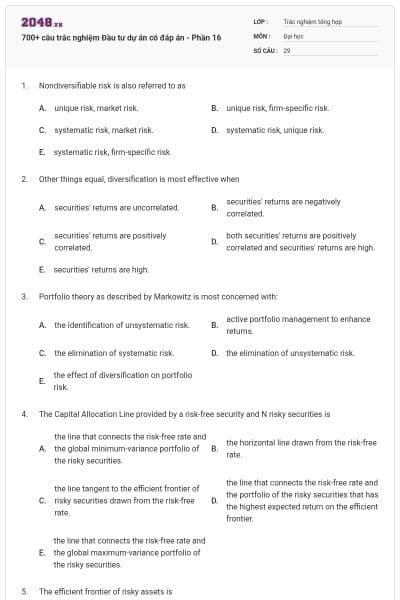
unique risk, market risk.
unique risk, firm-specific risk.
systematic risk, market risk.
systematic risk, unique risk.
systematic risk, firm-specific risk
Chọn đáp án C
securities' returns are uncorrelated.
securities' returns are negatively correlated.
securities' returns are positively correlated.
both securities' returns are positively correlated and securities' returns are high.
securities' returns are high.
Chọn đáp án B
the identification of unsystematic risk.
active portfolio management to enhance returns.
the elimination of systematic risk.
the elimination of unsystematic risk.
the effect of diversification on portfolio risk.
Chọn đáp án E
the line that connects the risk-free rate and the global minimum-variance portfolio of the risky securities.
the horizontal line drawn from the risk-free rate.
the line tangent to the efficient frontier of risky securities drawn from the risk-free rate.
the line that connects the risk-free rate and the portfolio of the risky securities that has the highest expected return on the efficient frontier.
the line that connects the risk-free rate and the global maximum-variance portfolio of the risky securities.
Chọn đáp án C
the portion of the investment opportunity set that lies above the global minimum variance portfolio.
both the portion of the investment opportunity set that lies above the global minimum variance portfolio and the portion of the investment opportunity set that represents the highest standard deviations.
the portion of the investment opportunity set which includes the portfolios with the lowest standard deviation.
the set of portfolios that have zero standard deviation.
the portion of the investment opportunity set that represents the highest standard deviations
Chọn đáp án A
is the sum of the securities' returns.
is both a weighted average of the securities' returns and a weighted sum of the securities' variances and covariances.
is the weighted sum of the securities' variances and covariances.
is a weighted average of the securities' returns.
is the weighted sum of the securities' covariances
Chọn đáp án D
1.0
0.5
0.0
-1.0
negative.
Chọn đáp án D
None of these is correct.
The point of tangency with the opportunity set and the capital allocation line.
The point of tangency with the indifference curve and the capital allocation line.
The point of highest reward to variability ratio in the opportunity set.
The point of the highest reward to variability ratio in the indifference curve
Chọn đáp án C
portfolio opportunity set
risk/reward tradeoff line
Capital Allocation Line
Security Market Line
efficient frontier
Chọn đáp án A

Học thông minh hơn mỗi ngày
Xem toàn bộ 29 câu hỏi và nhiều hơn nữa với tài khoản miễn phí
standard deviation of returns.
unique risk.
specific risk.
reinvestment risk.
beta
Chọn đáp án A
the determination of the best CAL is objective and the choice of the inputs to be used to determine the efficient frontier is subjective.
investors are separate beings and will therefore have different preferences regarding the risk-return tradeoff.
the choice of inputs to be used to determine the efficient frontier is objective and the choice of the best CAL is subjective.
the determination of the best risky portfolio is objective and the choice of the best complete portfolio is subjective.
the choice of the best complete portfolio is objective and the determination of the best risky portfolio is objective
Chọn đáp án D
the assets have a correlation coefficient less than one.
the assets have a correlation coefficient equal to one.
the assets have a correlation coefficient equal to zero.
the assets have a correlation coefficient greater than zero.
the assets have a correlation coefficient less than zero
Chọn đáp án B
cannot be diversified away.
results from factors unique to the firm.
depends on market volatility.
is likely to be higher in an increasing market.
is likely to be lower in a decreasing market.
Chọn đáp án B
the portfolio standard deviation will always be equal to the securities' covariance.
both the portfolio standard deviation will be greater than the weighted average of the individual security standard deviations and it will always be equal to the securities' covariance .
the portfolio standard deviation will be equal to the weighted average of the individual security standard deviations.
the portfolio standard deviation will be greater than the weighted average of the individual security standard deviations.
the portfolio standard deviation will be less than the weighted average of the individual security standard deviations.
Chọn đáp án E
Less risk-averse investors will invest more in the risk-free security and less in the optimal risky portfolio than more risk-averse investors.
Investors choose the portfolio that maximizes their expected utility.
Less risk-averse investors will invest more in the risk-free security and less in the optimal risky portfolio than more risk-averse investors and investors will choose the portfolio that maximizes their expected utility.
More risk-averse investors will invest less in the optimal risky portfolio and more in the risk-free security than less risk-averse investors and investors will choose the portfolio that maximizes their expected utility.
More risk-averse investors will invest less in the optimal risky portfolio and more in the risk-free security than less risk-averse investors.
Chọn đáp án D
There is a linear relationship between the securities' coefficient of correlation and the portfolio variance.
The higher the coefficient of correlation between securities, the greater the reduction in the portfolio variance and there is a linear relationship between the securities' coefficient of correlation and the portfolio variance.
The degree to which the portfolio variance is reduced depends on the degree of correlation between securities.
The higher the coefficient of correlation between securities, the greater the reduction in the portfolio variance.
The higher the coefficient of correlation between securities, the greater the reduction in the portfolio variance and the degree to which the portfolio variance is reduced depends on the degree of correlation between securities.
Chọn đáp án C
Only portfolio X cannot lie on the efficient frontier.
Only portfolio W cannot lie on the efficient frontier.
Only portfolio Y cannot lie on the efficient frontier.
Cannot tell from the information given.
Only portfolio Z cannot lie on the efficient frontier.
Chọn đáp án B
Only portfolio D cannot lie on the efficient frontier.
Only portfolio A cannot lie on the efficient frontier.
Cannot tell from the information given.
Only portfolio B cannot lie on the efficient frontier.
Only portfolio C cannot lie on the efficient frontier.
Chọn đáp án A
The risk-reducing benefits of diversification do not occur meaningfully until at least 50-60 individual securities have been purchased.
Proper diversification can eliminate systematic risk.
Typically, as more securities are added to a portfolio, total risk would be expected to decrease at a decreasing rate.
Proper diversification can eliminate systematic risk and increase return.
Because diversification reduces a portfolio's total risk, it necessarily reduces the portfolio's expected return
Chọn đáp án C
8.3%.
1.7%
-1.7%.
-5.5%.
5.5%
Chọn đáp án B
-0.95%.
-1.7%.
5.5%.
4.4%.
8.3%
Chọn đáp án A
unsystematic risk.
interest rate risk.
market risk.
reinvestment risk.
unique risk.
Chọn đáp án C
None of these is correct.
10.00%
10.26%
9.25%
13.98%
Chọn đáp án E
Giải thích: FV = 1100, n = 3, PMT = 100, PV = -975, i = 13.98%
None of these is correct.
\$729
\$870
\$1,000
\$810
Chọn đáp án C
Giải thích: 30 shares × \$29/share = \$870
\$1,110.10
None of these is correct.
\$1,160.25
\$1,087.50
\$1,150.00
Chọn đáp án D
Giải thích: 1000*1.08=1080 (90/2)*(30/182)=7.5
\$1,080 + \$7.5 (accrued interest) = \$1,087.50
6.00%
8.33%
12.00%
60.00%
None of these is correct.
Chọn đáp án C
Giải thích: FV = 1,000, PMT = 100, n = 5, PV = -928, i = 11.997%
12.62%
12.68%
12.40%
12.55%
None of these is correct
Chọn đáp án B
Giải thích: \$990/\$99,010 = 0.01; (1.01)^12 - 1.0 = 12.68%
1.0% and 1.2%
0.7% and 1.5%
0.8% and 1.3%
None of these is correct.
1.2% and 1.0%
Chọn đáp án C
Giải thích: Shell: 6.5% - 5.7% = 0.8%; Ford: 7.5% - 6.2% = 1.3%.
\$1,661.20
\$983.61
\$491.80
None of these is correct.
\$800.00
Chọn đáp án A
Giải thích: Accrued interest = (Annual coupon payment/2)*(Days since last coupon payment/Days separating coupon payments)
76/183(\$4,000) = \$1,661.2
Bạn có thích hoạt động này không?
Hãy lưu hoặc chia sẻ nội dung này đến mọi người.
Gợi ý cho bạn

Ý tưởng của bạn, bài học của bạn
Tự thiết kế đề thi, bài giảng hoặc flashcard theo cách riêng.


Học liệu phổ biến Trắc nghiệm tổng hợp
Trắc nghiệm tổng hợp
Bài tập vừa sức, đúng lớp
Chọn nội dung phù hợp và tạo hoạt động cho lớp của bạn.