700+ câu trắc nghiệm Đầu tư tài chính có đáp án - Phần 14
30 câu hỏi
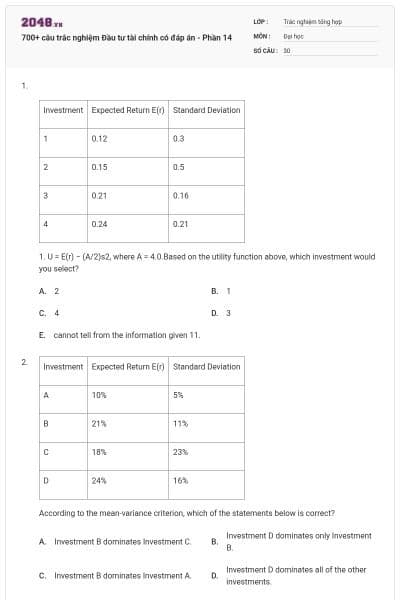
2
1
4
3
cannot tell from the information given 11.
Chọn đáp án D
Investment B dominates Investment C.
Investment D dominates only Investment B.
Investment B dominates Investment A.
Investment D dominates all of the other investments.
Investment C dominates investment A
Chọn đáp án A
III and IV
I and III
I and II
II and IV
I and V
Chọn đáp án B
represented by the scaling factor "−.005" in the utility function.
the rate that a risk-free investment would need to offer with certainty to be considered equally attractive as the risky portfolio.
the rate that equates "A" in the utility function with the average risk aversion coefficient for all risk-averse investors.
the minimum rate guaranteed by institutions such as banks.
the rate that the investor must earn for certain to give up the use of his money.
Chọn đáp án
None of these is correct.
cannot be known with perfect certainty.
can be calculated precisely with the use of advanced calculus.
allow the advisor to create more suitable portfolios for the client.
cannot be known with perfect certainty but they do allow the advisor to create more suitable portfolios for the client.
Chọn đáp án E
final wealth will be greater than initial wealth.
investors will lose money.
terminal wealth will be less than initial wealth.
more than one outcome is possible.
the standard deviation of the payoff is larger than its expected value
Chọn đáp án D
will increase as the rate of return increases.
will decrease as the rate of return increases.
will decrease as the standard deviation decreases.
will increase as the variance increases.
will decrease as the variance decreases.
Chọn đáp án A
the security's variance.
minimum required utility of the portfolio.
investor's return requirement.
investor's aversion to risk.
certainty-equivalent rate of the portfolio
Chọn đáp án D
A portfolio that pays 10 percent with 40 percent probability or 5 percent with a 60 percent probability.
A portfolio that pays 12 percent with 20 percent probability or 2 percent with 80 percent probability.
A portfolio that pays 10 percent with a 60 percent probability or 5 percent with 40 percent probability.
A portfolio that pays 12 percent with 60 percent probability or 5 percent with 40 percent probability.
A portfolio that pays 12 percent with 40 percent probability or 5 percent with 60 percent probability.
Chọn đáp án A

Học thông minh hơn mỗi ngày
Xem toàn bộ 30 câu hỏi và nhiều hơn nữa với tài khoản miễn phí
The investor's feelings about loss
The investor's prior investing experience
The investor's tendency to make risky or conservative choices
The level of return the investor prefers
The investor's degree of financial security
Chọn đáp án D
I and II only
II, III, and IV only
II and III only
I only
II only
Chọn đáp án A
They only accept risky investments that offer risk premiums over the risk- free rate.
They only care about the rate of return and accept investments that are fair games.
They only care about the rate of return.
They accept investments that are fair games.
They are willing to accept lower returns and high risk.
Chọn đáp án A
assessing the effects of inflation.
measuring the standard deviation of returns.
understanding how returns increase relative to risk increases.
analyzing returns on variable rate bonds.
None of these is correct.
Chọn đáp án C
0.087; 0.06
0.087; 0.12
0.114; 0.12
0.795; 0.14
0.295; 0.12
Chọn đáp án A
Giải thích: E(rP) = 0.3(15%) + 0.7(6%) = 8.7% sP = 0.3(0.04)^1/2 = 6%
0.106; 0.137
0.114; 0.112
0.096; 0.126
0.087; 0.144
0.087; 0.063
Chọn đáp án C
may involve the decision as to the allocation between a risk-free asset and a risky asset and may involve the decision as to the allocation among different risky assets.
may involve considerable security analysis.
may involve the decision as to the allocation between a risk-free asset and a risky asset and may involve considerable security analysis.
may involve the decision as to the allocation among different risky assets only.
may involve the decision as to the allocation between a risk-free asset and a risky asset only
Chọn đáp án A
all investors will have the same portfolio asset allocations.
investors would perform vastly different levels of security analysis.
investors will hold varying amounts of the risky asset in their portfolios.
investors will hold varying amounts of the risk-free asset in their portfolios.
investors will hold varying amounts of the risky asset and the risk-free asset in their portfolios
Chọn đáp án E
Cannot be determined.
The set of portfolios formed with the T-bill and security A.
The set of portfolios formed with the T-bill and security D.
The set of portfolios formed with the T-bill and security C.
The set of portfolios formed with the T-bill and security B
Chọn đáp án D
Giải thích: Security C has the highest reward-to-volatility ratio
maximizes her expected utility.
maximizes her expected profit.
minimizes both her risk and return.
minimizes her risk.
maximizes her risk
Chọn đáp án A
skewness
the Indifference Curve
the investor's utility line
the Security Market Line
the Capital Allocation Line
Chọn đáp án E
I, II, and III
III and IV
II, III, and IV
I, II, III, and IV
I, III, and IV
Chọn đáp án D
an investor's risk tolerance is decreasing.
borrowing rate exceeding lending rate.
increase in the portfolio proportion of the risk-free asset.
reward-to-volatility ratio increasing.
a flawed theory
Chọn đáp án B
analyzing financial statements.
assessing risk tolerance.
estimating security betas.
determining how much money a client needs to make.
identifying market anomalies.
Chọn đáp án B
change the standard deviation of the portfolio and find the expected return the investor would require to maintain the same utility level.
change the risk-free rate and find the utility level that results in the same standard deviation.
change the expected return of the portfolio and equate the utility to the standard deviation.
find another utility level with 0% risk.
find the utility of a portfolio with 0% in the risk-free asset.
Chọn đáp án A
Both their short-term nature makes their values insensitive to interest rate fluctuations and the inflation uncertainty over their time to maturity is negligible.
both the inflation uncertainty over their time to maturity is negligible and their term to
their short-term nature makes their values insensitive to interest rate fluctuations.
the inflation uncertainty over their time to maturity is negligible.
their term to maturity is identical to most investors' desired holding periods
Chọn đáp án A
\$568; \$378; \$54
\$108; \$514; \$378
\$568; \$54; \$378
\$378; \$54; \$568
Cannot be determined
Chọn đáp án A
Giải thích: (\$1,120 - \$1,000)/\$1,000 = 12% (0.6)14% + (0.4)10% = 12.4% 12% = w5% + 12.4%(1 - w)
w = 0.054
1-w = 0.946
w = 0.054(\$1,000) = \$54 (T-bills)
1 - w = 1 - 0.054 = 0.946(\$1,000) = \$946
\$946 × 0.6 = \$568 in X
\$946 × 0.4 = \$378 in Y.
The CAL shows risk-return combinations and is also called the efficient frontier of risky assets in the absence of a risk-free asset.
The CAL is also called the efficient frontier of risky assets in the absence of a risk-free asset.
The CAL shows risk-return combinations.
The slope of the CAL is also called the reward-to-volatility ratio.
The slope of the CAL equals the increase in the expected return of the complete portfolio per unit of additional standard deviation.
Chọn đáp án B
0.50; 0.50
0.25; 0.75
cannot be determined
0.19; 0.81
0.65; 0.35
Chọn đáp án D
Giải thích: E(rp) = 0.6(14%) + 0.4(10%) = 12.4% 11% = 5x + 12.4(1 - x)
x = 0.189 (T-bills) (1-x) = 0.811 (risky asset).
62.5% and 37.5%
75% and 25%
cannot be determined
57% and 43%
85% and 15%
Chọn đáp án A
Giải thích: 8% = w1(11%) + (1 - w1)(3%)
8% = 11%w1 + 3% - 3%w1
5% = 8%w1
w1 = 0.625
1 - w1 = 0.375
0.625(11%) + 0.375(3%) = 8.0%
50% and 50%
30% and 70%
Cannot be determined.
60% and 40%
40% and 60%
Chọn đáp án E
Giải thích: 0.08 = x(0.20); x = 40% in risky asset.
Bạn có thích hoạt động này không?
Hãy lưu hoặc chia sẻ nội dung này đến mọi người.
Gợi ý cho bạn

Ý tưởng của bạn, bài học của bạn
Tự thiết kế đề thi, bài giảng hoặc flashcard theo cách riêng.



Học liệu phổ biến Trắc nghiệm tổng hợp
Trắc nghiệm tổng hợp
Bài tập vừa sức, đúng lớp
Chọn nội dung phù hợp và tạo hoạt động cho lớp của bạn.