500 bài Đọc hiểu ôn thi Tiếng anh lớp 12 có đáp án (Đề 7)
7 câu hỏi
Read the following passage and mark the letter A, B, C, or D on your answer sheet to indicate the correct answer to each of the questions.
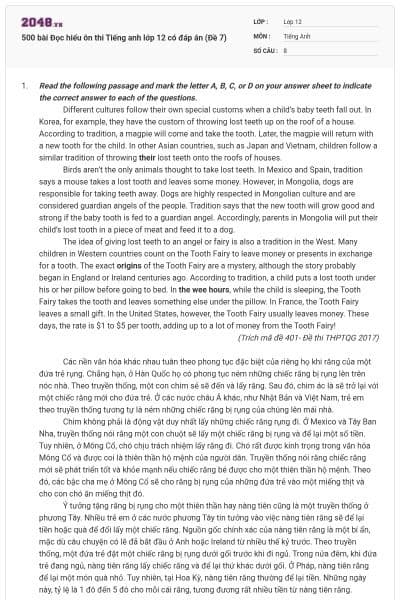
Different cultures follow their own special customs when a child’s baby teeth fall out. In Korea, for example, they have the custom of throwing lost teeth up on the roof of a house. According to tradition, a magpie will come and take the tooth. Later, the magpie will return with a new tooth for the child. In other Asian countries, such as Japan and Vietnam, children follow a similar tradition of throwing their lost teeth onto the roofs of houses.
Birds aren’t the only animals thought to take lost teeth. In Mexico and Spain, tradition says a mouse takes a lost tooth and leaves some money. However, in Mongolia, dogs are responsible for taking teeth away. Dogs are highly respected in Mongolian culture and are considered guardian angels of the people. Tradition says that the new tooth will grow good and strong if the baby tooth is fed to a guardian angel. Accordingly, parents in Mongolia will put their child’s lost tooth in a piece of meat and feed it to a dog.
The idea of giving lost teeth to an angel or fairy is also a tradition in the West. Many children in Western countries count on the Tooth Fairy to leave money or presents in exchange for a tooth. The exact origins of the Tooth Fairy are a mystery, although the story probably began in England or Ireland centuries ago. According to tradition, a child puts a lost tooth under his or her pillow before going to bed. In the wee hours, while the child is sleeping, the Tooth Fairy takes the tooth and leaves something else under the pillow. In France, the Tooth Fairy leaves a small gift. In the United States, however, the Tooth Fairy usually leaves money. These days, the rate is $1 to $5 per tooth, adding up to a lot of money from the Tooth Fairy!
(Trích mã đề 401- Đề thi THPTQG 2017)
Các nền văn hóa khác nhau tuân theo phong tục đặc biệt của riêng họ khi răng của một đứa trẻ rụng. Chẳng hạn, ở Hàn Quốc họ có phong tục ném những chiếc răng bị rụng lên trên nóc nhà. Theo truyền thống, một con chim sẻ sẽ đến và lấy răng. Sau đó, chim ác là sẽ trở lại với một chiếc răng mới cho đứa trẻ. Ở các nước châu Á khác, như Nhật Bản và Việt Nam, trẻ em theo truyền thống tương tự là ném những chiếc răng bị rụng của chúng lên mái nhà.
Chim không phải là động vật duy nhất lấy những chiếc răng rụng đi. Ở Mexico và Tây Ban Nha, truyền thống nói rằng một con chuột sẽ lấy một chiếc răng bị rụng và để lại một số tiền. Tuy nhiên, ở Mông Cổ, chó chịu trách nhiệm lấy răng đi. Chó rất được kính trọng trong văn hóa Mông Cổ và được coi là thiên thần hộ mệnh của người dân. Truyền thống nói rằng chiếc răng mới sẽ phát triển tốt và khỏe mạnh nếu chiếc răng bé được cho một thiên thần hộ mệnh. Theo đó, các bậc cha mẹ ở Mông Cổ sẽ cho răng bị rụng của những đứa trẻ vào một miếng thịt và cho con chó ăn miếng thịt đó.
Ý tưởng tặng răng bị rụng cho một thiên thần hay nàng tiên cũng là một truyền thống ở phương Tây. Nhiều trẻ em ở các nước phương Tây tin tưởng vào việc nàng tiên răng sẽ để lại tiền hoặc quà để đổi lấy một chiếc răng. Nguồn gốc chính xác của nàng tiên răng là một bí ẩn, mặc dù câu chuyện có lẽ đã bắt đầu ở Anh hoặc Ireland từ nhiều thế kỷ trước. Theo truyền thống, một đứa trẻ đặt một chiếc răng bị rụng dưới gối trước khi đi ngủ. Trong nửa đêm, khi đứa trẻ đang ngủ, nàng tiên răng lấy chiếc răng và để lại thứ khác dưới gối. Ở Pháp, nàng tiên răng để lại một món quà nhỏ. Tuy nhiên, tại Hoa Kỳ, nàng tiên răng thường để lại tiền. Những ngày này, tỷ lệ là 1 đô đến 5 đô cho mỗi cái răng, tương đương rất nhiều tiền từ nàng tiên răng.
What is the passage mainly about?
Traditions concerning children’s lost teeth
Presents for young children’s lost teeth
Animals eating children’s lost teeth
Customs concerning children’s new teeth
Đáp án A
Đoạn văn chủ yếu nói về?
A. phong tục về việc thay răng sữa của trẻ
B. món quà cho những đứa trẻ thay răng
C. những con động vật ăn răng sữa của trẻ
D. phong tục về việc mọc răng mới của trẻ
Căn cứ vào câu đầu tiên trong đoạn văn:
“Different cultures follow their own special customs when a child’s baby teeth fall out.”
(Những nền văn hóa khác nhau có những phong tục đặc biệt khi trẻ con thay răng.)The word "their" in paragraph 1 refers to_________.
houses’
roofs’
children’s
countries’
Đáp án C
Từ “their” trong đoạn 1 ám chỉ___________.
Căn cứ vào thông tin trong câu có chứa từ đó: “In other Asian countries, such as Japan and Vietnam, children follow a similar tradition of throwing their lost teeth onto the roofs of houses.”
(Ở các nước châu Á khác, như là Nhật và Việt Nam, lũ trẻ cũng áp dụng tương tự truyền thống ném chiếc răng sữa bị rụng của chúng lên trên mái nhà.)
According to the passage, where is a child’s lost tooth thought to be taken away by a mouse?
In Mexico and Spain
In Mongolia
In Japan and Vietnam
In Korea
Đáp án A
Theo như đoạn văn này, ở đâu răng sữa bị rụng của trẻ được nghĩ là bị chuột tha đi?
A. ở Mexico và Tây Ban Nha
B. ở Mongolia
C. ở Nhật Bản và Việt Nam
D. ở Hàn Quốc
Căn cứ vào thông tin sau trong đoạn văn: “In Mexico and Spain, tradition says a mouse takes a lost tooth and leaves some money.”
(Ở Mexico và Tây Ban Nha, theo truyền thống thì 1 chú chuột sẽ đến lấy chiếc răng đi và để lại 1 ít tiền lẻ.)
According to paragraph 2, parents in Mongolia feed their child’s lost tooth to a dog because____________.
they know that dogs are very responsible animals
they believe that this will make their child’s new tooth good and strong
they think dogs like eating children’s teeth
they hope that their child will get some gifts for his or her tooth
Đáp án B
Theo đoạn văn số 2, bố mẹ ở Mongolia mang răng rụng của con nhà mình cho chó ăn bởi vì_________________.
A. Họ biết rằng chó là loài vật rất có trách nhiệm.
B. Họ tin rằng điều này sẽ làm cho răng mới của con họ sẽ chắc khỏe hơn.
C. Họ nghĩ rằng chó thích ăn răng của trẻ con.
D. Họ hi vọng rằng con nhà họ sẽ có một vài món quà cho răng của nó.
Căn cứ vào thông tin sau: “Dogs are highly respected in Mongolian culture and are considered guardian angels of the people. Tradition says that the new tooth will grow good and strong if the baby tooth is fed to a guardian angel. Accordingly, parents in Mongolia will put their child’s lost tooth in a piece of meat and feed it to a dog.”
(Loài chó rất được tôn sùng trong nên văn hóa Mongolian, chúng được xem như những vị thần hộ vệ của loài người. Truyền thuyết kể rằng chiếc răng mới sẽ mọc lên đẹp và chắc chắn nếu như chiếc răng cũ được đem cho một vị thần hộ vệ ăn. Vì thế, những bậc cha mẹ ở Mongolian sẽ nhét chiếc răng sữa rụng của trẻ vào một miếng thịt và đem cho 1 chú cho ăn.)
The phrase "the wee hours" in paragraph 3 probably refers to the period of time_________.
early in the evening
soon after midnight
late in the morning
long before bedtime
Đáp án B
Cụm từ “the wee hours” trong đoạn 3 có lẽ ám chỉ khoảng thời gian_____________.
A. sớm vào buổi tối
B. sớm sau nửa đêm
C. muộn vào buổi sáng
D. rất lâu trước giờ đi ngủ
The wee hours = soon after midnight
The word "origins" in paragraph 3 is closest in meaning to_______.
countries
families
beginnings
stories
Đáp án C
Từ “origins” trong đoạn 3 gần nghĩa nhất với từ________________ .
A. countries: những quốc gia
B. families: những gia đình
C. beginnings: những nguồn gốc
D. stories: những câu chuyện
Căn cứ vào thông tin sau: “The exact origins of the Tooth Fairy are a mystery, although the story probably began in England or Ireland centuries ago.”
(Nguồn gốc câu chuyện tiên răng vẫn là một ẩn số mặc dù câu chuyện gần như chắc chắn được bắt nguồn từ Anh hoặc Ai Len vào nhiều thế kỷ trước.)
According to the passage, which of the following is NOT true about the tradition of tooth giving in the West?
Children give money to the Tooth Fairy.
Children put their lost teeth under their pillows.
Children hope to get money or gifts from the Tooth Fairy.
Lost teeth are traditionally given to an angel or fairy.
Đáp án A
Theo như đoạn văn này, câu nào dưới đây không đúng về truyền thống vứt răng ở phương Tây?
A. Trẻ con đưa tiền cho Tiên Răng.
B. Trẻ con đặt răng ở dưới gối của chúng.
C. Trẻ con hi vọng nhận được tiền hoặc là quà từ Tiên Răng.
D. Những chiếc răng rụng được tặng cho một thiên thần hoặc một vị tiên.
=> B đúng. Căn cứ vào thông tin trong đoạn văn cuối “According to tradition, a child puts a lost tooth under his or her pillow before going to bed.”
(Theo truyền thống, một đứa trẻ đặt một chiếc răng rụng dưới gối trước khi đi ngủ.)
=> C đúng. Căn cứ vào thông tin sau: “Many children in Western countries count on the Tooth Fairy to leave money or presents in exchange for a tooth.”
(Nhiều đứa trẻ ở các nước Phương Tây tin tưởng vị Tiên Răng đổi tiền hoặc quà để lấy một chiếc răng.)
=> D đúng. Vì theo thông tin: “The idea of giving lost teeth to an angel or fairy is also a tradition in the West.”
(Ý tưởng tặng răng thay cho một thiên thần hoặc một vị tiên cũng là một truyền thống ở Phương Tây.)
Trong bài không đề cập đến việc trẻ em đưa tiền cho tiên răng.
Bạn có thích hoạt động này không?