300+ câu trắc nghiệm Tiếng Anh Công nghệ ô tô có đáp án - Phần 9
30 câu hỏi
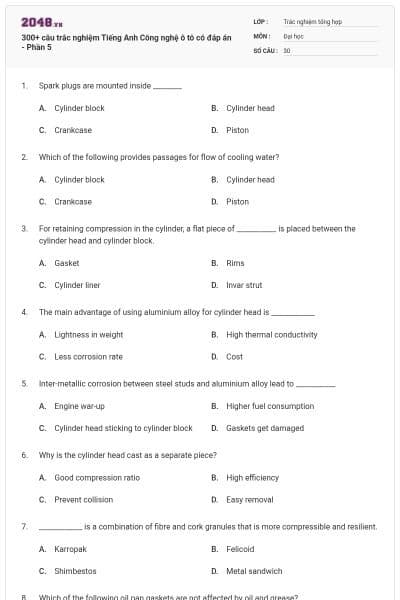
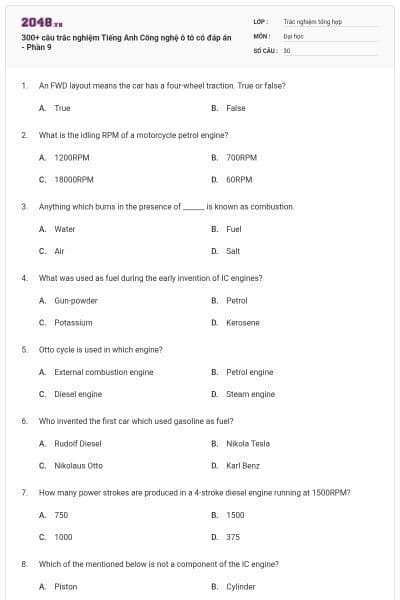
An FWD layout means the car has a four-wheel traction. True or false?
True
False
Chọn đáp án B
What is the idling RPM of a motorcycle petrol engine?
1200RPM
700RPM
18000RPM
60RPM
Chọn đáp án A
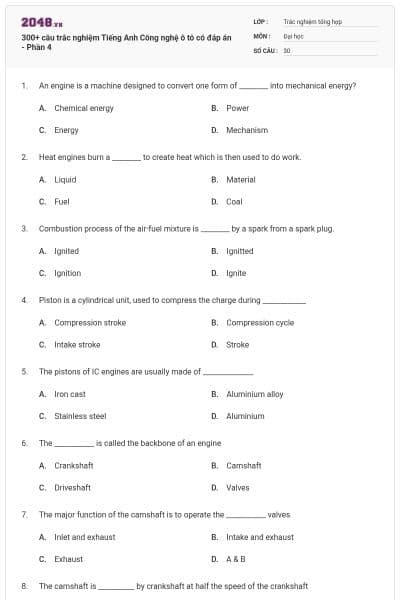
Anything which burns in the presence of ______ is known as combustion.
Water
Fuel
Air
Salt
Chọn đáp án C
What was used as fuel during the early invention of IC engines?
Gun-powder
Petrol
Potassium
Kerosene
Chọn đáp án A
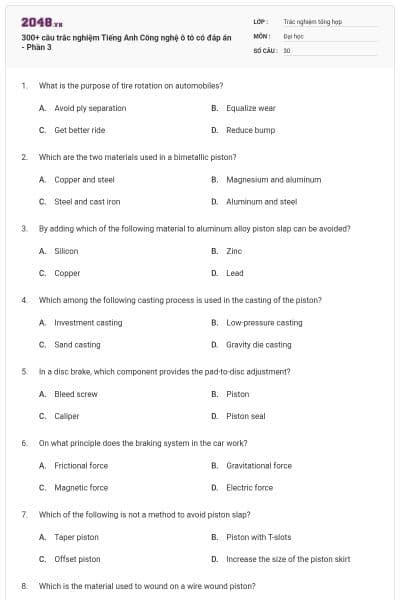
Otto cycle is used in which engine?
External combustion engine
Petrol engine
Diesel engine
Steam engine
Chọn đáp án B
Who invented the first car which used gasoline as fuel?
Rudolf Diesel
Nikola Tesla
Nikolaus Otto
Karl Benz
Chọn đáp án D
How many power strokes are produced in a 4-stroke diesel engine running at 1500RPM?
750
1500
1000
375
Chọn đáp án A
Which of the mentioned below is not a component of the IC engine?
Piston
Cylinder
Wheel
Spark plug
Chọn đáp án C
The black smoke coming out of a petrol engine is due to what particles?
Oxygen molecules
Magnesium particles
Nitrox
Carbon particles
Chọn đáp án D
Which is the first company to use assembly line mode for the production of cars?
Fiat
Mercedes Benz
Ford
Volvo
Chọn đáp án C
Which of the mentioned below is the external combustion engine?
Wankel engine
Steam engine
Petrol engine
VTEC engine
Chọn đáp án B
The Wankel engine is also called a Rotary engine.
True
False
Chọn đáp án A
Earlier, which material was used in pistons?
Aluminum alloy
Cast iron
Steel
Brass
Chọn đáp án B
Why aluminum alloy pistons are used in highly rated engine?
Due to its thermal factor
Due to its alloying element
Due to the piston speed
Due to circular
Chọn đáp án C
Cast iron pistons were used in low-speed cars, why?
Due to inertia force
Due to low-speed piston
Due to momentum
Due to centrifugal force
Chọn đáp án B
Why aluminum alloy pistons need more clearance?
Free moment
Good fixture
Thermal expansion
Cold start
Chọn đáp án C
Why cast iron was used in pistons earlier?
Availability
Cost
Luster property
Design feature
Chọn đáp án A
Which is the electrolyte used in Li-ion battery?
Lead dioxide
Lithium-based gel
Sulfur dioxide
Cobalt
Chọn đáp án B
Which of the following statement is true for the movement of electrons concerning the direction of current?
Same as the direction of current
Opposite direction of current
Does not depend on the direction of current
No movement of electrons
Chọn đáp án B
Which is the material used to as anode in a lithium-ion battery?
Brass foil coated with graphite
Aluminum foil coated with graphite
Copper foil coated with graphite
Stainless steel coated with graphite
Chọn đáp án B
Which of the following is formed at the graphite electrode during the charging process of a battery when the lithium-ion move through the separator?
Water
Graphite
Lithium hydroxide
Lithium carbide
Chọn đáp án D
What is the maximum storage temperature in degree centigrade of a Li-ion battery?
30
50
60
40
Chọn đáp án C
Which of the following material is used as separator material in Lithium-ion battery?
Brass
Metal sheet
Paper
Plastic
Chọn đáp án D
Which test is used to determine the evaporative emissions from an engine?
Canister test
Cat aging test
Vibration test
SHED test
Chọn đáp án D
Which test is used to measure a coating’s resistance to abrasions?
Coating and paint testing
Gravelometer testing
Emission bench testing
Mechanical testing
Chọn đáp án B
Which gases cannot be measured in emissions bench testing?
Carbon monoxide
Carbon dioxide
Methane
Ethane
Chọn đáp án D
An engine has a bore diameter of 160mm, what is the maximum number of studs in the engine?
6
7
8
9
Chọn đáp án C
Which of the following material is used in the manufacturing of studs?
Iron
Nickel
Steel
Titanium
Chọn đáp án C
Which are the two forces experienced by the center crankshaft?
Tensile and compressive
Tensile and Bending
Compressive and torsional
Bending and torsional
Chọn đáp án D
Which material is used for crankshaft?
Carbon steel
Carbon fiber
Plain carbon steel
Bulged carbon steel
Chọn đáp án C
Bạn có thích hoạt động này không?