15000 bài tập tách từ đề thi thử môn Tiếng Anh có đáp án (Phần 88)
68 câu hỏi
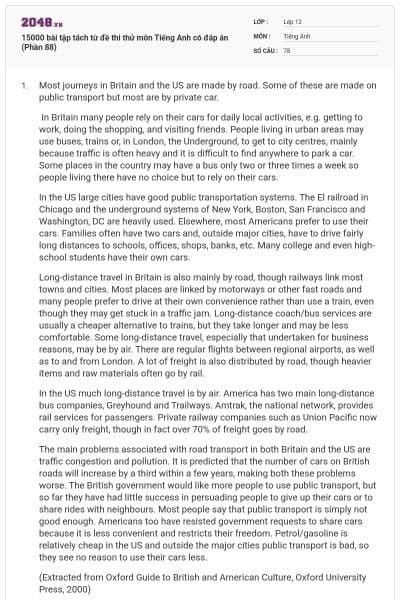
Most journeys in Britain and the US are made by road. Some of these are made on public transport but most are by private car.
In Britain many people rely on their cars for daily local activities, e.g. getting to work, doing the shopping, and visiting friends. People living in urban areas may use buses, trains or, in London, the Underground, to get to city centres, mainly because traffic is often heavy and it is difficult to find anywhere to park a car. Some places in the country may have a bus only two or three times a week so people living there have no choice but to rely on their cars.
In the US large cities have good public transportation systems. The El railroad in Chicago and the underground systems of New York, Boston, San Francisco and Washington, DC are heavily used. Elsewhere, most Americans prefer to use their cars. Families often have two cars and, outside major cities, have to drive fairly long distances to schools, offices, shops, banks, etc. Many college and even high-school students have their own cars.
Long-distance travel in Britain is also mainly by road, though railways link most towns and cities. Most places are linked by motorways or other fast roads and many people prefer to drive at their own convenience rather than use a train, even though they may get stuck in a traffic jam. Long-distance coach/bus services are usually a cheaper alternative to trains, but they take longer and may be less comfortable. Some long-distance travel, especially that undertaken for business reasons, may be by air. There are regular flights between regional airports, as well as to and from London. A lot of freight is also distributed by road, though heavier items and raw materials often go by rail.
In the US much long-distance travel is by air. America has two main long-distance bus companies, Greyhound and Trailways. Amtrak, the national network, provides rail services for passengers. Private railway companies such as Union Pacific now carry only freight, though in fact over 70% of freight goes by road.
The main problems associated with road transport in both Britain and the US are traffic congestion and pollution. It is predicted that the number of cars on British roads will increase by a third within a few years, making both these problems worse. The British government would like more people to use public transport, but so far they have had little success in persuading people to give up their cars or to share rides with neighbours. Most people say that public transport is simply not good enough. Americans too have resisted government requests to share cars because it is less convenient and restricts their freedom. Petrol/gasoline is relatively cheap in the US and outside the major cities public transport is bad, so they see no reason to use their cars less.
(Extracted from Oxford Guide to British and American Culture, Oxford University Press, 2000)
According to the passage, people in London may prefer the Underground to their own cars due to ______.
heavy traffic
cheap tickets
long distances
air pollution
Đáp án A
Theo bài đọc người ở Luân Đôn có thể thích đường hầm cho xe riêng của họ bởi vì
A.giao thông ùn tắc C. khoảng đường xa
B. vé rẻ D. air pollution
Dẫn chứng: People living in urban areas may use buses, trains or, in London, the Underground, to get to city centres, mainly because traffic is often heavy and it is difficult to find anywhere to park a car.
It is mentioned in paragraph 3 that the public transportation systems in the US are good in ______.
large cities
large states
some states
all cities
Đáp án A
Như được đề cập ở đoạn 3 hệ thống giao thông công cộng Mỹ tốt ở
A.các thành phố lớn C. một số bang
B. các bang lớn D. tất cả thành phố
Dẫn chứng: In the US large cities have good public transportation systems.
Which of the following is NOT true according to the passage?
Few college students in the US have their own cars.
The underground systems are popular in some major US cities.
Most Americans prefer to drive their cars outside large cities.
Families in the US often have more than one car.
Đáp án A
Câu nào sau đây không đúng theo như bài đọc?
A. Một vài sinh viên đại học ở Mỹ có xe riêng.
B. Hệ thống đường ngầm phổ biến ở các thành phố lớn của Mỹ.
C. Hầu hết người Mỹ thích lái xe ra ngoài các thành phố lớn.
D. Các gia đình Mỹ thường có 1 ô tô trở lên.
Dẫn chứng: Many college and even high-school students have their own cars.
The phrase “at their own convenience” in paragraph 4 is closest in meaning to ______.
at an early time and nearby place
at the fastest time and nearest place
at the latest time and nearest place
at an appropriate time and place
Đáp án D
Cụm từ “at their own convenience” ở đoạn 4 gần nghĩa nhất với
A. tại vào thời gian sớm và nơi lân cận
B. thời gian nhanh nhất và nơi gần nhất
C. thời gian muộn nhất và nơi gần nhất
D. thời gian và địa điểm thích hợp
Dẫn chứng:Most places are linked by motorways or other fast roads and many people prefer to drive at their own convenience rather than use a train, even though they may get stuck in a traffic jam.
Which of the following is true about transport in Britain?
Trains are usually cheaper than long-distance coach services.
There are no regular flights between regional airports.
Heavier items and raw materials are often transported by train.
Long-distance travel in Britain is only by road.
Đáp án C
Ý nào sau đây đúng về vận tải ở nước Anh?
A.Tàu hỏa thường rẻ hơn các dịch vụ xe khách đường dài.
B. Có những chuyến bay không thường xuyên đến các sân bay trong khu vực.
C. Những món hàng nặng hơn và nguyên liệu thô thường được vận chuyển và tàu hỏa.
D. Việc đi lại đường dài ở Anh chỉ bằng đường bộ.
Dẫn chứng: A lot of freight is also distributed by road, though heavier items and raw materials often go by rail.
It is stated in the passage that the major problems of road transport in Britain and the US are ______.
speeding and bad roads
drink-driving and traffic jams
traffic jams and pollution
accidents and pollution
Đáp án C
Bài đọc thể hiện rằng những vấn đề lớn của vận tải đường bộ ở Anh và Mỹ thì
A. nhanh và đường xấu C. ùn tắc giao thông và ô nhiễm
B. uống rượu lái xe và ùn tắc giao thông D. các tai nạn và ô nhiễm
Dẫn chứng:The main problems associated with road transport in both Britain and the US are traffic congestion and pollution.
According to the passage, people in Britain refuse public transport because ______.
they think it is not good enough
they see no reason to use their cars less
petrol is relatively cheap in Britain
they like to share rides with neighbours
Đáp án A
Theo bài đọc, người Anh từ chối dùng các phương tiện công cộng bởi vì
A. họ nghĩ rằng nó không đủ tốt
B. họ thấy không có lý do gì để sử dụng ô tô ít đi
C. xăng khá rẻ ở nước Anh
D. họ thích đi xe cùng với hàng xóm
Dẫn chứng: Most people say that public transport is simply not good enough.
The word “they” in the last sentence of the passage can best be replaced by ______.
major cities
Americans
the government
neighbours
Đáp án B
Từ “they” ở câu cuối của bài đọc có thể được thay thế tốt nhất bởi
A. các thành phố lớn C. chính phủ
B. người Mỹ D. những người hàng xóm
Dẫn chứng: Americans too have resisted government requests to share cars because it is less convenient and restricts their freedom. Petrol/gasoline is relatively cheap in the US and outside the major cities public transport is bad, so they see no reason to use their cars less.
A trend that has emerged recently is the sharing of childcare (321) __________ between husband and wife. Young couples will try to arrange their work schedules so that they work opposite hours or shifts in order that one parent is always home with the children. Since childcare is expensive, this saves money for the young couple trying to establish themselves and provide a secure environment for the family. Husband and wife may also share household chores. Some fathers are just as capable as mothers at cooking dinner, changing and bathing the baby, and doing the laundry.
In some cases, the woman’s salary is for family (322) __________ and the father becomes the “househusband." These cases are still fairly rare. One positive trend, however, is that fathers seem to be spending more time with their children. In a recent survey, 41% of the children sampled said they spend equal time with their mothers and fathers. “This is one of our most significant cultural changes,” says Dr. Leon Hoffman, who co-directs the Parent Child Center at the New York Psychoanalytic Society. In practice, for over 30 years, Hoffman has found "a very dramatic difference in the involvement of the father in everything from care-taking to general decision (323) __________ around kids' lives.”
Another factor has recently been added to the childcare formula. The number of people who work from home nearly full-time rose 23% from the last decade. The (324) _________ of technology - computers, faxes, teleconferencing - has made it easier for at-home workers to be constantly in touch.
abilities
possibilities
techniques
esponsibilities
Đáp án D
Abilities: khả năng Techniques: kỹ thuật
Possibilities: có thẻ Responsibilities: trách nhiệm
A trend that has emerged recently is the sharing of childcare (31) __________ between husband and wife.
[ Một xu hướng mới nổi lên gần đây là chia sẻ trách nhiệm chăm sóc con giữa vợ và chồng]
payment
expenses
fares
fees
Đáp án B
Payment: sự thanh toán/ trả nợ Fares: phí ( giao thông)
Expenses: chi tiêu/ chi phí Fees:phí ( học phí)
In some cases, the woman’s salary is for family (32) __________ and the father becomes the
“househusband."
[ Trong một vài trường hợp, lương của phụ nữ dành cho chi tiêu trong gia đình và ngưới bố trở thành nội trợ]
making
creating
holding
giving
Đáp án A
Make: tạo ra Hold: cầm/ giữ
Create: sáng tạo Give: đưa/ cho
Cụm từ: make decision [ quyết định]
In practice, for over 30 years, Hoffman has found "a very dramatic difference in the involvement of the father in everything from care-taking to general decision (33) __________ around kids' lives.”
[ Trong thực tiễn, khoảng hơn 3 năm, Hoffman đã phát hiện ra sự khác biệt rất lớn về sự tham gia của người bố trong mọi việc từ chăm sóc con cái cho đến đưa ra quyết định chung về cuộc cuộc đời các con]
The (324) _________ of technology - computers, faxes, teleconferencing - has made it easier for at-home workers to be constantly in touch.
accessible
accessibly
access
accessibility
Đáp án D
Accessible(a):có thể truy cập/ tiếp cận Access (n, v):truy cập
Accessibly(adv): Accessibility(n): khả năng truy cập
The (34) _________ of technology - computers, faxes, teleconferencing - has made it easier for at-home workers to be constantly in touch.
[ Khả năng truy cập công nghệ - máy vi tính, thuế, hội nghị - đã làm cho nó dễ dàng hơn cho những người nội trợ để được cập nhật liên tục]
If parents bring up a child with the sole aim of turning the child into a genius, they will cause a disaster. According to several leading educational psychologists, this is one of the biggest mistakes which ambitious parents make. Generally, the child will be only too aware of what his parents expect, and will fail. Unrealistic parental expectations can cause great damage to children.
However, if parents are not too unrealistic about what they expect their children to do, but are ambitious in a sensible way, the child may succeed in doing very well — especially if the parents are very supportive of their child. Michael Collins is very lucky. He is crazy about music, and his parents help him a lot by taking him to concerts and arranging private piano and violin lessons for him. They even drive him 50 kilometers twice a week for violin lessons. Michael's mother knows very little about music, but his father plays the trumpet in a large orchestra. However, he never makes Michael enter music competitions if he is unwilling.
Winston Smith, Michael's friend, however, is not so lucky. Both his parents are successful musicians, and they set too high a standard for Winston. They want their son to be as successful as they are and so they enter him for every piano competition held. They are very unhappy when he does not win. Winston is always afraid that he will disappoint his parents and now he always seems quiet and unhappy.
One of the serious mistakes parents can make is to __________.
push their child into trying too much
help their child to become a genius
make their child become a musician
neglect their child's education
Đáp án A
well-being:sự thịnh vượng/ hạnh phúc comfort: sự thoải mái
security: an ninh interests: sự thích thú, quan tâm
Will this new flexibility in the workforce bring a positive change for the (35) __________ of children? Only time will tell.
[Liệu rằng tính linh hoạt mới này trong lực lượng lao động sẽ mang lại sự thay đổi tích cực cho sự hạnh phúc của trẻ em. Chỉ có thời gian mới trả lời.]
Parents' ambition for their children is not wrong if they ___________.
force their children into achieving success
themselves have been very successful
understand and help their children sensibly
arrange private lessons for their children
Đáp án A
Một trong những lỗi lầm nghiêm trọng mà bố mẹ có thể gây ra là..............
A.thúc ép con họ cố gắng quá nhiều
B. giúp con họ trở thành thiên tài
C. làm con họ trở thành nhạc sĩ
D. sao lãng việc giáo dục con họ
Dẫn chứng:If parents bring up a child with the sole aim of turning the child into a genius, they will cause a disaster. According to several leading educational psychologists, this is one of the biggest mistakes which ambitious parents make.
Who have criticized the methods of some ambitious parents?
Successful musicians.
Unrealistic parents.
Their children.
Educational psychologists
Đáp án C
Hoài bão của bố mẹ dành cho con của họ là không sai nếu như họ.........
A.ép buộc con họ thành công
B. chính bản thân họ phải rất thành công
C. hiểu và giúp đỡ con họ một cách hợp lý
D. sắp xếp những bài học riêng cho con của họ.
Dẫn chứng:However, if parents are not too unrealistic about what they expect their children to do, but are ambitious in a sensible way, the child may succeed in doing very well — especially if the parents are very supportive of their child.
Michael Collins is fortunate in that ______.
his father is a musician
his parents are quite rich
his mother knows little about music
his parents help him in a sensible way
Đáp án D
Ai đã phê bình những phương pháp của một số bố mẹ đầy hoài bão?
A. các nhạc sĩ thành công
B. những bố mẹ không thực tế
C. con của họ
D. các nhà tâm lý giáo dục
Dẫn chứng:According to several leading educational psychologists, this is one of the biggest mistakes which ambitious parents make.
The phrase "crazy about" in the passage mostly means ________.
"surprised at"
"extremely interested in"
"completely unaware of"
"confused about"
Đáp án D
Michael Collin may mắn trong việc...................
A.bố ông là một nhạc sĩ
B. bố mẹ ông khá giàu có
C. mẹ ông biết một chút về âm nhạc
D. bố mẹ ông giúp đỡ ông một cách hợp lý
Dẫn chứng: Michael Collins is very lucky. He is crazy about music, and his parents help him a lot by taking him to concerts and arranging private piano and violin lessons for him. They even drive him 50 kilometers twice a week for violin lessons. Michael's mother knows very little about music, but his father plays the trumpet in a large orchestra. However, he never makes Michael enter music competitions if he is unwilling.
The phrase "crazy about" in the passage mostly means ________.
"surprised at"
"extremely interested in"
"completely unaware of"
"confused about"
Đáp án B
Cụm từ “crazy about” trong bài đọc hầu như có nghĩa là
A. ngạc nhiên về
B. cực kỳ thích thú với
C. hoàn toàn không ý thức về
D. bối rối về
Dẫn chứng: He is crazy about music, and his parents help him a lot by taking him to concerts and arranging private piano and violin lessons for him.
The word "They" in the passage refers to ________.
concerts
violin lessons
parents in general
Winston’s parents
Đáp án D
Từ “they” trong bài đọc ám chỉ đến.............
A.những buổi hòa nhạc
B. những bài dương cầm
C. bố mẹ nói chung
D. bố mẹ của Winston
Dẫn chứng:Winston Smith, Michael's friend, however, is not so lucky. Both his parents are successful musicians, and they set too high a standard for Winston. They want their son to be as successful as they are and so they enter him for every piano competition held.
The two examples given in the passage illustrate the principle that _______.
Successful parents always have intelligent children.
Successful parents often have unsuccessful children.
Parents should let the child develop in the way he wants.
Parents should spend more money on the child’s education.
Đáp án C
Hai ví dụ được ra trong bài để minh họa cho quy tắc..................
A. Bố mẹ thành công luôn có những đứa con thông minh.
B. Bố mẹ thành công thường có những đứa con không thành công.
C. Bố mẹ nên để cho các con phát triển theo cách mà chúng muốn.
D. Bố mẹ nên tiêu nhiều tiền hơn để giáo dục các con.
In addition to their military role, the forts of the nineteenth century provided numerous other benefits for the American West. The establishment of these posts opened new roads and provided for the protection of daring adventurers and expeditions as well as established settlers. Forts also served as bases where enterprising entrepreneurs could bring commerce to the West, providing supplies and refreshments to soldiers as well as to pioneers. Posts like Fort Laramie provided supplies for wagon trains traveling the natural highways toward new frontiers. Some posts became stations for the pony express; still others, such as Fort Davis, were stagecoach stops for weary travelers. All of these functions, of course, suggest that the contributions of the forts to the civilization and development of the West extended beyond patrol duty.
Through the establishment of military posts, yet other contributions were made to the development of western culture. Many posts maintained libraries or reading rooms, and some – for example, Fort Davis had schools. Post chapels provided a setting for religious services and weddings. Throughout the wilderness, post bands provided entertainment and boosted morale. During the last part of the nineteenth century, to reduce expenses, gardening was encouraged at the forts, thus making experimental agriculture another activity of the military. The military stationed at the various forts also played a role in civilian life by assisting in maintaining order, and civilian officials often called on the army for protection.
Certainly, among other significant contributions the army made to the improvement of the conditions of life was the investigation of the relationships among health, climate, and architecture. From the earliest colonial times throughout the nineteenth century, disease ranked as the foremost problem in defense. It slowed construction of forts and inhibited their military functions. Official documents from many regions contained innumerable reports of sickness that virtually incapacitated entire garrisons. In response to the problems, detailed observations of architecture and climate and their relationships to the frequency of the occurrence of various diseases were recorded at various posts across the nation by military surgeons.
Which of the following statements best expresses the main idea of the passage?
By the nineteenth century, forts were no longer used by the military.
Surgeons at forts could not prevent outbreaks of disease.
Forts were important to the development of the American West.
Life in nineteenth-century forts was very rough.
Đáp án C
Câu nào sau đây thể hiện tốt nhất nội dung của bài đọc?
A. Đên thế kỷ 19 các pháo đài không được quân đội sử dụng nữa.
B. Các bác sĩ giải phẫu ở pháo đài không thể ngăn chặn sự bùng phát dịch bệnh.
C. Các pháo đài quan trọng với sự phát triển của Tây Mỹ.
D. Cuộc sống trong các pháo đài thế kỷ 19 rất khó khăn.
Dẫn chứng: In addition to their military role, the forts of the nineteenth century provided numerous other benefits for the American West. Through the establishment of military posts, yet other contributions were made to the development of western culture.
Which of the following would a traveler be LEAST likely to obtain at Fort Laramie?
Fresh water
Food
Formal clothing
Lodging
Đáp án C
Vật nào sau đây mà du khách đến pháo đài Laramie ít có khả năng lấy được nhất?
A.nước sạch C. quần áo trang trọng
B. thức ăn D. nhà nghỉ
Dẫn chứng:The establishment of these posts opened new roads and provided for the protection of daring adventurers and expeditions as well as established settlers. Forts also served as bases where enterprising entrepreneurs could bring commerce to the West, providing supplies and refreshments to soldiers as well as to pioneers. Posts like Fort Laramie provided supplies for wagon trains traveling the natural highways toward new frontiers.
The word “boosted” in paragraph 2 is closest in meaning to _______.
influenced
established
raised
maintained
Đáp án C
Từ “boosted” ở đoạn 2 gần nghĩa nhất với..................
A.bị ảnh hưởng C. được nuôi dưỡng/ được nâng lên
B. được thành lập D. được duy trì
Dẫn chứng:Throughout the wilderness, post bands provided entertainment and boosted morale.
Which of the following is the most likely inference about the decision to promote gardening at forts?
It was expensive to import produce from far away.
Food brought in from outside was often spoiled
Gardening was a way to occupy otherwise idle soldiers.
The soil near the forts was very fertile.
Đáp án A
Câu nào sau đây có thể suy ra về quyết định đẩy mạnh làm vườn ở các pháo đài?
A. Quá tốn kém để nhập khẩu nông sản từ xa.
B. Thức ăn được mang từ bên ngoài thường bị hỏng.
C. Làm vườn là một cách để làm cho những binh lính nhàn rỗi trở nên bận rộn hơn.
D. Đất gần các pháo đài thường rất màu mỡ.
According to the passage, which of the following posed the biggest obstacle to the development of military forts?
Insufficient shelter
Shortage of materials
Attacks by wild animals
Illness
Đáp án D
Theo bài đọc, ý nào sau đây gây ra khó khăn lớn nhất cho sự phát triển của các pháo đài quân sự?
A. không đủ chỗ ở C. động vật hoang dã tấn công
B. thiếu nguyên liệu D. bệnh tật
Dẫn chứng:From the earliest colonial times throughout the nineteenth century, disease ranked as the foremost problem in defense.
The word “inhibited” in paragraph 3 is closest in meaning to _______.
involved
exploited
united
hindered
Đáp án D
Từ “inhibit” ở đoạn 3 gần nghĩa nhất với................
A.tham gia vào C. hợp nhất/ liên kết
B. khai thác D. ngăn cản
Dẫn chứng:It slowed construction of forts and inhibited their military functions. [ Nó làm chậm tiến trình xây dựng các pháo đài và cản trợ nhiêm vụ quân sự ]
How did the military assist in the investigation of health problems?
By registering annual birth and death rates
By experiments with different building materials
By maintaining records of diseases and potential causes
By monitoring the soldiers’ diets
Đáp án C
Quân đội đã giúp điều tra các vấn đề sức khỏe như thế nào?
A. Bằng cách đăng ký tỉ lệ sinh tử hằng năm.
B. Bằng các thí nghiệm với những vật liệu xây dựng khác nhau
C. Bằng việc giữ lại bản ghi của các căn bệnh và nguyên nhân có thể
D. Bằng cách kiểm soát chế độ ăn uống của các binh lính.
Dẫn chứng: among other significant contributions the army made to the improvement of the conditions of life was the investigation of the relationships among health, climate, and architecture. In response to the problems, detailed observations of architecture and climate and their relationships to the frequency of the occurrence of various diseases were recorded at various posts across the nation by military surgeons.
The author organizes the discussion of forts by ________.
describing their locations
comparing their sizes
explaining their damage to the environment
listing their contributions to western life
Đáp án D
Tác giả tổ chưc bài thảo luận về các pháo đài bằng cách...........
A. mô tả vị trí của nó
B. so sánh kích cỡ của nó
C. giải thích sự phá hủy của nó với môi trường
D. liệt kê những đóng góp vào đời sống phía tây
Dẫn chứng:In addition to their military role, the forts of the nineteenth century provided numerous other benefits for the American West. Through the establishment of military posts, yet other contributions were made to the development of western culture.
Rural America is diverse in many ways. As we have seen, no one industry dominates the rural economy, no single pattern of population decline or (341)________ exists for all rural areas, and no statement about improvements and gaps in well-being holds true for all rural people.
Many of these differences are regional in nature. That is, rural areas within a particular geographic region of the country often tend to be similar (342)_______ each other and different from areas in another region. Some industries, for example, are (343)_______ with different regions – logging and sawmills in the Pacific Northwest and New England, manufacturing in the Southeast and Midwest, and farming in the Great Plains. Persistent poverty also has a regional pattern, concentrated primarily in the Southeast. Other differences follow no regional pattern. Areas that rely heavily on the services industry are located throughout rural America, as are rural areas that have little access to advanced telecommunications services. Many of these differences, regional and non-regional, are the result of a (344)______ of factors including the availability of natural resources; distance from and access to major metropolitan areas and the information and services found there; transportation and shipping facilities; political history and structure; and the racial, ethnic, and (345)______ makeup of the population.
Adapted from “Understanding Rural America”, InfoUSA
grow
growth
growing
grown
Đáp án B
Grow (v): phát triển
Growth (n) Trước “or” là danh từ “ population decline” nên sau “or” cùng là danh từ
As we have seen, no one industry dominates the rural economy, no single pattern of population decline or (31)________ exists for all rural areas, and no statement about improvements and gaps in well-being holds true for all rural people. [ Như chúng ta thấy, không có n công nghiệp nào thống trị kinh tế nông nghiệp, không có trường hợp suy giảm hay phát triển dân số nào tồn tại ở tất cả các khu vực nông thôn, và không có phát biểu nào về sự tiến bộ và khoảng trống của sự thịnh vượng là đúng đối với người ở nông thôn.]
of
with
to
from
Đáp án C
Cụm từ: similar to [ tương tự như ]
That is, rural areas within a particular geographic region of the country often tend to be similar (32)_______ each other and different from areas in another region. [Đó là, các khu vực nông thôn trong một khu vực địa lý cụ thể của một đất nước thường có xu hướng giống nhau và khác so với khu vực khác]
added
associated
compared
related
Đáp án B
Cụm từ:
added to: thêm vào compared with: so với
associated with: liên quan đến related to: liên quan đến
Some industries, for example, are (33)_______ with different regions – logging and sawmills in the Pacific Northwest and New England, manufacturing in the Southeast and Midwest, and farming in the Great Plains.
[Một sô nên công nghiệp,chẳng hạn như liên quan đến các khu vực khác nhau – xưởng gỗ và xưởng cưa ở Tây bắc Thái Bình Dương và New England, sản xuất ở Đông Nam và Midwest, và canh tác ở Đồng bằng rộng lớn.]
cooperation
connection
link
combination
Đáp án D
cooperation: sự hợp tác
connection = link: sự liên kết/ kết nối
Cụm từ: a combination of factors [ sự kết hợp của các nhân tố]
Many of these differences, regional and non-regional, are the result of a (34)______ of factors including the availability of natural resources;
[ Nhiều sự khác nhau này, thuộc và không thuộc khu vực, là kết quả của sự kết hợp của nhiều yếu tố bao gồm các nguồn tài nguyên thiên nhiên sẵn có]
political history and structure; and the racial, ethnic, and (345)______ makeup of the population.
cultured
culturally
cultural
culture
Đáp án C
cultured (adj): có văn hóa cultural (adj): thuộc về văn hóa
culturally (adv) culture (n): văn hóa
and the racial, ethnic, and (35)______ makeup of the population.
[và sự cấu thành về mặt chủng tộc, dân tộc và văn hóa của dân số]
In my experience, freshmen today are different from those I knew when I started as a counselor and professor 25 years ago. College has always been demanding both academically and socially. But students now are less mature and often not ready for the responsibility of being in college.
It is really too easy to point the finger at parents who protect their children from life’s obstacles. Parents, who handle every difficulty and every other responsibility for their children from writing admission essays to picking college courses, certainly may contribute to their children’s lack of coping strategies. But we can look even more broadly to the social trends of today.
How many people do you know who are on medication to prevent anxiety or depression? The number of students who arrive at college already medicated for unwanted emotions has increased dramatically in the past 10 years. We, as a society, don’t want to “feel” anything unpleasant and we certainly don’t want our children to “suffer”.
The resulting problem is that by not experiencing negative emotions, one does not learn the necessary skills to tolerate and negotiate adversity. As a psychologist, I am well aware of the fact that some individuals suffer from depression and anxiety and can benefit from treatment, but I question the growing number of medicated adolescents today.
Our world is more stressful in general because of the current economic and political realities, but I don’t believe that the college experience itself is more intense today than that of the past 10 years. What I do think is that many students are often not prepared to be young “adults” with all the responsibilities of life. What does this mean for college faculty and staff? We are required to assist in the basic parenting of these students - the student who complains that her professor didn’t remind her of the due date for an assignment that was clearly listed on the syllabus and the student who cheats on an assignment in spite of careful instructions about plagiarism.
As college professors, we have to explain what it means to be an independent college student before we can even begin to teach. As parents and teachers we should expect young people to meet challenges. To encourage them in this direction, we have to step back and let them fail and pick themselves up and move forward. This approach needs to begin at an early age so that college can actually be a passage to independent adulthood.
(Adapted from “Students are different now” by Linda Bips. New York Times, October 11, 2010
According to the writer, students’ difficulties to cope with college life are partly due to ____.
the lack of financial support
the over-parenting from parents
the absence of parents' protection
the lack of parental support
Đáp án B
Theo tác giả, những khó khăn học sinh phải vượt qua trong đời sống sinh viên một phần là do....
A.thiếu hỗ trợ tài chính C. thiếu sự bảo vệ của bố mẹV
B. bố mẹ quan tâm quá mức D. thiếu sự ủng hộ của bố mẹ
Dẫn chứng: Parents, who handle every difficulty and every other responsibility for their children from writing admission essays to picking college courses, certainly may contribute to their children’s lack of coping strategies.
The phrase "on medication" in paragraph 3 is similar in meaning to
receiving medical treatment
suffering anxiety or depression
doing medical research
studying medicine at college
Đáp án A
Cụm từ “ on medication” ở đoạn 3 gần nghĩa với...........
A.nhận sự điều trị y học C. nghiên cứu y học
B. chịu sự lo lắng D. nghiên cứu ngành y ở đại học.
Dẫn chứng: How many people do you know who are on medication to prevent anxiety or depression?
Which of the following is NOT TRUE according to the passage?
The college experience itself is more intense today than that of the past 10 years.
Our world is more stressful because of the current economic and political situation.
College faculty and staff are required to help in the parenting of problematic students.
Our society certainly doesn't want our children to experience unpleasant things.
Đáp án A
Theo bài đọc, câu nào sau đây là không đúng?
A.Bản thân kinh nghiệm đại học ngày nay dữ dội hơn sơ với cách đây 10 năm.
B. Thế giới của chúng ta căng thẳng hơn vì tình hình kinh tế và chính trị hiện tại.
C. Các nhân viên và phòng ban ở đại học được yêu cầu giúp đỡ trong việc làm phụ huynh của những sinh viên có vấn đề.
D. Xã hội của chúng ta chắc chắn không muốn con cái của chúng ta trải nghiệm những thứ không thoải mái.
Dẫn chứng: but I don’t believe that the college experience itself is more intense today than that of the past 10 years.
The word "them" in the last paragraph refers to __________.
college professors
young people
teachers
parents
Đáp án B
Từ “ them” ở đoạn cuối ám chỉ đến
A.các giáo sư đại học C. những giáo viên
B. những người trẻ D. những bố mẹ
Dẫn chứng: As parents and teachers we should expect young people to meet challenges. To encourage them in this direction, we have to step back and let them fail and pick themselves up and move forward.
Students who are not well-prepared to be young “adults” with all the responsibilities of life will need ________.
to be assigned more housework from adults
to be given more social responsibilities
to be encouraged to meet challenges
daily coaching from their teachers
Đáp án C
Những sinh viên người mà chưa chuẩn bị kỹ để trưởng thành với tata cả trách nhiệm của cuộc sống sẽ cần...
A.người lớn giao cho nhiều việc nhà hơn.
B. giao phó nhiều trách nhiệm xã hội hơn.
C. được khuyến khích đối mặt với thử thách.
D. được giáo viên huấn luyện hằng ngày.
Dẫn chứng: What I do think is that many students are often not prepared to be young “adults” with all the responsibilities of life. As parents and teachers we should expect young people to meet challenges.
According to the writer, failure in life and less support from parents will ________.
defeat students from the very beginning
help students to learn to stand on their own feet
discourage students and let them down forever
allow students to learn the first lesson in their lives
Đáp án B
Theo tác giả, sự thất bại trong cuộc sống và ít ủng hộ từ bố mẹ sẽ............
A.đánh bại sinh viên từ lúc mới bắt đầu
B. giúp sinh viên học hỏi và đứng trên đôi chân của chúng
C. không khuyến khích sinh viên và làm chúng thất vọng mãi mãi
D. cho phép sinh viên học bài học đầu tiên trong cuộc sống.
Dẫn chứng: To encourage them in this direction, we have to step back and let them fail and pick themselves up and move forward. This approach needs to begin at an early age so that college can actually be a passage to independent adulthood.
What is probably the writer's attitude in the passage?
Indifferent
Praising
Critical
Humorous
Đáp án C
Thái độ của tác giả trong bài đọc có thể là?
A.bàn quan/ thờ ơ C.phê phán
B. đề cao D. hài hước
Most of us know a little about how babies learn to talk. From the time infants are born, they hear language because their parents talk to them all the time. Between the ages of seven and ten months, most infants begin to make sounds. They repeat the same sounds over and over again. This is called babbling. When babies babble, they are practicing their language.
What happens, though, to children who cannot hear? How do deaf children learn to communicate? Recently, doctors have learned that deaf babies babble with their hands. Laura Ann Petitto, a psychologist, observed three hearing infants with English-speaking parents and two deaf infants with deaf parents using American Sign Language (ASL) to communicate. Dr. Petitto studied the babies three times: at 10, 12, and 14 months. During this time, children really begin to develop their language skills.
After watching and videotaping the children for several hundred hours, the psychologist and her assistants made many important observations. For example, they saw that the hearing children made varied motions with their hands. However, there appeared to be no pattern to these motions. The deaf babies also made different movements with their hands, but these movements were more consistent and deliberate. The deaf babies seemed to make the same hand movements over and over again. During the four-month period, the deaf babies' hand motions started to resemble some basic hand-shapes used in ASL. The children also seemed to prefer certain hand-shapes.
Hearing infants start first with simple syllable babbling, then put more syllables together to sound like real sentences and questions. Apparently, deaf babies follow this same pattern, too. First, they repeat simple hand- shapes. Next, they form some simple hand signs and use these movements together to resemble ASL sentences.
Linguists believe that our ability for language is innate. In other words, humans are born with the capacity for language: It does not matter if we are physically able to speak or not. Language can be expressed in different ways - for instance, by speech or by sign. Dr. Petitto believes this theory and wants to prove it. She plans to study hearing children who have one deaf parent and one hearing parent. She wants to see what happens when babies have the opportunity to learn both sign language and speech. Does the human brain prefer speech? Some of these studies of hearing babies who have one deaf parent and one hearing parent show that the babies babble equally with their hands and their voices. They also produce their first words, both spoken and signed, at about the same time. More studies in the future may prove that the sign system of the deaf is the physical equivalent of speech.
Adapted from “Issues for Today” by Lorraine C. Smith and Nancy Nici Mare
According to paragraph 1, babies begin to babble ___________.
at their first moment after birth
at their first experience of language
when they are more than 6 months old
when they first hear their parents talk to them
Đáp án C
Theo đoạn 1, trẻ con bắt đầu bập bẹ................
A.ngay khi vừa sinh ra C. khi chúng hơn 6 tháng tuổi
B. trải nghiệm đầu tiên về ngôn ngữ D. khi lần đầu nghe bố mẹ trò chuyện với chúng
Dẫn chứng: Between the ages of seven and ten months, most infants begin to make sounds. They repeat the same sounds over and over again. This is called babbling.
The phrase “the babies” in paragraph 2 refers to _________ in the study.
the hearing infants
the deaf infants
the hearing and deaf infants
the disabled infants
Đáp án C
Từ “babies” ở đoạn 2 ám chỉ đến...........trong nghiên cứu.
A.những đứa trẻ biết nghe C. những đứa trẻ biết nghe và điếc
B. những đứa trẻ điếc D. những đứa trẻ tàn tật
Dẫn chứng: Laura Ann Petitto, a psychologist, observed three hearing infants with English-speaking parents and two deaf infants with deaf parents using American Sign Language (ASL) to communicate. Dr. Petitto studied the babies three times: at 10, 12, and 14 months.
The writer mentions “American Sign Language (ASL)” in paragraph 2 as a language
used by the deaf to communicate
especially formed by infants
used among psychologists
widely used by American children
Đáp án A
Tác giả đề cập đến “ Ngôn ngữ ký hiệu Mỹ” (ASL) ở đoạn 2 như là một ngôn ngữ
A.được người điếc sử dụng để giao tiếp.
B. đặc biệt do trẻ con hình thành
C. được sử dụng giữa các nhà tâm lý học
D. được sử dụng rộng rãi bởi trẻ em Mỹ
Dẫn chứng: two deaf infants with deaf parents using American Sign Language (ASL) to communicate.
The word “resemble” in paragraph 3 refers to ___________.
making initial movements
studying funny movements
creating strange movements
producing similar movements
Đáp án D
Từ “resemble” ở đoạn 3 ám chỉ đến...................
A.làm những cử động đầu tiên C. tạo ra những cử động lạ
B. nghiên cứu những cử động buồn cười D. tạo ra những cử động tương tự
Dẫn chứng: During the four-month period, the deaf babies' hand motions started to resemble some basic hand-shapes used in ASL.
It is stated in paragraph 3 that both the deaf and the hearing children made movements with their hands, but _________.
only the hearing children made different movements
the deaf children made less consistent hand movements
the hearing children only repeated the same hand motions
only the deaf children repeated the same hand motions
Đáp án A
Đoạn 3 thể hiện rằng cả trẻ em điếc và trẻ em biết nghe đều tạo ra những cử động với tay nhưng..........
A.chỉ trẻ em biết nghe làm những cử động khác nhau
B. trẻ em điếc làm ít những động tác tay ít thống nhất hơn.
C. trẻ em biết nghe chỉ thực hiện những cử động tay giống nhau
D. chỉ trẻ em điếc lặp lại những động tác tay giống nhau
Dẫn chứng: the hearing children made varied motions with their hands. However, there appeared to be no pattern to these motions. The deaf babies also made different movements with their hands, but these movements were more consistent and deliberate.
According to paragraph 4, hearing infants learn to talk first by ___________.
hand-shapes
babbling
hand motions
eye movements
Đáp án B
Theo đoạn 4, những đứa trẻ biết nghe ban đầu học nói bằng cách....
A.hình dạng tay C. cử động tay
B. nói bập bẹ D. cử động mắt
Dẫn chứng: Hearing infants start first with simple syllable babbling, then put more syllables together to sound like real sentences and questions.
It is mentioned in the last paragraph that Dr. Petitto plans to study __________.
what happens when babies have the opportunity to learn both speech and sign language
whether all children speak and make motions with their hands at the same time
the assumption that the human brain prefers sign language to speech
whether the sign system of the deaf is the physical equivalent of speech
Đáp án A
Đoạn cuối đề cập rằng tiến sĩ Petitto lên kế hoạch nghiên cứu............
A.điều xảy ra khi trẻ con có cơ hội học cả nói và ngôn ngữ ký hiệu.
B. có phải tất cả trẻ con đều nói và tạo những cử động tay cùng một lúc
C. giả định rằng não người thích ngôn ngữ ký hiệu hơn lời nói
D. có phải hệ thống ký hiệu của người điếc có tương đương về mặt quy luật tự nhiên với nói. Dẫn chứng: Dr. Petitto believes this theory and wants to prove it. She plans to study hearing children who have one deaf parent and one hearing parent. She wants to see what happens when babies have the opportunity to learn both sign language and speech.Dr. Petitto believes this theory and wants to prove it. She plans to study hearing children who have one deaf parent and one hearing parent. She wants to see what happens when babies have the opportunity to learn both sign language and speech.
Which of the following could best serve as the title of the passage?
Education for Deaf Children
How do Children Master Language?
Language: Is It Always Spoken?
American Sign Language
Đáp án B
Tiêu đề nào sau đây là phù hợp nhất cho bài đọc?
A.Giáo dục cho trẻ em điếc
B. Trẻ con học để thành thạo ngôn ngữ như thế nào?
C. Ngôn ngữ: Có phải lúc nào cũng được nói?
D. Ngôn ngữ ký hiệu Mỹ
In the United States and Canada, it is very important to (361) ______ a person directly in the eyes when you are having a conversation with him or her. If you look down or to the side when the (362) ______ person is talking, that person will think that you are not interested in what he or she is saying. This, of course, is not polite. If you look down or to the side when you are talking, it might (363) ______ that you are not honest. However, people who are speaking will sometimes look away for (364) ______ seconds when they are thinking or trying to find the right word. But they always turn immediately back to look the listener directly in the eyes. These social "rules" are (365) ______ for two men, two women, a man and a woman, or an adult and a child.
talk
notice
get
look
Đáp án D
talk: trò chuyện get: nhận
notice: thông báo look: nhìn
Cụm từ: look in the eyes [ nhìn thẳng vào mắt] In the United States and Canada, it is very important to (31) ______ a person directly in the eyes when you are having a conversation with him or her.
[ Ở Mỹ và Canada, rất quan trọng khi nói chuyện với một người nhìn vào mắt người đó khi bạn đối thoại với họ]
others
another
one
other
Đáp án D
Others = other + danh từ số nhiều
The other: một...khác ( xác định)
Another: một...khác
If you look down or to the side when the (32) ______ person is talking, that person will think that you are not interested in what he or she is saying.
[ Nếu bạn nhìn xuống hoặc nhìn sang hướng khác khi người khác đang nói, người đó sẽ nghĩ rằng bạn không hứng thú với cái họ đang nói]
seem
become
turn
come
Đáp án A
seem: có vẻ như turn: xoay, chuyển ( hướng)
become: trở nên come: đến
This, of course, is not polite. If you look down or to the side when you are talking, it might (33) ______ that you are not honest.
[ Điều này dĩ nhiên là mất lịch sự. Nếu bạn nhìn xuống hoặc nhìn hướng khác khi bạn đang trò chuyện có vẻ như là bạn không thành thật]
a little
a few
little
few
Đáp án B
A little + danh từ không đếm được: một chút
A few + danh từ số nhiều: một vài
“Little” nghĩa tiêu cự hơn so với “ a little”
“Few” nghĩa tiêu cực hơn “ a few”
However, people who are speaking will sometimes look away for (34) ______ seconds when they are thinking or trying to find the right word.
[ Tuy nhiên những người đang trò chuyện sẽ thỉnh thoảng nhìn chỗ khác một vài giây khi họ đang suy nghĩ hoặc tìm từ thích hợp]
These social "rules" are (365) ______ for two men, two women, a man and a woman, or an adult and a child.
like
the same
likely
such as
Đáp án B
like: giống như ( + danh từ/ mệnh đề) likely (a): có vẻ như
the same + danh từ: giống nhau such as: chẳng hạn như
But they always turn immediately back to look the listener directly in the eyes. These social "rules" are (35) ______ for two men, two women, a man and a woman, or an adult and a child.
[ Nhưng họ luôn quay lại ngay lập tức để nhìn trực tiếp vào mắt người nghe. Những quy tắc xã hội này giống nhau giữa 2 người đàn ông, 2 người phụ nữ, 1 đàn ông và 1 phụ nữ, hoặc 1 người lớn và 1 trẻ con]
The Ring of Fire is an enormous chain of volcanoes all around the Pacific Ocean. The ring goes from New Zealand up to Asia and across the ocean to Alaska. From Alaska, the ring continues southward along the coast of both North and South America. More than seventy-five percent of the world's volcanoes are located in this ring. Scientists are interested in studying the Ring of Fire because they can observe plate tectonics at work there. In 1912, a German scientist, Alfred Wegener, came up with the first theory of land movement. Wegener said continents are made up of lighter rocks resting on heavier material. Similar to the way large things move while floating on water, Wegener suggested that the positions of the continents were not fixed, but that they moved slightly. Later, scientists discovered most of Wegener's ideas were right on the mark. They then developed the theory called plate tectonics. According to plate tectonics, the surface of the Earth consists of a number of enormous plates or sections of rock, each about eighty kilometers thick. The plates float and slowly move at speeds between one to ten centimeters every year. That is about the rate your fingernails grow! Within the Ring of Fire, new material for the Earth's plates is constantly being created as hot liquid rock called magma flows from the center of the Earth up to the ocean floor. All the existing plates on the Earth's surface have to move slightly to make room for the new material. As plates move both away from and toward each other, they run into each other. When they hit each other, one plate might move under another. This process is called subduction. Subduction frequently causes earthquakes. It may also result in the bottom plate melting due to the extreme temperatures under the top plate. The magma created in this process can rise to the Earth's surface and come out through volcanoes, as can be seen along the Ring of Fire.
What is the main focus of this reading?
The most active volcanoes found in the Ring of Fire
The location of the Ring of Fire
How the plates on the Earth‟s surface move in different ways
How plate tectonics, volcanoes, and earthquakes are related
Đáp án D
Bài đọc chủ yếu thảo luận về?
A. Những núi lửa năng động nhất được tìm thấy ở Vành đai lửa.
B. Ví trí của Vành đai lửa.
C. Những mảng kiến tạo trên bề mặt Trái Đất di chuyển những hướng khác nhau như thế nào. D. Những mảng kiến tạo , núi lửa, và động đất có liên quan như thế nào.
The word “fixed” in paragraph 2 is closest in meaning to _______________.
not changing
unstable
moving
floating
Đáp án A
Từ “fixed” [ cố định] ở đoạn 2 gần nghĩa nhất với
A. không thay đổi C. đang di chuyển
B. không ổn định D. nổi lềnh bềnh
Dẫn chứng: Similar to the way large things move while floating on water, Wegener suggested that the positions of the continents were not fixed, but that they moved slightly.
According to the reading, which is true about the Ring of Fire?
All of the volcanoes along the ring are active.
Most of the volcanoes on Earth are part of the ring.
The ring gets bigger each year.
The ring was discovered in the 20th century.
Đáp án B
Theo bài đọc, ý nào đúng về vành đai núi lửa?
A.Tất cả núi lửa dọc vành đai đều hoạt động.
B. Hầu hết những núi lửa trên Trái Đất đều là một phần của vành đai.
C. Mỗi năm vành đai trở nên lớn hơn.
D. Vành đai được khám phá vào thế kỷ 20.
Dẫn chứng: More than seventy-five percent of the world's volcanoes are located in this ring.
What does “subduction” mean in this reading?
Rocks moving under volcanoes
Erupting liquid rock
The theory of moving plates
Movement of a plate under another
Đáp án D
Từ “subduction” trong bài đọc có nghĩa gì?
A. Đá đang di chuyển dưới những núi lửa
B. Nham thạch phun trào
C. Lý thuyết của những mảng kiến tạo chuyển động
D. Sự chuyển động của 1 mảng kiến tạo dưới mảng kiến tạo khác
Dẫn chứng: As plates move both away from and toward each other, they run into each other. When they hit each other, one plate might move under another. This process is called subduction.
What is NOT a result of shifting tectonic plates?
Earthquakes
Extreme temperatures inside the Earth
Volcanoes
Subduction
Đáp án B
Cái nào không phải là kết quả của sự dịch chuyển những mảng kiến tạo?
A. Động đất
B. Nhiệt độ khắc nghiệt bên trong trái đất.
C. Núi lửa
D. Sự dịch chuyển mảng kiến tạo dưới mảng khác
Dẫn chứng: Subduction frequently causes earthquakes. It may also result in the bottom plate melting due to the extreme temperatures under the top plate. The magma created in this process can rise to the Earth's surface and come out through volcanoes, as can be seen along the Ring of Fire.
Which question is NOT answered in the reading?
How fast do tectonic plates move?
How thick are the plates in tectonic theory?
What is the most active volcano today?
Where is the Ring of Fire?
Đáp án C
Câu hỏi nào không được trả lời trong bài đọc?
A. Những mảng kiến tạo di chuyển nhanh như thế nào?
B. Những mảng kiến tạo trong thuyết kiến tạo dày như thế nào?
C. Núi lửa hoạt động mạnh mẽ nhất ngày nay là gì?
D. Vành đai núi lửa ở đâu?
Dẫn chứng: According to plate tectonics, the surface of the Earth consists of a number of enormous plates or sections of rock, each about eighty kilometers thick. => loại B
The plates float and slowly move at speeds between one to ten centimeters every year. => loại A
The Ring of Fire is an enormous chain of volcanoes all around the Pacific Ocean. The ring goes from New Zealand up to Asia and across the ocean to Alaska. From Alaska, the ring continues southward along the coast of both North and South America. => loại D
On a winter night last June, José Antonio Tuki, a 30-year-old artist on Easter Island, sat on Anakena beach and stared at the enormous human statues there – the moai. The statues are from four feet tall to 33 feet tall. Some weigh more than 80 tons. They were carved a long time ago, with stone tools, and then they were
moved up to 11 miles to the beach. Tuki stares at their faces and he feels a connection. ‘This is something that was produced by my ancestors’, he says. ‘How did they do it?’
The first Polynesians arrived at Rapa Nui (Easter Island), probably by canoe, hundreds of years ago. The island is 2,150 miles west of South America and 1,300 miles east of its nearest inhabited neighbour, Pitcairn. Nowadays 12 flights arrive every week from Chile, Peru and Tahiti. In 2011, 50,000 tourists – ten times the
island’s population – flew to Easter Island. Almost all of the jobs on Easter Island depend on tourism. And the tourists go there for only one thing: the moai. People around the world became curious about the statues after the Norwegian adventurer Thor Heyerdahl made Easter Island famous, and there are different theories about how the statues were moved to the beach. Many researchers think the statues were pulled along the ground using ropes and wood. Pulitzer Prize winner Jared Diamond has suggested that many people were needed to build and move the
moai. As a result, the island’s trees were cut down for wood and to create farming land. This open land was
fragile and it was soon eroded by the strong winds, so it was very difficult to grow food. The situation was an early example of an ecological disaster, according to Diamond. On the other hand, archaeologists Terry Hunt of the University of Hawaii and Carl Lipo of California State
University Long Beach have a more positive view of the island’s history. They suggest that the inhabitants actually pioneered a type of sustainable farming – they built thousands of circular stone walls, called manavai, and grew food inside them. And their theory about how the moai were moved is that they were ‘walked’ along using a system of only ropes and a few people.
As José Tuki contemplates these enormous statues, he doesn’t mind that there are no definite answers about the history of his island. ‘I want to know the truth,’ he says, ‘but maybe knowing everything would take its power away’.
The Easter Island statues __________.
are new constructions to attract tourists.
aren’t completely understood by archaeologists
were destroyed by the islanders.
were made by José Antonio Tuki.
Đáp án B
Những bức tượng đảo Easter................
A. là những công trình mới thu hút du khách.
B. không được hiểu hoàn toàn bởi các nhà khảo cổ học.
C. đã bị phá hủy bởi người dân trên đảo
D. được tạo ra bởi Jose Antonio Tuki.
Dẫn chứng: As José Tuki contemplates these enormous statues, he doesn‟t mind that there are no definite answers about the history of his island. ‘I want to know the truth,’ he says, ‘but maybe knowing everything would take its power away’.
On Easter Island today, the statues _________.
are very important for the island’s economy.
have lost their significance.
are abandoned.
are regarded as a problem.
Đáp án A
Trên đảo Easter ngày nay, những bức tượng....................
A.rất quan trọng với nền kinh tế đảo
B. đã mất đi tầm quan trọng của nó
C. bị bỏ hoang
D. được quan tâm như một vấn đề
Dẫn chứng: Almost all of the jobs on Easter Island depend on tourism. And the tourists go there for only one thing: the moai.
The people of Easter Island today _________.
are isolated from the modern world.
are often unemployed.
are very rich.
depend on foreign visitors.
Đáp án D
Người dân trên đảo Easter ngày nay...................
A. bị cô lập với thế giới hiện đại C. rất giàu có
B. thường bị thất nghiệp D. phụ thuộc vào du khách nước ngoà
Studying the moai __________.
can tell us about the people who lived on the island.
is important to the farmers on Easter Island.
helps us to understand the art of José Tuki.
is not important to the people on Easter Island.
Đáp án A
Việc nghiên cứu những bức tượng mặt người................
A. có thể cho chúng ta biết về những người từng sống trên đảo.
B. quan trọng đối với nông dân trên đảo Easter
C. giúp chúng ta hiểu về nghệ thuật của Jose Tuki
D. không quan trọng đối với người trên đảo Easter.
Dẫn chứng: . ‘This is something that was produced by my ancestors,’ he says. ‘How did they do it?’
The moai __________.
are statues of animals.
are all the same size.
were made by José Tuki‟s ancestors.
are small human statues.
Đáp án C
Những bức tượng mặt người.......................
A. là tượng của động vật
B. cùng kích thước
C. được tạo bởi tổ tiên của Jose Tuki
D. là những tượng người nhỏ
Dẫn chứng: ‘This is something that was produced by my ancestors,’ he says.
Jared Diamond thinks that _________.
the forest resources on Easter Island were poor.
there were never any forests on Easter Island.
the people on Easter Island used to be very poor.
it became difficult to grow food after the forests were cut down.
Đáp án D
Jared Diamond nghĩ rằng....................
A. nguồn tài nguyên rừng trên đảo Easter thì nghèo nàn.
B. chưa bao giờ có rừng trên đảo Easter.
C. người trên đảo Easter đã từng rất nghèo
D. nó trở nên khó trồng thực phẩm sau khi rừng bị chặt
Dẫn chứng: As a result, the island‟s trees were cut down for wood and to create farming land. This open land was fragile and it was soon eroded by the strong winds, so it was very difficult to grow food.
Hunt and Lipo‟s theory about the movement of the statues involves using ________.
wood and stone.
ropes and people.
wood and ropes.
ropes and stone.
Đáp án B
Lý thuyết của Hunt và Lipo về việc di chuyển những bức tượng này bao gồm việc sử dụng.............
A. gỗ và đá C. gỗ và dây thừng
B. dây thừng và con người D. dây thừng và đá
Dẫn chứng: And their theory about how the moai were moved is that they were ‘walked’ along using a system of only ropes and a few people.
The word “fragile” in paragraph 4 is closest in meaning to ________.
easily broken
firm
hard
dry
Đáp án A
Từ “fragile” ở đoạn 4 gần nghĩa nhất với....................
A. dễ vỡ C. cứng
B. chắc/ chặt D. khô
Dẫn chứng: This open land was fragile and it was soon eroded by the strong winds, so it was very difficult to grow food.
The story of the moai can teach us lessons about _________.
our interaction with the environment.
the role of art in society.
island communities.
ecological disasters
Đáp án A
Câu chuyện của bức tượng mặt người dạy chúng ta những bài học về.................
A.sự tương tác của chúng ta với môi trường.
B. vai trò của nghệ thuật trong xã hội
C. các cộng đồng dân cư đảo
D. những thảm họa sinh thái học
Bạn có thích hoạt động này không?