15000 bài tập tách từ đề thi thử môn Tiếng Anh có đáp án (Phần 76)
72 câu hỏi
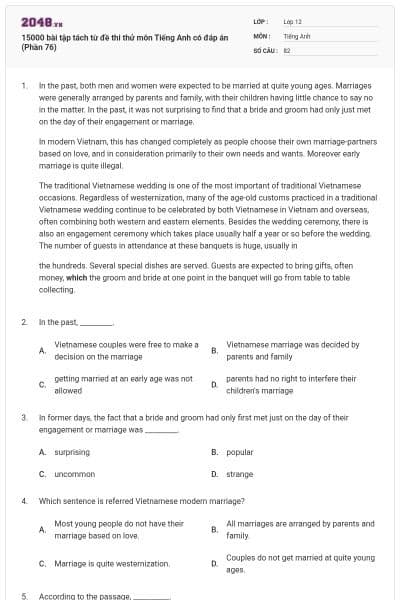
In the past, both men and women were expected to be married at quite young ages. Marriages were generally arranged by parents and family, with their children having little chance to say no in the matter. In the past, it was not surprising to find that a bride and groom had only just met on the day of their engagement or marriage.
In modern Vietnam, this has changed completely as people choose their own marriage-partners based on love, and in consideration primarily to their own needs and wants. Moreover early marriage is quite illegal.
The traditional Vietnamese wedding is one of the most important of traditional Vietnamese occasions. Regardless of westernization, many of the age-old customs practiced in a traditional Vietnamese wedding continue to be celebrated by both Vietnamese in Vietnam and overseas, often combining both western and eastern elements. Besides the wedding ceremony, there is also an engagement ceremony which takes place usually half a year or so before the wedding. The number of guests in attendance at these banquets is huge, usually in
the hundreds. Several special dishes are served. Guests are expected to bring gifts, often money, which the groom and bride at one point in the banquet will go from table to table collecting.
In the past, _________.
Vietnamese couples were free to make a decision on the marriage
Vietnamese marriage was decided by parents and family
getting married at an early age was not allowed
parents had no right to interfere their children's marriage
Đáp án B
Trong quá khứ, __________.
A. Các cặp đôi ở Việt Nam được tự do quyết định về hôn nhân
B. Hôn nhân Việt Nam do cha mẹ và gia đình quyết định
C. Việc lập gia đình khi còn nhỏ là không được phép
D. Cha mẹ không có quyền cản trở hôn nhân của con cái
Thông tin ở câu: “Marriages were generally arranged by parents and family, with their children having little chance to say no in the matter.” (Các cuộc hôn nhân thường được sắp xếp bởi cha mẹ và gia đình, con của họ thường có ít cơ hội để nói không trong việc này.)
Dịch bài đọc
Trước đây, cả nam và nữ đều được mong đợi kết hôn khi còn khá trẻ. Hôn nhân thường được cha mẹ và gia đình sắp đặt, con cái họ ít có cơ hội nói không trong vấn đề này. Trước đây, không có gì ngạc nhiên khi thấy cô dâu và chú rể chỉ mới gặp nhau vào ngày đính hôn hoặc kết hôn.
Ở Việt Nam hiện đại, điều này đã thay đổi hoàn toàn khi mọi người tự chọn bạn đời dựa trên tình yêu và chủ yếu cân nhắc đến nhu cầu và mong muốn của riêng họ. Hơn nữa, kết hôn sớm là hoàn toàn bất hợp pháp.
Đám cưới truyền thống của Việt Nam là một trong những dịp quan trọng nhất của người Việt Nam. Bất kể sự phương Tây hóa, nhiều phong tục lâu đời được thực hiện trong đám cưới truyền thống của Việt Nam vẫn được cả người Việt Nam ở Việt Nam và nước ngoài tổ chức, thường kết hợp cả yếu tố phương Tây và phương Đông. Bên cạnh lễ cưới, còn có lễ đính hôn thường diễn ra trước lễ cưới khoảng nửa năm. Số lượng khách tham dự những bữa tiệc này rất lớn, thường lên đến
hàng trăm người. Một số món ăn đặc biệt được phục vụ. Khách dự kiến sẽ mang theo quà tặng, thường là tiền, và chú rể và cô dâu sẽ đi từ bàn này sang bàn khác để nhận tiền trong tiệc.
In former days, the fact that a bride and groom had only first met just on the day of their engagement or marriage was _________.
surprising
popular
uncommon
strange
Đáp án B
Trước kia, thực tế là cô dâu và chú rể chỉ mới gặp nhau vào ngày cưới hay ngày đính hôn của họ là _________.
A. đáng ngạc nhiên
B. phổ biến
C. không phổ biến
D. kì lạ
Thông tin ở câu: “In the past, it was not surprising to find that a bride and groom had only just met on the day of their engagement or marriage.” (Trong quá khứ, không ngạc nhiên khi phát hiện ra rằng cô dâu và chú rể chỉ vừa mới gặp nhau vào ngày cưới hay ngày đính hôn của họ.)
Which sentence is referred Vietnamese modern marriage?
Most young people do not have their marriage based on love.
All marriages are arranged by parents and family.
Marriage is quite westernization.
Couples do not get married at quite young ages.
Đáp án D
Câu nào sau đây liên quan đến hôn nhân hiện đại của Việt Nam?
A. Hầu hết những người trẻ tuổi không có cuộc hôn nhân dựa trên tình yêu.
B. Tất cả các cuộc hôn nhân được bố trí bởi cha mẹ và gia đình.
C. Hôn nhân khá là Tây hóa.
D. Các cặp vợ chồng không kết hôn ở lứa tuổi khá trẻ.
Thông tin ở đoạn: “ In modern Vietnam, this has changed completely as people choose their own marriage-partners based on love, and in consideration primarily to their own needs and wants. Moreover early marriage is quite illegal.” (Ở Việt Nam hiện đại, điều này đã thay đổi hoàn toàn khi mọi người chọn một nửa để kết hôn của họ dựa trên tình yêu, và xem xét chủ yếu vào nhu cầu và mong muốn của họ. Hơn nữa tảo hôn là bất hợp pháp.)
According to the passage, __________.
Oversea Vietnamese people do not like to organize a traditional wedding
There is an engagement ceremony which takes place usually half a year or so before the wedding
Many of the age-old customs practiced in a traditional Vietnamese wedding do not exist nowadays
Vietnamese people never ask a fortune teller the date and time of the marriage ceremony
Đáp án B
Theo văn bản, __________.
A. Người Việt Nam ở nước ngoài không thích tổ chức đám cưới truyền thống
B. Có một buổi lễ đính hôn thường diễn ra vào tầm nửa năm hoặc hơn trước đám cưới
C. Nhiều phong tục tập quán lâu đời được diễn ra trong đám cưới truyền thống Việt Nam hiện nay không tồn tại
D. Người Việt Nam không bao giờ hỏi một thầy bói biết ngày và giờ của lễ cưới
Thông tin ở câu: “Besides the wedding ceremony, there is also an engagement ceremony which takes place usually half a year or so before the wedding.” (Bên cạnh lễ cưới, cũng có một lễ đính hôn thường diễn ra nửa năm trước đám cưới.)
Which does not exist in a Vietnamese wedding party?
dishes
firecrackers
guests
gifts
Đáp án B
Cái gì không có trong một đám cưới Việt Nam?
A. các món ăn
B. pháo nổ
C. các vị khách
D. những món quà
Thông tin ở đoạn : “The number of guests in attendance at these banquets is huge, usually in the hundreds. Several special dishes are served. Guests are expected to bring gifts, often money, which the groom and bride at one point in the banquet will go from table to table collecting.” (Số lượng khách mời tham dự các bữa tiệc rất lớn, thường là hàng trăm người. Một số món ăn đặc biệt được phục vụ. Khách dự kiến sẽ mang quà, thường là tiền, chú rể và cô dâu tại một thời điểm trong bữa tiệc sẽ đi từ bàn này tới bàn khác để nhận.)
Herman Melville, an American author best known today for his novel Moby Dick, was actually more popular during his lifetime for some of his other works. He traveled extensively and used the knowledge gained during his travels as the basis for his early novels. In 1837, at the age of eighteen, Melville signed as a cabin boy on a merchant ship that was to sail from his Massachusetts home to Liverpool, England. His experiences on this trip served as a basis for the novel Redburn (1849). In 1841 Melville set out on a whaling ship headed for the South Seas. After jumping ship in Tahiti, he wandered around the islands of Tahiti and Moorea. This South Sea island sojourn was a backdrop to the novel Omoo (1847). After three years away from home, Melville joined up with a U.S. naval frigate that was returning to the eastern United States around Cape Horn. The novel White-Jacket (1850) describes this lengthy voyage as a navy seaman.
With the publication of these early adventure novels, Melville developed a strong and loyal following among readers eager for his tales of exotic places and situations. However, in 1851, with the publication of Moby Dick, Melville's popularity started to diminish. Moby Dick, on one level the saga of the hunt for the great white whale, was also a heavily symbolic allegory of the heroic struggle of man against the universe. The public was not ready for Melville's literary metamorphosis from romantic adventure to philosophical symbolism. It is ironic that the novel that served to diminish Melville's popularity during his lifetime is the one for which he is best known today.
The main subject of the passage is_________.
Moby Dick
Melville’s personal background
the popularity of Melville’s novels
Đáp án D
Câu đầu tiên của đoạn văn cho ta biết chủ đề của bài: Herman Melville, an American author best known today for his novel Moby Dick, was actually more popular during his lifetime for some of his other works. (Herman Melvile, một tác gia người Mỹ, ngày nay nổi tiếng vì cuốn tiểu thuyết Moby Dick, thực ra lại được biết đến nhiều hơn nhờ những tác phẩm khác trong thời mà ông còn sống).
Và các đoạn sau, bài viết nói về các tác phẩm của ông. Các chuyến đi dù có được nhắc đến nhưng chỉ được nhắc đến như là cơ sở để ông viết văn, chứ không phải đoạn văn miêu tả hay kể về chuyến đi đó.
Nếu lấy nhan đề là Moby Dick, một tác phẩm của ông, thì đây chỉ là một chi tiết nhỏ, không đủ bao quát tác phẩm. Nếu lấy nhan đề là nền tảng cá nhân thì cũng không được vì trong bài không nhắc đến những tính chất này ngoài những chuyến đi.
The word “basis” in paragraph 1 is closest in meaning to_________.
message
bottom
dissertation
Đáp án A
Background: nền tảng
Message: thông điệp
Bottom: đáy
Dissertation: luận án
Ở đoạn 1: His experiences on this trip served as a basis for the novel Redburn (1849). (Những trải nghiệm trên chuyến tàu này chính là nền tảng cho cuốn tiểu thuyết Redburn (1849)).
Như vậy, từ basis có thể thay thế tốt nhất bằng từ background.
According to the passage, Melville’s early novels were__________.
completely fictional
all about his work on whaling ships
based on his travel experience
Đáp án D
Dịch: Theo bài viết, những cuốn tiểu thuyết đầu tiên của Melville
A. Được xuất bản khi ông đang trên đường di chuyển
B. Hoàn toàn là viễn tưởng
C. Tất cả đều là về công việc của ông khi còn trên tàu đánh cá voi
D. Dựa vào kinh nghiệm trong những chuyến đi của ông
Thông tin nằm ở đoạn 1: He travelled extensively and used the knowledge gathered during his travels as the basis for his early novels. (Ông đi rất nhiều và sử dụng kiến thức thu lượm được trong những chuyến đi để làm nền tảng cho những cuốn tiểu thuyết đầu tiên).
The passage implies that Melville stayed in Tahiti because____________.
he was on leave while his ship was in port
he had finished his term of duty
he had received permission to take a vacation in Tahiti
Đáp án A
Dịch: Bài viết ngụ ý rằng Melvile đã ở tại Tahiti vì
A. Ông ấy đã rời con tàu một cách không chính thức
B. Ông ấy đi khi con tàu ở cảng
C. Ông ấy đã hoàn thành trách nhiệm của đội
D. Ông ấy đã nhận được sự cho phép để đi nghỉ ở Tahiti
Thông tin nằm ở đoạn 1: After jumping ship in Tahiti, he wandered around the islands of Tahiti and Moorea. (Sau khi nhảy khỏi tàu ở Tahiti, ông ấy đi loanh quanh khắp các đảo ở Tahiti và Moorea).
Các ý trong B, C, D không hề được đề cập trong bài
How did the publication of Moby Dick affect Melville’s popularity?'
It caused his popularity to decrease.
His popularity increased immediately.
It had no effect on his popularity.
Đáp án B
Dịch: Việc xuất bản tác phẩm Moby Dick đã ảnh hưởng đến sự nổi tiếng của Malvile như thế nào?
A. Sự nổi tiếng đó vẫn y nguyên như trước đây
B. Nó khiến cho sự nổi tiếng tụt giảm
C. Sự nổi tiếng của ông tăng ngay lập tức
D. Nó không có ảnh hưởng gì đến sự nổi tiếng của ông
Thông tin nằm ở đoạn 2: However, in 1851, with the publication of Moby Dick, Melville's popularity started to diminish. (Tuy nhiên, vào năm 1851, với sự xuất bản của Moby Dick thì sự nổi tiếng của Melvile bắt đầu giảm xuống).
Diminish: giảm
According to the passage, Moby Dick is__________.'
a single-faceted work
a short story about a whale
a 47 adventure
Đáp án A
Dịch: Theo bài viết, Moby Dick là
A. Biểu tượng cho việc con người chống lại vũ trụ
B. Một công trình một mặt
C. Một câu chuyện ngắn về loài cá voi
D. Một hành trình lãng mạn
Thông tin nằm ở đoạn 2: Moby Dick, on one level the saga of the hunt for the great white whale, was also a heavily symbolic allegory of the heroic struggle of man against the universe. (Moby Dick, tầm cỡ như câu chuyện dân gian về cuộc săn bắt chú cá voi khổng lồ, cũng là một câu chuyện ngụ ý về cuộc đấu tranh anh hùng của con người chống lại vũ trụ).
In what year did Melville’s book about his experiences as a cabin boy appear?
1837
1847
1841
Đáp án A
Dịch: Sách của Melvole kể về trải nghiệm của ông khi làm một chàng trai làm việc trong cabin xuất hiện vào năm nào?
A. 1849
B. 1837
C. 1847
D. 1841
Thông tin nằm ở đoạn 1: In 1837, at the age of eighteen, Melville signed as a cabin boy on a merchant ship that was to sail from his Massachusetts home to Liverpool, England. His experiences on this trip served as a basis for the novel Redburn (1849). (Năm 1837, khi 18 tuổi, Melvile làm việc ở cabin trên một con tàu thương gia đi từ quê nhà Massachusetts đến Liverpool, vương quốc Anh. Kinh nghiệm tển chuyến đi này chính là nền tảng cho tác phẩm Redburn (1849)).
The word “metamorphosis” in paragraph 2 is closest in meaning to_________.
circle
mysticism
change
Đáp án D
Dịch: Từ “metamorphosis” ở đoạn 2 gần nghĩa nhất với
A. Hậu duệ
B. Vòng tròn
C. Thần bí
D. Thay đổi
Metamorphosis: sự biến hình
The handling and delivery of mail has always been a serious business, underpinned by the trust of the public in requiring timeliness, safety, and confidentiality. After early beginnings using horseback and stagecoach, and although cars and trucks later replaced stagecoaches and wagons, the Railway Mail Service still stands as one of America’s most resourceful and exciting postal innovations. This service began in 1832, but grew slowly until the Civil War. Then from 1862, by sorting the mail on board moving trains, the Post Office Department was able to decentralize its operations as railroads began to crisscross the nation on a regular basis, and speed up mail delivery. This service lasted until 1974. During peak decades of service, railway mail clerks handled 93% of all non-local mail and by 1905 the service had over 12,000 employees.
Railway Post Office trains used a system of mail cranes to exchange mail at stations without stopping. As a train approached the crane, a clerk prepared the catcher arm which would then snatch the incoming mailbag in the blink of an eye. The clerk then booted out the outgoing mailbag. Experienced clerks were considered the elite of the Postal Service’s employees, and spoke with pride of making the switch at night with nothing but the curves and feel of the track to warn them of an upcoming catch. They also worked under the greatest pressure and their jobs were considered to be exhausting and dangerous. In addition to regular demands of their jobs they could find themselves the victims of train wrecks and robberies.
As successful as it was, “mail-on-the-fly” still had its share of glitches. If they hoisted the train’s catcher arm too soon, they risked hitting switch targets, telegraph poles or semaphores, which would rip the catcher arm off the train. Too late, and they would miss an exchange.
Which of the following can be inferred from the first paragraph?
The development of the mail roads during the second half of the 19thcentury enabled Post Office Department to focus on timeliness.
The Post Office Department was more concerned about speeding up mail delivery than the safety of its clerks.
Mail was often lost or damaged as it was exchanged on the mail crane.
Đáp án B
Dịch: Từ đoạn văn thứ nhất, chúng ta có thể suy ra điều gì?
A. Nhân viên thư tín đường sắt có tỉ lệ nghỉ việc cao.
B. Việc phát triển đường thư tín trong suốt nửa sau thế kỉ 19 đã cho phép Sở bưu chính tập trung vào tính tốc độ nhanh chóng.
C. Sở Bưu chính lo lắng nhiều hơn về việc vận chuyển nhanh hơn là sự an toàn của các nhân viên.
D. Thư tín thường bị mất hoặc hư hỏng khi chúng được trao đổi ở các trạm.
Đoạn 1 nói về việc phát triển của hệ thống thư tín đường sắt.
Trong đoạn 1: Then from 1862, by sorting the mail on board moving trains, the Post Office Department was able to decentralize its operations as railroads began to crisscross the nation on a regular basis, and speed up mail delivery. (Sau đó, từ năm 1862, bằng cách phân loại thư trên tàu di chuyển, Sở Bưu điện đã có thể phân hoạt động của nó vì đường sắt bắt đầu mọc lên chằng chịt trên khắp đất nước và có thể tăng tốc độ chuyển thư).
Từ năm 1862 trở đi chính là nửa cuối thế kì 19.
The word “elite” in the second paragraph is closest in meaning to___________.
superior
more capable
leader
Đáp án B
Majority: đa số
Superior: áp đảo, cấp trên
Capable: có khả năng
Leader: lãnh đạo
Elite: ưu tú
Như vậy, elite gần nghĩa nhất với từ superior.
What does the passage mainly discuss?
How the mail cranes exchanged the mail.
Improvements in mail handling and delivery.
How Post Office Trains handled the mail without stopping.
The skills of experienced clerks.
Đáp án B
Dịch: Đoạn văn chủ yếu bàn bạc về chủ đề gì?
A. Cách những trạm thư trao đổi thư.
B. Những cải thiện trong việc xử lí và phân phát thư tín.
C. Cách những tàu bưu chính xử lí thư mà không cần dừng lại.
D. Những kĩ năng của một nhân viên giàu kinh nghiệm.
Đoạn đầu tiên nói về việc phát triển của hệ thống vận chuyển thư tín, đặc biệt là hệ thống thư tín đường sắt. Đoạn thứ hai nói chi tiết về cách hoạt động, cách làm việc của thư tín đường sắt. Và đoạn thứ ba nói về một số khó khăn, trở ngại của quá trình này. Như vậy, nhìn tổng quát thì bài viết nói về những cải tiến của việc xử lí và phân phát thư tín, các ý còn lại có được nhắc đến trong bài, nhưng quá nhỏ nhặt và chi tiết nên không thể coi là nội dung bao quát cả bài được.
According to the passage, the Railway Mail Service commenced in_________.
1842
1832
1905
Đáp án C
Dịch: Theo bài viết, Thư tín đường sắt bắt đầu vào năm
A. 1874
B. 1842
C. 1832
D. 1905
Thông tin nằm ở đoạn 1: After early beginnings using horseback and stagecoach, and although cars and trucks later replaced stagecoaches and wagons, the Railway Mail Service still stands as one of America’s most resourceful and exciting postal innovations. This service began in 1832, but grew slowly until the Civil War. (Bắt đầu với ngựa cưỡi và xe ngựa kéo, sau đó xe ô tô và xe tải đã thay thế xe ngựa và xe ngựa kéo, Dịch vụ Thư tín đường sắt vẫn còn là một trong những phát kiến bưu chính có tiềm lực và thú vị nhất nước Mỹ. Dịch vụ này bắt đầu vào năm 1832, nhưng tăng trưởng chậm cho đến khi cuộc Nội chiến nổ ra).
The word “glitches” in the third paragraph can be replaced by________.
blames
advantages
problems
Đáp án D
Accident: tai nạn
Blame: phê bình
Advantage: thuận lợi
Problem: vấn đề
Glitch: vấn đề
Như vậy, từ glitches gần nghĩa nhất với problems.
Which of the following is TRUE according to the passage?
Clerks couldn’t often see what they were doing.
The Railway Mail clerk’s job was considered elite because it was safe and exciting.
Despite their success, railway mail clerks only handled a small proportion of all non-local mail.
Đáp án B
Dịch: Đâu là mệnh đề đúng, dựa theo thông tin trong bài?
A. Nhân viên cho túi thư đi vào trước khi lấy túi thư đến ra.
B. Nhân viên không thể thường xuyên nhìn những gì họ đang làm.
C. Công việc của những nhân viên thư tín đường sắt được coi là ưu tú vì nó an toàn và thú vị.
D. Mặc dù thành công nhưng những nhân viên thư tín đường sắt chỉ xử lí một khối lượng nhỏ những thư không thuộc địa phương.
Thông tin nằm ở đoạn 2: Experienced clerks were considered the elite of the Postal Service’s employees, and spoke with pride of making the switch at night with nothing but the curves and feel of the track to warn them of an upcoming catch. (Các nhân viên giàu kinh nghiệm được xem là tầng lớp ưu tú của Dịch vụ Bưu điện, luôn tự hào vì có thể thực hiện những chuyển đổi này vào ban đêm mà không cần gì ngoài đường cong và cảm giác tàu tới để cảnh báo họ rằng sắp có một đợt bắt hàng).
=> Vào ban đêm họ chỉ cần cảm giác để làm việc nên không phải là họ thường xuyên nhìn thấy những gì họ làm.
Ý A sai vì: As a train approached the crane, a clerk prepared the catcher arm which would then snatch the incoming mailbag in the blink of an eye. The clerk then booted out the outgoing mailbag. – Họ lấy thư đến trước rồi mới cho thư đi vào.
Ý C sai vì: They also worked under the greatest pressure and their jobs were considered to be exhausting and dangerous. – Thực tế là nó nguy hiểm chứ không an toàn.
Ý D sai vì: During peak decades of service, railway mail clerks handled 93% of all non-local mail and by 1905 the service had over 12,000 employees. – thực tế thì họ xử lí rất nhiều, tới 93% chứ không phải là ít thư địa phương.
The public expects the following three services in handling and delivery of mail except___________.
accuracy
confidentiality
timeliness
Đáp án B
Dịch: Công chúng mong chờ ba yếu tố sau trong việc xử lí và vận chuyển thư tín, ngoại trừ:
A. Sự an toàn
B. Sự chính xác
C. Sự bảo mật
D. Tính nhanh chóng, kịp thời
Thông tin nằm ở đoạn 1: The handling and delivery of mail has always been a serious business, underpinned by the trust of the public in requiring timeliness, safety, and confidentiality. (Việc xử lý và phân phát thư luôn là một việc kinh doanh nghiêm túc, được củng cố bởi sự tin tưởng của công chúng trong việc đảm bảo tính kịp thời, an toàn và bảo mật). – Không hề nhắc tới tính chính xác ở trong đoạn văn.
Sunlight is solar energy. Sunlight is needed for growing plants that you eat to get energy. Sunlight is also used to make clean electricity. Burning fossil fuels to make electricity pollutes our atmosphere and rivers. Fossil fuels are expensive and limited sources of energy. Nuclear fission is used to create enormous amount of heat and electricity. However, nuclear fission forms dangerous radioactive waste.
Sunlight offers many ways to get energy. A window can allow warm sunlight into your room. Solar water-heating systems can use sunlight to warm the water for your home, swimming pool and school. Sunlight also warms the Earth and causes wind. Electricity can be made by wind generators.
Photovoltaic, or PV system use a type of material that converts sunlight into electricity. PV systems can power your air conditioner or a satellite like the International Space Station. PV systems are also used to run a calculator, recharge cell phone, or even power lightweight cars.
Sunlight is also changed into electricity by concentrating solar power or CSP systems. CSP systems have mirrors that focus the sunlight. The concentrated sunlight turns water into steam which turns a turbine that is connected to an electric generator. A CSP system usually uses sunlight to make steam. CSP power plants can store large amount of heat. The stored heat is used to make electricity at night. During cloud days, many CSP plants can also burn natural gas to provide the heat that is used to turn water into steam.
Sunlight provides the energy needed to grow plants and make large amount of environmentally friendly heat and electricity. Solar energy can provide power today and for a long time in the future.
This article is mainly about ______
Human using sunlight to stay warm.
The need to develop new technology for solar power system.
How the energy of sunlight is used.
How solar energy can provide power for transportation systems.
Đáp án C
Bài viết chủ yếu nói về ________
A. Con người dùng ánh sáng để giữ nhiệt.
B. Sự cần thiết cho việc phát triển công nghệ mới trong hệ thống quang năng.
C. Năng lượng mặt trời đang được dùng ra sao.
D. Năng lượng mặt trời dùng trong hệ thống giao thông vận tải.
Ánh sáng mặt trời và cách nó được dùng là chủ đề chính trong bài. Ta có thể thấy rõ công dụng của quang năng qua mỗi đoạn.
Các đáp án còn lại sai vì:
A. chỉ mới đề cập được một phần nhỏ, không phải ý chính
B. bài viết giới thiệu về các hệ thống chuyển đổi quang năng, nhưng không có ý nói chúng lạc hậu và cần phát triển công nghệ mới.
D. giao thông vận tải không được nhắc đến trong bài.
In the first paragraph, the word “fossil fuels” in line 2 means ________
fuels formed millions of years from the remains of animals and plants
nuclear energy
solar power
fuel formed from the energy of the wind
Đáp án A
Trong đoạn đầu tiên, từ “fossil fuels” dòng 2 mang nghĩa ______
A. chất đốt được hình thành qua hàng triệu năm từ phần còn lại của động thực vật
B. năng lượng nguyên tử
C. năng lượng mặt trời
D. chất đốt có từ năng lượng gió
Fossil fuels (n): nhiên liệu hoá thạch = fuels formed millions of years from the remains of animals and plants
The drawback of nuclear fission is that ________
it sends out energy in the form of rays that can be harmful.
it is costly.
it releases smoke.
it is time-consuming to be formed.
Đáp án A
Hạn chế của hạt nhân nguyên tử là _______
A. nó truyền ra năng lượng dưới dạng các tia độc hại.
B. nó tốn kém.
C. nó thải ra khói.
D. nó mất nhiều thời gian để hình thành
Câu cuối đoạn 1: “However, nuclear fission forms dangerous radioactive waste.”
(Tuy nhiên, hạt nhân thải ra các tia phóng xạ độc hại.)
To help the readers understand some of the benefits of solar energy, the author ________
provides a list of solar energy projects.
lists in chronological order the invention of various systems that gather the energy of sunlight.
describes in detail how a PV system works.
briefly compares and contrasts the differences in using fossil fuels, nuclear fission and solar energy in electric power systems
Đáp án D
Để giúp độc giả hiểu về ích lợi của năng lượng mặt trời, tác giả ______
A. liệt kê một loạt dự án quang năng.
B. liệt kê theo thứ tự ra đời của các hệ thống tập hợp năng lượng mặt trời.
C. mô tả chi tiết quy trình của hệ thống PV.
D. so sánh ngắn gọn và tương phản sự khác biệt trong việc dùng nhiên liệu hoá thạch, hạt nhân nguyên tử và năng lượng mặt trời trong hệ thống điện năng.
Trong đoạn 1, tác giả đưa ra sự so sánh và tương phản ngắn gọn về các dang năng lượng, nêu lên tác dụng và hạn chế của chúng, từ đó làm bật lên lợi ích của năng lượng mặt trờ
Which of the following statements is NOT true?
Fossil fuel supplies are unlimited.
Solar energy is the energy that comes from the sun.
PV systems provide electricity for the International Space Station.
A CSP power plant can produce steam even at night.
Đáp án A
Phát biểu nào sau đây không đúng?
A. Nguồn nhiên liệu hoá thạch là vô hạn.
B. Quang năng là năng lượng từ mặt trời.
C. Hệ thống PV cung cấp nguồn điện cho Trạm vũ trụ quốc tế.
D. Cột năng lượng CSP có thể tạo hơi nước vào ban đêm.
Ta có: “Fossil fuels are expensive and limited sources of energy.” (Nhiên liệu hoá thạch đắt và có hạn.)
In the third paragraph, the word “convert” is closest in meaning to _______
change form one religion to another
transform
exchange for something equal in value
converse
Đáp án B
Trong đoạn 3, từ “convert” gần nghĩa nhất với________
A. thay đổi hình thức một tôn giáo
B. thay đổi, cải biến
C. đổi sang thứ gì đó có giá trị tương đương
D. nói chuyện (to) convert = (to) transform: thay đổi, biến đổi
In the fourth paragraph, the word “which” refers to _______
water
steam
sunlight
solar power
Đáp án B
Trong đoạn 4, từ “which” nói đến ________
A. nước
B. hơi nước
C. ánh sáng mặt trời
D. năng lượng mặt trời
“The concentrated sunlight turns water into steam which turns a turbine that is connected to an electric generator.”
(Ánh sáng được tập trung chuyển nước từ dạng lỏng sang dạng hơi – làm xoay tuabin được nối với máy phát điện.)
Thứ làm xoay tuabin chính là hơi nước – steam.
In most discussions of cultural diversity, attention has focused on visible, explicit aspects of culture, such as language, dress, food, religion, music, and social rituals. Although they are important, these visible expressions of culture, which are taught deliberately and learned consciously, are only the tip of the iceberg of culture. Much of culture is taught and learned implicitly, or outside awareness. Thus, neither cultural insiders nor cultural outsiders are aware that certain “invisible” aspects of their culture exist.
Invisible elements of culture are important to us. For example, how long we can be late before being impolite, what topics we should avoid in a conversation, how we show interest or attention through listening behaviour, what we consider beautiful or ugly- these are all aspects of culture that we learn and use without being aware of it. When we meet other people whose invisible cultural assumptions differ from those we have learned implicitly, we usually do not recognize their behaviour as cultural in origin.
Differences in invisible culture can cause problems in cross-cultural relations. Conflicts may arise when we are unable to recognize others’ behavioural differences as cultural rather than personal. We tend to misinterpret other people’s behaviour, blame them, or judge their intentions or competence without realizing that we are experiencing cultural rather than individual differences.
Formal organizations and institutions, such as schools, hospitals, workplaces, governments, and the legal system are collection sites for invisible cultural differences. If the differences were more visible, we might have less misunderstanding. For example, if we met a man in a courthouse who was wearing exotic clothes, speaking a language other than ours, and carrying food that looked strange, we would not assume that we understood his thoughts and feelings or that he understood ours. Yet when such a man is dressed similarly to us, speaks our language, and does not differ from us in other obvious ways, we may fail to recognize the invisible cultural differences between us. As a result, mutual misunderstanding may arise.
What is the main purpose of the passage?
To point out that much of culture is learned consciously.
To describe cultural diversity.
To explain the importance of invisible aspects of culture.
To explain why cross-cultural conflict occurs.
Đáp án C
Mục đích chính của đoạn văn là gì?
A. Chỉ ra rằng phần đa văn hoá được chủ tâm tiếp thu.
B. Mô tả sự đa dạng văn hoá.
C. Giải thích tầm quan trọng của các khía cạnh vô hình trong văn hoá.
D. Giải thích tại sao mâu thuẫn văn hoá xảy ra.
Trong đoạn 1, tác giả giới thiệu về những khía cạnh vô hình trong văn hoá và từ đoạn 2 với câu chủ đề: “Invisible elements of culture are important to us.” tác giả đi sâu vào giải thích tầm quan trọng của chúng, đồng thời đưa ra những ví dụ, dẫn chứng để chứng minh luận điểm của mình.
The word “deliberately” in bold in paragraph 1 is closest in meaning to _______.
slowly
accurately
intentionally
randomly
Đáp án C
Từ “deliberately” in đậm trong đoạn 1 gần nghĩa nhất với _________
A. chậm, từ từ
B. chính xác
C. có chủ ý
D. ngẫu nhiên
Deliberately = intentionally (adv): chủ tâm, có chủ ý từ trước
The phrase “the tip of the iceberg” in paragraph 1 means that ___________.
most aspects of culture cannot be seen
we usually focus on the highest forms of culture
other cultures seem cold to us
visible aspects of culture are learned in formal institutions
Đáp án A
Cụm “the tip of the iceberg” trong đoạn 1 có nghĩa ______
A. phần lớn khía cạnh văn hoá không thể nhìn thấy
B. chúng ta thường chỉ chú trọng hình thức tối cao của văn hoá
C. các văn hoá khác có vẻ xa cách, lạnh lung với chúng ta
D. các khía cạnh bề nổi được tiếp thu qua các cơ quan chính quy
The tip of the iceberg: phần nổi tảng băng trôi.
Nguyên lý này nói đến những thứ ta dễ nhận thấy được chỉ là phần nổi của một sự vật, sự việc. Còn phần lớn hơn, quan trọng hơn lại là phần chìm, không nhận thấy được.
Tác giả có ý muốn nói phần lớn khía cạnh văn hoá là phần chìm mà ta không nhận thấy được.
Which of the following was NOT mentioned as an example of invisible culture?
How people express interest in what others are saying
How late is considered impolite
What topics to avoid in conversation
What food to eat in a courthouse
Đáp án D
Điều nào sau đây không được đề cập đến như một ví dụ về văn hoá vô hình?
A. Cách người ta thể hiện sự hứng thú với điều người khác nói.
B. Muộn bao lâu thì bị coi là bất lịch sự.
C. Chủ đề nào nên tránh trong các cuộc trò chuyện.
D. Đồ ăn nào nên ăn trong toà án.
Câu 2 đoạn 2: “For example, how long we can be late before being impolite, what topics we should avoid in a conversation, how we show interest or attention through listening behavior…”
Như vậy dễ thấy cả A, B, C đều được đề cập. Chỉ có D sai.
The word “those” in paragraph 2 refers to__________.
invisible cultural assumptions
people from a different culture
topics that should be avoided in conversation
people who speak a different language
Đáp án A
Từ “those” ở đoạn 2 nói đến _________
A. quan niệm văn hoá vô hình
B. những người từ nền văn hoá khác
C. chủ đề nên tránh khi trò chuyện
D. người nói ngôn ngữ khác
“When we meet other people whose invisible cultural assumptions differ from those we have learned implicitly, we usually do not recognize their behaviour as cultural in origin.”
(Khi gặp người có quan niệm văn hoá vô hình khác những gì mình quan niệm, ta thường không xem hành vi của họ là thứ thuộc về văn hoá.)
Như vậy those là thay thế cho cụm invisible cultural assumptions.
It can be inferred from paragraph 3 that conflict results when ___________.
one culture is more invisible than another culture
people compete with those from other cultures
some people recognize more cultural differences than others
people think cultural differences are personal
Đáp án D
Có thể suy ra từ đoạn 3 rằng mâu thuẫn xảy ra khi___________
A. văn hoá này khó nhận biết hơn văn hoá kia
B. người ta ganh đua với người từ nền văn hoá khác
C. vài người nhận biết nhiều khác biệt trong văn hoá hơn người khác
D. người ta đánh đồng khác biệt văn hoá với khác biệt quan điểm cá nhân
Câu 2 đoạn 3: “Conflicts may arise when we are unable to recognize others’ behavioural differences as cultural rather than personal.”
(Mâu thuẫn có thể xảy ra khi chúng ta không xem khác biệt trong cách hành xử của người khác như một đặc tính về văn hoá mà coi nó như vấn đề cá nhân.)
The author implies that institutions such as schools and workplaces ________.
reinforce invisible cultural differences
are aware of cultural differences
share a common culture
teach their employees about cultural differences
Đáp án A
Tác giả nói rằng những nơi như trường học hay cơ quan làm việc ________.
A. củng cố khác biệt vô hình trong văn hoá
B. nhận biết được khác biệt văn hoá
C. cùng có chung một văn hoá
D. dạy cho nhân viên về khác biệt văn hoá
Câu đầu đoạn cuối: “Formal organizations and institutions, such as schools, hospitals, workplaces, governments, and the legal system are collection sites for invisible cultural differences.”
(Các cơ quan tổ chức chính quy như trường học, bệnh viện, cơ quan làm việc, chính phủ và hệ thống pháp lý là nơi quy tụ những khác biệt vô hình trong văn hoá.)
Which of the following would most likely result in misunderstanding?
Strange behaviour from someone speaking a foreign language
Learning about our own culture in school
Strange behaviour from someone speaking our language
Unusual food being cooked by foreign visitors
Đáp án C
Điều nào sau đây dễ có khả năng gây hiểu nhầm nhất?
A. Hành vi kì lạ từ ai đó nói ngôn ngữ khác mình.
B. Học về văn hoá của mình tại trường học.
C. Hành vi kì lạ từ ai đó nói chung ngôn ngữ.
D. Thức ăn lạ miệng được nấu bởi du khách nước ngoài.
Đoạn cuối bài viết: “If the differences were more visible, we might have less misunderstanding. For example, if we met a man in a courthouse who was wearing exotic clothes, speaking a language other than ours, and carrying food that looked strange, we would not assume that we understood his thoughts and feelings or that he understood ours. Yet when such a man is dressed similarly to us, speaks our language, and does not differ from us in other obvious ways, we may fail to recognize the invisible cultural differences between us. As a result, mutual misunderstanding may arise.”
Ý chính: Khi sự khác biệt rõ ràng ngay từ đầu chúng ta ít hiểu nhầm hơn. Ví dụ một người có bề ngoài khác mình, nói ngôn ngữ khác mình thì ta sẽ không cho là mình hiểu được anh ta hay anh ta hiểu được mình. Nhưng nếu một người vẻ ngoài có vẻ không khác, lại nói chung ngôn ngữ thì ta sẽ cho rằng mình hiểu được anh ta. Tuy nhiên, quan niệm mới là cái quyết định hành vi, do đó dù cho vẻ ngoài giống nhưng quan niệm vô hình lại khác biệt thì mâu thuẫn từ đó sẽ dễ dàng xảy ra.
Many ants forage across the countryside in large numbers and undertake mass migrations; these activities proceed because one ant lays a trail on the ground for the others to follow. As a worker ant returns home after finding a source of food, it marks the route by intermittently touching its stinger to the ground and depositing a tiny amount of trail pheromone – a mixture of chemicals that delivers diverse messages as the context changes. These trails incorporate no directional information and may be followed by other ants in either direction.
Unlike some other messages, such as the one arising from a dead ant, a food trail has to be kept secret from members of other species. It is not surprising then that ant species use a wide variety of compounds as trail pheromones. Ants can be extremely sensitive to these signals. Investigators working with the trail pheromone of the leafcutter ant Atta texana calculated that one milligram of this substance would suffice to lead a column of ants three times around Earth.
The vapor of the evaporating pheromone over the trail guides an ant along the way, and the ant detects this signal with receptors in its antennae. A trail pheromone will evaporate to furnish the highest concentration of vapor right over the trail, in what is called a vapor space. In following the trail, the ant moves to the right and left, oscillating from side to side across the line of the trail itself, bringing first one and then the other antenna into the vapor space. As the ant moves to the right, its left antenna arrives in the vapor space. The signal it receives causes it to swing to the left, and the ant then pursues this new course until its right antenna reaches the vapor space. It then swings back to the right, and so weaves back and forth down the trail.
What does the passage mainly discuss?
The mass migration of ants
How ants mark and follow a chemical trail
Different species of ants around the world
The information contained in pheromones
Đáp án B
Dịch: Bài viết bàn luận chủ yếu về vấn đề gì?
A. Sự tổng di cư của loài kiến
B. Cách kiến đánh dấu và đi theo những vệt hóa học
C. Những loài kiến khác nhau trên khắp thế giới
D. Thông tin có trong chất pheromone
Bài viết chủ yếu bàn về cách những chú kiến đánh dấu và dựa theo những vệt hóa học để tìm đường.
Ý A và D có được đề cập trong bài nhưng chỉ là chi tiết nhỏ, không thể coi là tổng quan nội dung bài.
Ý C không được nhắc đến trong bài viết.
The word “intermittently” in live 4 is closest in meaning to
incorrectly
rapidly
roughly
Đáp án A
Intermittently: không liên tục
Periodically: tạm thời, trong một thời gian nhất định
Incorrectly: không chính xác
Rapidly: nhanh chóng
Roughly: gần tới
Như vậy, từ gần nghĩa nhất với intermittently là periodically.
The phrase “the one” in line 8 refers to a single
dead ant
food trail
species
Đáp án A
Unlike some other messages, such as the one arising from a dead ant… (Không giống những thông điệp khác, chẳng hạn như là cái đến từ một con kiến đã chết…).
Như vậy, cái đến từ một con kiến chết chính là thông điệp đến từ một con kiến chết. The one nhắc đến massage.
According to the passage, why do ants use different compounds as trail pheromones?
To attract different types of ants
To protect their trail from other species
To indicate how far away the food is
Đáp án C
Dịch: Theo bài văn, tại sao những chú kiến lại sử dụng những hợp chất khác nhau cho vệt pheromones?
A. Để giảm sự nhạy bén, thích ứng với một vài chất hóa học
B. Để thu hút nhiều loài kiến hơn
C. Để bảo vệ vệt của chúng khỏi những loài khác
D. Để báo hiệu thức ăn cách bao xa Thông tin nằm ở đoạn 2: Unlike some other messages, such as the one arising from a dead ant, a food trail has to be kept secret from members of other species. It is not surprising then that ant species use a wide variety of compounds as trail pheromones. (Không giống những thông điệp khác, chẳng hạn như thông điệp từ một con kiến đã chết, đường dấu thức ăn phải được giữ bí mật khỏi thành viên của những loài kiến khác. Cũng không có chuyện gì ngạc nhiên rằng loài kiến sử dụng những hợp chất khác nhau trong đường dấu pheromones).
The author mentions the trail pheromone of the leafcutter ant in line 11 to point out
the different types of pheromones ants can produce
a type of ant that is common in many parts of the world
that certain ants can produce up to one milligram of pheromone
Đáp án A
Dịch: Tác giả đề cập đến đường dấu pheromones của loài kiến cắt lá ở dòng 11 để chỉ ra rằng
A. Cần rất ít pheromones để đánh dấu một đường
B. Những loài pheromones khác nhau mà kiến có thể tạo ra
C. Một loài kiến phổ biến ở nhiều nơi trên thế giới
D. Chỉ một số loài kiến nhất định mới có thể tạo ra đến 1 miligram pheromones
Thông tin nằm ở đoạn 2: Investigators working with the trail pheromone of the leafcutter ant Attatexana calculated that one milligram of this substance would suffice to lead a column of ants three times around Earth (Các nhà điều tra làm việc với các đường dấu pheromone của kiến cắt lá Attatexana đã tính rằng một miligam của chất này sẽ đủ để dẫn một hàng kiến dài bằng ba lần Trái đất). Chỉ rất ít chất đó mà dẫn được rất nhiều kiến, do đó ta chọn được A.
According to the passage, how are ants guided by trail pheromones?
They follow an ant who is familiar with the trail.
They avoid the vapor spaces by moving in a straight line.
They sense the vapor through their antennae.
Đáp án D
Dịch: Theo bài viết, kiến được dẫn dắt bởi đường dấu pheromones như thế nào?
A. Chúng tập trung vào mùi vị thức ăn.
B. Chúng đi theo một con kiến mà đã quen thuộc với đường dấu.
C. Chúng tránh những khoảng không có khí đó bằng cách di chuyển theo một đường thẳng.
D. Chúng cảm nhận khí hơi đó qua ăng-ten.
Thông tin nằm ở đoạn 3: The vapor of the evaporating pheromone over the trail guides an ant along the way, and the ant detects this signal with receptors in its antennae. (Chất bay hơi pheromones ở ngay trên đường dấu sẽ dẫn dắt con kiến đi dọc theo đường, và kiến sẽ phát hiện ra dấu hiệu bằng bộ phận thụ thể ở ăng-ten).
The word “oscillating“ in line 17 is closest in meaning to
depositing
swinging
starting
Đáp án C
Đáp án C
Oscillate: dao động
Fall: ngã
Deposit: lắng cặn
Swing: lung lay
Start: bắt đầu
Như vậy, từ gần nghĩa nhất với oscillate là swing.
According to the passage, the highest amount of pheromone vapor is found
just above the trail
in the source of food
under the soil along the trail
Đáp án B
Dịch: Theo bài viết, lượng pheromones cao nhất có thể tìm thấy ở
A. Bộ phận thủ cảm của kiến
B. Ngay phía trên đường dấu
C. Nguồn thức ăn
D. Ngay dưới đất dọc theo đường dấu
Thông tin nằm ở đoạn 3: A trail pheromone will evaporate to furnish the highest concentration of vapor right over the trail, in what is called a vapor space. (Một đường dấu pheromone sẽ bốc hơi để tạo ra một lượng tập trung cao nhất của chất này ngay phía trên đường dấu, gọi là vùng không gian khí hơi).
Martin Luther King, Jf., is well- known for his work in civil rights and for his many famous speeches, among which is his moving “ I have a dream” speech. But fewer people know much about King’s childhood. M.L., as he was called, was born in 1929 in Atlanta, Georgia, at the home of his maternal grandfather. M.L.’s grandfather purchased their home on Auburn Avenue in 1909, twenty years before M.L was born. His grandfather allowed the house to be used as a meeting place for a number of organizations dedicated to the education and social advancement of blacks. M.L. grew up in the atmosphere, with his home being used as a community gathering place, and was no doubt influenced by it.
M.L.’s childhood was not especially eventfully. His father was a minister and his mother was a musician. He was the second of three children, and he attended all black schools in a black neighborhood. The neighborhood was not poor, however. Auburn Avenue was an area of banks, insurance companies, builders, jewelers, tailors, doctors, lawyers, and other businesses and services. Even in the face of Atlanta’s segregation, the district thrived. Dr. King never forgot the community spirit he had known as a child, nor did he forget the racial prejudice that was a huge barrier keeping black Atlantans from mingling with whites.
What is the passage mainly about?
M.L.’s grandfather
Martin Luther King’s childhood.
The neighborhood King grew up in
Đáp án C
Dịch: Đoạn văn chủ yếu về vấn đề gì?
A. Định kiến tồn tại ở Atlanta
B. Ông của M.L.
C. Tuổi thơ của Martin Luther King
D. Hàng xóm nơi mà King lớn lên
Bài viết tập trung về tuổi thơ của Martin Luther King, đoạn 1 nói về bối cảnh gia đình, đoạn 2 nói về bối cảnh xã hội của ông.
Ý A và D quá chi tiết, không thể là nội dung bao quát toàn bài. Ý B thì quá chung chung.
When was M.L. born?
in 1929
in 1949
20 years after his parents had met.
Đáp án B
Dịch: M.L. được sinh ra năm nào?
A. 1909
B. 1929
C. 1949
D. 20 năm sau khi bố mẹ của ông gặp nhau
Thông tin nằm ở đoạn 1: But few people know much about King’s childhood. M.L., as he was called, was born in 1929 in Atlanta, Georgia, at the home of his maternal grandfather. (Nhưng chỉ một số người biết về tuổi thơ của M.L., như cách mà ông được gọi, sinh vào năm 1929 ở Atlanta, Georgia, nhà của ông ngoại).
What is Martin Luthur King well- known for?
His neighborhood.
His childhood.
His work in civil rights.
Đáp án D
Dịch: Martin Luther King nổi tiếng vì điều gì?
A. Những xuất bản của ông
B. Hàng xóm của ông
C. Tuổi thơ của ông
D. Công việc của ông trong lĩnh vực quyền dân sự
Thông tin nằm ở đoạn 1: Martin Luther King, Jr., is well know for his work in civil rights and for his many famous speeches (Martin Luther King, Jr., nổi tiếng về công việc của ông trong lĩnh vực quyền nhân sự và rất nhiều bài diễn thuyết nổi tiếng).
According to the author, M.L. _______.
was a good musician as a child
loved to listen to his grandfather speak.
grew up in a relatively rich area of Atlanta.
Đáp án D
Dịch: Theo tác giả, M.L.
A. Có một tuổi thơ khó khăn
B. Khi còn nhỏ đã là một nhạc sĩ giỏi
C. Thích nghe ông nói chuyện
D. Lớn lên ở một vùng khá là giàu có ở Atlanta
Thông tin nằm ở đoạn 2: The neighborhood was not poor, however. (Khu vực láng giềng thực tế thì lại không hề nghèo khó).
Which of the following statements is NOT true?
M.L.’s grandfather built their home on Auburn Avenue in 1909.
M. L. grew up in a rich, black neighborhood.
M.L.’s childhood was uneventful.
Đáp án B
Dịch: Mệnh đề nào sau đây là KHÔNG đúng?
A. Auburn là một vùng thương mại
B. Ông của M.L. xây nhà của họ ở đại lộ Auburn vào năm 1909
C. M.L. lớn lên ở một vùng người già đen, giàu có
D. Tuổi thơ của M.L. không có nhiều biến cố
Thông tin nằm ở đoạn 1: M.L.’s grandfather, the Reverens A.D. Williams, purchased their home on Auburn Avenue in 1909, twenty years before M.L. was born. (Ông của M.L., Reverens A.D. Williams, mua nhà ở đại lộ Auburn vào năm 1909, 20 năm trước khi M.L. ra đời).
Ông mua nhà chứ không phải xây nhà nên là ý B sai.
From the passage we can infer that:
people gathered at M.L.’s to perform religious rituals.
M.L.’s father purchased their home on Auburn Avenue.
M.L. had a bitter childhood.
Đáp án B
Dịch: Từ đoạn văn chúng ta có thể suy ra rằng:
A. Bố của M.L. là một thành viên của nhà thờ
B. Người ta tập trung ở nhà của M.L. để thực hiện nghi lễ tôn giáo
C. Bố của M.L mua nhà của họ ở đại lộ Auburn
D. M.L. có một tuổi thơ khá cay đắng
Thông tin nằm ở đoạn 1: He allowed his church and his home to be used as a meeting place for a number of organizations dedicated to the education and social advancement of blacks. (Ông cho phép nhà thờ và nhà của ông được dùng làm địa điểm họp mặt của nhiều tổ chức tâm huyết với giáo dục và tiến bộ xã hội của người da đen).
Như vậy, có thể suy ra được nhà này diễn ra nhiều nghi lễ tôn giáo.
M.L. was _______ by the atmosphere in which he grew up.
doubted
certainly influenced
prejudiced
Đáp án C
Dịch: M.L. __________ bởi không gian nơi mà ông lớn lên.
A. Không bị ảnh hưởng gì cả
B. Bị nghi ngờ
C. Chắc chắn là bị ảnh hưởng
D. Bị định kiến
Thông tin nằm ở đoạn 1: M.L. grew up in this atmosphere, with his home being used as a community gathering place and was no doubt influenced by it. (M.L. lớn lên trong không gian nơi mà ngôi nhà được sử dụng như một nơi tập trung cộng đồng và không còn nghi ngờ gì nữa, đã ảnh hưởng bởi nó).
A pioneering study by Donald Appleyard made the astounding discovery that a sudden increase in the volume of traffic through an area affects people in the way that a sudden increase in crime does. Appleyard observed this by finding three blocks of houses in San Francisco that looked much alike and had the same kind of middle-class and working-class residents, with approximately the same ethnic mix. The difference was that only 2,000 cars a day ran down Octavia Street (LIGHT street, in Appleyard’s terminology) while Gough Street (MEDIUM street) was used by 8,000 cars daily, and Franklin Street (HEAVY street) had around 16,000 cars a day. Franklin Street often had as many cars in an hour as Octavia had in a day.
Heavy traffic brought with it danger, noise, fumes and soot, directly, and trash secondarily. That is, the cars didn’t bring in much trash, but when trash accumulated, residents seldom picked it up. The cars, Appleyard determined, reduced the amount of territory residents felt responsible for. Noise was a constant intrusion into their homes. Many Franklin Street residents covered their doors and windows and spent most of their time in the rear of their houses. Most families with children had already left.
Conditions on Octavia Street were much different. Residents picked up trash. They sat on their front steps and chatted with neighbors. They had three times as many friends and twice as many acquaintances as the people on Franklin.
On Gough Street, residents said that the old feeling of community was disappearing as traffic increased. People were becoming more and more preoccupied with their own lives. A number of families had recently moved and more were considering. Those who were staying expressed deep regret at the destruction of their community.
The word “astounding” in line 1 is closest in meaning to
startling
disappointing
dubious
alternative
Đáp án A
Từ “astounding” ở dòng 1 gần nghĩa nhất với _________
A. giật mình
B. đáng thất vọng
C. mơ hồ, không rõ ràng
D. luân phiên
Astounding (adj): đáng kinh ngạc ≈ startling (adj): giật mình
The three streets mentioned in this passage are different in that __________.
they are in different cities
the residents are of different ethnic backgrounds.
they have varying amounts of traffic.
the income levels of the residents vary considerably.
Đáp án C
Ba con đường được đề cập khác nhau ở điểm ________
A. Chúng ở khác thành phố.
B. Tôn giáo sắc tộc của dân cư khác nhau.
C. Chúng có lưu lượng giao thông khác nhau.
D. Mức thu nhập của cư dân khác nhau.
Đặc điểm 3 ngôi nhà được đề cập: “looked much alike and had the same kind of middle-class and working-class residents, with approximately the same ethnic mix”
(trông giống nhau, lượng dân cư độ tuổi trung niên và lao động ngang nhau và có tỉ lệ tôn giáo sắc tộc)
Và sau đó tác giả đưa ra khác biệt chính là: đường Octovia 2,000 xe, Gough 8,000 xe và Franklin 16,000 xe mỗi ngày.
Approximately how many cars used Franklin Street daily?
2,000
8,000
16,000
20,000
Đáp án C
Có khoảng bao nhiêu phương tiện dùng đường Franklin mỗi ngày?
A. 2,000
B. 8,000
C. 16,000
D. 20,000
Như đã nhắc ở trên, đường Franklin có 16,000 xe lưu thông mỗi ngày
All of the following are direct results of heavy traffic EXCEPT
increased amount of trash
greater danger to residents
more pollution
more vibrations
Đáp án D
Tất cả các đáp án sau đều là kết quả của giao thông đông đúc, NGOẠI TRỪ ________
A. lượng rác thải tăng lên
B. mối nguy hại lớn hơn cho cư dân
C. ô nhiễm hơn
D. nhiều rung động hơn
Câu đầu tiên đoạn 2: “Heavy traffic brought with it DANGER, NOISE, FUMES AND SOOT directly, and TRASH secondarily.” (Giao thông đông đúc mang theo mối nguy hại, tiếng ồn, khói bụi và cả rác)
Chỉ có vibrations không được nhắc tới.
The author’s main purpose in the second paragraph is to __________.
discuss the problem of trash disposal
point out the disadvantage of heavy traffic
propose an alternate system of transportation
suggest ways to cope with traffic problems
Đáp án B
Mục đích chính của tác giả trong đoạn 2 là ______________
A. bàn luận vấn đề xử lí rác thải.
B. chỉ ra điểm bất lợi của giao thông đông đúc.
C. đề xuất hệ thống giao thông thay thế.
D. gợi ý phương hướng giải quyết vấn đề giao thông.
Đoạn 2 chủ yếu nói về mối nguy hại mà giao thông đông đúc đưa lại, những tác động đến người dân và hệ quả sau đó (nhiều gia đình phải chuyển đi).
Which of the following is NOT a statement you would expect from a resident of Gough Street?
People on this street are unhappy because the neighborhood is deteriorating.
People on this street think mostly of themselves.
People on this street have more and more space for which they feel responsible.
A number of people are preparing to leave this street.
Đáp án C
Đâu không phải là điều mà người dân đường Gough có thể sẽ nói?
A. Người dân đường này không vui vì khu dân cư của họ đang mai một dần.
B. Người dân đường này chỉ nghĩ cho bản thân nhiều hơn.
C. Người dân đường này ngày càng cảm thấy có trách nhiệm.
D. Nhiều người đang có ý định chuyển đi.
Đoạn cuối nói về suy nghĩ của người dân đường Gough: cảm giác cộng đồng dần mất đi, người ta chỉ biết đến cuộc sống bản thân (ít trách nhiệm hơn, ít thông cảm cho nhau hơn). Nhiều gia đình đã chuyển và nhiều gia đình đang cân nhắc chuyển. Người ở lại bày tỏ tiếc nuối (không vui)… Như vậy, ta có thể thấy, đáp án C (cảm thấy có trách nhiệm hơn) là sai.
In what order does the author present detailed discussions of the three streets?
LIGHT, MEDIUM, HEAVY
HEAVY, MEDIUM, LIGHT
HEAVY, LIGHT, MEDIUM
LIGHT, HEAVY, MEDIUM
Đáp án C
Tác giả bàn luận chi tiết về 3 loại đường theo thứ tự nào?
A. LIGHT, MEDIUM, HEAVY
B. HEAVY, MEDIUM, LIGHT
C. HEAVY, LIGHT, MEDIUM
D. LIGHT, HEAVY, MEDIUM
Đọc bài ta có thể thấy, HEAVY Street được nhắc ở cuối đoạn 2, sau đó là LIGHT Street ở đoạn 3 và MEDIUM Street đoạn cuối. Như vậy thứ tự là C.
What is the writer’s attitude toward heavy traffic when he mentions the Appleyard’s study?
neutral
favorable
critical
doubtful
Đáp án C
Thái độ của tác giả đối với giao thông đông đúc ra sao khi ông đề cập nghiên cứu của Appleyard?
A. trung lập
B. ủng hộ
C. chỉ trích
D. nghi ngờ
Nhắc đến heavy traffic, tác giả nói đến mối nguy hại của nó và những hệ luỵ kéo theo. Từ đó có thể thấy được sự phản đối, chỉ trích của tác giả đối với nó.
Dinosaurs were reptiles that lived during a period of earth’s history called the Mesozoic Era, which is known as the Age of Reptiles. The first dinosaurs appeared more than 200 million years ago. For many millions of years, they dominated the land with their huge size and strength. Then about 65 million years ago, they died out rather suddenly, never to reemerge.
The word dinosaur comes from two Greek words meaning “terrible lizard”. Dinosaurs were not lizards, but their appearance could be truly terrifying. The biggest ones weighed more than ten times as much as a mature elephant and nearly equaled the size of most modern—day whales. The famous kinds of dinosaurs, including the brontosaur and tyrannosaurus, reached 80 to 90 feet in length. Not all dinosaurs were giants, however, some were actually no larger than a chicken.
Scientists still do not know what caused dinosaur to disappear. One theory involves a change in the earth’s climate. It is believed that temperature dropped significantly towards the end of the Cretaceous Period. Too large to hibernate and not having fur or feathers for protection, it is possible that the climate became too chilly for dinosaurs. In contrast, other species having protection, such as the mammals and birds, were able to survive
The word “ones” in the passage refers to __________
dinosaurs
millions
lizards
whales
Đáp án A
Từ “ones” trong đoạn nói đến _________
A. khủng long
B. hàng triệu
C. thằn lằn
D. cá voi
Ta đọc lại 2 câu trước đó, đều là nói về khủng long. Ones ở đây được sử dụng để thay thế khủng long nhằm tránh lặp.
The word “chilly” in the passage refers to _________
very hot
extremely cold
very cold
humid
Đáp án C
Từ “chilly” trong đoạn có nghĩa _______
A. rất nóng
B. cực lạnh
C. rất lạnh
D. ẩm
Chilly (adj): lạnh lẽo, giá lạnh (chỉ ở mức không thoải mái, chưa đến mức lạnh khắc nghiệt) = very cold
What is the best title for this passage?
The Domination of the Land
The Metabolism of Dinosaurs
Earth’s Largest Reptiles
The History of Earth
Đáp án B
Đề mục phù hợp nhất với đoạn văn là?
A. Thống trị vùng đất
B. Sự chuyển hoá của khủng long
C. Loài bò sát lớn nhất Trái Đất
D. Lịch sử Trái Đất
Bài đọc nói về khủng long và việc chúng tuyệt chủng,
It can be inferred from the passage that the Age of Reptiles lasted about ______
200 million years
135 million years
80 million years
65 million years
Đáp án B
Có thể suy ra từ đoạn văn Kỉ nguyên của loài bò sát kéo dài _______
A. 200 triệu năm
B. 135 triệu năm
C. 80 triệu năm
D. 65 triệu năm
Từ câu đầu bài đọc, ta biết Kỉ nguyên loài bò sát chính là thời kì tồn tại của khủng long. Như vậy cần tính thời gian chúng tồn tại.
Khủng long xuất hiện vào 200 triệu năm trước, và tuyệt chủng vào 65 triệu năm trước. Từ đó ta tính được chúng tồn tại trong 135 triệu năm, cũng chính là thời gian tồn tại của Kỉ nguyên loài bò sát.
The author uses the phrase “never to reemerge” to indicate the dinosaurs
became extinct
went into hiding
never died out
lost their way
Đáp án A
Tác giả dùng cụm “never to reemerge” để chỉ rằng loài khủng long _______
A. đã tuyệt chủng
B. đi trốn
D. không bao giờ chết mòn
D. lạc đường
Never to reemerge: không bao giờ xuất hiện lại nữa = tuyệt chủng
According to the passage, what is true about the size of dinosaurs?
It made them the largest creatures ever on earth.
It varied quite greatly.
It guaranteed their survival.
It was rather uniform.
Đáp án B
Theo bài đọc, điều nào là đúng về kích cỡ khủng long?
A. Nó giúp khủng long trở thành sinh vật khổng lồ nhất Trái Đất.
B. Nó vô cùng đa dạng.
C. Nó bảo đảm cho sự sống còn của khủng long
D. Nó khá đồng đều.
Tác giả nói về kích cỡ của các loài khủng long trong đoạn 3: “The biggest ones weighed more than ten times as much as a mature elephant and nearly equaled the size of most modern—day whales. The famous kinds of dinosaurs, including the brontosaur and tyrannosaurus, reached 80 to 90 feet in length. Not all dinosaurs were giants, however, some were actually no larger than a chicken.”
Tóm gọn, khủng long có thể nặng gấp 10 con voi trưởng thành, kích cỡ gần cá voi ngày nay và có thể đạt tới 80-90 feet về độ dài. Tuy nhiên, không phải tất cả, có những loài chỉ bé cỡ con gà.
Như vậy, ta thấy, kích cỡ của chúng vô cùng đa dạng.
Which of the following can be inferred about mammals and birds?
Most have either fur or feathers over their bodies.
They preceded the dinosaurs.
They were too large to hibernate.
They could not survive the chilly temperatures.
Đáp án A
Điều nào có thể suy ra về động vật có vú và chim?
A. Chúng phần lớn có da và lông trên cơ thể.
B. Chúng tồn tại trước khủng long.
C. Chúng quá lớn để ngủ đông.
D. Chúng không thể sống sót qua thời tiết lạnh.
Nói về sự tuyệt chủng của khủng long, giả thuyết đưa đưa ra: “Too large to hibernate and not having fur or feathers for protection, it is possible that the climate became too chilly for dinosaurs. In contrast, other species having protection, such as the mammals and birds, were able to survive.”
(Khủng long quá khổng lồ để ngủ đông, không có da lông bảo vệ, có khả năng khí hậu quá lạnh đối với chúng. Ngược lại, các loài khác có lớp bảo vệ, như động vật có vú hay chim, thì có thể sống sót)
Từ đó ta thấy ĐV có vú và chim có lớp da lông bảo vệ.
The cause of tooth decay is acid, which is produced by bacteria in the mouth. The acid removes minerals from tooth enamel, allowing tooth decay to begin; the saliva in your mouth encourages remineralization and neutralizes the acid. The rate at which bacteria in the mouth produce acid depends on the amount of plaque on the teeth, the composition of the microbial flora, and whether the bacteria of the plaque have been "primed" by frequent exposure to sugar. To keep your teeth healthy, a regular dental hygiene program should be followed.
Removing plaque with a toothbrush and dental floss temporarily reduces the numbers of bacteria in the mouth and thus reduces tooth decay. It also makes the surfaces of the teeth more accessible, enabling saliva to neutralize acid and remineralize lesions. If fluoride is present in drinking water when teeth are forming, some fluoride is incorporated into the enamel of the teeth, making them more resistant to attack by acid. Fluoride toothpaste seems to act in another way, by promoting the remineralization of early carious lesions.
In addition to a regular dental hygiene program, a good way to keep your teeth healthy is to reduce your intake of sweet food. The least cavity-causing way to eat sweets is to have them with meals and not between. The number of times you eat sweets rather than the total amount determines how much harmful acid the bacteria in your saliva produce. But the amount of sweets influences the quality of your saliva. Avoid, if you can, sticky sweets that stay in your mouth a long time. Also try to brush and floss your teeth after eating sugary foods. Even rinsing your mouth with water is effective. Whenever possible, eat foods with fiber, such as raw carrot sticks, apples, celery sticks, etc., that scrape off plaque, acting as a toothbrush. Cavities can be greatly reduced if these rules are followed when eating sweets.
What does this passage mainly discuss?
Good nutrition
Food with fiber
Ways to keep your teeth healthy
Fluoridization and cavities
Đáp án C
Đoạn văn chủ yếu thảo luận về vấn đề gì?
A. Dinh dưỡng tốt
B. Thức ăn với chất xơ
C. Những cách để giữ răng chắc khỏe
D. Sự cho florua vào nước để ngừa sâu răng và lỗ sâu răng.
Thông tin ở các câu: “To keep your teeth healthy, a regular dental hygiene program should be followed.” (Để giữ cho răng khỏe mạnh, nên tuân theo một quá trình vệ sinh nha khoa thường xuyên.)
“In addition to a regular dental hygiene program, a good way to keep your teeth healthy is to reduce your intake of sweet food.” (Ngoài quá trình vệ sinh răng miệng thường xuyên, cách tốt nhất để giữ cho răng khỏe mạnh 20 răng là giảm lượng thức ăn ngọt.)
Bên cạnh đó xuyên suốt cả đoạn văn bản là các biện pháp bảo vệ răng => Đoạn văn bản này đề cập chủ yếu đến những cách để giữ răng chắc khỏe.
The word “it” refers to ___________.
dental floss
bacteria
removal of plaque
plaque
Đáp án C
Từ “it” đề cập đến ___________.
A. dental floss: chỉ nha khoa
B. bacteria: vi khuẩn
C. removal of plaque: loại bỏ mảng bám
D. plaque: mảng bám
Từ it đứng ở vị trí đầu câu làm chủ ngữ vì vậy ta đọc câu trước đó: “ Removing plaque with a toothbrush and dental floss temporarily reduces the numbers of bacteria in the mouth and thus reduces tooth decay. It also makes the surfaces of the teeth more accessible, enabling saliva to neutralize acid and remineralize lesions.” (Loại bỏ mảng bám bằng bàn chải đánh răng và chỉ tơ nha khoa tạm thời làm giảm số lượng vi khuẩn trong miệng và do đó làm giảm sâu răng. Nó cũng làm cho bề mặt răng dễ tiếp cận hơn, cho phép nước bọt trung hoà axit và tái phát hiện các tổn thương.)
=> It ở đây để chỉ removing plaque. Ở đây removing plaque = removal of plaque.
According to the passage, all of the following statements about plaque are true EXCEPT ___________.
It consists of acid producing bacteria
It is not affected by eating sweets
It can be removed from teeth by brushing and flossing
It reduces the positive effect of saliva
Đáp án B
Theo đoạn văn, tất cả các điều sau về mảng bám đều đúng NGOẠI TRỪ ___________.
A. Nó có chứa các vi khuẩn sản xuất axit
B. Nó không bị ảnh hưởng bởi ăn đồ ngọt
C. Nó có thể được loại bỏ khỏi răng bằng cách đánh răng và dùng chỉ nha khoa
D. Nó làm giảm tác dụng tích cực của nước bọt
Thông tin ở các câu: “The rate at which bacteria in the mouth produce acid depends on the amount of plaque on the teeth, the composition of the microbial flora, and whether the bacteria of the plaque have been "primed" by frequent exposure to sugar.” (Tỷ lệ vi khuẩn trong miệng tạo ra axit phụ thuộc vào lượng mảng bám trên răng, thành phần của hệ vi sinh vật, và liệu vi khuẩn của mảng bám có được "bồi dưỡng" bằng việc thường xuyên tiếp xúc với đường hay không.) => Trong các mảng bám có chứa vi khuẩn sản xuất axit và các mảng bám cũng bị ảnh hưởng bởi đồ ngọt => Đáp án A đúng về mảng bám và đáp án B sai về mảng bám.
“Removing plaque with a toothbrush and dental floss temporarily reduces the numbers of bacteria in the mouth and thus reduces tooth decay. It also makes the surfaces of the teeth more accessible, enabling saliva to neutralize acid and remineralize lesions.” (Loại bỏ mảng bám bằng bàn chải đánh răng và chỉ tơ nha khoa tạm thời làm giảm số lượng vi khuẩn trong miệng và do đó làm giảm sâu răng. Nó cũng làm cho bề mặt răng dễ tiếp cận hơn, cho phép nước bọt trung hoà axit và tái phát hiện các tổn thương.) => Có thể loại bỏ mảng bám bằng chỉ nha khoa hoặc bằng bàn chải đánh răng và nếu không loại bỏ mảng bám thì rất khó để nước bọt trung hòa axit và tái phát hiện các tổn thương. => Đáp án C và D đúng về mảng bám
We can infer from the passage that one benefit of fluoride to healthy teeth is __________.
It strengthens tooth enamel
It stimulates saliva production
It makes teeth whiter
It is a replacement for brushing and flossing in dental care
Đáp án A
Chúng ta có thể suy luận từ đoạn văn rằng một lợi ích của florua đối với răng chắc khỏe là __________.
A. Nó tăng cường men răng
B. Nó kích thích sản xuất nước bọt
C. Nó làm cho răng trắng hơn
D. Nó là một chất thay thế cho việc đánh răng và dùng chỉ nha khoa trong chăm sóc răng miệng
Thông tin ở câu: “If fluoride is present in drinking water when teeth are forming, some fluoride is incorporated into the enamel of the teeth, making them more resistant to attack by acid.” (Nếu florua có mặt trong nước uống khi răng đang hình thành, một số florua sẽ được kết hợp vào men răng, giúp chúng có khả năng chống lại sự tấn công của axit.)
What can be concluded from the passage about sweets?
All sweets should be avoided.
Sweets should be eaten with care.
It is better to eat sweets a little at a time throughout the day.
Sticky sweets are less harmful than other sweets.
Đáp án B
Có thể kết luận điều gì từ đoạn văn về đồ ngọt?
A. Nên tránh tất cả các loại đồ ngọt.
B. Đồ ngọt phải được ăn một cách cẩn thận.
C. Tốt hơn nếu ăn một chút đồ ngọt trong một thời điểm trong ngày.
D. Những đồ ngọt dẻo ít gây hại hơn các đồ ngọt khác.
Thông tin ở câu: “In addition to a regular dental hygiene program, a good way to keep your teeth healthy is to reduce your intake of sweet food.” => Không nên tránh tất cả các loại đồ ngọt mà chỉ nên giảm lượng đồ ngọt bạn ăn => Phải ăn đồ ngọt một cách cẩn thận
The author of the passage states that the amount of acid produced by the bacteria in your saliva increases __________.
with the amount of sweets you eat
with the number of times you eat sweets
if you eat sweets with your meals
if you eat sticky sweets
Đáp án B
Tác giả của đoạn văn nói rằng lượng axit do vi khuẩn tạo ra trong nước bọt tăng __________.
A. với lượng đồ ngọt mà bạn ăn
B. với số lần bạn ăn đồ ngọt
C. nếu bạn ăn kẹo cùng với các bữa ăn
D. nếu bạn ăn đồ ngọt dẻo
Thông tin ở câu: “The number of times you eat sweets rather than the total amount determines how much harmful acid the bacteria in your saliva produce.” (Số lần bạn ăn đồ ngọt thay vì tổng số lượng bạn ăn quyết định có bao nhiêu axit gây hại do vi khuẩn trong nước bọt của bạn tạo ra.)
The word "scrape off" is closest in meaning to
repel
rub together with
remove
dissolve
Đáp án C
Từ “scrape off” gần nghĩa nhất với __________.
A. (to) repel: đẩy lùi
B. (to) rub together with: chà xát với
C. (to) remove: loại bỏ, khử đi
D. (to) dissolve: giải thể
(to) scrape off: cạo bỏ ≈ (to) remove
Bạn có thích hoạt động này không?