15000 bài tập tách từ đề thi thử môn Tiếng Anh có đáp án (Phần 73)
70 câu hỏi
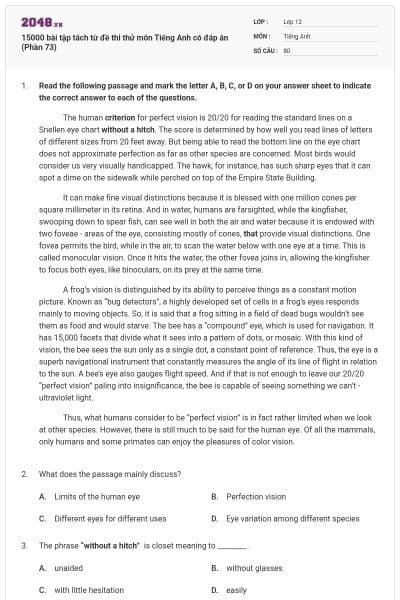
Read the following passage and mark the letter A, B, C, or D on your answer sheet to indicate the correct answer to each of the questions.
The human criterion for perfect vision is 20/20 for reading the standard lines on a Snellen eye chart without a hitch. The score is determined by how well you read lines of letters of different sizes from 20 feet away. But being able to read the bottom line on the eye chart does not approximate perfection as far as other species are concerned. Most birds would consider us very visually handicapped. The hawk, for instance, has such sharp eyes that it can spot a dime on the sidewalk while perched on top of the Empire State Building.
It can make fine visual distinctions because it is blessed with one million cones per square millimeter in its retina. And in water, humans are farsighted, while the kingfisher, swooping down to spear fish, can see well in both the air and water because it is endowed with two foveae - areas of the eye, consisting mostly of cones, that provide visual distinctions. One fovea permits the bird, while in the air, to scan the water below with one eye at a time. This is called monocular vision. Once it hits the water, the other fovea joins in, allowing the kingfisher to focus both eyes, like binoculars, on its prey at the same time.
A frog’s vision is distinguished by its ability to perceive things as a constant motion picture. Known as “bug detectors”, a highly developed set of cells in a frog’s eyes responds mainly to moving objects. So, it is said that a frog sitting in a field of dead bugs wouldn’t see them as food and would starve. The bee has a “compound” eye, which is used for navigation. It has 15,000 facets that divide what it sees into a pattern of dots, or mosaic. With this kind of vision, the bee sees the sun only as a single dot, a constant point of reference. Thus, the eye is a superb navigational instrument that constantly measures the angle of its line of flight in relation to the sun. A bee’s eye also gauges flight speed. And if that is not enough to leave our 20/20 “perfect vision” paling into insignificance, the bee is capable of seeing something we can’t - ultraviolet light.
Thus, what humans consider to be “perfect vision” is in fact rather limited when we look at other species. However, there is still much to be said for the human eye. Of all the mammals, only humans and some primates can enjoy the pleasures of color vision.
What does the passage mainly discuss?
Limits of the human eye
Perfection vision
Different eyes for different uses
Eye variation among different species
Đáp án D.
Key words: passage, discuss.
Clue: “But being able to read the bottom line on the eye chart does not approximate perfection as far as other species are concerned”: Nhưng việc đọc được dòng dưới cùng trong bảng kiểm tra mắt không có nghĩa là tầm mắt hoàn hảo của con người cũng xa như các loài khác.
A. limits of the human eye: giới hạn của mắt người
B. perfect vision: tầm nhìn hoàn hảo
C. different eyes for different uses: các loại mắt khác nhau dùng cho các mục đích sử dụng khác nhau.
D. eye variation among different species: sự khác nhau về mắt giữa các loài khác nhau.
Ta thấy bài văn nói về mắt của nhiều loài động vật khác nhau do đó đáp án chính xác là đáp án D.
The phrase “without a hitch” is closet meaning to ________ .
unaided
without glasses
with little hesitation
easily
Đáp án D.
Ta có without a hitch: không có gì khó khăn = easily/ without difficulty
Vậy đáp án chính xác là D. easily: một cách dễ dàng.
Các đáp án khác không đúng:
A. unaided: mắt thường, mắt trần
B. without glasses: không có kính
C. with little hesitation: với 1 chút do dự
According to the passage, why might birds and animals consider humans very visually handicapped?
Hunman can’t see very well in either air or water.
Human eyes are not as well suited to our needs.
The main outstanding feature of human eyes is color vision.
Human eyes can’t do what their eyes can do.
Đáp án D.
Keywords: birds and animals, consider, humans, visually handicapped
Clue: “Most birds would consider US very visually handicapped. The hawk, for instance, has such sharp eyes that it can spot a dime on the sidewalk while perched on top of the Empire State Building”: Hầu hết các loài chim sẽ cho rằng chúng ta có tật về mắt. Ví dụ diều hâu có đôi mắt tinh đến nỗi nó có thể xác định được một đốm nhỏ trên vỉa hè khi đang đậu trên đỉnh tòa nhà Empire State.
A. humans can’t see very well in cither air or water: con người không thể nhìn tốt trên không hoặc dưới nước.
B. human eyes are not as well suited to our needs: mắt của con người không đáp ứng tốt nhu cầu cùa chúng ta.
C. the main outstanding feature of human eyes is color vision: điểm nổi bật chính của mắt người là nhìn thấy màu sắc.
D.human eyes can’t do what their eyes can do: mắt con người không thể làm được những gì mà mắt chim và các loài động vật có thể làm.
Diều hâu có thể nhìn thấy một điểm nhỏ khi nó đậu trên đỉnh tòa nhà Empire State, đó là điều mắt nguời không thể làm được và cũng là một ví dụ cho thấy các loài chim và động vật sẽ cho ràng con người có tật về mắt.
Vậy đáp án chính xác là đáp án D.
The word “that” in line 10 refers to ________ .
foveae
areas of the eye
cones
visual distinctions
Đáp án A.
Key words: that, refersto
Clue: ... while the kingfisher, swooping down to spear fish, can see well in both the air and water because it is endowed with two foveae - areas of the eye, consisting mostly of cones, that provide visual distinctions.
Ta thấy areas of the eye và consisting mostly of cones là những cụm từ bổ nghĩa cho foveae và được ngăn cách bởi dấu gạch ngang và dấu phẩy vì vậy that phải là mệnh đề quan hệ thay thế cho cụm từ trước dấu gạch ngang là foveae.
Vậy đáp án chính xác là đáp án A. foveae.
According to the passage, “bug detectors” are useful for ________
navigation
seeing moving objects
avoiding bugs when getting food
avoiding starvation
Đáp án B.
Keywords: bug detectors, useful.
Clue: Known as “bug detectors”, a highly developed set of cells in a frog’s eyes responds mainly go moving objects: Được biết đến như là máy dò bọ, một tồ hợp các tế bào phát triển cao trong mắt ếch phản xạ chủ yểu vói vật thể đang chuyển động.
A. navigation: việc đi biển
B. seeing moving objects: nhìn vật thể đang chuyển động
C. avoiding bugs when getting food: tránh bọ khi đang lấy thức ăn
D. avoiding starvation: tránh chết đói.
Mắt ếch có tổ hợp các tế bào phát triển cao và hữu ích trong việc nhìn vật thể đang chuyển động
Vậy đáp án chính xác là đáp án B.
According to the passage, which of the following is NOT true?
Kingfishers have monocular vision.
Bees see patterns of dots.
Hawks eyes consist mostly of cones that can allow it to scan with one eye at time
Humans are farsighted in water.
Đáp án C.
Keywords: Passage, NOT true.
Clue:
1. And in water, humans are farsighted, while the kingfisher, swooping down to spear fish, can see well in both the air and water because it is endowed with two foveae - areas of the eye, consisting mostly of cones, that provide visual distinctions. One fovea permits the bird, while in the air, to scan the water below with one eye at a time. This is called monocular vision.
2. The bee has a “compound” eye, which is used for navigation. It has 15 000 facets that divide what it sees into a pattern of dots, or mosaic.)
Các đáp án sau đúng theo nội dung của bài:
A. kingfishers have monocular vision: loài chim nhỏ có tầm nhìn một mắt (clue 1)
B. bees sec patterns of dots: ong nhìn thấy các dấu chẩm (clue 2).
D. humans are farsighted in water: con người được xa trong nước (clue1).
Đáp án không đúng theo nội dung của bài là C. hawks eyes consist mostly of cones that can allow it to scan with one eye at a time: mắt diều hâu bao gồm hầu hết các hình nón có thể cho phép nó quét với một mắt riêng biệt.
Which of the following can be inferred from the passage?
Eyes have developed differently in each species
Bees have the most complex eye
Humans should not envy what they don’t need
Perfect vision is not perfect
Đáp án A.
Keywords: inferred, from the passage.
A. eyes have developed differently in each species: đôi mắt của mỗi loài phát triển khác nhau.
B. bees have the most complex eye: loài ong có đôi mắt phức tạp nhất.
C. humans should not envy what they don’t need: con người không nên thèm muốn cái mà họ không cần
D. .perfect vision is not perfect: tầm nhìn hoàn hảo là không hoàn hảo.
Ta thấy bài văn nói tới đôi mắt của những loài khác nhau với những điểm khác nhau do đó đáp án chính xác là đáp án A.
Read the following passage and mark the letter A, B, C, or D on your answer sheet to indicate the correct answer to each of the questions.
There are a number of natural disasters that can strike across the globe. Two that are frequently linked to one another are earthquakes and tsunamis. Both of them can cause a great amount of devastation when they hit. However, tsunamis are the direct result of earthquakes and cannot happen without them.
The Earth has three main parts. They are the crust, the mantle, and the core. The crust is the outer layer of the Earth. It is not a single piece of land. Instead, it is comprised of a number of plates. There are a few enormous plates and many smaller ones. These plates essentially rest upon the mantle, which is fluid. As a result, the plates are in constant - yet slow - motion. The plates may move away from or towards other plates. In some cases, they collide violently with the plates adjoining them. The movement of the plates causes tension in the rock. Over a long time, this tension may build up. When it is released, an earthquake happens.
Tens of thousands of earthquakes happen every year. The vast majority are so small that only scientific instruments can perceive them. Others are powerful enough that people can feel them, yet they cause little harm or damage. More powerful earthquakes, however, can cause buildings, bridges, and other structures to collapse. They may additionally injure and skill thousands of people and might even cause the land to change it appearance.
Since most of the Earth's surface is water, numerous earthquakes happen beneath the planet's oceans. Underwater earthquakes cause the seafloor to move. This results in the displacement of water in the ocean. When this occurs, a tsunami may form. This is a wave that forms on the surface and moves in all directions from the place where the earthquake happened. A tsunami moves extremely quickly and can travel thousands of kilometres. As it approaches land, the water near the coast gets sucked out to sea. This causes the tsunamis to increase in height. Minutes later, the tsunami arrives. A large tsunami - one more than ten meters in height - can travel far inland. As it does that, it can flood the land, destroy human settlements, and kill large numbers of people.
Which of the following statements does paragraph 1 support?
Earthquakes cause more destruction than tsunamis.
A tsunami happens in tandem with an earthquake.
The most severe type of natural disaster is an earthquake.
Earthquakes frequently take place after tsunamis do.
B
Đoạn văn 1 ủng hộ ý nào sau đây?
A. Động đất gây ra nhiều thiệt hại hơn sóng thần.
B. Sóng thần xảy ra song song với động đất.
C. Loại hình thiên tai tàn khốc nhất là động đất.
D. Động đất thường xảy ra sau sóng thần.
Dẫn chứng: However, tsunamis are the direct result of earthquakes and cannot happen without them.
=> Chọn B
The word "it" in bold in paragraph 2 refers to___________.
the Earth
the core
the crust
the mantle
C
Từ “it” ở đoạn 2 ám chỉ đến......
A. Trái Đất
B. hạt nhân
C. vỏ Trái Đất
D. vỏ ngoài
Dẫn chứng: The crust is the outer layer of the Earth. It is not a single piece of land. Instead, it is comprised of a number of plates.
“it” là “the crust”
=> Chọn C
What is the passage mainly about?
How earthquakes and tsunamis occur.
What kind of damage natural disasters can cause.
Why tsunamis are deadlier than earthquakes.
When earthquakes are the most likely to happen.
A
Bài đọc chủ yếu nói về?
A. Động đất và sóng thần xảy ra như thế nào?
B. Khi nào động đất có kahr năng xảy ra nhất?
C. Các thiên tai có thể gây ra những thiệt hại nào?
D. Tại sao sóng thần gây nguy hiểm chết người hơn động đất?
Dẫn chứng: Two that are frequently linked to one another are earthquakes and tsunamis. Both of them can cause a great amount of devastation when they hit.
=> Chọn A
The word "adjoining" in bold in paragraph 2 is closest in meaning to___________.
bordering
residing
approaching
appearing
A
Từ “adjoining” ( tiếp giáp) được in đậm ở đoạn 2 gần nghĩa nhất với....
A. giáp biên giới
B. cư trú
C. tiếp cận
D. xuất hiện
=> Chọn A
The word "perceive" in bold in paragraph 3 is closest in meaning to___________.
comprehend
detect
prevent
locate
B
Từ “perceive” ( nhận thức) được in đậm ở đoạn 3 gần nghĩa nhất với.....
A. thấu hiểu
B. tìm ra/ phát hiện ra
C. ngăn cản
D. đặt / để/ có vị trí
=> Chọn B
Which of the following is true regarding the crust?
There many separate pieces that make it up.
It is the smallest of the Earth's three layers.
It is thicker on land than it is under the water.
The mantle beneath it keeps it from moving too much.
A
Câu nào sau đây là đúng theo như bài đọc?
A. Có nhiều mảng riêng biệt tạo nên nó.
B. Nó là tầng nhỏ nhất trong 3 tầng của Trái Đất.
C. Vỏ Trái Đất trên đất dày hơn khi ở dưới nước.
D. Lớp vỏ bên dưới nó giữ cho nó không di chuyển quá nhiều.
Dẫn chứng: Instead, it is comprised of a number of plates. There are a few enormous plates and many smaller ones.
=> Chọn A
Based on the passage, what is probably true about tsunamis?
They kill more people each year than earthquakes.
They are able to move as fast as the speed of sound.
They cannot damage ships sailing on the ocean.
They can be deadly to people standing near shore.
D
Theo bài đọc câu nào đúng khi nói về sóng thần?
A. Mỗi năm nó giết chết nhiều người hơn động đất.
B. Nó có thể di chuyển với tốc độ nhanh như âm thanh.
C. Nó có thể phá những con tàu đang lênh đênh trên đại dương.
D. Nó có thể gây chết người khi họ đứng gần bờ biển.
Dẫn chứng: As it does that, it can flood the land, destroy human settlements, and kill large numbers of people.
=> Chọn D
Which of the following is NOT mentioned in paragraph 3 about earthquakes?
How many people they typically kill
How often powerful ones take place
What kind of damage they can cause
How severe the majority of them are
C
Ý nào sau đây không được đề cập ở đoạn 3 khi nói về động đất?
A. Hầu hết chúng tàn khốc như thế nào.
B. Chúng có thể gây ra loại thiệt hại nào.
C. Chúng thường diễn ra mạnh như thế nào.
D. Chúng gây thiệt hại bao nhiêu người.
Dẫn chứng: More powerful earthquakes, however, can cause buildings, bridges, and other structures to collapse. They may additionally injure and skill thousands of people and might even cause the land to change it appearance.
=> Không đề cập đến cách một trận động đất diễn ra.
=> Chọn C
In the 1960s, The Beatles were probably the most famous pop group in the whole world. Since then, there have been a great many groups that have achieved enormous fame, so it is perhaps difficult now to imagine how sensational The Beatles were at that time. They were four boys from the north of England and none of them had any training in music. They started by performing and recording songs by black Americans and they had some success with these songs. Then they started writing their own songs and that was when they became really popular. The Beatles changed pop music. They were the first pop group to achieve great success from songs they had written themselves. After that it became common for groups and singers to write their own songs. The Beatles did not have a long career. Their first hit record was in 1963 and they split up in 1970. They stopped doing live performances in 1966 because it had become too dangerous for them – their fans were so excited that they surrounded them and tried to take their clothes as souvenirs! However, today some of their songs remain as famous as they were when they first came out. Throughout the world many people can sing part of a Beatles song if you ask them.
The passage is mainly about
Why the Beatles split up after 7 years
The Beatles’ fame and success
How the Beatles became more successful than other groups
Many people’s ability to sing a Beatles song
B
Đoạn văn chủ yếu là về ______.
A. Tại sao nhóm The Beatles giải tán sau 7 năm
B. Danh tiếng và sự thành công của nhóm The Beatles
C. Cách nhóm The Beatles trở nên thành công hơn các nhóm khác
D. Nhiều người có khả năng hát một bài hát của nhóm The Beatles
Dẫn chứng: In the 1960s, The Beatles were probably the most famous pop group in the whole world... However, today some of their songs remain as famous as they were when they first came out.
=> Chọn B
The four boys of the Beatles___________
Were at the same age
Came from a town in the north of England
Came from the same family
Received good training in music
B
Bốn chàng trai của nhóm The Beatles ______.
A. ở cùng độ tuổi
B. đến từ một thị trấn ở phía Bắc nước Anh
C. đến từ cùng một gia đình.
D. nhận được sự huấn luyện tốt về âm nhạc
Dẫn chứng: They were four boys from the north of England and none of them had any training in music.
=> đáp án D sai, thông tin trong đáp án A, C không được đề cập đến trong bài.
=> Chọn B
The word “sensational” is closest in meaning to
shocking
bad
notorious
popular
A
Từ "sensational" có ý nghĩa gần nhất với _____.
A. sốc
B. xấu
C. hiển nhiên
D. phổ biến
sensational= shocking (adj): giật gân, gây chú ý.
=> Chọn A
The first songs of the Beatles were _____
paid a lot of money
broadcast on the radio
written by themselves
written by black Americans
D
Những bài hát đầu tiên của Beatles _____.
A. đã được trả rất nhiều tiền
B. đã được phát sóng trên đài
C. đã được viết bởi chính họ
D. đã được viết bởi người Mỹ da đen
Đáp án A, B không được đề cập đến trong bài.
Đáp án C sai. They started by performing and recording songs by black Americans
Dẫn chứng: Then they started writing their own songs and that was when they became really popular.
=> Chọn D
What is not true about the Beatles?
They became famous when they wrote their own songs
They had a long stable career
The members had no training in music
They were afraid of being hurt by fans
B
Điều gì không đúng về The Beatles?
A. Họ trở nên nổi tiếng khi họ viết bài hát của mình
B. Họ đã có một sự nghiệp ổn định
C. Các thành viên đã không có sự đào tạo về âm nhạc
D. Họ sợ bị thương tích bởi người hâm mộ
Đáp án A đúng. Then they started writing their own songs and that was when they became really popular.
Đáp án C đúng. They were four boys from the north of England and none of them had any training in music.
Đáp án D đúng. because it had become too dangerous for them – their fans were so excited that they surrounded them and tried to take their clothes as souvenirs
Dẫn chứng: The Beatles did not have a long career. => Họ không có một sự nghiệp lâu dài.
=> Chọn B
The Beatles stopped their live performances because
They spent more time writing their own songs
They did not want to work with each other
They had earned enough money
They were afraid of being hurt by fans.
D
The Beatles ngừng biểu diễn trực tiếp bởi vì _____.
A. họ đã dành nhiều thời gian hơn để sáng tác bài hát của mình
B. họ đã không muốn làm việc với nhau nữa.
C. họ đã kiếm đủ tiền.
D. họ sợ bị người hâm mộ gây thương tích.
Dẫn chứng: They stopped doing live performances in 1966 because it had become too dangerous for them – their fans were so excited that they surrounded them and tried to take their clothes as souvenirs!
=> Chọn D
The tone of the passage is that of________
neutral
criticism
admiration
sarcasm
C
Giọng điệu của đoạn văn là ________
A. trung lập
B. phê phán
C. ngưỡng mộ
D. chế nhạo
Dẫn chứng: However, today some of their songs remain as famous as they were when they first came out. Throughout the world many people can sing part of a Beatles song if you ask them.
=> Chọn C
Many ants forage across the countryside in large numbers and undertake mass
migrations; these activities proceed because one ant lays a trail on the ground for the others
to follow. As a worker ant returns home after finding a source of food, it marks the route
by intermittently touching its stinger to the ground and depositing a tiny amount of trail
(5) pheromone – a mixture of chemicals that delivers diverse messages as the context changes.
These trails incorporate no directional information and may be followed by other ants in
either direction.
Unlike some other messages, such as the one arising from a dead ant, a food trail has to
be kept secret from members of other species. It is not surprising then that ant species use
(10) a wide variety of compounds as trail pheromones. Ants can be extremely sensitive to these
signals. Investigators working with the trail pheromone of the leafcutter ant Atta texana
calculated that one milligram of this substance would suffice to lead a column of ants three
times around Earth.
The vapor of the evaporating pheromone over the trail guides an ant along the way,
(15) and the ant detects this signal with receptors in its antennae. A trail pheromone will
evaporate to furnish the highest concentration of vapor right over the trail, in what is called a vapor space. In following the trail, the ant moves to the right and left, oscillating from side
to side across the line of the trail itself, bringing first one and then the other antenna into
the vapor space. As the ant moves to the right, its left antenna arrives in the vapor space.
(20) The signal it receives causes it to swing to the left, and the ant then pursues this new course
until its right antenna reaches the vapor space. It then swings back to the right, and so
weaves back and forth down the trail.
What does the passage mainly discuss?
The mass migration of ants
How ants mark and follow a chemical trail
Different species of ants around the world
The information contained in pheromones
B
Đoạn văn chủ yếu thảo luận gì?
A. Sự di cư rất đông của kiến
B. Làm thế nào kiến đánh dấu và đi theo một dấu vết hóa học
C. Các loài kiến khác nhau trên thế giới
D. Thông tin chứa trong pheromones
=> đáp án B
The word “intermittently” in line 4 is closest in meaning to
periodically
incorrectly
rapidly
roughly
A
Từ " intermittently" ở dòng 4 có ý nghĩa gần nhất với
A. định kỳ B. không đúng
C. nhanh D. thô
=> đáp án A
" intermittently" ~ periodically: ngắt quãng, định kỳ
According to the passage, why do ants use different compounds as trail pheromones?
To reduce their sensitivity to some chemicals
To attract different types of ants
To protect their trail from other species
To indicate how far away the food is
C
Theo đoạn văn này, tại sao kiến lại sử dụng các hợp chất khác nhau như dấu vết pheromones?
A. Để giảm độ nhạy cảm của chúng đối với một số hóa chất
B. Thu hút các loại kiến khác nhau
C. Để bảo vệ dấu vết của chúng khỏi các loài khác
D. Để chỉ ra cách thức ăn bao xa
=> đáp án C
Thông tin: a food trail has to be kept secret from members of other species.
The author mentions the trail pheromone of the leafcutter ant in line 11 to point out
how little pheromone is needed to mark a trail
the different types of pheromones ants can produce
a type of ant that is common in many parts of the world
that certain ants can produce up to one milligram of pheromone
A
Tác giả đề cập đến dấu vết pheromone của kiến cắn lá ở dòng 11 để chỉ ra
A. cần rất ít Pheromone để đánh dấu một dấu vết
B. các loại pheromones khác nhau mà kiến có thể sản sinh
C. một loại kiến phổ biến ở nhiều nơi trên thế giới
D. Một số kiến có thể sản sinh đến một miligam pheromone
=> đáp án A
Thông tin: Investigators working with the trail pheromone of the leafcutter ant Atta texana calculated that one milligram of this substance would suffice to lead a column of ants three times around Earth.
According to the passage, how are ants guided by trail pheromones?
They concentrate on the smell of food.
They follow an ant who is familiar with the trail
They avoid the vapor spaces by moving in a straight line.
They sense the vapor through their antennae.
D
Theo đoạn văn, kiến được hướng dẫn bằng pheromone như thế nào?
A. chúng tập trung vào mùi thức ăn.
B. chúng đi theo một con kiến quen thuộc với dấu vết
C. chúng tránh không gian hơi bằng cách di chuyển theo một đường thẳng.
D. chúng có thể cảm nhận hơi qua ăngten của chúng.
=> đáp án D
The word “oscillating“ in line 17 is closest in meaning to
falling
depositing
swinging
starting
C
Từ "oscillating" trong dòng 17 có ý nghĩa gần nhất với
A. giảm B. gửi tiền C. dao động D. bắt đầu
=> đáp án C
"oscillating" ~ swinging: đung đưa, dao động, rẽ ngoặt
According to the passage, the highest amount of pheromone vapor is found
in the receptors of the ants
just above the trail
in the source of food
under the soil along the trail
B
Theo đoạn văn, lượng pheromone cao nhất được tìm thấy
A. trong các thụ thể của kiến B. ngay phía trên dấu vết
C. trong nguồn thức ăn D. dưới đất dọc theo dấu vết
=> đáp án B
Thông tin: A trail pheromone will evaporate to furnish the highest concentration of vapor right over the trail
The phrase “the one” in line 8 refers to a single
message
dead ant
food trail
species
A
Cụm từ "the one" trong dòng 8 đề cập đến một
A. thông điệp B. con kiến chết
C. đường kiếm ăn D. loài
=> đáp án A
Martin Luther King, Jf., is well- known for his work in civil rights and for his many famous speeches, among which is his moving “ I have a dream” speech. But fewer people know much about King’s childhood. M.L., as he was called, was born in 1929 in Atlanta, Georgia, at the home of his maternal grandfather. M.L.’s grandfather purchased their home on Auburn Avenue in 1909, twenty years before M.L was born. His grandfather allowed the house to be used as a meeting place for a number of organizations dedicated to the education and social advancement of blacks. M.L. grew up in the atmosphere, with his home being used as a community gathering place, and was no doubt influenced by it.
M.L.’s childhood was not especially eventfully. His father was a minister and his mother was a musician. He was the second of three children, and he attended all black schools in a black neighborhood. The neighborhood was not poor, however. Auburn Avenue was an area of banks, insurance companies, builders, jewelers, tailors, doctors, lawyers, and other businesses and services. Even in the face of Atlanta’s segregation, the district thrived. Dr. King never forgot the community spirit he had known as a child, nor did he forget the racial prejudice that was a huge barrier keeping black Atlantans from mingling with whites.
What is the passage mainly about?
The prejudice that existed in Atlanta.
M.L.’s grandfather
Martin Luther King’s childhood.
The neighborhood King grew up in
C
Ý chính của bài là gì?
A. Thành kiến tồn tại ở Atlanta. B. ông của M.L.
C. thời thơ ấu của Martin Luther King. D. khu phố King lớn lên
=> đáp án C
When was M.L. born?
in 1909
in 1929
in 1949
20 years after his parents had met.
B
Khi nào M.L. được sinh ra?
A. năm 1909 B. năm 1929 C. năm 1949 D. 20 năm sau khi cha mẹ ông gặp nhau.
Thông tin: M.L., as he was called, was born in 1929 in Atlanta, Georgia, at the home of his maternal grandfather.
What is Martin Luthur King well- known for?
His publications.
His neighborhood.
His childhood.
His work in civil rights.
D
Martin Luther King nổi tiếng bởi cái gì?
A. các ấn bản của ông. B. nơi sống của ông.
C. thời thơ ấu của ông. D. tác phẩm của ông về quyền công dân.
=> đáp án D
Thông tin: Martin Luther King, Jf., is well- known for his work in civil rights and for his many famous speeches
According to the author, M.L. _______.
had a difficult childhood.
was a good musician as a child
loved to listen to his grandfather speak.
grew up in a relatively rich area of Atlanta.
D
Theo tác giả, M.L. _______.
A. có một tuổi thơ khó khăn.
B. là một nhạc sĩ giỏi khi còn bé
C. thích nghe người ông nội của mình nói chuyện.
D. lớn lên trong một vùng tương đối giàu có của Atlanta.
=> đáp án D
Thông tin: He was the second of three children, and he attended all black schools in a black neighborhood. The neighborhood was not poor, however.
Which of the following statements is NOT true?
Auburn was a commercial areas.
M.L.’s grandfather built their home on Auburn Avenue in 1909.
M. L. grew up in a rich, black neighborhood.
M.L.’s childhood was uneventful.
B
Khẳng định nào sau đây là không đúng?
A. Auburn là một khu vực thương mại.
B. Ông của M.L. xây dựng nhà trên đại lộ Auburn năm 1909.
C. M. L. lớn lên trong một khu phố giàu có của người da đen.
D. Thời thơ ấu của D.L. yên ổn.
Thông tin: M.L.’s grandfather purchased their home on Auburn Avenue in 1909, twenty years before M.L was born.
=> đáp án B
From the passage we can infer that:
M.L.’s father was a church member.
people gathered at M.L.’s to perform religious rituals.
M.L.’s father purchased their home on Auburn Avenue.
M.L. had a bitter childhood.
B
Từ đoạn văn chúng ta có thể suy luận rằng:
A. Cha của M.L. là một thành viên của nhà thờ.
B. người ta đã tập trung tại nhà của M.L. để thực hiện các nghi lễ tôn giáo.
C. Cha của M.L. đã mua nhà trên đại lộ Auburn.
D. M.L. đã có một tuổi thơ cay đắng.
=> đáp án B
Thông tin: His grandfather allowed the house to be used as a meeting place for a number of organizations dedicated to the education and social advancement of blacks.
M.L. was _______ by the atmosphere in which he grew up.
not affected at all
doubted
certainly influenced
prejudiced
C
M.L. đã _______ bởi bầu không khí ông lớn lên.
A. không bị ảnh hưởng
B. nghi ngờ
C. chắc chắn bị ảnh hưởng
D. thành kiến
=> đáp án C
Thông tin: M.L. grew up in the atmosphere, with his home being used as a community gathering place, and was no doubt influenced by it.
"Did you see that?" Joe said to his friend Bill. "You're a great shooter!"
Bill caught the basketball and bounced it before throwing it again. The ball flew into the net.
"Bill, you never miss!" Joe said admiringly.
"Unless I'm in a real game," Bill complained. "Then I miss all the time."
Joe knew that Bill was right. Bill performed much better when he was having fun with Joe in the school yard than he did when he was playing for the school team in front of a large crowd.
"Maybe you just need to practice more," Joe suggested.
"But I practice all the time with you!" Bill objected. He shook his head. "I just can't play well when people are watching me."
"You play well when I'm watching," Joe pointed out.
"That's because I've known you since we were five years old," Bill said with a smile. "I'm just not comfortable playing when other people are around."
Joe nodded and understood, but he also had an idea.
The next day Joe and Bill met in the school yard again to practice. After a few minutes, Joe excused himself.
"Practice without me," Joe said to his friend. "I'll be back in a minute."
Joe hurried through the school building, gathering together whomever he could find—two students, a math teacher, two secretaries, and a janitor. When Joe explained why he needed them, everyone was happy to help.
Joe reminded the group to stay quiet as they all went toward the school's basketball court. As Joe had hoped, Bill was still practicing basketball. He made five baskets in a row without noticing the silent people standing behind him.
"Hey, Bill!" Joe called out finally.
Bill turned. A look of surprise came over his face.
"I just wanted to show you that you could play well with people watching you," Joe said. "Now you'll have nothing to worry about for the next game!"
(From: https://www.ets.org/toefl_junior/prepare/standard_sample_questions/language_form_and_meaning)
At the end of the story, all of the following people watch Bill practice EXCEPT ………………...
the basketball coach
a math teacher
a janitor
Joe
At the end of the story, all of the following people watch Bill practice EXCEPT ………………...
A. the basketball coach
Joe hurried through the school building, gathering together whomever he could find—two students, a math teacher, two secretaries, and a janitor. When Joe explained why he needed them, everyone was happy to help.
Bill is upset because ………………..
his team loses too many games.
he plays better in practice than he does during games.
the school yard is not a good place to practice.
Joe watches him too closely when he plays.
Bill is upset because ………………..
B. he plays better in practice than he does during games.
Bill performed much better when he was having fun with Joe in the school yard than he did when he was playing for the school team in front of a large crowd.
What does Joe decide to gather a group of people for?
To have more people see the next game
To show them Bill’s talent
To get more players for his team
To help Bill feel less nervous
What does Joe decide to gather a group of people for?
D. To help Bill feel less nervous
"I just wanted to show you that you could play well with people watching you," Joe said. "Now you'll have nothing to worry about for the next game!"
What would be the best title for the story?
Practice Makes Perfect
Joe Joins the Team
Bill Wins the Big Game
Bill's Basketball Problem
What would be the best title for the story?
D. Bill's Basketball Problem
"Unless I'm in a real game," Bill complained. "Then I miss all the time."
Bill said with a smile. "I'm just not comfortable playing when other people are around."
In line 6, the word performed is closest in meaning to ………………...
played
changed
moved
acted
In line 6, the word performed is closest in meaning to ………………...
A. played
Bill performed much better when he was having fun with Joe in the school yard than he did when he was playing for the school team in front of a large crowd.
Why does the group have to be quiet when they go to the basketball court?
Because they do not want Bill to know they were there
Because the group needs to listen to Joe’s instructions
Because Joe is telling Bill what to do
Because Bill likes to practice alone
Why does the group have to be quiet when they go to the basketball court?
A. Because they do not want Bill to know they were there
Joe reminded the group to stay quiet as they all went toward the school's basketball court. As Joe had hoped, Bill was still practicing basketball. He made five baskets in a row without noticing the silent people standing behind him.
Why does Bill play well when Joe is watching him?
He is comfortable with Joe.
Joe tells him how to play better.
He does not know that Joe is there.
He wants to prove to Joe that he is a good player.
Why does Bill play well when Joe is watching him?
A. He is comfortable with Joe.
"You play well when I'm watching," Joe pointed out.
"That's because I've known you since we were five years old," Bill said with a smile. "I'm just not comfortable playing when other people are around."
When another old cave is discovered in the south of France, it is not usually news. Rather, it is an ordinary event. Such discoveries are so frequent these days that hardly anybodypays heed tothem. However, when the Lascaux cave complex was discovered in 1940, the world was amazed. Painted directly on its walls were hundreds of scenes showing how people lived thousands of years ago. The scenes show people hunting animals, such as bison or wild cats. Other imagesdepictbirds and, most noticeably, horses, which appear in more than 300 wall images, by far outnumbering all other animals.
Early artists drawing these animals accomplished a monumental and difficult task. “They”did not limit themselves to the easily accessible walls but carried their painting materials to spaces that required climbing steep walls or crawling into narrow passages in the Lascaux complex.
Unfortunately, the paintings have been exposed to the destructive action of water and temperature changes, which easily wear the images away. Because the Lascaux caves have many entrances, air movement has also damaged the images inside. Although they are not out in the open air, where natural light would have destroyed them long ago, many of the images have deteriorated and are barely recognizable. To prevent further damage, the site was closed to tourists in 1963, 23 years after it was discovered.
(From: https://www.ets.org/toefl_junior/prepare/standard_sample_questions/language_form_and_meaning)
In line 12, the word “They”refers to………………...
Walls
Animals
Materials
Artists
In line 12, the word “They”refers to………………...
D. Artists
Early artists drawing these animals accomplished a monumental and difficult task. “They”did not limit themselves…..
Based on the passage, what is probably true about the south of France?
It is home to rare animals.
It is known for horse-racing events.
It has attracted many famous artists.
It has a large number of caves.
Based on the passage, what is probably true about the south of France?
D. It has a large number of caves.
When another old cave is discovered in the south of France, it is not usually news. Rather, it is an ordinary event. Such discoveries are so frequent these days that hardly anybodypays heed tothem.
Which title best summarizes the main idea of the passage?
Hidden Prehistoric Paintings
Determining the Age of French Caves
Wild Animals in Art
Exploring Caves Respectfully
Which title best summarizes the main idea of the passage?
A. Hidden Prehistoric Paintings
Căn cứ vào ý của cả bài đọc.
Why was painting inside the Lascaux complex a difficult task?
It was completely dark inside.
The caves were full of wild animals.
Many painting spaces were difficult to reach.
Painting materials were hard to find.
Why was painting inside the Lascaux complex a difficult task?
C. Many painting spaces were difficult to reach.
Early artists drawing these animals accomplished a monumental and difficult task. “They”did not limit themselves to the easily accessible walls but carried their painting materials to spaces that required climbing steep walls or crawling into narrow passages in the Lascaux complex.
In line 3, the wordspays heed toare closest in meaning to………………...
watches
discovers
notices
buys
In line 3, the wordspays heed toare closest in meaning to………………...
C. notices
Such discoveries are so frequent these days that hardly anybodypays heed tothem.
What does the passage say happened at the Lascaux caves in 1963?
Another part was discovered.
Visitors were prohibited from entering.
A new entrance was created.
A new lighting system was installed.
What does the passage say happened at the Lascaux caves in 1963?
B. Visitors were prohibited from entering.
To prevent further damage, the site was closed to tourists in 1963, 23 years after it was discovered.
According to the passage, all of the following have caused damage to the paintings EXCEPT………………...
water
temperature changes
air movement
light
According to the passage, all of the following have caused damage to the paintings EXCEPT………………...
D. light
Unfortunately, the paintings have been exposed to the destructive action of water and temperature changes, which easily wear the images away. Because the Lascaux caves have many entrances, air movement has also damaged the images inside. Although they are not out in the open air, where natural light would have destroyed them long ago, many of the images have deteriorated and are barely recognizable.
According to the passage, which animals appear most often on the cave walls?
Horses
Bison
Birds
Wild cats
According to the passage, which animals appear most often on the cave walls?
A. Horses
The scenes show people hunting animals, such as bison or wild cats. Other imagesdepictbirds and, most noticeably, horses, which appear in more than 300 wall images, by far outnumbering all other animals.
Body postures and movements are frequently indicators of self-confidence, energy, fatigue, or status. Cognitively, gestures operate to clarify, contradict, or replace verbal messages. Gestures also serve an important function with regard to regulating the flow of conversation. For example, if a student is talking about something in front of the class, single nods of the head from the teacher will likely cause that student to continue and perhaps more elaborate. Postures as well as gestures are used to indicate attitudes, status, affective moods, approval, deception, warmth, arid other variables related to conversation interaction.
The saying “A picture is worth a thousand words” well describes the meaning of facial expressions. Facial appearance – including wrinkles, muscle tone, skin coloration, and eye color-offers enduring cues that reveal information about age, sex, race, ethnic origin, and status.
A less permanent second set of facial cues-including length of hair, hairstyle, cleanliness, and facial hair-relate to an individual’s idea of beauty. A third group of facial markers are momentary expressions that signal that cause changes in the forehead, eyebrows, eyelids, cheeks, nose, lips, and chin, such as raising the eyebrows, wrinkling the brow, curling the lip.
Some facial expressions are readily visible, while others are fleeting. Both types can positively or negatively reinforce the spoken words and convey cues concerning emotions and attitudes.
Facial expressions __________.
cannot convey emotions
cannot reinforce spoken words
can only express negative attitudes
can be either visible or fleeting
Chọn đáp án D
Biểu cảm trên khuôn mặt _______
A. không thể truyền cảm xúc
B. không thể củng cố những lời nói
C. chỉ có thể thể hiện thái độ tiêu cực
D. có thể nhìn thấy hoặc chỉ thoáng qua
Câu đầu tiên của đoạn 4: “Some facial expressions are readily visible, while others are fleeting.” (Một số biểu hiện trên khuôn mặt có thể nhìn thấy dễ dàng, trong khi những biểu hiện khác lướt qua nhanh)
Gestures __________.
can do nothing with a conversation
can clarify the meaning of verbal messages
may interrupt the flow of a conversation
can end a conversation more quickly than usual
Chọn đáp án B
Những cử chỉ _______
A. không thể làm gì với một cuộc trò chuyện
B. có thể làm rõ ý nghĩa của thông điệp bằng lời nói
C. có thể làm gián đoạn dòng chảy của một cuộc trò chuyện
D. có thể kết thúc một cuộc trò chuyện nhanh hơn bình thường
Câu thứ 2 của đoạn đầu: Cognitively, gestures operate to clarify, contradict, or replace verbal messages. (Dựa trên kinh nghiệm, những cử chỉ hành động để làm rõ, làm mâu thuẫn, hoặc thay thế những thông điệp bằng lời nói).
According to the writer, “A picture is worth a thousand words” means __________.
a picture of a face is more valuable than a thousand words
a picture is more important than a thousand words
facial gestures can convey a lot of meanings
he has just bought a picture with a thousand words on it
Chọn đáp án C
Theo tác giả, “một hình ảnh đáng giá ngàn con chữ” có nghĩa là _______
A. một bức ảnh của một khuôn mặt có giá trị hơn một ngàn chữ
B. một bức tranh quan trọng hơn một nghìn từ
C. cử chỉ trên khuôn mặt có thể truyền đạt rất nhiều ý nghĩa
D. anh ấy đã mua một bức tranh với hàng ngàn từ
A picture is worth a thousand words: diễn tả sự sinh động bằng hình ảnh thì truyền đạt tốt hơn với việc chỉ sử dụng lời nói.
How many categories of facial expressions are mentioned?
2
3
4
5
Chọn đáp án B
Có bao nhiêu loại biểu hiện trên khuôn mặt được đề cập?
A. 2
B. 3
C. 4
D. 5
Câu thứ 2 đoạn 3: “A third group of facial markers are momentary expressions…” (Một nhóm ba của các dấu hiệu trên khuôn mặt là những tín hiệu tạm thời…)
A nod of the head from the teacher will likely ask his student to __________ what he is saying.
go on
give up
put off
throwaway
Chọn đáp án A
Một gật đầu từ giáo viên có thể sẽ giống như yêu cầu học sinh của mình _______ những gì nó đang nói.
A. tiếp tục
B. từ bỏ
C. tống khứ
D. ném đi
Câu thứ 4 của đoạn đầu: “… if a student is talking about something in front of the class, single nods of the head from the teacher will likely cause that student to continue and perhaps more elaborate” (nếu một học sinh đang nói gì đó trước lớp học, những cái gật đầu của giáo viên sẽ có thể làm học sinh tiếp tục và có lẽ sẽ nói thêm nhiều hơn)
“Where is the university?” is a question many visitors to Cambridge ask, but no one can give them a clear answer, for there is no wall to be found around the university. The university is the city. You can find the classroom buildings, libraries, museums and offices of the university all over the city. And most of its members are the students and teachers or professors of the thirty-one colleges. Cambridge is already a developing town long before the first students and teachers arrived 800 years ago. It grew up by the river Granta, as the Cam was once called. A bridge was built over the river as early as 875.
In the fourteenth and fifteenth centuries, more and more land was used for college buildings. The town grew faster in the nineteenth century after the opening of the railway in 1845. Cambridge became a city in 1951 and now it has the population of over 100000. Many young students want to study at Cambridge. Thousands of people from all over the world come to visit the university town. It has become a famous place all around the world.
Why did people name Cambridge the “city of Cambridge”?
Because the river was very well-known.
Because there is a bridge over the Cam.
Because it was a developing town.
Because there is a river named Granta.
Chọn đáp án B
Tại sao người ta đặt tên cho Cambridge là “thành phố của Cambridge”?
A. Bởi vì dòng sông đó rất nổi tiếng
B. Vì có một cây cầu bắc qua dòng sông Cam
C. Vì nó là một thị trấn phát triển
D. Vì có một dòng sông tên Granta
Câu 2, câu 3 đoạn thứ 2: It grew up by the river Granta, as the Cam was once called. A bridge was built over the river as early as 875. (Nó phát triển bên dòng sông Granta, hay Cam như đã từng được gọi. Một cây cầu đã được xây dựng trên sông từ năm 875.)
From what we read we know that now Cambridge is _______.
visited by international tourists
a city without wall
a city of growing population
a city that may have a wall around
Chọn đáp án A
Từ những gì chúng ta đọc chúng ta biết rằng bây giờ Cambridge _______.
A. được thăm quan bởi du khách quốc tế
B. là một thành phố không có tường
C. một thành phố đang tăng dân số
D. một thành phố có thể có một bức tường bao xung quanh
Câu thứ 5 đoạn 3: Thousands of people from all over the world come to visit the university town. (Hàng ngàn người từ khắp thế giới đến tham quan thị trấn trường đại học này)
from all over the world: khắp nơi trên thế giới ≈ international
Around what time did the university begin to appear?
In the 8th century
In the 13th century
In the 9th century
In the 15th century
Chọn đáp án B
Trong khoảng thời gian nào trường đại học bắt đầu xuất hiện
A. Thế kỉ thứ 8
B. Thế kỉ thứ 13
C. Thế kỉ thứ 9
D. Thế kỉ thứ 15
Câu đầu tiên của đoạn 2: “Cambridge is already a developing town long before the first students and teachers arrived 800 years ago.” (Cambridge đã là một thị trấn phát triển rất lâu trước khi các sinh viên và giáo viên đầu tiên đến đây vào 800 năm trước.)
Trường đại học xuất hiện khi giáo viên và sinh viên đầu tiên đến vào 800 trước => Khoảng thế kỉ thứ 13.
Why do most visitors come to Cambridge?
To see the university
To study in the colleges in Cambridge
To find the classroom buildings
To use the libraries of the university
Chọn đáp án A
Tại sao hầu hết các du khách đến thăm Cambridge?
A. Để thăm quan trường đại học
B. Để học ở các trường đại học ở Cambridge
C. Để tìm các tòa nhà lớp học
D. Để sử dụng thư viện của các trường đạ học
Câu thứ 5 đoạn 3: Thousands of people from all over the world come to visit the university town. (Hàng ngàn người tứ khắp thế giới đến thăm quan thị trấn trường đại học này)
After which year did the town really begin developing?
800
875
1845
1951
Chọn đáp án C
Sau năm nào thì thị trấn bắt đầu phát triển?
A. 800
B. 875
C. 1845
D. 1951
Câu thứ 2 đoạn 3: The town grew faster in the nineteenth century after the opening of the railway in 1845.
(Thị trấn phát triển nhanh hơn vào thế kỉ 19 sau khi mở đường sắt vào năm 1945)
Accustomed though we are to speaking of the films made before 1927 as “silent”, the film has never been, in the full sense of the word, silent. From the very beginning, music was regarded as an indispensable accompaniment; when the Lumiere films were shown at the first public film exhibition in the United States in February 1896, they were accompanied by piano improvisations on popular tunes. At first, the music played bore no special relationship to the films; an accompaniment of any kind was sufficient. Within a very short time, however, the incongruity of playing lively music to a solemn film became apparent, and film pianists began to take some care in matching their pieces to the mood of the film.
As movie theaters grew in number and importance, a violinist, and perhaps a cellist, would be added to the pianist in certain cases, and in the larger movie theaters small orchestras were formed. For a number of years the selection of music for each film program rested entirely in the hands of the conductor or leader of the orchestra, and very often the principal qualification for holding such a position was not skill or taste so much as the ownership of a large personal library of musical pieces. Since the conductor seldom saw the films until the night before the y were to be shown (if, indeed, the conductor was lucky enough to see them then), the musical arrangement was normally improvised in the greatest hurry.
To help meet this difficulty, film distributing companies started the practice of publishing suggestions for musical accompaniments. In 1909, for example, the Edison Company began issuing with their films such indications of mood as “pleasant’, “sad”, “lively”. The suggestions became more explicit, and so emerged the musical cue sheet containing indications of mood, the titles of suitable pieces of music, and precise directions to show where one piece led into the next.
Certain films had music especially composed for them. The most famous of these early special scores was that composed and arranged for D. w. Griffith’s film Birth of a Nation, which was released in 1915.
It may be inferred from the passage that the first musical cue sheets appeared around _______ .
1896
1909
1915
1927
Chọn đáp án B
Có thể suy luận từ đoạn văn rằng những bản sắp xếp trình tự xuất hiện của bản nhạc đầu tiên xuất hiện trong khoảng ________.
Câu thứ 2 và thứ 3 đoạn 3: “In 1909, for example, the Edison Company began issuing with their films such indications of mood as “pleasant’, “sad”, “lively”. The suggestions became more explicit, and so emerged the musical cue sheet containing indications of mood...” (Ví dụ vào năm 1909, Công ty Edison đã bắt đầu phát hành những bộ phim của họ với những biểu thị tâm trạng ẩn trong đó như “vui”, “buồn”, “sống động”. Những gợi ý này dần trở nên rõ ràng hơn và vì thế đã xuất hiện những bản sắp xếp trình tự xuất hiện của bản nhạc bao gồm cả tâm trạng được biểu thị...)
The word “them” refers to _______ .
films
years
pieces
hands
Chọn đáp án A
Câu cuối của đoạn 2: Since the conductor seldom saw the films until the night before they were to be shown (if, indeed, the conductor was lucky enough to see them then) (Bởi người chỉ huy dàn nhạc hiếm khi được xem những bộ phim và phải tới đêm trước khi những bộ phim được trình chiếu(đó là trong trường hợp người chỉ đạo dàn nhạc may mắn mới được xem bộ phim vào thời điểm đó)) Từ them đóng vai trò tân ngữ trong câu, chỉ những cái đã được nhắc đến phía trước. Do đó ta đọc phần trước của câu đó. Chỉ có danh từ “films” được nhắc đến và hợp lí khi đi cùng với “see”.
Which of the following notations is most likely to have been included on a musical cue sheet of the early 1900's?
“Key of c major”
“Directed by D. w. Griffith”
“Calm, peaceful”
“Piano, violin”
Chọn đáp án C
Những chú thích nào sau đây có nhiều khả năng được đưa vào bảng sắp xếp trình tự xuất hiện của bản nhạc vào đầu những năm 1900?
A: "Calm, peaceful": “Bình tĩnh, yên ả”: Đây là biểu thị tâm trạng: Có được thể hiện trên musical cue sheet
B: "Piano, violin": “Piano, vi-ô-lông”: Đây là nhạc cụ: Không được thể hiện trên musical cue sheet
C: "Key of C major": “khóa Đô trưởng”: Đây là khóa nhạc: Không được thể hiện trên musical cue sheet.
D: "Directed by D. W. Griffith's”: “Đạo diễn bởi D. W. Griffith's”: Đây là tên đạo diễn: Không được thể hiện trên musical cue sheet
Câu thứ 3 đoạn 3: “...so emerged the musical cue sheet containing indications of mood, the titles of suitable pieces of music, and precise directions to show where one piece led into the next” ( … vì thế đã xuất hiện những bản sắp xếp trình tự xuất hiện của bản nhạc bao gồm cả tâm trạng được biểu thị, tiêu đề của loại nhạc phù hợp, và các chỉ dẫn chính xác để thể hiện một bản nhạc tiếp theo sẽ dẫn tới đâu.)
According to the passage, what kind of business was the Edison Company?
It published musical arrangements.
It made musical instruments.
It distributed films.
It produced electricity.
Chọn đáp án C
Theo đoạn văn, Công ty Edison theo loại hình kinh doanh nào ?
A.It published musical arrangements.: Nó xuất bản những bản bố trí âm nhạc.
B. It made musical instruments: Công ty này chế tạo các nhạc cụ.
C. It distributed films: Công ty này phân phối những bộ phim.
D. It produced electricity: Công ty này sản xuất điện
Câu thứ 2 đoạn 3: “In 1909, for example, the Edison Company began issuing with their films...” ( Vào năm 1909, ví dụ, công ty Edision bắt đầu phát hành những bộ phim của họ…)
issue: phát hành. Ở câu này issue ≈ distribute: phân phối
The passage mainly discusses music that was _______ .
performed before the showing of a film
played during silent films
specifically composed for certain movie theaters
recorded during film exhibitions
Chọn đáp án B
Văn bản chủ yếu thảo luận về âm nhạc________.
A. Performed before the showing of a film: được chơi trước khi trình chiếu một bộ phim.
B. Played during silent films: được chơi trong suốt các bộ phim câm.
C. Specifically composed for certain movie: được soạn đặc biệt cho một bộ phim nhất định.
D. Recorded during film exhibitions: được thu lại trong khi triển lãm phim .
Câu đầu và câu thứ hai đoạn 1: “Accustomed though we are to speaking of the films made before 1927 as “silent”, the film has never been, in the full sense of the word, silent. From the very beginning, music was regarded as an indispensable accompaniment…” ( Mặc dù chúng ta đã quen thuộc nhắc tới những bộ phim được sản xuất trước năm 1927 là “phim câm’ thì phim chưa bao giờ thực sự im lặng. Ngay từ khi mới bắt đầu, âm nhạc đã được xem là thứ đồng hành không thể thiếu…)
The word “composed” is closest in meaning to _______ .
selected
combined
played
created
Chọn đáp án D
Từ “composed” (sáng tác) gần nghĩa nhất với________.
A. selected: chọn
B. combined: nối
C. played: chơi
D. created: sáng tạo
The word “scores” most likely mean _______ .
successes
totals
groups of musicians
musical compositions
Chọn đáp án D
Từ "scores" trong đọa văn có nghĩa là
A. Successes: chuỗi thành công
B. Totals: tổng cộng
C. Groups of musicians: nhóm các nhà soạn nhạc
D. Musical compositions: tác phẩm âm nhạc
Đoạn cuối: “Certain films had music especially composed for them. The most famous of these early special scores was that composed and arranged for D. W. Griffith's film Birth of a Nation, which was released in 1915” ( Những bộ phim nhất định có âm nhạc được đặc biệt sáng tác cho chúng. Bản nhạc nổi tiếng nhất trong những bản dàn bè này là bản nhạc được soạn và sắp xếp cho bộ phim Birth of a Nation của D. W. Griffith's, bộ phim ra mắt năm 1915.)
It can be inferred that orchestra conductors who worked in movie theaters needed to _______ .
be able to compose original music
have pleasant voices
be able to play many instruments
be familiar with a wide variety of music
Chọn đáp án D
Có thể suy luận ra rằng những người chỉ huy dàn nhạc làm việc trong rạp chiếu phim cần ________.
A. be able to compose original music: có khả năng soạn nhạc nguyên bản
B. Have pleasant voices: có giọng hay.
C. Be able to play many instruments: có khả năng chơi nhiều nhạc cụ.
D. be familiar with a wide variety of music: quen thuộc với các loại nhạc Đáp án dạng khác nhau.
Câu thứ 2 đoạn 2: “For a number of years the selection of music for each film program rested entirely in the hands of the conductor or leader of the orchestra, and very often the principal qualification for holding such a position was not skill or taste so much as the ownership of a large personal library of musical pieces” ( Trong một vài năm việc lựa chọn âm nhạc cho từng chương trình phim hoàn toàn nằm trong quyết định của người chỉ huy hoặc người chỉ đạo dàn nhạc, và rất thường xuyên thì tiêu chuẩn chính để được nắm giữ vị trí này không phải nằm ở kỹ năng hay thẩm âm mà là ở việc sở hữu một kho tàng các bản nhạc đồ sộ riêng)
Bạn có thích hoạt động này không?