15000 bài tập tách từ đề thi thử môn Tiếng Anh có đáp án (Phần 72)
76 câu hỏi
Read the following passage and mark the letter A, B, C or D on your answer sheet to indicate the correct answer to each of the questions.
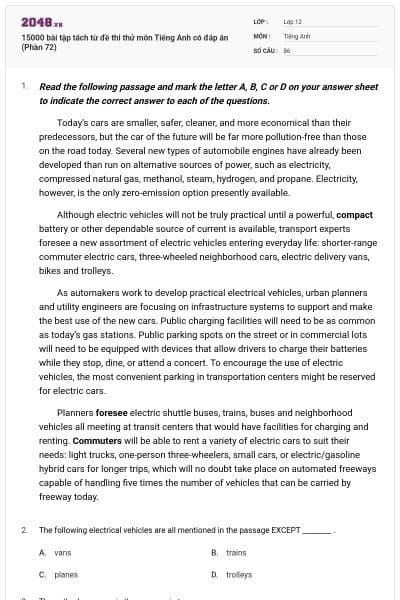
Today’s cars are smaller, safer, cleaner, and more economical than their predecessors, but the car of the future will be far more pollution-free than those on the road today. Several new types of automobile engines have already been developed than run on alternative sources of power, such as electricity, compressed natural gas, methanol, steam, hydrogen, and propane. Electricity, however, is the only zero-emission option presently available.
Although electric vehicles will not be truly practical until a powerful, compact battery or other dependable source of current is available, transport experts foresee a new assortment of electric vehicles entering everyday life: shorter-range commuter electric cars, three-wheeled neighborhood cars, electric delivery vans, bikes and trolleys.
As automakers work to develop practical electrical vehicles, urban planners and utility engineers are focusing on infrastructure systems to support and make the best use of the new cars. Public charging facilities will need to be as common as today’s gas stations. Public parking spots on the street or in commercial lots will need to be equipped with devices that allow drivers to charge their batteries while they stop, dine, or attend a concert. To encourage the use of electric vehicles, the most convenient parking in transportation centers might be reserved for electric cars.
Planners foresee electric shuttle buses, trains, buses and neighborhood vehicles all meeting at transit centers that would have facilities for charging and renting. Commuters will be able to rent a variety of electric cars to suit their needs: light trucks, one-person three-wheelers, small cars, or electric/gasoline hybrid cars for longer trips, which will no doubt take place on automated freeways capable of handling five times the number of vehicles that can be carried by freeway today.
The following electrical vehicles are all mentioned in the passage EXCEPT ________ .
vans
trains
planes
trolleys
Đáp án C.
Keyword: vehicles, mentioned, except.
Clue:
1. “electric vehicles entering everyday life: shorter-range commuter electric cars, three-wheeled neighborhood cars, electric delivery vans, bikes and trolleys.” những phương tiện dùng điện được sử dụng trong cuộc sống hằng ngày như: ô tô điện di chuyển ngắn hơn, ô tô ba bánh trong khu phố, xe tải điện chở hàng, xe đạp và xe đẩy.
2. “Planners foresee electric shuttle buses, trains, buses”: những nhà hoạch định chính sách có thể… những xe buýt điện con thoi, tàu hỏa và xe buýt.
Phân tích đáp án:
A. vans: xe tải – có trong clue 1.
B. trains: tàu lửa – có trong clue 2.
C. planes: máy bay – không có trong bài.
D. trolleys: xe đẩy – có trong clue 1.
Đề bài yêu cầu tìm phương tiện không được đề cập đến trong bài, do đó đáp án chính xác là C.
The author’s purpose in the passage is to ________ .
criticize conventional vehicles
support the invention of electric cars
narrate a story about alternative energy vehicles
describe the possibilities for transportation in the future
Đáp án D.
Keyword: purpose.
Phân tích đáp án:
A. criticize conventional vehicles: chỉ trích các phương tiện truyền thống – Sai vì bài tập trung chủ yếu vào các phương tiện trong tương lai.
B. support the invention of electric cars: ủng hộ việc phát minh ô tô điện – Sai vì ô tô điện chỉ là một phương tiện trong số nhiều phương tiện sử dụng điện.
C. narrate a story about alternative energy vehicles: kể một câu chuyện về các phương tiện sử dụng năng lượng thay thế - Sai vì bài viết không được triển khai theo mạch một câu chuyện.
D. describe the possibilities for transportation in the future: miêu tả các phương án tham gia giao thông trong tương lai – Đúng vì bài văn miêu tả rất nhiều các phương tiện khác nhau trong tương lại.
The passage would most likely be followed by details about _______.
automated freeways
pollution restrictions in the future
the neighborhood of the future
electric shuttle buses
Đáp án A.
Keyword: passage, likely be followed, details about.
Câu hỏi yêu cầu tìm thông tin đoạn văn tiếp nối bài văn này. Để làm dạng câu hỏi này, chúng ta cần nghiên cứu kỹ đoạn cuối cùng và đặc biệt là câu văn cuối cùng.
Clue: “Commuters will be able to rent a variety of electric cars to suit their needs: light trucks, one-person three-wheelers, small cars, or electric/gasoline hybrid cars for longer trips, which will no doubt take place on automated freeways capable of handling five times the number of vehicles that can be carried by freeway today”: những… sẽ có thể thuê rất nhiều các loại xe điện khác nhau tùy theo nhu cầu của họ: xe tải nhẹ, xe ba bánh chở một người, xe ô tô nhỏ, hay xe ô tô lại sử dụng cả xăng và điện cho những chuyến đi dài hơn. Những phương tiện này chắc chắn sẽ lưu hành trên những quốc lộ tự động hóa mà có thể đáp ứng cho số lượng phương tiện nhiều gấp năm lần so với đường cao tốc ngày nay.
Phân tích đáp án:
A. automated freeways: các đường cao tốc tự động hóa.
B. pollution restrictions in the future: sự hạn chế tình trạng ô nhiễm trong tương lai.
C. the neighborhood of the future: vùng lân cận trong tương lai.
D. electric shuttle buses: xe buýt điện chạy tuyến đường ngắn.
Đáp án A chính xác vì nội dung của câu cuối cùng của bài văn có đề cập đến một khái niệm mới đó là “automated freeways capable of handling five times the number of vehicles that can be carried by freeway today”. Bởi vậy chúng ta có cơ sở để dự đoán rằng đoạn văn tiếp theo sẽ đề cập tới nội dung này.
The word “compact” in the second paragraph is closest in meaning to ________ .
long-range
inexpensive
concentrated
squared
Đáp án C.
Keyword: compact, second paragraph, closest in meaning.
Clue: “Although electric vehicles will not be truly practical until a powerful, compact battery or other dependable source of current is available, transport experts foresee a new assortment of electric vehicles entering everyday life: shorter-range commuter electric cars, three-wheeled neighborhood cars, electric delivery vans, bikes and trolleys”: Mặc dù xe điện sẽ không hoàn toàn khả thi/thực tế cho đến khi chúng ta tìm ra một loại pin mạnh và … hoặc nguồn năng lượng điện khác mà chúng ta có thể trông mong vào. Các chuyên gia về giao thông … được một loạt những phương tiện chạy điện mới sẽ có mặt trong cuộc sống của chúng ta như: ô tô điện di chuyển trong đoạn đường ngắn hơn, ô tô ba bánh trong khu phố, xe tải điện chở hàng, xe đạp, và xe đẩy.
Ta thấy từ compact phải mang nghĩa tích cực vì nó song hành với powerful (mạnh mẽ) để miêu tả về một loại pin mới.
Phân tích đáp án:
A. long-range (adj): có tầm xa – Sai vì ở dưới có thông tin rằng các chuyên gia nhìn trước về các phương tiện chạy bằng điện trong đó có ô tô di chuyển đường ngắn, do đó tính chất này không phù hợp.
B. inexpensive (adj): rẻ, không đắt
C. concentrated (adj): tập trung, cô đặc, rắn chắc.
D. squared (adj): được tạo thành hình vuông – Sai vì hình vuông không mang tính chất đặc biệt nào để miêu tả về sự ưu việt của loại pin.
Sau khi loại được hai đáp án A và B thì ta còn hai đáp án để phân vân là C và D. Cả hai yếu tố này đều chứng minh được sự tiến bộ cũng như đặc biệt của công nghẹ mới này. Dựa và vốn kiến thức thông thường ta biết rằng đĩa CD có tên tiếng anh là “compact disc” – là một loại đĩa được dùng để nén các file dữ liệu vào. Bởi vậy liên tưởng gần nhất cho những bạn không biết nghĩa của từ compact là đáp án
C. concentrated (adj): tập trung, cô đặc, rắn chắc vì nó mang tính chất của đĩa CD, tập trung các file rời rạc vào trong một cái đĩa.
In the second paragraph, the author implies that _______ .
a dependable source of electric energy will eventually be developed.
everyday life will stay much the same in the future.
a single electric vehicle will eventually replace several modes of transportation.
electric vehicles are not practical for the future.
Đáp án A.
Keyword: second paragraph, implies.
Clue: “Although electric vehicles will not be truly practical until a powerful, compact battery or other dependable source of current is available, transport experts foresee a new assortment of electric vehicles entering everyday life: shorter-range commuter electric cars, three-wheeled neighborhood cars, electric delivery vans, bikes and trolleys”: Mặc dù xe điện sẽ không hoàn toàn khả thi/thực tế cho đến khi chúng ta tìm ra một loại pin mạnh và … hoặc nguồn năng lượng điện khác mà chúng ta có thể trông mong vào. Các chuyên gia về giao thông … được một loạt những phương tiện chạy điện mới sẽ có mặt trong cuộc sống của chúng ta như: ô tô điện di chuyển trong đoạn đường ngắn hơn, ô tô ba bánh trong khu phố, xe tải điện chở hàng, xe đạp, và xe đẩy.
Phân tích đáp án:
A. a dependable source of electric energy will eventually be developed: một nguồn năng lượng điện có thể trông cậy cuối cùng sẽ được phát triển.
B. everyday life will stay much the same in the future: cuộc sống hiện tại sẽ vẫn như vậy trong tương lai – Sai vì trong tương lai sẽ có các phương tiện mới, chưa từng xuất hiện, do đó tương lai sẽ không giống hệt hiện tại.
C. a single electric vehicle will eventually replace several modes of transportation: một chiếc xe điện duy nhất cuối cùng sẽ thay thế một số phương thức vận tải. Sai
D. electric vehicles are not practical for the future: xe điện thì không thực tế cho tương lai. Sai
According to the passage, public parking lots of the future will be ________ .
more convenient than they are today
equipped with charging devices
much larger than they are today
as common as today’s gas stations
Đáp án B.
Keyword: public parking, future.
Clue:
1. “Public parking spots on the street or in commercial lots will need to be equipped with devices that allow drivers to charge their batteries while they stop, dine, or attend a concert.”: Những điểm đỗ xe công cộng trên đường hay những lô đất thương mại sẽ cần được trang bị những thiết bị cho phép lái xe sạc pin khi họ dừng xe, ăn tối hoặc đi đến một buổi hòa nhạc.
2. “Public charging facilities will need to be as common as today’s gas stations”: Những thiết bị hỗ trợ sạc công cộng phải phổ biến như trạm xăng ngày nay.
Phân tích đáp án:
A. more convenient than they are today: tiện lợi hơn ngày nay.
B. equipped with charging devices: trang bị với thiết bị sạc.
C. much larger than they are today: lớn hơn ngày nay.
D. as common as today’s gas stations: sẽ phổ biến như trạm xăng ngày nay.
Ta thấy đáp án B hoàn toàn phù hợp với nội dung của clue.
Đáp án D sai vì public charging facilities mới có đặc điểm này chứ không phải là public parking spots. Các đáp án A và C không có thông tin tương xứng trong bài.
The word “foresee” in this passage could best be replaced with ________ .
count on
invent
imagine
rely on
Đáp án C.
Keyword: foresee, best be replaced with
Clue: “Although electric vehicles will not be truly practical until a powerful, compact battery or other dependable source of current is available, transport experts foresee a new assortment of electric vehicles entering everyday life: shorter-range commuter electric cars, three-wheeled neighborhood cars, electric delivery vans, bikes and trolleys”: Mặc dù xe điện sẽ không hoàn toàn khả thi/thực tế cho đến khi chúng ta tìm ra một loại pin mạnh và … hoặc nguồn năng lượng điện khác mà chúng ta có thể trông mong vào. Các chuyên gia về giao thông … được một loạt những phương tiện chạy điện mới sẽ có mặt trong cuộc sống của chúng ta như: ô tô điện di chuyển trong đoạn đường ngắn hơn, ô tô ba bánh trong khu phố, xe tải điện chở hàng, xe đạp, và xe đẩy.
Phân tích đáp án:
A. count on: phụ thuộc, trông cậy vào
B. invent: sáng chế ra
C. imagine: tưởng tượng
D. rely on: phụ thuộc vào
Ta thấy rằng các phương tiện ở câu 2 của clue đều chưa xuất hiện ở hiện tại và chúng là những gì có thể sẽ được sử dụng trong tương lai. Vậy đáp án là C.
The word “commuters” in paragraph 4 refers to ________
daily travelers
visitors
cab drivers
shoppers
Đáp án A.
Keyword: commuters, paragraph 4, refers.
Clue: “Commuters will be able to rent a variety of electric cars to suit their needs: light trucks, one-person three-wheelers, small cars, or electric/gasoline hybrid cars for longer trips, which will no doubt take place on automated freeways capable of handling five times the number of vehicles that can be carried by freeway today”: những… sẽ có thể thuê rất nhiều các loại xe điện khác nhau tùy theo nhu cầu của họ: xe tải nhẹ, xe ba bánh chở một người, xe ô tô nhỏ, hay xe ô tô lại sử dụng cả xăng và điện cho những chuyến đi dài hơn. Những phương tiện này chắc chắn sẽ lưu hành trên những quốc lộ tự động hóa mà có thể đáp ứng cho số lượng phương tiện nhiều gấp năm lần so với đường cao tốc ngày nay.
Phân tích đáp án:
A. daily travelers: người di chuyển hằng ngày
B. visitors: khách tới thăm, khách du lịch
C. cab drivers: tài xế taxi
D. shoppers: người đi mua sắm
Ta thấy dựa vào clue, “commuters” là một nhóm người có mục đích khác nhau trong việc di chuyển, bởi vậy tác giả mới sử dụng cụm “suit their needs” (đáp ứng nhu cầu của họ) và sau đó liệt kê rất nhiều phương tiện khác nhau. Do đó ta có thể loại các đáp án nhỏ và quá chi tiết như B, C và D. Đáp áp chính xác là A. daily travelers.
Read the follwing passage and mark the letter A, B, C or D on your answer sheet to indicate the correct answer to each of the questions.
The rules of etiquette in American restaurants depend upon a number of factors the physical location of the restaurant, eg., rural or urban; the type of restaurant, eg., informal or formal; and certain standards that are more universal. In other words, some standards of etiquette vary significantly while other standards apply almost anywhere. Learning the proper etiquette in a particular type of restaurant in a particular area may sometimes require instruction, but more commonly it simply requires sensitivity and experience. For example, while it is acceptable to read a magazine in a coffee shop, it is inappropriate to do the same in a more luxurious setting. And, if you are eating in a very rustic setting it may be fine to tuck your napkin into your shirt, but if you are in a sophisticated urban restaurant this behavior would demonstrate a lack of manners. It is safe to say, however, that in virtually every restaurant it is unacceptable to indiscriminately throw your food on the floor. The conclusion we can most likely draw from the above is that while the types and locations of restaurant determine etiquette appropriate to them, some rules apply to all restaurant.
With what topic is this passage primarily concerned?
Rules of etiquette.
Instruction in proper etiquette.
The importance of good manners.
Variable and universal standards of etiquette.
Đáp án D.
Key words: topic, passage, concerned.
Phân tích đáp án:
A. rules of etiquette: các quy tắc của nghi thức
B. instruction in proper etiquette: lời hướng dẫn nghi thức thích hợp.
C. the importance of good manners: tầm quan trọng của cách cư xử tốt.
D. variable and universal standards of etiquette: các tiêu chuẩn phổ cập và luôn biến đổi của nghi thức.
Sau khi hoàn thành 6 câu khác trong bài, chúng ta thấy rằng mục đích của tác giả là muốn đơn giản hóa, nêu ra quy tắc ứng xử được áp dụng chung.
Vậy đáp án đúng là D. variable and universal standards of etiquette.
According to the passage, which of the following is a universal rule of etiquette?
Tucking a napkin in your shirt.
Not throwing food on the floor.
Reading a magazine while eating.
Eating in rustic settings.
Đáp án B.
Key words: universal rule, etiquette.
Clue:
1. “It is safe to say, however, that in virtually every restaurant it is unacceptable to indiscriminately throw your food on the floor”: Có thể nói rằng hầu như mọi nhà hàng đều không chấp nhận việc vứt đồ ăn lên sàn nhà một cách bừa bãi.
2. “And, if you are eating in a very rustic setting it may be fine to tuck your napkin into your shirt, but if you are in a sophisticated urban restaurant this behavior would demonstrate a lack of manners”: Nếu như bạn đang ăn ở một chỗ ngoại tỉnh, bạn có thể cài khăn ăn vào áo. Thế nhưng nếu như bạn đang ở trong một nhà hàng sang trọng trong thành phố, hành động đó biến bạn thành một người không biết cư xử.
3. “while it is acceptable to read a magazine in a coffee shop, it is inappropriate to do the same in a more luxurious setting”: trong khi việc đọc tạp chí trong quán cáfe được chấp nhận, hành động đó lại không phù hợp trong một môi trường sang trọng.
Phân tích đáp án: Yêu cầu của đề bài là tìm ra nghi thức (etiquette) ăn trong nhà hàng được chấp nhận rộng rãi.
A. tucking a napkin in your shirt: cái khăn ăn vào áo
B. not throwing food on the floor: không ném thức ăn ra sàn nhà
C. reading a magazine while eating: đọc tạp chí trong khi ăn
D. eating in rustic settings: ăn ở một nơi ngoại thành
Ta loại được đáp án D vì đây không phải là nghi lễ khi ăn. Đáp án A và C lần lượt không phải là những hành động được chấp nhận rộng rãi vì vẫn có những trường hợp ngoại lệ, không phù hợp (tham khảo clue 2, 3). Đáp án chính xác là B. not throwing food on the floor: không ném thức ăn ra sàn vì hầu như toàn bộ (virtually every) nhà hàng chấp nhận điều này.
What does the word “it” in line 5 refer to?
learning the proper etiquette
clear instruction
knowing the type of restaurant
sensitivity
Đáp án A.
Key words: it, line 5, refer.
Clue: “Learning the proper etiquette in a particular type of restaurant in a particular area may sometimes require instruction, but more commonly it simply requires sensitivity and experience”: Học các nghi thức cư xử đúng đắn trong những loại nhà hàng trong 1 khu vực cụ thể đôi khi có thể cần đến sự chỉ dẫn, thế nhưng thường thì nó yêu cầu sự nhạy cảm và kinh nghiệm.
Phân tích Clue, ta thấy ở vế trước việc “learning the proper etiquette” đòi hỏi sự chỉ dẫn, còn vế sau từ “it” đòi hỏi sự nhạy cảm và trải nghiệm. Do đó ta thấy từ “it” tương ứng với đáp án A. learning the proper etiquette.
Which of the following words is most similar to the meaning of “rustic” in line 7?
agricultural
ancient
unsophisticated
urban
Đáp án C.
Key words: rustic, similar to.
Clue: “And, if you are eating in a very rustic setting it may be fine to tuck your napkin into your shirt, but if you are in a sophisticated urban restaurant this behavior would demonstrate a lack of manners”: Nếu như bạn đang ăn ở một chỗ mộc mạc, bạn có thể cài khăn ăn vào áo. Thế nhưng nếu như bạn đang ở trong một nhà hàng lịch sự trong thành phố, hành động đó biến bạn thành một người không biết cách cư xử.
Dựa vào Clue ta thấy từ rustic phải mang ý nghĩa ngược lại với từ sophisticated. → Đáp án chính xác là C. unsophisticated (adj): tự nhiên, cơ bản, đơn giản, không phức tạp
Các đáp án còn lại không đúng:
A. agricultural (adj): thuộc về nông nghiệp
B. ancient (adj): cổ
D. urban (adj): thuộc về thành thị
The word “manners” in line 9 could best be replaced by which of the following?
experience
character
ceremony
tact
Đáp án D.
Key word: manners, replaced by
Clue: “And, if you are eating in a very rustic setting it may be fine to tuck your napkin into your shirt, but if you are in a sophisticated urban restaurant this behavior would demonstrate a lack of manners”: Nếu như bạn đang ăn ở một chỗ mộc mạc, bạn có thể cài khăn ăn vào áo. Thế nhưng nếu như bạn đang ở trong một nhà hàng sang trọng trong thành phố, hành động đó biến bạn thành một người không biết ________.
Phân tích các đáp án:
A. experience: kinh nghiệm
B. character: tính cách
C. ceremony: nghi thức, nghi lễ
D. tact: cách ứng xử
Ở đây đáp án phù hợp nhất là D.
The author uses the word “draw” in line 10 to mean ________.
pick out
drag away
evoke
infer
Đáp án D.
Key word: draw, line 10, mean.
Clue: “The conclusion we can most likely draw from the above…”: Kết luận mà chúng ta có khả năng đưa ra cao nhất từ những điều trên…
Ở đây từ draw mang nghĩa đưa ra, luận ra cho nên đáp án phù hợp nhất là D. infer: suy ra.
Các đáp án còn lại không đúng:
A. pick out: lựa chọn, nhận ra
Ex: - She was picked out from dozens of applicants for the job.
- See if you can pick me out in this photo.
B. drag away: làm ai rời khỏi chỗ hoặc dừng việc đang làm lại để họ có thể đi đâu hoặc làm gì khác
Ex: I’ll bring Tom, if I can drag him away from the TV.
C. evoke: gợi lên (ký ức, tình cảm)
Ex: The music evoked memories of her youth.
What is the author’s main purpose in this passage?
To assist people in learning sophisticated manners
To describe variations in restaurant manners
To simplify rules of restaurant etiquette
To compare sophisticated and rustic restaurants
Đáp án C.
Key words: main purpose.
Câu hỏi yêu cầu xác định mục đích của tác giả khi viết bài văn.
Clue: “The conclusion we can most likely draw from the above is that while the types and locations of restaurants determine etiquette appropriate to them, some rules apply to all restaurants”: Kết luận có thể rút ra từ bài văn là mặc dù loại và địa điểm nhà hàng quyết định những nghi thức ứng xử phù hợp, vẫn có những quy tắc áp dụng được cho tất cả các loại nhà hàng.
Phân tích các đáp án:
A. to assist people in learning sophisticated manners: để giúp đỡ mọi người trong việc học những cách cư xử có văn hóa.
B. to describe variations in restaurant manners: miêu tả sự đa dạng trong văn hóa ăn uống ở nhà hàng
C. to simplify rules of restaurant etiquette: đơn giản hóa những quy tắc ứng xử trong nhà hàng
D. to compare sophisticated and rustic restaurant: so sánh nhà hàng văn hóa và nhà hàng mộc mạc
Qua Clue, chúng ta thấy rằng tác giả kết luận và nhấn mạnh vào những quy tắc áp dụng vào trong mọi nhà hàng. Mục đích của người viết là muốn miêu tả những nguyên tắc chung, đơn giản cho mọi nhà hàng chứ không phải miêu tả những đặc điểm của từng loại khác nhau. Do đó đáp án chính xác là C. to simplify rules of restaurant etiquette.
Read the follwing passage and mark the letter A, B, C or D on your answer sheet to indicate the correct answer to each of the questions.
Niagara Falls, one of the most famous North American natural wonders, has long been a popular tourist destination. Tourists today flock to see the two falls that actually constitute Niagara Falls: the 173-foot-high Horseshoe Falls on the Canadian side of the Niagara River in the Canadian province of Ontario and 182-foot-high American Falls on the U.S. side of the river in the state of New York. Approximately 85 percent of the water that goes over the falls actually goes over Horseshoe Falls, with the rest going over American Falls.
Most visitors come between April and October, and it is quite a popular activity to take a steamer out onto the river and right up to the base of the falls for a close-up view. It is also possible to get a spectacular view of the falls from the strategic locations along the Niagara River, such as Prospect Point of Table Rock, or from one of the four observation towers which have heights up to 500 feet.
Tourists have been visiting Niagara Falls in large numbers since the 1800’s; annual visitation now averages above 10 million visitors per year. Because of concern that all these tourists would inadvertently destroy the natural beauty of this scenic wonder, the State of New York in 1885 created Niagara Falls Park in order to protect the land surrounding American Falls. A year later Canda created Queen Victoria Park on the Canadian side of the Niagara, around Horseshoe Falls. With the area surrounding the falls under the jurisdiction of government agencies, appropriate steps could be taken to preserve the pristine beauty of the area.
What is the major point that the author is making in this passage?
Niagara Falls can be viewed from either the American side or the Canadian side.
A trip to the United States isn’t complete without a visit to Niagara Falls.
Niagara Falls has had an interesting history.
It has been necessary to protect Niagara Falls from the many tourtists who go there.
Đáp án D.
Key words: major point.
Câu hỏi yêu cầu tìm ý chính của bài văn.
Phân tích đáp án:
A. Niagara Falls can be viewed from either the American side or the Canadian side: Thác Niagara có thể được nhìn thấy từ phía Mỹ hoặc phía Canada – Sai vì đây chỉ là một ý nhỏ tron khổ 1.
B. A trip to the United States isn’t complete without a visit to Niagara Falls: Chuyến đi du lịch đến Hoa Kỳ sẽ không hoàn chỉnh nếu không đến thăm Thác Niagara – Sai vì không có thông tin.
C. Niagara Falls has had an interesting history: Niagara Falls đã có một lịch sử thú vị - Sai vì bài không nêu nhiều về quá khứ của thác, chỉ có một chút thông tin về giai đoạn khánh thành công viên Niagara.
D. It has been necessary to protect Niagara Falls from the many tourists who go there: Cần thiết phải bảo vệ Thác Niagara khỏi những khách du lịch đến đó – Đúng vì bài miêu tả cách khách tham quan tới đây, họ mang đến những rủi ro và gợi ý những biện pháp của chính phủ.
The word “flock” in paragraph 1 could best be replaced by ________.
come by plane
come in large number
come out of boredom
come without knowing what they will see
Đáp án B.
Key word: flock, paragraph 1, replaced by
Clue: “Niagara Falls, one of the most famous North American natural wonders, has long been a popular tourist destination. Tourists today flock to see the two falls that actually constitute Niagara Falls”: Thác Niagara, một trong những kỳ quan thiên nhiên Bắc Mỹ nổi tiếng nhất, từ lâu đã là điểm đến du lịch phổ biến. Khách du lịch ngày nay … để xem hai thác thực sự tạo thành Thác Niagara
Phân tích đáp án:
A. come by plane: đi đến bằng máy bay
B. come in large number: đến với số lượng lớn
C. come out of boredom: đến để quên đi sự nhàm chán
D. come without knowing what they will see: đến mà không biết những gì họ sẽ thấy
Dựa vào câu trước ta thấy đây là một điểm đến nổi tiếng. Có thể suy luận rằng khách du lịch sẽ đến đây với số lượng lớn và đáp án chính xác là B. come in large number
According to the passage, which of the following best describes Niagara Falls?
Niagara Falls consists of two rivers, one Canadian and the other American.
American Falls is considerably higher than Horseshoe Falls.
The Niagara River has two falls, one in Canada and one in The United States.
Although the Niagara River flows through the United States and Canada, the falls are only in the United States.
Đáp án C.
Key words: best describes Niagara Falls.
Clue: “Tourists today flock to see the two falls that actually constitute Niagara Falls: the 173-foot-high Horseshoe Falls on the Canadian side of the Niagara River in the Canadian province of Ontario and 182-foot-high American Falls on the U.S. side of the river in the state of New York”: Khách du lịch ngày nay đổ xô đi xem hai thác thực sự tạo ra Thác Niagara: Thác Horseshoe cao 173 foot ở phía Canada của sông Niagara thuộc tỉnh Ontario của Canada và thung lũng American Falls cao 182 foot ở phía Hoa Kỳ của con sông ở bang New York. Dựa vào những dự kiện trong bài → đáp án chính xác là C. The Niagara River has two falls, one in Canada and one in The United States.
A “steamer” in paragraph 2 is probably ________.
a bus
a boat
a walkway
a park
Đáp án B.
Key word: steamer, paragraph 2
Clue: “it is quite a popular activity to take a steamer out onto the river and right up to the base of the falls for a close-up view”: nó là một hoạt động khá phổ biến để có một … đi trên sông và lên thẳng đến trung tâm của thác để có một cái nhìn cận cảnh.
Do đây là hoạt động di chuyển trên sông nên đáp án phù hợp là B. a boat.
The expression “right up” in paragraph 2 could best be replaced by ________.
turn to the right
follow correct procedures
travel upstream
all the way up
Đáp án D.
Key word: right up, in paragraph 2, replaced by.
Clue: Xem Clue của câu 38.
Phân tích đáp án:
A. turn to the right: rẽ sang phải
B. follow correct procedures: đi theo đúng quy trình
C. travel upstream: đi ngược dòng
D. all the way up: đi thẳng lên
Đáp án phù hợp là D vì từ right ở đây có nghĩa là chính xác, đúng, thích hợp.
Ex: right now: đúng lúc này.
right up to sth: đi thẳng lên đến vị trí của cái gì đó.
The passage implies that tourists prefer to ________.
visit Niagara Falls during warmer weather
see the falls from a great distance
take a ride over the falls
come to Niagara Falls for a winter vacation.
Đáp án A.
Key word: implies, tourists prefer
Clue: “Most visitors come between April and October”: Hầu hết khách đến từ tháng 4 đến tháng 10.
Phân tích đáp án:
A. visit Niagara Falls during warmer weather: ghé thăm thác Niagara trong lúc thời tiết ấm hơn bình thường.
B. see the falls from a great distance: xem thác nước từ một khoảng cách xa – Sai (tham khảo clue câu 38).
C. take a ride over the falls: đi xe qua thác.
D. come to Niagara Falls for a winter vacation: đến Niagara Falls vào kỳ nghỉ mùa đông.
Khoảng thời gian giữa tháng 4 và tháng 10 là mùa hè và đầu thu nên thời tiết sẽ ấm hơn các thời điểm khác trong năm. Đáp án chính xác là A. visit Niagara Falls during warmer weather.
According to the passage, why was Niagara Falls created?
To encourage tourists to visit Niagara Falls
To show off the natural beauty of Niagara Falls
To protect the area around Niagara Falls
To force Canda to open Queen Victoria Park
Đáp án C.
Key word: why, Niagara Falls, created.
Clue: “Because of concern that all these tourists would inadvertently destroy the natural beauty of this scenic wonder, the State of New York in 1885 created Niagara Falls Park in order to protect the land surrounding American Falls”: Do lo ngại rằng tất cả những khách du lịch này sẽ vô tình phá hủy vẻ đẹp tự nhiên của kỳ quan kỳ thú này, Bang New York năm 1885 đã tạo ra công viên Niagara Falls để bảo vệ vùng đất xung quanh Thác Hoa Kỳ.
Dựa vào clue ta thấy đáp án chính xác là C. To protect the area around Niagara Falls.
The paragraph following the passage most probably discusses ________.
additional ways to observe the falls
steps taken by government agencies to protect the falls
a detailed description of the division of the falls between the United States and Canada
further problems that are destroying the area around the falls
Đáp án B.
Câu hỏi yêu cầu xác định nội dung đoạn văn tiếp theo ngay sau khổ cuối. Để làm dạng câu hỏi này, chúng ta cần xác định nội dung khổ cuối và đặc biệt là câu cuối vì người Anh thường khai triển ý một cách logic, các ý tiếp nối nhau.
Clue: “With the area surrounding the falls under the jurisdiction of government agencies, appropriate steps could be taken to preserve the pristine beauty of the area”: Với diện tích xung quanh thác thuộc thẩm quyền của các cơ quan chính phủ, các biện pháp thích hợp có thể thực hiện để bảo vệ vẻ đẹp nguyên sơ của khu vực.
Dựa vào clue thì đáp án đúng là B. steps taken by government agencies to protect the falls.
Read the following passage and mark the letter A, B, C, or D on your answer sheet to indicate the correct answer to each of the questions.
Very few people in the modern world obtain their food supply by hunting and gathering in the natural environment surrounding their homes. This method of harvesting from nature's provision is the oldest known subsistence strategy and has been practised for at least the last two million years. It was, indeed, the only way to obtain food until rudimentary farming and the domestication of wild animals were introduced about 10,000 years ago.
Because hunter-gatherers have fared poorly in comparison with their agricultural cousins, their numbers have dwindled, and they have been forced to live in marginal environments, such as deserts and arctic wastelands. In higher latitudes, the shorter growing seasons have restricted the availability of plant life. Such conditions have caused a greater dependence on hunting, and on fishing along the coasts and waterways. The abundance of vegetation in the lower latitudes of the tropics, on the other hand, has provided a greater opportunity for gathering a variety of plants. In short, the environmental differences have restricted the diet and have limited possibilities for the development of subsistence societies.
Contemporary hunter-gatherers may help us understand our prehistoric ancestors. We know from the observation of modern hunter-gatherers in both Africa and Alaska that a society based on hunting and gathering must be very mobile. While the entire community camps in a central location, a smaller party harvests the food within a reasonable distance from the camp. When the food in the area has become exhausted, the community moves on to exploit another site. We also notice seasonal migration patterns evolving for most hunter-gatherers, along with a strict division of labor between the sexes. These patterns of behavior may be similar to those practised by mankind during the Paleolithic Period.
The word “domestication” in the first paragraph mostly means ________.
adapting animals to suit a new working environment
hatching and raising new species of wild animals in the home
teaching animals to do a particular job or activity in the home
making wild animals used to living with and working for humans
Đáp án D.
- domestication (n): thuần hóa
A. adapting animals to suit a new working environment: thích ứng động vật để phù hợp với môi trường làm việc mới – Sai, không đủ nghĩa.
B. hatching and raising new species of wild animals in the home: sinh sản và nuôi những loại đồng vật hoang dã mới trong nhà. – Sai nghĩa.
C. teaching animals to do a particular job or activity in the home: dạy động vật làm công việc cụ thể hoặc hoạt động trong nhà. – Sai nghĩa.
D. making wild animals used to living with and working for humans: làm cho những loài động vật hoang dã quen với việc sống cùng con người và làm việc cho con người.
According to the passage, subsistence societies depend mainly on ________.
hunter-gatherers’ tools
nature’s provision
farming methods
agricultural products
Đáp án B.
Keywords: subsistence societies, depend mainly on.
Clue: “This method of harvesting from nature’s provision is the oldest known subsistence strategy and has been practised for at least the last two million years. It was, indeed, the only way to obtain food”: Phương pháp thu hoạch từ tự nhiên là kế sinh nhai lâu đời nhất được biết đến và đã được áp dụng ít nhất từ hai triệu năm trước. Thực vậy, đó là cách duy nhất để kiếm thức ăn...
Như vậy, ta có thể thấy sự tồn tại của xã hội thời kì đó phụ thuộc phần lớn vào tự nhiên.
A. hunter-gatherers’ tools: công cụ săn bắt, hái lượn – Sai, tham khảo clue.
C. farming methods: phương thức canh tác – Sai, tham khảo clue.
D. agricultural products: sản phẩm nông nghiệp – Sai, tham khảo clue.
Vậy đáp án đúng là B. nature’s provision.
In the lower latitudes of the tropics, hunter-gatherers ________.
can free themselves from hunting
have better food gathering from nature
live along the coasts and waterways for fishing
harvest shorter seasonal crops.
Đáp án B
Keywords: lower latitudes of the tropics, hunter-gatherers.
Clue: “The abundance of vegetation in the lower latitudes of the tropics, on the other hand, has provided a greater opportunity for gathering a variety of plants”: Thảm thực vật phong phú ở vùng khí hậu ấm áp nhiệt đới, mặt khác, đã đem lại một cơ hội lớn để người dân thu thập được nhiều loại thực vật khác nhau.
Chọn đáp án B. have better food gathering from nature.
Các đáp án còn lại không đúng:
A. can free themselves from hunting: có thể giải phóng khỏi việc săn bắn.
C. live along the coasts and waterways for fishing: sống dọc bờ biển và đường thủy để câu cá.
D. harvest shorter seasonal crops: có những mùa vụ ngắn hơn để thu hoạch.
A typical feature of both modern and prehistoric hunter-gatherers is that ________.
they live in the forests for all their life
they don’t have a healthy and balanced diet
they don’t have a strong sense of community
they often change their living places
Đáp án D.
Keywords: A typical feature, both modern and prehistoric hunter-gatherers.
Clue: “We know from the observation of modern hunter-gatherers in both Africa and Alaska that a society based on hunting and gathering must be very mobile.... When the food in the area has become exhausted, the community moves on to exploit another site”: Từ quan sát những người thợ săn hiện đại ở cả Phi Châu và Alaska chúng ta biết rằng một xã hội dựa vào việc săn bắn và hái lượm phải rất linh hoạt... Khi thức ăn trong vùng đã cạn kiệt, họ chuyển tới khai thác ở một vùng khác.
Chọn đáp án D. they often change their living places: thường xuyên thay đổi nơi sống là đáp án chính xác và phù hợp nhất.
Các đáp án còn lại không đúng:
A. they live in the forests for all their life: họ sống trong rừng suốt đời.
B. they don’t have a healthy and balanced diet: họ không có chế độ ăn uống lành mạnh và cân bằng.
C. they don’t have a strong sense of community: họ không có ý thức mạnh mẽ về cộng đồng.
According to the passage, which of the following is NOT mentioned?
Harvesting from the natural environment had existed long before farming was taken up.
The environmental differences produce no effect on subsistence societies.
The number of hunter-gatherers decreases where farming is convenient.
Hunting or fishing develops where there are no or short growing seasons.
Đáp án B.
Keywords: not metioned.
Các đáp án A, C, D đều được đề cập trong bài.
A. Harvesting from the natural environment had existed long before farming was taken up: Thu hoạch từ môi trường tự nhiên đã tồn tại rất lâu trước khi canh tác thế chỗ nó.
C. The number of hunter-gatherers decreases where farming is convenient: Số lượng người săn bắt hái lượm đã giảm khi mà canh tác nông nghiệp trở nên tiện lợi.
D. Hunting or fishing develops where there are no or short growing seasons: Săn bắn hoặc đánh bắt cá phát triển khi mà không có mùa trồng cấy hoặc mùa trồng cấy ngắn.
B sai vì trong bài có nói đến sự khác nhau của môi trường sống tác động đến sự tồn vong của xã hội “In short, the environment differences have restricted the diet and have limited possibilities for the development of subsistence societies.” chứ không phải là “no effect” (không gây ra tác động gì).
Vậy đáp án đúng là B. The environment differences produce no effect on subsistence societies.
According to the author, most contemporary and prehistoric hunter-gatherers share ________.
some methods of production
some patterns of behavior
some restricted daily rules
only the way of duty division
Đáp án B.
Keywords: contemporary and prehistoric hunter-gatherers, share.
Clue: “We also notice seasonal migration patterns evolving for most hunter-gatherers, along with a strict division of labor between the sexes”: Chúng ta cũng nhận ra tập quán di cư theo mùa với hầu hết những người săn bắt hái lượm, cùng với sự phân chia chiêm ngặt trong lao động giữa hai giới tính.
Như vậy, hầu hết những người săn bắt hái lượm đương đại và tiền sử cùng giống nhau ở tập quán của mình.
Đáp án đúng là B. some patterns of behavior.
Các đáp án còn lại không đúng:
A. some methods of production: một số phương pháp sản xuất.
C. some restricted daily rules: một số quy tắc hàng ngày bị giới hạn.
D. only the way of duty division: chỉ có cách phân chia nhiệm vụ.
Which of the following would serve as the best title of the passage?
Hunter-gatherers and Subsistence Societies
Evolution of Humans’ Farming Methods
A Brief History of Subsistence Farming
Hunter-gatherers: Always on the Move
Đáp án A.
Keywords: the best title of the passage.
Đáp án đúng là A. Hunter-gatherers and Subsistence Societies.
B. Evolution of Humans’ Farming Methods: Quá trình phát triển các phương thức canh tác của con người – Sai, không phù hợp nội dung toàn bài.
C. A Brief History of Subsistence Farming: Lược sử ngắn gọn của canh tác tự cung tự cấp – Sai, không phải nội dung chính.
D. Hunter-gatherers: Always on the Move: Những người săn bắt hái lượm: Luôn luôn di chuyển – Sai, ý này có được đề cập nhưng không đủ bao quát toàn bài.
Read the following passage and mark the letter A, B, C, or D on your answer sheet to indicate the correct answer to each of the questions.
Most journeys in Britain and the US are made by road. Some of these are made on public transport but most are by private car.
In Britain many people rely on their cars for daily local activities, e.g. getting to work, doing the shopping, and visiting friends. People living in urban areas may use buses, trains or, in London, the Underground, to get to city centres, mainly because traffic is often heavy and it is difficult to find anywhere to park a car. Some places in the country may have a bus only two or three times a week so people living there have no choice but to rely on their cars.
In the US large cities have good public transportation systems. The El railroad in Chicago and the underground systems of New York, Boston, San Francisco and Washington, DC are heavily used. Elsewhere, most Americans prefer to use their cars. Families often have two cars and, outside major cities, have to drive fairly long distances to schools, offices, shops, banks, etc. Many college and even high-school students have their own cars.
Long-distance travel in Britain is also mainly by road, though railways link most towns and cities. Most places are linked by motorways or other fast roads and many people prefer to drive at their own convenience rather than use a train, even though they may get stuck in a traffic jam. Long-distance coach/bus services are usually a cheaper alternative to trains, but they take longer and may be less comfortable. Some long-distance travel, especially that undertaken for business reasons, may be by air. There are regular flights between regional airports, as well as to and from London. A lot of freight is also distributed by road, though heavier items and raw materials often go by rail.
In the US much long-distance travel is by air. America has two main long-distance bus companies, Greyhound and Trailways. Amtrak, the national network, provides rail services for passengers. Private railway companies such as Union Pacific now carry only freight, though in fact over 70% of freight goes by road.
The main problems associated with road transport in both Britain and the US are traffic congestion and pollution. It is predicted that the number of cars on British roads will increase by a third within a few years, making both these problems worse. The British government would like more people to use public transport, but so far they have had little success in persuading people to give up their cars or to share rides with neighbours. Most people say that public transport is simply not good enough. Americans too have resisted government requests to share cars because it is less convenient and restricts their freedom. Petrol/gasoline is relatively cheap in the US and outside the major cities public transport is bad, so they see no reason to use their cars less.
(Extracted from Oxford Guide to British and American Culture, Oxford University Press, 2000)
In Britain and the US most people travel by ________.
sea
rail
road
air
Đáp án C.
Keywords: Britain, the US, most, travel.
Clue: “Most journeys in Britain and the US are made by road”: Hầu hết những chuyến đi ở Anh và Mỹ đều bằng đường bộ.
Như vậy hầu hết mọi người ở Anh và Mỹ đều đi lại bằng đường bộ. Đáp án đúng là C. road.
According to the passage, people in London may prefer the Underground to their own cars due to ________.
cheap tickets
air pollution
long distances
heavy traffic
Đáp án D.
Keywords: in London, may prefer, the Underground.
Clue: “People living in urban areas may use buses, trains or, in London, the Underground, to get to city centres, mainly because traffic is often heavy and it is difficult to find anywhere to park a car”: Người dân sống ở các khu vực thành thị có thể sử dụng xe buýt, tàu hỏa, hoặc tại London, người dân dùng tàu điện ngầm, để đến trung tâm thành phố, chủ yếu do nhiều xe cộ lưu thông và khó có thể tìm chỗ đậu xe.
Vì vậy người dân London có thể thích tàu điện ngầm hơn là dùng xe của họ vì giao thông tắc nghẽn. Vậy ta chọn D. heavy traffic.
It is mentioned in paragraph 3 that the public transportation systems in the US are good in ________.
some states
all cities
large states
large cities
Đáp án D.
Keywords: paragraph 3, public transportation systems, in US, good.
Clue: “In the US, large cities have good public transportation systems”: Ở Mỹ, những thành phố lớn có hệ thống giao thông công cộng rất tốt.
Vậy ta chọn D. large cities.
Which of the following is NOT true according to the passage?
Few college students in the US have their own cars.
Families in the US often have more than one car.
Most Americans prefer to drive their cars outside large cities.
The underground systems are popular in some major US cities.
Đáp án A.
Clue: “Many college and even high-school students have their own cars”: Nhiều sinh viên đại học thậm chí học sinh phổ thông có xe riêng.
Đáp án sai là A. Few college students in the US have their own cars.
Các đáp án còn lại đúng theo nội dung bài đọc:
B. Families in the US often have more than one car.
Clue: Families often have two cars and, outside major cities, have to drive fairly long distances to schools, offices, shops, banks, etc.
C. Most Americans prefer to drive their cars outside large cities.
Clue: Most places are linked by motorways or other fast roads and many people prefer to drive at their own convenience rather than use a train, even though they may get stuck in a traffic jam.
D. The underground systems are popular in some major US cities.
Clue: and the underground systems of New York, Boston, San Francisco and Washington, DC are heavily used.
The phrase “at their own convenience” in paragraph 4 is closest in meaning to ________.
at the latest time and nearest place
at an appropriate time and place
at an early time and nearby place
at the fastest time and nearest place
Đáp án B
- at somebody’s convenience: đúng lúc đúng chỗ = B. at an appropriate time and place.
According to the information in paragraph 3, long-distance travellers in the US can choose ________ mode(s) of transport.
one
two
three
four
Đáp án C.
Keywords: paragraph 3, long-distance, in the US.
Dẫn chứng ở đoạn văn số 3, có thể nhận thấy du khách đường dài có thể chọn đi bằng máy bay, xe bus hoặc tàu hỏa.
Đáp án là C. three
It is stated in the passage that the major problems of road transport in Britain and the US are ________.
speeding and bad roads
accidents and pollution
traffic jams and pollution
drink-driving and traffic jams.
Đáp án C.
Keywords: major problems of road transport.
Clue: “The main problems associated with road transport in both Britain and the US are traffic congestion and pollution”: Những vấn đề chính liên quan đến vận tải đường bộ ở cả Anh lẫn Mỹ là tình trạng tắc nghẽn giao thông và ô nhiễm.
Đáp án là C. traffic jams and pollution.
The word “they” in the last sentence of the passage can best be replaced by ________.
the government
major cities
Americans
neighbours
Đáp án C.
Keywords: “they”, last sentence, replaced by.
Trong bài: “they” see no reason to use their car less: Họ không thấy lí do gì để sử dụng xe của họ ít đi cả
Như vậy “they” ở đây thay thế cho danh từ số nhiều, có liên quan đến những câu trước đó. Đọc câu phía trước ta có thể thấy ngay “they” được nhắc đến chính là người Mỹ.
Americans too have resisted government requests to sharre cars because it is less convenient and restricts their freedom. Petrol/gasoline is relatively cheap in the US and outside the major cities public transport is bad, so they see no reason to use their cars less.
Đáp án đúng là C. Americans.
Read the following passage and mark the letter A, B, C, or D on your answer sheet to indicate the correct answer to each of the questions.
It's often said that we learn things at the wrong time. University students frequently do the minimum of work because they‘re crazy about a good social life instead. Children often scream before their piano practice because it‘s so boring. They have to be given gold stars and medals to be persuaded to swim, or have to be bribed to take exams. But the story is different when you're older.
Over the years, I‘ve done my share of adult learning. At 30, I went to a college and did courses in History and English. It was an amazing experience. For starters, I was paying. so there was no reason to be late – I was the one frowning and drumming my fingers if the tutor was late, not the other way round. Indeed, if I could persuade him to linger for an extra five minutes. It was a bonus, not a nuisance. I wasn‘t frightened to ask questions, and homework was a pleasure not a pain. When I passed an exam, I had passed it for me and me alone, not for my parents or my teachers. The satisfaction I got was entirely personal.
Some people fear going back to school because they worry that their brains have got rusty. But the joy is that. although some pans have rusted up, your brain has learnt all kinds of other things since you were young. It has learnt to think independently and flexibly and is much better at relating one thing to another. What you lose in the rust department, you gain in the maturity department.
In some ways, age is a positive plus. For instance. when you’re older, you get less frustrated. Experience has told you that, if you‘re calm and simply do something carefully again and again, eventually you'll get the hang of it. The confidence you have in other areas – from being able to drive a car, perhaps – means that if you can't, say, build a chair instantly, you don‘t, like a child, want to destroy your first pathetic attempts. Maturity tells you that you will, with application, eventually get there.
I hated piano lessons at school, but I was good at music. And coming back to it, with a teacher who could explain why certain exercises were useful and with musical concepts that, at the age of ten, I could never grasp, was magical. Initially, I did feel a bit strange, thumping out a piece that I‘d played for my school exams, with just as little comprehension of what the composer intended as I‘d had all those years before. But soon. complex emotions that I never knew poured out from my fingers, and suddenly I could understand why practice makes perfect.
It is implied in paragraph 1 that________.
young learners are usually lazy in their class
teachers should give young learners less homework
young learners often lack a good motivation for learning
parents should encourage young learners to study more
Đáp án C.
Keywords: implied, paragraph 1.
Clue: “. . .They have to be given gold stars and medals to be persuaded to swim, or have to be bribed to take exams": để thuyết phục được họ bơi lội. thì phải trao cho họ các ngôi sao vàng và huy chương, hoặc để họ tham gia thì phải hối lộ tiền. Chọn đáp án C. young learners often lack a good motivation for learning: người học trẻ thường thiếu động lực học tập tốt.
Các đáp án còn lại không đúng:
A. young learners are usually lazy in their class: người học trẻ thường lười biếng trong lớp
B. teachers should give young learners less homework: giáo viên nên cho học sinh trẻ ít bài tập ở nhà hơn.
D. parents should encourage young learners to study more: phụ huynh nên khuyến khích con trẻ học nhiều hơn
The writer's main point in paragraph 2 is to show that as people grow up, ________
they cannot learn as well as younger learners
they have a more positive attitude towards learning
they tend to learn less as they are discouraged
they get more impatient With their teachers
Đáp án B.
Keywords: main point, paragraph 2, as people grow up.
Toàn bộ nội dung đoạn 2 nói về trải nghiệm học tập của tác giả khi đi học đầy đủ, không ngại hỏi, không ngại bài về nhà… .vân vân. Như vậy tác giả muốn chi ra rằng khi ta lớn thường có thái độ tích cực hơn về việc học. Chọn đáp án B. they have a more positive attitude towards learning
Các đáp án còn lại đều sai thông tin:
A. they cannot learn as well as younger learners: họ không thể học như những người trẻ được.
C. they tend to learn less as they are discouraged: họ có xu hướng học ít đi vì không được động viên.
D. they get more impatient with their teachers: họ trở nên thiếu kiên nhẫn hơn với giáo viên
While doing some adult learning courses at a college, the writer was surprised ________.
to have more time to learn
o be able to learn more quickly
to feel learning more enjoyable
to get on better With the tutor
Đáp án C.
Keywords: writer, was surprised.
Clue: “...When I passed an exam, I had passed it for me md me alone, not for my parents or my teachers. The satisfaction I got was entirely personal"
Có thể dễ dàng nhận thấy tác giả cảm thấy việc học hứng thú hơn vì học cho bản thân chứ không phải cho bố mẹ. Đáp án đúng là C. to feel learning more enjoyable.
Các đáp án còn lại là sai thông tin.
A. to have more time to learn: để có thêm thời gian để học.
B. o be able to learn more quickly: để có thể học nhanh hơn.
D. to get on better with the tutor: để có mối quan hệ tốt hơn với gia sư.
In paragraph 3. the word “rusty" means ________.
not as good as it used to be through lack of practice
impatient because of having nothing to do
covered with rust and not as good as it used to be
staying alive and becoming more active
Đáp án A.
- rusty (adj): han gỉ (nghĩa đen), lỗi thời, lạc hậu, trình đó kém (do thiếu thực hành) = A. not as good as it used to be through lack of practice: không tốt như trước do thiếu thực hành
Các đáp án còn lại là sai:
B. impatient because of having nothing to do: không kiên nhẫn do chẳng có gì để làm
C. covered with rust and not as good as it used to be: bị gỉ bao phủ và không tốt như nước.
D. staying alive and becoming more active: đầy sức sống và trở nên năng động hơn.
The phrase “get there" in paragraph 4 is closest in meaning to “________ "
have the things you have long desired
achieve your aim with hard work
arrive at an intended place with difficulty
receive a school or college degree
Đáp án B.
Keywords: get there, paragraph 4, closest in meaning.
Clue: “Maturity tells you that you will. with application. eventually get there": Sự trưởng thành nói với bạn rằng bạn sẽ thực hiện được mong ước nếu có sự nỗ lực của bản thân". Đáp án đúng là B. achieve your aim with hard work: đạt được mục tiêu với sự làm việc chăm chí
A. have the things you have long desired: sở hữu những gi từ lâu bạn mong muốn
C. arrive at an intended place with difficulty: đến được điểm đã định trước với khó khan.
D. receive a school or college degree: nhận được bằng tốt nghiệp hoặc bằng đại học.
All of the following are true about adult learning EXCEPT ________.
experience in doing other things can help one's learning
young people usually feel less patient than adults
adults think more independently and flexibly than young people
adult learners have fewer advantages than young learners
Đáp án D.
Keywords: true, adult learning. EXCEPT.
Toàn bộ bài đọc là những thuận lợi, lợi ích khi học ở độ tuổi trường thành. Vì vậy thông tin trong đáp án D là sai.
Đáp án đúng D. adult learners have fewer advantages than young learners: người học ở độ tuổi trưởng thành có ít lợi thế hơn người trẻ.
Các đáp án còn lại đều đúng thông tin trong bài:
A. experience in doing other things can help one's learning: kinh nghiệm trong việc làm những thứ khác có thể giúp ích cho việc học của một người.
B. young people usually feel less patient than adults: những người trẻ tuổi thường cảm thấy ít kiên nhẫn hơn người lớn.
C. adults think more independently and flexibly than young people: người lớn nghĩ độc lập hơn và linh hoạt hơn những người trẻ tuổi
It can be inferred from paragraph 4 that maturity is a positive plus in the learning process because adult learners________.
pay more attention to detail than younger learners
have become more patient than younger learners
are less worried about learning than younger learners
are able to organize themselves better than younger learners
Đáp án B.
Keywords: inferred, paragraph 4, maturity, positive plus.
Clue: “. . .when you're older, you get less frustrated. Experience has told you that, if you're calm and simply do something carefully again and again, eventually you’ll get the hang of it“: khi bạn già, bạn sẽ ít nản chí. Kinh nghiệm cho thấy nếu bạn binh tĩnh và làm lại một cách cẩn thận hết lần này đến lần khác, dần dẫn bạn sẽ thành công.
Đáp án đúng là B. have become more patient than younger learners: Những người trưởng thành có kiên nhẫn hơn những người trẻ ruồi.
Các đáp án còn lại là sai:
A. pay more attention to detail than younger learners: chú ý nhiều hơn đến chi tiết so với người học trẻ tuổi hơn
C. are less worried about learning than younger learners: ít lo lắng về việc học hơn những người học trẻ.
D. are able to organize themselves better than younger learners: có thể sắp xếp cho bản thân tốt hơn so với người học trẻ.
It is implied in the last paragraph that when you learn later in life, you ________.
should expect to take longer to learn than when you were younger
find that you can recall a lot of things you learnt when younger
can sometimes understand more than when you were younger
are not able to concentrate as well as when you were younger
Đáp án C.
Keywords: implied, last paragraph, learn later in life.
Clue: “at the age of ten, I could never grasp...suddenly I could understand why practice makes perfect": ở tuổi lên mười, tôi không bao giờ có thể nắm bắt… đột nhiên tôi có thể hiểu tại sao thực hành làm cho hoàn hảo.
- to grasp: nắm chặt, thấu hiểu vấn đề
Ex: He grasped my hands: Anh ấy đã nắm chặt tay tôi.
How can I grasp this hand thing: Sao tôi có thể hiểu được điều khó khăn này.
Đoạn văn nói về việc tác giả tập đàn piano lúc nhỏ, và dần lớn lên bỗng hiểu được sâu hơn những bài học, thực hành đó.
Đáp án đúng là C. can sometimes understand more than when you were younger: thi thoảng có thể hiểu được nhiều hơn lúc còn nhỏ.
Các đáp án còn lại là sai:
A. should expect to take longer to learn than when you were younger: thường nghĩ là sẽ phải mất thời gian lâu hơn khi còn nhỏ để học hỏi.
B. find that you can recall a lot of things you learnt when younger: thấy rằng bạn có thể nhớ lại rất nhiều điều bạn đã học được khi còn nhỏ
D. are not able to concentrate as well as when you were younger: không thể lập trung cũng như khi bạn còn trẻ.
Read the following passage and mark the letter A, B, C, or D on your answer sheet to indicate the correct answer to each of the questions.
Scientists have developed a new bionic computer chip that can be mated with human cells to combat disease. The tiny device, smaller and thinner than a strand of hair, combines a healthy human cell with an electronic circuitry chip. Doctors can control the activity of the cell by controlling the chip with a computer.
It has long been established that cell members become permeable when exposed to electrical impulses. Researchers have conducted genetic research for years with a trial-and-error process of bombarding cells with electricity in an attempt to introduce foreign substances such as new drug treatments or genetic material. They were unable to apply a particular level of voltage for a particular purpose. With the new invention, the computer sends electrical impulses to the chip, which triggers the physicians to open a cell‘s pores with control.
Researchers hope that eventually they will be able to develop more advanced chips whereby they can choose a particular voltage to activate particular tissues, whether they be muscle, bone, brain, or others. They believe that they will be able to implant multiple chips into a person to deal with one problem or more than one problem.
The word “strand" in the second sentence is closest in meaning to ________.
chip
type
color
thread
Đáp án D.
Keywords: strand. second sentence, closest in meaning
Clue: “The tiny device, smaller and thinner than a strand of hair“: Một thiết bị rất bé, nhỏ và mỏng hơn cả sợi tóc.
- strand (n): sợi
A. chip (n): vi mạch
B. type (n): kiểu, loại
C. color (n): màu sắc
D. thread (n): sợi
Như vậy chọn D.
The author implies that scientists are excited about the new technology because ________.
it is possible to kill cancer with a single jolt.
It is less expensive than current techniques.
It allows them to be able to shock cells for the first time.
it is more precise than previous techniques
Đáp án D.
Key words: implies, scientists, excited, the new technology
Clue: “Doctors can control the activity of the cell by controlling the chip with a computer”: Bác sĩ có thể điều khiến hoạt động của tế bào bằng việc điều khiến con chip trên máy tính.
Đọc bài ta sẽ thấy các nhà khoa học hứng thú với công nghệ mới bởi nó chính xác hơn những công nghệ trước đó. Cụ thế hơn, giờ đây bác sĩ có thể tự can thiệp và tham gia vào điều khiển hoạt động của tế bào. Nên đáp án chính xác nhất là D. it is more precise than previous techniques
Các đáp án khác không đúng:
A. it is possible to kill cancer with a single jolt: có thể giết chết ung thư bằng một cơn lốc.
B. It is less expensive than current techniques: nó rẻ hơn các kỹ thuật hiện nay.
C. It allows them to be able to shock cells for the first time: nó cho phép họ lần đầu tiên có thể gây sốc tế bào.
The word “eventually" in the third paragraph is closest in meaning to ________.
in the future
especially
possibly
finally
Đáp án A.
Key words: eventually, the third paragraph
- eventually (adv): cuối cùng
A. in the future: trong tương lai
B. especially: đặc biệt là
C. possibly: có thể
D. finally: cuối cùng
Không chọn finally vì từ eventually ở câu này mang sắc thái nghĩa trong tương lai, finally ám chỉ “cuối cùng” trong quá khứ hoặc điều cuối cùng trong một loạt chuyện đang nói đến.
The author implies that up to now. the point of applying electric impulse to cells was to ________.
open their walls to introduce medication
kill them
combine cells
stop growth
Đáp án A.
Key words: implies, applying electric impulse to cells.
Clue: With the new invention. the computer sends electrical impulses to the chip, which triggers the physicians to open a cell's pores with control": Với phát minh mới này, máy tinh có thế gửi lệnh xung điện tới con chip, khiến bác sĩ có thể mở lối vào tế bảo với quyền kiểm soát của mình.
Như vậy chọn A. open their walls to introduce medication: để mở các thành tế bào để đưa thuốc vào.
Các đáp án còn lại không đúng:
B. kill them: để giết chúng (tế bào)
C. combine cells: để trộn các tế bào
D. stop growth: để dừng việc tăng trưởng
The author states that scientists previously were aware that ________.
electric impulses could affect cells
electric charges could harm a person
cells interact with each other through electrical charges
they could control cells with a separate compute
Đáp án A.
Key words: states, scientists, previously, aware
Clue: “It has long been established that cell members become permeable when exposed to electrical impulses": Từ lâu giới khoa học đã nhận biết được rằng các tế bào trở nên bị thẩm thấu khi tác động bởi xung điện.
Như vậy chọn A. electric impulses could affect cells: xung điện có thể ảnh hướng đến các tế bào.
Các đáp án còn lại không đúng:
B. electric charges could harm a person: tích điện có thể gây hại cho một người.
C. cells interact with each other through electrical charges: các tế bào tương tác với nhau qua điện tích.
D. they could control cells with a separate compute: họ có thể kiểm soát tế bào bằng một máy tính riêng.
The word they in the first sentences of the third paragraph refers to________.
chips
tissues
voltages
researchers
Đáp án D.
Key words: they. first sentences, third paragraph, refers
Clue: “Researchers hope that eventually they will be able to develop more advanced chips whereby they can choose a particular voltage to activate particular tissues …"
Vậy ta chọn đáp án D. researchers.
The author indicates that it is expected doctors will be able to ________.
place more than one chip in a single person
place one large chip in a person to control multiple problems
place a chip directly inside a cell
place a chip inside a strand of hair
Đáp án A.
Key words: indicates, expected, doctors, be able to
Clue: “They believe that they will be able to implant multiple chips into a person”: Họ tin rằng có thể cấy nhiều chip vào một người.
Dựa vào clue ta chọn được đáp án đúng là A. place more than one chip in a single person: đặt nhiều hơn một con chip vào một cơ thể người
Các đáp án còn lại không đúng:
B. place one large chip in a person to control multiple problems: đặt một con chip lớn vào một người để kiểm soát nhiều vấn để một lúc.
C. place a chip directly inside a cell: đặt một con chip trực tiếp vào trong một tế bào.
D. place a chip inside a strand of hair: đặt một con chip vào trong một sợi tóc.
Read the following passage and mark the letter A, B, C, or D on your answer sheet to indicate the correct answer to each of the question
Foot racing is a popular activity in the US. It is seen not only as a competitive sport but also as a way to exercise, to enjoy the camaraderie of like-minded people, and to donate money to a good cause. Though serious runners may spend months training to compete, other runners and walkers might not train at all. Those not competing to win might run in an effort to beat their own time or simply to enjoy the fun and excrcise. People of all ages, from those of less than one year (who may be pushed in astrollers) to those in their eighties, enter into this sport. The races are held on city streets, on college campuses, through parks, and in suburban areas, and they are commonly 5 to 10 kilometers in length.
The largest footrace in the world is the 12-kilometer Bay to Breakers race that is held in San Francisco every spring. This race begins on the east side of the city near San Francisco Bay and ends on the west side at the Pacific Ocean. There may be 80.000 or more people running in this race through the streets and hills of San Francisco. In the front are the serious runners who compete to win and who might finish in as little as 35 minutes. Behind them are the thousands who take several hours to finish. In the back of the race are those who dress in costumes and come just for fun. One year there was a group of men who dressed like Elvis Presley, and another group consisted of firefighters who were tied together in a long line and who were carrying a fire hose. There was even a bridal party, in which the bride was dressed in a long white gown and the groom wore a tuxedo. The bride and groom threw flowers to bystanders, and they were actually married at some point along the route.
The main purpose of this passage is to ________.
encourage people to exercise
describe a popular activity
make fun of runners in costume
give reasons for the popularity of foot races
Đáp án b
Key words: main purpose.
Hãy làm câu hỏi này sau khi hoàn thành các câu hỏi khác.
Sau khi làm 6 câu khác của bài, ta biết được cấu trúc bài văn là miêu tả và cho ví dụ. Bài đơn thuần chỉ miêu tả về một môn thể thao ở nước Mỹ và đáp án chính xác là B. describe a popular activity.
Các đáp án khác sai:
A. encourage people to exercise: khuyến khích mọi người tập thể dục.
C. make fun of runners in costume: chêu chọc tham gia chạy đang mặc trang phục
D. give reasons for the popularity of foottraces: đưa ra lý do cho sự phổ biến của các cuộc đua chạy.
Which of following is NOT implied by author?
Foot races appeal to a variety of people.
Walkers can compete for prizes.
Entering a race is a way to give support to an organization.
Running is a good way to strengthen the heart.
Đáp án D.
Key words: NOT implied
Clue:
1. People of all ages, from those of less than one year (who may be pused in astrollers) to those in their eighties, enter into this sport: Người chơi ở mọi lứa tuổi, từ những em bé nhỏ hơn một tuổi (có thể được đẩy trong xe đẩy) tới những người khoảng 80 tuổi, tham gia vào môn thể thao này.
2. In the front are the serious runners who compete to win and who might finish in as little as 35 minutes.
3. Footracing is a popular activity in the US. It is seen not only as a competitive sport but also as a way to exercise, to enjoy the camaraderie of like-minded people, and to donate money to a good cause.
Phân tích đáp án:
A. Foot races appeal a variety of people: Cuộc đua hấp dẫn nhiều người
B. Walkers can compete for prizes: Người đi bộ có thể thi đấu tranh giải.
C. Entering is a good way to give support to an organization: Tham gia là một cách tốt để hỗ trợ một tổ chức.
D. Running is a good way to strengthen the heart: Chạy là một cách tốt để làm cho trái tim khỏe mạnh.
Ta thấy nội dung của đáp án A, B, C lần lượt tương ứng với Clue 1, 2 và 3. Nội dung đáp án D không thấy xuất hiện trong bài.
The word “beat” as used in paragraph 1 could be best replaced by which of the following?
incline
overturn
outdo
undermine
Đáp án C.
Key words: Beat, paragraph 1, replaced by.
Clue: “Those not competing to win might run in an effort to beat their own time or simply to enjpy the fun and exercise”: Những ai không thi đấu để chiến thắng có thể chạt với nỗ lực chiến thắng thành tích cũ hoặc có thể chỉ đơn giản là để tận hưởng cuộc vui và luyện tập.
A. incline (v): có xu hướng, cúi đầu (đồng ý)
Ex: His obvious sincerity inclined me to trust him: Sự chân thành hiển nhiên của ông đã làm tôi tin tưởng ông.
He inclined his head in acknow ledgement: Anh ấy cúi đầu trong sự thừa nhận.
B. overturn (v): lật đổ, đảo lộn tình thế, chính thức quyết định cái gì đó không còn hiệu lực
Ex: He stood up quickly, overturning his chair.
His sentence was overturned by the appeal court: Án của ông đã được xóa bởi tòa án phúc thẩm.
C. outdo (v): vượt qua (làm tốt hơn ai đó) = beat
Ex: Sometimes small firms can outdo big business when it comes to customer care: Đôi khi các công ty nhỏ có thể vượt qua các công ty kinh doanh lớn bởi chúng chú trọng đến việc chăm sóc khách hàng.
- Not to be outdone (= not wanting to let somebody else do better), she tried again: Không muốn để người ta hơn mình, cô ấy cố gắng lần nữa.
D. undermine: làm yếu đi, đục khoét, phá hoại
Ex: This crisis has undermined his position: Cuộc khủng hoảng này đã làm suy yếu vị trí của ông
In what lines does the author give reasons for why people enter footraces?
Line 1-2
Line 4-5
Line 8-11
Line 13-14
Đáp án A.
Clues:
1. Foot racing is a popular activity in the US. It is seen not only as a competitive sport but also as a way to exercise: Chạy đua là một hoạt động phổ biến ở Mỹ. Nó vừa được xem là một môn thể thao cạnh tranh và vừa là một cách để tập luyện.
2. People of all ages, from those of less than one year (who may be pushed in a stroller) to those in their eighties, enter into this sport: Người chơi ở mọi lứa tuổi, từ những em bé nhỏ hơn một tuổi (có thể được đẩy trong xe đẩy) tới những người khoảng 80 tuổi, tham gia vào môn thể thao này.
3. The largest foot race in the world is the 12-kilometer Bay to Breakers race that is held in San Francisco every spring. This race begins on the east side of the city near San Francisco Bay and ends on the west side at the Pacific Ocean. There may be 80.000 or more people running in this race through the streets and hills of San Francisco. In the front are the serious runners who compete to win and who might finish in as little as 35 minutes: Cuộc đua lớn nhất thế giới là cuộc đua “Bay to Breakers” có quãng đường 12km được tổ chức vào mỗi mùa xuân ở San Francisco. Cuộc đua này bắt đầu từ khu phía tây của vịnh San Francisco và kết thúc ở vùng phía tây tại Thái Bình Dương. Có thể có đến 80.000 người tham gia vào cuộc đua đi qua các con đường và đồi ở thành phố San Francisco. Dẫn đầu là những tay đua nghiêm túc thi đấu để chiến thắng và có thể kết thúc trong vòng 35 phút.
4. One year there was a group of men who dressed like Elvis Presley, and another group consisted of firefighters who were tied together in a long line and who were carrying a firehose.
Dựa vào Clue ta thấy Đáp án chính xác là A. Ở 2 dòng này tác giả đưa ra lý do tại sao mọi người tham gia cuộc đua.
The word “costumes” as used in paragraph 2 most likely refers to ________.
outfits
uniforms
cloaks
suits
Đáp án A.
Key words: costumes, paragraph 2.
Clues: “ In the back of the race those who dress in costumes and come just jor fun”: Ở phía sau của đoàn đua là những người mặc … và chỉ tới đây cho vui.
Phân tích:
A. outfits: trang phục, quần áo
B. uniforms: đồng phục
C. cloaks: áo choàng
D. suits: vest
Ở đây chỉ đề cập đến những người bình thường mặc một bộ quần áo nào đó và đến đây vui chơi. Do họ không có mục đích cụ thể gì nên những gì họ mặc không nhất thiết phải đồng nhất giống nhau. Vì vậy, đáp án phù hợp nhất là A.
Which of the following is NOT mentioned in this passage?
Some runners looked like Elvis Presley
Some runners were ready to put out a fire.
Some runners were participating in a wedding
Some runners were serious abot winning
Đáp án B.
Key words: NOT mentioned.
Yêu cầu của câu hỏi là chọn đáp án không được đề cập đến trong bài văn.
Clues:
1. “Behind them are the thousands who take several hours to finish. In the back of the race are those who dress in costumes and come just for fun. One year there was a group of men who dressed like Elvis Presley, and another group consisted of fireghters who were tied together in a long line and who were carrying a firehose”: Ở phía sau là hàng ngàn người dành ra vài tiếng đồng hồ để hoàn thành cuộc đua …
2. “There was even a bridal party, in which the bride was dressed in a long white gown and the groom wore a tuxedo. The bride and groom threw flowers to bystanders, and they were actually married at some point along the route.” (thậm chí còn có cả họ nhà gái ở đám cưới).
3. “In the front are the serious runners who compete to win and who might finish in as little as 35 minutes: Dẫn đầu là những tay đua nghiêm túc thi đấu để chiến thắng và có thể kết thúc trong vòng 35 phút.
Phân tích đáp án:
A. Some runners looked like Elvis Presley.
B. Some runners were ready to put out a fire.
C. Some runners were participating in a wedding.
D. Some runners serious about winning.
Ta thấy các đáp án A, C, D đều được nói đến trong các clue 1, 2 và 3. Đáp án B có thể gây nhầm lẫn vì có liên quan tới “firefighters” nhưng họ chỉ mặc trang phục và tham gia vào cuộc chạy chứ không có thông tin nào cho biết họ sẽ dập lửa.
Which of following best describes the organization of this passage?
chronological order
specific to general
cause and result
statement and example
Đáp án D.
Key words: best describes, organization of this passage
Để làm câu hỏi này, chúng ta hãy chú ý tới kết cấu của bài văn và các đoạn nhỏ.
Phân tích đáp án:
A. chronological order: Sai vì bài văn không đề cập đến năm hay có các dấu hiệu của thời gian nhiều.
B. specific to general: Sai vì bài chỉ đơn thuần miêu tả chứ không phân tích sâu.
C. cause and result: Sai vì bài không có các diễn biến đặc biệt và không phải bài phân tích nguyên nhân kết quả.
D. statement and examole: Đúng vì bài chỉ miêu tả về môn chạy đua ở nước Mỹ (Topic sentence)
Read the following passage and mark the letter A, B, C or D on your answer sheet to indicate the correct answer to each of the question
Overpopulation, the situatuon of having large numbers of people with too few reources and too little space, is closely associated with poverty. It can result from high population density, or from low amounts of resources, or from both. Excessively high population densities put stress on available resources. Only a certain number of people can be supported on a given area of land, and that number depends on how much food and other resources the land can provide. In countries where people live primarily by means of simple farming, gardening, herding, hunting, and gathering, even large areas of land can support only small numbers of people because these labor-intensive subsistence activities produce only small amounts of food.
In developed countries such as the United States, Japan, and the countries of Western Europe, overpopulation generally is not considered a major caus of poverty. These countries produce large quantities of food through mechanized farming, which depends on commercial fertilizers, large-scale irrigation, and agricultural machinery. This form of production provides enough food to support the high densities of people in metropolitan areas.
A country’s level of poverty can depend greatly on its mix of population density and agricultural productivity. Bangladesh, for example, has one of the world’s highest population densities, with 1, 147 persons per sq km. A large majority of the people of Bangladesh engage in low – productivity manual farming, which contributes to the country’s extremely high level of poverty. Some of the smalleer countries in Western Europe, such as the Netherlands and Belgium, have high population densities as well. These countries practice mechanized farming and are involved in high-tech industries, however, and there fore have high standards of living.
At the other end of the spectrum, many countries in sub-Saharan Africa have population densities of less than 30 persons per sq km. Many people in these countries practice manual subsistence farming; these countries also have infertile land, and lack the economic resources and technology to boost productivity. As a consequence, these nations are very poor. The United States has both relatively low population density and high agricultural productivity; it is one of the world’s wealthiest nations.
High birth rates contribute to overpopulation in many developing countries. Children are assets to many poor families because they provide labor, usually for farming. Cultural norms in traditionally rural societies commonly sanction the value of large families. Also, the governments of developing countries often provide little or no support, financial or political, for family planning; even people who wish to keep their families small have difficulty doing so. For all these reasons, developing countries tend to have high rates of population growth.
(From “Poverty” by Thomas J. Corbett)
Which of the following is given a definition in paragraoh 1?
Overpopulation
Population density
Simple farming
Poverty
Đáp án A.
Keywords: a definition, paragraph 1.
Clue: “Overpopulation, the situation of having large numbers of people with too few resources and too little space, is closely associated with povety”: Bùng nổ dân số - tình trạng của việc có quá nhiều người nhưng lại quá ít tài nguyên và diện tích, có liên quan chặt chẽ tới đói nghèo.
Chọn đáp án A. overpopulation. Các đáp án còn lại không được định nghĩa trong đoạn 1.
B. population density: mật độ dân số
C. simple farming: canh tác đơn giản
D. poverty: sự đói nghèo.
What will suffer when there are excessively high population densities?
Available resources
skilled labor
Farming methods
Land area
Đáp án A.
Key words: What, suffer, excessively high population densities.
Clue: “Excessively high population densities put stress on available resources:: Mật độ dân số quá cao gây nên áp lực về nguồn tài nguyên sẵn có.
Chọn đáp án A. available resources
Các đáp án còn lại không đúng:
B. skilled labor: lao động lành nghề
C. farming methods: phương pháp canh tác
D. land area: diện tích đất.
The phrase “that number” in paragraph 1 refers to the number of ________.
people
densities
resources
countries
Đáp án A.
Key words: that number, paragraph 1
Clue: “Only a certain number of people can be supported on a given area of land, and that number depends on how much food and other resources the land can provide”: Chỉ một số lượng người nhất định có thể được hỗ trợ trên một khu đất nhất định và số lượng người đó phụ thuộc vào mức thức ăn và nguồn tài nguyên vùng đất đem lại
Chọn đáp án A. people
Các đáp án còn lại không đúng:
B. densities: mật độ
C. resources: tài nguyên
D. countries: quốc gia
In certain countries, large areas of land can only yield small amounts of food because ________.
there is lack of mechanization
there are small numbers of laborers
there is an abundance of resources
there is no shortage of skilled labor
Đáp án A.
Key words: large areas, yield small amounts of food.
Câu hỏi: Từ “they” ở đoạn thứ hai là chỉ cái gì?
Clue: “In countries where people live primarily by means of simple farming, gardening, herding, hunting, and gathering, even large areas of land can support only small numbers of people because these labor-intensive subsistence activities produce only small amounts of food”: Ở những đất nước mà nọi người chủ yếu sống bằng canh tác, làm vườn, chăn nuôi, săn bắt hái lượm, ngay cả những vùng đất rộng lớn chỉ có thể hỗ trợ số ít người dân bởi các hoạt động sinh hoạt, lao động sản xuất sử dụng nhiều lao động này chỉ tạo ra được số lượng nhỏ thức ăn. Như vậy, những vùng đất rộng lớn nhưng chỉ có thể đem lại lượng nhỏ thức ăn là do nền công nghiệp chưa cơ giới hóa, mọi người chỉ sản xuất bằng những việc lao động chân tay đơn giản.
Chọn đáp án A. there is lack of mechanization
Các đáp án còn lại không đúng:
B. there are small numbers of laborers: có ít nhân công
C. there is an abundance of resources: có rất nhiều nguồn lực
D. there is no shortage of skilled labor: không thiếu lao động lành nghề
Bangladesh is a country where the level of poverty depends greatly on ________.
its population density only
both population density and agricultural productivity
population density in metropolitan areas
its high agricultural productivity
Đáp án B.
Key words: Bangladesh, level of poverty, depends greatly on.
Câu hỏi: “A country’s level of poverty can depend greatly on its mix of population density and agricultural productivity. Bangladesh, for example …”: Mức đói nghèo của một quốc gia có thể phụ thuộc rất lớn vào cả mật độ dân số lẫn sản xuất nông nghiệp. Ví dụ như Bangladesh ….
Bangladesh là đất nước mà mức độ đói nghèo phụ thuộc chủ yếu vào cả mật độ dân số lẫn sản xuất nông nghiệp. Vậy đáp án đúng là B. both population density and agricultural productivity.
Các đáp án còn lại đều sai:
A. its population density only: chỉ (phụ thuộc vào) mật độ dân số
C. population density in metropolitan areas: mật độ dân số ở các khu đô thị
D. its high agricultural productivity: năng suất nông nghiệp cao.
The phrase “engage in” in paragraph 3 is losest in meaning to ________.
escape from
look into
give up
participate in
Đáp án D.
Key words: engage in, paragraph 3
- engage in (v): tham gia vào
A. escape from (v): thoát khỏi
B. look into (v): xem xét, nghiên cứu
C. give up (v): từ bỏ
Chọn đáp án D. participate in (v): tham gia vào
Which of the following is TRUE, according to the passage?
In certain developed countries, mechanized farming is applied.
In sub-Saharan African countris, productivity is boosted by technology.
There is no connection between a country’s culture and overpopulation.
All small countries in Western Europe have high population densities.
Đáp án A.
Key words: TRUE
Clue: “These countries produce large quantities of food through mechanized farming”: Những đất nước này sản xuất ra một lượng lớn thực phẩm thông qua cơ giới hóa nông nghiệp.
Chọn đáp án A. In certain developed countries, mechanized farming is applied: Ở một số nước phát triển, cơ giới hóa nông nghiệp được áp dụng.
Các đáp án còn lại đều sai thông tin hoặc không được đề cập đến trong bài:
B. In sub-Saharan Afican coutries, productivity is boosted by technology: Ở các nước châu Phi cận Sahara, năng suất được đẩy mạnh bởi công nghệ
C. There is no connection between a country’s culture and overpopulation: Không có mối liên hệ nào giữa văn hóa của một quốc gia và tình trạng dân số quá tải
D. All small countries in Western Europe have high population densities: Tất cả các nước nhỏ ở Tây Âu có mật độ dân số cao
Which of the following could be the best title for the passage?
High Birth Rate and its Consequences.
Overpopulation: A Cause of Poverty.
Overpopulation: A Worldwide Problem
Poverty in Developing Countries.
Đáp án B.
Key words: best title
Đoạn văn nói sự bùng nổ dân số, là nguyên nhân gây nên đói nghèo.
Chọn đáp án B. Overpopulation: A Cause of Poverty: Bùng nổ dân số: Nguyên nhân của đói nghèo.
Các đáp án còn lại đều sai:
A. High Birth Rate and its Consequences: Tỉ lệ sinh cao và hậu quả của nó – Không bao quát nội dung toàn bài, chỉ đề cập đến trong đoạn văn cuối
C. Overpopulation: A Worldwide Problem: Bùng nổ dân số: Một vấn đề toàn cầu – Không làm rõ được vấn đề đói nghèo được đưa ra trong bài
D. Poverty in Developing Countries: Đói nghèo ở các quốc gia đang phát triển – Không đủ bao quát vì không đề cập đến bùng nổ dân số.
Read the following passage and mark the letter A, B, C or D on your answer sheet to indicate the correct answer to each of the questions
At 7pm on a dark, cold November evening, thousands of people are making their way across a vast car park. They’re not here to see a film, or the ballet, or even the circus. They are all here for what is, bizarrely, a global phenomenon: they are here to see Holiday on Ice. Given that most people don’t seem to be acquainted with anyone who’s ever been, the show’s statistics are extraordinary: nearly 300 million people have seen Holiday on Ice since it began in 1943; it is the most popular live entertainment in the world.
But what does the production involve? And why are so many people prepared to spend their lives travelling round Europe in caravans in order to appear in it? It can't be glamorous, and it's undoubtedly hard work. The backstage atmosphere is an odd mix of gym class and workplace. A curtained-off section at the back of the arena is laughably referred to as the girls' dressing room, but is more accurately described as a corridor, with beige, cracked walls and cheap temporary tables set up along the length of it. Each girl has a small area littered with pots of orange make-up, tubes of mascara and long false eyelashes.
As a place to work, it must rank pretty low down the scale: the area round the ice-rink is grey and mucky with rows of dirty blue and brown plastic seating and red carpet tiles. It's an unimpressive picture, but the show itself is an unquestionably vast, polished global enterprise: the lights come from a firm in Texas, the people who make the audio system are in California, but Montreal supplies the smoke effects; former British Olympic skater Robin Cousins is now creative director for the company and conducts a vast master class to make sure they're ready for the show's next performance.
The next day, as the music blares out from the sound system, the cast start to go through their routines under Cousins’ direction. Cousins says, The aim is to make sure they're all still getting to exactly the right place on the ice at the right time - largely because the banks of lights in the ceiling are set to those places, and if the skaters are all half a metre out they'll be illuminating empty ice. Our challenge, ‘he continues, ‘is to produce something they can sell in a number of countries at the same time. My theory is that you take those things that people want to see and you give it to them, but not in the way they expect to see it. You try to twist it. And you have to find music that is challenging to the skaters, because they have to do it every night.’
It may be a job which he took to pay the rent, but you can't doubt his enthusiasm. “The only place you'll see certain skating moves is an ice show,” he says, “because you're not allowed to do them in competition. It's not in the rules. So the ice show world has things to offer which the competitive world just doesn't.” Cousin knows what he's talking about because he skated for the show himself when he stopped competing - he was financially unable to retire. He learnt the hard way that you can't put on an Olympic performance every night. “I'd be thinking, these people have paid their money, now do your stuff, and I suddenly thought”, “I really can't cope. I'm not enjoying it”. The solution, he realised, was to give 75 per cent every night, rather than striving for the sort of twice-a-year excellence which won him medals.
To be honest, for those of us whose only experience of ice-skating is watching top-class Olympic skaters, some of the movements can look a bit amateurish, but then, who are we to judge? Equally, it's impossible not to be swept up in the whole thing; well, you'd have to try pretty hard not to enjoy it.
According to paragraph 1 the writer is surprised to see that although Holiday on Ice is popular ________ .
people often prefer other types of show
most people consider it as a holiday
few people know someone who has seen it
people prefer to see a film, the ballet, or the circus
Đáp án C.
Key word: paragraph 1, writer, surprised, Holiday on Ice, popular.
Clue: “...They're not here to see a film, or the ballet, or even the circus... Given that most people don't seem to be acquainted with anyone who's ever been, the show's statistics are extraordinary: nearly 300 million people have seen Holiday on Ice since it began in 1943; it is the most popular live entertainment in the world”: ... Bọn họ không ở đây để xem phim, múa ba lê hay xem xiếc. ... Với việc hầu hết mọi người có vẻ như không hề quen biết ai đã từng ở đây, số liệu của chương trình vô cùng ấn tượng: gần 300 triệu người đã xem Kỳ nghỉ trên băng từ khi nó bắt đầu vào năm 1943; đây là một trong những chương trình giải trí trực tiếp nổi tiếng nhất thế giới.
A. people often prefer other types of show: mọi người thường thích xem những loại chương trình khác.
B. most people consider it as a holiday: hầu hết mọi người xem nó như một kỳ nghỉ.
C. few people know someone who has seen it: ít người quen ai đó đã xem chương trình này.
D. people prefer to see a film, the ballet, or the circus: mọi người thích xem phim, múa ba lê hoặc xiếc.
Đáp án đúng theo Clue là C.
Dịch bài
Bài viết này thảo luận về Vai trò của CNTT, công nghệ truyền thông thông tin, trong giáo dục. CNTT đang tạo ra những thay đổi năng động trong xã hội cũng như ảnh hưởng đến mọi khía cạnh của cuộc sống. Mặc dù CNTT đóng vai trò quan trọng trong việc đại diện cho chiến lược bình đẳng hóa cho các nước đang phát triển, nhưng thực tế của khoảng cách số, tức là khoảng cách giữa những người có quyền truy cập và kiểm soát công nghệ và những người không tạo ra sự khác biệt lớn trong việc sử dụng CNTT. Điều này có nghĩa là việc đưa CNTT vào và tích hợp ở các cấp độ khác nhau và các loại hình giáo dục khác nhau là nhiệm vụ đầy thách thức nhất. Không giải quyết được những thách thức này sẽ có nghĩa là khoảng cách kiến thức sẽ ngày càng nới rộng và bất bình đẳng kinh tế và xã hội hiện có giữa các nước phát triển và đang phát triển sẽ ngày càng sâu sắc hơn. Do đó, mục đích của bài đánh giá này là thảo luận về những lợi ích của việc sử dụng CNTT trong giáo dục, trong việc nâng cao việc học tập của học sinh và trải nghiệm của một số quốc gia nhằm khuyến khích các nhà hoạch định chính sách, quản lý nhà trường và giáo viên chú ý để tích hợp công nghệ này vào hệ thống giáo dục của họ.
(Chuyển thể từ 'Vai trò của truyền thông thông tin' của FissehaMikre.)
Which of the following adjectives can be used to describe the backstage area?
messy
glamorous
relaxing
old
Đáp án A.
Key word: describe, backstage area.
Clue: “The backstage atmosphere is an odd mix of gym class and workplace”: bầu không khỉ ở khu vực sau sân khấu là một sự kết hợp cọc cạch của một phòng thể hình và một nơi làm việc.
Đáp án chính xác là A. messy: lộn xộn
Các đáp án còn lại là sai:
B. glamorous /'glasmoros/ (adj): đặc biệt thu hút
C. relaxing (adj): giúp thư giãn
D. old (adj): già, cũ
It is mentioned in paragraph 3 that ________ .
the show has been staged in many places
many companies are involved in the production
the show need financial support
it is difficult to find suitable equipment
Đáp án B.
Key word: mentioned, paragraph 3.
Clue: “the lights come from a firm in Texas, the people who make the audio system are in California, but Montreal supplies the smoke effects”: đèn được mua từ một công ty ở Texas, những người cài đặt hệ thống âm thanh làm việc ở California, nhưng những công ty đến từ Montreal cung cấp hiệu ứng khói.
Ta thấy từ manh mối rằng có rất nhiều công ty khác nhau góp phần vào việc tổ chức chương trình. Đáp án chính xác là B. many companies are involved in the production.
Các đáp án còn lại là sai:
A. the show has been staged in many places: chương trình đã được tổ chức ở nhiều nơi.
C. the show needs financial support: chương trình cần hỗ trợ tài chính
D. it is difficult to find suitable equipment: rất khó tìm được thiết bị phù hợp
For Robin Cousins, the aim of the rehearsal is ________ .
to adjust the spotlights
to keep in time with the music
to be acquainted with the stage
to position the skaters on the ice
Đáp án D.
Key word: Robin Cousins, aim, rehearsal.
Clue: "... the cast start to go through their routines under Cousins' direction. Cousins says, “The aim is to make sure they're all still getting to exactly the right place on the ice at the right time”: dàn diễn viên bắt đầu diễn tập lại dưới sự chỉ đạo của Cousins. Theo Cousins, mục đích của việc làm này là để đảm bảo rằng mọi người đều đang ở đứng vị trí trên bằng vào đúng thời điểm.
Dựa vào clue, ta thấy đáp án chính xác là D. to position the skaters on the ice: để định vị những người trượt băng.
Các đáp án còn lại là sai:
A. to adjust the spotlights: để điều chỉnh đèn sân khấu
B. to keep in time with the music: để giữ đúng thời gian với âm nhạc
C. to be acquainted with the stage: để làm quen với sân khấu
It is suggested in paragraph 5 that skating in shows ________ .
enables skaters to visit a variety of places
is as competitive as other forms of skating
allows skaters to try out a range of ideas
is particularly well paid
Đáp án C.
Key word: suggested, paragraph 5, skating in shows.
Clue: “The only place you’ll see certain skating moves is an ice show,” he says, “because you’re not allowed to do them in competition. It’s not in the rules. So the ice show world has things to offer which the competitive world just doesn’t”.
Dựa vào clue, đáp án chính xác là C. allows skaters to try out a range of ideas: trượt băng trong các chương trình biểu diễn cho phép người trượt thử một loạt các ý tưởng.
Các đáp án còn lại không đúng:
A. enables skaters to visit a variety of places: cho phép người trượt băng đến thăm nhiều nơi khác nhau.
B. is as competitive as other forms of skating: cũng có tính cạnh tranh như các hình thức trượt băng khác.
D. is particularly well paid: đặc biệt được trả lương cao.
The pronoun “them” in paragraph 5 refers to ________ .
some live performances
some famous skaters
certain ice shows
certain skating moves
Đáp án D.
Key word: them, paragraph 5.
Clue: “'The only place you'll see certain skating moves is an ice show,' he says, because you're not allowed to do them in competition”: Nơi duy nhất mà bạn có thể thấy những động tác trượt băng là ở trong một chương trình trượt băng bởi vì bạn không được phép làm chủng ở trong thi đấu.
Dựa vào clue ta thấy từ them dùng thay thế cho certain skating moves. Đáp án chính xác là D.
The phrase “the hard way” in paragraph 5 most likely means ________ .
by working very hard
by having expectation of others
through doing things again and again
through difficult personal experience
Đáp án D.
Key word: the hard way, paragraph 5.
Câu này đòi hỏi kiến thức về từ vựng, không thể đoán theo ngữ cảnh, learn the hard way: học từ kinh nghiệm cay đắng của bản thân.
Chọn đáp án D. through difficult personal experience.
Which of the following is the writer’s conclusion of Holiday on Ice?
It is more enjoyable than Holiday on Ice.
It is hard to know who really enjoys it.
It is difficult to dislike it.
It requires more skills than Olympic ice-skating.
Đáp án C.
Keywords: writer’s conclusion, Holiday on Ice
Yêu cầu của câu hỏi là xác định kết luận của tác giả.
Clue:“To be honest, for those of US whose only experience of ice-skating is watching top-class Olympic skaters, some of the movements can look a bit amateurish, but then, who are we to judge? Equally, it’s impossible not to be swept up in the whole thing; well, you'd have to try pretty hard not to enjoy it.”: thật tình mà nói, đổi với những người đã cỏ kinh nghiệm xem trượt băng từ những vận động viên Olympic hàng đầu, một vài động tác (của Holiday on Ice) cỏ vẻ nghiệp dư. Nhưng rút cục thì ở đây cỏ ai phản xét không? Công bằng mà nói, không có gì là hoàn hảo cả và bạn cũng sẽ phải cố gắng rẩt nhiều để không thích chương trình này.
Tác giả thuyết phục người đọc rằng chương trình trượt băng của ông thật khó để mọi người không thích được mặc dù nó không được như những cuộc thi chuyên nghiệp.
Đáp án chính xác là C. It is difficult to dislike it.
Cảc phương án còn lại không đúng:
A. Olympic ice-skating is more enjoyable than Holiday on Ice: Trượt băng Olympic là thú vị hơn so với Holiday on Ice.
B. It is hard to know who really enjoys Holiday on Ice: thật khó để biết ai thật sự thích Holiday on Ice.
D. Holiday on Ice requires more skills than Olympic ice-skating: Holiday on Ice đòi hỏi nhiều kỹ năng hơn trượt băng Olympic.
Bạn có thích hoạt động này không?