15000 bài tập tách từ đề thi thử môn Tiếng Anh có đáp án (Phần 64)
74 câu hỏi
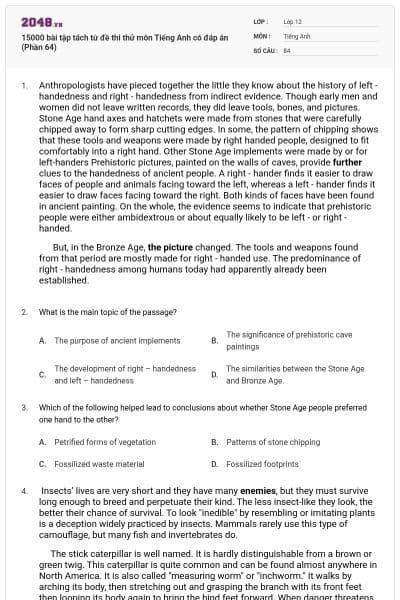
Anthropologists have pieced together the little they know about the history of left - handedness and right - handedness from indirect evidence. Though early men and women did not leave written records, they did leave tools, bones, and pictures. Stone Age hand axes and hatchets were made from stones that were carefully chipped away to form sharp cutting edges. In some, the pattern of chipping shows that these tools and weapons were made by right handed people, designed to fit comfortably into a right hand. Other Stone Age implements were made by or for left-handers Prehistoric pictures, painted on the walls of caves, provide further clues to the handedness of ancient people. A right - hander finds it easier to draw faces of people and animals facing toward the left, whereas a left - hander finds it easier to draw faces facing toward the right. Both kinds of faces have been found in ancient painting. On the whole, the evidence seems to indicate that prehistoric people were either ambidextrous or about equally likely to be left - or right - handed.
But, in the Bronze Age, the picture changed. The tools and weapons found from that period are mostly made for right - handed use. The predominance of right - handedness among humans today had apparently already been established.
What is the main topic of the passage?
The purpose of ancient implements
The significance of prehistoric cave paintings
The development of right – handedness and left – handedness
The similarities between the Stone Age and Bronze Age.
C
Đề: Chủ đề chính của đoạn văn là gì?
A. Mục đích của các dụng cụ cổ xưa
B. Tầm quan trọng của bức tranh khắc trong hang động thời tiền sử
C. Sự phát triển của việc tay phải và thuận tay thay trái
D. Các điểm tương đồng ở giữa thời kỳ đồ đá và thời kỳ đồ đồng
Thông tin lấy ở “Anthropologists have pieced together the little they know about the history of left – handedness and right – handedness from indirect evidence”
Dịch: các nhà khảo cổ cho thấy họ có biết rất ít về lịch sử của thuận tay trái và tay phải qua những bằng chứng trực quan
Which of the following helped lead to conclusions about whether Stone Age people preferred one hand to the other?
Petrified forms of vegetation
Patterns of stone chipping
Fossilized waste material
Fossilized footprints
B
Đề: Điều nào sau đây giúp dẫn đến kết luận về việc liệu người thời kỳ đồ đá thuận tay này hơn tay kia?
A. Hóa thạch của thực vật
B. Các mẫu đá được đập vỡ
C. Vật liệu phế thải
D. Những dấu chân hóa thạch
Thông tin “Stone Age hand axes and hatches … comfortably into a right hand”
In line 6, the word “further” is closest in meaning to which of the following?
advanced
additional
artistic
factual
B
Further (adj) ~ additional (adj): thêm nữa, hơn nữa
According to the passage, a person who is right-handed is more likely to draw people and animals that are facing
upward
downward
toward the right
toward the left
D
Theo đoạn văn, một người thuận tay phải có nhiều khả năng vẽ người và động vật mà đang đối diện
A. ở phía trên B. ở phía dưới
C. về phía bên phải D. về phía bên trái
Thông tin trong bài “A right – hander finds … facing toward the right”
In line 11, the words “the picture” refer to which of the following?
Faces of animals and people
People’s view from inside a cave
People’s tendency to work with either hand
The kinds of paint used on cave walls
C
Đề: Ở dòng 11, từ “the picture” đề cập đến điều gì?
A. Khuôn mặt của động vật và con người
B. Cái nhìn của con người từ trong một cái hang
C. Xu hướng làm việc với một trong hai tay của con người
D. Những loại tranh được sử dụng trên các vách hang động
Dựa vào thông tin ở trước “On the whole, the evidence … equally likely to be left – or right – handed” → đáp án C đúng
Where is the passage does the author mention a type of evidence that was NOT studied by anthropologists researching the handedness of ancient people?
Lines 1-3
Lines 7-8
Lines 9-10
Lines 11-13
A
Đề: Chỗ nào trong đoạn văn tác đề cập đến một loai bằng chứng mà KHÔNG được nghiên cứu bởi các nhà chủng tộc học về việc thuận sử dụng tay của người cổ đại?
Thông tin được đề cập “Anthropologists have pieced… leave tools, bones, and pictures”
The author implies that which of the following developments occurred around the time of the Bronze Age
The establishment of written records
A change in the styles of cave painting
An increase in human skill in the handling of tools
The prevalence of right handedness
B
Đề: Tác giả ngụ ý rằng đó trong sự phát triển nào sau đây đã xảy ra trong thời kỳ đồ đồng
A. Việc thành lập các bản ghi chép
B. Một sự thay đổi trong phong cách của tranh được khắc trong hang động
C. Sự gia tăng kỹ năng của con người trong việc xử lý các công cụ
D. Tỉ lệ thuận tay phải
Thông tin được đề cập “Other Stone Age implements were made by or for left-handers Prehistoric pictures, painted on the walls of caves, provide further clues to the handedness of ancient people.”
Insects’ lives are very short and they have many enemies, but they must survive long enough to breed and perpetuate their kind. The less insect-like they look, the better their chance of survival. To look "inedible" by resembling or imitating plants is a deception widely practiced by insects. Mammals rarely use this type of camouflage, but many fish and invertebrates do.
The stick caterpillar is well named. It is hardly distinguishable from a brown or green twig. This caterpillar is quite common and can be found almost anywhere in North America. It is also called "measuring worm" or "inchworm." It walks by arching its body, then stretching out and grasping the branch with its front feet then looping its body again to bring the hind feet forward. When danger threatens, the stick caterpillar stretches its body away from the branch at an angle and remains rigid and still, like a twig, until the danger has passed.
Walking sticks, or stick insects, do not have to assume a rigid, twig-like pose to find protection; they look like inedible twigs in any position. There are many kinds of walking sticks, ranging in size from the few inches of the North American variety to some tropical species that may be over a foot long. When at rest their front legs are stretched out, heightening their camouflage. Some of the tropical species are adorned with spines or ridges, imitating the thorny bushes or trees in which they live.
Leaves also seem to be a favorite object for insects to imitate. Many butterflies can suddenly disappear from view by folding their wings and sitting quietly among the foliage that they resemble.
What is the main subject of the passage?
Caterpillars that live in trees
The feeding habits of insects
How some insects camouflage themselves
Insects that are threatened with extinction
C
Đề: Nội dung chính của đoạn là gì?
A. Những con sâu bướm sống trên cây
B. Thói quen ăn uống của côn trùng
C. Côn trùng ngụy trang như thế nào
D. Côn trùng bị đe dọa tuyệt chủng
Thông tin được đề cập “To look “inedible” by resembling or imitating plants is a deception widely practiced by insects”
In lines 1, the word “enemies” refers to
other creatures competing for space
extreme weather conditions
creatures that eat insects
inedible insects
C
Đề: Ở dòng 1, từ “enemies” (kẻ thù) đề cập đến
A. những loài sinh vật tranh giành nơi ở
B. điều kiện thời tiết cực kì khắc nghiệt
C. những sinh vật mà ăn côn trùng
D. những con côn trùng không ăn được
Thông tin được đề cập “Insects’ lives are very short and they have many enemies…”
Dịch: Cuộc sống của những con côn trùng thì rất ngắn và chúng có kẻ thù. Vậy kẻ thù ở đây là những loài ăn những con côn trùng này.
According to the passage, how does the stick caterpillar make itself look like a twig?
By holding its body stiff and motionless
By looping itself around a stick
By changing the color of its skin
By laying its body flat against a branch
A
Đề: Theo đoạn văn, con sâu bướm làm thế nào để ngụy trang giống như một cành cây nhỏ?
A. Bằng cách giữ cho cơ thể cứng và bất động
B. Bằng cách quấn vào một cành cây nhỏ
C. Bằng cách thay đổi màu da
D. Bằng cách nằm bẹt trên một cành cây
Thông tin “When danger threatens, …the danger has passed” Ý câu này là chúng trở nên cứng khô và yên ắng như 1 cái cây.
Which of the following is true of stick insects?
They resemble their surroundings all the time.
They make themselves look like other insects.
They are camouflage only when walking.
They change color to make themselves invisible.
A
Đề: Câu nào sau đây đúng về những loài côn trùng trên cây?
A. Chúng luôn giống môi trường xung quanh
B. Chúng ngụy trang thành những loài côn trùng khác
C. Chúng chỉ được cải trang khi đang di chuyển
D. Màu sắc thay đổi khiến chúng không bị nhìn thấy
Which of the following are NOT mentioned in the passage as objects that are imitated as a means of protection?
Thorns
Flowers
Leaves
Sticks
B
Đề: Thứ nào KHÔNG được đề cập trong đoạn văn như những vật thể mà được ngụy trang như một cách tự vệ?
A. Những cái gai B. Những bông hoa
C. Những chiếc lá D. Những cành cây nhỏ
In which paragraph does the author describe the way in which stick caterpillars move?
Paragraph one
Paragraph two
Paragraph three
Paragraph four
B
Đề: Ở đoạn văn nào tác giả miêu tả cách sâu bướm di chuyển?
Thông tin này được đề cập trong đoạn 2 “It walks by arching … bring the hind feet forward”
When in the passage does the author describe the habitat of tropical stick insects?
Line 7
Lines 10-11
Lines 13-14
Lines 16-17
: C
Đề: Chỗ nào trong đoạn văn tác giả mô tả thói quen của những loài côn trùng sống trên cây nhiệt đới?
Thông tin nằm ở dòng 13, 14 “Some of the tropical species … bushes or trees in which they live”
Homing pigeons are placed in a training program from about the time they are twenty-eight days of age. They are taught to enter the loft through a trap and to exercise above and around the loft, and gradually they are taken away for short distances in wicker baskets and released. They are then expected to find their way home in the shortest possible time.
In their training flights or in actual races, the birds are taken to prearranged distant points and released to find their way back to their own lofts. Once the birds are liberated, their owners, who are standing by at the home lofts, anxiously watch the sky for the return of their entries. Since time is of the essence, the speed with which the birds can be induced to enter the loft trap may make the difference between gaining a win or a second place.
The head of a homing pigeon is comparatively small, but its brain is one quarter larger than that of the ordinary pigeon. The homing pigeon is very intelligent and will persevere to the point of stubbornness some have been known to fly a hundred miles off course to avoid a storm.
Some homing pigeon experts claim that this bird is gifted with a form of built-in radar that helps it find its own loft after hours of flight, for hidden under the head feathers are two very sensitive ears, while the sharp, prominent eyes can see great distances in daytime.
Why do homing pigeons fly home? They are not unique in this inherent skill: it is found in most migratory birds, in bees, ants, toads, and even turtles, which have been known to travel hundreds of miles to return to their homes. But in the animal world, the homing pigeon alone can be trusted with its freedom and trained to carry out the missions that people demand.
What is the purpose of the passage?
To convince the reader to buy a homing pigeon
To inform the reader about homing pigeons and their training
To protect homing pigeons against the threat of extinction
To encourage the owners of homing pigeons to set the birds free
Đáp án B
Nội dung bài xoay quanh những đặc điểm của chim bồ câu dẫn đường và quá trình huấn luyện chúng
→ chọn B. Mục tiêu của bài viết là để thông tin cho người đọc về chim bồ câu dẫn đường và sự huấn luyện của chúng.
According to the passage, what happens to homing pigeons when they are about a month old?
They are kept in a trap.
They enter their first race.
They begin a training program.
They get their wings clipped and marked.
Đáp án C
Thông tin trong bài “Homing pigeons are placed in a training program from about the time they are twenty-eight days of age”
→ Khi chim bồ câu dẫn đường được khoảng một tháng tuổi, chúng sẽ bắt đầu một quá trình huấn luyện.
In line 7, when the author states that the owners "anxiously watch the sky" there is the implication that the owners
want their pigeon to win the race
are sending radar signals to their pigeons
do not know whether the race began on time
do not trust the rules set down by the judges
Đáp án A
Thông tin trong bài “In their training flights or in actual races, the birds are taken to prearranged distant points and released to find their way back to their own lofts. Once the birds are liberated, their owners, who are standing by at the home lofts, anxiously watch the sky for the return of their entries”
→ tác giả chỉ ra rằng chủ nhân những con chim muốn chúng thắng cuộc đua khi nhìn một cách lo lắng lên bầu trời.
According to the passage, what is the difference between a homing pigeon and an ordinary one?
The span of the wings
The shape of the eyes
The texture of the feathers
The size of the brain
Đáp án D
Thông tin trong bài “The head of a homing pigeon is comparatively small, but its brain is one quarter larger than that of the ordinary pigeon”
→ sự khác nhau giữa chim bồ câu dẫn đường và chim bồ câu thông thường chính là kích thước của bộ não.
The author mentions all of the following at tributes that enable a homing pigeon to return home EXCEPT
instinct
air sacs
sensitive ears
good eyes
Đáp án B
Thông tin trong bài “…for hidden under the head feathers are two very sensitive ears, while the sharp, prominent eyes can see great distances in daytime” và “They are not unique in this inherent skill”
→ Một đôi tai nhạy cảm, một đôi mắt tốt và bản tính vốn có đã giúp chim bồ câu dẫn đường trở về nhà.
→ Đáp án B không được đề cập → chọn B
In line 12, the pronoun "it" refers to which of the following?
Radar
Bird
Loft
Form
Đáp án B
Câu trong bài “Some homing pigeon experts claim that this bird is gifted with a form of built-in radar that helps it find its own loft after hours of flight”
→ Đại từ “it” trong câu chính là đề cập đến danh từ “bird”
Why does the author mention bees, ants, toads, and turtles in the last paragraph?
To describe some unusual kinds of pets
To measure distances traveled by various animals
To compare their home-finding abilities with those of homing pigeons
To interest the reader in learning about other animals
Đáp án C
Thông tin trong bài “Why do homing pigeons fly home? They are not unique … the missions that people demand.”
→ tác giả đề cập đến những loài động vật khác nhằm so sánh khả năng tìm đường về nhà của chúng với khả năng tìm đường về nhà của chim bồ câu dẫn đường.
If the salinity of ocean waters is analyzed, it is found to vary only slightly from place to place. Nevertheless, some of these small changes are important. There are three basic processes that cause a change in oceanic salinity. One of these is the subtraction of water from the ocean by means of evaporation-conversion of liquid water to water vapor. In this manner, the salinity is increased, since the salts stay behind. If this is carried to the extreme, of course, white crystals of salt would be left behind: this, by the way, is how much of the table salt we use is actually obtained.
The opposite of evaporation is precipitation. such as rain, by which water is added to the ocean. Here the ocean is being diluted so that the salinity is decreased. This may occur in areas of high rainfall or in coastal regions where rivers flow into the ocean. Thus salinity may be increased by the subtraction of water by evaporation, or decreased by the addition of fresh water by precipitation or runoff.
Normally in tropical regions where the Sun is very strong, the ocean salinity is somewhat higher than it is in other parts of the world where there is not as much evaporation. Similarly, in coastal regions where rivers dilute the sea salinity is somewhat lower than in other oceanic areas.
A third process by which salinity may be altered is associated with the formation and melting of sea ice. When seawater is frozen, the dissolved materials are left behind. In this manner, seawater directly beneath freshly formed sea ice has a higher salinity than it did before the ice appeared. Of course, when this ice melts, it will tend to decrease the salinity of the surrounding water.
In the Weddell Sea, off Antarctica, the densest water in the oceans is formed as a result of this freezing process, which increases the salinity of cold water. This heavy water sinks and is found in the deeper portions of the oceans of the world.
What does the passage mainly discuss?
The bodies of water of the world
The elements of salt
The many forms of ocean life
The salinity of ocean water
Đáp án D
Dựa vào câu mở đầu “If the salinity of ocean waters is analyzed, it is found to vary only slightly from place to place” và các thông tin được đề cập đến trong toàn đoạn văn → đoạn văn chủ yếu thảo luận về độ mặn của nước biển.
According to the passage, the ocean generally has more salt in
coastal areas
tropical areas
rainy areas
turbulent areas
Đáp án B
Thông tin trong bài “Normally in tropical regions where the Sun is very strong, the ocean salinity is somewhat higher than it is in other parts of the world where there is not as much evaporation”
→ biển thông thường sẽ có nhiều muối hơn ở những khu vực nhiệt đới.
All of the following are processes that decrease salinity EXCEPT
evaporation
precipitation
runoff
melting
Đáp án A
Thông tin trong bài “… salinity may be increased by the subtraction of water by evaporation, or decreased by the addition of fresh water by precipitation or runoff…” và “when this ice melts, it will tend to decrease the salinity of the surrounding water”
→ Các đáp án B, C, D đều được đề cập đến là quá trình làm giảm độ mặn
Which of the following statements about the salinity of a body of water can best be inferred from the passage?
The temperature of the water is the most important factor.
How quickly the water moves is directly related to the amount of alt.
Ocean salinity has little effect on sea life.
Various factors combine to cause variations in the salt content of water.
Đáp án D
Dựa vào các thông tin được đề cập trong đoạn văn → có thể suy ra rằng có nhiều nhân tố kết hợp lại để gây ra sự thay đổi lượng muối trong nước biển.
The word "it" in line 16 refers to which of the following?
Sea ice
Salinity
Seawater
Manner
Đáp án C
Thông tin trong bài “… seawater directly beneath freshly formed sea ice has a higher salinity than it did before the ice appeared”
→ từ “it” chính là dạng thay thế của danh từ “seawater”
Why does the author mention the Weddell Sea?
To show that this body of water has salinity variations
To compare Antarctic waters with Arctic waters
To give an example of cold-water salinity
To point out the location of deep waters
Đáp án C
Dựa vào thông tin đề cập trong đoạn cuối → tác giả đề cập đến biển Weddell để cho ví dụ về độ mặn của nước lạnh.
Which of the following is NOT a result of the formation of ocean ice?
The salt remains in the water
The surrounding water sinks
Water salinity decreases
The water becomes denser
Đáp án C
Thông tin trong đoạn cuối “…the densest water in the oceans is formed as a result of this freezing process, which increases the salinity of cold water. This heavy water sinks…”
→ sự hình thành băng ở biển KHÔNG làm giảm độ mặn của nước biển.
What can be inferred about the water near the bottom of oceans?
It is relatively warm
Its salinity is relatively high.
It does not move.
It is formed by melting sea ice.
Đáp án B
Đoạn cuối của bài “In the Weddell Sea, off Antarctica, the densest water in the oceans is formed as a result of this freezing process, which increases the salinity of cold water. This heavy water sinks and is found in the deeper portions of the oceans of the world”
→ có thể suy ra rằng độ mặn của nước gần dưới đáy biển tương đối cao.
Stars have been significant features in the design of many United States coins and their number has varied from one to foty-eight stars. Most of the coins issued from about 1799 to the early years of the twentieth century bore thirteen stars representing the thirteen original colonies.
Curiously enough, the first American silver coins, issued in, 1794, had fifteen stars because by that time Vermont and Kentucky had joined the Union. At that time it was apparently the intention of mint officials to add a star for each new state. Following the admission of Tennessee in 1796, for example, some varieties of half dimes, dimes, and half-dollars were produced with sixteen stars.
As more states were admitted to the Union, however, it quickly became apparent that this scheme would not prove practical and the coins from 1798 on were issued with only thirteen stars-one for each of the original colonies. Due to an error at the mint, one variety of the 1828 half cent was issued with only twelve stars. There is also a variety of the large cent with only 12 stars, but this is the result of a die break and is not a true error.
What is the main topic of the passage?
The teaching of astronomy in state universities
Stars on American coins
Colonial stamps and coins
The star as national symbol of the United States
B
Dựa vào thông tin được đề cập đến ở câu đầu và trong các đoạn văn, có thể suy ra nội dung chính được đề cập trong đoạn văn chính là về những ngôi sao trên đồng tiền Mỹ à chọn B
The word “their” in line 1 refers to
stars
features
coins
colonies
A
Dựa vào câu đầu tiên “Stars have been significant features… and their number has varied from one to forty-eight stars…” à đại từ sở hữu “their” đến cập đến danh từ “stars”
The word “bore” in line 3 is closest in meaning to which of the following?
Carried
Drilled
Cost
Symbolized
A
Bear (v) ~ carry (v): mang
The expression “Curiously enough” is used in line 4 because the author finds it strange that
silver coins with fifteen stars appeared before coins with thirteen
Vermont and Kentucky joined the Union in 1794
no silver coins were issue until 1794
Tennessee was the first state to use half dimes
A
Dựa vào thông tin “Most of the coins issued from about 1799…” và “Curiously enough, the first American silver coins, issued in, 1794…” à Tác giả cảm thấy lạ vì những đồng tiền bạc có 15 ngôi sao xuất hiện trước đồng xu có 13 ngôi sao à chọn A
Which of the following can be inferred about the order in which Kentucky, Tennessee, and Vermont joined the Union?
Vermont and Kentucky joined at the same time.
Kentucky joined before Tennessee and Vermont.
Tennessee joined after Vermont and Kentuck
Vermont joined after Tennessee and Kentucky.
C
Dựa vào các thông tin “…1794, had fifteen stars because by that time Vermont and Kentucky had joined the Union…” và “…Following the admission of Tennessee in 1796…” à có thể suy ra rằng Tennessee đã tham gia sau Vermont và Kentucky à chọn C
Which of the following is NOT mentioned as the denomination of an American coin?
Half cent
Half nickel
Half dime
Half-dollar
: B
Các đáp án A, C, D đều được nhắc đến như một tên gọi của đồng tiền Mỹ “…some varieties of half dimes, dimes, and half-dollars were produced…” và “…one variety of the 1828 half cent was issued…” à chọn BWhy was a coin produced in 1828 with only twelve stars?
There were twelve states at the time
There was a change in design policy.
Tennessee had left the Union.
The mint made a mistake.
D
Dựa vào câu “Due to an error at the mint, one variety of the 1828 half cent was issued with only twelve stars” àNguyên nhân đồng tiền được sản xuất năm 1828 chỉ có 12 ngôi sao là vì sở đúc tiền bị nhầm lẫn à chọn D
Icebergs are among nature’s most spectacular creations, and yet most people have never seen one. A vague air of mystery envelops them. They come into being somewhere-in faraway, frigid waters, amid thunderous noise and splashing turbulence, which in most cases no one hears or sees. They exist only a short time and then slowly waste away just a unnoticed.
Objects of sheerest beauty, they have been called. Appearing in an andless variety of shapes they may be dazzlingly white, or they may be glassy blue, green, or purple, tinted faintly or in darker hues. They are graceful, stately, inspiring-in calm, sunlit seas.
But they are also called frightening and dangerous, and that they are-in the night, in the fog, and in storms. Even in clear weather one is wise to stay a safe distance away from them. Most of their bulk is hidden below the water, so their underwater parts may extend out far beyond the visible top. Also, they may roll over uexpectedly, churning the waters around them.
Icebergs are parts of glaciers that break off, drift into the water, float about awhile, and finally melt. Icebergs afloat today are made of snowflakes that have fallen over long ages of time. They embody snows that drifted down hundreds, or many thousands, or in some cases maybe a milliom years ago. The snows fell in polar regions and on cold mountains, where they melted only a little or not at all, and so collected to great depths over the years and centuries.
As each year’s snow accumulation lay on the surface, evaporation and melting caused the snowflakes slowly to lose their feathery points and become tiny grains of ice. When new snow fell on top of the old, it too turned to icy grains. So blankets of snow and ice grains mounted layer upon layer and were of such great thickness that the weight of the upper layers compressed the lower ones. With time and pressure from above, the many small ice grains joined and changed to larger crystals, and eventually the deeper crystals merged into a solid mass of ice.
Which of the following is the best tittle for the passage?
The Melting of Icebergs
The Nature and Origin of Icebergs
The Size and Shape of Icebergs
The Dangers of Icebergs
B
Nội dung chính của bài đề cập đến bản chất và nguồn gốc của núi băng trôi.
The author states that icebergs are rarely seen because they are
surrounded by fog
hidden beneath the mountains
located in remote regions of the wolrd
broken by waves soon after they are formed
C
Dựa vào đoạn “…They come into being somewhere-in faraway, frigid waters, amid thunderous noise and splashing turbulence…” à chọn C
The passage mentions all of the following colors for icebergs EXCEPT
yellow
blue
green
purple
A
Dựa vào thông tin “…they may be dazzlingly white, or they may be glassy blue, green, or purple, tinted faintly or in darker hues…” à chọn A
According to the passage, icebergs are dangerous because they
usually melt quickly
can turn over very suddenly
may create immense snowdrifts
can cause unexpected avalanches
B
Dựa vào thông tin “…they may roll over unexpectedly, churning the waters around them…” à chọn B
According to the passage, icebergs originate from a buildup of
turbulent water
feathers
underwater pressure
snowflakes
D
Dựa vào thông tin “…Icebergs afloat today are made of snowflakes that have fallen over long ages of time…” à chọn D
The formation of an iceberg is most clearly analogous to which of the following activities?
Walking on fluffy new snow, causing it to become more compact and icy
Plowing large areas of earth, leaving the land flat and barren
Skating across a frozen lake and leaving a trail behind
Blowing snow into one large pile to clear an area
A
Dựa vào đoạn cuối à sự hình thành của núi đá trôi giống như việc đi trên lớp tuyết mới tơi xốp, làm cho nó kết chặt vào và thành băng à chọn A
In line 20, the expression “from above” refers to
sunlit seas
polar regions
weight of mountains
layers of ice and snow
D
Dựa vào đoạn “…So blankets of snow and ice grains mounted layer and were of such great thickness that the weight of the upper layers compressed the lower ones. With time and pressure from above…” à “from above” chính là đề cập đến những lớp tuyết và băng à chọn D
The attitude of the author toward icebergs is one of
disappointment
humor
disinterest
wonder
D
Đề: Thái độ của tác giả về núi băng trôi là
A: Không đồng tình
B: Hài hước
C: Không hứng thú
D: Ngạc nhiên
à chọn đáp án D phù hợp nhất
The invention of the incandescent light bulb by Thomas A. Edison in 1879 created a demand for a cheap, readily available fuel with which to generate large amounts of electric power. Coal seemed to fit the bill, and it fueled the earliest power stations (which were set up at the end Of the nineteenth century by Edison himself). As more power plants were constructed throughout the country, the reliance on coal increased. Since the First World War, coal-fired power plants have accounted for about half of the electricity produced in the United States each year. In 1986 such plants had a combined generating capacity of 289,000 megawatts and consumed 33 percent of the nearly 900 million tons of coal mined in the country that year. Given the uncertainty in the future growth of nuclear power and in the supply of oil and natural gas, coal-fired power plants could well provide up to 70 percent of the electric power in the United States by the end of the century.
Yet, in spite of the fact that coal has long been a source of electricity and may remain one for many years (coal represents about 80 percent of United States fossil-fuel reserves), it has actually never been the most desirable fossil fuel for power plants. Coal contains less energy per unit of weight than natural gas or oil; it is difficult to transport, and it is associated with a host of environmental issues, among them acid rain. Since the late 1960's problems of emission control and waste disposal have sharply reduced the appeal of coal-fired power plants. The cost of ameliorating these environmental problems, along with the rising cost of building a facility as large and complex as a coal-fired power plant, has also made such plants less attractive from a purely economic perspective.
Changes in the technological base of coal fired power plants could restore their attractiveness, however. Whereas some of these changes are evolutionary and are intended mainly to increase the productivity of existing plants, completely new technologies for burning coal cleanly are also being developed.
What is the main idea of the passage?
Coal-fired plants are an important source of electricity in the United States and are likely to remain so.
Generating electricity from coal is comparatively recent in the United States.
Coal is a more economical fuel than either oil or nuclear power.
Coal is a safer and more dependable fossil fuel than oil or gas.
Đáp án A
Dựa vào thông tin được đưa ra trong toàn đoạn văn và đoạn cuối → nội dung chính của đoạn văn nói về việc các nhà máy than đốt là một nguồn điện quan trọng ở Hoa Kỳ và vẫn có khả năng sẽ vẫn duy trì như vậy → chọn A
Edison's electric light bulb is mentioned in the passage because it _______.
replaced gas as a light source
increased the need for electrical power
was safer than any other method of lighting
could work only with electricity generated from coal
Đáp án B
Dựa vào thông tin “The invention of the incandescent light bulb by Thomas A. Edison in 1879 created a demand for a cheap, readily available fuel with which to generate large amounts of electric power” → bóng đèn điện của Edison được đề cập đến trong đoạn văn bởi vì nó làm tăng nhu cầu về năng lượng điện.
It can be inferred from the passage that coal became the principal source of electricity in the United States, because it _______.
required no complicated machinery
was comparatively plentiful and inexpensive
was easy to transport
burned efficiently
Đáp án B
Dựa vào thông tin “… created a demand for a cheap, readily available fuel with which to generate large amounts of electric power. Coal seemed to fit the bill…” → có thể suy ra rằng than đá trở thành nguồn điện chính của Hoa Kỳ bởi vì nó tương đối nhiều và không quá đắt đỏ.
In the author's opinion, the importance of coal-generated electricity could increase in the future for which of the following reasons?
The possible substitutes are too dangerous.
The cost of changing to other fuels is too great.
The future availability of other fuels is uncertain.
Other fuels present too many environmental problems.
Đáp án C
Dựa vào câu “Given the uncertainty in the future growth of nuclear power and in the supply of oil and natural gas…” → sự quan trọng của nguồn điện được tạo ra từ than có thể tăng trong tương lai vì lí do sự sẵn có của các nguồn nhiên liệu khác trong tương lai không được chắc chắn.
Acid rain is mentioned in the passage for which of the following reasons?
It reduces the efficiency of coal-fired plants
It increases the difficulty of transporting coal
It is an environmental problem associated with coal use
It contains less energy per unit of weight than coal does
Đáp án C
Dựa vào câu “… it is difficult to transport, and it is associated with a host of environmental issues, among them acid rain” → mưa axit là một vấn đề môi trường liên quan đến việc sử dụng than đá.
According to the passage, which of the following is one of the goals of the new technology in coal-fired plants?
To adapt the plants to other kinds of fuel
To reduce the cost of building more plants
To lengthen the lives of plants already in use
To make the plants already in use more productive
Đáp án D
Dựa vào câu “Whereas some of these changes are evolutionary and are intended mainly to increase the productivity of existing plants…” → một trong những mục tiêu của công nghệ mới trong các nhà máy than đốt là làm cho những nhà máy đang tồn tại trở nên năng suất hơn → chọn D
Where in the passage is there a reference to the establishment of the first electric power stations?
Lines 2-3
Lines 5-7
Lines 9-11
Lines 16-18
Đáp án A
Thông tin được đề cập đến ở dòng 2, 3 “Coal seemed to fit the bill, and it fueled the earliest power stations (which were set up at the end Of the nineteenth century by Edison himself)” → chọn A
Born in 1830 in rural Amherst, Massachusetts, Emily Dickinson spent her entire life in the household of her parents. Between 1858 and 1862, it was later discovered, she wrote like a person possessed, often producing a poem a day. It was also during this period that her life was transformed into the myth of Amherst.
Withdrawing more and more, keeping to her room sometimes even refusing to see visitors who called, she began to dress only in white - a habit that added to her reputation as an eccentric.
In their determination to read Dickinson's life in terms of a traditional romantic plot, biographers have missed the unique pattern of her life - her struggle to create a female life not yet imagined by the culture in which she lived. Dickinson was not the innocent, lovelorn and emotionally fragile girl sentimentalized by the Dickinson myth and popularized by William Luce’s 1976 play, The BeIle of Amherst. Her decision to shut the door on Amherst society in the 1950's transformed her house into a kind of magical realm in which she was free to engage her poetic genius. Her seclusion was not the result of a failed love affairs but rather a part of a more general pattern of renunciation through which she, in her quest for self – sovereignty, carried on an argument with the Puritan fathers, attacking with wit and irony their cheerless Calvinist doctrine, their stern patriarchal God, and their rigid notions of "true womanhood."
What is the author's main purpose in the passage?
To interpret Emily Dickinson’s eccentric behavior
To promote the popular myth of Emily Dickinson
To discuss Emily Dickinson's failed love affair
To describe the religious climate in Emily Dickinson's time
Đáp án A
Dựa vào toàn bộ những thông tin được đề cập trong đoạn văn → mục đích chính của tác giả là để làm sáng tỏ hành vi lập dị của Emily Dickinson → chọn A
According to the passage, the period from 1858 to 1862 was for Emily Dickinson a period of great _______.
tragedy
sociability
productivity
frivolity
Đáp án C
Dựa vào thông tin “Between 1858 and 1862, it was later discovered, she wrote like a person possessed, often producing a poem a day. It was also during this period that her life was transformed into the myth of Amherst” → giai đoạn 1858 đến 1862 là giai đoạn làm việc năng suất nhất của Emily Dickinson
Which of the following is NOT mentioned as being one of Emily Dickinson' s eccentricities?
Refusing to eat
Wearing only white
Avoiding visitors
Staying in her room
Đáp án A
Dựa vào đoạn thứ 2 “Withdrawing more and more, keeping to her room sometimes even refusing to see visitors who called, she began to dress only in white - a habit that added to her reputation as an eccentric” → các đáp án B, C, D đều được đề cập → chọn D
According to the passage, biographers of Emily Dickinson have traditionally _______.
criticized most of her poems
ignored her innocence and emotional fragility
seen her life in romantic terms
blamed her parents for restricting her activities
Đáp án C
Dựa vào câu “In their determination to read Dickinson's life in terms of a traditional romantic plot, biographers have missed the unique pattern of her life…” → chọn C
Why does the author mention William Luce's play The Belle of Amherst?
To give an example of the sentimentalized Emily Dickinson myth
To show how popular Emily Dickinson's poems have become
To show that Emily Dickinson was also an actress
To illustrate the theatrical quality of Emily Dickinson's poems
Đáp án A
Dựa vào đoạn “Dickinson was not the innocent, lovelorn and emotionally fragile girl sentimentalized by the Dickinson myth and popularized by William Luce’s 1976 play, The BeIle of Amherst” → tác giả đề cập đến vở kịch The Belle of Amherst để cho ví dụ về huyền thoại Emily Dickinson đa cảm.
The author implies that many people attribute Emily Dickinson's seclusion to _______.
physical illness
a failed love affair
religious fervor
her dislike of people
Đáp án B
Dựa vào câu “Her seclusion was not the result of a failed love affairs…” → có thể thấy tác giả ngụ ý rằng nhiều người cho rằng sự ẩn dật của Emily Dickinson là do một cuộc tình bị thất bại → chọn B
The author suggests all of the following as reasons for Emily Dickinson's unusual behavior EXCEPT the _______.
struggle to create a new female identity
desire to develop her genius undisturbed
search for her own independence
attempt to draw attention to her poetry
Đáp án D
Tất cả các đáp án A, B, C đều được đề cập trong đoạn văn là lí do cho những hành vi kỳ quặc của Emily Dickinson → chọn D (những lỗ lực để thu hút sự chú ý đến thơ ca của bà ấy)
It can be inferred from the passage that Emily Dickinson lived in a society that was characterized by _______.
strong Puritan beliefs
equality of men and women
the encouragement of nonconformity
the appreciation of poetic creativity
Đáp án A
Dựa vào đoạn cuối “Her seclusion was not the result of a failed love affairs … and their rigid notions of "true womanhood."” → Emily Dickinson sống trong một xã hội được đặc trưng bởi niềm tin Thanh Giáo mạnh mẽ.
The first navigational lights in the New World were probably lanterns hung at harbor entrances. The first lighthouse was put up by the Massachusetts Bay Colony In 1766 on Little Brewster Island at the entrance to Boston Harbor. Paid for and maintained by light dues levied on ships, the original beacon was blown up in 1776. By then there were only a dozen or so true lighthouses in the colonies. Little over a century later, there were 700 lighthouses.
The first eight erected on the West Coast in the 1850’s featured the same basic New England design: a Cape Cod dwelling with the tower rising from the center or standing close by. In New England and elsewhere, though, lighthouses reflected a variety of architectural styles. Since most stations in the Northeast were built on rocky eminences, enormous towers were not the rule. Some were made of stone and brick, others of wood or metal. Some stood on pilings or stilts: some were fastened to rock with iron rods. Farther south, from Maryland through the Florida Keys, the coast was low and sandy. It was often necessary to build tall towers there – massive structures like the majestic Cape Hatteras, North Carolina lighthouse, which was lit in 1870. At 190 feet, it is the tallest brick lighthouse in the country.
Not withstanding differences in appearance and construction, most American lighthouses shared several features: a light, living quarters, and sometimes a bell (or, later, a foghorn). They also had something else in common: a keeper and, usually, the keeper's family. The keeper's essential task was trimming the lantern Nick in order to maintain a steady bright flame. The earliest keepers came from every walk of life-they were seamen. Farmers, mechanics, rough mill hands-and appointments were often handed out by local customs commissioners as political plums. After the administration of lighthouses was taken over in 1852 by the United States Lighthouse 803rd, an agency of the Treasury Department, the keeper corps gradually became highly professional.
What is the best title for the passage?
The Lighthouse on Little Brewster Island
The Life of a Lighthouse Keeper
Early Lighthouses in the United States
The Modern Profession of Lighthouse Keeping
C
Dựa vào câu đầu và nội dung xuyên suốt toàn đoạn văn ® nội dung chính của bài nói về những ngọn hải đăng đầu tiên ở Mỹ.
Why does the author mention the Massachusetts Bay Colony?
It was the headquarters of the United States Lighthouse Board
Many of the tallest lighthouses were built there.
The first lantern wicks were developed there.
The first lighthouse in North America was built there.
D
Thông tin “The first lighthouse was put up by the Massachusetts Bay Colony In 1766” ®tác giả đề cập đến Massachusetts Bay Colony vì nó là ngọn hải đăng đầu tiên ở Mỹ được xây dựng.
It can be inferred from the passage that lighthouses in the Northeast did not need high towers because ________ .
ships there had high masts
coastal waters were safe
the coast was straight and unobstructed
the lighthouse were built on high places
D
Dựa vào thông tin: “Since most stations in the Northeast were built on rocky eminences, enormous towers were not the rule...” ®các ngọn hải đăng ở vùng Đông bắc không cần những cái tháp cao bởi vì chúng được xây dựng trên những địa điểm cao.
According to the passage, where can the tallest brick lighthouse in the United States be found?
Little Brewster Island
The Florida Keys
Cape Hatteras
Cape Cod
C
Dựa vào đoạn “It was often necessary to build tall towers there - massive structures like the majestic Cape Hatteras, North Carolina lighthouse, which was lit in 1870. At 190 feet, it is the tallest brick lighthouse in the country” ®ngọn hải đăng bằng gạch cao nhất ở nước Mỹ có thể được tìm thấy ở Cape Hatteras.
In line 15, to which of the following does the word "They" refer?
Lighthouses
Differences
Quarters
Features
A
Dựa vào câu phía trước và câu chứa đại từ “they” “Not withstanding differences in appearance and construction, most American lighthouses shared several features: a light, living quarters, and sometimes a bell (or, later, a foghorn). They also had something else in common...” ®đại từ này đề cập đến đối tượng “lighthouses”
It can be inferred from the passage that the Treasury Department, after assuming control of the lighthouses, improved which of the following?
The training of the lighthouse keepers
The sturdiness ofthe lighthouses
The visibility of the lights
The locations of thelighthouses
A
Dựa vào câu cuối “After the administration of lighthouses was taken over in 1852 by the United States Lighthouse 803rd, an agency of the Treasury Department, the keeper corps gradually became highly professional” ®sau khi đảm đương việc kiểm soát hải đăng, Bộ tài chính đã cải thiện lại việc đào tạo những người trông coi hải đăng.
Where in the passage does the author tell how lighthouses in the Northeast were fastened to the surrounding rock?
Lines 3-4
Line 10
Lines 14-15
Line 19
B
Thông tin nằm ở dòng 10 “Some stood on pilings or stilts: some were fastened to rock with iron rods…” ® chọn B
In the past oysters were raised in much the same way as dirt farmers raised tomatoes - by transplanting them. First, farmers selected the oyster bed, cleared the bottom of old shells and other debris, then scattered clean shells about. Next, they "planted" fertilized oyster eggs, which within two or three weeks hatched into larvae. The larvae drifted until they attached themselves to the clean shells on the bottom. There they remained and in time grew into baby oysters called seed or spat. The spat grew larger by drawing in seawater from which they derived microscopic particles of food. Before long farmers gathered the baby oysters transplanted them in other waters to speed up their growth, then transplanted them once more into another body of water to fatten them up.
Until recently; the supply of wild oysters and those crudely farmed were more than enough to satisfy people's needs. But today the delectable seafood is no longer available in abundance. The problem has become so serious that some oyster beds have vanished entirely.
Fortunately, as far back as the early 1900's marine biologists realized that if new measures were not taken, oysters would become extinct or at best a luxury food. So they set up well equipped hatcheries and went to work. But they did not have the proper equipment or the skill to handle the eggs. They did not know when, what, and how to feed the larvae. And they knew little about the predators that attack and eat baby oysters by the millions. They failed, but they doggedly kept at it. Finally, in the 1940's a significant breakthrough was made.
The marine biologists discovered that by raising the temperature of the water, they could induce oysters to spawn not only in the summer but also in the fall, winter, and spring. Later they developed a technique for feeding the larvae and rearing them to spat. Going still further, they succeeded in breeding new strains that were resistant to diseases, grew faster and larger, and flourished in water of different salinities and temperatures. In addition, the cultivated oysters tasted better.
Which of the following would be the best title for the passage?
The Threatened Extinction of Marine Life
The Cultivation of Oysters
The Discoveries Made by Marine Biologists
The Varieties of Wild Oysters
B
Dựa vào những thông tin trong các đoạn, có thể thấy tất cả đều liên quan đến việc nuôi trồng hàu® suy ra tiêu đề phù hợp nhất cho đoạn văn sẽ là “ Sự nuôi trồng loài hàu” (The Cultivation of Oysters)
In the first paragraph, the production of oysters is compared to what other industry?
Mining
Fishing
Banking
Farming
: D
Dựa vào câu “In the past oysters were raised in much the same way as dirt farmers raised tomatoes” trong đoạn văn đầu, sản phẩm hàu được so sánh với ngành nông nghiệp.
In the passage, which of the following is NOT mentioned as a stage of an oyster's life?
Debris
Egg
Larvae
Spat
A
Dựa vào đoạn “Next, they" planted" fertilized oyster eggs, which within two or three weeks hatched into larvae. The larvae drifted until they attached themselves to the clean shells on the bottom. There they remained and in time grew into baby oysters called seed or spat. The spat grew larger by drawing in seawater from which they derived microscopic particles of food” ®các đáp án B, C, D đã được đề cập đến trong đoạn văn như là một giai đoạn của vòng đời loài hàu.
When did scientists discover that oysters were in danger?
In the early part of the 19th century
At the beginning of this century
In the 1940's
Just recently
B
Theo thông tin trong bài “Until recently; the supply of wild oysters and those crudely farmed were more than enough to satisfy people's needs. But today the delectable seafood is no longer available in abundance. The problem has become so serious that some oyster beds have vanished entirely”®các nhà khoa học phát hiện rằng loài hàu đang gặp nguy hiểm ở trong đầu thế kỷ này.
According to the passage, which of the following words best describes the efforts of the marine biologists working with oysters?
Persistent
Intermittent
Traditional
Fruitless
: A
Dựa vào đoạn “So they set up well equipped hatcheries and went to work. But they did not have the proper equipment or the skill to handle the eggs. They did not know when, what, and how to feed the larvae. And they knew little about the predators that attack and eat baby oysters by the millions. They failed, but they doggedly kept at it. Finally, in the 1940’s a significant breakthrough was made” ®những nhà sinh vật học đã nỗ lực một cách kiên trì ® chọn A
In the passage, the author mentions that the new strains of oyster are ________.
cheaper
shaped differently
better textured
healthier
D
Thông tin trong bài “…they succeeded in breeding new strains that were resistant to diseases, grew faster and larger, and flourished in water of different salinities and temperatures...” giống hàu mới khỏe mạnh hơn ® chọn D
In what paragraph does the author describe successful methods for increasing
the oyster population?
First
Second
Third
Fourth
D
Những phương pháp thành công cho việc làm tăng số lượng hàu được miêu tả trong đoạn thứ tư “The marine biologists discovered that by raising the temperature of the water, they ... oysters tasted better” ®chọn đáp án D
Which of the following best describes the organization of the passage?
Step by step description ofthe evolution ofmarine biology
Discussion of chronological events concerning oysterproduction
Random presentation of facts about oysters
Description of oyster production al different geographic locations
B
Dựa vào nội dung của đoạn văn, ta thấy đầu tiên tác giả nói đến việc nuôi hàu, tiếp đến là đến vấn đề loài hàu có nguy cơ bị tuyệt chủng, tiếp đến là những nỗ lực của các nhà sinh vật học để làm tăng số lượng hàu, và cuối cùng sau đó họ nhân giống được những giống hàu mới ® có thể thấy cách viết của đoạn văn là thảo luôn về những sự việc thời gian liên quan đến việc sản xuất hàu.
Bạn có thích hoạt động này không?