15000 bài tập tách từ đề thi thử môn Tiếng Anh có đáp án (Phần 62)
71 câu hỏi
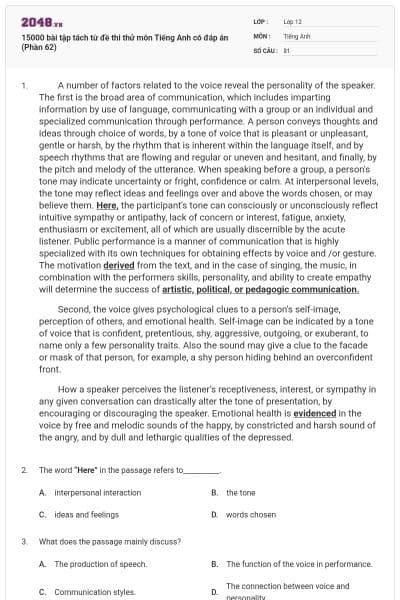
A number of factors related to the voice reveal the personality of the speaker. The first is the broad area of communication, which includes imparting information by use of language, communicating with a group or an individual and specialized communication through performance. A person conveys thoughts and ideas through choice of words, by a tone of voice that is pleasant or unpleasant, gentle or harsh, by the rhythm that is inherent within the language itself, and by speech rhythms that are flowing and regular or uneven and hesitant, and finally, by the pitch and melody of the utterance. When speaking before a group, a person's tone may indicate uncertainty or fright, confidence or calm. At interpersonal levels, the tone may reflect ideas and feelings over and above the words chosen, or may believe them. Here, the participant's tone can consciously or unconsciously reflect intuitive sympathy or antipathy, lack of concern or interest, fatigue, anxiety, enthusiasm or excitement, all of which are usually discernible by the acute listener. Public performance is a manner of communication that is highly specialized with its own techniques for obtaining effects by voice and /or gesture. The motivation derived from the text, and in the case of singing, the music, in combination with the performers skills, personality, and ability to create empathy will determine the success of artistic, political, or pedagogic communication.
Second, the voice gives psychological clues to a person's self-image, perception of others, and emotional health. Self-image can be indicated by a tone of voice that is confident, pretentious, shy, aggressive, outgoing, or exuberant, to name only a few personality traits. Also the sound may give a clue to the facade or mask of that person, for example, a shy person hiding behind an overconfident front.
How a speaker perceives the listener’s receptiveness, interest, or sympathy in any given conversation can drastically alter the tone of presentation, by encouraging or discouraging the speaker. Emotional health is evidenced in the voice by free and melodic sounds of the happy, by constricted and harsh sound of the angry, and by dull and lethargic qualities of the depressed.
The word “Here” in the passage refers to__________.
interpersonal interaction
the tone
ideas and feelings
words chosen
Đáp án A
Dẫn chứng:At interpersonal levels,the tone may reflect ideas and feelings over and above the words chosen, or may belie them. Here the participant's tone can consciously or unconsciously reflect intuitive sympathy or antipathy”
Vậy: “here” = At interpersonal levels
ðĐáp án A (interpersonal interactions: sự tương tác cá nhân với nhau)
What does the passage mainly discuss?
The production of speech.
The function of the voice in performance.
Communication styles.
The connection between voice and personality.
Đáp án D
Bài đọc chủ yếu thảo luận điều gì?
A. Việc tạo ra lời nói
B. Chức năng của giọng nói trong biểu diễn
C. Các kiểu giao tiếp
D. Sự kết nối giữa giọng nói và tính cách
“A number of factors related to the voice reveal the personality of the speaker”
The word “evidenced” in the passage is closest in meaning to _________.
questioned
repeated
indicated
exaggerated
Đáp án C
- Evidence /'evidəns/ (v): chứng minh, chứng tỏ
- Indicate (v): chỉ ra, chứng tỏ, cho biết
- Repeat (v): lặp lại
- Question /'kwestʃən/: hỏi
- Exaggerate /ig'zædʤəreit/ (v): thổi phồng, phóng đại
Why does the author mention “artistic, political, or pedagogic communication” in the passage?
To introduce the idea of self-image
As examples of public performance
As examples of basic styles of communication
To contrast them to singing
Đáp án C
Tại sao tác giả đề cập “giao tiếp nghệ thuật, chính trị hay sư phạm” trong bài đọc?
A. để giới thiệu hình ảnh tự nhận thức
B. như những ví dụ của việc biểu diễn nơi công cộng
C. như những ví dụ của những kiểu giao tiếp cơ bản
D. để đối chiếu chúng với việc ca hát
“The motivation derived from the text, and in the case of singing, the music, in combination with the performer's skills, personality, and ability to create empathy will determine the success of artistic, political, or pedagogic communication.”
(Tác giả muốn liệt kê những loại hình giao tiếp trên như là những loại hình giao tiếp cơ bản cùa con người)
The word “derived” in the passage is closest in meaning to __________.
prepared
registered
discussed
obtained
Đáp án D
- Derive /di'raiv/ (v): nhận được, bắt nguồn từ (derive from sth)
- Prepare /pri'peə /(v): chuẩn bị
- Register /reʤistə / (v): ghi vào sổ
- Discuss /dis'kʌs/ (v): thảo luận (discuss sth)
- Obtain /əb'tein / (v): đạt được, thu được
According to the passage, an overconfident front may hide __________.
hostility
shyness
friendliness
strength
Đáp án B
Theo bài đọc, một bộ mặt quá tự tin có thể che giấu __________.
A. sự thù địch
B. sự e thẹn
C. sự thân thiện
D. sức mạnh
“Also the sound may give a clue to the facade or mask of that person, for example, a shy person hiding behind an overconfident front”
According to the passage, what does a constricted and harsh voice indicate?
Lethargy
Depression
Boredom
Anger
Đáp án D
Theo bài đọc, giọng điệu khó chịu và gay gắt chỉ ra cái gì?
A. sự thờ ơ
B. sự chán nản, tuyệt vọng
C. sự nhàm chán, buồn tẻ
D. sự tức giận
“Emotional health is evidenced in the voice by constricted and harsh sound of the angry”
According to the passage, an exuberant tone of voice may be an indication of a
person’s ____________.
general physical health
personality
ability to communicate
vocal quality
Đáp án B
Theo bài đọc, một giọng điệu cởi mở có là dấu hiệu của _________ của một người.
A. sức khỏe thể chất tổng thể
B. tính cách
C. khả năng giao tiếp
D. chất lượng thanh âm
"Self-image can be indicated by a tone of voice that is confident, pretentious, shy, aggressive, outgoing, or exuberant, to name only a few personality traits”
VOCABULARY
- Factor /'fæktə/ (n) : yếu tố - Reveal /ri'vi:l/ (v) : bộc lộ, tiết lộ - Personality (n): cá tính, tính cách - Impart /im'pɑ:t/ (v): truyền đạt, phổ biến - Tone /toun/ (n): giọng - Rhythm /'riðm / (n): nhịp điệu - Inherent /in'hiərənt/ (adj): vốn có, cố hữu - Hesitant /'hezitənt/ (adj): do dự, ngập ngừng - Pitch /pitʃ/ (n): độ cao - Intuitive /in'tju:itiv/ (adj): trực giác - Sympathy /'simpəθi/ (n): sự thông cảm - Antipathy /æn'tipəθi/ (n): ác cảm - Fatigue /fə'ti:g/ (n): sự mệt nhọc - Acute /'əkju:t/ (adj): sắc sảo, nhạy - Discernible /di'sə:nəbl/ (adj): có thể thấy rõ - Gesture /'ʤestʃər/ (n): cử chỉ, điệu bộ - Motivation /,məuti'veiʃən/ (n): động lực | - Technique /tek'ni:k/ (n): kỹ thuật - Combination /,kɔmbi'neiʃn/ (n): sự kết hợp, sự phối hợp - Artistic /ɑ:'tistik/ (adj): nghệ thuật - Pedagogic /,pedə'gɔdik/ (adj): sư phạm - Perception /pə'sepʃn/ (n) Sự nhận thức - Pretentious /pri'tenʃəs/ (adj): tự phụ, kiêu căng - Exuberant /ig'zju:bərənt/ (adj): hồ hởi, cởi mở - Aggressive /ə'gresiv/ (adj) hung hăng, hiếu thắng - Facade /fə’sɑ:d/ (n): mặt tiền, bề ngoài - Melodic /mi'lɔdik/ (adj): giai điệu - Harsh /hɑ:ʃ/ (adj): khắc nghiệt, gay gắt - Lethargic /le'θɑ:dʤik/ (adj): lờ phờ, thờ ơ - Depressed /di'prest/ (adj) thất vọng, chán nản |
Read the following passage and mark the letter A, B, C or D on your answer sheet to indicate the correct answer to each of the following questions
BÀI SỐ 1
Animation traditionally is done by hand-drawing or painting successive frames of an object, each slightly different than the preceding frame. In computer animation, although the computer may be the one to draw the different frames, in most cases the artist will draw the beginning and ending frames and the computer will produce the drawings between the first and the last drawing. This is generally referred to as computer-assisted animation, because the computer is more of a helper than an originator.
In full computer animation, complex mathematical formulas are used to produce the final sequence of pictures. These formulas operate on extensive databases of numbers that define the objects in the pictures as they exist in mathematical space. The database consists of endpoints, and color and intensity information. Highly trained professionals are needed to produce such effects because animation that obtains high degrees of realism involves computer techniques for three-dimensional transformation, shading, and curvatures.
High-tech computer animation for film involves very expensive computer systems along with special color terminals or frame buffers. The frame buffer is nothing more than a giant image memory for viewing a single frame. It temporarily holds the image for display on the screen.
A camera can be used to film directly from the computer's display screen, but for the highest quality images possible, expensive film recorders are used. The computer computes the positions and colors for the figures in the picture, and sends this information to the recorder, which captures it on film. Sometimes, however, the images are stored on a large magnetic disk before being sent to the recorder. Once this process is completed, it is repeated for the next frame. When the entire sequence has been recorded on the film, the film must be developed before the animation can be viewed. If the entire sequence does not seem right, the motions must be corrected, recomputed, redisplayed, and rerecorded. This approach can be very expensive and time consuming. Often, computer-animation companies first do motion tests with simple computer-generated line drawings before selling their computers to the task of calculating the high-resolution, realistic-looking images.
What aspect of computer animation does the passage mainly discuss?
The production procession
The equipment needed
The high cost
The role of the artist
A
Đề: Khía cạnh nào của hoạt hình máy tính được thảo luận trong đoạn này?
Qui trình sản xuất (Dựa vào dòng đầu mỗi đoạn và câu đầu của bài: Animation traditionally is done by hand-drawing or painting successive frame of an object, each slightly different than the proceeding frame ... )
Which of the following statements is supported by the passage?
Computers have reduced the costs of animation.
In the future, traditional artists will no longer be needed.
Artists are unable to produce drawings as high in quality as computer drawings.
Animation involves a wide range of technical and artistic skills.
Phân tích: Bài văn cho thấy việc làm hoạt hình bằng máy tính rất phức tạp đòi hỏi kỹ thuật máy tính tốt. Ngoài ra chuyên môn về nghệ thuật cũng là yếu tố quan trọng mà máy tính không thể thay thế.
à Đáp án D. Animation involves a wide range of technical and artistic skills: Hoạt hình cần có một loạt các kỹ năng kỹ thuật và nghệ thuật.
According to the passage, in computer-assisted animation the role of the computer is to draw the ________.
first frame
middle frames
lastframe
entire sequences of frames
B
Dựa vào câu: In computer animation, although the computer may be the one to draw the different frames, in most cases the artist will draw the beginning and ending frames and the computer will produce the drawings between the first and the last drawing (Trong hoạt hình máy tính, mặc dù máy tính có thể vẽ các khung hình khác nhau, trong nhiều trường hợp nghệ sĩ sẽ vẽ khung bắt đầu và kết thúc và máy tính sẽ tạo ra các bản vẽ ở giữa bản đầu tiên và cuối cùng.)
The word "they" in the second paragraph refers to ________
formulas
objects
numbers
database
B
Đề: Từ "they" ở đoạn thứ hai là chỉ cái gì?
Dựa vào: "These formulas operate on extensive databases of numbers that defines the objects in the pictures as they exist in mathematical space" (Những công thức này vận hành trên một cơ sở dữ liệu lớn các con số xác định vật trong bức ảnh khi chúng tồn tại trong không gian toán học)
à "They" ở đây chính là vật có thể tồn tại được dưới dạng toán học hoặc không.
According to the passage, the frame buffers mentioned in the third paragraph are used to ________.
add color to the images
expose several frames at the same time
store individual images
create new frames
: C
Đề: Theo bài văn, các khung hình đệm ở đoạn thứ ba được sử dụng để làm gì ?
Dựa vào: "The frame buffer is nothing more than a giant image memory for viewing a single frame. It temporarily holds the image for display on the screen"
à Các khung hình đệm chỉ là một bộ nhớ ảnh khổng lồ để xem từng khung hình một. Nó tạm thời chứa những bức ảnh để hiện thị trên màn hình.
According to the passage, the positions and colours of the figures in high-tech animation are determined ________.
drawing several versions
enlarging one frame at a lime
analyzing the sequence from different angles
using computer calculations
D
Đề: Theo bài văn, vị trí và màu của nhân vật hoạt hình kỹ thuật cao được quyết định bởi cái gì ?
Dựa vào: "The computer computers the positions and colors for the figures in the picture, and sends this information to the recorder, which captures it on film"
à Máy tính tính toán vị trí và màu sắc của nhân vật trên bức tranh và gửi thông tin này đến bộ thu để thu lại trên phim.
The word "captures" in the fourth paragraph is closest in meaning to _______
separates
registers
describes
numbers
B
Đề: Từ "capture" ở đoạn thứ tư gần nghĩa với từ nào nhất?
Dựa vào: "Capture" ở đây là công việc làm gì đó với thông tin từ máy thu để làm thành phim.
à Chọn B. registers: ghi lại. Các đáp án khác không phù hợp.
BÀI SỐ 2
In the world today, particularly in the two most industrialized areas, North America and Europe, recycling is big news. People are talking about it, practicing it, and discovering new ways to be sensitive the environment. Recycling means finding ways to used products a second time. The motto of the recycling movement is "Reduce, Reuse, Recycle".
The first step is to reduce garbage. In stores, a shopper has to buy products in blister packs, boxes and expensive plastic wrappings. A hamburger from a fast food restaurant comes in lots of packaging: usually paper, a box, and a bag. All that packaging is wasted resources. People should try to buy things that are wrapped simply, and to reuse cups and utensils. Another way to reduce waste is to buy high-quality products. When low quality appliances break, many customers throw them away and buy new ones - a loss of more resources and more energy. For example, if a customer buys a high-quality appliance that can be easily repaired, the manufacturer receives an important message. In the same way, if a customer chooses a product with less packaging, that customer sends an important message to the manufacturers. To reduce garbage, the throwaway must stop.
The second step is to reuse. It is better to buy juices and soft drinks in returnable bottles. After customers empty the bottles, they return them to the store. The manufacturers of the drinks collect the bottles, wash them, and then fill them again. The energy that is necessary to make new bottles is saved. In some parts of the world, returning bottles for money is a common practice. In those places, the garbage dumps have relatively little glass and plastic from throwaway bottles.
The third step is being environmentally sensitive is to recycle. Spent motor oil can be cleaned and used again. Aluminum cans are expensive to make. It takes the same amount of energy to make one aluminum can as it does to run a color TV set for three hours. When people collect and recycle aluminum (for new cans), they help save one of the world's precious resources.
Which area is considered one of the most industrialized?
South America
Middle East
Europe
Asia
C
Thông tin trong bài “ In the world today, particularly in the two most industrialized areas, North America and Europe…”
→ trong các đáp án, chỉ có C đúng
What does the word “sensitive” in line 2 means?
cautious
logical
friendly
responding
C
Sensitive (adj): nhạy cảm, cảm thông ~ friendly (adj): thân thiện
Các từ khác
Cautious (adj): thận trọng
Logical (adj): hợp lí
Responding (V-ing): phản ứng lại, đáp lại
The word “motto” is closet in meaning to ________
meaning
value
belief
reference
C
Motto (n): khẩu hiệu ~ belief
Các từ còn lại
Meaning (n): ý nghĩa
Value (n): giá trị
Reference (n): sự nhắc đến, sự liên quan
What is the topic of the passage?
How to live sensitively to the environment.
How to reduce garbage disposal.
What is involved in the recycling movement.
What people understand the term “recycle”
A
Chủ đề của đoạn văn được nêu ngay trong phần mở bài “In the world today, particularly in the two most industrialized areas, North America and Europe, recycling is big news. People are talking about it, practicing it, and discovering new ways to be sensitive the environment.”
Ngoài ra bài văn đề cập đến các bước để giảm, sử dụng lại và tái chế rác thải.
→ đáp án A bao quát nhất và đúng nhất
People can do the following to reduce waste EXCEPT ________
buy high-quality products
buy simply-wrapped things
reuse cups
buy more hamburgers
D
Cả ba đáp án A, B, C đều được đề cấp trong bài là cách để giảm thải rác
Thông tin trong bài “A hamburger from a fast food restaurant comes in lots of packaging: usually paper, a box, and a bag. All that packaging is wasted resources” → đáp án D không phải là cách để giảm thải rác.
What best describe the process of reuse?
The bottles are collected, washed, returned and filled again.
The bottles are washed, returned filled again and collected.
The bottles are filled again after being returned, collected and washed.
The bottles are collected, returned, filled again and washed.
C
Thông tin trong bài “After customers empty the bottles, they return them to the store. The manufacturers of the drinks collect the bottles, wash them, and then fill them again”
→ quy trình tái sử dụng chai lọ sẽ là: đưa trở lại cửa hàng, thu gom chai, rửa chúng, và rồi đỗ đầy chúng trở lại → đáp án C đúng quy trình.
It is a waste when customers buy low-quality products because ________
they have to be repaired many times.
they will soon throw them away
customers always change their area
they are very cheap
B
Thông tin được nhắc đến trong bài “When low quality appliances break, many customers throw them away and buy new ones - a loss of more resources and more energy”
→ chỉ có đáp án B được đề cập
A survey is a study, generally in the form of an interview or a questionnaire, which provides information concerning how people think and act. In the United States, the best-known surveys are the Gallup poll and the Harris poll. As anyone who watches the news during presidential campaigns knows, these polls have become an important part of political life in the United States.
North Americans are familiar with the many "person on the street" interviews on local television news shows. While such interviews can be highly entertaining, they are not necessarily an accurate indication of public opinion. First, they reflect the opinions of only those people who appear at a certain location. Thus, such samples can be biased in favor of commuters, middle-class shoppers, or factory workers, depending on which area the new people select. Second, television interviews tend to attract outgoing people who are willing to appear on the air, while they frighten away others who may feel intimidated by a camera. A survey must be based on a precise, representative sampling if it is to genuinely reflect a broad range of the population.
In preparing to conduct a survey, sociologists must exercise great care in the wording of questions. An effective survey question must be simple and clear enough for people to understand it. It must also be specific enough so that there are no problems in interpreting the results. Even questions that are less structured must be carefully phrased in order to elicit the type of information desired. Surveys can be indispensable sources of information, but only if the sampling is done properly and the questions are worded accurately.
There are two main forms of surveys: the interview and the questionnaire. Each of these forms of survey research has its advantages. An interviewer can obtain a high response rate because people find it more difficult to turn down a personal request for an interview than to throw away a written questionnaire.
In addition, an interviewer can go beyond written questions and probe for a subject's underlying feelings and reasons. However, questionnaires have the advantage of being cheaper and more consistent.
According to the passage, one advantage of live interviews over questionnaires is that live interviews _________.
minimize the influence of the researcher
are easier to interpret
costless
can produce more information
D
Thông tin trong bài “An interviewer can obtain a high response rate because people find it more difficult to turn down a personal request for an interview than to throw away a written questionnaire.” → như vậy, một ưu điểm lớn hơn của phỏng vấn so với bản câu hỏi là có thể thu thập được nhiều thông tin hơn.
→ chọn đáp án D
The word “they” refers to ________.
interviews
opinions
news shows
North Americans
A
Thông tin trong bài “While such interviews can be highly entertaining, they are not necessarily an accurate indication of public opinion. First, they reflect the opinions of only those people who appear at a certain location” → đang đề cập đến đối tượng là “interviews”→ “they” chính là “interviews”
Which word is given definition in the text?
sampling
poll
survey
interview
C
Thông tin được nêu ngay trong câu hỏi đầu tiên “A survey is a study, generally in the form of an interview or a questionnaire, which provides information concerning how people think and act” → “survey” là danh từ được định nghĩa trong đoạn văn
According to paragraph 3, which of the following is most important for an effective survey?
A sociologist who is able to interpret the results
Carefully worded questions
An interviewer’s ability to measure respondents’ feelings
A high number of respondents
B
Nội dung chính của đoạn ba được bao quát ở đầu đoạn “In preparing to conduct a survey, sociologists must exercise great care in the wording of questions”, các ý sau triển khai cho ý đầu → như vậy, những câu hỏi được diễn tả một cách cẩn thận là thứ quan trọng nhất cho một cuộc phỏng vấn có hiệu quả.
What does the passage mainly discuss?
The principles of conducting surveys
The importance of polls in American political life
Problems associated with interpreting surveys
The history of surveys in North America
: A
Toàn bộ bài nói về việc khảo sát, các hình thức khảo sát, các bước chuẩn bị tiến hành một cuộc khảo sát
→ Nội dung chính của bài xoay quanh những yếu tố cơ bản của việc tiến hành một cuộc khảo sát
→ Đáp án A bao quát nhất
Basic to any understanding of Canada in the 20 years after the Second World War is the country’s impressive population growth. For every three Canadians in 1945, there were over five in 1966. In September 1966 Canada’s population passed the 20 million mark. Most of his surging growth came from natural increase. The depression of the 1930’s and the war had held back marriages, and the catching-up process began after 1945. The baby boom continued through the decade of the 1950s, producing a population increase of nearly fifteen percent in the five years from 1951 to 1956. This rate of increase had been exceeded only once before settle. Undoubtedly, the good economic conditions of the 1950’s supported a growth in the population, but the expansion also derived from a trend toward earlier marriages and an increase in the average size of families. In 1957 the Canadian birth rate stood at 28 per thousand, one of the highest in the world.
After the peak year of 1957, the birth rate in Canada began to decline. It continued falling until in 1966 it stood at the lowest level in 25 years. Partly this decline reflected the low level of births during the depression and the war, but it was also caused by changes in Canadian society. Young people were staying at school longer; more women were working; young married couples were buying automobiles or houses before starting families; rising living standards were cutting down the size of families. It appeared that Canada was once more falling in step with the trend toward smaller families that had occurred all through the Western world since the time of the Industrial Revolution.
Although the growth in Canada’s population had slowed down by 1966 (the increase in the first half of the 1960’s was only nine percent), another large population wave was coming over the horizon. It would be composed of the children who were born during the period of the high birth rate prior to 1957.
What does the passage mainly discuss?
Educational changes in Canadian society
Canada during the Second World War
Population trends in postwar Canada
Standards of living in Canada.
C
Đề: Đoạn văn bàn chủ yếu về vấn đề gì?
Dựa vào đoạn văn, tác giả chủ yếu nói về xu hướng dân số ở Canada sau chiến tranh và chú ý nhiều mốc thời gian tác giả đề ra
The word “five” in bold refers to
Canadians
years
decades
marriages
A
Đề: Từ “five” in đậm trong đoạn văn đề cập đến gì?
Dựa vào: “Basic to any understanding of Canada in the 20 years after the Second World War is the country’s impressive population growth. For every three Canadians in 1945, there were over five in 1966”: Lẽ cơ bản về Canada 20 năm sau Thế chiến thứ hai là sự gia tăng dân số ấn tượng của đất nước này. Cứ mỗi ba người Canada vào năm 1945 thì có năm người vào năm 1966 ⇒ Canadians là đáp án đúng.
The word “surging” in bold is closest in meaning to
new
extra
accelerating
surprising
: C
Đề: Từ “surging” in đậm gần nghĩa nhất với từ nào?
Dựa vào: In September 1966 Canada’s population passed the 20 million mark. Most of this surging growth came from natural increase.”: Vào năm 1966, dân số của Canada đã vượt mốc 20 triệu người.
Phần lớn của làn sóng gia tăng này là gia tăng tự nhiên.
⇒ “Surging” là trào lên, dâng lên như một làn sóng, ám chỉ sự gia tăng rất nhanh.
The author suggests that in Canada during the 1950’s
the urban population decreased rapidly
fewer people married
economic conditions were poor
the birth rate was very high
D
Đề: Tác giả cho rằng Canada trong những năm 1950 như thế nào?
Dựa vào: The baby boom continued through the decade of the 1950s, producing a population increase of nearly fifteen percent in the five years from 1951 to 1956…Undoubtedly, the good economic conditions of the 1950’s supported a growth in the population”: Thế hệ sinh ra sau Thế chiến thứ hai tiếp tục tăng suốt những thập kỷ của những năm 1950, sản sinh ra lượng dân số tăng gần 15% trong vòng 5 năm từ 1951 đến 1956… Không nghi ngờ rằng, điều kiện kinh tế thuận lợi của những năm 1950 đã hỗ trợ cho sự gia tăng trong dân số.
The word “trend” in bold is closest in meaning to:
tendency
aim
growth
directive
A
Trend = tendency: xu thế, xu hướng
The author mention all of the following as causes of declines in population growth after 1957
EXCEPT
people being better educated
people getting married earlier
better standards of living
couples buying houses
B
Đề: Tác giả đề cập tới tất cả những điều sau đều là nguyên nhân của sự giảm gia tăng dân số sau năm 1957 NGOẠI TRỪ?
Dựa vào: “… this decline… was also caused by changes in Canadian society. Young people were staying at school longer; more women were working; young married couples were buying automobiles or houses before starting families; rising living standards were cutting down the size of families”: Những người trẻ tuổi học cao hơn, nhiều phụ nữ đi làm hơn; các cặp đôi đã kết hôn đang tiết kiệm mua xe và nhà trước khi sinh con; mức sống tăng cao đang cắt giảm quy mô các gia đình.
⇒ Đáp án B. people getting married earlier: con người kết hôn sớm hơn không có thông tin
It can be inferred from the passage that before the Industrial Revolution
families were larger
population statistics were unreliable
the population grew steadily
economic conditions were bad
A
Đề: Có thể suy đoán điều gì từ đoạn văn về thời điểm trước khi xảy ra Cách mạng Công nghệ?
Dựa vào: “It appeared that Canada was once more falling in step with the trend toward smaller families that had occurred all through the Western world since the time of the Industrial Revolution”: Có vẻ như Canada lại một lần nữa rơi vào xu hướng gia đình nhỏ hơn, xu hướng đã từng xảy ra khắp phương Tây từ cuộc Cách mạng Công nghiệp.
⇒ Sau cuộc Cách mạng Công nghiệp gia đình có xu hướng nhỏ đi. Vậy trước đó các gia đình có quy mô lớn hơn. Vậy có thể suy luận về thời điểm trước cuộc Cách mạng Công nghiệp là các gia đình khi đó lớn hơn. Ta chọn đáp án A. families were larger: những gia đình đông hơn.
The word “it” in bold refers to
horizon
population wave
nine percent
first half
B
Đề: Từ “it” in đậm trong đoạn văn đề cập vấn đề gì?
Dựa vào: Although the growth in Canada’s population had slowed down by 1966…, another large population wave was coming over the horizon. It would be composed of the children… “: Mặc dù gia tăng dân số tại Canada đã giảm xuống vào năm 1966… một làn sóng dân số khác dự tính sắp xuất hiện. Nó có thành phần là các trẻ em…
⇒ It = population wave: làn sóng dân số
Shyness may not seem to be a serious complaint, but for some who suffer from it, it can become unbearable. Even talking to a small group of people you know can seem like an ordeal - it can feel as if you’ve been asked to give a speech on a topic you know very little about to a number of experts. You start to feel hot and shaky, your heart beats faster, your knees feel weak, you begin to stutter and the whole experience seems to last forever.
The fact of the matter is that shyness is something we often recognize in others: blushing is one of the more visible signs, for example. Yet we do not judge someone harshly because of this. But shyness does mean you are harder to approach, so you become more isolated. As one shy person put it, “It’s like being in a prison, and it’s very hard to break out.”
Experts on the subject have come up with various possible solutions, and one has been singled out as being the key to success, namely, finding an interest in common with other people. Spending a lot of time on the sidelines watching other people and envying them because they are much more outgoing doesn’t help; remembering that some of the people you envy most are probably shy themselves. The secret is how you deal with it. And experts have come up with four things you can do today to help. Firstly, you can start by listening to other people. You will find yourself getting interested in what they’re talking about and asking questions, and before you know it, you’ll be having a conversation. Secondly, you could try asking neighbors if you can walk their dog. Like children, pets can be excellent icebreakers for conversations with passers-by. Thirdly, try joining a class to learn something like tap-dancing or flamenco, where people are likely to laugh a lot. You’ll feel relaxed, and also you’ll be much too busy concentrating on what you are doing to feel shy. Lastly, try telling yourself that it doesn’t matter if you say or do something silly. Most people make a fool of themselves every so often, and it’s not the end of the world if you do.
One of the symptoms of shyness in a stressful situation is ________
sweating a lot.
an increased heart rate.
pain in the knees.
excessive talkativeness.
B
Dịch nghĩa: Một trong những biểu hiện của sự nhút nhát trong một tình huống căng thẳng là:
A. Đổ mồ hôi nhiều B. Nhịp tim tăng
C. Nói nhiều quá độ D. Đau ở đầu gối
Dựa vào câu sau: “You start to feel hot and shaky, your heart beats faster, your knees feel weak, you begin to stutter and the whole experience seems to last forever.”
Why do shy people become more reserved?
Their social unease makes them more difficult to talk to.
They see that others are shy too.
Other people lack the patience to talk to them.
They dread being judged by others.
A
Tại sao những người nhút nhát trở nên dè dặt hơn?
A. Những người khác thiếu sự kiên nhẫn để nói chuyện với họ.
B. Sự không thoải mái về mặt xã hội của họ làm họ khó khăn để trò chuyện.
C. Họ sợ bị đánh giá bởi người khác.
D. Họ thấy những người khác cũng nhút nhát.
Dựa vào câu sau: “It’s like being in a prison, and it’s very hard to break out.”
The word “blushing” in paragraph 2 is closest in meaning to ________.
going green
going red
smiling
sweating
B
Blushing (adj): đỏ mặt
What do experts believe is the most essential measure to be taken?
Studying others’ behaviour in social situations.
Discovering shared interests with others.
Comparing yourself to other people.
Finding out what makes other people shy.
B
Những chuyên gia tin rằng giải pháp cơ bản nhất là gì?
A. So sánh bạn với người khác.
B. Nghiên cứu cách ứng xử của người khác trong các tình huống xã hội.
C. Khám phá các mối quan tâm chung với người khác.
D. Khám phá những điều làm người khác e dè.
How can listening to others prove helpful in combating shyness?
You develop useful psychological skills.
It’s the first step to getting into conversation.
People will see you care about their interests.
It’s a visible sign of becoming less shy.
B
Làm cách nào việc lắng nghe người khác hữu ích để tranh đấu với sự nhút nhát?
A. Đó là bước đầu tiên để bước vào cuộc nói chuyện.
B. Đó là một dấu hiệu có thể thấy được về việc bớt đi sự e dè.
C. Mọi người thấy bạn quan tâm đến sở thích của họ.
D. Bạn phát triển kĩ năng tâm lý một cách hữu ích.
Dựa vào câu sau: You will find yourself getting interested in what they’re talking about and asking questions, and before you know it, you’ll be having a conversation.
Every drop of water in the ocean, even in the deepest parts, responds to the forces that create the tides. No other force that affects the sea is so strong. Compared with the tides, the waves created by the wind are surface movements felt no more than a hundred fathoms below the surface. The currents also seldom involve more than the upper several hundred fathoms despite their impressive sweep.
The tides are a response of the waters of the ocean to the pull of the Moon and the more distant Sun. In theory, there is a gravitational attraction between the water and even the outermost star of the universe. In reality, however, the pull of remote stars is so slight as to be obliterated by the control of the Moon and, to a lesser extent, the Sun.
Just as the Moon rises later each day by fifty minutes, on the average, so, in most places, the time of high tide is correspondingly later each day. And as the Moon waxes and wanes in its monthly cycle, so the height of the tide varies. The tidal movements are strongest when the Moon is a sliver in the sky, and when it is full. These are the highest flood tides and the lowest ebb tides of the lunar month and are called the spring tides. At these times the Sun, Moon, and Earth are nearly in line and the pull of the two heavenly bodies is added together to bring the water high on the beaches, to send its surf upward against the sea cliffs, and to draw a high tide into the harbors. Twice each month, at the quarters of the Moon, when the Sun, Moon, and Earth lie at the apexes of a triangular configuration and the pull of the Sun and Moon are opposed, the moderate tidal movements called neap tides occur. Then the difference between high and low water is less than at any other time during the month.
What is the main point of the first paragraph?
The waves created by ocean currents are very large.
Despite the strength of the wind, it only moves surface water.
Deep ocean water is seldom affected by forces that move water.
The tides are the most powerful force to affect the movement of ocean water.
D
Ý chính của đoạn 1 dựa vào câu “Every drop of water in the ocean, even in the deepest parts, responds to the forces that create the tides.”
No other force that affects the sea is so strong. (Không lực nào ảnh hưởng đến biển mạnh mẽ như vậy.)
The word “felt” in line 3 is closest in meaning to
based
dropped
detected
explored
C
Felt: được cảm nhận thấy
Detected: được phát hiện, được nhận thấy
The words “In reality” in line 8 are closest in meaning to
surprisingly
actually
characteristically
similarly
B
In reality: trong thực tế Actually: thực chất
It can be inferred from the passage that the most important factor in determining how much gravitational effect one object in space has on the tides is
size
distance
temperature
density
B
Distance: khoảng cách
Dựa vào câu: the pull of remote stars is so slight as to be obliterated by the control of the Moon and, to a lesser extent, the Sun. (Dịch: lực hút của ngôi sao xa rất nhỏ so với mặt trăng, và cái ở gần hơn là mặt trời)
The word “correspondingly” in line 11 is closest in meaning to
unpredictably
interestingly
similarly
unusually
C
Correspondingly: theo đó, tương tự = Similarly: tương tự, giống nhau.
What is the cause of spring tides?
Seasonal changes in the weather
The gravitational pull of the Sun and the Moon when nearly in line with the Earth
The Earth's movement around the Sun
The triangular arrangement of the Earth, Sun, and Moon
B
Dựa vào câu “These are the highest flood tides and the lowest ebb tides of the lunar month and are called the spring tides. At these times the Sun, Moon, and Earth are nearly in line”
(Dịch: mặt trời, mặt trăng và trái đất gần như nằm trên một đường thẳng)
Centuries ago, man discovered that removing moisture from food helped to preserve it, and that the easiest way to do thiswas to expose the food to sun and wind. In this way the North American Indians produced pemmican (dried meat ground into powder and made into cakes), the Scandinavians made stockfish and the Arabs dried dates and apricots.
All foods contain water - cabbage and other leaf vegetables contain as much as 93% water, potatoes and other root vegetables 80%, lean meat 75% and fish anything from 80% to 60% depending on how fatty it is. If this water is removed, the activity of the bacteria which cause food to go bad is checked.
Fruit is sun-dried in Asia Minor, Greece, Spain and other Mediterranean countries, and also in California, South Africa and Australia. The methods used vary, but in general the fruit is spread out on trays in drying yards in the hot sun. In order to prevent darkening, pears, peaches and apricots are exposed to the fumes of burning sulphur before drying. Plums for making prunes, and certain varieties of grapes for making raisins and currants, are dipped in an alkaline solution in order to crack the skins of the fruit slightly and remove their wax coating, so increasing the rate of drying.
Nowadays most foods are dried mechanically; the conventional method of such dehydration is to put food in chambers through which hot air is blown at temperatures of about 110°C at entry to about 45°C at exit. This is the usual method for drying such things as vegetables, minced meat, and fish.
Liquids such as milk, coffee, tea, soups and eggs may be dried by pouring them over a heated horizontal steel cylinder or by spraying them into a chamber through which a current of hot air passes. In the first case, the dried material is scraped off the roller as a thin film which is then broken up into small, though still relatively coarse flakes. In the second process it falls to the bottom of the chamber as a fine powder. Where recognizable pieces of meat and vegetables are required, as in soup, the ingredients are dried separately and then mixed.
Dried foods take up less room and weigh less than the same food packed in cans or frozen, and they do not need to be stored in special conditions. For these reasons they are invaluable to climbers, explorers and soldiers in battle, who have little storage space. They are also popular with housewives because it takes so little time to cook them.
What is the main idea of the passage?
Mechanization of drying foods
Water, the main component of food
Advantages of dried foods
Different methods of drying foods.
D
Đoạn văn mở đầu đã nói nên bao quát nội dung của cả bài “Centuries ago, man discovered that removing moisture from food helped to preserve it, and that the easiest way to do this was to expose the food to sun and wind. In this way the North American Indians produced pemmican (dried meat ground into powder and made into cakes), the Scandinavians made stock fish and the Arabs dried dates and apricots...”
Nội dung chính của bài sẽ bàn về những phương pháp khác nhau để làm khô thức ăn.
The word “checked” in the second paragraph is closest in meaning to ________.
put a tick
reduced considerably
motivated to develop
examined carefully
B
Check (v): ngăn cản, cản trở = reduce considerably
In the process of drying certain kinds of fruits, sulphur fumes helps ________.
crack the skin
kill of bacteria
remove the wax coating
maintain the color
D
Thông tin trong bài “in order to prevent darkening, pears, peaches and apricots are exposed to the fumes of burning sulphur before drying” Sulphur có nhiệm vụ duy trì màu sắc của các loại hoa quả sấy khô.
According to the passage, dried foods are most useful for ________.
people who are on the move
explores who are underweight
housewives who have little storage space
soldiers who are not in battle.
A
Thông tin ở trong bài “For these reasons they are invaluable to climbers, explorers and soldiers in battle, who have little storage space. They are also popular with housewives because it takes so little time to cook them...” Các đáp án B, C, D đều đề cập sai thông tin Đáp án A đúng (đối tượng đề cập đến trong đáp án A có thể là “climbers” hoặc “explorers”).
This passage is mainly ________.
informative
fictional
argumentative
analytical
A
Trong cả bài đọc, ta thấy tác giả hầu hết chỉ đưa ra thông tin nhằm cung cấp cho người đọc mà không hè tranh cãi, phân tích hay tưởng tượng.
We prefer going by train because we can enjoy the sight.
We would like to go by train, or we will enjoy the sight.
We enjoy the sight although we go by train.
We prefer going by train to enjoying the sight.
We would like to go by train so that we can enjoy the sight.
D
Dịch đề: Chúng tôi thích đi bằng xe lửa bởi vì chúng tôi có thể thưởng thức được phong cảnh.
- prefer + V-ing = would like + to V: muốn, thích làm gì
- so that + SVO..: để ( chỉ mục đích của hành động ).
Trong các đáp án, chỉ có đáp án D đúng nghĩa với câu đã cho.
Các đáp án khác:
A. Chúng tôi muốn đi bằng xe lửa, hoặc là chúng tôi sẽ thưởng thức phong cảnh
B. Chúng tôi thưởng thức phong cảnh mặc dù chúng tôi đi bằng xe lửa.
C. Chúng tôi thích đi xe lửa hơn việc ngắm phong cảnh.
The airport taxes are included in the ticket price.
You need to pay for ticket and airport taxes.
The ticket is included in the airport taxes.
The ticket price includes the airport taxes.
The airport taxes and ticket price should be paid separately.
C
Dịch đề: Các loại thuế hàng không đã được bao gồm trong giá vé
Đáp án C đúng nghĩa nhất
Dịch: Giá vé đã bao gồm các loại thuế hàng không.
Các đáp án khác:
A. Bạn cần phải trả tiền vé vad các loại thuế hàng không.
B. Vé đã được bao gồm trong các loại thuế hàng không.
D. Các loại thuế hàng không và giá vé nên được trả một cách riêng lẻ.
The researchers finalized their research methods.
The researchers chose the last research methods.
The researchers made the final decision on their research methods
Research methods are decided at the final stage of the study.
The researchers saved research methods for the final part.
Dịch đề: Các nhà nghiên cứu thông qua lần cuối phương pháp nghiên cứu của họ.
Trong các đáp án, chỉ có đáp án B gần nghĩa nhất.
Dịch: Những nhà nghiên cứu đưa ra quyết định cuối cùng về phương pháp nghiên cứu của họ
Các đáp án khác:
A. Các nhà nghiên cứu chọn phương pháp nghiên cứu cuối cùng.
C. Phương pháp nghiên cứu được quyết định ở giai đoạn cuối cùng của cuộc nghiên cứu.
D. Những người nghiên cứu để dành phương pháp nghiên cứu cho phần cuối cùng.
We always find Robert’s stories amusing.
Robert’s amusing stories are found.
Robert always interested in amusing stories.
We are always amused by Robert’s stories.
We always find Robert reading amusing stories.
C
Dịch đề: Chúng tôi luôn luôn thấy những câu chuyện của Robert hài hước.
Chọn đáp án C gần nghĩa nhất với câu đã cho
Dịch: Chúng tôi luôn luôn được làm cho buồn cười bởi những câu chuyện của Robert.
Các đáp án khác:
A. Những câu chuyện hài hước của Robert được tìm thấy.
B. Robert luôn luôn thích thú với những câu chuyện hài hước.
D. Chúng tôi luôn luôn thấy Robert đang đọc những câu chuyện hài hước.
The secretary was upset because she was fired.
The secretary was unhappy as she lost her job.
The secretary was so angry that she set fire to the office.
The job was upsetting that the secretary gave it up.
The fire was so devastating that the secretary was upset
A
Dịch đề: Cô thư kí buồn bởi vì cô ấy bị sa thải.
Upset = unhappy: buồn
Đáp án A khớp nghĩa nhất với câu đã cho.
Dịch câu: Cô thư lí buồn bởi vì cô ấy mất công việc của mình.
Các đáp án khác:
B. Cô thư kí quá giận dữ đến nỗi mà cô ấy đốt văn phòng.
C. Công việc quá nhàm chán đến nỗi mà cô thư kí bỏ nó.
D. Đóng lửa quá khốc liệt đến nỗi mà cô thư kí buồn.
Plants and animals will find it difficult to escape from or adjust to the effect of global warming. Scientists have already observed shifts in the lifecycles of many plants and animals, such as flowers blooming earlier and birds hatching earlier in the spring. Many species have begun shifting where they live or their annual migration patterns due to warmer temperatures. With further warming, animals will tend to migrate toward the poles and up mountainsides toward higher elevations. Plants will also attempt to shift their ranges, seeking new areas as old habitats grow too warm. In many places, however, human development will prevent these shifts. Species that find cities or farmland blocking their way north or south may become extinct. Species living in unique ecosystems, such as those found in polar and mountaintop regions, are especially at risk because migration to new habitats is not possible. For instance, polar bears and marine mammals in the Arctic are already threatened by dwindling sea ice but have nowhere farther to go. Projecting species extinction due to global warming is extremely difficult. Some scientists have estimated that 20 to 50 percent of species could be committed to extinction with 2 to 3 Celsius degrees of further warming. The rate of warming, not just the magnitude, is extremely important for plants and animals. Some species and even entire ecosystems, such as certain types of forest, many not be able to adjust quickly enough and may disappear. Ocean ecosystems, especially fragile ones like coral reefs, will also be affected by global warming. Warmer ocean temperatures can cause coral to “bleach”, a state which if prolonged will lead to the death of the coral. Scientists estimate that even 1 Celsius degree of additional warming could lead to widespread bleaching and death of coral reefs around the world. Also, increasing carbon dioxide in the atmosphere enters the ocean and increases the acidity of ocean waters. This acidification further stresses ocean ecosystems.
From “global warming” by Michael Mastrandrea and Stephen H.Schneider
Scientists have observed that warmer temperatures in the spring cause flowers to ________.
bloom earlier
die instantly
become lighter
lose color
A
Câu thứ nhất của bài đọc nói về việc Trái Đất nóng dần lên, và câu thứ hai đưa ra dấn chứng: “Scientists have already observed...flowers blooming earlier”.
According to paragragh 2, when their habitats grow warmer, animals tend to move ________.
toward the North Pole and down mountainsides toward lower elevations.
toward the poles and up mountainsides toward higher elevations.
south-eastwards and up down mountainsides toward lower elevations.
north-westwards and up mountainsides toward higher elevations.
B
Bằng chứng nằm trong dòng đầu tiên của đoạn: “animals will tend to migrate...higher elevations.”
The pronoun “those” in paragragh 2 refers to ________.
areas
habitats
species
ecosystems
: C
Vé trước của question có chủ ngữ là “species” nên “those” ở đây chỉ species. Hơn nữa, trong cụm “those found in polar and mountaintop regions”, “those” phải chỉ “species” vì vế sau đang nói tới nơi sinh sống của các loài đó.
The phrase “dwindling sea ice” in paragraph 2 refers to _______.
the cold ice in the Arctic
the violent Arctic Ocean
the melting ice in the Arctic
the frozen water in the Arctic
C
Vì “dwinding sea ice” nhắc tới “ice” nên đáp án không thể là B hay D. Đáp án A và C chỉ khác ở “cold” hay “meeting”. Ta chọn “meeting” do đó nghĩa tương đương với “dwinding”.
It is mentioned in the passage that if the global temperature rose by 2 or 3 Celsius degrees ________.
half of the earth’s surface would be flooded
water supply would decrease by 50 percent
the sea level would rise by 20 centimeters
20 or 50 percent of species could become extinct.
D
Bằn chứng trong bài ở câu thứ hai của đoạn thứ hai: “ 20 to 50 percent of species...with 2 to 3 Celcius degrees of further warming.”
According to the passage, if some species are not able to adjust quickly to warmer temperatures, ________.
they will certainly need water
they can begin to develop
they may be endangered
they move to tropical forests.
C
Bằng chứng trong bài ở câu cuối cùng của đoạn thứ ba: “may not be able to adjust quickly enough and may disappear.” Bằng phương pháp loại trừ “endangered” là từ có ý nghĩa gần nhất với “disappear”.
The word “fragile” in paragragh 4 most probably means_______.
pretty hard
easily damaged
rather strong
very large
B
“Fragile” có nghĩa là mỏng manh, dề vỡ. Trong trường hợp này, từ gần nghĩa nhất là “easily damaged”.
The bleaching of coral reefs as mentioned in paragraph 4 indicates ________.
the slow death of coral reefs
the blooming phase of sea weeds
the quick growth of marine mammals
the water absorption of coral reefs
A
Khi nhắc đến “bleaching” đoạn văn miêu tả: “a state which if prolonged will lead to the death of the coral” (dòng 2 đoạn 4). Do đó đáp án đúng nhất là “slow death”.
The level of acidity in the ocean is increased by ________.
the loss of acidity in the atmosphere around the earth
the decrease of acidity of the pole waters
the extinction of species in coastal areas
the rising amount of carbon dioxide entering the ocean.
D
Cuối bài nhắc tới CO2 là một tác nhân gây nên sự tăng độ acid của nước biển: “increasing carbon dioxide...increase the acidity of ocean waters.”
What does the passage mainly discuss?
Influence of climate changes on human lifestyles.
Effects of global warming on animals and plants.
Global warming and possible solutions.
Global warming and species migration.
D
Câu đầu tiên của bài khẳng định rằng: “plants and animals will find it difficult... global warming.” Hơn nữa trong suốt bài đọc người viết đã nhấn mạnh ảnh hưởng của việc trái đất nóng lên với các loài động thực vật ở các vùng khác nhau.
Long ago prehistoric man began to domesticate a number of wild plants and animals for his own use. This not only provided a more abundant food source but also allowed more people to live on a smaller plot of ground. We tend to forget that all of our present – day pets, livestock, and food plants were taken from the wild and developed into the forms we know today.
As centuries passed and human cultures evolved anf blossomed, humans began to organise their knowledge of nature into the broad field of natural history. One aspect of early natural history concerned the use of plants for drugs and medicine. The early herbalists sometimes overworked their imaginations in this respect. For example, it was widely believed that a plant or part of a plant that resembles an internal organ would cure ailments of that organ. Thus, an extract made from a heart-shaped leaf might be prescribled for a person suffering from heart problems.
Nevertheless, the overall contributions of these early observers provided the rudiments of our present knowledge of drugs and their uses.
What does this passage mainly discuss?
Cures from plants
The beginning of natural history
Prehistoric man
Early plants of animals
B
Đoạn văn nói về chủ đề gì?
A “Cures from plants” (các cách chữa bệnh từ cây cỏ) xuất hiện ở câu “ For example, it was widely belived that a plant or part of a plant that resembles an internal organ would cure ailments of that organ”. → Chỉ là một ví dụ nhỏ trong bài.
C “prehistoric man” (người tiền xử) xuất hiện ở dòng đầu tiên, tuy nhiên không được nói tới trong bài.
D “Early plants and animals” (Cây cỏ và sinh vật thời kỳ đầu) sai ở “early”, đồng thời trong bài nói chủ yếu về “plants” và chỉ nhắc sơ qua về “animals”.
→ Chọn B. The beginning of natural history (Khởi nguồn của lịch sử tự nhiên).
Domestication of plants and animals probably occurred because of_________.
the need for more readily a vailable food
lack of wild animals and plants
early man’s power as a hunter
the desire of prehistoric man to be nomadic
A
Sự thuần hóa cây trồng và vật nuôi đã diễn ra nhiều khả năng vì…
A. Nhu cầu cần có thêm thực phẩm sẵn có
B. Sự thiếu thốn động vật và cây cỏ hoang dã
C. Sức mạnh của người xưa với vai trò là thợ săn
D. Khao khát được nay đây mai đó của người xưa
Câu 2 của bài: “This not only provided more abundant food but also…”
→ Chọn A
The word “This” in the frist paragraph refers to _____________.
providing food for man
man’s domestication of plants and animals
man’s ability to live on a small plot of land
the eariest condition of prehistoric man
B
A. Cung cấp thực phẩm cho con người
B. Sự thuần hóa cây cỏ và động vật
C. Khả năng sống trên một mảnh đất nhỏ của con người
D. Điều kiện sơ khai nhất của người tiền sử
“This” thay thế cho toàn bộ câu đầu tiên của bài → Chọn B
The word “blossomed” in the second paragraph is closest in meaning to_____.
produced flowers
changed
learned
flourished
: D
Từ “blossomed” (nở rộ, phát triển rực rỡ) ở đoạn 2 sát nghĩa nhất với…
A. Đã sản xuất ra hoa
B. Đã thay đổi
C. Đã học được
D. Đã phát triển rực rỡ, hưng thịnh
An herbalist is which of the following?
A dreamer
An early historian
Someone who uses plants in medicine
A farmer
C
“herbalist” (nhà thảo dược học) là ai?
A. Người mộng mơ
B. Nhà sử học thời kỳ đầu
C. Người sử dụng cây cỏ làm thuốc/ người sử dụng thảo dược
D. Nông dân
Bạn có thích hoạt động này không?