15000 bài tập tách từ đề thi thử môn Tiếng Anh có đáp án (Phần 6)
75 câu hỏi
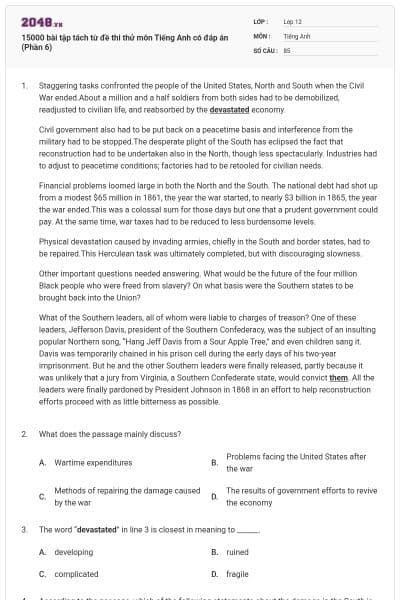
Staggering tasks confronted the people of the United States, North and South when the Civil War ended.About a million and a half soldiers from both sides had to be demobilized, readjusted to civilian life, and reabsorbed by the devastated economy.
Civil government also had to be put back on a peacetime basis and interference from the military had to be stopped.The desperate plight of the South has eclipsed the fact that reconstruction had to be undertaken also in the North, though less spectacularly. Industries had to adjust to peacetime conditions; factories had to be retooled for civilian needs.
Financial problems loomed large in both the North and the South. The national debt had shot up from a modest $65 million in 1861, the year the war started, to nearly $3 billion in 1865, the year the war ended.This was a colossal sum for those days but one that a prudent government could pay. At the same time, war taxes had to be reduced to less burdensome levels.
Physical devastation caused by invading armies, chiefly in the South and border states, had to be repaired.This Herculean task was ultimately completed, but with discouraging slowness.
Other important questions needed answering. What would be the future of the four million Black people who were freed from slavery? On what basis were the Southern states to be brought back into the Union?
What of the Southern leaders, all of whom were liable to charges of treason? One of these leaders, Jefferson Davis, president of the Southern Confederacy, was the subject of an insulting popular Northern song, “Hang Jeff Davis from a Sour Apple Tree,” and even children sang it. Davis was temporarily chained in his prison cell during the early days of his two-year imprisonment. But he and the other Southern leaders were finally released, partly because it was unlikely that a jury from Virginia, a Southern Confederate state, would convict them. All the leaders were finally pardoned by President Johnson in 1868 in an effort to help reconstruction efforts proceed with as little bitterness as possible.
What does the passage mainly discuss?
Wartime expenditures
Problems facing the United States after the war
Methods of repairing the damage caused by the war
The results of government efforts to revive the economy
Đáp án B
Đoạn văn chủ yếu thảo luận là gì?
A. Chi tiêu thời chiến
B. Các vấn đề phải đối mặt với Hoa Kỳ sau chiến tranh
C. Phương pháp sửa chữa thiệt hại do chiến tranh gây ra
D. Kết quả của các nỗ lực của chính phủ để làm sống lại nền kinh tế
The word “devastated” in line 3 is closest in meaning to ______.
developing
ruined
complicated
fragile
Đáp án B
Từ "evastated" trong dòng 3 gần nghĩa với:
A. đang phát triển
B. bị hủy hoại
C. phức tạp
D. mong manh
According to the passage, which of the following statements about the damage in the South is correct?
It was worse than in the North
The cost was less than expected
It was centered in the border states
It was remedied rather quickly
Đáp án D
Câu nào sau đây về thiệt hại trong miền Nam là chính xác?
A. Tệ hơn ở miền Bắc
B. Chi phí thấp hơn dự kiến
C. Nó tập trung ở các bang biên giới
D. Nó đã được khắc phục khá nhanh chóng
The passage refers to all of the following as necessary steps following the Civil War EXCEPT______
helping soldiers readjust
restructuring industry
returning government to normal
increasing taxes
Đáp án D
Đoạn văn đề cập đến tất cả những điều sau đây khi các bước cần thiết sau Chiến tranh trừ:
A. giúp người lính trở về cuộc sống bình thường
B. tái cơ cấu công nghiệp
C. trả lại chính phủ cho bình thường
D. tăng thuế
Why does the author mention a popular song?
To give an example of a Northern attitude towards the South
To illustrate the Northern love of music
To emphasize the cultural differences between the North and the South
To compare the Northern and Southern presidents
Đáp án A
Tại sao tác giả đề cập đến một bài hát nổi tiếng?
A. Đưa ra một ví dụ về thái độ phía Bắc đối với miền Nam
B. Để minh họa cho tình yêu âm nhạc miền Bắc
C. Để nhấn mạnh sự khác biệt văn hóa giữa miền Bắc và miền Nam
D. So sánh các chủ tịch miền Bắc và miền Nam
The word “them” in line 20 refers to ______.
charges
leader
days
irons
Đáp án A
Từ "họ" trong dòng 20 đề cập đến:
A. chi phí
B. lãnh đạo
C. ngày
D. súng lục
Which of the following can be inferred from the phrase “…it was unlikely that a jury from Virginia, a Southern Confederate state, would convict them”?
Virginians felt betrayed by Jefferson Davis
A popular song insulted Virginia
Virginians were loyal to their leaders
All of the Virginia military leaders had been put in chains
Đáp án C
Điều nào sau đây có thể được suy ra từ cụm từ “… không chắc rằng bồi thẩm đoàn từ Virginia, một miền Nam miền Nam, sẽ kết án họ ”?
A. Virginians cảm thấy bị phản bội bởi Jefferson Davis
B. Một bài hát nổi tiếng xúc phạm Virginia
C. Virginians đã trung thành với các nhà lãnh đạo của họ
D. Tất cả các nhà lãnh đạo quân đội Virginia đã được đưa vào chuỗi
It can be inferred from the passage that President Johnson pardoned the Southern leaders in order to _________.
raise money for the North
repair the physical damage in the South
prevent Northern leaders from punishing more Southerners
help the nation recover from the war
Đáp án D
Có thể suy ra từ đoạn văn mà Tổng thống Johnson đã tha thứ cho miền Nam các nhà lãnh đạo để:
A. quyên tiền cho miền Bắc
B. sửa chữa thiệt hại vật chất ở miền Nam
C. ngăn cản các nhà lãnh đạo miền Bắc trừng phạt nhiều người miền Nam hơn
D. giúp quốc gia hồi phục sau chiến tranh
Are organically grown foods the best food choices? The advantages claimed for such foods over conventionally grown and marketed food products are now being debated. Advocates of organic foods - a term whose meaning varies greatly - frequently proclaim that such products are safer and more nutritious than others.
The growing interest of consumers in the safety and nutritional quality of the typical North American diet is a welcome development. However, much of this interest has been sparked by sweeping claims that the food supply is unsafe or inadequate in meeting nutritional needs. Although most of these claims are not supported by scientific evidence, the preponderance of written material advancing such claims makes it difficult for the general public to separate fact from fiction. As a result, claims that eating a diet consisting entirely of organically grown foods prevents or cures disease or provides other benefits to health have become widely publicized and form the basis for folklore.
Almost daily the public is besieged by claims for “no-aging” diets, new vitamins, and other wonder foods. There are numerous unsubstantiated reports that natural vitamins are superior to synthetic ones, that fertilized eggs are nutritionally superior to unfertilized eggs, that untreated grains are better than fumigated grains, and the like.
One thing that most organically grown food products seem to have in common is that they cost more than conventionally grown foods. But in many cases consumers are misled if they believe organic foods can maintain health and provide better nutritional quality than conventionally grown foods. So there is real cause for concern if consumers, particularly those with limited incomes, distrust the regular food supply and buy only expensive organic foods instead.
The “welcome development” mentioned in line 6 is an increase in ______.
interest in food safety and nutrition among North Americans
the nutritional quality of the typical North American diet.
the amount of healthy food grown in North America.
the number of consumers in North America.
Đáp án A
" welcome development" được đề cập trong dòng 6 là sự gia tăng trong ______.
The growing interest of consumers in the safety and nutritional quality of the typical North American diet is a welcome development.
A. quan tâm đến an toàn thực phẩm và dinh dưỡng ở Bắc Mỹ
B. chất lượng dinh dưỡng của chế độ ăn điển hình ở Bắc Mỹ.
C. lượng thực phẩm lành mạnh được trồng ở Bắc Mỹ.
D. số lượng người tiêu dùng ở Bắc Mỹ.
According to the first paragraph, which of the following is true about the term “organic foods”?
It is accepted by most nutritionists.
It has been used only in recent years.
It has no fixed meaning.
It is seldom used by consumers.
Đáp án C
Điều nào sau đây là đúng về thuật ngữ “thực phẩm hữu cơ”?
Advocates of organic foods - a term whose meaning varies greatly -…
A. Nó được hầu hết các chuyên gia dinh dưỡng chấp nhận.
B. Nó đã được sử dụng chỉ trong những năm gần đây.
C. Nó không có ý nghĩa cố định.
D. Nó hiếm khi được người tiêu dùng sử dụng.
improve
monitor
keep
restore
Đáp án C
Từ "duy trì" có nghĩa gần nhất với ______.
A. cải thiện
B. màn hình
C. giữ
D. khôi phục
The author implies that there is cause for concern if consumers with limited incomes buy organic foods instead of conventionally grown foods because ______.
organic foods can be more expensive but are often no better than conventionally grown foods.
many organic foods are actually less nutritious than similar conventionally grown foods.
conventionally grown foods are more readily available than organic foods.
too many farmers will stop using conventional methods to grow food crops.
Đáp án A
Tác giả ngụ ý rằng điều gây lo ngại nếu người tiêu dùng có thu nhập hạn chế mua thực phẩm hữu cơ thay vì thực phẩm được trồng thông thường là;
But in many cases consumers are misled if they believe organic foods can maintain health and provide better nutritional quality than conventionally grown foods.
A. thực phẩm hữu cơ có thể đắt hơn nhưng thường không tốt hơn so với thực phẩm được trồng thông thường.
B. nhiều thực phẩm hữu cơ thực sự ít dinh dưỡng hơn so với các loại thực phẩm được trồng thông thường.
C. thực phẩm được trồng thông thường có sẵn nhiều hơn thực phẩm hữu cơ.
D. quá nhiều nông dân sẽ ngừng sử dụng các phương pháp thông thường để trồng cây lương thực.
According to the last paragraph, consumers who believe that organic foods are better than conventionally grown foods are often ______.
careless
mistaken
economical
wealthy
Đáp án B
Người tiêu dùng tin rằng thực phẩm hữu cơ tốt hơn so với thực phẩm được trồng thông thường thường là người
A. bất cẩn
B. nhầm lẫn
C. kinh tế
D. giàu có
The word “those” stands for ______?
foods
concern
consumers
they
Đáp án C
Từ "those" là viết tắt của ______?
A. thực phẩm
B. mối quan tâm
C. người tiêu dùng
D. họ
Very enthusiastic
Somewhat favorable
Neutral
Skeptical
Đáp án C
Thái độ của tác giả đối với các tuyên bố của những người ủng hộ thực phẩm lành mạnh là gì?
A. Rất nhiệt tình
B. Hơi thiên vị
C. Trung lập
D. Hoài nghi
The Native American peoples of the north Pacific Coast created a highly complex maritime culture as they invented modes of production unique to their special environment. In addition to their sophisticated technical culture, they also attained one of the most complex social organizations of any nonagricultural people in the world.
In a division of labor similar to that of the hunting peoples in the interior and among foraging peoples throughout the world, the men did most of the fishing, and the women processed the catch. Women also specialized in the gathering of the abundant shellfish that lived closer to shore. They collected oysters, crabs, sea urchins, mussels, abalone, and clams, which they could gather while remaining close to their children. The maritime life harvested by the women not only provided food, but also supplied more of the raw materials for making tools than did fish gathered by the men. Of particular importance for the native tool than did the fish gathered by the men. Of particular made from the larger mussel shells, and a variety of cutting edges that could be made from other marine shells.
The women used their tools to process all of the fish and marine mammals brought in by the men. They cleaned the fish, and dried vast quantities of them for the winter. They sun-dried fish when practical, but in the rainy climate of the coastal area they also used smokehouses to preserve tons of fish and other seafood annually. Each product had its own peculiar characteristics that demanded a particular way of cutting or drying the meat, and each task required its own cutting blades and other utensils.
After drying the fish, the women pounded some of them into fish meal, which was an easily transported food used in soups, stews, or other dishes to provide protein and thickening in the absence of fresh fish or while on long trips. The women also made a cheese-like substance from a mixture of fish and roe by aging it in storehouses or by burying it in wooden boxes or pits lined with rocks and tree leaves.
Which aspect of the lives of the Native Americans of the north Pacific Coast does the passage mainly discuss?
Methods of food preservation
How diet was restricted by the environment
The contributions of women to the food supply
Difficulties in establishing successful farms
Đáp án C
Khía cạnh nào của cuộc sống của những người Mỹ bản địa ở bờ biển phía bắc Thái Bình Dương chủ yếu thảo luận?
A. Phương pháp bảo quản thực phẩm
B. Chế độ ăn uống bị giới hạn bởi môi trường như thế nào
C. Sự đóng góp của phụ nữ vào việc cung cấp thực phẩm
D. Khó khăn trong việc thành lập các trang trại thành công
achieved
modified
demanded
spread
Đáp án A
Từ “attain” trong dòng 3 gần nghĩa ___________.
A. đạt được
B. biến đổi
C. yêu cầu
D. lây lan
more complex than that of hunters and foragers
less efficient than that of hunters and foragers
more widespread than that of hunters and foragers
better documented than that of hunters and foragers
Đáp án B
Tổ chức xã hội của nhiều dân tộc nông nghiệp là ___________.
A. phức tạp hơn so với xã hội của thợ săn và thợ rèn
B. kém hiệu quả hơn so với xã hội của thợ săn và thợ rèn
C. rộng rãi hơn so với xã hội của thợ săn và kiếm
D. có dẫn chứng tốt hơn so với xã hội của thợ săn và người đi săn
It was first developed by Native Americans of the north Pacific Coast.
It rarely existed among hunting
It was a structure that the Native Americans of the north Pacific Coast shared with many other peoples.
It provided a form of social organization that was found mainly among coastal peoples.
Đáp án D
Theo đoạn văn, điều gì là đúng trong “phân công lao động” được đề cập trong dòng 5?
A. Nó lần đầu tiên được phát triển bởi người Mỹ bản địa của bờ biển phía bắc Thái Bình Dương.
B. Nó hiếm khi tồn tại trong săn bắn
C. Đó là một cấu trúc mà người Mỹ bản xứ của bờ biển phía bắc Thái Bình Dương chia sẻ với nhiều người khác.
D. Nó cung cấp một hình thức tổ chức xã hội được tìm thấy chủ yếu ở các dân tộc ven biển.
were more likely to catch shellfish than other kinds of fish
contributed more materials for tool making than the men did
sometimes searched for food far inland from the coast
prepared and preserved the fish
Đáp án C
Tất cả những điều sau đây đúng với phụ nữ bờ biển phía bắc Thái Bình Dương NGOẠI TRỪ rằng họ
A. có nhiều khả năng bắt động vật có vỏ hơn các loại cá khác
B. đóng góp nhiều vật liệu hơn cho việc chế tạo công cụ hơn là những người đàn ông đã làm
C. đôi khi tìm kiếm thức ăn xa nội địa từ bờ biển
D. chuẩn bị và bảo quản cá
women
tools
mammals
men
Đáp án A
Từ “Họ” trong dòng 16 đề cập đến ___________.
A. phụ nữ
B. công cụ
C. động vật có vú
D. đàn ông
The Native Americans of the north Pacific Coast used smokehouses in order to
___________.
store utensils used in food preparation
prevent fish and shellfish from spoiling
have a place to store fish and shellfis
prepare elaborate meal
Đáp án C
Người Mỹ bản địa của bờ biển phía bắc Thái Bình Dương đã sử dụng buồng xông khói để
… but in the rainy climate of the coastal area they also used smokehouses to preserve tons of fish and other seafood annually.
A. đồ dùng lưu trữ được sử dụng trong chế biến thực phẩm
B. ngăn chặn cá và động vật giáp xác khỏi bị hư hỏng
C. có một nơi để lưu trữ cá và động vật giáp xác
D. chuẩn bị bữa ăn phức tạp
made from fish
not actually cheese
useful on long journeys
made in a short period of time
Đáp án D
Tất cả những điều sau đây đều đúng với chất giống như phô mai được đề cập trong đoạn 4 ngoài trừ việc nó
The women also made a cheese-like substance from a mixture of fish and roe by aging it in storehouses or by burying it in wooden boxes or pits lined with rocks and tree leaves.
A. làm từ cá
B. không thực sự phô mai
C. hữu ích trên các chuyến đi dài
D. được thực hiện trong một khoảng thời gian ngắn
All mammals feed their young. Beluga whale mothers, for example, nurse their calves for some twenty months, until they are about to give birth again and their young are able to find their own food. The behavior of feeding of the young is built into the reproductive system. It is a nonselective part of parental care and the defining feature of a mammal, the most important thing that mammals-- whether marsupials, platypuses, spiny anteaters, or placental mammals -- have in common.
But not all animal parents, even those that tend their offspring to the point of hatching or birth, feed their young. Most egg-guarding fish do not, for the simple reason that their young are so much smaller than the parents and eat food that is also much smaller than the food eaten by adults. In reptiles, the crocodile mother protects her young after they have hatched and takes them down to the water, where they will find food, but she does not actually feed them. Few insects feed their young after hatching, but some make other arrangement, provisioning their cells and nests with caterpillars and spiders that they have paralyzed with their venom and stored in a state of suspended animation so that their larvae might have a supply of fresh food when they hatch.
For animals other than mammals, then, feeding is not intrinsic to parental care. Animals add it to their reproductive strategies to give them an edge in their lifelong quest for descendants. The most vulnerable moment in any animal's life is when it first finds itself completely on its own, when it must forage and fend for itself. Feeding postpones that moment until a young animal has grown to such a size that it is better able to cope. Young that are fed by their parents become nutritionally independent at a much greater fraction of their full adult size. And in the meantime those young are shielded against the vagaries of fluctuating of difficult-to-find supplies. Once a species does take the step of feeding its young, the young become totally dependent on the extra effort. If both parents are removed, the young generally do not survive.
The care that various animals give to their offspring.
The difficulties young animals face in obtaining food.
The methods that mammals use to nurse their young.
The importance among young mammals of becoming independent.
Đáp án A
Đoạn văn chủ yếu thảo luận là gì?
A. Sự chăm sóc mà các loài động vật khác nhau cung cấp cho con cái của chúng.
B. Những khó khăn mà động vật trẻ phải đối mặt trong việc có được thức ăn.
C. Các phương pháp mà động vật có vú sử dụng để nuôi dưỡng trẻ.
D. Tầm quan trọng của động vật có vú trẻ trở nên độc lập.
What can be inferred from the passage about the practice of animal parents feeding their young?
It is unknown among fish.
It is unrelated to the size of the young.
It is dangerous for the parents.
It is most common among mammals.
:Đáp án B
Điều gì có thể được suy ra từ đoạn văn về việc nuôi trẻ của cha mẹ động vật?
A. Nó không được biết đến trong cá.
B. Nó không liên quan đến kích thước của trẻ.
C. Nó nguy hiểm cho cha mẹ.
D. Nó phổ biến nhất ở động vật có vú.
contrast the feeding habits of different types of mammals
describe the process by which mammals came to be defined
emphasize the point that every type of mammal feeds its own young
explain why a particular feature of mammals is nonselective
Đáp án C
Tác giả liệt kê các loài động vật khác nhau trong dòng 5 để ________
A. đối chiếu thói quen ăn uống của các loại động vật có vú khác nhau
B. mô tả quá trình mà các động vật có vú đã được xác định
C. nhấn mạnh rằng mọi loại động vật có vú đều nuôi dưỡng con của chúng
D. giải thích lý do tại sao một đặc điểm đặc biệt của động vật có vú là không chọn lọc
By storing food near their young.
By locating their nests or cells near spiders and caterpillars.
By searching for food some distance from their nest.
By gathering food from a nearby water source.
Đáp án B
Theo đoạn văn, làm thế nào để một số loài côn trùng đảm bảo trẻ có thức ăn?
Few insects feed their young after hatching, but some make other arrangement, provisioning their cells and nests with caterpillars and spiders that they have paralyzed with their venom and stored in a state of suspended animation so that their larvae might have a supply of fresh food when they hatch.
A. bằng cách lưu trữ thực phẩm gần trẻ của họ.
B. Bằng cách định vị tổ hoặc tế bào của chúng gần nhện và sâu bướm.
C. Bằng cách tìm kiếm thức ăn cách xa tổ của chúng.
D. Bằng cách thu thập thức ăn từ một nguồn nước gần đó.
feeding
moment
young animal
size
Đáp án C
Từ "nó" trong dòng 20 đề cập đến _________
A. việc cho ăn
B. thời điểm
C. động vật nhỏ
D. kích thước
their parents are away searching for food
their parents have many young to feed
they are only a few days old
they first become independent
Đáp án D
Theo đoạn văn, động vật nhỏ không có khả năng tự vệ nhất khi
The most vulnerable moment in any animal's life is when it first finds itself completely on its own, when it must forage and fend for itself.
A. cha mẹ của chúng đang đi tìm thức ăn
B. cha mẹ của chúng có nhiều đứa để nuôi
C. chúng chỉ là một vài ngày tuổi
D. chúng lần đầu tiên trở nên độc lập
raised
protected
hatched
valued
Đáp án B
Từ "shielded" trong dòng 22 gần nhất có nghĩa là
A. nuôi
B. bảo vệ
C. nở
D. giá trị
Being aware of one's own emotions - recognizing and acknowledging feelings as they happen - is at the very heart of Emotional Intelligence. And this awareness encompasses not only moods but also thoughts about those moods. People who are able to monitor their feelings as they arise are less likely to be ruled by them and are thus better able to manage their emotions.
Managing emotions does not mean suppressing them; nor does it mean giving free rein to every feeling. Psychologist Daniel Goleman, one of several authors who have popularized the notion of Emotional Intelligence, insisted that the goal is balance and that every feeling has value and significance. As Goleman said, "A life without passion would be a dull wasteland of neutrality, cut off and isolated from the richness of life itself." Thus, we manage our emotions by expressing them in an appropriate manner. Emotions can also be managed by engaging in activities that cheer us up, soothe our hurts, or reassure us when we feel anxious.
Clearly, awareness and management of emotions are not independent. For instance, you might think that individuals who seem to experience their feelings more intensely than others would be less able to manage them. However, a critical component of awareness of emotions is the ability to assign meaning to them - to know why we are experiencing a particular feeling or mood. Psychologists have found that, among individuals who experience intense emotions, individual differences in the ability to assign meaning to those feelings predict differences in the ability to manage them. In other words, if two individuals are intensely angry, the one who is better able to understand why he or she is angry will also be better able to manage the anger.
Self-motivation refers to strong emotional self-control, which enables a person to get moving and pursue worthy goals, persist at tasks even when frustrated, and resist the temptation to act on impulse. Resisting impulsive behavior is, according to Goleman, "the root of all emotional self-control."
Of all the attributes of Emotional Intelligence, the ability to postpone immediate gratification and to persist in working toward some greater future gain is most closely related to success - whether one is trying to build a business, get a college degree, or even stay on a diet. One researcher examined whether this trait can predict a child's success in school. The study showed that 4-year-old children who can delay instant gratification in order to advance toward some future goal will be "far superior as students" when they graduate from high school than will 4-year-olds who are not able to resist the impulse to satisfy their immediate wishes.
Some people can understand their feelings better than others.
People who can manage their emotions will be controlled by them.
If people pay attention to their feelings, they will not be able to manage them.
If people pay attention to their feelings, they can control their emotions better.
Đáp án C
Điều nào sau đây chúng ta có thể phỏng đoán từ đoạn 1?
People who are able to monitor their feelings as they arise are less likely to be ruled by them and are thus better able to manage their emotions.
A. Một số người có thể hiểu cảm xúc của họ tốt hơn những người khác.
B. Những người có thể quản lý cảm xúc của họ sẽ được kiểm soát bởi họ.
C. Nếu mọi người chú ý đến cảm xúc của họ, họ sẽ không thể quản lý chúng.
D. Nếu mọi người chú ý đến cảm xúc của họ, họ có thể kiểm soát cảm xúc của họ tốt hơn.
The word "soothe" in paragraph 2 could be best replaced by ______________.
reduce
weaken
worsen
relieve
Đáp án D
Từ "soothe” trong đoạn 2 có thể được thay thế bằng ______________.
A. giảm
B. làm suy yếu
C. xấu đi
D. giảm bớt
manage their emotions appropriately
stop feeling angry
experience feelings more intensively
explain their emotions to others
Đáp án A
Theo các đoạn từ 1 đến 3, mọi người nên nhận thức được cảm xúc của họ để họ có thể
Clearly, awareness and management of emotions are not independent.
A. quản lý cảm xúc của họ một cách thích hợp
B. ngừng cảm thấy tức giận
C. trải nghiệm cảm xúc mạnh mẽ hơn
D. giải thích cảm xúc của họ cho người khác
trained people to increase their Emotional Intelligence
treated patients who had emotional problems
wrote about Emotional Intelligence
studied how people manage their emotions
Đáp án C
Từ đoạn 2, chúng ta có thể thấy rằng Daniel Goleman______________.
Psychologist Daniel Goleman, one of several authors who have popularized the notion of Emotional Intelligence,…
A. đào tạo mọi người để tăng trí thông minh cảm xúc của họ
B.điều trị bệnh nhân có vấn đề về cảm xúc
C. viết về trí thông minh cảm xúc
D. nghiên cứu cách mọi người quản lý cảm xúc của họ
every feeling is important
we can manage our emotions
emotions are part of a satisfying life
we should ignore some feelings
Đáp án D
Tất cả những điều sau đây được đề cập trong đoạn 2 về cảm xúc của chúng tôi trừ
A. mọi cảm giác đều quan trọng
B. chúng ta có thể quản lý cảm xúc của mình
C. cảm xúc là một phần của cuộc sống hạnh phúc
D. chúng ta nên bỏ qua một số cảm xúc
psychologists
individuals
individual differences
intense emotions
Đáp án D
Từ "chúng" trong đoạn 3 đề cập đến ______________.
A. nhà tâm lý học
B. cá nhân
C. sự khác biệt cá nhân
D. cảm xúc mãnh liệt
In paragraph 3, the author explains the concept of awareness and management of
emotions by______________.
describing how people learn to control their emotions
giving an example of why people get angry
comparing how two people might respond to an intense emotion
explaining why some people are not aware of their emotions
Đáp án C
Trong đoạn 3, tác giả giải thích khái niệm về nhận thức và quản lý cảm xúc bằng cách:
A. mô tả cách mọi người học cách kiểm soát cảm xúc của họ
B. đưa ra một ví dụ về lý do tại sao mọi người tức giận
C. so sánh hai người có thể phản ứng như thế nào với một cảm xúc mãnh liệt
D. giải thích tại sao một số người không nhận thức được cảm xúc của họ
easily understand new information
be more popular with their teachers
have more friends at school
focus on their work and not get distracted
Đáp án D
Theo đoạn 5, trẻ em có thể thành công hơn ở trường nếu chúng có thể chống lại các mong muốn vì chúng có thể ____________.
A. dễ hiểu thông tin mới
B. phổ biến hơn với giáo viên của họ
C. có nhiều bạn bè ở trường
D. tập trung vào công việc của họ và không bị phân tâm
There are many theories about the beginning of drama in ancient Greek. The one most widely accepted today is based on the assumption that drama evolved from ritual. The argument for this view goes as follows. In the beginning human beings viewed the natural forces of the world, even the seasonal changes, as unpredictable, and they sought, through various means, to control these unknown and feared powers. Those measures which appeared to bring the desired results were then retained and repeated until they hardened into fixed rituals. Eventually stories arose which explained or veiled the mysteries of the rites. As time passed some rituals were abandoned, but the stories, later called myths, persisted and provided material for art and drama.
Those who believed that drama evolved out of ritual also argue that those rites contained the seed of theatre because music, dance, masks, and costumes were almost always used. Furthermore, a suitable site had to be provided for performances, and when the entire community did not participate, a clear division was usually made between the “acting area” and “auditorium”. In addition, there were performers, and since considerable importance was attached to avoiding mistakes in the enactment of rites. Religious leaders usually assumed that task. Wearing masks and costumes, they often impersonated other people, animals, or supernatural beings, and mimed the desired effect- success in hunt or battle, the coming rain, the revival of the Sun-as an actor might. Eventually such dramatic representations were separated from religious activities.
Another theory traces the theatre’s origin from the human interest in storytelling. According to this view, tales (about the hunt, war, or other feats) are gradually elaborated, at first through the use of impersonation, action, and dialogue by a narrator and then through the assumption of each of the roles by a different person. A closely related theory traces theatre to those dances that are primarily rhythmical and gymnastic or that are imitations of animal movements and sound.
The origins of theatre
The variety of early religious activities.
the role of ritual in modern dance
The importance of storytelling
Đáp án A
Đoạn văn chủ yếu thảo luận là gì?
A. Nguồn gốc của nhà hát
B. Sự đa dạng của các hoạt động tôn giáo ban đầu.
C. vai trò của nghi lễ trong điệu nhảy hiện đại
D. Tầm quan trọng của kể chuyện
The connection between myths and dramatic plots
The seasons in which dramas were performed
The importance of costumes in early drama
The reason drama is often unpredictable
Đáp án A
Tác giả nói về khía cạnh nào của bộ phim trong đoạn đầu tiên?
A. Sự kết nối giữa những truyền thuyết và những cốt truyện đầy kịch tính
B. Các mùa phim được công chiếu
C. Tầm quan trọng của trang phục trong bộ phim
D. Lý do bộ phim thường không thể đoán trước
music
dance
magic
costumes
Đáp án C
Điều nào sau đây KHÔNG được đề cập như một yếu tố chung của nhà hát và nghi thức?
A. âm nhạc
B. khiêu vũ
C. ma thuật
D. trang phục
The word “considerable” in line 11 is closest in meaning to_____________.
relational
thoughtful
substantial
ceremonial
Đáp án C
Từ “considerable” trong dòng 11 gần nghĩa______________.
A. quan hệ
B. chu đáo
C. đáng kể
D. nghi lễ
mistakes
performers
animals
costumes
Đáp án B
Từ “họ” trong dòng 13 đề cập đến ______________.
A. sai lầm
B. người biểu diễn
C. động vật
D. trang phục
Ritual requires fewer performers than drama.
Ritual use music whereas drama does not.
Ritual is shorter than drama.
Ritual has a religious purpose and drama does not.
Đáp án B
Theo đoạn văn, sự khác biệt chính giữa nghi lễ và phim truyền hình là gì?
A. Nghi lễ đòi hỏi ít người biểu diễn hơn là kịch.
B. Nghi thức sử dụng âm nhạc trong khi phim truyền hình thì không.
C. Nghi lễ ngắn hơn kịch.
D. Nghi lễ có mục đích tôn giáo và kịch tính thì không.
Myths are longer represented dramatically.
No one really knows how the theatre began.
Storytelling is an important part of dance.
Dramatic activities require the use of costume.
Đáp án B
Những câu nào sau đây được nhắc tới trong đoạn văn?
A. Thần thoại được đại diện lâu hơn.
B. Không ai thực sự biết làm thế nào nhà hát bắt đầu.
C. Kể chuyện là một phần quan trọng của khiêu vũ.
D. Các hoạt động kịch tính yêu cầu sử dụng trang phục.
Choosing a career may be one of the hardest jobs you ever have, and it must be done with care. View a career as an opportunity to do something you love, not simply as a way to earn a living. Investing the time and effort to thoroughly explore your options can mean the difference between finding a stimulating and rewarding career and move from job to unsatisfying job in an attempt to find the right one. Work influences virtually every aspect of your life, from your choice of friends to where you live. Here are just a few of the factors to consider.
Deciding what matters most to you is essential to making the right decision. You may want to begin by assessing your likes, dislikes, strengths, and weaknesses. Think about the classes, hobbies, and surroundings that you find most appealing. Ask yourself questions, such as “Would you like to travel? Do you want to work with children? Are you more suited to solitary or co-operative work?” There are no right or wrong answers; only you know what is important to you. Determine which job features you require, which ones you would prefer, and which ones you cannot accept. Then rank them in order of importance to you.
The setting of the job is one factor to take into account. You may not want to sit at a desk all day. If not, there are diversity occupations – building inspector, supervisor, real estate agent – that involve a great deal of time away from the office. Geographical location may be a concern, and employment in some fields is concentrated in certain regions. Advertising job can generally be found only in large cities. On the other hand, many industries such as hospitality, law education, and retail sales are found in all regions of the country. If a high salary is important to you, do not judge a career by its starting wages. Many jobs, such as insurance sales, offers relatively low starting salaries; however, pay substantially increases along with your experience, additional training, promotions and commission.
Don’t rule out any occupation without learning more about it. Some industries evoke positive or negative associations. The traveling life of a flight attendant appears glamorous, while that of a plumber does not. Remember that many jobs are not what they appear to be at first, and may have merits or demerits that are less obvious. Flight attendants must work long, grueling hours without sleeps, whereas plumbers can be as highly paid as some doctors. Another point to consider is that as you get mature, you will likely to develop new interests and skills that may point the way to new opportunities. The choice you make today need not be your final one.
emphasize that each person’s answers will be different.
show that answering the questions is a long and difficult process.
indicate that the answers are not really important.
indicate that each person’s answers may change over time.
Đáp án B
Từ “assessing” trong đoạn 2 tốt nhất có thể được thay thế bằng _______.
A. khám phá
B. xem xét
C. đo
D. xử lý
questions
answers
features
jobs
Đáp án D
Theo đoạn 3, những lĩnh vực nào sau đây KHÔNG phù hợp với một người không muốn sống trong một thành phố lớn?
Advertising job can generally be found only in large cities.
A. thợ sửa ống nước
B. luật
C. bán hàng
D. nhà quảng cáo
discovering
considering
measuring
disposing
Đáp án B
Đó là tất cả các yếu tố bạn nên tính đến khi chọn một công việc NGOẠI TRỪ.
A. Sở thích và ghét của bạn
B. Bầu không khí tại nơi làm việc
C. Vị trí địa lý
D. Điểm mạnh và điểm yếu của bạn
plumbing
law
retail sales
advertising
Đáp án A
Trong đoạn 5, tác giả gợi ý điều đó.
The choice you make today need not be your final one.
A. bạn có thể muốn thay đổi nghề nghiệp tại một thời điểm nào đó trong tương lai.
B. khi bạn già đi, sự nghiệp của bạn có thể sẽ kém hiệu quả hơn.
C. bạn sẽ ở công việc của bạn suốt đời, vì vậy hãy chọn cẩn thận.
D. bạn có thể sẽ thất nghiệp vào một thời điểm nào đó trong tương lai.
Your likes and your dislikes
The atmosphere at work
Geographical location
Your strengths and weaknesses
Đáp án B
Tại sao tác giả đề cập đến “hàng giờ mệt mỏi, không ngủ” trong đoạn 4?
A. Để nhấn mạnh sự khó khăn của việc làm thợ sửa ống nước.
B. Để đối chiếu thực tế của công việc của một tiếp viên hàng không với hầu hết nhận thức của mọi người.
C. Để cho thấy rằng mọi người phải làm việc chăm chỉ cho sự nghiệp mà họ đã chọn.
D. Để ngăn cản người đọc lựa chọn nghề nghiệp làm tiếp viên hàng không.
In paragraph 5, the author suggests that .
you may want to change careers at some time in the future.
as you get older, your career will probably less fulfilling.
you will be at your job for a lifetime, so choose carefully.
you will probably jobless at some time in the future.
Đáp án D
Theo đoạn văn, điều nào sau đây là đúng?
A. Để kiếm được nhiều tiền, bạn không nên làm một công việc với mức lương khởi điểm thấp.
B. Để kiếm được nhiều tiền, bạn nên loại trừ tất cả các công việc nhà máy.
C. Nếu bạn muốn có một lối sống dễ dàng và quyến rũ, bạn nên xem xét trở thành tiếp viên hàng không.
D. Quan điểm ban đầu về sự nghiệp nhất định của bạn có thể không chính xác.
To emphasize the difficulty of working as a plumber.
To contrast the reality of a flight attendant’s job with most people’s perception.
To show that people must work hard for the career they have chosen.
To discourage readers from choosing a career as a flight attendant.
Đáp án B
Theo đoạn văn, điện thoại di động đặc biệt phổ biến với những người trẻ tuổi vì _______
A. chúng là thứ không thể thiếu hàng ngày.
B. chúng làm cho họ trông phong cách hơn.
C. họ giữ cho người dùng cảnh báo tất cả các thời gian.
D. họ không thể được thay thế bằng điện thoại thông thường.
To make a lot of money, you should not take a job with a low starting salary.
To make lots of money, you should rule out all factory jobs.
If you want an easy and glamorous lifestyle, you should consider becoming flight attendant.
Your initial view of certain careers may not be accurate.
Đáp án B
"Sự công khai tiêu cực" trong đoạn văn có thể là __________
A. những ý tưởng tồi về ảnh hưởng của điện thoại di động.
B. ý kiến rộng rãi về tác động xấu của điện thoại di động.
C. thông tin về các hiệu ứng gây chết người của điện thoại di động.
D. việc sử dụng điện thoại di động công cộng một cách tiêu cực.
Millions of people are using cell phones today. In many places, it is actually considered unusual not to use one. In many countries, cell phones are very popular with young people. They find that the phones are more than a means of communication - having a mobile phone shows that they are cool and connected.
The explosion in mobile phone use around the world has made some health professionals worried. Some doctors are concerned that in the future many people may suffer health problems from the use of mobile phones. In England, there has been a serious debate about this issue. Mobile phone companies are worried about the negative publicity of such ideas. They say that there is no proof that mobile phones are bad for your health.
On the other hand, medical studies have shown changes in the brain cells of some people who use mobile phones. Signs of change in the tissues of the brain and head can be detected with modern scanning equipment. In one case, a traveling salesman had to retire at young age because of serious memory loss. He couldn't remember even simple tasks. He would often forget the name of his own son. This man used to talk on his mobile phone for about six hours a day, every day of his working week, for a couple of years. His family doctor blamed his mobile phone use, but his employer's doctor didn't agree.
What is it that makes mobile phones potentially harmful? The answer is radiation. High-tech machines can detect very small amounts of radiation from mobile phones. Mobile phone companies agree that there is some radiation, but they say the amount is too small to worry about.
As the discussion about their safety continues, it appears that it's best to use mobile phones less often. Use your regular phone if you want to talk for a long time. Use your mobile phone only when you really need it. Mobile phones can be very useful and convenient, especially in emergencies. In the future, mobile phones may have a warning label that says they are bad for your health. So for now, it's wise not to use your mobile phone too often.
According to the passage, cell phones are especially popular with young people because _______
they are indispensable in everyday communications.
they make them look more stylish.
they keep the users alert all the time.
they cannot be replaced by regular phones.
Đáp án A
Những thay đổi gây ra bởi điện thoại di động chủ yếu liên quan đến ______
A. các tế bào của não.
C. sự di chuyển của trí não và cơ thể.
B. trí nhớ
D. các động mạch của não.
poor ideas about the effects of cell phones.
widespread opinion about bad effects of cell phones.
information on the lethal effects of cell phones.
the negative public use of cell phones.
Đáp án B
"Sự công khai tiêu cực" trong đoạn văn có thể là __________
A. những ý tưởng tồi về ảnh hưởng của điện thoại di động.
B. ý kiến rộng rãi về tác động xấu của điện thoại di động.
C. thông tin về các hiệu ứng gây chết người của điện thoại di động.
D. việc sử dụng điện thoại di động công cộng một cách tiêu cực.
the smallest units of the brain.
the resident memory.
the mobility of the mind and the body.
the arteries of the brain.
Đáp án A
Những thay đổi gây ra bởi điện thoại di động chủ yếu liên quan đến ______
A. các tế bào của não.
C. sự di chuyển của trí não và cơ thể.
B. trí nhớ
D. các động mạch của não.
had a problem with memory
abandoned his family.
suffered serious loss of mental ability.
could no longer think lucidly
Đáp án A
Người đàn ông được đề cập trong đoạn văn, người thường xuyên sử dụng điện thoại di động của mình, _______
A. có vấn đề với trí nhớ.
B. từ bỏ gia đình.
C. bị mất khả năng sử dụng trí não nghiêm trọng.
D. không còn có thể suy nghĩ một cách sáng suốt
ideas
negative publicity
Mobile phone companies
health problems
Đáp án C
Từ “họ” trong đoạn 1 đề cập đến ______.
A. ý tưởng
B. công khai tiêu cực
C. Các công ty điện thoại di động
D. vấn đề sức khỏe
“certainly”
“obviously”
“privately”
“possibly”
Đáp án D
Từ " potentially" trong đoạn văn gần nghĩa với:
A. "chắc chắn"
B. "rõ ràng"
C. "riêng"
D. "có thể"
“Mobile Phones: A Must of Our Time”
“Technological Innovations and Their Price”.
“The Way Mobile Phones Work”.
“The Reasons Why Mobile Phones Are Popular”.
Đáp án B
Tiêu đề phù hợp nhất cho đoạn văn có thể là _______
A. “Điện thoại di động: vật dụng cần thiết của thời đại của chúng ta”
B. “Đổi mới công nghệ và cái giá của nó”.
C. "Cách hoạt động của điện thoại di động".
D. "Lý do tại sao điện thoại di động là phổ biến".
For a time, the Hubble telescope was the brunt of jokes and subject to the wrath of those who believed the U.S government had spent too much money on space projects that served no valid purpose. The Hubble was sent into orbit with a satellite by the Space Shuttle Discovery in 1990 amid huge hype and expectation. Yet after it was in position, it simply did not work. Because the primary mirror was misshapen, it was not until 1993 that the crew of the Shuttle Endeavor arrived like roadside mechanics, opened the hatch that was installed for the purpose, and replaced the defective mirror with a good one.
Suddenly, all that had originally been expected came true. The Hubble telescope was indeed the “window on the universe”, as it had originally been dubbed. When you look deep into space, you are actually looking back through time, because even though light travels at 186,000 miles a second, it requires time to get from one place to another. In fact, it is said that in some cases, the Hubble telescope is looking back eleven billion years to see galaxies already forming. The distant galaxies are speeding away from Earth, some travelling at the speed of light.
Hubble has viewed exploding stars such as the Eta Carinae, which clearly displayed clouds of gas and dust billowing outward from its poles at 1.5 million miles an hour. Prior to Hubble, it was visible from traditional telescopes on Earth, but its details were not as certainable. But now, the evidence of the explosion is obvious. The star still burns five million times brighter than the Sun and illuminates clouds from the inside.
Hubble has also provided a close look at black holes, which are described as comic drains. Gas and dust swirl around the drain and are slowly sucked in by the incredible gravity. It has also looked into an area that looked empty to the naked eye and, within a region the size of a grain of sand, located layer upon layer of galaxies, with each galaxy consisting of billions of stars.
The Hubble telescope was named after Edwin Hubble, a 1920s astronomer who developed a formula that expresses the proportional relationship of distances between clusters of galaxies and the speeds at which they travel. Astronomers use stars known as Cepheid variables to measure distances in space. These stars dim and brighten from time to time, and they are photographed over time and charted. All the discoveries made by Hubble have allowed astronomers to learn more about the formation of early galaxies.
people were afraid of what might be foun
many people believed space exploration was a waste of time
it was defective for its first three years in space
it was more expensive than most space shuttles
Đáp án B
Tác giả nói rằng Hubble không phải lúc nào cũng phổ biến vì ________.
A. mọi người sợ những gì có thể được tìm thấy
B. nhiều người tin rằng khám phá không gian là một sự lãng phí thời gian
C. nó đã bị lỗi trong ba năm đầu tiên của nó trong không gian
D. nó đắt hơn hầu hết các tàu con thoi
the known defective mirror could be replaced in space rather than on Earth
maintenance could be done by travelling astronauts
the Hubble could move easily
the mirror could contract and expand
Đáp án B
Tác giả cho rằng vệ tinh mang theo Hubble được thiết kế đặc biệt để _________.
A. những tấm gương khuyết có thể được thay thế trong không gian thay vì trên Trái đất
B. các phi hành gia có thể bảo trì máy
C. Hubble có thể di chuyển dễ dàng
D. gương có thể thu nhỏ và mở rộng
astronomers
scientists
mechanics
politicians
Đáp án C
Tác giả so sánh các phi hành gia của Endeavour với ________.
A. các nhà thiên văn học
B. các nhà khoa học
C. các thợ cơ khí
D. các chính trị gia
time
space
186,000 miles a second
light
Đáp án D
Từ “nó” trong đoạn 1 đề cập đến ______.
A. thời gian
B. không gian
C. 186.000 dặm một giây
D. ánh sáng
developed the Hubble telescope
was the first person to use the Hubble telescope
developed a mathematical formula to measure speed and distances between galaxies
was a politician who sponsored funding in Congress
Đáp án C
Tác giả nói rằng Edward Hubble ________.
A. đã phát triển kính thiên văn Hubble
B. là người đầu tiên sử dụng kính thiên văn Hubble
C. đã phát triển một công thức toán học để đo tốc độ và khoảng cách giữa các thiên hà
D. là một chính trị gia tài trợ tài trợ cho Quốc hội
when viewing a distant galaxy through the Hubble telescope, you are actually looking back in time
the new mirror distorts the image
the view from Hubble is not accurate, but it is interesting
you cannot discern distance or time with any kind of accuracy
Đáp án A
Tác giả nói rằng ________.
A. khi xem một thiên hà xa xôi qua kính thiên văn Hubble, bạn thực sự đang nhìn lại thời gian
B. gương mới làm biến dạng hình ảnh
C. chế độ xem từ Hubble không chính xác nhưng điều thú vị
D. bạn không thể phân biệt khoảng cách hoặc thời gian với bất kỳ loại đơn vị đo lường chính xác nào
sitting
stopping
exploding
pouring
Đáp án D
Từ “billowing” trong đoạn thứ ba có ý nghĩa gần nhất với ________.
A. ngồi
B. dừng
C. bùng nổ
D. đổ ra
water draining in a bathtub
a galaxy
a group of stars
a cloud
Đáp án A
Tác giả cho rằng hố đen tương tự như ________.
A. nước chảy trong bồn tắm
B. một thiên hà
C. một nhóm các ngôi sao
D. một đám mây
Since the dawn of time, people have found ways to communicate with one another. Smoke signals and tribal drums were some of the earliest forms of communication. Letters, carried by birds or by humans on foot or on horseback, made it possible for people to communicate larger amounts of information between two places. The telegram and telephone set the stage for more modern means of communication. With the invention of the cellular phone, communication itself has become mobile.
For you, a cell phone is probably just a device that you and your friends use to keep in touch with family and friends, take pictures, play games, or send text message. The definition of a cell phone is more specific: it is a hand- held wireless communication device that sends and receives signals by way of small special areas called cells.
Walkie - talkies, telephones and cell phones are duplex communication devices: They make it possible for two people to talk to each other. Cell phones and walkie- talkies are different from regular phones because they can be used in many different locations. A walkie- talkie is sometimes called a half- duplex communication device because only one person can talk at a time. A cell phone is a full- duplex device because it uses both frequencies at the same time. A walkie-talkie has only one channel. A cell phone has more than a thousand channels. A walkie- talkie can transmit and receive signals across a distance of about a mile. A cell phone can transmit and receive signals over hundreds of miles. In 1973, an electronic company called Motorola hired Martin Cooper to work on wireless communication. Motorola and Bell Laboratories (now AT& T) were in a race to invent the first portable communication device. Martin Cooper won the race and became the inventor of the cell phone. On April 3, 1973, Cooper made the first cell phone call to his opponent at AT& T while walking down the streets of New York city. People on the sidewalks gazed at cooper in amazement. Cooper's phone was called A Motorola Dyna- Tac. It weighed a whopping 2.5 pounds (as compared to today's cell phones that weigh as little as 3 or 4 ounces)
After the invention of his cell phone, Cooper began thinking of ways to make the cell phone available to the general public. After a decade, Motorola introduced the first cell phone for commercial use. The early cell phone and its service were both expensive. The cell phone itself cost about $ 3, 500. In 1977, AT & T constructed a cell phone system and tried it out in Chicago with over 2, 000 customers. In 1981, a second cellular phone system was started in the Washington,D.C and Baltimore area. It took nearly 37 years for cell phones to become available for general public use. Today, there are more than sixty million cell phone customers with cell phones producing over thirty billion dollars per years.
The increasing number of people using cell phone.
The difference between cell phones and telephones.
The history of a cell phone
How Cooper competed with AT& T.
Đáp án C
Ý tưởng chính của đoạn văn là gì?
A. Số lượng ngày càng tăng của người sử dụng điện thoại di động.
B. Sự khác biệt giữa điện thoại di động và điện thoại.
C. Lịch sử của điện thoại di động
D. Làm thế nào Cooper cạnh tranh với AT & T.
The first product of two famous corporation.
A hand-held wireless communication device.
Something we use just for playing games.
A version of walkie- talkie.
Đáp án B
Định nghĩa nào là đúng của điện thoại di động?
A. Sản phẩm đầu tiên của hai tập đoàn nổi tiếng.
B. Một thiết bị giao tiếp không dây cầm tay.
C. Một cái gì đó chúng ta sử dụng chỉ để chơi trò chơi.
D. Một phiên bản của bộ đàm.
It has one channel
It was first designed in 1973.
It can be used within a distance of a mile.
Only one person can talk at a time.
Đáp án B
Thông tin nào không đúng về thiết bị “nói chuyện cầm tay”?
A. Nó có một kênh
B. Nó được thiết kế lần đầu tiên vào năm 1973.
C. Nó có thể được sử dụng trong vòng một dặm.
D. Chỉ có một người có thể nói chuyện cùng một lúc.
having two parts
quick
modern
having defects
Đáp án A
Từ "duplex" gần nghĩa với ________.
A. có hai phần
B. nhanh chóng
C. hiện đại
D. có khuyết tật
Walkie – talkies
Walkie - talkies, telephones
telephones and cell phones
Walkie - talkies, telephones and cell phones
Đáp án D
Từ “họ” trong đoạn 2 đề cập đến _________
A. Walkie - talkies
B. Walkie - talkies, điện thoại
C. điện thoại và điện thoại di động
D. Walkie - talkies, điện thoại và điện thoại di động
His assistant at Motorola.
A person on New York street.
A member of Bell Laboratories.
The director of his company.
Đáp án C
Cooper đã thực hiện cuộc gọi điện thoại di động đầu tiên của mình tới ai?
A. Trợ lý của anh tại Motorola.
B. Một người trên phố New York.
C. Một thành viên của phòng thí nghiệm Bell.
D. Giám đốc công ty của anh ta.
In the same years when he first made a cell- phone call.
In 1981.
In 1983.
In the same year when AT& T constructed a cell phone system.
Đáp án C
Motorola đã giới thiệu điện thoại di động đầu tiên cho mục đích thương mại khi nào?
A. Trong cùng một năm khi ông lần đầu tiên thực hiện một cuộc gọi điện thoại di động.
B. Năm 1981.
C. Năm 1983.
D. Trong cùng năm đó, AT & T đã xây dựng một hệ thống điện thoại di động.
Bạn có thích hoạt động này không?