15000 bài tập tách từ đề thi thử môn Tiếng Anh có đáp án (Phần 50)
69 câu hỏi
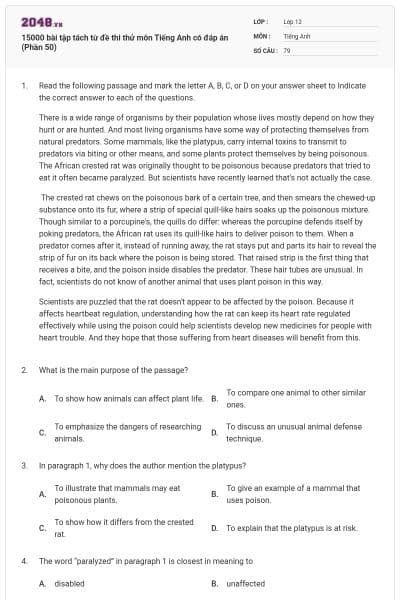
Read the following passage and mark the letter A, B, C, or D on your answer sheet to Indicate the correct answer to each of the questions.
There is a wide range of organisms by their population whose lives mostly depend on how they hunt or are hunted. And most living organisms have some way of protecting themselves from natural predators. Some mammals, like the platypus, carry internal toxins to transmit to predators via biting or other means, and some plants protect themselves by being poisonous. The African crested rat was originally thought to be poisonous because predators that tried to eat it often became paralyzed. But scientists have recently learned that's not actually the case.
The crested rat chews on the poisonous bark of a certain tree, and then smears the chewed-up substance onto its fur, where a strip of special quill-like hairs soaks up the poisonous mixture. Though similar to a porcupine's, the quills do differ: whereas the porcupine defends itself by poking predators, the African rat uses its quill-like hairs to deliver poison to them. When a predator comes after it, instead of running away, the rat stays put and parts its hair to reveal the strip of fur on its back where the poison is being stored. That raised strip is the first thing that receives a bite, and the poison inside disables the predator. These hair tubes are unusual. In fact, scientists do not know of another animal that uses plant poison in this way.
Scientists are puzzled that the rat doesn't appear to be affected by the poison. Because it affects heartbeat regulation, understanding how the rat can keep its heart rate regulated effectively while using the poison could help scientists develop new medicines for people with heart trouble. And they hope that those suffering from heart diseases will benefit from this.
What is the main purpose of the passage?
To show how animals can affect plant life.
To compare one animal to other similar ones.
To emphasize the dangers of researching animals.
To discuss an unusual animal defense technique.
. D
Kiến thức: Đọc hiểu
Giải thích: Mục đích chính của đoạn văn là gì?
A. Để cho thấy cách mà động vật có thể ảnh hưởng đến đời sống thực vật.
B. Để so sánh một con vật với những loài tương tự.
C. Để nhấn mạnh sự nguy hiểm của việc nghiên cứu động vật.
D. Để thảo luận một kỹ thuật bảo vệ bất thường của động vật.
Đáp án:D
In paragraph 1, why does the author mention the platypus?
To illustrate that mammals may eat poisonous plants.
To give an example of a mammal that uses poison.
To show how it differs from the crested rat.
To explain that the platypus is at risk.
B
Kiến thức: Đọc hiểu
Giải thích: Trong đoạn 1, tại sao tác giả đề cập đến thú mỏ vịt?
A. Để minh họa cho rằng động vật có vú có thể ăn thực vật có độc.
B. Để cho một ví dụ về một động vật có vú sử dụng chất độc.
C. Để cho thấy nó khác với chuột nhắt.
D. Để giải thích rằng thú mỏ vịt đang bị nguy hiểm.
Thông tin: And most living organisms have some way of protecting themselves from natural predators. Some mammals, like the platypus, carry internal toxins to transmit to predators via biting or other means
Đáp án:B
The word “paralyzed” in paragraph 1 is closest in meaning to
disabled
unaffected
inaccessible
undecided
A
Kiến thức: Đọc hiểu
Giải thích:
Từ "paralyzed" trong đoạn 1 gần nghĩa nhất với
A. tê liệt, tàn tật C. không thể tiếp cận
B. không bị ảnh hưởng D. chưa quyết định
"paralyzed" = disabled
The African crested rat was originally thought to be poisonous because predators that tried to eat it often became paralyzed.
Giống chuột nhắt Châu Phi ban đầu được cho có độc bởi vì những kẻ ăn thịt cố ăn nó thường bị tê liệt.
Đáp án:A
In paragraph 2, what does the word “them” refer to?
predators
porcupines
crested rats
quill-like hairs
A
Kiến thức: Đọc hiểu
Giải thích:
Trong đoạn 2, từ "them" đề cập đến?
A. động vật ăn thịt C. chuột nhắt
B. nhím D. dải lông
Though similar to a porcupine's, the quills do differ: whereas the porcupine defends itself by poking predators, the African rat uses its quill-like hairs to deliver poison to them.
Mặc dù tương tự như lông của nhím, dải lông này rất khác: trong khi con nhím tự bảo vệ bằng cách húc vào những kẻ săn mồi, chuột nhắt châu Phi sử dụng dải lông của nó để chuyển chất độc cho chúng.
Đáp án:A
The word “defends” in paragraph 2 is closest in meaning to
encourages
protects
feeds
pretends
B
Kiến thức: Đọc hiểu
Giải thích:
Từ “defends” trong đoạn 2 gần nhất có nghĩa là
A. khuyến khích C. cho ăn
B. bảo vệ D. giả vờ
“defend” = protect: bảo vệ
Though similar to a porcupine's, the quills do differ: whereas the porcupine defends itself by poking predators, the African rat uses its quill-like hairs to deliver poison to them.
Mặc dù tương tự như lông của nhím, dải lông này rất khác: trong khi con nhím tự bảo vệ bằng cách húc vào những kẻ săn mồi, chuột nhắt châu Phi sử dụng dải lông của nó để chuyển chất độc cho chúng.
Đáp án:B
What are scientists surprised by?
How toxic plant poison can be.
How useful plant toxins can be.
How quickly rats learn new behavior.
That the rats are protected from the poison.
D
Kiến thức: Đọc hiểu
Giải thích: Các nhà khoa học ngạc nhiên bởi?
A. Thực vật độc có thể độc đến mức nào.
B. Chất độc thực vật có ích như thế nào
C. Cách chuột học được hành vi mới nhanh thế nào
D. Rằng chuột được bảo vệ khỏi chất độc.
Thông tin: Scientists are puzzled that the rat doesn't appear to be affected by the poison.
Đáp án:D
What would scientists like to investigate further?
Medicine used to counteract poison.
Other animals like the crested rat.
Health effects of a chemical.
Rats with unhealthy hearts.
D
Kiến thức: Đọc hiểu
Giải thích:
Các nhà khoa học muốn nghiên cứu sâu hơn cái gì?
A. Thuốc dùng để chống lại chất độc.
B. Các loài động vật khác như chuột nhắt.
C. Ảnh hưởng sức khoẻ của một hóa chất.
D. Chuột có trái tim không khoẻ mạnh.
Thông tin: Scientists are puzzled that the rat doesn't appear to be affected by the poison. Because it affects heartbeat regulation, understanding how the rat can keep its heart rate regulated effectively while using the poison could help scientists develop new medicines for people with heart trouble.
Đáp án:D
Dịch bài đọc số 96:
Có rất nhiều sinh vật do số lượng, chủ yếu sống phụ thuộc vào cách săn bắn hoặc bị săn bắn. Và hầu hết sinh vật sống có một số cách tự bảo vệ mình khỏi những kẻ thù tự nhiên. Một số động vật có vú, như thú mỏ vịt, mang chất độc bên trong truyền cho kẻ thù thông qua việc cắn hoặc các cách khác, và một số thực vật tự bảo vệ mình bằng cách trở nên rất độc. Giống chuột nhắt Châu Phi ban đầu được cho có độc bởi vì những kẻ ăn thịt cố ăn nó thường bị tê liệt. Tuy nhiên, các nhà khoa học gần đây đã biết được rằng điều này không thực sự đúng.
Những con chuột nhắt nhai vỏ độc của một cây nào đó, và sau đó bôi lên lông của nó, nơi mà một dải lông đặc biệt ngấm hỗn hợp độc hại. Mặc dù tương tự như lông của nhím, dải lông này rất khác: trong khi con nhím tự bảo vệ bằng cách húc vào những kẻ săn mồi, chuột nhắt châu Phi sử dụng dải lông của nó để chuyển chất độc cho chúng. Khi một kẻ săn mồi đi sau nó, thay vì chạy trốn, con chuột kiên định và rẽ lông để lộ dải lông trên lưng, nơi chất độc đang được lưu trữ. Đó là nơi bị cắn đầu tiên, và chất độc bên trong vô hiệu hóa thú ăn thịt. Những ống lông này không bình thường. Trên thực tế, các nhà khoa học không biết một con vật nào khác cũng sử dụng chất độc thực vật theo cách này.
Các nhà khoa học đang bối rối vì chuột không bị ảnh hưởng bởi chất độc. Vì nó ảnh hưởng đến việc điều hòa nhịp tim, hiểu cách chuột có thể giữ nhịp tim trong khi sử dụng chất độc có thể giúp các nhà khoa học phát triển các loại thuốc mới cho những người có vấn đề về tim. Và họ hy vọng rằng những người bị bệnh tim sẽ được hưởng lợi từ điều này.
Read the following passage and mark A, B, C, or D to indicate the correct answer to each of the blanks.
University researchers have taken samples from a preserved dodo specimen in an (641) _____ to uncover the extinct bird’s family tree. They worked with the British Natural History Museum to collect and study genetic material from large number of specimens: a preserved dodo, the extinct solitaire bird, and 35 kind of living pigeons and doves. Their analysis (642) _____ the doo and the solitaire to be close relatives with the Nicobar pigeon, their nearest living relative. The dodo lived on Mauritius in the Indian Ocean. It was a flightless bird, bigger than a turkey. By 1681, all dodos had been (643) _____ by hungry sailors. The solitaire, which looked a bit like a dodo, had gone the same way by 1800. By extracting short pieces of the dodo’s DNA and (644) _____ these with the DNA of living birds, the scientists were able to deduce when the dodo evolved away from its relatives into a separate entity. The scientists can now (645) _____ assume that the dodo developed its distinctive appearance and features as a result of its geographical isolation. They are now convinced that it separated from the solitaire about 25 million years ago, long before Mauritius became an island.
attempt
intention
order
assistance
Đáp án: A
Giải thích:
Kiến thức: Từ vựng
Giải thích:
A. attempt (n): nỗ lực
B. intention (n): dự định
C. order (n): mệnh lệnh, yêu cầu
D. assistance (n): hỗ trợ, giúp đỡ
in an attempt to do something: trong nỗ lực làm gì
Dịch: Các nhà nghiên cứu tại trường đại học đã lấy mẫu từ một mẫu vật chim dodo được bảo quản nhằm mục đích khám phá cây phả hệ của loài chim đã tuyệt chủng này.
advises
involves
shows
recommends
C
Kiến thức: từ vựng
Giải thích:
advise (v): khuyên bảo involve (v): liên quan
show (v): chỉ ra recommend (v): gợi ý
disappeared
vanished
killed
extinct
C
Kiến thức: từ vựng
Giải thích:
disappear (v): biến mất vanish (v): biến mất
kill (v): giết extinct (adj): tuyệt chủngstudying
comparing
researching
combining
B
Kiến thức: từ vựng
Giải thích:
study (v): học tập compare (v): so sánh
research (v): nghiên cứu combine (v): kết hợp
Đáp án: B
surely
hardly
highly
safely
A
Kiến thức: từ vựng
Giải thích:
surely (adv): chắc chắn hardly (adv): hầu như không có
highly (adv): rất nhiều safely (adv): an toàn
Dịch bài đọc số 97:
Các nhà nghiên cứu ở trường đại học đã lấy mẫu từ một mẫu chim dodo được bảo tồn trong một nỗ lực để phát hiện ra cây gia phả của loài chim tuyệt chủng. Họ đã làm việc với Bảo tàng Lịch sử Tự nhiên Anh để thu thập và nghiên cứu vật liệu di truyền từ một số lượng lớn mẫu vật: một con chim dodo được bảo tồn, chim solitaire tuyệt chủng và 35 loại chim bồ câu và chim bồ câu trắng sống. Phân tích của họ cho thấy doo và solitaire là họ hàng gần với chim bồ câu Nicobar, họ hàng gần nhất còn sống của chúng. Chim dodo sống trên Mauritius ở Ấn Độ Dương. Đó là một con chim không biết bay, lớn hơn một con gà tây. Đến năm 1681, tất cả các con dodo đã bị giết bởi các thủy thủ đói. Chim solitaire, mà trông giống như một dodo, cũng chết như thế năm 1800. Bằng cách trích xuất đoạn ngắn DNA của dodo và so sánh chúng với DNA của chim sống, các nhà khoa học đã có thể suy ra khi dodo tiến hóa từ họ hàng của nó thành một thực thể riêng biệt. Các nhà khoa học bây giờ có thể chắc chắn cho rằng dodo phát triển bề ngoài và các đặc điểm riêng biệt của nó là do sự cô lập địa lý của nó. Bây giờ họ bị thuyết phục rằng nó tách ra khỏi loài chim solitaire khoảng 25 triệu năm trước, lâu trước khi Mauritius trở thành một hòn đảo.
Read the following passage and mark the letter A, B, C, or D on your answer sheet to indicate the correct answer to each of the Question s.
There has been much debate over the past few decades concerning fears that automation will lead to robots replacing human workers on a massive scale.
The increasing use of robotics, computers and artificial intelligence is a reality, but its full implications are far from cut and dried. Some forecasts present the future in a utopian way, claiming that robots will take over the tedious heavy work thus freeing up human time and potential, allowing for more creativity and innovation. At the other end of spectrum are those who foresee an employment apocalypse, predicting that almost fifty percent of all American jobs could vanish within the next few decades. Former Microsoft chairman Bill Gates states that in 20 years robots could be in place in a number of job categories, particularly those at lower end of the scale in terms of skills.
The bottom line is that while the future is always uncertain, robots are a fixture of our society, which is not going to disappear. As with the Industrial Revolution, where machines were utilized in many tasks in place of manual laborers and social upheaval followed, the Digital Revolution is likely to place robots in various jobs. In spite of that, many of today’s jobs were not in existence before the Industrial Revolution, such as those of programmers, engineers and data scientists. This leads other experts to criticize this alarmist approach of robot scare-mongering, which is invariably compared to the 19th-century “Luddites”. This group was textile workers who feared being displaced by machines and resorted to violence, burning down factories and destroying industrial equipment – their rejection of inevitable progress has come to symbolize mindless ignorance.
Needless to say, exactly what new kinds of jobs might exist in the future is difficult to envision at present. Therefore, the crux of the issue is not whether jobs will be lost, but whether the creation of new vacancies will outpace the ever-increasing number of losses and what skills will be required in the future.
It is clearly not all doom and gloom, as demand for employees with skills in data analysis, coding, computer science, artificial intelligence and human-machine interface is rising and will continue to do so. Furthermore, the demand for skills in jobs where humans surpass computers, such as those involving care, creativity and innovative craftmanship, are likely to increase considerably. Ultimately, the key lies in the adaptation of the workforces, through appropriate education and training, to keep pace with our world’s technological progress.
What is the main concern associated with technological advances in the workplace?
safety at work
increased unemployment
the use of artificial intelligence
robots taking over the world
B
Kiến thức: đọc hiểu
Tạm dịch: Mối quan tâm chính liên quan đến tiến bộ công nghệ ở nơi làm việc là gì?
A. an toàn tại nơi làm việc B. tăng thất nghiệp
C. việc sử dụng trí tuệ nhân tạo D. robot chiếm lĩnh thế giới
Thông tin: There has been much debate over the past few decades concerning fears that automation will lead to robots replacing human workers on a massive scale.
What do optimists predict technology will allow?
workplaces to become more relaxing
a greater enjoyment of life
flexible working hours
higher quality products
D
Kiến thức: đọc hiểu
Tạm dịch: Những người lạc quan dự đoán công nghệ sẽ cho phép điều gì?
A. nơi làmD việc sẽ thư giãn hơn B. tăng hưởng thụ cuộc sống
C. thời gian làm việc linh hoạt D. chất lượng sản phẩm cao hơn
Thông tin: Some forecasts present the future in a utopian way, claiming that robots will take over the tedious heavy work thus freeing up human time and potential, allowing for more creativity and innovation.
What can be inferred from the comments made by Bill Gates?
Changes will occur for many decades.
There will be increasing amounts of unskilled workers.
Highly skilled workers have less to worry about.
Technology will have a negative effect in the workplace.
C
Kiến thức: đọc hiểu
Tạm dịch: Điều gì có thể suy ra từ bình luận của Bill Gates?
A. Thay đổi diễn ra trong nhiều thập kỷ.
B. Sẽ tăng số lượng công nhân không có kỹ năng.
C. Công nhân có tay nghề cao có ít lo lắng hơn.
D. Công nghệ sẽ có tác động tiêu cực tại nơi làm việc.
Thông tin: Former Microsoft chairman Bill Gates states that in 20 years robots could be in place in a number of job categories, particularly those at lower end of the scale in terms of skills.
Why is the example of the Industrial Revolution given?
It was also a time of great change in the workplace.
It had far less of an effect than the Digital Revolution.
It lead to widespread unemployment in the world.
It resulted in a more violent society.
A
Kiến thức: đọc hiểu
Tạm dịch: Tại sao ví dụ về Cách mạng công nghiệp lại được nêu ra?
A. Đó cũng là thời gian có thay đổi lớn ở nơi làm việc.
B. Nó có ít hiệu quả hơn Cuộc Cách mạng Kỹ thuật số.
C. Nó dẫn đến tình trạng thất nghiệp phổ biến trên thế giới.
D. Nó dẫn đến một xã hội bạo lực hơn.
Thông tin: As with the Industrial Revolution, where machines were utilized in many tasks in place of manual laborers and social upheaval followed, the Digital Revolution is likely to place robots in various jobs.
What is the modern-day view of the Luddites?
They managed to protect their jobs.
Their refusing to adapt to change is seen in a negative way.
Their adapting to new technology saved their jobs.
Their actions are inspiring many workers today.
B
Kiến thức: đọc hiểu
Tạm dịch: Quan điểm hiện đại về “Luddites” là gì?
A. Họ cố gắng bảo vệ công việc của họ.
B. Việc từ chối thích ứng với sự thay đổi của họ được nhìn nhận một cách tiêu cực.
C. Việc họ thích nghi với công nghệ mới đã cứu được công việc của họ.
D. Hành động của họ là truyền cảm hứng cho nhiều công nhân ngày nay.
Thông tin: This group was textile workers who feared being displaced by machines and resorted to violence, burning down factories and destroying industrial equipment – their rejection of inevitable progress has come to symbolize mindless ignorance.
Which of the following is closest in meaning to crux in paragraph 4?
The most complex part
The hidden message
The least understood part
The most important part
D
Kiến thức: từ vựng
Tạm dịch: Cụm từ nào gần nghĩa nhất với từ “crux” ở đoạn 4?
A. phần phức tạp nhất B. tin nhắn bị giấu
C. phần ít được hiểu nhất D. phần quan trọng nhất
According to the article, which quality will technology never be able to replace?
teamwork
human compassion
the desire to manufacture goods
human intelligence
B
Kiến thức: đọc hiểu
Tạm dịch: Theo đoạn văn, yếu tố nào mà công nghệ không bao giờ có thể thay thế?
A. làm việc nhóm B. lòng trắc ẩn của con người
C. mong muốn sản xuất hàng hóa D. trí thông minh của con người
Thông tin: Furthermore, the demand for skills in jobs where humans surpass computers, such as those involving care, creativity and innovative craftmanship, are likely to increase considerably.
What is the main idea of this article?
There are few negative consequences to the Digital Revolution.
Learning about technology is a natural part of human development.
Workers will need to adapt to technological changes.
Unemployment will increase dramatically as technology advances.
C
Kiến thức: đọc hiểu
Tạm dịch: Ý chính của đoạn văn là gì?
A. Có vài hậu quả tiêu cực đối với Cuộc Cách mạng Kỹ thuật số.
B. Học về công nghệ là một phần tự nhiên của sự phát triển con người.
C. Người lao động sẽ cần phải thích nghi với những thay đổi công nghệ.
D. Thất nghiệp sẽ tăng đáng kể khi tiến bộ công nghệ.
Thông tin: Ultimately, the key lies in the adaptation of the workforces, through appropriate education and training, to keep pace with our world’s technological progress.
Dịch bài đọc số 98:
Đã có nhiều cuộc tranh luận trong vài thập kỷ qua liên quan đến lo ngại rằng tự động hóa sẽ dẫn đến việc robot thay thế nhân công trên quy mô lớn.
Việc sử dụng robot, máy vi tính và trí thông minh nhân tạo ngày càng tăng là một thực tế, nhưng tác động đầy đủ của nó là không hề đơn giản. Một số dự báo thể hiện tương lai một cách không tưởng, tuyên bố rằng robot sẽ tiếp quản công việc nặng nhọc, do đó giải phóng thời gian và tiềm năng của con người, cho phép sáng tạo và đổi mới nhiều hơn. Phía quan điểm ngược lại là những người dự đoán rằng gần như năm mươi phần trăm của tất cả các công việc của người Mỹ có thể biến mất trong vài thập kỷ tới. Cựu chủ tịch của Microsoft, Bill Gates, nói rằng trong vòng 20 năm, các robot có thể thay thế nhiều loại việc làm, đặc biệt là những loại ở quy mô kỹ năng cấp thấp hơn.
Điểm mấu chốt là trong khi tương lai là luôn luôn không chắc chắn, robot là một vật cố định của xã hội chúng ta, mà sẽ không biến mất. Cũng như cuộc cách mạng công nghiệp, nơi mà máy móc được sử dụng trong nhiều nhiệm vụ thay cho lao động thủ công và biến động xã hội theo sau, Cuộc cách mạng kỹ thuật số có thể đặt robot vào nhiều công việc khác nhau. Mặc dù vậy, nhiều công việc của ngày nay không tồn tại trước cuộc cách mạng công nghiệp, chẳng hạn như những người lập trình, kỹ sư và nhà khoa học dữ liệu. Điều này dẫn các chuyên gia khác để chỉ trích cách tiếp cận báo động lan truyền nỗi sợ robot, mà là luôn luôn so với "những người phản đối công nghệ" ở thế kỷ 19. Nhóm này là những công nhân dệt may sợ bị thay đổi bởi máy móc và dùng đến bạo lực, đốt cháy các nhà máy và phá hủy thiết bị công nghiệp - sự từ chối của họ về tiến bộ không thể tránh khỏi đã trở thành biểu tượng cho sự thiếu hiểu biết vô ý thức.
Không cần phải nói, chính xác những loại công việc mới có thể tồn tại trong tương lai là khó hình dung hiện nay. Do đó, mấu chốt của vấn đề không phải là liệu công việc có bị mất hay không, nhưng liệu việc tạo ra các vị trí tuyển dụng mới có vượt quá số bị mất ngày càng tăng và những kỹ năng nào sẽ được yêu cầu trong tương lai.
Rõ ràng không phải tất cả là đều là bi quan, vì nhu cầu về nhân viên có kỹ năng phân tích dữ liệu, mã hóa, khoa học máy tính, trí tuệ nhân tạo và giao diện người-máy đang tăng lên và sẽ tiếp tục như vậy. Hơn nữa, nhu cầu về kỹ năng trong công việc mà con người vượt qua máy tính, chẳng hạn như những việc liên quan đến chăm sóc, sáng tạo và nghề thủ công sáng tạo, có khả năng tăng đáng kể. Cuối cùng, chìa khóa nằm trong sự thích nghi của lực lượng lao động, thông qua giáo dục và đào tạo phù hợp, để bắt kịp với tiến bộ công nghệ của thế giới.
Read the following passage and mark the letter A, B, C, or D on your answer sheet to indicate the correct answer to each of the Question s.
Thanks to electricity, candles are no longer a necessity in our lives, but they are still a pleasure. The warm flame of candlelight can quickly alter the mood and atmosphere of a room, often creating a peaceful scene that electric light just cannot match.
Candles are an important part of many cultural and religious festival and have been burnt in various forms for centuries. The ancient Romans and Egyptians made candles from a type of fiber coated with wax. However, up until the nineteenth century, most candles were made from a substance called tallow, obtained from beef fat. Tallow candles were very smoky and, understandably, had an unpleasant odor.
In the 19th century, candle makers learned to separate stearin, the solid form fat used as a type of glue, from tallow and used it to harden other fats. Candles that contained stearin would burn longer than previous ones and had a better smell. Stearin is still one of the main components of modern candle-making, and the techniques used to create candles today are much the same as they have been for many years. These days, the increase range of wax dyes, perfumes and other additives that are now available make candle making a very exciting and rewarding hobby.
Sales of candles have increased greatly over the last few years, showing that they have become part of our lives again, not through necessity, but because of the magical atmosphere they create. In our increasingly stressful lives, the calming quality of candlelight has a relaxing effect that many enjoy.
For those would like to learn to make candles, finding and buying candle-making kits is easy. Candle-making is definitely enhanced by the exciting possibilities of experimentation with various materials. Be brave and try out different effects – some of the most wonderful creations can happen by accident. With a bit of practice, you will be amazed at the very professional finish that can be achieved.
Despite their delicate beauty, candles can, of course, be highly dangerous. One should never leave lit candles unattended, even for a few moments. Always make sure candles are securely placed within candleholders.
Teach your children to respect a burning candle, and of course keep burning candles away from flammable materials. Keep your home safe by remembering that a candle is magical, but fire can be very destructive. Be careful, and enjoy the beauty of your candles!
According to the text, what is the importance of candles?
We need them in case there is an electric backout.
We gain a feeling of calm when they are lit in a room.
We light them to create a more romantic atmosphere.
We cannot do without them in our daily lives.
B
Kiến thức: đọc hiểu
Tạm dịch: Theo đoạn văn, điều quan trọng của nến là gì?
A. Chúng ta cần chúng phòng khi cúp điện.
B. Chúng ta có được cảm giác bình lặng khi chúng được thắp sáng trong một căn phòng.
C. Chúng ta thắp sáng chúng để tạo ra một bầu không khí lãng mạn hơn.
D. Chúng ta không thể làm gì nếu không có chúng trong cuộc sống hàng ngày.
Thông tin: Thanks to electricity, candles are no longer a necessity in our lives, but they are still a pleasure. The warm flame of candlelight can quickly alter the mood and atmosphere of a room, often creating a peaceful scene that electric light just cannot match.
Why dose the writer mention ancient Romans and Egyptians in the text?
to show that before making candles, we should learn their history
to show one of the ways candles were made in the past
to show how candles were invented
to show that candles have always been used
B
Kiến thức: đọc hiểu
Tạm dịch: Tại sao tác giả lại đề cập đến người Roma và Ai Cập cổ đại trong đoạn văn?
A. để chỉ ra rằng trước khi làm nến, chúng ta nên học về lịch sử của chúng
B. để chỉ ra một trong những cách mà nến được tạo ra trong quá khứ
C. để chỉ ra nến được phát minh như thế nào
D. để chỉ ra rằng nến luôn luôn được sử dụng
Thông tin: The ancient Romans and Egyptians made candles from a type of fiber coated with wax. However, up until the nineteenth were made from a substance called tallow, obtained from beef fat.
Why was stearin used in candles?
It create a more colorful flame than tallow.
It covered up unpleasant smells in the air.
It was used to get rid of fat in the candles.
It helped make candles burn longer.
D
Kiến thức: đọc hiểu
Tạm dịch: Tại sao stearin được sử dụng trong nến?
A. Nó tạo ra ngọn lửa nhiều màu sắc hơn so với tallow.
B. Nó che được mùi khó chịu trong không khí.
C. Nó được sử dụng để loại bỏ chất béo trong nến.
D. Nó giúp nến đốt cháy lâu hơn.
Thông tin: Candles that contained stearin would burn longer than previous ones and had a better smell.
According to the text, what dose the increase of candle sales illustrate?
People enjoy the calming effect that candles produce.
The variety of candles to choose from makes them more attractive.
People buy candles as gifts more often than they used to.
Candles are cheaper to buy now than they were in the past.
A
Kiến thức: đọc hiểu
Tạm dịch: Theo văn bản, mức tăng doanh thu của nến được minh họa như thế nào?
A. Mọi người tận hưởng hiệu ứng làm dịu mà nến tạo ra.
B. Sự đa dạng trong việc lựa chọn nến làm cho chúng hấp dẫn hơn.
C. Mọi người mua nến làm quà tặng thường xuyên hơn so với trước đây.
D. Nến bây giờ rẻ hơn để mua so với trước đây.
Thông tin: Sales of candles have increased greatly over the last few years, showing that they have become part of our lives again, not through necessity, but because of the magical atmosphere they create. In our increasingly stressful lives, the calming quality of candlelight has a relaxing effect that many enjoy.
According to the text, what is needed to succeed at candle-making?
a few years of practice
a lot of time and money
willingness to take risks
many expensive materials
C
Kiến thức: đọc hiểu
Tạm dịch: Theo đoạn văn, cần điều gì để làm nến thành công?
A. một vài năm luyện tập B. rất nhiều thời gian và tiền bạc
C. sẵn lòng chấp nhận rủi ro D. nhiều vật liệu đắt tiền
Thông tin: For those would like to learn to make candles, finding and buying candle-making kits is easy. Candle-making is definitely enhanced by the exciting possibilities of experimentation with various materials. Be brave and try out different effects – some of the most wonderful creations can happen by accident. With a bit of practice, you will be amazed at the very professional finish that can be achieved.
What dose the passage warn readers not to do?
burn candle without adult supervision
leave a room where a candle is burning
use unapproved ingredients in candles
burn candles for only a few minutes
A
Kiến thức: đọc hiểu
Tạm dịch: Đoạn văn cảnh báo người đọc không làm gì?
A. đốt nến mà không có sự giám sát của người lớn
B. rời khỏi một căn phòng nơi một ngọn nến đang cháy
C. sử dụng các thành phần không được chấp thuận trong nến
D. đốt nến chỉ trong vài phút
Thông tin: Despite their delicate beauty, candles can, of course, be highly dangerous. One should never leave lit candles unattended, even for a few moments. Always make sure candles are securely placed within candleholders.
Which of the following best expresses the main idea of this passage?
Candle-making can be a successful business.
Candles are made from different types of material.
Candles continue to be a part of people’s lives.
Candle-making has changed little over the years.
C
Kiến thức: đọc hiểu
Tạm dịch: Điều nào sau đây thể hiện ý tưởng chính của đoạn văn này?
A. Làm nến có thể là một ngành kinh doanh thành công.
B. Nến được làm từ nhiều loại vật liệu khác nhau.
C. Nến tiếp tục là một phần của cuộc sống của mọi người.
D. Làm nến đã thay đổi rất ít trong những năm qua.
Giải thích: Nội dung bài bao gồm các công dụng của nến, nguyên liệu để làm nến, việc học làm nến, sự nguy hiểm của nến. Do đó, ý chính của bài phải là “Nến tiếp tục là một phần của cuộc sống của mọi người.”
Dịch bài đọc số 99:
Nhờ có điện, nến không còn là một điều cần thiết trong cuộc sống của chúng ta, nhưng chúng vẫn là một niềm vui. Ngọn lửa ấm áp của ánh nến có thể nhanh chóng thay đổi tâm trạng và bầu không khí của căn phòng, thường tạo ra một cảnh yên bình mà ánh sáng điện không thể sánh được.
Nến là một phần quan trọng của nhiều lễ hội văn hóa và tôn giáo và đã bị đốt cháy dưới nhiều hình thức trong nhiều thế kỷ. Người La Mã cổ đại và người Ai Cập đã làm nến từ một loại sợi phủ sáp. Tuy nhiên, cho đến thế kỷ XIX, hầu hết nến được làm từ một chất gọi là mỡ, thu được từ mỡ bò. Những cây nến trát rất khói và dễ hiểu, có mùi khó chịu.
Trong thế kỷ 19, các nhà sản xuất nến đã học cách tách stearin, chất béo dạng rắn được sử dụng như một loại keo, từ mỡ động vật và sử dụng nó để làm cứng các chất béo khác. Nến có chứa stearin sẽ cháy lâu hơn những loại trước và có mùi thơm hơn. Stearin vẫn là một trong những thành phần chính của việc chế tạo nến hiện đại, và các kỹ thuật được sử dụng để tạo ra nến ngày nay cũng giống như chúng đã tồn tại trong nhiều năm. Những ngày này, phạm vi gia tăng của thuốc nhuộm sáp, nước hoa và các chất phụ gia khác hiện đang có sẵn làm cho việc làm nến là một sở thích rất thú vị và bổ ích.
Việc bán nến đã tăng lên đáng kể trong vài năm qua, cho thấy rằng họ đã trở thành một phần của cuộc sống của chúng ta một lần nữa, không phải thông qua sự cần thiết, mà là vì bầu không khí kỳ diệu mà chúng tạo ra. Trong cuộc sống ngày càng căng thẳng của chúng tôi, chất lượng êm dịu của ánh nến có tác dụng thư giãn mà nhiều người thích.
Đối với những người muốn học cách làm nến, việc tìm kiếm và mua bộ dụng cụ làm nến thật dễ dàng. Làm nến chắc chắn được tăng cường bởi những khả năng thú vị của thử nghiệm với các vật liệu khác nhau. Hãy dũng cảm và thử các hiệu ứng khác nhau - một số trong những sáng tạo tuyệt vời nhất có thể xảy ra một cách tình cờ. Với một chút luyện tập, bạn sẽ ngạc nhiên trước kết thúc rất chuyên nghiệp có thể đạt được.
Mặc dù vẻ đẹp tinh tế của chúng, nến có thể, tất nhiên, rất nguy hiểm. Người ta không bao giờ nên rời khỏi và để nến cháy mà không cần giám sát, ngay cả trong một vài phút. Luôn đảm bảo rằng nến được đặt an toàn trong cốc nến.
Dạy cho trẻ em của bạn tôn trọng một ngọn nến đang cháy, và tất nhiên hãy tiếp tục đốt nến khỏi các vật liệu dễ cháy. Giữ nhà của bạn an toàn bằng cách nhớ rằng một cây nến là huyền diệu, nhưng lửa có thể rất phá hoại. Hãy cẩn thận, và tận hưởng vẻ đẹp của nến của bạn!
Read the following passage and mark the letter A, B, C or D on your answer sheet to indicate the best option for each of the blanks
Women are much healthier when they (661) ______ it easy, reveals a new survey. Those who work long hours are more likely than men to (662) ______ in unhealthy behavior such as eating snacks, smoking and drinking caffeine. (Long hours have no such impact on men). One positive benefit of long hours for both sexes, however, is that alcohol (663) ______ is reduced.
The study (664) ______ by the Economic and Social Research Council is part of a wider study by psychologists from the University of Leeds into the effects of stress on eating. “Stress causes people to (665) ______ for unhealthy high fat and high–sugar snacks in preference to healthier food choice” says researcher Dr. Daryl of the University of Leeds.
make
feel
take
get
C
Kiến thức: Cụm từ, đọc hiểu
Giải thích:
Ta có cụm “take it easy”: từ từ, thoải mái, dễ dàng thôi
Đáp án:C
indulge
interest
develop
participate
A
Kiến thức: Từ vựng, đọc hiểu
Giải thích:
indulge (v): (+ in) cho phép mình hưởng (cái thú gì đó)
interest (v): thích thú, quan tâm
develop (v): phát triển
participate (v): tham gia
Đáp án:A
One positive benefit of long hours for both sexes, however, is that alcohol (663) ______ is reduced.
beverage
consumption
expenditure
sales
B
Kiến thức: Từ vựng, đọc hiểu
Giải thích:
beverage (n): đồ uống
consumption (n): số lượng tiêu dùng
expenditure (n): số tiền tiêu, tiêu dùng
sales (n): buôn bán, sự bán
Đáp án:B
funding
which funds
funded
which funded
C
Kiến thức: Quá khứ phân từ
Giải thích:
Ta dùng quá khứ phân từ tạo mệnh đề quan hệ rút gọn với dạng bị động (dạng chủ động ta dùng hiện tại phân từ)
“funded” được hiểu là “which is funded”
Đáp án:C
“Stress causes people to (665) ______ for unhealthy high fat and high–sugar snacks in preference to healthier food choice” says researcher Dr. Daryl of the University of Leeds.
choose
select
decide
opt
D
Kiến thức: Từ vựng, đọc hiểu
Giải thích:
choose (v): lựa chọn
select (v): lựa chọn, chọn
decide (v): quyết định
opt + for (v): chọn, lựa chọn
Đáp án:D
Dịch bài đọc số100:
Phụ nữ khỏe mạnh hơn nhiều khi họ thoải mái, một cuộc khảo sát mới tiết lộ. Những người làm việc nhiều giờ có khả năng cho phép mình thực hiện những hành vi không lành mạnh như ăn vặt, hút thuốc và uống cà phê hơn nam giới. (Thời gian dài không có tác động như vậy đối với nam giới). Tuy nhiên, một lợi ích tích cực của thời gian dài đối với cả hai giới là lượng tiêu thụ rượu giảm.
Nghiên cứu được tài trợ bởi Hội đồng Nghiên cứu Kinh tế và Xã hội là một phần của một nghiên cứu rộng hơn bởi các nhà tâm lý học từ Đại học Leeds về những ảnh hưởng của stress đối với việc ăn uống. “Căng thẳng làm cho mọi người lựa chọn các món ăn nhẹ có nhiều chất béo và đường không có lợi cho sức khỏe, thay vì lựa chọn thực phẩm lành mạnh hơn”, nhà nghiên cứu tiến sĩ Daryl thuộc Đại học Leeds nói.
Read the following passage and mark the letter A, B, C, or D on your answer sheet to indicate the correct answer to each of the questions.
The end of the nineteenth century and the early years of the twentieth century were marked by the development of an international Art Nouveau style, characterized by sinuous lines, floral and vegetable motifs, and soft evanescent coloration. The Art Nouveau style was an eclectic one, bringing together elements of Japanese art, motifs of ancient cultures, and natural forms. The glass objects of this style were elegant in outline, although often deliberately distorted, with pale or iridescent surfaces. A favored device of the style was to imitate the iridescent surface seen on ancient glass that had been buried. Much of the Art Nouveau glass produced during the years of its greatest popularity had been generically termed “art glass.” Art glass was intended for decorative purposes and relied for its effect on carefully chosen color combinations and innovative techniques.
France produced a number of outstanding exponents of the Art Nouveau style; among the most celebrated was Emile Galle (1846–1904). In the United States, Louis Comfort Tiffany (1843–1933) was the most noted exponent of this style, producing a great variety of glass forms and surfaces, which were widely copied in their time and are highly prized today. Tiffany was a brilliant designer, successfully combining ancient Egyptian, Japanese, and Persian motifs.
The Art Nouveau style was a major force in the decorative arts from 1895 until 1915, although its influence continued throughout the mid–1920’s.It was eventually to be overtaken by a new school of thought known as Functionalism that had been present since the turn of the century. At first restricted to a small avant–garde group of architects and designers, Functionalism emerged as the dominant influence upon designers after the First World War. The basic tenet of the movement–that function should determine form–was not a new concept. Soon a distinct aesthetic code evolved: from should be simple, surfaces plain, and any ornament should be based on geometric relationships. This new design concept, coupled with the sharp postwar reactions to the styles and conventions of the preceding decades, created an entirely new public taste which caused Art Nouveau types of glass to fall out of favor. The new taste demanded dramatic effects of contrast, stark outline and complex textural surfaces.
What does paragraph 1 mainly discuss?
Design elements in the Art Nouveau style
The popularity of the Art Nouveau style
Production techniques for art glass
Color combinations typical of the Art Nouveau style
B
Kiến thức: Đọc hiểu
Giải thích:
Đoạn 1 chủ yếu thảo luận về điều gì?
A. Các yếu tố thiết kế theo phong cách Art Nouveau
B. Sự phổ biến của phong cách Art Nouveau
C. Kỹ thuật sản xuất kính nghệ thuật
D. Kết hợp màu sắc điển hình của phong cách Art Nouveau
Thông tin: The end of the nineteenth century and the early years of the twentieth century were marked by the development of an international Art Nouveau style
Đáp án:B
The word “one” refers to______.
century.
development.
style.
coloration.
C
Kiến thức: Đọc hiểu
Giải thích:
Từ "one" đề cập đến _____.
A. thế kỷ.
B. phát triển.
C. phong cách.
D. màu sắc.
“one” đề cập đến style ở trước đó: The Art Nouveau style was an eclectic one, bringing together elements of Japanese art, motifs of ancient cultures, and natural forms.
Đáp án:C
Para.1 mentions that Art Nouveau glass was sometimes similar to which aspect of ancient buried glass______.
The distortion of the glass
The appearance of the glass surface
The shapes of the glass objects
The size of the glass objects
B
Kiến thức: Đọc hiểu
Giải thích:
Đoạn 1 đề cập rằng kính Art Nouveau đôi khi tương tự như khía cạnh nào của kính được chôn thời cổ xưa?
A. Sự biến dạng của kính
B. Bề ngoài của bề mặt kính
C. Các hình dạng của các vật thủy tinh
D. Kích thước của các vật thủy tinh
Thông tin: The glass objects of this style were elegant in outline, although often deliberately distorted, with pale or iridescent surfaces. A favored device of the style was to imitate the iridescent surface seen on ancient glass that had been buried.
Đáp án:B
The word “overtaken” in line 19 is closest in meaning to______.
surpassed
inclined
expressed
applied
A
Kiến thức: Đọc hiểu
Giải thích:
Từ “overtaken” trong dòng 19 gần nhất với nghĩa ______.
A. vượt qua B. nghiêng C. thể hiện D. áp dụng
“overtaken” = surpassed: vượt qua
Đáp án:A
What does the author mean by stating that “function should determine form”?
A useful object should not be attractive.
The purpose of an object should influence its form.
The design of an object is considered more significant than its function.
The form of an object should not include decorative elements.
B
Kiến thức: Đọc hiểu
Giải thích:
Tác giả có ý gì khi nói rằng “chức năng nên xác định hình thức”?
A. Một vật hữu ích không nên trông hấp dẫn.
B. Mục đích của một vật nên ảnh hưởng đến hình thức của nó.
C. Thiết kế của một vật được coi là quan trọng hơn chức năng của nó.
D. Hình thức của một vật không nên bao gồm các yếu tố trang trí.
Thông tin: Soon a distinct aesthetic code evolved: from should be simple, surfaces plain, and any ornament should be based on geometric relationships.
Đáp án:B
It can be inferred from the passage that one reason Functionalism became popular was that it______.
clearly distinguished between art and design
appealed to people who liked complex painted designs
reflected a common desire to break from the past
was easily interpreted by the general public
C
Kiến thức: Đọc hiểu
Giải thích:
Nó có thể được suy ra từ đoạn văn rằng một lý do Thuyết Chức năng trở nên phổ biến là nó ______.
A. phân biệt rõ ràng giữa nghệ thuật và thiết kế
B. kêu gọi những người thích thiết kế phức tạp
C. phản ánh mong muốn chung để thoát khỏi quá khứ
D. dễ dàng được giải thích bởi công chúng
Thông tin: This new design concept, coupled with the sharp postwar reactions to the styles and conventions of the preceding decades, created an entirely new public taste which caused Art Nouveau types of glass to fall out of favor.
Đáp án:C
Paragraph 3 supports which of the following statements about Functionalism?
Its design concept avoided geometric shapes.
It started on a small scale and then spread gradually.
It was a major force in the decorative arts before the First World War.
It was not attractive to architects all designers.
B
Kiến thức: Đọc hiểu
Giải thích:
Đoạn 3 hỗ trợ câu nào sau đây về thuyết chức năng?
A. Khái niệm thiết kế của nó tránh hình dạng hình học.
B. Nó bắt đầu trên một quy mô nhỏ và sau đó lan dần dần.
C. Đó là một lực lượng lớn trong nghệ thuật trang trí trước Chiến tranh thế giới thứ nhất.
D. Nó không hấp dẫn đối với kiến trúc sư và tất cả các nhà thiết kế.
Thông tin: Soon a distinct aesthetic code evolved: from should be simple, surfaces plain, and any ornament should be based on geometric relationships.
Đáp án:B
According to the passage, an object made in the Art Nouveau style would most likely include ______.
a flowered design.
bright colors.
modern symbols.
a textured surface.
A
Kiến thức: Đọc hiểu
Giải thích:
Theo đoạn văn, một vật được thực hiện theo phong cách Art Nouveau rất có thể bao gồm ______.
A. một họa tiết hoa văn. B. màu sắc tươi sáng.
C. biểu tượng hiện đại. D. một bề mặt kết cấu.
Thông tin: The end of the nineteenth century and the early years of the twentieth century were marked by the development of an international Art Nouveau style, characterized by sinuous lines, floral and vegetable motifs, and soft evanescent coloration.
Đáp án:A
Dịch bài đọc số 101:
Cuối của thế kỷ XIX và những năm đầu của thế kỷ XX đã được đánh dấu bằng sự phát triển của một phong cách Art Nouveau quốc tế, đặc trưng bởi những đường uốn khúc, họa tiết hoa văn và thực vật, và màu sắc mềm mại. Phong cách Art Nouveau là một phong cách rộng, kết hợp các yếu tố của nghệ thuật Nhật Bản, các họa tiết văn hóa cổ đại và các hình thức tự nhiên. Các đồ vật bằng kính theo phong cách này rất thanh lịch, mặc dù thường xuyên bị méo mó, với các bề mặt nhợt nhạt hoặc óng ánh. Một mưu kế ưa thích của phong cách là bắt chước bề mặt óng ánh nhìn thấy trên kính cổ xưa đã được chôn cất. Phần lớn kính nghệ thuật được sản xuất trong những năm phổ biến nhất của nó được gọi chung là “Kính nghệ thuật.” Kính nghệ thuật được thiết kế cho mục đích trang trí và dựa vào hiệu ứng của nó trên các kết hợp màu được lựa chọn cẩn thận và kỹ thuật sáng tạo.
Pháp có một số người nổi bật trong phong cách Art Nouveau; trong số những người đó nổi tiếng nhất là Emile Galle (1846-1904). Tại Hoa Kỳ, Louis Comfort Tiffany (1843-1933) là người được ghi nhận nhiều nhất về phong cách này, tạo ra nhiều dạng kính và bề mặt, được sao chép rộng rãi trong thời điểm đó và được đánh giá cao trong ngày nay. Tiffany là một nhà thiết kế tuyệt vời, kết hợp thành công các họa tiết Ai Cập, Nhật Bản và Ba Tư cổ đại.
Phong cách Art Nouveau là một lực lượng lớn trong nghệ thuật trang trí từ năm 1895 đến năm 1915, mặc dù ảnh hưởng của nó vẫn tiếp tục trong suốt giữa những năm 1920. Nó cuối cùng đã bị vượt qua bởi một trường phái tư tưởng mới được gọi là Thuyết chức năng đã có mặt kể từ khi chuyển giao thế kỷ. Ban đầu bị giới hạn bởi một nhóm các kiến trúc sư và nhà thiết kế tiên phong nhỏ, Thuyết chức năng nổi lên như là ảnh hưởng thống trị của các nhà thiết kế sau Chiến tranh thế giới thứ nhất. Nguyên lý cơ bản của chuyển động- chức năng nên xác định hình thức - không phải là một khái niệm mới. Chẳng bao lâu một mã thẩm mỹ khác biệt đã tiến hóa: từ đơn giản, bề mặt trơn, và bất kỳ vật trang trí nào cũng nên dựa trên các mối quan hệ hình học. Khái niệm thiết kế mới này, cùng với những phản ứng mạnh mẽ sau chiến tranh đối với phong cách và quy ước của những thập niên trước, tạo ra một thị hiếu công chúng hoàn toàn mới khiến các loại kính nghệ thuật không còn được yêu thích. Thị hiếu mới đòi hỏi những hiệu ứng ấn tượng của độ tương phản, đường viền hoàn toàn và bề mặt kết cấu phức tạp.
Read the following passage and mark the letter A, B, C, or D on your answer sheet to indicate the correct answer to each of the questions.
According to anthropologists, people in preindustrial societies spent 3 to 4 hours per day or about 20 hours per week doing the work necessary for life. Modern comparisons of the amount of work performed per week, however, begin with the Industrial Revolution (1760–1840) when 10– to 12–hour workdays with six workdays per week were the norm. Even with extensive time devoted to work, however, both incomes and standards of living were low. As incomes rose near the end of the Industrial Revolution, it became increasingly common to treat Saturday afternoons as a half–day holiday. The half holiday had become standard practice in Britain by the 1870's, but did not become common in the United States until the 1920's.
In the United States, the first third of the twentieth century saw the workweek move from 60 hours per week to just under 50 hours by the start of the 1930' s. In 1914, Henry Ford reduced daily work hours at his automobile plants from 9 to 8. In 1926 he announced that henceforth his factories would close for the entire day on Saturday. At the time, Ford received criticism from other firms such as United States Steel and Westinghouse, but the idea was popular with workers.
The Depression years of the 1930's brought with them the notion of job sharing to spread available work around; the workweek dropped to a modem low for the United States of 35 hours. In 1938 the Fair Labor Standards Act mandated a weekly maximum of 40 hours to begin in 1940, and since that time the 8–hour day, 5–day workweek has been the standard in the United States. Adjustments in various places, however, show that this standard is not immutable. In 1987, for example, German metalworkers struck for and received a 37.5–hour workweek; and in 1990 many workers in Britain won a 37–hour week. Since 1989, the Japanese government has moved from a 6– to a 5–day workweek and has set a national target of 1,800 work hours per year for the average worker. The average amount of work per year in Japan in 1989 was 2,088 hours per worker, compared to 1,957 for the United States and 1,646 for France.
Compared to preindustrial times, the number of hours in the workweek in the nineteenth century______.
remained constant
decreased slightly
decreased significantly
increased significantly
D
Kiến thức: Đọc hiểu
Giải thích:
So với thời kỳ tiền công nghiệp, số giờ trong tuần làm việc trong thế kỷ XIX ______.
A. vẫn không đổi
B. giảm nhẹ
C. giảm đáng kể
D. tăng đáng kể
Thông tin: According to anthropologists, people in preindustrial societies spent 3 to 4 hours per day or about 20 hours per week doing the work necessary for life. Modern comparisons of the amount of work performed per week, however, begin with the Industrial Revolution (1760-1840) when 10- to 12-hour workdays with six workdays per week were the norm.
Đáp án:D
The "idea" mentioned in line 15 refers to______.
the criticism of Ford by United States Steel and Westinghouse.
the reduction in the workweek at some automobile factories.
the reduction in the cost of automobiles.
the 60–hour workweek.
B
Kiến thức: Đọc hiểu
Giải thích:
"Ý tưởng" được đề cập trong dòng 15 đề cập đến _______.
A. những lời chỉ trích Ford của US Steel và Westinghouse.
B. giảm tuần làm việc tại một số nhà máy ô tô.
C. giảm chi phí ô tô.
D. tuần làm việc 60 giờ.
Thông tin: In 1914, Henry Ford reduced daily work hours at his automobile plants from 9 to 8. In 1926 he announced that henceforth his factories would close for the entire day on Saturday.
Đáp án:B
What is one reason for the change in the length of the workweek for the average worker in the United States during the 1930's?
Several people sometimes shared a single job.
Labor strikes in several countries influenced labor policy in the United States.
Several corporations increased the length of the workweek.
The United States government instituted a 35–hour workweek.
A
Kiến thức: Đọc hiểu
Giải thích:
Một trong những lý do cho sự thay đổi trong độ dài của tuần làm việc cho công nhân trung bình ở Hoa Kỳ trong những năm 1930 là gì?
A. Một số người đôi khi chia sẻ cùng làm một công việc duy nhất.
B. Bạo lực lao động ở một số nước ảnh hưởng đến chính sách lao động ở Hoa Kỳ.
C. Một số tập đoàn tăng độ dài của tuần làm việc.
D. Chính phủ Hoa Kỳ đã thiết lập một tuần làm việc 35 giờ.
Thông tin: The Depression years of the 1930's brought with them the notion of job sharing to spread available work around; the workweek dropped to a modem low for the United States of 35 hours.
Đáp án:A
What does the passage mainly discuss?
Working conditions during the Industrial Revolution.
Why people in preindustrial societies worked few hours per week.
Changes that have occurred in the number of hours that people work per week.
A comparison of the number of hours worked per year in several industries.
C
Kiến thức: Đọc hiểu
Giải thích:
Đoạn văn chủ yếu thảo luận gì?
A. Điều kiện làm việc trong cuộc cách mạng công nghiệp.
B. Tại sao những người trong xã hội tiền công nghiệp làm việc vài giờ mỗi tuần.
C. Những thay đổi đã xảy ra trong số giờ mà mọi người làm việc mỗi tuần.
D. So sánh số giờ làm việc mỗi năm trong một số ngành.
Đáp án:C
The word "henceforth" in line 13 is closest in meaning to
for a brief period.
from that time on.
in the end.
on occasion.
B
Kiến thức: Đọc hiểu
Giải thích:
Từ "henceforth" trong dòng 13 gần nhất nghĩa với
A. trong một thời gian ngắn.
B. từ thời điểm đó trở đi.
C. cuối cùng.
D. nhân dịp.
"henceforth" = from that time on: từ đó trở đi
Đáp án:B
Which of the following is NOT mentioned as evidence that the length of the workweek has been declining since the nineteenth century?
Henry Ford.
German metalworkers.
The half–day holiday.
United States Steel and Westinghouse.
D
Kiến thức: Đọc hiểu
Giải thích:
Điều nào sau đây KHÔNG được đề cập là bằng chứng cho thấy độ dài của tuần làm việc đã giảm từ thế kỷ XIX?
A. Henry Ford.
B. Công nhân kim loại ở Đức.
C. Ngày nghỉ nửa ngày.
D. US Steel and Westinghouse.
Thông tin: In 1926 he announced that henceforth his factories would close for the entire day on Saturday. At the time, Ford received criticism from other firms such as United States Steel and Westinghouse, but the idea was popular with workers.
Đáp án:D
Dịch bài đọc số 102:
Theo các nhà nhân chủng học, mọi người trong xã hội tiền công nghiệp đã dành 3-4 giờ mỗi ngày hoặc khoảng 20 giờ mỗi tuần để thực hiện công việc cần thiết cho cuộc sống. Tuy nhiên, so sánh hiện đại về số lượng công việc được thực hiện mỗi tuần, bắt đầu với Cuộc Cách mạng Công nghiệp (1760-1840) khi ngày làm việc từ 10 đến 12 giờ với sáu ngày làm việc mỗi tuần là tiêu chuẩn. Tuy nhiên, ngay cả với thời gian trải dài dành cho công việc, cả thu nhập và mức sống đều thấp. Khi thu nhập tăng gần cuối cuộc cách mạng công nghiệp, nó trở nên ngày càng phổ biến khi dành buổi chiều thứ bảy như một nửa ngày nghỉ. Một nửa ngày nghỉ đã trở thành tiêu chuẩn ở Anh vào những năm 1870, nhưng đã không trở nên phổ biến ở Hoa Kỳ cho đến những năm 1920.
Tại Hoa Kỳ, trong một phần ba đầu tiên của thế kỷ hai mươi đã cho thấy tuần làm việc di động từ 60 giờ một tuần đến dưới 50 giờ vào đầu những năm 1930. Năm 1914, Henry Ford giảm số giờ làm việc hàng ngày tại các nhà máy ô tô của mình từ 9 xuống còn 8. Năm 1926, ông thông báo rằng từ nay các nhà máy của ông sẽ đóng cửa cả ngày vào thứ Bảy. Vào thời điểm đó, Ford đã nhận được những lời chỉ trích từ các công ty khác như US Steel và Westinghouse, nhưng ý tưởng này rất phổ biến với công nhân.
Những năm suy thoái của những năm 1930 mang lại cho họ khái niệm về chia sẻ công việc để truyền bá công việc có sẵn xung quanh; tuần làm việc giảm xuống còn 35 giờ ở Hoa Kỳ. Năm 1938 Đạo luật Tiêu chuẩn Lao động Công bằng bắt buộc một tuần làm việc tối đa 40 giờ bắt đầu vào năm 1940, và kể từ đó, ngày làm việc 8 giờ, tuần làm việc 5 ngày là tiêu chuẩn ở Hoa Kỳ. Tuy nhiên, các điều chỉnh ở những nơi khác nhau cho thấy tiêu chuẩn này không phải là bất biến. Ví dụ, năm 1987, các công nhân làm kim loại của Đức đã đình công và nhận được một tuần làm việc 37,5 giờ; và vào năm 1990, nhiều công nhân ở Anh đã giành được một tuần làm 37 giờ. Kể từ năm 1989, chính phủ Nhật đã chuyển từ 6 xuống còn 5 ngày làm việc trong tuần và đã đặt mục tiêu quốc gia là 1.800 giờ làm việc mỗi năm cho nhân viên trung bình. Số lượng công việc trung bình mỗi năm ở Nhật Bản năm 1989 là 2.088 giờ cho mỗi công nhân, so với 1.957 ở Hoa Kỳ và 1.646 ở Pháp.
Which of the following is mentioned as one of the purposes of the Fair Labor Standards Act of 1938?
To restrict trade with countries that had a long workweek.
To discourage workers from asking for increased wages.
To establish a limit on the number of hours in the workweek.
To allow employers to set the length of the workweek for their workers.
C
Kiến thức: Đọc hiểu
Giải thích:
Điều nào sau đây được đề cập là một trong những mục đích của Đạo luật Tiêu chuẩn Lao động Công bằng năm 1938?
A. Hạn chế giao dịch với các quốc gia có một tuần làm việc dài.
B. Để ngăn cản người lao động yêu cầu tăng lương.
C. Để thiết lập một giới hạn về số giờ trong tuần làm việc.
D. Cho phép nhà tuyển dụng thiết lập độ dài của tuần làm việc cho công nhân của họ.
Thông tin: In 1938 the Fair Labor Standards Act mandated a weekly maximum of 40 hours to begin in 1940, and since that time the 8-hour day, 5-day workweek has been the standard in the United States.
Đáp án:C
Read the following passage and mark the letter A, B, C or D on your answer sheet to indicate the correct answer to each of the questions.
You can usually tell when your friends are happy or angry by the looks on their faces or by their actions. This is useful because reading their emotional expressions helps you to know how to respond to them. Emotions have evolved to help us respond to important situations and to convey our intentions to others. But does raising the eyebrows and rounding the mouth say the same thing in Minneapolis as it does in Madagascar? Much research on emotional expressions has centered on such questions.
According to Paul Ekman, the leading researcher in this area, people speak and understand substantially the same "facial language". Studies by Ekman's group have demonstrated that humans share a set of universal emotional expressions that testify to the common biological heritage of the human species. Smiles, for example, signal happiness and frowns indicate sadness on the faces of people in such far- flung places as Argentina, Japan, Spain, Hungary, Poland , Sumatra ,the United States, Vietnam, the jungles of New Guinea , and the Eskimo villages north of Artic Circle. Ekman and his colleagues claim that people everywhere can recognize at least seven basic emotions: sadness, fear, anger, disgust, contempt, happiness, and surprise. There are, however, huge differences across cultures in both the context and intensity of emotional displays - the so called display rules. In many Asian cultures, for example, children are taught to control emotional responses - especially negative ones- while many American children are encouraged to express their feelings more openly. Regardless of culture, however, emotions usually show themselves, to some degree , in people's behavior. From their first days of life, babies produce facial expressions that communicate their feelings.
The ability to read facial expressions develops early, too. Very young children pay close attention to facial expressions, and by age five, they nearly equal adults in their skill at reading emotions on people's faces. This evidence all points to a biological underpinning for our abilities to express and interpret a basic set of human emotions. Moreover, as Charles Darwin pointed out over a century ago, some emotional expressions seem to appear across species boundaries. Cross - cultural psychologists tell us that certain emotional responses carry different meanings in different cultures. For example, what emotion do you suppose might be conveyed by sticking out your tongue? For Americans, this might indicate disgust, while in China it can signify surprise. Likewise, a grin on an American face may indicate joy, while on a Japanese face it may just as easily mean embarrassment. Clearly, culture influences emotional expressions.
The word " evolved" is closest in meaning to _________.
developed
simplified
increased
reduced
Đáp án A
Kiến thức: Từ vựng
Giải thích:
Từ “evolved” (phát triển) trong bài đọc gần nghĩa nhất với
developed (v): phát triển simplified (v): đơn giản hóa
increased (v): tăng reduced (v): giảm
=> evolved = developed
Many studies on emotional expressions try to answer the question whether _________.
raising the eyebrows has similar meaning to rounding the mouth.
different cultures have similar emotional expressions.
rounding the mouth has the same meaning in Minneapolis and Madagascar.
eyebrow raising means the same in Minneapolis and Madagascar.
Đáp án B
Kiến thức: Đọc hiểu
Giải thích:
Nhiều nghiên cứu về thể hiện cảm xúc cố gắng trả lời câu hỏi liệu rằng ... .
A. việc cau mày có ý nghĩa giống với há hốc miệng hay không
B. văn hóa khác nhau thể hiện cảm xúc khác nhau hay không
C. há hốc miệng có ý nghĩa giống nhau ở Minneapolis và Madagascar hay không
D. cau mày có ý nghĩa giống nhau giữa Minneapolis và Madagascar hay không
Dẫn chứng: Studies by Ekman's group have demonstrated that humans share a set of universal emotional expressions that testify to the common biological heritage of the human species. Smiles, for example, signal happiness and frowns indicate sadness on the faces of people in such far- flung places as Argentina, Japan, Spain, Hungary, Poland , Sumatra ,the United States, Vietnam, the jungles of New Guinea , and the Eskimo villages north of Artic Circle.
Unlike American children, Asian children are encouraged to _______.
change their behaviour
conceal their positive emotions
display their emotions openly
control their emotions
Đáp án D
Kiến thức: Đọc hiểu
Giải thích:
Không giống như trẻ em ở Mỹ, trẻ em Châu Á được khuyến khích ... .
A. thay đổi cách cư xử B. thể hiện cảm xúc cởi mở
C. bộc lộ cảm xúc tích cực D. kiểm soát cảm xúc
Dẫn chứng: In many Asian cultures, for example, children are taught to control emotional responses - especially negative ones- while many American children are encouraged to express their feelings more openly.
The biggest difference lies in __________.
how intensive emotions are expressed
how often positive emotions are shown
how emotional responses are controlled
how long negative emotions are displayed
Đáp án A
Kiến thức: Đọc hiểu
Giải thích:
Sự khác nhau lớn nhất về giao thoa văn hóa nằm ở chỗ ... .
A. cảm xúc được thể hiện ở mức độ như thế nào
B. những phản ứng cảm xúc được kiểm soát như thế nào
C. cảm xúc tích cực được thể hiện thường xuyên như thế nào
D. cảm xúc tiêu cực được thể hiện trong bao lâu
Dẫn chứng: There are, however, huge differences across cultures in both the context and intensity of emotional displays - the so called display rules.
According to the passage, we respond to others by _________.
looking at their faces
observing their looks
watching their actions
observing their emotional expressions
Đáp án C
Kiến thức: Đọc hiểu
Giải thích:
Theo bài đọc, chúng ta phản ứng lại người khác bằng cách ... .
A. nhìn vào khuôn mặt của họ B. xem hành động của họ
C. quan sát thể hiện cảm xúc của họ D. quan sát vẻ ngoài của họ
Dẫn chứng: This is useful because reading their emotional expressions helps you to know how to respond to them.
Young children __________.
spend a long time learning to read others' emotions
are sensitive towards others' emotions
make amazing progress in controlling their emotions
take time to control their facial expressions
Đáp án B
Kiến thức: Đọc hiểu
Giải thích:
Trẻ nhỏ ....... .
A. dành nhiều thời gian học cách đọc cảm xúc của người khác
B. nhạy cảm với cảm xúc của người khác
C. có những tiến triển đáng kinh ngạc trong việc kiểm soát cảm xúc
D. cần thời gian để kiểm soát biểu cảm của khuôn mặt
Dẫn chứng: Very young children pay close attention to facial expressions, and by age five, they nearly equal adults in their skill at reading emotions on people's faces.
The best title for the passage is ________________.
Human habit of displaying emotions
Ways to control emotional expressions
Cultural universals in emotional expressions
Review of research on emotional expressions
Đáp án B
Kiến thức: Đọc hiểu
Giải thích:
Tiêu đề phù hợp nhất cho bài đọc này là ... .
A. Thói quen của con người khi thể hiện cảm xúc
B. Văn hóa thế giới trong việc thể hiện cảm xúc
C. Các cách để kiểm soát việc thể hiện cảm xúc
D. Tổng quan nghiên cứu về thể hiện cảm xúc
Dẫn chứng: Nội dung của cả bài đọc.
Dịch bài đọc:
Bạn có thể thường xuyên biết khi nào bạn mình vui hay tức giận bằng cách nhìn vào khuôn mặt họ hay qua hành động của họ. Việc này rất hữu ích bởi vì việc đọc cảm xúc của người khác giúp bạn biết cách để đáp trả lại chúng. Cảm xúc phát triển giúp chúng ta đáp trả lại những tình huống quan trọng và để truyền đạt mong muốn đến người khác. Nhưng liệu việc cau mày và há hốc miệng có ý nghĩa giống nhau ở Minneaplis như khi ở Madagascar? Nhiều nghiên cứu về các cách thể hiện cảm xúc đã tập trung vào những câu hỏi như thế này.
Theo Paul Akman, nhà nghiên cứu hàng đầu trong lĩnh vực này, con người nói và hiểu đáng kể như “ ngôn ngữ khuôn mặt”. Những nghiên cứu được thực hiện bởi nhóm của Ekman đã cho thấy rằng nhân loại có chung một hệ thống những cách thể hiện cảm xúc chung cái mà kiểm chứng với di sản sinh học chung của nhân loại. Chằng hạn như, nụ cười dấu hiệu của niềm vui và nhăn mặt thể hiện nỗi buồn trên khuôn mặt của con người ở những nơi xa xôi như Ac-hen-ti-na, Nhật Bản, Tây Ban Nha, Hung – ga – ry, Ba Lan, Sumatra, Mỹ, Việt Nam và rừng nhiệt đới New Guinea, và những là Eskimo phía bắc của vòng Bắc cực. Ekman và những đồng nghiệp của ông đã tuyên bố rằng con người ở khắp mọi nơi có thể nhận ra ít nhất 7 cảm xúc cơ bản: buồn, sợ hãi, tức giận, ghê tởm, khinh thường, hạnh phúc và ngạc nhiên. Tuy nhiên, có sự khác nhau lớn giữa các nền văn hóa về cả nội dung và cường độ của cách thể hiện cảm xúc – được gọi là quy luật thể hiện. Ví dụ, theo văn hóa những nước châu Á, trẻ con được dạy kiểm soát cách đáp trả lại cảm xúc – đặc biệt là đáp trả tiêu cực – trong khi nhiều trẻ em Mỹ được khuyến khích thể hiện cảm xúc một cách cởi mở. Tuy nhiên, bất kể nền văn hóa nào thì cảm xúc thường tự nó bộc lộ ra, ở một mức độ nào đó, trong cách hành xử của con người. Từ những ngày đầu của cuộc đời, trẻ con đã có biểu hiện cảm xúc trên khuôn mặt để truyền đạt cảm xúc.
Khả năng đọc thể hiện của khuôn mặt cũng sớm phát triển. Những đứa bé rất nhỏ chú ý kỹ đến biểu cảm của khuôn mặt, và khi lên 5 tuổi, chúng gần như ngang bằng với người lớn trong việc đọc biểu cảm trên khuôn mặt của người khác. Đây là bằng chứng cho thấy cơ sở sinh học về khả năng của chúng ta khi thể hiện và hiểu những cảm xúc cơ bản của con người. Hơn thế nữa, khi Charles Darwin chỉ ra rằng cách đây hơn 100 năm, một số thể hiện cảm xúc có vẻ nhất đã xuất hiện ở khắp các vùng. Các nhà tâm lý học về giao thoa văn hóa cho chúng ta biết rằng những đáp trả cảm xúc nhất định mang ý nghĩa khác nhau ở những nền văn hóa khác nhau. Ví dụ, cảm xúc gì bạn nghĩ có thể bằng việc thè lưỡi? Đối với người Mỹ , nó có thể cho thấy sự ghê tởm trong khi người Trung Quốc cho rằng đó là dấu hiện ngạc nhiên Tương tự, cười nhe răng trên khuôn mặt người Mỹ có thể cho biết họ vui, trong khi trên khuôn mặt người Nhật đơn giảng có nghĩa là bối rối. Rõ ràng, văn hóa ảnh
hưởng đến những biểu hiện cảm xúc.
Read the following passage and mark the letter A, B, C or D on your answer sheet to indicate the correct answer to each of the questions
Millions of people are using cell phones today. In many places, it is actually considered unusual not to use one. In many countries, cell phones are very popular with young people. They find that the phones are more than a means of communication - having a mobile phone shows that they are cool and connected.
The explosion in mobile phone use around the world has made some health professionals worried. Some doctors are concerned that in the future many people may suffer health problems from the use of mobile phones. In England, there has been a serious debate about this issue. Mobile phone companies are worried about the negative publicity of such ideas. They say that there is no proof that mobile phones are bad for your health.
On the other hand, medical studies have shown changes in the brain cells of some people who use mobile phones. Signs of change in the tissues of the brain and head can be detected with modern scanning equipment. In one case, a traveling salesman had to retire at young age because of serious memory loss. He couldn't remember even simple tasks. He would often forget the name of his own son. This man used to talk on his mobile phone for about six hours a day, every day of his working week, for a couple of years. His family doctor blamed his mobile phone use, but his employer's doctor didn't agree.
What is it that makes mobile phones potentially harmful? The answer is radiation. High-tech machines can detect very small amounts of radiation from mobile phones. Mobile phone companies agree that there is some radiation, but they say the amount is too small to worry about.
As the discussion about their safety continues, it appears that it's best to use mobile phones less often. Use your regular phone if you want to talk for a long time. Use your mobile phone only when you really need it. Mobile phones can be very useful and convenient, especially in emergencies. In the future, mobile phones may have a warning label that says they are bad for your health. So for now, it's wise not to use your mobile phone too often.
The man mentioned in the passage, who used his cell phone too often, ____________.
suffered serious loss of mental ability
abandoned his family.
had a problem with memory
could no longer think lucidly
Đáp án B
Kiến thức: Đọc hiểu
Giải thích:
Người đàn ông được đề cập trong bài đọc, người mà sử dụng điện thoại di động quá thường xuyên, ... .
A. bị mất kỹ năng xã hội trầm trọng B. có vấn đề về trí nhớ
C. từ bỏ gia đình D. không thể suy nghĩ rõ ràng nữa
Dẫn chứng: In one case, a traveling salesman had to retire at young age because of serious memory loss. He couldn't remember even simple tasks. He would often forget the name of his own son.
Doctors have tentatively concluded that cell phones may ____________.
change their users’ temperament
have damaged their users’ emotions
cause some mental malfunction
change their users’ social behaviours
Đáp án B
Kiến thức: Đọc hiểu
Giải thích:
Các bác sĩ tạm thời đã kết luận rằng điện thoại di động có thể ... .
A. thay đổi tính khí của người dùng B. gây ra vấn đề về tinh thần
C. phá hoại cảm xúc của người sử dụng D. thay đổi lỗi cư xử xã hội của người sử dụng
Dẫn chứng: On the other hand, medical studies have shown changes in the brain cells of some people who use mobile phones. Signs of change in the tissues of the brain and head can be detected with modern scanning equipment.
According to the writer, people should ____________.
keep off mobile phones regularly
never use mobile phones in all cases
only use mobile phones in medical emergencies
only use mobile phones in urgent cases
Đáp án D
Kiến thức: Đọc hiểu
Giải thích:
Theo tác giả, mọi người nên ... .
A. thường xuyên tắt điện thoại
B. chỉ dụng điện thoại khi cấp cứu
C. không bao giờ dùng điện thoại trong mọi trường hợp
D. chỉ sử dụng điện thoại trong trường hợp khẩn cấp
Dẫn chứng: Use your regular phone if you want to talk for a long time. Use your mobile phone only when you really need it.
The changes possibly caused by the cell phones are mainly concerned with ____________.
the resident memory
the smallest units of the brain
the mobility of the mind and the body
the arteries of the brain
Đáp án C
Kiến thức: Đọc hiểu
Giải thích:
Điện thoại di động có thể gây ra những sự thay đổi chủ yếu liên quan đến ... .
A. trí nhớ của người dân B. độ linh hoạt của tinh thần và cơ thể
C. những đơn vị nhỏ nhất của não D. động mạch não
Dẫn chứng: On the other hand, medical studies have shown changes in the brain cells of some people who use mobile phones.
According to the passage, cell phones are especially popular with young people because ____________.
they keep the users alert all the time
they make them look more stylish
they are indispensable in everyday communications
they cannot be replaced by regular phones
Đáp án B
Kiến thức: Đọc hiểu
Giải thích:
Theo bài đọc, điện thoại di động đặc biệt phổ biến với giới trẻ bởi vì ... .
A. chúng làm cho người dùng luôn nhanh nhẹn
B. chúng làm cho họ trông phong cách hơn
C. chúng không thể thiếu trong giao tiếp hằng ngày
D. chúng không thể bị những điện thoại thông thường thay thế
Dẫn chứng: In many countries, cell phones are very popular with young people. They find that the phones are more than a means of communication - having a mobile phone shows that they are cool and connected.
The word "potentially" in the passage most closely means ____________.
possibly
certainly
obviously
privately
Đáp án A
Kiến thức: Từ vựng
Giải thích: Từ “ potentially” (có tiềm năng) trong bài đọc gần như có nghĩa là ... .
possibily (adv): có thể, có lẽ certainly (adv): chắc chắn
obviously (adv): hiển nhiên privately (adv): cá nhân, riêng tư
=> potentially = possibily
According to the passage, what makes mobile phones potentially harmful is ____________.
their power of attraction
their raiding power
their radiant light
their invisible rays
Đáp án D
Kiến thức: Đọc hiểu
Giải thích:
Theo bào đọc, cái làm cho điện thoại di động có thể có hại là ... .
A. lực hút (sức hấp dẫn) B. năng lượng đột ngột
C. ánh sáng rực rõ D. những tia không thể nhìn thấy
Dẫn chứng: What is it that makes mobile phones potentially harmful? The answer is radiation. High-tech machines can detect very small amounts of radiation from mobile phones.
The phrase "negative publicity" in the passage most likely means ____________.
poor ideas about the effects of cell phones
the negative public use of cell phones
widespread opinion about bad effects of cell phones
information on the lethal effects of cell phones
Đáp án C
Kiến thức: Đọc hiểu
Giải thích:
Cụm từ “ nagative publicity” ( tuyên truyền tiêu cực) trong bài đọc gần như có nghĩa là ... .
A. những ý kiến nghèo nàn về ảnh hưởng của điện thoại di động
B. việc sử dụng điện thoại di động tiêu cực trong công đồng
C. ý kiến ngày càng lan rộng về những ảnh hưởng xấu của điện thoại di động
D. thông tin về những ảnh hưởng chết người của điện thoại di động
Dẫn chứng: Mobile phone companies are worried about the negative publicity of such ideas. They say that there is no proof that mobile phones are bad for your health.
Dịch bài đọc:
Ngày nay, hàng triệu người đang sử dụng điện thoại di động. Nhiều nơi, nó được cho là hiếm khi không sử dụng nó. Trên nhiều quốc gia, điện thoại di động trở nên phổ biến với giới trẻ. Họ tìm thấy điện thoại có nhiều hữu ích hơn là phương tiện liên lạc - có điện thoai thể hiện được họ rất ngầu và được kết nối.
Sự bùng nổ việc sử dụng điện thoại di động làm chó những chuyên gia về sức khỏe lo lắng. Một vài bác sỹ quan ngại rằng trong tương lai, nhiều người có thể chịu những vấn đề sức khỏe từ việc sử dụng điện thoại. Ở nước Anh đã diễn ra cuộc tranh cãi về vấn đề này. Họ nói rằng không có bằng chứng chỉ ra rằng điện thoại di động có hại cho sức khỏe. Mặt khác, nghiên cứu về hóa học đã chỉ ra về sự thay đổi của não con người mà sử dụng điện thoại. Dấu hiệu của sự thay đổi của não và đầu đã được nhận ra bởi thiết bị quét hiện đại.Trong 1 trường hợp, nhân viên bán hàng nam làm bên du lịch phải nghỉ hưu ở độ tuổi rất trẻ bởi vì mất trí nhớ nghiêm trọng. Anh ấy không thể nhớ được thậm chí những công việc đơn giản. Anh ấy sẽ thường xuyên quên tên con trai anh ấy. Người đàn ông thường nói chuyện trên điện thoại 6 giờ mỗi ngày, mọi ngày trong tuần làm việc, trong 2 năm vậy. Bác sỹ gia đình của anh ấy đổ lỗi cho việc sử dụng điện thoại, nhưng bác sỹ của ông chủ anh ấy lại phản bác.
Vậy điều gì làm cho điện thoại có thể có hại như vậy? Câu trả lời là bức xạ. Máy công nghệ cao đã phát hiện ra những bức xạ rất nhỏ từ điện thoại di động. Các công ty điện thoại di động đồng ý rằng có bức xạ, nhưng họ nói lượng đó quá nhỏ để phải lo lắng. Bởi vì cuộc thảo luận về an toàn của điện thoại tiếp tục, nó đã cho thấy rằng, tốt nhất là chúng ta sử dụng điện thoại ít hơn. Sử dụng thường xuyên nếu bạn muốn nói chuyện trong 1 thời gian dài. Sử dụng điện thoại chỉ khi bạn thực sự cần. Điện thoại di động có thể rất hữu ích và thuận tiện, đặc biệt trong trường hợp khẩn cấp. Trong tương lai, điện thoại di động có thể có nhãn hiệu cảnh báo rằng chúng có hại cho sức khỏe. Cho đến bây giờ, thật là khôn ngoan để không sử dụng điện thoại quá thường xuyên.
Read the following passage and mark the letter A, B, C, or D on your answer sheet to indicate the correct answer to each of the questions.
Have you ever entered a tropical rainforest? It’s a special, dark place completely different from anywhere else. A rainforest is a place where the trees grow very tall. Millions of kinds of animals, insects, and plants live in the rainforest. It is hot and humid in a rainforest. It rains a lot in the rainforest, but sometimes you don't know it's raining. The trees grow so closely together that rain doesn't always reach the ground.
Rainforests make up only a small part of the Earth's surface, about six percent. They are found in tropical parts of the world. The largest rainforest in the world is the Amazon in South America. The Amazon covers 1.2 billion acres, or almost five million square kilometers. The second largest rainforest is in Western Africa. There are also rainforests in Central America, Southeast Asia, Northeastern Australia, and the Pacific Islands
Rainforests provide us with many things. In fact, the Amazon Rainforest is called the "lungs of our planet" because it produces twenty percent of the world's oxygen. One fifth of the world's fresh water is also found in the Amazon Rainforest. Furthermore, one half of the world's species of animals, plants, and insects live in the Earth's rainforests. Eighty percent of the food we eat first grew in the rainforest. For example, pineapples, bananas, tomatoes, corn, potatoes, chocolate, coffee, and sugar all came from rainforests. Twenty-five percent of the drugs we take when we are sick are made of plants that grow only in rainforests. Some of these drugs are even used to fight and cure cancer. With all the good things we get from rainforests, it's surprising to find that we are destroying our rainforests. In fact, 1.5 acres, or 6,000 square meters, of rainforest disappear every second. The forests are being cut down to make fields for cows, to harvest the plants, and to clear land for farms. Along with losing countless valuable species, the destruction of rainforests creates many problems worldwide. Destruction of rainforests results in more pollution, less rain, and less oxygen for the world
What is the passage mainly about?
Where rainforest are located.
Kinds of forests.
Facts about rainforests.
How much oxygen rainforests make.
Đáp án C
Đoạn văn chủ yếu bàn về:
A. Nơi có rừng nhiệt đới.
B. Các loại rừng nhiệt đới.
C. Những sự thật về rừng nhiệt đới.
D. Số lượng khí ô-xi mà rừng nhiệt đới sản sinh.
Đối vơi dạng câu hỏi tìm ý chính toàn bài, ta sẽ xem xét đến ý chính của từng đoạn văn:
Đoạn 1: Đặc điểm sinh thái của rừng nhiệt đới.
Đoan 2: Đặc điểm địa lý của rừng nhiệt đới.
Đoạn 3: Lợi ích từ rừng nhiệt đới , thực trạng và hệ lụy từ sự tàn phá rừng nhiệt đới trên toàn hành tinh.
=> Toàn bài nói về “Rừng nhiệt đới trên thế giới” và các ý A, C. D chỉ là ý nhỏ, không bao quát toàn bài
Dịch bài đọc
Bạn đã bao giờ bước vào một khu rừng mưa nhiệt đới chưa? Đó là một nơi đặc biệt, tối tăm hoàn toàn khác biệt so với bất kỳ nơi nào khác. Rừng mưa là nơi cây cối mọc rất cao. Hàng triệu loài động vật, côn trùng và thực vật sinh sống trong rừng mưa. Thời tiết nóng và ẩm ướt trong rừng mưa. Mưa rất nhiều trong rừng mưa, nhưng đôi khi bạn không biết trời đang mưa. Cây cối mọc rất gần nhau nên mưa không phải lúc nào cũng rơi xuống đất.
Rừng mưa chỉ chiếm một phần nhỏ bề mặt Trái đất, khoảng sáu phần trăm. Chúng được tìm thấy ở các vùng nhiệt đới trên thế giới. Rừng mưa lớn nhất thế giới là Amazon ở Nam Mỹ. Amazon bao phủ 1,2 tỷ mẫu Anh, hay gần năm triệu km vuông. Rừng mưa lớn thứ hai nằm ở Tây Phi. Ngoài ra còn có rừng mưa ở Trung Mỹ, Đông Nam Á, Đông Bắc Úc và Quần đảo Thái Bình Dương
Rừng mưa cung cấp cho chúng ta nhiều thứ. Trên thực tế, Rừng mưa Amazon được gọi là "lá phổi của hành tinh chúng ta" vì nó tạo ra hai mươi phần trăm oxy của thế giới. Một phần năm lượng nước ngọt của thế giới cũng được tìm thấy trong Rừng mưa Amazon. Hơn nữa, một nửa số loài động vật, thực vật và côn trùng trên thế giới sống trong các khu rừng mưa của Trái đất. Tám mươi phần trăm thực phẩm chúng ta ăn đầu tiên được trồng trong rừng mưa. Ví dụ, dứa, chuối, cà chua, ngô, khoai tây, sô cô la, cà phê và đường đều có nguồn gốc từ rừng mưa. Hai mươi lăm phần trăm thuốc chúng ta dùng khi bị bệnh được làm từ các loại cây chỉ mọc trong rừng mưa. Một số loại thuốc này thậm chí còn được sử dụng để chống lại và chữa khỏi bệnh ung thư. Với tất cả những điều tốt đẹp mà chúng ta có được từ rừng mưa, thật đáng ngạc nhiên khi thấy rằng chúng ta đang phá hủy rừng mưa của mình. Trên thực tế, 1,5 mẫu Anh, hoặc 6.000 mét vuông rừng mưa biến mất mỗi giây. Rừng đang bị chặt phá để làm đồng cỏ cho bò, để thu hoạch thực vật và để dọn đất cho các trang trại. Cùng với việc mất đi vô số loài có giá trị, việc phá hủy rừng mưa tạo ra nhiều vấn đề trên toàn thế giới. Việc phá hủy rừng mưa dẫn đến ô nhiễm nhiều hơn, ít mưa hơn và ít oxy hơn cho thế giới.
According to the passage, rainforests provide human all of the following EXCEPT?
Oxygen
Drugs used to fight and cure cancer.
Fresh water.
Lung problems.
Đáp án D
Theo như đoạn văn, rừng nhiệt đới cung cấp cho con người những thứ dưới đây NGOẠI TRỪ?
A. Khí ô-xi.
B. Những loại thuốc để chống lại bệnh ung thư.
C. Nước sạch.
D. Những vấn đề về phổi.
Tất cả những thông tin A, B, C đều được tìm thấy trong bài.
Dẫn chứng:
A. Câu thứ 2 ở đoạn 3: “In fact, the Amazon Rainforest is called the "lungs of our planet" because it produces twenty percent of the world's oxygen” – ( Sự thật rằng Rừng nhiệt đới Amazon được gọi là “ Lá phổi xanh của hành tinh” bởi nó sản sinh 20% lượng khí ô-xi trên toàn thế giới).
B. Câu thứ 6 ở đoạn 3: “Twenty-five percent of the drugs we take when we are sick are made of plants that grow only in rainforests. Some of these drugs are even used to fight and cure cancer.” – ( 25% số thuốc chúng ta sử dụng khi đau ốm là được chiết xuất từ thực vật chỉ tồn tại được ở trong rừng nhiệt đới. Một vài trong số chúng thậm chí được sử dụng để chống lại và chữa trị căn bệnh ung thư)
C. Câu thứ 3 ở đoạn 3: “One fifth of the world's fresh water is also found in the Amazon Rainforest” – ( 1/5 lượng nước ngọt trên toàn thế giới là được tìm thấy ở Rừng nhiệt đới Amazon)
Why is Amazon Rainforest called “Lungs of the planet”?
It provides much of our air.
It uses much of the world’s oxygen.
It helps us breathe.
It helps circulation.
Đáp án A
Tại sao rừng nhiệt đới Amazon lại được gọi là “ Lá phổi xanh của hành tinh”.
A. Nó cung cấp cho chúng ta phần lớn không khí để thở.
B. Nó sử dụng nhiều khí ô-xi trên trái đất.
C. Nó giúp chúng ta thở.
D. Nó giúp cho sự lưu thông.
Dẫn chứng: Câu thứ 2 ở đoạn 3: “In fact, the Amazon Rainforest is called the "lungs of our planet" because it produces twenty percent of the world's oxygen” – ( Sự thật rằng Rừng nhiệt đới Amazon được gọi là “ Lá phổi xanh của hành tinh” bởi nó sản sinh 20% lượng khí ô-xi trên toàn thế giới).
Where would you find the largest rainforest in the world?
Western Africa.
Southeast Asia.
in South America.
Northeastern Australia.
Đáp án C
Nơi nào bạn có thể tìm thấy khu rừng nhiệt đới lớn nhất trên thế giới?
A. Tây Phi.
B. Đông Nam Á.
C. Nam Mỹ.
D. Đông Bắc nước Úc.
Dẫn chứng: Câu thứ 3 ở đoạn 2: “The largest rainforest in the world is the Amazon in South America.” – ( Rừng nhiệt đới lớn nhất thế giới là Rừng Amazon ở Nam Mỹ).
The word “humid” in paragraph 1 is closest in meaning to______.
cool
moist
dehydrated
dry
Đáp án B
humid (adj) = moist (adj): ẩm ướt.
Các đáp án còn lại:
A. cool (adj): mát mẻ.
C. dehydrated (adj): làm khô, khử nước.
D. dry (adj): khô.
The word “harvest” in paragraph 3 is closest in meaning to______.
destroy
reduce
create
gather
Đáp án D
harvest (v): thu hoạch = gather (v): tập hợp, hái lượm.
Các đáp án còn lại:
A. destroy (v): phá hủy.
B. reduce (v): làm giảm.
C. create (v): tạo ra.
What is the most likely reason why the author is surprised that we are destroying rainforest?
It will be too difficult to grow food without them.
They are necessary for the fight against cancer.
It will be too expensive to replant them.
They are necessary for the health of our planet.
Đáp án D
Đâu có thể là lí do mà nhà văn ngạc nhiên rằng chúng ta đang hủy hoại rừng nhiệt đới?
A. Sẽ là rất khó khăn để trồng được cây lương thực mà không có rừng nhiệt đới.
B. Rừng nhiệt đới rất cần thiết trong cuộc chiến chống lại bệnh ung thư.
C. Sẽ là rất khó để có thể trồng lại được rừng nhiệt đới.
D. Rừng nhiệt đới rất cần cho sức khỏe của cả hành tinh.
Dẫn chứng ở câu thứ 5 từ cuối lên: “With all the good things we get from rainforests, it's surprising to find that we are destroying our rainforests” – ( Với tất cả những thứ tốt đẹp mà chúng ta nhận được từ rừng nhiệt đới thì thật ngạc nhiên rằng là chính chúng ta lại đang phá hủy chúng). Và 2 câu cuối cùng “Along with losing countless valuable species, the destruction of rainforests creates many problems worldwide. Destruction of rainforests results in more pollution, less rain, and less oxygen for the world.” – (Cùng với sự biến mất của vô số loài sinh vật quý hiếm, sự tàn phá rừng nhiệt đới đang tạo ra những vấn đề trên phạm vi toàn cầu. Sự phá hủy rừng nhiệt đới dẫn tới ô nhiễm môi trường, lượng mưa thấp và suy giảm lượng khí ô-xi trên toàn thế giới)
Bạn có thích hoạt động này không?