15000 bài tập tách từ đề thi thử môn Tiếng Anh có đáp án (Phần 5)
75 câu hỏi
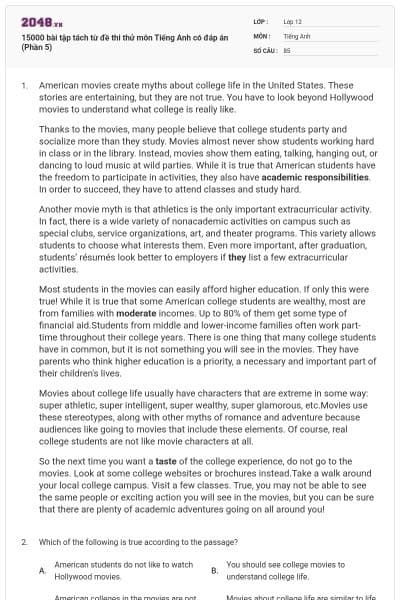
American movies create myths about college life in the United States. These stories are entertaining, but they are not true. You have to look beyond Hollywood movies to understand what college is really like.
Thanks to the movies, many people believe that college students party and socialize more than they study. Movies almost never show students working hard in class or in the library. Instead, movies show them eating, talking, hanging out, or dancing to loud music at wild parties. While it is true that American students have the freedom to participate in activities, they also have academic responsibilities. In order to succeed, they have to attend classes and study hard.
Another movie myth is that athletics is the only important extracurricular activity. In fact, there is a wide variety of nonacademic activities on campus such as special clubs, service organizations, art, and theater programs. This variety allows students to choose what interests them. Even more important, after graduation, students’ résumés look better to employers if they list a few extracurricular activities.
Most students in the movies can easily afford higher education. If only this were true! While it is true that some American college students are wealthy, most are from families with moderate incomes. Up to 80% of them get some type of financial aid.Students from middle and lower-income families often work part-time throughout their college years. There is one thing that many college students have in common, but it is not something you will see in the movies. They have parents who think higher education is a priority, a necessary and important part of their children's lives.
Movies about college life usually have characters that are extreme in some way: super athletic, super intelligent, super wealthy, super glamorous, etc.Movies use these stereotypes, along with other myths of romance and adventure because audiences like going to movies that include these elements. Of course, real college students are not like movie characters at all.
So the next time you want a taste of the college experience, do not go to the movies. Look at some college websites or brochures instead.Take a walk around your local college campus. Visit a few classes. True, you may not be able to see the same people or exciting action you will see in the movies, but you can be sure that there are plenty of academic adventures going on all around you!
Which of the following is true according to the passage?
American students do not like to watch Hollywood movies.
You should see college movies to understand college life.
American colleges in the movies are not like those in reality.
Movies about college life are similar to life and fun to watch.
Đáp án C
Điều nào sau đây là đúng?
A. Sinh viên Mỹ không thích xem phim Hollywood.
B. Bạn nên xem phim đại học để hiểu cuộc sống đại học.
C. Các trường đại học Mỹ trong các bộ phim không giống như những người trong thực tế.
D. Phim về cuộc sống đại học tương tự như cuộc sống và niềm vui để xem.
Which of the following is NOT true?
There is a wide choice of extracurricular activities for college students.
Extracurricular activities are of no importance to employers.
Not all extracurricular activities are students’ academic responsibilities.
Learning is not only part of students’ college life.
Đáp án B
Điều nào sau đây KHÔNG đúng?
A. Có nhiều lựa chọn các hoạt động ngoại khóa cho sinh viên đại học.
B. Các hoạt động ngoại khóa không quan trọng đối với người sử dụng lao động.
C. Không phải tất cả các hoạt động ngoại khóa đều là trách nhiệm học tập của học sinh.
D. Học tập không chỉ là một phần của cuộc sống đại học của học sinh.
The word “they” in the third paragraph refers to ______.
activities
résumés
employers
students
Đáp án B
Từ “they” trong đoạn thứ ba đề cập đến:
A. hoạt động
B. résumés (CV) hồ sơ xin việc
C. nhà tuyển dụng
D. sinh viên
The word “moderate” in the fourth paragraph is closest in meaning to “______”.
not steady
sensible
unlimited
not high
Đáp án D
Từ “moderate” trong đoạn thứ tư gần nghĩa với:
A. không ổn định
B. hợp lý
C. không giới hạn
D. không cao
Which of the following is NOT mentioned in the passage?
Most college students’ families are not well-off.
All college students have to work part-time.
It is important for students to get higher education.
Most students in the movies can afford college expenses.
Đáp án B
Điều nào sau đây KHÔNG được đề cập trong đoạn văn?
A. Hầu hết các gia đình sinh viên đại học đều không tốt.
B. Tất cả sinh viên đại học phải làm việc bán thời gian.
C. Điều quan trọng là học sinh phải học cao hơn.
D. Hầu hết các sinh viên trong các bộ phim có thể đủ khả năng chi phí đại học.
American parents believe in ______.
the necessity of higher education in their children's lives
the quality of their children's college lives
the extracurricular activities that help ensure their children’s jobs
how movie-makers describe American college life
Đáp án A
Cha mẹ người Mỹ tin vào:
A. sự cần thiết của giáo dục đại học trong cuộc sống của trẻ em
B. chất lượng cuộc sống đại học của con em họ10
C. các hoạt động ngoại khóa giúp đảm bảo công việc của con cái họ
D. cách các nhà làm phim mô tả cuộc sống đại học Mỹ
Many American students have to work part-time throughout their college years because ______.
they are not allowed to work full-time
their parents force them to
they can earn money for their expenses
they want to gain experience
Đáp án C
Nhiều sinh viên Mỹ phải làm việc bán thời gian trong suốt năm đại học của họ bởi vì:
A. họ không được phép làm việc toàn thời gian
B. cha mẹ của họ buộc họ phải
C. họ có thể kiếm tiền cho chi phí của họ
D. họ muốn có được kinh nghiệm
Which of the following could best serve as the title of the passage?
Extracurricular Activities and Job Opportunities
American College Life and the Movies
Hollywood Movies: The Best About College Life
Going to College: The Only Way to Succeed in Life
Đáp án B
Điều nào sau đây có thể làm tiêu đề của đoạn văn?
A. Các hoạt động ngoại khóa và cơ hội việc làm
B. Cuộc sống đại học Mỹ và phim ảnh
C. Phim Hollywood: điều tuyệt nhất về cuộc sống đại học
D. Đi học đại học: Con đường duy nhất để thành công trong cuộc sống
Paul Watson is an environmental activist. He is a man who believes that he must do something, not just talk about doing something. Paul believes in protecting endangered animals, and he protects them in controversial ways. Some people think that Watson is a hero and admire him very much. Other people think that he is a criminal.
On July 16th, 1979, Paul Watson and his crew were on his ship, which is called the Sea Shepherd. Watson and the people who work on the Sea Shepherd were hunting on the Atlantic Ocean near Portugal. However, they had a strange prey; instead of hunting for animals, their prey was a ship, the Sierra. The Sea Shepherd found the Sierra, ran into it and sank it. As a result, the Sierra never returned to the sea. The Sea Shepherd, on the other hand, returned to its home in Canada. Paul Watson and his workers thought that they had been successful.
The Sierra had been a whaling ship, which had operated illegally. The captain and crew of the Sierra did not obey any of the international laws that restrict whaling. Instead, they killed as many whales as they could, quickly cut off the meat, and froze it. Later, they sold the whale meat in countries where it is eaten.
Paul Watson tried to persuade the international whaling commission to stop the Sierra. However, the commission did very little, and Paul became impatient. He decided to stop the Sierra and other whaling ships in any way that he could. He offered to pay $25,000 to anyone who sank any illegal whaling ship, and he sank the Sierra. He acted because he believes that the whales must be protected. Still, he acted without the approval of the government; therefore, his actions were controversial.
Paul Watson is not the only environmental activist. Other men and women are also fighting to protect the Earth. Like Watson, they do not always have the approval of their governments, and like Watson, they have become impatient. Yet, because of their concern for the environment, they will act to protect it.
(Adapted from “Eco fighters” by Eric Schwartz, OMNI)
According to the reading, an environmental activist is someone who_______.
runs into whaling ship.
does something to protect the Earth.
talks about protecting endangered species.
is a hero, like Paul Watson.
Đáp án B
Một nhà hoạt động môi trường là người:
A. chạy vào tàu cá voi.
B. làm điều gì đó để bảo vệ trái đất.
C. nói về việc bảo vệ các loài đang bị đe dọa.
D. là một anh hùng, giống như Paul Watson.
When something is “controversial”, __________.
everyone agrees with it.
everyone disagrees with it.
people have different ideas about it.
people protect it.
Đáp án C
Khi một cái gì đó "gây tranh cãi":
A. tất cả mọi người đồng ý với nó.
B. mọi người không đồng ý với nó.
C. mọi người có những ý tưởng khác nhau về nó.
D. người bảo vệ nó.
The main idea of paragraph one is that __________.
Paul Watson is a hero to some people.
activists are people who do something.
Paul Watson is a controversial environmental activist.
Paul Watson does not believe in talking.
Đáp án C
Khi một cái gì đó "gây tranh cãi":
A. tất cả mọi người đồng ý với nó.
B. mọi người không đồng ý với nó.
C. mọi người có những ý tưởng khác nhau về nó.
D. người bảo vệ nó.
The Sea Shepherd was hunting ______.
the Atlantic Ocean
whales
the Sierra
Portugal
Đáp án C
Ý tưởng chính của đoạn một là:
A. Paul Watson là một anh hùng đối với một số người.
B. các nhà hoạt động là những người làm điều gì đó.
C. Paul Watson là một nhà hoạt động môi trường gây tranh cãi.
D. Paul Watson không tin vào việc nói chuyện.
The author implies that Paul Watson lives in ______.
Portugal
a ship on the Atlantic
the Sierra
Canada
Đáp án D
Sea Shepherd đang tìm kiếm:
A. Đại Tây Dương
B. cá voi
C. Sierra
D. Bồ Đào Nha
In paragraph 3, the phrase “and froze it” refers to ______.
whale meat
the Sierra
whales
the Sierra crew
Đáp án A
Tác giả cho rằng Paul Watson sống trong:
A. Bồ Đào Nha
B. một con tàu trên Đại Tây Dương
C. Sierra
D. Canada
The main idea of paragraph three is that _______.
the Sierra sold whale meat in some countries.
the people on the Sierra did not obey international laws.
the people on the Sierra killed as many whales as they could.
whaling is illegal according to international law.
Đáp án B
Trong đoạn 3, cụm từ “and froze it” đề cập đến:
A. thịt cá voi
B. Sierra
C. cá voi
D. phi hành đoàn Sierra
The ocean bottom - a region nearly 2.5 times greater than the total land area of Earth - is a vast frontier that even today is largely unexplored and uncharted. Until about a century ago, the deep-ocean floor was completely inaccessible, hidden beneath waters averaging over 3,600 meters deep. Totally without light and subjected to intense pressures hundreds of times greater than at the Earth’s surface, the deep-ocean bottom is a hostile environment to humans, in some ways as forbidding and remote as the void of outer space.
Although researchers have taken samples of deep-ocean rocks and sediments for over a century, the first detailed global investigation of the ocean bottom did not actually start until 1968, with the beginning of the National Science Foundation’s Deep Sea Drilling Project (DSDP). Using techniques first developed for the offshore oil and gas industry, the DSDP’s drill ship, the Glomar Challenger, was able to maintain a steady position on the ocean’s surface and drill in very deep waters, extracting samples of sediments and rock from the ocean floor.
The Glomar Challenger completed 96 voyages in a 15-year research program that ended in November 1983. During this time, the vessel logged 600,000 kilometers and took almost 20,000 core samples of seabed sediments and rocks at 624 drilling sites around the world.. The Glomar Challenger’s core samples have allowed geologists to reconstruct what the planet looked like hundreds of millions of years ago and to calculate what it will probably look like millions of years in the future. Today, largely on the strength of evidence gathered during the Glomar Challenger’s voyages, nearly all earth scientists agree on the theories of plate tectonics and continental drift that explain many of the geological processes that shape the Earth.
The cores of sediment drilled by the Glomar Challenger have also yielded information critical to understanding the world’s past climates. Deep-ocean sediments provide a climatic record stretching back hundreds of millions of years, because they are largely isolated from the mechanical erosion and the intense chemical and biological activity that rapidly destroy much land-based evidence of past climates. This record has already provided insights into the patterns and causes of past climatic change - information that may be used to predict future climates.
The author refers to the ocean bottom as a “frontier” because it _______
is not a popular area for scientific research
contains a wide variety of life forms
attracts courageous explorers
is an unknown territory
Đáp án D
Tác giả đề cập đến đáy đại dương như là một "biên giới" bởi vì nó:
A. không phải là một lĩnh vực phổ biến cho nghiên cứu khoa học
B. chứa nhiều dạng sống khác nhau
C. thu hút những người khám phá dũng cảm
D. là một lãnh thổ không xác định
The word “inaccessible” is closest in meaning to _______.
unrecognizable
unreachable
unusable
unsafe
Đáp án B
Từ " inaccessible" gần nghĩa với:
A. không thể nhận ra
B. không thể truy cập
C. không sử dụng được
D. không an toàn
The author mentions “outer space” because _______.
the Earth’s climate millions of years ago was similar to conditions in outer space.
it is similar to the ocean floor in being alien to the human environment.
rock formations in outer space are similar to those found on the ocean floor.
techniques used by scientists to explore outer space were similar to those used in ocean exploration.
Đáp án B
Tác giả đề cập đến "không gian bên ngoài" vì:
A. khí hậu của Trái đất hàng triệu năm trước cũng tương tự như điều kiện trong không gian bên ngoài.
B. nó tương tự như đáy đại dương trong môi trường người ngoài hành tinh.
C. hình thành đá trong không gian bên ngoài là tương tự như những người được tìm thấy trên đáy đại dương.
D. các kỹ thuật được các nhà khoa học sử dụng để khám phá không gian bên ngoài giống với các kỹ thuật được sử dụng trong thăm dò đại dương.
Which of the following is true of the Glomar Challenger?
It is a type of submarine.
It is an ongoing project.
It has gone on over 100 voyages.
It made its first DSDP voyage in 1968.
Đáp án D
Điều nào sau đây đúng với Glomar Challenger?
A. Nó là một loại tàu ngầm.
B. Đó là một dự án đang diễn ra.
C. Nó đã đi hơn 100 chuyến đi.
D. Nó thực hiện chuyến đi DSDP đầu tiên vào năm 1968.
The Deep Sea Drilling Project was significant because it was ______.
an attempt to find new sources of oil and gas
the first extensive exploration of the ocean bottom
composed of geologists from all over the world
funded entirely by the gas and oil industry
Đáp án B
Dự án khoan biển sâu rất quan trọng vì đó là:
A. một nỗ lực để tìm nguồn dầu khí mới
B. thăm dò mở rộng đầu tiên của đáy đại dương
C. bao gồm các nhà địa chất từ khắp nơi trên thế giới
D. được tài trợ hoàn toàn bởi ngành công nghiệp dầu khí
The word “they” refers _______.
years
climates
sediments
cores
Đáp án C
Từ "they" đề cập đến:
A. năm
B. khí hậu
C. trầm tích
D. lõi
Which of the following is NOT mentioned in the passage as being a result of the Deep Sea Drilling Project?
Geologists were able to determine the Earth’s appearance hundreds of millions of years ago
Two geological theories became more widely accepted by scientists.
Information was revealed about the Earth’s past climatic changes.
Geologists observed forms of marine life never before seen.
Đáp án D
Điều nào sau đây KHÔNG được đề cập trong đoạn văn như là kết quả của dự án khoan biển sâu?
A. Các nhà địa chất đã có thể xác định sự xuất hiện của Trái Đất hàng trăm triệu năm trước.
B. Hai lý thuyết địa chất trở nên được các nhà khoa học chấp nhận rộng rãi hơn.
C. Thông tin đã được tiết lộ về những thay đổi khí hậu trong quá khứ của Trái Đất.
D. Các nhà địa chất quan sát các dạng sinh vật biển chưa từng thấy trước đây.
How long did the Glomar Challenger conduct its research?
3 years
5 years
15 years
16 years
Đáp án C
Glomar Challenger đã tiến hành nghiên cứu của mình trong bao lâu?
A. 3 năm
B. 5 năm
C. 15 năm
D. 16 năm
It is hard to get any agreement on the precise meaning of the term "social class". In everyday life, people tend to have a different approach to those they consider their equals from which they assume with people they consider higher or lower than themselves in social scale. The criteria we use to 'place' a new acquaintance, however, are a complex mixture of factors. Dress, way of speaking, area of residence in a given city or province, education and manners all play a part.
In ancient civilizations, the Sumerian, for example, which flourished in the lower Euphrates valley from 2000 to 5000 B.C.social differences were based on birth, status or rank, rather than on wealth. Four main classes were recognized.These were the rulers, the priestly administrators, the freemen (such as craftsmen, merchants or farmers) and the slaves.
In Greece, after the sixth-century B.C., there was a growing conflict between the peasants and the aristocrats, and a gradual decrease in the power of the aristocracy when a kind of ‘middle class’ of traders and skilled workers grew up. The population of Athens, for example, was divided into three main classes which were politically and legally distinct. About one-third of the total population was slaves, who did not count politically at all, a fact often forgotten by those who praise Athens as the nursery of democracy. The next main group consisted of resident foreigners, the, ‘metics’ who were freemen, though they too were allowed no share in political life. The third group was the powerful body of ‘citizens”, who were themselves divided into sub-classes.
In the later Middle Ages, however, the development of a money economy and the growth of cities and trade led to the rise of another class, the ‘burghers’ or city merchants and mayors. These were the predecessors of the modern middle classes. Gradually high office and occupation assumed importance in determining social position, as it became more and more possible for a person born to one station in life to move to another. This change affected the towns more than the country areas, where remnants of feudalism lasted much longer.
According to the passage, we evaluate other people's social position by ________ .
questioning them in great details
their dress, manners, area of residence and other factors
finding out how much their salary is
the kind of job they do
Đáp án B
Chúng tôi đánh giá vị trí xã hội của người khác bằng cách:
The criteria we use to 'place' a new acquaintance, however, are a complex mixture of factors. Dress, way of speaking, area of residence in a given city or province, education and manners all play a part.
A. hỏi họ những chi tiết tuyệt vời
B. trang phục, cách cư xử, khu vực cư trú và các yếu tố khác
C. tìm ra mức lương của họ là bao nhiêu
D. loại công việc họ làm
The word "criteria" in the first paragraph is closest in meaning to ________ .
characteristics
words
standards of judgment
criticisms
Đáp án C
Từ " criteria " trong đoạn đầu tiên có ý nghĩa gần nghĩa với:
A. đặc điểm
B. từ
C. tiêu chuẩn phán xét
D. phê bình
The word “which” in the paragraph 2 refers to ______.
ancient civilizations
Sumerian
example
Euphrates valley
Đáp án B
Từ “which” trong đoạn 2 đề cập đến:
A. nền văn minh cổ đại
B. Sumerian
C. ví dụ
D. Euphrates valley
The decline of the Greek aristocracy's power in the sixth century B.C ________ .
caused international conflicts in the area
coincided with the rise of a new "middle class" of traders and peasants
lasted for only a short time
lasted for only a short time
Đáp án B
Sự suy giảm quyền lực quý tộc Hy Lạp trong thế kỷ thứ sáu trước Công Nguyên:
In Greece, after the sixth-century B.C., there was a growing conflict between the peasants and
the aristocrats, and a gradual decrease in the power of the aristocracy when a kind of ‘middle
class’ of traders and skilled workers grew up.
A. gây ra xung đột quốc tế trong khu vực
B. trùng hợp với sự nổi lên của một "tầng lớp trung lưu" mới của các thương lái và nông dân
C. được hỗ trợ bởi sự gia tăng số lượng nô lệ
D. chỉ kéo dài trong một thời gian ngắn
Athens is often praised as the nursery of democracy ________.
even though slaves were allowed to vote
because its three main classes were politically and legally distinct.
in spite of its heavy dependence on slave labor
because even very young children could vote
Đáp án B
Athens thường được ca ngợi là vườn ươm của nền dân chủ ________.
The population of Athens, for example, was divided into three main classes which were
politically and legally distinct. About one-third of the total population was slaves, who did not count politically at all, a fact often forgotten by those who praise Athens as the nursery of democracy.
A. mặc dù nô lệ được phép bỏ phiếu
B. bởi vì ba lớp chính của nó có sự khác biệt về mặt chính trị và pháp lý.
C. mặc dù phụ thuộc nặng nề vào lao động nô lệ
D. bởi vì ngay cả trẻ nhỏ cũng có thể bầu cử
The word "predecessors" in the last paragraph is closest in meaning to ________.
supporters
descendants
ancestors
authorities
Đáp án C
Từ " predecessors " trong đoạn cuối cùng có ý nghĩa gần nhất với ________.
A. người ủng hộ
B. con cháu
C. tổ tiên
D. cơ quan chức năng
The passage is mainly about ________.
the human history
the modern society
the division of social classes in the ancient world
the social life in ancient Greece
Đáp án C
Chủ đề chính của đoạn văn là:
A. lịch sử nhân loại
B. xã hội hiện đại
C. sự phân chia các tầng lớp xã hội trong thế giới cổ đại
D. đời sống xã hội ở Hy Lạp cổ đại
The National Automobile Show in New York has been one of the top auto shows in the United States since 1900. On November 3 of that year, about 8,000 people looked over the “horseless carriages.” It was the opening day and the first opportunity for the automobile industry to show off its wares to a large crowd; however, the black-tie audience treated the occasion more as a social affair than as a sales extravaganza. It was also on the first day of this show that William McKinley became the first U.S. president to ride in a car.
The automobile was not invented in the United States. That distinction belongs to Germany. Nicolaus Otto built the first practical internal-combustion engine there in 1876. Then, German engineer Karl Benz built what are regarded as the first modern automobiles in the mid-1880s. But the United States pioneered the merchandising of the automobile. The auto show proved to be an effective means of getting the public excited about automotive products.
By happenstance, the number of people at the first New York show equaled the entire car population of the United States at that time. In 1900, 10 million bicycles and an unknown number of horse-drawn carriages provided the prime means of personal transportation. Only about 4,000 cars were assembled in the United States in 1900, and only a quarter of those were gasoline powered.The rest ran on steam or electricity.
After viewing the cars made by forty car makers, the show’s audience favored electric cars because they were quiet. The risk of a boiler explosion turned people away from steamers, and the gasoline-powered cars produced smelly fumes. The Duryea Motor Wagon Company, which launched the American auto industry in 1895, offered a fragrant additive designed to mask the smells of the naphtha that it burned.Many of the 1900 models were cumbersome—the Gasmobile, the Franklin, and the Orient, for example, steered with a tiller like a boat instead of with a steering wheel. None of them was equipped with an automatic starter.
These early model cars were practically handmade and were not very dependable. They were basically toys of the well-to-do. In fact, Woodrow Wilson, then a professor at Princeton University and later President of the United States, predicted that automobiles would cause conflict between the wealthy and the poor. However, among the exhibitors at the 1900 show was a young engineer named Henry Ford.But before the end of the decade, he would revolutionize the automobile industry with his Model T Ford.The Model T, first produced in 1909, featured a standardized design and a streamlined method of production—the assembly line. Its lower costs made it available to the mass market.
Cars at the 1900 show ranged in price from $1,000 to $1,500, or roughly $14,000 to $21,000 in today’s prices. By 1913, the Model T was selling for less than $300, and soon the price would drop even further. “I will build cars for the multitudes,” Ford said, and he kept his promise.
The passage implies that the audience viewed the 1900 National Automobile Show
primarily as a(n) ______
formal social occasion.
chance to buy automobiles at low prices
opportunity to learn how to drive
chance to invest in one of thirty-two automobile manufacturers
Đáp án A
Đoạn văn cho rằng khán giả đã xem Triển lãm ô tô quốc gia 1900 chủ yếu là một:
carriages.” It was the opening day and the first opportunity for the automobile industry to show off its wares to a large crowd; however, the black-tie audience treated the occasion more as a social affair than as a sales extravaganza.
A. buổi lễ trang trọng mang tính chất xã hội
B. cơ hội mua ô tô với giá thấp
C. cơ hội học cách lái xe
D. cơ hội đầu tư vào một trong ba mươi hai nhà sản xuất ô tô
According to the passage, who developed the first modern car?
Karl Benz
Nikolaus Otto
William McKinley
Henry Ford
Đáp án A
Người đã phát triển chiếc xe hiện đại đầu tiên?
Karl Benz built what are regarded as the first modern automobiles in the mid-1880s
A. Karl Benz
B. Nikolaus Otto
C. William McKinley
D. Henry Ford
Approximately how many cars were there in the United States in 1900?
4,000
8,000
10 million
An unknown number
Đáp án A
Có khoảng bao nhiêu chiếc xe ở Hoa Kỳ vào năm 1900?
Only about 4,000 cars were assembled in the United States in 1900,
A. 4,000
B. 8.000
C. 10 triệu
D. Một số không xác định
The phrase “by happenstance” in paragraph 3 is closest in meaning to________.
Generally
For example
Coincidentally
By design
Đáp án C
Cụm từ “by happenstance” trong đoạn 3 gần nghĩa với:
A. Nói chung
B. Ví dụ
C. Thật trùng hợp
D. Theo thiết kế
The word “they” in the paragraph 2 refers to ________.
car makers
model cars
audience
electric cars
Đáp án D
Từ “họ” trong đoạn 2 đề cập đến ________.
A. nhà sản xuất ô tô
B. mẫu xe ô tô
C. đối tượng
D. xe điện
Approximately how many of the cars assembled in the year 1900 were gasoline powered?
32
1,000
2,000
4,000
Đáp án B
Khoảng bao nhiêu chiếc xe lắp ráp trong năm 1900 chạy bằng xăng?
Only about 4,000 cars were assembled in the United States in 1900, and only a quarter of those were gasoline powered.
Which of the following is NOT mentioned in the passage as steering with a tiller rather than with a steering wheel?
A Franklin
A Gasmobile
An Orient
A Duryea
Đáp án D
Điều nào sau đây KHÔNG được đề cập trong đoạn văn như một bánh lái thay vì với một tay lái?
Many of the 1900 models were cumbersome - the Gasmobile, the Franklin, and the Orient, for example, steered with a tiller like a boat instead of with a steering wheel.
What was the highest price asked for a car at the 1900 National Automobile Show in the dollars of that time?
$300
$1,500
$14,000
$21,000
Đáp án B
Giá cao nhất được yêu cầu cho một chiếc xe tại Triển lãm ô tô quốc gia 1900 là gì?
bằng đô la của thời gian đó?
Cars at the 1900 show ranged in price from $1,000 to $1,500
The principle of use and disuse states that those parts of organisms’ bodies that are used grow larger. Those parts that are not tend to wither away. It is an observed fact that when you exercise particular muscles, they grow. Those that are never used diminish. By examining a man’s body, we can tell which muscles he uses and which he does not. We may even be able to guess his profession or his recreation. Enthusiasts of the ‘body-building’ cult make use of the principle of use and disuse to ‘build’ their bodies, almost like a piece of sculpture, into whatever unnatural shape is demanded by fashion in this peculiar minority culture. Muscles are not the only parts of the body that respond to use in this kind of way. Walk barefoot and you acquire harder skin on your soles. It is easy to tell a farmer from a bank teller by looking at their hands alone. The farmer’s hands are horny, hardened by long exposure to rough work. The teller’s hands are relatively soft.
The principle of use and disuse enables animals to become better at the job of surviving in their world, progressively better during their lifetime as a result of living in that world.Humans, through direct exposure to sunlight, or lack of it, develop a skin color which equips them better to survive in the particular local conditions. Too much sunlight is dangerous. Enthusiastic sunbathers with very fair skins are susceptible to skin cancer. Too little sunlight, on the other hand, leads to vitamin-D deficiency. The brown pigment melanin which is synthesized under the influence of sunlight, makes a screen to protect the underlying tissues from the harmful effects of further sunlight. If a suntanned person moves to a less sunny climate, the melanin disappears, and the body is able to benefit from what little sun there is. This can be represented as an instance of the principle of use and disuse: skin goes brown when it is “used’, and fades to white when it is not.
What does the passage mainly discuss?
How the principles of use and disuse change people’s concepts of themselves.
The way in which people change themselves to conform to fashion
The changes that occur according to the principle of use and disuse.
The effects of the sun on the principle of use and disuse
Đáp án C
Đoạn văn chủ yếu thảo luận là gì?
A. Cách các nguyên tắc sử dụng và không sử dụng đã thay đổi các khái niệm của con người về bản thân họ.
B. Cách thức mà mọi người thay đổi chính mình để phù hợp với thời trang
C. Những thay đổi xảy ra theo nguyên tắc sử dụng và không sử dụng.
D. Những ảnh hưởng của mặt trời với nguyên tắc sử dụng và không sử dụng
The word ‘Those’ in line 3 refers to _____.
organisms
bodies
parts
muscles
Đáp án D
Từ ‘those’ trong dòng 3 đề cập đến _____.
A. sinh vật
B. thi thể
C. bộ phận
D. cơ bắp
According to the passage, men who body build_____.
appear like sculptures
change their appearance
belong to strange cults
are very fashionable
Đáp án D
Người đàn ông có rèn luyện cơ thể:
Enthusiasts of the ‘body-building’ cult make use of the principle of use and disuse to ‘build’ their bodies, almost like a piece of sculpture, into whatever unnatural shape is demanded by fashion in this peculiar minority culture.
A. xuất hiện như tác phẩm điêu khắc
B. thay đổi diện mạo của họ
C. thuộc về giáo phái kỳ lạ
D. rất thời trang
From the passage, it can be inferred that the author views body building _____.
with enthusiasm
as an artistic form
with scientific interest
of doubtful benefit
Đáp án C
Từ đoạn văn, có thể suy ra rằng tác giả xem việc rèn luyện cơ thể:
A. với sự nhiệt tình
B. như một hình thức nghệ thuật
C. với sự quan tâm khoa học
D. với lợi ích đáng ngờ
It can be inferred from the passage that the principle of use and disuse enables organisms to _____.
change their existence
automatically benefit
better survive in their conditions
improve their lifetime
Đáp án C
Nguyên tắc sử dụng và loại bỏ có thể khiến sinh vật:
A. thay đổi sự tồn tại của chúng
B. hưởng lợi một cách tự động
C. tồn tại tốt hơn trong điều kiện của chúng
D. cải thiện tuổi thọ của chúng
The author suggests that melanin _____.
is necessary for the production of vitamin-D
is beneficial in sunless climates.
helps protect fair-skinned people
is a synthetic product
Đáp án D
Tác giả gợi ý rằng melanin _____.
The brown pigment melanin which is synthesized under the influence of sunlight, makes a screen to protect the underlying tissues from the harmful effects of further sunlight.
A. là cần thiết cho việc sản xuất vitamin-D
B. có lợi ở vùng khí hậu không có nắng.
C. giúp bảo vệ người da trắng
D. là một sản phẩm tổng hợp
The word ‘susceptible’ could be best replaced by _____.
condemned
vulnerable
allergic
suggestible
Đáp án B
Từ 'susceptible' có thể được thay thế bằng:
A. lên án
B. dễ bị tổn thương
C. dị ứng
D. gợi ý
MOBILE PHONES: ARE THEY ABOUT TO TRANSFORM OUR LIVES?
We love them so much that some of us sleep with them under the pillow, yet we are increasingly concerned that we cannot escape their electronic reach. We use them to convey our most intimate secrets, yet we worry that they are a threat to our privacy. We rely on them more than the Internet to cope with modern life, yet many of us don’t believe advertisements saying we need more advanced services.Sweeping aside the doubts that many people feel about the benefits of new third generation phones and fears over the health effects of phone masts, a recent report claims that the long-term effects of new mobile technologies will be entirely positive so long as the public can be convinced to make use of them. Research about users of mobile phones reveals that the mobile has already moved beyond being a mere practical communications tool to become the backbone of modern social life, from love affairs to friendship to work.
The close relationship between user and phone is most pronounced among teenagers, the report says, who regard their mobiles as an expression of their identity. This is partly because mobiles are seen as being beyond the control of parents. But the researchers suggest that another reason may be that mobiles, especially text messaging, were seen as a way of overcoming shyness. The impact of phones, however, has been local rather than global, supporting existing friendship and networks, rather than opening users to a new broader community. Even the language of texting in one area can be incomprehensible to anybody from another area.
Among the most important benefits of using mobile phones, the report claims, will be a vastly improved mobile infrastructure, providing gains throughout the economy, and the provision of a more sophisticated location-based services for users. The report calls on government to put more effort into the delivery of services by mobile phone, with suggestion including public transport and traffic information and doctors’ text messages to remind patients of appointments. There are many possibilities. At a recent trade fair in Sweden, a mobile navigation product was launched.When the user enters a destination, a route is automatically downloaded to their mobile and presented by voices, pictures and maps as they drive. In future, these devices will also be able to plan around congestion and road works in real time. Third generation phones will also allow for remote monitoring of patients by doctors. In Britain, scientists are developing an asthma management solution using mobiles to detect early signs of an attack.
Mobile phones can be used in education. A group of teachers in Britain use third generation phones to provide fast internet service to children who live beyond the reach of terrestrial broadband services and can have no access to online information. ‘As the new generation of mobile technologies takes off, the social potential will vastly increase,’ the report argues.
What does the writer suggest in the first paragraph about our attitudes to mobile phones?
We are worried about using them so much
We have contradictory feelings about them
We need them more than anything else to deal with modern life.
We cannot live without them
Đáp án A
Nhà văn đề xuất gì trong đoạn đầu tiên về thái độ của chúng tôi đối với thiết bị di động
điện thoại?
A. Chúng tôi đang lo lắng về việc sử dụng chúng rất nhiều
B. Chúng tôi có những cảm xúc mâu thuẫn với họ
C. Chúng ta cần chúng hơn bất cứ thứ gì khác để đối phó với cuộc sống hiện đại.
D. Chúng ta không thể sống thiếu chúng
What does “them” in paragraph 2 refer to?
new mobile technologies
benefits
doubts
long-term effects
Đáp án A
“Chúng” trong đoạn 2 đề cập đến điều gì?
A. công nghệ di động mới
B. lợi ích
C. nghi ngờ
D. hiệu ứng lâu dài
What is the connection between social life and mobile phones?
Mobile phones make romantic communication easier.
Mobile phones enable people to communicate while moving around.
Modern social life relies significantly on the use of mobile phones.
Mobile phones encourage people to make friends.
Đáp án A
Mối liên hệ giữa đời sống xã hội và điện thoại di động là gì?
Research about users of mobile phones reveals that the mobile has already moved beyond
being a mere practical communications tool to become the backbone of modern social life, from love affairs to friendship to work.
A. Điện thoại di động làm cho giao tiếp lãng mạn dễ dàng hơn.
B. Điện thoại di động cho phép mọi người giao tiếp trong khi di chuyển.
C. Đời sống xã hội hiện đại phụ thuộc đáng kể vào việc sử dụng điện thoại di động.
D. Điện thoại di động khuyến khích mọi người kết bạn.
Why do teenagers have such a close relationship with their mobile phones?
They are more inclined to be late than older people
They feel independent when they use them.
They tend to feel uncomfortable in many situations.
They use text messages more than any other group
Đáp án B
Tại sao thanh thiếu niên có mối quan hệ gần gũi với điện thoại di động của họ?
The close relationship between user and phone is most pronounced among teenagers, the report says, who regard their mobiles as an expression of their identity. This is partly because mobiles are seen as being beyond the control of parents.
A. Họ có khuynh hướng muộn hơn người già
B. Họ cảm thấy độc lập khi họ sử dụng chúng.
C. Họ có xu hướng cảm thấy khó chịu trong nhiều tình huống.
D. Họ sử dụng tin nhắn văn bản nhiều hơn bất kỳ nhóm nào khác
Which of the following is NOT true?
People can overcome shyness by using texting to communicate things that make them uncomfortable
There is no need to suspect the harmfulness of mobile phones
Mobile phone is considered as a means for the youth to show their characters
Mobile phones are playing a wide range of roles in people’s life
Đáp án C
Điều nào sau đây KHÔNG đúng?
A. Mọi người có thể vượt qua sự nhút nhát bằng cách sử dụng nhắn tin để truyền đạt những điều khiến họ không thoải mái
B. Không cần phải nghi ngờ tính độc hại của điện thoại di động
C. Điện thoại di động được coi là phương tiện để giới trẻ thể hiện tính cách của mình
D. Điện thoại di động đang đóng một loạt vai trò trong cuộc sống của mọi người
In what sense has the impact of phones been “local” in paragraph 3?
People tend to communicate with people they already know.
Users generally phone people who live in the same neighbourhood.
It depends on local dialects.
The phone networks use different systems.
Đáp án A
Theo nghĩa nào thì tác động của điện thoại là “cục bộ” trong đoạn 3?
The impact of phones, however, has been local rather than global, supporting existing friendship and networks, rather than opening users to a new broader community.
A. Mọi người có xu hướng giao tiếp với những người mà họ đã biết.
B. Người dùng thường gọi điện cho những người sống trong cùng một khu phố.
C. Nó phụ thuộc vào phương ngữ địa phương.
D. Các mạng điện thoại sử dụng các hệ thống khác nhau.
The navigation product launched in Sweden is helpful for drivers because ______.
it shows them how to avoid road works
it can suggest the best way to get to a place
it tells them which roads are congested
it provides directions orally
Đáp án B
Sản phẩm điều hướng được khởi chạy ở Thụy Điển rất hữu ích cho người lái xe vì ______.
At a recent trade fair in Sweden, a mobile navigation product was launched. When the user enters a destination, a route is automatically downloaded to their mobile and presented by voices, pictures and maps as they drive.
A. nó cho họ thấy cách tránh các công trình đường
B. nó có thể gợi ý cách tốt nhất để đến một nơi
C. nó cho họ biết đường nào bị tắc nghẽn
D. nó cung cấp hướng dẫn bằng miệng
Where is this passage most likely to appear?
fashion magazine
school bulletin
technical magazine
advertising section
Đáp án B
Đoạn văn này có khả năng xuất hiện ở đâu?
A. tạp chí thời trang
B. bản tin trường học
C. tạp chí kỹ thuật
D. phần quảng cáo
Ranked as the number one beverage consumed worldwide, tea takes the lead over coffee in both popularity and production with more than 5 million tons of tea produced annually. Although much of this tea is consumed in Asian, European and African countries, the United States drinks its fair share. According to estimates by the Tea Council of the United States, tea is enjoyed by no less than half of the U.S. population on any given day. Black tea or green tea - iced, spiced, or instant - tea drinking has spurred a billion-dollar business with major tea producers in Africa and South America and throughout Asia.
Tea is made from the leaves of an evergreen plant, Camellia sinensis, which grows tall and lush in tropical regions. On tea plantations, the plant is kept trimmed to approximately four feet high and as new buds called flush appear, they are plucked off by hand. Even in today’s world of modern agricultural machinery, hand harvesting continues to be the preferred method. Ideally, only the top two leaves and a bud should be pickeb. This new growth produces the highest quality tea.
After being harvested, tea leaves are laid out on long drying racks, called withering racks, for 18 to 20 hours. Next, depending on the type of tea being produced, the leaves may be crushed or chopped to release flavor, and then fermented under controlled conditions of heat and humidity. For green tea, the whole leaves are often steamed to retain their green color, and the fermentation process is skipped. Producing black teas requires fermentation during which the tea leaves begin to darken. After fermentation, black tea is dried in vats to produce its rich brown or black color.
No one knows when or how tea became popular, but legend has it that tea as a beverage, was discovered in 2737 B. C. by Emperor Shen Nung of China when leaves from a Camellia dropped into his drinking water as it was boiling over a fire. As the story goes, Emperor Shen Nung drank the resulting liquid and proclaimed the drink to be most nourishing and refreshing. Though this account cannot be documented, it is thought that tea drinking probably originated in China and spread to other parts of Asia, then to Europe, and ultimately to America colonies around 1650.
With about half the caffeine content as coffee, tea is often chosen by those who want to reduce, but not necessarily eliminate their caffeine intake. Some people find that tea is less acidic than coffee and therefore easier on the stomach. Others have become interested in tea drinking since the National Cancer Institute published its findings on the antioxidant properties of tea. But whether tea is enjoyed for its perceived health benefits, its flavor, or as a social drink, teacups continue to be filled daily with the world’s most popular beverage.
Why does the author include statistics on the amount of tea produced, sold and consumed?
To show the expense of processing such a large quantity of tea.
To explain why coffee is not the most popular beverage worldwide
To demonstrate tea’s popularity.
To impress the reader with factual sounding information.
Đáp án C
Tại sao tác giả đã viết số liệu thống kê về lượng trà được sản xuất, bán và tiêu thụ?
A. Để thể hiện chi phí chế biến một lượng lớn trà như vậy.
B. Để giải thích tại sao cà phê không phải là thức uống phổ biến nhất trên toàn thế giới
C. Để chứng minh sự nổi tiếng của trà.
D. Để gây ấn tượng với người đọc với thông tin âm thanh thực tế
Based on the passage, what is implied about tea harvesting?
It is totally done with the assistance of modern agricultural machinery
It is no longer done in China
The method has remained nearly the same for a long time
The method involves trimming the uppermost branches of the plant
Đáp án C
Điều gì được nói tới về việc thu hoạch chè?
Even in today’s world of modern agricultural machinery, hand harvesting continues to be the preferred method.
A. Nó hoàn toàn được thực hiện với sự hỗ trợ của máy móc nông nghiệp hiện đại
B. Nó không còn được thực hiện ở Trung Quốc
C. Phương pháp này vẫn gần như giống nhau trong một thời gian dài
D. Phương pháp này bao gồm cắt tỉa các nhánh trên cùng của cây
What does the word “they” in paragraph 2 of the passage refer to?
Tea pickers
New buds
Evergreen plants
Tropical regions
Đáp án B
Chữ “they” trong đoạn 2 của đoạn văn nói đến điều gì?
A. Người hái chè
B. Nụ mới
C. Cây thường xanh
D. Vùng nhiệt đới
According to the passage, what is true about the origin of tea drinking?
It began during the Shen Nung dynasty
It may have begun sometime around 1650
It is unknown when tea first became popular
It was originally produced from Camellia plants in Europe
Đáp án A
Điều gì là đúng về nguồn gốc của uống trà?
No one knows when or how tea became popular, but legend has it that tea as a beverage, was
discovered in 2737 B. C. by Emperor Shen Nung of China when leaves from a Camellia
dropped into his drinking water as it was boiling over a fire.
A. Nó bắt đầu trong triều đại Shen Nung
B. Nó có thể đã bắt đầu vào khoảng năm 1650
C. Đó là chưa biết khi trà đầu tiên trở nên phổ biến
D. Nó ban đầu được sản xuất từ cây Camellia ở châu Âu
The word “eliminate” in paragraph 5 could be best replaced by which of the
following word?
decrease
increase
reduce
remove
Đáp án D
Từ "eliminate" trong đoạn 5 có thể được thay thế tốt nhất bằng từ
từ sau đây?
According to the passage, which may be the reason why someone would choose to drink tea instead of coffee?
A. Because it’s easier to digest than coffee
B. Because it has a higher nutritional content than coffee
C. Because it helps prevent cancer
D. Because it has more caffeine than coffee
Because it’s easier to digest than coffee
Because it has a higher nutritional content than coffee
Because it helps prevent cancer
Because it has more caffeine than coffee
Đáp án A
Điều gì có thể là lý do tại sao một người nào đó sẽ chọn uống trà thay vì cà phê?
Some people find that tea is less acidic than coffee and therefore easier on the stomach.
A. Bởi vì dễ tiêu hóa hơn cà phê
B. Bởi vì nó có hàm lượng dinh dưỡng cao hơn cà phê
C. Vì nó giúp ngăn ngừa ung thư
D. Vì nó có nhiều caffeine hơn cà phê
What best describes the topic of this passage?
Tea consumption and production
The two most popular types of tea
The benefits of tea consumption worldwide
How tea is produced and brewed
Đáp án A
Điều gì mô tả đúng nhất chủ đề của đoạn văn này?
A. Tiêu thụ và sản xuất chè
B. Hai loại trà phổ biến nhất
C. Lợi ích của việc tiêu thụ trà trên toàn thế giới
D. Làm thế nào trà được sản xuất và ủ
In the last third of the nineteenth century a new housing form was quietly being developed. In 1869 the Stuyvesant, considered New York’s first apartment house, was built on East Eighteenth Street. The building was financed by the developer Rutherfurd Stuyvesant and designed by Richard Morris Hunt, the first American architect to graduate from the Ecole des Beaux Arts in Paris. Each man had lived in Paris, and each understood the economic and social potential of this Parisian housing form. But the Stuyvesant was at best a limited success. In spite of Hunt’s inviting facade, the living place was awkwardly arranged. Those who could afford them were quite content to remain in the more sumptuous, single-family homes, leaving the Stuyvesant to young married couple and bachelors.
The fundamental problem with the Stuyvesant and the other early apartment buildings that quickly followed, in the late 1870’s and early 1880’s, was that they were confined to the typical New York building lot. That lot was a rectangular area 25 feet wide by 100 feet deep - a shape perfectly suited for a row house. The lot could also accommodate a rectangular tenement, though it could not yield the square, well-lighted, and logically arranged rooms that great apartment buildings require. But even with the awkward interior configurations of the early apartment buildings, the idea caught on. It met the needs of a large and growing population that wanted something better than tenements but could not afford or did not want row houses.
So while the city’s newly emerging social leadership commissioned their mansions, apartment houses and hotels began to sprout on multiple lots, thus breaking the initial space constraints. In the closing decades of the nineteenth century, large apartment houses began dotting the developed portions of New York City, and by the opening decades of the twentieth century, spacious buildings, such as the Dakota and the Ansonia finally transcended the tight confinement of row house building lots. From there it was only a small step to building luxury apartment houses on the newly created Park Avenue, right next to the fashionable Fifth Avenue shopping area.
The new housing form discussed in the passage refers to ________
single-family homes
apartment buildings
row houses
hotels
Đáp án B
Mẫu nhà ở mới được thảo luận trong đoạn văn đề cập đến là:
A. nhà một gia đình
B. chung cư
C. dãy nhà
D. khách sạn
Why was the Stuyvesant a limited success?
The arrangement of the rooms was not convenient
Most people could not afford to live there
There were no shopping areas nearby
It was in a crowded neighborhoo
Đáp án B
Tại sao Stuyvesant là một thành công chưa hoàn chỉnh?
But the Stuyvesant was at best a limited success. In spite of Hunt’s inviting facade, the living place was awkwardly arranged. Those who could afford them were quite content to remain in the more sumptuous, single-family homes, leaving the Stuyvesant to young married couple and bachelors.
A. Sự sắp xếp của các phòng không thuận tiện
B. Hầu hết mọi người không thể sống ở đó
C. Không có khu vực mua sắm nào gần đó
D. Đó là trong một người hàng xóm đông đúc
The word “sumptuous” in paragraph 1 is closest in meaning to ________
luxurious
unique
modem
distant
Đáp án A
Từ "sumptuous" trong đoạn 1 gần nghĩa với:
A. sang trọng
B. duy nhất
C. hiện đại
D. xa
It can be inferred that the majority of people who lived in New York’s first apartments were ________.
highly educated
unemployed
wealthy
young
Đáp án C
Có thể suy ra rằng phần lớn những người sống ở New York đầu tiên căn hộ là người:
A. có học vấn cao
B. thất nghiệp
C. giàu có
D. trẻ
The word “they” in the passage refers to ________.
fundamental problems
the Stuyvesant
modern apartment buildings
early apartment buildings
Đáp án D
Từ "họ" trong đoạn văn đề cập đến:
A. vấn đề cơ bản
B. Stuyvesant
C. tòa nhà chung cư hiện đại
D. tòa nhà chung cư sớm
It can be inferred that a New York apartment building in the 1870’s and 1880’s had all of the following characteristics EXCEPT________
Its room arrangement was not logical
It was rectangular
It was spacious inside
It had limited light
Đáp án C
Có thể suy ra rằng một tòa nhà căn hộ ở New York vào những năm 1870 và 1880 có tất cả các đặc điểm sau đây trừ:
A. Sự sắp xếp phòng của nó không hợp lý
B. Đó là hình chữ nhật
C. Nó rộng rãi bên trong
D. Nó có ánh sáng hạn chế
Why did the idea of living in an apartment become popular in the late 1880’s?
Large families needed housing with sufficient space
Apartments were preferable to tenements and cheaper than row houses
The city officials of “New York wanted housing that was centrally located
The shape of early apartments could accommodate a variety of interior designs
Đáp án B
Tại sao ý tưởng sống trong một căn hộ trở nên phổ biến vào cuối những năm 1880?
A. Các gia đình lớn cần nhà ở có đủ không gian
B. Căn hộ thích hợp hơn với các khu nhà ở và rẻ hơn so với các dãy nhà
C. Các quan chức thành phố của "New York muốn nhà ở được đặt ở trung tâm
D. Hình dạng của các căn hộ ban đầu có thể chứa một loạt các thiết kế nội thất
The author mentions the Dakota and the Ansonia in paragraph 3 because ________.
they are examples of large, well-designed apartment buildings
their design is similar to that of row houses
they were built on a single building lot
they are famous hotels
Đáp án A
Tác giả đề cập đến Dakota và Ansonia trong đoạn 3 vì
A. chúng là ví dụ về các tòa nhà chung cư được thiết kế đẹp mắt
B. thiết kế của họ là tương tự như của các dãy nhà
C. chúng được xây dựng trên một tòa nhà duy nhất
D. họ là những khách sạn nổi tiếng
They call Jamaica the "Island in the sun" and that is my memory of it. Of sunshine, warmth and abundant fruit that was growing everywhere, and of love. There were two sisters ahead of me in the family, and though of course I didn't know it, there was an exciting talk of emigration, possibly to Canada but more usually to England, the land of opportunity. I guess that plans were already being made when I was born, for a year or so later my Dad left for London. Two years after that my mum went as well and my sisters and I were left in the care of my grandmother.
Emigrating to better yourself was a dream for most Jamaicans, a dream many were determined to fulfill. Families were close and grandmothers were an important part of the family. So, when the mass emigrations began, it seemed perfectly right and natural for them to take over the running of families left behind.
Grandmothers are often strict, but usually also spoil you. She ran the family like a military operation: each of us, no matter how young, had our tasks. Every morning, before we went to school, we all had to take a bucket appropriate to our size and run a relay from the communal tap to the barrels until they are full. My sisters had to sweep the yard before they went to school. My grandmother would give orders to the eldest and these were passed down- as I got older I found this particularly annoying! But I can tell you, no one avoided their duties.
My Dad came over from England to see how we were getting on . He talked to us about the new country, about snow, about the huge city, and we all wanted to know more, to see what it was like. I didn't know it at that time., but he had come to prepare us for the move to England.Six months later my grandmother told me that I was going to join my parents and that she, too, was emigrating.
London was strange and disappointing. There was no gold on the pavements, as the stories in Jaimaica had indicated.The roads were busy, the buildings were grey and dull, with many tall, high-rise blocks. It was totally unlike Jamaica, the houses all small and packed close together. In my grandmother's house I had a big bedroom, here I had to share.
Then came the biggest shock: snow. While flakes came out of the sky and Dad smiled, pointed and said: "That's snow!" I rushed outside, looked up and opened my mouth to let the flakes drop in. The snow settled on my tongue and it was so cold that I cried.My toes lost all feeling. As my shoes and socks got wet and frozen, there came an excruciating pain and I cried with the intensity of it. I didn't know what was happening to me.
The writer says that when he was very young ________.
he was upset because his parents left
he was very keen to go to England
his parents had decided to leave
his parents changed their plans
Đáp án C
Nhà văn nói rằng khi ông còn rất trẻ ________.
There were two sisters ahead of me inthe family, and though of course I didn't know it, there was an exciting talk of emigration, possibly to Canada but more usually to England, the land of opportunity. I guess that plans werealready being made when I was born,
A. ông ấy rất buồn vì cha mẹ anh ấy đã bỏ đi
B. ông ấy rất muốn đi Anh
C. cha mẹ ông đã quyết định rời đi
D. cha mẹ của ông đã thay đổi kế hoạch của họ
According to the writer, many people from Jamaica at that time ________.
wanted to be free from responsibility
wanted to improve their standard of living
had ambitions that were unrealistic
dislike the country they came from
Đáp án D
Nhiều người Jamaica vào thời điểm đó:
Emigrating to better yourself was a dream for most Jamaicans, a dream many were determined to fulfill.
A. muốn được tự do khỏi trách nhiệm
B. muốn cải thiện mức sống của họ
C. có tham vọng không thực tế
D. không thích đất nước họ sinh ra
What does "this" in the third paragraph refer t
being told what to do by his sisters
having to sweep the yard before school
having to do duties he found difficult
being given orders by his grandmother
Đáp án A
"This" trong đoạn thứ ba là gì?
My grandmother would give orders to the eldest and these were passed down- as I got older I found this particularly annoying!
A. được bảo làm gì bởi các chị em của mình
B. phải quét sân trước khi đi học
C. phải làm nhiệm vụ mà anh thấy khó khăn
D. nhận được lệnh của bà ngoại
What happened when the writer's father came?
His father didn't tell him why he had come
He didn't know how to react to his father
His father told him things that were untrue
He felt eager about what his father told him
Đáp án A
Điều gì đã xảy ra khi cha của nhà văn đến?
A. Cha ông không nói cho ông biết tại sao ông lại đến
B. Ông ta không biết phản ứng với cha mình như thế nào
C. Cha ông nói với ông những điều không đúng sự thật
D. Ông cảm thấy háo hức về những gì cha ông đã nói với ông
When the writer first went to London, he was disappointed because ________.
it was smaller than he expected
he had been given a false impression of it
he had to spend a lot of time on his own
his new surroundings frightened him
Đáp án B
Khi nhà văn đầu tiên đến London, ông đã thất vọng vì:
A. nó nhỏ hơn ông mong đợi
B. ông ta đã bị ấn tượng sai về nó
C. ông ta phải dành nhiều thời gian cho riêng mình
D. môi trường xung quanh mới khiến ông sợ hãi
The word "excruciating" in the last paragraph means ________.
painful
rather painful
extremely painful
painless
Đáp án C
Từ "excruciating" trong đoạn cuối có nghĩa là:
A. đau
B. khá đau đớn
C. vô cùng đau đớn
D. không đau
Which of the following would be the best title for this passage?
From Sun to Snow
A strange childhood
Hard times
Too many changes
Đáp án C
Điều nào sau đây sẽ là tiêu đề tốt nhất cho đoạn văn này?
A. Từ mặt trời tới tuyết
B. Một thời thơ ấu kì lạ
C. Thời gian khó khăn
D. Quá nhiều thay đổi
Bạn có thích hoạt động này không?